| Ἐν ἰσχίοις μὲν ἵπποι Πυρὸς χάραγμ’ ἔχουσι. Καὶ Παρθίους τὶς ἄνδρας Ἐγνώρισεν τιάραις. Ἐγὼ δὲ τοὺς ἐρῶντας Ἰδὼν ἐπίσταμ’ εὐθύς. Ἔχουσι γάρ τι λεπτὸν Ψυχῆς ἔδω χάραγμα. | | En ischiois men hippoi pyros charagm’ echūsi kai parthius tis andras egnōrisen tiarais. Egō de tūs erōntas idōn epistam’ euthys: echūsi gar ti lepton psychēs edō charagma. | |  On their hips the horses
bear a burning brand and the men of Persia are recognized by their tiaras. As to me, I recognize the lovers at once: for they bear a secret brand burned in the soul. |
At dawn, on the verge of dream and awakening, the verses of the old Greek memoriter snake out of my memory, with galloping iambs ˘ ¯ ˘ ¯ ˘ ¯ ¯, like Franz Marc’s dream-colored horses. It was Anacreon who wrote them in this serpentine way: at the brand of the horses in the first verse you don’t know yet what he is getting at, then with the Persian tiaras he bends away all the way ’round, to finally return to the burned property signs with the lovers at the end.
Between the horses and lovers who rhyme with each other, the Persian men continue to stand somewhat like cuckoo eggs, whose only rhetorical role is that their tiaras have as much of a distinctive character – that is, for a Greek –, as the burning brand for the other rôles.
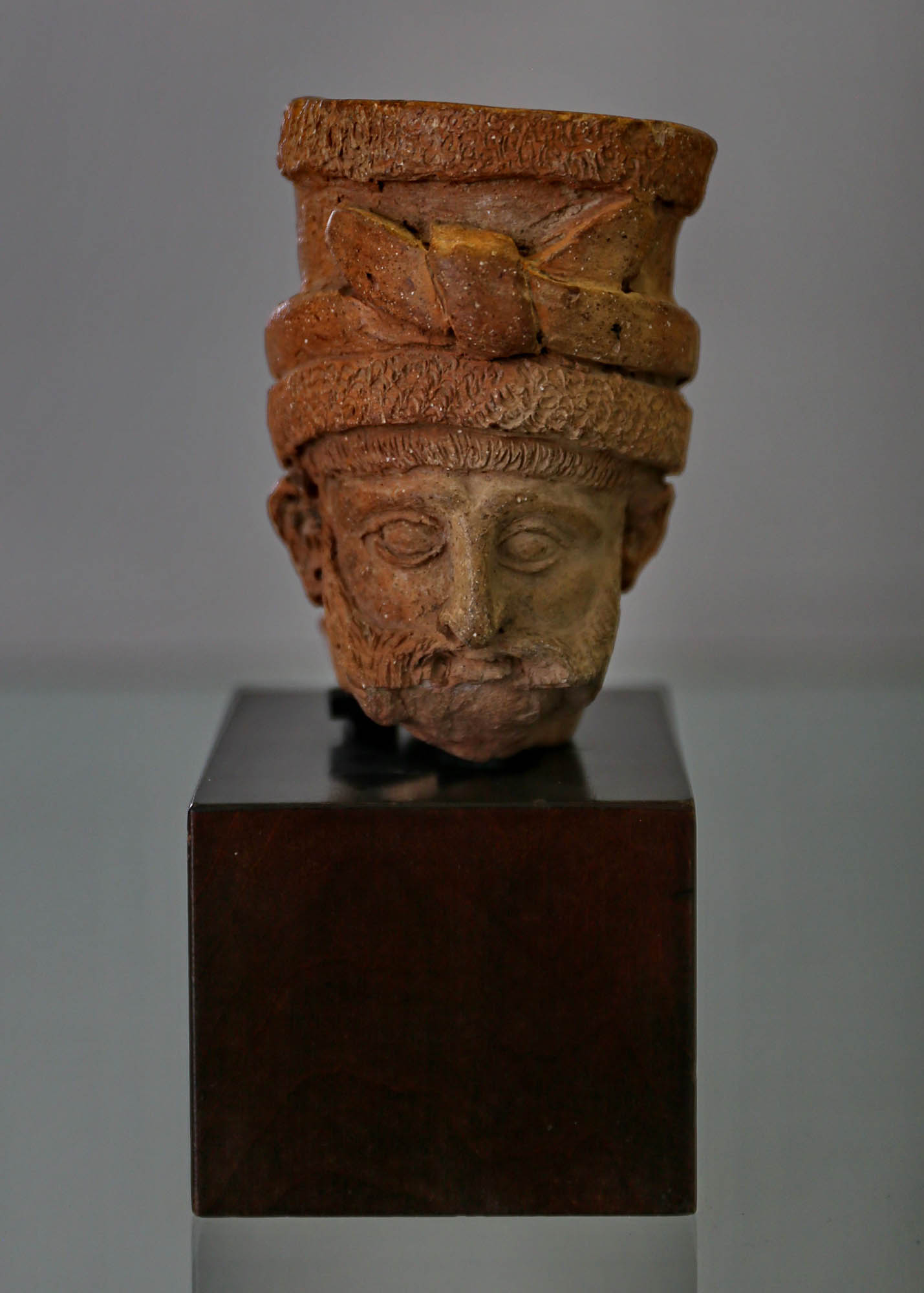
The emotional missing link is provided by this tiny, perhaps fist-sized Persian head from the ancient exhibition at the National Museum in Tehran. With his tiara, he looks like an altertumswissenschaftliche illustration to the poem. But his face, his pensive, inward-looking gaze, his almost invisible delicate smile suggest that he, too, wears a secret brand burned in the soul.
It will take another thousand years for Hafez to write his love poems. The love poetry of Anacreon’s Persian contemporaries was incinerated by the Greeks of Alexander the Great and the Arabs of Caliph Omar. That there must have been such a poetic tradition is attested by the love episodes in the Book of Kings, in which Ferdowsi summarizes in the 10th century, after the Arab devastation and a hiatus of three hundred years, all that was left of ancient Persian poetry. And it is attested, too, by the mysterious facial expression of this little Persian contemporary of Anacreon.


 Come with us to…
 Atlantis
 Bestiary
 Bohemia+Prague
 Books, exhibitions, music, film
 Brave old world
 Caucasus
 Cemeteries
 Crimea
 Get to know the
 Images of the East
 Lightwriting
 Lwów/Lemberg
 Mallorca
 Message on the wall
 The Museum of Propaganda
 Odessa
 Paper Museum
 Persian letters
 The Jewish heritage


