Switch over to our new blog! • ¡Pásese a nuestro nuevo blog!

The renewed version of our blog, with more features, a richer design, and available in nine languages, can be read here: https://wangriver.com

The new version also includes the old posts, often in expanded form. If you are curious about the updated version of this post, replace “riowang.blogspot.com/” in the URL with “riowang.studiolum.com/”, and the new link will most likely lead you there.


La versión renovada de nuestro blog, con más herramientas, un diseño más rico y disponible en nueve idiomas, se puede leer aquí: https://riowang.com

La nueva versión también incluye las publicaciones antiguas, a menudo en una forma ampliada. Si tiene curiosidad por la versión actualizada de esta entrada, sustituya «riowang.blogspot.com/» en la URL por «riowang.studiolum.com/es/», y el nuevo enlace probablemente le llevará allí.

Mostrando entradas con la etiqueta Kaufmann; David. Mostrar todas las entradas

La Memoria del Mundo


La UNESCO puso en marcha en 1997 el Programa de la Memoria del Mundo que, a semejanza del Patrimonio Mundial donde se registran los monumentos que deben preservarse como herencia de la humanidad, recoge aquellos documentos que constituyen nuestra memoria insoslayable y deben ser conservados en archivos y bibliotecas. Esta lista suma 158 entradas, con joyas como las tablillas cuneiformes hititas, la Biblia de Gutenberg, la Colección Linneo o los manuscritos de Chopin.

Acabamos de saber que el comité del Programa de la Memoria del Mundo, en su reunión anual que tuvo lugar hace seis días, añadió treinta y cinco nuevos elementos a su registro. Y que han entrado dos procedentes de Hungría: el legado del fundador de los estudios tibetanos, Alexander Csoma de Körös, que se guarda en la Colección Oriental de la Academia Húngara de Ciencias, y el Appendix (1832) de János Bolyai, que registra el nacimiento de la geometría no euclideana. Es un gran honor para nosotros que la documentación web de ambos ítems fuera preparada por Studiolum a partir de los materiales de la Academia Húngara de Ciencias y en colaboración con los colegas de la Academia, presentándola en húngaro, inglés y español.


Alexander Csoma de Körös salió en 1842 de Calcuta hacia Lhasa buscando las presuntas fuentes históricas de los antiguos húngaros en la biblioteca de los Dalai Lamas. Durante los veinte años anteriores se había preparado concienzudamente para este viaje. Viviendo en los monasterios de los lamas del «Tibet indio» aprendió su lengua y su religión, compuso luego el primero de los diccionarios tibetanos y la primera gramática de esta lengua (1834) y dio una descripción tan detallada de la religión budista y del canon literario, por entonces solo vagamente conocido en Europa, que tras él apenas hubo nada esencial que añadir. Sin embargo, nunca llegó a Lhasa. De camino, enfermó de malaria y murió en Darjeeling.

Antes de abandonar Calcuta, sospechando que quizá no volvería nunca, entregó todos sus libros a su discípulo S. C. Malan, secretario de la Sociedad Asiática de Bengala. Malan los pasó a Tivadar Duka, un médico húngaro que, tras el colapso de la guerra de independencia de Hungría, en 1849, había emigrado a Gran Bretaña y viajado luego a India como oficial médico del Ejército Británico. Allí, impresionado por el destino de su compatriota, fue recogiendo toda la información que pudo sobre él. Escribió la primera biografía en inglés y húngaro de Csoma, y en 1885 donó sus libros a la Academia Húngara de Ciencias. Entre los treinta y seis códices tibetanos de Csoma, los más valiosos son los conocidos como «Libros de Alexander». En ellos los lamas dan detallada respuesta a las preguntas que Csoma les hacía sobre muy variados asuntos –filosofía, religión, medicina, astronomía–. Están escritos en forma de preguntas y respuestas y son documentos excepcionales de uno de los primeros contactos serios entre el pensamiento europeo y el tibetano.

En la documentación web del legado de Csoma publicamos por primera vez el facsímil, la transcripción y la traducción de uno de estos Libros de Alexander, el códice número 4 sobre cosmología budista tibetana, y tenemos intención de continuar más adelante con la publicación de los demás volúmenes. La documentación también incluye una completa biografía de Csoma, la descripción de su legado, la biografía de Duka y sus dos biografías de Csoma, así como una presentación abundantemente ilustrada de la «Colección Tibetana» de la Academia Húngara de Ciencias.


El web dedicado al Appendix de János Bolyai contiene la documentación de la conexión y el legado de dos matemáticos geniales, padre e hijo, Farkas y János Bolyai, compilada con extremo cuidado por Károly Horányi y Béla Mázi, del Departamento de Manuscritos de la LHAS. Las páginas incluyen la biografía más actualizada hasta hoy de János Bolyai, basada en fuentes recién descubiertas y nuevas publicaciones, y ofrece por primera vez facsímiles de cartas relevantes de ambos Bolyai. Se puede ver completo el ejemplar del Appendix conservado en la LHAS, en el que se hallan importantes notas manuscritas añadidas por el propio János Bolyai. La documentación también presenta minuciosamente el material completo de la exposición organizada en 2002 por el 200 aniversario del nacimiento de Bolyai, los avatares de la recepción europea de la geometría no euclideana, así como la historia del Premio Internacional Bolyai, establecido a fines del siglo XIX en memoria del gran investigador.


Y mientras contempláis estas páginas, podéis también dar una vuelta por las otras webs preparadas por Studiolum en colaboración con la Academia Húngara de Ciencias. La exposición de Hongkong sobre el legado fotográfico de las expediciones de Aurel Stein a Asia Central, asunto del que hemos escrito ya en Río Wang. La Exposición Stein, organizada con motivo del centenario del descubrimiento de la famosa gruta biblioteca de Dunhuang. La excepcionalmente rica colección de códices hebreos medievales de Dávid Kaufmann, de quien también hemos dado noticias aquí y aquí. El album amicorum de Franciscus Pariz Papai, que contiene notas autógrafas de personalidades de la talla de Isaac Newton o Edmund Halley. La Corvina del siglo XV, del humanista italiano Ludovicus Carbo, compuesta sobre las gloriosas hazañas de Matías Corvino, rey de Hungría, con el facsímil, su transcripción y traducción. Las páginas dedicadas al conde József Teleki, fundador de la biblioteca de la Academia… Dentro de unos meses publicaremos el legado del gran poeta húngaro Miklós Radnóti, asesinado en 1944. Y esperamos que la serie continúe.

Memory of the World


The UNESCO started in 1997 the Memory of the World Program which, similarly to the World Heritage program registering the world’s built heritage, inscribes in its list the documentary heritage of the world, that is the most valuable archive holdings and library collections. The list contained thus far 158 items, including such treasures like the Hittite cuneiform tablets, the Gutenberg Bible, the Linné Collection or Chopin’s collected manuscripts.

We have just got news that the Committee of the Memory of the World project on its yearly meeting held four days ago has inscribed thirty-five new items in its register. These include two Hungarian ones: the legacy of the founder of Tibetan studies Alexander Csoma of Körös, preserved in the Oriental Collection of the Hungarian Academy of Sciences, and the 1832 Appendix of János Bolyai, which laid the foundations of non-Euclidean geometry. It is a great honor to us that the web documentation of both items were prepared by Studiolum from the materials of the Hungarian Academy of Sciences and in collaboration with the Academy’s colleagues, in Hungarian, English and Spanish version.


Alexander Csoma de Körös in 1842 left Calcutta for Lhasa to look for eventual sources on the history of ancient Hungarians in the library of the Dalai Lamas. In the previous twenty years he had been preparing for this journey. Living in the lama monasteries of “Indian Tibet”, he learned Tibetan language and religion, composed and published the very first Tibetan dictionary and grammar (1834), and gave such a detailed description of Buddhist religion and literary canon, at that time only vaguely known in Europe, that after him no essential could be added. However, he never reached Lhasa. On the way he caught malaria and died in Darjeeling.

Before leaving Calcutta, as if he knew that he would never come back, he gave all his books to his pupil S. C. Malan, secretary of the Asiatic Society of Bengal. Malan gave over the books to Tivadar Duka, a Hungarian physician who after the collapse of the Hungarian war of independence in 1849 emigrated to Britain and later worked in India as a medical officer of the British army. Here he was intrigued by the fate of his compatriot and he collected all available information on him. He composed Csoma’s first biography in English and Hungarian, and in 1885 he donated Csoma’s books to the Hungarian Academy of Sciences. Among Csoma’s thirty-six Tibetan codexes the most valuable ones are the so-called “Alexander Books” that received their name after Alexander Csoma de Körös. These volumes, in which the lamas give detailed answer to the questions raised by Csoma on various topics – philosophy, religion, medicine, astronomy – in question-and-answer form, are exceptional documents of the encounter of European and Tibetan thought.

In the web documentation of Csoma’s legacy we publish for the first time the facsimile, transcription and translation of an Alexander Book, the codex number 4 on Tibetan Buddhist cosmology, and we want to go on with the publication of the other volumes as well. The documentation also includes a detailed biography of Csoma, the description of his legacy, the biography of Duka and his both monographies on Csoma, as well as a lavishly illustrated description of the Tibetan Collection of the Hungarian Academy of Sciences.


The site dedicated to the Appendix of János Bolyai is also a detailed documentation of the connection and legacy of the two genial mathematicians, father and son, Farkas and János Bolyai, compiled with extreme care by Károly Horányi and Béla Mázi in the Manuscript Department of the LHAS. The site includes the hitherto most up-to-date biography of János Bolyai, based on recently discovered sources and new publications, and it publishes for the first time the facsimiles of some important letters by the two Bolyais. It publishes in its entirety the copy of the Appendix preserved in the LHAS, in which further important handwritten notes were added by János Bolyai himself. The documentation also presents in detail the complete material of the exhibition organized in 2002 for the 200th anniversary of Bolyai’s birth, the adventures of the Europen reception of non-Euclidean geometry, as well as the history of the International Bolyai Prize established at the turn of the 19th-20th century in memory of the great scholar.


And while you are there, go to see also the other sites prepared by Studiolum in collaboration with the Library of the Hungarian Academy of Sciences. The Hongkong exhibition of the photo legacy of the Central Asian expeditions of Aurel Stein, of which we have also written here in Río Wang. The Stein exhibition organized on the centenary of the discovery of the famous Dunhuang library cave. The exceptionally rich medieval Hebrew codex collection of Dávid Kaufmann, of which we have also given news here and here. The 18th-century album amicorum of Franciscus Pariz Papai including handwritten notes by such notabilities as Isaac Newton or Edmund Halley. The 15th-century Corvina by the Italian humanist Ludovicus Carbo composed on the glorious deeds of Matthias Corvin, King of Hungary, with facsimile, transcription and translation. The site dedicated to Count József Teleki, founder of the Library of the Academy. Within some months we will also publish the legacy of the great Hungarian poet Miklós Radnóti, killed in 1944. And the series will hopefully continue.


Totum devicerat orbem

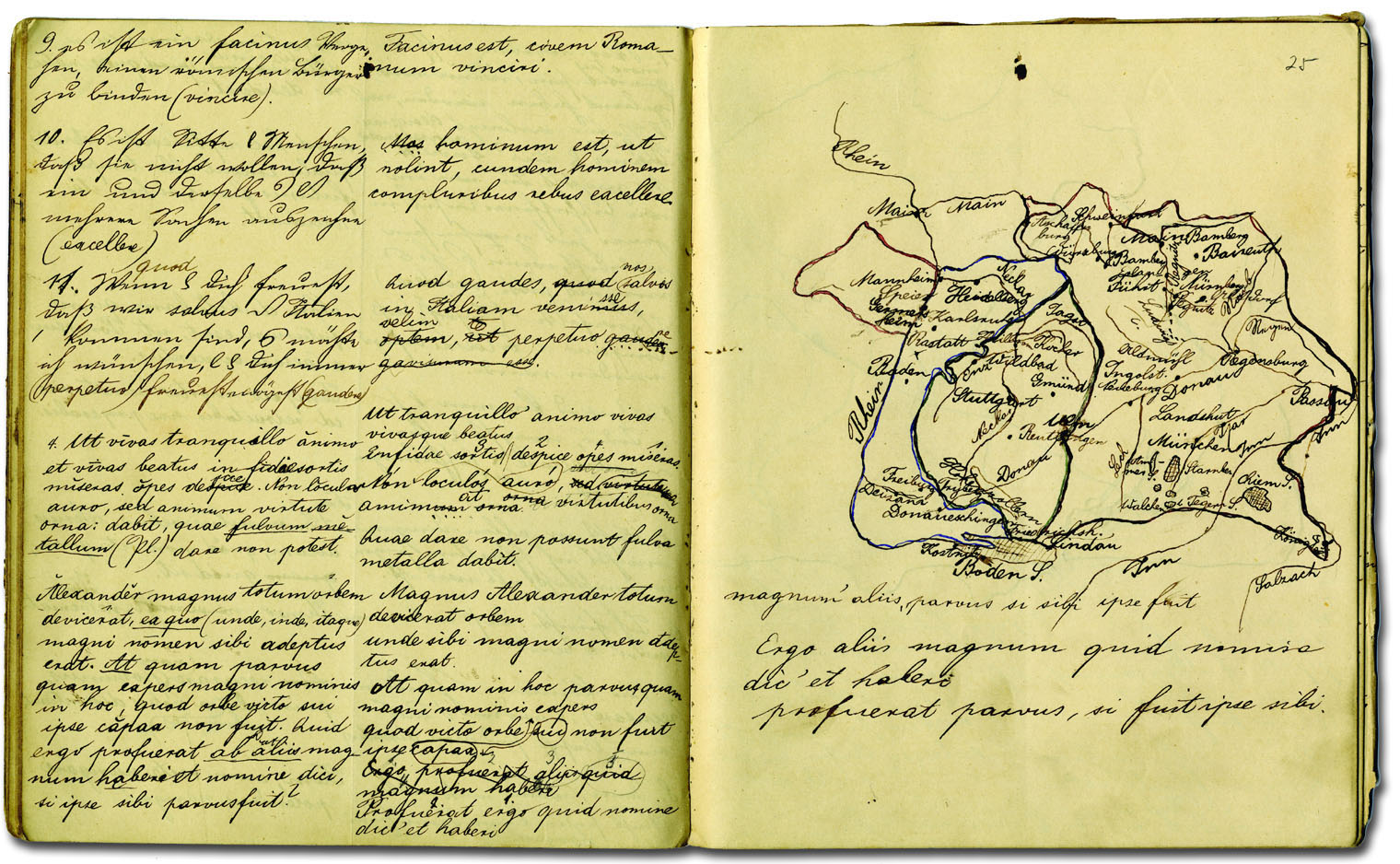
Exercise-book of Aurél Stein from the Dresden Kreuzschule, 1876
The exercise-book of fourteen-year old Aurél Stein from his Dresden school years was opened at these two pages on the Hong Kong exhibition, organized in this March-May by the Oriental Collection of the Hungarian Academy of Sciences to illustrate with manuscripts and photos from the Stein legacy his path of life from his native house in front of the Academy through the Silk Road to the cemetery of Kabul.

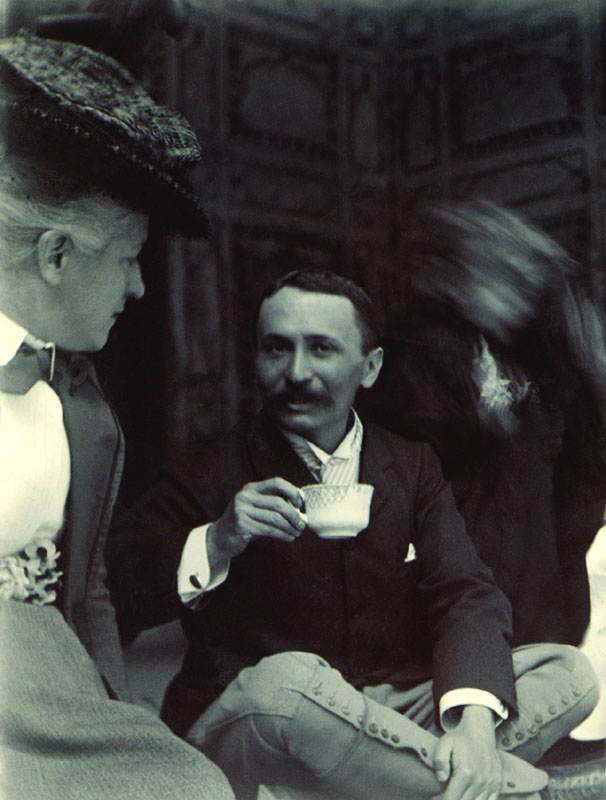
Aurél Stein drinking tea in India
It is not clear to which subject this exercise-book belonged, for it includes everything together, just like his later life, from cartography through languages to philological analysis. He failed to learn the lesson of the Ancient wisdom he even noted here in Latin and German. No wonder he did not receive the so much sought-for high school teachership in Kolozsvár, nor any other position in Hungary, never.

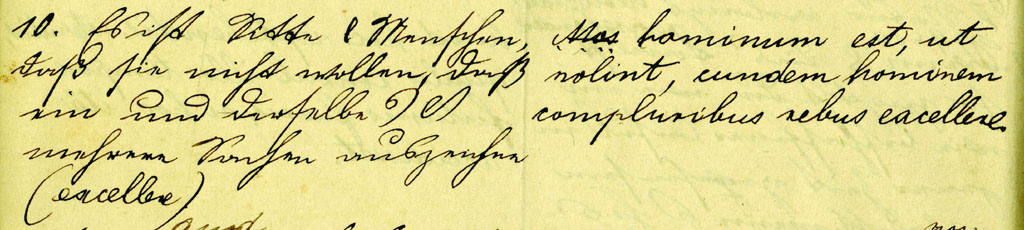
Exercise-book of Aurél Stein from the Dresden Kreuzschule, 1876, detailMos hominum est, ut nolint, eundem hominem compluribus rebus excellere.
It is customary of people that they do not like when one excels in more than one thing.


To the right, the sketch of the regions of Bavaria, Württemberg and Baden. The tracing is still uncertain, but the geographical structure is clearly built. To the left, Latin syntactical exercises, above with German translation and below with analyses of syntax and prosody.

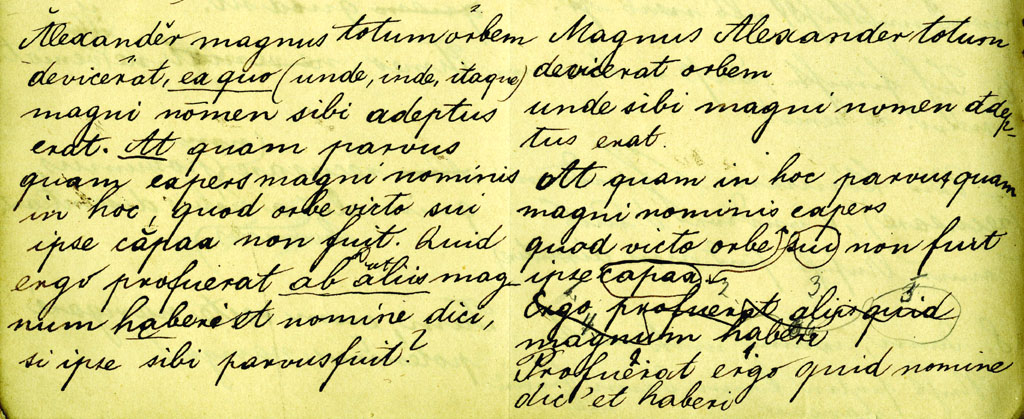
Exercise-book of Aurél Stein from the Dresden Kreuzschule, 1876, detailMagnus Alexander totum devicerat orbem
unde sibi magni nomen adeptus erat.

Alexander the Great conquered the whole world
thus seizing a great name for himself.


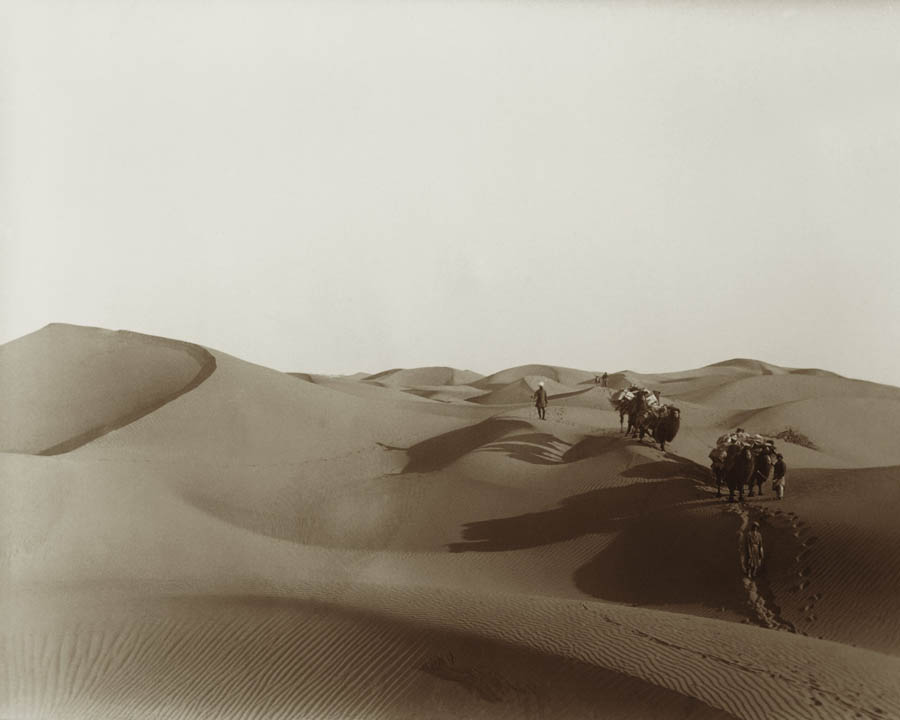
He has before him yet the Indian and Iranian studies in Vienna, Leipzig and Tübingen, the post-doctoral years in London, Cambridge and Oxford, the discoveries in India, Turkestan and Persia. He does not know yet that he will seize a great name for himself by walking through the Silk Road from China to Syria and by reconstructing for the first time the world-conquering path of Alexander the Great.

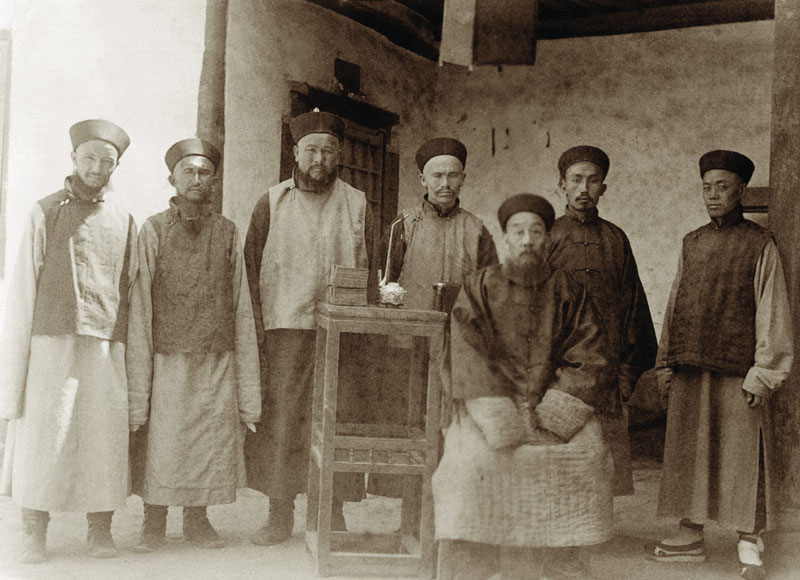
Photo of Aurél Stein on the Silk Road: Pan Zhen with attendants
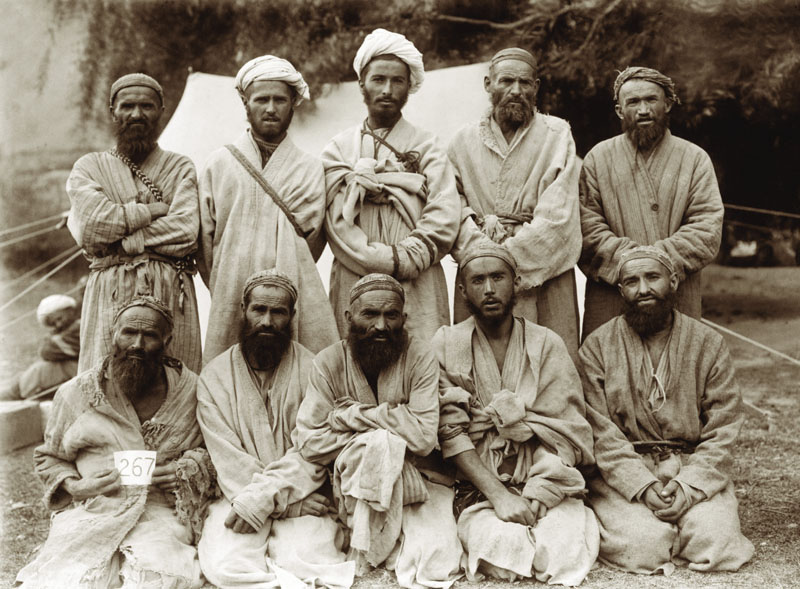
Photo of Aurél Stein on the Silk Road: Yazgulamis anthropometrically examined at Rokhar
In Studiolum we have just completed the four languages – English, Spanish, Chinese and Hungarian – web catalog of the Hong Kong exhibition. We have just uploaded it on the server of the Hungarian Academy: http://stein.mtak.hu/index-en.html. The day after tomorrow, on November 12, at 14 o’clock it will be solemnly presented to the Hungarian scholarly public at the Academy, together with the web edition of the medieval Hebrew Kaufmann Codices. The two collections will be introduced by professor and head of the department of Ancient history Gyula Wojtilla, and by chief rabbi Tamás Raj, respectively. After them, we will demonstrate the secrets of the web edition. Coffee and cakes will be provided by our host. All our readers are welcome.

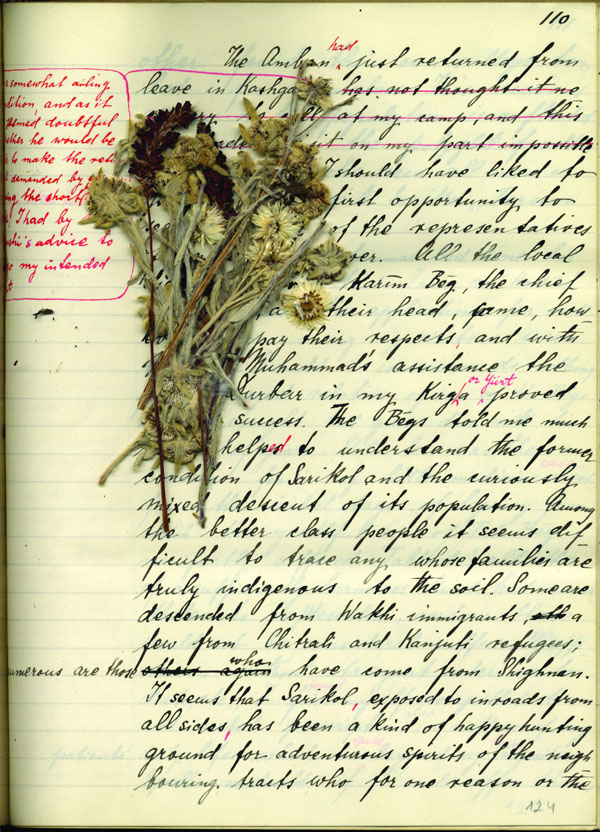
The Khotan manuscript of Aurél Stein with flower

Library opening

The Lion of Judah stealing a lamb
A while ago we discovered in the figure of King David, lifting his goblet for blessing in the 14th-century Catalan Haggadah, the owner of the codex Dávid Kaufmann, who expressed in an apocryphal “Psalm of David” his joy of the acquisition of the most ancient – 10th century Palestinian – manuscript of the Mishnah. This is why we chose that image as the emblem of the electronic library of the Kaufmann Codices. But we prefer to see the great collector of ancient Hebrew books also in another symbol of King David, in the lion of Judah who is just stowing away in safety a recent gorgeous finding from the competition in the marginal decoration of a 13th-century Mishneh Torah.

On – very rare – occasions, however, even Dávid Kaufmann was let down by his good luck. It was a close shave that one of the most important Jewish manuscript findings, the one hundred and forty thousand fragments that had been accumulated for a thousand years in the genizah of the synagogue of Cairo, did not get to him – and then, through him, to the Hungarian Academy of Sciences – but to the University of Cambridge. Through his network of agents covering all the Mediterraneum, Kaufmann had learned about this material, even more important than the scrolls of the Dead Sea, much earlier than the fantastic Scottish twin sisters, Agnes and Margaret Smith, scholars of many Biblical languages and discoverers of several manuscripts, who in 1896 discovered the collection following the traces of some fragments found on the Cairo market, and then bought it in its entirety. However, at this time Kaufmann was already bargaining over the material, and in 1894 he even received a sample of five hundred pieces of it. Today only this much is in the possession of the Academy. Nevertheless, he bore the news of the Cambridge purchase like a man, and later he even remarked that the manuscripts are in a better place there. What’s more, he also participated in their scholarly description. Incidentally, it is interesting that the family of Salomon Dov Goitein who published the complete material in six volumes, came from the same Moravian town of Kojetein like that of Kaufmann. This aroused our curiosity in this town, whose subsisting Medieval Jewish quartier we will soon visit and report about it.

The Kaufmann Collection, including six hundred codices and more than a thousand printed books besides the genizah fragments, is even so among the most important ones in the world, and we in Studiolum are proud to be the first to publish it on the internet, on behalf of the Oriental Collection of the Hungarian Academy. We have just completed the first version of the electronic library – or rather bookshelf yet – containing the five most important codices of the collection: the above mentioned 10th-century Palestinian Mishnah, the starting point of all Mishnah editions, the French Mishneh Torah of 1296, the summary of Jewish law in four volumes, two Southern Germanian Mahzor from the age of Dante with all the prayers of the year, and the most beautiful piece of the collection, the lavishly illustrated 14th-century Catalonian Haggadah, the ritual of the Passover night. But, scanned from a black and white microfilm, we will also include one of the most painful losses of the collection, the 15th-century Renaissance codex of the Siddur of Pesaro, stolen in the ’80s together with some other books on an Israelian order. Since the Academy managed to claim back in court one of the stolen books from an auction of Israel, this codex is latent somewhere together with the rest.

Until the official presentation in November the library will receive some final touches, we will include a bibliography and an iconographic index, some additions and corrections, or maybe even more codices. However, the readers of our blog can enter already now by presenting a copy of this entry. Go ahead, go ahead, come in, look around, and make your bettering comments.

Meshiakh ben Dovid zitst oybn on

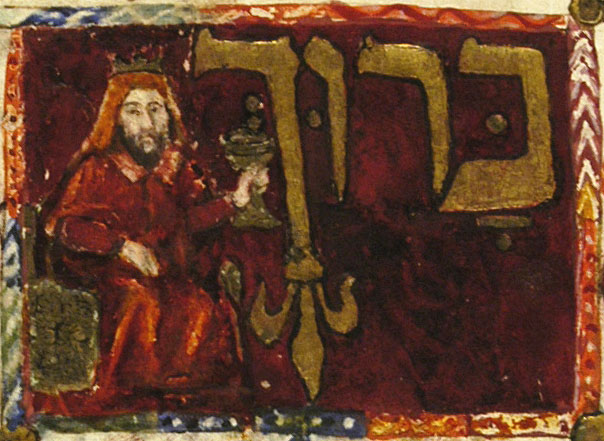
Kaufmann Haggadah (Budapest, Hungarian Academy of Sciences, Oriental Collection), King David saying a blessing
This illuminated initial letter of the so-called Kaufmann Haggadah, copied in Catalonia in the 14th century represents a king raising his goblet to say a blessing: BRWK, that is Baruk Adonai, Blessed be the Lord. The king is in all probability David, for in the haggadah resuming the liturgy of Seder Night this image follows Psalm 113 of David:

Praise the Lord!
Praise the name of the Lord!
Let the name of the Lord be praised both now and for evermore!
From the risig of the sun to the place where it sets, the name of the Lord is to be praised!
The Lord is exalted over all the nations,
his glory above the heavens.

The Bohemian David Kaufmann (1852-1899) won at a competition the first professor’s chair of the College of Rabbinical Studies of Budapest founded in 1877. He soon learned perfect Hungarian too, as foreseen by the requirements of his new position, and later he left his precious collection of medieval Hebrew manuscripts to the Hungarian Academy of Sciences. We are just working on their web edition with Studiolum.

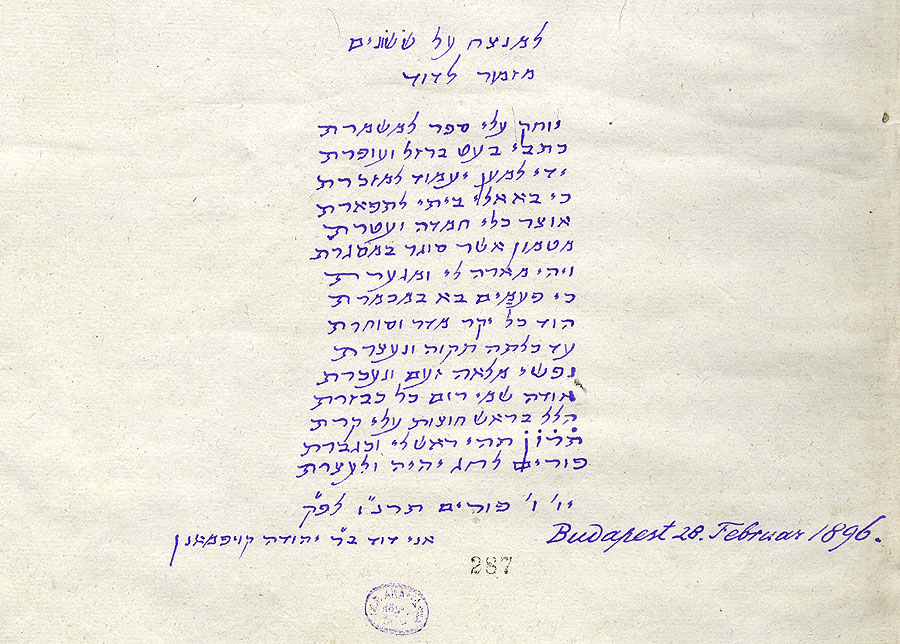
We have selected this blessing initial from the most famous manuscript of the collection as the emblem of our edition. For David Kaufmann himself became identical with King David for a moment when, out of exuberant joy felt over the purchase of the most ancient – 10th-century Palestinian - manuscript of the Mishnah, he wrote his own thanksgiving poem on the inner endpaper of the manuscript with the title “Psalm of David”.

Kaufmann Mishnah (Budapest, Hungarian Academy of Sciences), “Psalm of David” written by David Kaufmann out of joy at the purchase of this precious 10th-century Palestinian manuscript
This representation of King David seen exactly in the eschatological light of Seder Night also foresees the figure of the Messiah, as he is described in this beautiful Hassidic song:
A string of pearls, a golden banner
The Messiah, son of David sits on high
Holding a goblet in his right hand
Making a blessing on the whole land.
Amen and amen, this is sure:
The Messiah will come this year.

If he comes by chariot,
There will be good years.
If he comes on horseback,
There will be good times.
If he comes on foot,
The Jews will go into the Land of Israel.
Shnirele perele, gildene fon
Meshiakh ben Dovid zitst oybn on
Er halt a bekher in der rekhter hant,
Makht a brokhe afn gantsn land.
Omeyn veomeyn, dos iz vor,
Meshiakh vet kumen hayntiks yor.

Vet er kumen tsu forn,
Veln zayn gute yorn.
Vet er kumen tsu raytn,
Veln zayn gute tsaytn.
Vet er kumen tsu geyn,
Veln di yidn in erets yisroyl aynshteyn.

Kata recounts that when the Klezmatics at the very end of the 80’s – among the first signs of the political opening of Hungary – gave a concert in Budapest, and they had been frolicking throughout all the night with such modern klezmers like


Klezmatics: Man in a Hat (3'03") (From the disk Jews with Horns)

at the very end they suddenly stopped short, and then silently started this song: The Messiah will come this year.


Klezmatics: Shnirele perele (6'11") (From the disk Rhythm & Jews)

The public of the concert – secularized Jews of the second and third generation – listened to them in a dumbfounded silence.