
  |
 The 120 woodcuts that make up the volume of Les songes drolatiques de Pantagruel appeared without almost any text in 1565. But the short and somewhat babbling preface by the printer, Richard Breton even so reveals everything that can be told about this curious collection of prints. It starts with a lie, but the syntax soon betrays the bad conscience of the author who cannot stay on the edge of half-truths. However much Breton assures us, with reference to their old friendship, these pictures are surely not by the hand of the already famous François Rabelais (1494-1553) who died twelve years earlier. True, only a year had passed since the publication of the popular posthumous addition of Pantagruel (Le Cinquième et dernier livre des faits et dits heroïques du bon Pantagruel) whose Rabelaisian paternity was much discussed over time, but now it seems definitely accepted. And it is also true that at that time already a whole publishing industry was built on the name of Rabelais. Nevertheless, all this should not have necessarily led Richard Breton into temptation. But we also have to admit that this pious fraud, which is really consistent with the work of Rabelais, gives an attractive upbeat to this striking series of pictures. He wrote this in the dedication Au lecteur salut:
The great familiarity I had with the late François Rabelais (dear Reader), has moved and even compelled me to bring to light the last of his work, the drolatic dreams of the very excellent and wonderful Patagruel, a man very famous for his heroic deeds on which the more than veritable histories write awesome things. This was the main reason that I, wanting to avoid prolixity, did not want to add any comment apart from emphasizing that these are the most curious pictures that can be found in the whole world, and I do not think that Panurge would have ever seen or known more admirable ones in the countries visited during his last voyages. As to a detailed description of the properties and essence of these figures, I leave this work to those who are more versed in this faculty and more capable than I am, as well as the explanation of their mystical and allegoric meaning, and their provision with the names most fitting to them. Similarly, I have not seen it fitting to add a long recommendation before this work: may they do it who want to spread their fame all over the world, because as the proverb says, the good wine needs no bush. Nor have I wanted to entertain myself in finding out the author’s intentions, both as they are uncertain to me, and because of the great difficulty to reach the rather lunatic thoughts of such great geniuses. Nevertheless I hope that many people will be satisfied with the present little work, because who are of a dreaming nature will find here enough matter to their dreams, the melancholic will find what to cheer him and the merry to laugh, due to the great variety to be found in it. And I also ask all of them to accept this in a good soul, assuring them that by giving this work to light I had no intention to insult or to scandalize anyone, but only to offer it as a pastime for the youth. I also add that open intellects will find several good inventions in it for preparing extravagances, organizing masquerades, or to apply them as the occasion requires. This is in truth the reason that has led me to avoid this little work being lost, and I beg you to accept it just as willingly as I offer it.

The Parisian printer Richard Breton, died in 1571, closely related to the German book market, and to whom the spreading of Protestant text would later cause serious headache, had published in 1562 a Recueil de la diversité des habits qui sont de present en usage, tant es pays d’Europe, Asie, Affrique et Isles Sauvages, Le tout fait apres le naturel, illustrating the immense human variety of outfits, dresses and fashions. The hundred woodcuts show with a great fantasy the fanciful ways of dressing all over the world, also making distinction between social classes, and paying great attention to exotic curiosities. Each plate of the book is accompanied by an explanatory quatrain. The authorship of this book is not indicated either, only the dedication was signed by a certain François Desprez (albeit with the thinly veiled anagram of “Deserpz”).
 Some woodcuts of the Recueil de la diversité des habits
The affinity between the design and style of the woodcuts, the imaginative presence of some monstrous figures, as well as the sustained collaboration between Breton and Desprez leaves no doubt about the responsibility of the latter for the Drolatic dreams of Pantagruel. We know that Desprez was a good craftsman, but he was surely no “intellectual” and even less an “author”. His job was the design of fillets for prints and ornamental decorations, and his mind and hand were accustomed to this task. However, he was obviously not satisfied with mere ornamental design, and occasionally he also made an excursion into the world of book design.
 Desprez clearly perceived that printing industry, for the first time in its history, launched the mass production of all kinds of images, producing illustrated books which every day reached a wider public. He was himself a collector of the images he saw in books of emblems and imprese, scientific and travel books, bestiaries or the less accessible “libri di arte”, and for whose appreciation he did not have to be an educated humanist. The collection of such works was very widespread in this period, especially among craftsmen and artists who sought inspiration in them for their work. Thanks to printing, a large encyclopedia of images was being created from the mid-16th century, and Desprez obviously might have asked himself why not to contribute, as a designer of ornaments and grotteschi, to this ever growing corpus. Although he could not compete with the symbolic density of emblems, neither with the dialectic application of the erudition of ancient culture, but he discovered a demand for his own speciality, the popular air, mockery and laugh. And it was just obvious to make his ware more profitable through the use of the greatest specialist of these, Rabelais.
 A passage in Richard Breton’s dedication almost inadvertently betrays this intention, emphasizing the same point that we read in several other dedications of the period: the utility of the illustrations of the book. Among them, he writes, “the open intellects will find several good inventions for preparing extravagances, organizing masquerades, or to apply them as the occasion requires.” From Pierio Valeriano’s commented hieroglyphs through Hans Holbein’s The Images of the Old Testament (published by us in Spanish) to a great part of emblm books, from the Jesuit Claude-François Menestrier’s guide to compose “symbolic images” through Filippo Picinelli’s Mundus symbolicus to the antique coin collections by Erizzo, Vico and others, and of course to Cesare Ripa’s great compendium of allegories, the Iconologia (translated by us to Hungarian), all emphasize the same idea. This latter treatise, for example, announces already in its title: “A not less useful than necessary work for poets, painters, sculptors, designers and others to represent human virtues and vices, passions and affections and to compose concepts, emblems and decorations for weddings, funerals and dramatic plays”. He considered that Desprez’s more humble woodcuts would be serve principally for masquerades, but he was not averse to anything “required by the occasion”.
 On the other hand Desprez, by his training and by his work also knew that these incongruous figures that he was proposing to the editor (or were they commissioned by the clever Breton?) were not born from nothing, but were rooted in a burlesque and satiric tradition, in the metamorphosis of the carnival, the transgressive visions of madness. They had been present in medieval architecture, the carvings of stalls and capitals, between the ornaments of tapestries, and of course on the borders of manuscripts, the drôleries. All these sources which nowadays pass rather unnoticed as secondary or decorative arts, offered to the avid eyes of Desprez a feast of images, where the figurative and the ornamental, intertwining each other, created a multitude of unusual, whimsical or shocking forms. The most learned and noble representative of this art was Pieter Brueghel (1525-1569), whose engravings were widely disseminated in France of those years, and who was also a direct inspiration for Desprez. But a first glance at these pictures also immediately calls to mind The Garden of Earthly Delights, The Hay Wain and other paintings by Hyeronimus Bosch (1450-1516). The basic genealogy of these images is therefore traced quite clearly.
 The title of the book includes an adjective (drolatique) which seems to appear here for the first time in French. Drôle means “funny, curious”, and this is the origin of the term drôlerie used by modern art history for the ornamental fantasies on the borders of medieval manuscripts or architectural decorations. Drôlerie is thus related to grottesco, but they are distinguished by the classical origins of the latter as contrasted to the medieval roots of the former. In late 16th-century France the meaning of drôlerie also included those satyrical – and often grotesque – figures which since the beginning of the wars of religion flooded the press, as well as the animal-shaped masks and costumes. Its etymological origin, the Dutch drol (gnome) carries in itself the ambivalence of a being which on the one hand is funny and simple, while on the other hand murky, tangled and even with a shade of malignancy. Some centuries later, in 1830 it was Balzac to use again this term when he chose the title Les contes drolatiques for a series of unlikely medieval stories which gave him occasion to an uninhibited, at times rough, or even obscene narrative, and whose fifth edition in 1855, five years after Balzac’s death, was decorated with 425 fantastic illustrations and vignettes by Gustave Doré.
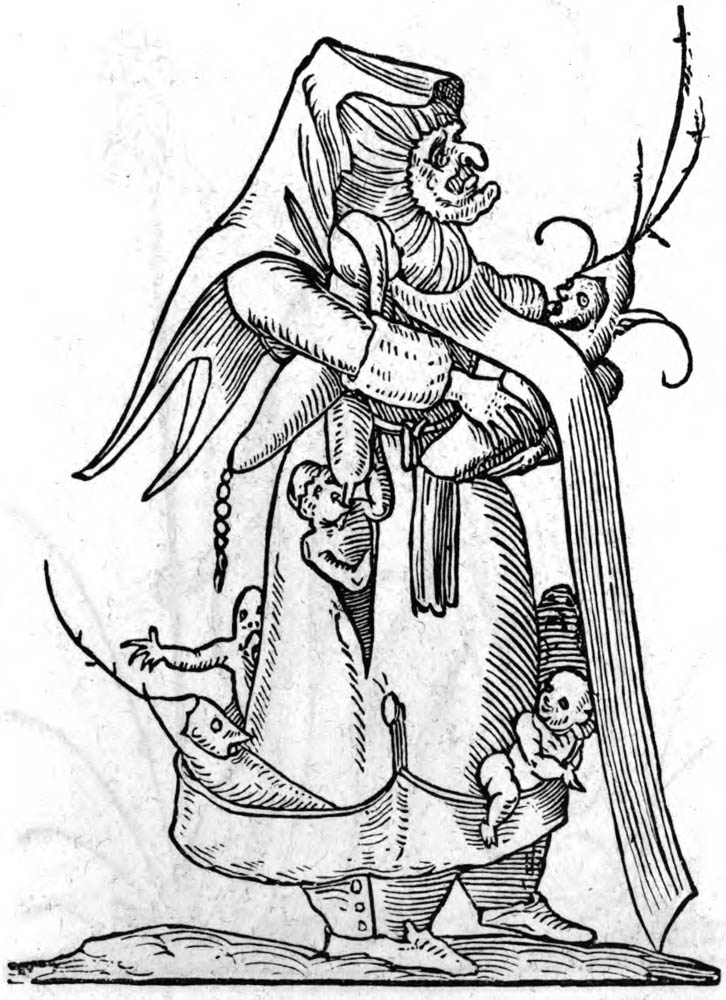 “Drolatic” is an adjective of “dream” in the title, and we must ask what kind of dream is this. It is certainly the dream of reason, as it gives birth to monsters. And also a dream of revelation through which we acquire a knowledge impossible in wakefulness. That dreams (especially by virtue of the vis imaginativa during the conception and pregnancy) can literally give birth to monsters, was well known by contemporary authors of treatises.
Nothing derogatory is then in the use of “dream” in the title, nothing that would diminish the seriousness of the artistic purpose. On the contrary, this dream reveals us a reality which is hidden by daytime appearances, and which escapes the constraints of socially correct discourse, language and logic. This dream offers us a glimpse into the continuous flow of the unexpected associations between the objects and the elements of the language, into a deeper layer of reality which makes more complete our understanding of the world.
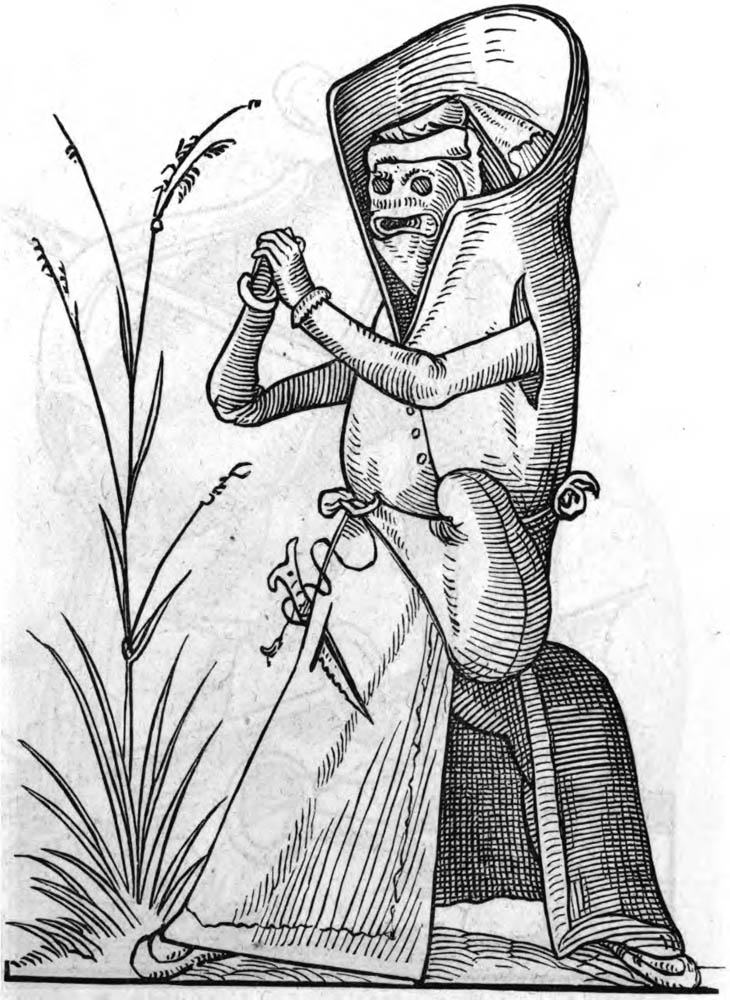
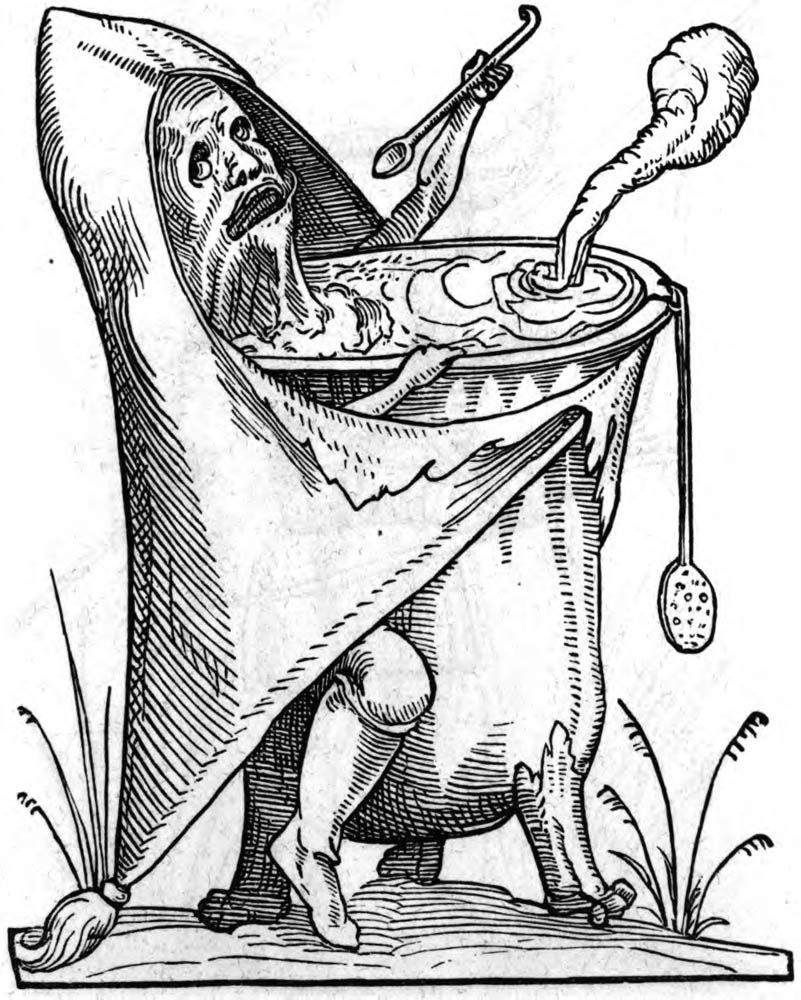
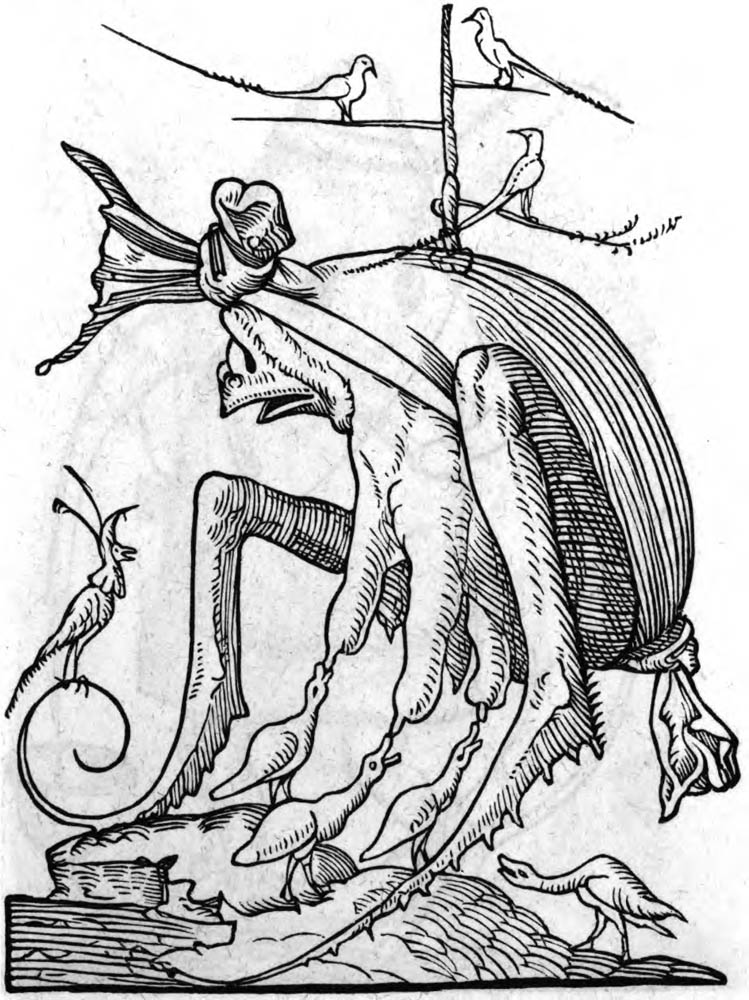 It was with a similar intention and rhetorical use that Francisco de Quevedo gave the title Sueños to his poems written between 1606 and 1623, although among his work it is perhaps La hora de todos y la Fortuna con seso which would fit the best the woodcuts of Desprez. It is enough to read besides woodcut number 32 the tenth fragment of La hora de todos, or the following sonnet criticizing a woman wearing a fashionable crinoline.
| Si eres campana, ¿dónde está el badajo? Si pirámide andante, vete a Egito. Si peonza al revés, trae sobrescrito, si pan de azúcar, en Motril te encajo. Si capitel, ¿qué haces aquí abajo? Si de disciplinante mal contrito eres el cucurucho y el delito, llámente los cipreses arrendajo. Si eres punzón, ¿por qué el estuche dejas? Si cubilete, saca el testimonio. Si eres coroza, encájate en las viejas. Si buïda visión de San Antonio, llámate Doña Embudo con guedejas. Si mujer, da esas faldas al demonio. | If you’re a bell, where’s the clapper? If a walking pyramid, get thee to Egypt; If an overturned top, find a label; If a Hershey’s kiss, you need some foil. If a turret, why are you down here? If an unrepentant penitent’s, then you’re his hood and his crime; you’re a mockingbird in a cypress tree. If you’re a plunger, where’s the toilet? If a goblet, then let’s have a toast; If a dunce cap, then clothe the stupid. If a pointy vision of Saint Anthony, your name is Lady Funnel with a mane: If a woman, go to Hell with these petticoats. |
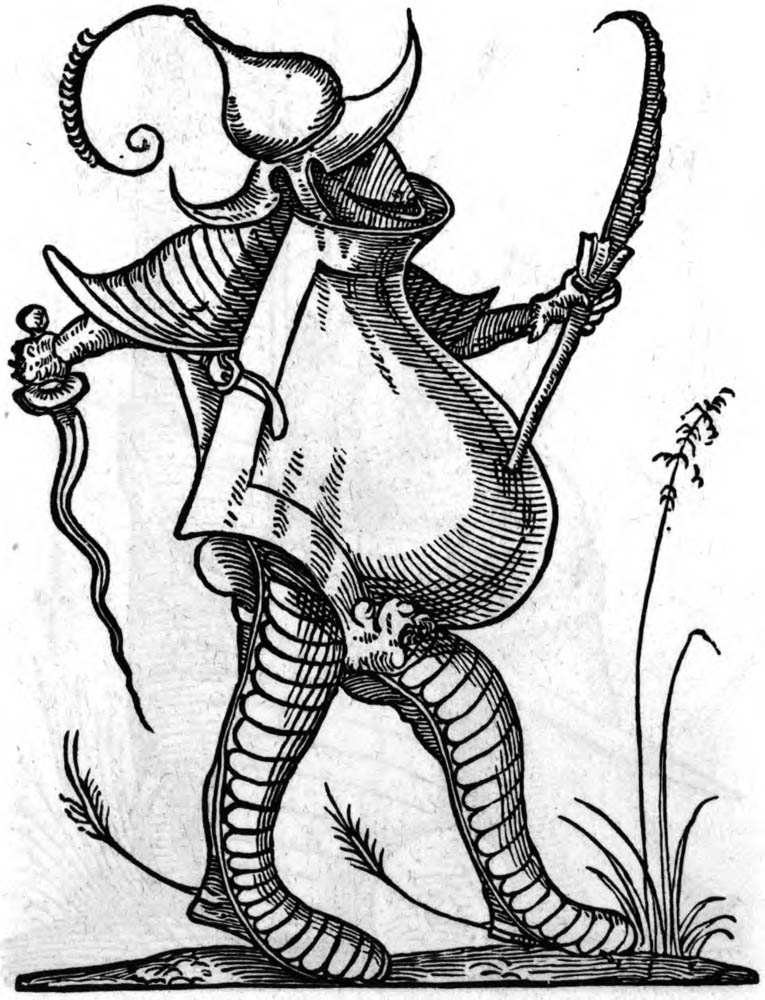
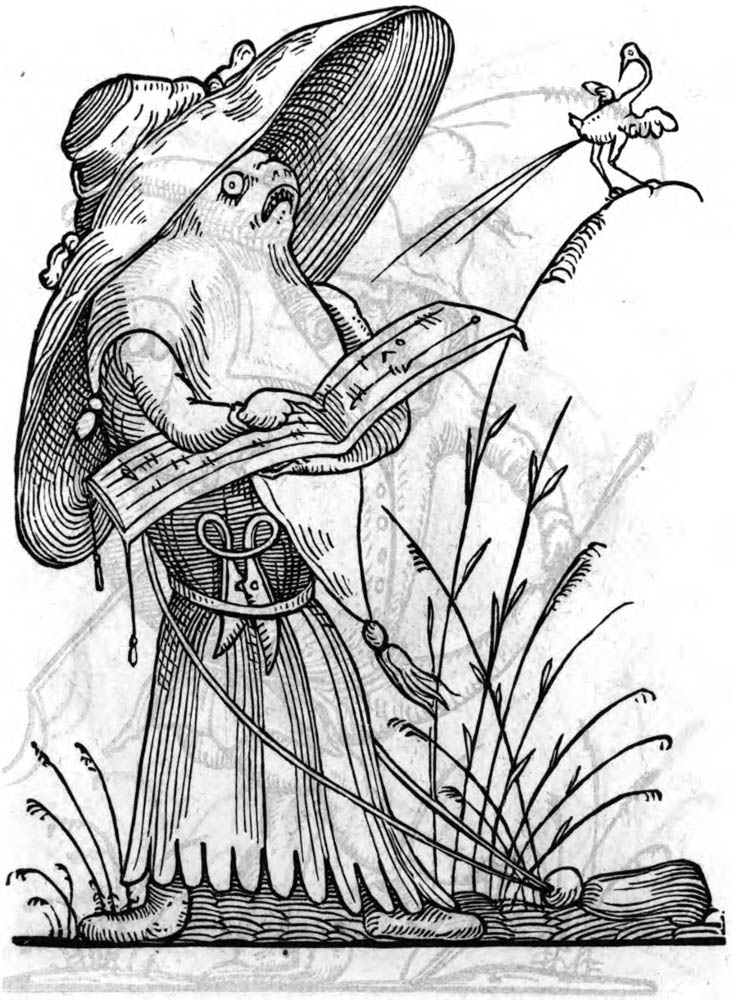
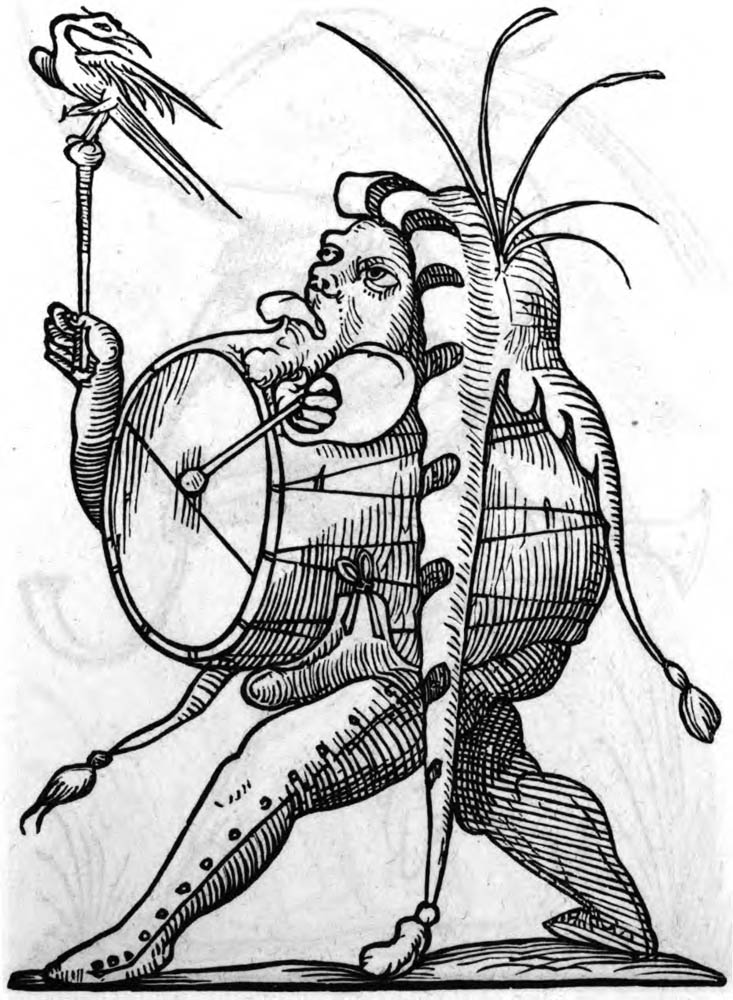
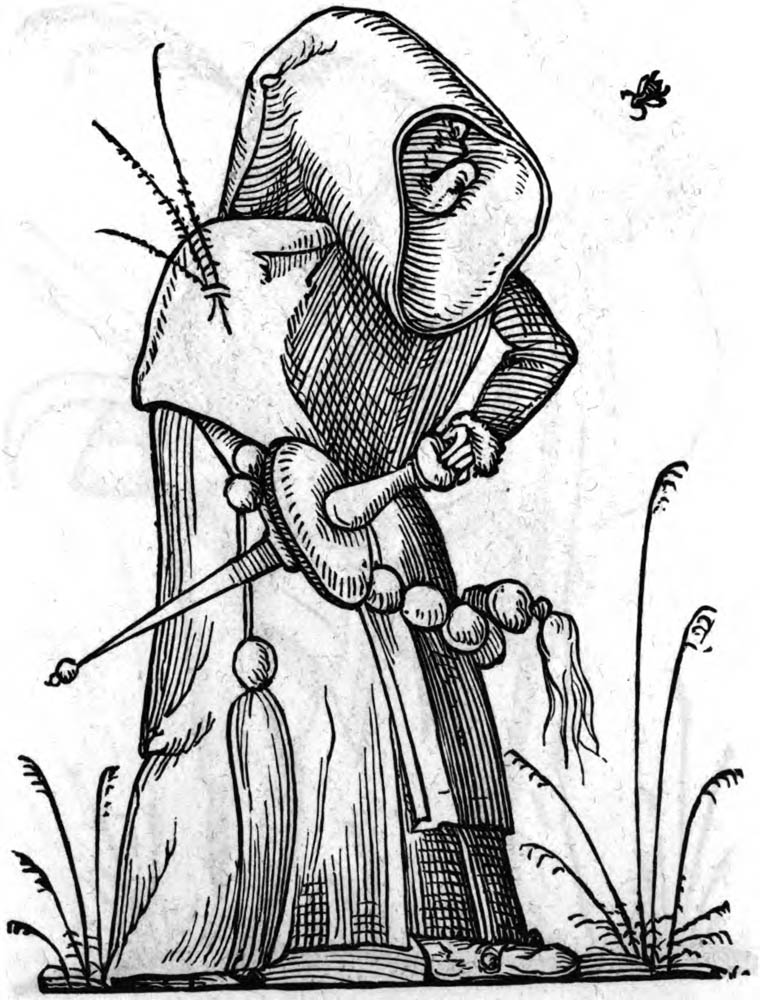
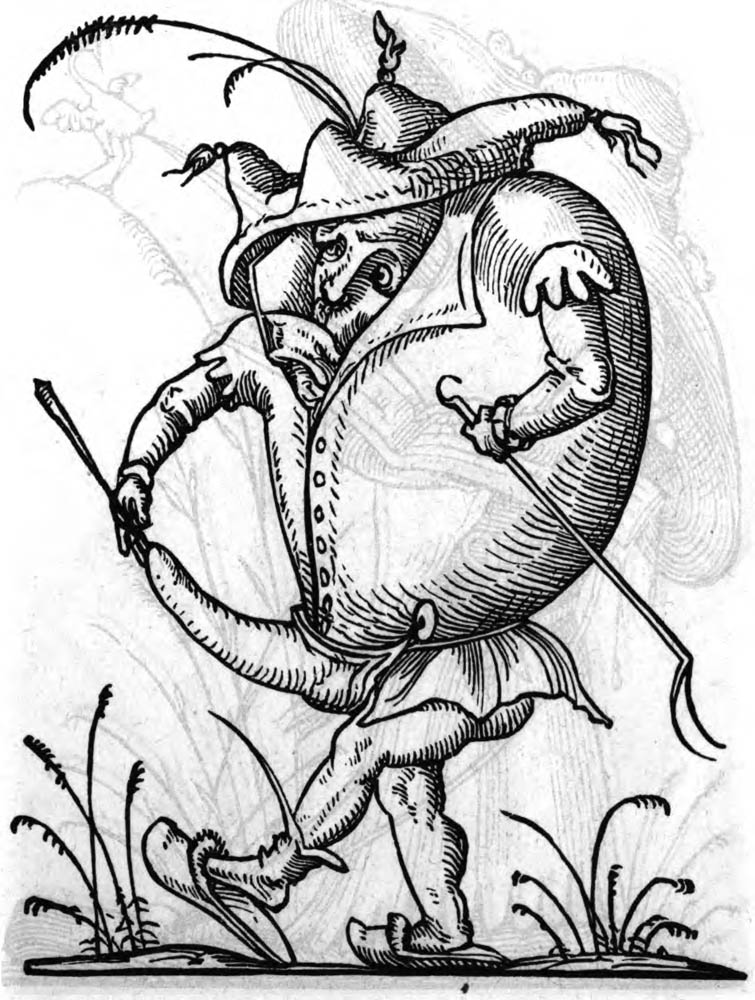
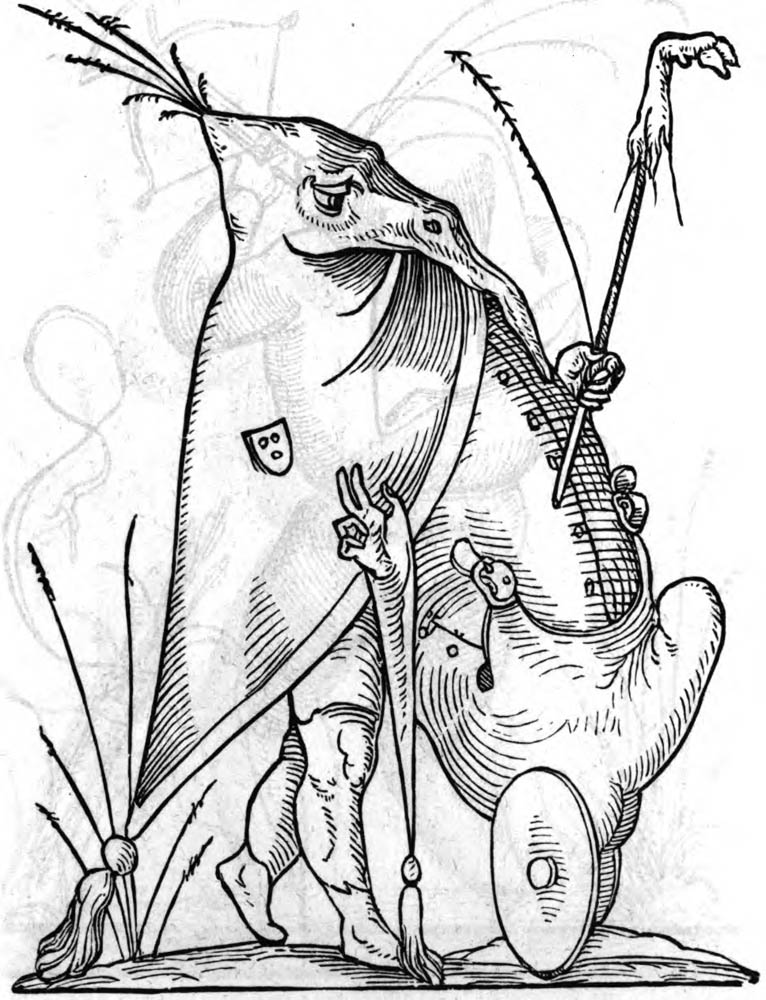
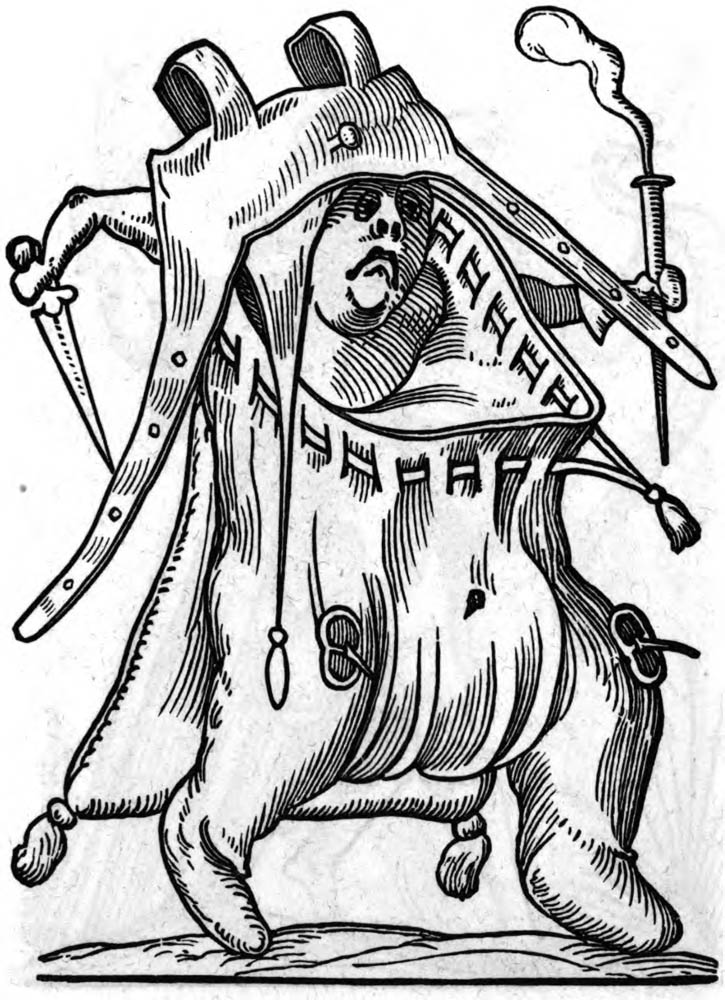 The language itself is stretching the borders of objects towards an anamorphosis which reveals the most hidden secrets and shames. In these pictures the “world upside down” of the carnival is accompanied by the juxtaposition of the contraries, and traditionally both belong to the safest way of soliciting laughter. And just at this point the deepest seriousness of these drolatic dreams is revealed. Let us look into the faces of these figures. Many are deeply expressionless, and most are serious, even angry. Some are depressed, and some sorrowful. Even those laughing do it bitterly, or at most smile slyly. Virtually all of these characters carry their inconsistency as an unbearable sentence. Quite a few hide their face or even lack it, and their most human part is replaced by an object, a cube, a jug, a motley, a shoe, a helmet which imprison them and leave them brainless. These bodies are radically uncomfortable in their uncertainty, with spectacularly self-destructive tendencies, as if only suicide or autophagy could get them out of their tortured bodies. Almost all are armed, and a more or less repressed violence runs through the pages. This uncertainty of species does not fit the venerable notion, so dear to the Humanism and Baroque, the Great Chain of Being, where man is on top of all the this-worldly creatures, just one step under his Creator. Here the boundaries are erased, and the human being, by losing his dignitas, almost becomes a blasphemous emblem of God’s inexperience. Hybridity, just as in the creatures of Giger’s Alien, go as far as the intertwining of the living flesh with objects and machines.
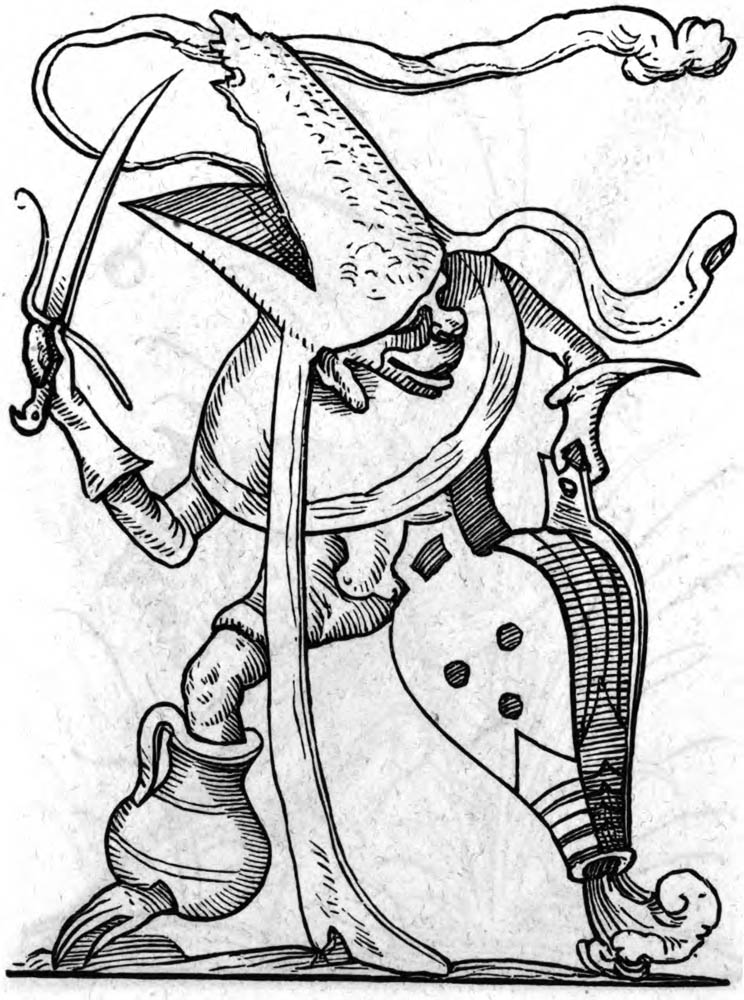 This erasure of differences, coupled with a blurring of the venerable traditions, pulls us down into a curious and shockingly egalitarian world. The hierarchy of dignitas hominis – which includes a process of improvement, as man, by virtue of his free will, is able to climb higher or to sink into misery – becomes its own caricature here. These pictures do not just illustrate the egalitarianism of medieval carnival such as we have seen in the masters of Desprez, Brueghel and Bosch, but already lead to the Baroque disappointment where for example Lazarillo de Tormes is converted into a tuna under the pen of Juan de Luna (Segunda parte del Lazarillo), and they open the gallery of the beings which Adrenio and Critilo will encounter during their journey in Gracián’s El Criticón. An air of fatalism is hanging over these poor souls doomed to be what they are. If the naked Scythe in Alciato’s famous emblem announced his freedom with the motto Omnia mea mecum porto, “I carry with myself everything I have”, then these beings, each a crazed microcosm, shout the same, but as a motto of their indissoluble bondage to the earth beyond which there is nothing and without which they would also become nothing (notice the underlined presence of rivets, knots, ribbons and straps). Wherever they go, they carry with themselves not their liberty, but their prison. So why do we laugh when looking at them? Do we perhaps laugh when watching Tod Browning’s Freaks of 1932? It is true that ugliness can be laughable at the first glance. But this does not seem a good answer either. The representation of ugliness presupposes and refers to an idea of beauty, but these figures do not want to give us this comfort either. It is not their ugliness that affects us, but their basic indeterminacy. Not their distance from the design, but the fact that there is no design. And if there is no design, there is no God. Everything is just a provisional assembly.
We can also see it from the opposite aspect. Perhaps Desprez, in contrast to his earlier Recueil de la diversité des habits, shows here the naked man, stripped of any appearance and habit, with a deep anthropological pessimism, in its heterogeneous and absurd essence, which finally defines him, without any mask.
We noted earlier that Desprez’s designs unites the grotteschi of Italian and French humanists with the medieval drôleries, still alive in the popular tradition. This practice of the educated decorator is revealed in the execution of even the slightest details of the woodcuts, in his tendency to the arabesque, the flight of the feathers and plumes, the gracefulness of the lines of tapes and herbs. The drawings are loaded with a rhythm that lends lightness to these figures, while a different, heavier line would make them excessively sober, and even sinister. Many of them show how a seemingly superfluous stroke contributes to the definition of a gesture, the suggestion of movement, the balance of the composition, the playful associations.
 The dedication to the readers, the only text accompanying the volume bears a remarkable affinity to Cervantes. So much that one is tempted to think that Cervantes in fact read it, because its strategy is so similar to the famous prologue of the first part of Don Quixote (1605). Both Breton and Cervantes confess of being unable to properly present such a “naked” work, or even define the ultimate purpose of the author. Breton, with an irony which from the perspective of the above analysis is much sharper than it looks, even refers to the possibility of a mystical or allegorical reading of the pictures, although admits that he is not capable of giving it. And one cannot ignore the parallel between the implicit purpose of the two works: “Strive, too, that in reading your story the melancholy may be moved to laughter, and the merry made merrier still; that the simple shall not be wearied, that the judicious shall admire the invention, that the grave shall not despise it, nor the wise fail to praise it”, and “Nor have I wanted to entertain myself in finding out the author’s intentions, both as they are uncertain to me, and because of the great difficulty to reach the rather lunatic thoughts of such great geniuses. Nevertheless I hope that many people will be satisfied with the present little work, because who are of a dreaming nature will find here enough matter to their dreams, the melancholic will find what to cheer him and the merry to laugh”. Of course, Bakhtin has already long demonstrated how much Rabelais and Cervantes are united by their interest in popular culture and the affinity of their humor, but it looks like we have to pick up also the printer Richard Breton into their carriage.
 Breton’s decision to resist the urge to add any text to the images was a more serious and complex one than it seems. Note that we are in a world which fervently wanted to exploit the multimedia potential of the union of picture and text both as a mean of persuasion and as that of the ars memorandi, fixing things in the memory. The fundamental model of this combination was the emblem with its threefold structure where the central pictura was encircled by an inscriptio and a subscriptio, and with its established habits of reading. For a publisher it was therefore difficult to avoid the addition of some text.
Breton, however, was able to see the power of these images to elicit astonishment and reflection in their mute and defiant presence, without any further guide. In his decision it might also have played a part that once he attributed the book to Rabelais, the texts accompanying the images would have to be written at the height of the master, and he did not dare to go this far.
 The publishers following Breton did not have so good sense, and they provided the pictures either with moralizing verses and authorities, or claimed that each of them were portraits of key figures in Rabelais’ life and works (here you can see the woodcuts with these assignments). The first way was chosen by two late 17th-century German editions in Augsburg, the one of which accompanies the pictures with moral quatrains on vices, characters, etc., while the other proposed their reading as satires of specific professions or offices. For their part, the 19th-century editors of the complete works of Rabelais (1823) provided each of the 120 figures with a name and subtitle. In 1870 Edwin Tross refused this, published the book without these additions, and in hsi foreword he criticized those positivist excesses. To take just an example from which each reader can judge the arbitrariness of these attributions, according to the edition of 1823 Pope Julius II would have been represented by no less than sixteen quite different figures in the book.
 However, it should be noted that beyond the abstract deformities and monstruosities of the carnival some more specific allegorical features can be also detected in these pictures. Throughout Europe, a specific teratology of political cartoons was developed, which was especially alive in the religious debate in Germany and in the Netherlands. This was not alien to Rabelais either, for in the last book of Pantagruel, published only a year before the Drolatic dreams, the Loud Island is inhabited by a bunch of impossible birds representing prelates, bishops, cardinals and other illustrious personalities of the Roman Curia. In the Dreams many pictures contain religious overtones. One glance is enough to note that weapons and religion are the two most frequent sources of their motives, which is well justified by the political climate of the time. However, their satirical or allegorical articulation is far from unequivocal. The mixture of motives and their drift toward the absurd avoids a linear reading which would indispensable to a direct criticism of a given enemy one wants to subdue. On the other hand, we also have to admit the contiguity of these figures with other sets of pictures which also included similarly monstrous beings, as the illustrations of fables and miracles, voyages, bestiaries or medical treaties. They are constant hints to the fact that we cannot completely understand the machine of nature. The Baroque monsters have even less humor. They are interpreted as ominous signs, and their presence through the stories and engravings of popular prints becomes more stressed and widespread as European society – especially the South – becomes aware that the world is aging and getting worse, abandoning the way of the old Humanist ideals. This work also fits in this process.
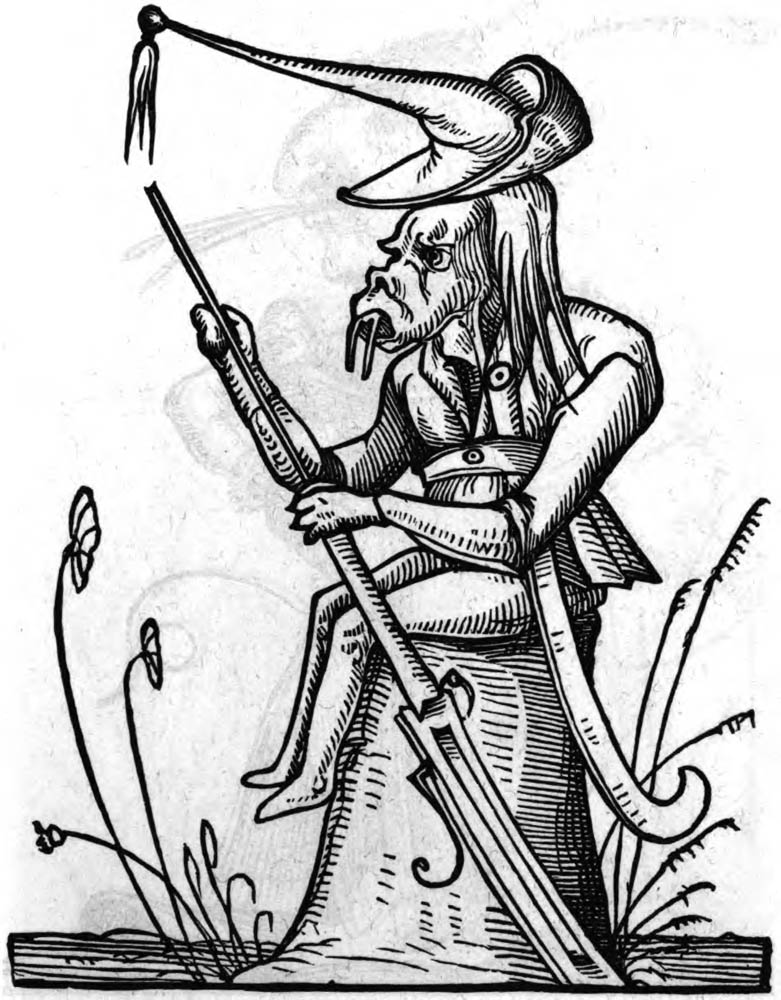 The monsters of Drolatic dreams are deeply rooted in this cultural landscape. The chill caused by them was resolved as summarized by Michel Jeanneret: “There are several ways to get rid of monsters, and the 16th century had different ways for this purpose. You can attribute the wonders to distant countries, thus converting them into exotic objects which will not disturb us so much. You can also disable them by treating them as allegories, conventional and fictive signs, by which they lose their frightening face. In other cases, the existence of monsters is assigned to natural causes, thus dissipating their mystery. From the 17th century, rationality will be the most effective defense against the horror. It can be seen at this point how different the strategy of Drolatic dreams is. It does not intend to neutralize the monster, it does not deny it, but, on the contrary, it accepts its plausibility. […] At the intersection of farce and fear, the Dreams, probably unknowingly, realizes the carnivalization of horror. It exorcises the strange and alien by using one of the few really effective human weapons, laughing. This operation falls within the process of the great change observed by Foucault since the early 16th century: the figure of madness gradually replaces the obsessive image of death. […] Rather than distorting the human, they humanize the unknown.” (“Rire à la face du monstre”, in: Les Songes drolatiques de Pantagruel, Paris: La-Chaux-de-Fonds: 1989, 33.). The same Jeanneret noticed a certain regularity in the design of the book that would strengthen his argument. The figures of two facing pages always look at each other, and while the left one is always of a threatening or disturbing aspect, with more aggressive features, the right one is funnier or merely more innocent; and it is always on the right side where we find more birds, decorations, lighter traces, more musical instruments.
We can ask whether this was the final lesson that François Desprez and Richard Breton wanted to offer (in the shadow of Rabelais, of course), such a linear reading during which, by proceeding from the mournful to the festive and merry we balance the initial unrest with a laughter that kills the monsters (what we are), thus gradually humanizing us. In this interpretation we are the suffering humanity that laughs at itself by looking in a distorting mirror, this infinite procession of chimeras lightened by the subtle embroideries of master Desprez, the ultimate teaching of the Humanism on humanism.

Our Spanish edition of Dreams, whose introduction is an enlarged version of this post, was recently published in the series “Centellas”: Los Sueños droláticos de Pantagruel, Palma: José J. de Olañeta, Editor, 2011.
ISBN: 978-849716-722-2.


 Las 120 imágenes que componen el volumen de Les songes drolatiques de Pantagruel se publicaron en 1565 sin apenas explicaciones. Pero el exiguo y un poco balbuceante prólogo del impresor Richard Breton revela y oculta por igual casi todo lo que se puede decir de la curiosa colección de grabados. Arranca con una mentira y al poco la sintaxis le traiciona dejando ver la mala conciencia de quien no puede mantenerse en el filo de las medias verdades. Por más que Breton nos lo asegure, apelando a una vieja amistad, estos dibujos no salieron de la mano, ni siquiera del pensamiento, del famoso


 Come with us to…
 Atlantis
 Bohemia+Prague
 Books, exhibitions, music, film
 Brave old world
 Caucasus
 Cemeteries
 Crimea
 Get to know the
 Images of the East
 Lightwriting
 Lwów/Lemberg
 Mallorca
 Message on the wall
 The Museum of Propaganda
 Odessa
 Persian letters
 The Jewish heritage


