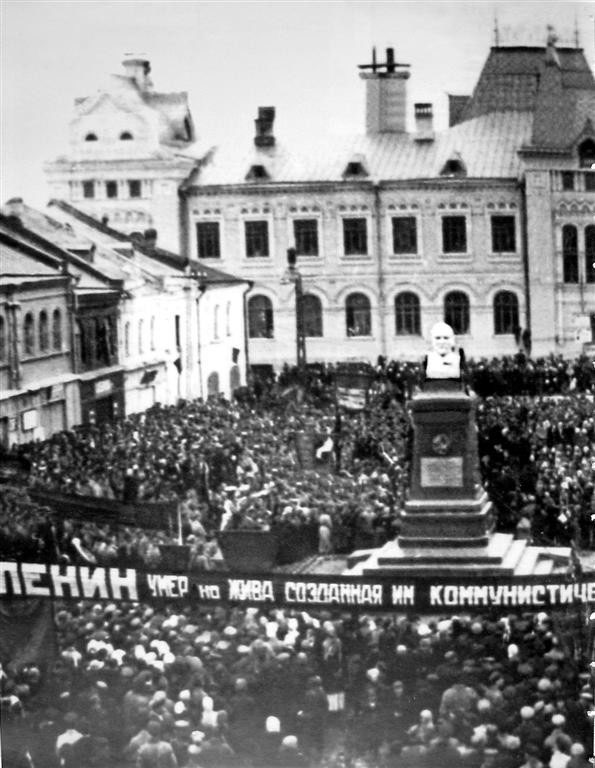
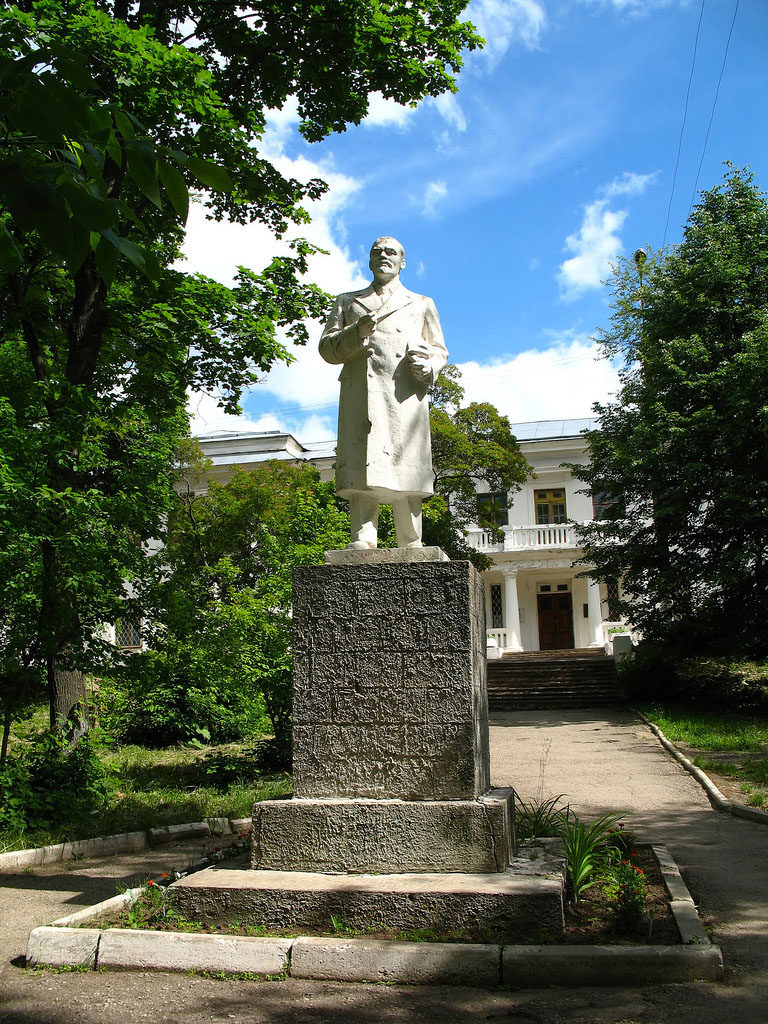
And finally a last example from Yasnaya Polnaya, the former estate of Lev Tolstoy, where not only the base but the complete former statue was preserved and in fact only its head was changed: that of Stalin was replaced by that of Lenin. However, the coat attests well that it was tailored for the Generalissimus:
Switch over to our new blog! • ¡Pásese a nuestro nuevo blog!
The renewed version of our blog, with more features, a richer design, and available in nine languages, can be read here: https://wangriver.com
The new version also includes the old posts, often in expanded form. If you are curious about the updated version of this post, replace “riowang.blogspot.com/” in the URL with “riowang.studiolum.com/”, and the new link will most likely lead you there.
La versión renovada de nuestro blog, con más herramientas, un diseño más rico y disponible en nueve idiomas, se puede leer aquí: https://riowang.com
La nueva versión también incluye las publicaciones antiguas, a menudo en una forma ampliada. Si tiene curiosidad por la versión actualizada de esta entrada, sustituya «riowang.blogspot.com/» en la URL por «riowang.studiolum.com/es/», y el nuevo enlace probablemente le llevará allí.
Base and superstructure
And finally a last example from Yasnaya Polnaya, the former estate of Lev Tolstoy, where not only the base but the complete former statue was preserved and in fact only its head was changed: that of Stalin was replaced by that of Lenin. However, the coat attests well that it was tailored for the Generalissimus:
Great Patriotic War
I read in the news that the consumption of kvass is victoriously advancing on the Russian front of soft drinks. “Local drink producers advertise their products as patriotic alternatives to Western drinks. One of them even chose a patriotic name: Nikola, alluding to Ne kola [not Cola]. In the last year they even launched an «anticolanization» campaign against colanizing Western soft drinks.”
– Nu pogodi! [wait a minute] – I recall immediately the title of the famous Soviet tale serial of my childhood. Did they not nail this name and slogan from Pelevin?
In one of these drafts the protagonist writes (already in the 90's!):
First of all it is to be considered that the actual order of things in Russia cannot survive for long. The future dictatorship, independently of its political and economical program, will avail of nationalistic catchwords, and pseudo-Slavic style will become the dominant state aesthetics. In the system of signs and symbols of this style the traditional Western advertisement is simply unimaginable. (…) Let us consider the traditional positioning slogan: Sprite – the Uncola! Its use seems to be maximally purposeful in Russia, albeit for reasons different from America, where the term Uncola successfully positions the Sprite as compared to Pepsi and Coca-Cola. (…) However, we know that in the countries of Eastern Europe, the Coca-Cola has meant rather an ideological fetish than a soft drink, the “taste of freedom”, as it was proclaimed by a large number of Eastern European refugees in the 70's and 80's. Thus the term Uncola creates a largely antidemocratic and antiliberal connotation for the home consumer, a fact that renders it maximally attractive and promising in a military dictatorship. The Russian translation of Uncola is Ne-kola [Некола]. It sounds similar to the name Nikola, and, considering the associations evoked by this word, it perfectly fits in the aesthetics of the probable future. A possible version of its slogan is:
[СПРАЙТ. НЕ-КОЛА ДЛЯ НИКОЛЫ]
It would be worth to consider the introduction of Nikola Spraitovich, into the consciousness of the consumer, a figure similar to Ronald McDonald but with a deeply patriotic soul.
And yes, they made it. NiKola has arrived, Nikola Spraitovich has been created, the patriotic campaign around it has been organized, and of course the matching political system has been also established in the meantime.
According to the historical summary by Vlad Grinkevich, the Nikola was created on May 9, 2005, the Day of Victory (!) by Nikita Volkov, the director of the Deka beer factory in Novgorod that had lost its market as a consequence of the invasion of Western multinational companies. And he confessedly drew the idea of the name and of the slogan from Pelevin.
The campaign of the Nikola was initially based on a patriotic joining of forces against the “aggressors” breaking in upon Russia, primarily against the two Cola’s, also targeted by name. However, the Russian counterattack also proved too aggressive. The Pepsi- and Coca-Cola raised objections, and the Russian anti-monopoly authorities constrained the Deka to a change of strategy – writes in his recent analysis Anton Gladchenko. They are not permitted to mention the enemy by name. But there are also much more subtle tools, aren’t we Russians after all?
On the eve of the Day of Victory of 2008 new advertisements appeared in the metro and autobuses of Moscow – writes Sergey in his blog Idiotskaya reklama –, that build on the unique skill of Eastern European citizens of reading between the lines. For the initials of the single paragraphs of the usual boring and politically correct blabla sum up the following phrase:
The Cola to… where? What is “гопа”? – ask the Russians themselves. True, this word means a ‘drinking den’ in the slang of the Russian underworld, and in a figurative sense a ‘gang of hooligans’, and whoever knows it may cheer up seeing this ad. However, hardly anyone knows it. But a similar word known and used by everyone is “жопа”, ass, and the term “в жопу” – get the fuck off! Knowing the susceptibility of colloquial Russian to expressive nuances, I would not be surprised to see the eufemism “гопа” soon in standard dictionaries.
But what about Pelevin? Did he receive a percentage after the brand and slogan created by him from the kvass business that has doubled its turnover since 2005?
“We have registered the copyright on the brand, and all its rights belong to us.” – replies on this question Nikita Volkov. – “We keep trying to say thanks to Pelevin, but we have not managed to get in contact with him.”
This noble effort immediately recalls to me another great classic of post-Communist Eastern European literature, the I’m a Communist granny (Sînt o babă comunistă) by Dan Lungu:
Now there is her favorite program, when the listeners can also phone in. They can speak about the voluntary works they have accomplished. Now there is a comrade on the line and she says:
– I’m a working woman from Craiova… In the last days I was in Bucharest to arrange my personal affairs. In front of the Hotel Intercontinental I have found a purse… Of course I have lifted it and looked into it. There were five thousand lei and two thousand dollars in it… From the documents it turned out that the owner of the purse was a certain Anton Cărăşel, Bucharest, Izvoarelor street 46, block A6, stairway C, first floor 3.…
– Yes? And what can we do for you?
– I would like very much to send a beautiful song to Comrade Cărăşel.
And this makes this story really beautiful, Eastern European and Russian.
magyarul
Like the Cicada
Our appeal to our Readers to send us the songs telling about their history has been generously answered by Julia sharing with us her experiences of their change of regime in the early ’80s:
Having read this post of the Poemas del Río Wang, I have realized that I could not give a really comprehensive picture of the music of the protest songs or the songs of the Transición in Argentina. There are so many that I do not know or do not remember, or that I know by name but, to be sincere, has never touched me. Nevertheless, if I consider it with sincerity and renounce to be exhaustive to any extent, there are some songs that begin to emerge in my head when I think about the period.
I don’t know whether they all are of the same quality, and I also know that they do not represent the same period. Some of them I remember from the period when I was 12 and they started to speak about democracy in Argentina again, while others were handed to me by my parents. Here I offer a rather aleatory compilation, adding that the last ones are those of the most universal value.
As there are many great names in Argentina that could not be absent from a complete overview but have not became part of my real history, I thought it would be the best to select only from the songs of 1982 and 1983.
In Argentina we were ruled since 1976 by a military dictatorship calling themselves “Proceso de Reorganización Nacional”) that had won themselves a dark fame by their brutal repression killing thousands and thousands. The state terrorism acted through underground canals and its dimensions were not really known to everyone in their complete magnitude until the reappearing of democracy. We lived at that time in the climate of silent violence, censure and oppression that became almost natural.
In 1982, the Junta Militar committed its silliest mistake by starting a war against Great Britain for the Falkland Islands. Although I believe that we Argentinians all defend our sovereignty above these islands, the mortal project of attacking the British and send a large number of 18 years old boys, doing their obligatory military service, poorly equipped and poorly defended, was a desperately irresponsible undertaking from the government. Unfortunately many Argentinians, intoxicated by the mental dullness provoked by Chauvinism, applauded the de facto President of the country, Comandante Leopoldo F. Galtieri in declaring war. The defeat to be expected from the British was one of the most important factors forcing the “Proceso” to leave the power and to convoke elections in 1983.
I told about this war so much in detail because it was due to this conflict with Great Britain that in this year of 1982 the military dictatorship prohibited the radio stations from broadcasting music in English, thus producing the boom (what a mutiny, to use a word of the “enemy”) of the so-called “Rock Nacional”.
Then, in 1983 we were electrified by the imminent arrival of democracy. I was 11-12 years old (and, for an exotic detail, we lived in Ushuaia, in the most southernmost city of the world), and I remember my fascination at listening to the songs of the great Argentinian rocker Charly García, like the Inconsciente colectivo.
Charly García - Inconsciente colectivo - From the album Yendo de la cama al living, 1982
| The Collective Unconsciousness Charly García A flower is born, every day the sun rises, every now and then you hear that voice, like bread, wanting to sing, in the roof of my mind, with the bees. But at the same time there is a transformer that consumes the best of you holds you back, asks more and more of you up to a point where you want to have no more to do with it. Breast suck liberty. You’ll always have it within your heart. You may be corrupted, you may forget, but she’ll always be there. Breast suck liberty. You’ll always have it within your heart. You may be corrupted, you may forget, but she’ll always be there. Yesterday I dreamt about the hungry people, the mad people. Those who went away , those who are in prison. Today I awoke singing this song that had already been written . It’s necessary to sing again once more. | Inconsciente colectivo Charly García Nace una flor, todos los días sale el sol de vez en cuando escuchas aquella voz. Cómo de pan, gustosa de cantar, en los aleros de mi mente con las chicharras. Pero a la vez existe un transformador que te consume lo mejor que tenés te tira atrás, te pide más y más y llega un punto en que no querés. Mamá la libertad, siempre la llevarás dentro del corazón te pueden corromper te puedes olvidar pero ella siempre está Mamá la libertad, siempre la llevarás dentro del corazón te pueden corromper te puedes olvidar pero ella siempre está Ayer soñé con los hambrientos, los locos, los que se fueron, los que están en prisión hoy desperté cantando esta canción que ya fue escrita hace tiempo atrás. Es necesario cantar de nuevo, una vez más. |
I also remember the song Los dinosaurios which told a lot without saying, by referring to the members of the military dictatorship leaving the power and to the “disappeared”, the persons who were arrested, tortured and in the majority killed by state terrorism developing in the years of the dictatorship between 1976 and 1983.
Charly García - Los dinosaurios - From the album Clics modernos, 1983
| The Dinosaurs Charly García Neighborhood friends may disappear, radio singers may disappear, those who are in the papers may disappear, the person that you love may disappear, those who are in the street may disappear, those who are on the air might disappear. Neighborhood friends may disappear. But the Dinosaurs, will disappear. I’m uneasy, my love. Today is Saturday night, a friend is in jail. Oh, my love, the world disappears. If the heavy people of the world, my love, carry such a lot of baggage in their hands, Oh, my love, I want to be lighthanded. When the world pulls you down It’s better not to be tied up to anything. Imagine Dinosaurs in bed, when the world pulls you down, it’s better not to be tied up to anything. Imagine Dinosaurs in bed. Neighborhood friends may disappear, radio singers may disappear, those who are in the papers may disappear, the person that you love may disappear, those who are in the street may disappear, those who are on the air might disappear, neighborhood friends may disappear. But the dinosaurs, will disappear. | Los dinosaurios Charly García Los amigos del barrio pueden desaparecer Los cantores de radio pueden desaparecer Los que están en los diarios pueden desaparecer La persona que amas puede desaparecer. Los que están en el aire pueden desaparecer en el aire Los que están en la calle pueden desaparecer en la calle. Los amigos del barrio pueden desaparecer, Pero los dinosaurios van a desaparecer. No estoy tranquilo mi amor, Hoy es sábado a la noche, Un amigo está en cana. Oh, mi amor, Desaparece el mundo Si los pesados, mi amor, llevan todo ese montón de equipajes en la mano Oh, mi amor, yo quiero estar liviano. Cuando el mundo tira para abajo es mejor no estar atado a nada Imaginen a los dinosaurios en la cama Cuando el mundo tira para abajo es mejor no estar atado a nada Imaginen a los dinosaurios en la cama Los amigos del barrio pueden desaparecer Los cantores de radio pueden desaparecer Los que están en los diarios pueden desaparecer La persona que amas puede desaparecer. Los que están en el aire pueden desaparecer en el aire Los que están en la calle pueden desaparecer en la calle. Los amigos del barrio pueden desaparecer, Pero los dinosaurios van a desaparecer. |
But without doubt the song that unified the Argentinians of any shades was the Sólo le pido a Dios by León Gieco that was written in 1978 but became a hymn of pacifism during the Falkland War of 1982 and continued to be very symbolic for all the Transición towards democracy.
León Gieco - Sólo le pido a Dios - Del álbum IV LP, 1978 - Sung in this link by Mercedes Sosa
| I Only Ask God León Gieco I only ask God that pain be not indifferent to me. that dry death won’t find me empty and alone without having done enough. I only ask of God that war be not indifferent to me, it’s a big monster and it tramples hard on the poor innocence of people. I only ask God that injustice be not indifferent to me that I will not be slapped on the other cheek after a claw has torn me in this manner. I only ask God that deceit be not indifferent to me if a traitor is mightier than a few let those few not forget it easily. I only ask God. that the Future be not indifferent to me someone who has to leave and live a different culture is one to be despaired of. | Sólo le pido a Dios León Gieco Sólo le pido a Dios que el dolor no me sea indiferente, que la reseca muerte no me encuentre vacío y solo sin haber hecho lo suficiente. Sólo le pido a Dios que lo injusto no me sea indiferente, que no me abofeteen la otra mejilla después que una garra me arañó esta suerte. Sólo le pido a Dios que la guerra no me sea indiferente, es un monstruo grande y pisa fuerte toda la pobre inocencia de la gente. Sólo le pido a Dios que el engaño no me sea indiferente si un traidor puede más que unos cuantos, que esos cuantos no lo olviden fácilmente. Sólo le pido a Dios que el futuro no me sea indiferente, desahuciado está el que tiene que marchar a vivir a una cultura diferente |
If I already mentioned Mercedes Sosa who sings so beautifully this song by León Gieco, I must also remember another song by María Elena Walsh that my mother had shown to me. This genial and versatile writer is an institution of children’s literature and songs in our country, but she also wrote songs “for adults”, including the Serenata para la tierra de uno, a precious song that touches me again each time I listen to it (undoubtedly a heredity from my mother). María Elena Walsh suffered a lot because of the ideological closure of the governments of Juan Domingo Perón (from 1946 to 1955 and from 1973 to 1976, followed after his death in 1974 by his wife, elected vice president) and also by the various dictatorships following them (except for some small breaths of democracy in the 60’s). This song of love to her own country and of her dedication to it beyond all the difficulties, troubles and conflicts shows the exact feelings of many Argentinians. It is obviously hard to accept, of course, that it is only us who bear responsibility for the way we live (as we had no invasions, no external attacks, neither natural catastrophes that could justify the dark moments of our history). Anyway, the lyrics of the song is very subtle, without any shade of denunciation. It only suggests almost without words how much difficulties she has to overcome in order to justify her will to live “in one’s own land”.
Serenata para la tierra de uno by María Elena Walsh, sung also by Mercedes Sosa
| Serenade for One’s Own Land María Elena Walsh Because it pains me if I stay But it kills me if I leave For everything and in spite of everything, my love, I want to live in you. Because of your decency of vidala. And because of your scandal of sun, Because of your summer with jasmines, my love, I want to live in you. Because childhood language Is a secret between us two, Because you gave shelter To my heart’s dereliction. Because of your old rebellions And because of the age of your pain, Because of your endless hope, my love, I want to live in you. To scatter the seeds of guitars in you To take care of you in every flower, And to hate those that harm you, my love, I want to live in you. | Serenata para la tierra de uno María Elena Walsh Porque me duele si me quedo pero me muero si me voy, por todo y a pesar de todo, mi amor, yo quiero vivir en vos. Por tu decencia de vidala y por tu escándalo de sol, por tu verano con jazmines, mi amor, yo quiero vivir en vos. Porque el idioma de infancia es un secreto entre los dos, porque le diste reparo al desarraigo de mi corazón. Por tus antiguas rebeldías y por la edad de tu dolor, por tu esperanza interminable, mi amor, yo quiero vivir en vos. Para sembrarte de guitarra para cuidarte en cada flor, y odiar a los que te lastiman, mi amor, yo quiero vivir en vos. |
Another, for us very emblematic song is the Como la cigarra. It was composed at the end of the 60's, in a period of transition from a military government to the last one by Perón which then, in 1976, would lead into the “Proceso”. It is interesting that the very author told that when she publicly sung this song before 1975, it did not attract special attention, and nobody seemed to understand it, but some years later, in 1983 it became a hymn of the rebirth of democracy. It seems that in that moment many Argentinians understood that we had been and we were like the cicada.
Como la cigarra – María Elena Walsh, 1972 - En este link cantada Mercedes Sosa (a mediados de los '70 supongo)
| Like the Cicada María Elena Walsh I was killed so many times. I died so many times however, here I am reviving . I thank misfortune and I thank the hand with the dagger because it killed me so badly that I went on singing Singing in the sun like the Cicada after a year under the earth just like a survivor, that’s returning from war. So may times was I wiped away so many times did I disappear, I went to my own funeral alone and crying I tied a knot on my handkerchief but then I forget that it hadn’t been the only time and I went on singing. Singing in the sun, like the Cicada after a year under the earth just like a survivor that´s returning from war So may times will you be killed so many will you revive how many years will you spend despairing. And at the moment of shipwreck and that of darkness someone will rescue you to go on singing Singing in the sun like the Cicada, after a year below the earth just like a survivor returning from war. | Como la cigarra María Elena Walsh Tantas veces me mataron, tantas veces me morí, sin embargo estoy aquí resucitando. Gracias doy a la desgracia y a la mano con puñal, porque me mató tan mal, y seguí cantando. Cantando al sol, como la cigarra, después de un año bajo la tierra, igual que sobreviviente que vuelve de la guerra. Tantas veces me borraron, tantas desaparecí, a mi propio entierro fui, solo y llorando. Hice un nudo del pañuelo, pero me olvidé después que no era la única vez y seguí cantando. Cantando al sol, como la cigarra, después de un año bajo la tierra, igual que sobreviviente que vuelve de la guerra. Tantas veces te mataron, tantas resucitarás cuántas noches pasarás desesperando. Y a la hora del naufragio y a la de la oscuridad alguien te rescatará, para ir cantando. Cantando al sol, como la cigarra, después de un año bajo la tierra, igual que sobreviviente que vuelve de la guerra. |
en español • magyarul
Como la cigarra
Our appeal to our Readers to send us the songs telling about their history has been generously answered by Julia sharing with us her experiences of their change of regime in the early ’80s:
Me di cuenta, al leer esta entrada de Poemas del Río Wang, de que no podía en modo alguno hacer un aporte realmente abarcador de lo que fue la música de protesta o de transición en Argentina. Hay tanto que no conozco o no tengo presente, o que conozco de nombre, pero para ser sinceros no llegó a tocarme directamente. Sin embargo pensando con sinceridad y sin pretender ser en lo más mínimo exhaustiva, hay canciones que se me empezaron a agolpar en la cabeza al considerar el asunto.
No sé si tienen todas la misma calidad, sé que no representan un misma época. Algunas las recuerdo de cuando yo tenía 12 años y empezaba a hablarse de democracia nuevamente en Argentina, otras vienen heredadas de mis padres. Aquí hay un compilado muy aleatorio (aclaro que creo que las últimas son las de valor más universal).
Lo primero que pensé –al darme cuenta de que lo mejor era hablar de uno mismo, porque hay grandes nombres de Argentina que no podrían faltar en un recorrido completo, pero que no formaron parte de mi verdadera historia– fue en los años 1982 y 1983.
En la Argentina, vivíamos desde 1976 gobernados por una dictadura militar (autodenominada “Proceso de Reorganización Nacional”) que es tristemente célebre por su brutal represión que dejó como saldo miles y miles de muertos. El terrorismo de estado transitaba por cauces subterráneos y su dimensión no fue realmente reconocida por todos en su completa magnitud hasta que volvió la democracia. Se vivía, entonces, un clima de violencia silenciada, de censura y represión ya casi naturalizadas.
En 1982, la Junta Militar nos sumerge en una gran locura: una guerra contra Gran Bretaña por las Islas Malvinas. Si bien creo que todos los argentinos defendemos nuestra soberanía sobre estas islas, el letal proyecto de atacar a los ingleses y mandar una gran cantidad de soldados de 18 años (chicos que estaban haciendo su servicio militar), mal equipados y poco protegidos, fue desgarrador. Lamentablemente muchos argentinos, imbuidos de esa estupidez mental que produce el chauvinismo, aplaudieron al presidente de facto en el poder en ese momento, Comandante Leopoldo F. Galtieri, al proclamar la guerra. La esperable derrota contra los ingleses fue uno de los detonantes más importantes para que el “Proceso” tuviera que dejar el poder y llamara a elecciones en 1983.
El relato de esta guerra viene a cuento aquí, porque fue a causa del enfrentamiento con Gran Bretaña que, en ese año de 1982, la dictadura militar prohibió a las radios pasar música en inglés y se produjo un boom (¡qué rebeldía usar un vocablo del “enemigo”) del llamado “Rock Nacional”.
Luego, en 1983, todos estábamos enfervorizados por la inminente vuelta de la democracia. Yo tenía entre 11 y 12 años (y para datos exóticos vivía en Ushuaia, la ciudad más austral del mundo) y recuerdo mi fascinación al escuchar las canciones del gran músico del rock argentino, Charly García, como Inconsciente colectivo.
Charly García - Inconsciente colectivo - Del álbum Yendo de la cama al living, 1982
También recuerdo el decir sin decir, pero diciendo bastante, otra canción posterior Los dinosaurios (aludiendo a los militares que se estaban yendo del poder y con una clara referencia a los “desaparecidos”, personas arrestadas, torturadas y, en la mayoría de los casos, asesinadas por el terrorismo de estado que se desplegó durante la dictadura de 1976-1983).
Charly García - Los dinosaurios - Del álbum Clics modernos, 1983
Pero sin duda una canción que reúne a argentinos de todos los ámbitos es Sólo le pido a Dios de León Gieco que fue escrita en 1978, pero se convirtió en un himno pacifista durante la guerra de Malvinas (1982) y luego fue muy simbólica en toda la transición hacia la democracia.
León Gieco - Sólo le pido a Dios - Del álbum IV LP, 1978 - Cantada en el link por Mercedes Sosa
Al llegar a Mercedes Sosa que canta tan lindo esa canción de León Gieco, recordé las de María Elena Walsh que me hacía escuchar mi madre. Esta genial y multifacética autora es una institución de la literatura y canción infantil en nuestro país, pero tiene además canciones “para grandes”, entre ellas Serenata para la tierra de uno, una canción preciosa que me emociona cada vez que la escucho (transmisión materna, sin duda). María Elena Walsh sufrió la cerrazón ideológica de los gobiernos de Juan Domingo Perón (de 1946 a 1955 y de 1973 a 1976 –seguido después de su muerte en 1974 por su mujer, vicepresidente electa) y también la de las distintas dictaduras militares que los sucedieron (salvo pequeñas bocanadas de democracia en la década del 60). Así que esta canción de amor al propio país y de compromiso con él más allá de todas las dificultades, desagrados y contradicciones muestra el sentir preciso de muchos argentinos. Cuesta reconocer, sin embargo, que sólo nosotros somos los culpables de lo que vivimos (no tuvimos invasiones, ataques externos, ni catástrofes naturales que puedan justificar los descalabros de nuestra historia). De todas formas, la letra de la canción es muy sutil, no hay un tono de denuncia, sólo se sobreentienden las dificultades al retratar los tironeos del alma al tener que justificar el querer vivir “en la tierra de uno”.
Serenata para la tierra de uno de María Elena Walsh cantada también por Mercedes Sosa
Otra canción suya, muy emblemática para nosotros, es Como la cigarra. Fue compuesta en épocas de transición de un gobierno militar de los 60 al último de Perón, que luego, en 1976, desembocaría en el “Proceso” militar. Lo curioso es que la misma autora ha dicho que cuando ella cantó en público esta canción hacia 1975 a nadie le llamaba mucho la atención ni parecía entenderla y, sin embargo, años después se convertiría en un himno del renacimiento de la democracia en 1983. Se ve que en ese momento muchos argentinos nos dimos cuenta de que también habíamos sido y éramos como la cigarra.
Como la cigarra – María Elena Walsh, 1972 - En este link cantada Mercedes Sosa (a mediados de los '70 supongo)
Aquí van las letras.
| Inconsciente colectivo Charly García Nace una flor, todos los días sale el sol de vez en cuando escuchas aquella voz. Como de pan, gustosa de cantar, en los aleros de mi mente con las chicharras. Pero a la vez existe un transformador que te consume lo mejor que tenés te tira atrás, te pide más y más y llega un punto en que no querés. Mamá la libertad, siempre la llevarás dentro del corazón te pueden corromper te puedes olvidar pero ella siempre está Mamá la libertad, siempre la llevarás dentro del corazón te pueden corromper te puedes olvidar pero ella siempre está Ayer soñé con los hambrientos, los locos, los que se fueron, los que están en prisión hoy desperté cantando esta canción que ya fue escrita hace tiempo atrás. Es necesario cantar de nuevo, una vez más. Los Dinosaurios Charly García Los amigos del barrio pueden desaparecer Los cantores de radio pueden desaparecer Los que están en los diarios pueden desaparecer La persona que amas puede desaparecer. Los que están en el aire pueden desaparecer en el aire Los que están en la calle pueden desaparecer en la calle. Los amigos del barrio pueden desaparecer, Pero los dinosaurios van a desaparecer. No estoy tranquilo mi amor, Hoy es sábado a la noche, Un amigo está en cana. Oh, mi amor, Desaparece el mundo Si los pesados, mi amor, llevan todo ese montón de equipajes en la mano Oh, mi amor, yo quiero estar liviano. Cuando el mundo tira para abajo es mejor no estar atado a nada Imaginen a los dinosaurios en la cama Cuando el mundo tira para abajo es mejor no estar atado a nada Imaginen a los dinosaurios en la cama Los amigos del barrio pueden desaparecer Los cantores de radio pueden desaparecer Los que están en los diarios pueden desaparecer La persona que amas puede desaparecer. Los que están en el aire pueden desaparecer en el aire Los que están en la calle pueden desaparecer en la calle. Los amigos del barrio pueden desaparecer, Pero los dinosaurios van a desaparecer. Serenata para la tierra de uno María Elena Walsh Porque me duele si me quedo pero me muero si me voy, por todo y a pesar de todo, mi amor, yo quiero vivir en vos. Por tu decencia de vidala y por tu escándalo de sol, por tu verano con jazmines, mi amor, yo quiero vivir en vos. Porque el idioma de infancia es un secreto entre los dos, porque le diste reparo al desarraigo de mi corazón. Por tus antiguas rebeldías y por la edad de tu dolor, por tu esperanza interminable, mi amor, yo quiero vivir en vos. Para sembrarte de guitarra para cuidarte en cada flor, y odiar a los que te lastiman, mi amor, yo quiero vivir en vos. | Sólo le pido a Dios León Gieco Sólo le pido a Dios que el dolor no me sea indiferente, que la reseca muerte no me encuentre vacío y solo sin haber hecho lo suficiente. Sólo le pido a Dios que lo injusto no me sea indiferente, que no me abofeteen la otra mejilla después que una garra me arañó esta suerte. Sólo le pido a Dios que la guerra no me sea indiferente, es un monstruo grande y pisa fuerte toda la pobre inocencia de la gente. Sólo le pido a Dios que el engaño no me sea indiferente si un traidor puede más que unos cuantos, que esos cuantos no lo olviden fácilmente. Sólo le pido a Dios que el futuro no me sea indiferente, desahuciado está el que tiene que marchar a vivir a una cultura diferente Como la cigarra María Elena Walsh Tantas veces me mataron, tantas veces me morí, sin embargo estoy aquí resucitando. Gracias doy a la desgracia y a la mano con puñal, porque me mató tan mal, y seguí cantando. Cantando al sol, como la cigarra, después de un año bajo la tierra, igual que sobreviviente que vuelve de la guerra. Tantas veces me borraron, tantas desaparecí, a mi propio entierro fui, solo y llorando. Hice un nudo del pañuelo, pero me olvidé después que no era la única vez y seguí cantando. Cantando al sol, como la cigarra, después de un año bajo la tierra, igual que sobreviviente que vuelve de la guerra. Tantas veces te mataron, tantas resucitarás cuántas noches pasarás desesperando. Y a la hora del naufragio y a la de la oscuridad alguien te rescatará, para ir cantando. Cantando al sol, como la cigarra, después de un año bajo la tierra, igual que sobreviviente que vuelve de la guerra |
in English • magyarul
History sung
Recently we were listening with Wang Wei along a whole night to the songs of the Spanish Transition, comparing those years with those of the change of regimes in Eastern Europe. During that night we decided that we would post for each other some songs now and then that put into words the history as it was personally experienced, and that thus became “hymns” for a generation, as they say in Spanish.
Such songs, in spite of their popularity in their own countries, are almost always unknown beyond their borders. They are never translated, and when their melody is occasionally borrowed it is always provided with a new text. Only if you take into consideration how many such songs you know and love in your own language – and hereby we ask the benevolent Reader to share with us her or his own ones – then you realize how important dimensions of the history of all the other countries remain unknown to you, even if you perhaps know the languages of some of them.
At the same time it is exactly the local notoriety of these songs that makes it difficult to write about them in one’s own language. For what could I tell about them that my compatriots do not know? If it were not for the deliberate bilinguism of our blog, we would prefer to write about them only in English, so that Wang Wei – or Pei Di – would translate them only into Spanish or Hungarian, respectively. Under the circumstances, however, we cannot but keep in mind an ideal reader who is a foreigner but nevertheless reads well Hungarian or Spanish; and consequently we also expect our benevolent Reader to keep in mind that these posts have been written for such an ideal reader and to benevolently forgive us the references to things too well known to her or him.
It is even difficult to label these posts in their original languages. In English most of such songs are called “ballads” and those who sing them “ballad singers.” In other languages there is no word for the genre, but yes for their authors-singers, like the Spanish and Italian “cantautores” and “cantautori”, or the Russian “бард”. In Hungarian, however, neither the genre nor its singers have a term of their own, although both of them exist since the medieval minstrels and the wandering chronicle-singers of the Turkish wars to János Bródy and Dusán Sztevanovity (the latter has just published in print his complete lyrics written since the '60s with the title Csak szöveg [Just texts]). Finally, while keeping “ballad” as our English label, in the Hungarian version of the blog we decided to adopt the label “énekelt versek” (“poems sung”) coined by the great performer Ferenc Sebő in the '80s which also indicates how much this genre has borrowed from written poetry, both from medieval minstrels and Renaissance chronicle-singers and from modern authors.
As this thread started from the songs of various changes of regimes, let us open our sounding gallery with the song of the Hungarian change of regime undergone by ourselves, the Happy times by Zorán Sztevanovity.
(Those who read some Hungarian, here can find a fascinating short biography of the two brothers of Serbian origin, the singer Zorán and the poet Dušán whose father, having fought as a Serbian partisan against the Nazis, suffered several years of persecution, imprisonment and tortures in the '50s as a member of the Yugoslavian embassy of Budapest for resisting to the claims of autocracy of both Tito and Stalin. One of their most famous songs, also quoted below, bears reference to these events.)
Interestingly, the experiences of the years of change in the late '80s and early '90s, bringing with themselves the interruption of so many friendships falling on the other side of the unexpectedly and irrationally outlined new ideological borders, will be also familiar to our Spanish readers, albeit not in the perspective of twenty, but rather of eighty years. We specifically call the attention of our foreign readers to such polysemic idioms like “camp” (peace camp, pioneer camp, labour camp), or “digging a pit” (“gravediggers of capitalism” and the Hungarian proverb “who digs a pit for others will fall in it himself”), as well as to such idiosyncrasies like
Dusán Sztevanovity (text) and Zorán (song):
Boldog idő (Happy time) (from the CD Az élet dolgai (The things of life), 1991)
| So proudly stood the camp in the very middle of the world and we had a tent of our own and her and me in it It was a tremendously bright age the Sun shone day and night and we discovered the great purpose: she me and I her. It was a great life The song was echoing on The heart was drumming for that was a beautiful, happy time no wine, no money, only me and her That was a beautiful, happy time happy time In the daytime we mostly digged pits: the beautiful future already came up to the shoulders and we were always on the top once me and then her Tell me anything, but I liked that damned past time because there was the tent in it and her and me in the tent It was a great life The song was echoing on The heart was drumming for that was a beautiful, happy time no wine, no money, only me and her That was a beautiful, happy time only me and her, happy time And then the camp suddenly collapsed in the very middle of the peace and the tent buried us under itself with me and her in it And by when we finally crept out there was no camp, only bad weather and we set out to seek for a new tent this way me and that way her In front of us there was the large horizon and I already see that this will be the beautiful happy time no problem, no money, no wine, no woman This will be the beautiful happy time no money, no woman happy time | Olyan büszkén állt a tábor Pont a világ kellős közepén És a miénk volt egy sátor Benne ő, és benne én Az egy roppant fényes kor volt Éjjel-nappal a Nap sütött És a nagy célt felfedeztük Engem ő, és én meg őt Nagy élet volt Az ének szólt A szív dobolt Mert az volt a szép boldog idő Se bor, se pénz, csak én meg ő Az volt a szép boldog idő Boldog idő Nappal főleg vermet ástunk Már vállig ért a szép jövő De mi mindig fölül voltunk Egyszer én, máskor ő Mondhatsz bármit, nekem tetszett Ez az átkos múlt idő Mert a sátor ott állt benne És benne én, s benne ő Nagy élet volt Az ének szólt A szív dobolt Mert az volt a szép boldog idő Se bor, se pénz, csak én meg ő Az volt a szép boldog idő Csak én meg ő, boldog idő Aztán összedőlt a tábor Pont a béke kellős közepén Maga alá gyűrt a sátor És benne ő, és benne én S mire lassan előbújtunk Tábor nincs, csak rossz idő Megyünk sátor után nézni Erre én és arra ő Előttünk áll A tág határ S én látom már Hogy az lesz a szép boldog idő Se gond, se pénz Se bor, se nő Az lesz a szép boldog idő Se pénz, se nő boldog idő |
Two other songs serve for footnote to this one. The Volt egy tánc (There Was a Dance), written on the melody of Leonard Cohen’s “Take This Waltz” and published on the same CD – it could have not even been published earlier – sums up the history of the fifty years coming to a definitive end in 1989, through the personal history of the author’s and singer’s parents: from pre-war years, the last time when there was dance and brooch and culture in Hungary through the darkness of the fifties to the hopeless provincialism of the three decades of the so-called “Kádár era”. There’s not much to explain about this either. We call the attention of the foreign reader that the “dreadful car” is a synonyme of the idiom “fekete autó” (“black car”, e.g. “the black car came for him” = ‘he was arrested by the secret police’) that in those years put deep roots in colloquial Hungarian.
Dusán & Zorán Sztevanovity: Volt egy tánc (There Was a Dance) (From the CD Az élet dolgai (The Things of Life), 1991)
| A show-white ship was sailing on the river and the boy and the girl pressed close to each other a colorful lampion was shining on the sky like the brooch on the deep blue vest And the board was filled with music, they played a slowly swinging romantic song ay, ay, ay, ay, there was a dance, a dance as beautiful as you only see in movies And the trains set off, one after the other and the boy was standing at the window and the old, hardeded soldiers in the wagon were just laughing at him: If you are a man, hide your tears – what will you do when coming to the battlefield? Ay, ay, ay, ay there was a dance, a dance and perhaps there will be a continuation one time A dance, a dance, a dance, a dance and through the flames, death and smoke a white ship is sailing And the trains came back, one after the other – some peaceful years we did merit too – and then came that dreadful car and it silently stopped in front of the house. And Mom was standing at the window and waiting for my father for years again. Ay, ay, ay, ay there was a dance, a dance perhaps there will be a continuation some time And the brooch was not enough to buy any more coal and the third winter passed away and an early morning they rang the bell three times and my father stood at the door It did not matter that we already had nothing the great pawnshop swallowed everything ay, ay, ay, ay there was a dance, a dance and perhaps there will be a continuation indeed A dance, a dance, a dance, a dance and through the prison, solitude and hope a white ship is sailing But the news and cannons were speaking again in fact, why should life be different? and we pressed all we had in two suitcases but we already did not manage to leave Now they watch the TV in silence where another world is shining and they don’t call anyone to account for the long series of stolen years Because dreams were lost for nothing like the clothes left in the pawnshop Hm, there was a dance a dance, a dance and sometimes they believed there would be a continuation | Hófehér hajó úszott a folyón S összesimult a fiú s a lány Színes lampion fénylett az égen Mint a brosstű a mélykék ruhán És a fedélzet zenével megtelt Szólt a ringató, lassú románc Aj, aj, aj, aj Volt egy tánc, volt egy tánc Ilyen szépet csak filmekben látsz És a vonatok indultak sorra És a fiú az ablakban állt És a vagonban nevettek rajta A harcedzett vén katonák Hogyha férfi vagy, rejtsd el a könnyed Mi lesz veled, ha a csatában jársz Aj, aj, aj, aj Volt egy tánc, volt egy tánc Talán egyszer még lesz folytatás Egy tánc, egy tánc, egy tánc, egy tánc És a lángon, a halálon, füstön át Úszik egy fehér hajó És a vonatok megjöttek sorra Néhány békeév nekünk is járt Aztán jött az a rettegett autó És a ház előtt halkan megállt És a mama az ablaknál állva Újra évekig apámra várt Aj, aj, aj, aj Volt egy tánc, volt egy tánc Talán egyszer még lesz folytatás És a brosstűből szénre már nem telt És a harmadik tél is lejárt És egy hajnalon csöngettek hármat És az apám az ajtóban állt Azt se bántuk, hogy nem volt már semmink Mindent elnyelt a nagy zálogház Aj, aj, aj, aj Volt egy tánc, volt egy tánc Talán mégiscsak lesz folytatás Egy tánc, egy tánc, egy tánc, egy tánc És a börtönön, magányon, reményen át Úszik egy fehér hajó De már szóltak a hírek s az ágyuk Mondd, az életük miért lenne más És mi mindent két bőröndbe gyűrtünk De már nem ment az elindulás Már csak csendesen nézik a tévét Ahol ragyog egy másik világ És ők nem kérik senkin se számon Az elrabolt évek sorát Pedig semmiért vesztek el álmok Mint a zálogban hagyott ruhák Hm, volt egy tánc Volt egy tánc, volt egy tánc S néha elhitték, lesz folytatás |
And finally the same hopeless atmosphere is immortalized in another footnote song, the Vasárnap délután (Sunday Afternoon), as we have undergone it ourselves. When I look inside, I clearly see in front of me even today the stale silence and choking desperation of the empty city in a Sunday afternoon. When I tried to present this to Wang Wei as the quintessence of Eastern European existence, illustrating it precisely with the Vasárnap délután, he just laughed and cited to me the Portuguese fados speaking about the same unbearableness of Sunday. So small is this our world.
Dusán & Zorán Sztevanovity: Vasárnap délután (Sunday Afternoon) (From the CD Zorán III, 1979)
| On Sunday afternoon the city dies a little bit and the shopwindows are somehow paler On Sunday afternoon a real ice cream is a real pleasure and sometimes I feel an old fragrance On Sunday afternoon, after the long and silent lunch Mom always put the nice clothes on me At the door she combed my hair and she did not pay attention to my demand to let me dress all the week like this. na - na - na - na - Sunday afternoon na - na - na - na - Sunday afternoon On Sunday afternoon the faces of the girls are a little bit nicer and the big boy promised to come home by ten The shoes are shining on the parquet floor of the dance school and a few pairs manage to perform the figure On Sunday afternoon was it that I got to know you your brother was playing chess with my father at us we were teenagers and I talked heaps of crap to you and we tried and found how good love was On Sunday afternoon perhaps anger is more silent, too and the divorced father can see his little son Relatives from the countryside pay visit to the newborns and all the flowers are bought up at the cemetery of Farkasrét. On Sunday afternoon was it that I saw you again and it all happened again as at one time You did not grew much more adult, neither I more serious and we knew beforehead how good it is to love On Sunday afternoon my time silently passes away and sometimes I feel as if you were nearing on Sunday afternoon is always too close the evening when I know you’ll never come again On Sunday afternoon the city dies a little bit and the shopwindows are somehow paler On Sunday afternoon nothing has happened since long only sometimes I feel an old fragrance | Vasárnap délután a város meghal egy kicsit És valahogy sápadtabbak a kirakatok Vasárnap délután egy igazi fagylalt jólesik És néha érzek egy régi illatot Vasárnap délután a csendes, hosszú ebéd után A mama rám adta mindig a szép ruhát Az ajtóban még megfésült és nem hallgatott rám Ha kértem, hadd járjak így egész héten át na - na - na - na - vasárnap délután, na - na - na - na - vasárnap délután Vasárnap délután a lányok arca kicsit szebb S a nagyfiú ígérte tízre hazajön A tánciskola parkettjén a cipők fényesek És néhány párnak a figura összejön Vasárnap délután volt mikor megismertelek A bátyád apámmal nálunk sakkozott Kamaszok voltunk és sok hülyeséget beszéltem neked És kipróbáltuk, a szerelem jó dolog Vasárnap délután talán a harag is csendesebb S az elvált apa láthatja kisfiát A vidéki rokonok látogatják az újszülötteket És Farkasréten is elfogy a sok virág Vasárnap délután volt mikor viszontláttalak És újra megtörtént, ahogyan egy régi napon Te sem lettél felnőttebb és én sem komolyabb És előre tudtuk, szeretni jó nagyon Vasárnap délután az időm csendesen megy el És néha úgy érzem, máris érkezel Vasárnap délután az este mindig túl közel Mikor tudom, hogy többé nem jössz el Vasárnap délután a város meghal egy kicsit És valahogy sápadtabbak a kirakatok Vasárnap délután már régen semmi sem történik Csak néha érzek egy régi illatot |
magyarul