Switch over to our new blog! • ¡Pásese a nuestro nuevo blog!

The renewed version of our blog, with more features, a richer design, and available in nine languages, can be read here: https://wangriver.com

The new version also includes the old posts, often in expanded form. If you are curious about the updated version of this post, replace “riowang.blogspot.com/” in the URL with “riowang.studiolum.com/”, and the new link will most likely lead you there.


La versión renovada de nuestro blog, con más herramientas, un diseño más rico y disponible en nueve idiomas, se puede leer aquí: https://riowang.com

La nueva versión también incluye las publicaciones antiguas, a menudo en una forma ampliada. Si tiene curiosidad por la versión actualizada de esta entrada, sustituya «riowang.blogspot.com/» en la URL por «riowang.studiolum.com/es/», y el nuevo enlace probablemente le llevará allí.

Mostrando entradas con la etiqueta woman. Mostrar todas las entradas

Missing women


the photo is from here

“How many letters are there in the Chinese alphabet?” The answer to this frequently asked question is not unambiguous. First of all, Chinese writing is not an alphabet, that is, it does not use letters, but rather word signs abstracted from images, the number of which is many times higher than even the richest alphabet. The largest Chinese dictionaries and the Chinese national character table count tens of thousands of characters – 48,000 in the 1992 edition –, but most of them are historical or obsolete term that cannot be said to be part of “the Chinese alphabet” anymore. Readers of fiction recognize an average of 3-4 thousand characters, and specialists some 5-6 thousand. The standard published in 2013 in mainland China contains 8,105 characters, of which one must be able to write virtually all.

However, this number is only two-thirds of the comprehensive character set of pre-war Chinese, and the vast majority of today’s characters does not even look like the ones used for millennia before.

In the rush of the  fever of modernization that began in China around the turn of the century which intensified after the republican revolution of 1912, more and more intellectuals proclaimed that the complexity of Chinese writing was one of the biggest obstacles to the country’s development. Many wanted to switch to a Latin script – which, however, is almost imposible for writing Chinese –, or at least to reduce the number of characters or simplify their complex forms. Their opponents claimed that this would have brought on a fatal impoverishment of the rich historical heritage encoded in the characters.

Finally, the Chinese Communist Party – officially to promote literacy, but also to break with the past – introduced today’s simplified writing system in 1956. It simplified the form of many characters, and eliminated nearly one-third of them. This system is only official in mainland China, while Hong Kong, Taiwan and the old Chinese diasporas – in the USA, Britain or Indochina – still use the old characters.
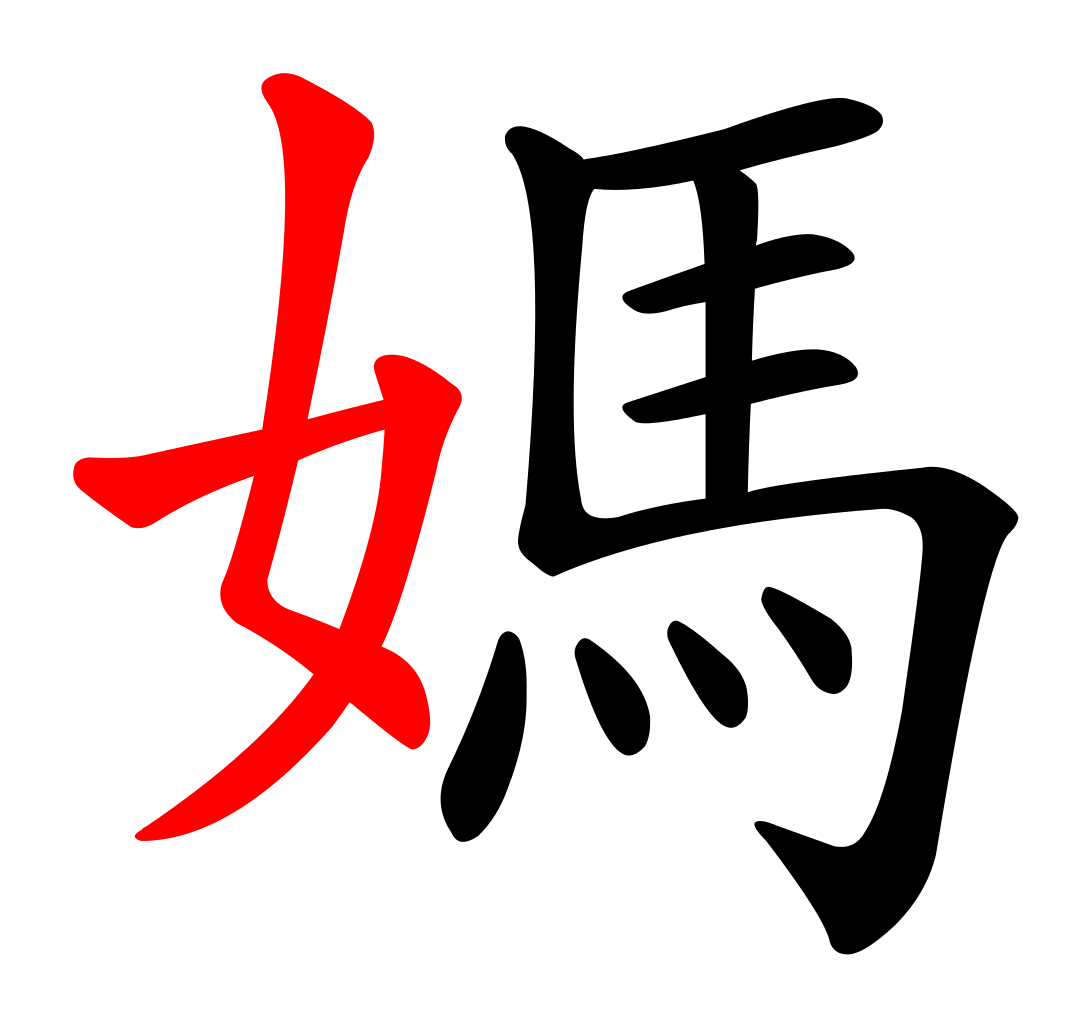
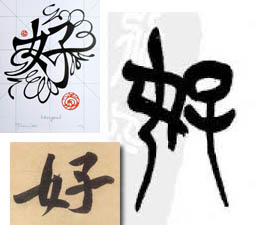
The vast majority of Chinese characters consist of two parts. The reason for this is that the first Chinese dictionaries, composed in the 3rd and 2nd centuries BC, organized the characters into semantic groups, and then the character of the given group became part of all the characters included. This facilitated memorization and the consulting of dictionaries. At the same time, new characters could be created by adding a new group name – 部首 bùshǒu, “group head”, in English radical) before an existing character, which thus took on a new meaning. For example, if we add the radical 女 nü “woman” before the character 馬 mǎ “horse” (which still shows the mane and the four legs of a horse, while its post-1956 simplified form 马 no longer does), we get the new character 媽 mā “mum” (simplified form: 妈), that is, “a word we pronounce like horse, but belongs to the group of woman words”). Woman 女 and child 子 make together 好 hǎo, “good” (see calligraphic variants here to the right), woman 女 and ancient 古 are together “aunt” 姑 gū. In the word 妻 qī “wife”, the sign of the woman is at the bottom. What we see above it is the long hair of the girl that she is braiding with her hand. And three women together 姦 jiān mean “evil” … perhaps the depressing memory of polygamy.

And speaking of women, it is well known how the combination of the “one child” policy and the pension system introduced by the Communist Party distorted China’s demographics. Since married couples can’t rely on their pensions, and with only their sons to support them in their old age, they obviously want the permitted “one child” to be male, because any girl would support her husband’s family. Therefore, since the sex of the unborn child can be determined in advance, a much higher proportion of female fetuses have been aborted than males. In mainland China, there were 117 men per 100 women in 2001, meaning that nearly 20% of men will not be able to find a wife back home because of the missing women.

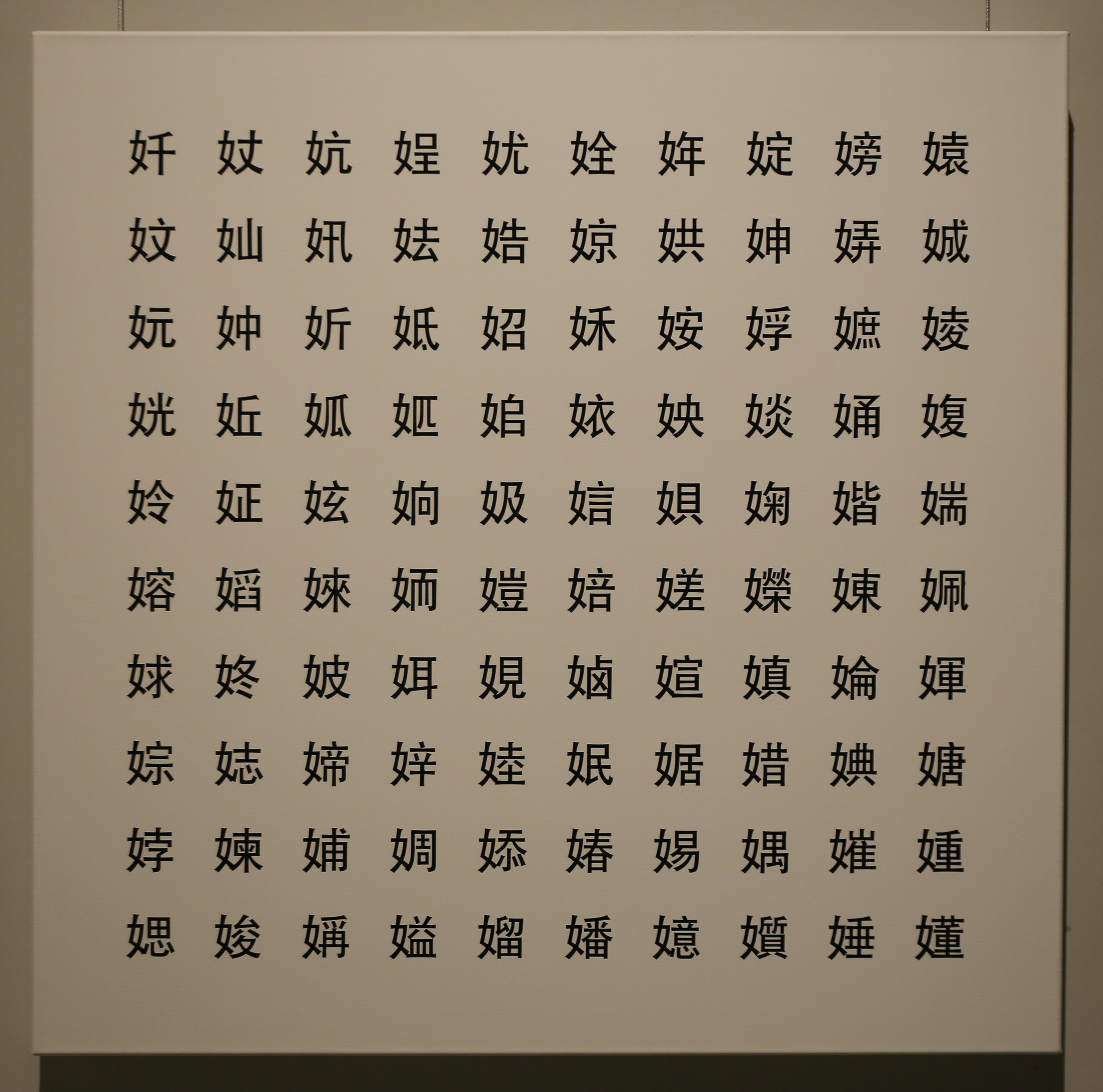
It is necessary to know all of this in order to understand the laconic painting on display in the recently opened Chinese exhibition at the Humboldt Forum in Berlin. The 2016 picture One Hundred Women was painted by Jia 嘉, born in 1979, who works a lot with Chinese characters. There are a hundred characters in the picture arranged as a chessboard, each of which contains the “woman” radical, that is, each means something related to women and femininity. Another common feature of these characters is that the communist writing reform evicted all of them from the set of accepted characters. They can no longer be used to express concepts for the nuanced recording of which they had been invented by the several thousand year old Chinese literature. The “femininity content” of Chinese culture has declined with the ban, just as with communist birth control. The proclamation character and message of the painting are underlined by the typography chosen by Jia, which is identical to that of early communist posters. As if it was publishing a list of one hundred women sentenced to death by the regime.


Sunday best


Festive Mass in Bârsana/Barcánfalva. The monastery complex, built in 1993 but referring to many centuries of tradition, is the idealized re-creation of a never-existed prosperity. Its church tower is the second tallest wooden building in Europe, preceding the 18th-century Șurdești/Dióshalom church. The mass of the faithful is constantly flowing around the entrance, from inside two nuns are singing on a penetrating, ringing voice.

Just thirty years ago, they still largely wore homespun clothes and plaited shoes in these parts, the spinning reel could not fall off the hands of women for any moment, the home production of tissues – enforced by poverty and isolation – gave a lot of work. The accessible prices of ready-to-wear clothes have changed a lot in everyday clothing, which, on the other hand, made the pieces of traditional costume an identity element to be consciously retained.


The general rise of nationalism brought back folklore elements into street fashion in Hungary, too, but here, in Maramureș they – not accidentally – appear more organic and continuous than the Matyó embroidery on the Budapest asphalt. Depending on the quicker or slower pace of labor market mobility, the ethnic wear is increasingly limited to the festive occasions. On these occasions, however, even those put on a piece of traditional costume or one referring to it, who do not wear it any more in everyday life.