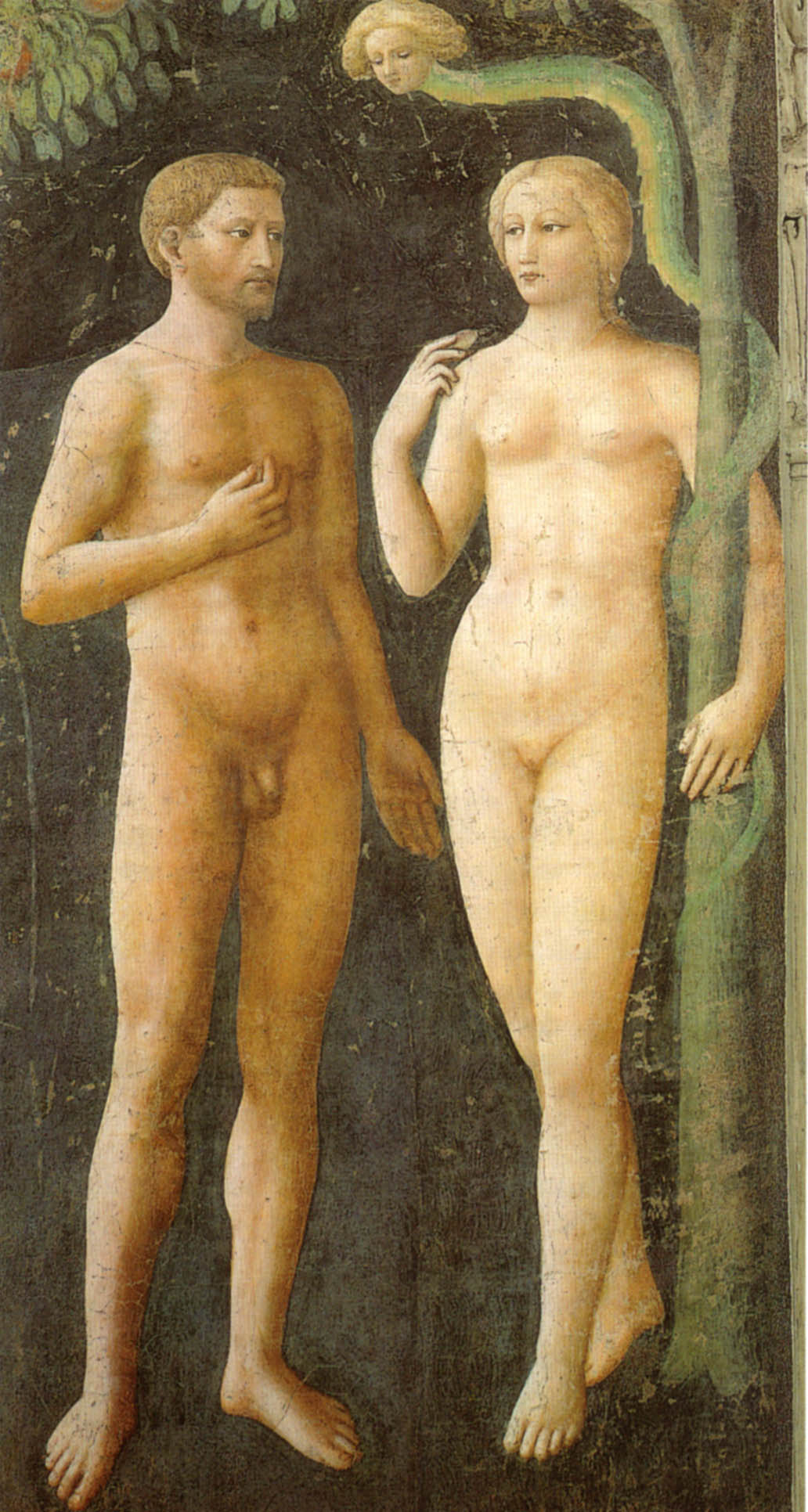

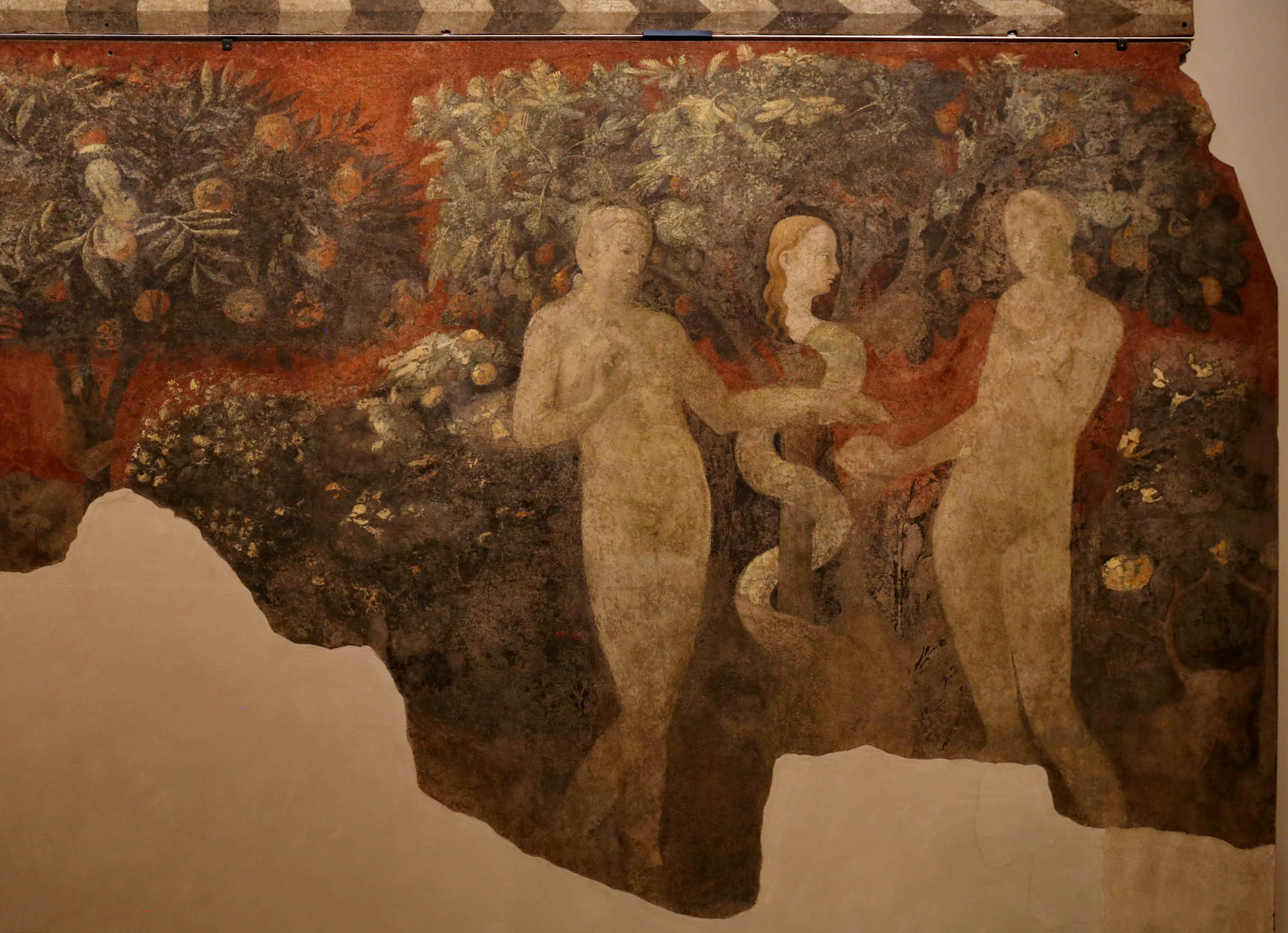
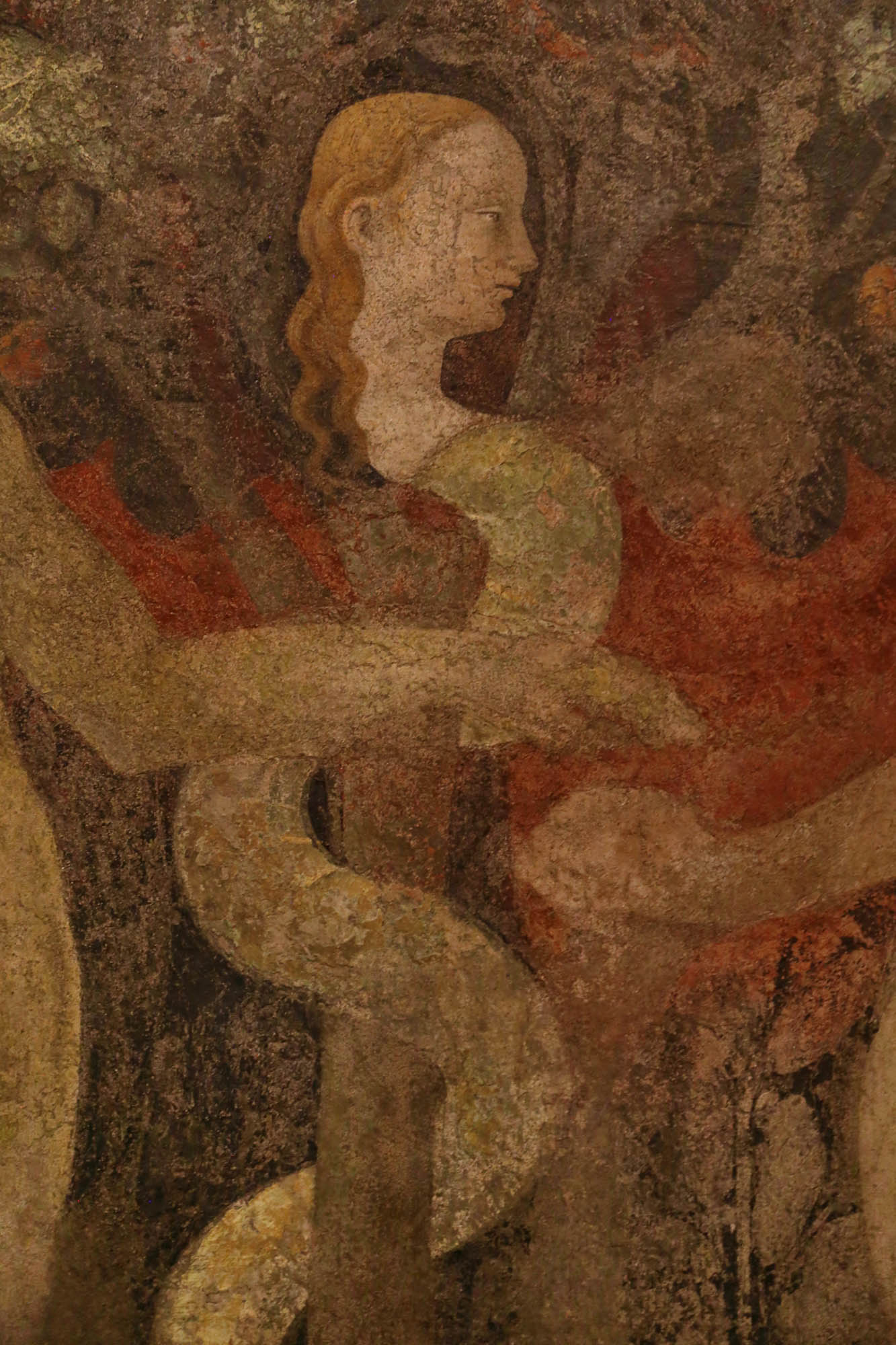
 One of the masterpieces of Florentine Renaissance painting, the fresco cycle 1424-1428) in the Brancacci Chapel of the Carmine Church, begins with the scene of the Fall from Paradise. While the cycle was made truly great by Masaccio’s contribution, the leading master here was Masolino, and he also painted the opening picture. In it, we see the first couple in a light, dancing, Gothic posture under the tree from which the tempting snake hovers over them. But this snake has a strangely human head: a charming female face with a hunge blonde crown of hair.
Who is this woman?
The well-informed would immediately reply: Lilith, Adam’s ex, who has been known to the educated European since Goethe’s Witch Saturday (1808):
| “MEPHISTO: Adams erste Frau! Nimm dich in Acht von ihren schönen Haaren, Vor diesem Schmuck, mit dem sie einzig prangt, Wenn sie damit den jungen Mann erlangt, So läßt sich ihn so bald nicht wieder fahren.” | “MEPHISTOPHELES: Adam’s first wife is she. Beware the lure within her lovely tresses, The splendid sole adornment of her hair! When he succeeds therewith a youth to snare, Not soon again she frees him from her jesses.” |
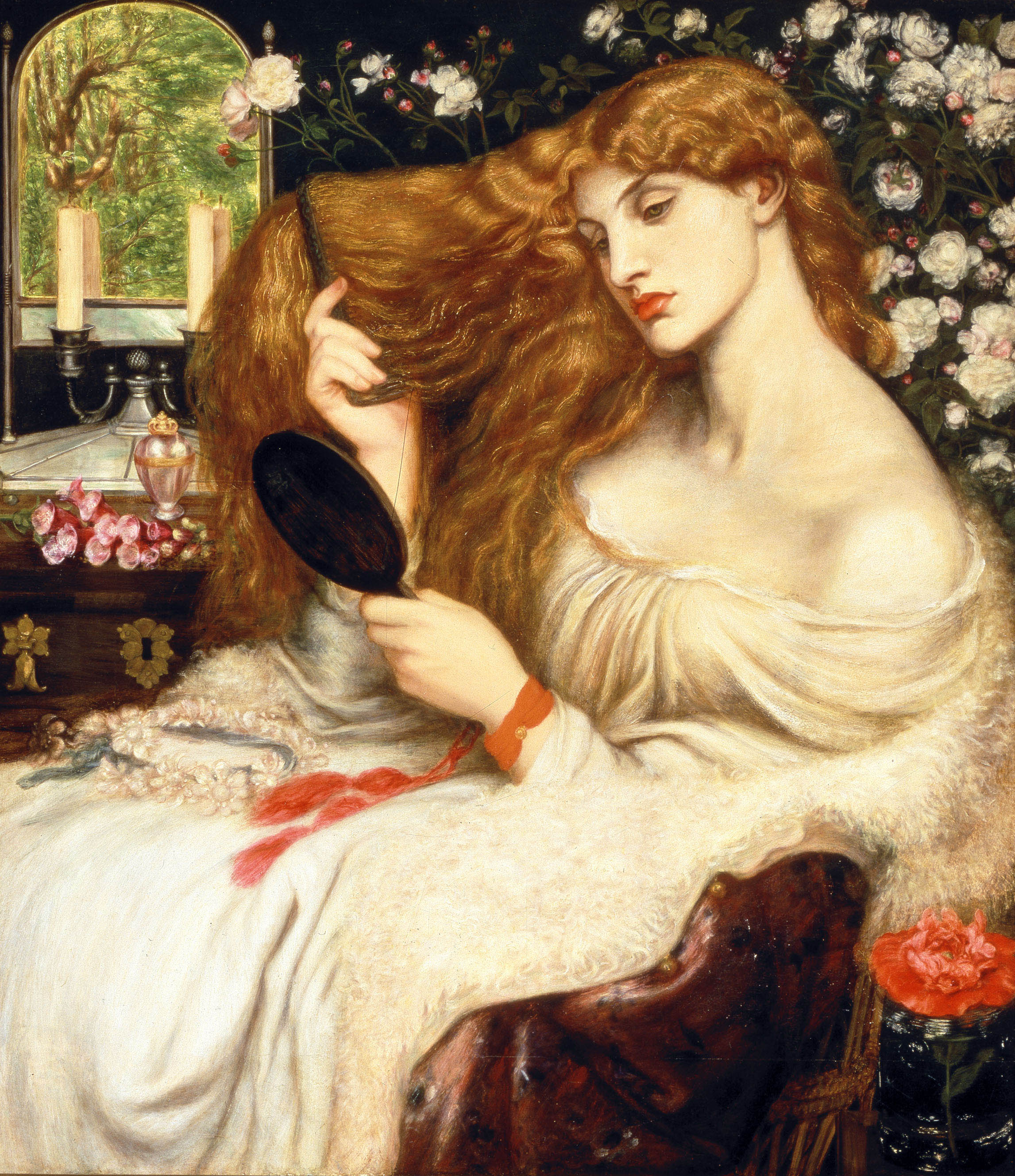
This picture is also taken from Goethe by Dante Gabriel Rossetti, the founder of the Pre-Raphaelite school, in his sonnet entitled Body’s Beauty, published in 1881, which, however, originally accompanied his picture Lady Lilith (1866-1873) with the title Lilith:
| „Lo! as that youth’s eyes burned at thine, so went Thy spell through him, and left his straight neck bent And round his heart one strangling golden hair.” |
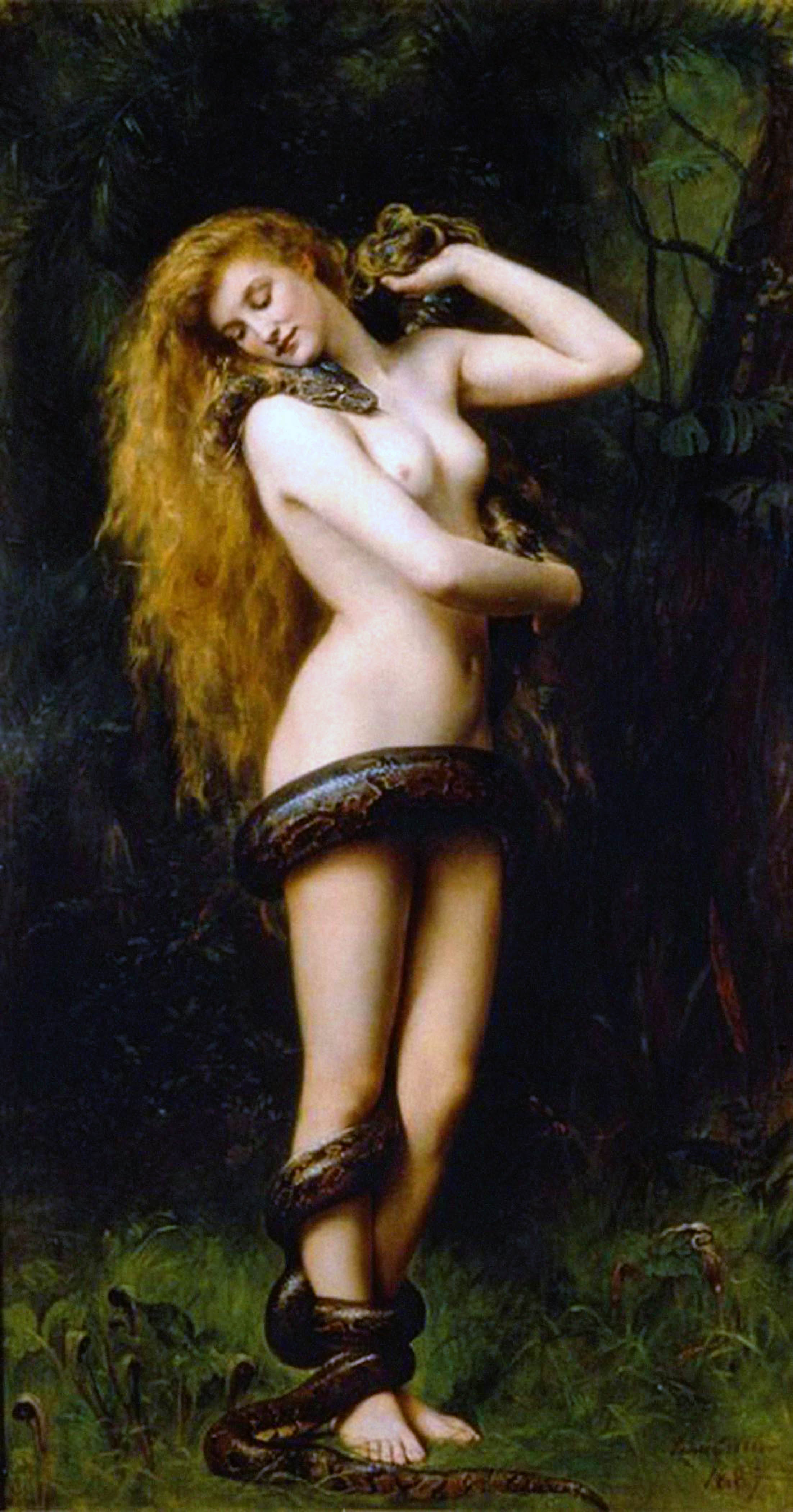 The other impressive Pre-Raphaelite portrait of Lilith by John Collier, 1892, Merseyside, Atkinson Art Gallery
However, we know that the devil is the father of lies, and thus the marriage certificate shown to Dr. Faust that mentions Lilith is also a big fake.
In fact, Lilith appears in one single place in the Hebrew Bible, in Isaiah 34 (13-16), where the Lord foretells how He would destroy Edom:
“Thorns will overrun her citadels, nettles and brambles her strongholds. She will become a haunt for jackals, a home for owls. Desert creatures will meet with hyenas, and wild goats will bleat to each other. There the lilith לִילִית will also lie down and find for themselves places of rest. The owl will nest there and lay eggs, she will hatch them and care for her young under the shadow of her wings. There also the falcons will gather, each with its mate.”
The role of the lilith is here to mark, along with all the other ominous beings, how desolate the Lord makes Edom. But as to exactly what kind of being it is, we are not told, since the name is a hapax legomenon, a word that only occurs once in the Bible. Nevertheless, it must have been familiar to the Jews of the period if it could be used to indicate the extent of destruction. As if we were reading today that a place has become a home for vampires and orcs, the nest of Dracula. The products of the fantasy literature of the last hundred years are pretty much in the public consciousness, they don’t need to be explained.
The words lili and līlītu in the Mesopotamian languages Sumerian, Akkadian and Assyrian, meant ʻspirit’, in some texts a disease-bearing spirit living in the wind. It was probably from there and in this sense transferred into the Aramaic language spoken by the Jews of Babylon and the Bible. In the 4th to 6th century AD, “bowls of incantation” were widespread in the area: these were hidden in the base or ground of the houses as traps to catch the liliths intruding in the houses. These bowls were used by all local cultures and languages. Several hundred of them have been found from Jews with texts in Aramaic. biblical or talmudic references.
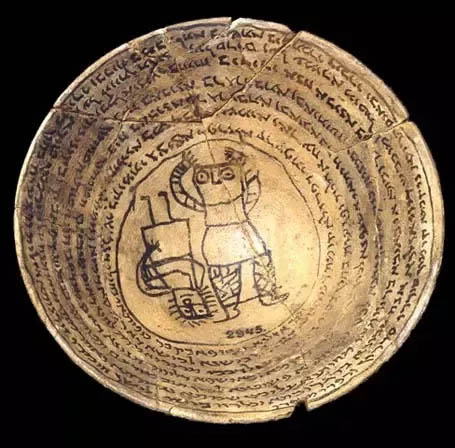 A Jewish bowl of incantation from the 6th century (above) and its contemporary counterpart collected by Penn Museum (below)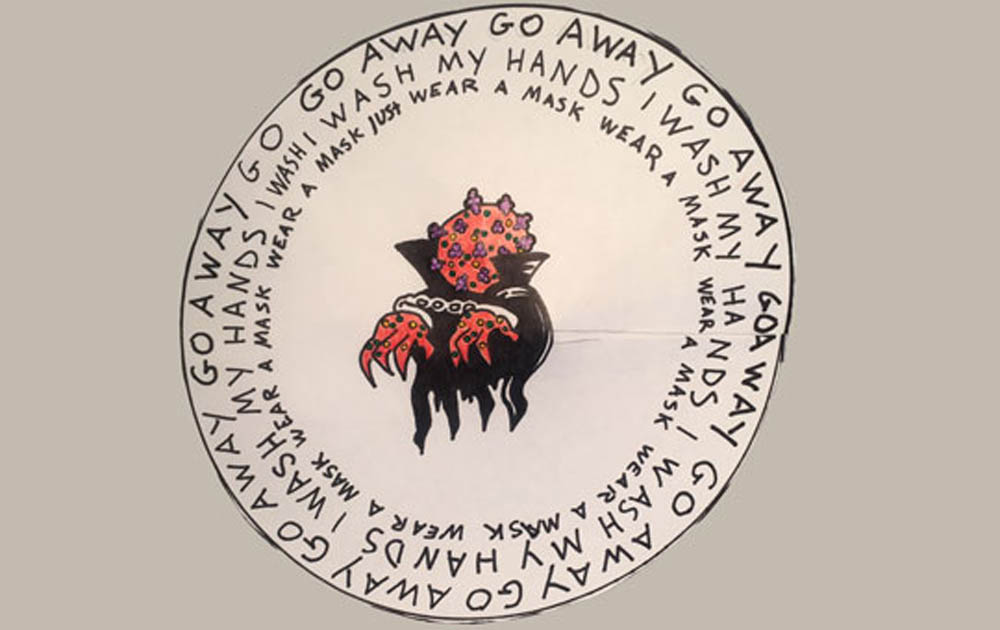
Typically, Bible translations did not know what to do with the name. The Septuagint, the Greek translation of the Diaspora Jews merges the hyenas with the lilith under the name “onocentaur”, and translates the goat, understood as a satyre, as “demon”.
| “καὶ συναντήσουσιν δαιμόνια ὀνοκενταύροις καὶ βοήσουσιν ἕτερος πρὸς τὸν ἕτερον ἐκεῗ ἀναπαύσονται ὀνοκένταυροι εὗρον γὰρ αὑτοῗς ἀνάπαυσιν” | “and demons will meet onocentaurs, and they will cry to each other; there will rest the onocentaurs, finding a resting place there.” |
Basically, this translation is followed by the Vulgate, the Latin translation of St. Jerome, which translates the lilith as lamia, a child-devoring female demon in Greek mythology:
| “et occurrent daemonia onocentauris et pilosus clamabit alter ad alterum, ibi cubavit lamia et invenit sibi requiem” | “and demons will meet onocentaurs, and hairy beings cry to each other. The lamia also abides there, it finds a resting place there.” |
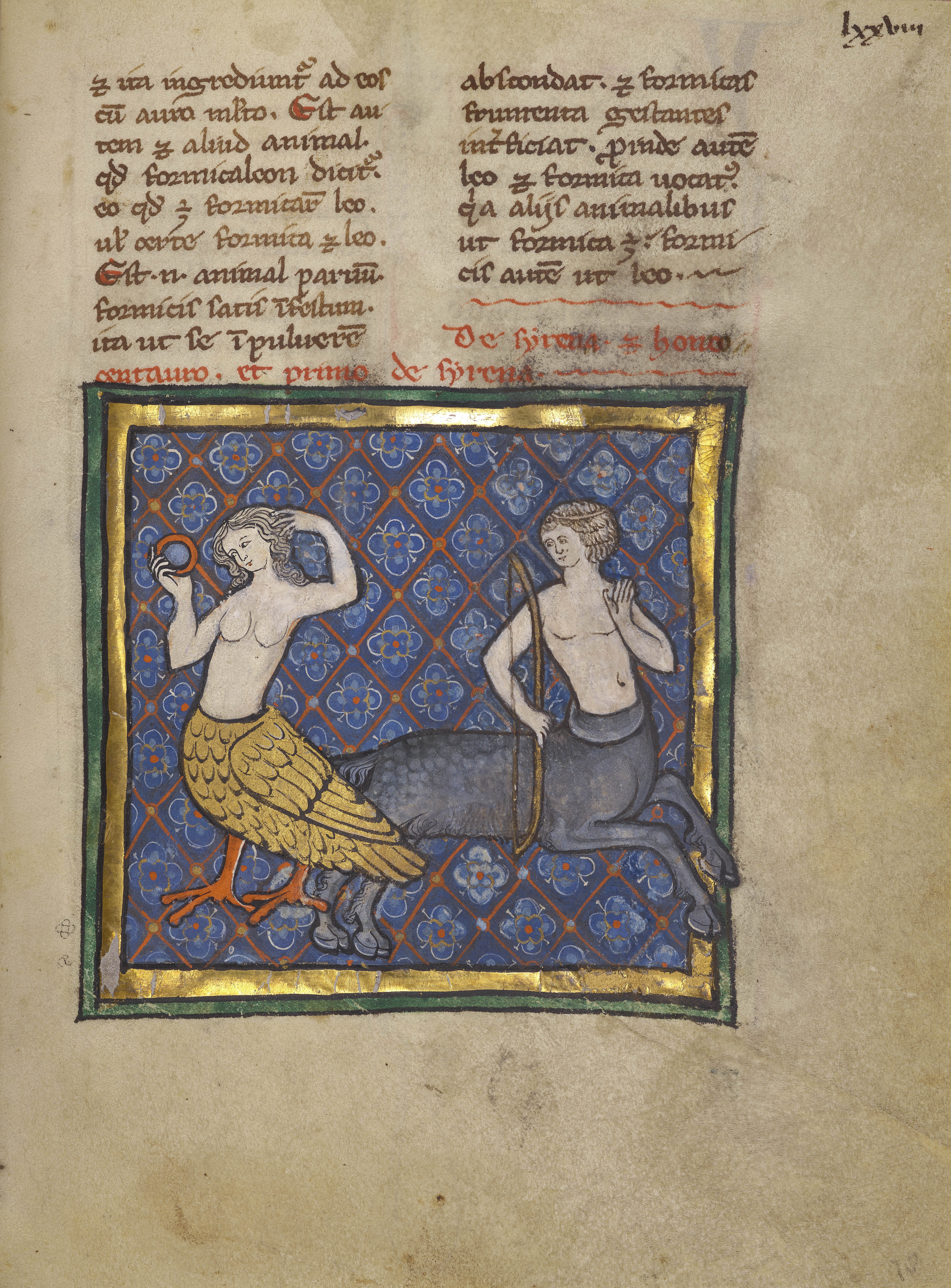
The meaning of ʻonocentaur’ was only slightly clearer than that of the lilith. Based on ὄνος = donkey, it was interpreted as a kind of donkey-centaur. This is how a 12th-century Franco-Flemish bestiary depicts the encounter of the demon with the onocentaur:
In Jewish rabbinic literature, the name only occurs four times, always referring to the text of Isaiah, in a sense of “evil spirit” until the 8-10th c. AD, that is, well into the Middle Ages, when a Hebrew treatise called The Alphabet of Ben Sira made it a person. The treatise contains twice 22 proverbs in Aramaic and Hebrew, arranged according to the Hebrew alphabet, and illuminates the meaning of each with a Midrashic story. According to the story that interests us here, Ben Sira heals the sick little son of King Nebuchadnezzar with an amulet. When the king asks him what he wrote on the amulet, Ben Sira tells him that God kneaded the first human couple from the dust of earth, and they were thus equal. The woman, Lilith, therefore, did not want to lie under Adam in the bed, as required by Jewish sexual morals, but she wanted to be above. She rebelled and fled to the Red Sea, where she mated with demons. God sent three angels after her, Senoy, Sansenoy and Semangelof, who, however, failed to bring her back. All they could agree with her was that although she as a demon now had power to infect newborn children, nevertheless if the names of these three angels were written somewhere, she would not hurt the child there.
Literature considers this tractate a kind of satire, a compilation of parodies brought together by bored yeshivabohers, a huge hoax full of pedantic talmudic hochmetsing over assorted smut, from farting through masturbation to incest (for example, Ben Sira himself is said to be born from the union of Prophet Jeremiah with his own daughter). This is how seriously we have to take the tradition of Lilith as Adam’s first wife. True, in the double creation story of the Book of Genesis, God first creates the man and the woman in His own image (Gen 1:27), and then He creates the woman from the rib of the man (Gen 2:22). For believers in the literal interpretation of the Bible, these were two creations: but then, where is the first woman? This logical hiatus was made up for by the yeshivabohers with the lilith which stood without any real meaning in the Bible and the Talmud. Before them, however, neither the Jewish nor the Christian exegetical tradition raised and answered this question, especially not by creating a “first wife”.
In any case, the amulet recommended against child death sounded too good to be left behind. Better safe than sorry, the amulet began to become a reality in Jewish circles, and was widely used until the 20th century.
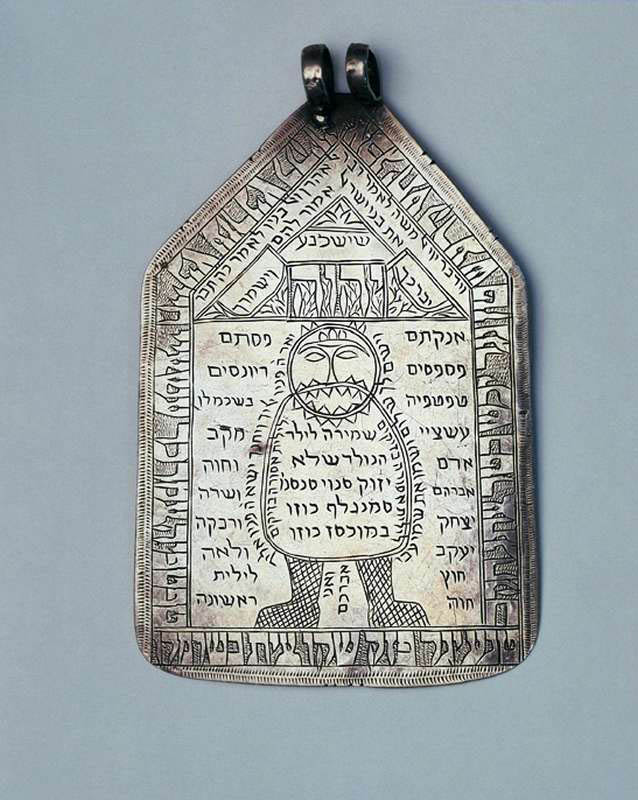
 A medieval amulet, with the names of the three angels in the three bird-like figures, from the Amsterdam 1701 edition of Sepher Raziel HaMalach (Archangel Raziel’s Secret Book) (above), a 18th-century printed kimpetbrivl (kind+bet+briv, child-bed-letter) from the Jewish Museum in Berlin (below), and a 19th-century silver amulet with the figure of Lilith from the collection of the Israel Museum in Jerusalem (more below)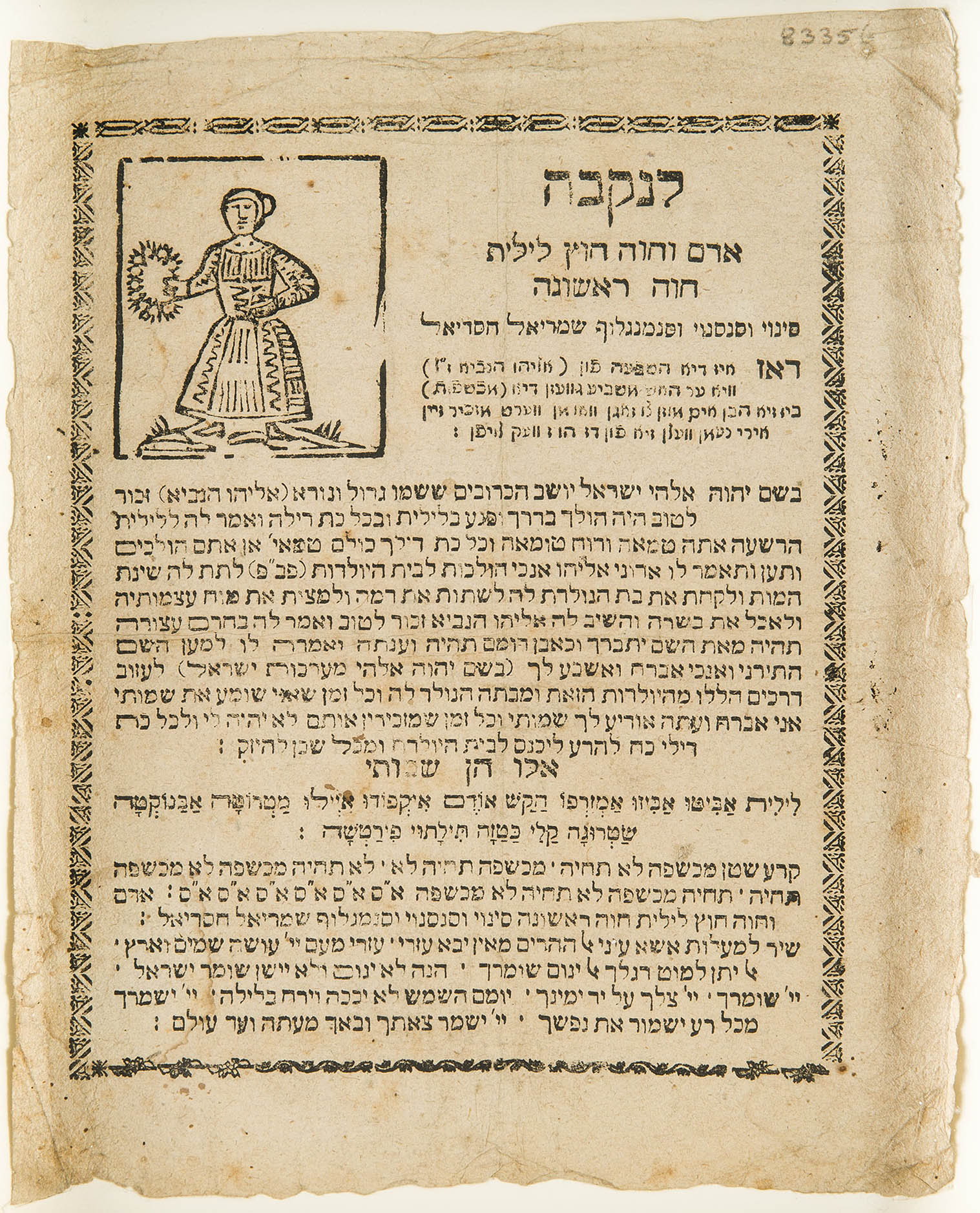
And along with the amulet, the idea of Lilith as Adam’s first wife gradually took root in Jewish folk religiosity. However, this idea excited Christians even more, when they first became acquainted with this Jewish tradition which they considered a very ancient and holy secret knowledge. This happened just in Florence at the end of the 15th century, when in Lorenzo de’ Medici’s Platonic Academy, of which Pico della Mirandola, the first Christian kabbalist, was a member, they started translating excerpts from the Kabbalah and rabbinic literature. This is how the motif appeared in works of artists who were visitors of the Academy.
Filippino Lippi, for example, painted in the Filippo Strozzi Chapel of Santa Maria Novella the first four patriarchs, including Adam as he protects his little son Seth from Lilith (while he still casts a dreamy look at his ex of rich red hair). Some art historians also see Lilith in Michelangelo’s temptress in the Sistine Chapel, or in Bosch’s first woman in the Garden of Earthly Delights, but their arguments are not convincing: these works can be perfectly explained from the medieval Christian tradition, which we will see below.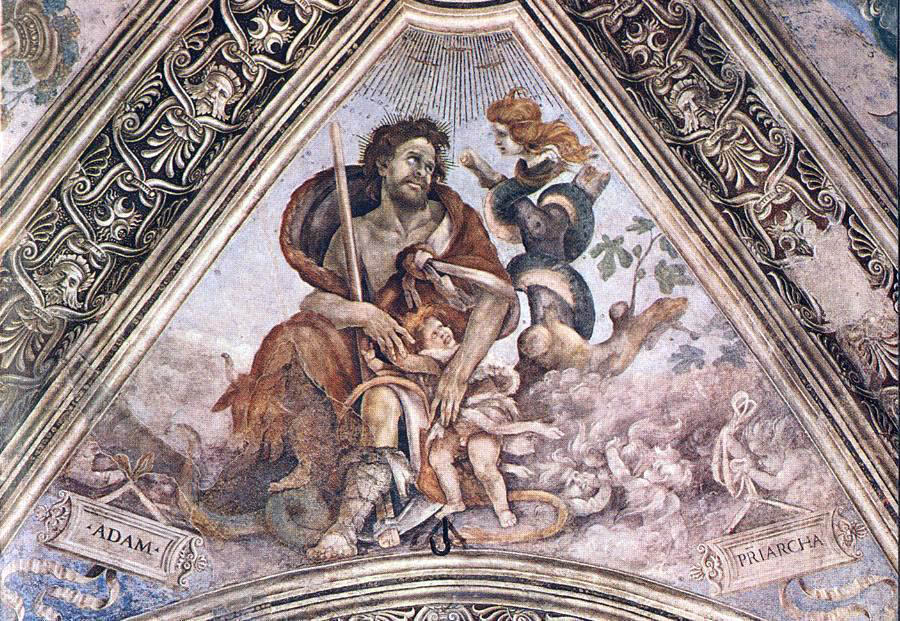
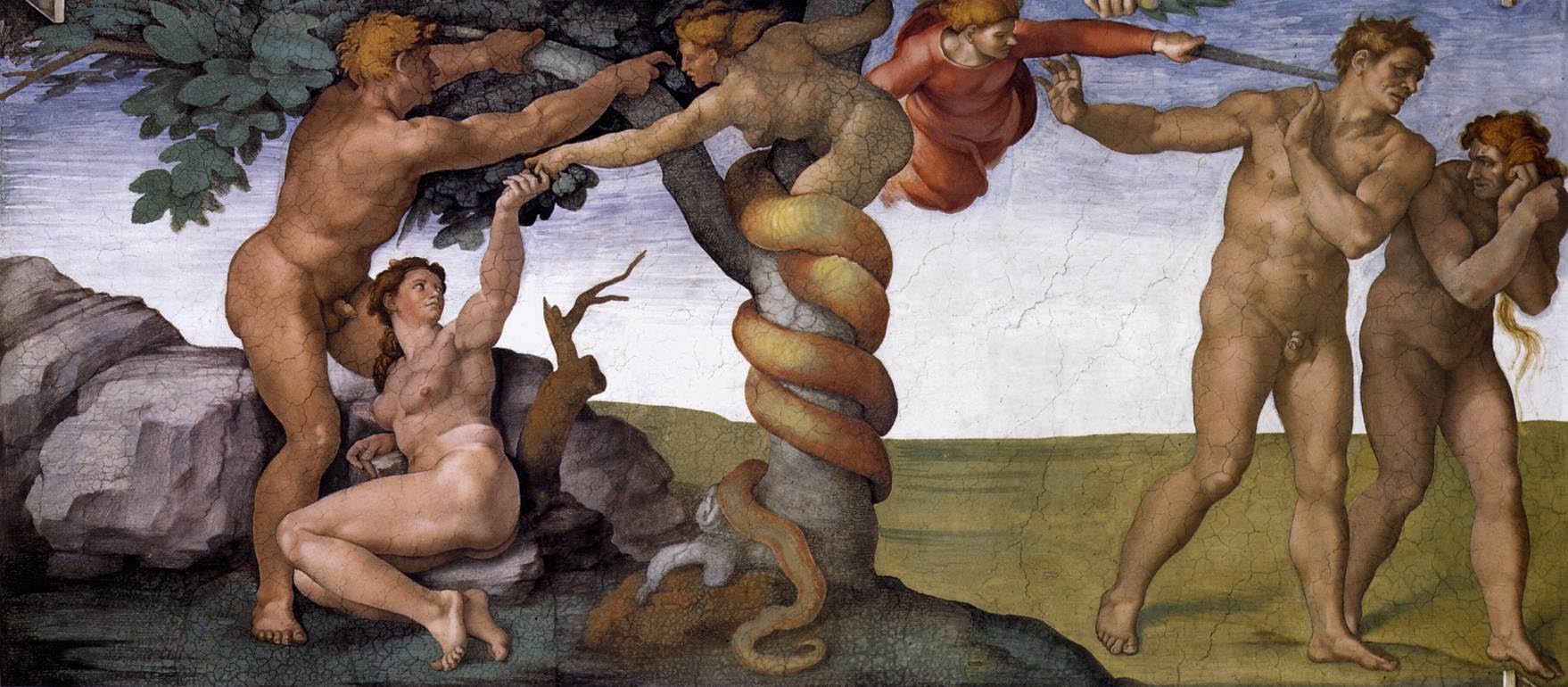
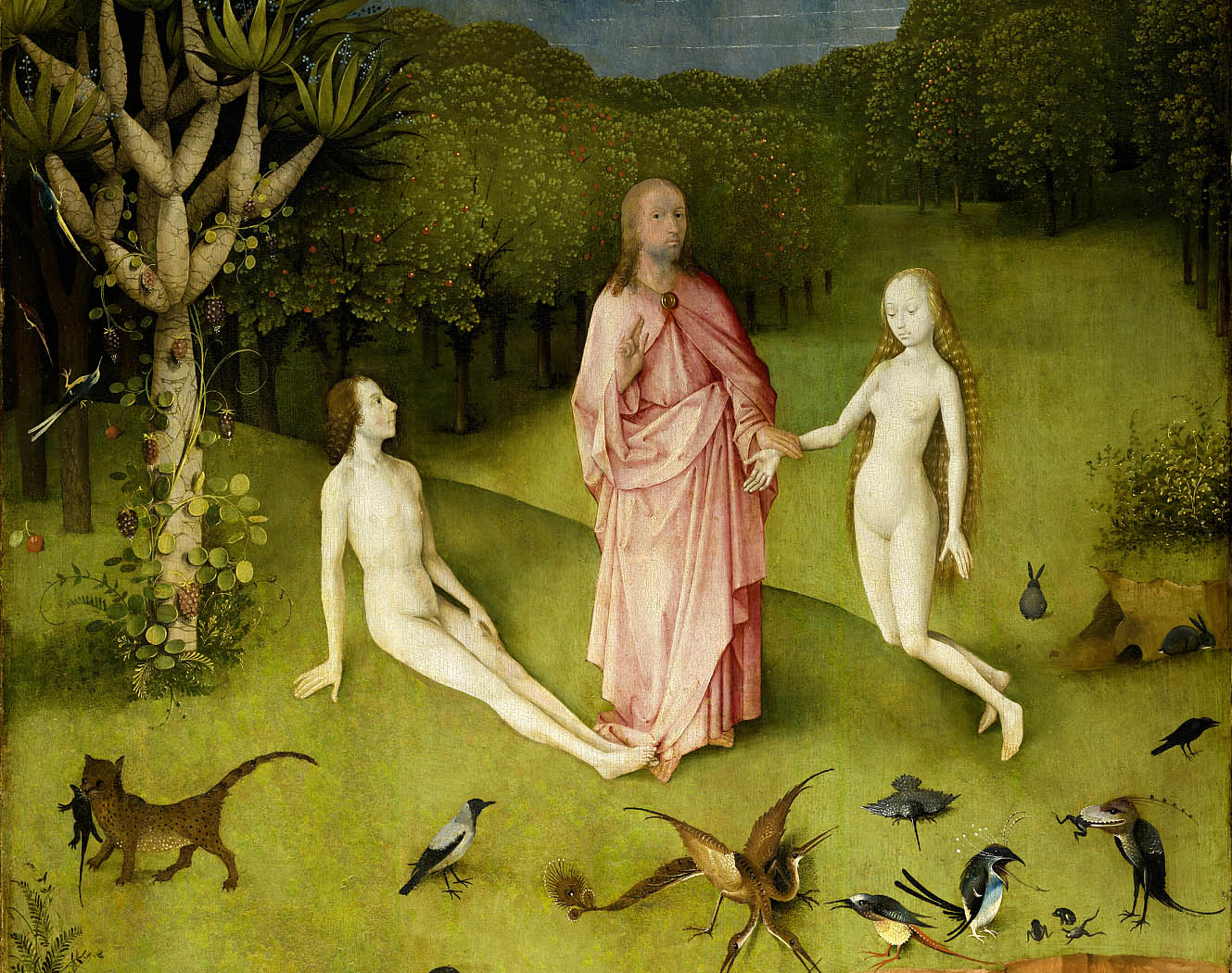
The Neoplatonic trend, however, died out in the 16th century. Lilith was resurrected by Goethe, and elevated to new heights and made a “Victorian icon” by the Pre-Raphaelites, so much that she is now considered a feminist patron saint as the first woman who did not renounce her equality with man.
It is interesting to see how modern Bible translations change with the spread of the Lilith myth, and how Lilith, created by the yeshivabohers, Goethe and the Pre-Raphaelites, moves into the barren homestead of the lilith as a harmful spirit of Is 34:14. Luther still translates lilith as Kobold, the later versions as Gespenster, ʻspirits’, while the Geneva Schlechter of 2000 as Lilith. The earliest English versions as lamia, borrowed from the Vulgate, the King James Version as screech owl, while the later English versions represented it more and more as lilith, and even Lilith. The first – Protestant – Hungarian version has éji boszorkány (night witch), while the new Catholic version has Lilith. The myth seems to have done a good job, and soon you will be able to prove from the Bible itself that Lilith was a central figure of ancient Jewish faith, at least since the time of Isaiah.
 The very first printed amulet against Lilith. Amsterdam, c. 1700. “Adam and Eve, excluding Lilith. Senoy, Sansenoy and Semangelof guardian angels, break the Satan.”
The image of the maiden-headed serpent tempting Adam and Eve in paradise, however, had been born much before the Jewish esoteric tradition was translated in the Medici court: in fact, not long after the yeshivabohers’ arsing-about gave birth to Lilith as Adam’s first wife. Its author, Petrus Comestor was the head of the 12th-century Parisian theological school, who in 1173 published his Historia scholastica, the “popular Bible” of the Middle Ages, which became a basic handbook of the university curriculum and was translated into most European vernaculars. He wrote:
“Because Lucifer was afraid of being found out by the man, he approached the woman, who had less foresight and was [like] «wax to be twisted into vice» and this by means of the serpent; for the serpent at that time was erect like a man, since it was laid prostrate when it was cursed. … He also chose a certain kind of serpent … which had the countenance of a virgin, because like favors like; and he moved its tongue to speak, though it knew nothing itself, just as he speaks through the frenzied and the possessed.”
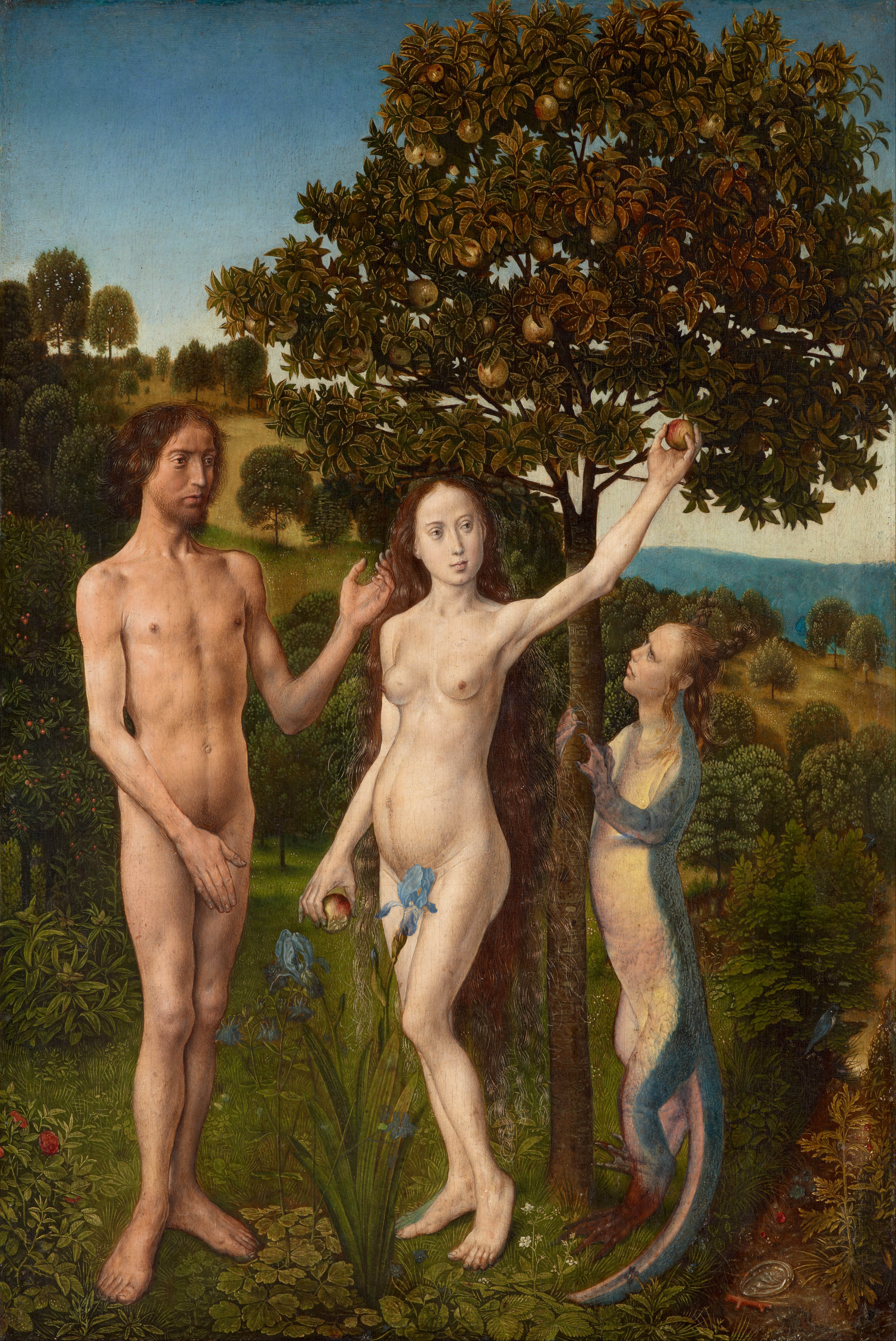 A maiden-headed snake standing on two feet in Hugo van der Goes’ The fall of man (after 1479), in Vienna’s Kunsthistorisches Museum
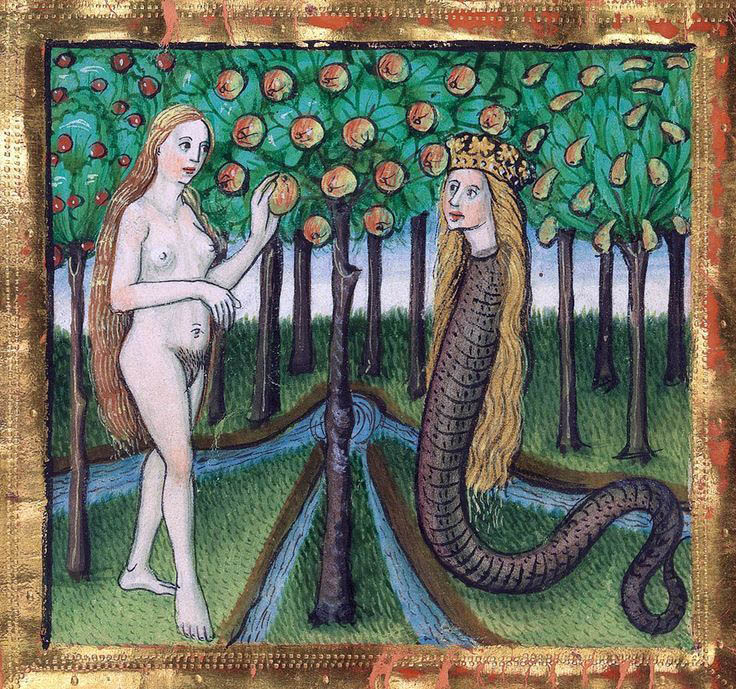 An erect snake. Furtmeyr Bible, Regensburg, after 1475
 Speculum humanae salvationis, German, 14th c. British Library, Harley 4996 f. 4v
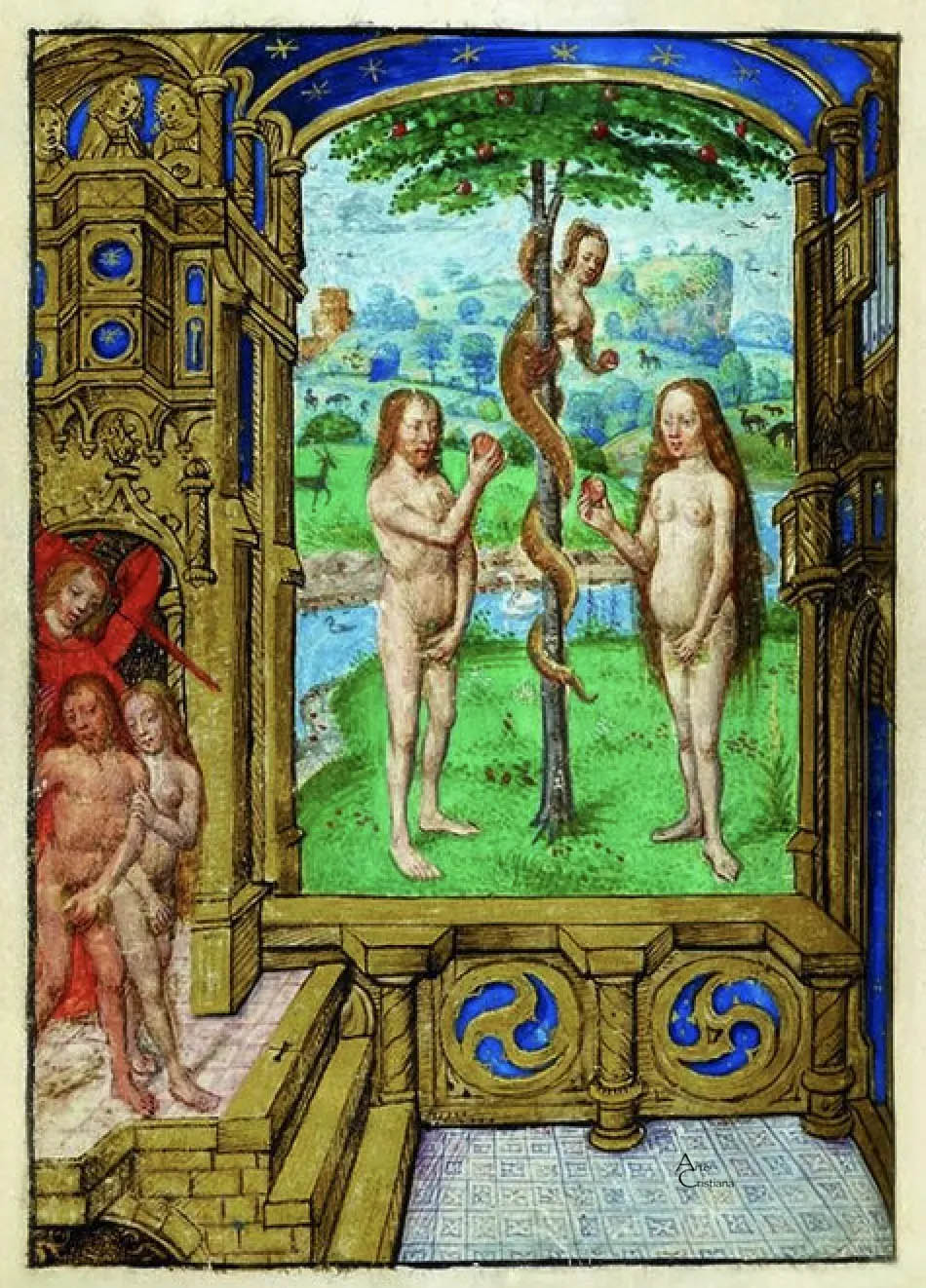 Johanna of Castilia’s prayer book. British Library, Add. MS 18852, fol. 15v
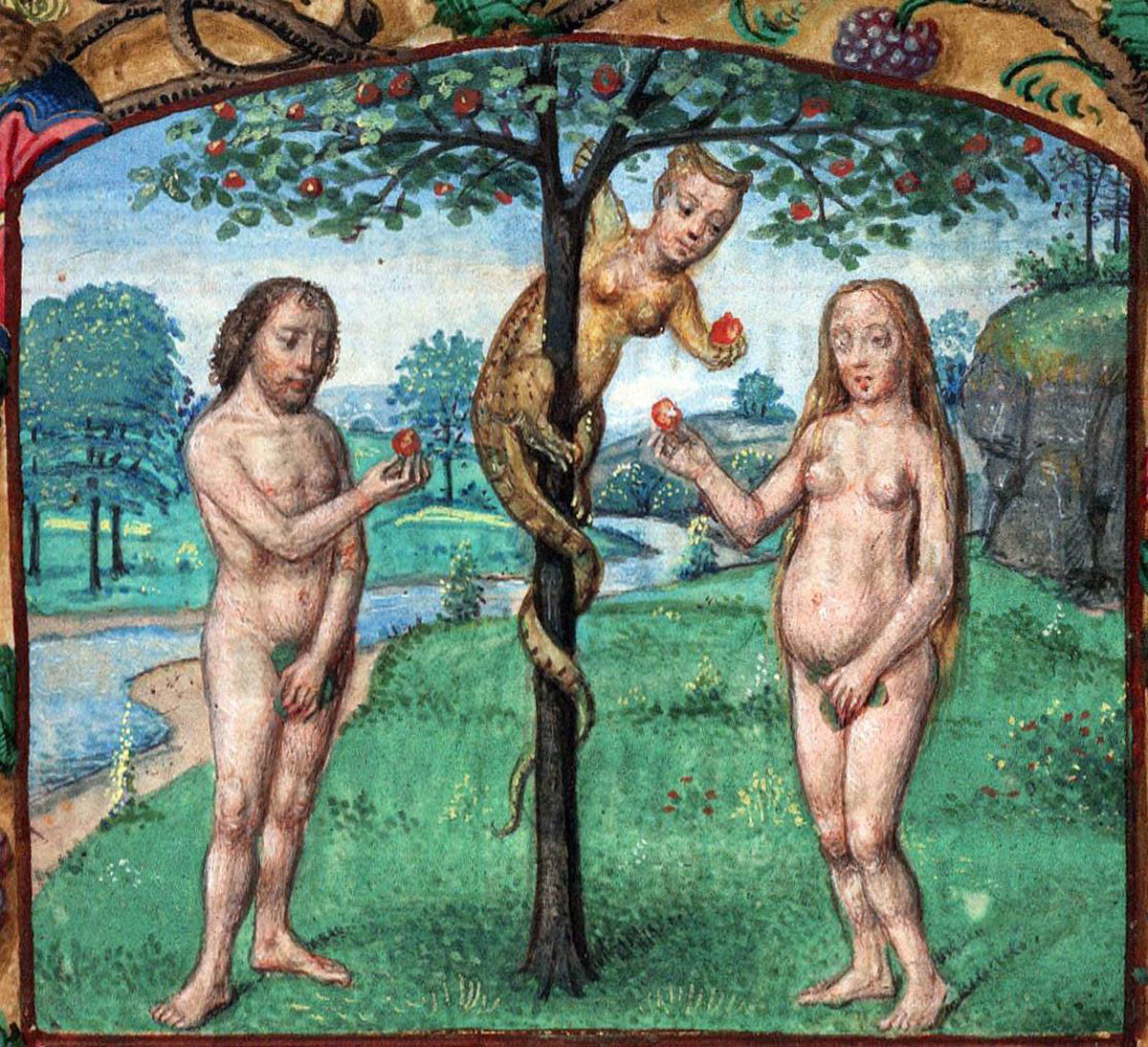 Book of Hours, Bruges or Ghent, 15th c. Beinecke Rare Book and Manuscript Library, MS 287, fol. 46r
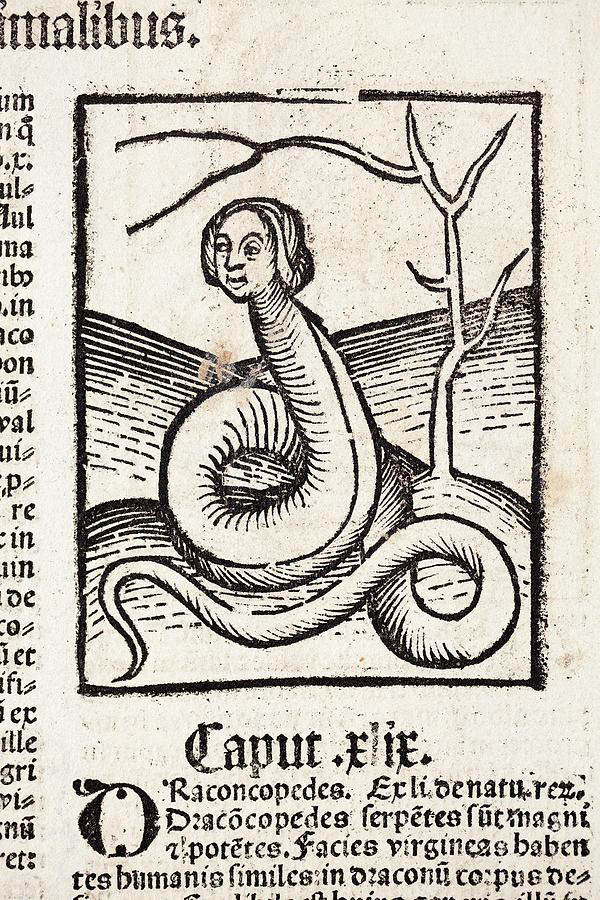 And here you have that “certain kind of serpent” chosen by Lucifer: the draconcopes (=ʻsnake-footed’). From the Hortus Sanitatis,1491. Originally from Vincent of Beauvais’ 13th-century Speculum naturale: “Draconcopedes serpentes magni sunt, et potentes, facies virgineas habentes humanis similes, in draconum corpus desinentes.” (Dracontopedes are large and strong snakes, whose maiden-face is similar to the man, but their body ends in snake body.)
The image was adopted by many authors. One of its most popular distributors was the 12th-century Norman-English mystery play Le Jeu d’Adam, which, in three acts, presented creation, the Fall and the prophecies about the coming of the Savior (here you can see its modern presentation). The piece, played across Europe, was mostly performed in front of the main gates of the cathedrals, and at a certain point displayed a “cleverly contrived” snake on a tree. It was certainly maiden-headed, because its figure also passed on to the carvings of the portals made at that time.
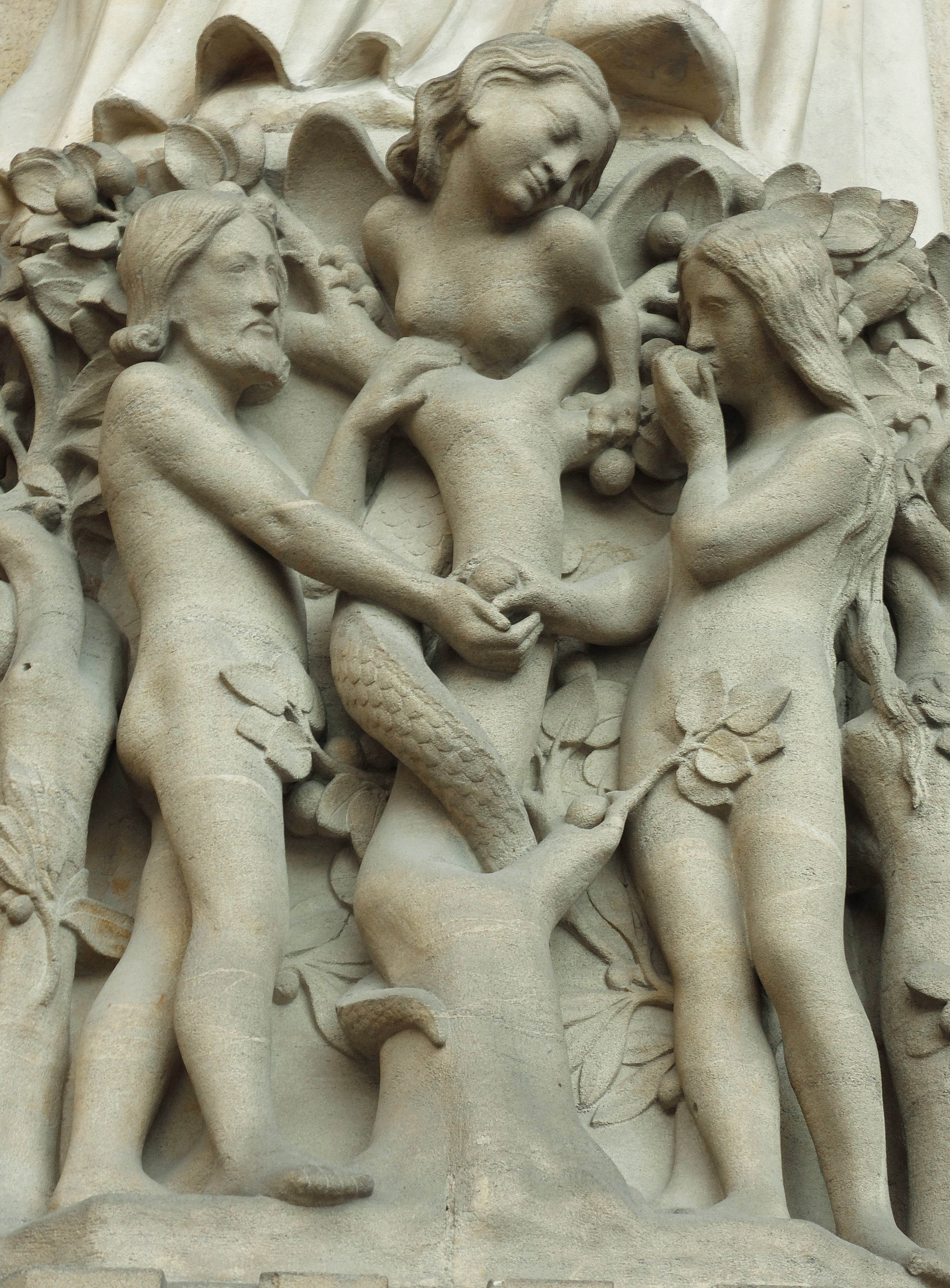 Paris, Notre-Dame, western façade, 13th c.
Another important mediator of the image was Boccaccio’s On Famous Women (De mulieribus claris), also translated into many languages. The series of famous women began with Eve, whose story, in the 14th- and 15th-century manuscripts, was illustrated with the Fall, invariably with a maiden-headed snake. The most moving example is the manuscript at the Getty Museum illustrated by the Boucicaut Master between 1413 and 1415, in the opening picture of which Boccaccio, sitting at his desk at the left side wall of the Paradise, is waiting for old Adam and Eve arriving from the right, to record oral history with them.
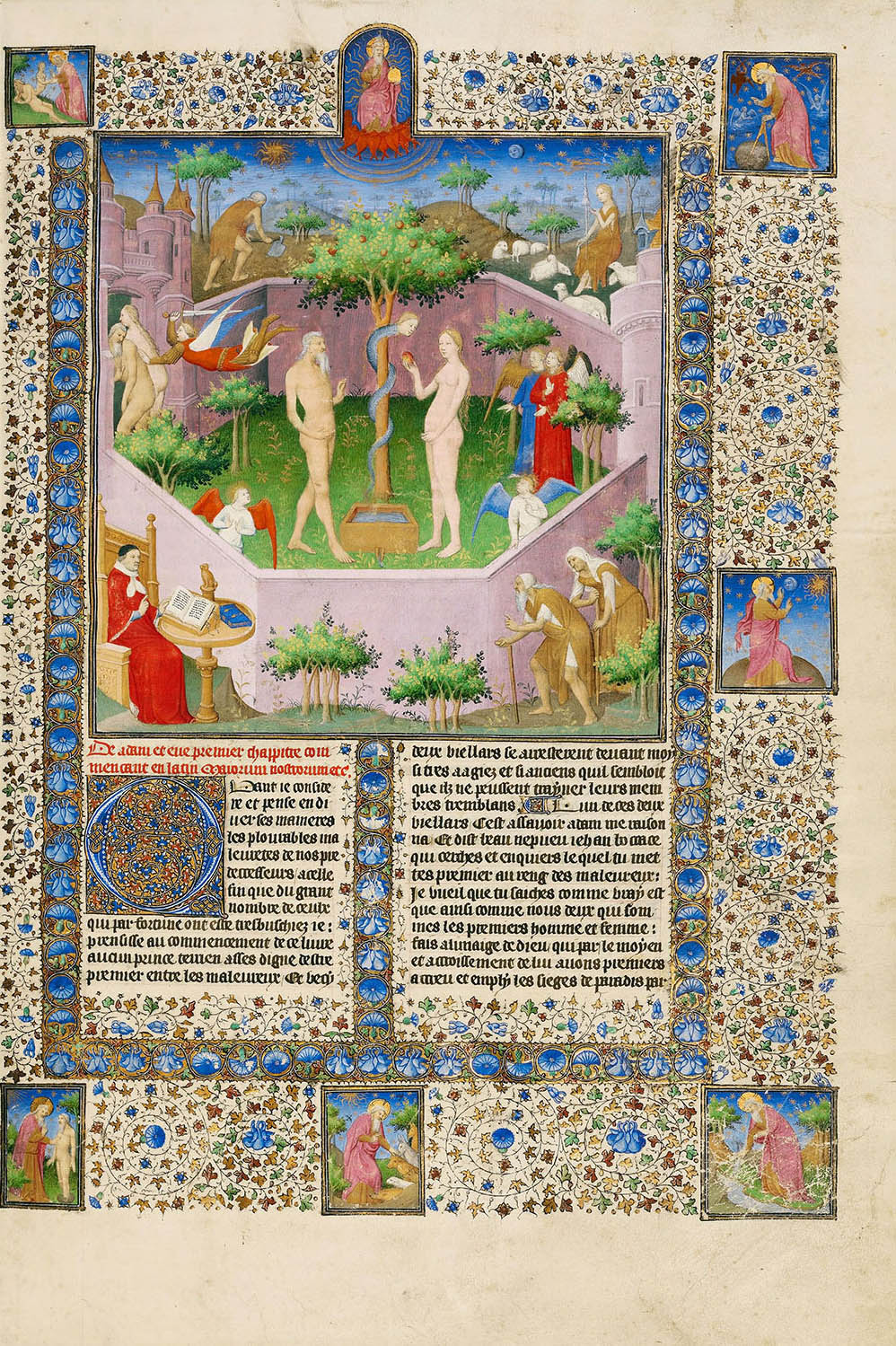
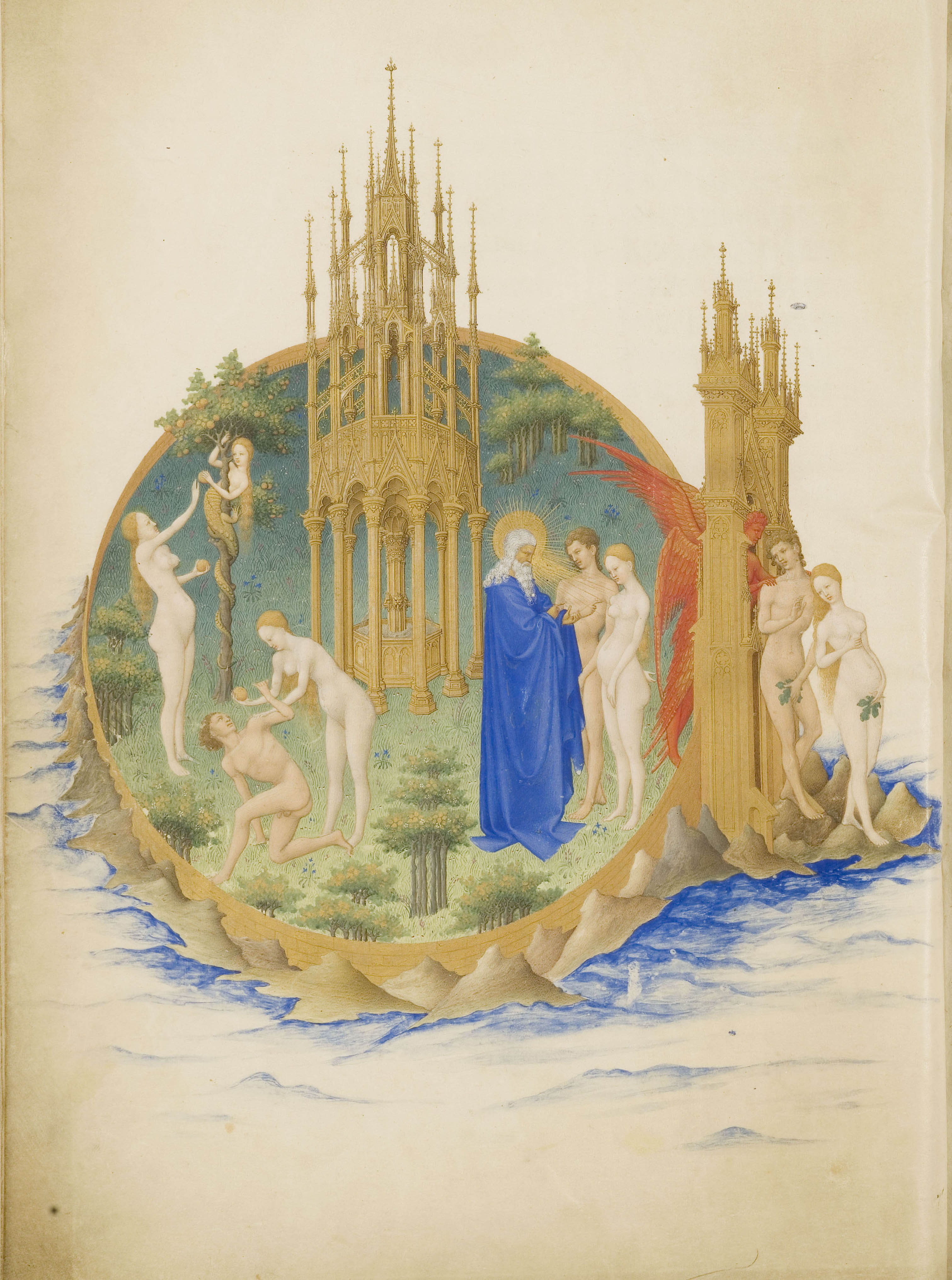 Très Riches Heures du duc de Berry, Limbourg brothers, between 1411 and 1415, fol. 25v
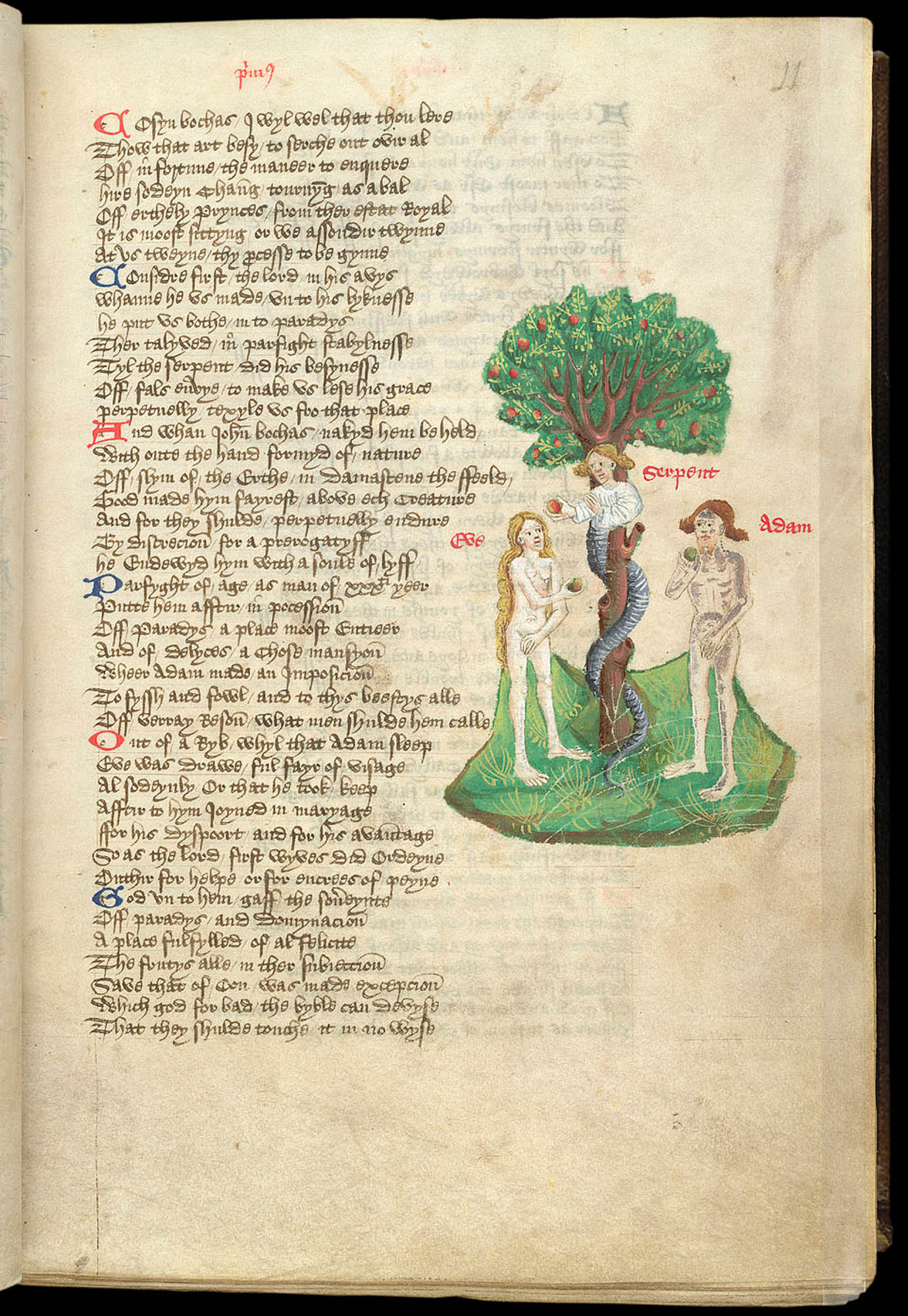 Boccaccio, The Fall of Princes, translated by John Lydgate, 1450-60. British Library, Harley 1766, fol. 11r It was only a step away from the work of an Italian author to an Italian painter to paint the motif as well. In the early 1420s, Paolo Uccello was commissioned to paint the cycle of Creation and Fall in the so-called Green Cloister of Santa Maria Novella in Florence. The pictures – which were severely damaged by the 1966 flood of Arno – were still fresh when Masaccio worked here on the fresco of the Trinity, and in parallel on the fresco cycle of the Brancacci Chapel, where a similar woman-headed tempter would soon appear.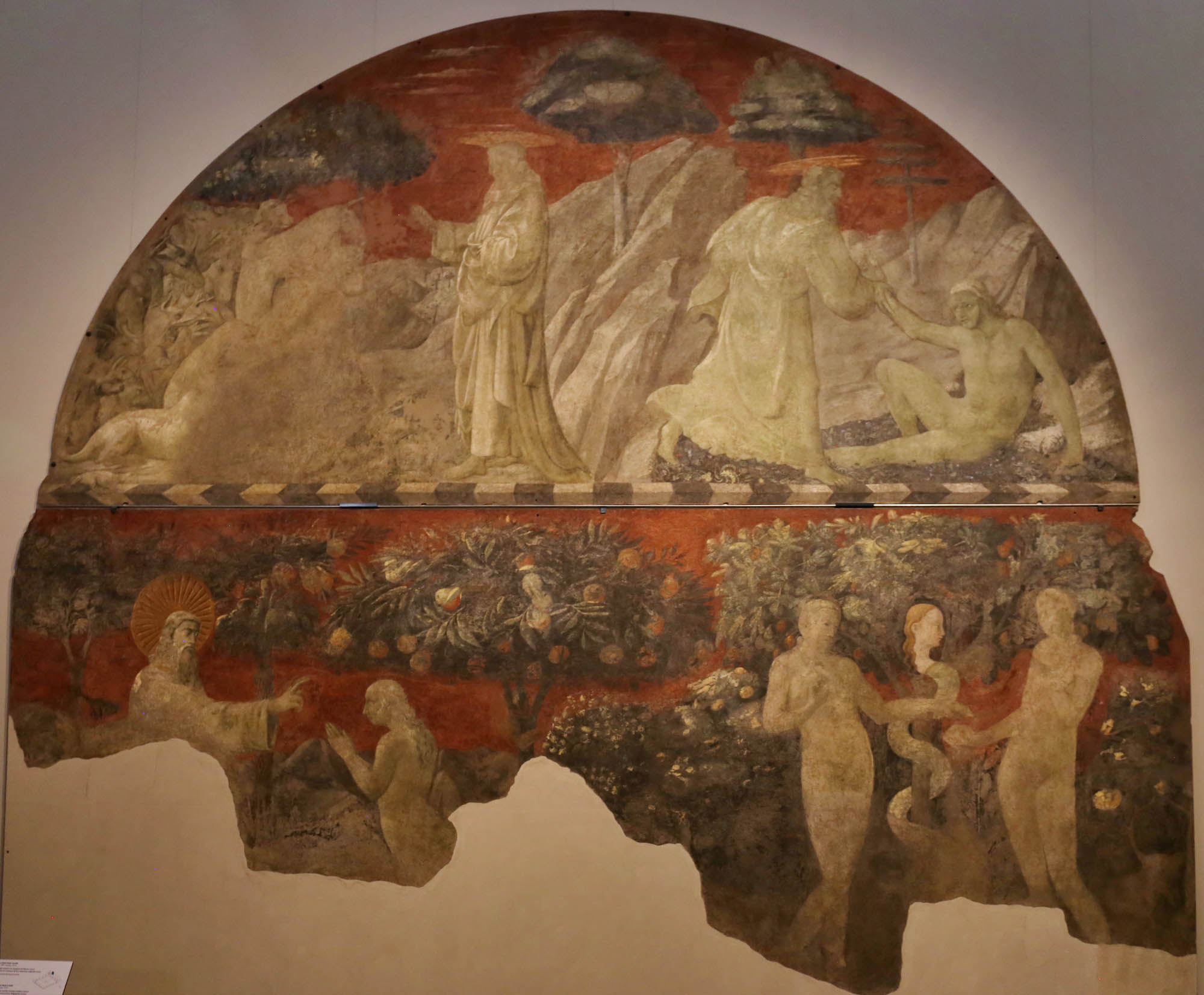
We have seen the actors; let the cycle begin.







 Come with us to…
 Atlantis
 Bestiary
 Bohemia+Prague
 Books, exhibitions, music, film
 Brave old world
 Caucasus
 Cemeteries
 Crimea
 Get to know the
 Images of the East
 Lightwriting
 Lwów/Lemberg
 Mallorca
 Message on the wall
 The Museum of Propaganda
 Odessa
 Paper Museum
 Persian letters
 The Jewish heritage


