 It will turn exactly 100 in this year, but it is just as fresh and vivid as when its author Tanburi Cemil Bey first recorded it on wax cylinder. In the reality its author was not Cemil Bey, and it was not Chechen by birth, but Greek from the nearby island of Midilli, or Lesbos by its Greek name. From there it was brought by those wandering Greek baglama players making music in the cafés of fin-de-siècle Istanbul who, after the collapse – the Katastrophê – of the Minor Asian Greek world in the 1920s fled to Athens to create there the music of rebetiko exactly from such half Oriental and half Greek melodies.
Fin-de-siècle Istanbul, however, was still the capital of an empire, with multicolored population and musical life. The true richness of this music can be estimated only in recent years, with Kalan Müzik publishing in row the music of the last decades of the Ottoman Empire from archive recordings and in the authentic performance of modern musicians. The cafés saw, apart from the Greeks also Armenian oud-players, Sepharadic female singers and Turkish male gazel-singers, Azeri kamanche-players, wandering Kurdish lutenist aşıks and the Slavic and Albanian bards described by Ismail Kadare in The palace of dreams, and still flourished the Ottoman court, dervish and military music which, melting with the Classical and entertaining music of the West, produced an infinite number of exotic local sports of this latter. Istanbul is even today imbued with spontaneous music, from the loudspeakers of the Muezzins calling to prayer again and again to the chanting of the sellers and to the music broadcasted by various Anatolian radio stations in every shop and café, and we can imagine how much richer this music was before the 1920s, that is
 before the collapse of the Ottoman empire, the extirpation, expulsion or oppression of the ethnic minorities, the disappearance of the court and of the traditional elite and the suppression of the dervish orders put an end to this richness.
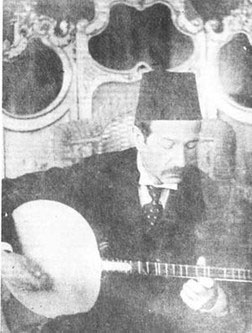
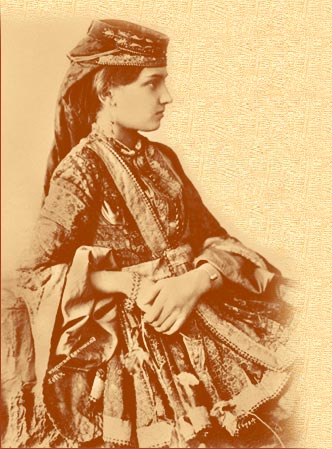
Of this world was an estimated figure Tanburi Cemil Bey, the unrivalledly talented musician who with the same perfection played on the Turkish tanbur – this is where his name comes from –, the Azeri kamanche, the Greek lauta, the Persian kanoun and a number of other instruments, and he also melted the musical worlds belonging to these different instruments and ethnic groups in his compositions played all over Istanbul and the empire. The “Chechen girl”, just like the enchanting “Circassian women” of the Romantic novels or the Russian “кавказская красавица” is that rosy-cheeked, black-haired, large-eyed and unattainable Caucasian beauty who used to be remembered frequently and with desire by the poets and café musicians of the empire. The Greek song singing about her was to become famous all over Turkey in the version of Tanburi Cemil Bey and with his characteristic improvised introduction Hüseyni taksim. Unfortunately I don’t have exactly that volume of the archive phonograph recordings of Cemil Bey where he plays the Çeçen kızı, but in the traditional interpretation of the Kurdish Sufi musician Kudsi Erguner and his ensemble we can feel something from the force of the original song.
Kudsi Erguner, Çeçen kızı, from the CD “Tanburi Cemil Bey”
On YouTube one can find several versions of this song, a restrained Ottoman-style orchestral piece, the performance by Cihat Aşkin rewritten for Western orchestra, or other versions bearing testimony to its great popularity, like the jazz version by James Brown Funk and Emin Findikoglu, an anonymous kanoun piece introduced with Hüseyni taksim, another one apparently played in an interval of a musical evening, and an amateur recording performed, as its title says, “by a Turk from the neighborhood of Amherst”.
I especially like three versions. The first one is performed by Necati Çelik and his traditional ensemble in the TRT TV, introduced with the Hüseyni taksim.
The second one comes from a video series presenting the antique instruments of the estimated Istanbul musical instrument maker firm Veysel Music House (how much I’d like to have a lute of their production!). Here it is played by Alper Taş on an oud made in 1910 by Beşiktaşlı Vasil.
The third one is a fusion version by the Balkan Messengers, in the sign of the Balkan nostalgy flourishing in the last twenty years in Turkey. Perhaps this makes you feel the best the forceful impact that this song could have in its own bygone world.
Balkan Messengers, Çeçen kızı, from the CD “Balkan Messengers 2”


 However, this small typo was only good to offer an occasion for the popularization of the Kulin ban. For both their site and their program is rich and beautiful, as is the music they play. Their first CD


 Come with us to…
 Atlantis
 Bestiary
 Bohemia+Prague
 Books, exhibitions, music, film
 Brave old world
 Caucasus
 Cemeteries
 Crimea
 Get to know the
 Images of the East
 Lightwriting
 Lwów/Lemberg
 Mallorca
 Message on the wall
 The Museum of Propaganda
 Odessa
 Paper Museum
 Persian letters
 The Jewish heritage


