Switch over to our new blog! • ¡Pásese a nuestro nuevo blog!
The renewed version of our blog, with more features, a richer design, and available in nine languages, can be read here: https://wangriver.com
The new version also includes the old posts, often in expanded form. If you are curious about the updated version of this post, replace “riowang.blogspot.com/” in the URL with “riowang.studiolum.com/”, and the new link will most likely lead you there.
La versión renovada de nuestro blog, con más herramientas, un diseño más rico y disponible en nueve idiomas, se puede leer aquí: https://riowang.com
La nueva versión también incluye las publicaciones antiguas, a menudo en una forma ampliada. Si tiene curiosidad por la versión actualizada de esta entrada, sustituya «riowang.blogspot.com/» en la URL por «riowang.studiolum.com/es/», y el nuevo enlace probablemente le llevará allí.
The two ways of seeing the mimosa reminded me of the question intriguing Batu, the protagonist of the daily comic strip Tute in the newspaper La Nación.
“Are you like you see yourself or like others see you?” … … … “I’ll ask my mom and I’ll tell you.”
This Metro Goldwyn Mayer short film about Buenos Aires in 1932 that I have just received from my mother is a further illustration of this essential question. Beyond the images that testify how the city looked at that time, the presentation is colored by the rather romantic and vague preconceptions of the filmmakers. Just like in the famous movie scene where Rodolfo Valentino is dancing tango dressed up as a gaucho and wearing a Spanish hat, here too the imageries of various people of Hispanic origin are intermixed, especially in the music. One could also object that the film shows only the nice aspects of the city and its people, while nothing is seen of the other, much more miserable and less pleasant reality of Argentina of the thirties, although it might seem exaggerated to demand so much social realism from a touristic and commercial film such as this.
Recently I had to act as a tourist guide in my own city, although I have to say I didn’t get to shine that much in this role (I don’t think I will be hired again). It served, however, to oblige me to look at Buenos Aires with different eyes. And of course this look has also included several places shown here in the video, really typical places of Buenos Aires now as then:
The Costanera Sur – Southern Riverside – at the start of the tour, which in the thirties was still a bathing place and where already there stood the impressive fountain sculpted by Lola Mora (in the last twenty years or so, after several years of neglect, nature took claim of the place and it has become an ecological reserve only some minutes away from the commercial district of the town).
The monument of the Spaniards where Libertador and Sarmiento Avenues cross, in the midst of Palermo Woods, my favourite image of the city.
“El Tigre,” a recreation spot that was very fashionable around the thirties and which has recently recovered part of its old splendour.
Maybe the most curious thing for me was to see the Palermo Hippodrome as it is shown here. In one of its buildings, remodeled years ago with its bleachers now encased in glass, we had our wedding party. I must say, however, that I had never heard anything about that prohibition of being out on the street without a jacket.
And then the other curiosities that have been lost, like the milk vendors leading their cows and the scarcely hygienic “pleasure” of drinking milk directly from the cow… Or the policemen acting as light signals and Calle Florida when it was not yet converted into a pedestrian street as we know it now.
And what to say about that man, Benito, who colored the pigeons of Buenos Aires to make them merrier? Again the question whether for themselves or for the others? because I doubt if the pigeons felt merrier after the artistic intervention, even if perhaps they cheered those who looked at their new colors.
By the end of the film we are absolutely convinced that Buenos Aires has always been a theater of all imaginable kind of madness.
Las dos maneras de ver al aromo me hicieron acordar al interrogante en que está inmerso Batu, el personaje de la tira diaria de Tute en La Nación
Es curioso que en momento tan oportuno mi madre me haya reenviado este corto de la Metro Goldwyn Mayer sobre Buenos Aires en 1932. Más allá de las imágenes que testimonian cómo era la ciudad en ese entonces, sin duda la presentación está teñida por los presupuestos bastante románticos y poco precisos de los realizadores. Como la famosa escena de Rodolfo Valentino bailando un tango vestido de gaucho y con sombrero español, aquí también se mezclan representaciones de varios pueblos de origen hispano; especialmente en la música. También podría decirse que las imágenes sólo muestran la parte brillante de la ciudad y su gente, mientras nada vemos de la otra realidad mucho más sufrida y menos agradable de la Argentina del '30. Aunque parece algo extemporáneo reclamarle tanta realidad social a un corto turístico y publicitario como éste.
Hace poco tuve que hacer guía turística en mi ciudad, aunque la verdad sea dicha, no llegué a lucirme mucho en mi labor... (no creo que vuelvan a contratarme), pero me sirvió para obligarme a mirar Buenos Aires con otros ojos. Y por supuesto, esa mirada se fijaba en muchos de los lugares que aquí se presentan. Bien típicos de Buenos Aires tanto ahora como entonces:
La Costanera Sur, comienzo del recorrido, que en el 30 todavía era un balneario y donde ya estaba emplazada la impresionante fuente hecha por Lola Mora (desde hace unos veinte años, tras muchos más de abandono, la naturaleza tomó el lugar y se ha convertido en una reserva ecológica a minutos del centro de la ciudad).
El monumento de los españoles donde se cruzan las avenidas del Libertador y Sarmiento, en medio de los Bosques de Palermo, mi imagen preferida de la ciudad.
El Tigre, lugar de recreo muy de moda por el 30 y que en los últimos tiempos ha recuperado parte de su esplendor.
Quizás lo que más curioso me resulte sea ver el Hipódromo de Palermo tal como lo muestran aquí. En uno de sus edificios, hace años remodelados y con sus gradas cerradas con vidrios, hicimos nuestra fiesta de casamiento. Eso sí, nunca había oído nada de aquella prohibición de salir sin saco a la calle.
Y luego otras curiosidades que se han perdido en todas partes como los vendedores de leche con vaca a cuestas y el “placer” tan poco higiénico de tomar la leche directamente de la vaca... O los policías que hacían de semáforos y la calle Florida cuando todavía no era peatonal en toda su traza, como la conocemos.
¿Y qué decir de aquel hombre, Benito, que coloreaba las palomas para hacerlas más alegres? De nuevo la pregunta ¿se es para el otro o para uno? porque dudo que las palomas se sintieran más alegres con la intervención artística, pero alegrarían a los que las miraban con sus nuevos colores.
En fin, nos quedamos con su imagen y con la certeza de que Buenos Aires parece haber dado siempre lugar a todo tipo de locuras.
Elegance, musical precision and an intimate voice devoid of shrillness are the things that define Horacio Molina’s manner of singing, A tanguero well immersed in the spirit of the tango but one who differs from the aggressive and excessively macho stereotype of the malevo.
The first song of his that I recall having heard is “Naranjo en flor” (Orange Tree in Blossom). It was frequently played on the radio by Alejandro Dolina on his program “La venganza será terrible” (Vengeance Will be Awful), a late late night show that continues to be on the air. There are voice timbres that enchant you. Horacio Molina’s is one of these.
Era más blanda que el agua, que el agua blanda, era más fresca que el río, naranjo en flor. Y en esa calle de estío, calle perdida, dejó un pedazo de vida y se marchó…
Primero hay que saber sufrir, después amar, después partir y al fin andar sin pensamiento… Perfume de naranjo en flor, promesas vanas de un amor que se escaparon en el viento.
Después… ¿qué importa del después? Toda mi vida es el ayer que me detiene en el pasado, eterna y vieja juventud que me ha dejado acobardado como un pájaro sin luz.
¿Qué le habrán hecho mis manos? ¿Qué le habrán hecho para dejarme en el pecho tanto dolor? Dolor de vieja arboleda, canción de esquina con un pedazo de vida, naranjo en flor.
She was softer than water, than the softest of waters. She was fresher than the river, orange tree in blossom. And in that summer street, in that lost street she left a piece of her life and went away…
First you must know how to suffer then how to love, and then to leave and in the end wander without thoughts… Perfume of an orange tree in blossom, vain promises of love that ran off with the wind.
Then… what matters then? All my life is yesterday that detains me in the past, eternal and old youth that has made me a coward, like a bird without light.
What did my hands do to her? What could they have done to leave so much pain in my breast? Pain like that of an old woods, song of a street corner with a piece of life, orange tree in blossom.
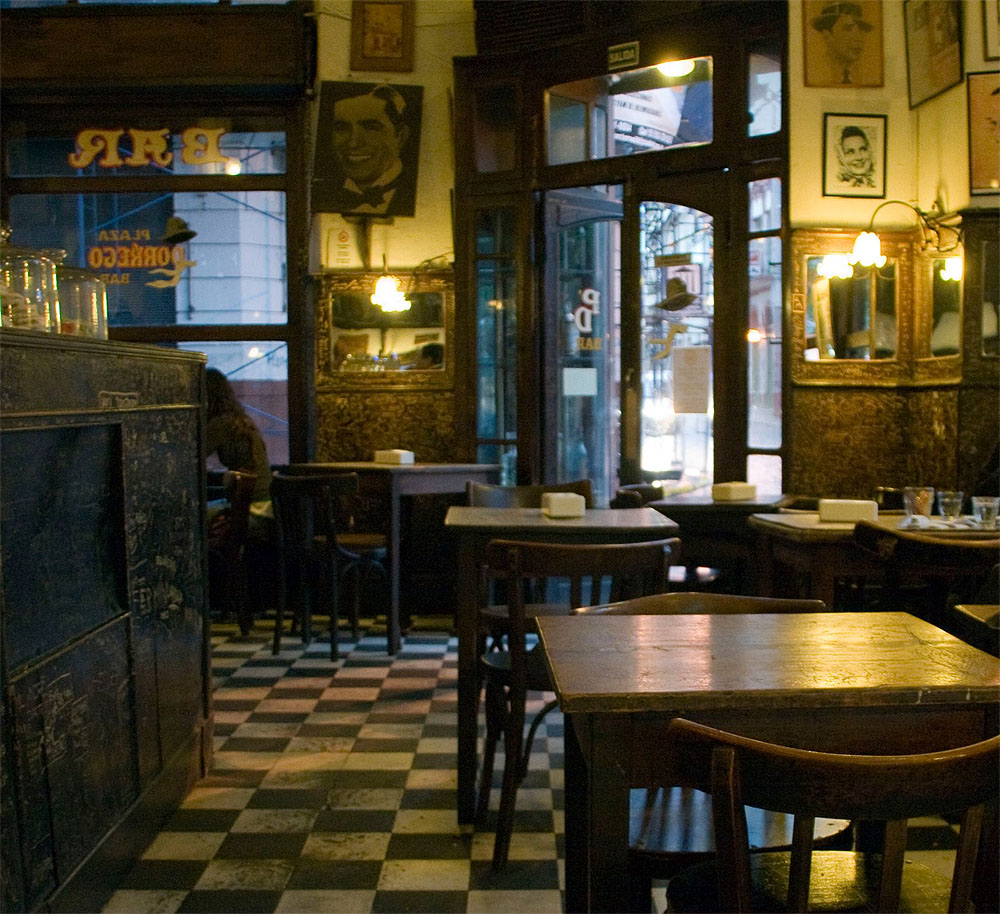
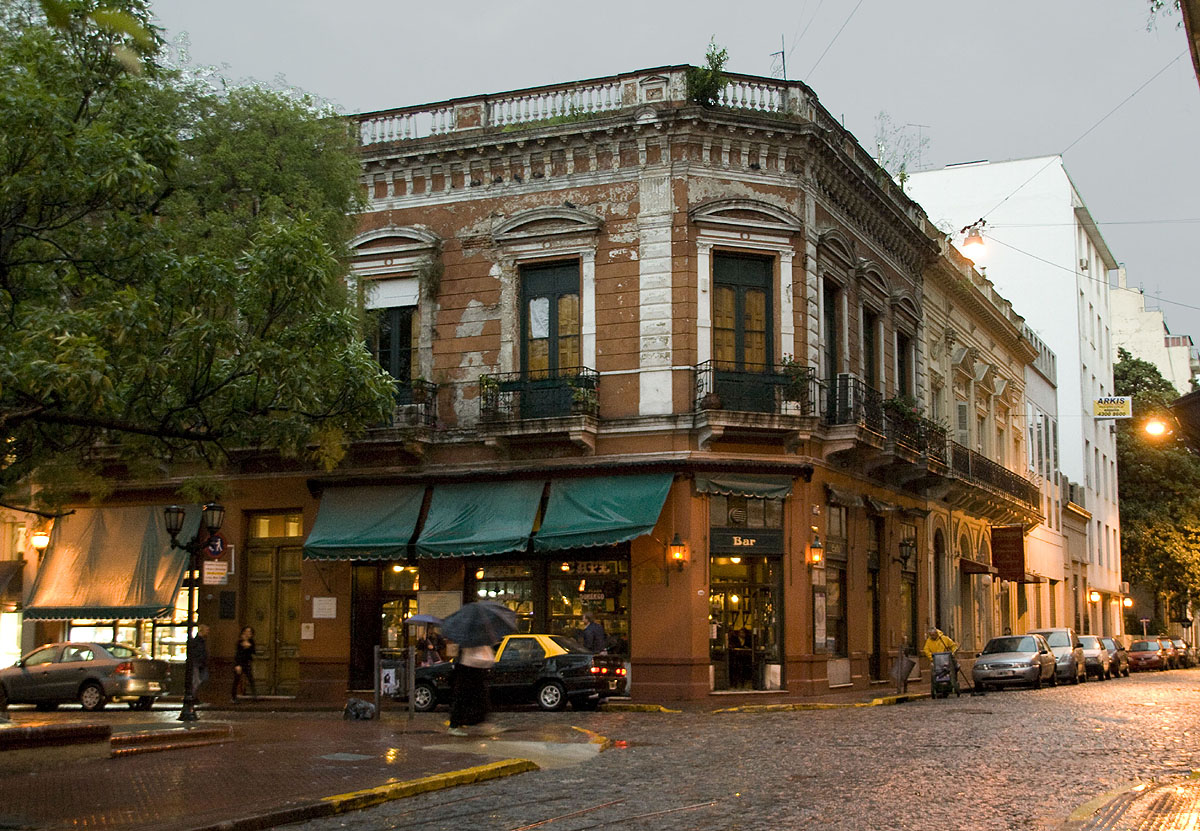
Bar in the Plaza Dorrego. Photos of Wang Wei
Molina is a confessed and enthusiastic admirer of Carlos Gardel. And like him, not only has a unique voice but also a particular manner of interpreting each song, a way of making vivid before our eyes each verse that he sings. And, of course, the pursuit of the tango-song or ballad which was given such an impetus by Gardel and which is recovered by Molina in our days as no one else does. This is what he speaks of in these two videos which embrace a large part of our musical history and where he expresses his artistic postulations on how he considers that the tango should be interpreted.
Horacio Molina’s biographies usually describe a family lineage that is evident to any porteño who hears his manner of speaking. (This 2007 interview scans with the minuteness of a connoisseur this characteristic of a social and economic class and of a cultural upbringing so peculiar to many of our families). And as to his musical formation, his transit through bossa nova and jazz should not be overlooked. These musical genres influence the way in which Molina interprets the tango, while not making him betray its essence.
Qué noche llena de hastío y de frío! El viento trae un extraño lamento Parece un pozo de sombras, la noche; y yo en las sombras camino muy lento.
Mientras tanto la garúa se acentúa con sus púas en mi corazón… En esta noche tan fría y tan mía pensando siempre en lo mismo me abismo; y por más que quiera odiarla desecharla y olvidarla, la recuerdo más…
Garúa… Solo y triste por la acera va este corazón transido con tristeza de tapera… Sintiendo tu hielo porque aquella con su olvido hoy le ha abierto una gotera…
Perdido como un duende que en la sombra más la busca y más la nombra Garúa… Tristeza… ¡Si hasta el cielo se ha puesto a llorar!
Qué noche tan llena de frío y hastío. No se ve a nadie cruzar por la esquina. Sobre la calle, la hilera de focos lustra el asfalto con luz mortecina. Y yo voy como un descarte, siempre solo, siempre aparte, recordantote…
Las gotas caen en el charco de mi alma; sobre los huesos, calado y helado. Y humillando este tormento todavía pasa el viento empujándome…
How full of tedium and cold is the night! The wind brings a strange complaint. It seems to be a pit of shadows, the night, and I, amidst the shadows, walk very slowly.
Meanwhile the drizzle sharpens its darts in my heart… In this night so cold and so mine, obsessed by one thought I plunge into the abyss; and as much as I want to hate her, cast her aside and forget her, I remember her all the more.
Drizzle… Alone and sad along the sidewalk goes a heart overcome with sadness like a hovel… Feeling your frost because she, with her disdain has today made its roof leak.
Lost like a sprite who, among shadows seeks her and names her ever more Drizzle… Sadness… Even the sky has begun to cry!
What a night so full of coldness and tedium. No one is seen crossing the corner. Over the street, the line of lanterns shine on the pavement with a webbing light, And on I go like a castaway, always alone, always apart, remembering you…
Drops fall on the muddy pool of my soul, on my bones, drenched and frozen. And humiliating me in my torment, the wind shoves against me…
It’s funny to realize that the image of Buenos Aires portrayed in the lyrics of tangos is usually that of a rainy city in perpetual winter. As if there were no sun and as if the blossoming trees that carpet the streets with diminutive colours did not exist. The Buenos Aires of tangos appears to rarely have summers.
Thus it is in Cadicamo’s exquisite poetry in “Niebla del Riachuelo” (Fog over the Riachuelo) that Molina sings here in a show of intimate colour, only accompanied by a guitar. In this tango, the piers on the Riachuelo, at the legendary maritime scenery of La Boca are a symbol of melancholy. Anguish and disquiet seem to me especially well expressed in these verses that say: “nunca más su voz / nombró mi nombre junto a mí…” (“never more did her voice name my name by my side”). Here the double condition of the voice, that is intangible but at the same time embodied, joined with one’s own name which may be uttered by that voice but no longer perceived by one’s own ears, is a palpable sign of physical estrangement.
Lamentation for things which one no longer has, for things which are lost and will not return, is a characteristic of the elegiac tone of the tango. It may be for love which is running away from us, but it also may be for childhood or youth, or for a neighbourhood that has changed and no longer is what it once was. Just like in this waltz that describes my own neighborhood as I never got to know it.
Caserón de tejas (Big house with tiled roof, 1941 - waltz). Music: Sebastián Piana. Lyrics: Cátulo Castillo. Album: Horacio Molina a pedido (2005)
Barrio de Belgrano, caserón de tejas, ¿te acordás, hermana, de las tibias noches sobre la vereda…? Cuando un tren cercano nos dejaba viejas raras añoranzas bajo la templanza suave del rosal…
Todo fue tan simple, claro como el cielo, bueno como el cuento que en las dulces siestas nos contó el abuelo, cuando en el pianito de la sala oscura sangraba la pura ternura de un vals…
Revivió, revivió en las voces dormidas del piano y al conjuro sutil de tu mano el faldón del abuelo vendrá… Llámalo, llámalo, viviremos el cuento lejano que en aquel caserón de Belgrano, venciendo al arcano, nos llama mamá.
Barrio de Belgrano, caserón de tejas, ¿dónde está el aljibe, dónde están tus patios, dónde están tus rejas…? Volverás al piano, mi hermanita vieja, y en las melodías vivirán los días claros del hogar…
Tu sonrisa, hermano, cobijó mi duelo y como en el cuento que en las dulces siestas nos contó el abuelo, tornará el pianito de la sala oscura o sangrar la pura ternura del vals…
Neighbourhood of Belgrano, tile-roofed big house, do you remember, sister, the warm nights on the sidewalk…? When a nearby train left us with an old and strange nostalgia under the soft warmness of the roses…
Everything was so simple, as clear as the sky good like the story that in the sweet naptimes our grandfather told us while from the little piano in the shaded parlor the pure tenderness of a waltz flowed.
It has lived again, it has lived again in the sounds sleeping in the piano and by the subtle enchantment of your hand grandfather’s coat-tail will appear. Call him, call him, we shall live the charm of that far away story and in that big house of Belgrano, conquering the arcane, Mother calls us.
Neighbourhood of Belgrano, tile-roofed big house, where is the well where are your courtyards where are your grates? You will go back to the piano my old little sister and in those melodies the bright days of our home will live….
Your smile, brother shelters my mourning, and just like the story that in the sweet naptimes our grandfather told us, the little piano in the shaded parlor will come back to let the pure tenderness of a waltz flow.
However, if melancholy is a porteño’s registered trademark, irony is not far behind it. This other tango, suggested by my father, can be read in this crossing between the feeling of sorrow and the laughing grimace of he who laughs at his own misfortunes. For what else can we find in the pleading voice of the woman: “Ay, mi amor, si vos pudieras…” (Oh my life, if only you could…) and the pun at the end: “el tapado lo estoy pagando / y tu amor ya se apagó” (I am still paying for the cloak / and your love is already extinguished).
Aquel tapado de armiño, todo forrado en lamé, que tu cuerpito abrigaba al salir del cabaret. Cuando pasaste a mi lado, prendida a aquel gigoló, aquel tapado de armiño ¡cuánta pena me causó!
¿Te acordás?, era el momento culminante del cariño; me encontraba yo sin vento, vos amabas el armiño. Cuántas veces tiritando, los dos junto a la vidriera, me decías suspirando: ¡Ay, amor, si vos pudieras! Y yo con mil sacrificios te lo pude al fin comprar, mangué a amigos vi usureros y estuve un mes sin fumar.
Aquel tapado de armiño todo forrado en lamé, que tu cuerpito abrigaba al salir del cabaret. Me resultó, al fin y al cabo, más durable que tu amor: el tapado lo estoy pagando y tu amor ya se apagó,
That ermine wrap all lined with lamé that warmed your little body as you left the cabaret. Brushing by me Clinging to that gigolo that ermine wrap, the troubles it brought to me!
Remember? It was at the height of our love; I was broke, while you adored ermine. How many times, shivering together in front of the store window you sighed: Oh darling, If only you could! And I, with a thousand sacrifices at long last was able to buy it for you: I borrowed from friends and moneylenders and didn’t smoke for a month
That ermine wrap all lined with lamé that warmed your little body, as you left the cabaret was, in the long run, more lasting than your love: I’m still paying for the cloak and your love has already died.
Elegancia, precisión musical y voz íntima sin estridencias, definen el modo de cantar tangos de Horacio Molina. Un tanguero bien metido en el espíritu del tango, pero que se aparta del estereotipo del malevo agresivo y demasiado “macho”.
La primera canción que registro haber escuchado por él es “Naranjo en flor”. Alejandro Dolina la pasaba con frecuencia en su programa de radio “La venganza será terrible” (una emisión de madrugada que todavía continúa en el aire). Hay timbres de voz que fascinan. La de Horacio Molina es una de ellas.
Era más blanda que el agua, que el agua blanda, era más fresca que el río, naranjo en flor. Y en esa calle de estío, calle perdida, dejó un pedazo de vida y se marchó…
Primero hay que saber sufrir, después amar, después partir y al fin andar sin pensamiento… Perfume de naranjo en flor, promesas vanas de un amor que se escaparon en el viento.
Después…¿qué importa del después? Toda mi vida es el ayer que me detiene en el pasado, eterna y vieja juventud que me ha dejado acobardado como un pájaro sin luz.
¿Qué le habrán hecho mis manos? ¿Qué le habrán hecho para dejarme en el pecho tanto dolor? Dolor de vieja arboleda, canción de esquina con un pedazo de vida, naranjo en flor.
Bar en la Plaza Dorrego. Fotos de Wang Wei
Molina es admirador confeso y entusiasta de Carlos Gardel, rescata de él, además de su voz única, su modo particular de interpretar cada canción, de hacer vívidos frente nuestros ojos cada verso que va cantando. Y por supuesto, la búsqueda del tango canción al que Gardel le dio tanto impulso y que Molina recupera en nuestros días como nadie. De eso habla en estos dos videos que recorren una parte de nuestra historia musical y donde expresa sus postulados artísticos sobre cómo cree que debe interpretarse el tango.
En sus biografías se suele recordar la alcurnia familiar que para cualquier porteño se hace evidente al oír su forma de hablar (esta entrevista del 2007 recorre con minucia de conocedor esa característica de clase social, económica y formación cultural tan particular de muchas de nuestras familias). Y en su formación artística no se olvida su paso por la bossa nova y el jazz; géneros musicales que se asoman en la forma en que Molina interpreta el tango, pero sin por eso traicionarlo.
Qué noche llena de hastío y de frío! El viento trae un extraño lamento Parece un pozo de sombras, la noche; y yo en las sombras camino muy lento. Mientras tanto la garúa se acentúa con sus púas en mi corazón… En esta noche tan fría y tan mía pensando siempre en lo mismo me abismo; y por más que quiera odiarla desecharla y olvidarla, la recuerdo más…
Garúa… Solo y triste por la acera va este corazón transido con tristeza de tapera… Sintiendo tu hielo porque aquella con su olvido hoy le ha abierto una gotera…
Perdido como un duende que en la sombra más la busca y más la nombra Garúa… Tristeza… ¡Si hasta el cielo se ha puesto a llorar!
Qué noche tan llena de frío y hastío. No se ve a nadie cruzar por la esquina. Sobre la calle, la hilera de focos lustra el asfalto con luz mortecina. Y yo voy como un descarte, siempre solo, siempre aparte, recordándote… Las gotas caen en el charco de mi alma; sobre los huesos, calado y helado. Y humillando este tormento todavía pasa el viento empujándome…
Resulta curioso darse cuenta de que el Buenos Aires retratado en las letras de los tangos suele ser la imagen de una ciudad de lluvias y en constante invierno. Como si no hubiera sol, ni árboles florecidos que alfombran las calles con colores diminutos. El Buenos Aires de los tangos rara vez parecerá tener veranos.
Así en la preciosa poesía de Cadícamo en “Niebla del Riachuelo” que aquí canta Molina en un espectáculo de tono íntimo, sólo acompañado por una guitarra. En este tango, los muelles de La Boca sobre el Riachuelo -legendario escenario de marineros- son símbolo de la melancolía. El desgarro y desasosiego me parecen especialmente bien expresados en esos versos que dicen: “nunca más su voz / nombró mi nombre junto a mí”. Donde la doble condición de la voz, que es intangible pero a la vez corpórea, unido al propio nombre, que podrá ser dicho por aquella voz, pero ya no percibido por nuestros oídos, es señal patente del alejamiento físico.
Turbio fondeadero donde van a recalar, barcos que en el muelle para siempre han de quedar… Sombras que se alargan en la noche del dolor; náufragos del mundo que han perdido el corazón… Puentes y cordajes donde el viento viene a aullar, barcos carboneros que jamás han de zarpar… Torvo cementerio de las naves que al morir, sueñan sin embargo que hacia el mar han de partir…
¡Niebla del Riachuelo! Amarrado al recuerdo yo sigo esperando… ¡Niebla del Riachuelo! De ese amor, para siempre, me vas alejando…
Nunca más volvió, nunca más la vi, nunca más su voz nombró mi nombre junto a mí… esa misma voz que dijo: "¡Adiós!".
Sueña, marinero, con tu viejo bergantín, bebe tus nostalgias en el sordo cafetín… Llueve sobre el puerto, mientras tanto mi canción; llueve lentamente sobre tu desolación… Anclas que ya nunca, nunca más, han de levar, bordas de lanchones sin amarras que soltar… Triste caravana sin destino ni ilusión, como un barco preso en la botella del figón…
Es propio del tango el tono elegíaco, el lamento por lo que ya no se tiene, por aquello perdido que ya no volverá. Puede ser el amor que se nos escapa, pero también el tiempo de la infancia o juventud, el barrio que ha cambiado y ya no es lo que fue. Como en este vals que habla de mi barrio, tal como nunca llegué a conocerlo.
Barrio de Belgrano, caserón de tejas, ¿te acordás, hermana, de las tibias noches sobre la vereda…? Cuando un tren cercano nos dejaba viejas raras añoranzas bajo la templanza suave del rosal…
Todo fue tan simple, claro como el cielo, bueno como el cuento que en las dulces siestas nos contó el abuelo, cuando en el pianito de la sala oscura sangraba la pura ternura de un vals… Revivió, revivió en las voces dormidas del piano y al conjunro sutil de tu mano el faldón del abuelo vendrá…
Llámalo, llámalo, viviremos el cuento lejano que en aquel caserón de Belgrano, venciendo al arcano, nos llama mamá. Barrio de Belgrano, caserón de tejas, ¿dónde está el aljibe, dónde están tus patios, dónde están tus rejas…? Volverás al piano, mi hermanita vieja, y en las melodías vivirán los días claros del hogar…
Tu sonrisa, hermano, cobijó mi duelo y como en el cuento que en las dulces siestas nos contó el abuelo, tornará el pianito de la sala oscura o sangrar la pura ternura del vals…
Sin embargo si la melancolía es una marca registrada del porteño, la ironía no lo es menos. Este otro tango, recomendado por mi padre, puede leerse en ese cruce entre el dolor sentido y la mueca risueña de quien se ríe de las propias desgracias. Porque ¿qué otra cosa se descubre en la voz pedigüeña de la mujer “Ay amor, si vos pudieras” y en el juego de palabras del final, “el tapado lo estoy pagando / y tu amor ya se apagó”?
Aquel tapado de armiño, todo forrado en lamé, que tu cuerpito abrigaba al salir del cabaret. Cuando pasaste a mi lado, prendida a aquel gigoló, aquel tapado de armiño ¡cuánta pena me causó!
¿Te acordás?, era el momento culminante del cariño; me encontraba yo sin vento, vos amabas el armiño. Cuántas veces tiritando, los dos junto a la vidriera,
me decías suspirando: ¡Ay, amor, si vos pudieras! Y yo con mil sacrificios te lo pude al fin comprar, mangué a amigos vi usureros y estuve un mes sin fumar.
Aquel tapado de armiño todo forrado en lamé, que tu cuerpito abrigaba al salir del cabaret. Me resultó, al fin y al cabo, más durable que tu amor: el tapado lo estoy pagando y tu amor ya se apagó.
Things that mustn’t be left without doing in MY Buenos Aires
(a totally disordered and purely subjective enunciation: others may have different Buenos Aireses)
Eating
Alfajores of chocolate and dulce de leche (brands: Havanna and now Cachafaz, made by the former pastry makers of the firm “Havanna” which was sold).
Bonafide bocaditos (morsels), or Cabsha which are smaller.
Revuelto Gramajo (Gramajo scramble), a typical porteño dish not suitable for low colesterol diets: very fine fried potatoes and ham, scrambled with eggs and the possible addition of leek and green peas.
asado, of course: all kinds of meat barbecued on coal and firewood: beef: asado de tira (short ribs), vacío (flank steak), colita de cuadril (rump steak) , lomo (tenderloin), matambre (outer flank steak), not forgetting the achuras, various viscera (you might prefer not going into what each one is), mollejas (sweetbread), riñoncitos (kidney), chinchulines (beef chitterlings) etc. But also pork and chicken.
Empanadas (individual semicircular pies with different fillings) are also typical. The more traditional are those with meat and cheese fillings, but in Buenos Aires there are an infinity of varied fillings that purists refuse to recognize as “empanadas”. Each province – especially those of North-Western Argentina – has its own way of preparing them.
milanesas! (slender meat slices covered with a batter of grated bread and egg and fried in oil.) In Europe they are known as “schnitzels”.
drinking mate (an infusion of mate herb). It can be in the traditional way, which is sipping it trough a metal straw out of a hollow gourd or as what is called ‘mate cocido’ or ‘boiled mate’ which means making it like any other infusion (there are mate bags).
wines, of course (but I am totally ignorant in the matter – and not because of any religious reasons. I would even say that I am unworthy of my family because of this unforgivable lacking…)
Outings
Libertador Avenue, in the zone of the Bosques de Palermo (Palermo Woods), up to the area of the Recoleta. Rather a series of parks than ‘woods’. Here used to be the residence of Juan Manuel de Rozas, Governor of Buenos Aires and important caudillo in the mid-eighteenth century.
The Recoleta Cemetery and the elegant neighbourhood that surrounds it (Alvear Avenue, Quintana Avenue).
The Botanical Gardens, somewhat unkempt for some years now, but getting better (it’s a childhood space for me, so it will always maintain its charm – albeit as a testimony of tempus fugit – so that the more deteriorated it is, the more evident its message!)
The area of Callao Avenue and Santa Fe Avenue (enter the book store, bar and concert café space “Clásica y Moderna”)
9 de Julio Avenue, a block wide (to construct it whole blocks were torn down for its entire length), with the emblematic “Obelisco” in its crossing with Corrientes Avenue.
Corrientes Avenue with its book stores and theatres, somewhat run down now, but still keeping something of its personality ( you must eat pizza at “Los Inmortales”).
Plaza San Martín (visit the Plaza Hotel, first luxury hotel in Latin America).
Barrio de Palermo, formerly a neighbourhood of malevos (urban toughies), today of modern designers. Borges must be recalled, fascinated as he was by the aura of slummish peril that this area had when he was a child. Then, a small distance away, you can visit the museum-house of Geogie’s friend, polifacetic Xul Solar.
San Telmo and Plaza Dorrego with its Fair of Antiquarians on weekends.
The neighbourhood of Barracas and Lezama Park (where some scenes of Sábato’s On Heroes and Tombs were set).
La Boca and Caminito. As well as the typical tango alley, nowadays the Proa Foundation is a must.
My neighbourhood: Belgrano. Avoid the hours when classes finish at schools: traffic goes mad. Walk through 11 de Septiembre or 3 de Febrero streets between the streets of Federico Lacroze and Juramento. Reach Plaza General Belgrano where “La Redonda” Church is. Look over Belgrano R, one of the finest residential areas in Buenos Aires
Go to the outskirts of Buenos Aires, especially San Isidro. (I can’t invite everyone, but to me, my club, the Náutico San Isidro, is something that shouldn’t be missed. See the Rio de la Plata Delta, visiting the city of Tigre and its Port of Produce (Puerto de frutos)
1. Obelisco (Corrientes & 9 de Julio Avenues) • 2. Plaza San Martín • 3. San Telmo Quartier • 4. Lezama Park • 5. La Boca • 6. Santa Fe & Callao Avenues • 7. Libertador Avenue through the Palermo “Woods” • 8. Botanical Gardens • 9. Palermo Quartier • 10. Recoleta Cemetery • B. My quartier: Belgrano (out of the map) • x. This is where Wang Wei will reside during his sojourn in Buenos Aires
Nevertheless, let us not be so idealistic… As something that can’t be absent in the spirit of a porteño who always has criticism on hand and complaints on the tip of his tongue, let us remember that our visitors will surely not be able to avoid running into streets that need more cleaning, traffic jams caused by an infinity of reasons, ill tempered and aggressive people. In short, the daily charm of living in Buenos Aires!
Lo que no debe dejarse de hacer en MI Buenos Aires
(enumeración totalmente desordenada y puramente subjetiva: otros tendrán diferentes Buenos Aires)
Comer
alfajores de chocolate y dulce de leche (marca Havanna y ahora marca Cachafaz hechos por los antiguos pasteleros de la empresa Havanna que fue vendida).
bocaditos Bonafide de dulce de leche o los Cabsha, más pequeños.
probar los helados de Freddo, Chungo y Persicco (entrar en la competencia sobre cuáles se prefieren).
revuelto Gramajo (un plato típico porteño no apto para regímenes de bajo colesterol: papas fritas bien finitas y jamón, mezclados con huevo revuelto y con el posible agregado de puerro y arvejas)
desde ya asado de todo tipo de carnes. De vaca: tira de asado, vacío, colita de cuadril, lomo, matambre, etc.; sin olvidar las «achuras»: distintas vísceras (se puede preferir no indagar qué es cada cosa), mollejas, riñoncitos, chinchulines, etc. Pero también cerdo y pollo.
también son típicas las empanadas (pasteles con forma de semicírculo con diferentes rellenos). Las más tradicionales son las de carne y las de queso, pero hay en Buenos Aires una infinidad de rellenos variados, que los más puristas se niegan a llamar «empanadas». Cada provincia –especialmente las del noroeste de Argentina– tiene su forma típica de prepararlas.
¡milanesas! (tajadas finitas de carne vacuna rebozadas con una mezcla de pan rallado y huevo) fritas en aceite.
tomar mate (infusión de yerba mate). Puede ser en la forma más típica y tradicional, en una calabaza y con bombilla, o como en lo que se llama “mate cocido”, haciendo una infusión tipo té (hay saquitos de «mate cocido»)
por supuesto, vinos (pero desconozco absolutamente el asunto –y no por cuestiones religiosas, incluso diría que soy indigna de mi familia por esta imperdonable falla…)
Pasear
Avenida del Libertador en la zona de los bosques de Palermo (una serie de parques más que un «bosque» donde estaba la residencia de Juan Martín de Rozas, gobernador de Buenos Aires e importante caudillo de mediados del siglo XIX) y hasta la zona de Recoleta.
El cementerio de Recoleta y el elegante barrio que la rodea (Av. Quintana, Av. Alvear).
El Botánico, algo descuidado desde hace ya años, pero mejorando (para mí es el espacio de mí infancia, así que siempre conservará su encanto aunque sea como testimonio del tempus fugit –así que cuanto más destruido, más patente su mensaje!)
La zona de Avenida Callao y Avenida Santa Fe (entrar a la librería, bar y sala de café concert «Clásica y Moderna»)
Avenida 9 de Julio, ancha como una manzana (para hacerla se derribaron manzanas enteras a lo largo de su traza), con el emblemático obelisco en el medio, en el cruce de Av. Corrientes
La Avenida Corrientes, con sus librerías y teatros, algo decadente ya, pero sigue manteniendo algo de su personalidad (hay que comer pizza en «Los Inmortales»)
Plaza San Martín (visitar el Plaza Hotel, el primer hotel de lujo de Latinoamérica).
Barrio de Palermo, antes barrio de malevos, ahora de modernos diseñadores. Se recordará a Borges, fascinado por el aura orillera que tenía esa zona cuando él era pequeño. Luego alejándose un poco, se podrá visitar la casa museo del gran amigo de Geogie, el polifacético Xul Solar.
San Telmo y la Plaza Dorrego con su feria de anticuarios los fines de semana.
El barrio de Barracas y el parque Lezama (donde se sitúan algunas escenas de Sobre héroes y tumbas de Sábato)
La Boca y Caminito además del pasaje típico tanguero, ahora hay que visitar la Fundación Proa.
Mi barrio: Belgrano (evitar horarios de salida de colegios: una locura de tránsito) recorrer las calles 11 de Septiembre o 3 de Febrero. Llegar a la plaza General Belgrano, donde está la iglesia «La Redonda». Recorrer Belgrano R, de las mejores zonas residenciales de Buenos Aires.
Ir a las afueras de Buenos Aires, especialmente San Isidro (no podré invitar a todos, pero para mí es imperdible mi club, el Náutico San Isidro). Conocer el Delta del Río de la Plata, visitando el Tigre y el Puerto de Frutos.
1. Obelisco (Av. Corrientes & 9 de Julio) • 2. Plaza San Martín • 3. Barrio de San Telmo • 4. Parque Lezama • 5. La Boca • 6. Av. Santa Fe & Av. Callao • 7. Av. del Libertador por los Bosques de Palermo • 8. Jardín Botánico • 9. Barrio de Palermo • 10. Cementerio de la Recoleta • B. Mi barrio: Belgrano (no entra) • x. En la cruz indiqué donde será la residencia porteña de Wang Wei
Pero tampoco seamos tan idealistas… como no podía faltar en el espíritu porteño, que tiene siempre a flor de piel la crítica y en la punta de la lengua una queja, recordemos que quien nos visite seguramente tampoco dejará de toparse con calles que necesitan más limpieza, embotellamientos de tránsito causados por infinidad de razones, gente malhumorada & agresiva. En fin, el encanto diario de vivir en Buenos Aires!
All this talk about nightingales in the previousposts has brought to my mind what could be considered their equivalent at us, around the Rio de la Plata: the zorzal (Turdus rufiventris, rufous-bellied thrush).
America does not have the same bird which is called nightingale in the Old Continent, although for example in the Caribbean there are a few that had been given that name. (It is really fascinating how the European names were gradually given to new and different species on American soil, as a consequence of the nostalgic vision of explorers and conquistadors.)
The zorzal is undoubtedly the best known songbird in the Rio de la Plata Basin. Just like the nightingale, it has a very melodious song and it is heard specially between night and dawn, in springtime, when the courting and mating season begins.
In cities, many zorzals are to be found in harmonious coexistence with humans. And in the springtime, that is between the months of October and November, many porteños, even those who know nothing about ornithology, begin to identify it as the bird which makes them wake up at dawn. To tell the truth, however charming the zorzal be, I can vouch that its penetrating and repetitive call at night can be unnerving for a light sleeper.
Like the mockingbird and the nightingale, the zorzal does not have one unique song. It varies not only according to the season of the year, but also according to the geographic zone and even from one individual to another. This is due to the fact that they imitate the songs of other birds, so that on occasions they create very particular “remixes”, even imitating the noise of motors, windmills or bells that were near their nests, thus puzzling many an ornithologist. Moreover, the song is the males’ weapon of seduction, so that while some individuals are very young and inexpert, others are mature and own a wide and proved repertoire of complex songs which have already afforded them successful conquests.
The zorzal is such an emblem of a melodious voice that Carlos Gardel, the most famous tango singer of the last century was known as “El Zorzal Criollo” (“The Creole Thrush”).
The two tangos that Gardel sings here are classic and very well known (even by those who, like myself, know nothing about tango). Many lines of these songs have become standard sayings, proverbs and aphorisms. They are also very good examples of the use of lunfardo porteño, the argot of Buenos Aires, which probably few Spanish speakers from other regions are able to decode without difficulty.
The first tango, “Mano a mano” (We’re Even) tells of a woman who, being of humble origins, now considers herself a “bacana” (a wealthy person who puts on elegant airs). In former times she accepted the singer’s love but now she holds it in contempt, because she has a rich “otario”, (a sucker, a fool) who keeps her and lets her throw “morlacos a la marchanta” (money around). He therefore speaks up with the intention of warning her that her vain illusions, her ephemeral triumphs will not last long and will soon leave her “like an old, unstuck, piece of furniture”: forgotten and hopeless.
I think we agree that this is the discourse which all of us spited by unreciprocated love would like to inflict on those by whom we have been forsaken. Al least, it is a feeling that well depicts a porteño: if something makes him suffer, he will always try to show to the other that he is beyond insults and contempt because he “knows” that the other will end up worse than himself.
Mano a mano – We’re Even Music: Carlos Gardel & José Razzano. Lyrics: Celedonio Flores
(The lyrics of the tangos, just like the text of the whole post, have been translated from Spanish to English by María Lía Macchi to whom I’m infinitely grateful for the great job!)
Rechiflao en mi tristeza, te evoco y veo que has sido de mi pobre vida paria sólo una buena mujer tu presencia de bacana puso calor en mi nido fuiste buena, consecuente, y yo sé que me has querido como no quisiste a nadie, como no podrás querer.
Se dio el juego de remanye cuando vos, pobre percanta, gambeteabas la pobreza en la casa de pensión: hoy sos toda una bacana, la vida te ríe y canta, los morlacos del otario los tirás a la marchanta como juega el gato maula con el misero ratón.
Hoy tenés el mate lleno de infelices ilusiones te engrupieron los otarios, las amigas, el gavión la milonga entre magnates con sus locas tentaciones donde triunfan y claudican milongueras pretensiones se te ha entrado muy adentro en el pobre corazón.
Nada debo agradecerte, mano a mano hemos quedado, no me importa lo que has hecho, lo que hacés ni lo que harás; los favores recibidos creo habértelos pagado y si alguna deuda chica sin querer se había olvidado en la cuenta del otario que tenés se la cargás.
Mientras tanto, que tus triunfos, pobres triunfos pasajeros, sean una larga fila de riquezas y placer; que el bacán que te acamala tenga pesos duraderos que te abrás en las paradas con cafishios milongueros y que digan los muchachos: “Es una buena mujer”.
Y mañana cuando seas deslocado mueble viejo y no tengas esperanzas en el pobre corazón si precisás una ayuda, si te hace falta un consejo acordate de este amigo que ha de jugarse el pellejo p’ayudarte en lo que pueda cuando llegue la ocasión.
Out of my mind with sadness I think about you again, and I see that in my poor miserable life you were just a good woman. Your elegant beauty gave warmth to my nest, you were kind and loyal, and I know you’ve loved me like you’ve loved no one like you’ll never love again.
We fell for each other when you were a poor girl who was trying to outsmart poverty in a boarding house: Today you’re a lady, life smiles and sings to you, you squander your sucker’s bucks just like an evil cat plays around with a wretched mouse.
Today your brain is crammed with unattainable daydreams. you’ve been deluded by your suckers, your girlfriends and your beau. The parties thrown by tycoons with their mad temptations where the ambitions of dance hall girls triumph or fall apart have become deeply embedded into your wretched heart.
I have no reason to be grateful, we’re even. I don’t care what you’ve done, what you do now, or what you’ll do. All the favours I have received, I’m sure I’ve already paid for. And if I’ve unwittingly forgotten some small debt, you can charge it on your current sucker’s account.
Meanwhile, I hope that your success, poor, ephemeral success, stretches out as a long line of riches and pleasures, that the tycoon who keeps you has lasting money that you can show off in public places with swinging pimps and that all the guys may agree “That’s a fine woman!”
And tomorrow, when you are an old, discarded piece of junk, and no hope is left in your poor heart, if you will need help, if you’re in want of advice, remember this friend who would risk his skin To help you in everything that he can when the need arises.
This other tango, also very famous, is by Enrique Santos Discepolo, a great porteño musician and poet. As it can be seen, it exhales nothing but bitterness and skepticism, a vision of life very typical of tangos and particularly characteristic of Discepolo, also the author of the well known “Cambalache”: “El mundo fue y será una porquería/ ya lo sé, en el 503 / y en el 2000 también” (“The world has always been and always will be trash, / I know, in the year 503 / and also in 2000”).
We again find the singer who assumes that he possesses supreme knowledge and therefore warns his listener to harbor no hope because it would be in vain (it’s remarkable how we porteños are defined by this image of the know-it-all…, I want to believe that not all of us are so, but its presence is constant in popular beliefs). Everything is a lie, nothing is love; nobody cares about what happens to the other and no one will help you when you are in need. He knows it because he’s already been through it and he knows about “rajarse los tamangos buscando ese mango que te haga morfar”, wearing out your shoes in search of money with which to eat. So when the other gets to realize that those around him are preparing to step into his clothes when he fails: “manyés que a tu lado se prueben las pilchas que vas a dejar” (manyés, ‘realize’ is another argot word that comes from the Italian, mangiare, to eat, because when you become aware of something it’s as if you ate it, you incorporated it spiritually), he will remember the warnings that were made to him.
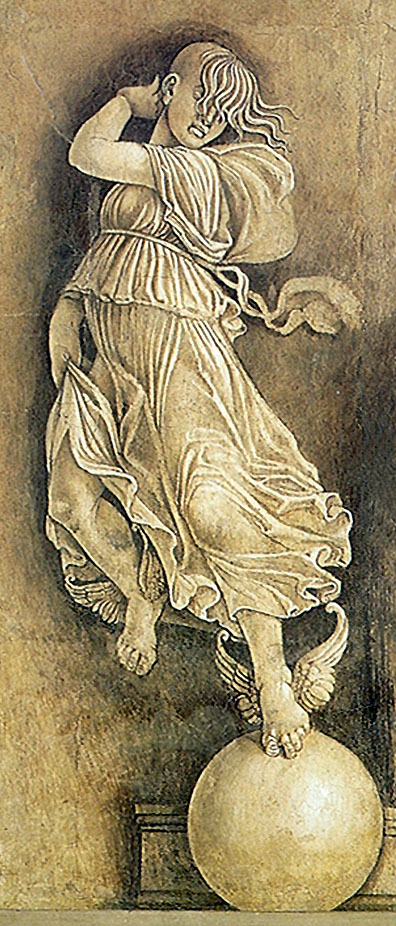
But perhaps the most interesting aspect is the image with which the tango begins on which all the subsequent development is based. “Cuando la suerte, que es grela”, that is, ‘luck, who is a woman’. Since ancient times luck, opportunity or fortune has been represented as a woman, and here is important not only the tradition of representing vices and virtues with allegorical feminine figures, but also the supposedly changing moods attributed to women or, what is more admissible, their changes of status, like those of the moon. Opportunity or fortune was therefore represented as a woman on a wheel or a sphere, because she is never stable, she goes turning and thus changing the fortunes of men. This is precisely what the tango suggests by saying “yira, yira”, that is, it goes round and round, (with another contamination by the Italian girare). But “yiro” was also the name given to prostitutes in lunfardo, because they wander around (yiran) corners of the city in search of clients. We have then the concept of luck that’s a woman, that lets you down (“fallando, fallando”) and leaves you without what you have expected of her (“Te largue parao”). Fortune goes round like a prostitute and she IS a prostitute. And this is the image of the world which has nothing stable or sure, except this bitter truth.
Yira, Tira – Going Round and Round Music & Lyrics: Enrique S. Discépolo, 1930
Cuando la suerte, que es grela, fallando y fallando te largue parao… Cuando estés bien en la vía, sin rumbo, desesperao… Cuando no tengas ni fe, ni yerba de ayer secándose al sol… Cuando rajés los tamangos buscando ese mango que te haga morfar… la indiferencia del mundo que es sordo y es mudo recién sentirás. Verás que todo es mentira, verás que nada es amor… que al mundo nada le importa Yira… Yira…
Aunque te quiebre la vida, aunque te muerda un dolor, no esperes nunca una ayuda, ni una mano, ni un favor… Cuando estén secas las pilas de todos los timbres que vos apretás, buscando un pecho fraterno para morir abrazao… Cuando te dejen tirao después de cinchar, lo mismo que a mí… Cuando manyés que a tu lado se prueban la ropa que vas a dejar… ¡Te acordarás de este otario que un día, cansado, se puso a ladrar!
When Fortune, who’s a woman, leaves you on the lurch… When you’re completely broke, aimless and desperate… When you no longer have faith nor yesterday’s mate leaves drying in the sun… When you wear out your shoes in search of a buck to buy food… Only then will you feel the indifference of the deaf and dumb World. You’ll realize that everything’s a lie that nothing is love… that the world doesn’t care at all, it just keeps going round and round…
Even though life is tearing you apart even though you’re broken by pain, don’t ever expect any help, an aiding hand, or a favour… When you’ve dried out the batteries of all the doorbells that you’ve rung looking for a brotherly bosom to embrace and die… When you’re thrown away after you’ve slaved as they did to me… When you realize that they’re trying on the clothes that you’re leaving behind… You’ll remember this jerk who one day got fed up and started to growl!
But maybe the voice of the “Creole Thrush” is best appreciated in the famous “El día que me quieras” (The Day When You’ll Love Me), which isn’t a proper tango but a tango-ballad. It was composed for the movie by the same title in 1935. Leaving aside the flamboyant gestures and acting of the two leading characters, the matchless melody and the poetry, which is perhaps somewhat kitschy but nevertheless enchants me, is one of our national prides.
El día que me quieras – The Day When You’ll love Me Music: Carlos Gardel. Lyrics: Alfredo Lepera.
Acaricia mi ensueño el suave murmullo de tu suspirar, ¡como ríe la vida si tus ojos negros me quieren mirar! Y si es mío el amparo de tu risa leve que es como un cantar, ella aquieta mi herida, ¡todo, todo se olvida!
El día que me quieras la rosas que engalana se vestirá de fiesta con su mejor color. Al viento las campanas dirán que ya eres mía y locas las fontanas me contarán tu amor. La noche que me quieras desde el azul del cielo, las estrellas celosas nos mirarán pasar y un rayo misterioso hará nido en tu pelo, luciérnaga curiosa que verá… ¡que eres mi consuelo!
Recitado:
El día que me quieras no habrá más que armonías, será clara la aurora y alegre el manantial. Traerá quieta la brisa rumor de melodías y nos darán las fuentes su canto de cristal. El día que me quieras endulzará sus cuerdas el pájaro cantor, florecerá la vida, no existirá el dolor.
La noche que me quieras desde el azul del cielo, las estrellas celosas nos mirarán pasar y un rayo misterioso hará nido en tu pelo, luciérnaga curiosa que verá… ¡que eres mi consuelo!
My daydream is caressed by the light murmur of your sighs. How mirthful life is if your black eyes are willing to look at me! And if your laughter, soft like a song, gives me shelter, my wound is soothed, everything, everything, is forgotten!
The day when you’ll love me the embellishing rose will attire itself in its best colours. Bells sounding to the winds will ring out that now you’re mine. And the fountains, insane with joy will tell me of your love. The night, when you’ll love me, peering from the blue of the sky, jealous stars will watch us go by and a mysterious beam will nestle in your hair: an inquisitive firefly who will realize that you’re my solace!
Recitative:
The day when you’ll love me, there will be only harmony, daybreak will be clear and the spring will be merry the breeze will quietly bring a rumor of melodies and the fountains will offer us their song of crystal. The day when you’ll love me, the songbird will sweeten its cords, life will blossom pain will not exist any more.
The night that you love me, peering from the blue of the sky, jealous stars will watch us pass, and a mysterious beam will nestle in your hair: an inquisitive firefly who will realize that you’re my solace!
 “Are you like you see yourself or like others see you?” … … … “I’ll ask my mom and I’ll tell you.”
 fountain sculpted by Lola Mora (in the last twenty years or so, after several years of neglect, nature took claim of the place and it has become an ecological reserve only some minutes away from the commercial district of the town).








 Come with us to…
 Atlantis
 Bestiary
 Bohemia+Prague
 Books, exhibitions, music, film
 Brave old world
 Caucasus
 Cemeteries
 Crimea
 Get to know the
 Images of the East
 Lightwriting
 Lwów/Lemberg
 Mallorca
 Message on the wall
 The Museum of Propaganda
 Odessa
 Paper Museum
 Persian letters
 The Jewish heritage


