Switch over to our new blog! • ¡Pásese a nuestro nuevo blog!

The renewed version of our blog, with more features, a richer design, and available in nine languages, can be read here: https://wangriver.com

The new version also includes the old posts, often in expanded form. If you are curious about the updated version of this post, replace “riowang.blogspot.com/” in the URL with “riowang.studiolum.com/”, and the new link will most likely lead you there.


La versión renovada de nuestro blog, con más herramientas, un diseño más rico y disponible en nueve idiomas, se puede leer aquí: https://riowang.com

La nueva versión también incluye las publicaciones antiguas, a menudo en una forma ampliada. Si tiene curiosidad por la versión actualizada de esta entrada, sustituya «riowang.blogspot.com/» en la URL por «riowang.studiolum.com/es/», y el nuevo enlace probablemente le llevará allí.

Mostrando entradas con la etiqueta Andalusia. Mostrar todas las entradas

Columbus’ coffin

“It floats between heaven and earth, like the coffin of Muhammad.” That’s how the old saying goes — though it’s not quite true, since Muhammad’s coffin rests peacefully in the soil of Medina. The image comes from Vita Mahumeti, an 11th-century European “biography” of Muhammad written by Embricho of Mainz, which claimed that the Prophet’s coffin was magically suspended by magnets — a clever trick meant to mimic the levitating Christian saints and impress gullible believers.

But there really are at least two coffins that hang between heaven and earth. One of them, surprisingly, belongs to a Muslim true believer — Father Bem.
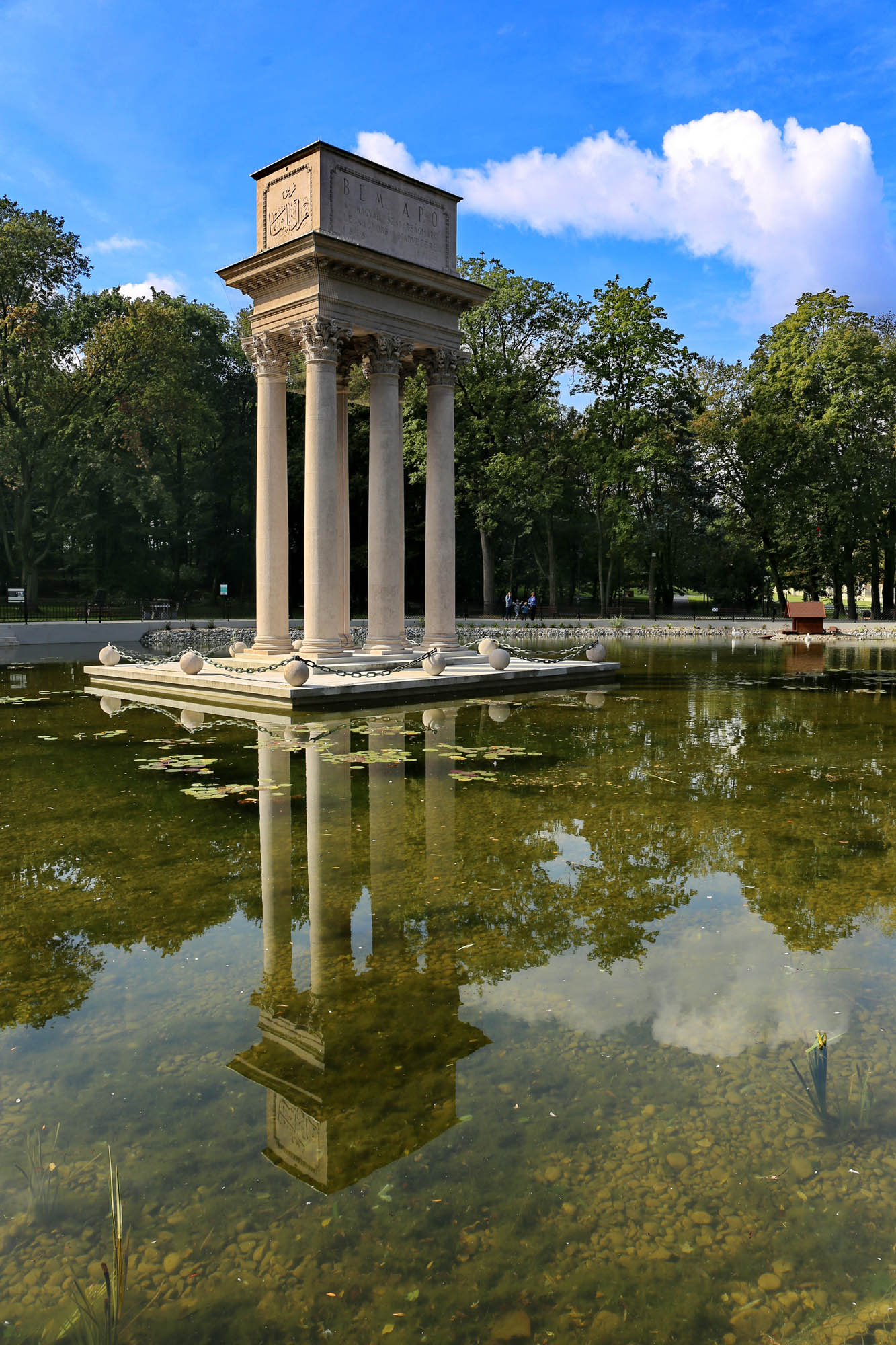
The floating coffin of a Muslim general

After losing the Battle of Temesvár on August 9, 1849, the Polish general of the Hungarian war of independence of 1848-1849, Józef Bem, fled to Constantinople. The Ottoman army, impressed by his reputation, gladly took him in — but military rank was reserved for Muslims only. So Bem, along with seventy-four officers, converted to Islam. He served faithfully in Aleppo until his death on December 10, 1850.

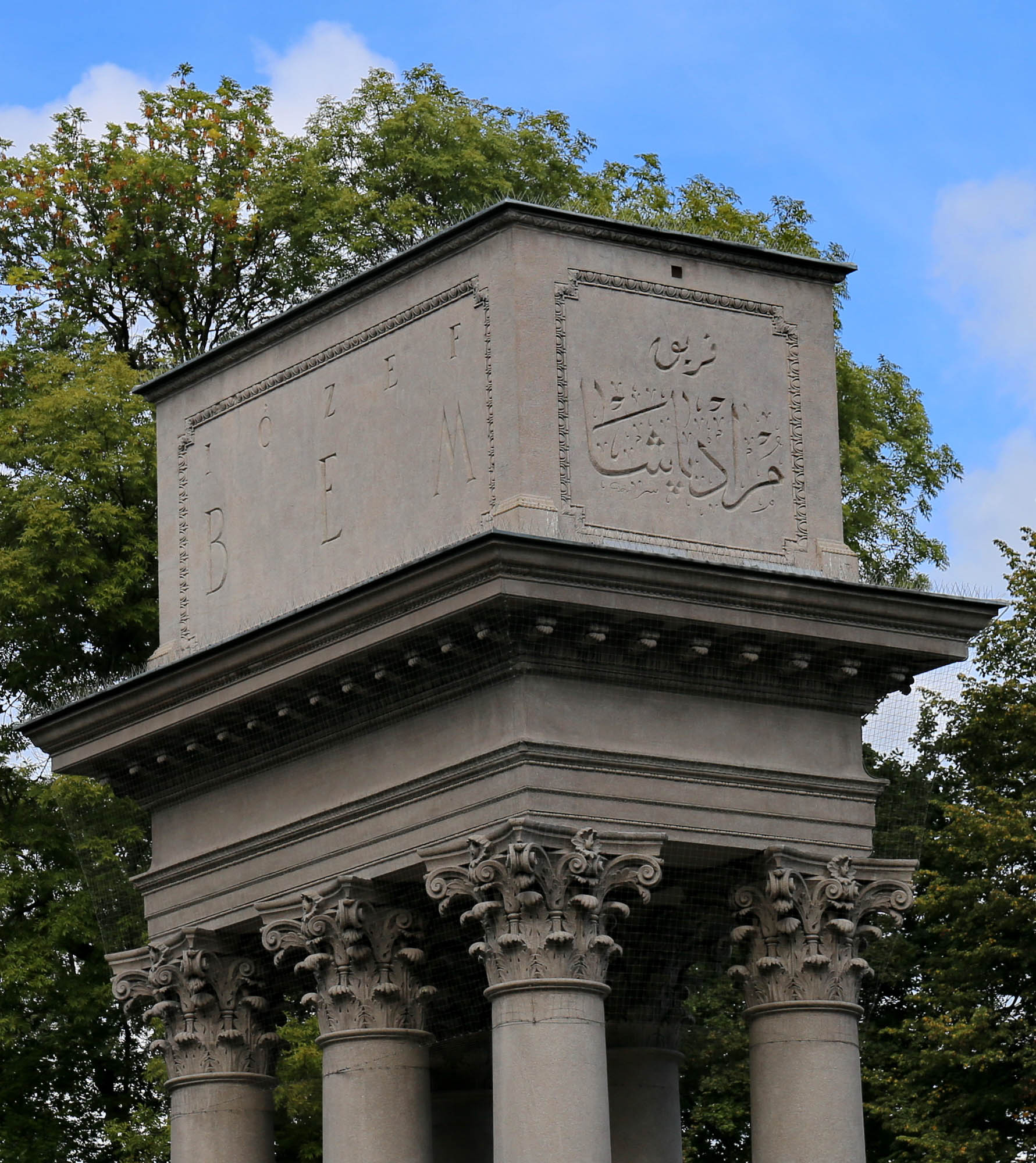
When his remains were returned to his hometown of Tarnów in 1929, the Polish Church refused to bury a Muslim in consecrated ground. There was no other cemetery — save for the Jewish one, which was deemed inappropriate — so the townspeople came up with an ingenious solution. They placed Bem’s sarcophagus on six Corinthian columns rising from the middle of an ornamental pond in a city park — suspended literally between heaven and earth. Even his Turkish name is inscribed on it: مراد پاشا, (Murad Pasha).

The other floating coffin

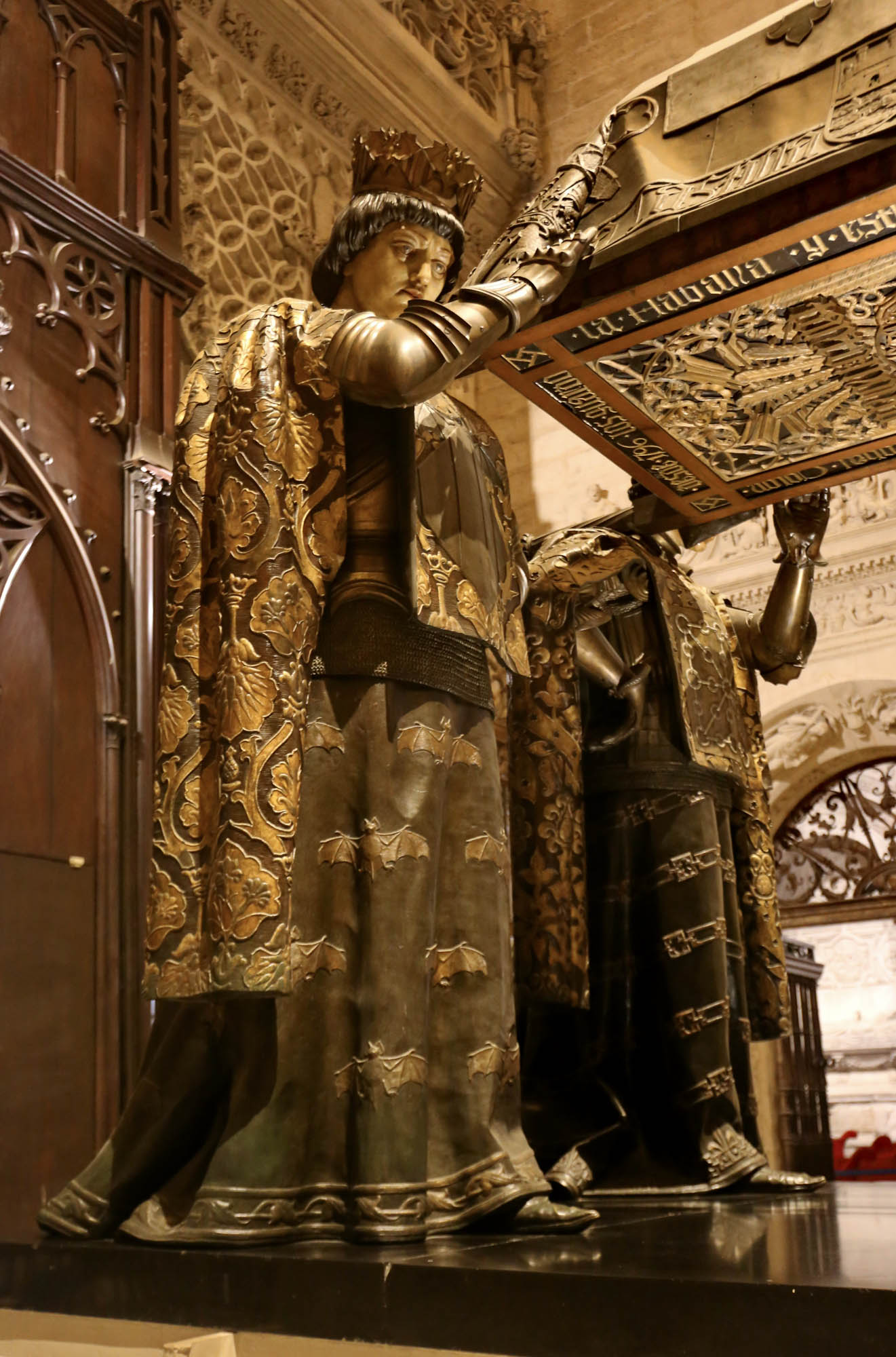
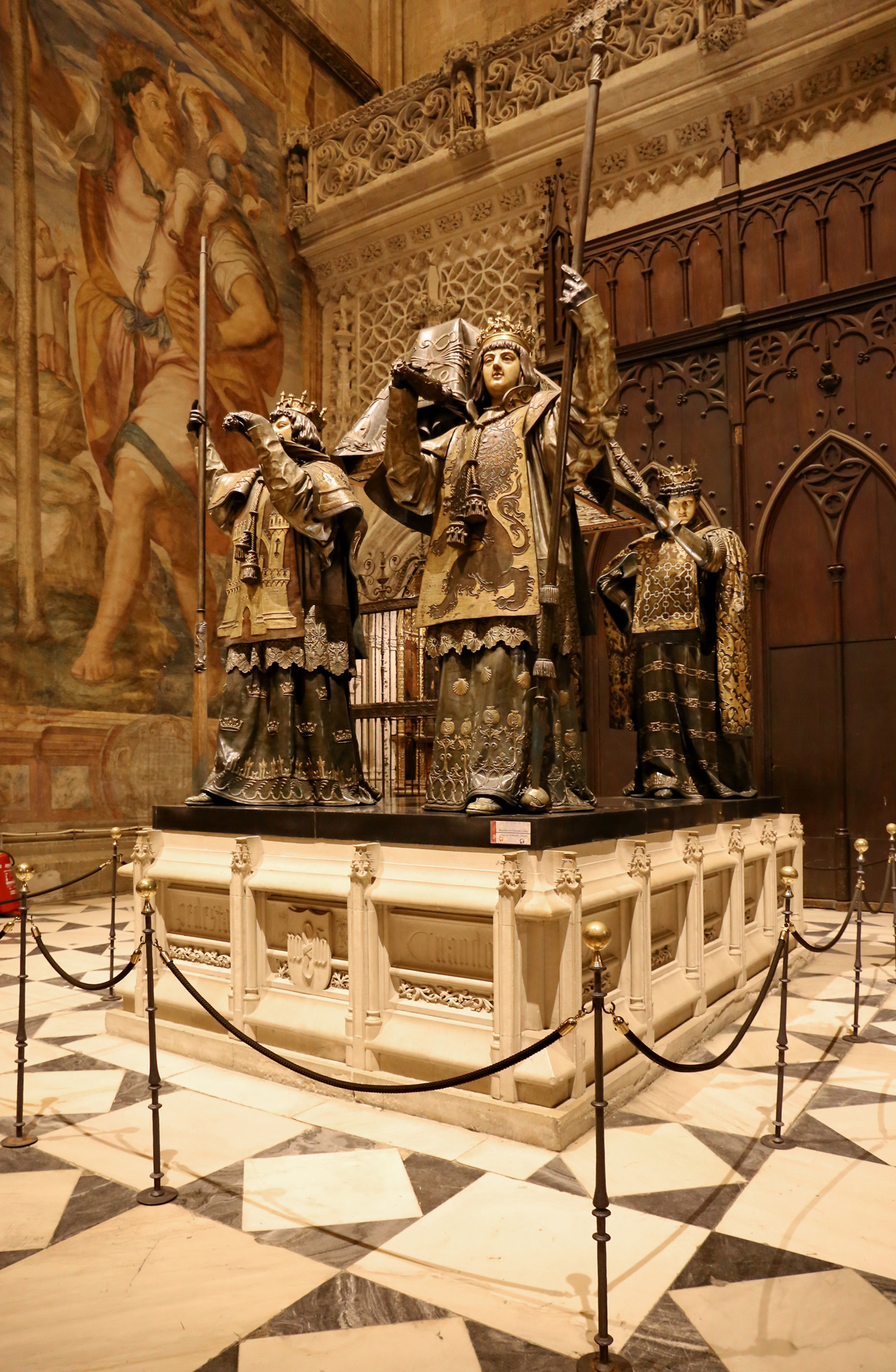
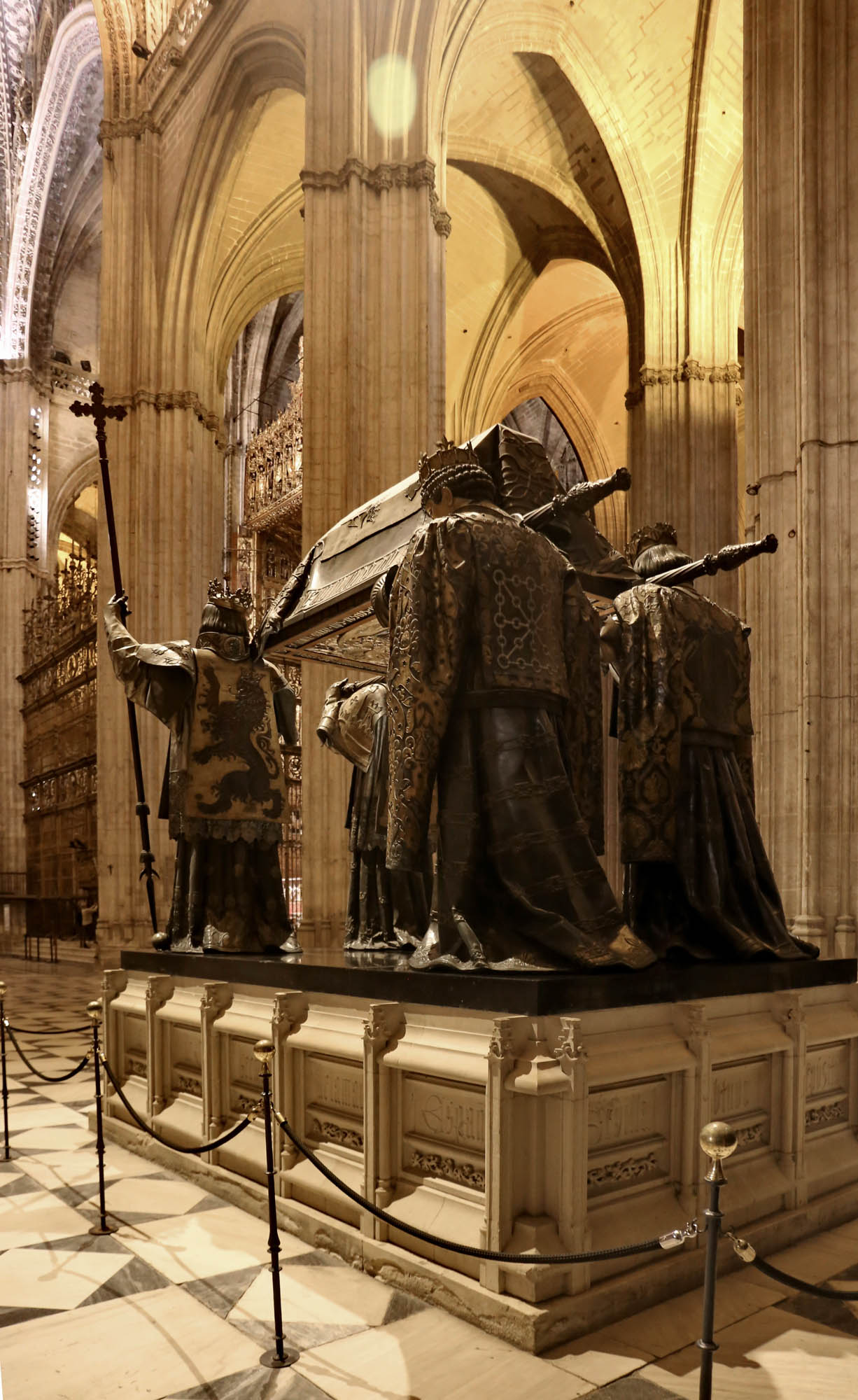
The other coffin that seems to hover above the ground belongs to Christopher Columbus, in Seville Cathedral. (Though if any “conversion” took place in his story, it had nothing to do with the coffin’s levitation.)

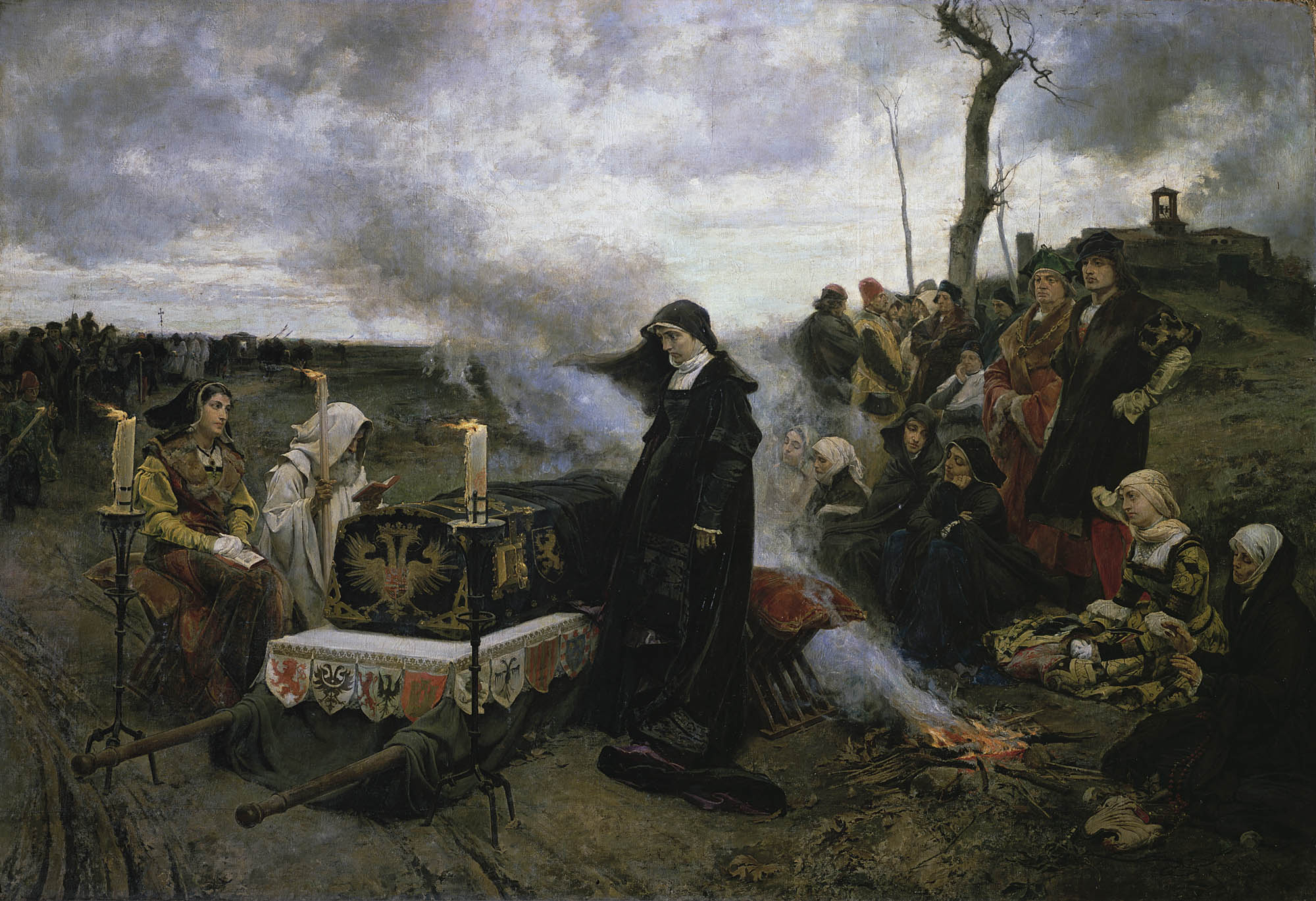
The monument’s designer, Arturo Mélida (1849–1902), was a historicist artist who looked to the grand funerary art of Columbus’s era — the tomb of Philippe Pot in the Louvre (c.1480), Hieronymus Cock’s 1559 engraving of Emperor Charles V’s funeral procession, as well as Francisco Pradilla’s wildly successful 1877 painting Doña Juana the Mad.
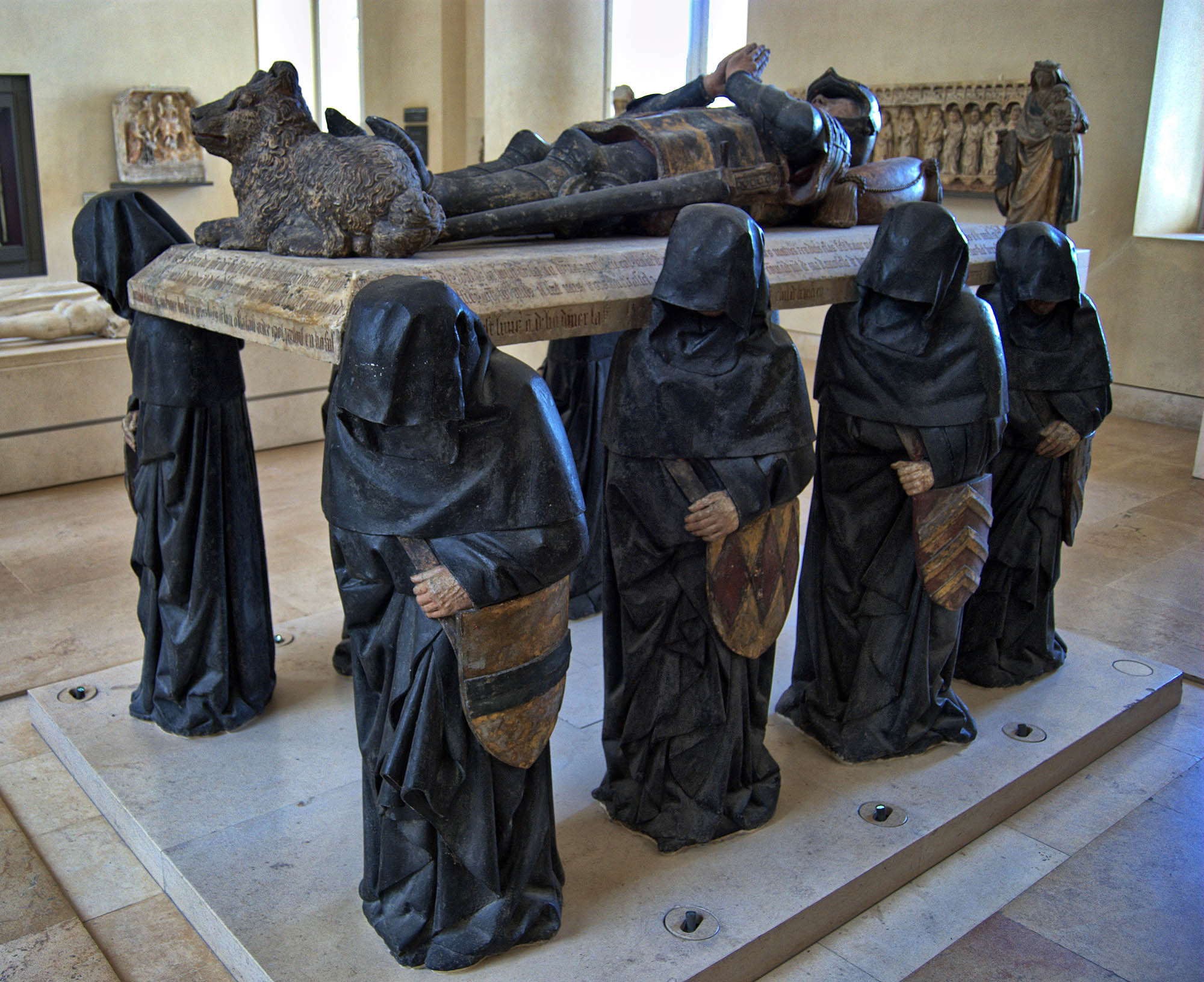
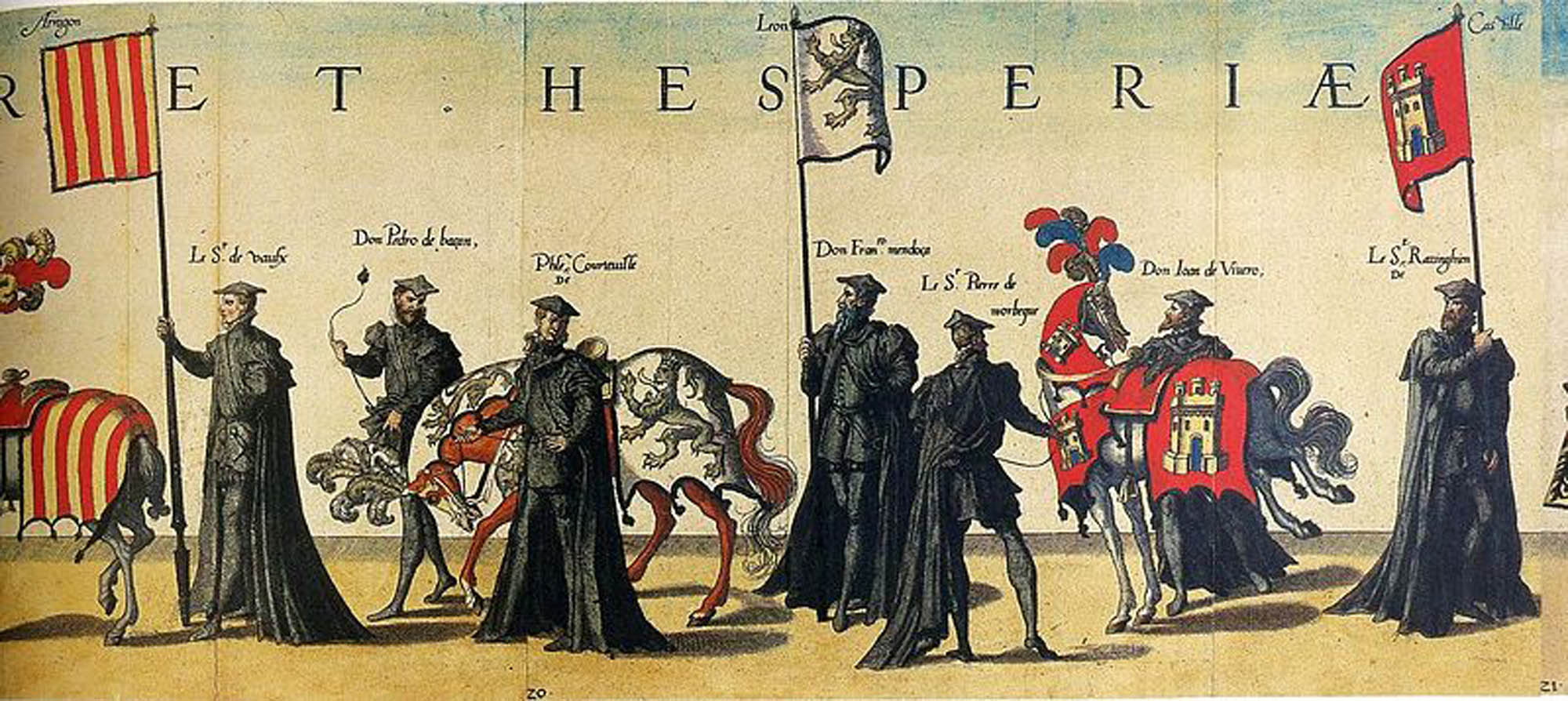
Columbus died in Valladolid on May 20, 1506, and was buried in the local Franciscan church. At his son Diego’s request, the remains were moved to Seville in 1509 — the very port from which he had set sail in 1492. There, in the Carthusian monastery he had loved during his lifetime, he was laid to what was supposed to be his eternal rest.

That eternity was short-lived.

In 1536 or 1544, Columbus’s bones — along with Diego’s — were shipped to Santo Domingo (today’s Dominican Republic), to rest in the newly completed Cathedral of Santa María de la Encarnación. When Spain ceded the island to France in 1795, the remains were moved again, this time to Havana.

In mid-19th-century Havana, plans were made to honor Columbus properly. A public monument was first proposed, then relocated to the cathedral. To strengthen the symbolic bond between Spain and the colony, the monument was commissioned from Madrid’s Royal Academy of Fine Arts. Arturo Mélida won the competition, and his majestic tomb was unveiled in 1891. When Spain lost Cuba in 1898, the coffin made one final journey — back to Seville, where it was installed in 1902 in the Cathedral.
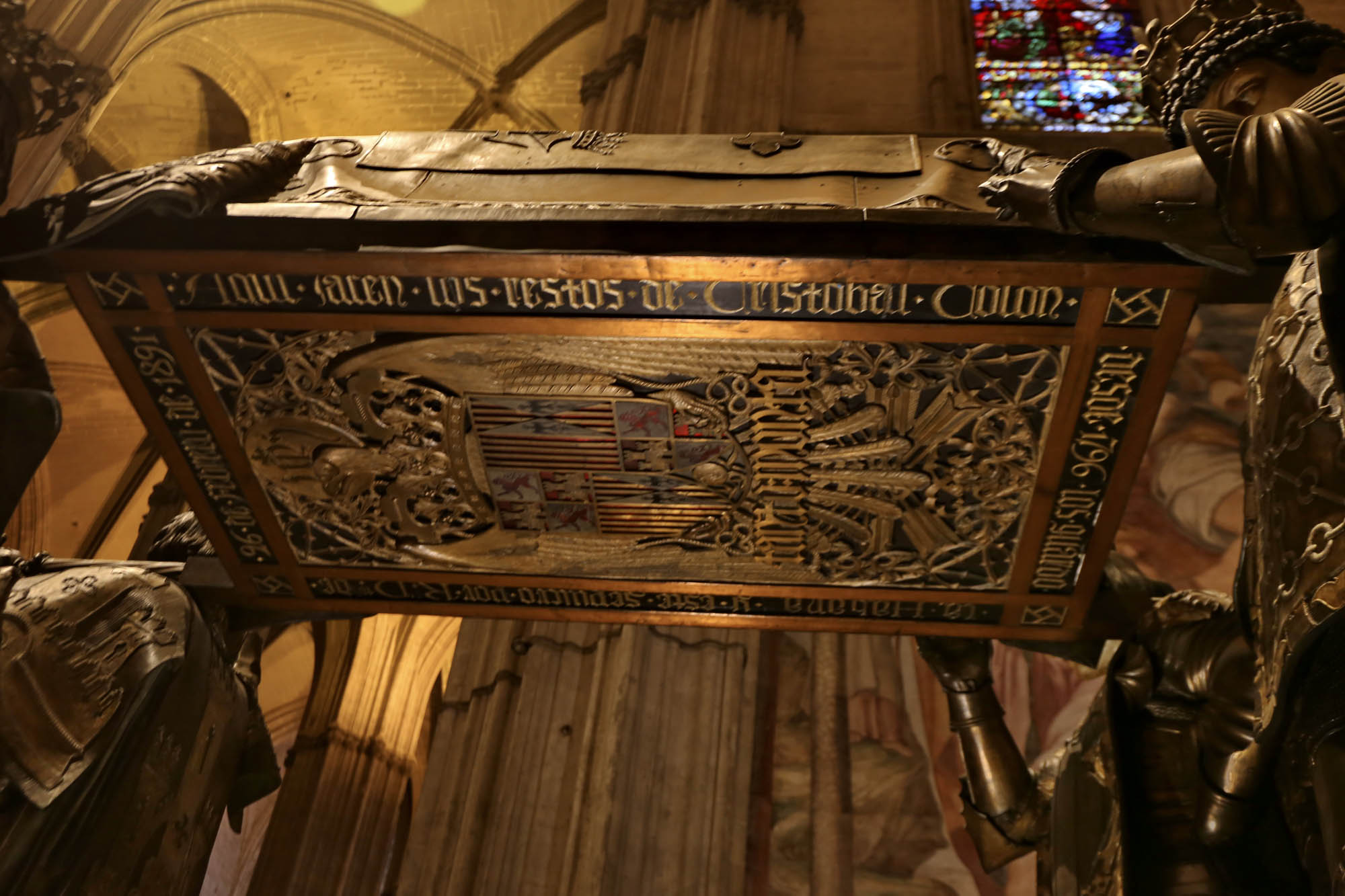
A rival tomb appears

Meanwhile, in 1877, an urn was discovered in Santo Domingo with the inscription: “To the illustrious and distinguished man, Don Colón, Admiral of the Ocean Sea.”

In 2006, scientists at the University of Granada tested the DNA from Seville’s coffin and confirmed that it matched Columbus’s brother Diego. So perhaps the Santo Domingo urn holds his son Diego’s ashes — who bore the same title

A remarkable life indeed for Don Colón — but what a restless afterlife.
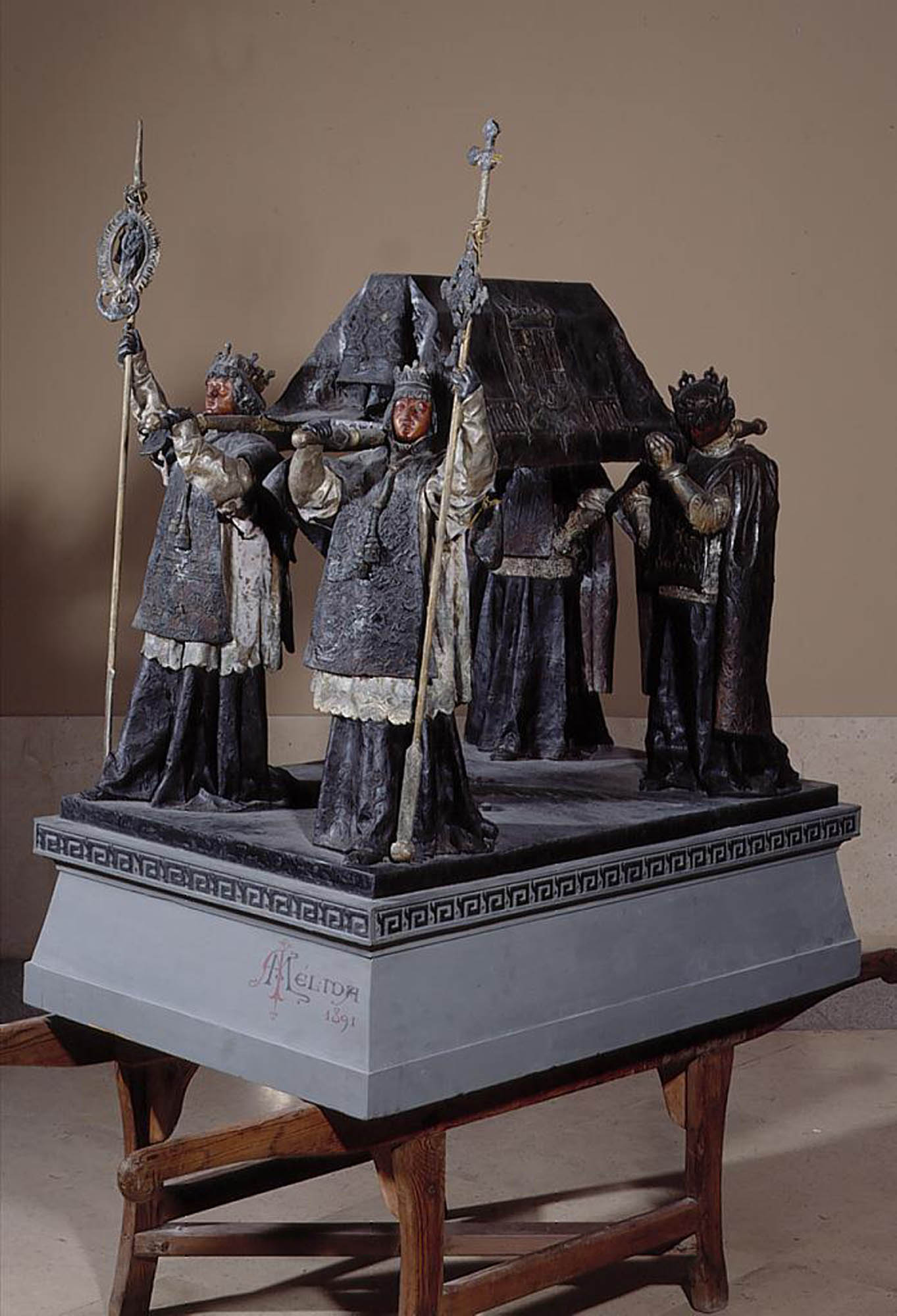
A wax model of Mélida’s Columbus monument can be seen today in Madrid’s Prado Museum

Designing glory

By 1891, Arturo Mélida was already one of Spain’s leading historicist architects and sculptors. He had studied the late Gothic and Renaissance styles of the 15th–16th centuries, including the mudéjar (Moorish-inspired) and plateresque (ornamental Renaissance) traditions. In 1881 he had even been chosen to restore Toledo’s Monastery of San Juan de los Reyes — the great national shrine founded by Ferdinand and Isabella in 1478. Within this same visual and ideological framework, he conceived Columbus’s tomb.

When the monument was finally brought back from Cuba in 1899 and destined for Seville Cathedral, a suitable location had to be found. The obvious choice was the “Old Virgin Chapel”, from where sailors had prayed to the Madonna before setting sail — and to which they returned to give thanks. But the grand monument would have overwhelmed the tiny chapel. So instead, it was placed in the transept, directly before a vast fresco of Saint Christopher, Columbus’s patron saint.
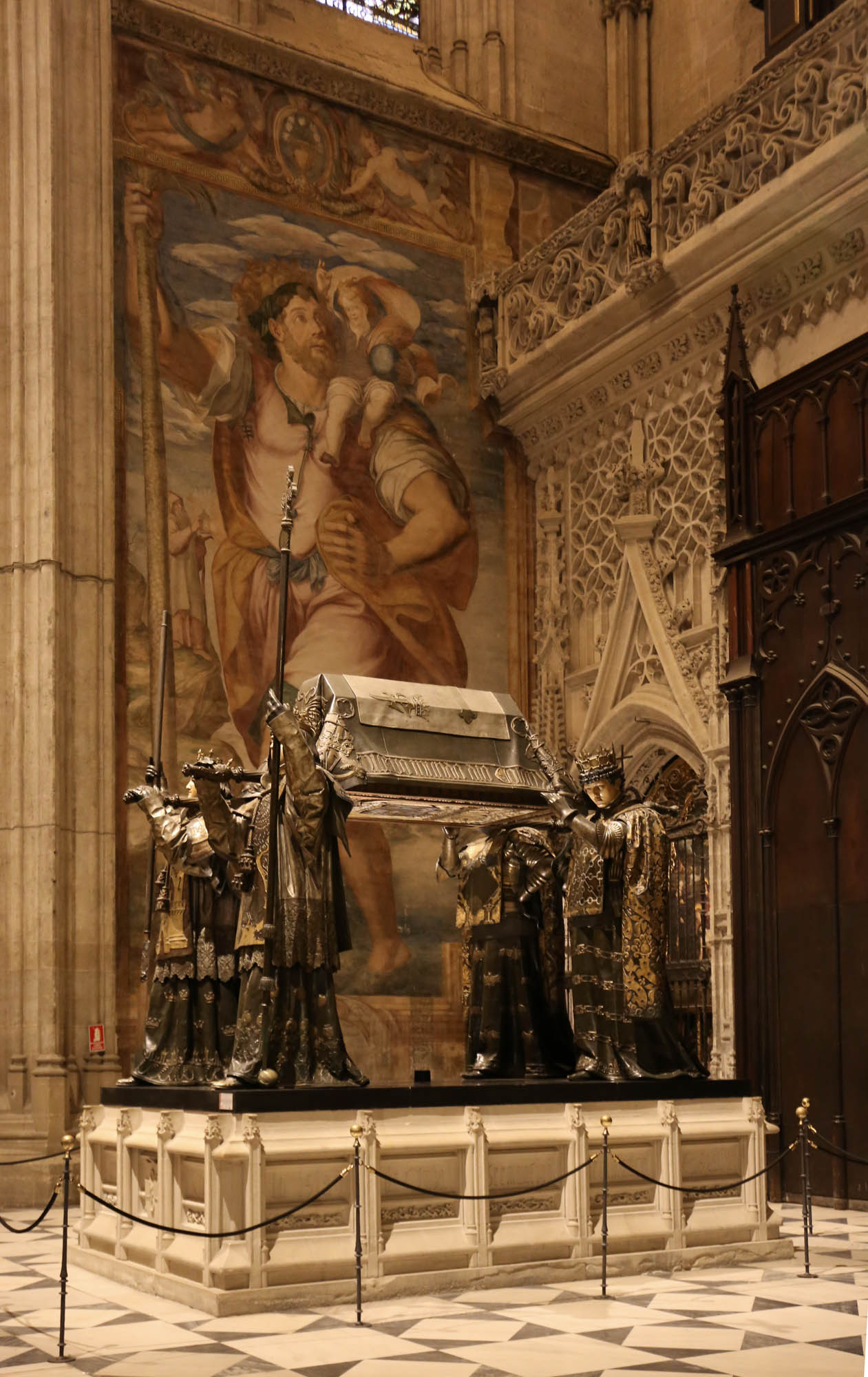
The bearers of Spain

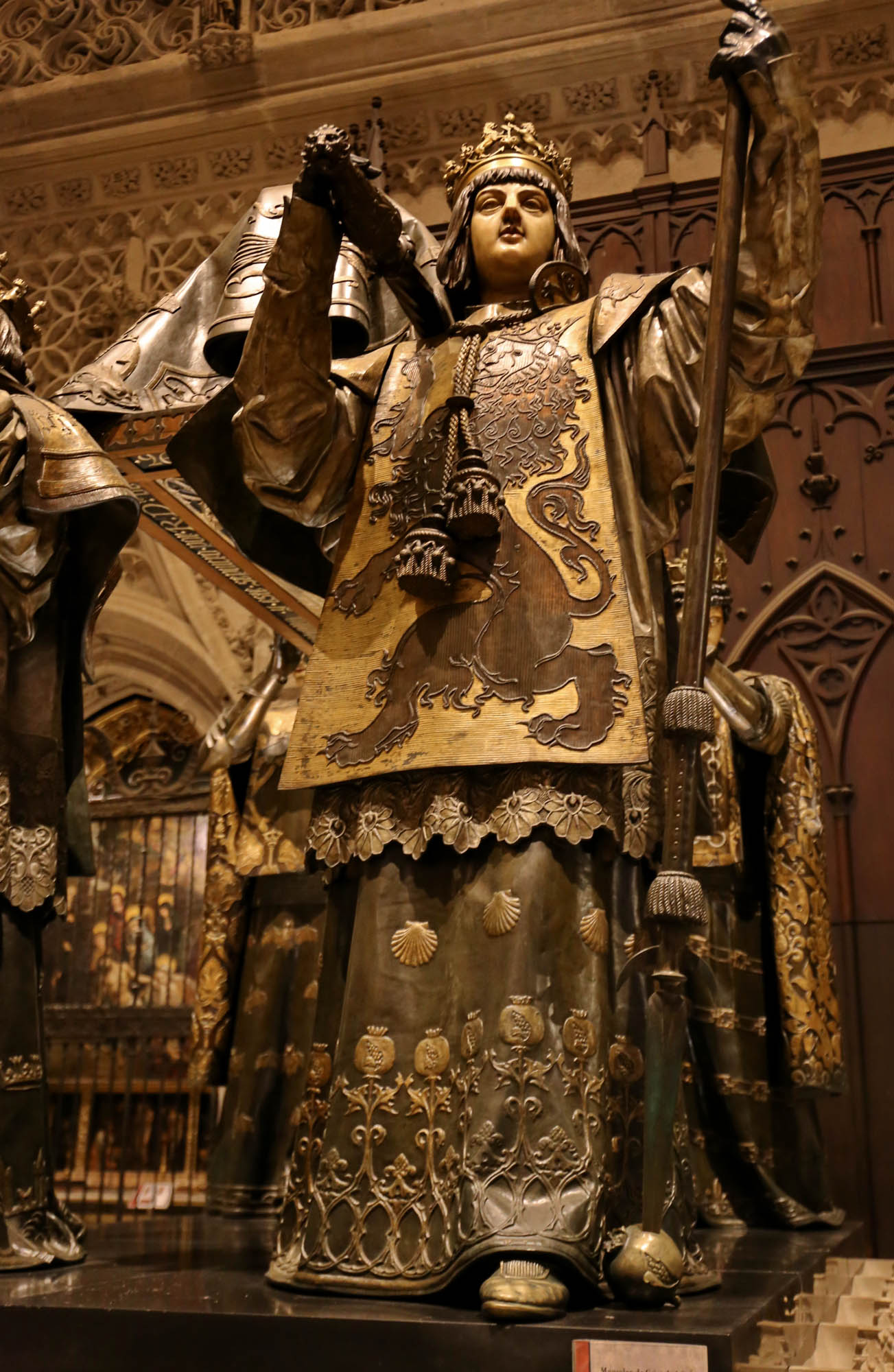
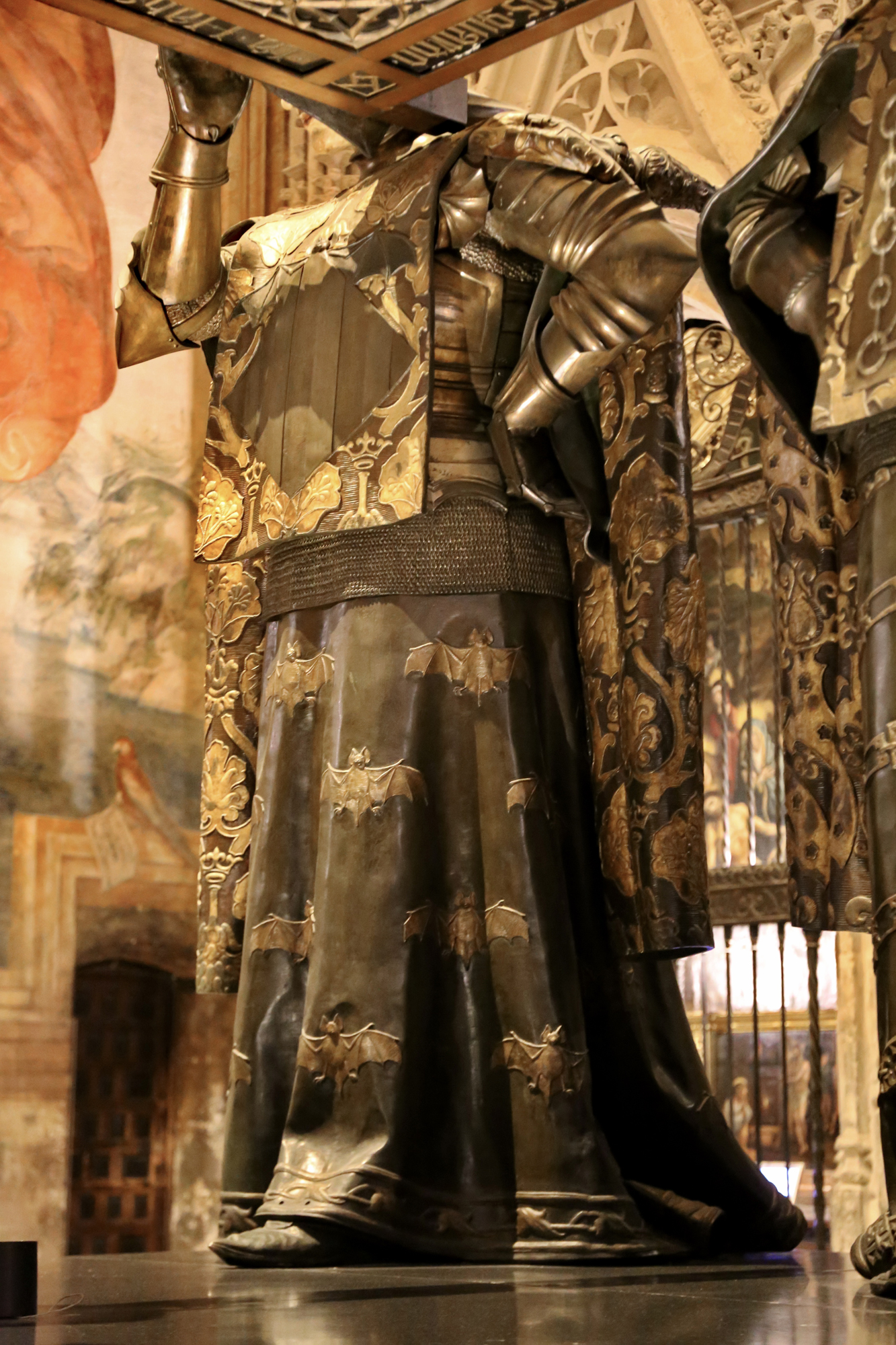
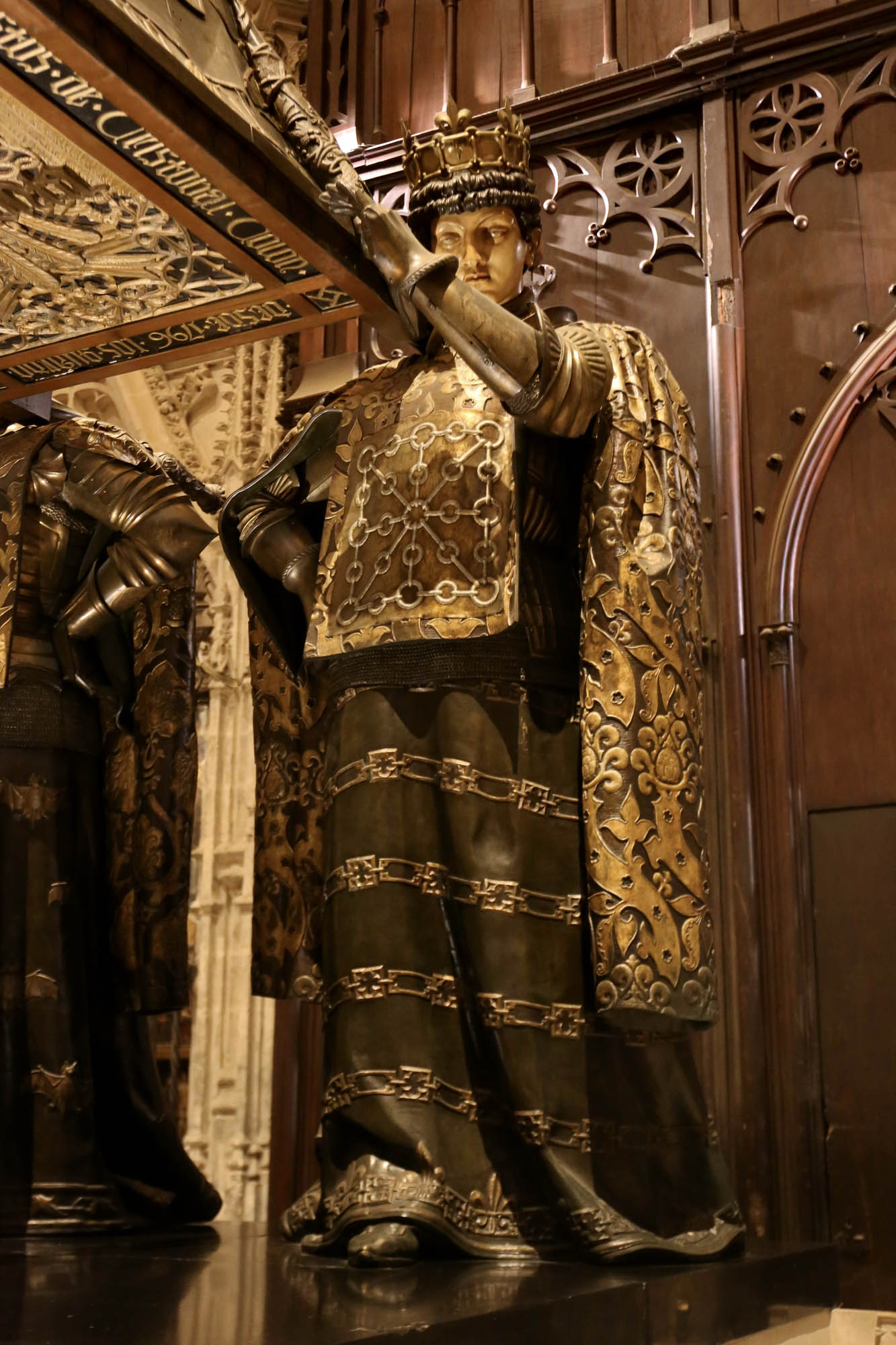
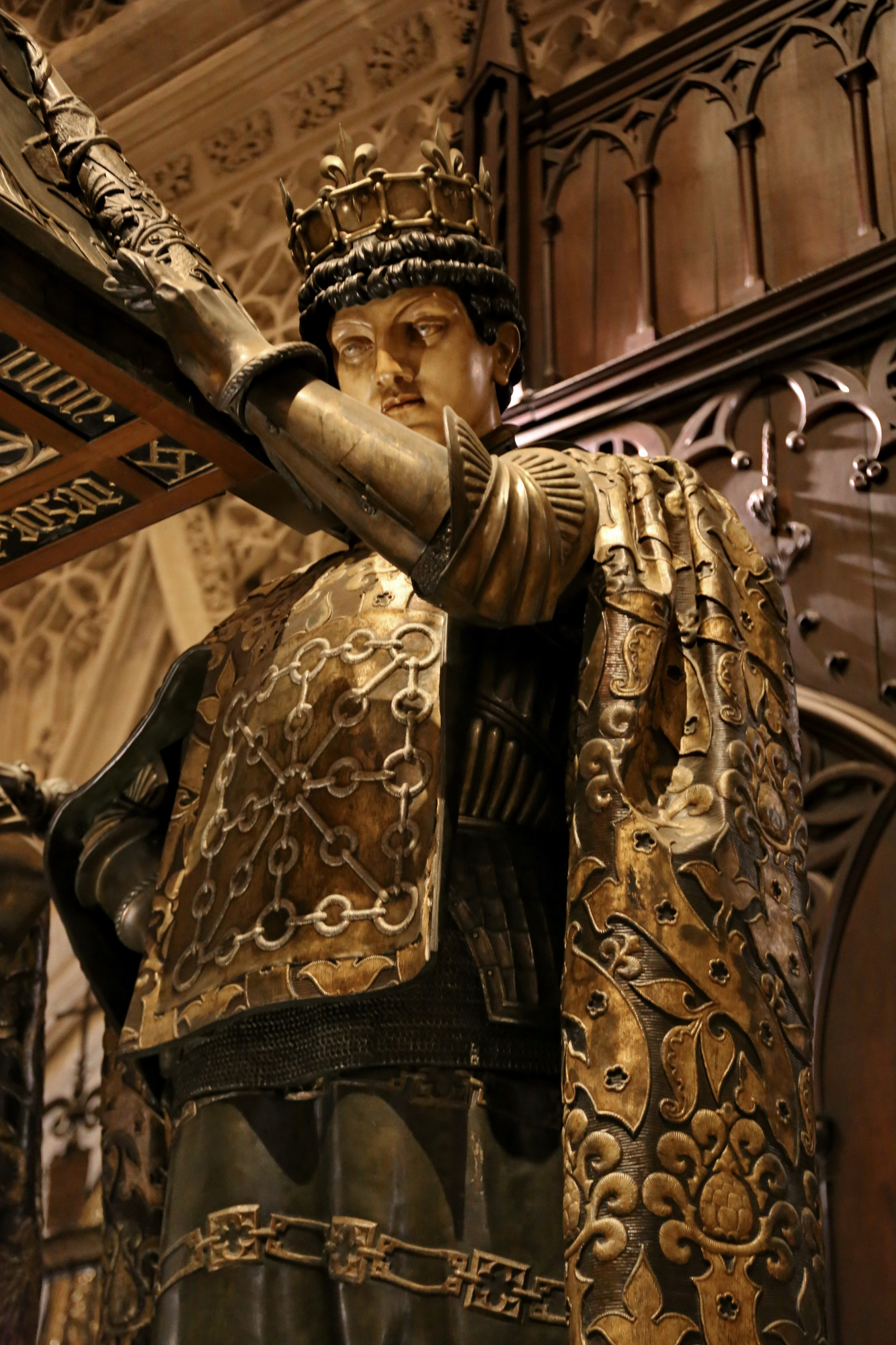
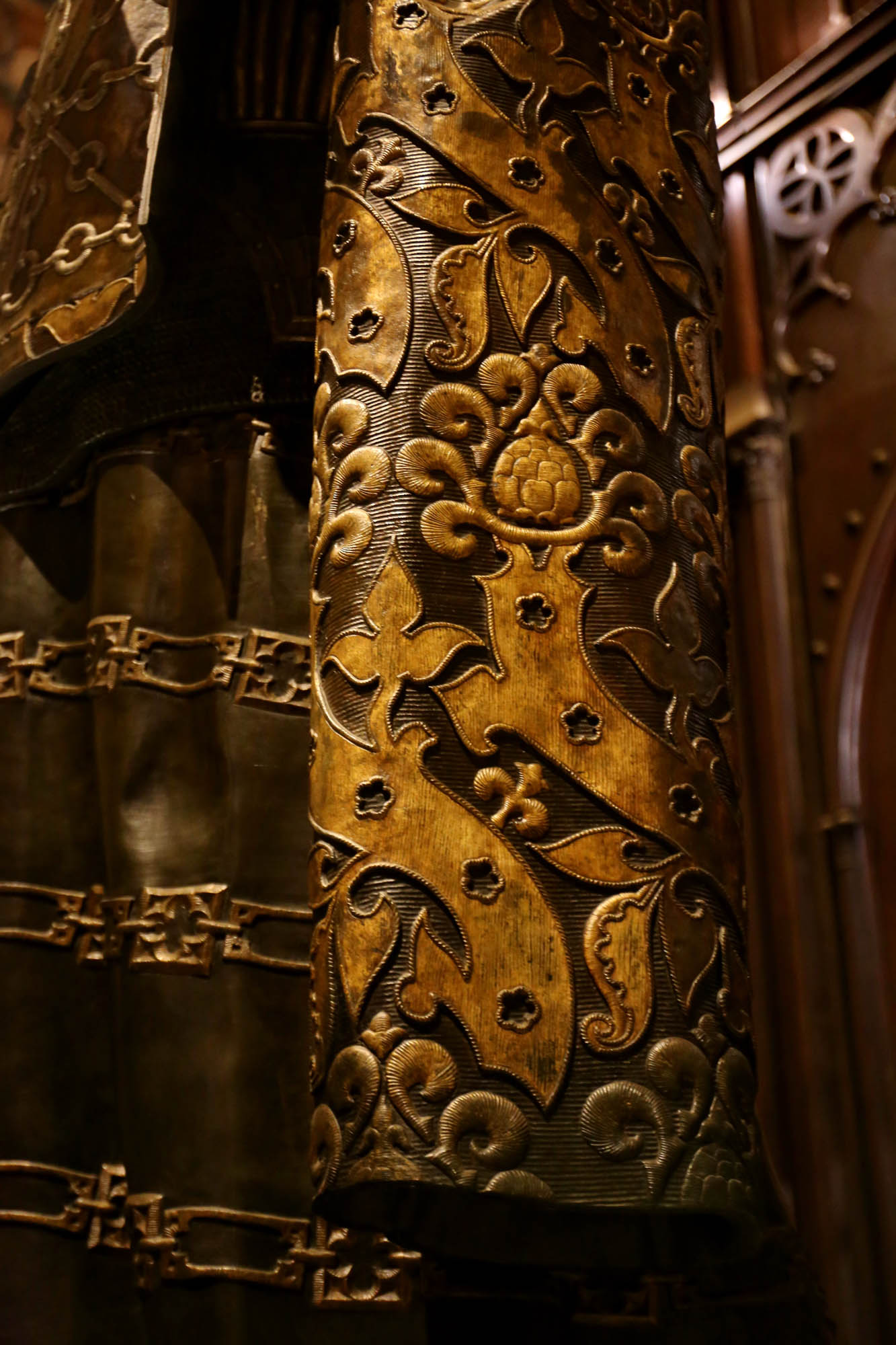
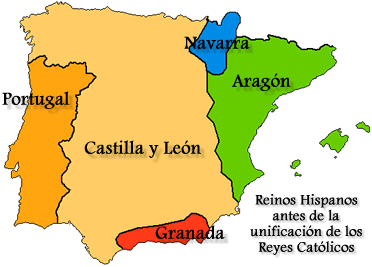
Four allegorical figures carry the Admiral’s coffin — representing Spain’s four historic kingdoms. The lineup, however, reflects a certain 19th-century nationalist bias.

At the front stand Castile and León — although these two realms had merged as early as 1230. Separated again here, they appear more than just one. Behind them are Aragon and Navarre. Mélida downplayed Aragon’s role, explaining that it had “little part in the discovery of the New World.” True enough: by royal decree, Aragonese merchants were banned from Atlantic trade. Even today, Barcelona’s Columbus statue faces away from the sea — as if to declare, “We weren’t part of that.”
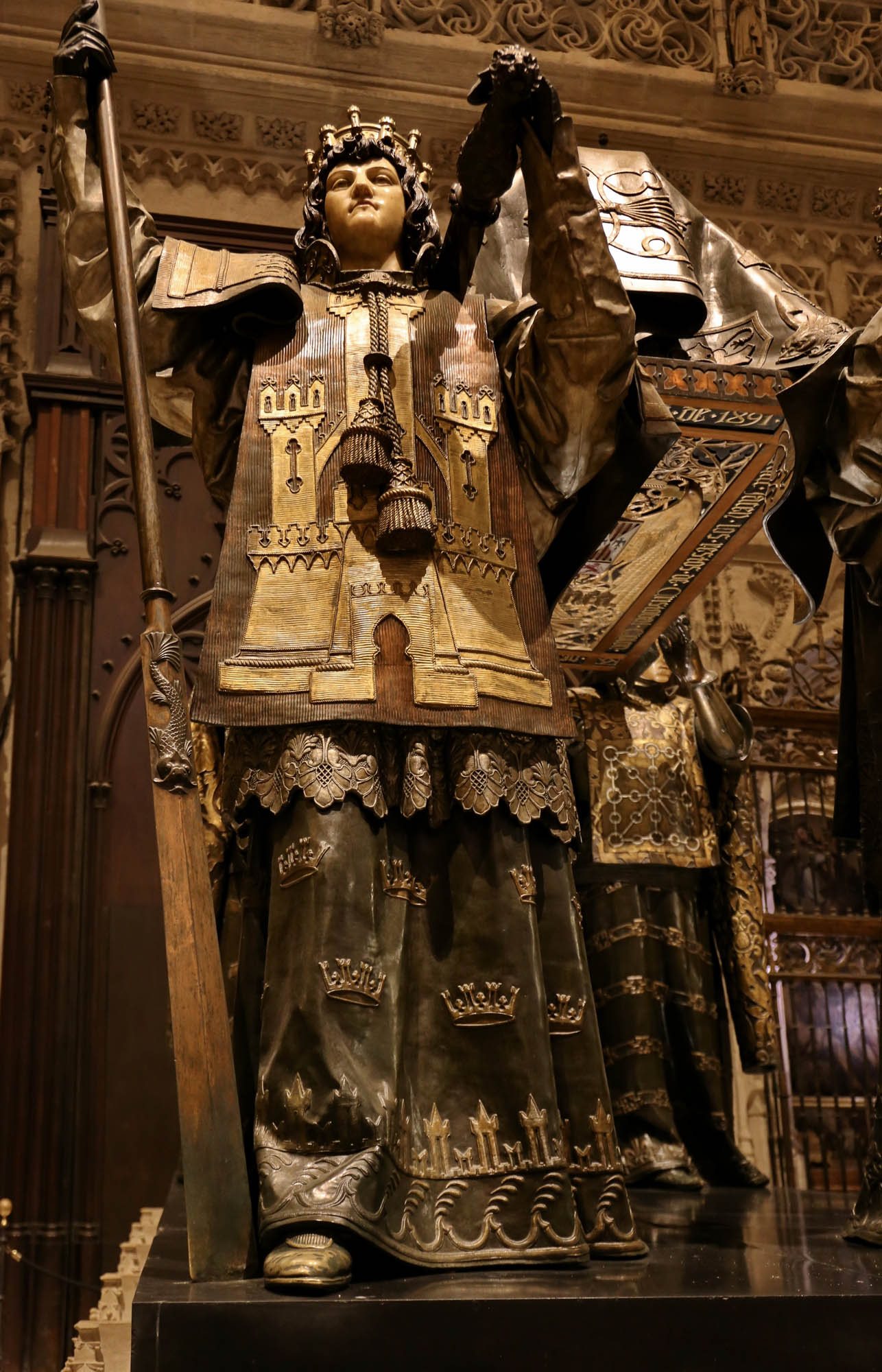
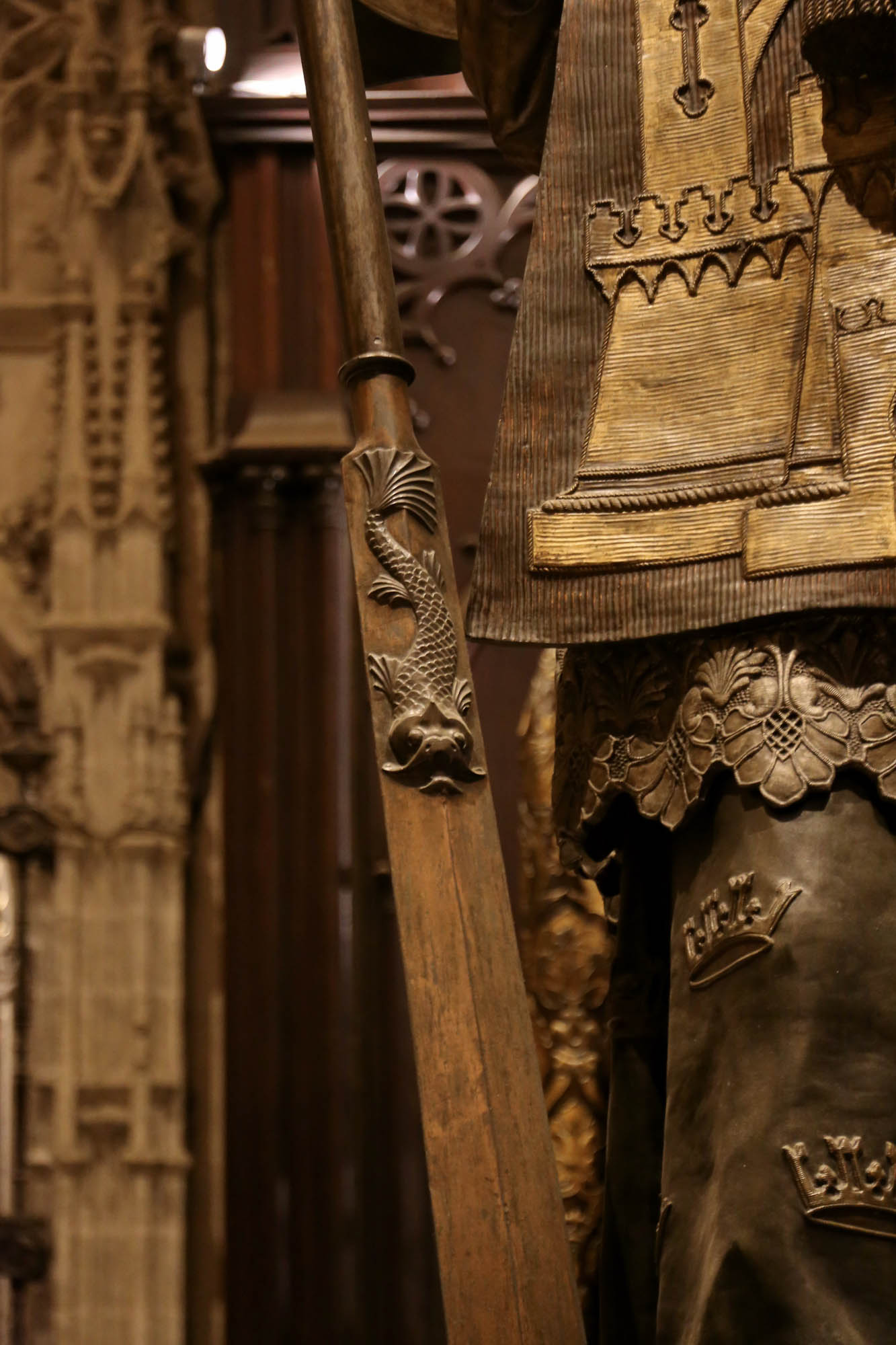
Castile wears a cloak emblazoned with a castle and holds an oar adorned with a dolphin — symbolizing royal permission for Columbus’s voyage

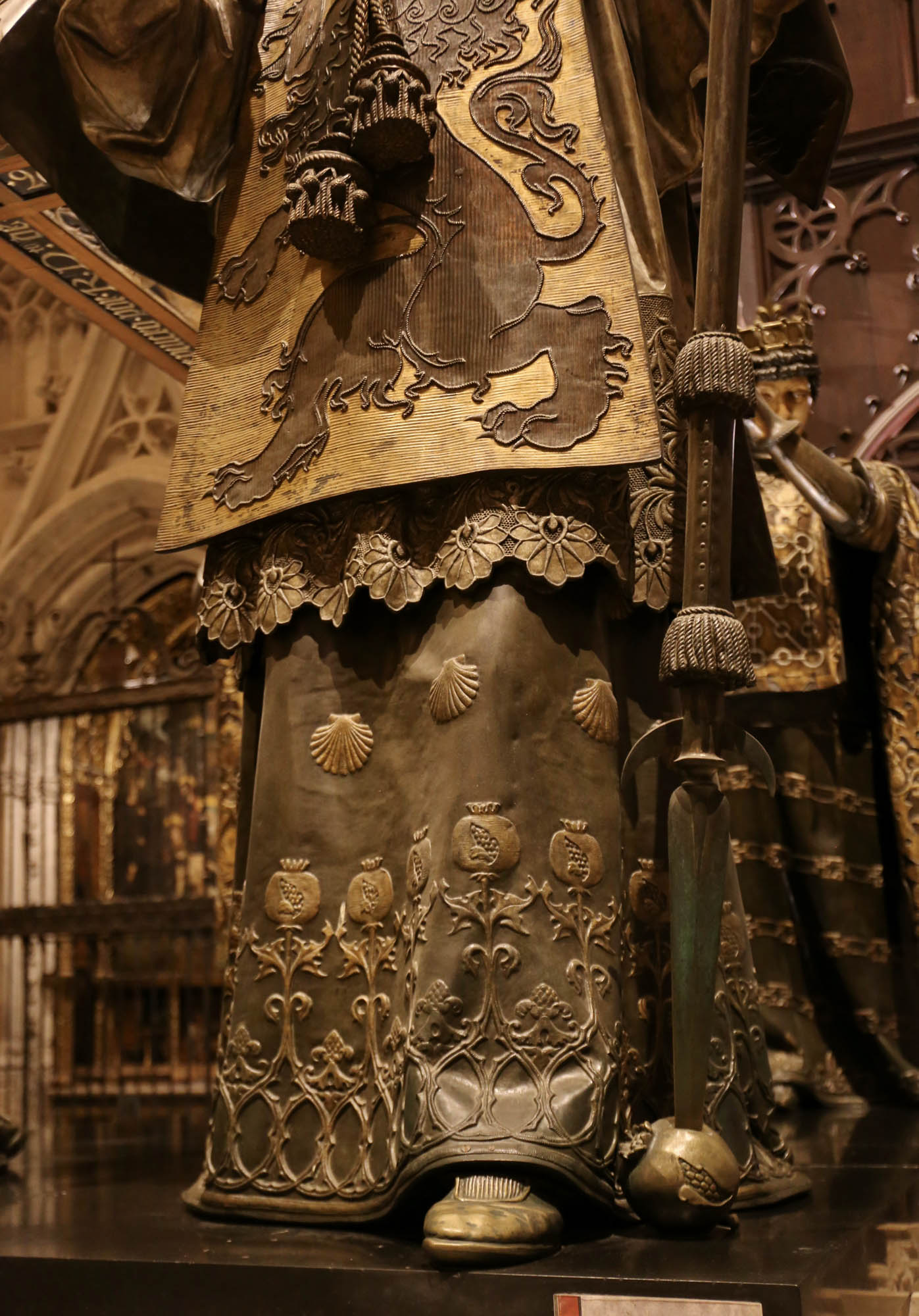
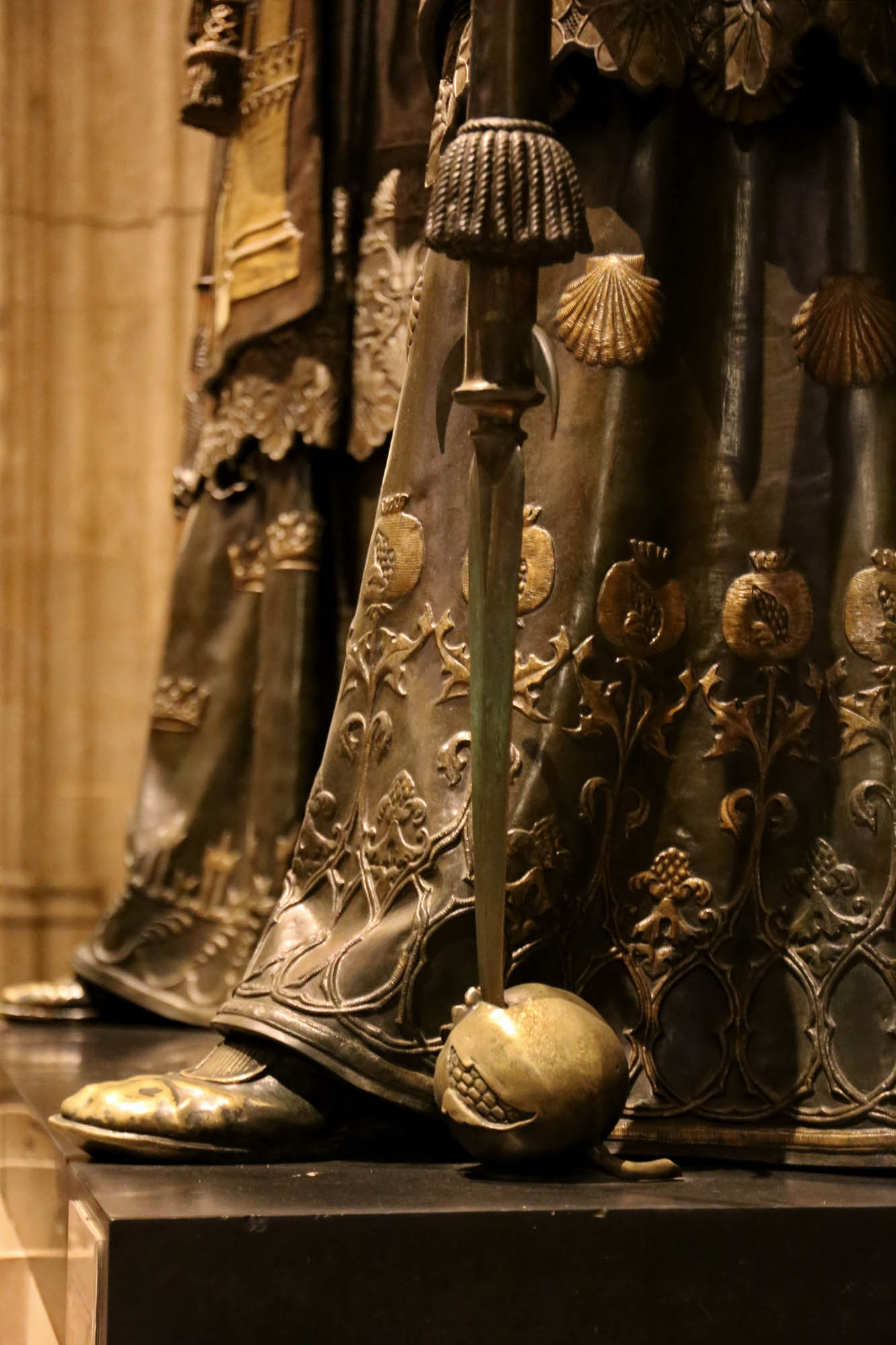
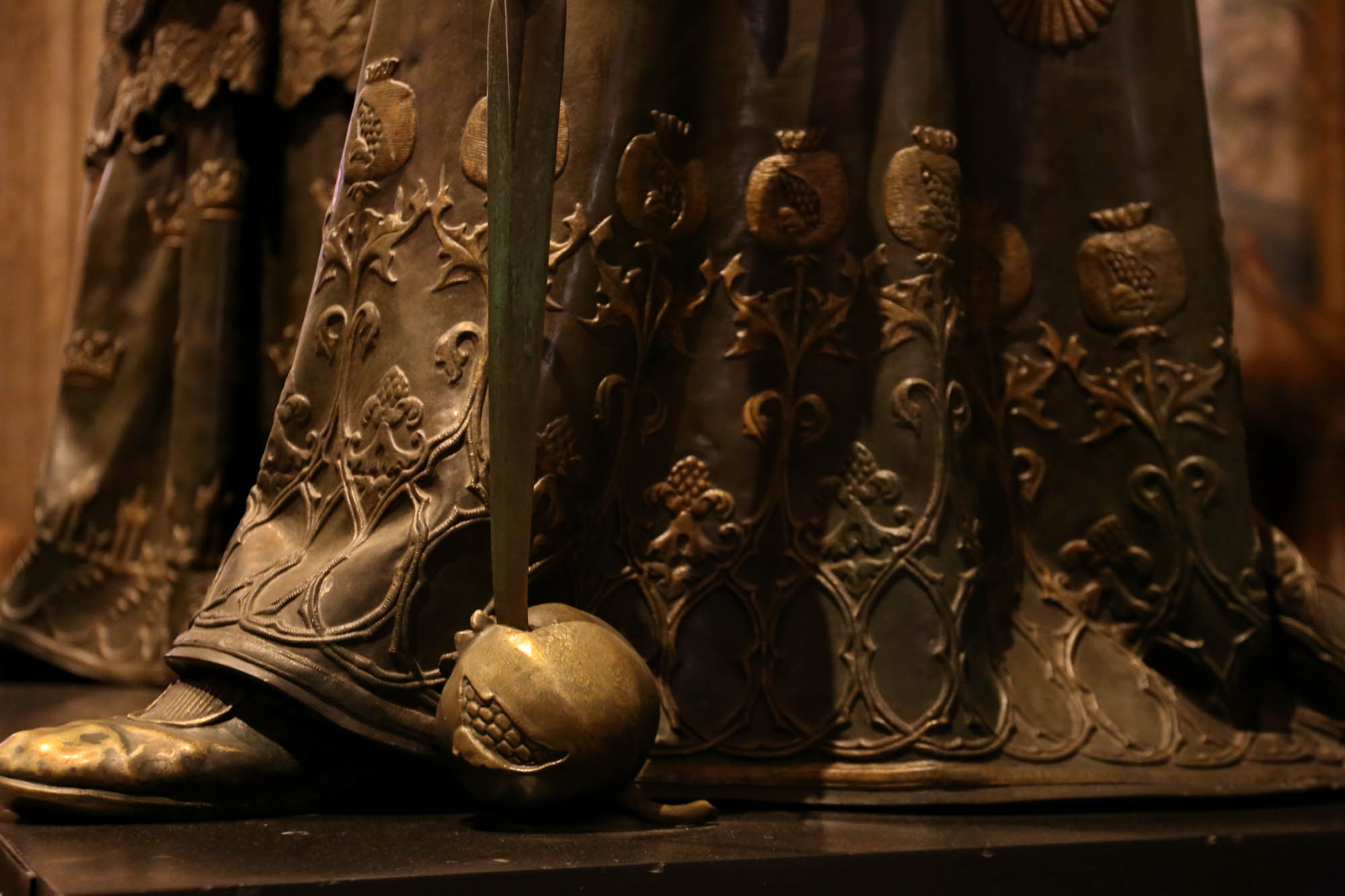
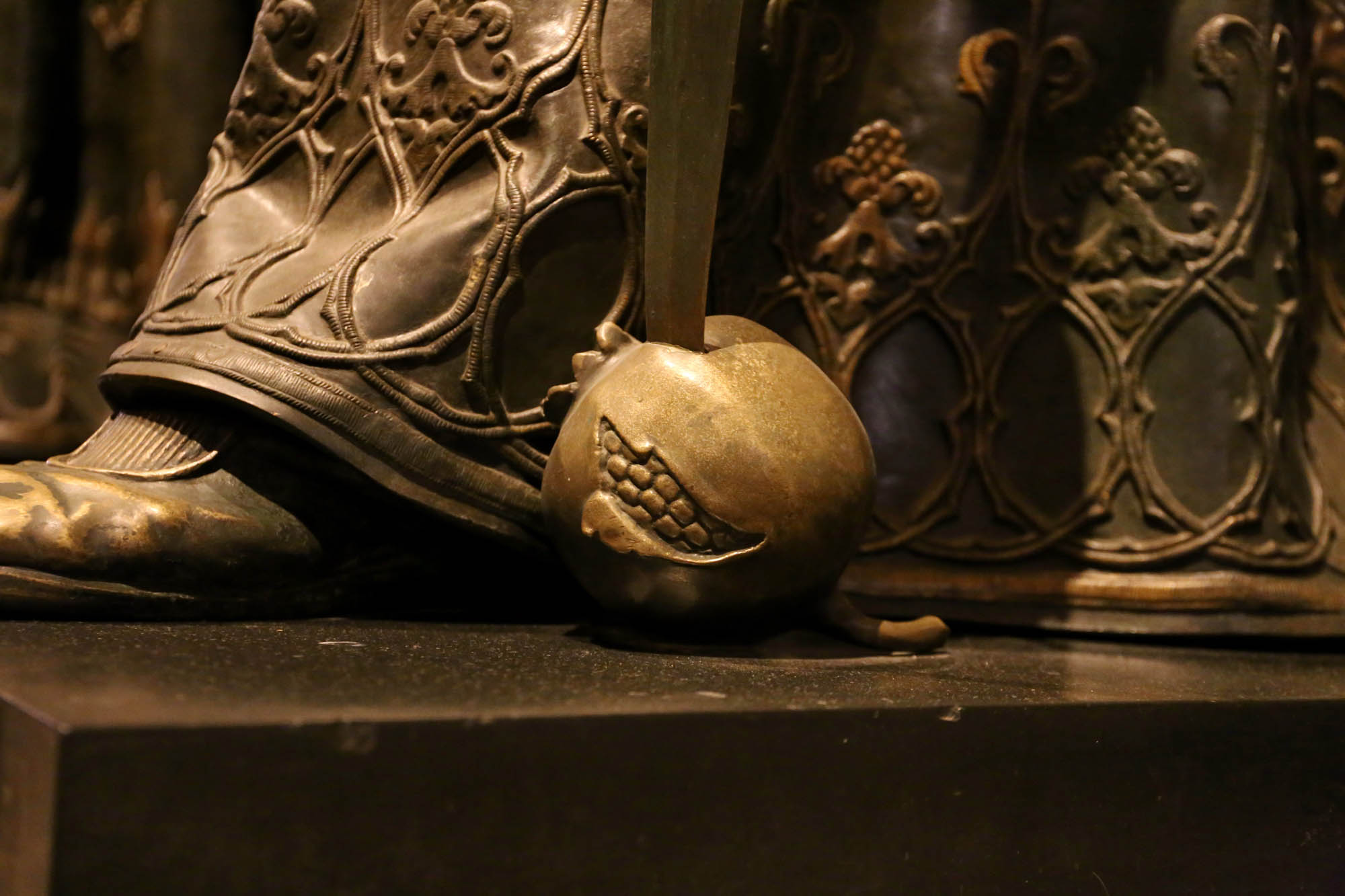
León, whose name comes not from the lion but from the Roman Legio VI, as is proved by its medieval name regnum Legionense, proudly displays the beast nonetheless, along with scallop shells for Galicia and pomegranates for Granada. His cross-tipped spear pierces a pomegranate — a direct allusion to Granada’s conquest in 1492, the same year Columbus set sail

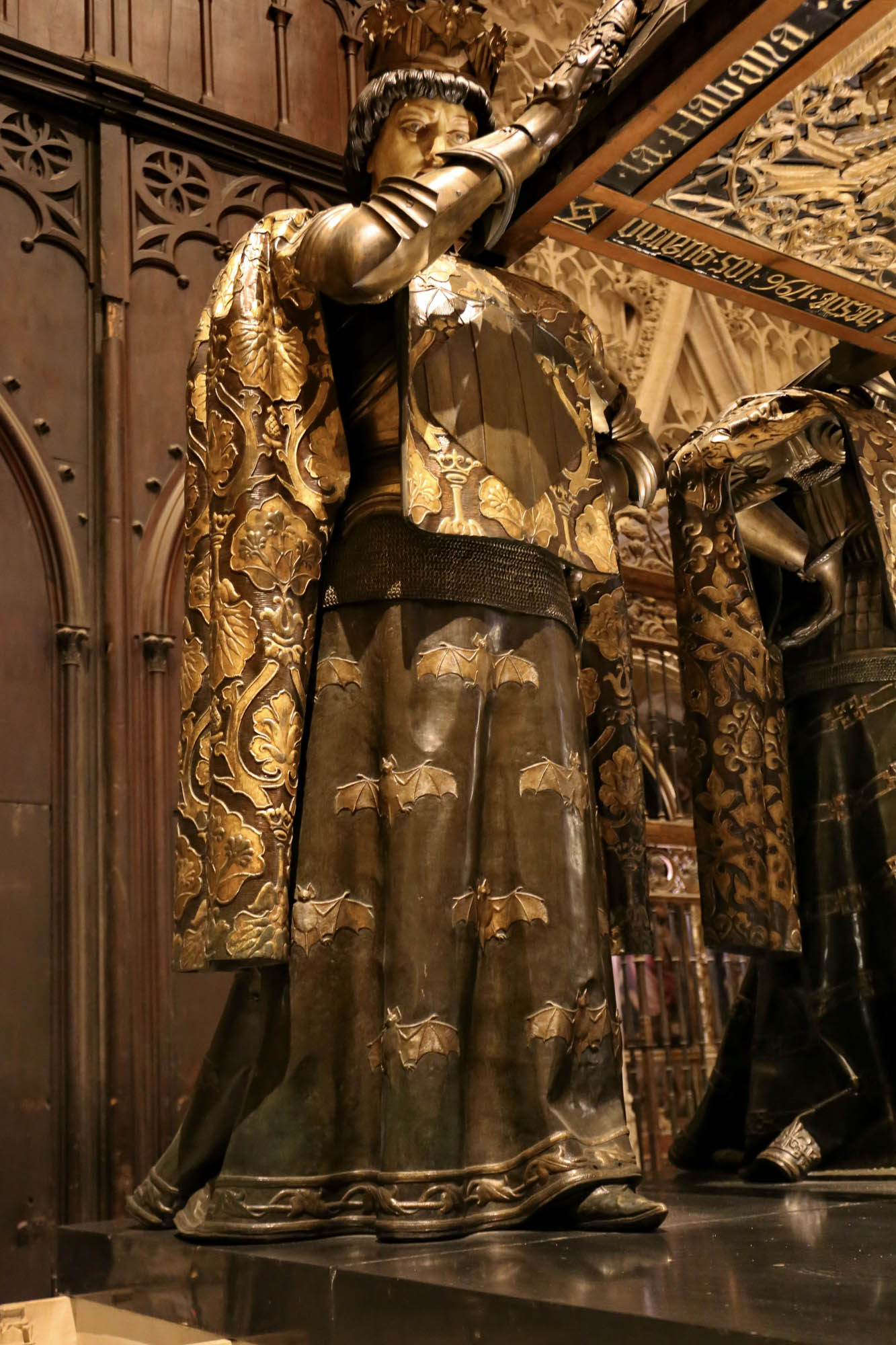
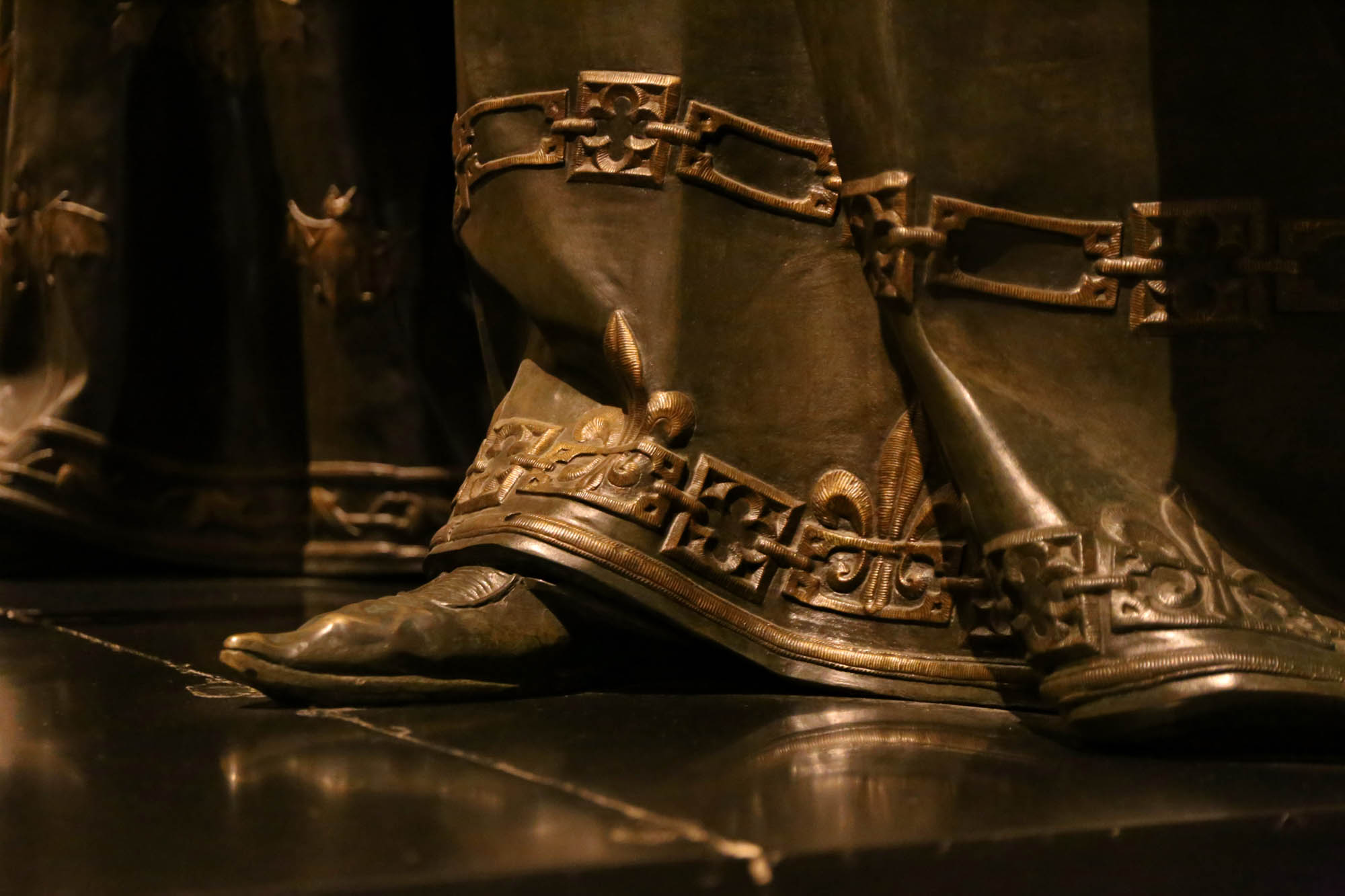
Aragon, Spain’s other founding kingdom of 1492, should wear the red-and-yellow stripes of its coat of arms. But by the late 19th century, those stripes had become a Catalan nationalist symbol, so Mélida substituted another regional emblem — a bat, borrowed from the kingdom of Valencia, which once belonged to Aragon. It was probably originally a dragon, a griffin, or some other more heraldic beast, but by the 13th century it had turned into a bat — accompanied by the legend that the army of King James I of Valencia, fighting against the Muslims, was awakened by the fluttering of bats just in time to repel a night attack by the enemy

Finally comes Navarre, which Spain annexed only in 1512. Its emblem is a chain arranged in a curious eight-pointed pattern, with a turquoise gem at the center. It also has its legend, according to which, in the victorious Battle of Navas de Tolosa in 1212 — known to the Andalusian Muslims as maʿerakat al-eikab, “the Battle of Punishment” — the Navarrese troops supposedly broke through certain chains, penetrated the Muslim leader’s tent, and seized his jewel. So be it.

Women in armor

Yet, for all their pomp, these coffin-bearers look oddly delicate. Shouldn’t an admiral’s coffin be carried by grizzled sailors or rugged soldiers? Instead, Mélida gives us smooth-faced, almost feminine figures — in fact, they are women dressed as men.

Women, dressed in men’s clothes and playing male roles — or maybe hermaphrodites? — in a cathedral? Wrap it up!

But not so fast.

Christian iconography is full of armed, armored women — personifications of virtues battling the equally female personifications of sin, in the psychomachia (“battle for the soul”) tradition dating back to Prudentius. They stand, sword in hand, at the north portal of Chartres Cathedral and are codified by Cesare Ripa’s 1593 Iconologia, the encyclopedic manual of allegory that defined such imagery for centuries.
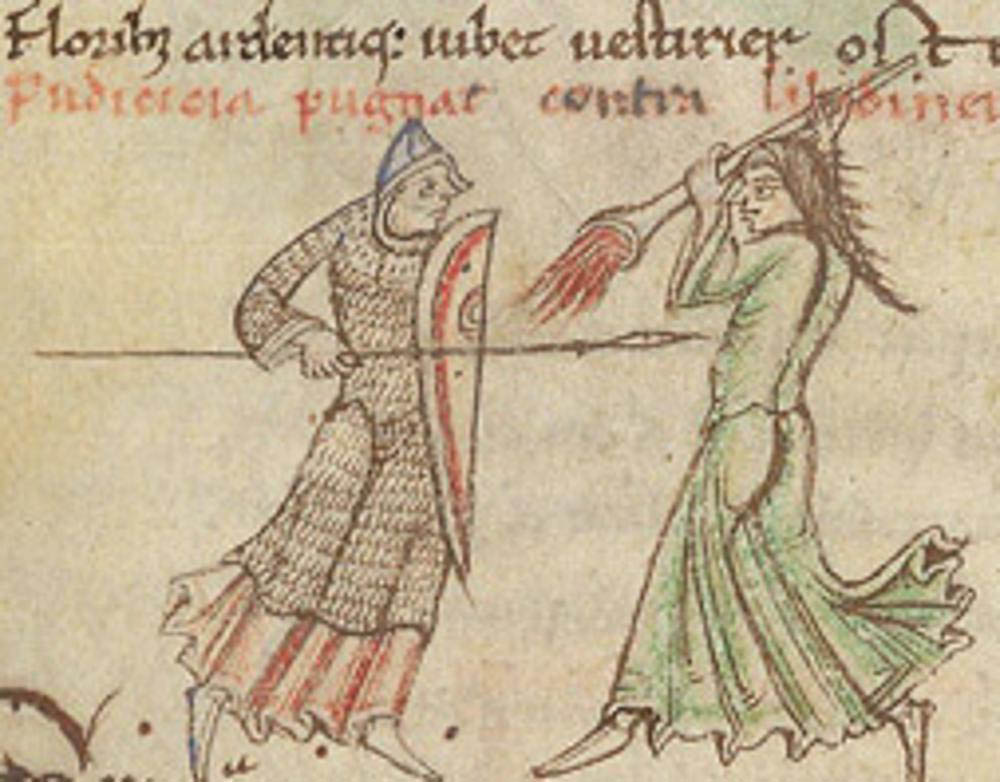
And why women? Because in the Romance languages, abstract nouns — and thus the virtues, and even “regions” (regiones) — are feminine. To depict Spain’s four realms as male warriors would have seemed just as jarring to a Spanish viewer as these female figures do to one whose language, like Hungarian, lacks grammatical gender.
The last serf village in Europe

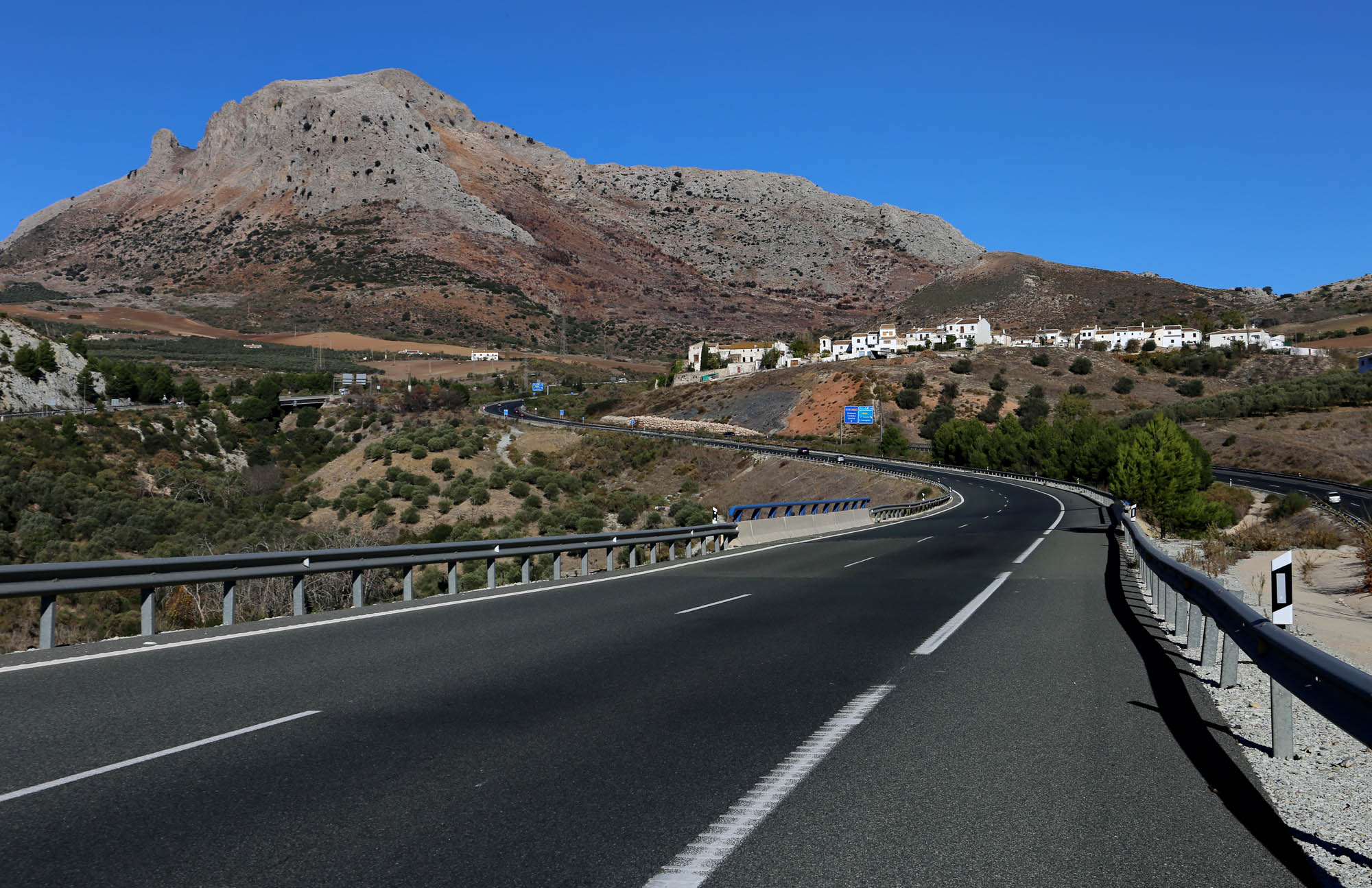
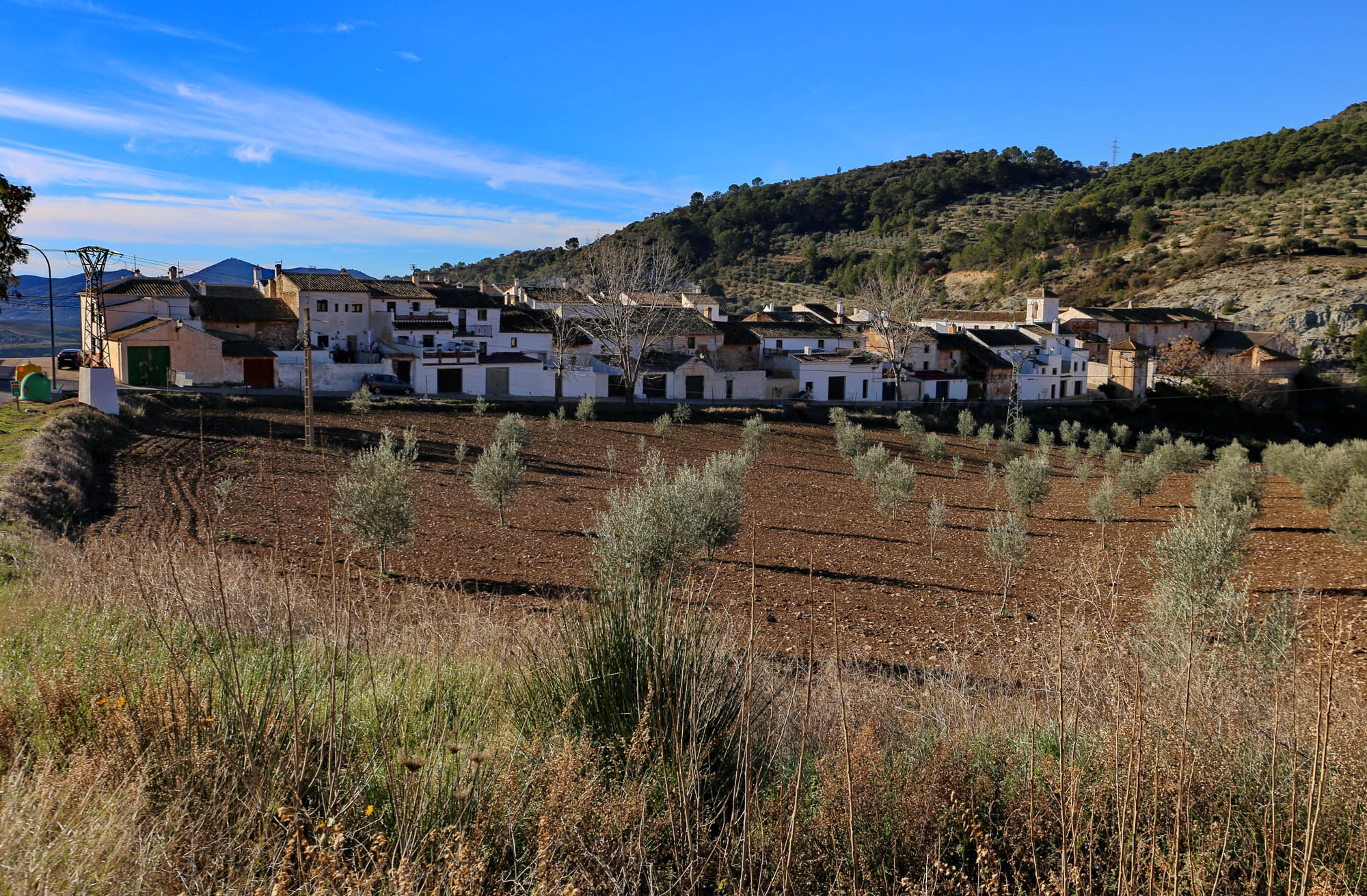
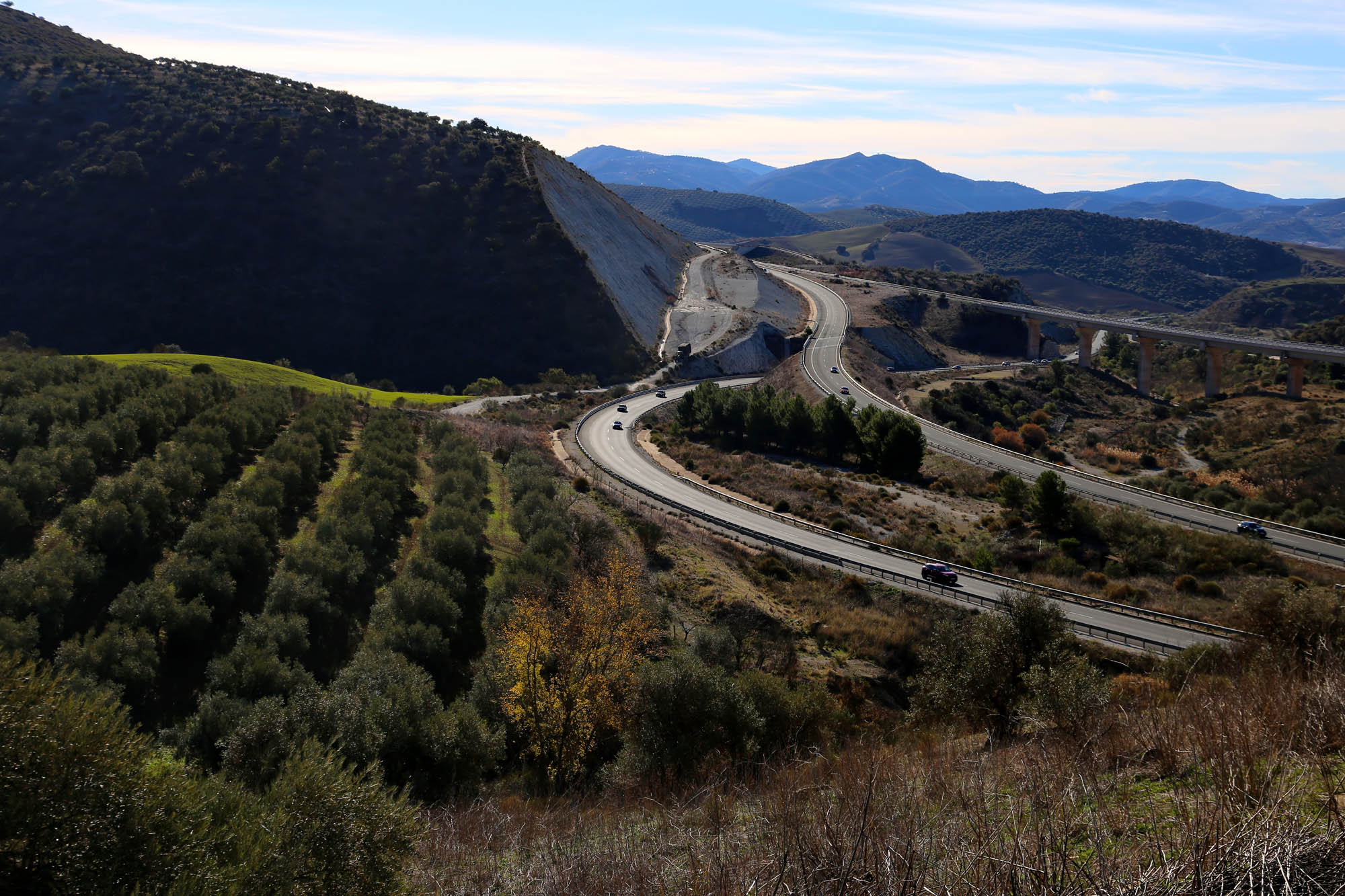
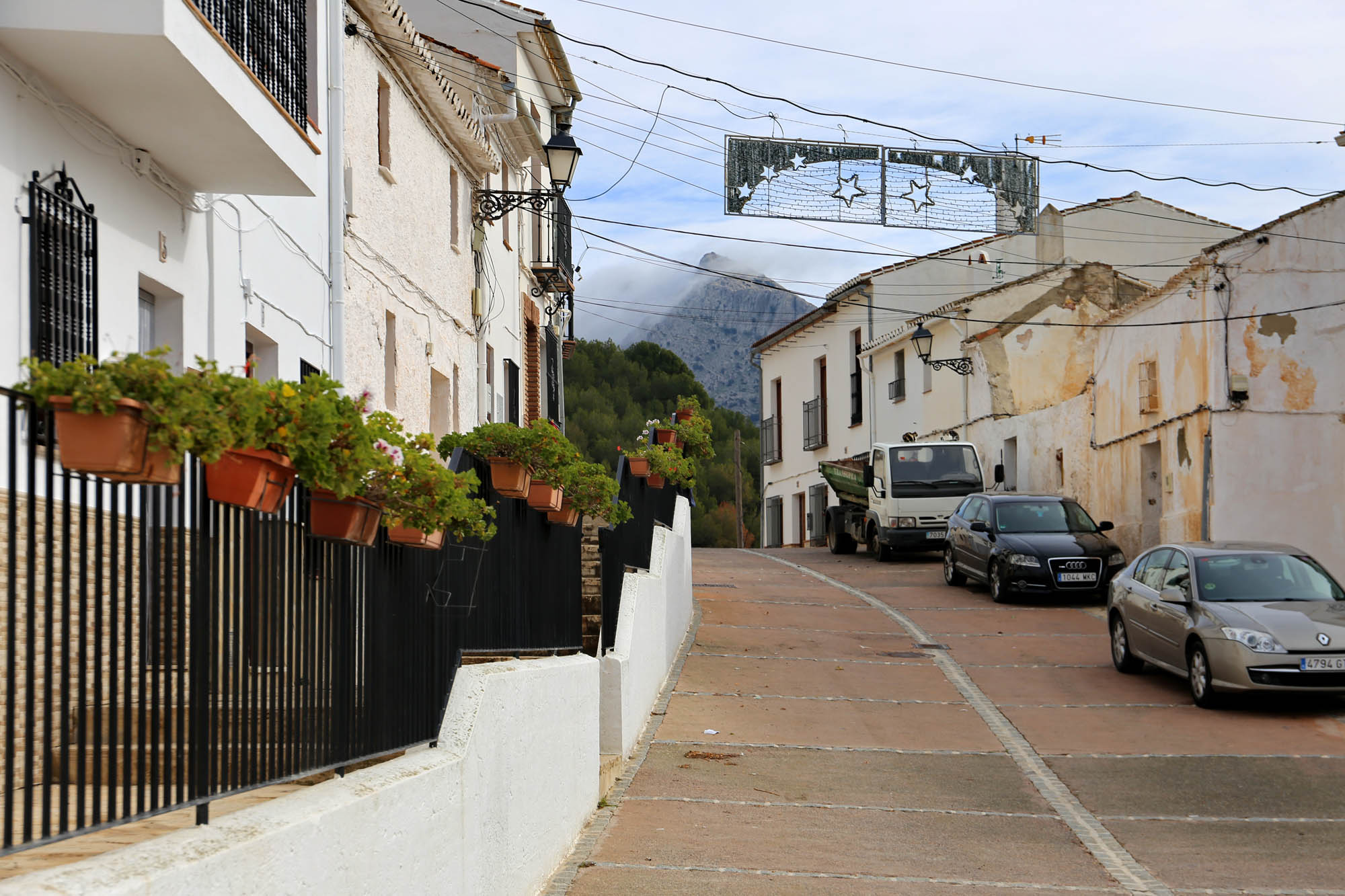
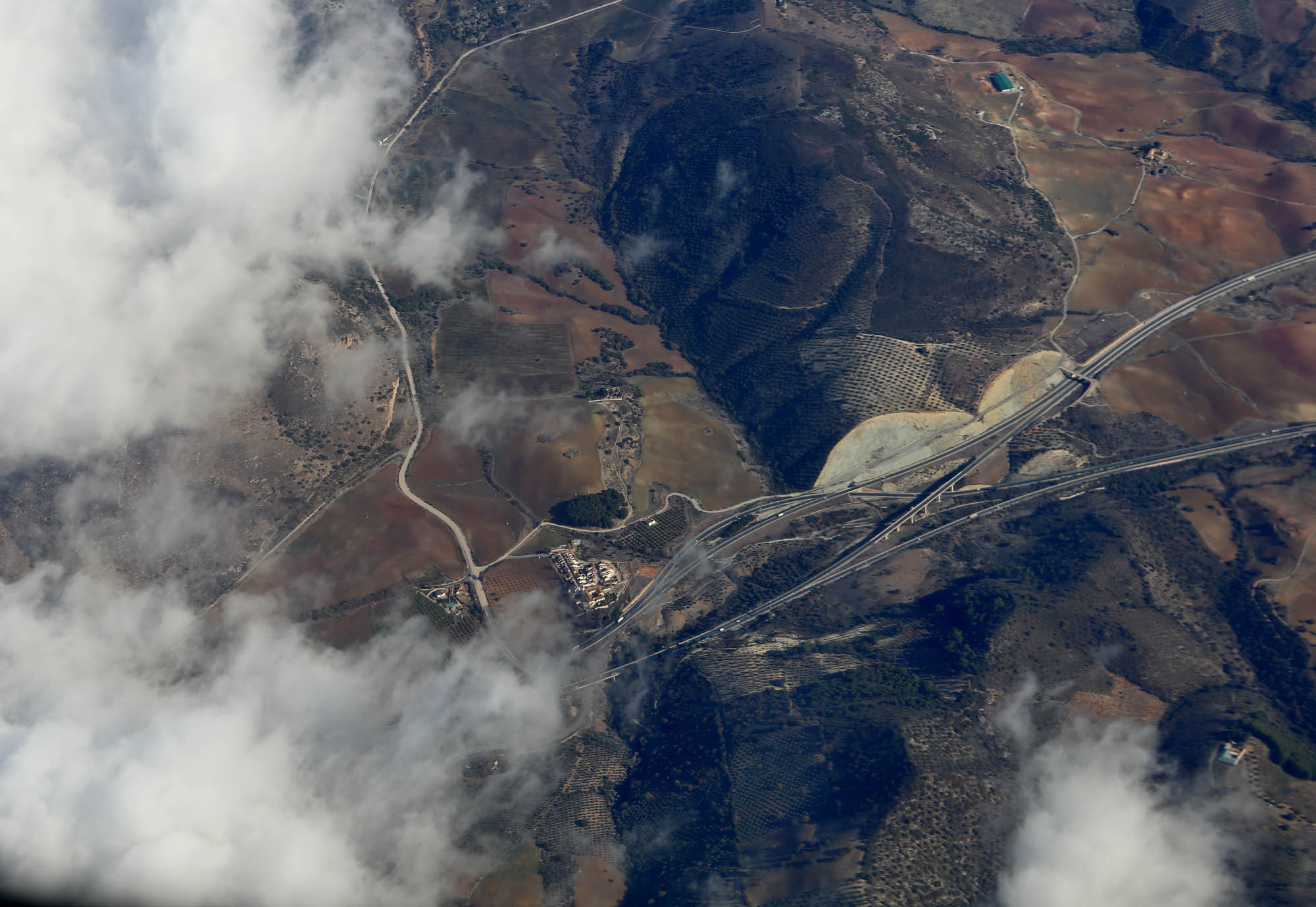
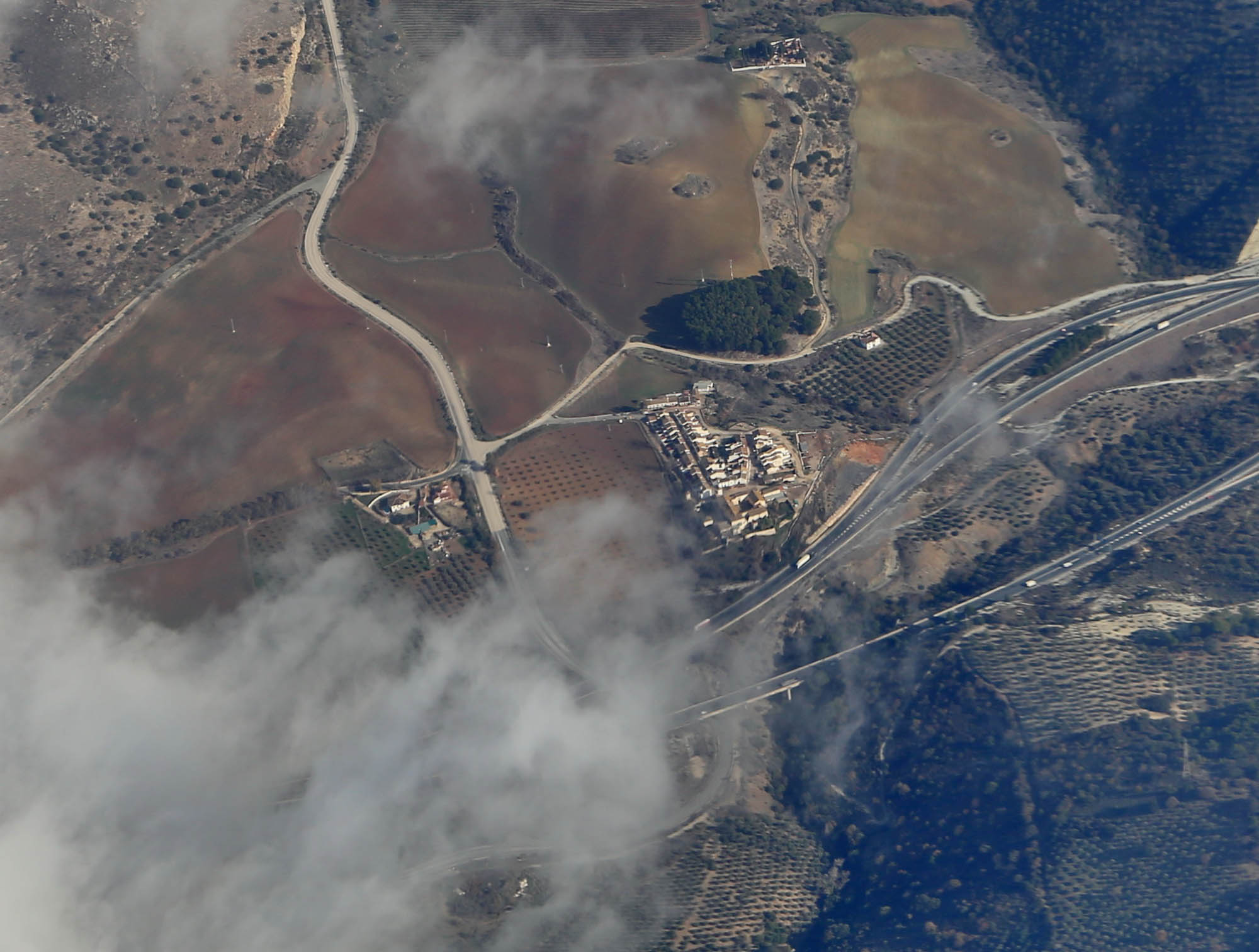
As you drive from Málaga airport through the Málaga mountains into the interior of Andalusia, just before the Antequera junction where the roads branch off to Seville, Córdoba and Granada, a compact cluster of houses looks down from a hilltop along the way. Traditional Andalusian white houses, standing shoulder to shoulder, coming together as a single closed settlement, as if they were preserving an old story. I give in to my gut feeling and pull off the highway to listen to that story.

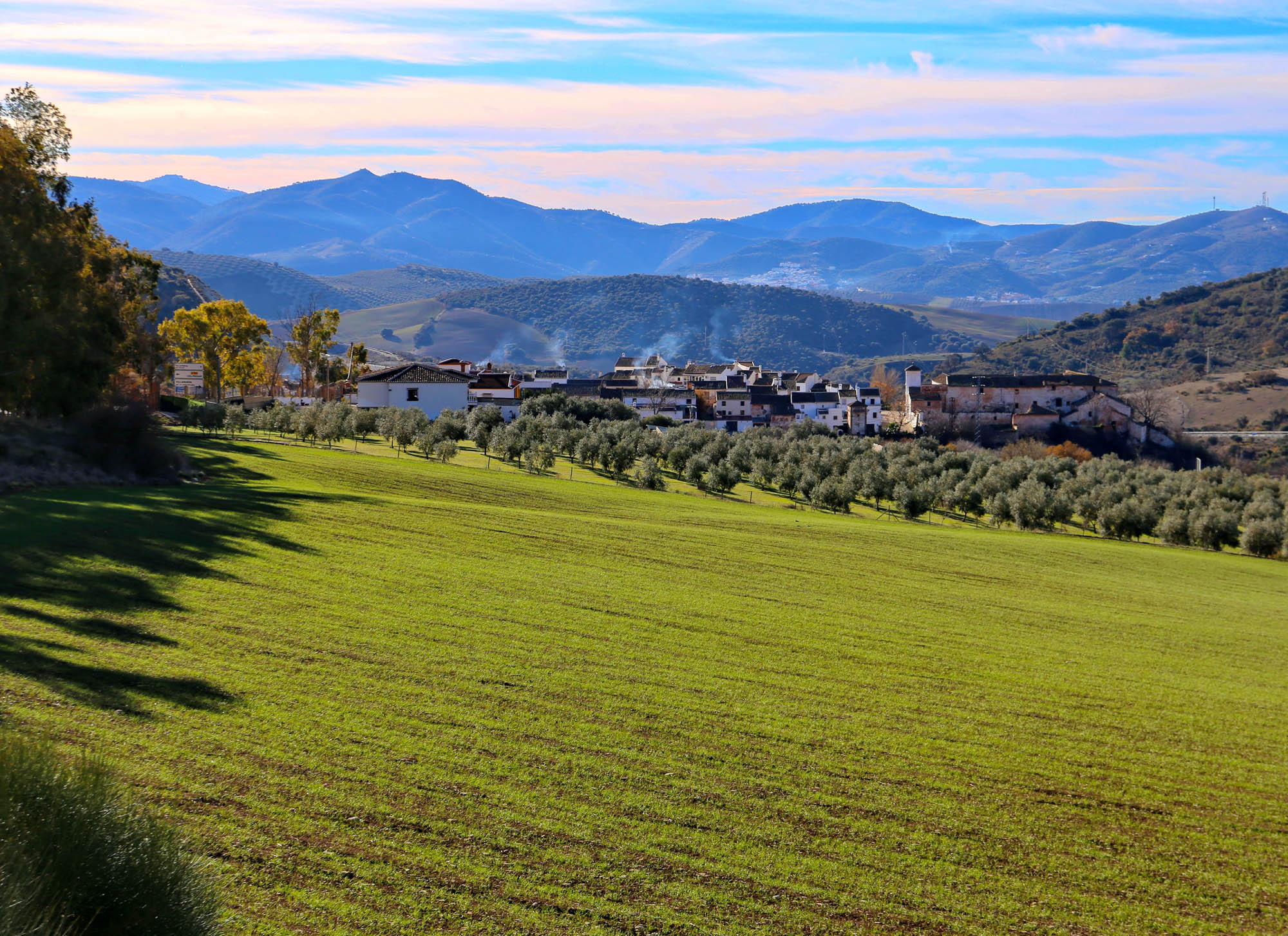
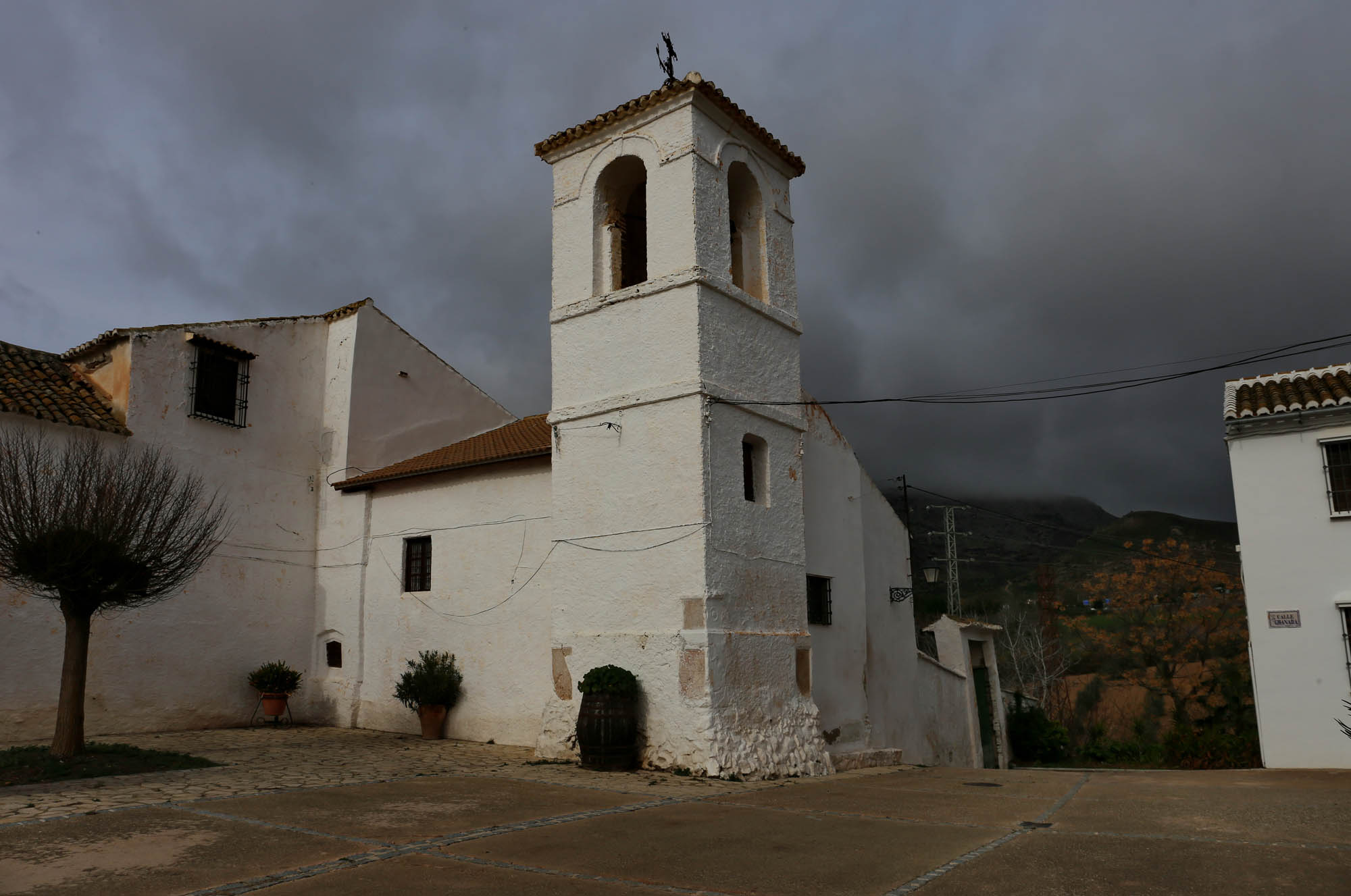
Approaching the village on the access road, the compactness of the settlement is even more striking. Behind the fields and olive groves shining in the warm January sunlight, the white façades arranged in a straight line seem to be the first protective wall of a fortified settlement, and to the right, the large block of buildings behind the white church tower looks like a fortified monastery or a castle.

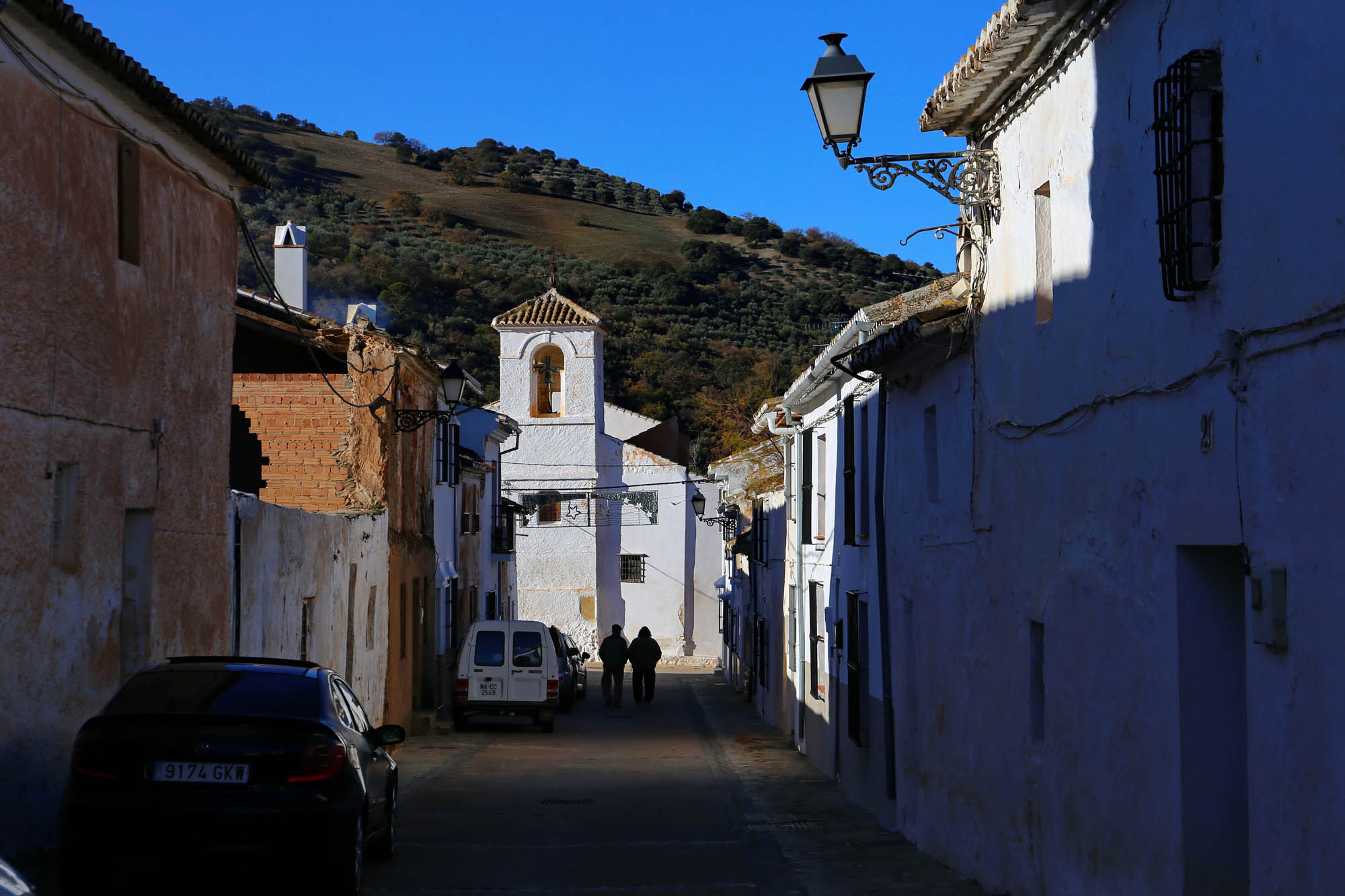
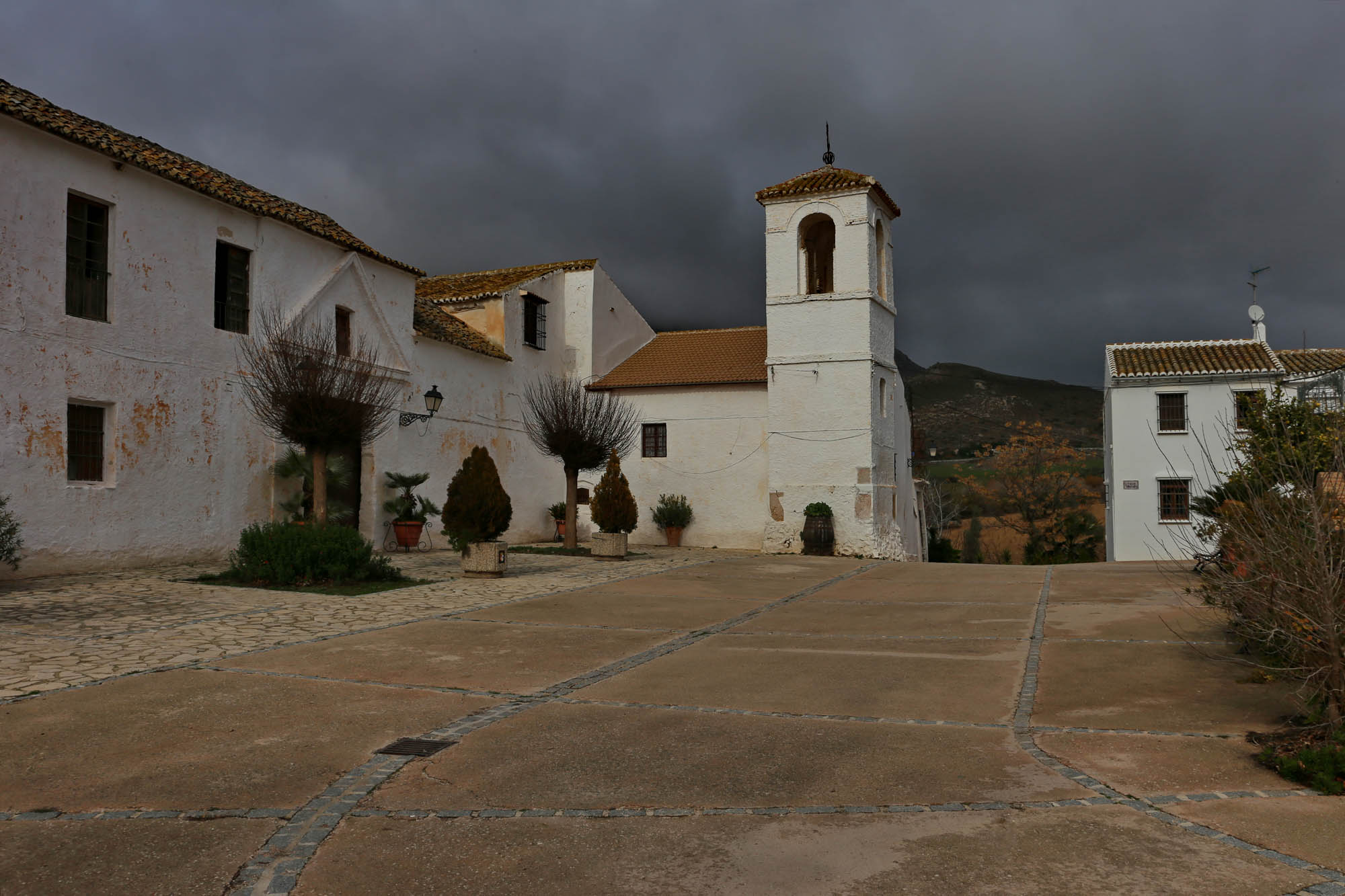
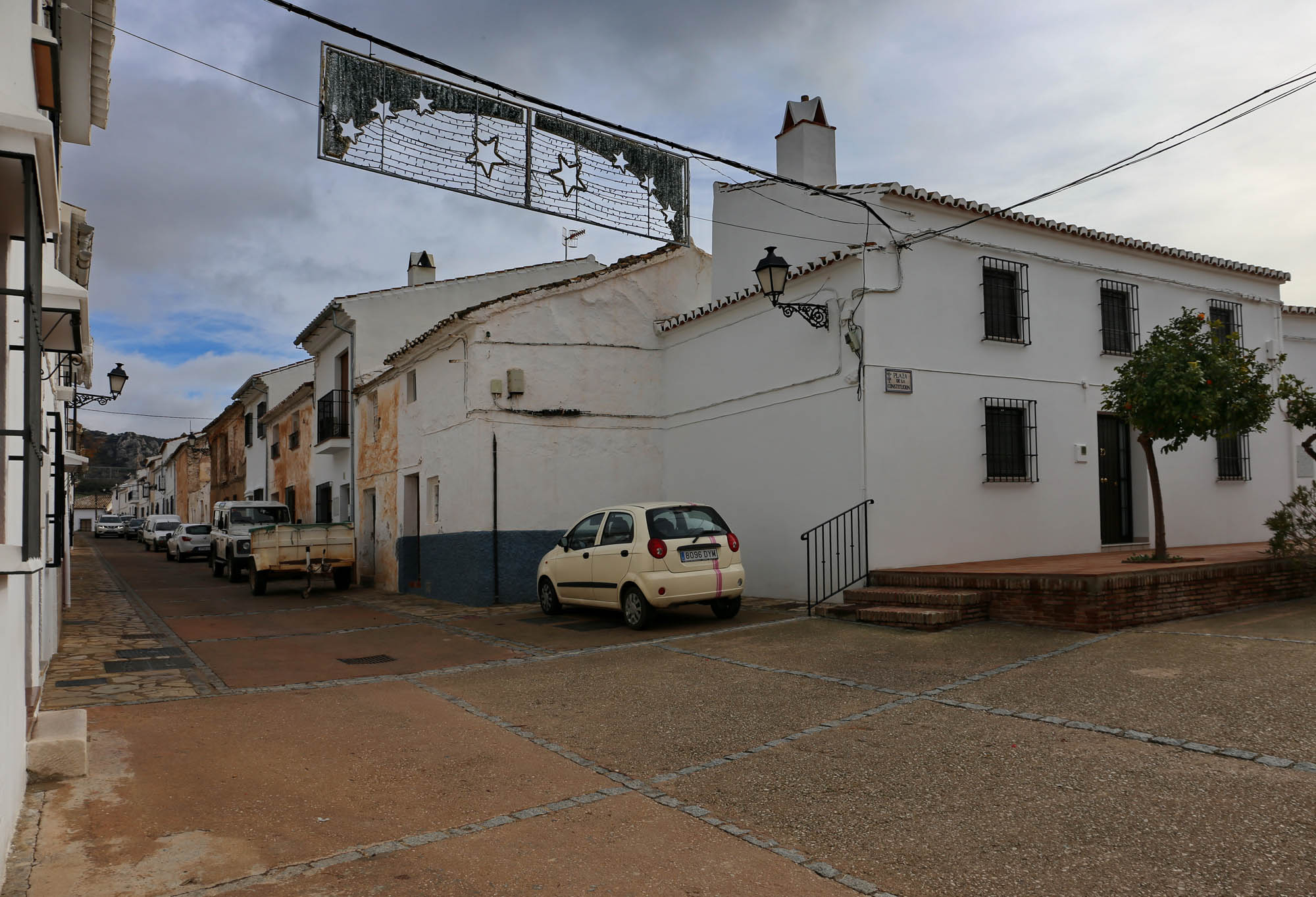
And it is indeed. As I park the car on the left side of the village and walk down Granada street between closed rows of white houses leading to the church – the other two streets are named after Seville and Málaga, as if giving a hint as to where you can go from here –, the many-windowed façade of a large, thick-walled block of buildings gradually unfolds behind the white church tower. This large peasant castle, assembled over the centuries, is none other than the Moorish castle of Cabeche or Qawŷ.

The castle of Cabeche was first mentioned by the 10th-century Córdoban historian Ahmad ibn Muhammad al-Razi in his History of the Rulers of Andalusia, which became known in Spanish as The Chronicle of the Moorish Rasis. According to this, the castle was built in the early period or golden age of Andalusia, sometime during the Umayyad emirate.

The castle of Qawŷ was mentioned in the chronicle Yannat al-Rida of the 15th-century Muhammad Abu Yahya ibn ʿĀsim from Granada among the castles that the Christians captured in 1410 on the western border of the Sultanate of Granada, but in 1447 the Muslims recaptured from them for a while. Ibn ʿĀsim describes the location of the castle quite precisely, and it roughly coincides with the castle of Cauche. It is not known whether this is identical with the castle of Cabeche mentioned by al-Razi, because he does not localize it exactly, but it is not excluded.

What is certain is that the castle, as a Moorish fortress, oversaw the main road from Málaga to Medina Antequera for centuries.

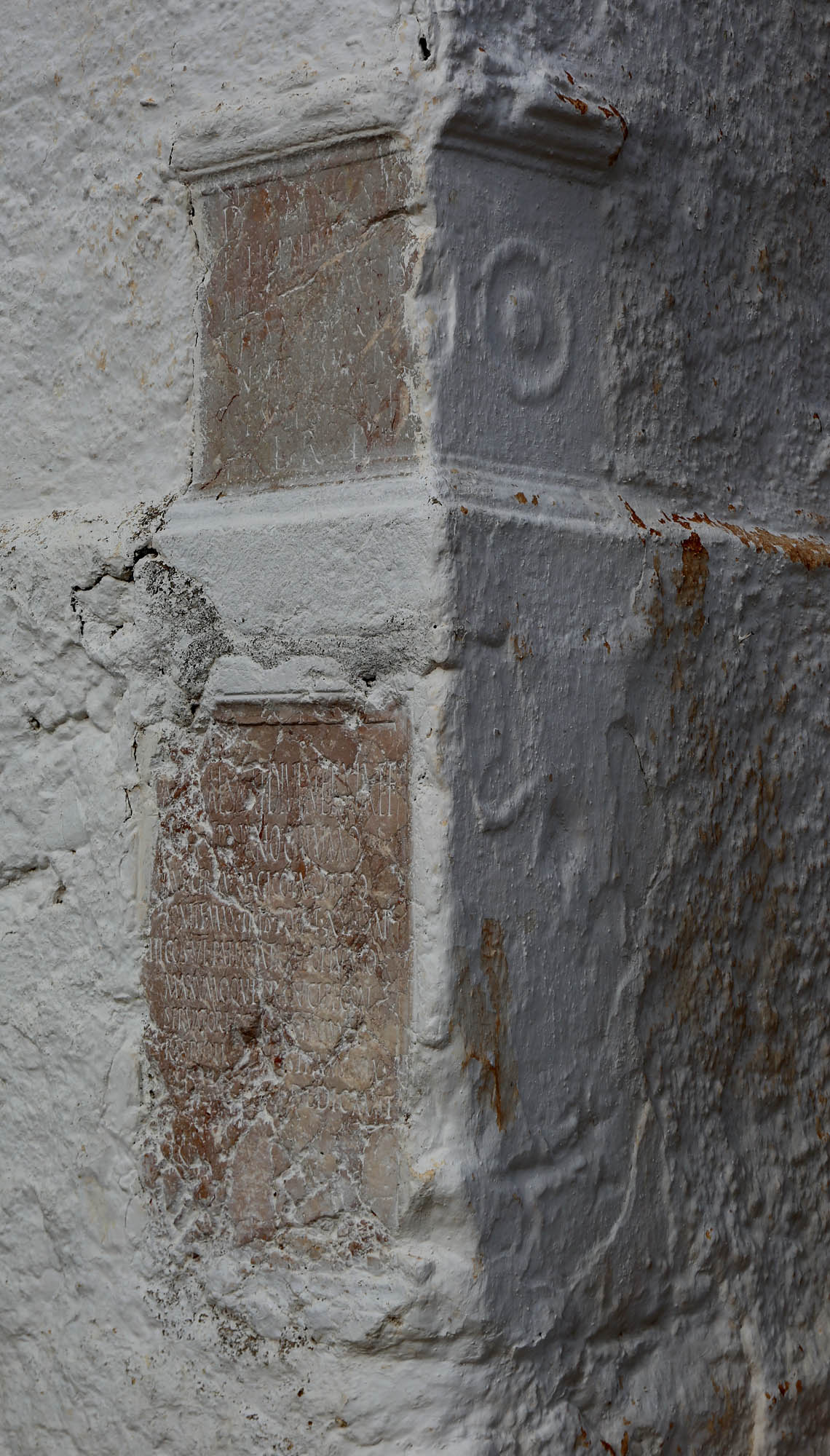
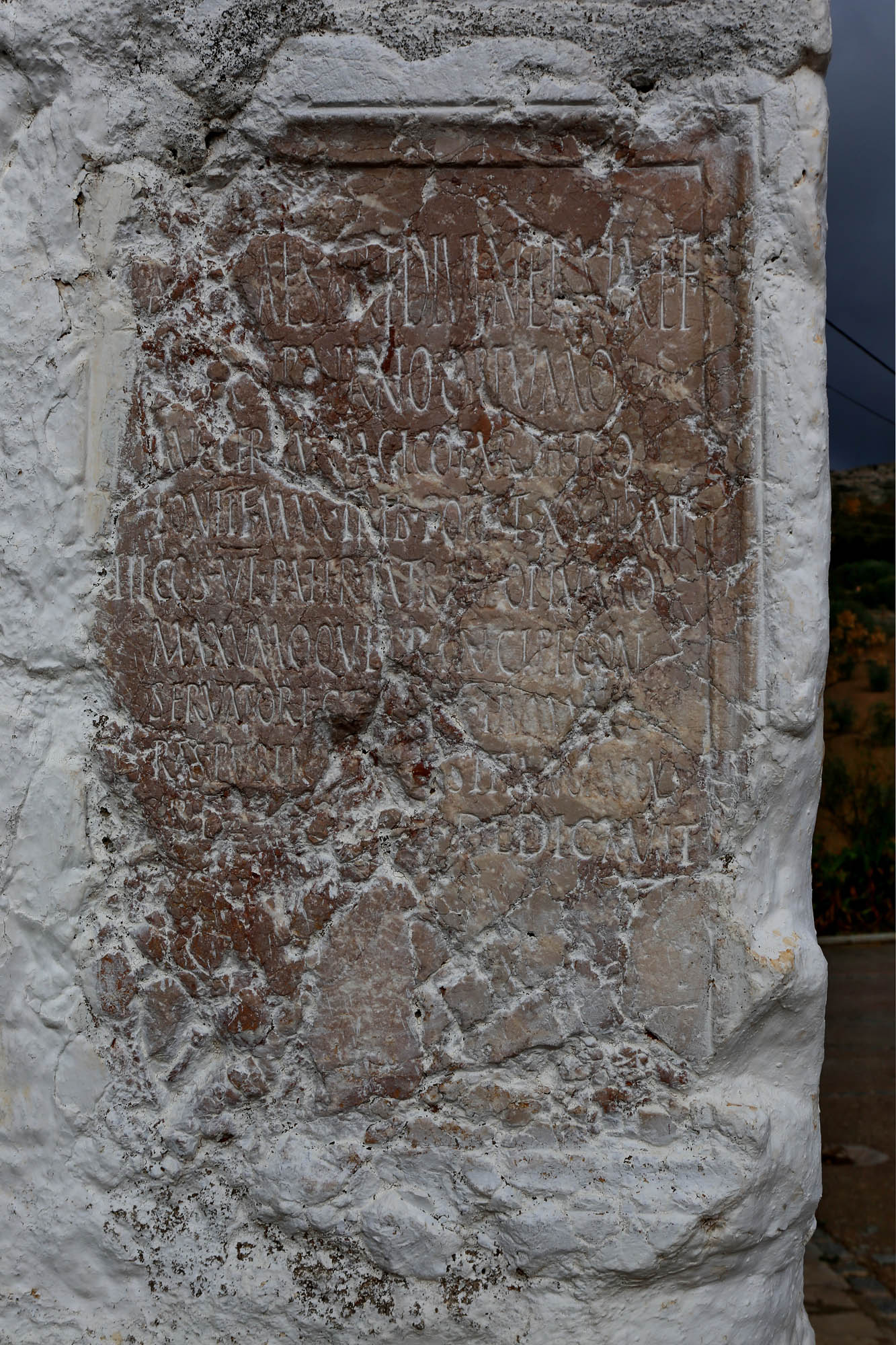
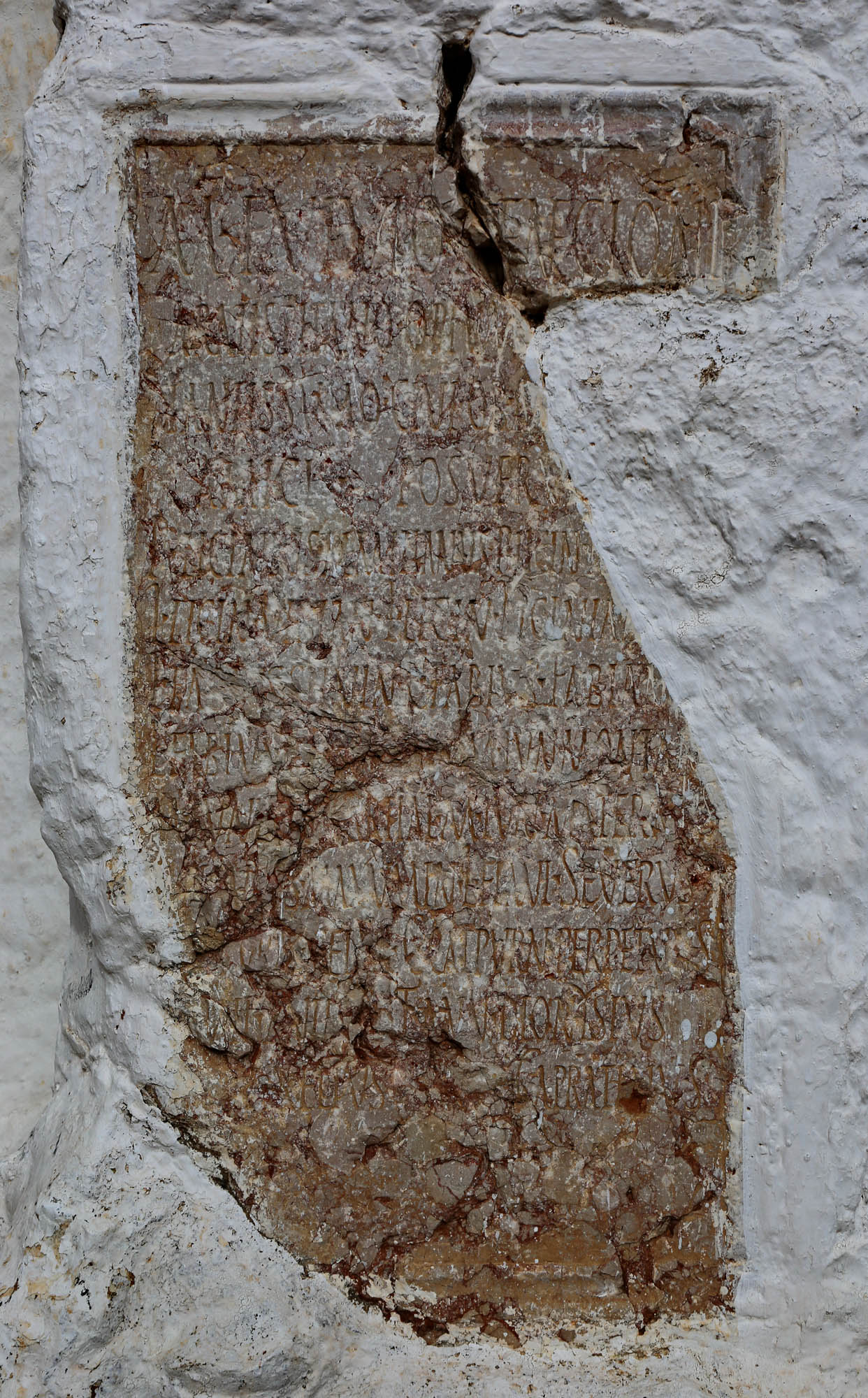
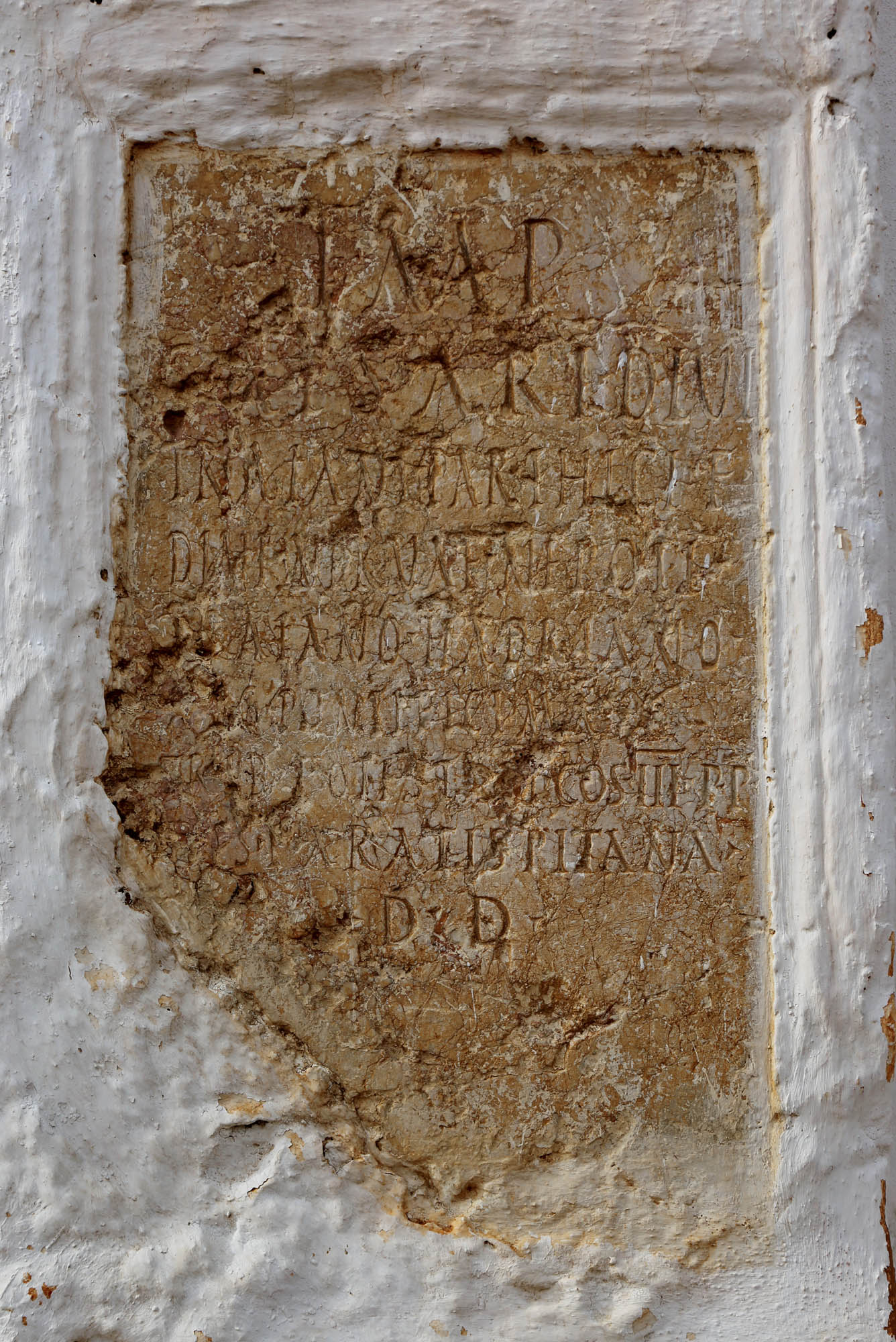
However, the settlement has a much older history. A little south of the former Moorish fortress, the foundation walls of the Roman-era town of Aratispi are still visible, which the locals also call Cauche el Viejo, as if the original population of today’s Villanova de Cauche came from there. The mill of the village, which today stands in ruins on the banks of the Cauche river, was also built from its carved stones. And this is also where three beautiful carved stones with Roman inscriptions from the 2nd century come from, built into the tower of the village church in 1731, so placed as to indicate not simply the use of free stone material, but antiquarian interest.

The stone on the SE corner commemorates the death of Emperor Trajan (53-117), who was born in this province, Hispania Baetica. It ends: Res publica Aratispitanorum decrevit et dedicavit – ordered and established by the community of Aratispi

A tombstone on the S wall with the initials M. Fulvio Senecioni Aratispitano – erected to Marcus Fulvius Senecio of Aratispi by his friends

The stone on the E wall of the tower was erected in honor of Emperor Hadrian (76-138), who was also born in Hispania Baetica: Res.P. Aratispitana D.D. – ordered and installed by the Aratispi community

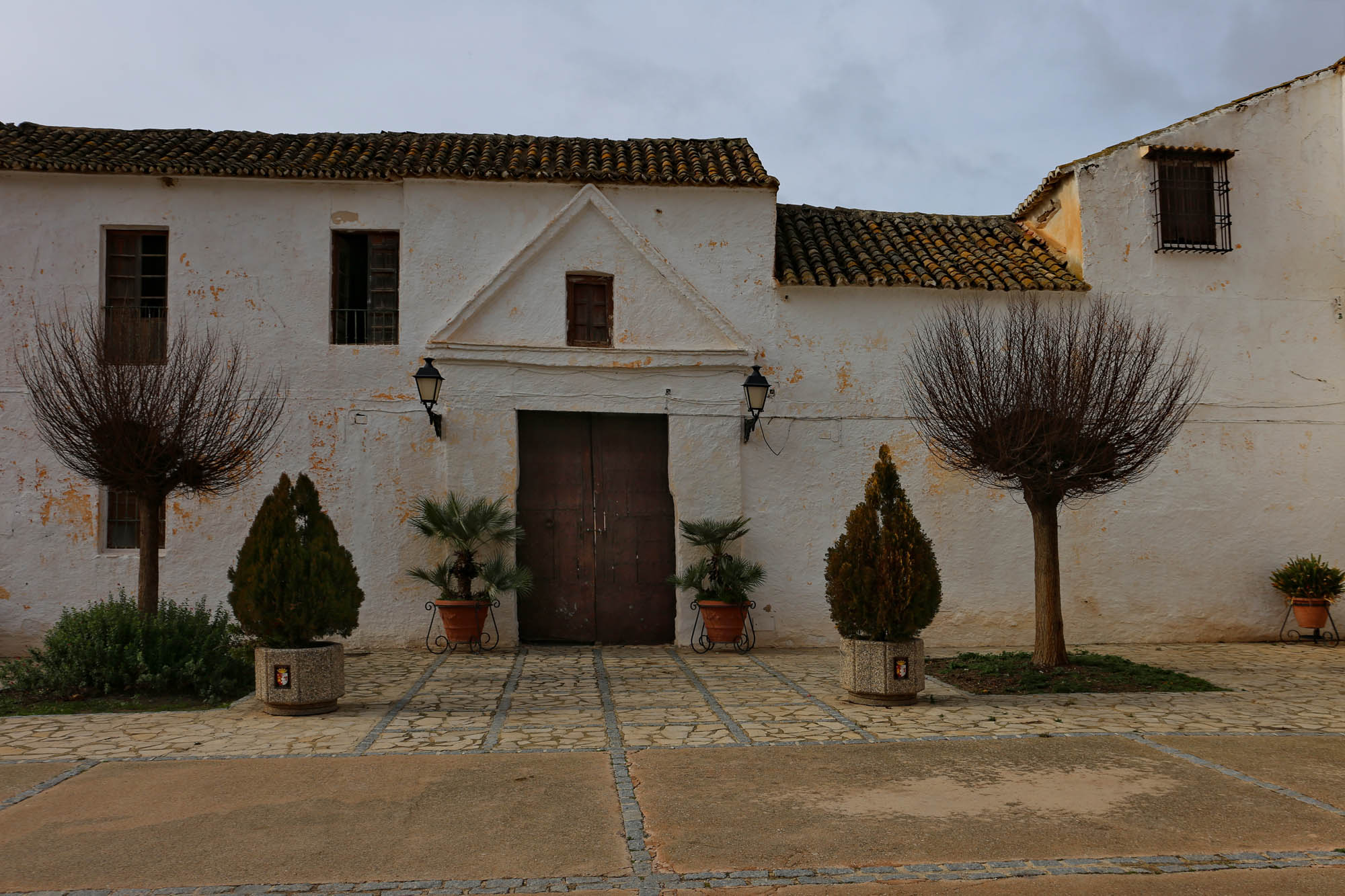
After King Ferdinand II in 1487 captured Málaga, the southernmost stronghold of the Sultanate of Granada, the castle of Qawŷ, which depended on it, also fell, and the king had it destroyed along with several other small Moorish fortresses. The depopulated area of the castle was resettled in 1509 by the nearby town of Antequera with Christian residents. This is why the name of the village was expanded with “Villanueva”, new settlement, so characteristic of Andalusia that was undergoing a change of population. Their descendants are the 65 inhabitants of today’s Villanueva de Cauche. The land was given to the Arreses noble family, whose eighth descendant, Pedro de Arreses y Aspillaga was raised to the rank of Marquis in 1679. They built today’s manor house on the ruins of the Moorish fortress, to the wall of which the three streets of the village run.

The inhabitants of the thirty-five houses of the three streets were thus the serfs of the Marquis of Cauche for several centuries. They cultivated their lands, partly in the form of compulsory free work, partly for their own benefit, but in return for a tithe. Even at the turn of the millennium, the residents of Cauche regularly delivered chickens and crops to the manor house. Although they had lived in their houses for generations, they had no title deeds, only a document signed by the Marquis, which allowed them to live there. In this way, the houses could neither be sold nor rebuilt.

After 2005, the new heir reorganized the noble estate into a modern farm and gave the residents of Cauche the opportunity to buy the land they cultivated at a price of 90 euros/m². This was realized, but the new owners only received a private contract without an entry into the land registry, because the Antequera land registry was not able to transform the records of the Marquis’s estates according to the new parcels. Finally, in 2015 it was possible to solve the reorganization and register the ownership of the lands and houses. In 2015, the Middle Ages ended also in the last serf village in Europe.

All this did not change in the view of the village. Its most significant building is still the Marquis’s manor house with the church. Apart from this, there is only one community institution in the village, the “Antigua Peña”, Old Club, that is, the pub. It was closed when I was there now, but according the local papers reporting on the end of feudalism, there is a lot going on here. There is no store: a grocery truck comes twice a day with bread, meat, fish and other basic foods, and on Saturdays the mobile supermarket. “In which other village do they deliver the goods to your door?” the residents say proudly. The built heritage of the village is subject to strict regulations of monument protection. Even if the Middle Ages are over, the traditional Andalusion white houses – preserved by the constraints of serfdom – must be maintained without any changes.

Villanueva de Cauche photographed from a plane this afternoon

The Elephant’s Well

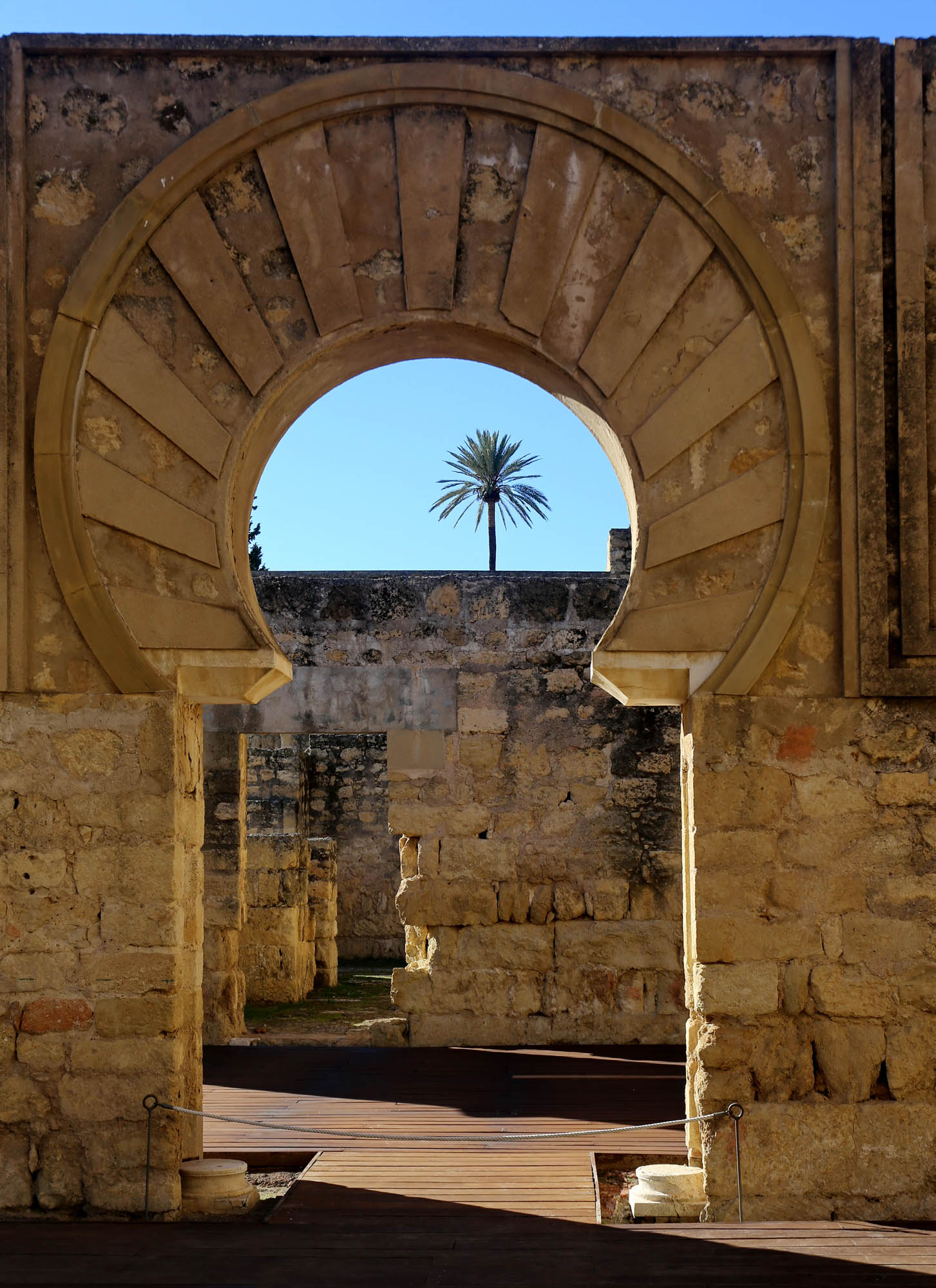
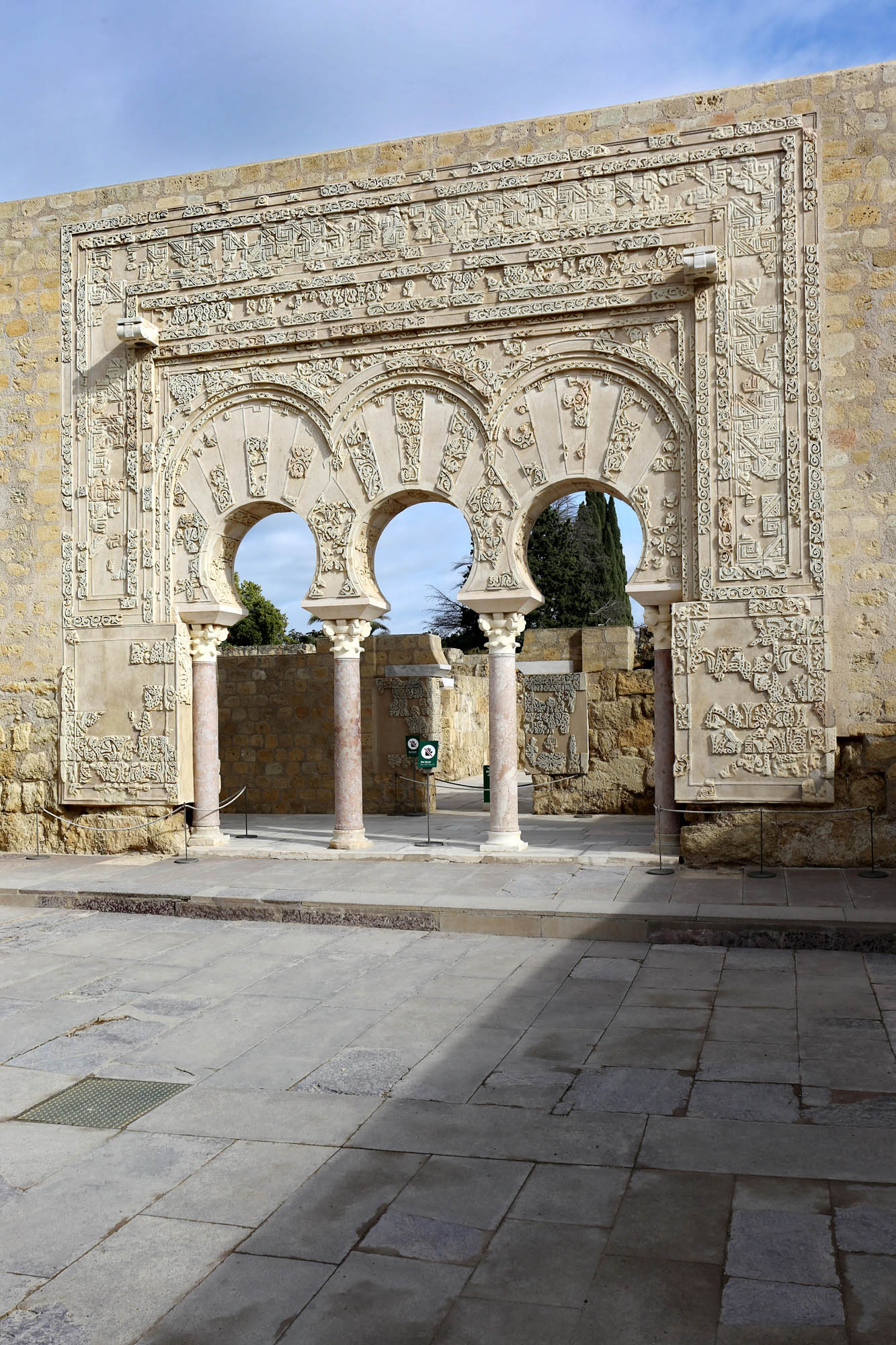
Ten kilometers west of Cordoba lies Medinat Al-Zahra, the Shining City, built as the most beautiful city of the world by Abdurrahman III in 929, on the occasion of declaring himself the caliph of Andalusia, as a sign of his independence from the Sunni caliph of Baghdad and the Shiʿa caliph of Cairo. Today, only the central part of the city is standing, deprived of all its ornaments, carvings and noble wall coverings, but even in it ruins, it clearly testifies to its former beauty and richness.

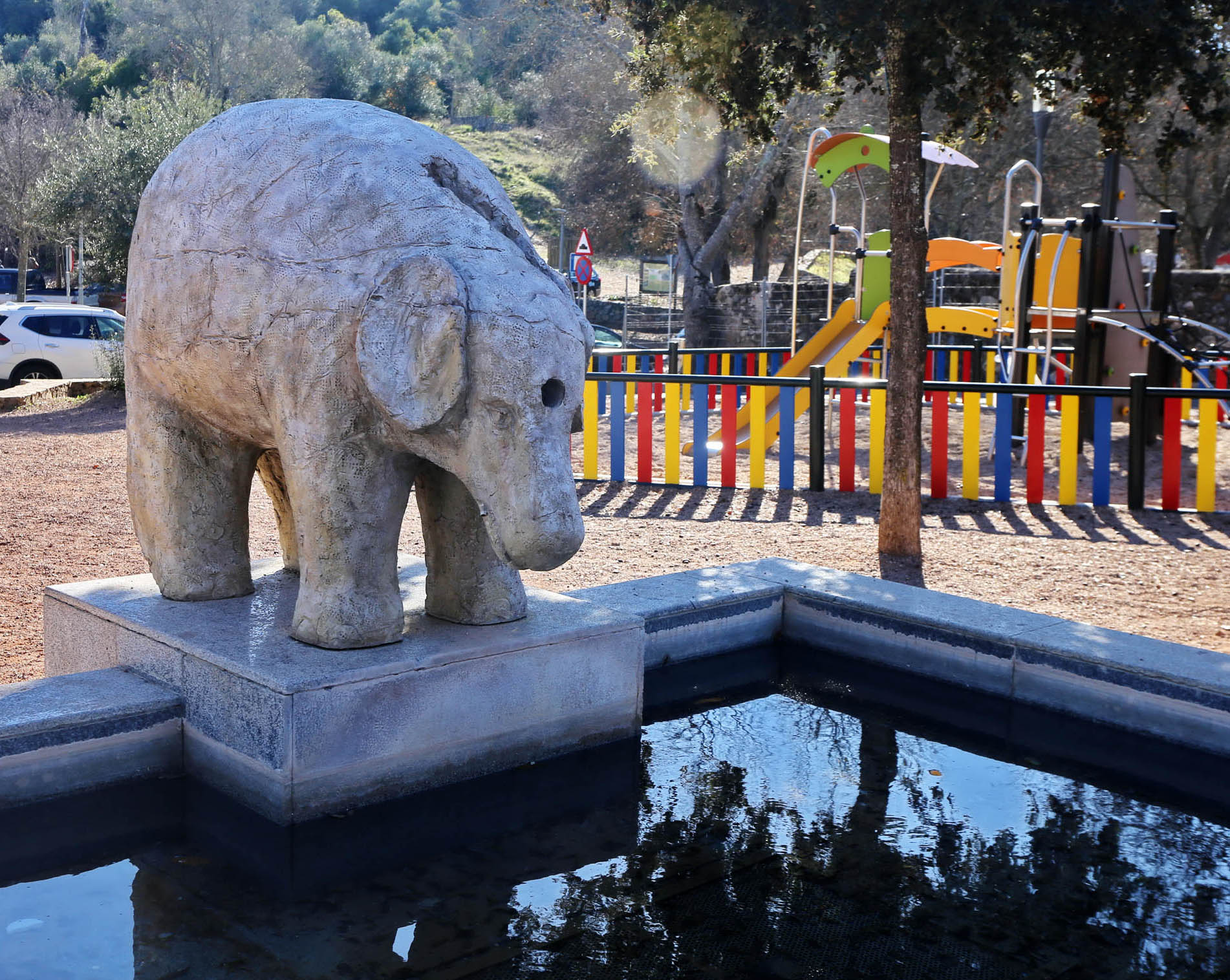
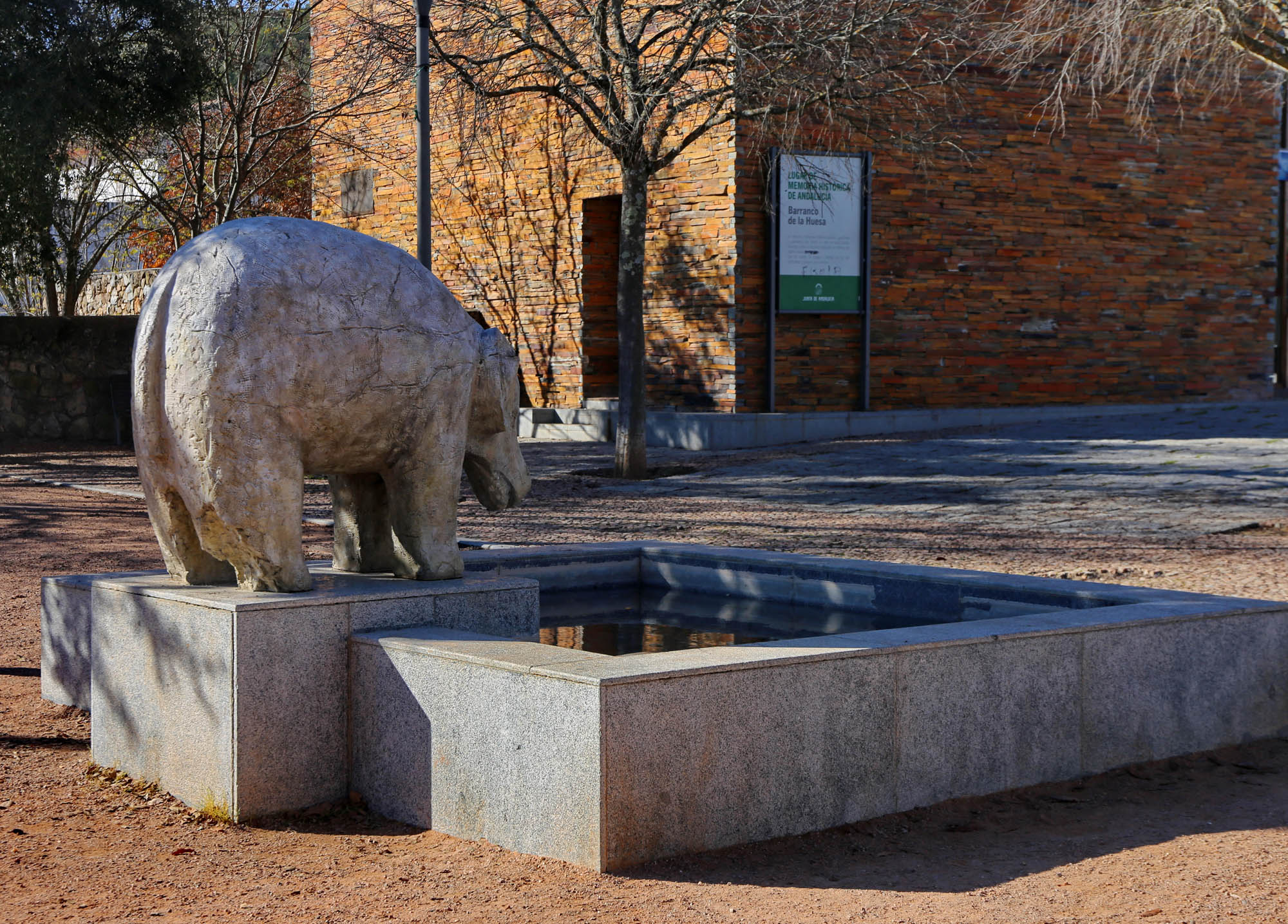
Directly above the city rises the Sierra Morena range, a national park whose springs once supplied the city with water. One of these springs is a few kilometers above the town, in the main square of the present-day town of Santa María de la Trassierra. The spring is today surrounded by a regular granite well, with a large animal carved from pink limestone on it. Its shape, ears and legs are of an elephant, only its nose is too short, as if the sculptor found impossible to accept the existence of an animal carrying its tail on its face.

Although the statue looks old, it is just the copy of a really old one. Its original stood in the woods a kilometer away for a thousand years, until 1988, when it was transferred to the courtyard of the Archbishop’s Palace in Cordoba. Since then, a copy stand in the original place, too, but in order to boast with it not only to hikers, but also to all other visitors of the town – for example to those who come to the excellent Candil restaurant across the street –, the municipality also erected a copy here, in the main square. None of the three has any information board.


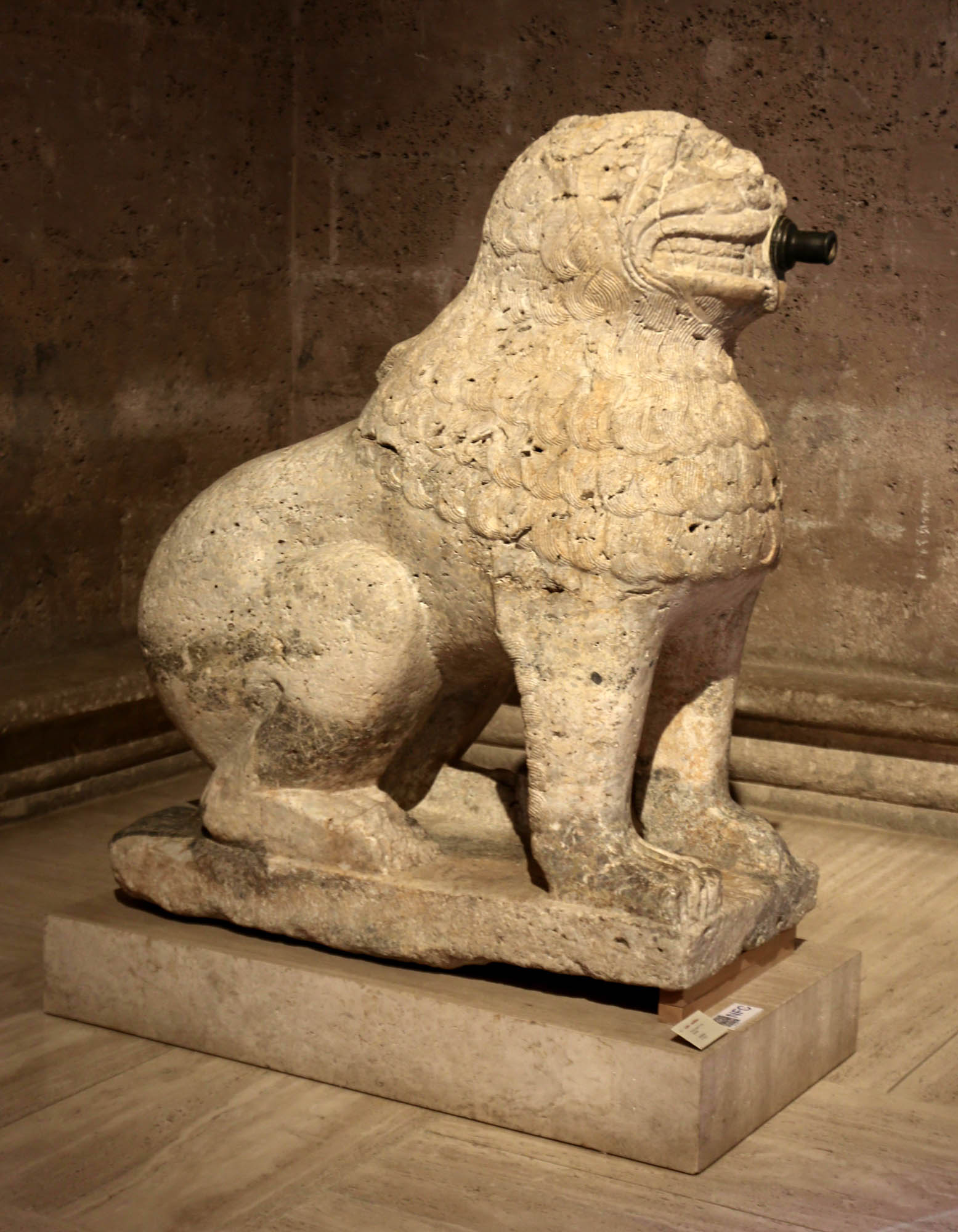
According to radiocarbon dating, the original sculpture may have been created sometime between 982 and 1193, that is, during the heyday of the Shining City. We also know its cause and function. It stood next to the Valdepuentes aqueduct, known by the Latins as Aqua Vetus or Aqua Augusta, which had supplied water to the expanding city of Corduba since the time of Emperor Augustus. The architect of the Shining City, Maslama ben Abdallah renovated this aqueduct in the 930s to provide the caliphal city with water. And not long after, Caliph Abdurrahman, or one of his high-ranking courtiers, had a pleasure garden built here, in the Valley of the Roses, which was also irrigatd by the water of the Aqua Vetus. As evidenced by the opening on its forehead and the bed of a tube carved in its temple, the elephant was the well statue of this water somewhere at a prominent point in the garden, just like the lion statues in the garden of the Alhambra.

The origins of the elephant, like most relics of al-Andalus, are enveloped in a legend that Manuel Pimentel has included in his book of legends of Medina Azahara. The legend, like the tales of the Thousand and One Nights, has a swirling structure: leaning over it, we see another legend. According to it, Maslama ben Abdallah roamed in the Sierra Morena in search of building materials for the new city of the caliph, and everywhere talked to the locals in hope for information about the materials on the site. This is how he met a hermit in the woods, a connoisseur of the traditions of the Christian world of two centuries earlier, who told him the following legend:

The Romans conquering southern Hispania, had to wage war with the Carthaginians, who regarded the region as part of their own colonial empire. To fight them with weapons equivalent to theirs, a large group of combat elephants were brought over from North Africa, and with their help they could oust the Carthaginians. Thereafter, the elephants were stationed at the headquarters of the legion at the foot of the Sierra Morena, but their feeding during in the dry and barren years put the camp’s logistical capacity to test. Eventually, the centurion in charge of the camp decided that since the Carthaginian threat was over, the elephants would have to be killed. However, their caretaker, who felt sorry for them, preferred to release them. The herd set out for the green mountains, where the head elephant stopped at a point in the valley, and turned a large rock out of the ground. From under the rock, abundant water flowed and gathered in the form of a large lake at the foot of the rocks.

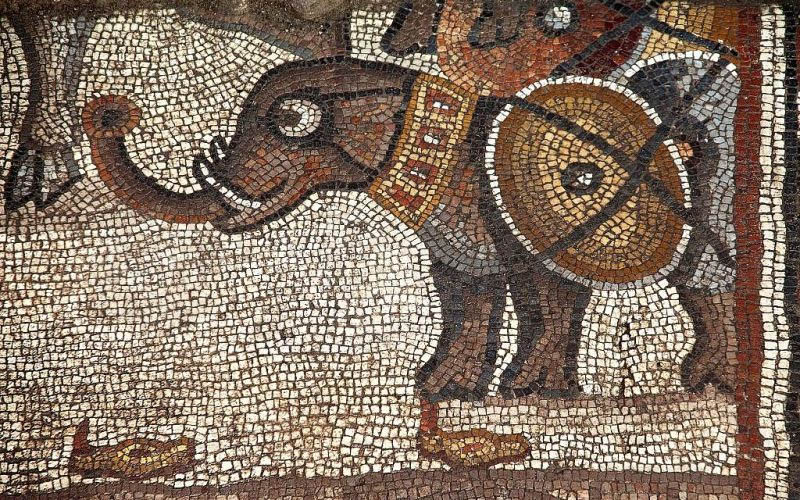
Combat elephant. AD 5th-century Roman mosaic in the town of Huqoq, Galilee

The centurion was informed of the fountain, and hurried to the spot. However, he slipped at the shore of the newly formed lake, and fell into the water. His armor would have pulled him to the bottom of it, but the elephant with its snout reached after him and lifted him ashore. The centurion then ordered the elephants to receive ample provision until their deaths. An aqueduct wa built from the lake to supply the center of the province, Corduba. And in the decades that followed, the two aging males, the centurion and the elephant, were often seen walking together in the mountains above the city.

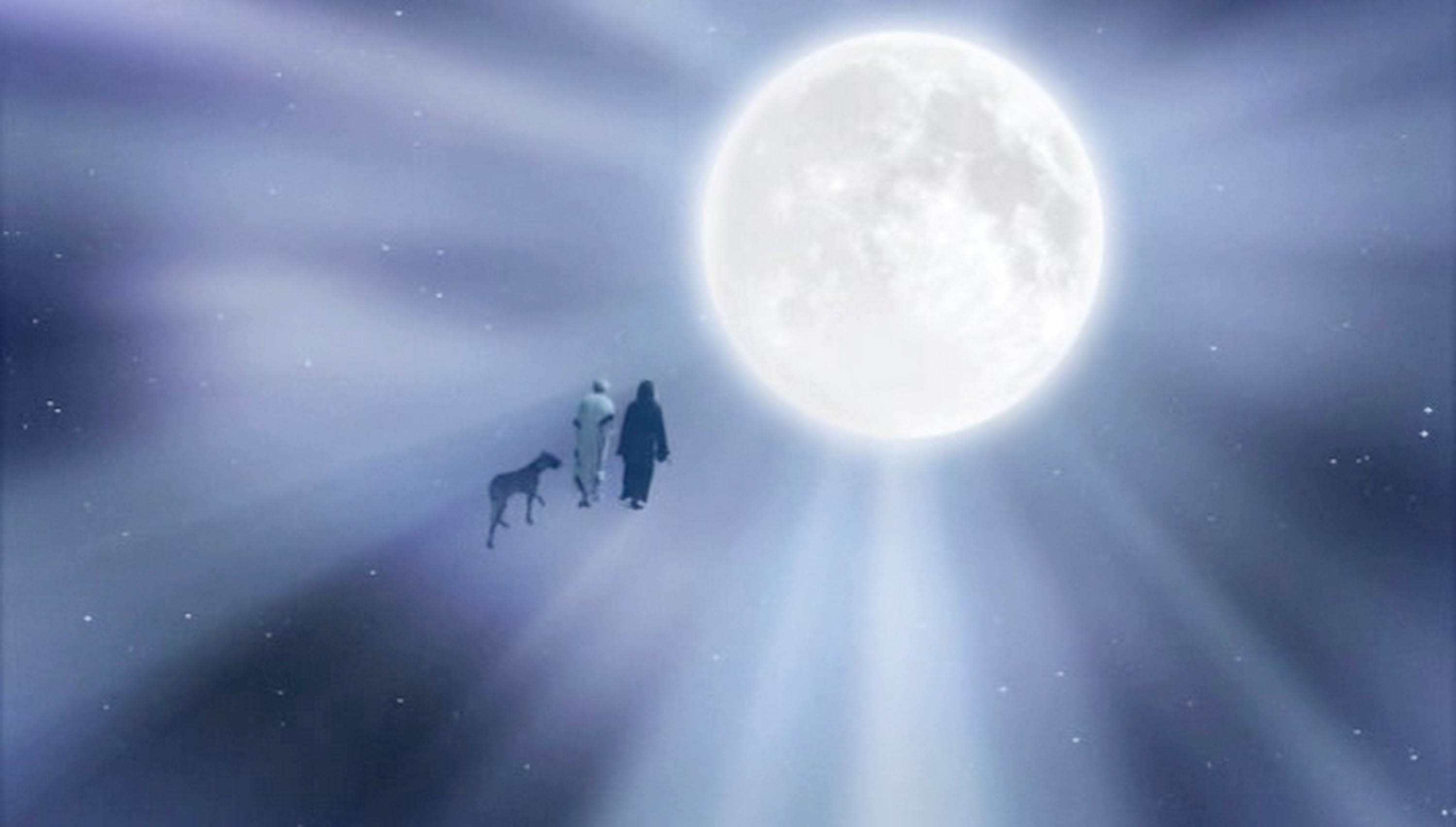
Pilate and his dog walking with Ha-Nocri until the end of times in Vladimir Bortko’s movie The Master and Margarita

On hearing the legend, Maslama ben Abdallah renovated the Roman aqueduct and led the water of the Elephant’s Well to the new city of the caliph. And when the hermit died, he had an elephant statue carved on the shores of the lake in memory of him and his story.

The original statue next to the Aqua Vetus in the 1930s

So far the legend. Its core is certainly an attempt to explain the origin of the lake accumulated near the ruins of the aqueduct. And the elephant is an Arab well statue erected after its restoration, a unique work in Muslim art which otherwise rejects sculptures and modeling living beings. However, in al-Andalus, existing in close contact with European culture, this ban softened in many cases, as we shall see later.

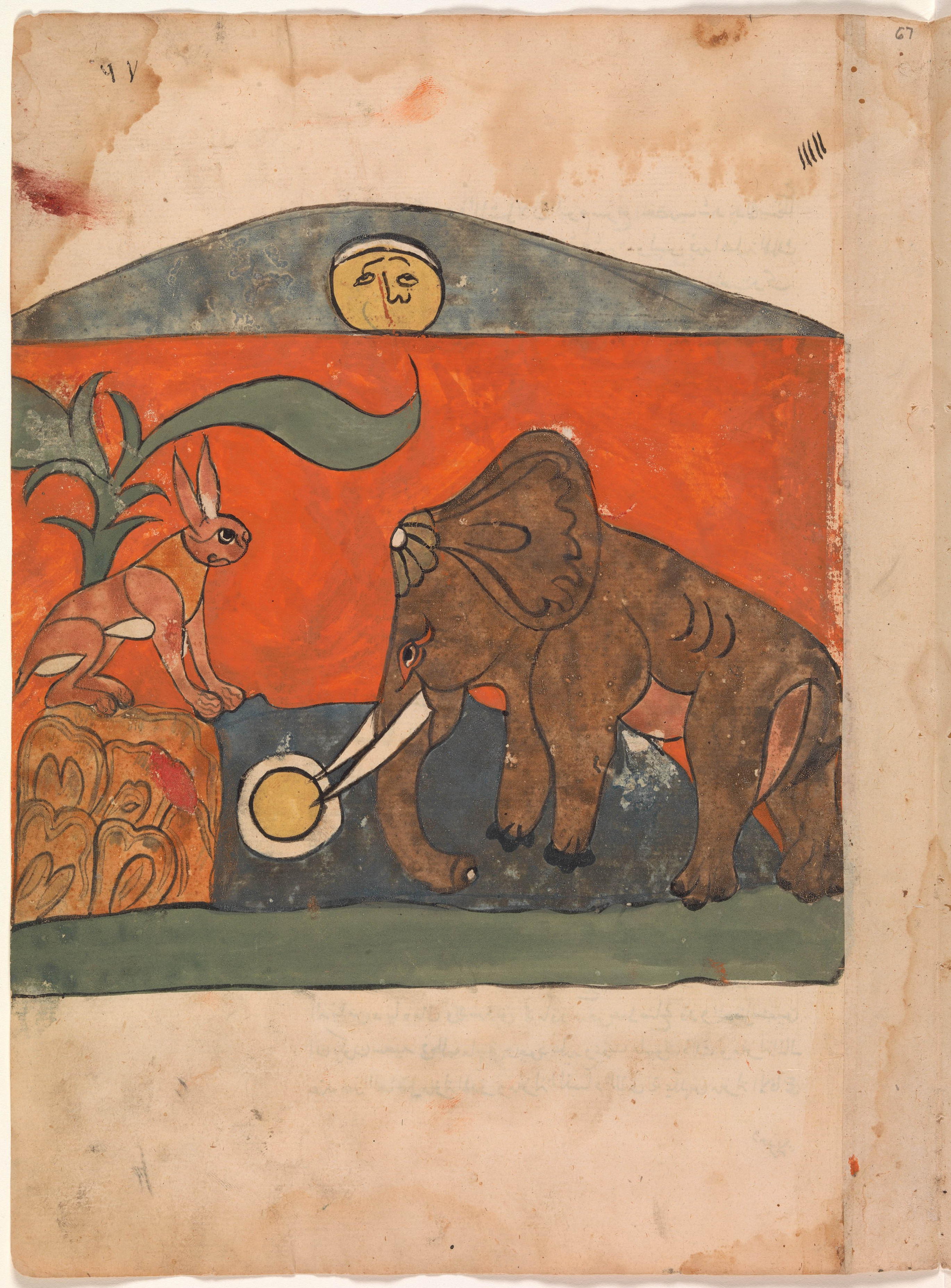
The wise rabbit and the Elephant King at the Moon’s Well. From the Arab animal tale collection Kalila wa Dimna, 16th century, MET