

|
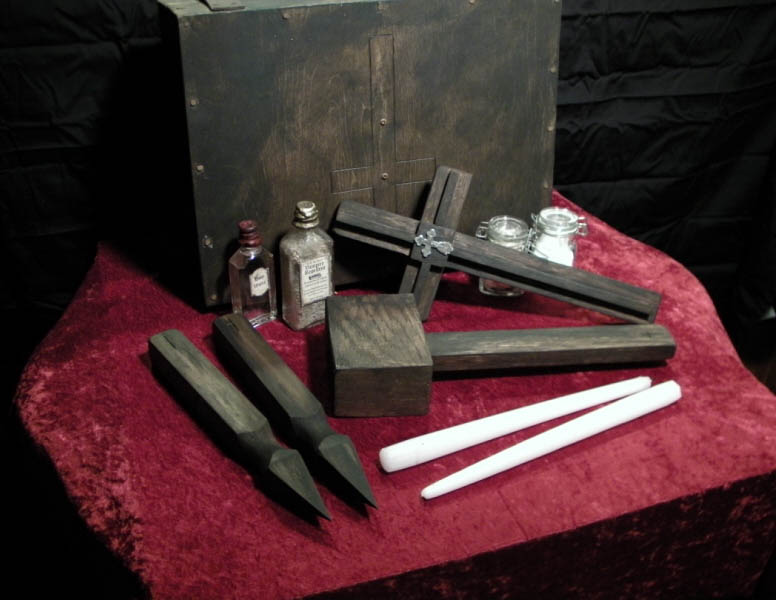
 Whoever has been inspired by the previous post to set out on the trails of Bram Stoker and Dracula to Bistritz and the Borgó Pass, is in a far better situation than the unsuspecting Jonathan Harker. Not only because he already knows exactly what kind of threat he would face, but also because he can buy with a single click, collected in a single package, all that is necessary to an easy victory over that threat.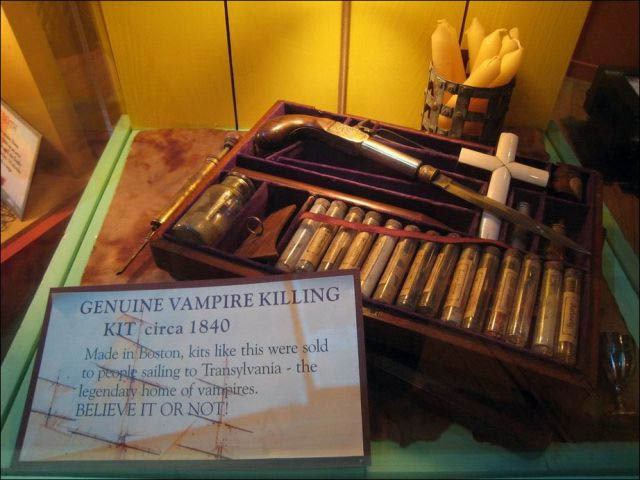
The 19th-century vampire killing sets, made for those traveling from the U.S. East Coast to the eastern curve of the Transylvanian Carpathians, are steadily to be purchased on eBay, and even at the prestigious Sotheby’s auction house, for about 10-14 thousand USD. No small amount, but a man’s life is worth any money.
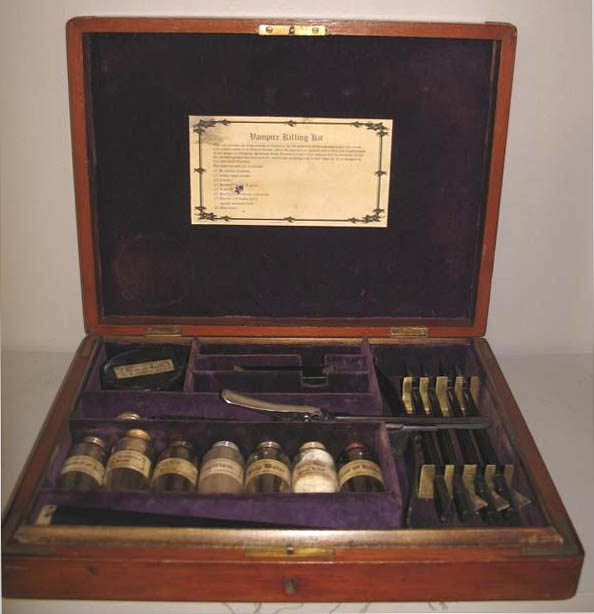
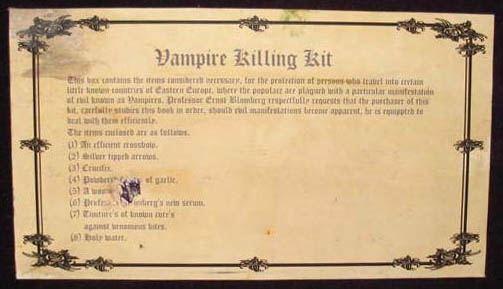
The content of the sets is rich and varied, from the garlic, holy water, holy candles and crucifix expelling vampires to the wooden stake and decapitating dagger for the final showdown, and it even includes such apocryphal weapons, not mentioned in the vampire literature, as the gun with silver bullets, which initially served as a protection against werewolves. The rosary plays a particularly important role, since it was introduced into the literature by the Dracula novel itself, and its first documented use is tied to the King of Hungary Hotel in Bistritz:
Just before I was leaving, the old lady came up to my room and said in a hysterical way: “Must you go? Oh! Young Herr, must you go?” She was in such an excited state that she seemed to have lost her grip of what German she knew, and mixed it all up with some other language which I did not know at all. I was just able to follow her by asking many questions. When I told her that I must go at once, and that I was engaged on important business, she asked again: “Do you know what day it is?” I answered that it was the fourth of May. She shook her head as she said again: “Oh, yes! I know that! I know that, but do you know what day it is?” On my saying that I did not understand, she went on: “It is the eve of St. George’s Day. Do you not know that tonight, when the clock strikes midnight, all the evil things in the world will have full sway? Do you know where you are going, and what you are going to?”
She was in such evident distress that I tried to comfort her, but without effect. Finally, she went down on her knees and implored me not to go; at least to wait a day or two before starting. It was all very ridiculous but I did not feel comfortable. However, there was business to be done, and I could allow nothing to interfere with it. I tried to raise her up, and said, as gravely as I could, that I thanked her, but my duty was imperative, and that I must go. She then rose and dried her eyes, and taking a crucifix from her neck offered it to me. I did not know what to do, for, as an English Churchman, I have been taught to regard such things as in some measure idolatrous, and yet it seemed so ungracious to refuse an old lady meaning so well and in such a state of mind. She saw, I suppose, the doubt in my face, for she put the rosary round my neck and said, “For your mother’s sake,” and went out of the room.
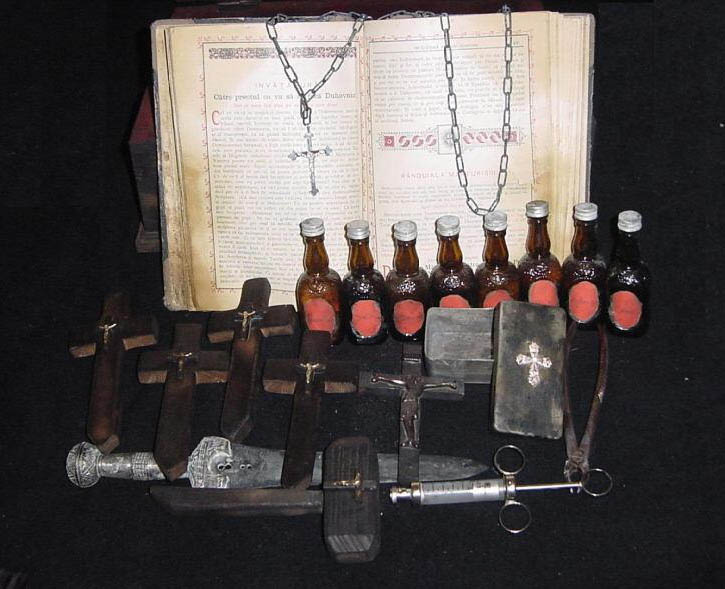
Strangely enough, they do not contain any mirror, which is the surest recognition tool of the vampires in disguise.
I only slept a few hours when I went to bed, and feeling that I could not sleep any more, got up. I had hung my shaving glass by the window, and was just beginning to shave. Suddenly I felt a hand on my shoulder, and heard the Count’s voice saying to me, “Good morning.” I started, for it amazed me that I had not seen him, since the reflection of the glass covered the whole room behind me. In starting I had cut myself slightly, but did not notice it at the moment. Having answered the Count’s salutation, I turned to the glass again to see how I had been mistaken. This time there could be no error, for the man was close to me, and I could see him over my shoulder. But there was no reflection of him in the mirror! The whole room behind me was displayed, but there was no sign of a man in it, except myself. This was startling, and coming on the top of so many strange things, was beginning to increase that vague feeling of uneasiness which I always have when the Count is near. But at the instant I saw that the cut had bled a little, and the blood was trickling over my chin. I laid down the razor, turning as I did so half round to look for some sticking plaster. When the Count saw my face, his eyes blazed with a sort of demoniac fury, and he suddenly made a grab at my throat. I drew away and his hand touched the string of beads which held the crucifix. It made an instant change in him, for the fury passed so quickly that I could hardly believe that it was ever there. “Take care,” he said, “take care how you cut yourself. It is more dangerous that you think in this country.” Then seizing the shaving glass, he went on, “And this is the wretched thing that has done the mischief. It is a foul bauble of man’s vanity. Away with it!” And opening the window with one wrench of his terrible hand, he flung out the glass, which was shattered into a thousand pieces on the stones of the courtyard far below.
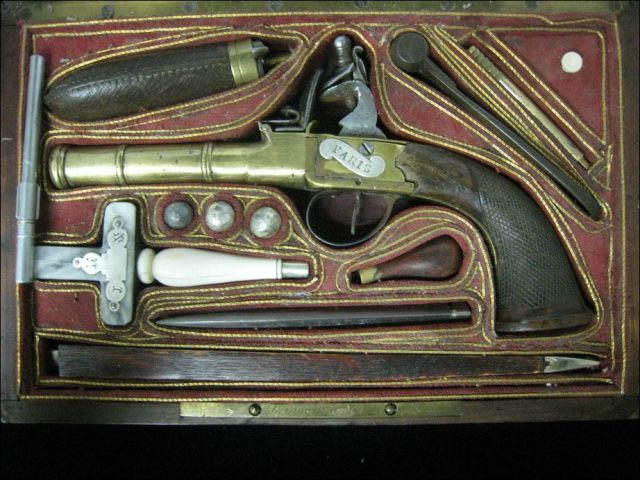
I wonder from what period these kits come. Most of them are dated to the 1840s and 1850s at eBay, but as a post of BS Historian writes, this is absolutely impossible. The MondoSkepto blog, quoted by him – and unfortunately since then disappeared – published a detailed analysis of the content of these kits, and pointed out, that many of their elements cannot be older than the turn of the century – that is, the vampire craze following the publication of the Dracula novel (1897). Of course, today a kit from those years would be considered a museum piece, too, but back then they felt like adding the extra decades necessary to its credibility.
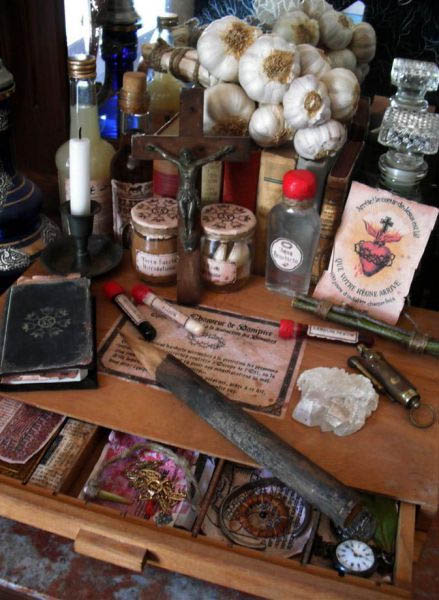
And the vampire fever has not died ever since. In 2005 a certain Michael de Winter boasted that it was him to invent the vampire killing pseudo-kits back in the 1970s, which is just as far-fetched as the claim of their being from the 19th century, since similar ones had been openly prepared already in the 1950s. It is plausible, however, that he made the typography of that frontispiece without a book, which has since then inspired the attribution of a number of kits to the never existing Professor Ernst Blomberg. And the industry, as it is obvious or suspected from some sites, is still thriving.








 Come with us to…
 Atlantis
 Bestiary
 Bohemia+Prague
 Books, exhibitions, music, film
 Caucasus
 Cemeteries
 Crimea
 Get to know the
 Images of the East
 Lightwriting
 Lwów/Lemberg
 Mallorca
 Message on the wall
 The Museum of Propaganda
 Odessa
 Paper Museum
 Persian letters
 The Jewish heritage


