Switch over to our new blog! • ¡Pásese a nuestro nuevo blog!

The renewed version of our blog, with more features, a richer design, and available in nine languages, can be read here: https://wangriver.com

The new version also includes the old posts, often in expanded form. If you are curious about the updated version of this post, replace “riowang.blogspot.com/” in the URL with “riowang.studiolum.com/”, and the new link will most likely lead you there.


La versión renovada de nuestro blog, con más herramientas, un diseño más rico y disponible en nueve idiomas, se puede leer aquí: https://riowang.com

La nueva versión también incluye las publicaciones antiguas, a menudo en una forma ampliada. Si tiene curiosidad por la versión actualizada de esta entrada, sustituya «riowang.blogspot.com/» en la URL por «riowang.studiolum.com/es/», y el nuevo enlace probablemente le llevará allí.

Mostrando entradas con la etiqueta black pearls. Mostrar todas las entradas

Turkish Coffee Evenings

Gül Baba Street, Budapest, from here

When Hungarian-Turkish relations and the common elements of the past of the two nations are mentioned, most Hungarians will surely remember two things: the period of Ottoman dominion (1526-1686), and the legendary Turkish hospitality, with which the Hungarian kardeșler (brothers) are received all over Turkey, from the Istanbul bazaar to Antalya.

Nevertheless, Hungarian-Turkish relations do not end here. They reach much farther, both in space and time. Its first period, long before the arrival of the Hungarian tribes to the Carpathian Basin around 896, is attested not only by our Turkic linguistic heritage, already mentioned by us, but also by the many common features in our folk music, researched by Béla Bartók, and, more recently, by János Sipos. These musical parallels have been impressively broadcast to a wider audience by the Moroccan-born Hungarian folk singer Majda Mária Guessous.


The Turkish folk song “Kurt paşa çıktı Gozan'a” (Kurt Pasha enters Kozan), collected by Béla Bartók in Osmaniye, and a Hungarian version collected by Zoltán Kodály in Hontfüzesgyarmat: “Üveg az ablakom, nem réz” (My window is glass, not copper), performed by Majda Mária Guessous. See here its video.

This Oriental heritage contrasts sharply with the hundred and fifty years of Ottoman dominion, whose indirect impact is still felt, and which, strictly speaking, started a little earlier, and ended a little later than in public opinion: the earlier with the successful siege of Belgrade in 1521, and the later, with the Treaty of Požarevac in 1718, when the Ottoman rule was abolished even in the last territory of historical Hungary, in the Banat of Temes. And the time brackets direct relationships, which can be further broadened, from the first military contacts in the 1370s and the subsequent development of the southern fortress system, to the “last Hungarian-Turkish war” which ended in 1791.

The survival of the memories of the hostilities in the 19th century was increasingly joined by a new pro-Turkish approach, together with contemporary politics (as we also mentioned in connection with Sándor Kégl’s Persian journey), as a new chapter of the modern idea of nationalism and a quest for the nation’s historical roots. This quest, as well as the popular 19th-century Orientalism, was the source of Hungary’s vigorous Oriental studies. Interestingly, although the knowledge gained during the Central Asian trips of Arminius Vámbéry gave an impetus to the idea of Pan-Turanism, this was never as strong in Hungary as in Finland or Japan, where it enjoyed high popularity (in pre-war Finland the association had forty thousand members), or Turkey, where, for some time, it was the official ideology.


All this and much more was discussed by Pál Fodor, Turcologist and historian, Director General of the Institute of History of the Hungarian Academy of Sciences, in his lecture “Hungarians and Turks in each other’s eyes”, held on 3 December in a series of Turkish Coffee Evenings, organized in the Bobula Palace by the Yunus Emre Enstitüsü, the Turkish cultural institute named after the 14th-century Turkish Sufi mystic poet.


The now four-year-old series began, in an exemplary manner, as a civil initiative. Ildikó Rüll, and Ágnes Tóth, graduates of English studies and international studies, respectively, organize it from month to month with great enthusiasm and love for Turkish culture. As a result, the series has by now become the flagship of the Turkish Cultural Institute of Budapest. Before the lecture, we talked to them about the Coffee Evenings, and Ágnes Tóth, who in the meantime has become a full-time colleague of the Institute, also spoke about its operation.

Ágnes Tóth

When was the Institute founded, what are its main objectives and programs?

Ágnes Tóth: The Institute was officially opened in September 2013, but we had already organized a number of cultural programs before that. The Coffee Evenings series was the first program held in this building. We also have other regular monthly events, like the Turkish film evenings, or a “Yunus Emre Conversations”, in Turkish only. We also have some special events, and take part in such popular programs, like the Night of Museums, but we also aim at collaborating with other popular event venues and academic institutions. In March we had a “Gül Baba Day”, where we organized a joint conference with the Hungarian Academy of Sciences, as well as an off-site concert. In addition, we also teach Turkish. Perhaps we are different from other similar institutions, that our language teachers can be only Turkish. I mean, now we also have a Hungarian teacher, but he also learned in Turkey, and we demand our teachers to have academic qualifications in Turkish universities, and to have graduated in Turkish language and/or literature.

What is the age distribution of the audience in the coffee evenings and the other events of the Institute?

Á. T.: This really depends on the programs. For example, the film evenings are visited by lots of young people, but the audience of the coffee evenings is variable, from university students to people in their seventies. Similarly, in the dance house and language courses, we have students from the high school to over seventy. So it is very diverse. We of course try to reach out to the young generation, but we do not want to efface scientific topics. In the field of music we also want to show a broad spectrum, from classical through folk to jazz. We have had all kinds of concerts.

How did the coffee evenings start? How did the idea come?


Ildikó Rüll

Ildikó Rüll: Both Ági and I lived in Turkey, both of us fell in love with its culture, and both came home very enthusiastic, looking for the occasions to encounter this culture also at home. We met at one of these events, and we decided to organize something regular. This is how the coffee house talks were organized on every first Wednesday. We wanted to establish an informal talk evening, choosing one topic for each occasion from this huge, culturally diverse palette, to which we invite an expert, but we ask him to only introduce the theme in thirty minutes, and the rest is based on the questions of the audience, so these evenings are usually very interactive. I remember we started with eight participants, sitting on the top of a little tea house, it was very cozy. Later, the rumor spread, everyone invited more people, we wandered from place to place for a while, and since last February we are stably here. The institute was not yet officially open then, but we were happy, because this is the best place for this series, and they were also happy, because this is still the flagship event of the institute. We are glad that we managed to form a pretty good base over four years, we meet many returning faces, a community has been formed, and we also learn from these nights, because none of us is a Turkish expert. The themes are developed according to what interests us, but the audience can also suggest topics.

Á. T.: And it is also important, in which topic we find a lecturer, because there are a lot of themes that interest us, but there is no expert in it.

Why exactly the Turkish culture?

Á. T.: We still do not know the answer to this question. (laughing)

I. R.: I used to answer that there are things you do not necessarily have to rationally explain.

Á. T.: We have no Turkish family bonds. Our story was just so much, that both of us went to Turkey and fell in love with it. I was there first at a summer university organized by a student organization. It was then that I fell in love with the country, and since then I have tried to go back as often as possible.

I. R.: And my first time was a private journey. Maybe this is why the Turkish coffee evenings are so successful, because we look at it in a different light, in fact everyone is an outsider. This is why we intend to organize informal lectures, which are intentionally different from university lectures. We always tell at the beginning, that there are no bad questions, everyone can ask anything or comment on anything, they should not be afraid to share their opinions and thoughts. Our aim is to get more people to endear to this culture. Or if someone thinks that he or she is only interested in the Turkish crafts, but not in history, then after a couple of events we can show him that history and literature can also be interesting, so we can broaden the horizons of those who are already interested in the subject at some level.

What do you know, how much you are known in Turkey?

Á. T.: News about the institute regularly appear in Turkey, since there are a number of news agencies, and their local representatives regularly come to our events, report on them, and some of their reports are published, some other not. The institute’s first birthday was for example very much heralded in Turkey, but I do not know whether the coffee evenings were also mentioned.

I. R.: I think not yet, but fortunately in Hungary increasingly more people speak about us, which we are very happy about, because this started as an absolutely civil initiative, no one was behind us. This is a good news story, how one can start such an event in collaboration with others.

It was surely not simple to finance it, especially in the beginning…

Á. T: Yes, initially we went to places where we did not have to pay rent, and we always bought chocolate on our own money for the lecturers, who, by the way, present completely without pay. And then, as the event grew larger, we had to go to locations where you had to pay rent, had to pay for the technology, the sound, the projector. We solved this by visiting several Turkish businessmen – not just one sponsor, because in this way they probably would have not supported us, but a different person each month, who paid that small rental fee for us, and in exchange we of course indicated their logo and announced their names. But there were also some occasions when we could find no sponsor, then we collected donations. As Ildi also said, we had many recurrent guests, who saw that we had been working on this for many years, and that we really loved to do this. We put a small box at the entrance, and we said that if they liked the evening, they should contribute with as much as they wanted…

I. R.: …and in fact, everyone contributed with fifty cents, one euro, and thus we collected the amount for the next location rent. Thus we were able to organize the next occasion with them and for them.

How did you choose the sponsors? Did you for example try to find a sponsor who could be linked to the subject of the evening?

Á. T.: No, we looked for them only on the basis of acquaintance.

I. R.: Since we both did this along with our major work, it was not so consciously considered along a thematic line. Now, as Ági works in the institute, we also try to adjust the coffee evenings to the themes of the institute, which change every month or two months.

What are your future plans? Do you also plan other programs, for example urban tours focusing on the Ottoman monuments of Budapest?

Á. T.: The regular events will go on in the Institute, and we will certainly participate in the Night of Museums. As until now, we will seek to find a special theme for each month. Next May, for example, will be special, because it will focus on gastronomy, there will be traditional breakfasts, dinners, cooking courses.

I. R.: Many people come to us and say, how good it would be if we organized such a urban tour, so we consider it. In reality, everything depends on human resources, whether we can focus on this as well, and have enough energy to organize it. But it would be very good, so, that a community has been already formed through the coffee evenings, on which we can already build.


ye ye ye ye ye ye ye ye ye ye ye ye ye ye
Photos by Dániel Végel on the evening, from the Facebook site of Yunus Emre Budapest.

Encounters

The Jews of Kolomea (Galicia) welcome Charles, Emperor of Austria and King of Hungary visiting the Eastern Front on 4 August 1917

More than a year ago Andrea Deák asked us to help to interpret a postcard from a Hungarian collector of WWI Jewish relics, Gábor Izsák, on which Galician Jews greet with their Torah scroll the commander in chief of the Austro-Hungarian army. The date – 9 November 1915 – was found out by Deák Tamás on the basis of contemporary press; the historical background was provided in part by the KehilaLinks, who then also quoted us back; and the Hebraist Két Sheng, an expert of the role played by the Jews in WWI, sent us some similar photos from Erwin A. Schmiedl’s Juden in der K. (u.) K. Armee, 1788-1918 (Eisenstadt: Österreisches Jüdisches Museum, 1989). And today Kálmán Dániel drew our attention to the above photo published by Yvette Métral – another of our long-time readers – on the Yiddish Florilège, one more, hitherto unknown Galician example of the welcoming of a commander in chief with a Torah scroll. Just on this day, when – on the request of Héjoká – we have written about Kolomea concerning a very different matter. We also commented on the Florilège, which was then looked at by many of our readers. Then we asked Deák Tamás, who within a few minutes, figured out that the festive event took place on 4 August 1917. Well, río Wang is fed by such sources. Thank you all.

Update: Paweł, as if he just wanted to illustrate our closing sentence, has sent an extremely interesting addition to this photo: “I have found on the web the memoirs of some Polish families from the Kresy, among others that of the Chanias from Kolomea. Pages 23-24 have the following passage:

“In the summer of 1917 the Russian front collapsed again, and the Austrians returned to Kolomea. Before the war, in 1911-1912 Archduke Charles of Austria lived with his wife in Kolomea, serving there in the same regiment of dragoons as dr. Chania, he as a lieutenant, and Dr. Chania as a lieutenant-doctor. The two lieutenants were friends. With the return of the Austrians, Charles also came to Kolomea, this time already as an emperor. In the summer of 1917, Emperor Charles on entering Kolomea was welcomed by a delegation of the inhabitants in front of the town hall. When Krysia Chania [a daughter of the mentioned dr. Józef Chania; my comment] greeted the emperor in beautiful German, handing him over a bouquet of roses, the emperor kept this bouquet, while he put the other bouquets aside. He thanked her, and endowed her with the imperial brooch with the letter “K”. Dr. Józef gave Charles welcome in his home. The emperor spent there the evening and one night”.

Illustration of the Polish memoir: Archduke Charles as a captain of dragoons in front of his house in Kolomea, 1911-1912.

With a good breeze


One must be cautious with the spread-out sheets: as photogenic they are, as trivial they can become on the photo. However, Zsófi Porkoláb’s spreading-out blog helps to discover how much new is in them. Thanks a lot to her for having quoted the sea of Lwów, thus involving Río Wang into the great global spreading out. For gratitude we wanted to add one or two more spreading-out photos from Lwów, being sure that we do not have more than that. However, browsing through the recent photos it turned out how much they determine the city and how many pictures they sail into unnoticed, the spread-out sheets, the sails of the courtyards.


Pyotr Leshchenko: Вино Любви. Tango, 1936


I’ve Taken It To Pieces


The Hungarian “I’ve Taken It To Pieces” project – “something just a bit, but something to the extreme, because the Lord has given a screwdriver in my hand” –, whose link was given to us by Grimpix, fits quite well to the retronautic, fact-finding and creative thread of Río Wang. Let us now see only one random project of the six hundred and ninety ones which unveil what operated the fallen regime from the background for long decades. The numbered pictures follow each other in a strict boustrophedon order, that is, the lines turn back to the opposite direction at the wall.


Origami


The ruined concrete coasts of the Black Sea reminded Komaváry of the coasts of the Japanese sea ruined by the concrete.


“I admit that after the title and the first line I expected the Japanese coast. The Japanese coast which, after the two great dangers (earthquake and tsunami) is also threatened by the third one: that of being slowly washed away by the sea.

This is why it has to be covered with concrete all around the island, this is why it has to be scattered all over with concrete blocks. Because concrete protects. Even if we already know that concrete promotes erosion. But the factory has been already built, the command is issued, and the concrete is slowly devouring the shores.”


The pictures quoted by him are from the blog Unfamiliar Japan by Ojisanjake – “artist, writer, photographer, mask-maker, tour guide, gardener, walker, anarchist, freegan” – which with short and meditative posts, beautiful images and great attention gives news about a rarely seen and attractive Japan.


Among the posts a particular group is dedicated to “tetrapods”, the concrete blocks of various forms used to control coastal erosion. More than half of Japan’s coastline is covered by such blocks.


Ojisanjake cannot afford to stress how harmful this amount of concrete is to the environment, not to speak about aesthetics – while he extracts beautiful images out of them.


Is it the endless repetition of geometric forms that makes so compellingly abstract and immaterial the same material which shows its worst side along the Black Sea? Or is it the photographer who, despite all his aversion, sees the beauty even in it?


Moreover, the concrete here seems to achieve something that in Europe never can do: to age beautifully.


Ojisanjake: „Concrete Wabi sabi” series:
Tetrapods • Tetrapods 2 • Virgin tetrapods • Steps • More steps • Mountainsides

Thanks


La lingua più divertente del mondo

Nel post sulla storia di Bella ciao ho accennato all’eccellente sito di Riccardo Venturi, che vi ha raccolto le più popolari canzoni contro la guerra, accompagnate da traduzioni in varie lingue e da abbondanti documenti di storia e di stampa. Poco più tardi Riccardo mi ha fatto l’onore di includere nel suo sito la traduzione letterale di Bella ciao dalla versione ungherese del post, introducendola con delle parole calorose.

Ma la vera sorpresa è seguita dopo. Quando l’ho ringraziato – in italiano – e gli ho mandato l’indirizzo della versione inglese del post perché sicuramente avrebbe potuto essere capita da molti più lettori rispetto alla versione ungherese, Riccardo mi ha risposto in ungherese:

Szívesen köszönöm az egész munkádért a szép blogodon. Én is elfogadom, hogy az olvasók többsége könnyebben olvashat angolul, de én a magyar nyelvet mindig jobban szeretem, mint a “világnyelv”...Elkezdettem magyart tanulni 16 éves korában én részrehajló vagyok :-) Minden esetben remélem, hogy a blogod és a honlapom a jövőben is a magyar és olasz néphagyományok tanulmányáért és történetéért közreműködhetnek!

(Un ringrazio affettuoso per tutto il tuo lavoro nel tuo bel blog. Anch’io ammetto che la maggioranza dei lettori possa leggere con più facilità in inglese, ma ho sempre preferito l’ungherese alla “lingua del mondo”… All’età di 16 anni ho cominciato a imparare l’ungherese, e così sono parziale :-) In ogni caso spero che il tuo blog e il mio sito possano collaborare anche nel futuro per lo studio e la storia delle tradizioni popolari ungheresi ed italiane!)


Già il fatto che un ragazzo italiano di sedici anni scelga fra le migliaia di alternative proprio questa lingua estremamente difficile e di limitata utilità è abbastanza improbabile. Ma che poi arrivi a questo livello di perfezione – ovviamente con un bella dose di diligenza e di talento – è addirittura incredibile. Interrogato sulle cause della sua scelta, Riccardo ha risposto questo:

A magyar nyelv két legfontosabb szava: szerelem és szabadság. Mikor 16 éves voltam, voltam mint minden 16 éves: romanticizmus, elmezavar, eredetiség, “én-nem-vagyok-mint-a-mások” zűrzavara...s a többi. Továbbá a határtalan nyelvszerelmem volt, mert a nyelvek, mint mondta a híres olasz keleti nyelvész Alessandro Bausani, “a világ legszebb játéka”. Egy firenzei könyvesboltban Fábián Pál magyar nyelvtanát (“Manuale della lingua ungherese”) láttam meg, és a magyar nyelv a hihetetlen szerkezetével elbűvölt engem; de sajnos nem volt pénzem vásárolni, túl drága volt. Két honapot várnom kellett, és a napon, mikor a szükséges pénzem volt, buszsztrájk volt. Jól, hazámból a könyvesboltba gyalog mentem, hogy vásároljam: nyolc kilómeter. Szerelem első látásra. A magyar nyelv nem “nehéz”: különböző, másféle. Az elméjét különböző gondolatmódra, gondolatszerkezetre készteti; és a különbözés szabadság. Megtanultam és beszélek más nyelveket, de a magyar még kedvenc játszótársam, a világ legszebb, legszabadabb és legszórakoztatóbb nyelve. A szerelem és a szabadság nyelve.

(Le due parole più importanti della lingua ungherese sono: amore e libertà. All’età di sedici ero come tutti i sedicenni: in una confusione di romanticismo, follia, originalità, “non sono come gli altri”… eccetera. E poi c’era l’irrefrenabile amore verso le lingue, perché le lingue, come disse il famoso orientalista italiano Alessandro Bausani, son “il gioco più bello del mondo”. Ho scoperto in una libreria fiorentina il Manuale della lingua ungherese di Pál Fábián, e la lingua ungherese mi ha completamente affascinato con la sua incredibile struttura. Però, purtroppo, non avevo i soldi per comprarlo, costava troppo. Ho dovuto aspettare due mesi prima di avere i soldi, ma proprio quel giorno c’era sciopero degli autobus. Bene, sono andato a piedi da casa alla libreria per comprarlo: otto chilometri… Amore a prima vista. La lingua ungherese non è “difficile”: è differente. Apre la mente a un differente modo di pensare, a delle strutture mentali differenti. E la differenza è libertà. Ho imparato e parlo anche un paio di altre lingue, ma l’ungherese è tuttora il mio preferito compagno di gioco, la lingua più bella, più libera e più divertente del mondo. La lingua dell’amore e della libertà.)


Pál Fábián, Manuale della lingua unghereseFábián Pál magyar nyelvtana (Budapest 1970, Tankönyvkiadó) az asztalomon, 30 év után... :-)
(La grammatica ungherese di Pál Fábián [Budapest 1970, Editore Libri Scolastici] sul mio tavolo, dopo 30 anni… :-) )

Anch’io mi ricordo bene di questo libro, con cui una volta ho insegnato, anzi due volte, e tutt’e due volte senza successo. Il mio primo studente è stato un ufficiale dei carabinieri molto simpatico, di Torino, nel mezzo del cammin fra i venti e trent’anni, che si era avvicinato a noi spinto dall‘attrazione per una ragazza ungherese, figlia di un famoso etnografo e studentessa al dipartimento di italiano. Alla fine degli anni ’80 una relazione ungherese era considerata un rischio per la sicurezza dello stato, e il ragazzo – con una carriera molto promettente dopo parecchi anni di servizio – è stato messo davanti a una scelta dai suoi superiori: o la ragazza o la professione. Ha scelto la ragazza. E dopo nemmeno sei mesi di studio dell’ungherese, la ragazza ha scelto qualcun altro al posto suo, mandandolo a casa perché cominciasse una nuova vita, la migliore che potesse.

La seconda volta abbiamo cominciato il libro con Bobo, il mio amico sardo-pratese, che negli anni ’90 ha trovato un’avventura eccitante aprire un caffé italiano a Budapest. Però questa è stata una breve parentesi. Bobo si è smarrito verso la terza lezione, nel corso dell’analisi morfologica della frase Hol vannak az amerikai turisták kocsijai? (“Dove sono le macchine dei turisti americani?” – in ungherese una costruzione un po’ prematuramente complicata per un principiante.) Bene, Dio abbia in pace il signor Fábián (è morto in questo settembre), ma se imparare ungherese è già difficile di per sé, allora impararlo di questo libro è addirittura un atto erculeo, per cui Riccardo merita veramente ogni riconoscimento.

Qualche giorno dopo il nostro scambio di commenti, il 6 di gennaio, quando la Befana porta i regali ai bambini, Riccardo ha fatto anche a me l’onore di farmi un regalo. Nella pagina del suo sito dedicata alla canzone Mio nonno partì per l’Ortigara di Chiara Riondino, ha tradotto in ungherese questa canzone con una dedica personale. In cima alla pagina ha anche incluso un link a una registrazione del canzone con Chiara, ma, dato che questo si può ottenere solo tramite diversi passaggi, qui sotto includo un link diretto.Chiara Riondino, foto dal sito di Riccardo Venturi


Chiara Riondino: Mio nonno partì per l’Ortigara, registrazione fatta  in occasione all’evento organizzato dalla comunità di base fiorentina Baracche Verdi in piazza dell’Isolotto, il 13 di maggio di 2007.

Questa canzone – scrive Riccardo – parla anche di suo nonno, “ragazzo del ’98” che è stato altrettanto derubato della sua gioventù dalla prima guerra mondiale e dagli anni passati nelle trincee delle Alpi italiane, di fronte alle trincee dell’armata austro-ungarica.

In cambio anch’io mando a Riccardo la canzone di mio nonno, “ragazzo dell’88”, cantata negli stessi anni e fra le stesse montagne – però dall’altro lato dello stesso fronte. E, già che siamo, includo anche la canzone del mio altro nonno, che ha servito sul fronte russo, un canzone che è tanto piacciuta ai miei amici russi. Come la canzone italiana, così quelle ungheresi non parlano di nessun odio verso il “nemico”, ma solo di una vita insensatamente sprecata in una guerra insensata.


András Széles: Kimegyek a doberdói harctérre (Esco al campo di battaglia di Doberdò). Dal CD di Tamás Cseh - Péter Péterdi: Magyar katonadalok és énekek a XX. századból (Canzoni dei soldati ungheresi del 20mo secolo) (2000).

Kimegyek a doberdói harctérre,
feltekintek a csillagos nagy égre:
Csillagos ég, merre van a magyar hazám,
merre sirat engem az édesanyám?

Én Istenem, hol fogok én meghalni,
hol fog az én piros vérem kifolyni?
Olaszország közepébe lesz a sírom,
édesanyám, arra kérem, ne sírjon.
Esco sul campo di battaglia di Doberdò
guardo insù verso il cielo stellato:
Cielo stellato, dov’è la mia patria ungherese,
dove sta piangendo per me la mia dolce madre?

Dio mio, dove morirò,
dove si verserà il mio sangue rosso?
La mia tomba sarà nel bel mezzo dell’Italia,
mia dolce madre, ti prego di non piangere per me.


Zoltán Kátai and the Hegedűs Ensemble: Esik az eső, ázik a heveder (Cade la pioggia, la bardatura è umida). Dallo stesso CD. Tuttavia, la versione di mio nonno era molto più melancolica, proprio quella era la sua bellezza.

Esik az eső, ázik a heveder
gyönge lábamat szorítja a kengyel
bársony lekötő szorítja lovamat
nehéz karabély nyomja a vállamat.

Megjött a levél fekete pecséttel:
megjött a muszka százezer emberrel
kétszáz ágyúval áll a harc mezején
így hát, jó anyám, elmasírozok én.

Jön egy kapitány hófehér paripán
fényes kard csillog annak az oldalán
kardja megvillan, az ágyú mennydörög
szép piros vérem a földre lecsöpög.
Cade la pioggia, la bardatura è umida
i miei deboli piedi sono stretti dalla staffa
una cavezza di velluto stringe il mio cavallo
una mitra pesante pesa sulla mia spalla.

È arrivata la lettera con il sigillo nero:
sono arrivati i russi con duecentomila persone,
con duecento cannoni stanno sul campo di battaglia
perciò, mia buona madre, devo marciare via.

Arriva un capitano su un cavallo bianco
una spada lucente brilla al suo fianco
la sua spada brilla, i cannoni tuonano
e il mio sangue rosso stilla sulla terra.

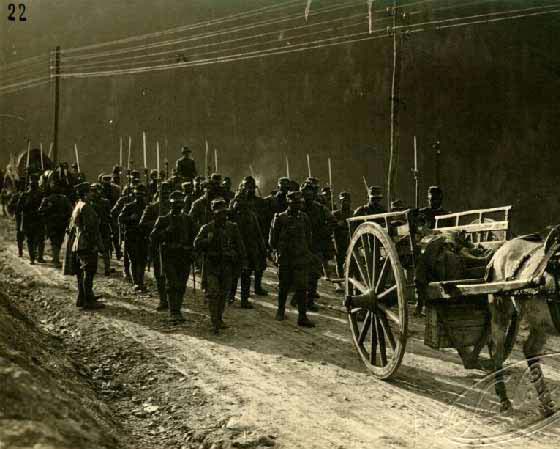
Italia, Doberdò, Prima guerra mondiale: Prigionieri dell’armata austro-ungherese
Tante grazie a Francesca per la revisione del testo italiano.

The most entertaining language of the world

In the post on the history of Bella ciao I have mentioned the great site of Riccardo Venturi where he has been collecting a large amount of popular antiwar songs accompanied with several translations as well as historical and press documentation. Not much later I was honored by Riccardo’s having included on his page the verbatim translation of the Bella ciao from the Hungarian version of the post, introducing it with some warm words.

But the real surprise followed only next. When I have said thanks to him – in Italian – and sent to him the address of the English version of the post as it could be understood by much more readers than the Hungarian one, Riccardo answered to me in Hungarian:

Szívesen köszönöm az egész munkádért a szép blogodon. Én is elfogadom, hogy az olvasók többsége könnyebben olvashat angolul, de én a magyar nyelvet mindig jobban szeretem, mint a “világnyelv”...Elkezdettem magyart tanulni 16 éves korában én részrehajló vagyok :-) Minden esetben remélem, hogy a blogod és a honlapom a jövőben is a magyar és olasz néphagyományok tanulmányáért és történetéért közreműködhetnek!

(A warm thanks to you for all your work in your beautiful blog. I also accept that the majority of the readers can more easily read in English, but I have always loved Hungarian much more than “world languages”… I started to learn Hungarian when I was 16, and I’m therefore biased :-) In any case, I hope that your blog and my site could collaborate in the future too for the study and history of Hungarian and Italian folk traditions!)

It is already improbable enough that a sixteen years old Italian boy choose from thousands of alternatives precisely this extraordinarily difficult language of very limited usefulness. But it is completely unbelievable that he has reached – obviously with a great amount of diligence and talent – to this level of perfection. When asked about the reason of his choice, Riccardo answered like this:

A magyar nyelv két legfontosabb szava: szerelem és szabadság. Mikor 16 éves voltam, voltam mint minden 16 éves: romanticizmus, elmezavar, eredetiség, “én-nem-vagyok-mint-a-mások” zűrzavara...s a többi. Továbbá a határtalan nyelvszerelmem volt, mert a nyelvek, mint mondta a híres olasz keleti nyelvész Alessandro Bausani, “a világ legszebb játéka”. Egy firenzei könyvesboltban Fábián Pál magyar nyelvtanát (“Manuale della lingua ungherese”) láttam meg, és a magyar nyelv a hihetetlen szerkezetével elbűvölt engem; de sajnos nem volt pénzem vásárolni, túl drága volt. Két honapot várnom kellett, és a napon, mikor a szükséges pénzem volt, buszsztrájk volt. Jól, hazámból a könyvesboltba gyalog mentem, hogy vásároljam: nyolc kilómeter. Szerelem első látásra. A magyar nyelv nem “nehéz”: különböző, másféle. Az elméjét különböző gondolatmódra, gondolatszerkezetre készteti; és a különbözés szabadság. Megtanultam és beszélek más nyelveket, de a magyar még kedvenc játszótársam, a világ legszebb, legszabadabb és legszórakoztatóbb nyelve. A szerelem és a szabadság nyelve.

(The two most important words of Hungarian language are love and freedom. When I was 16, I was like any 16 years old boy: in a confusion of romanticism, madness, originality, “I’m not like others”… and so on. And I was fallen in love beyond limites with languages, for, as the renowned Italian Orientalist Alessandro Bausani told, languages are “the most beautiful toy of the world.” I found the Manuale della lingua ungherese, the Hungarian grammar by Pál Fábián in a bookshop in Florence, and the Hungarian language has enchanted me with its unbelievable structure. However, it was too expensive and I had no money to buy it. I had to wait two months, and on the day when I finally had the necessary money, there was a bus strike. Well, I went from my home to the bookshop on foot to buy it: eight kilometers. Love at first sight. Hungarian is not “difficult:” it is different. It opens your mind to a different way of thinking and to different mental structures. And difference means freedom. I have learned and have spoken a couple of other languages too, but the Hungarian language has remained my favorite playmate, the most beautiful, most free and most entertaining language of the world. The language of love and freedom.)

Pál Fábián, Manuale della lingua unghereseFábián Pál magyar nyelvtana (Budapest 1970, Tankönyvkiadó) az asztalomon, 30 év után... :-)
(The Hungarian grammar of Pál Fábián [Budapest 1970, Schoolbook Publisher] on my table, after 30 years… :-) )

I remember this book well. I have taught with it. On two occasions, and both times without success. My first student was a very sympathetic twenty-and-some years old carabiniere officer from Torino who had been attracted to us by a Hungarian girl, the daughter of a renowned ethnographer and a student at the Italian department. As at the end of the 80’s a Hungarian connection was considered a risk of state security, the young officer – with a promising career after several years of service – was given a choice by his superiors: either the girl or the profession. The boy chose the girl. And then, after some six months of learning Hungarian, the girl chose someone else instead of him, and sent him home to begin a new life as best he can.

The second time we started the book with my friend Bobo who in the 90’s found it an exciting venture to open an Italian café in Budapest. However, this was a short round. Bobo lost track somewhere around the third lesson, during the morphological analysis of the phrase Hol vannak az amerikai turisták kocsijai? (“Where are the cars of the American tourists?” – in Hungarian a somewhat prematurely complicated construction for a beginner.) Well, may God give rest to signor Fábián (he died in this September), but if it is difficult to learn Hungarian, then to learn it with his book is a Herculean labor. So that Riccardo deserves all the possible credits.

Some days after our change of comments, on January 6 when in Italy the Befana brings gifts to the children, Riccardo also favored me with a gift of Epiphany. On the page of his site dedicated to the song Mio nonno partì per l’Ortigara (My grandfather set off to Ortigara) by Chiara Riondino, he translated to Hungarian this song with a personal dedication. On the top of the page he also included a link to a registration of the song with Chiara, but as this can be reached only through a number of steps, I also link the song here. While listening to it, you can read his English translation in parallel with the original Italian text of the song.Chiara Riondino, foto dal sito di Riccardo Venturi


Chiara Riondino: Mio nonno partì per l’Ortigara, registration of the performance organized by the Florentine basis community Baracche Verdi on the Piazza dell’Isolotto, May 13, 2007.

This song – writes Riccardo – is also about his grandfather “of 98,” who was similarly robbed of his youth by the First World War, by the years spent in the trenches of the Italian Alps facing the trenches of the Austro-Hungarian army.

In return I also send to Riccardo the song of my grandfather “of 88,” which was sung in the same years and in the same mountains – on the other side of the same front. And since we are here, I also include here the song of my other grandfather serving at the Russian front, a song which was so much liked by our Russian friends. Similarly to the Italian song, its Hungarian counterparts are not about hatred against the enemy, but about life senselessly wasted in a senseless war.


András Széles: Kimegyek a doberdói harctérre (I go out to the battlefield of Doberdo). From the CD of Tamás Cseh - Péter Péterdi: Magyar katonadalok és énekek a XX. századból (Hungarian soldiers’ songs from the 20th century) (2000).

Kimegyek a doberdói harctérre,
feltekintek a csillagos nagy égre:
Csillagos ég, merre van a magyar hazám,
merre sirat engem az édesanyám?

Én Istenem, hol fogok én meghalni,
hol fog az én piros vérem kifolyni?
Olaszország közepébe lesz a sírom,
édesanyám, arra kérem, ne sírjon.

I go out to the battlefield of Doberdo
I look up on the starlit sky:
Starry sky, where is my Hungarian homeland,
where does my sweet mother cry for me?

My God, where will I die,
where will my red blood run off?
My tomb will be in the middle of Italy,
my sweet mother, I beg you not to cry.


Zoltán Kátai and the Hegedűs Ensemble: Esik az eső, ázik a heveder (The rain is falling, the girth is getting wet). From the same CD. However, the version of my grandfather was much more melancholic, exactly that was beautiful in it.

Esik az eső, ázik a heveder
gyönge lábamat szorítja a kengyel
bársony lekötő szorítja lovamat
nehéz karabély nyomja a vállamat.

Megjött a levél fekete pecséttel:
megjött a muszka százezer emberrel
kétszáz ágyúval áll a harc mezején
így hát, jó anyám, elmasírozok én.

Jön egy kapitány hófehér paripán
fényes kard csillog annak az oldalán
kardja megvillan, az ágyú mennydörög
szép piros vérem a földre lecsöpög.

The rain is falling, the girth is getting wet
my weak feet are pinched by the stirrup
a velvet halter pinches my horse
a heavy rifle weighs on my shoulder.

The letter has come with a black seal:
the Russians have come, a hundred thousand,
with two hundred cannons they stay at the battlefield
so my good mother, I have to march away.

A captain is coming on a white horse
a brilliant sword shines on his side
his sword flares up, the cannons are thundering
my beautiful red blood drips down on the earth.

Italy, Doberdo, First World War: Prisoners of the Austro-Hungarian Army