Switch over to our new blog! • ¡Pásese a nuestro nuevo blog!

The renewed version of our blog, with more features, a richer design, and available in nine languages, can be read here: https://wangriver.com

The new version also includes the old posts, often in expanded form. If you are curious about the updated version of this post, replace “riowang.blogspot.com/” in the URL with “riowang.studiolum.com/”, and the new link will most likely lead you there.


La versión renovada de nuestro blog, con más herramientas, un diseño más rico y disponible en nueve idiomas, se puede leer aquí: https://riowang.com

La nueva versión también incluye las publicaciones antiguas, a menudo en una forma ampliada. Si tiene curiosidad por la versión actualizada de esta entrada, sustituya «riowang.blogspot.com/» en la URL por «riowang.studiolum.com/es/», y el nuevo enlace probablemente le llevará allí.

Mostrando entradas con la etiqueta fish. Mostrar todas las entradas

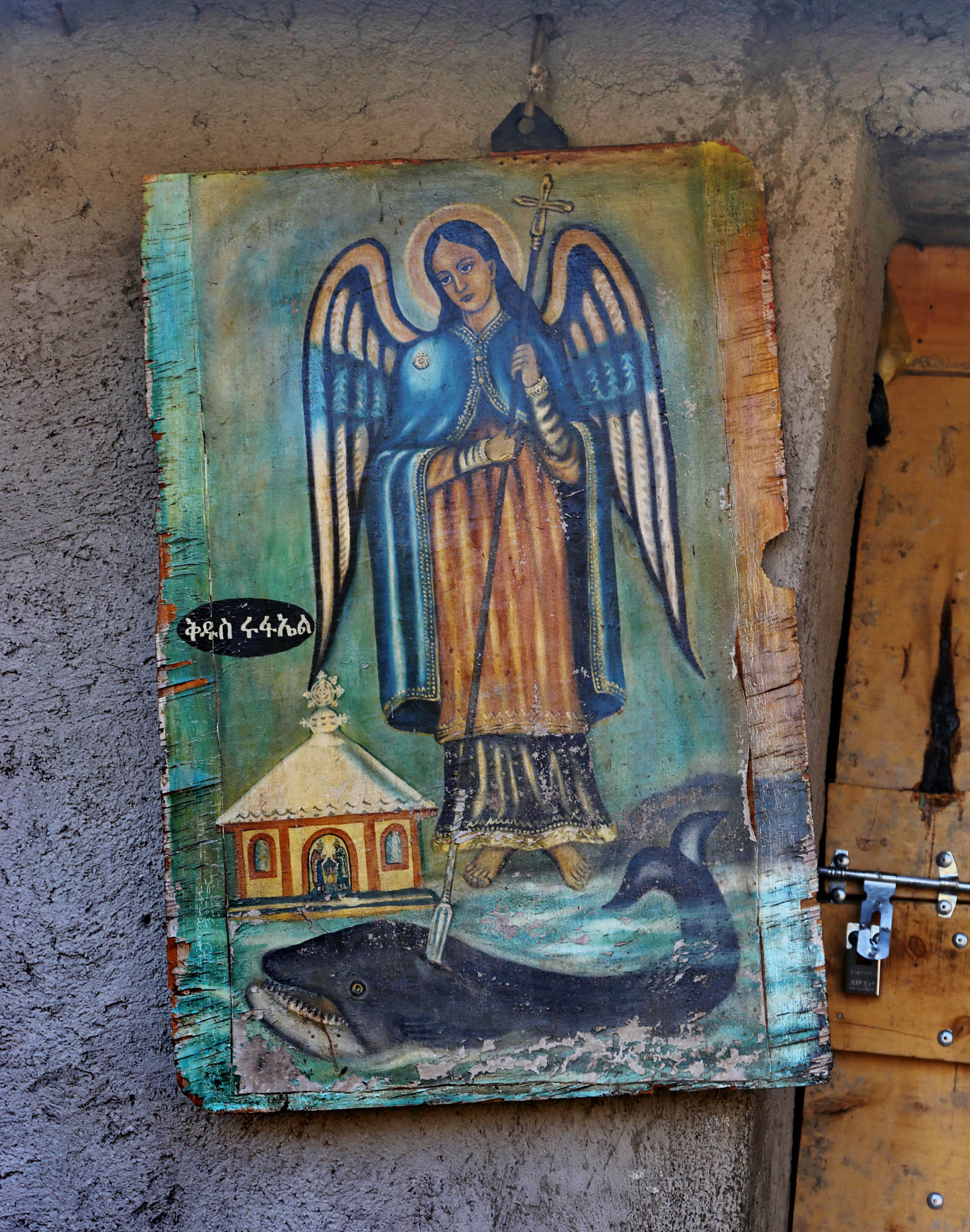
Saint Raphael the Whale-Slayer

St. Raphael’s icon on the chapel at the bridgehead of the Blue Nile, 19th c.

I have already written that the iconography, that is, the system of representations of the Ethiopian church, living isolated at the edge of the Christian world, had evolved in a separate way, and developed many pictorial formulas that are apocryphal to other Christian churches.

Such as the prominent role of the seven archangels in the church frescoes. The Ethiopian monastery churches of Lake Tana are circular wooden constructions, with square-based stone sanctuaries inside. On each of the four sides of the sanctuary, a gate opens (or, more precisely, is closed to the ordinary believer), and on their double doors are painted a pair of archangels (and on the doors of the fourth gate, the seventh archangel and the Virgin Mary).
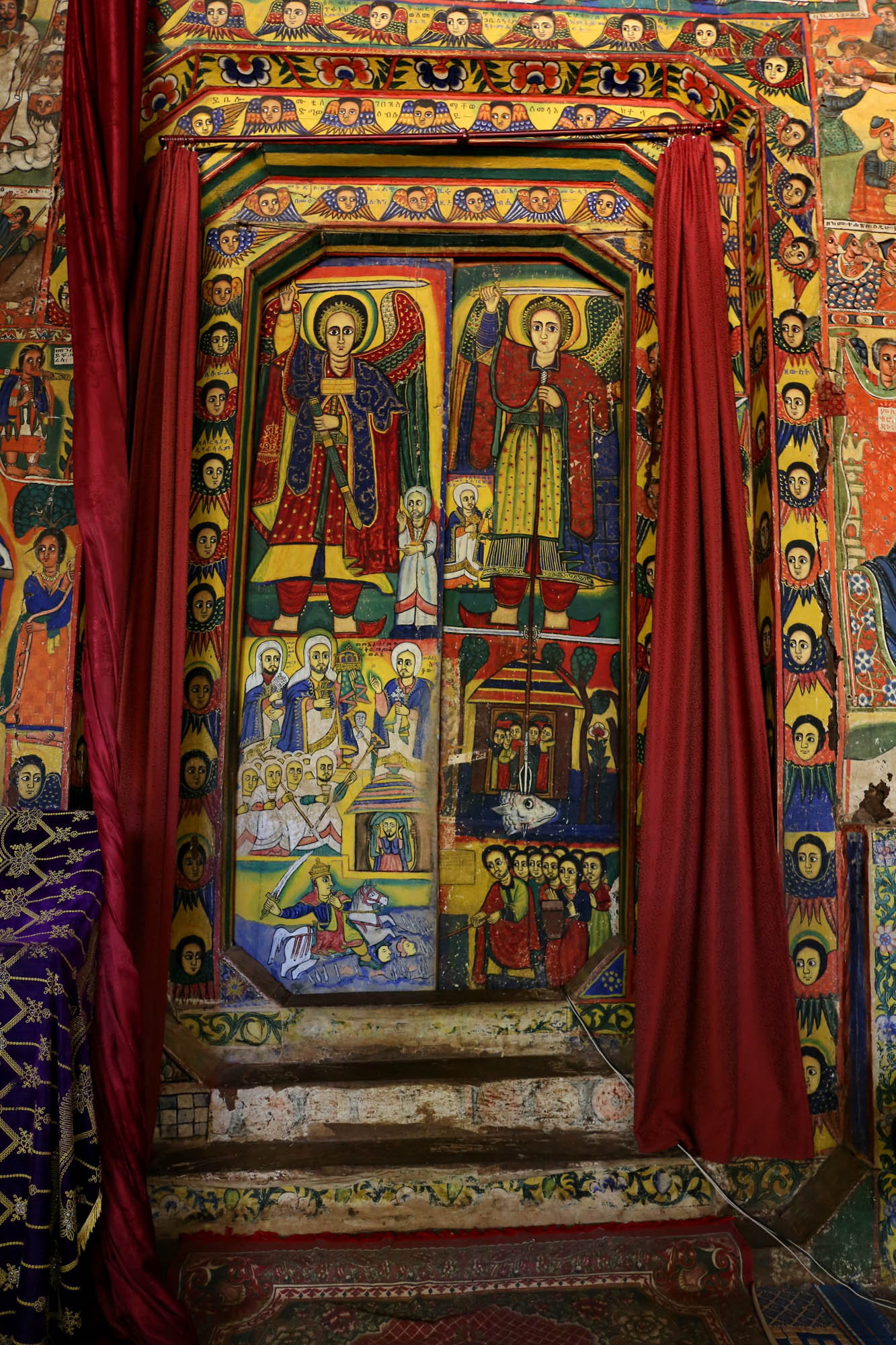
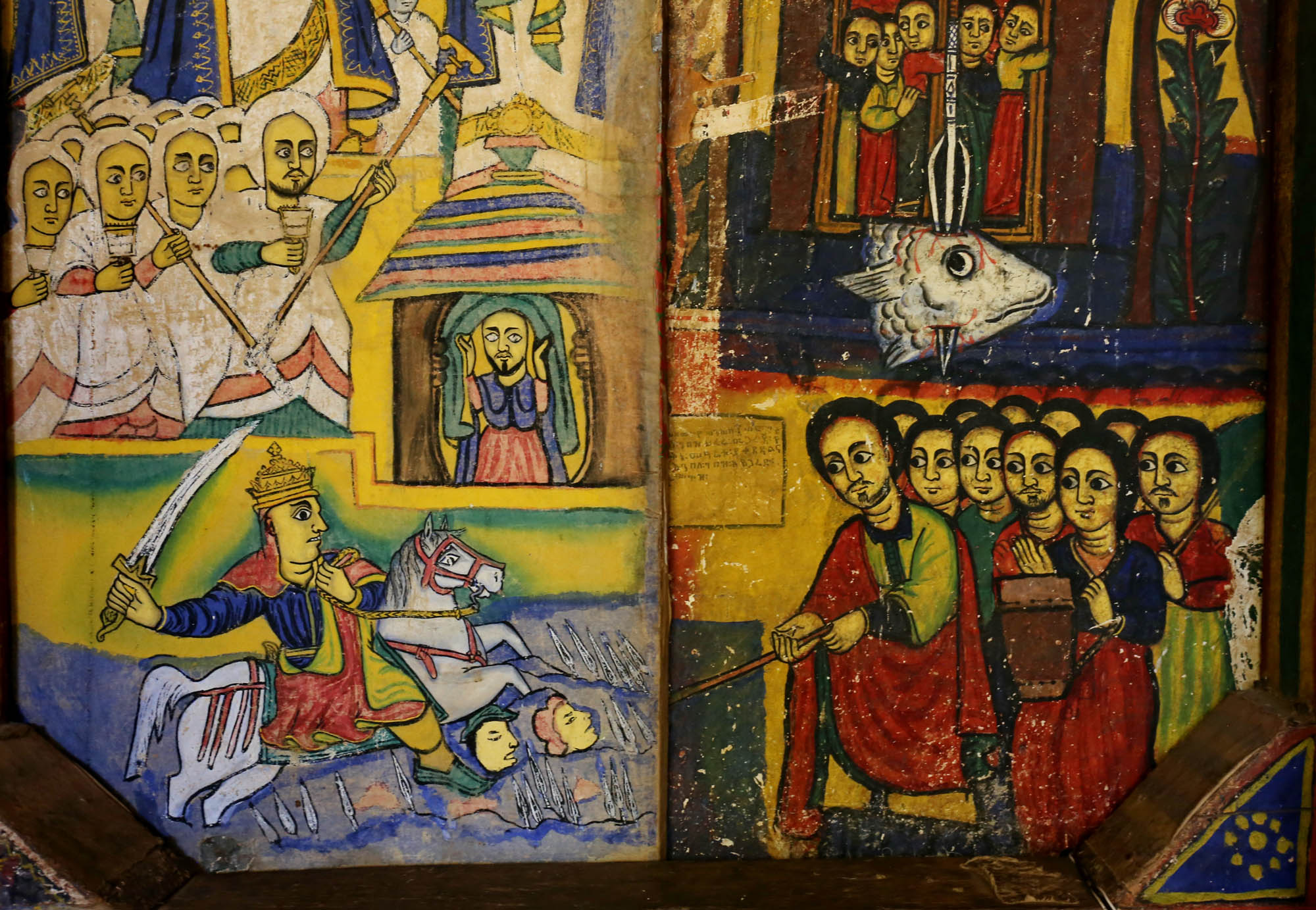
Archangel Raphael (to the right) on one gate of Ura Kidane Mihret monastery church. The counterpart of the slaying of the big fish is everywhere another sea scene, the crossing of the Red Sea and the destruction of Pharaoh’s army in the water.


Who can name all seven archangels? Probably not many of us. In fact, the Bible mentions only two or three of them by name, depending on confession. Michael, who pushes down the rebellious angels with a fiery sword, and Gabriel, who forwards the divine message to the Virgin Mary with a white lily in hand, are known to everyone. And the Catholic Bible also includes the book of Tobit, which is not accepted in the Jewish and Protestant scriptures, since it had no Hebrew original, only a Greek version was known. In this, a third archangel, Rafael, accompanies the young Tobias from Nineveh to Media – to Ekbatana/Hamadan, a significant Jewish settlement at that time, the later funeral place of Queen Esther and Mordecai, to connect it also to today’s Purim celebration.

At the same time, apocryphal or not, this is the book which establishes that seven is the number of archangels. In its final part, the archangel reveals himself: “I am Raphael, one of the seven angels who stand in the glorious presence of the Lord, ready to serve him.” (Tob 12:15) The idea of the seven archangels – the lords of the seven planets – was taken over by the Jews from the surrounding peoples, especially from the Zoroastrian religion, where it first took shape, during the Assyrian-Babylonian captivity, when Tobias’ story also takes place. The Yezidi Kurds preserved from the same cultural milieu the cult of the seven archangels, for which they are now being massacred by the extremists of ISIS. This cult was also popular with local Christians in the first centuries, so much so, that the Council of Laodicea of 363 (Article 35) had to expressly prohibit the worship of the angels, and allow only their veneration. The Latin church limited this to the three archangels known by name, while the Orthodox church has preserved to this day the veneration of the seven archangels, celebrated on 8 November in a special feast called “the gathering of the archangels” (Σύναξη τῶν Ἀρχαγγέλων), “the gathering of Archangel Michael” (Собор Архистратига Михаила), or “the gathering of the bodiless” (Σύναξη τῶν Ἀσωμάτων). At this meeting, the seven archangels hold a council at the end of time, just before the last judgment.
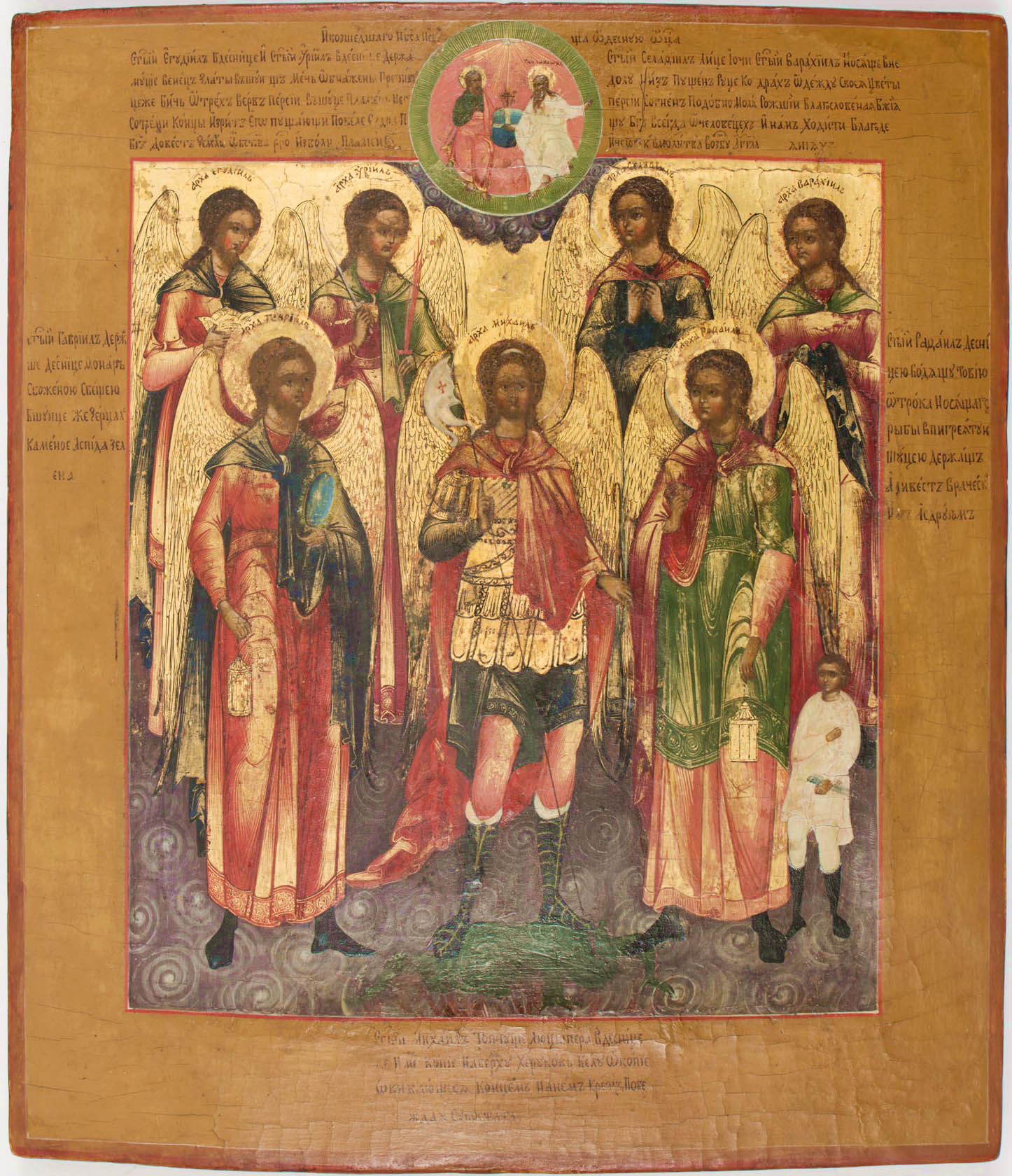
The gathering of Archangel Michael. Russian icon, 19th c., with the names of the single archangels in their halos: Yegudiel, Uriel, Selaphiel, Barakhiel, Gabriel, Michael, Raphael (the latter with the young Tobias, who holds the fish in hand).

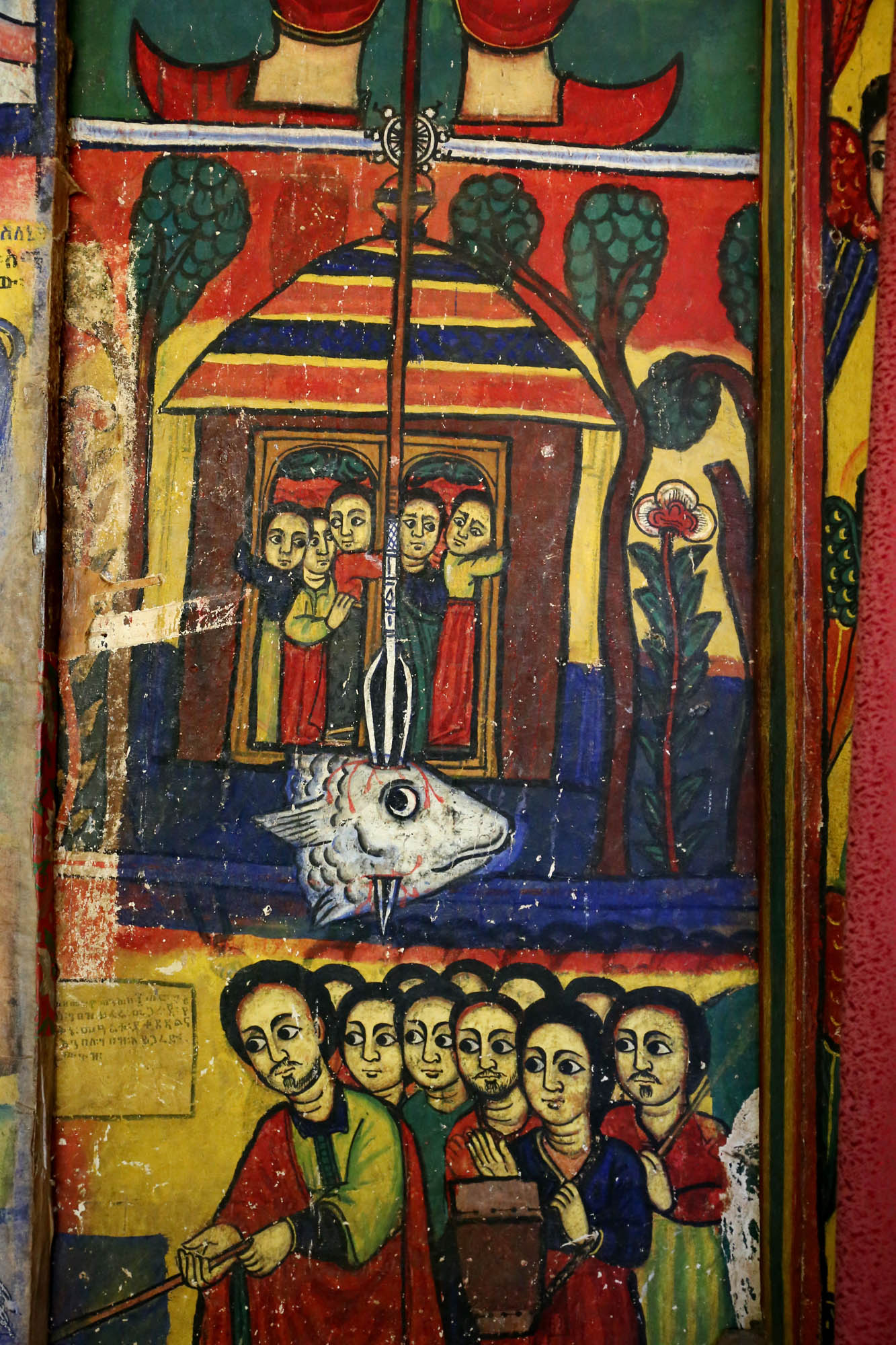
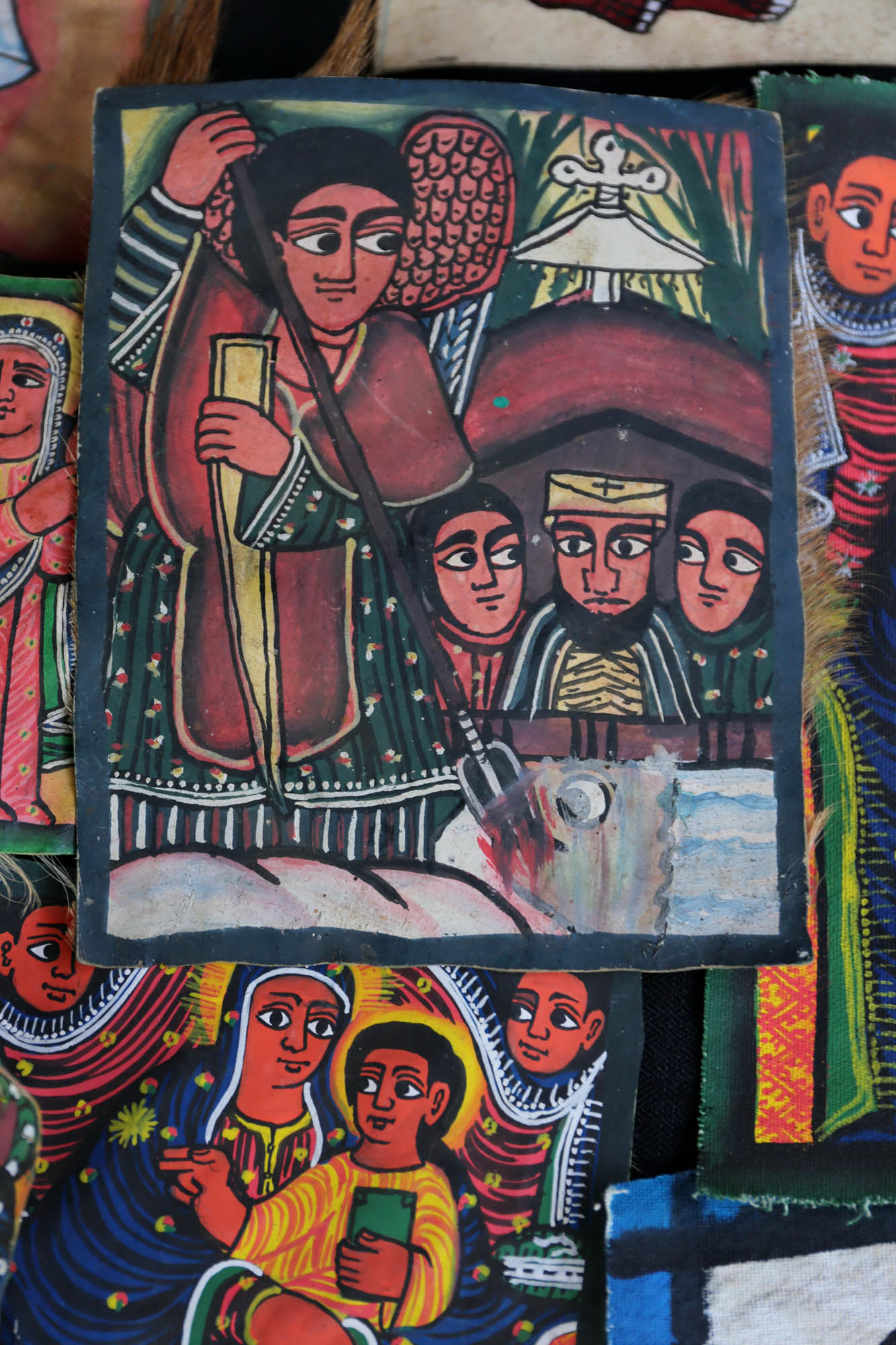
Especially remarkable among the Ethiopian representations is the figure of Raphael, who always stabs a big fish with his spear. In the Book of Tobit, Raphael and Tobias wandering together catch a big fish from Tigris River, whose heart and liver are later used to expel the demon Asmodeus, and its gall to heal the blind eye of Tobit, the father of Tobias. We might think that the Ethiopian pictures of Raphael also show the fish of the Book of Tobit. It is peculiar, however, that we always see a small chapel beside the fish or on the fish’s back, with people praying inside. What’s that?

The answer is given by an Ethiopian source. The 14th-century Synaxarium Aethiopicum, the collection of the biographies of the Ethiopian saints, ordered by feasts, celebrates on 8 September the feast of Archangel Raphael, about whom it tells, amongst others, the following miraculous story. The Coptic Patriarch St. Theophilus (385-412)

“…built many churches, and among them was the church, which was on the island outside the city of Alexandria, and was dedicated in the name of the glorious Archangel Rufa’el (Raphael); and Abba Theophilus the Archbishop finished the building thereof and consecrated it as it were this day. And whilst the believers were praying in the church, behold the church trembled, and was rent asunder, and it moved about. And they found that the church had been built upon the back of a whale of the whales of the sea, on which a very large mass of sand had heaped itself. Now the whale lay firmly fixed in its place, and the treading of the feet of the people upon it cut it off from the mainland; and it was Satan who moved the whale so that he might throw down the church. And the believers and the archbishop cried out together, and made supplication to the Lord Christ, and they asked for the intercession of the glorious Archangel Rufa’el. And God, the Most High, sent the glorious angel Rufa’el, and he had mercy on the children of men, and he drove his spear into the whale, saying unto him, “By the commandment of God stand still, and move not thyself from thy place”; and the whale stood in his place and moved not. And many signs and wonders were made manifest, and great healings of sick folk took place in that church. And this church continued to exist until the time when the Muslims reigned [641], and then it was destroyed, and the whale moved, and the sea flowed back again and drowned many people who dwelt in that place.”

In this story, we can recognize two “Wandermotive”, traveling motifs. One is the big sea fish which is thought to be an island, but which, after a while, swims away or submerges in the sea. Its best known example is read in the sea travels of the 6th-century Irish abbot St. Brendan, where the abbot and his companions moor at night on an island. However, when in the morning they read Mass, and then set fire, the island moves, and slowly swims away. The companions flee back in horror to the ship, where they hear from St. Brendan:

“God has last night revealed to me the mystery of all this; it was not an island you were upon, but a fish, the largest of all that swim in the ocean, which is ever trying to make its head and tail meet, but cannot succeed, because of its great length. Its name is Iasconius.”
Navigatio Sancti Brendani Abbatis. The voyage of St. Brendan the Abbot, ch. 10., translated by Denis O’Donoghue, 1893
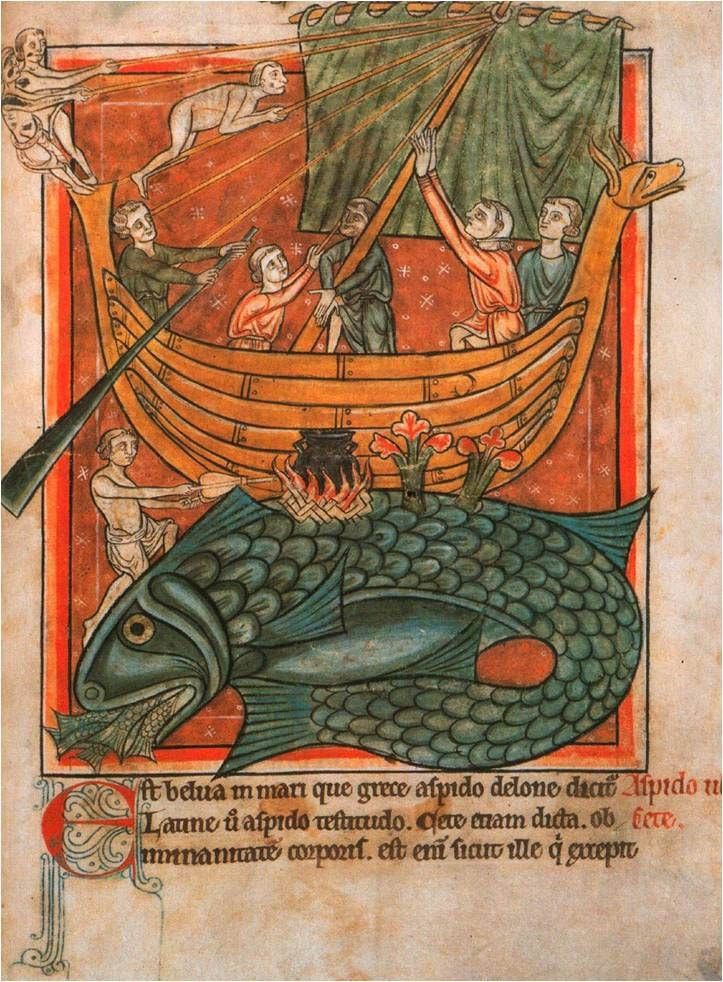
St. Brendan’s island, c. 1230-1240. British Library, Harley MS 4751, f. 69r.

The other traveling motif is the subjection of the great fish / water monster. This story often appeared in various creation stories in Mesopotamia, where the Book of Tobit was also written: the deity (Ninurta, Marduk, Hadad etc.) overcomes the great fish / snake / dragon living in the ancestral sea of chaos, and creates from it / builds upon it the world. This myth was also taken over by the Jews at the time of the Babylonian captivity, and although later they replaced it with the two creation stories now read at the beginning of the Book of Genesis, its traces were retained in the Bible. For example, in Job 40:25-32, where God reminds Job of His greatness with references to the former struggle: “Can you pull the Leviathan with a fishhook… will it make an agreement with you for you to take it as your slave for life?” or in Psalm 74, which briefly summarizes the creation myth to illustrate God’s greatness:

“It was you who split open the sea by your power; you broke the heads of the monster in the waters. It was you who crushed the heads of Leviathan, and gave it as food to the creatures of the desert. It was you who opened up springs and streams; you dried up the ever-flowing rivers. The day is yours, and yours also the night; you established the sun and moon. It was you who set all the boundaries of the earth; you made both summer and winter.” (Psalm 74:13-17)

The creation founded on the Leviathan in the center of the Hasidic synagogue of Łańcut (on the vault of the bimah), late 18th c.

The Ethiopian legend of Raphael bears a great resemblance to this creation story. The archangel, at the command of God, stabs the great fish, so it serves as a solid foundation for the house of God. Is it possible that the Ethiopian tradition has retained something from the Jewish myth, in which, perhaps, the Archangel Raphael fulfilled the subjugation of the ancient water monster at His command, just as the rebellious angels were pushed out from heaven to the underworld by the Archangel Michael in His name?

This is justified by a motif that was unintentionally left in the Book of Tobit. Known as the “Tobias’ Dog Problem”, it has excited the fantasy of commentators at least since the age of confessional debates. It is about the dog that appears twice in brief mentions without any antecedents, and then disappears again without any further role in the Book of Tobit:

“So the son and the angel departed, and the dog went after them.” (Tob 6:2)

“They both arrived, and the dog went after them.” (Tob 11:4)


Tobias and Raphael depart and then come back, and on these occasions the dog appears next to them. Jacob van Maerlant, Rijmbijbel. Utrecht, 1332, miniatures by Michiel van der Borch


According to the analysis of Naomi S. S. Jacobs (What about the dog? Tobit’s mysterious canine revisited, 2014), the dog remained in the Book of Tobit from a more detailed folk narrative, written – as it is indicated by its Greek vernacular – as an entertaining and teaching Midrashic story. In the original narrative, it might have been the helper of Raphael who subjugated the great fish / water monster, just as in similar myths, the evil-chasing dog helps the deity to overcome the water monster / dragon. In the final version, it appears at the two key points of the fish story: before the catching of the great fish, and when Tobias and Raphael heal the blind Tobit with the fish gall.

It is thus conceivable, that this unique motif of Ethiopian iconography, Archangel Raphael stabbing the big fish and firmly founding the house of God on it, as well as the Book of Tobit, written in the 3th century BC in a Greek-speaking Jewish diaspora of Mesopotamia or Egypt, preserved the memory of the most ancient “third creation story” on these two edges of the Jewish and Christian religions, where the authority of the official Book of Genesis, redacted in Judea in the 6th century BC, had not yet completely pushed the original myth into oblivion.
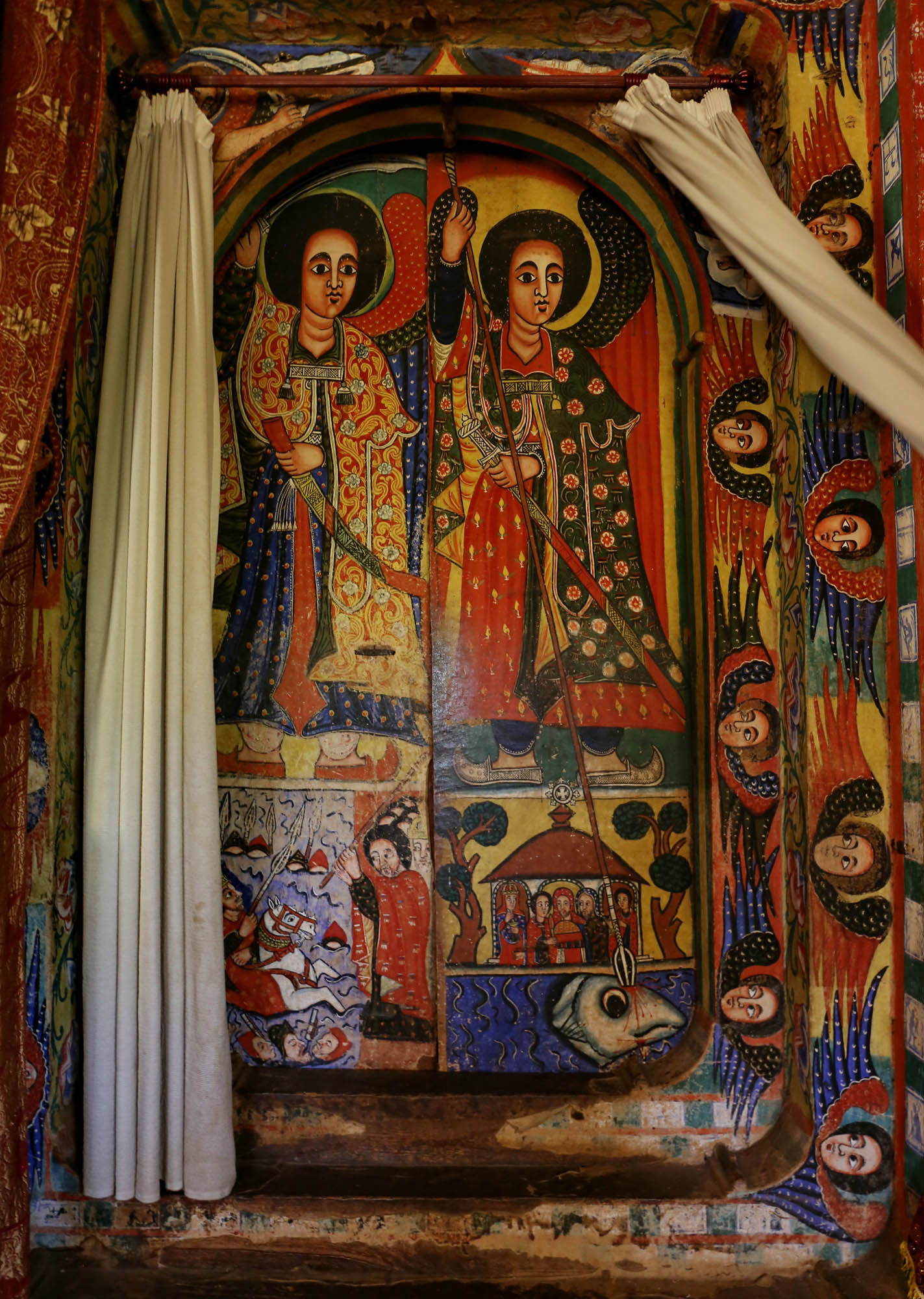
Archangel Raphael (to the right) on a gate of the Azwa Mariam monastery church at Lake Tana.
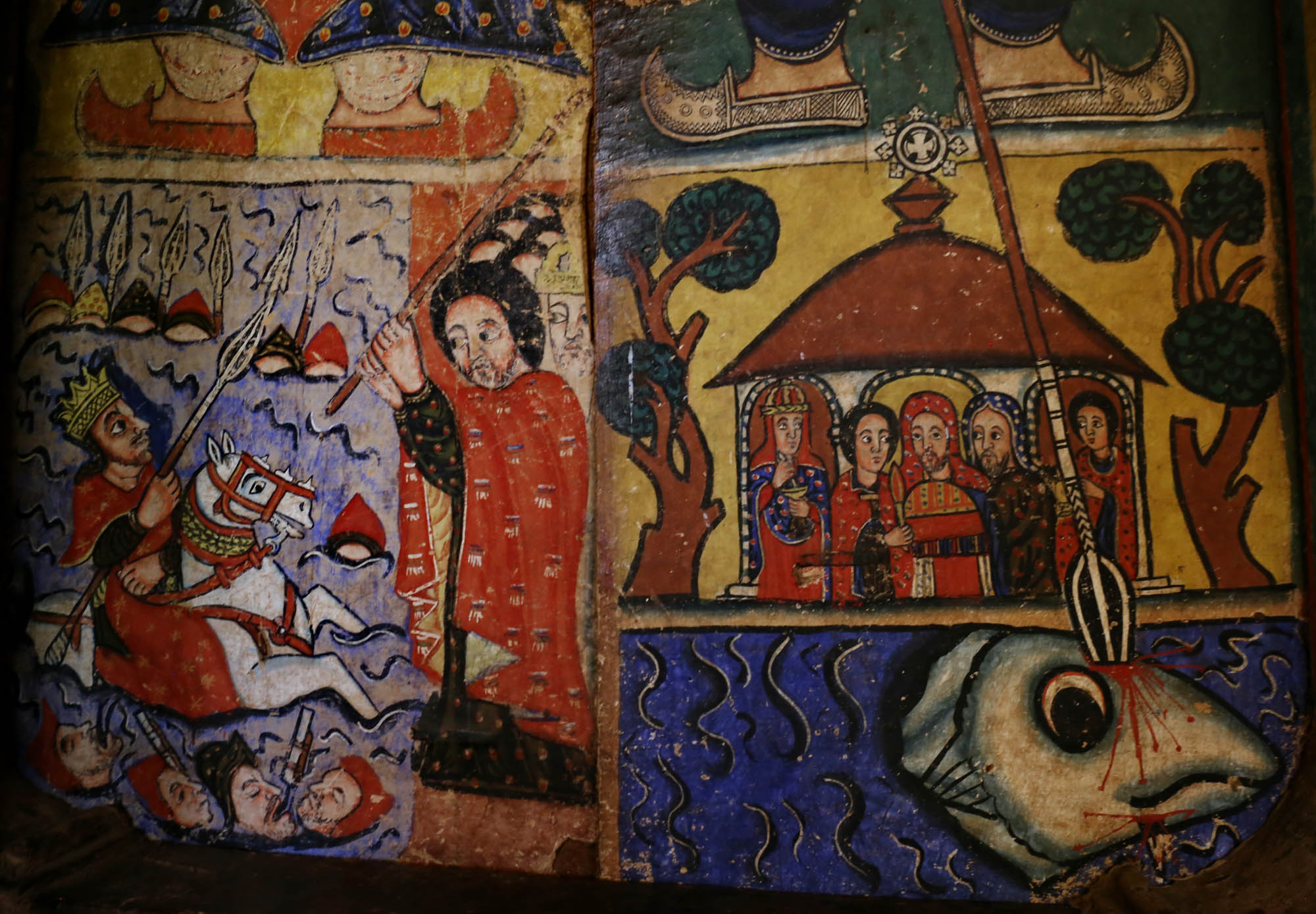

In any case, the fish scene is well suited to the monasteries built on the islands of Lake Tana. The frescoes of the nearly two-dozen monastery churches willingly reach back to those biblical or apocryphal scenes, where the holy figures catch or eat fish, thus blessing and elevating up to a higher sphere the most important daily food of the islands’ inhabitants.


raphael1 raphael1 raphael1 raphael1 raphael1 raphael1 raphael1 raphael1


Gracias por el pescado


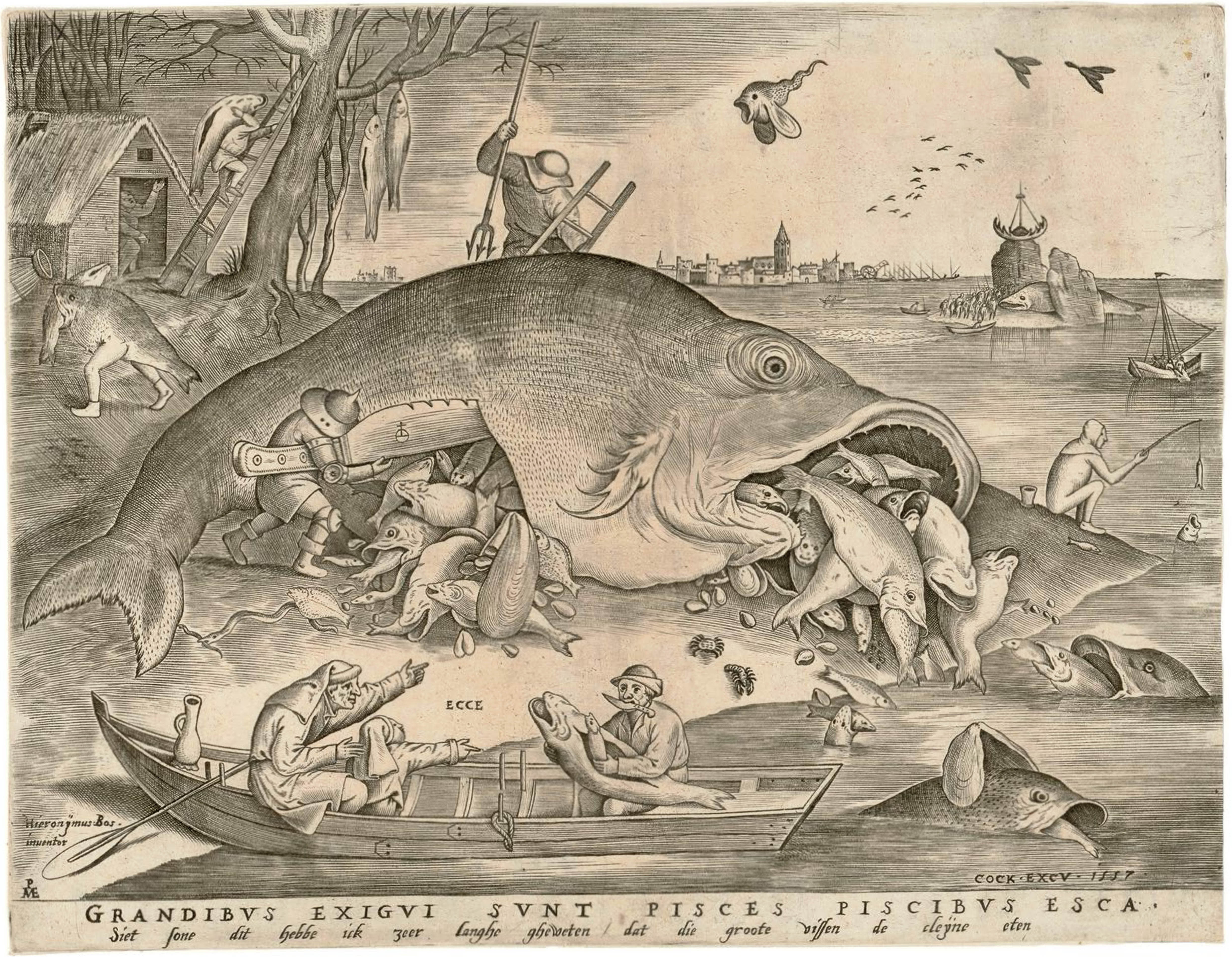
¿Qué quedaría de esta imagen si elimináramos el enorme pez? Apenas nada: una pobre cabaña de pescador a la izquierda y una ciudad portuaria en el horizonte, una bahía abierta al mar entre ambos y una playa de arena vagamente definida. El paisaje parece limitado a ejercer de marco a la presa sin par, ese Gran Pez cuyo vientre saja un hombre como liliputiense, embistiéndole con un cuchillo más grande que él. Del tajo en el estómago y de la boca del animal varado se derraman grandes peces-matrioshka: los que había engullido el pez y que justo antes, o ya en su estómago, tragan a su vez peces menores. Las piezas de la presa que se escurren al mar son devoradas inmediatamente por otros peces (como hacían las focas en la lonja de Puerto Ayora), y hasta vemos un pez volador que con las fauces abiertas llega reclamando su parte del festín. El paroxismo de este frenesí de engullimiento llega al punto de que los mejillones intentan atrapar los peces. En el bote de la parte inferior de la imagen, un remero señala el espectáculo a su hijo: ECCE, y en la inscripción en cursiva en lengua flamenca, comparte con él la experiencia básica de su vida: «Mira, hijo mío, he sabido desde hace mucho tiempo que los peces grandes se comen a los pequeños». Lo mismo dice el hexámetro de las mayúsculas latinas: «GRANDIBUS EXIGUI SUNT PISCES PISCIBUS ESCA»: Los peces pequeños son alimento para los peces grandes. Y una versión bastante posterior de esta de 1557, publicada por Jan Galle, activo en Amberes entre 1620 y 1670, que agrega además una explicación trilingüe de la imagen para que nadie pueda malinterpretar ni un ápice la metáfora: «La opresión de los pobres. Los ricos te aniquilan con su poder». Epístola de Santiago, 2: 6».
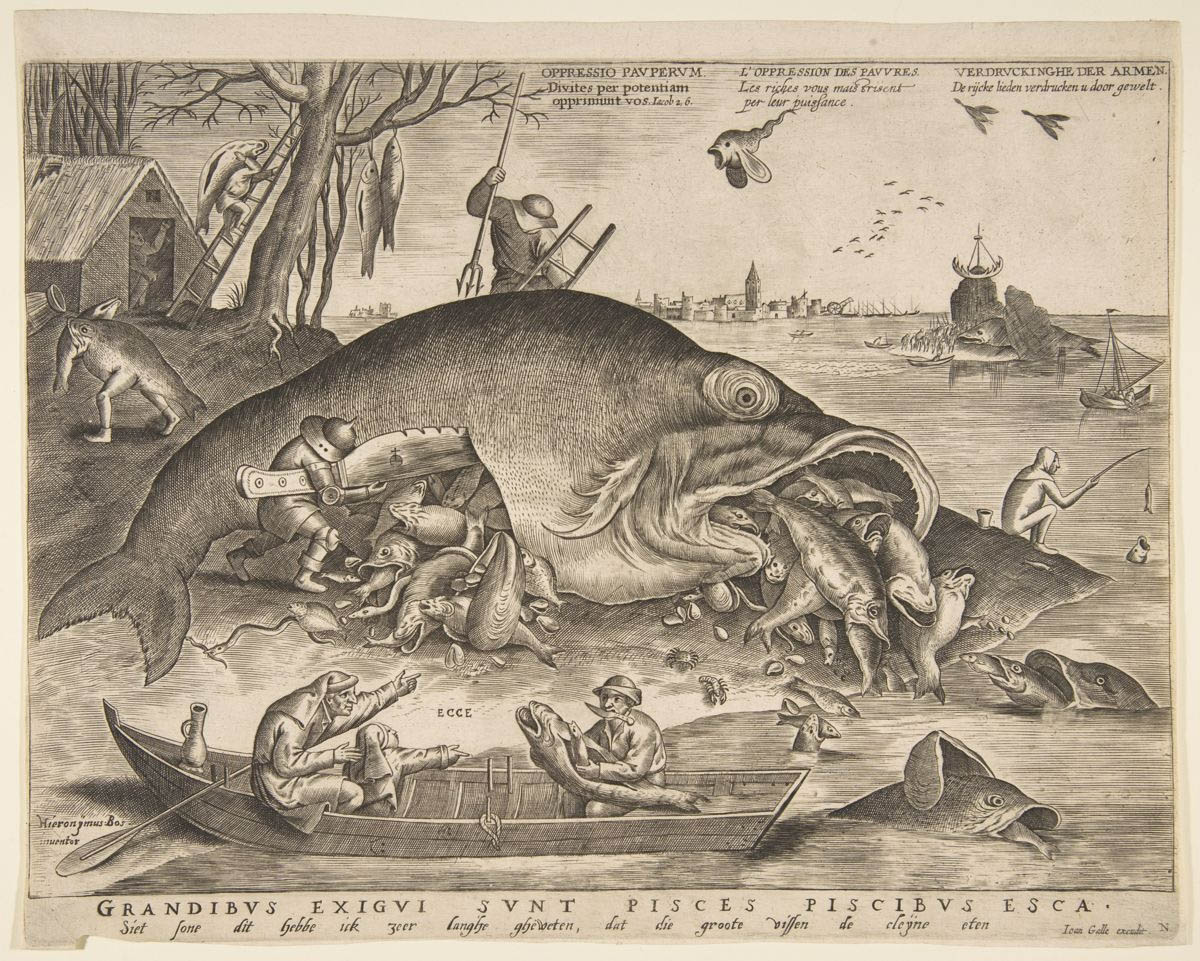

Si el Pez —con los menores peces que ha tragado— ilustra esta injusticia básica, entonces es posible que el cuchillo que le abre el estómago, con la representación del orbe en forma de una insignia real en la hoja, como la que usualmente sostiene Cristo en las escenas del Juicio Final, represente la justicia suprema.


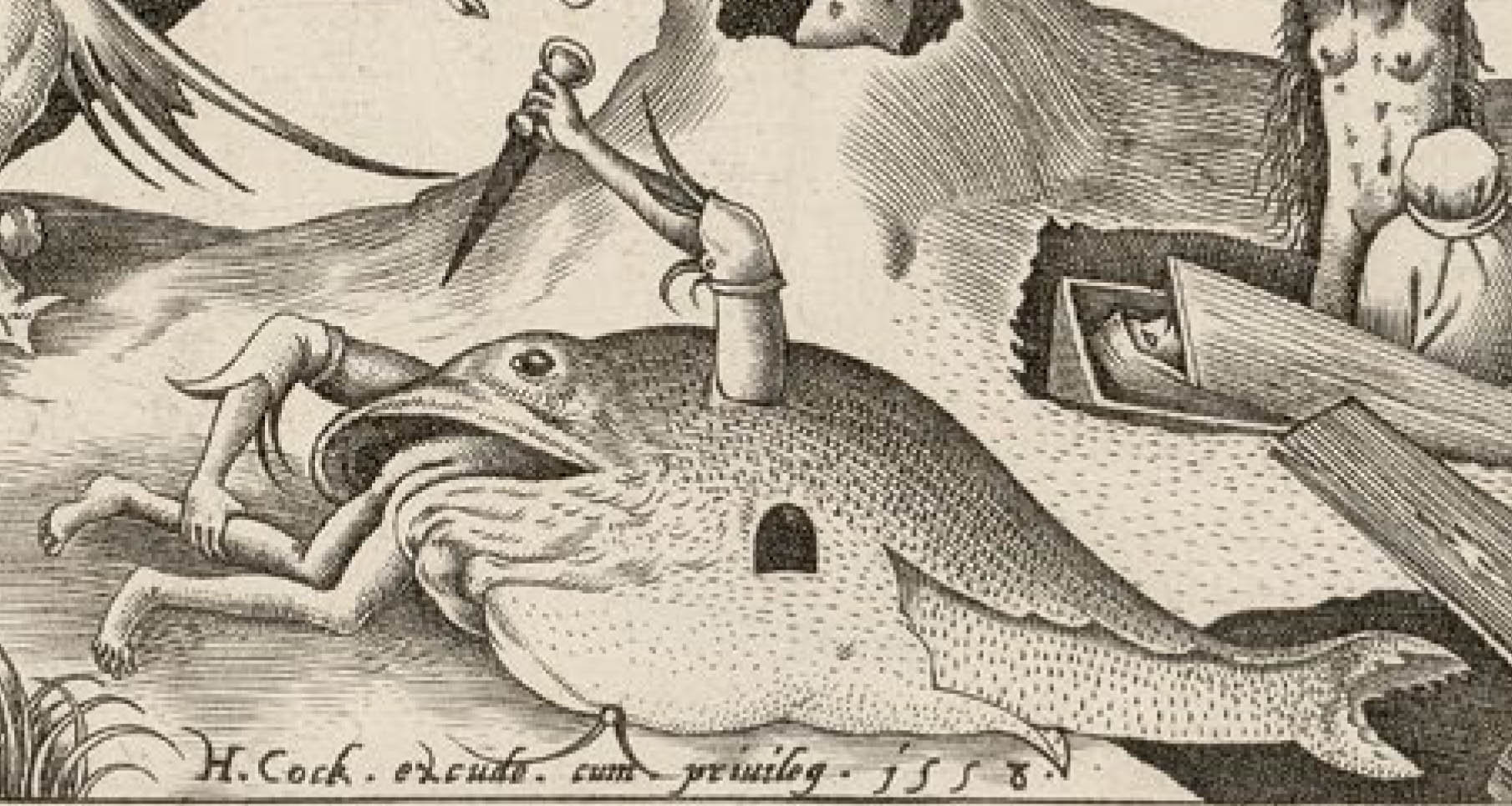
¿Quién es el autor de la imagen? La inscripción muestra dos firmas. A la izquierda: «Hieronymus Bos. inventor», y bajo esta: «PAME», mientras que a la derecha vemos: «COCK EXCU[DIT], 1557». Es decir, el dibujo es de Hieronymus Bosch y la impresión fue realizada por Cock en 1557. Nada de esto es verdad. Que Cock no fue el grabador lo prueba el monograma PAME, que señala a Pieter van der Heyden: uno de los grabadores habituales de Hieronymus Cock, el mejor editor de grabados de Amberes. Por lo tanto, Cock se jactaba de la ejecución de la impresión no como autor, sino como editor. Pero tampoco se puede atribuir el dibujo original a El Bosco. Es similar en estilo, ciertamente, pero carece de la profusión de monstruos compuestos que lo caracteriza (excepto por ese pez bípedo que trata de escapar con su presa cerca de la choza).

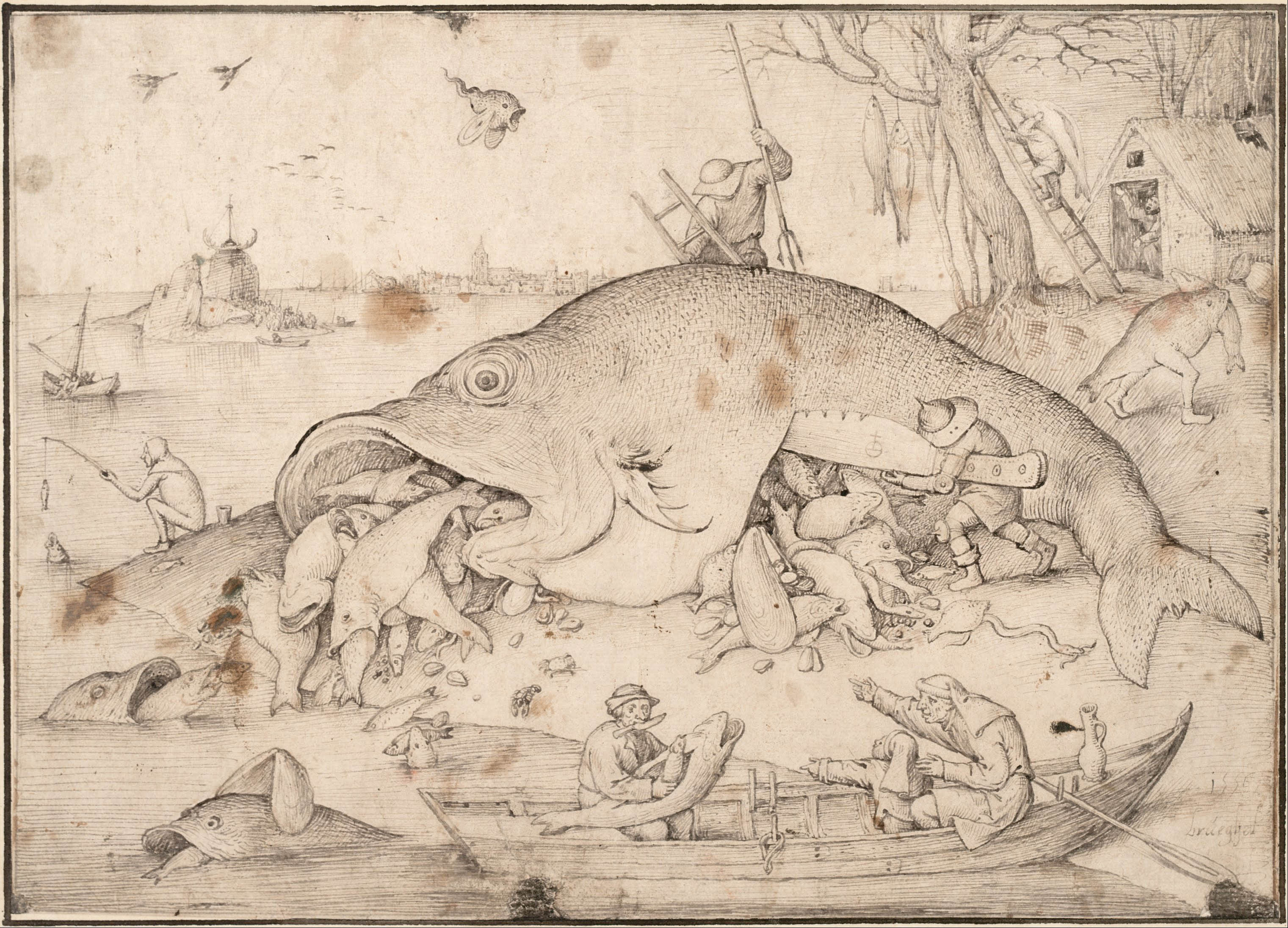
El Albertina de Viena, sin embargo, conserva el dibujo original que sirvió como modelo para la impresión (inv. no. 7875). Y este en lugar de la firma de Bosch lleva la de Pieter Bruegel el Viejo. Aquí aún escribe su nombre con una h, pero pronto la eliminará, y solo sus hijos Pieter el Joven y Jan recuperarán la forma Brueghel.


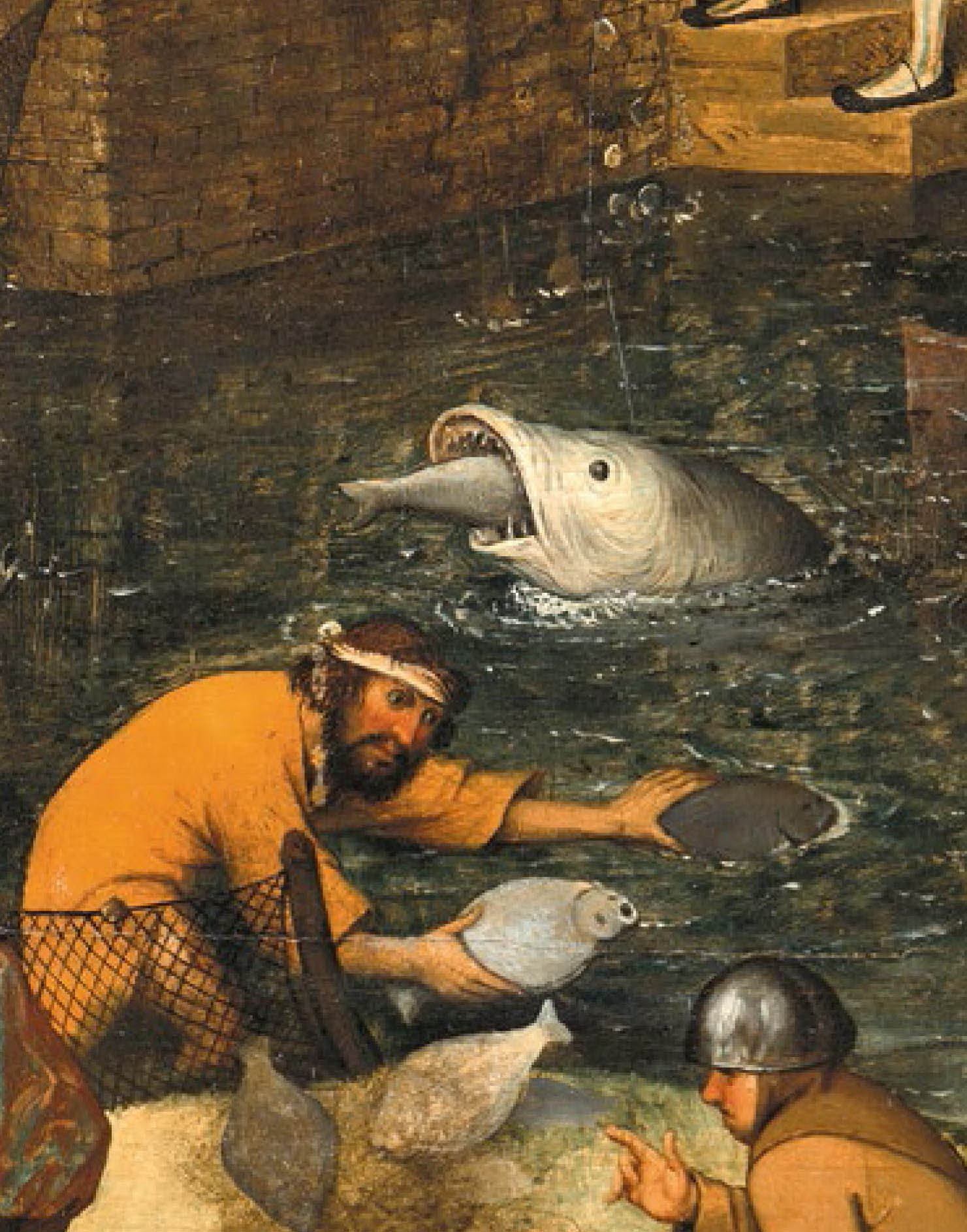
Y Bruegel también usa este motivo para una de las escenas de sus Proverbios neerlandeses de 1559.


En 1556, el joven —quizás de unos treinta años— Pieter Bruegel el Viejo acababa de regresar a casa tras su viaje de estudios en Italia, donde mejoró sus habilidades de dibujante y realizó una gran cantidad de bocetos, especialmente de los paisajes montañosos, desconocidos y atractivos para el público de los Países Bajos. Quería hacerse un hueco en Amberes, que era el centro no solo comercial sino especialmente del mercado de arte por entonces. En 1540 se abrió aquí la primera galería europea permanente de pintura y grabados, donde trescientos maestros de la ciudad colocaban sus obras, y desde aquí alcanzaban lugares tan lejanos como, por ejemplo, la catedral armenia en Isfahan, donde las paredes se decoraron con frescos hechos a partir de grabados bíblicos producidos en Amberes. Uno de los comerciantes de arte de más éxito en la ciudad, Hieronymus Cock, abrió en 1548 su casa editora A los cuatro vientos (In de Vier Winden), donde imprimió grabados muy codiciados. Y para ello necesitaba dibujantes de talento. Así, cuando el joven Bruegel volvió de Italia, lo contrató de inmediato (y quizás ya le había financiado el viaje), y desde ese momento colaboraron en multitud de exitosas series de grabados, desde los Grandes paisajes hasta Los siete pecados capitales y las siete virtudes, que aumentaron la fama de ambos.

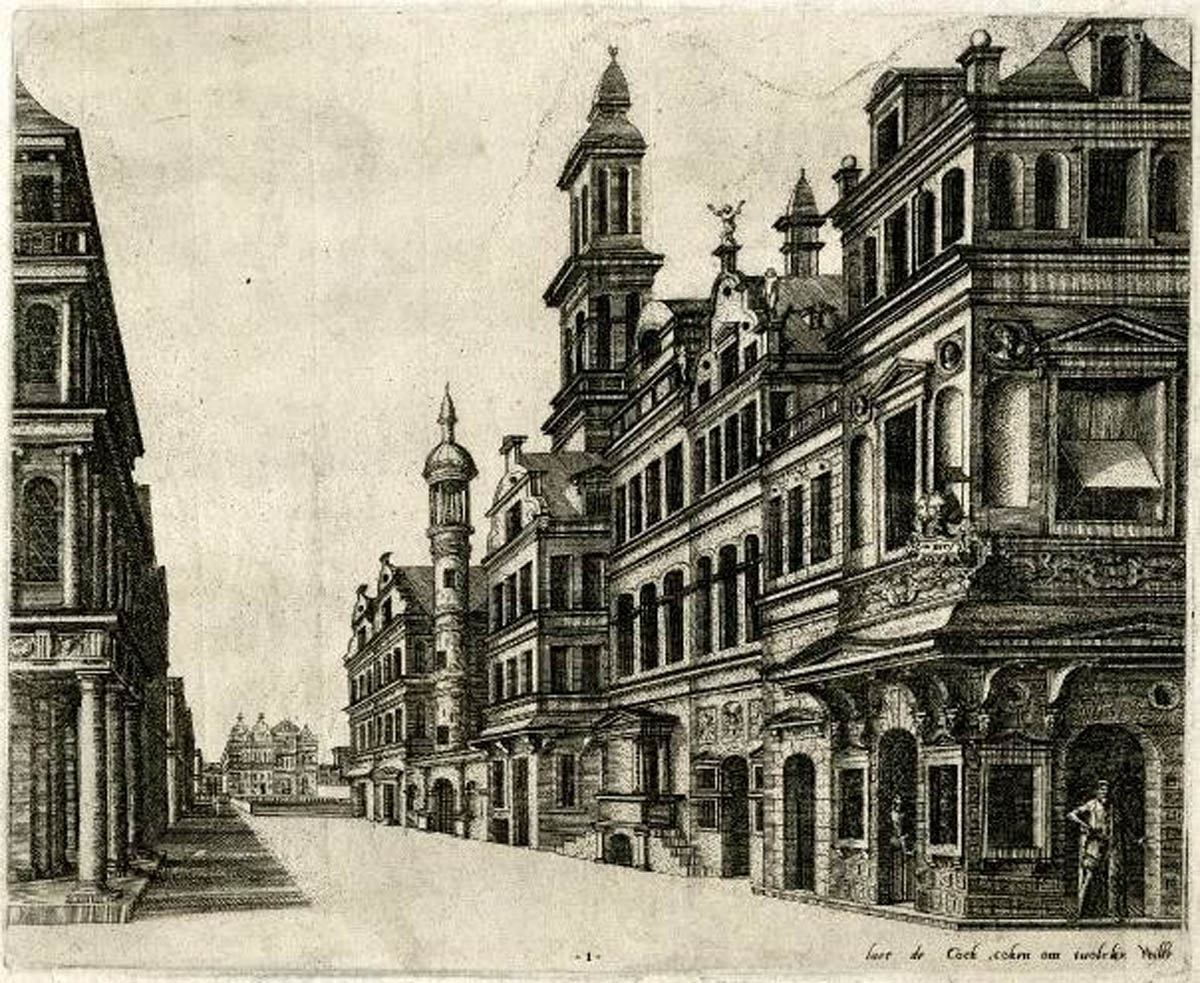
Hans Vredemann de Vries, Vista de calle de Amberes, con la editorial de Hieronymus Cock en la esquina derecha, donde también se imprimió este mismo grabado en 1560, y con el propio Hieronymus Cock a la puerta

En el mercado de arte de Amberes, un joven y prometedor principiante podía prosperar promocionándose como maestro en aquellos temas populares que habían cobrado vida en décadas anteriores. Hasta principios de la década de 1500, había un solo tema comercial: el retablo, ya fuera para la iglesia o particular. Sin embargo, al asentarse el mercado de arte y el coleccionismo privado —con el auge de las Kunst- und Wunderkammer— en el siglo XVI, aparecieron nuevos temas de especialización: paisajes, asuntos exóticos, escenas campesinas, etc. Entre los nuevos temas, las réplicas de El Bosco llegaron a ser un sector independiente. Las sorprendentes criaturas fantásticas de Hieronymus Bosch eran extremadamente populares. Su obra original había sido recogida principalmente por Felipe II para su colección y el mercado reclamaba sucedáneos. Muchos pintores se especializaron en ello: copias de sus pinturas y nuevas creaciones siguiendo su estilo. Entre ellos se encontraba Bruegel, que hizo varios dibujos de monstruos a imitación de El Bosco y Cock los publicó con gran éxito.


Bruegel, La tentación de san Antonio, 1554. Esta escena fue uno de los temas principales de los imitadores de El Bosco, porque los demonios que acosaban al santo ermitaño ofrecían un generoso pretexto para la representación de seres monstruosos similares a los del maestro.

Una de las piezas de más éxito de la colaboración entre Bruegel y Cock fue la serie de grabados que representan los siete pecados mortales, las siete virtudes y el Juicio Final, entre 1557-60. El éxito se atribuyó en gran parte a las diablerías de El Bosco, que inundaron casi todas las planchas de la serie: las de los pecados, naturalmente, pero también las de las virtudes, llenas por igual de demonios aquí derrotados.

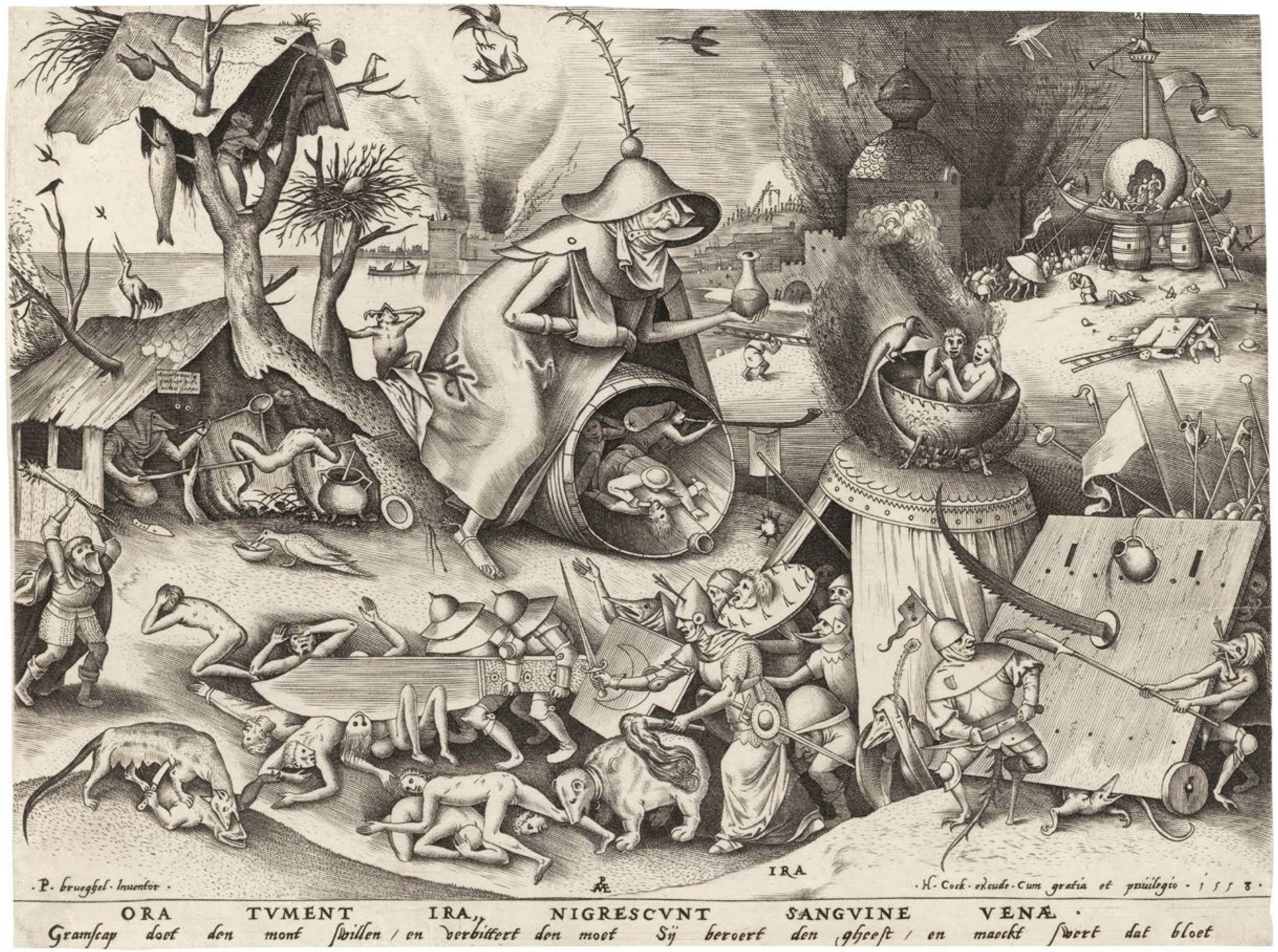
Bruegel, Ira, 1558

Bruegel, Fortitudo, 1560

En 1572, el humanista Dominicus Lampsonius de Brujas publicó con Cock una colección de retratos de grandes artistas holandeses. Para entonces, la reputación de Bruegel como imitador de El Bosco era tan notoria que Lampsonius podía escribir sobre él: «Es el nuevo Hieronymus Bosch, quien con su pincel imita y pone ante nuestros ojos los ingeniosos sueños del Maestro y reproduce su estilo tan eficazmente, que así al mismo tiempo lo supera». De aquí viene la apelación de Bruegel como «segundo Bosco» que, gracias a la descripción de los Países Bajos de Lodovico Guicciardini, se extendió también por todo el sur de Europa.

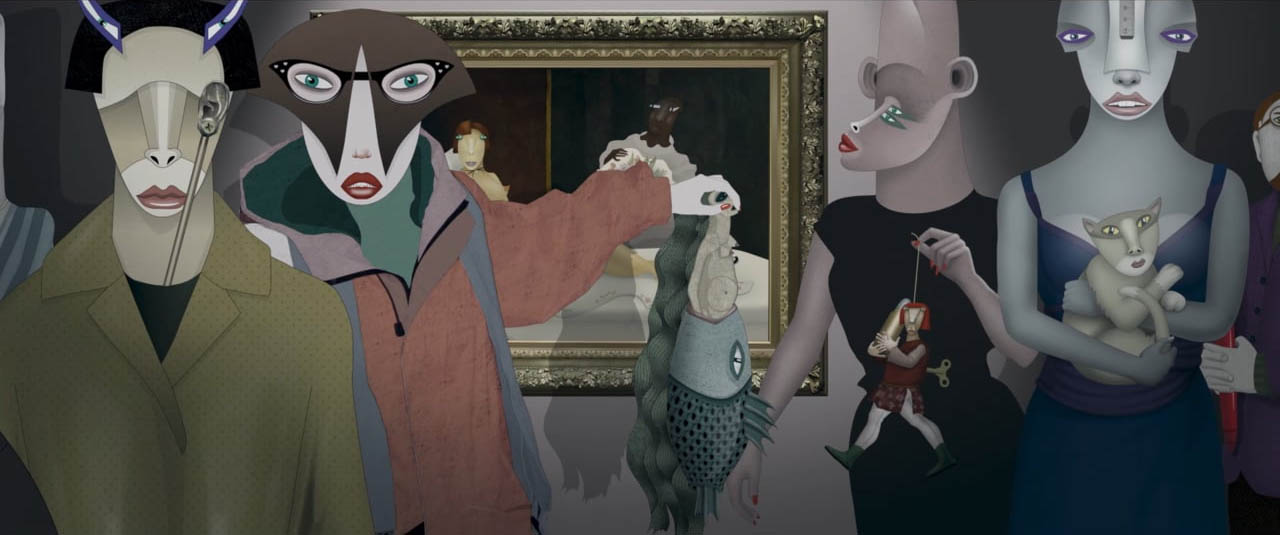
En el grabado de los peces de 1557, que hemos visto arriba, Bruegel todavía no usaba aquellos monstruos típicos de El Bosco. Pero para el espectador contemporáneo, los peces que se devoran entre sí ya eran marca registrada de este autor, quien a menudo representaba sus demonios de igual modo. Curiosamente, el motivo aparece repetidamente en la película Ruben Brandt, el coleccionista (2018), que trabaja con numerosas referencias a la historia del arte e imágenes absurdas. Si no la habéis visto aún, hacedlo (y si lo habéis hecho, volved a verla) y contad los peces.

El Bosco, La tentación de san Antonio, c. 1501, detalle

El Bosco, Adoración de los Magos, c. 1485-1500, detalle

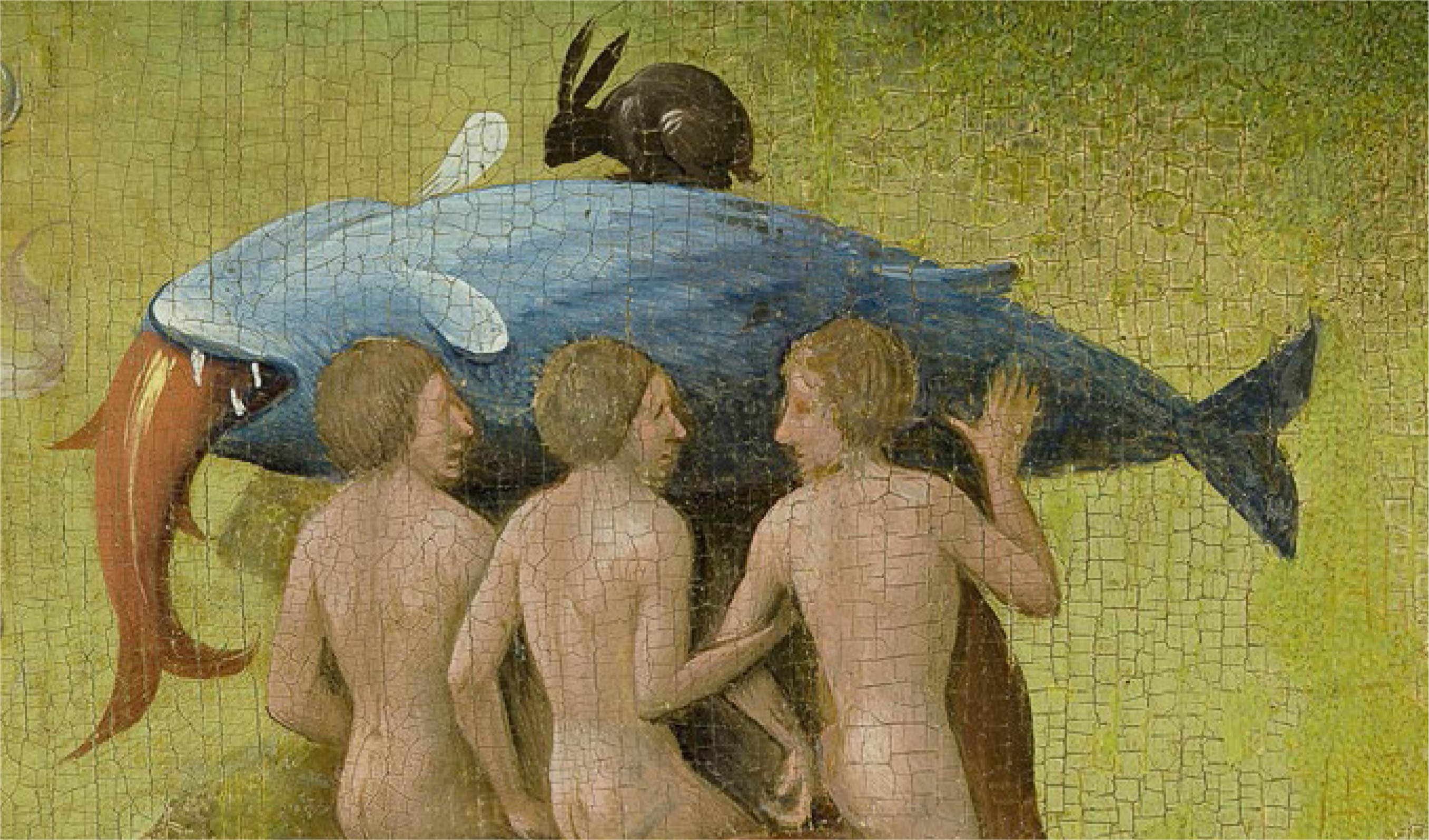
El Bosco, El jardín de las delicias, c. 1490-1510, detalle

El Bosco, El carro de heno, 1516, detalle. A la derecha, el pez bípedo del grabado de Bruegel

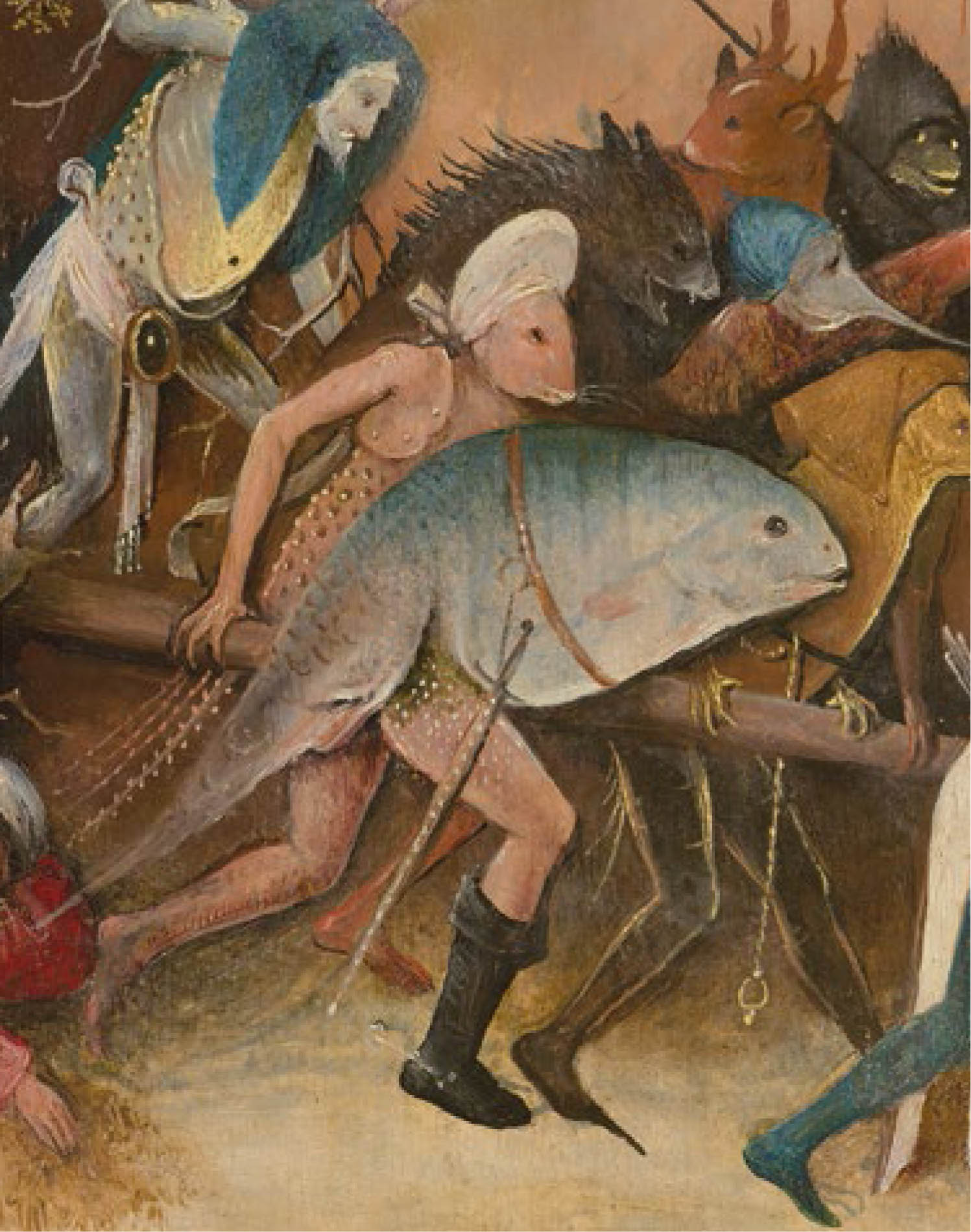
Bruegel, El Juicio Final, 1558, detalle

Milorad Krstić, Ruben Brandt, el coleccionista, 2018. Detalle del episodio sobre la exposición de arte pop en Tokio

En 1556, cuando Bruegel dibujó y firmó el modelo del grabado de los peces, era todavía un joven talento desconocido, que se buscaba la vida en casa de Cock (y Cock se enriquecía gracias a Bruegel). El Bosco, por su parte, era ya toda una marca. Quizás sea por eso que Cock decidió poner a El Bosco como el «inventor» del dibujo. En aquel momento, esto no significaba necesariamente engañar al consumidor. Se trataba claramente de una obra de género: esto es «un Bosco», o, con mayor precisión: «diseñado a partir de El Bosco por un miembro de nuestra editorial». Y el aficionado que lo comprara y lo conservara durante al menos quince años, momento en el que Bruegel también se convirtió en una marca de referencia, podía presumir de tener un Bosco que, en realidad, finalmente resultó ser un Bruegel. No está mal.

Para ilustrar el recorrido de esta imagen entre los consumidores de los Países Bajos, veamos este ejemplo de sesenta años después.


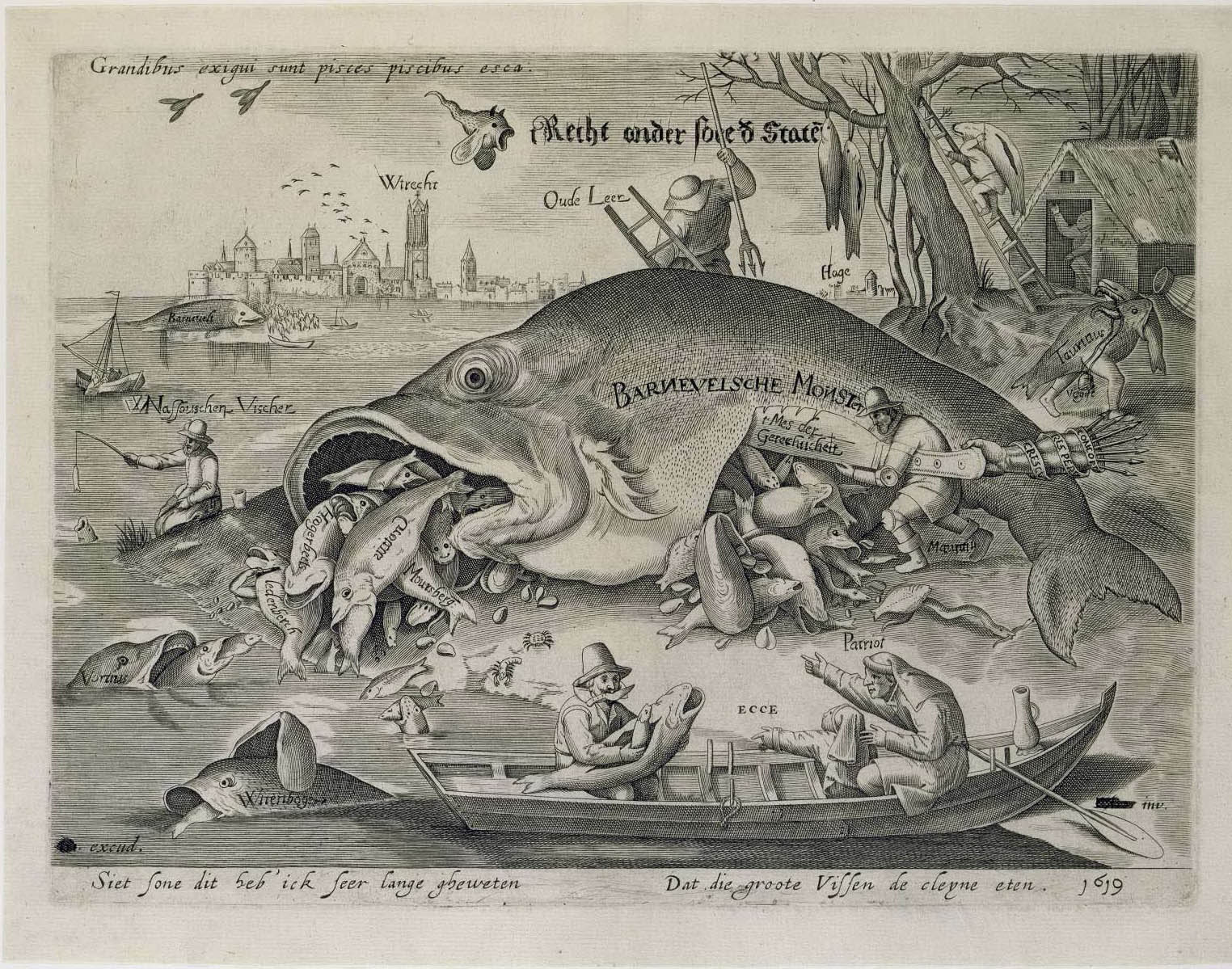
Claramente se copió de la impresión original de Cock. Sin embargo, la crítica social de tipo general se agudiza aquí alrededor del debate político. El pez lleva la inscripción «Barnevelsche Monster», de la cual, y de otros detalles, se infiere que el panfleto celebra la ejecución de Johan van Oldenbarnevelt, canciller de las Provincias Unidas de los Países Bajos, en 1619.

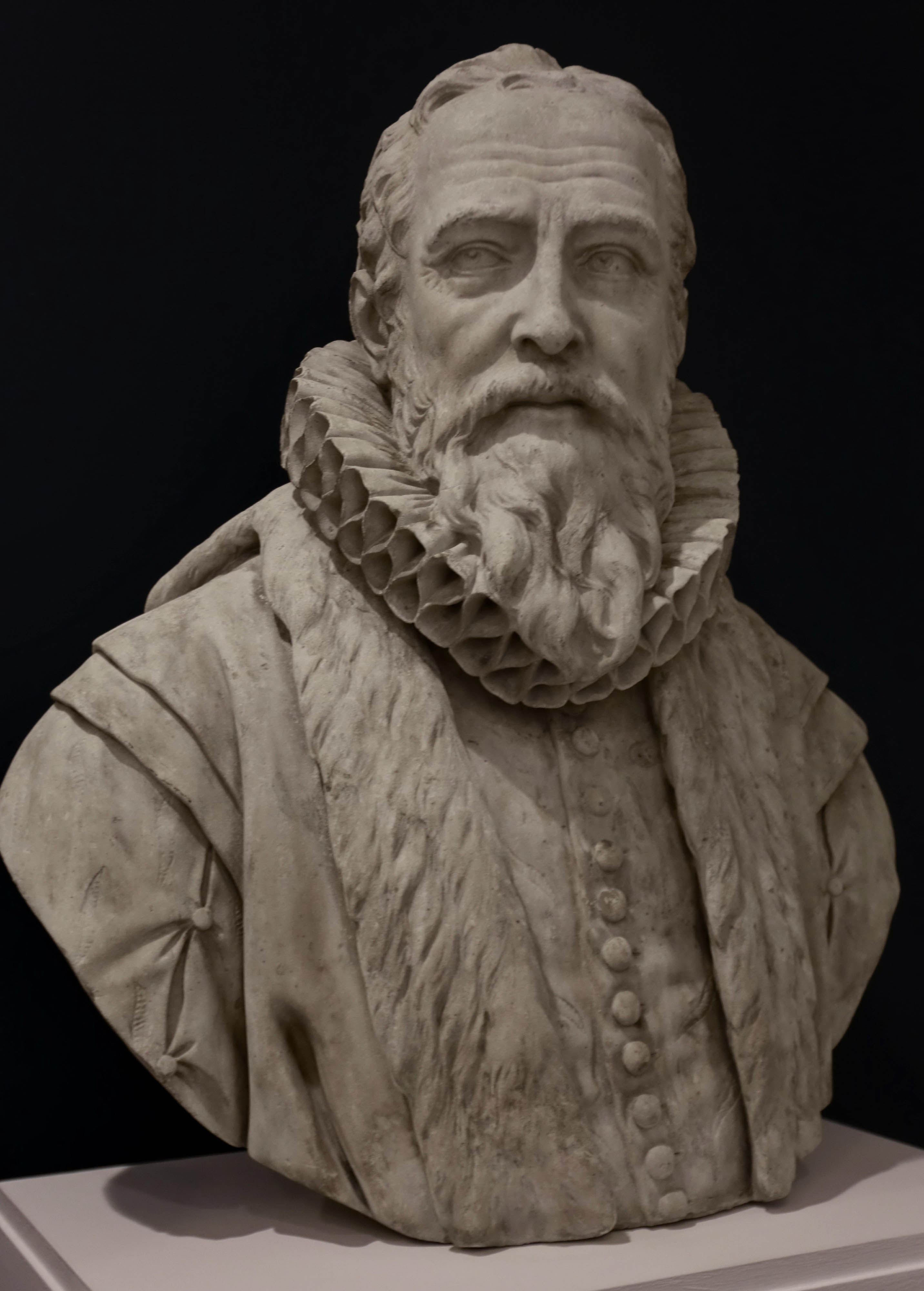
Gilles-Lambert Godecharle: Johan van Oldebarnevelt (1549-1619), 1817. Bruselas, Museo Real de Bellas Artes

El canciller, que había sido el juez supremo de los Países Bajos Libres durante treinta años, finalmente entró en conflicto con los Estados de los Países Bajos como partidario de la rama arminiana del calvinismo, y estos convencieron al gobernador príncipe Mauricio de Nassau para que lo condenara y ejecutara en un juicio sumario, al igual que en el grabado el príncipe abre el estómago del «monstruo» con «el cuchillo de la justicia». El «monstruo» es rematado por el arpón de la «Oude Leer», es decir, la enseñanza calvinista ortodoxa, y la ciudad del horizonte se perfila con las características particulares de Utrecht, el último refugio de Oldenbarnevelt. La posteridad considera a Oldenbarnevelt como un gran estadista, pero en el transcurso de treinta años pudo haber perjudicado a algunos: sus nombres pueden leerse en los peces que escapan de su estómago y garganta. La verdad triunfó, desde el punto de vista de alguien. La pregunta es, tal como un pez grande le preguntó al chico antes de tragárselo: ¿qué es la verdad?

Thanks for All the Fish


What would there be left in the picture if we took the big fish out of it? Basically nothing: the poor fishing hut on the left and the harbor town on the horizon, as well as the open sea bay between them, with a large, formless sandy beach. The landscape apparently was created to be a worthy frame for the matchless prey, the Great Fish, which is being cut open by a Liliputian man with a knife far greater than himself. From the stomach and mouth of the Fish, as if the blade of the knife also cut its throat, big fish-matrioshki are pouring out, those that had been swallowed by the Fish, and which immediately before that, or already in its stomach, tried to swallow further fishes. The pieces of the prey falling into the sea are awaited and immediately swallowed by other fishes, as by the seals on the fish market, and there is even a fish that come flying in for its share. The paroxysm of this gobbling frenzy grew to the point that even the mussels try to swallow fishes, even though they would think twice at this in their natural habitat. At the bottom of the picture, in a fishing boat, an oarsman points to the spectacle to his son: ECCE, and in the Flemish-language Italic inscription at the very bottom he shares with him the basic experience of his life: Look, my son, I have known for a long time that big fish eat small fish. The same is said by the Latin legend, in hexameter: “GRANDIBUS EXIGUI SUNT PISCES PISCIBUS ESCA” – small fishes serve as food for big fishes. And a much later version of this 1557 print, published by Jan Galle, active in Antwerp between 1620 and 1670, who even adds a trilingual explanation over the image, so that nobody can misunderstand the metaphor: “OPPRESSION OF THE POOR. The rich suppress you with their power. Letter of James, 2:6.”


If the Fish – and the large fishes swallowed by it – illustrate this basic injustice, then it is possible that the Knife ripping its stomach, with its representation of the world in the form of a royal insignia on its blade, like the one usually held by Christ on the scenes of the Last Judgment, represents the ultimate justice.


Who is the author of the picture? The inscription gives two signatures. To the left: “Hieronymus Bos. inventor”, and under it: “PAME”, while to the right: “COCK EXCU[DIT], 1557”. This means that the design is by Hieronymus Bosch, and the print was made by Cock in 1557. Neither of which is true. That Cock was not the engraver is proved by the monogram PAME, which indicates Pieter van der Heyden: he was one of the permanent engravers of Hieronymus Cock, the greatest print publisher of Antwerp. Thus, Cock boasted with the authorship of the print not as its master, but as its publisher. But neither can the original drawing be attributed to Bosch. It is akin to his style, but the usual composite monsters are missing (except for the fish next to the hut, which tries to get away with its prey on two legs).

The Albertina in Vienna, however, preserves the original drawing which served as a model for the print (inv. no. 7875). And this, rather than the signature of Bosch, bears that of Pieter Bruegel the Elder. Here he writes his name with an h, but soon he will drop it, and only his sons Pieter the Younger and Jan will return to the form Brueghel.


And Bruegel also uses this motif for one of the scenes in his “Netherlandish proverbs” of 1559.


In 1556, the young – perhaps thirty years old – Pieter Bruegel the Elder just recently returned home from his Italian study trip, where he improved his draughtmanship and made a lot of sketches, especially of the mountainous landscapes, which were unknown and attractive to the public in the Netherlands. He was looking for a living in Antwerp, which was the center not only of trade, but also of the art market of the contemporary world. In 1540 the first European permanent painting and print gallery was opened here, to which three hundred masters of the city delivered their products, and these reached such far away places as, for example, the Armenian cathedral in Isfahan, where the walls were decorated with frescoes made after biblical prints from Antwerp. One of the city’s best-selling art dealers, Hieronymus Cock, opened in 1548 his publishing house At the Four Winds (In de Vier Winden), where highly sought-after prints were printed on the device, and for this, he sorely needed talented draughtsmen. As the young Bruegel arrived from Italy, he immediately contracted with him (and perhaps he already supported his Italian trip), and from then on they produced together a multitude of successful series of prints, from the Large Landscapes to The Seven Deadly Sins and Seven Virtues, which promoted the reputation of both of them.

Hans Vredemann de Vries, Antwerpen Street View, with Hieronymus Cock’s publisher in the right corner, where this engraving was also printed in 1560, and with Hieronymus Cock himself in the door

In the Antwerp art market, a promising young beginner might prevail by positioning himself as a master of the popular themes that had come to life in the previous decades. Until the early 1500s, there was one single marketable theme: the altarpiece, whether for the church or private. At the establishment of the art market and collections – Kunst- und Wunderkammer – in the 16th century, however, new themes appeared in which collectors specialized: landscapes, exotic topics, peasant scenes, and so on. Among the new themes, Bosch replicas were an independent sector. Bosch’s thrilling fantasy creatures were extremely popular, but his original paintings were mainly accumulated by Philip II of Spain for his private collection, and the market cried for substitutes. A lot of painters specialized in this, the production of copies after Bosch and new creations in his style. Among them was Bruegel, who made several drawings of Boschian monsters, and they were published in print by Cock for great profit.

Bruegel, The temptation of St. Anthony, 1554. This scene was one of the main themes of the imitators of Bosch, because the demons tempting the holy hermit offered a generous pretext to the representation of Bosch’s typical monsters.

One of the most successful pieces of the collaboration of Bruegel and Cock was the series of prints representing the seven deadly sins, the seven virtues, and the Last Judgment, in 1557-60. The success was largely attributed to the Boschian devileries, which flooded almost every sheet of the series: those of the sins naturally, but also those of the virtues, in the form of the demons defeated by them.

Bruegel, Ira (Anger), 1558

Bruegel, Fortitudo (Strength), 1560

In 1572, the humanist Dominicus Lampsonius from Bruges published at Cock’s a portrait collection of great Netherlandish artists. By that time, Bruegel’s reputation as a Bosch imitator was so great, that Lampsonius could write about him: “He is the new Hieronymus Bosch, who with his brush imitates and sets in front of our eyes the clever dreams of the Master, and mimics his style so greatly, that at the same time he surpasses him.” From here comes the attribution of Bruegel as the “second Bosch”, which, thanks to the description of the Netherlands by Lodovico Guicciardini, was also spread through Southern Europe.

In the fish print of 1557, Bruegel did not yet use such typical Boschian monsters. But to the contemporary viewer, the fishes swallowing each other were already a trademark of Bosch, who often depicted his demons likewise. Interestingly, the motif is repeatedly featured in the film Ruben Brandt, the collector (2018), which works with numerous references of art history and absurd images. If you have not seen it yet, do so (and if you have, watch it again) and count the fishes.

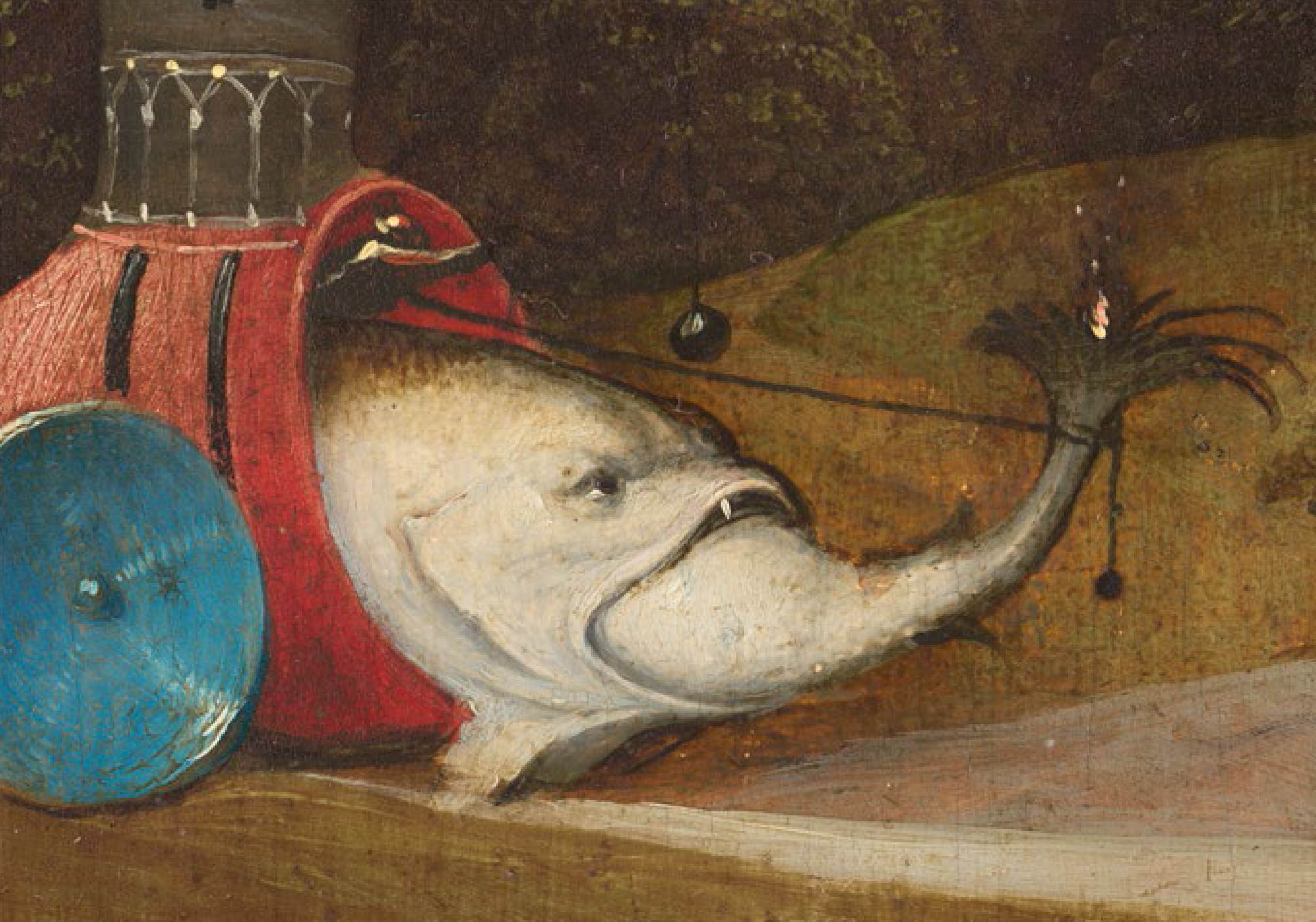
Bosch, The temptation of St. Anthony, c. 1501, detail

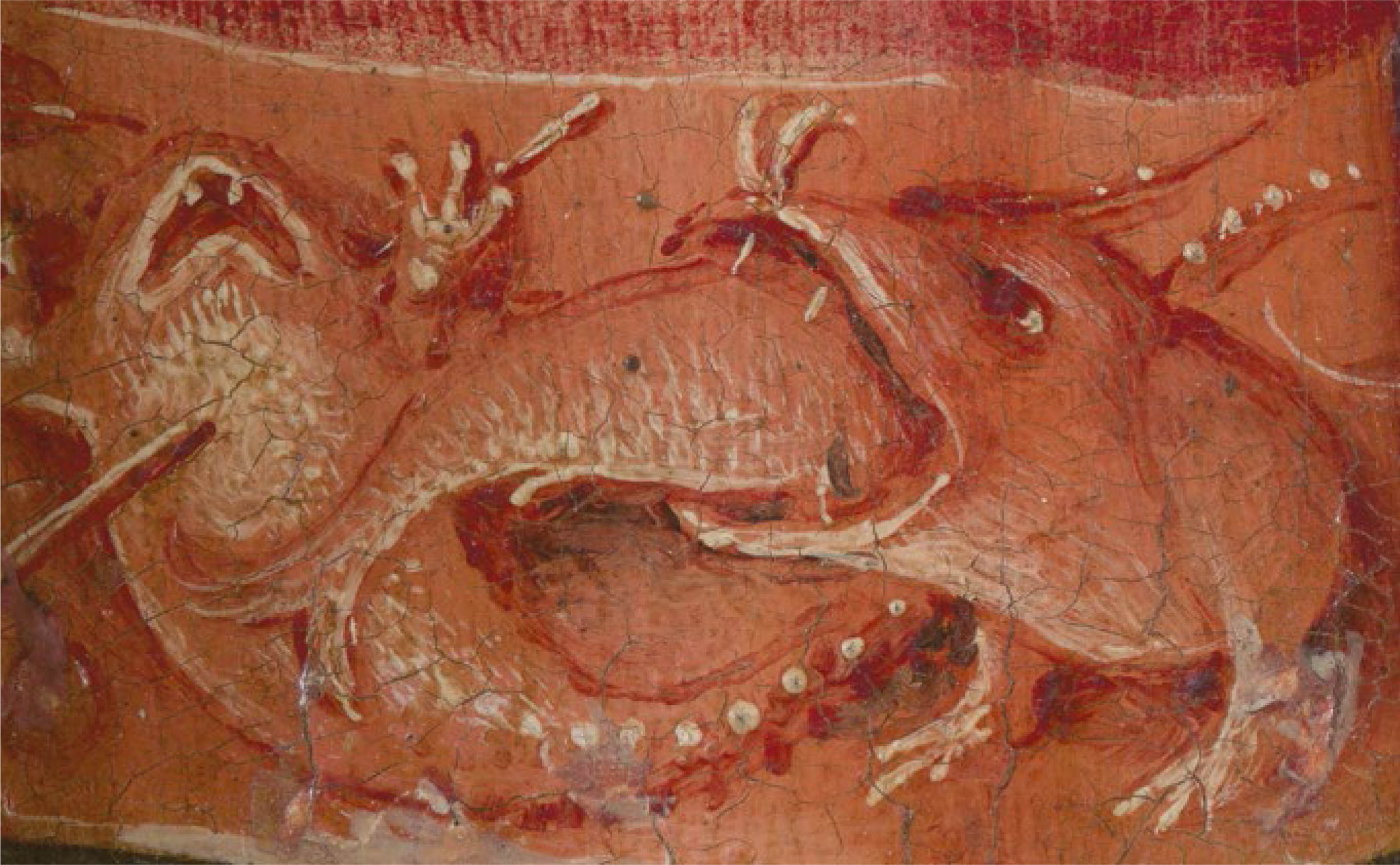
Bosch, Adoration of the Magi, c. 1485-1500, detail

Bosch, The garden of earthly delights, c. 1490-1510, detail

Bosch, The Haywain, 1516, detail. To the right, the fish on two legs from Bruegel’s fish print

Bruegel, The Last Judgment, 1558, detail

Milorad Krstić, Ruben Brandt, the collector, 2018. A detail of the episode about the Tokyo pop art exhibition

In 1556, when Bruegel drew and signed the model of the fish print, he was still an unknown young talent, who might have a future thanks to Cock (and Cock a profit thanks to Bruegel). Bosch, however, was a brand. Perhaps this is why Cock decided to name Bosch as the “inventor” of the print. At that time, this did not necessary mean deceiving the consumer. It was merely a genre: this is “a bosch”, or, in greater detail: “designed after Bosch by a fellow of our publisher”. And the consumer who bought it and kept it for at least fifteen years, by which time Bruegel had also become a brand, well, he could boast of having a bosch, that was actually a bruegel.

To illustrate the career of the picture among the consumers in the Netherlands, let us see this example sixty years later.


The facing page image shows that it was copied from Cock’s original print. However, the general social criticism is sharpened here into a political debate. The Fish bears the label “Barnevelsche Monster”, from which – and from other details – it can be inferred that the pamphlet celebrates the execution of Johan van Oldenbarnevelt, the Chancellor of the United Provinces of the Netherlands in 1619.

Gilles-Lambert Godecharle: Johan van Oldebarnevelt (1549-1619), 1817. Brussel, Royal Museum of Fine Arts

The Chancellor, who had been the supreme judge of the Free Netherlands for thirty years, finally came into conflict with the States of the Netherlands as a supporter of the Arminian branch of Calvinism, and they convinced Governor-Prince Maurice of Nassau to condemn and execute him in a kangaroo court, just as in the print the Prince cuts open the stomach of the “monster” with “the knife of righteousness”. The “monster” is killed by the harpoon of the “Oude Leer”, that is, orthodox Calvinist teaching, and the city on the horizon rises up and gains independent features as Utrecht, Oldenbarnevelt’s last refuge. Posterity considers Oldenbarnevelt as a great statesman, but in the course of thirty years he may have injured some: their names can be read on the fishes slipping from its stomach and throat. Truth triumphed, from someone’s point of view. The question is – just as a big fish once asked a small fish before swallowing it –: what is truth?