


|
| Published in Szombat 2013/3 before our travel to Odessa organized with the Hungarian Jewish Cultural Association |

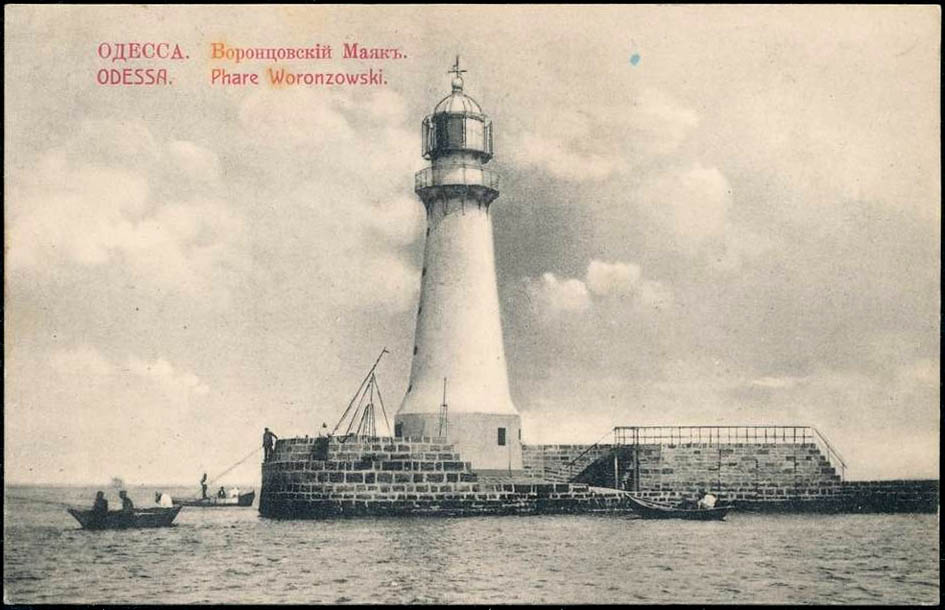
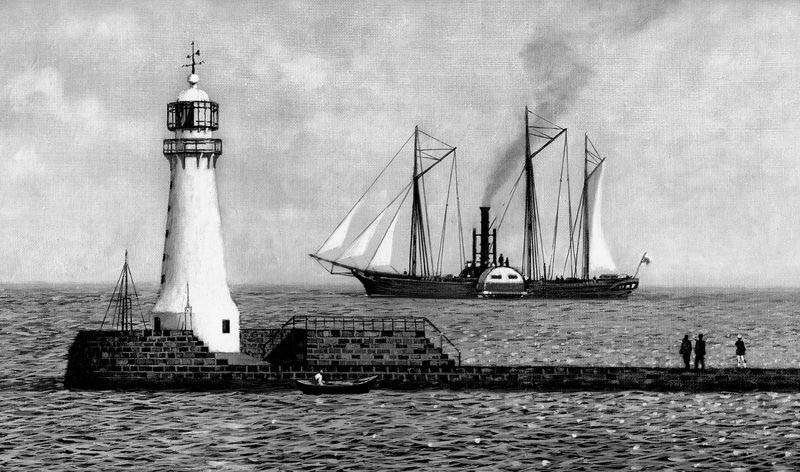
The sleek white silhouette of the Vorontsov Lighthouse –
slim candle, extinguished at dawn, as Vera Imber described it from her window – was the last thing that Hayim Nahman Bialik saw of Odessa. The
Ruslan steamer, which in 1919 had already carried the cream of the Odessan Jewish intelligentsia off to Jaffa, now, two years later could set sail again through the intervention of Gorky, with the rear guard of Jewish literary life in Odessa, the authors, journal editors, textbook writers, book publishers on board. The passenger Bialik’s chests also held the manuscripts of the publisher
Dir, which he had recently founded, and which upon arrival at the destined shore would take the name
Dvir, and become the leading book publisher of Palestine. Bialik would become the national poet of Israel.
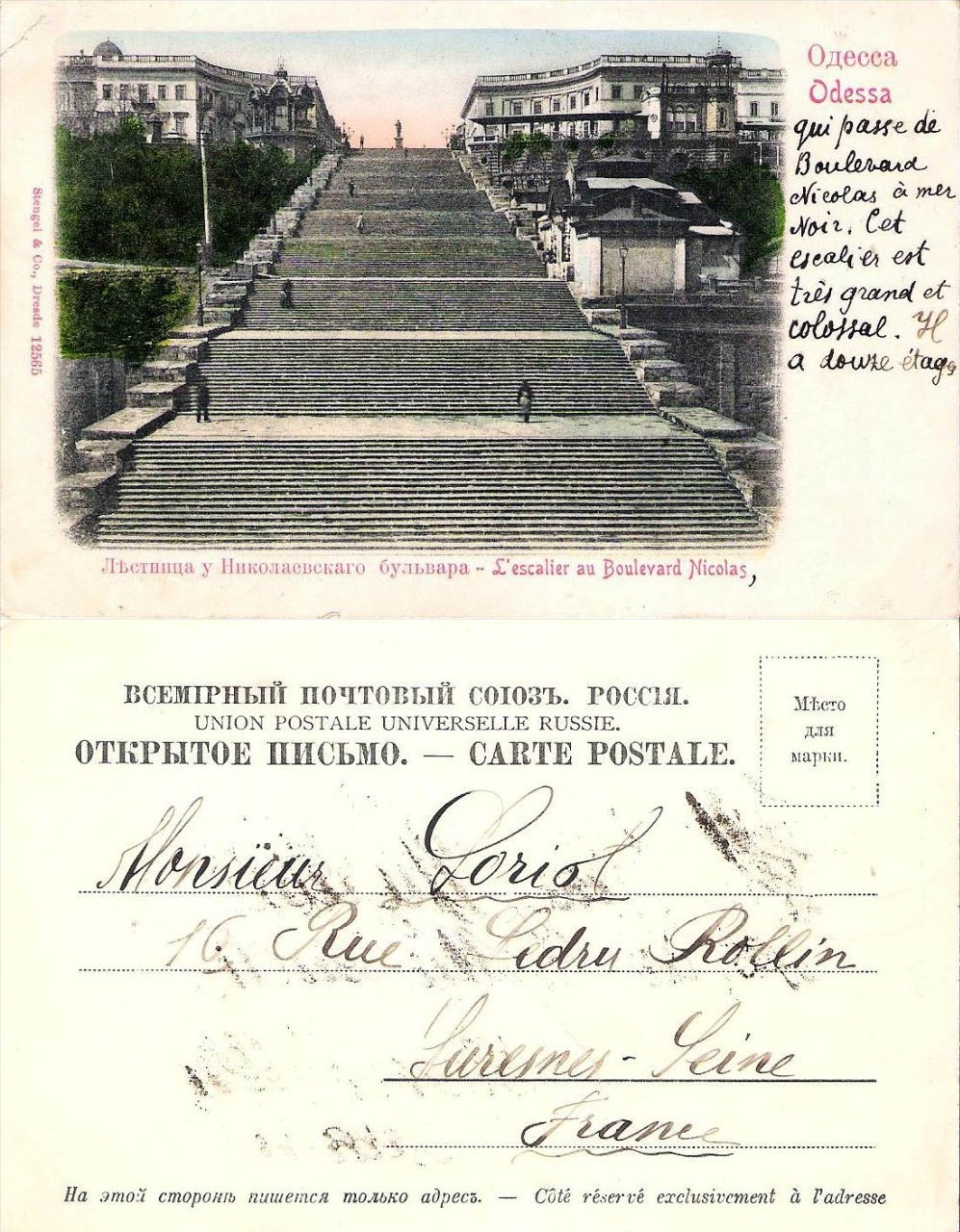
If he raised his eyes, he could still see the Giant Stairs, as they were then known, before Eisenstein’s stroller tumbled down its length a few years later during the climactic scene of rebellion in the film
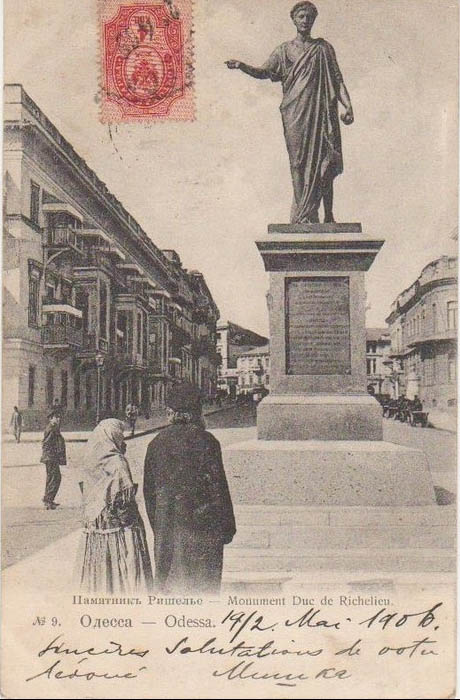
Battleship Potemkin. The gigantic stairway then still reached down to the water, they had not yet built the wide thoroughfare that now separates the monumental umbilical cord linking the city with the sea, from which she was born. At the apex of the two hundred stairs, he could still discern the toga-clad figure of Duke Richelieu, the planner of the city, the first monument of Odessa, erected by the Jewish population in gratitude to their governor, thanks to whom, for the first time, they could feel themselves equal with any other inhabitant of the Russian empire.


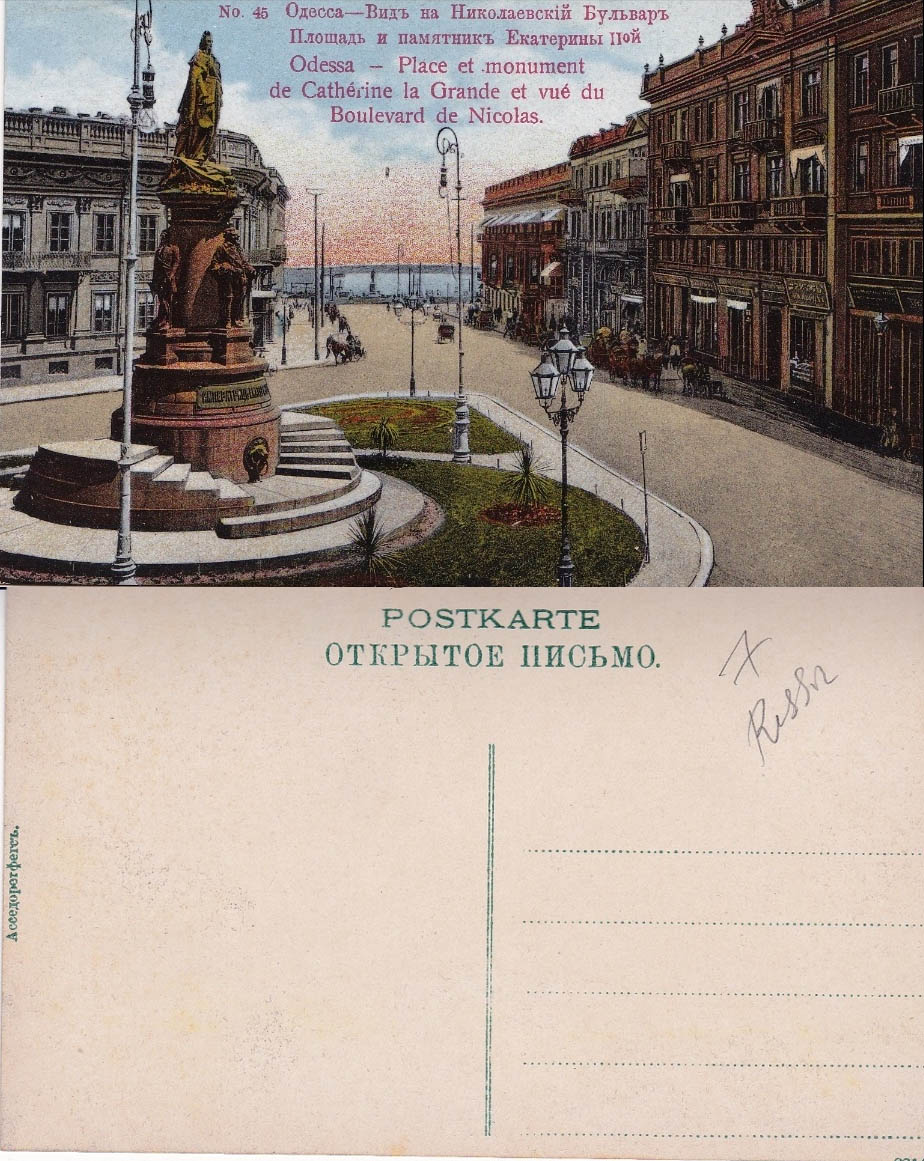
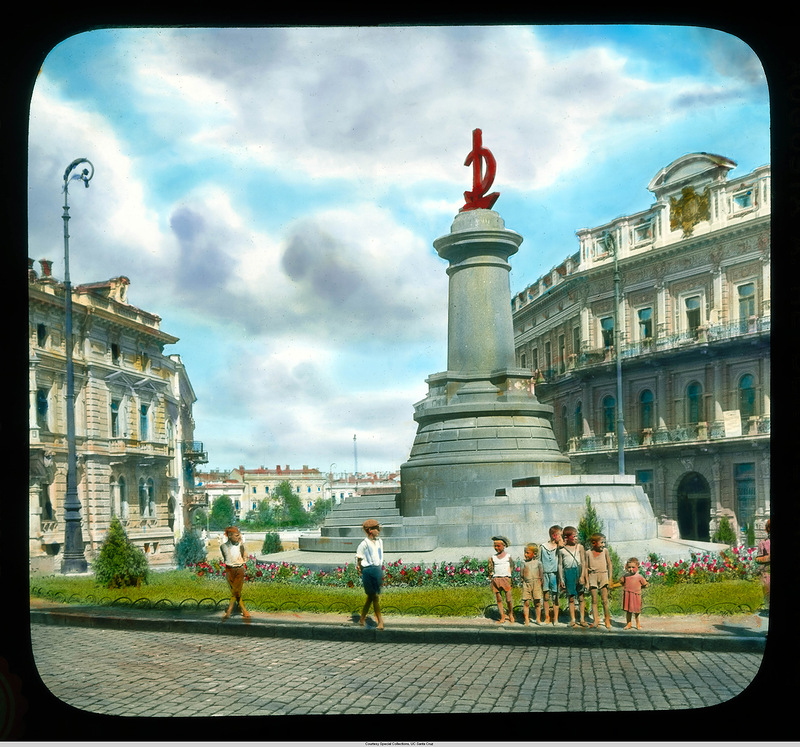
The rest was already hidden in the trees. Only in the imagination could he follow the Primorsky boulevard, where he so often walked in the late afternoon, when the changing wind starts to blow in from the sea, and when the city livens up, from the Pushkin statue in front of the white columns of the Duma to the stone lions in front of the white columns of the governor’s palace, the rigid cadence of the neoclassical promenade, of which all the rest of Odessa is merely an appendix. And perhaps even in the imagination, he did not want to go beyond the Richelieu monument, to Catherine’s Square which opened just behind it, where now the statue of the empress who founded the city was covered with a red cloth. As Babel wrote in the last chapter of his
Odessa Tales, it was in this square’s building number seven, the new headquarters of the Cheka, that they had just at that time wound down the kingdom of Benya Krik and Froyim Gach, the Jewish underlords of the Moldavanka underworld.
 The monument to Catherine the Great, with the Giant Stairs and the sea in the background, 1910 (above), and in a 1931 photo by Branson DeCou (below, from here)

Beyond Catherine Square, behind the magnificent opera house stood the
Literaturka, Prince Gagarin’s former palace, which stood as the center of the literary life of Odessa, a meeting place of writers, critics and editors around the clock, and today the museum of the literature of Odessa. If anything still tied the emigrants to Odessa, then it was this club, the city’s alter-ego and the essence of her life. But the club had been closed for two years, and its members scattered throughout the world. Vladimir Zeev Jabotinsky, the celebrated essayist and Jewish civil rights activist of Odessa remembers it like this in
The Five, the most Odessan novel, which he wrote in his Paris exile:
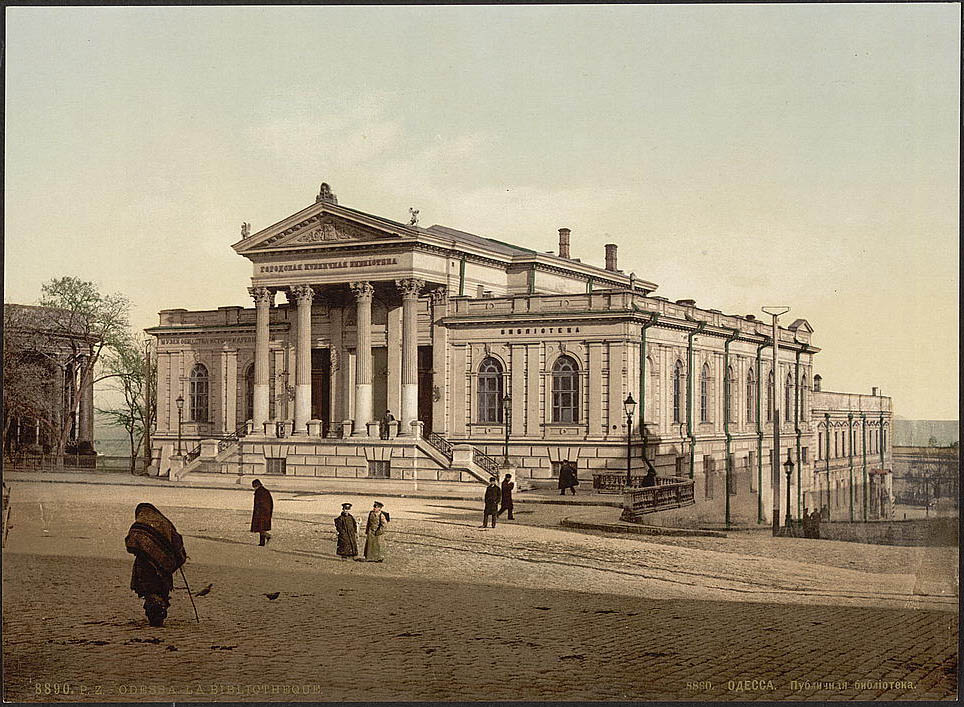
“The headquarters of the literary club was a separate palace. I do not remember whose it was and who lived there before that, but obviously some rich aristocrat. It stood in the best place of the city, at the border of two worlds, the aristocratic downtown and the merchant town. If I close my eyes, even today I can evoke it in my imagination – albeit only through the fog of the past, which blurs the details – the large space, the relic of the noble architecture of early 19th-century overseas masters, and of the quietly noble, archaic taste of the first city-builders: Richelieu, De Ribas, Vorontsov, and the first generation of the merchants and smugglers with Italian and Greek names. Directly in front of me, the colonnade of the city library, and to the left, in the forefront of the wide, almost shoreless bay that of the town council: neither of them would be a disgrace to Corinth or Pisa. To the right, the first houses of the Italian Street, which in my time already bore the name of Pushkin, who wrote here the Onegin. Behind me, the building of the English Club, and further to left, the facade of the City Theater. All these were built in different times, but with the same love to the foreign, Latin and Greek genius of the city of the incomprehensible name. And right here, at the palace of the Literaturka – which looks exactly like the villa I saw in Siena – began one of the steep roads down to the port, and on calm days you could hear from there the murmur of the loading bridges.”
 The Gagarin Palace, today home of three – the archaeological, literary and naval – museums
On the other end of the main street, the
Deribasovskaya, opposite the
City Park, just a quarter-hour walk from the
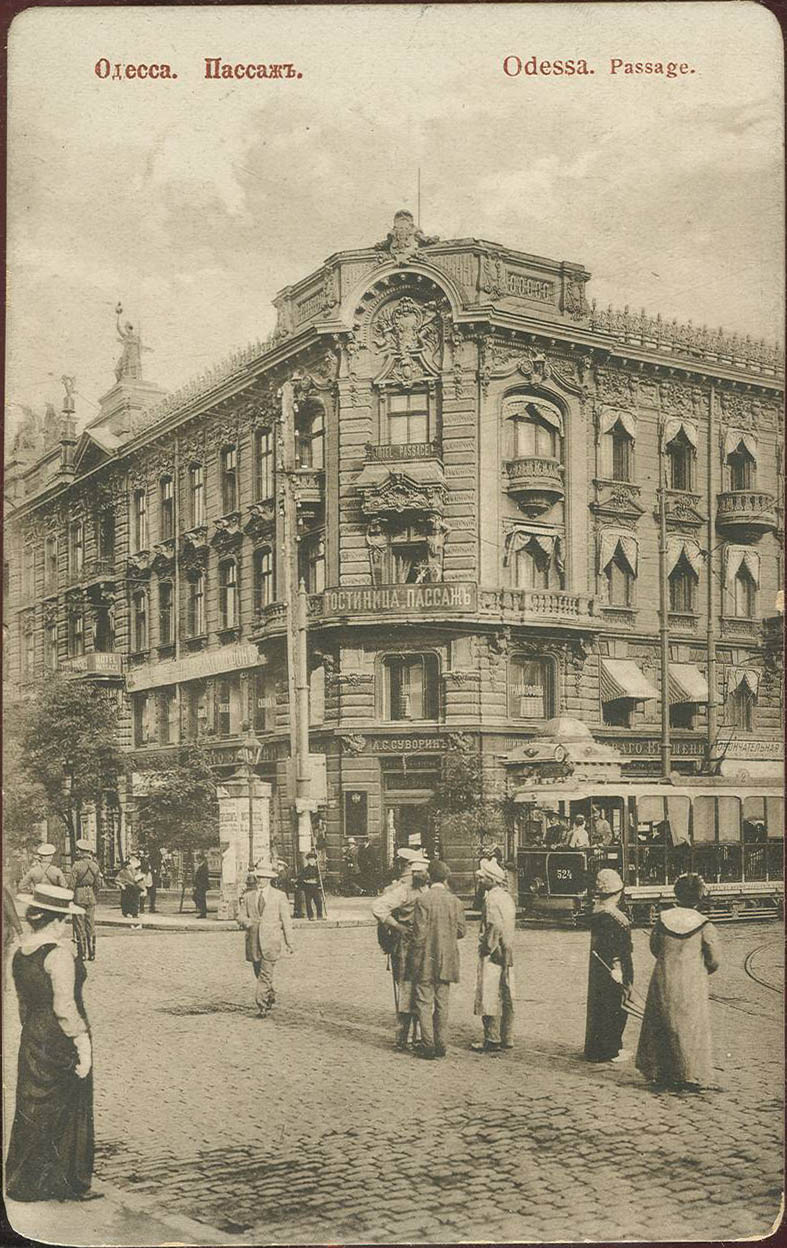
Literaturka, stood the Passage, the luxurious symbol of the trade of the city, built in 1899. Jabotinsky himself made this trip daily, because the Passage was also the center of the press. Here they published the dailies of Odessa, including the
Odessa News, to which Jabotinsky and many other eminent authors were daily contributors.

The predecessor of
Odessa News was published with the title
Rassvet, that is,
Dawn, by Joachim Tarnopol and Osip Rabinovich, founders of the “Society for spreading culture among the Jews”, with its offices at Richelieu street 11. The company set itself the goal of the cultural emancipation and assimilation of the Jews, and its members sought to promote Jewish culture and history in the Russian language both among the Jews of Odessa and the Russian audience. They included the historian Semyon Dubnov, founder of the historical and ethnographic society of Odessa, and of the library of Judaic and Hebrew studies, whose
The history of the Jews was the first book on this topic in Russia. They also included Semyon Frug, whose poems and short stories were immensely popular, as the Jewish intellectuals saw in them the first real expression of the Jewish spirit of Odessa.

His poems were set to music, they became folk and pub songs, and due to his extravagant life, he also became a hero of the city’s folklore. His funeral was at the same time a demonstration of solidarity with the Jews of Odessa. As Zvi Rama writes in her memoirs:
“The students, holding hands, lined up along the boulevard, separating the funeral procession from the passers-by on both sides of the road. Still there echoed in our ears the poems and songs of this great poet of our people, which we read and sang hundreds of times, and which were understandable to everyone, because they were written in Russian, and were so close to our hearts, because, nevertheless, they spoke in Jewish.”
The third great figure of Russian-language Jewish literature in Odessa was Semyon Yushkevich, the most renowned Jewish author of prose and theater in the 19th century. His pieces, which, in accordance with the spirit of the Society, mainly spoke about the conflict of innovation and tradition, were staged throughout Russia, and his novels – like
The taylor, or images of Jewish life – became bestsellers. It was his merit to introduce to the Russian public the topic of Jewish life, and at the same time Odessa, whose unmistakable language is spoken by his characters.
The members of the Society also included Mordechai Ben-Ami, who for the first time represented provincial Jewry in Russian literature, and the everyday life of the shtetls, in a satirical, ironic spirit. His writings were very popular not only among Jewish, but also Russian readers, and they created a genre – as well as its audience – which would be further developed by so many later authors and with much great success, not only in Russian, but also Yiddish and Hebrew.

The first, and at the same time the best-known representative of this genre, Sholem Aleichem already belonged to the generation which, after the pogroms of 1881-1884 and the anti-Semitic laws of 1882, gave up the apparently futile efforts to assimilate, and who set itself the goal of creating cultural autonomy and the cultivation of the Yiddish language. He started his literary career in the Odessa newspapers, and, under the influence of Ben-Ami’s short stories, he wrote his first story,
Menachem Mendl. This writing, just as in his later works, clearly reflect the sly Odessan sense of humor, which made him – as his contemporary critics said – “the Jewish Chekhov”, or – as he was later known – “the Jewish Mark Twain”.
The other great Odessan author writing in Yiddish, who portrayed provincial Jewry in an original way, was Mendele Mocher-Sforim, “the grandfather of Jewish literature”, as Sholem Aleichem called him. He came from a poor Belorussian family, studied in yeshiva, but in his adolescent years he wandered around in the world of the Belorussian and Lithuanian shtetls as the attendant of a beggar named Lame Avreml. This latter became the model of the protagonist of his novel
Lame Fishke, which became a bestseller of contemporary Jewish literature, just like his other picaresque novel,
The travels of Benjamin III, the “Jewish Don Quixote”, which introduced the troubled life of the medieval Spanish Jew Benjamin of Tudela, as well as the world of Sephardic Jews to Yiddish-speaking readers.
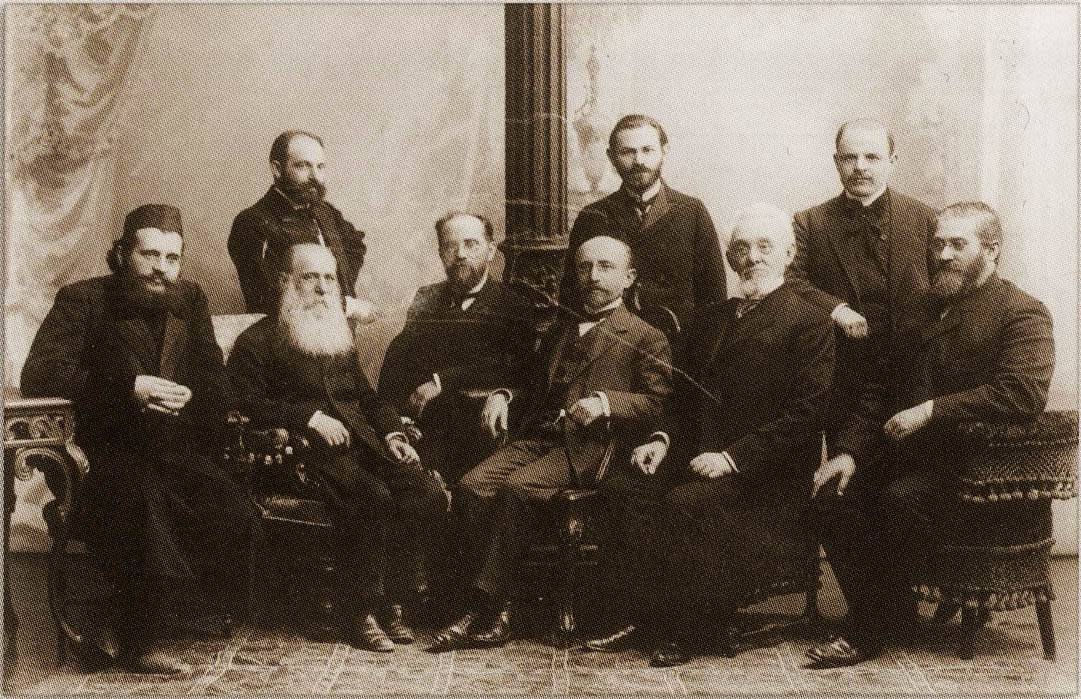
 The outstanding figures of the literary life in Odessa, 1905. Sitting: H. Czernowitz, M. Lilienblum,
H. Ravnitsky, Achad ha-Am, Mendele Mocher-Sforim, E. Levinsky.
The outstanding figures of the literary life in Odessa, 1905. Sitting: H. Czernowitz, M. Lilienblum,
H. Ravnitsky, Achad ha-Am, Mendele Mocher-Sforim, E. Levinsky.
Standing: A. Borokhov, I. Klausner, H-N. Bialik
Along with the Society, which represented the spirit of the Jewish Enlightenment, after the pogroms of the 1880s they also established the society of the lovers of the Hebrew language and literature in the same building at Richelieu street 11. Its aim, in addition to the cultural emancipation of the Jews, was more and more centered on their political autonomy. Its founder and leader was the philosopher Josif Klausner, initiator of the
Hebrew Encyclopedia, editor in chief of
Ha-Siloah and
Sholem Aleichem, the first Hebrew- and Yiddish-language newspapers in Odessa. He, too, sailed to Palestine on the Ruslan steamer – he was the sole person permitted by the Palestine Committee to take with him his entire library, which occupied the places of four other people – and he would later found the Hebrew department of Jerusalem University. His literary salon was maintained at Osipova street 9, which became the most important center of Jewish intellectual life in Odessa, and was described by his brother’s grandson, Amos Oz, in the autobiographical novel
Love and Darkness:
“Uncle Yosef, who at twenty-nine inherited from Achad Haʻam the position of editor in chief of Hasiloah, the leading journal of modern Hebrew culture (the literary editor was the poet Bialik himself), directed Hebrew literature from Odessa. It took him only a word to elevate or to destroy an author. To the “soirées” of his brother and sister-in-law, he was also accompanied by Aunt Zippora, who made sure to carefully wrap him in woolen scarves, warm coats and ear muffs. Menachem Usishkin, the leader of the Lovers of Zion, which can be considered a forerunner of Zionism, commanded silence with his mere appearance. Elegantly dressed, he puffed up his chest to the size of a buffalo, and his rough voice competed with that of a Russian governor, as it made a fiercely murmuring sound next to the samovar. Respect for him cut off all conversation, and always there was someone who jumped up to offer his own seat to him, while Usishkin would then march across the room with a general’s steps, and sit down, spreading his thick legs, and tapping twice with his cane, would thus indicate that the conversation could go on. The regular visitors of the salon also included Rabbi Czernowitz (penname Rav Cair). […] Even Bialik appeared some nights, sometimes pale and trembling from the cold and anger, while other times on the contrary, he was the center and soul of the company. […] He was like a spry kid. A real scoundrel. Full of daring. He had no scruples, for sure. Sometimes he joked in Yiddish, until the ladies blushed. […] Bialik liked to eat and drink, he loved to have fun. He stuffed himself with bread and cheese, then he devoured a lot of cakes, drank a glass of piping hot tea and a small glass of liqueur, and then he sang entire serenades in Yiddish on the wonders of Hebrew. […] They had fierce debates on the rebirth of Hebrew language and literature, the points of connection of the cultural heritage of the Jews and of other peoples, the Bundists, the supporters of the Yiddish language, […] on the recently established agricultural settlements in Judea and Galilee, the old problems of the Jewish farmers in Kherson or Kharkov, Knut Hamsun and Maupassant, the great powers and socialism, the question of women and the land question.”
Another leading figure of the Hebrew society was the physician Leon Pinsker, who was invited as a professor of the recently founded Hebrew school in Odessa thanks to his fundamental works on Sabbatai Zvi and the Karaim. He represented the political direction of the new Hebraist generation. In his famous pamphlet
Auto-Emancipation, published after the pogrom of 1881, he proclaimed the need of the political autonomy of the Jews, and the return to Palestine. In 1890 he initiated the establishment of the Palestine Committee with the aim of supporting the Jews living in Palestine and promote emigration. An outstanding representative of this trend was Vladimir Zeev Jabotinsky who, aside from
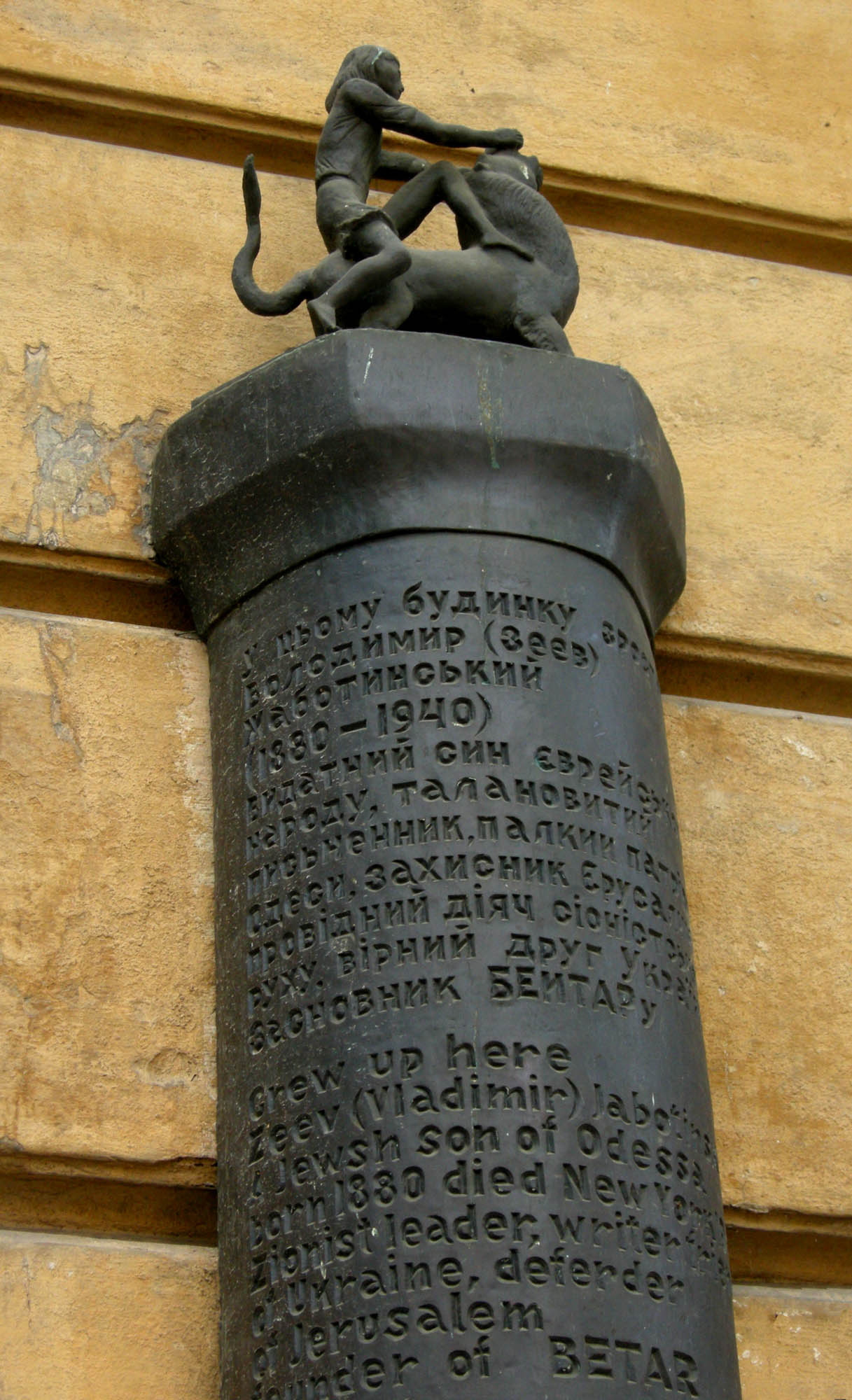
 Jabotinsky monument on the wall of his birthplace, Jewish street 2, with the figure of Samson on its top Jabotinsky monument on the wall of his birthplace, Jewish street 2, with the figure of Samson on its top |
his brilliant satirical essays published under the pen name
Altalena, contributed to Odessan literature two books, written already from emigration. In
Samson, the Nazir (1927) he formulated that active and bold idea of Jewish life that he pursued for his entire life, while
The Five (1935) is a nostalgic, detailed evocation of one-upon-a-time Odessa.
The polyglot Jabotinsky translated into Russian the poems of the greatest representative of the Hebrew trend, Hayim-Nahman Bialik. Bialik came from Volhynia to Odessa, and it was in the literary milieu of the city that he became the greatest figure of modern Hebrew poetry. As a publisher, he also played an important role in the strengthening of Hebrew literature. The Moriah house, which he founded, published the most important Hebrew classics and textbooks, while his collection of folk tales and sayings scattered in the Talmud, the
Sefer HaAggadah (1908-11) was a huge success, and often published worldwide bestseller.
The civil war of 1918-20 put an end to this thriving, diverse Jewish cultural life in Odessa. Whosoever could, in time fled to Europe, Berlin or Paris. And the Jewish cultural elite which remained in place until the last moment, was finally taken away by two round-trips of the Ruslan steamer to Palestine, where they offered a decisive contribution to the foundation of modern Hebrew literature and scholarship.
It is a wonder of Odessa, that precisely then, after the disappearance of the Jewish cultural and literary elite, followed that second efflorencesce of Odessan Jewish literature, which is the best known and most appreciated today. It is then that Isaak Babel writes his
Odessa Tales, immortalizing and ennobling into a legend the world of the Jewish slums of the Moldavanka and Peresyp, and Ilf and Petrov give form, in the character of Ostap Bender, to the Odessan scoundrel who always prevails due to his cunning, humor and insolence. This world and this character, which were introduced into literature by Semyon Frug, Mordecai Ben-Ami, Mendele Mocher-Sforim and Sholem Aleichem, and this vibrant, absurd and clever spirit of Odessa, created by a century in the life and literature of the city. Babel and Ilf grew up on this literature, embraced this spirit, and set up a memorial to it, after it had said goodbye to Odessa.

Sites mentioned in this article: a) Vorontsov Lighthouse; b) Richelieu monument
on the top of the Giant Stairs; c) the Duma and Pushkin’s statue, one end of
the Primorsky promenade; d) the other end of the promenade, the palace
of the governor; e) statue of Catherine the Great; f) Gagarin Palace;
g) the Passage; h) Richelieu 11, center of the Jewish cultural
societies; i) Osipova 9, Josef Klausner’s literary salon
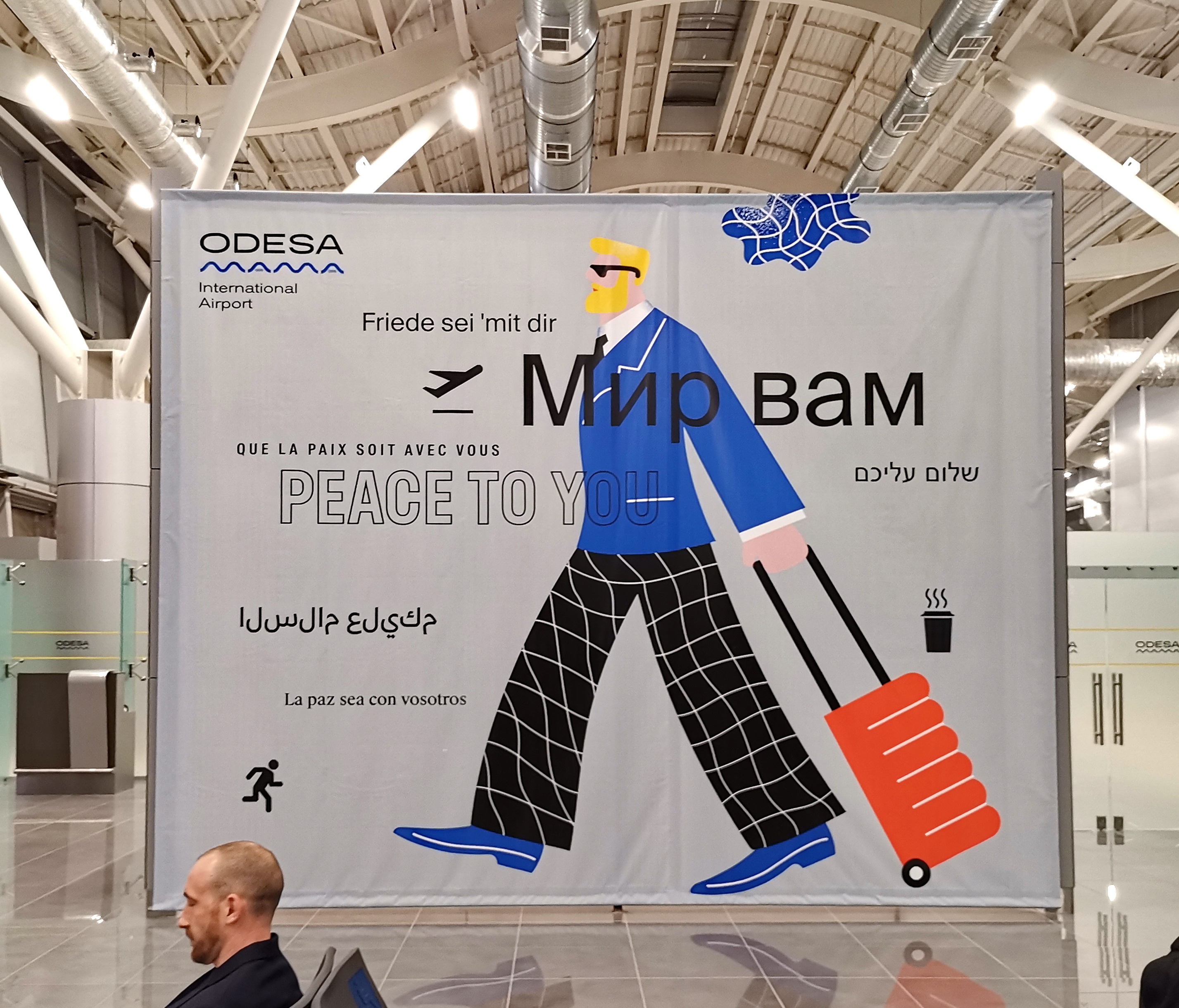
 At Odessa Airport, a multilingual greeting welcomes the traveler: Peace with you. In most of the languages featuring here, this greeting is not colloquial, so probably this is the same situation as in the previous post: that in Odessa, “foreigner” means “Israeli”, and their שָׁלוֹם עֲלֵיכֶם shālôm ʻalêḵem is translated into the other languages.




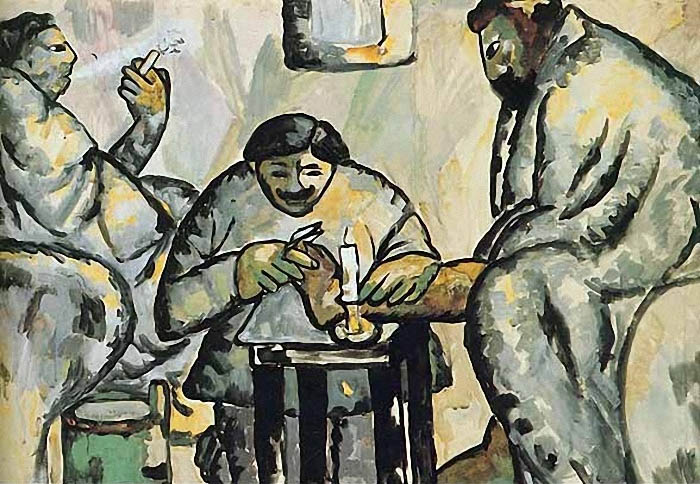
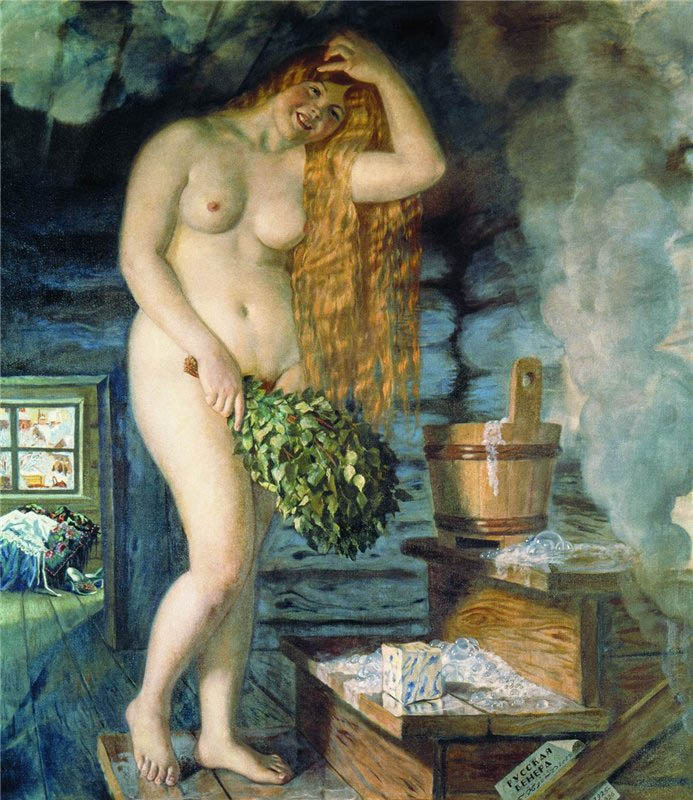
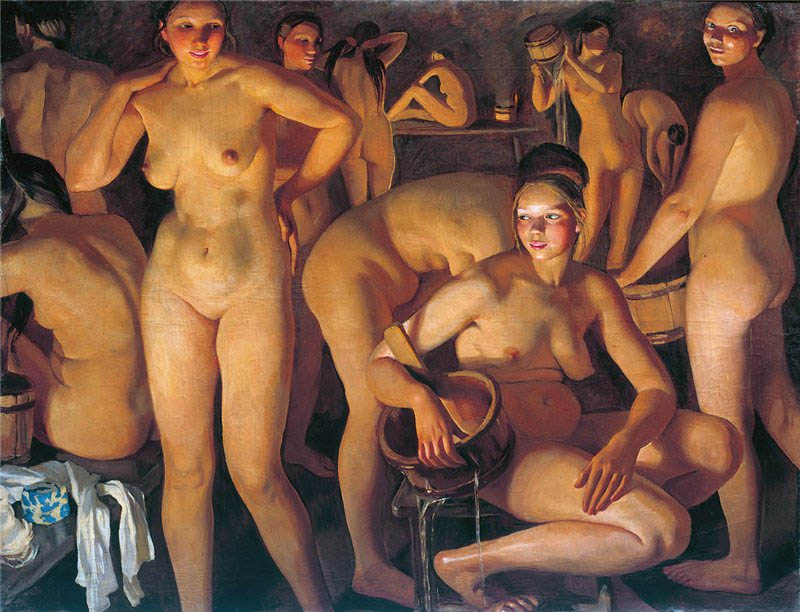




 Sometimes I feel the need to simply pick out and insert here some pictures from the










 Come with us to…
 Atlantis
 Bestiary
 Books, exhibitions, music, film
 Caucasus
 Cemeteries
 Crimea
 Get to know the
 Images of the East
 Lightwriting
 Lwów/Lemberg
 Mallorca
 Message on the wall
 The Museum of Propaganda
 Paper Museum
 Persian letters


