We remember from our Marxist studies that the base is the most important thing and it determines the superstructure. This is well illustrated by the history of a number of important Lenin monuments. For even an idiot can carve a statue of Lenin, as it is well attested by some examples in our earlier Lenin post. But for building a stable and strong base, the knowledge of the old school was indispensable.
 Kostroma. The base of the monument for the third centenary of the Romanov dynasty was built in 1913. The monument, however, was never finished. Instead, the statue of Lenin was set on the base in 1920.
 Samara. The statue of Alexander II was carved by V. O. Sherwood in 1889. In 1927 it was replaced on the same pedestal by the statue of Lenin by M. G. Manizer.
 Moscow, Kuzminki. The monument of Nicholas I by M. D. Bykovsky was erected in 1856. In 1920 the base was taken nearer to the promenade of the park of Kuzminki and the statue of Lenin was set on it. It was followed by the present version in the early 1970s.
 Vladimir. Czar Alexander II was substituted on his pedestal by Lenin on 5 June 1920. The corner decorations of the black base were changed for the sickle and hammer. The present statue of Lenin was made in 1950. Please observe on the facade in the background the Romanov coat of arms with the double-headed eagle and the emphatically pre-revolutionary orthography of the inscription БАНКЪ.
 Rybinsk. The statue of Alexander II by A. Opekushin was set up in 1914 and hurled down in 1918 from its pedestal which was occupied by the present statue of Lenin in 1957. Between the two dates a Lenin bust stood on it as it is illustrated by the following archive photo:

 Chernyahovsk. The earlier statue was erected in 1885 in memory of the union of Germany and it was called “Kriegerdenkmal” and “Мать Германия” (Mother Germany). After the revolution it was melted down. Its base was removed for a while, until on 7 November 1954 the Lenin bust was unveiled on it.
 Volgograd. The statue of Stalin was made by E. V. Vuchetich in 1952. In 1961 it was removed from the base, on which the statue of Lenin, also created by E. V. Vuchetich, was set up in 1972.
 Lysva. The monument of Count Suvalov was erected in 1908. The statue was removed in 1918 and in 1938 a gilded gypsum statue of Lenin put on its place. In 2009 this was relocated and a new copy of the original statue of Count Suvalov was set on the pedestal:

 Sevastopol. The statue of Admiral P. S. Nahimov was made by I. I. Schröder and A. A. Bildgerling in 1898. It was removed twenty years later. In 1932 a statue of Lenin was put on the pedestal and the figures of a red soldier and a sailor on the two sides of the monument. In 1959 the statue of Lenin was taken elsewhere and the Nahimov monument was restored in its original form:

 Novocherkassk. The statue of Count Platov was set up in 1853 and removed in 1923. Two years later a statue of Lenin was set on its pedestal, replaced by a new statue in the 70s. In 1993 a copy of the original Platov statue was set on the base:

 Taganrog. The statue of Czar Peter I the Great was erected in 1903. In 1924 it was removed and a Lenin statue set up on its base. In 1935 the statue received a new pedestal and the old one was taken to the riverside where it laid abandoned for long decades. In 1993 it was brought back and a new statue of Peter I set up on it:

 Sumy. The monument of the entrepreneur and philanthropist I. G. Haritonenko was erected in 1899. In 1918 his statue was removed and that of Lenin was put on its place. A copy of the original statue was set up on its original place in 1996. According to a widespread (but false) urban legend only the head of the Lenin statue was replaced with that of Haritonenko:

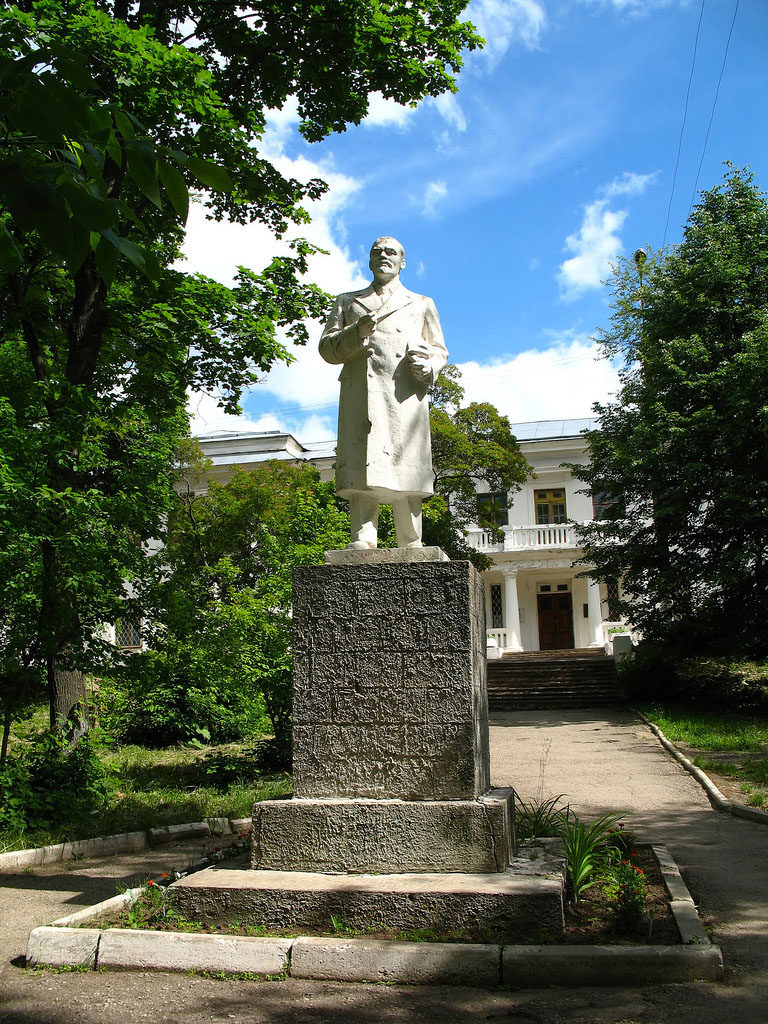
And finally a last example from Yasnaya Polnaya, the former estate of Lev Tolstoy, where not only the base but the complete former statue was preserved and in fact only its head was changed: that of Stalin was replaced by that of Lenin. However, the coat attests well that it was tailored for the Generalissimus:

Kostroma. The base of the monument for the third centenary of the Romanov dynasty was built in 1913. The monument, however, was never finished. Instead, the statue of Lenin was set on the base in 1920.Samara. The statue of Alexander II was carved by V. O. Sherwood in 1889. In 1927 it was replaced on the same pedestal by the statue of Lenin by M. G. Manizer.Moscow, Kuzminki. The monument of Nicholas I by M. D. Bykovsky was erected in 1856. In 1920 the base was taken nearer to the promenade of the park of Kuzminki and the statue of Lenin was set on it. It was followed by the present version in the early 1970s.Vladimir. Czar Alexander II was substituted on his pedestal by Lenin on 5 June 1920. The corner decorations of the black base were changed for the sickle and hammer. The present statue of Lenin was made in 1950. Please observe on the facade in the background the Romanov coat of arms with the double-headed eagle and the emphatically pre-revolutionary orthography of the inscription БАНКЪ.Rybinsk. The statue of Alexander II by A. Opekushin was set up in 1914 and hurled down in 1918 from its pedestal which was occupied by the present statue of Lenin in 1957. Between the two dates a Lenin bust stood on it as it is illustrated by the following archive photo: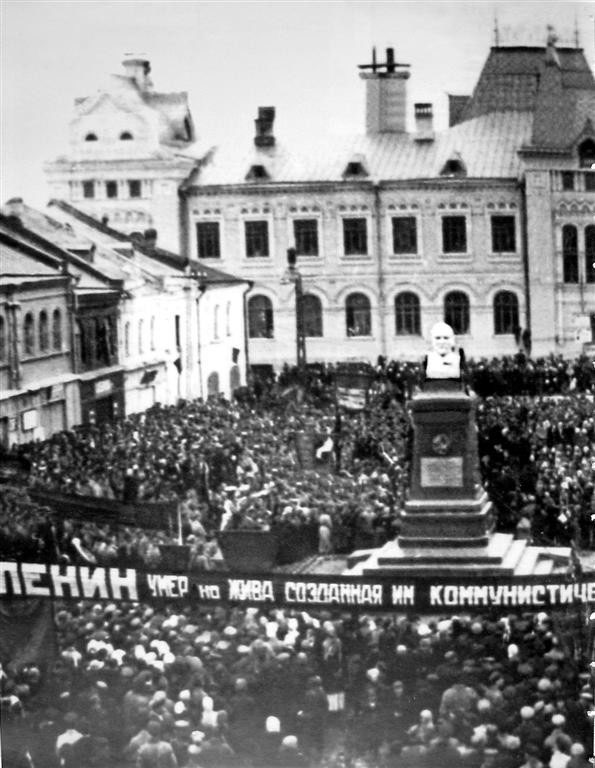 Chernyahovsk. The earlier statue was erected in 1885 in memory of the union of Germany and it was called “Kriegerdenkmal” and “Мать Германия” (Mother Germany). After the revolution it was melted down. Its base was removed for a while, until on 7 November 1954 the Lenin bust was unveiled on it.Volgograd. The statue of Stalin was made by E. V. Vuchetich in 1952. In 1961 it was removed from the base, on which the statue of Lenin, also created by E. V. Vuchetich, was set up in 1972.Lysva. The monument of Count Suvalov was erected in 1908. The statue was removed in 1918 and in 1938 a gilded gypsum statue of Lenin put on its place. In 2009 this was relocated and a new copy of the original statue of Count Suvalov was set on the pedestal:Sevastopol. The statue of Admiral P. S. Nahimov was made by I. I. Schröder and A. A. Bildgerling in 1898. It was removed twenty years later. In 1932 a statue of Lenin was put on the pedestal and the figures of a red soldier and a sailor on the two sides of the monument. In 1959 the statue of Lenin was taken elsewhere and the Nahimov monument was restored in its original form:Novocherkassk. The statue of Count Platov was set up in 1853 and removed in 1923. Two years later a statue of Lenin was set on its pedestal, replaced by a new statue in the 70s. In 1993 a copy of the original Platov statue was set on the base:Taganrog. The statue of Czar Peter I the Great was erected in 1903. In 1924 it was removed and a Lenin statue set up on its base. In 1935 the statue received a new pedestal and the old one was taken to the riverside where it laid abandoned for long decades. In 1993 it was brought back and a new statue of Peter I set up on it:Sumy. The monument of the entrepreneur and philanthropist I. G. Haritonenko was erected in 1899. In 1918 his statue was removed and that of Lenin was put on its place. A copy of the original statue was set up on its original place in 1996. According to a widespread (but false) urban legend only the head of the Lenin statue was replaced with that of Haritonenko:
And finally a last example from Yasnaya Polnaya, the former estate of Lev Tolstoy, where not only the base but the complete former statue was preserved and in fact only its head was changed: that of Stalin was replaced by that of Lenin. However, the coat attests well that it was tailored for the Generalissimus:


 Come with us to…
 Atlantis
 Bestiary
 Bohemia+Prague
 Books, exhibitions, music, film
 Brave old world
 Caucasus
 Cemeteries
 Crimea
 Get to know the
 Images of the East
 Lightwriting
 Lwów/Lemberg
 Mallorca
 Message on the wall
 The Museum of Propaganda
 Odessa
 Paper Museum
 Persian letters
 The Jewish heritage


4 comentarios:
If I didn't fear being considered a refusenik, I'd say he stays however you put him.
:-)
I mean a monument to a person has several layers of representation, the person as a person, the person as a historical actor, the person as an icon for an ideology, the conscious self-representation and the unconscious representation of the society that created that monument with more or less stress on one of the three above interpretations of the person, just to mention five main ones. It happens very rarely that a discriminate person says yes to all these layers; but it is quite possible to say yes to some while refusing others: in other words, to establish an individual and dynamic relationship to that person as a person and as a historic actor, to that ideology and to that society. “Zilu said: The ruler of Wei awaits your taking on administration. What would be master’s priority? The Master replied: Certainly – rectifying names! If names are not rectified then language will not flow. If language does not flow, then affairs cannot be completed. If affairs are not completed, ritual and music will not flourish.”
But I was just kidding and noting how easily he could fit to any pre-existing base!
Personally, I say yes to everything that happened. It belongs to history, it cannot be changed, it should not be removed and, if possible, it should be remembered. These are also some of the reasons why I like your blog.
However, even if I was just kidding, since you gave me a detailed and generous response, for which I thank you, I find that in most cases a monument to a person, like any other piece of architecture commissioned by a state, from St. Peter's basilica to the Stasi building in Berlin, tends to be a rather conscious representation of power.
Rectifying names as first priority: how true.
There is always this amazing passage from Angelopoulous' film 'Ulysses Gaze'.... http://www.youtube.com/watch?v=8VF48LWXCjU&feature=related
Publicar un comentario