
The library of the Kalocsa Cathedral preserves a strange book. This is how I wanted to begin this post, but on second thought I have considered how many posts could be started like this. The magic of these old church libraries is precisely that they preserve so many strange books, personal documents, legacies never studied, collections untouched. You do not expect the same from those ancient libraries in state ownership that have been reorganized, catalogized and disciplined a number of times. When you nestle in such a library for some days, you feel the same happy excitement of discovery as the Italian humanists of early Renaissance did when browsing through ancient monastic libraries in search of Classical authors. And in most cases you will not be disappointed.

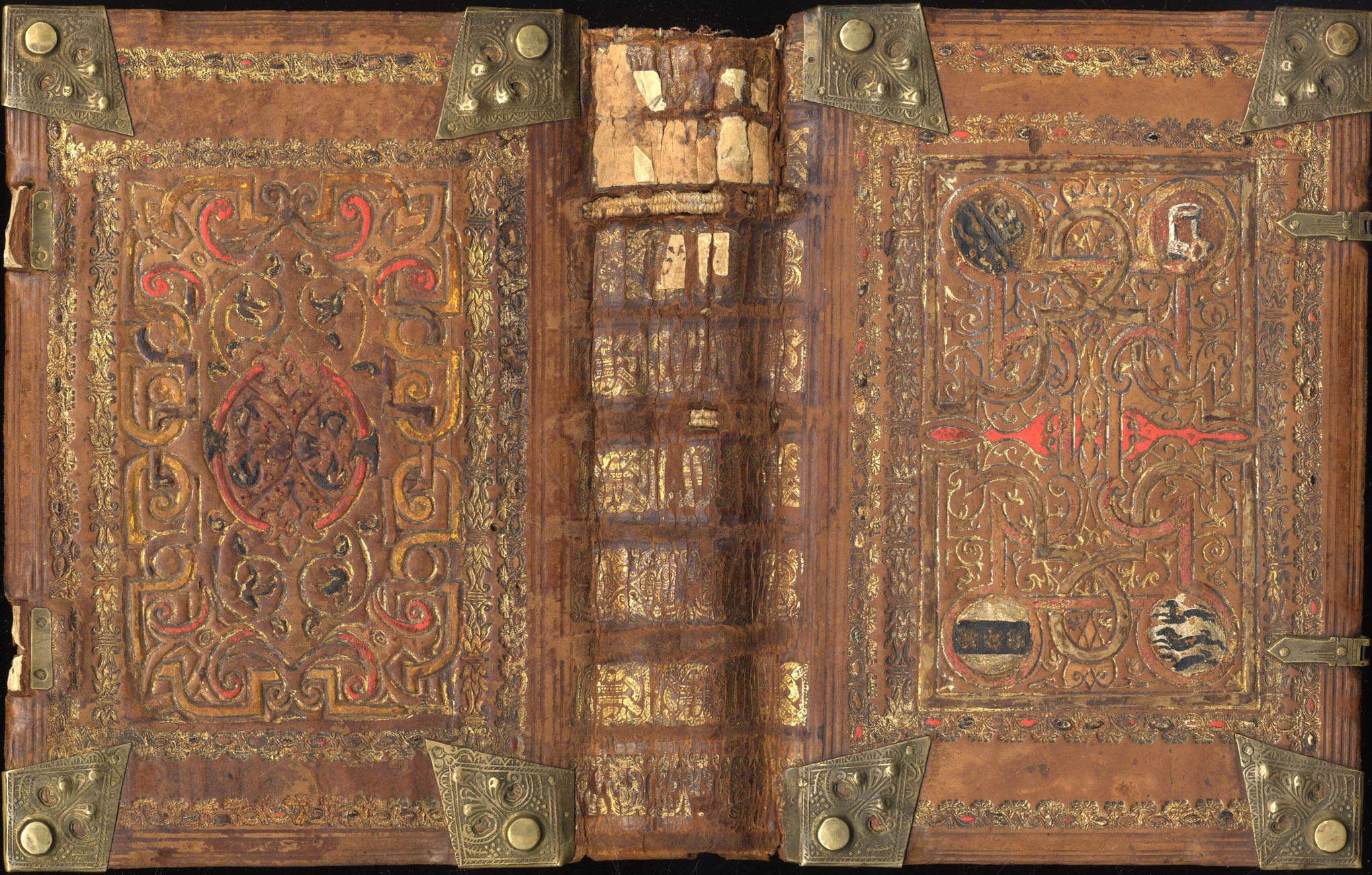
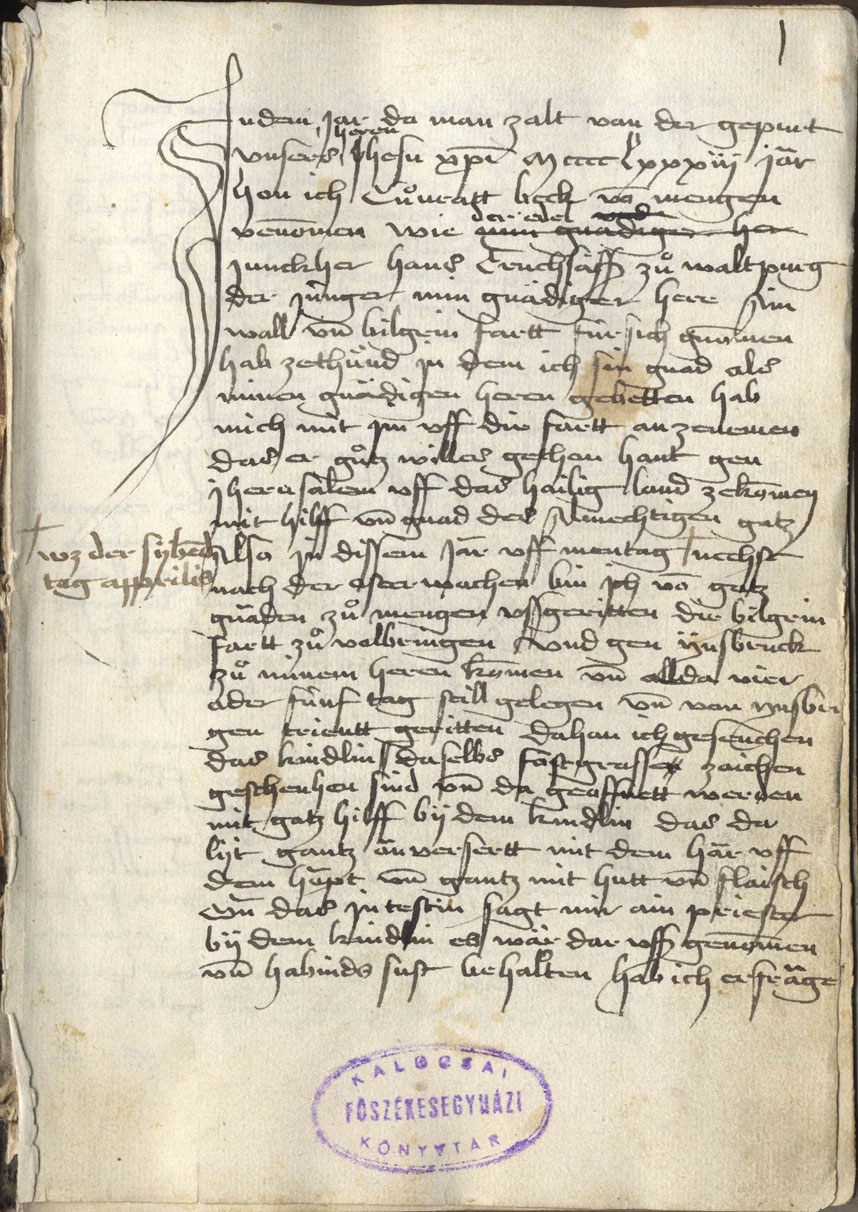
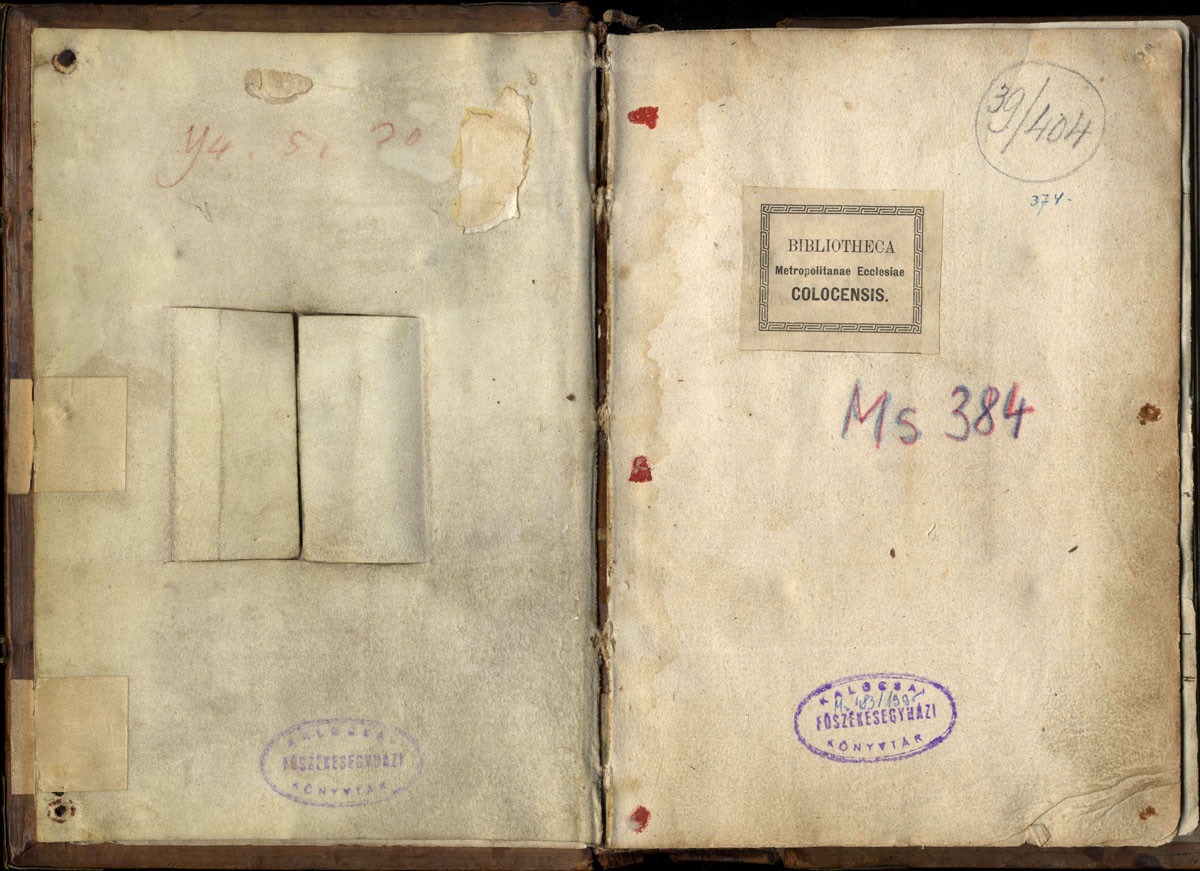
The book I am speaking about is a handwritten German diary in which a certain Konrad Beck recorded the events of his peregrination to the Holy Land in 1483. The manuscript of only 36 leaves gets lost in the much larger, beautifully elaborated, embossed, painted, mounted and clasped leather binding like a puppy dog in its oversize fur coat. You may have the impression that the author took a large book cover with him on the long way, and he gradually added the sheets to it as he was advancing with the diary. But no, the binding is a later addition from the seventeenth century. It was then that one of the author’s late descendants inserted the diary of his grand-grand-grandfather, preserved as a precious relic, in the binding of a book that had become superfluous.


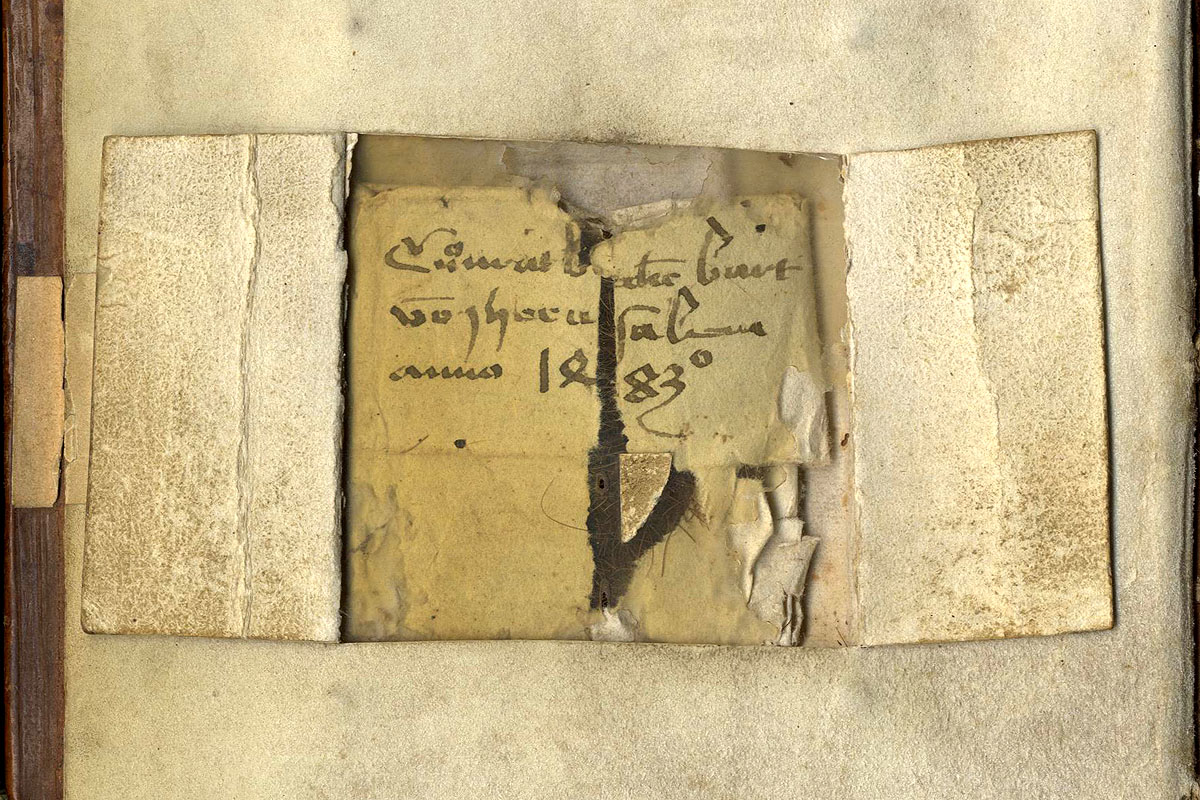
But the most peculiar feature of the book is on the inner side of the cover. Here a small two-leaved parchment window opens, similar to those on the Advent chocolate boxes arranged for each day from Saint Catherine to Christmas.

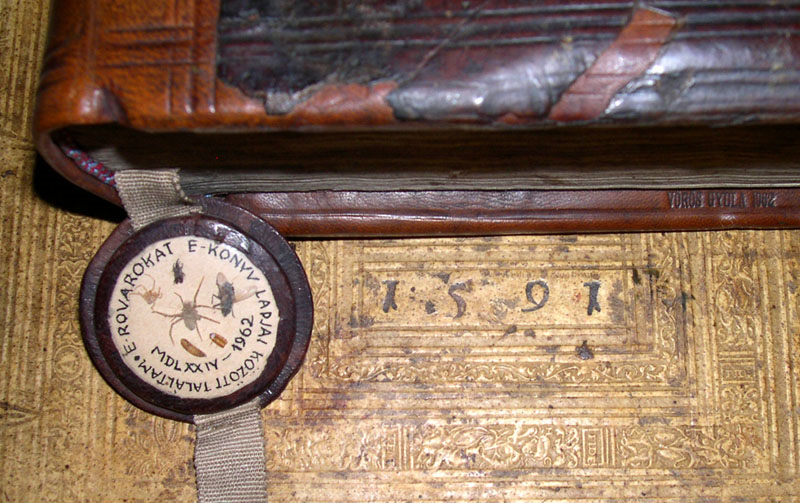
Behind the window, in a niche cut into the wooden book cover and protected with a small Muscovy glass plate, there is some strange black hair wrapped in paper. A German inscription of difficult reading announces that this is
Cůnrat becken bart von Iherusalem anno 1483º, that is, “the beard of Konrad Beck from Jerusalem, 1483”. This is why the librarians called this volume “Bart-Codex”, that is, “Beard Codex” already in the 19th century.

An explication for the unusual Holy Land relic can be found some pages further, on a separate leaflet written in Latin and inserted between the folios by a descendant of Konrad Beck at the middle of the 17th century. It was him who bound the diary of his highly estimated pilgrim ancestor in this reused book cover.
 Illustris Generosus et magnificus vir Dominus Joannes Truchses de Waldburg Junior deuota peregrinatione 1483. XII. Julij Hierosolymam venit. Et secum habuit Cunradum Beck de mengen Joannis fil[ium], Petrum coquum de Waldst et Vlricum pictorem familiares et famulos suos. Cunradus Beck totam peregrinationem breuiter descripsit, et barbam suam nescio an voto aut deuotione aut alia de causa abscissam in complicatam chartam condidit et inter alias e terra sancta adnectas res diligenter asseruauit, cum inscriptione proprij chyrographi: Cuenrat Becken part von Jerusalem 1483. – Hieronijmus Beck a Leopoldstorf Marci fil[ius] aui sui Itinerarium sua manu scriptum in librum hunc conligare fecit, illiusque Barbam huc reposuit, et in rei memoriam M. H. scripsit.
The illustrious, generous and magnificent Lord Johann Truchsess von Waldburg the Younger arrived on a pious pilgrimage to Jerusalem on July 12, 1483. He was accompanied by Konrad Beck of Mengen, son of Johann, the cooker Peter from Waldsee and the painter Ulrich, all of them his servants and members of his household. Konrad Beck made a short description of all the pilgrimage, and he cut his beard – it is not known whether for a vote, piety or any other reason – and, wrapping it in a paper, he assiduously kept it together with the other things he had brought from the Holy Land. He wrote on the paper with his own hand: The beard of Cuenrat Beck from Jerusalem, 1483. – Jeremias Beck, son of Markus from Leopoldsdorf caused the Itinerary, written by his ancestor with his own hand, to be bound in this cover, in which he also enclosed his beard, and in memory of all this he composed the present note.This is all we know of the origins of the beard. Even Felix Fabri specifies only that much that Ulrich was no painter but a merchant who during one of his business journeys had been condemned to the galleys by the Saracens, and thus he accompanied Count Waldburg in the quality of an experienced interpreter. The further flamboyant details decorating the beard’s history in the poem of the popular 19th-century Jesuit poet
Kálmán Rosty in the November 22, 1883 edition of the provincial daily
Kalocsai Néplap are completely apocryphal. The benevolent Readers will excuse me – and if they knew its content, they would be even grateful – for not translating the text of this jovial poem.

The journey described in this diary was an important one in the history of the pilgrimages to the Holy Land, because at least six of its participants kept a journal, and two of these, the itineraries of the Dominican Felix Fabri of Ulm and of the canon Bernhard von Breidenbach of Mainz became the most popular medieval guides to the Holy Land. They were read and translated even in the 19th century.
Count Johann Truchsess von Waldburg (†1511) was the head of one of the most distinguished aristocratic family in the German Empire. The family was granted the title of
Truchsess, that is “the Emperor’s steward” in 1170, and its members bore the most important offices of the empire for centuries. Johann –
the Younger, to distinguish him from his uncle living in the same time (†1504) – was the counsellor of
Sigismund, Archduke of Austria, while his nephew,
Otto, Cardinal of Augsburg, counsellor of Emperor Charles V – and a protagonist of the popular TV series
The Tudors – was one of the most consistent supporter of 16th-century Catholic reform. The seat of the family, the Upper Swabian castle of Waldburg to the north of the Lake of Boden was the official place of preservation of the imperial insignia. Their coat of arms – like those of Johann’s grandfather and father Wilhelm and Georg above – displayed three rampant black lions (or, in other descriptions, leopards). We see a similar coat of arms on the binding of the Beck manuscript, which is not surprising if the Becks belonged to the Waldburg household, although these figures appear rather grayhounds than leopards.

We do not know what moved Johann von Waldburg to his pilgrimage, but some personal crisis might have played part in it as well. It was in the previous year that he took over the heritage and offices of his deceased father, and already in the spring of 1483 he was reluctant to participate at the Imperial Diet. He asked his lord Archduke Sigismund to excuse him, but without success. Shortly afterward he asked the Archduke for permission of absence for himself and three of his fellow counsellors Johann Werner von Zimmern, Heinrich von Stoffeln and Bär (Ursus) von Hohenrechberg for the purpose of a pilgrimage to the Holy Land. Fabri in the list of the pilgrims mentions that “he was, as it were, a father of all the aforesaid, and from whom they all received the impulse which sent them on their pilgrimage”, and he notes only about him that he was “of respectable and lofty character,

serious, and deeply concerned about the salvation of his soul”.
Joseph Vochezer in his monumental monograph (1900) on the Waldburg house on pp. 393-396 of
Vol. II gives a detailed chronology of this journey. Here he notes that Count Waldburg first of all looked for an appropriate guide, and he was recommended to take with him the Dominican preacher
Felix Fabri from the monastery of Ulm.
Fabri, the son of a Zurich blacksmith, seems to have been a restless and extroverted figure who took the greatest pleasure in traveling. From 1467 he organized pilgrimages to more and more distant places: to Aachen, Nuremberg, Rome, Venice and in 1480 to Palestine. But as soon as he came back from there, he was “caught by a burning desire” to return and visit the holy places again. Several travelers can identify with his remarkably precise self-analysis:
For I was by no means satisfied with my first pilgrimage, because it was exceeding short and hurried, and we ran round the holy places without understanding and feeling what they were. Besides this, we were not permitted to visit some of the holy places, both within Jerusalem and without. Nor were we allowed to walk over the Mount of Olives and its holy places more than once; and we only visited Bethlehem and Bethany once, and that in the dark. So after I had returned to Ulm and began to think about the most holy sepulchre of our Lord, and the manger wherein He lay, and the holy city of Jerusalem and the mountains which are round about it, the appearance, shape, and arrangements of these and of other holy places escaped from my mind, and the Holy Land and Jerusalem with its holy places appeared to me, shrouded in a dark mist, as though I had beheld them in a dream; and I seemed to myself to know less about all the holy places than I did before I visited them. From this I used to conceive a burning desire to return and prove the truth of this.His superior in Ulm, however, was happy to finally have the restless monk in the monastery, and had no intention to let him go again. But Fabri pulled a lot of strings in his own interest. During the Nuremberg chapter of the order he secretly seized the permission of the Roman superior, and then he arranged with the imperial bailiff of Ulm Konrad Lochner that if this latter heard about any aristocrat going to the Holy Land, he would recommend Fabri for chaplain. This is how Count Waldburg got to know about the monk. He personally went for him to the monastery, but the superior asked time to consider. Waldburg without hesitation went to the town hall where he called upon the town council to summon the superior to fulfill his request. It indeed happened so, and Fabri happily stood at the disposal of the count and his companions. He guided them through all the wonders of the Holy Land, and in the autumn, when the others turned upon the back trail, he decided to continue his way alone (once he was granted such freedom and probably also some money for the way out of the Count’s generosity) to visit the monastery of his patron saint Catherine of Alexandria in Egypt. Later he also went to see the pyramids, he saw hippopotamuses, crocodiles and giraffes, and when finally back in Ulm he gave detailed description of them all.
 The wonders of the Holy Land from the 1486 Mainz edition of Breidenbach: These animals were
faithfully painted just as we saw them in the Holy Land. From top to bottom:
Giraffe. Crocodile. Indian goat. Unicorn. Camel. Salamander.
The name of this one is not known.Although the itinerary of Fabri became very popular, it had to go through a windy road just like the author himself. Its autograph Latin manuscript is preserved in the city library of Ulm, but the Latin text was
published for the first time only in 1843. The section on the Holy Land was translated in 1896 to English by Aubrey Stewart (his name means the same as German
Truchsess) on behalf of the Palestine Pilgrims’ Text Society, and it
can be found on the net in the excellent
Traveling to Jerusalem collection of the Colorado University; but the Egyptian adventure can be only read in Latin to this day. A practical German summary of the Latin text was made as early as the end of the 15th century, and this was published in print in 1557.
A very early, probably pre-1490 manuscript version of the German text is also preserved in the library of the Kalocsa Cathedral. However, with its 132 densely written folios it is much more bulky than the other manuscript or printed German versions. As it was never collated either with the German edition or with the Latin text, it is quite possible that it is in fact more complete than the other German texts. Its large volume and early hand both fuel our secret hope that this manuscript, probably purchased by Achbishop Ádám Patachich (†1784) together with the Beck Codex, was the German original of Fabri’s Latin text. Let us cherish this dream at least as long as we start to collate them.
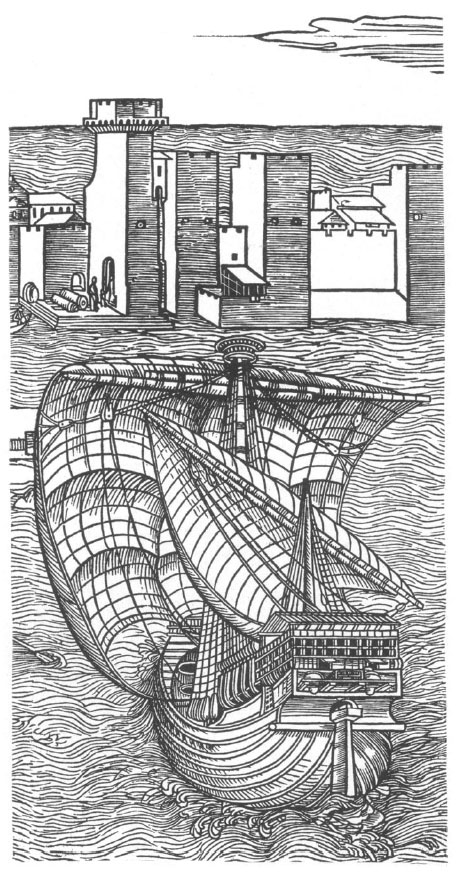
 Ship building in the Arsenal of Venice. From the 1486 Mainz edition of Breidenbach.
Among the participants of the pilgrimage Fabri also remembers Konrad Beck, a
vir honestus et providus civis de Merengen qui Dominorum provisor fuit et procurator, a honest and careful man and a burgher of Mengen who took charge of food and provisions of the aforementioned lords. Fabri also recalls a custom of the pilgrims that may shed some light on the origins of the beard kept as a relic:
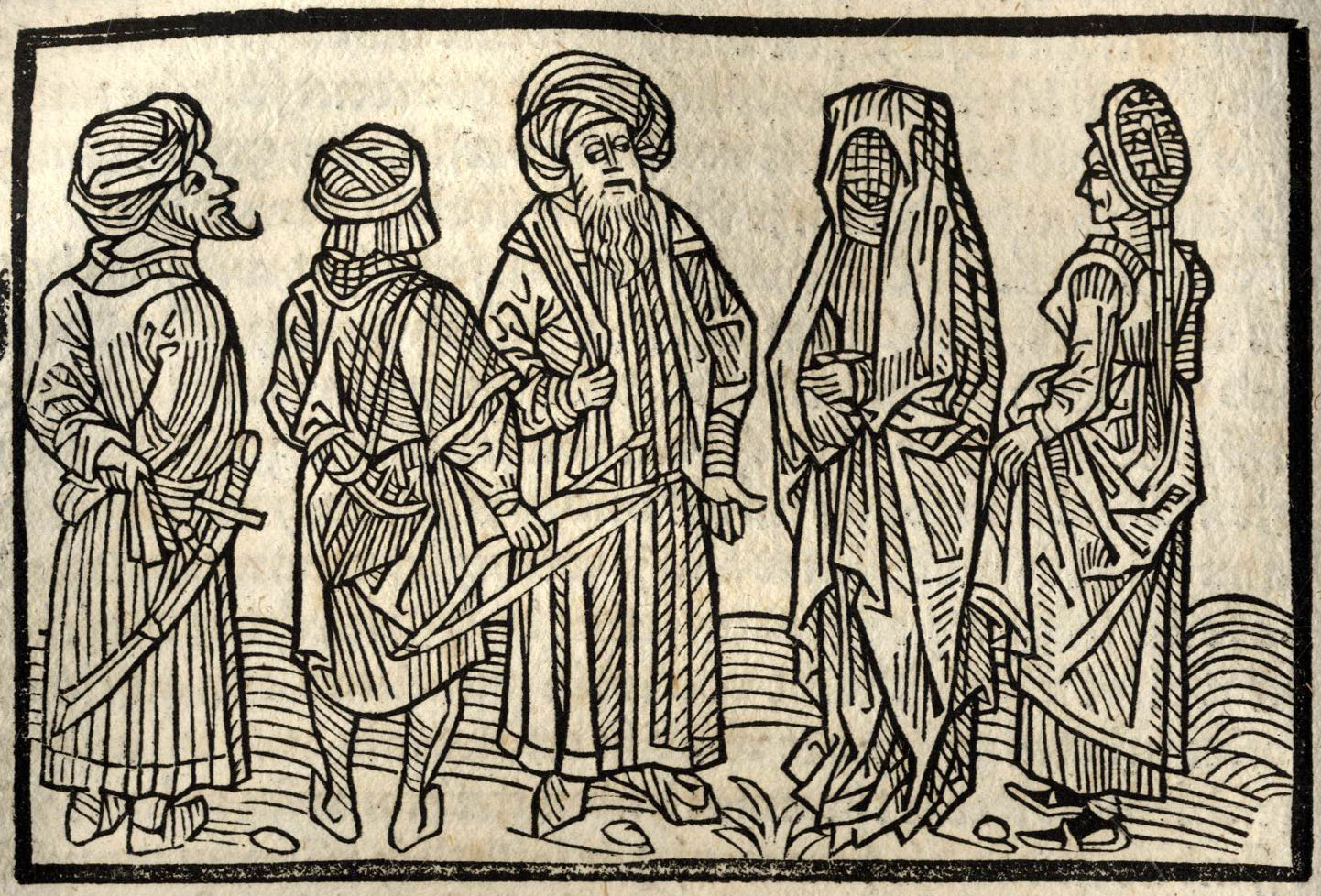
So I from this day forth [from the day of departure] let my beard grow,and adorned both my cap and my scapular with red crosses, and I assumed all the other outward signs of that holy pilgrimage, as I had a right to do. There are five outward badges of a pilgrim, to wit, a red cross on a long gray gown, with the monk's cowl sewn to the tunic-unless the pilgrim belong to some order which does not permit him to wear a gray gown. The second is a black or gray hat, also marked in front with a red cross. The third is a long beard growing from a {ace which is serious and pale on account of his labours and dangers, for in every land even heathens themselves when travelling let their beards and hair grow long until their return home; and this, they say, was first done by Osiris, a very ancient King of Egypt, who was reputed to be a God, and who travelled throughout the whole world. The fourth is the scrip upon his shoulders, containing his slender provisions, with a bottle-sufficient, not for luxury, but barely for the necessaries of life. The fifth, which he assumes only in the Holy Land, is an ass, with a Saracen driver, instead of his staff. Saracens in the Holy Land. One of the women wears a burka. From the 1488 Augsburg edition of Breidenbach.
The third chronicler of the pilgrimage, also recalled by Fabri, was
Bernhard von Breidenbach, a canon of Mainz, who accompanied Count Johannes von Solms of Hessen. They joined the Waldburg company in Venice together with some more pilgrims, including four Hungarians:
Johannes archidiaconus, Matheus canonicus, Oschwaldus plebanus and
Petrus von Ethews ein Burger. Breidenbach thus visited and described the same places as Fabri and Beck, but already with a guide as a business enterprise in mind. In the spring of the following year of 1484
Count Ludwig von Hanau-Lichtenberg already visited the holy places with the help of a guide compiled by him. And two years later, in 1486
Erhard Reuwich of Mainz
published the book in Latin and German, illustrated with his own woodcuts which then were also taken over by the great
Chronicle of the World by Schedel. A copy of the 1488 Augsburg edition of Breidenbach’s guide is also preserved in the library of the Kalocsa Cathedral.
When ninety-nine years after the pilgrimage, in 1582 the tomb of Breidenbach (†1497) was opened, his body was found entire, because – as the contemporaries wrote – on his Eastern journey he had taken the precaution of bringing back with him the best of spices for embalming. And his face, though in life clean shaven, as witness his statue in the Cathedral of Mainz, was covered with
prolixa ac ruffa barba, an abundant and ruddy beard, thus even in his death attesting his being an illustrious pilgrim.
 The Church of the Holy Sepulchre in the 1486 Mainz edition of Breidenbach.
In the Studiolum we plan to publish during the next months the facsimile of the Bart Codex with the transcription of the German text and a summary of its content in English, Spanish and Hungarian. We will also note what Fabri and Breidenbach saw in the same places, and will also quote from other guides as well as from the ancient and modern descriptions of the holy places. Although this virtual pilgrimage grants no indulgence whatsoever, at least it will evoke something of that region which was at once
the center of the world and
the gorgeous East for the Middle Ages. Come with us.











 Come with us to…
 Atlantis
 Bestiary
 Bohemia+Prague
 Books, exhibitions, music, film
 Brave old world
 Caucasus
 Cemeteries
 Crimea
 Get to know the
 Images of the East
 Lightwriting
 Lwów/Lemberg
 Mallorca
 Message on the wall
 The Museum of Propaganda
 Odessa
 Paper Museum
 Persian letters
 The Jewish heritage


