Switch over to our new blog! • ¡Pásese a nuestro nuevo blog!

The renewed version of our blog, with more features, a richer design, and available in nine languages, can be read here: https://wangriver.com

The new version also includes the old posts, often in expanded form. If you are curious about the updated version of this post, replace “riowang.blogspot.com/” in the URL with “riowang.studiolum.com/”, and the new link will most likely lead you there.


La versión renovada de nuestro blog, con más herramientas, un diseño más rico y disponible en nueve idiomas, se puede leer aquí: https://riowang.com

La nueva versión también incluye las publicaciones antiguas, a menudo en una forma ampliada. Si tiene curiosidad por la versión actualizada de esta entrada, sustituya «riowang.blogspot.com/» en la URL por «riowang.studiolum.com/es/», y el nuevo enlace probablemente le llevará allí.

Kingdom forever

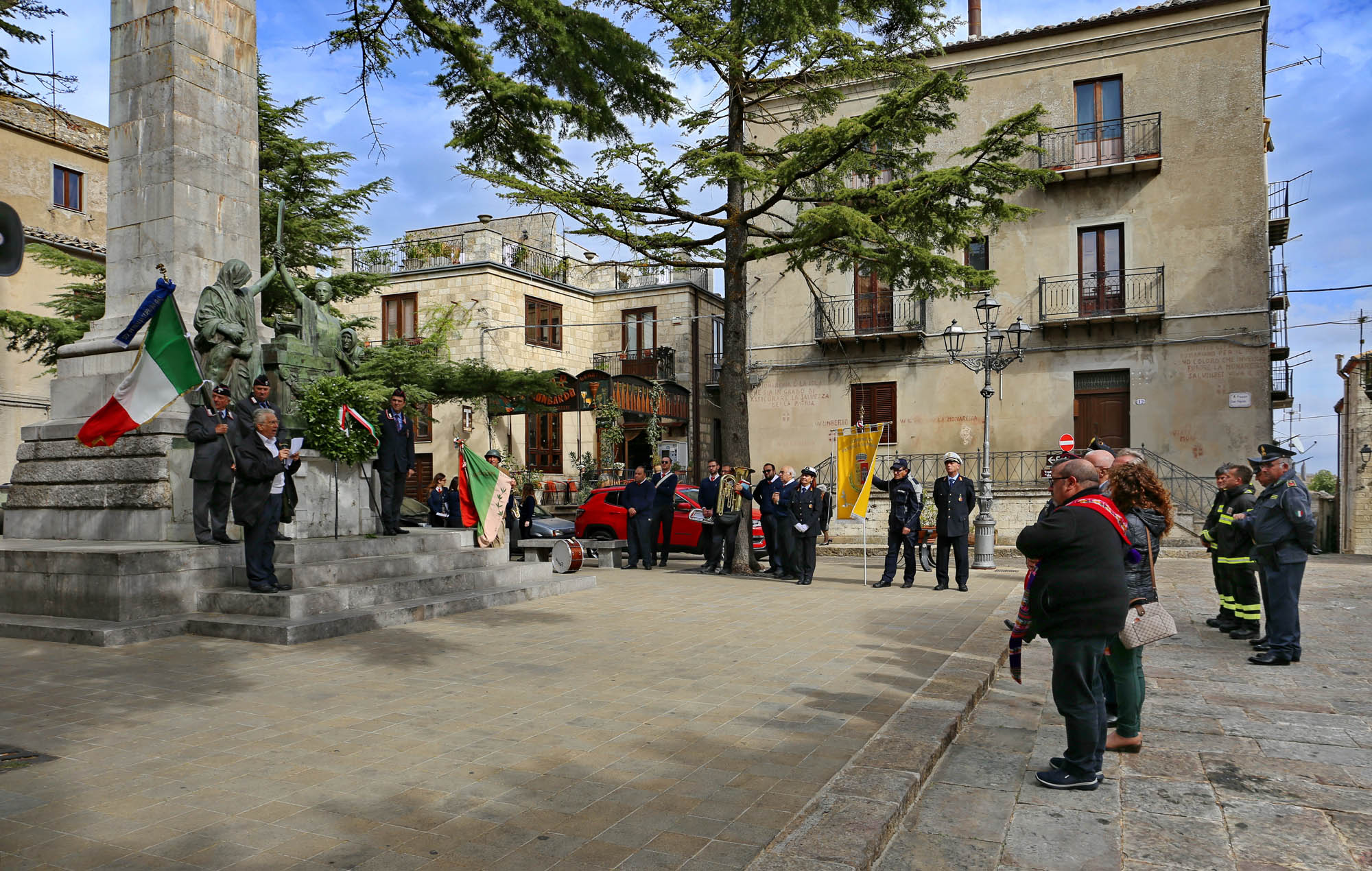
Petralia Soprana is a charming medieval town in north-central Sicily, at the inland foot of the Madonie mountain range that separates the cheerful Cefalù coast from the hopeless inland hills. It has everything you need: winding medieval streets, a Baroque cathedral of Romanesque origins, a Norman castle which was converted into a Carmelite monastery after the Arab threat has passed, its weekly Friday market, on which day it is forbidden to enter the city from 9 am to 1 pm, a begun but never finished highway, on the six pillars of which a car park has been arranged, and, last but not least, a town hall, with a pastry shop below, and a small park in front with a monument to the fallen heroes.

The Piazza del Popolo on the feast of the armed forces, November 4, 2022

Today, in the age of democracy, the small park is called Piazza del Popolo, but in the anti-democratic age it was called Vecchia Vuccirìa. In the Sicilian language, vuccirìa means cacophony and confusion, in which today’s speakers tend to recognize the root voce, ʻword, sound’, but this is a false etymology. The name actually comes from the French word boucherie, cattle market, and the noise associated with such markets leads to the word’s modern meaning.

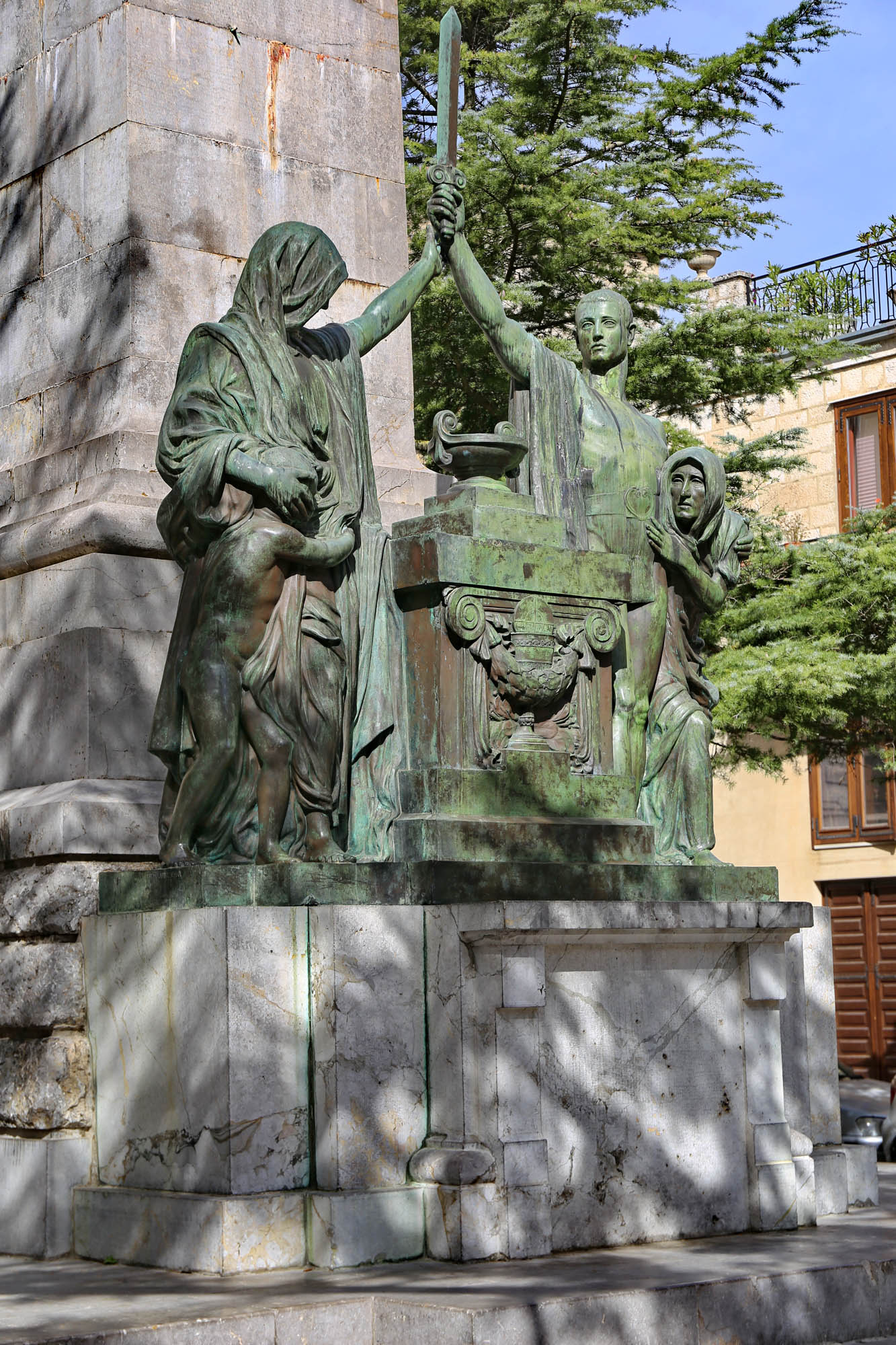
The ʻcattle market’ lends a special second meaning to the monument in the middle, which, according to tradition, commemorates those massacred in the war. The monument was dreamed up in 1929 by Antonio Ugo (1870-1950), a prolific sculptor during Fascism, head of the sculpture department of the Accademy of Fine Arts in Palermo, in the popular “Novecento” monumental classicist style of the period, which was so close to other – German or Soviet – imperial styles. The young Roman warrior going to war swears to defend his country with his sword held above a burning altar, like Mucius Scaevola. From under his arm, his anxious old mother peers at the altar, which is probably decorated with the motif of the Eucharist for her – and for Petralia Soprana’s similar old women’s – sake. On the other side, the hero is supported by his wife in going to war, only she knows why. Her arm embraces their Michelangeloesque child, who is partly secretly grieving his father’s heroic decision, partly drawing strength from his mother’s clothes for the time after his father’s fall, which is what this post is about.
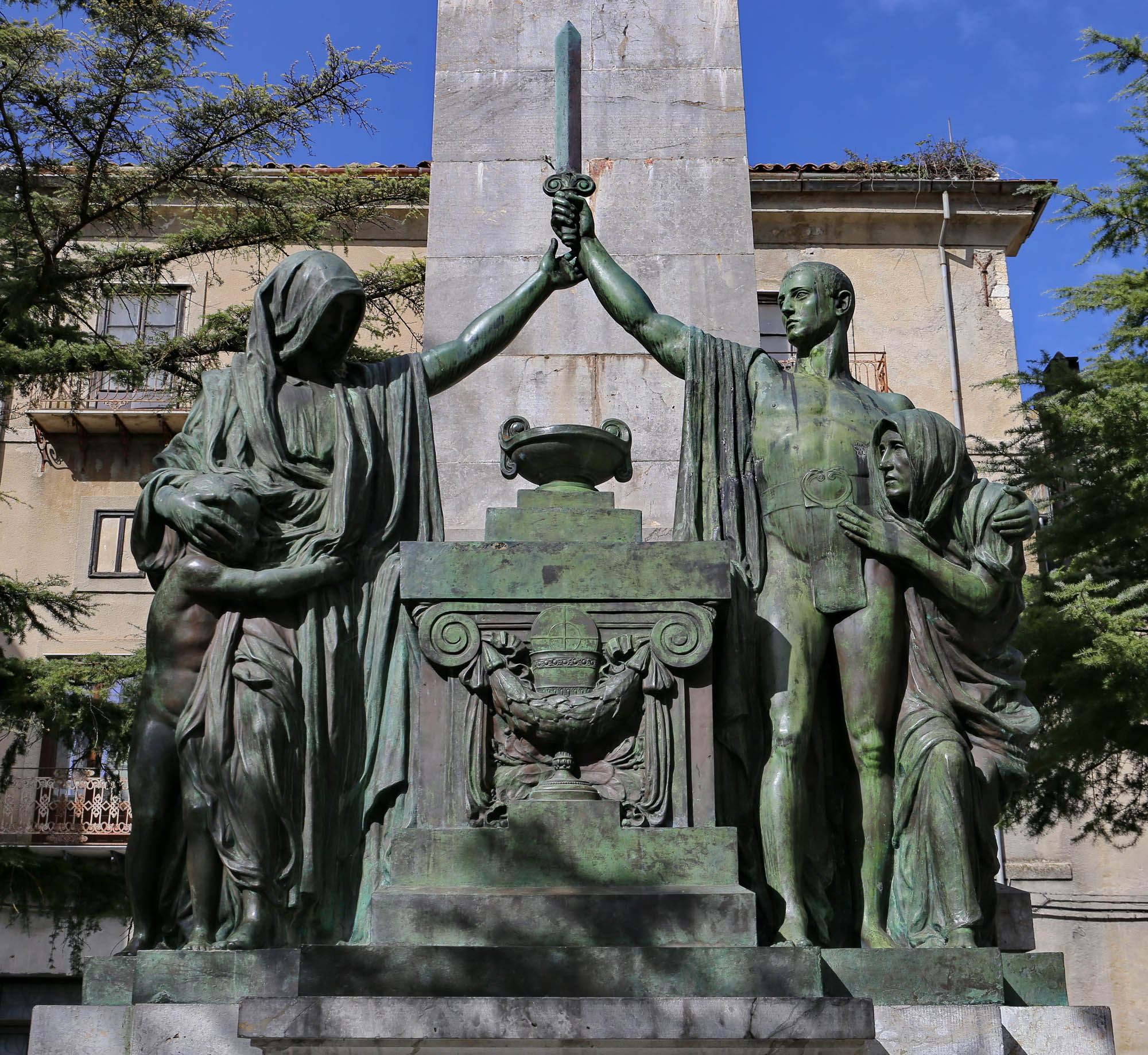
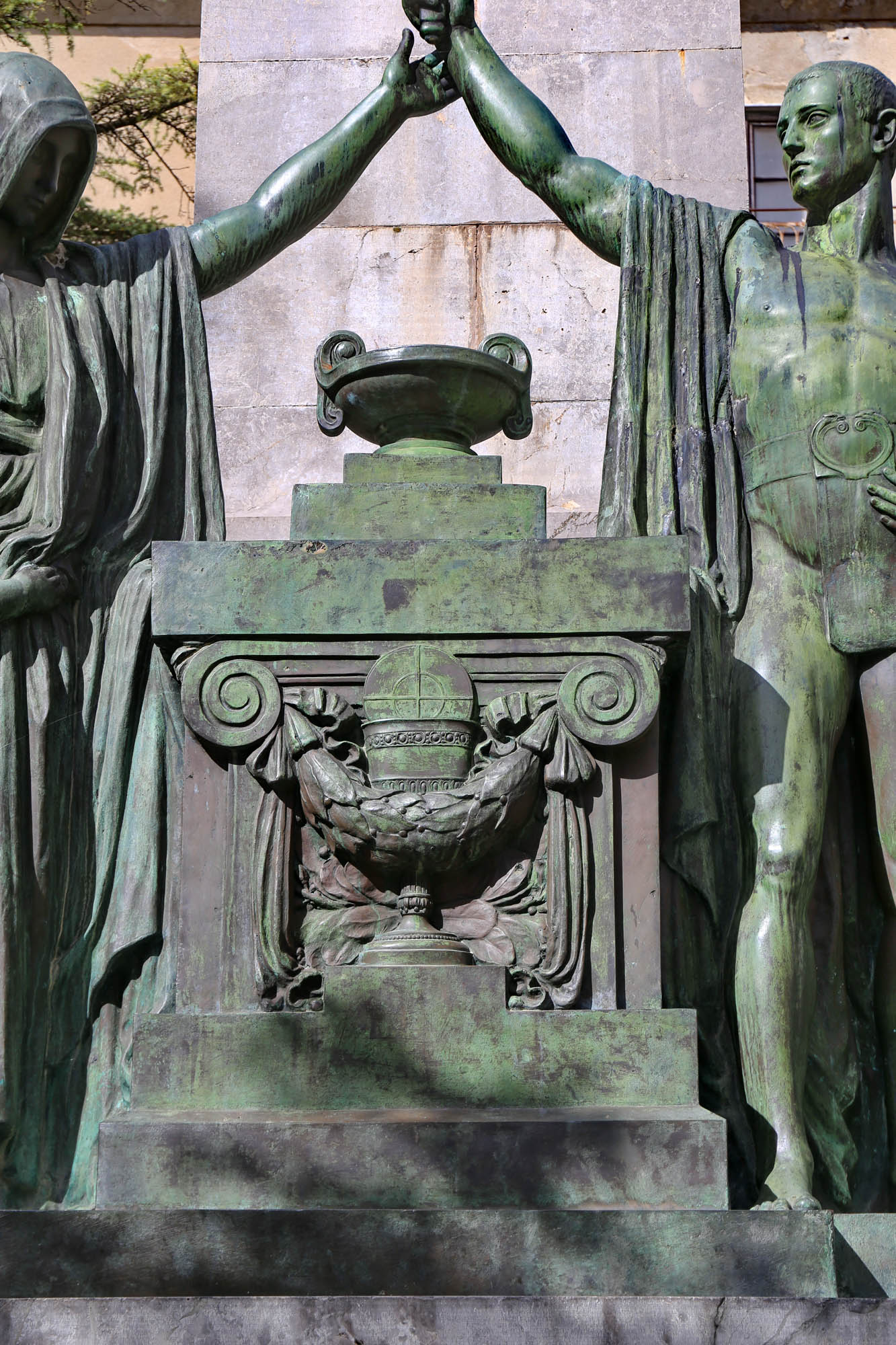
Strangely enough, there is no inscription on the monument, although space was left for it, and the holes of the dowels fixing the former marble tablets are still visible.

We are probably dealing with another case of the historical cognitive dissonance which, as we have seen, is so characteristic of the small towns in Sicily. Mussolini’s rule brought development and public security to Sicily, and a harsh suppression of the mafia, which was only restored to its former monopoly by the Anglo-Saxon landings in 1943. The island therefore finds it difficult to give up its Mussolini-era monuments, which remind them of a bygone golden age that has not been reached since. In the main squares of small towns, Mussolini’s frasi celebri can still be read, and still there are sculptures and statues from his era. In the neighboring Gangi, the nationalist memorial plaque of 1936 was first removed in 1945, and then put back due to popular pressure. Probably this monument also had some dedicatory inscription which it was thought better to remove. The monument speaks for itself eloquently enough.
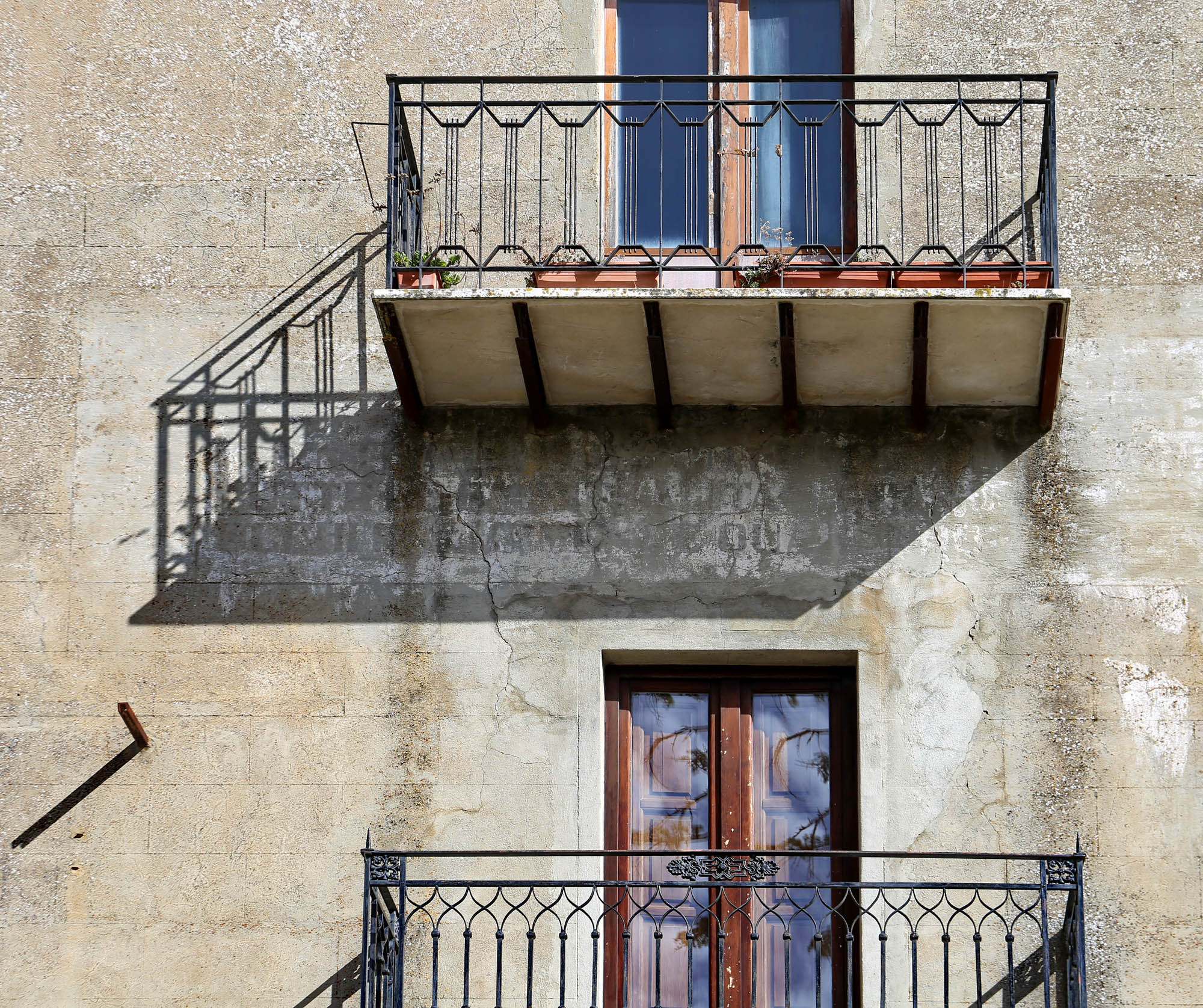
In the photo above, on the corner house overlooking the monument – which may have been an office or a party center – you can still see that under the balcony there was once a text painted in the font typical of public Mussolini quotes. What exactly it was, can be told only by the dwindling age group that can still browse the frasi celebri in their memory and identify the still readable groups of letters.
Much more interesting historical documents are the still-preserved inscriptions that were painted on the façade in May 1946, long after the fall of Mussolini, and which celebrate the monarchy and the king.
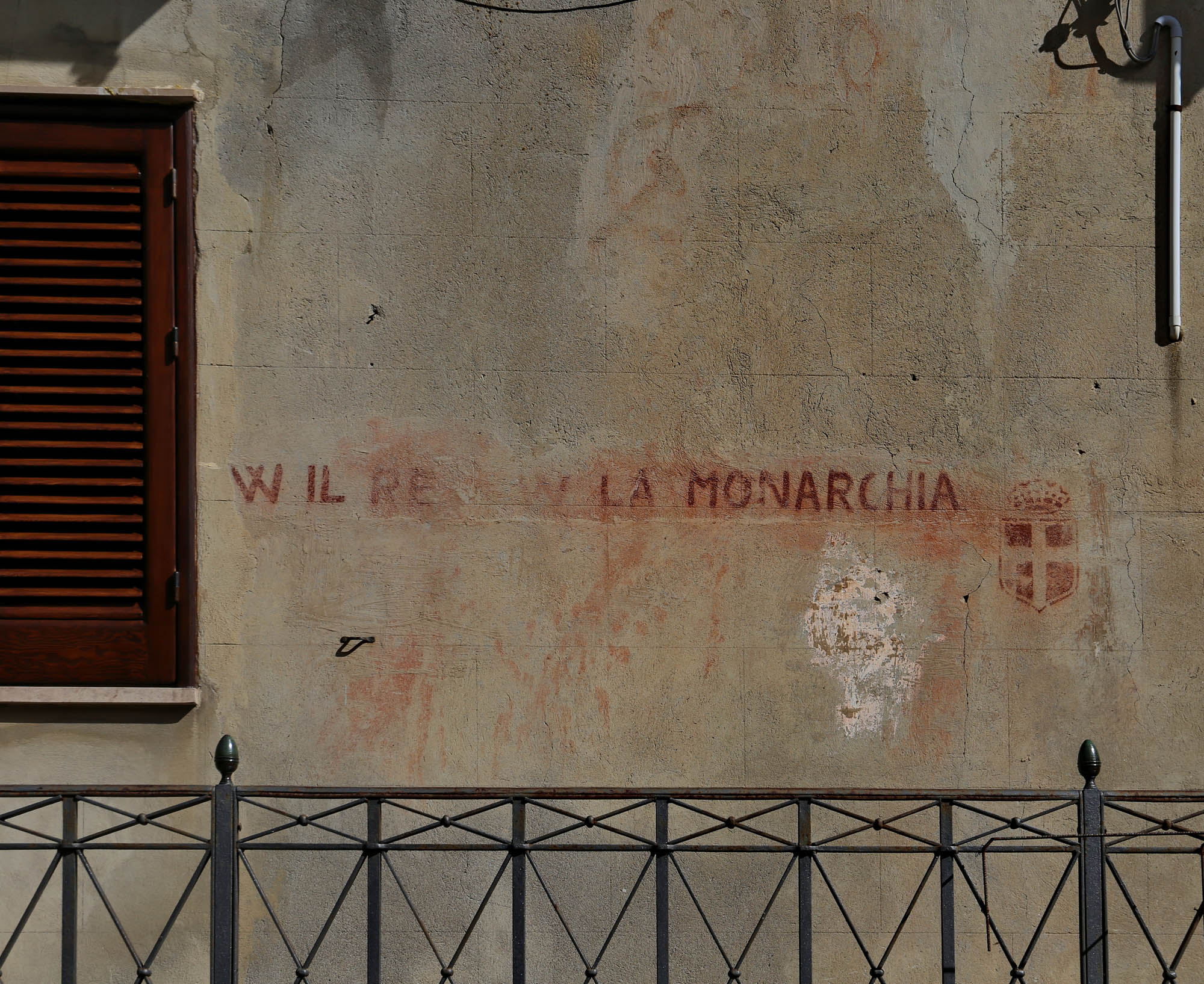
“Long live the King! Long live the monarchy!” The hammers and sickles that were faded above and below were not repainted like the royalist inscriptions.

These inscriptions are perhaps unique survivors of a campaign that preceded the June 2, 1946 referendum on Italy’s form of government.

The question of the form of government caused tensions in the domestic politics of united Italy from the very beginning. The spiritual father of the unified Italian state, Giuseppe Mazzini, who founded the Giovine Italia movement in 1831, dreamed of this state as a democratic republic that would abolish all previous kingdoms. However, the unification of Italy was ultimately carried out under the leadership of the king of Sardinia and Piedmont, in reality as a kind of internal colonization. Garibaldi, who united the country from the south, from Sicily, was indeed a republican, but for the sake of a unified Italy, he finally handed over his conquests to Victor Emanuel II. This even made some of his party colleagues consider him a traitor. The opposition between republicans and monarchists determined the entire domestic politics of Italy until Mussolini came to power in 1922.

After the fall of Mussolini on July 25, 1943, the question gained new relevance. The king fled to southern Italy, controlled by Anglo-Saxon troops, and virtually became a lame duck. In addition, he had already compromised himself by appointing Mussolini in 1922, and supporting his dictatorship for twenty years. In the North, occupied by the Germans, the republican parties were illegally re-established, and participated in the anti-German partisan movement. Therefore, after the liberation of the country on April 25, 1945, they demanded a referendum on the form of government.
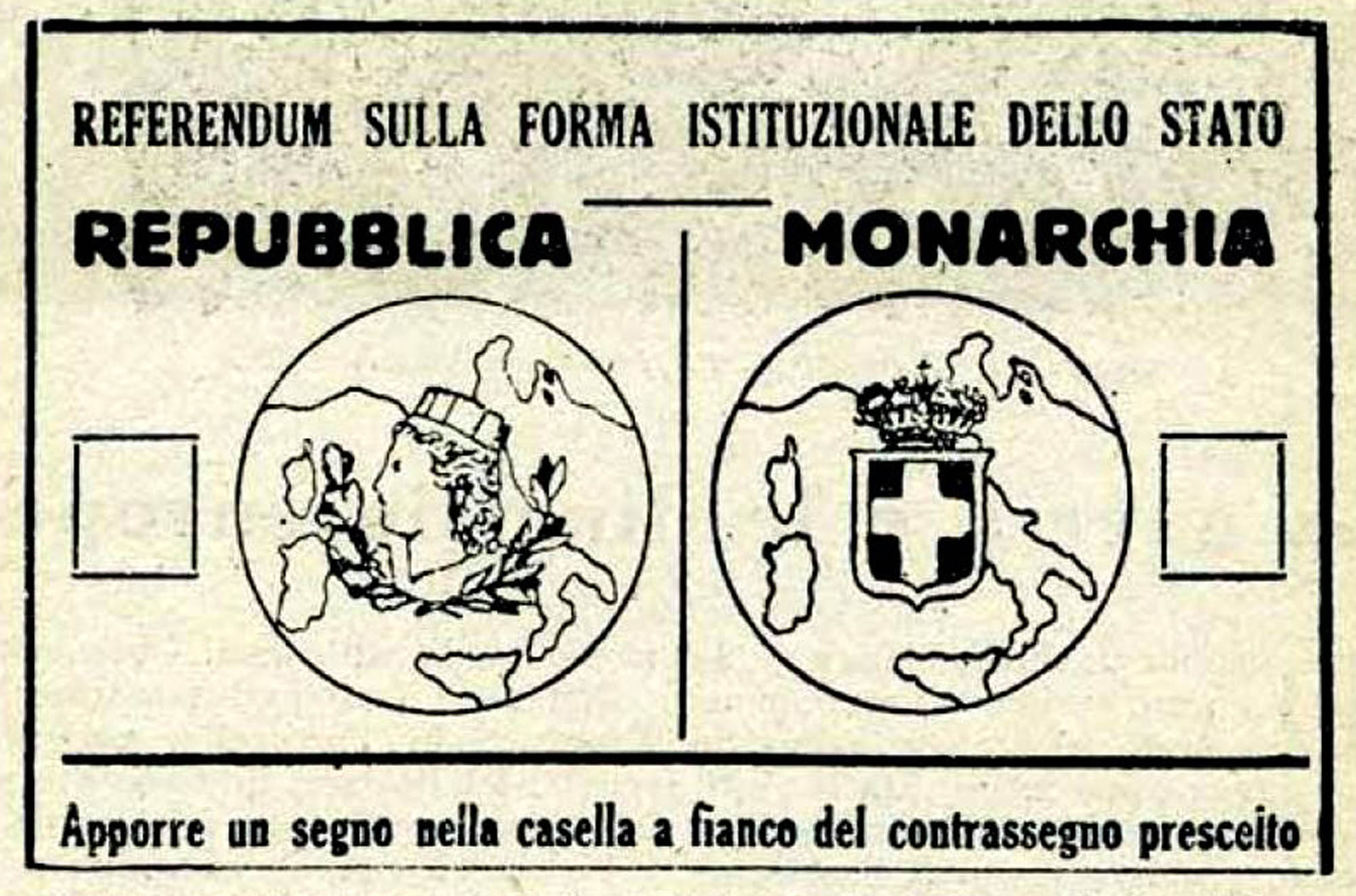
The ballot of the referedum on June 2, 1946

One month before the referendum, Victor Emanuel III passed the throne to his son Umberto, whose name is still given to squares in Sicily. This change dates the Petralia campaign inscriptions to May 1946..
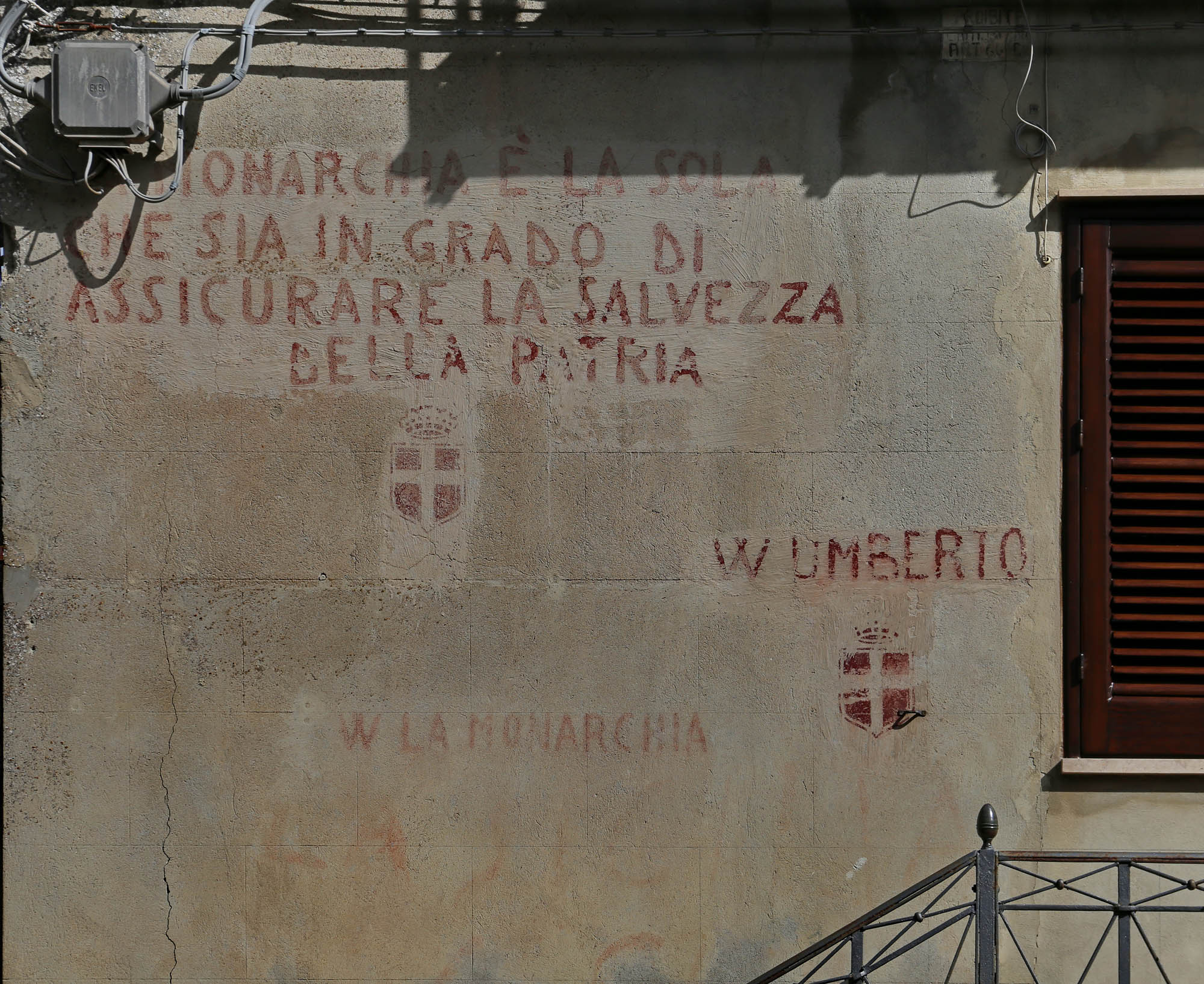
“The monarchy is the only one that can guarantee the salvation of the homeland. Long live Umberto! Long live the monarchy!”

The June 2 referendum was the first in Italy to take place on the basis of universal suffrage, i.e. women could also participate in it. Less than half of the population of 45 million cast valid votes, of which 12 million voted for the republic and 10 million for the monarchy. After the proclamation of the republic on June 11, King Umberto handed over the power to the new president, Alcide De Gasperi, and then went into exile.

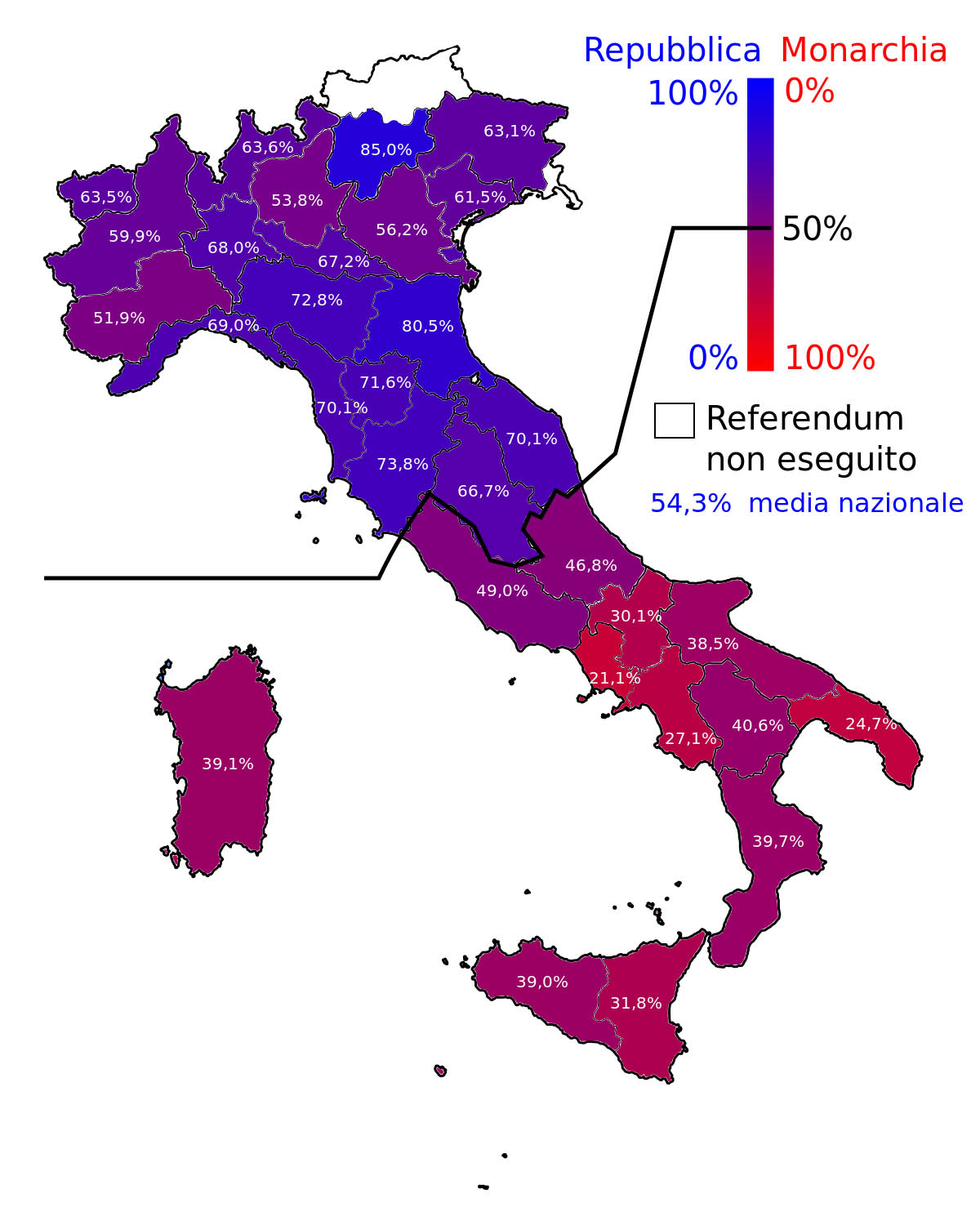
By projecting the votes on the map, we can see how much the issue divided the country. Roughly to the north of Rome, supporters of the republic predominated, and supporters of the monarchy to the south of it. In eastern Sicily, where Petralia is located, the monarchy achieved more than two thirds. This might be also the reason of the survival of the monarchist campaign inscriptions in Petralia, as silent witnesses of the resistance against the colonizing North.

“It is the careerists and adventurers mad for power who are furiously attacking the monarchy. God save the king! Long live the king! People of Petralia! Vote for the monarchy!”


Dissolving: The wonder

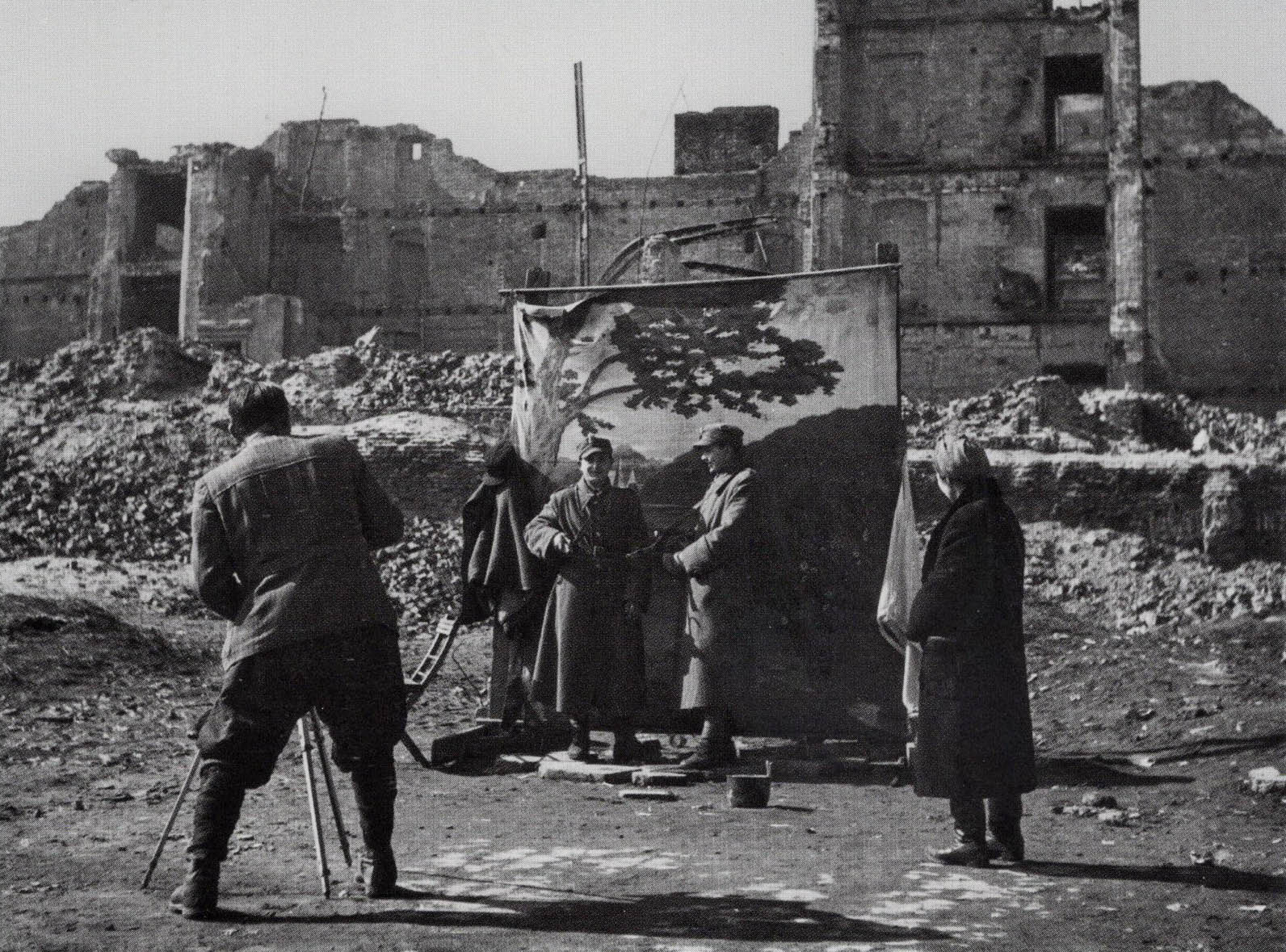
In a photo by the Portuguese Andre Boto, a man in a suit stretches out a mountain landscape photographed in bright colors and minute details on a sheet in front of a depressingly polluted industrial area, so that the viewer does not have to face reality. In the Czech Marko Jindřich’s picture from 1945, the amateur photographer stretches out a similarly idyllic landscape sheet in front of the ruins of destroyed Warsaw, so that the survivors can capture themselves in front of a usual, more optimistic photographer’s background.

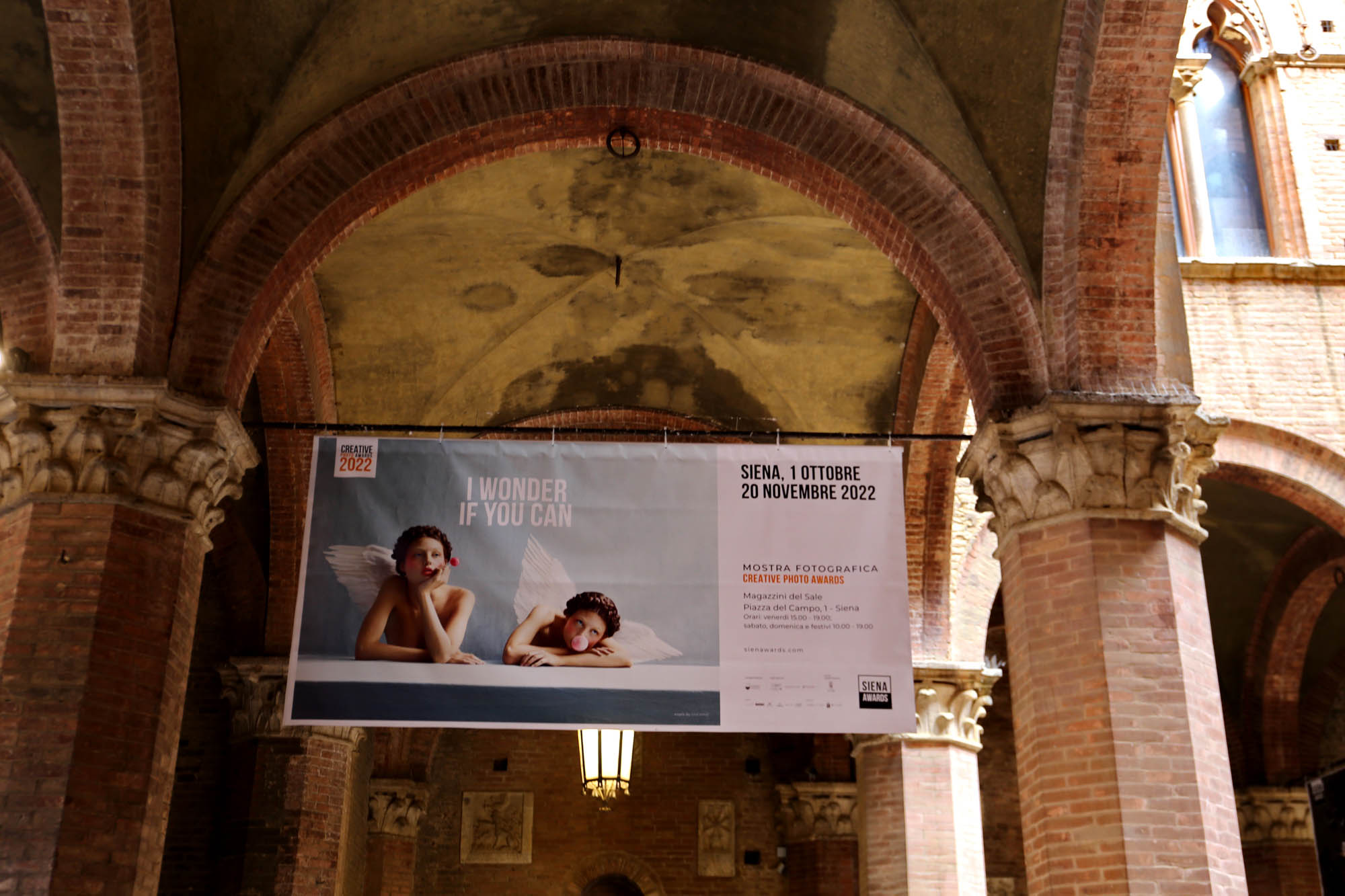
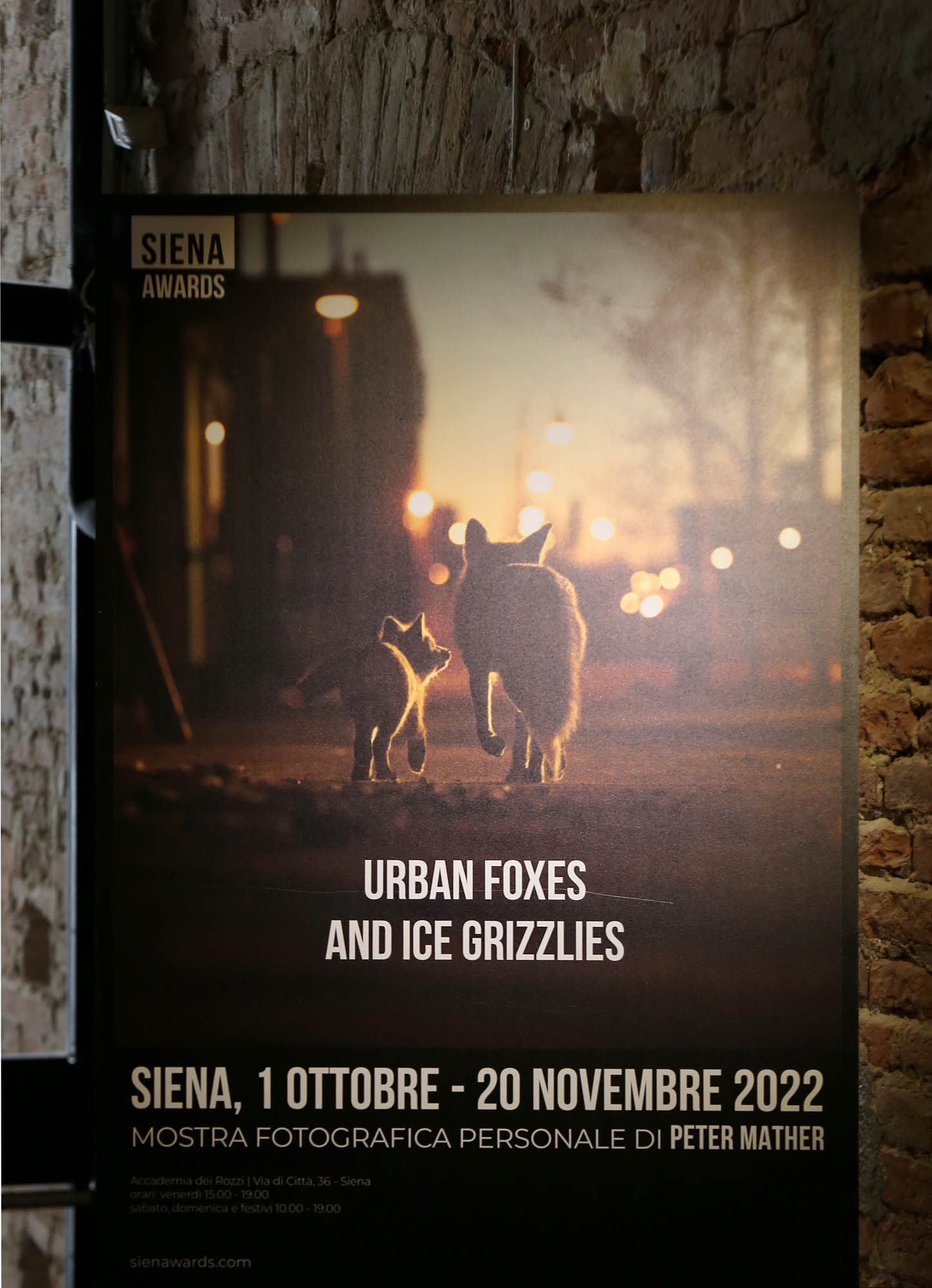
Boto’s picture was chosen this October as the “photo of the year” out of 48,000 pictures submitted to the Creative Photo Awards of Siena. The finalist photos of the competition were exhibited in October and November in Siena’s Palazzo Pubblico.

The theme of this year’s competition is “I wonder if you can”, from which most of the pictures chose wonder as the keyword. The only exception is the Bulgarian Yuri Vasilyev’s Fish, you can!, which plays with the two meanings of ʻcan’.

But what is wonder? In most of the pictures in Palazzo Pubblico, it is the replacement of the usual reality with another, brighter reality, exactly as is depicted in the winning photo. Still lifes constructed and bodies dressed as Netherlandish paintings, visually elaborated concepts, landscapes with the obligatory lonely tree filtered to the extremities, a musician as a modern Orpheus moving the world as in a Surrealist paiting. The wonder that we await, which is fundamentally diffrent from reality, and which never comes.

creativephotoawards1 creativephotoawards1 creativephotoawards1 creativephotoawards1 creativephotoawards1 creativephotoawards1 creativephotoawards1 creativephotoawards1 creativephotoawards1 creativephotoawards1 creativephotoawards1 creativephotoawards1 creativephotoawards1

In only a few pictures does the true meaning of wonder appear: the epiphany. The wonder that is always present and sometimes shines on. The entry of authenticity into reality, or rather the cathartic recognition of its presence in reality.

Roddy Macinnes: Honeymoon in Finland


Our reputation in the world

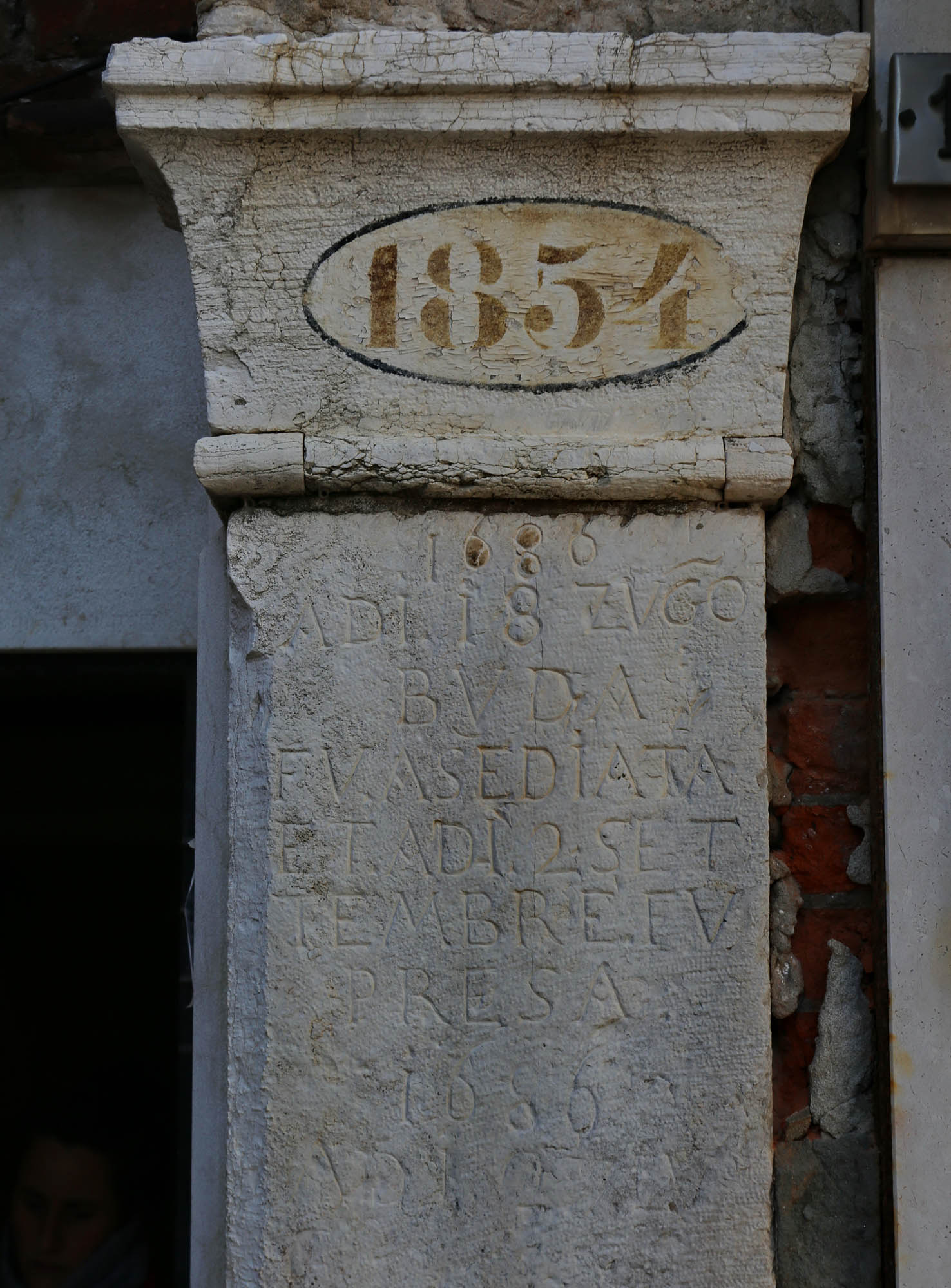
In Venice, a small square opens at the side of the San Cassiano parish church, where the Ponte de la Chiesa leads to the Calle dei Morti on the other side. This latter got its name from the parish cemetery that was once there. At the foot of the bridge steps, there stands the marble corner column of the only house in the square, which bears the house number 1854 on its capital. However, the inscription under the capital is only noticed by those who go close enough to see the letters engraved on it in low relief.

The upper, larger part of the inscription was engraved by a skilled hand in regular capital letters:

1686 A DÌ 18 ZUGNO BVDA FV ASEDIATA ET A DÌ 2 SETTEMBRE FV PRESA

Buda was besieged on June 18, 1686, and occupied on September 2

Beneath, another date was engraved in a freer hand:

1686 A DI 27 LV

On July 27, 1686

We do not know who considered it important enough to record the dates of the recapture of Buda from the Ottomans. But we know he was not alone.

The history of the liberation of Buda, occupied by Suleyman on August 29, 1541, goes back to September 1683, when the imperial German and Polish armies liberated Vienna from the Turkish siege, and a month later they also recaptured Párkány and Esztergom from the Turks. In the euphoria of the victory, Pope Innocent XI convinced the Hapsburgs, Poland and Venice to establish the Holy League for the recapture of additional Ottoman territories. The League’s troops already besieged Buda in 1684, but that time without success. In 1686, after a long preparation, they returned again and, after a three-month siege, at the cost of heavy losses, the finally took the city on September 2, after almost exactly 145 years of Turkish rule.

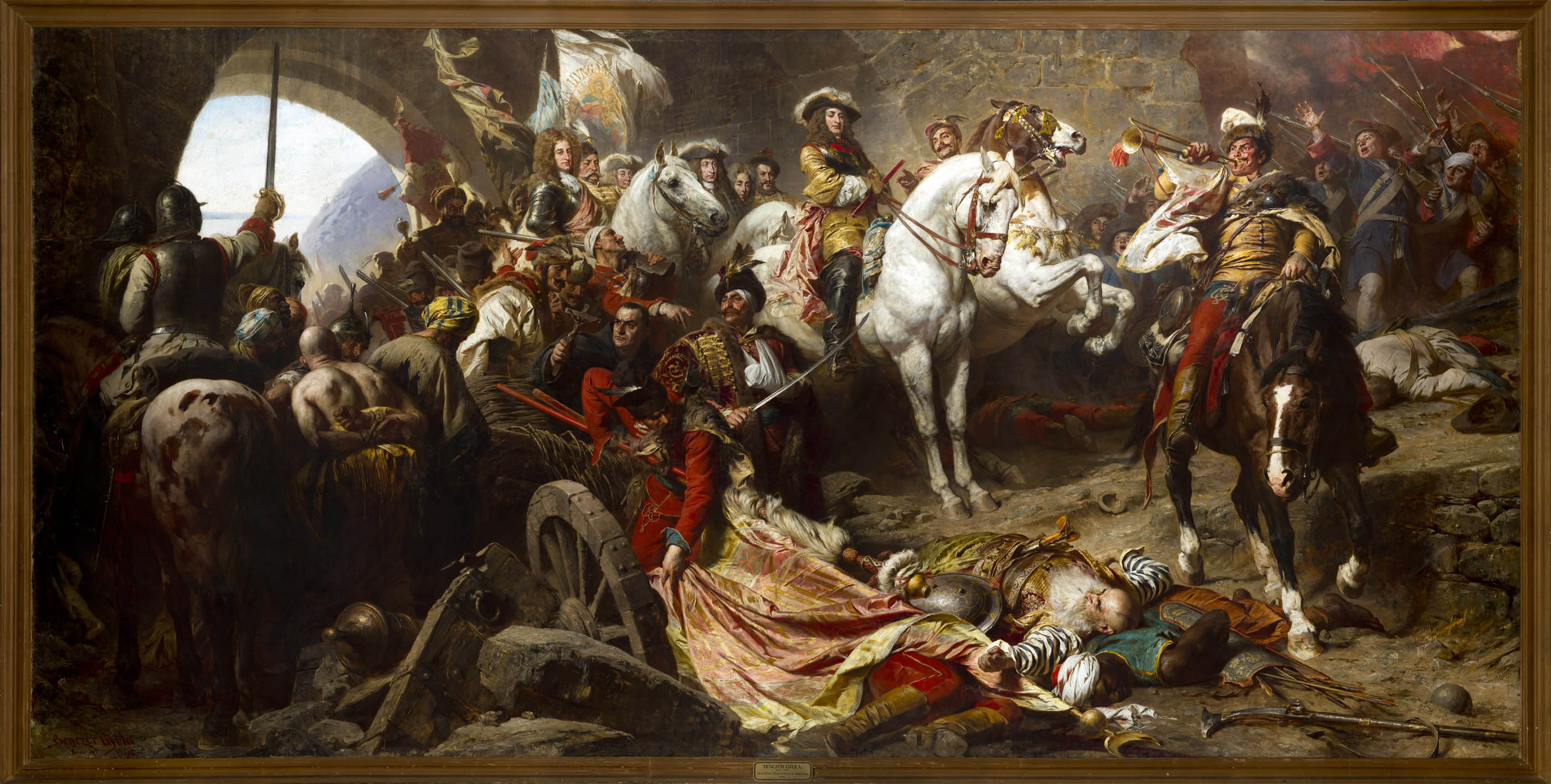
Gyula Benczúr: The recapture of Buda Castle, 1896. Entering through the castle’s Vienna Gate, Charles of Lothringen looks at the corpse of the Ottoman commander defending the castle, Arnavut Abdurrahman Abdi Paşa, whose monument stands behind the gate today

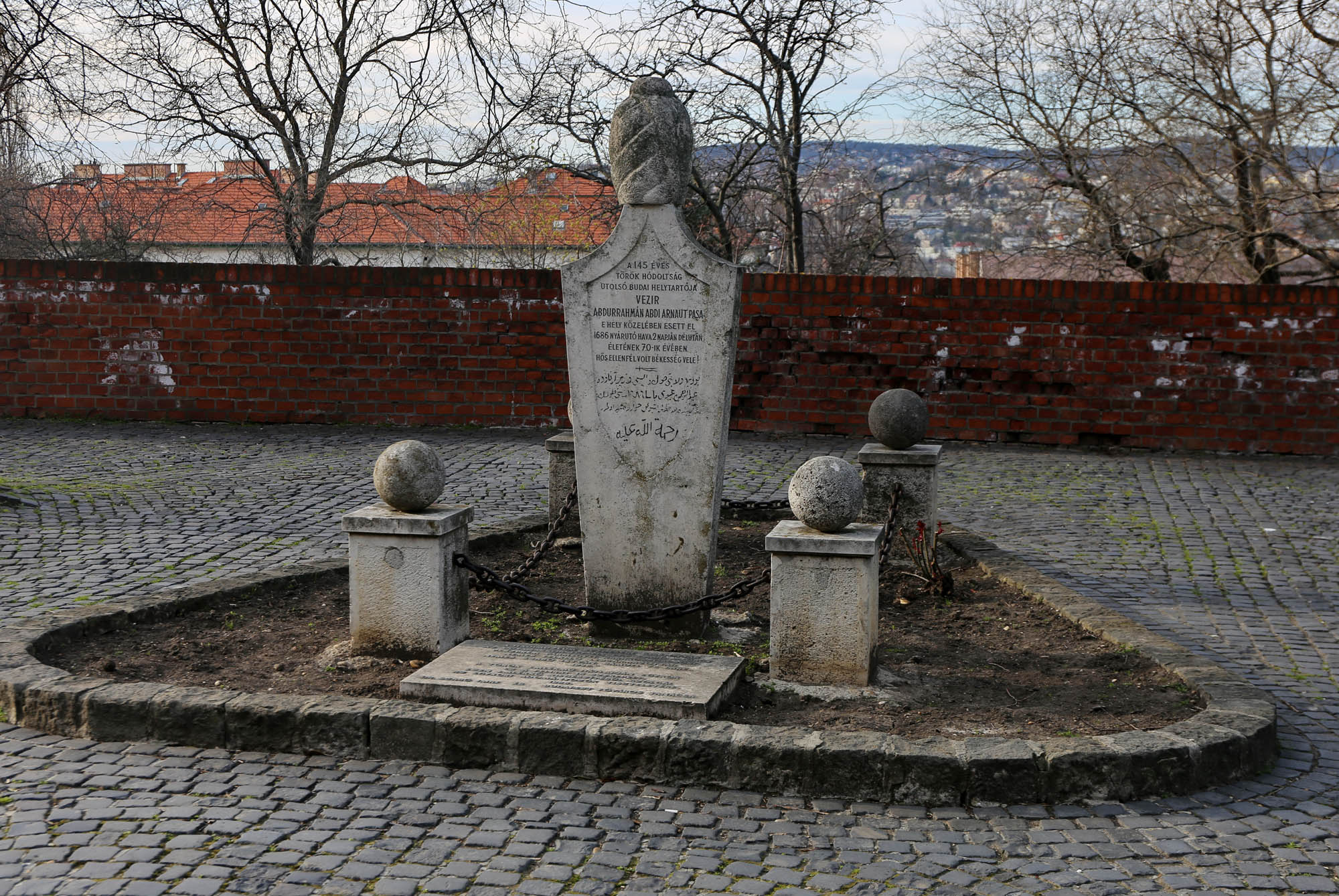
The monument to the Turkish commander of Buda stands at the place where he fell on September 2, 1686, defending the castle. It was erected in 1932 by the descendants of György Szabó, who fell in the same place, on the same day, besieging the castle. The inscription on the monument is in Hungarian, Ottoman Turkish and modern Turkish: “Arnavut Abdurrahman Abdi Paşa, the last governor of the 145-year Turkish occupation of Buda, fell near this place on the afternoon of the 2nd day of September of 1686, in the 70th year of his life. He was a heroic adversary, peace be upon him.”

The pasha’s death is also commemorated by Margit Kovács’s naive ceramics of 1977 at the Vienna Gate, at the beginning of Ostrom (Siege) Street. A particular blooper of the ceramics is that the castle in the background is besieged not by Christians, but by Turks, most probably under the influence of Géza Gárdonyi’s popular Stars of Eger, the most extensive romantic description of castle sieges in Ottoman-period Hungary

The recapture of Buda was celebrated all over Europe with fireworks, bell ringing and masses. This was especially the case in Venice, which, as a naval ally of the Holy League, liberated the Peloponnese from the Turks at the same time, which I will write about shortly. The inscription next to San Cassiano was also born out of this enthusiasm. It is not known, however, what the date of July 27 refers to. On that day, General János Eszterházy launched a major attack against the castle, but it was only partially successful, so it is unlikely that this is what the inscription reminds us of.

Fireworks on Brussels’ main square to celebrate the recapture of Buda

Among the celebrating cities was also Brussels, where, in addition to fireworks, several inns adopted Buda’s name. Around the lonely Buda Inn to the north of the city, a small village had developed by the early 19th century, which was later integrated into Greater Brussels as an industrial district.


Della Bosiers’ Fleur de Buda (1971) is about Brussels’ industrial district Buda

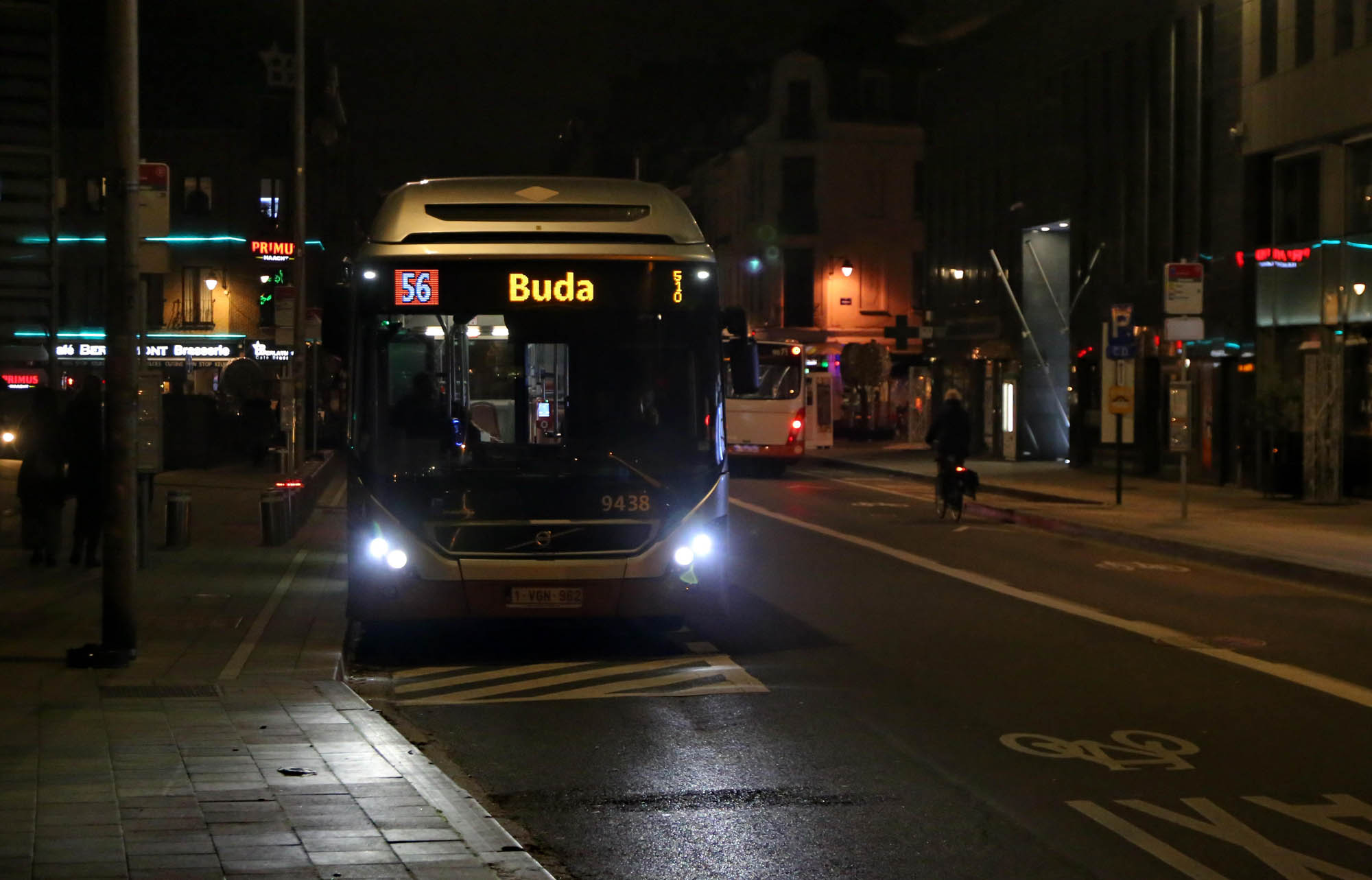
The next Hungarian historical event that made the hearts of all of Europe flutter was the revolution of 1956, after which squares and streets were once again renamed. Brussels already had its Buda, so what they did was to give number 56 to the bus going from the European Parliament to Buda quarter.

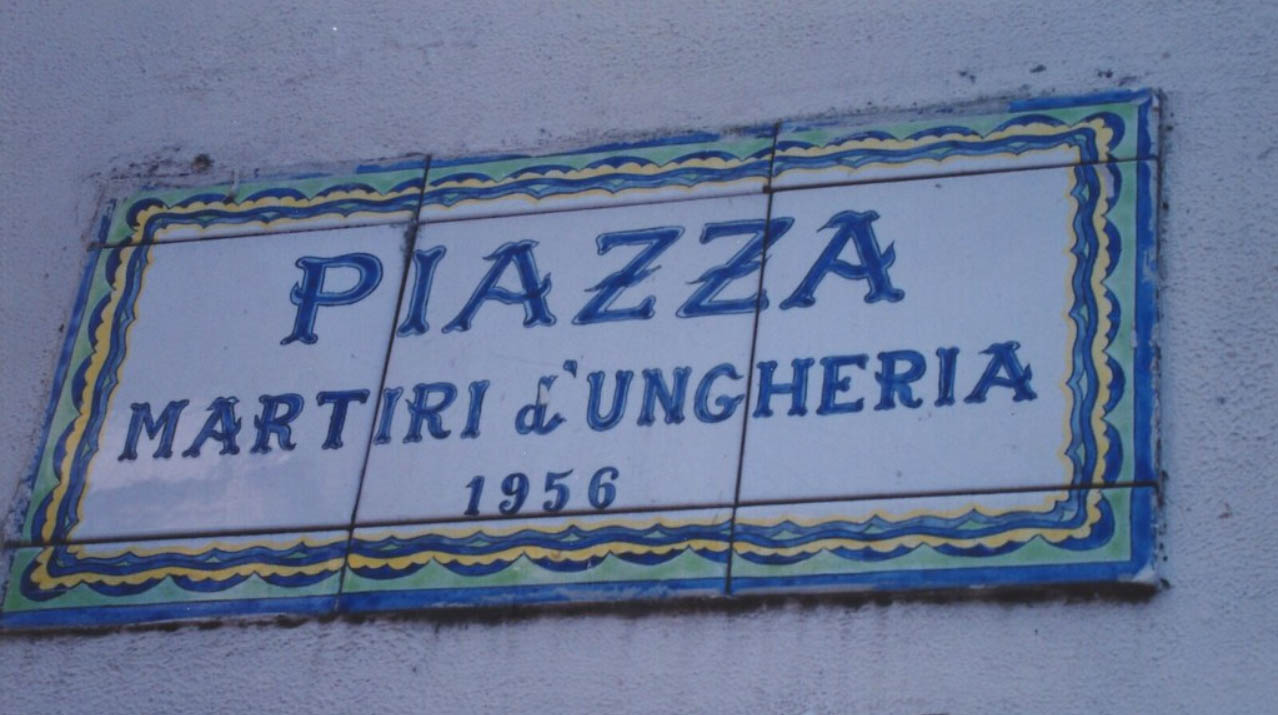
After the 1956 revolution, tens of thousands of Hungarian refugees were received in Italy as well, and squares in several cities were named after the Hungarian martyrs.

For example, in Capri (copyright by ribizlifőzelék)

Or in the Sicilian town of Piazza Armerina. On this October 23, we commemorated the anniversary here in a truly dignified place.

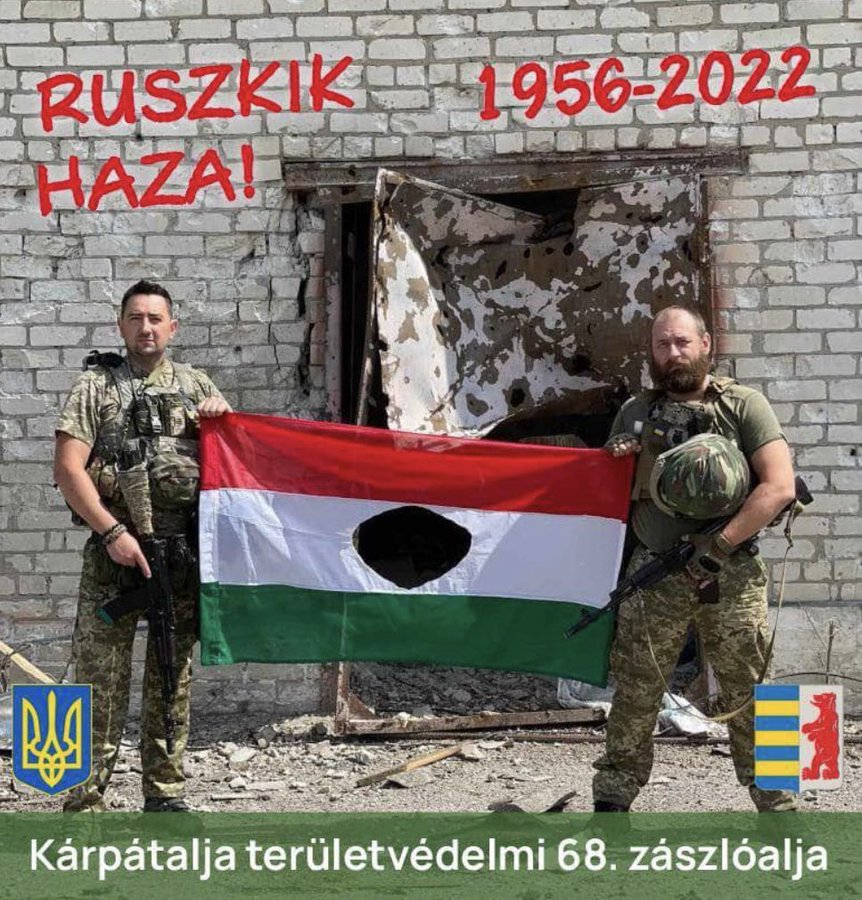
It was commemorated in a more dignified place by those Subcarpathian Hungarians, who in 1956 could not even dream of participating in the revolution, but now they are doing and promoting exactly what people of their age wanted to achieve in 1956, and what today’s Hungarian government wants to completely forget. After three hundred years, they are now improving our quite worn reputation in the world.    

“Russian, go home. 1956-2022. The 68th Territorial Defense Battalion of Subcarpathia, Ukraine”


On the dignity of felines

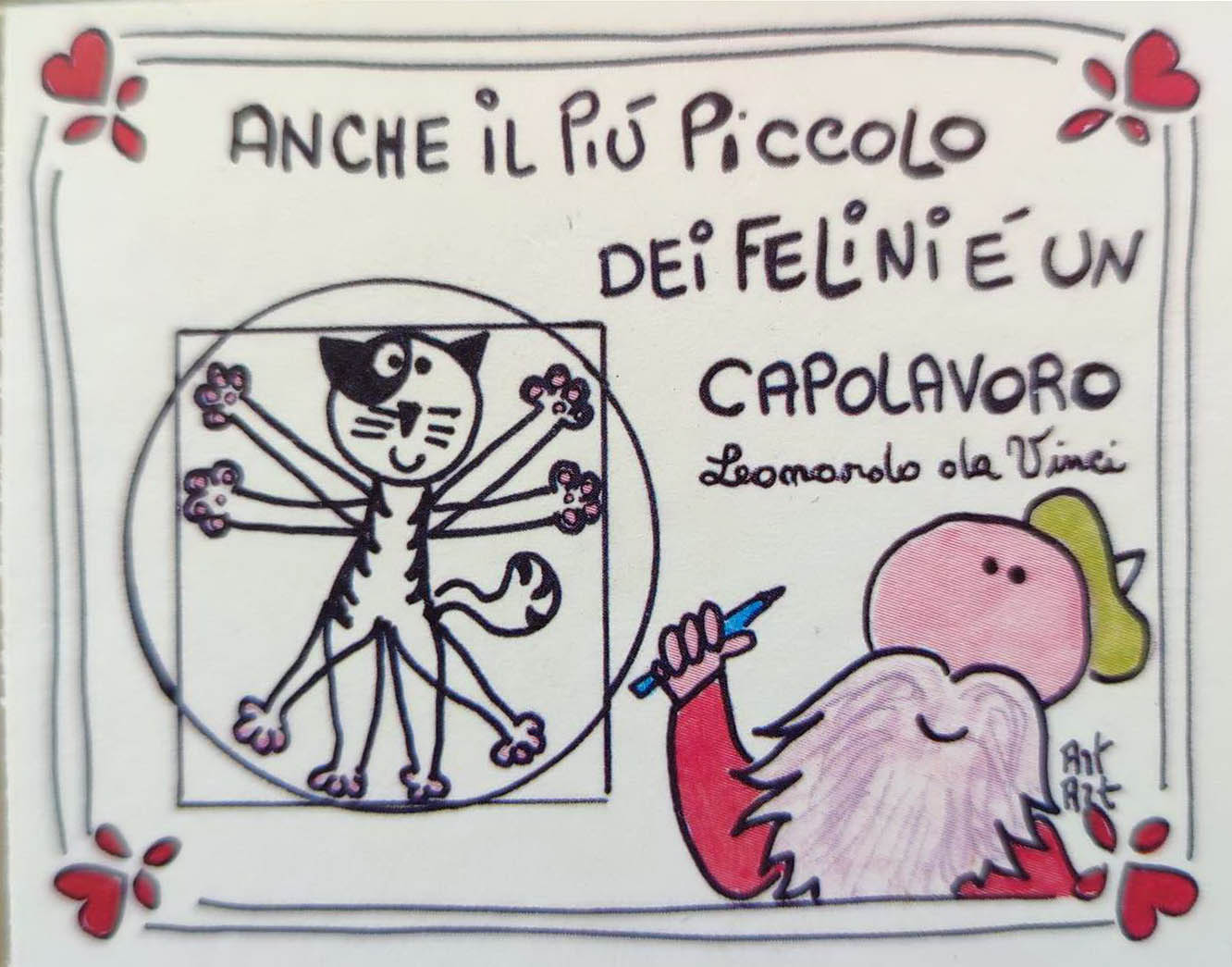
I just photographed this Leonardo caricature in Tuscany. “Even the smallest feline is a masterpiece”, the master comments on his Vitruvian cat with a satisfied face, as if he already knew that he would start his humanist treatise Laudatio cati (In praise of the cat) or De dignitate felidarum (On the dignity of felines) with this motto.

I also photographed this picture because it offers an opportunity to compare two nations’ souls, whatever that means. The other nation is the Russian, and the subject of comparison is the emblematic song about the cat, which is sung in the 1966 Soviet cult film Республика ШКИД.

This film is about how a school and art training were organized in the 1920s, after the civil war, for the orphaned children who wandered around (and committed crimes) by the millions in Russia. The protagonist of the film, Mamochka, wants to prove his talent with a beggar’s song.

У кошки четыре ноги
Позади у нее длинный хвост
Но трогать ее не моги
За ее малый рост, малый рост

The cat has four legs,
and has a long tail behind.
But don’t hurt it, since
it is so small by stature.

The song, one might say, begins in the same way as the picture. In the first two lines, it realistically depicts the cat with its four legs and one tail. But while the Italian artist continues this as “and these can be written in perfect plane figures, the circle and the square, so it harmonizes with the great relationships of the created world,” for the Russian two things follow: aggression and mercy. The cat is small and fragile: the first thought of the Russian is that it is easy to hurt. The second is to take pity on it and protect it. And yes, these two fit together in the Russian soul.

But the Russian character also requires a third component: brilliant absurdity. Already the unnecessarily factual opening image is absurd, but it is the performance that makes it really creepy. In the 1980s and 1990s, I myself heard such creepy and powerful songs from child beggars on Romanian and Soviet trains, and later in Iran. The film about Pyotr Leshchenko’s life, Петр Лещенко. Все, что было… (2013), also begins with such a scene, where the little Pyotr sings and begs on the streets of Chisinau. The emotionless, haunting song, accompanied with pizzicato chords, seems to be an Orthodox funeral song, a relative of later workers’ funeral marches.

Gennady Poloka, the director of Республика ШКИД, wanted to spice up the film with some блатные песни, gangsters’ songs that were still well-known in the 1920s and which today are enjoying a renaissance under the label “Odessan pub songs”. Aleksey Yeremeyev, the author of the autobiographical novel on which the film is based, himself quoted some of them. However, from the song about the difficult life of felines he only remembered the first verse. As can be seen from a recently published interview with composer Sergei Slonimsky, the rest was partly written by the composer, and partly expanded further by some unknown sons of the people after the success of the film. This is how it was included, as an authentic блатная песня, on the 2010 album Легенды блатной песни by the band Amerikanka:

А у кошки четыре ноги,
Позади у неё длинный хвост.
Но трогать её не моги
За её малый рост, малый рост

А кошку обидеть легко,
Утюгом её между ушей.
И не будет лакать молокооо,
И не бууудет ловить мышей.

А ты не бей, не бей, кота по пузу,
Кота по пузу, кота по пузу.
А ты не бей, не бей, кота по пузу,
И мокрым полотенцем не моги.

У ней голубые глаза,
На ресницах застыла слеза.
Это ты наступил ей на хвост,
Несмотря на её малый рост

The cat has four legs,
and has a long tail behind.
But don’t hurt it, since
it is so small by stature.

It is easy to hurt the cat,
with an iron rod between its ears,
and it no longer drinks milk,
and won’t catch mice any more.

Don’t hit, don’t hit the cat’s belly
the cat’s, the cat’s belly
Don’t hit, don’t hit the cat’s belly,
and don’t hurt it with a wet towel.

It has blue eyes,
with a tear on its eyelid:
it was you who stepped on its tail,
regardless of its small stature.

The extended text is almost reveling in the methods of doing in the cat, described with forensic precision and placidity, while it constantly formulates them as prohibitions. This song may also hint at violence against women, especially against one’s girlfriend, like Murka, written about the same time, but the singing rogue also identifies with the cat, and experiences the aggression that menaces it – which he knows well from his own daily life – as a threat against himself.

The absurd and therefore Russian character of the song is further enhanced by the 2020 music video by Отава Ё, in which it is accompanied by a series of gags made in the visual world of the films about the 1920s and 1930s, like Leonid Gaidai’s Twelve chairs, Vladimir Bortko’s Master and Margarita, or Vladimir Davidenko’s Mishka Japonchik. The main task of the gags is to evoke this retro visual world, but from their seemingly random succession, the thread of protecting the vulnerable emerges emphatically. This, perhaps, may give some ground for optimism regarding the future of the song and of the Russian soul.


They take me as a soldier

Заберут меня в солдаты,
На кого буду служить.
Отец старый, мать больная,
Дед беременный лежит.
Помолися, милка, Богу
На высокой на горе,
Чтобы не взяли во солдаты,
Не убили на войне.
Во солдатики поеду
На три года на войну,
На кого же я оставлю чернобровую мою?
Город Рига, город Рига,
Рига – славный городок,
Да какой же я вояка –
мне семнадцатый годок.

Стали листики валиться, стала осень приходить,
Рекрута стали с тальяночкой по улице ходить.

Шила я, кроила я, кисетик из лоскутиков,
Любила я, гуляла я, с парнем из рекрутиков.
Расхорошенький ты мой, ведь я ж не виноватая,
Разлучила нас с тобой солдатчина проклятыя.
Мил последний день гуляет на лошадке вороной,
Повезут его в солдаты на машине паровой.
Милый мой, моя утеха, я люблю, а ты уехал,
Ты уехал воевать, меня оставил горевать.
 
На вокзалике фонарики осталися гореть
Дружка в солдатики угнали, я осталась реветь.

Что ж ты, милка, по мне плачешь, али я тебе родной?
Как, хороший, мне не плакать – оставляешь сиротой.
Ой ты, маменька родная, куда деньги бережешь
Мать заплакала, сказала: «Во солдаты, сын, пойдёшь».
Ах ты, писарь, чёрт усатый, записал меня в солдаты,
К девятнадцати годам я в солдатушки попал.
Распроклятая война, что она наделала,
Сколько девок, сколько баб, сиротами сделала.
 
Ах ты, милая моя, начинается война,
На войну меня угонят, ты останешься одна.

They take me as a soldier
whom will I serve?
My father is old, my mother is sick,
my grandfather lays paralyzed.
Ask, my dear, our God
up there on the high mountain
so they would not take me away
to be killed in the war.
I am going to be a soldier,
for three years in the war,
who do I leave my black-eyebrowed to?
Riga city, Riga city,
famous city of Riga *
what kind of warrior am I
with my seventeen years?

Leaves are falling, autumn has come,
the recruits are marching to the sound of the accordion.

I sewed, I embroidered, I made appliqués,
I fell in love with one of the recruits.
My sweetheart, it is not my fault
that the cursed summoner separates us.
On the last day my sweetheart rides a black horse,
a black steamer takes him to the war.
My dear, my joy, I love you but you leave,
you go to war, and I am left with grief.

The lights are still on at the station.
He was taken as a soldier, I am crying alone.

Why do you cry, my dear, since I am yours.
How should I not cry, my love, since you leave me an orphan.
Oh, mother, what do you collect the money for?
My mother cries: “So you are going to war, son?”
Oh, you scribe, hairy devil, why did you put me on the list
to become a soldier at the age of nineteen?
Cursed war, what did you do,
you made so many girls, so many mothers orphans.

Oh, dear, the war starts,
I am taken to war, you are left to yourself.


The printer’s devil

Anyone who deals with the printed letter, either with its reproduction as an author or editor, or with its consumption as a reader, knows well the printer’s devil, at least from the scattered traces of his sacrificial and tireless activity. However, I met him in person yesterday in York.

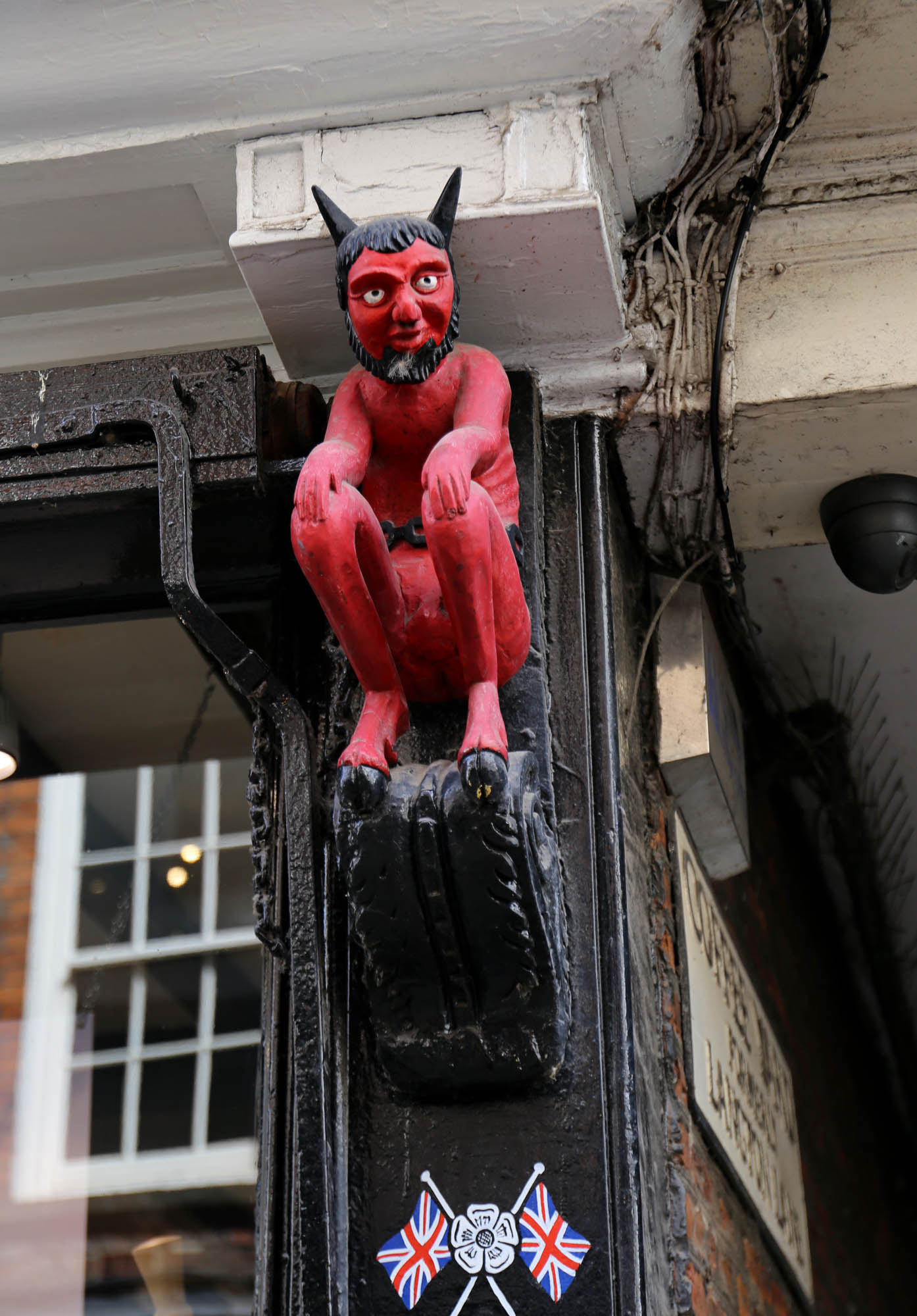
The devil was sitting on top of the column of a Renaissance shop portal at the corner of Stonegate and Coffee Yard. He did not wear Prada on his red body, but only an elegant black iron chain around his waist. His spread legs showed the absence of his reproductive organs, as he sat up there before the soon-to-be-started witch trials denigrated him as the corruptor of the unfortunate women dragged into court. He wore a carefully trimmed humanist’s round beard, and he carefully scanned the passersby on the other side of the streets. They, however, did not look back at him, because in York even the child knows that whoever looks into the eyes of the red devil will be in trouble that day.

The shop at 33 Stonegate, when the devil sat upon its portal, was a print shop. Book printing took root in the important university and episcopal city of York in the 1500s, and most of the printing presses operated on Stonegate. And the presses had their own devils. Not only because book printing was considered somehow magical and in league with the devil, but also because the masters had young assistants to mix the printing ink, smear it on the lead letters, then took them apart and, if necessary, remelt them. These smudgy guys were called the devils of the printing press. And if there was a mistake in the typesetting, the master spread the blame on the printer’s devil. And since the assistants also swore that they did everything right, the printer’s devil gradually became a mysterious and elusive being, an invisible inhabitant of the printing house, who leaves his handprints even on the most carefully set and twice proofread text, precisely on the page where the reader first opens the book.

In that period there was no house numbering yet. The houses and shops were marked with colorful signs, as we still see today in the Old Town of Prague. Think about it, what self-irony and courage it took for the Stonegate master to choose the manufacturer of printing errors, considered as shameful anomalies, for the emblem of his craft. True, by doing so, he slipped aside from blame. Whoever orders a job from a workshop dedicated to the Printer’s Devil, should not be surprised at the result.


Arrival of the Hungarians

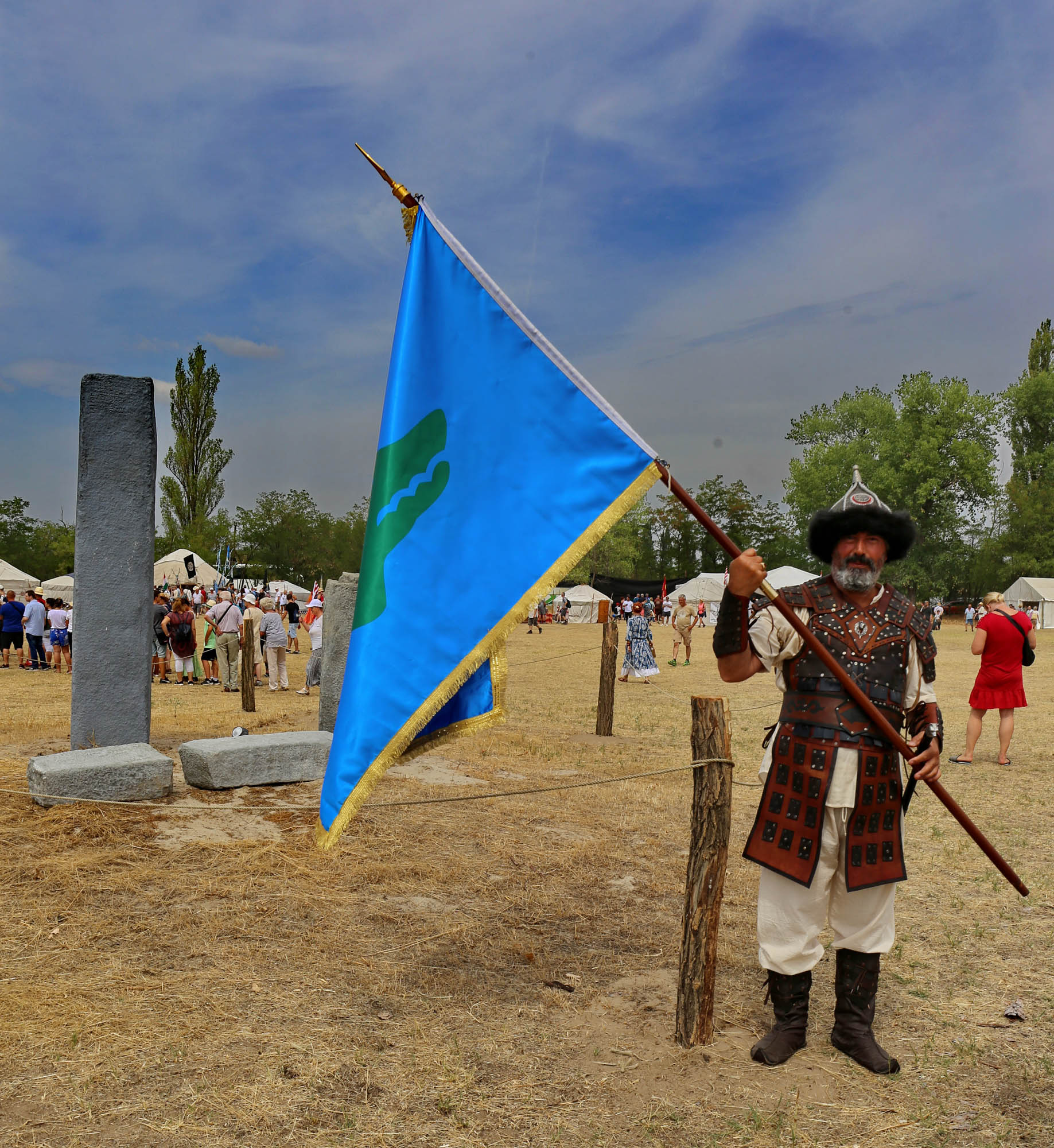
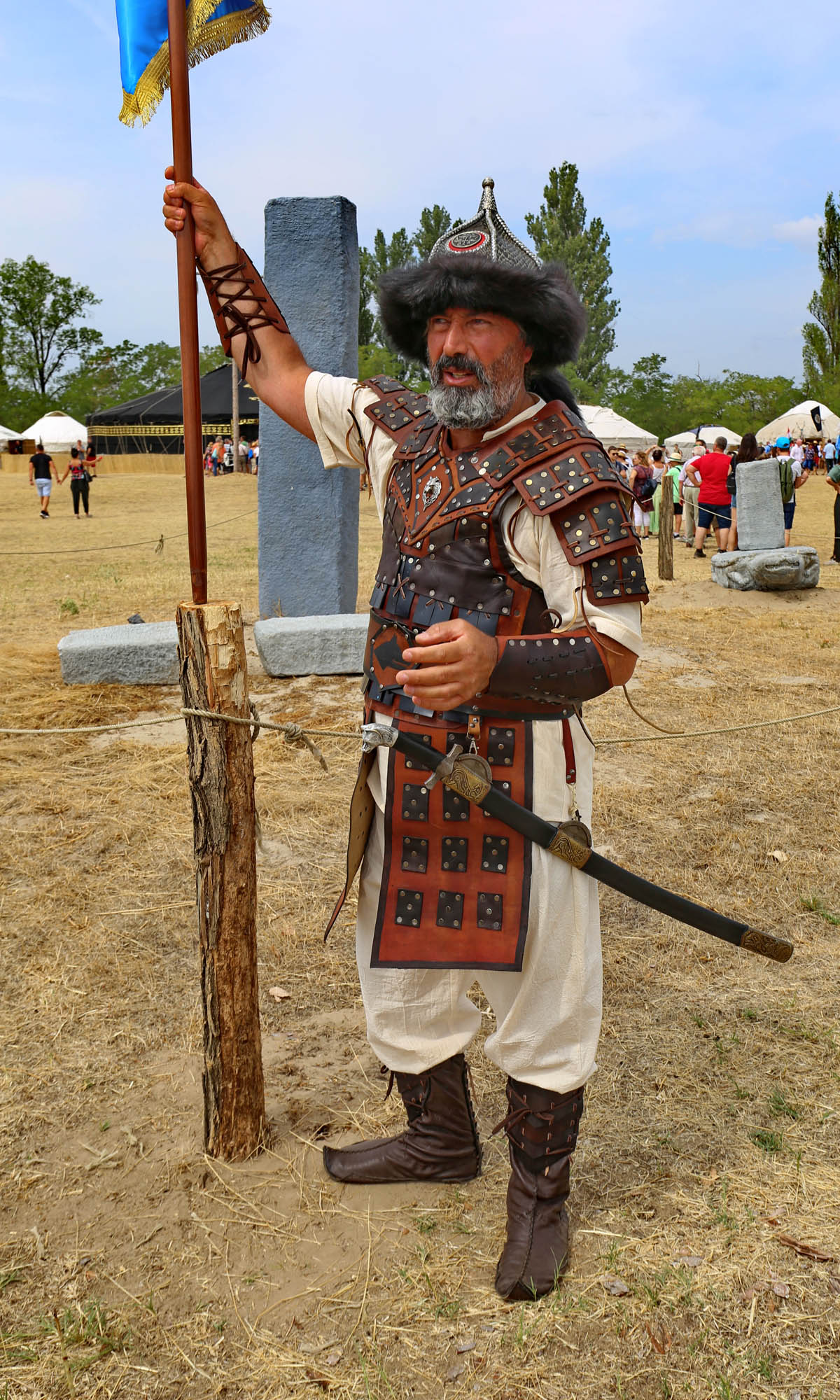
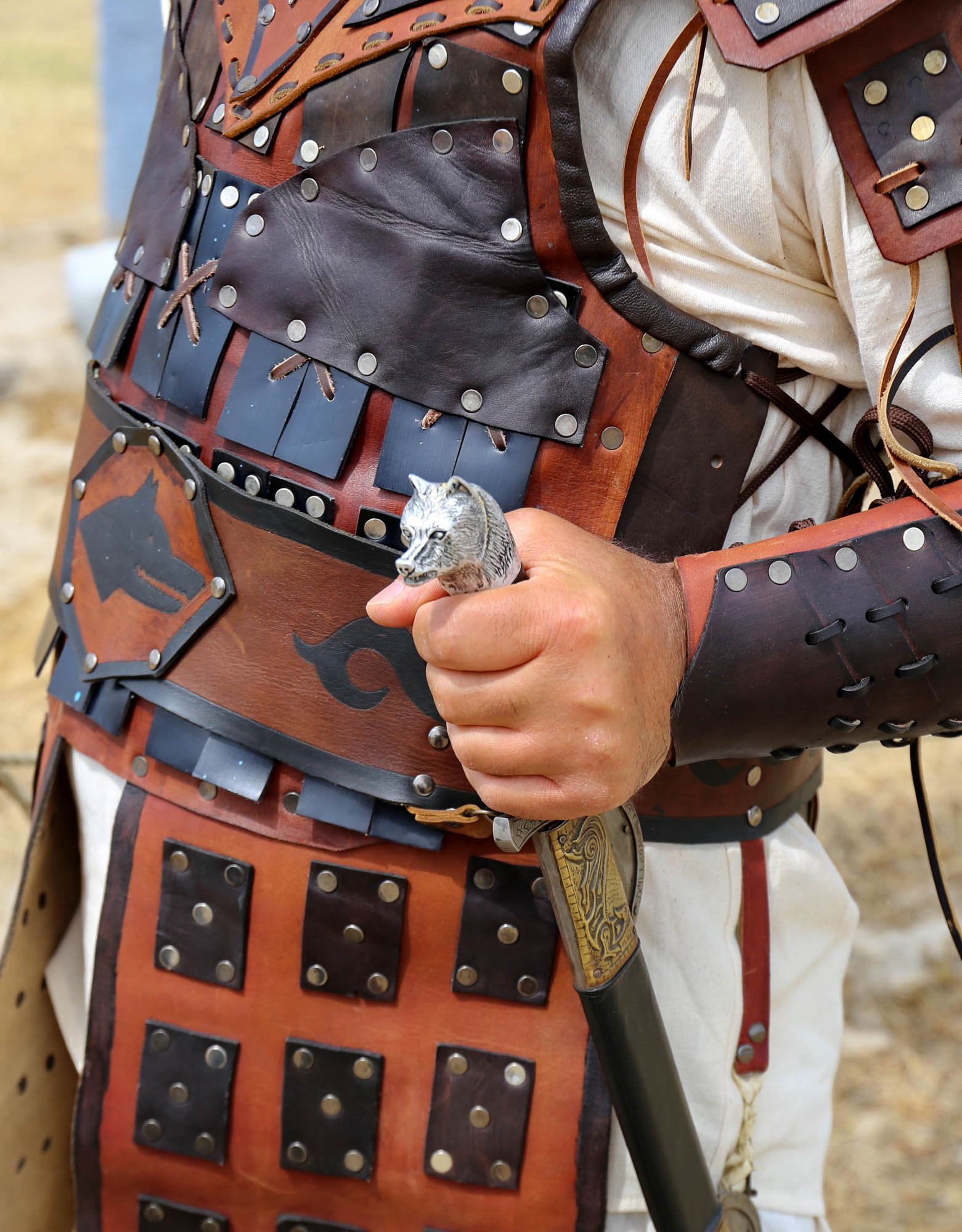
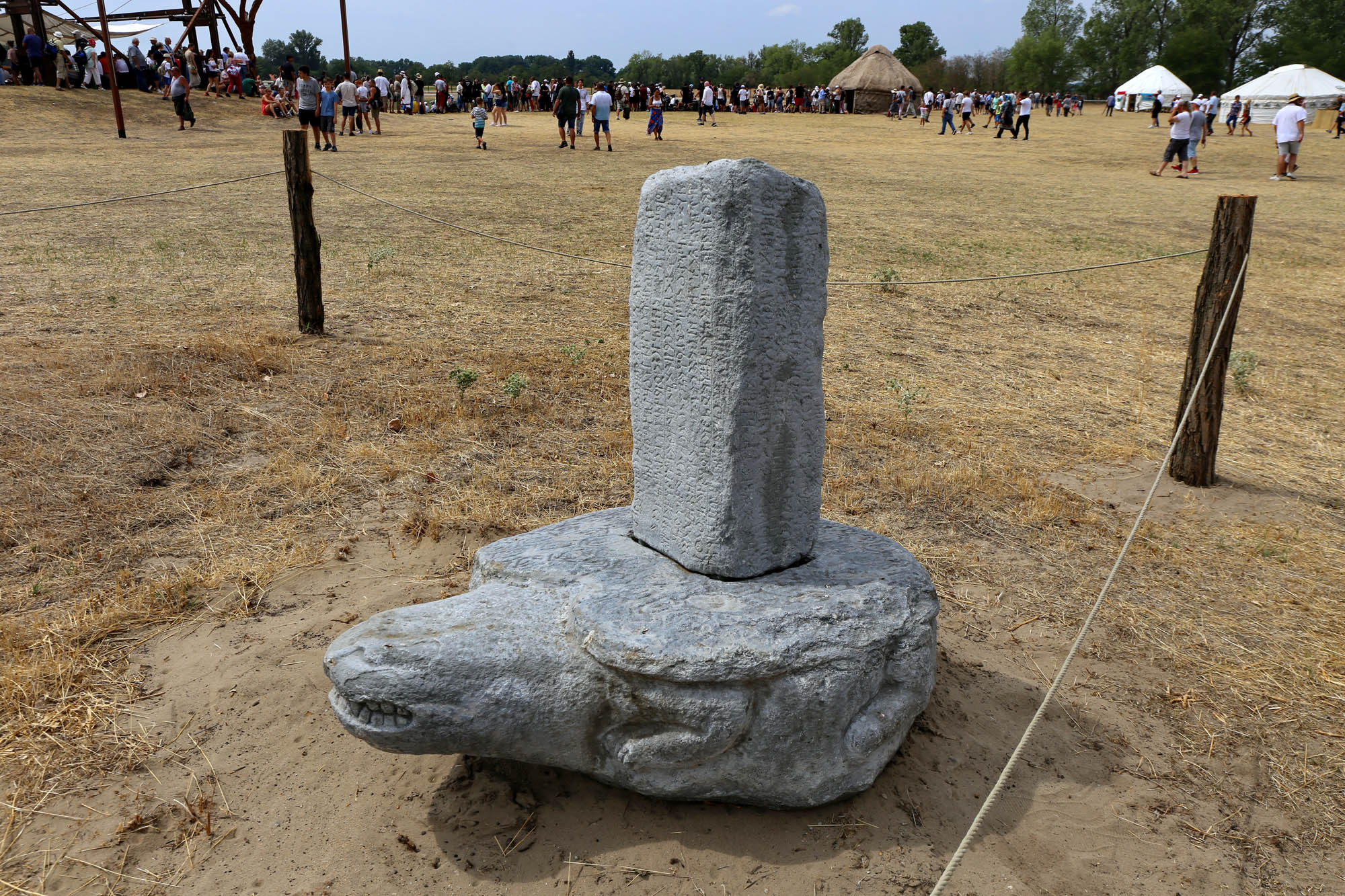
First I notice the scaled-down resin copies of the Orkhon steles with Old Turkic inscriptions in the puszta of Bugac, and only then do I pay attention to the nomadic warrior posing in front of them. “What flag is this?” I ask, pointing to the green wolf-headed flag in his hand, but he responds in German. I mistakenly considered him an ancient Hungarian warrior. He is actually German, he says with a Turkish accent, this is the first time he is in Hungary, otherwise he had attended similar traditional reenactment meetings in Turkey and Mongolia – the home of the Orkhon steles – with this portable apotheosis of Turkish writing. The green wolf is the imagined flag of the Göktürks ruling Orkhon in the 6th and 7th centuries. It was there that this runic script, adapted from the Aramaic script to the Turkic language, was first used to record the history of the empire. I say good-bye in Turkish, the silver head of his small symbolic animal nods in gratitude.

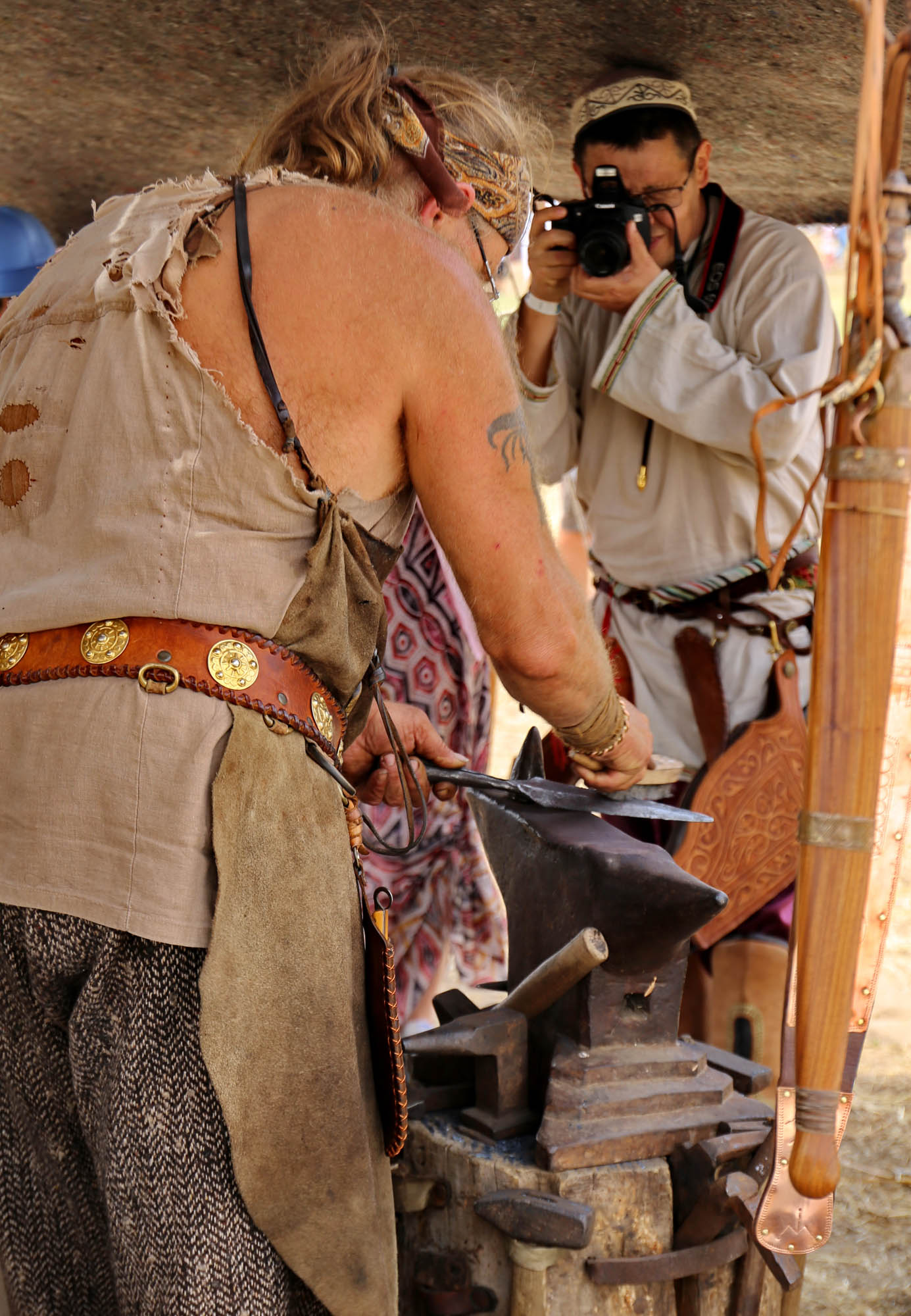
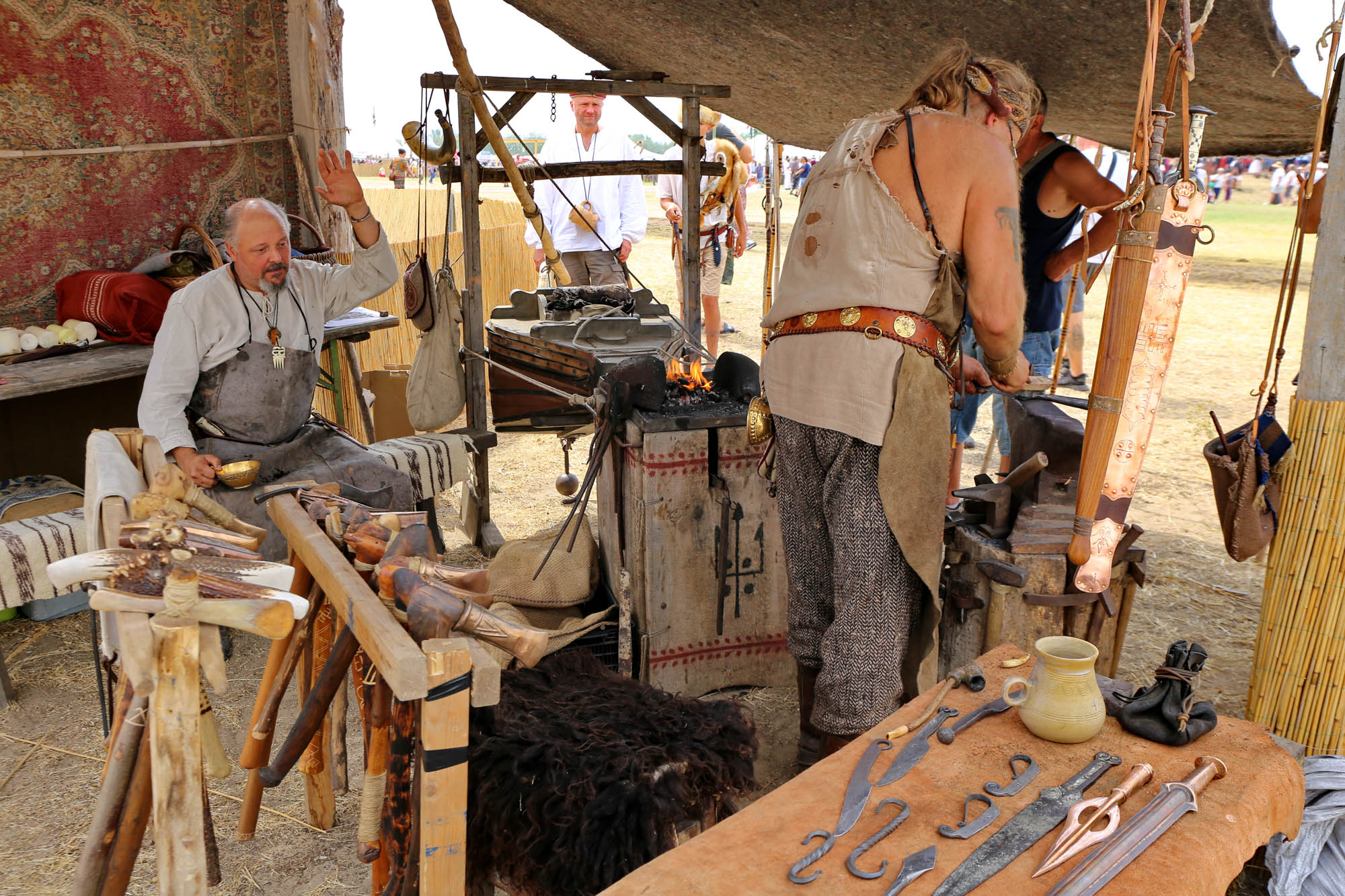
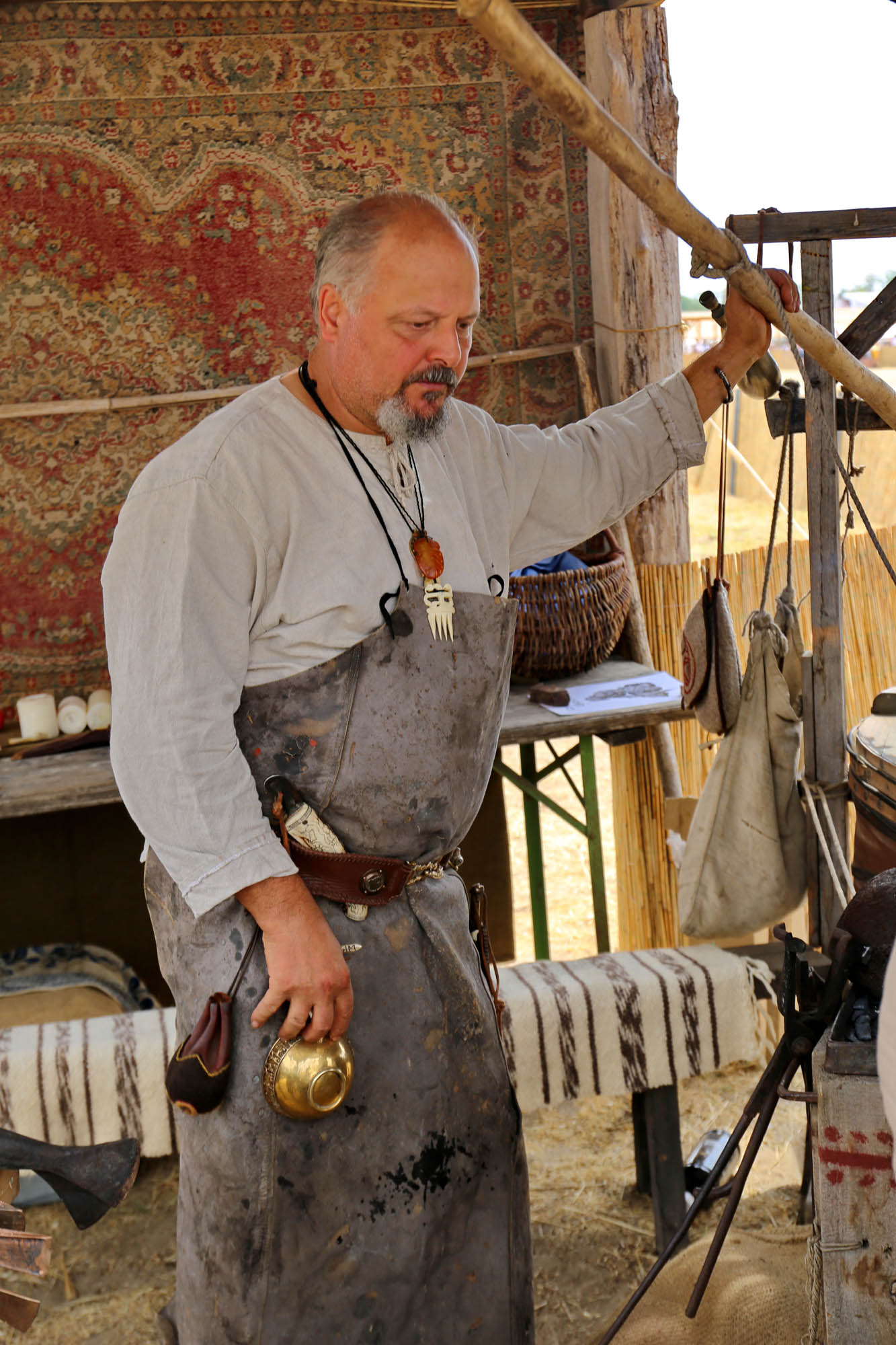
The nomadic Kazakh archer does a long photo session of a man demonstrating ancient Hungarian blacksmithing, pulling his Canon camera out from under his saddle. The master blacksmith, sitting on a bench covered with a rag rug, comments on the masterstrokes of his apprentice, spinning an empty drinking cup in his hand. “Is the drinking cup from the time of the Conquest?” asks one of the reverent spectators. “Actually, it’s a Tunisian tourist souvenir, but it would pass for the Late Iron Age.”

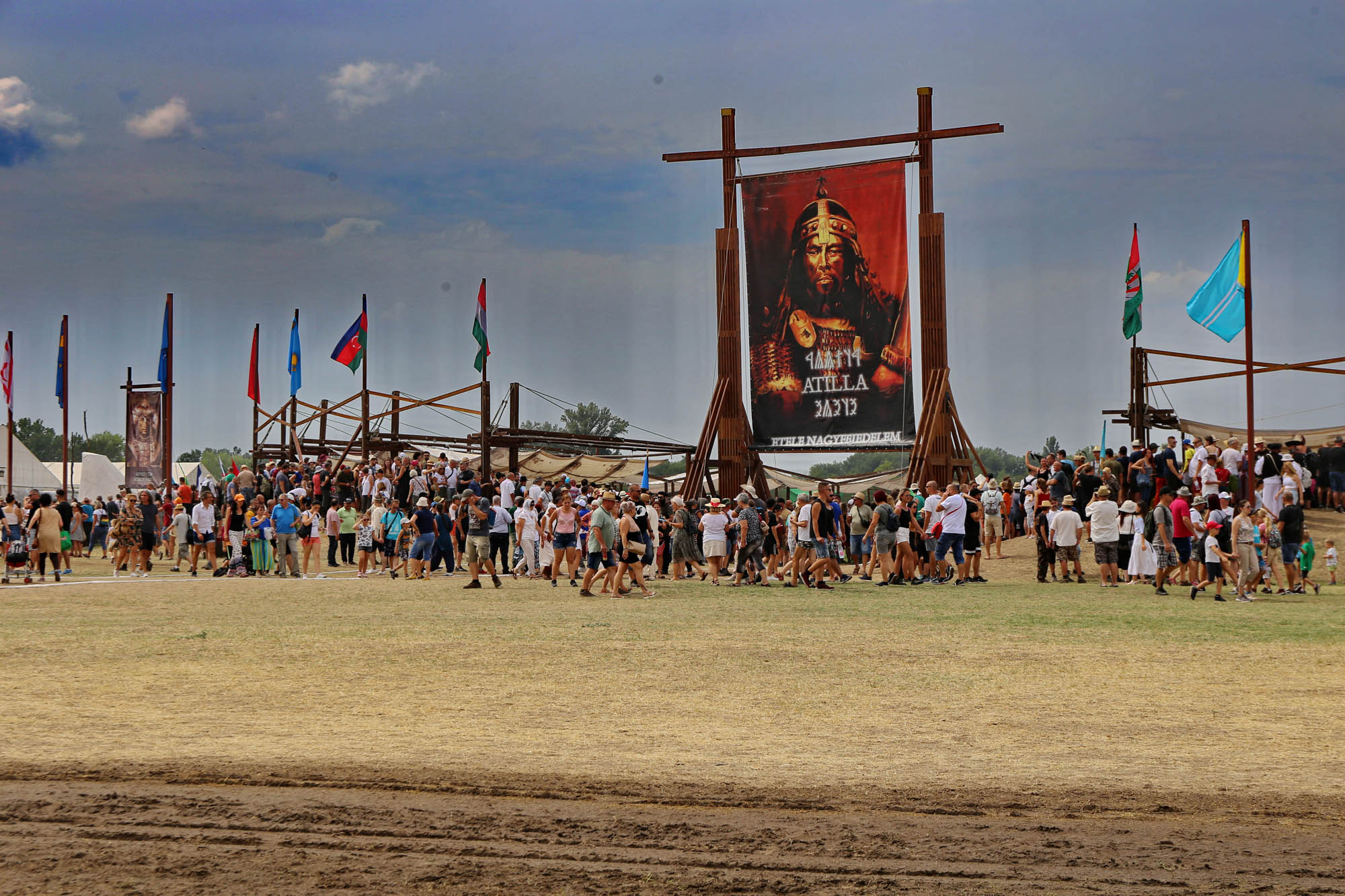
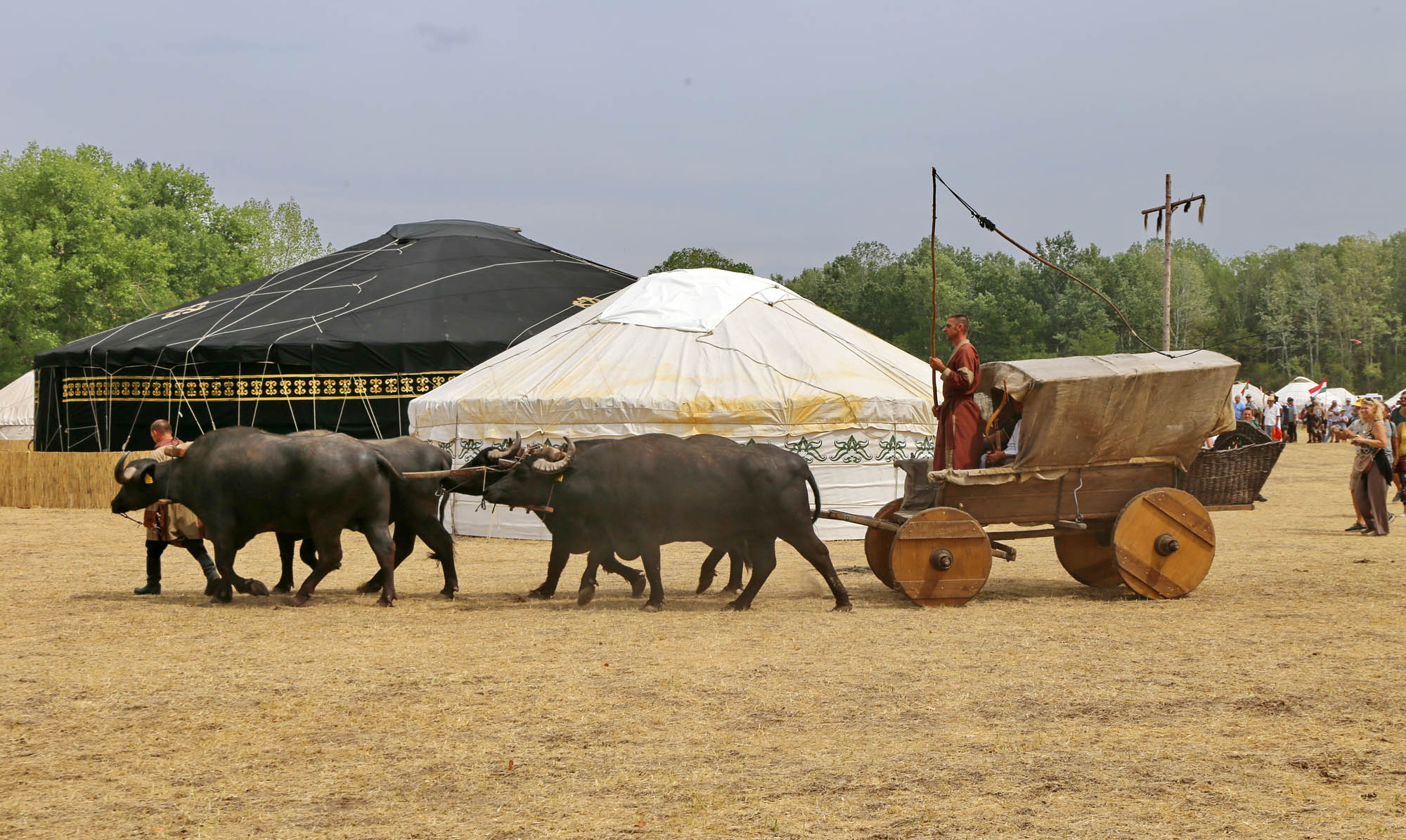
The highlight of the day is when, at noon, a cloud of dust rises in the Bugac steppe, from which the outlines of a cavalry column slowly unfold. They are the Hungarians who, after more than a thousand years, reenact how their ancestors arrived here, in the Carpathian Basin. Determined-looking men and women on horseback, behind them are heavy-footed infantrymen, between them carts for the old and the small folk. I can feel how this sight may have frozen the bowels of the Slavic onlookers of the time. Just as for the Hungarians when, a few centuries later, our nomadic brothers marched here in similary military columns. As they come closer, and I can clearly perceive that they are ours, I can better appreciate their enthusiastic participation and homage to the memory of our ancestors. Only one thing bothers me: I’ve been to many historical reenactment gatherings, and period clothing is essential everywhere. The participants subtly but clearly comment on possible anachronistic features of each other’s clothing. This parade, where everything goes from imagined Árpád dynasty costumes to csikós’ dress and 1848 military uniforms, is thus less a reenactment than rather a ritual procession, for which everyone has donned their best historical Sunday clothes. For the sake of the perfect experience, those who understand Hungarian should turn off the sound with the unctuous commentary of the celebrant:

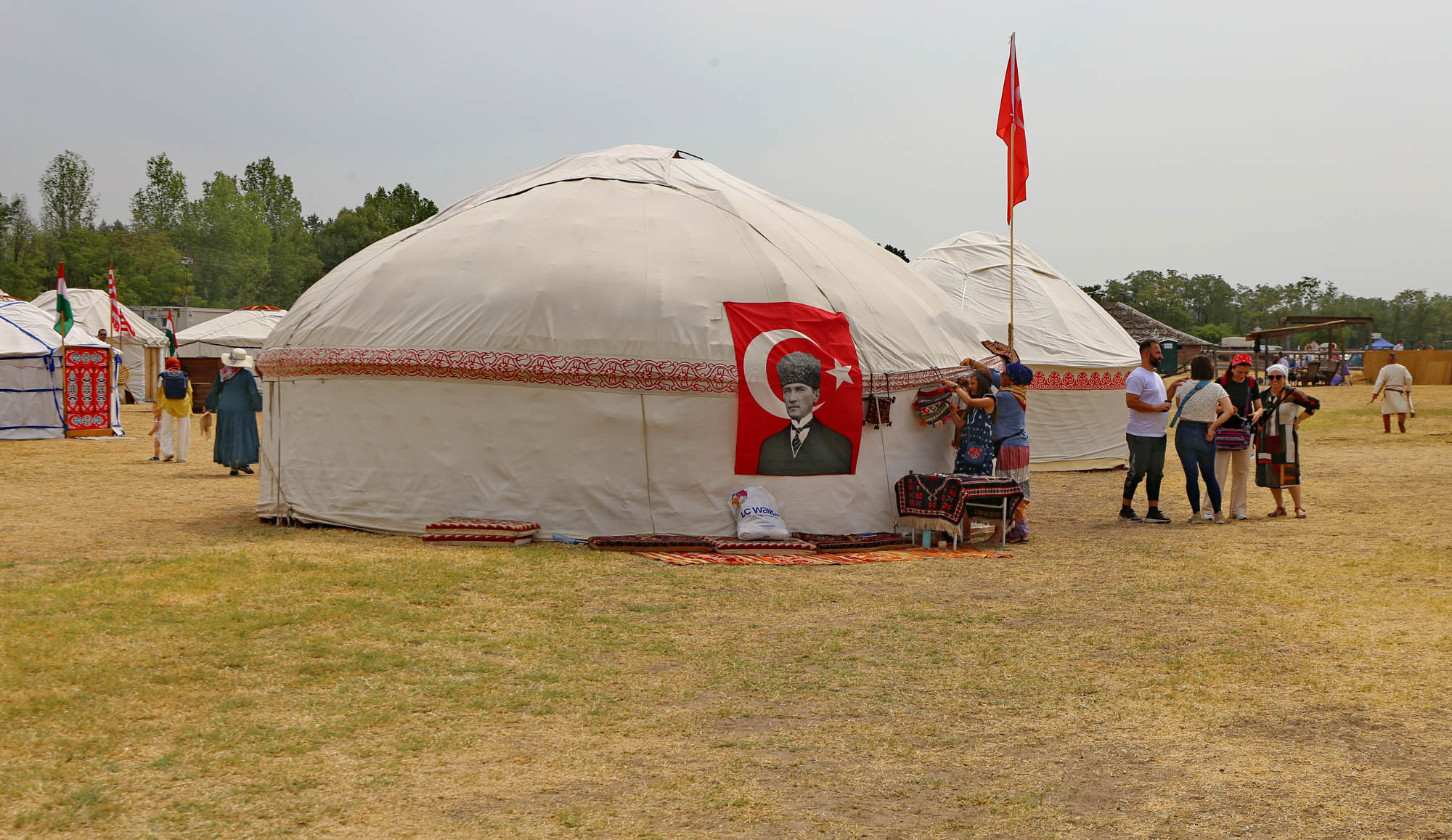
In Iran, on the second day of Ashura, there is a procession in Nushabad, where representatives of all parts of the country march long from the desert through the clay city, dressed in 7th-century warrior’s clothing, exotic armor and on various war animals, to fight for Imam Hussain who fell on this day, against the disgraceful Sunnis. A great visual advantage of this parade is that it proceeds along a two-meter corridor left open between the spectators, so that everyone can take a look at the horse or camel’s jewelry, the weapons, and the little boys’ clothes, since most of the warriors also bring a nicely clothed little boy in his lap, in memory of Imam Hussain’s little son who was escaped from the massacre. In Bugac, the conquering Hungarians are kept far away from their late successors, but then those of them incompatible with a group image – the pedestrians, carts and camels – quietly slink away among the yurts after the march. There you can take a closer look at them, and the spectators happily take advantage of the opportunity. Just be careful not to get bitten by a camel – this danger is one of the central metaphors of the main speaker of the event, a founding member of the right-wing government party.
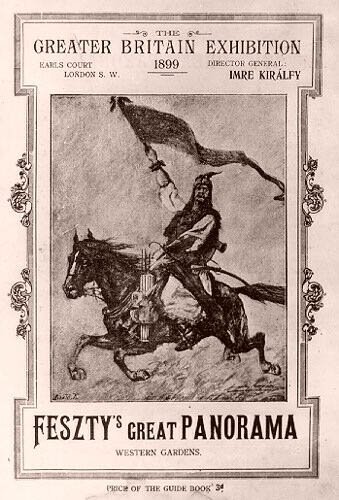
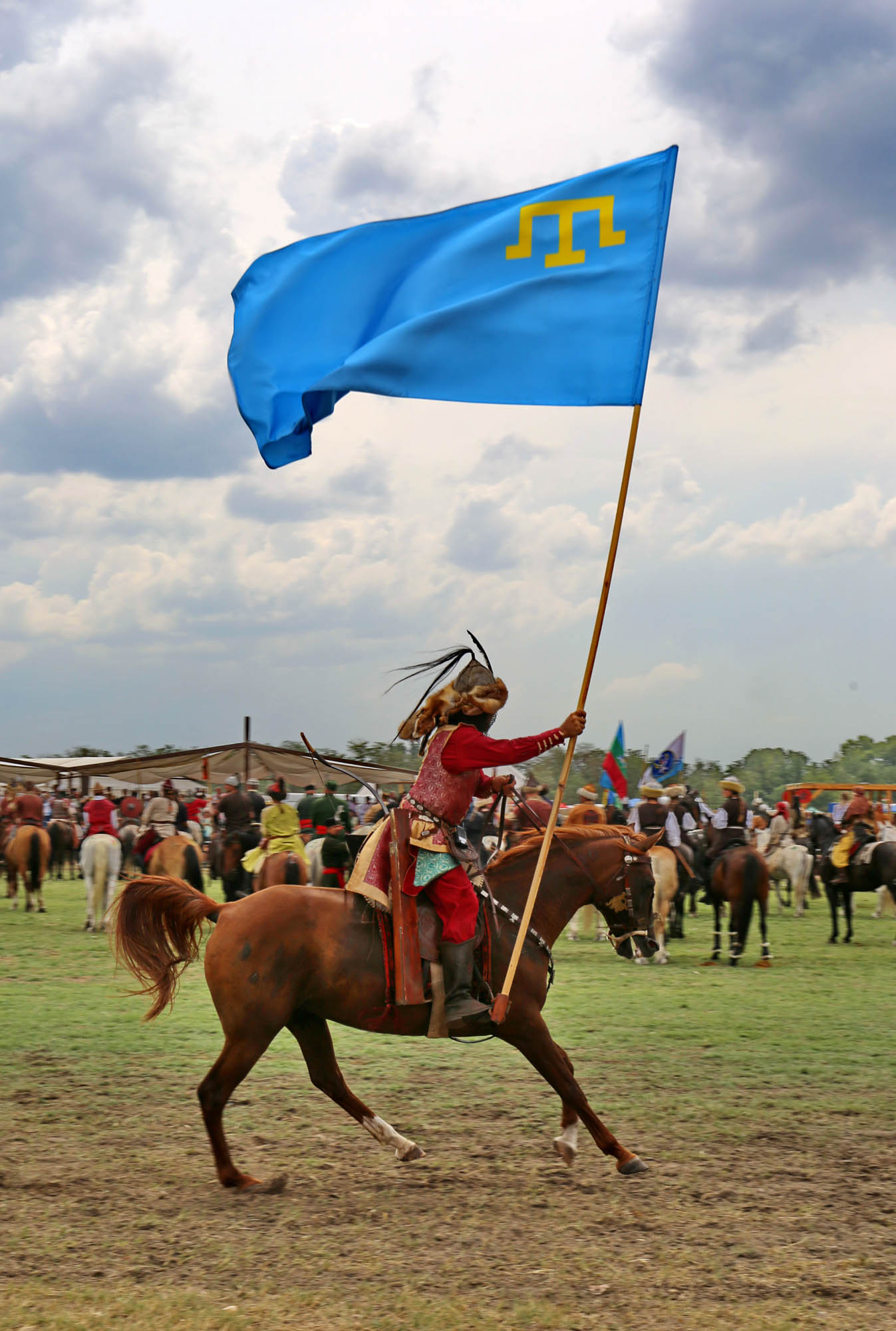
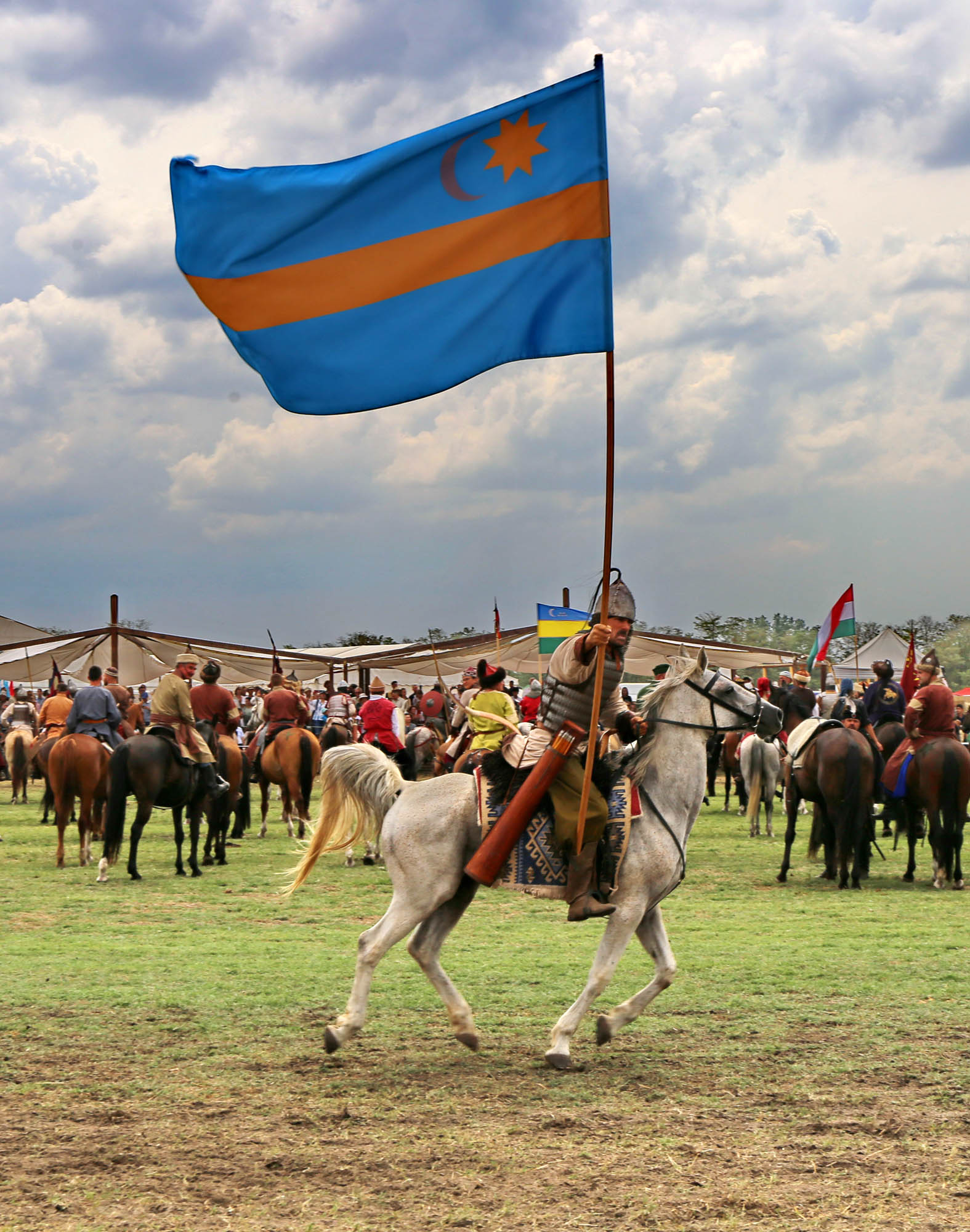
Representatives of twenty-seven peoples with nomadic roots participate in this year’s kurultay on horseback and in historical costumes. After the conquering Hungarians marched in, one horseman from each of them ran around the Hungarian camp with the modern flag of their people. This motif was perhaps taken from the photos of the show accompanying Árpád Feszty’s famous Arrival of the Hungarians (1894) in the Greater Britain Exhibition of 1899-1909. The Kyrgyz and the Mongol fall off of their horses: what a shame! They will probably be beheaded back home. Here we see the flag bearers of the Crimean Tatars and the Transylvanian Szeklers. The eternal and unbreakable Tatar-Transylvanian friendship dates back to the centuries of the Principality of Transylvania, when Tatars sometimes went on study trips to the rich cities of Transylvania, just as Transylvanians did to the tanneries of the Crimea, as Mór Jókai vividly describes in A Damokosok (on this, see our post). Their last joint venture was when, in 1717, Prince Rákóczi’s former Hungarian insurgents and the Crimean Tatars, on the Sultan's behalf, broke into and plundered Transylvania, already ruled by the Habsburgs. The city of Szék / Sic was also destroyed at that time, which the people of Szék still mourn each year on August 24. I was there a few years ago and suggested that the Crimean Tatars might also be invited to the upcoming 300th anniversary in 2017 as a symbol of reconciliation. The hard-necked Calvinist presbyters of Szék just shook their heads. “It’s not time yet.”