Sursum corda

Detail of the floor mosaic of Santa Maria Maggiore in Rome
dedicado a Wang Wei quien sabe
que también entre los pucheros anda

In one morning in the spring of 1977, in the high school „Margit Kaffka” – some decades earlier and later „Holy Margaret” – the teacher responsible for the mobilization of the Communist Youth Association went round the classes. He was inviting people for the folk dance instruction of the Torch Folk Ensemble in the afternoon.

The group was going to start a dance house on the model of the already popular Hungarian folk dance houses, where they were going to teach the dances of the Serbian, Croatian, Bulgarian, Greek and Macedonian ethnic minorities. They were going round the high schools of Budapest for recruiting participants.

Our school was visited by the wife of the ensemble’s leader Antal Kricskovics. She was an extraordinary beauty. Apart from her really exceptional appearance, she owed this also to her majestic bearing.

She arranged us in a circle and immediately started the instruction. We draw our stomach in, trust the chest out, press the shoulders down. Our back is tight, but the hip and the limbs move easily and flexibly.

If you do all this, you immediately begin to breathe with full lungs. This was not customary in those times. The majority of Hungarian society compromised with the political system. People sought after momentary survival, small advantages, permitted little joys. They went about humped, they took shallow, gasping breaths.

After we clarified the necessary bearing, she taught us the song “Makedonsko devoiche”, and then she started to teach the steps. Not only the bearing was majestic, but the song and the steps as well.

Now as I’m writing this, I look over what sorts of music were available at that time. And I see that almost exclusively those that matched a convulsively disciplined and limited, sentimental and sensual taste of the petty bourgeoisie. Those which, even if they touched something majestic, only did so in order to pull it down to this vulgarity. “Goodbye, my sweet Piroska, there are even more beautiful girls than you.” Two steps to the right, two steps to the left. The musical indoctrinations of compromise, momentary survival, small advantages and permitted little joys.

At that time I did not know anything about the subtle and intricate rhythmic structures of Balkan and Greek music, neither that I was encountering a tradition that had been preserved since the ancient Greeks. There was no live music, not even a tape recorder, only ten or fifteen teenager girls coming together by chance and singing “Makedonsko devoiche” – and my heart rose up.

And that dance… Ten years later, on a warm summertime Sunday afternoon the wandering tambura-player arrived in the small Southern Hungarian village, at that time already inhabited only by Gypsies. He played kolo for some pennies. Immediately a great flock gathered around him, and everyone was watching him with great yearning. The man who counted as a chief came out from his hovel, accompanied by his two wives. None of the two was older than thirty, but they were already old women, tormented, bowed and emaciated. The man gave over the money with a theatrical gesture. One woman stood to his left and the other to his right. The music started. They began to dance the kolo, with a tight back, but with a loose hip, easily and flexibly. Their dance was characterized by a peculiar dignity, not canceling, but embracing their misery. Like the hand of the resurrected Christ the traces of the wounds.

At that time, in that spring afternoon of 1977 I did not know anything about Christ either. But as I pulled myself out and held on to the others, my heart rose up. I was touched by that peculiar dignity that cannot be canceled by any misery.

At the end of the instruction the wife of Kricskovics announced that the first dance house will be held in the House of Culture on Sunday afternoon. Of course I went there.

In the thereafter following two years I lived from Sunday to Sunday. I went to the dance house of Kricskovics like a believer goes to Mass. These dances let me, the atheist, experience the sacred through my own body.

Postscript. As I began to write this post, Tamás found a number of recordings of “Makedonsko devoiche” on the web. All of them are that sentimental “my sweet Piroska” kind, they have nothing to do with the rising up of the heart.

I thought it was the creative genius of Kricskovics as a dancer that he was able to evolve the inherent transcendental potentiality of the music and dance of the Balkan. Certainly, it was necessary to that.

But there was also something else that I had not known, and I only discovered it as I made some research to this post. Kricskovics was a devout Catholic, characterizing this period of his life in an interview given in 2005 like this:

“In the 70s began a new period of creation for me: the period of religious and Biblical themes. … With time one gets nearer and nearer to faith, and is more and more attracted by the artistic possibilities offered by the Scripture.” (Antal Kricskovics is 75 years old)


In the lack of authentic folk music, let us listen to one of my favorite songs of those times: the “Highwayman Ilju”, a Macedonian-inspired poem by the great Hungarian poet László Nagy, performed by the old Kolinda group (1977!). I do not know what route took them to the point of perceiving and transmitting the transcendence inherent in this music – their singer Ágnes Zsigmondi, for example, was an offspring of the Communist political establishment just like me –, but I do not know any other musical group coming anywhere near to them. I think this was one of the reasons why they, while being highly successful in Western Europe, could not publish a single record in Hungary.


Kolinda, Ilju haramia (Highwayman Ilju), from the LP “Kolinda II”, 1977 (poem by László Nagy)

Hey how they’re gathering to go to war
Hey how they are gathering
The pagans of Kochan
Mother, my sweet, the pagans of Kochan

Hey how densely they are coming, my sweet
Hey how densely they are coming
To the wide water of Kriva
Mother, my sweet, to the wide water of Kriva.

Hey how they would like to put in irons
Hey how they would like
Highwayman Ilju
Mother, my sweet, Highwayman Ilju.


Hey but Ilju is not there, my sweet
Hey Ilju is not there
At the wide water of Kriva
Mother, my sweet, at the wide water of Kriva.

Hey Ilju is having a merry time, my sweet
Hey he’s having a merry time
In the city of Solun
Mother, my sweet, in a good cool tavern.

Hey he is served, my sweet
Hey he is served
By a beautiful Macedonian girl
Mother, my sweet, by a beautiful Macedonian girl.
Hej de, gyűlnek hadba, édes,
Hej de, gyűlnek hadba
Kocsáni pogányok,
Anyám édes, kocsáni pogányok.

Hej de, sűrün jönnek, édes,
Hej de, sűrün jönnek
Széles Kríva vízhez,
Anyám édes, széles Kríva vízhez.

Hej de, vasra vernék, édes,
Hej de, vasra vernék
Ilju haramiát,
Anyám édes, Ilju haramiát.


Hej de, nincs ott Ilju, édes,
Hej de, nincs ott Ilju,
Széles Kríva víznél,
Anyám édes, széles Kríva víznél.

Hej de, vígad Ilju, édes,
Hej de, vígad Ilju,
Szolun városában,
Anyám édes, jó hűvös ivóban.

Hej de, néki szolgál, édes,
Hej de, néki szolgál,
Széplány, makedonka,
Anyám édes, széplány, makedonka.

Now as I’m listening to it, this song even thirty years later asks me whether I’m living with a heart rose up enough. Perhaps I will write more about them.

The dawn gives news

The Dawn from the video clip of the poem by Mahdi Akhavan Sales, set to music by Soheil NafissiThe sewer in the background is just like the thousand other ones that run down from the Darband through the rich northern suburbs of Tehran to the poor southern suburbs of Tehran, covering a level difference of a thousand meters and a thousand years, flushing the city of twelve million inhabitants with the fresh spring-water of the mountains, and supplying an unforgettable background and pitch-note to such marvelous films like the Bachehâ-ye âseman (Children of the Sky) by Majid Majidi, or Tehrân sâ'at-e haft sobh (Tehran, seven in the morning) by Mohsen Makhmalbaf. The few that we can see of the houses also permits to localize it somewhere in the southern part of the city, in one of the alleys of the former southern center developed by the Shah and since then swallowed by the bazaar, from the low windows suitable both to sale and to fostering neighborhood life, through the sky-blue door to the emerald green moss growing at the foot of the walls. It is only this burning red rusari that we would not find anywhere.

Recently, in a night requiring lots of Catalan red wine we compared with Wang Wei the songs of different changes of regimes from Eastern Europe to the Spanish Transition. Then we quoted by way of example this poem of one of the greatest modern Persian poets Mahdi Akhavan Sales (1928-1991), set to music by Soheil Nafissi. However, in the roll of the video below in vain we look for the name of Sales. Perhaps he was omitted by way of precaution. Sales – ثالث Saless, as one of the best Tehran bookshops rebelliously calls itself (in the quoted post a bit above the portrait of Lőrinc Szabó) – under the Shah’s rule wrote poems expressing the anxiety of the period (to the Zemestan ast, It’s Winter we will dedicate a separate post), and in the thereafter following times ones similar to the Dawn. To this he owes the summary judgment of today’s official Iranian history of literature: “After 1979 his literary activity shows decline.” After the hastily prepared night translation of the post quoted above, now we want to offer a more reasoned one, so that everyone might decide for himself whether it is really a decline (and if yes, then what kind of peaks exist in Persian poetry), and everyone could foretell what it means when such a poem is set to music, sold on a successful CD and broadcasted in Iranian internet radios.


شهاب‌ها و شب‌ها
Shahâbhâ va shabhâ
Comets and nights

Persian poetry is made so beautiful and untranslatable by its preference to exploit the assonance of sounds and the thereby established accidental relations of words. Who would ever think that night and comet, darkness and light are in such a close relationship to each other: shab and shahâb. This constitutes one of the basic motifs of the poem, the thread of sounds “sh” running through it and linking darkness and light, parallel to which runs that of the adjectives and metaphors beginning with “r”.

از ظلمت رمیده خبر می‌دهد سحر
شب رفت و با سپیده خبر می‌دهد سحر
از اختر شبان رمه شب رمید و رفت
از رفته و رمیده خبر می‌دهد سحر

Az zolmat-e ramide khabar midehad sahar
shab raft o bâ sepide khabar midehad sahar
az akhtar-e shabân rame-ye shab ramid o raft
az rafte o ramide khabar midehad sahar

Of the darkness scared away gives news the dawn
the night has gone and with the daybreak gives news the dawn
the flock of the night was scared away from the star of the shepherd and has gone
of the scared away and the gone gives news the dawn

The quatrains with rhyme scheme AABA or CABA – where A is not just a simple rhyme, but rather the magic repetition of some words throughout the poetry – continue the tradition of medieval Persian rubaiyyat, like the quatrains of Omar Khayyam. Ramidan, scare away, raftan, go (away), rame, flock (related to German and English Ram and ram) – these are the r-columns of this quatrain, resonating with the words akhtar, star (a kin to Latin aster), khabar, news, and of course sahar, dawn, an Arabic word related to the Hebrew Zohar. Sepide, daybreak (which is also a common woman’s name) comes from sefid, white, which, contrasted to the reds of the following strophes, adds further shades to the interplay of darkness and light.

The adjectives scared away and gone in the first three verses refer to the night and its “flock”, but the last verse, by taking them from their context, bears a strong reference to those scared away and gone due to the night. This adumbration, so familiar to the Eastern European reader, is a much liked instrument of Persian poetry.

The “star of the shepherd” is a strange image, but only until we learn that it is also based on verbal consonances. In the term akhtar-e shabân the shabân is an archaic, poetic plural for shab, night, so at first sight it sounds like “star of the nights”. However, shabân also means “shepherd” (this is where Hungarian “csobán” comes from), and the second part of the verse already alludes to this meaning with the word flock, offering such a mythical metaphor for the morning star like the Hungarian poet Ágnes Gergely who also calls it “shepherd of old flocks” in one of her poems.

زنگار خورد جوشن شب را به نوشخند
از تیغ آبدیده خبر می‌دهد سحر
باز از حریق بیشه خاکسترین فلق
آتش به جان خریده خبر می‌دهد سحر

Zangâr khord joshan-e shab-râ bâ nushkhand
az tiq-e âbdide khabar midehad sahar
bâz az hariq-e bishe-ye khâkestarin falaq
âtash be jân kharide khabar midehad sahar

Rust ate the shield of night with a smile
of tempered blades gives news the dawn
from the grove of the gray morning set to fire
brings fire to the soul the news-bringing dawn

In the 80s we Eastern Europeans also learned how rust can eat the shield of the night. However, at that time it was not advisable to speak about tempered blades. In fact, upon a closer view this poem does not speak about them either. Tiq means first of all ray, and only in a second meaning blade or sword. Tiq-e aqtân for example means the rays of the dawn. Thus also the above compound tiq-e âbdide can mean âb-dide, “water-seen” rays, like those of the rising sun reflected on the surface of the water. This would also fit to this poem, nobody can utter a word. However, a much more accepted meaning of this compound is water-seen blade, that is tempered steel sword, and the fact that nobody uttered a word about this either shows how much the rust has already eaten the shield of the night.

از غمز و ناز و انجم و از رمز و راز شب
از دیده و شنیده خبر می‌دهد سحر
بس شد شهید پرده شبها شهاب‌ها
وان پرده‌ها دریده خبر می‌دهد سحر

Az qamz o nâz o anjâm o az ramz o râz-e shab
az dide o shenide khabar midehad sahar
bas shod shahid-e parde-ye shabhâ shahâbhâ
va ân pardehâ daride khabar midehad sahar

Of the signs, coquetry, secrets and termination of the night
the things seen and heard gives news the dawn
of the comets fallen before the fall of the shroud of the night
who tore that shroud off, gives news the dawn

The pulsation of the short words piling up in the first verse is one of the most beautiful examples of the typical Persian play with sounds in this poem.

آه آن پریده رنگ چه بود و چه شد کزو
رنگش ز رخ پریده خبر می‌دهد سحر
چاووش‌خوان قافله روشنان امید
از ظلمت رمیده خبر می‌دهد سحر

Âh ân paride rang che bud o che shod kazu
rangash ze rokh paride khabar midehad sahar
châvushkhân-e qâfele-ye roshanân omid
az zolmat-e ramide khabar midehad sahar

Oh, what was that pale color, and how could it be
that about pale faces gives news the dawn?
She’s the leader of the song of the hope-bringing caravan of stars,
of the darkness scared away gives news the dawn.

And now, with full knowledge of the text, let us listen a second time to the video.


Comets and nights

Of the darkness scared away gives news the dawn
the night’s gone and with the daybreak gives news the dawn
the flock of the night was scared away
         from the star of the shepherd and has gone,
of the scared away and the gone gives news the dawn

Rust ate the shield of night with a smile
of tempered blades gives news the dawn
from the grove of the gray morning set to fire
brings fire to the soul the news-bringing dawn

Of the signs, coquetry, secrets and termination of the night
the things seen and heard gives news the dawn
of the comets fallen before the fall of the shroud of the night
who tore that shroud off, gives news the dawn

Oh, what was that pale color, and how could it be
that about pale faces gives news the dawn?
She’s the leader of the song of the hope-bringing caravan of stars,
of the darkness scared away gives news the dawn.

Shahâbhâ va shabhâ

Az zolmat-e ramide khabar midehad sahar
shab raft o bâ sepide khabar midehad sahar
az akhtar-e shabân rame-ye shab ramid o raft
az rafte o ramide khabar midehad sahar


Zangâr khord joshan-e shab-râ bâ nushkhand
az tiq-e âbdide khabar midehad sahar
bâz az hariq-e bishe-ye khâkestarin falaq
âtash be jân kharide khabar midehad sahar

Az qamz o nâz o anjâm o az ramz o râz-e shab
az dide o shenide khabar midehad sahar
bas shod shahid-e parde-ye shabhâ shahâbhâ
va ân pardehâ daride khabar midehad sahar

Âh ân paride rang che bud o che shod kazu
rangash ze rokh paride khabar midehad sahar
châvushkhân-e qâfele-ye roshanân omid
az zolmat-e ramide khabar midehad sahar.

Huehuetlahtolli

We have just learned the melodious word huehuetlahtolli” in the volume of essays edited by Roxana Recio, Traducción y humanismo: Panorama de un desarrollo cultural (Soria: Vertere. Monográficos de la revista Hermeneus, 2007). It is in Nahuatl, and it is composed by huehue (ancient) and tlahtolli (word, discourse, account, proverb, warning), so that its literal traduction would be “ancient word”. However, it would be more proper to translate it as “word – or testimony – of the ancients”, as it refers to a sort of simple didactic texts, written in beautiful verses and provided with delicate metaphors, which were used to inculcate the moral principles of civilization upon the youth. This is how it is explained in the analysis by Librado Silva Galeana, «Los huehuetlahtolli recogidos por fray Andrés de Olmos, publicados después por fray Juan Bautista. Algunas dificultades que presentó su traducción» (pages 173-185 of the book quoted).
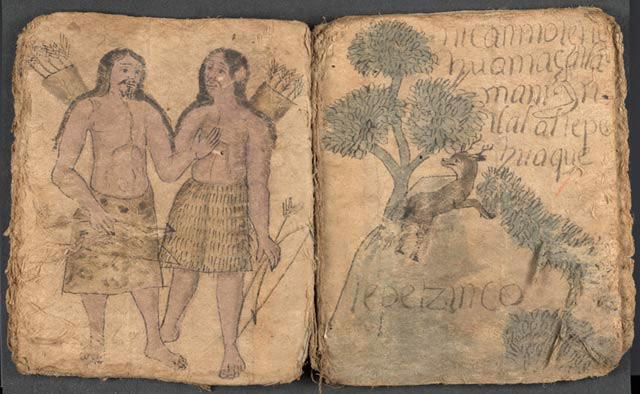
Don Andrés, Aztec notary: Techialoyan land records, in Nahuatl (17th c.) (Mexico)Don Andrés, Aztec notary: Techialoyan land records, in Nahuatl (17th c.)

These texts include that few that has been preserved from the culture of the ancient Mexicans. In the surviving compilations we can feel the efforts of the last Pre-Colombian generation done in a moment when their world has already been forever annihilated, and the dominion of the conquerors has become unequivocally palpable.

From here, far in space and time we believe that the ancient Nahuatl are also “our ancestors”. They began to become that in the very moment when Spain reached to them and the two people started to blend, and their word should be heard by us with the same attention dedicated to our European forefathers. Unfortunately, in the Spanish universities these themes are generally ignored. After the immense and grotesque publicity campaign dedicated by the Spanish government to the celebrations of the Fifth Centennary in 1992, we have fallen into the most absolute disdain in confront of the American culture (obviously, there are always small exceptions). What most vigorously survives from those solemnities are the sometimes vitrioline critical essays dedicated by Rafael Sánchez Ferlosio to them as well as to the relation of Spain with America.

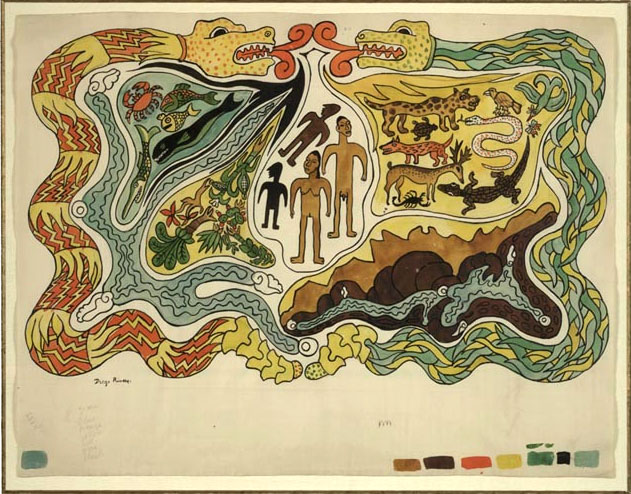
Diego Rivera (1886-1957): The Creation. Illustration to Popol Vuh, c. 1931Diego Rivera (1886-1957): The Creation. Illustration to Popol Vuh, ca. 1931

The occasion that moves us to write this commentary is the fresh shock of having seen the extremely distorted view of history of the Apocalypto perpetrated by Mel Gibson. It was the more irritating as with the means at his disposal he could have made of this theme something really good. True, we were delighted to hear the dialogues en Maya, but these spectacular simplifications of history create topic that stick to the mind of the spectator like a tick, forever blocking the way to any more subtle approach.

Anyway. Now our main task is to find this book: Fray Juan Bautista Viseo, Huehuetlahtolli: testimonio de la antigua palabra. Ed. Miguel León-Portilla. Trad. Librado Silva Galeana. México: Comisión Nacional Conmemorativa del V Centenario del Encuentro de Dos Mundos, 1988 (and México: Fondo de Cultura Económica, 1991).

Huehuetlahtolli

Ayer aprendimos la sonora palabra «huehuetlahtolli» en la colección de estudios que ha publicado Roxana Recio Traducción y humanismo: Panorama de un desarrollo cultural (Soria: Vertere. Monográficos de la revista Hermeneus, 2007). Es náhuatl y está compuesta de huehue (viejo, en el sentido de antiguo) y tlahtolli (palabra, discurso, relato, refrán, amonestación), así que su traducción literal sería «antigua palabra». Quizá sea más adecuado traducirla por «la palabra –o el testimonio– de los ancianos» porque designa unos textos didácticos simples –aunque de una poesía directa, hermosa y cuajada de delicadas metáforas– con que se adoctrinaba a los jóvenes y se les enseñaban los principios morales de la civilización. Así lo explica el trabajo de Librado Silva Galeana, «Los huehuetlahtolli recogidos por fray Andrés de Olmos, publicados después por fray Juan Bautista. Algunas dificultades que presentó su traducción» (págs. 173-185 del libro citado).

Don Andrés azték jegyző: Techialoyani birtokkönyv nahuatl nyelven (17. század) (Mexikó)Don Andrés, notario azteca: Catastro de Techialoyan en náhuatl (siglo XVII)

En estos textos se encuentra lo poco que nos ha quedado de la cultura de los antiguos mexicanos. En las recopilaciones que han sobrevivido vemos los esfuerzos de la última generación precolombina esmerándose en dejar constancia del viejo saber cuando ya había ocurrido la aniquilación de su mundo y se hacía presente la imposición del de los conquistadores.

Desde aquí, lejos en tiempo y espacio, creeemos que los viejos náhuatl también son «nuestros mayores». Lo empezaron a ser en el mismo momento en que España llegó allá y se mezclaron los pueblos, y su palabra debe ser escuchada con la misma atención que dedicamos a nuestros antepasados europeos. En los estudios universitarios españoles, desgraciadamente, se tiende a ignorar por completo estos temas. Después de la gran operación publicitaria y grotesca que montó el estado español alrededor de las celebraciones del Quinto Centenario, en 1992, hemos caído en el desprecio más absoluto hacia la cultura americana (siempre hay pequeñas excepciones, claro está). Sin duda, lo que mejor pervive son los escritos críticos, a veces furiosamente atrabiliarios, que dedicó Rafael Sánchez Ferlosio a aquellos festejos y a la relación española con América.

Diego Rivera (1886-1957): A Teremtés. Illusztráció a Popol Vuh-hoz, 1931 k.Diego Rivera (1886-1957): La Creación. Ilustración al Popol Vuh, c. 1931

Y ahora nos mueve a escribir estas líneas el estremecimiento sufrido hoy al ver la ambigua lección de historia perpetrada por Mel Gibson en su film Apocalypto. Es especialmente irritante porque con los medios de que ha dispuesto y los temas que apunta podría haber resultado una película muy valiosa. Nos ha gustado oír los diálogos en maya, pero estas espectaculares simplificaciones de la historia crean tópicos como garrapatas en la mente de la mayoría de espectadores, y luego ya no es posible matizar nada.

Bien. Buscaremos este libro: Fray Juan Bautista Viseo, Huehuetlahtolli: testimonio de la antigua palabra. Ed. Miguel León-Portilla. Trad. Librado Silva Galeana. México: Comisión Nacional Conmemorativa del V Centenario del Encuentro de Dos Mundos, 1988 (y México: Fondo de Cultura Económica, 1991).

Puzzle

Mallorca, Szent Bonaventura-kolostor kerengőjének egykori tetőszegély-cserepeiThe solution of this puzzle is impeded by the absolute lack of data, but the story is beautiful. In Mallorca, the lower border of the roof of the farmhouses was often covered by painted tiles. The custom dates from the Middle Ages, but nothing more is known about the exact date or place of its origin. It seems to have spread from the manor houses in the mountains to the rest of the island. In the valley of Sóller still there are many examples of it, but we also find them in Muro, Binissalem, Esporles or Sancelles. It is always decorated in a very simple, popular style, and with apotropaic or prophylactic motifs so that it might protect the roof of the house and the people living under it. Of course, they can be also found in places very far away from Mallorca, as it is attested by these precious examples of Chuquinga, Peru.

Guillem Rosselló Bordoy has just published a curious book: Les teules del claustre, in which he presents a set of 17th-century painted tiles – which were, in contrast to the above mentioned examples, decorated by the hand of a trained painter – recently found in the Convent de Sant Bonaventura of Llucmajor. They are 134 in number, that is only a small part of those that had flanked the roof on the four sides of the cloisters of this Franciscan monastery. The tiles were provided by a letter each one, so that in they original order they used to form a text, whose reconstruction is the puzzle I referred to in the first phrase.

We do not know the original order of the few surviving tiles, as they were reutilized in the course of the various transformations of the building. Of the 134 pieces only 64 have preserved a clearly legible letter, and there are 19 more of a dubious lecture. It is calculated that the four edges of the roof were covered by about 280 tiles. Mallorca, Szent Bonaventura-kolostor kerengőjének egykori tetőszegély-cserepeiWithin the span of this number we have to look for the Biblical sentence, supplication or Franciscan motto that had framed the sky of the cloisters. Perhaps with the support of a refined software, or more probably with that of some additional available documentation we could find a soultion. At the moment, the puzzle remains unsolved. If someone wants to try a hand at it, these are the raw data:
Letter A .......... 3
Letter B .......... 2
Letter C .......... 3
Letter D .......... 2
Letter E .......... 10
Letter G .......... 1
Letter I ........... 11
Letter L .......... 1
Letter M ........ 4
Letter N ......... 6
Letter O ......... 4
Letter Q .......... 1
Letter R .......... 2
Letter S .......... 2
Letter T .......... 3
Letter V (U) .... 5
Letter X .......... 1

The book – from which we borrowed our illustrations – has also more information and hypothesis, but they do not seem to be especially helpful to the verification of the phrase. Let us see whether some of our Readers who is especially knowledgeable about Franciscan ways and customs will be equal to the task.

Las tejas del Claustro de San Buenaventura

Mallorca, Szent Bonaventura-kolostor kerengőjének egykori tetőszegély-cserepeiEs una especie de acertijo o reto, y lo hace difícil la falta de datos. Pero también es una bonita historia. En los voladizos de los tejados de las casas de campo mallorquinas era habitual encontrar tejas pintadas. Su origen es medieval y poco más se sabe acerca de su procedencia ni de cuándo exactamente llegó este uso a Mallorca. Parece que su presencia se extendió desde los predios y casas de la montaña hacia toda la isla. El valle de Sóller guarda aún bastantes ejemplos. También se encuentran en Muro, Binissalem, Esporles, Sancelles... Su carácter es siempre popular, muy simple y con alguna función apotropaica o profiláctica, protectora de la cubierta de la casa y de sus habitantes. Por supuesto, se las encuentra también en lugares muy alejados de Mallorca, como se ve en este precioso ejemplo de Chuquinga, Peru.

Guillem Rosselló Bordoy acaba de publicar un curioso libro: Les teules del claustre, donde da cuenta del hallazgo de una serie de tejas pintadas, éstas de carácter culto y del siglo XVII, en el Convent de Sant Bonaventura de Llucmajor. Son en concreto 134 tejas, una pequeña parte de todas las tejas decoradas que componían el voladizo completo, las cuatro aguas, del claustro de aquel convento franciscano. Todas las tejas de aquel voladizo estaban pintadas y formaban un texto. Así, el acertijo al que me refería al principio es reconstruir la frase que podía leerse.

Las escasas tejas supervivientes están desordenadas porque ya habían sido reutilizadas en varias reformas del edificio, y de las 134 que hoy nos quedan solo nos son útiles las 64 que contienen una letra claramente legible. Todavía hay 19 más de lectura dudosa. Se ha calculado que entre los cuatro tramos de tejado sumarían alrededor de 280 tejas. Con estos números deberíamos buscar la frase bíblica, Mallorca, Szent Bonaventura-kolostor kerengőjének egykori tetőszegély-cserepeijaculatoria o sentencia franciscana que enmarcaba el cielo del claustro. Quizá con la ayuda de algún potente programa informático, pero más probablemente con el apoyo de una fuente documental complementaria, encontraremos algún día la solución. De momento, vale como reto. Por si alguien quiere acometerlo, estos son los datos crudos:

Letra A .......... 3
Letra B .......... 2
Letra C .......... 3
Letra D .......... 2
Letra E .......... 10
Letra G .......... 1
Letra I ........... 11
Letra L .......... 1
Letra M ........ 4
Letra N ......... 6
Letra O ......... 4
Letra Q .......... 1
Letra R .......... 2
Letra S .......... 2
Letra T .......... 3
Letra V (U) .... 5
Letra X .......... 1

Hay más informaciones e hipótesis en el libro que comentamos (del que hemos extraído las dos imágenes que aquí veis), pero poco añaden para la averiguación de la frase. A ver si alguno de nuestros lectores especialmente sabio en usos y costumbres franciscanos es capaz de dar con ella.

The salty bread

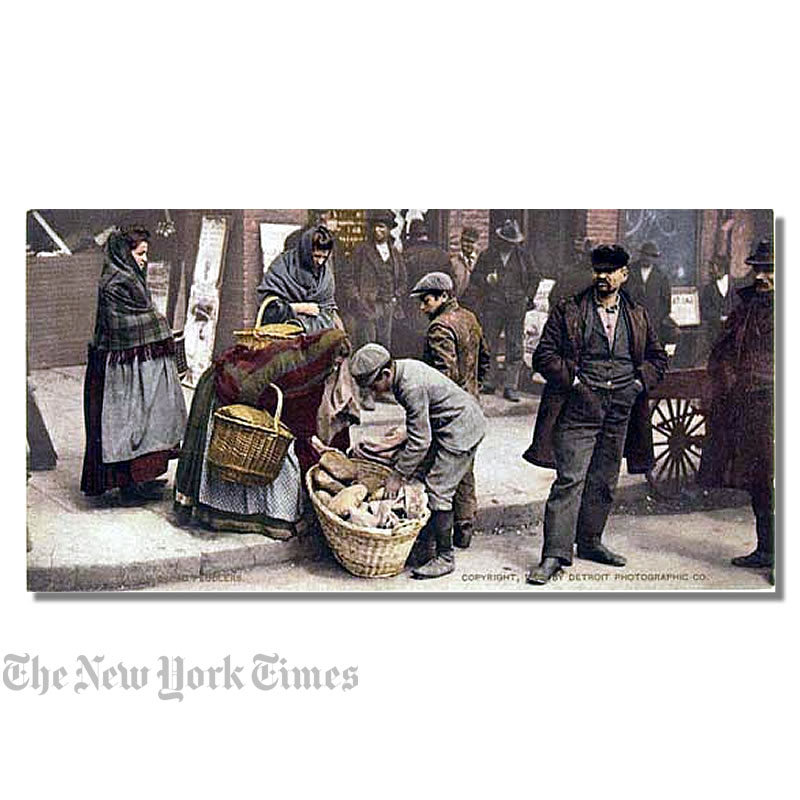
Italian bread peddler, Mulberry St., New York. Photocrome, 1902. Detroit Publishing Company, 1880-1920Bread peddler in the Italian quarter of New York. Photocrome, 1902. Detroit Publishing Company

Dante was banished from Firenze in November 1301, after the opposing party seized the power over the city by conspiracy.

As to which party Dante belonged and which one was the party opposing it is a tricky question even at the Italian department. The basic factor that determined the political field of 13th-century Italy was the struggle between the Papacy and the Empire, and this field was split along this fault line into the two parties of pro-Empire Ghibellines and pro-Papacy Guelfs. But as to what it means to be a Guelf or a Ghibelline in 1301, thirty-three years after the last Hohenstauf offspring was beheaded on the marketplace of Naples, was just as controversial and different from town to town as the meaning of the Left and of the Right in the countries of Eastern Europe twenty years after the end of the Cold War. Dante belonged to the so-called “white” wing of the Guelf party defending the independence of Florence, while their opponents, the “black” Guelfs advocating a much closer collaboration with the Pope robbed them of the power over the city with the support of the troops of the Ghibelline Siena. On the other hand, the white Guelfs who were immediately banished from the city, continued to fight for their return in alliance with the Ghibellines of Florence whom they had defeated at Campaldino in 1289 and banished from the city. The white Guelf Dante, who for personal reason very soon had an argument with his fellow exiles, spent most of the remaining twenty years of his life in Ghibelline courts as the most influential Italian advocate of the cause of the Empire, while it was the black Guelf Cino da Pistoia who provided him a lecturer’s position at the University of Bologna. And if the threads are not entangled enough: Corso Donati, the leader of the Black party was the brother-in-law of Dante (this is why Dante’s wife could remain in Florence), and he ordered the banishment of the White just one year after Dante – who was a Prior of Florence in the summer of 1300 – having subscribed with his own hands the document about the banishment of his own best friend Guido Cavalcanti. Albeit Cavalcanti was a White Guelf just like Dante, but he fall on the other side of another fault line: he belonged to the noblemen deprived of their citizenship after a long internal struggle by the White and Black Guelf burghers in agreement.

Every person has his own trauma that he then drags along for a life. For Dante it was this exile that he could not get over until his death. To this topic he returns again and again in his writings, the contrivers of this are inflicted by him with the most terrible punishments in the Inferno – the main conceiver Boniface VIII with more than one, as if Dante was trying where it hurts him the most painfully –, and while in the Holy Week of 1300 he arrives from Hell to Heaven, most characters foretell him about this. This is done in the most explicit form by his ancestor Cacciaguida in the 17th canto of the Paradiso:

Tu proverai sì come sa di sale
lo pane altrui, e come è duro calle
lo scendere e’l salir per l’altrui scale.

Thou shalt by sharp experience be aware

how salt the bread of strangers is, how hard
the up and down of someone else’s stair.

This “salty bread” is usually interpreted as the “bitter bread of exile”, the one “salted with tears” by the refugee. This is how it is also interpreted by the most authoritative Renaissance commentator Cristoforo Landino of the Comedy, expounding these verses of Cacciaguida like this in his commentary first published in 1498:

ma nondimeno tu nel tuo essilio sarai percosso dalla prima saetta, che trahe l’essilio: & questo è, che ti converrà lasciar le cose a te piu care, cioè, la patria, i parenti, gli amici, le case, le possessioni, & simili, & proverai, come sa di sale, cioè, quanto pare amaro.

nevertheless you will be reached too by that first arrow that means the exile: that is, you will have to leave everything that is dearest to you, your homeland, your parents, your friends, your home, your possessions and everything else, and then you will see how salty, that is, how bitter it is.


However, this verse of the Comedy also offers another possibility of interpretation. The archaic structure sì come or, in a contracted form, siccome in the sì come sa di sale was used in the old literary Tuscan language in the sense of modern che, on the model of Latin sicut. If we translate the first two verses like this, they will simply mean: You will be aware that the bread of others is salty.

What is the difference? That the bread in Florence is not salty. It was not salty already in Dante’s time. Medieval Florence had no sea, and purchased salt from the great enemy, Pisa – for an usurious price. Salt was regarded as a treasure in the city, like pepper elsewhere, and whenever it was used, it was rather added to the companaticum, that is to the things “eaten with the bread”, and omitted from the bread itself. Even today one of the specialities of Tuscan kitchen is that their bread lacks salt, while traditional smoked meat – in compensation – is much more salty than elsewhere in Italy. Salty bread – as all our Tuscan friends proudly proclaim it – is therefore per definitionem “the bread of strangers”.

Dante wrote this canto of the Paradiso almost twenty years after his banishment in Ravenna, where after so much wandering he finally received a house of his own from the lord of the city, Guido Novello da Polenta. It was here, writes Barbara Reynolds, whose excellent biography of Dante has just been translated to Hungarian by us:

where it was possible for his sons and a daughter to join him and possibly also his wife, where the bread was surely more palatable and the stairs at last familiar beneath his feet.

The stairs – for that short time he could spend in Ravenna, where his tomb today stands in the small square at the side of the church, just having enough time to complete his Comedy – perhaps yes. But salty Ravenna bread could never feel as tasty to him as twenty years earlier quello bbòno, della hhasa.

Great Patriotic War

Квас - не кола, пей НиКолу (Kvass is no Cola – drink NiKola)
I read in the news that the consumption of kvass is victoriously advancing on the Russian front of soft drinks. “Local drink producers advertise their products as patriotic alternatives to Western drinks. One of them even chose a patriotic name: Nikola, alluding to Ne kola [not Cola]. In the last year they even launched an «anticolanization» campaign against colanizing Western soft drinks.”

Квас - не кола, пей НиКолу (Kvass is the health of the A kvász nem kóla – igyál Nikolát)Say no to colanization – Kvass is the health of the nation.

– Nu pogodi! [wait a minute] – I recall immediately the title of the famous Soviet tale serial of my childhood. Did they not nail this name and slogan from Pelevin?

Viktor Pelevin, Cover of the book Generation PViktor Pelevin (the second one among the three Che portraits) published at the end of the 90's in free web sequels – today we would call it a blog – his remarkable work Generation П, the absurd utopy of the Post-Soviet chaos and of the new order manipulated, moreover created, moreover substituted by the publicity and TV. The action of the novel that takes place in the world of the creatives is dotted by excellent advertisement drafts, illustrating with tangible examples what Pelevin scented with an amazing intuition: that the Russians (but we could also safely say Eastern Europeans) have a great relish for watching the ads and wares, the capitalism and the West being ridiculed – and if this is done in an advertisement, then with this advertisement you can sell anything to them.

In one of these drafts the protagonist writes (already in the 90's!):

First of all it is to be considered that the actual order of things in Russia cannot survive for long. The future dictatorship, independently of its political and economical program, will avail of nationalistic catchwords, and pseudo-Slavic style will become the dominant state aesthetics. In the system of signs and symbols of this style the traditional Western advertisement is simply unimaginable. (…) Let us consider the traditional positioning slogan: Sprite – the Uncola! Its use seems to be maximally purposeful in Russia, albeit for reasons different from America, where the term Uncola successfully positions the Sprite as compared to Pepsi and Coca-Cola. (…) However, we know that in the countries of Eastern Europe, the Coca-Cola has meant rather an ideological fetish than a soft drink, the “taste of freedom”, as it was proclaimed by a large number of Eastern European refugees in the 70's and 80's. Thus the term Uncola creates a largely antidemocratic and antiliberal connotation for the home consumer, a fact that renders it maximally attractive and promising in a military dictatorship. The Russian translation of Uncola is Ne-kola [Некола]. It sounds similar to the name Nikola, and, considering the associations evoked by this word, it perfectly fits in the aesthetics of the probable future. A possible version of its slogan is:

SPRITE – NE-KOLA FOR NIKOLA

[СПРАЙТ. НЕ-КОЛА ДЛЯ НИКОЛЫ]

It would be worth to consider the introduction of Nikola Spraitovich, into the consciousness of the consumer, a figure similar to Ronald McDonald but with a deeply patriotic soul.

And yes, they made it. NiKola has arrived, Nikola Spraitovich has been created, the patriotic campaign around it has been organized, and of course the matching political system has been also established in the meantime.

Nikola Kvassovich
Nikola Kvassovich
Plakat fruktovogo kvasa (Фруктовый квас, плакат)


According to the historical summary by Vlad Grinkevich, the Nikola was created on May 9, 2005, the Day of Victory (!) by Nikita Volkov, the director of the Deka beer factory in Novgorod that had lost its market as a consequence of the invasion of Western multinational companies. And he confessedly drew the idea of the name and of the slogan from Pelevin.

The campaign of the Nikola was initially based on a patriotic joining of forces against the “aggressors” breaking in upon Russia, primarily against the two Cola’s, also targeted by name. However, the Russian counterattack also proved too aggressive. The Pepsi- and Coca-Cola raised objections, and the Russian anti-monopoly authorities constrained the Deka to a change of strategy – writes in his recent analysis Anton Gladchenko. They are not permitted to mention the enemy by name. But there are also much more subtle tools, aren’t we Russians after all?

Колу в гопу. The new anti-Cola campaign of Deka (Nikola)
On the eve of the Day of Victory of 2008 new advertisements appeared in the metro and autobuses of Moscow – writes Sergey in his blog Idiotskaya reklama –, that build on the unique skill of Eastern European citizens of reading between the lines. For the initials of the single paragraphs of the usual boring and politically correct blabla sum up the following phrase:

КОЛУ В ГОПУ.

The Cola to… where? What is “гопа”? – ask the Russians themselves. True, this word means a ‘drinking den’ in the slang of the Russian underworld, and in a figurative sense a ‘gang of hooligans’, and whoever knows it may cheer up seeing this ad. However, hardly anyone knows it. But a similar word known and used by everyone is “жопа”, ass, and the term “в жопу” – get the fuck off! Knowing the susceptibility of colloquial Russian to expressive nuances, I would not be surprised to see the eufemism “гопа” soon in standard dictionaries.

But what about Pelevin? Did he receive a percentage after the brand and slogan created by him from the kvass business that has doubled its turnover since 2005?

“We have registered the copyright on the brand, and all its rights belong to us.” – replies on this question Nikita Volkov. – “We keep trying to say thanks to Pelevin, but we have not managed to get in contact with him.”

This noble effort immediately recalls to me another great classic of post-Communist Eastern European literature, the I’m a Communist granny (Sînt o babă comunistă) by Dan Lungu:

Now there is her favorite program, when the listeners can also phone in. They can speak about the voluntary works they have accomplished. Now there is a comrade on the line and she says:
– I’m a working woman from Craiova… In the last days I was in Bucharest to arrange my personal affairs. In front of the Hotel Intercontinental I have found a purse… Of course I have lifted it and looked into it. There were five thousand lei and two thousand dollars in it… From the documents it turned out that the owner of the purse was a certain Anton Cărăşel, Bucharest, Izvoarelor street 46, block A6, stairway C, first floor 3.…
– Yes? And what can we do for you?
– I would like very much to send a beautiful song to Comrade Cărăşel.


And this makes this story really beautiful, Eastern European and Russian.

The Mexican corrido

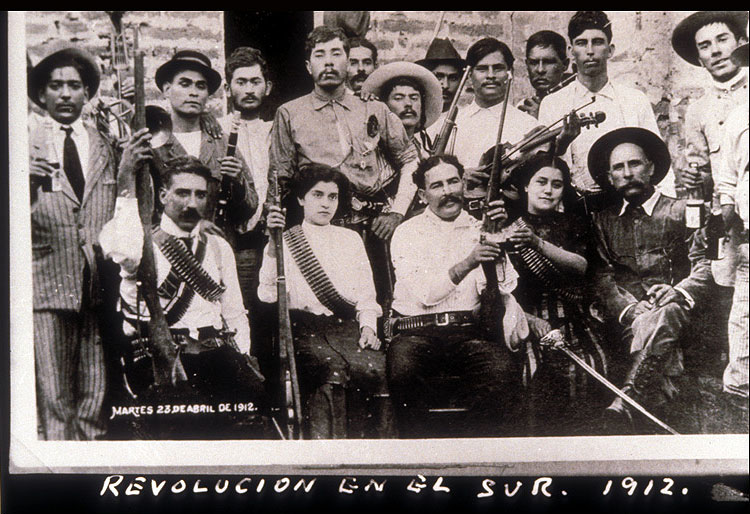
Mexico, Revolution in the South, 1912. Photo by Agustín Victor Casasola (1874-1938). Cf. http://content.cdlib.org/ark:/13030/hb367nb4xx/?layout=metadata&brand=calisphere
Fleur du Printemps has also answered our appeal to our Readers to send us the songs telling about their history, presenting us this beautiful bouquet of the corridos of the Mexican Revolution (1910-1920). The photos commenting the texts are by the photographer of the Revolution Agustín Victor Casasola (1874-1938).

The corridos are the Mexican offsprings of the Spanish romance. They express feelings and ideas, triumphs and defeats, pains and happiness which are so overflowing to constitute a collective importance for the Mexican folk. The corrido is the language of the people. At one time it played the role of the press: the news used to spread all over the countryside in songs, rather than in newspapers which were no important sources of information in an overwhelmingly illiterate country. Only the most important events or the great personalities deserved to be sung about in a corrido, but they sometimes also immortalize scenes of the everyday life of the internal parts of the country.

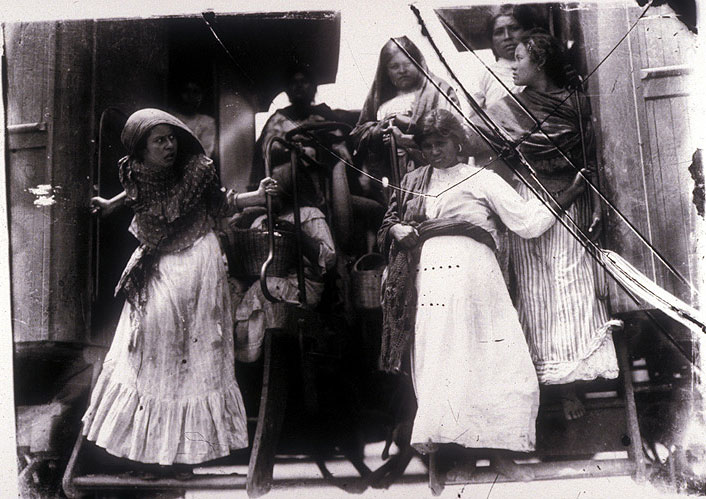
Mexico, Revolution. Women disembarking from a train. Photo by Agustín Victor Casasola (1874-1938). Cf. http://content.cdlib.org/ark:/13030/hb0v19p09c/?layout=metadata&brand=calisphere
The corrido is characterized by spontaneity, and by a simple language and melody. It uses few poetic tools, but it is very concise, and gives more importance to the rhythm than to the form. Its classical form is the quatrain 8a 8b 8a 8b which also permits more than one poems to be sung with the same melody. This is why they can also easily be modified and actualized, so that one corrido lives on in several versions.

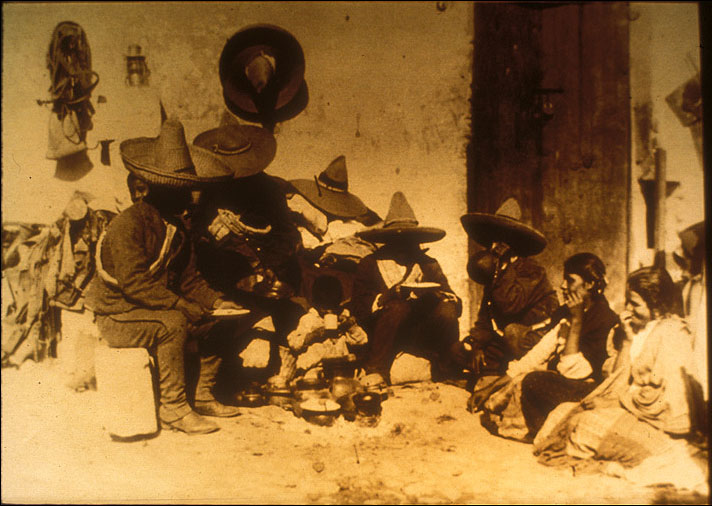
Mexico, Revolution. Soldiers in family circle. Photo by Agustín Victor Casasola (1874-1938). Cf. http://content-s10.cdlib.org/ark:/13030/hb6199p2k3/?layout=metadata&brand=calisphere
According to the man of letters, politician, speaker and poet of native Mexican blood Andrés Henestrosa, the circumstances favorable to the birth of the corrido were provided by the formation of national feeling and identity. It was born together with the Independence, but it reached its climax during the Revolution, with the collective rejection of “Porfirism” that took its name from the Mexican dictator Porfirio Díaz (1876-1911) and of forced Europization (Díaz was one of the great promoters of French culture among the Mexican high society). This was the longest and most supported phase of national rebirth, the one with the deepest roots in Mexican reality, and therefore the most popular one.

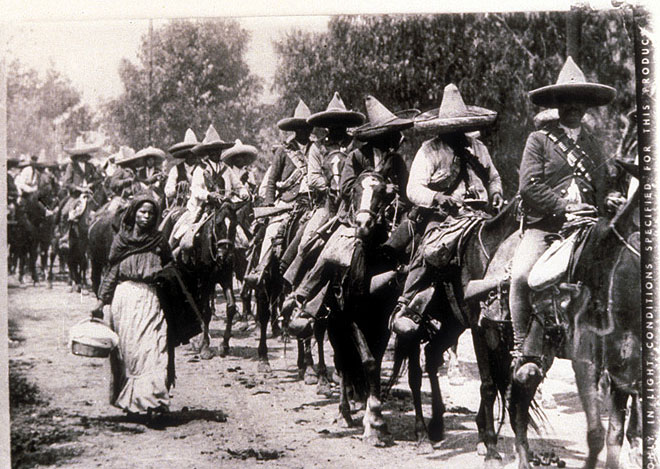
Mexico, Revolution, Photo of a woman walking next to a line of mounted Zapatista. Photo by Agustín Victor Casasola (1874-1938). Cf. http://content.cdlib.org/ark:/13030/hb1p300718/?layout=metadata&brand=calisphere
The Revolution originated in the conflict between the new parties, as the old ones ceased to exist with the arrival of Porfirio Díaz to the power. The resistance against his reelection was organized by Francisco I. Madero who also launched the armed rebellion. Later the movement was divided in factions, as in fact it was never united but by the hatred against the common enemy, that is Díaz. The factions were formed according to the most influential generals and the regions where they camped. The most important ones were Venustiano Carranza in the North (it was him to prepare the Constitution of 1917, still in force in Mexico), Emiliano Zapata in Central Mexico, Pancho Villa, Pascual Orozco and Álvaro Obregón in the North (Obregón was to become the co-founder of the Partido Nacional Revolucionario, predecessor of the Partido Revolucionario Institucional that maintained the power from the foundation of the PNR in 1929 until 2000).

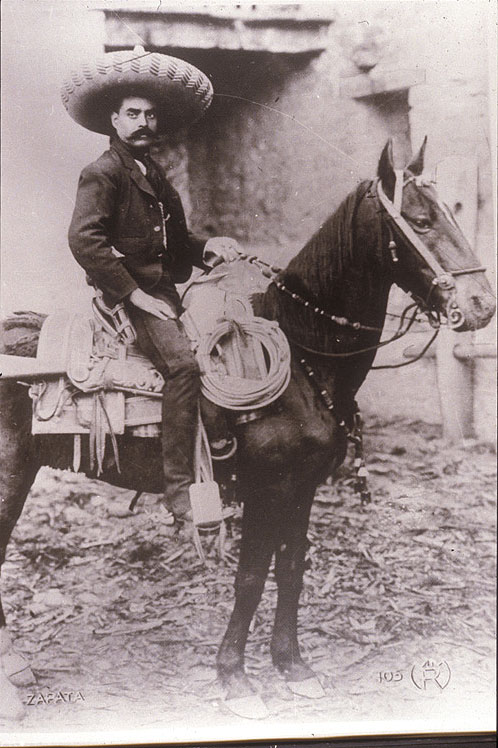
Mexico, Revolution. General Zapata on horseback. Photo by Agustín Victor Casasola (1874-1938). Cf. http://content.cdlib.org/ark:/13030/hb6p3009q4/?layout=metadata&brand=calisphere
However, Pancho Villa and Emiliano Zapata were the personalities embraced by the greatest popular devotion, and their names have been used to give credit to certain movements, like the Ejército Zapatista de Liberación Nacional (EZLN) or the Frente Popular Francisco Villa (FPFV).

I have chosen some of the most famous corridos, and some of those that I like the most, hoping that you would also love them. Enjoy.

Mexico, Revolution. Revolutionary soldier aboard a train holding the hand of a woman on the ground. Photo by Agustín Victor Casasola (1874-1938). Cf. http://content.cdlib.org/ark:/13030/hb8c601174/?layout=metadata&brand=calisphere
La Rielera. I learned this corrido while singing in the school choir, and I have always loved it. The rielera – the railwaywoman – worked for the railways, in this case for the central railways connecting the city of México with the North. Lerdo, Gómez and Torreón are cities in the northern states (Durango and Coahuila) which at that time were important mining regions, especially Torreón. This song is from the period of the Revolution splitting into factions, when the Carrancistas (of Venustiano Carranza) fought against the Villistas (of Francisco Villa).


I’m a railwaywoman and I love Juan
he’s my life and I’m his delight;
when they say the train is leaving,
adiós, my railwaywoman, your Juan is leaving.

When the engine-driver says
that the train is leaving for San Juan,
I already bring his basket
with which he’s going to refine.

I have a pair of pistols
with an ivory head
to defend myself, if necessary,
against those of the railway.

I have a pair of pistols
with a precise aiming
with one shot for my lover
and another for my enemy.

Adiós, boys of Lerdo,
of Gómez and of Torreón
the maintainers are already leaving
the turn is over forever.

I have a pair of horses
for the Revolution
one is called Robin
and the other Sparrow.

They say the Carrancistas
are like scorpion
when the Villistas are coming
they run away with lifted tail.

I know that as you see me in uniform
you believe I come to ask of you
although I come to you, brown girl,
to look for your favors.

As you see me in boots
you believe me to be a soldier
although I’m only a poor railwayman
at the Central Railways.

Yo soy rielera y tengo mi Juan,
él es mi vida yo soy su querer;
cuando me dicen que ya se va el tren,
adiós mi rielera ya se va tu Juan.

Cuando dice el conductor,
va salir para San Juan,
le llevo su canastita
con la que va a refinar.

Tengo mi par de pistolas,
con sus cachas de marfil,
para darme de balazos
con los del ferrocarril.

Tengo mi par de pistolas
con su parque muy cabal,
una para mi querida
y otra para mi rival.

Adiós muchachos de Lerdo,
de Gómez y de Torreón,
ya se van los garroteros,
ya se acabo la función.

Tengo mi par de caballos
para la Revolución,
uno se llama el Jilguero
y otro de llama el Gorrión.

Dicen que los carrancistas
parecen un alacrán,
cuando ven a los villistas
alzan la cola y se van.

So porque me ves de traje
crees que te voy a pedir,
solo quiero prieta chula
tus favores conseguir.

Si porque me ves con botas
piensas que soy melitar, [militar]
soy un pobre rielerito
del Ferrocarril Central.

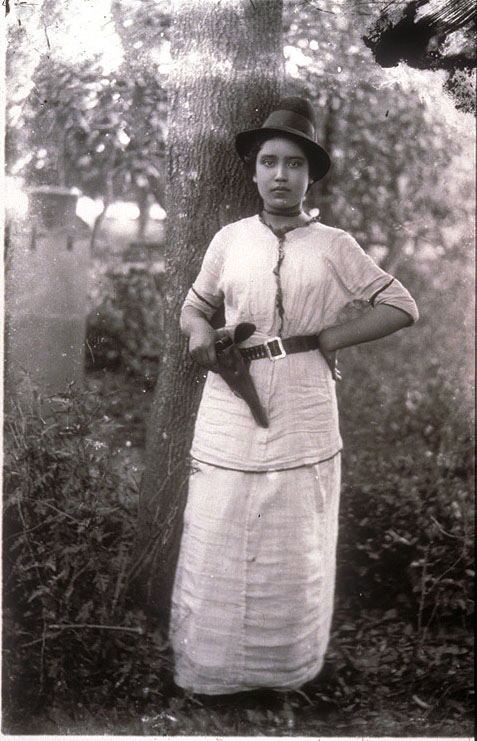
Mexico, Revolution. Armed soldadera. Photo by Agustín Victor Casasola (1874-1938). Cf. http://content.cdlib.org/ark:/13030/hb909nb8h6/?layout=metadata&brand=calisphere
La Adelita. This is one of the most famous Mexican corridos. The Revolution was not only the case of the soldiers. The troops were also followed by women and children who took care of the solders and feeded them, healed the ill and the wounded, etc. [This is a scene with the famous actresses María Félix and Dolores del Río, in a film from the golden age of the Mexican cinema, that presented the women following the soldiers in the time of the war.]


On the top of the rocky mountain
there was an army camped
and a courageous women followed them
fallen in love with the sergeant.

Everyone appreciated Adelita
who loved the sergeant
as she was courageous and beautiful
even the colonel estimated her.

And they heard that it was told
by him who loved her so much:

If Adelita wanted to be mine
if Adelita wanted to be my wife
I’d buy her a silk garment
to take her to dance in the caserm.

And if Adelita went with another
I’d follow her over land and sea
with a battleship on the sea
and with a military train on land.

And as the cruel battle was over
and the army retired to the camp
the sobbing of a woman was heard
her crying filling the whole camp.

The sergeant heared it, and fearing
to loose his adored forever
concealing his pain in himself
he sang like this to his lover:

And they heard that it was told
by him who was dying so much:

And if I died in the battle
and my body was buried there
Adelita, I ask you for God
to come there and cry over me.

En lo alto de una abrupta serranía,
acampado se encontraba un regimiento,
y una joven que valiente lo seguía,
locamente enamorada del sargento.

Popular entre la tropa era Adelita,
las mujer que el sargento idolatraba,
que además de ser valiente era bonita,
que hasta el mismo coronel la respetaba.

Y se oía, que decía,
aquel que tanto la quería:

Y si Adelita quisiera ser mi esposa,
si Adelita fuera mi mujer,
le compraría un vestido de seda
para llevarle a bailar al cuartel.

Y si Adelita se fuera con otro,
la seguiría por tierra y por mar,
si por mar en un buque de guerra,
si por tierra en un tren militar.

Y después que termino la cruel batalla
y la tropa regresó a su campamento,
se oye la voz de una mujer que sollozaba,
su plegaria se escucho en el campamento.

Al oírla el sargento temeroso,
de perder para siempre a su adorada,
ocultando su dolor bajo el esbozo
a su amada le cantó de esta manera:

Y se oía, que decía,
aquel que tanto se moría:

Y si acaso yo muero en campaña,
y mi cadáver lo van a sepultar,
Adelita por Dios te lo ruego,
que con tus ojos me vayas a llorar.

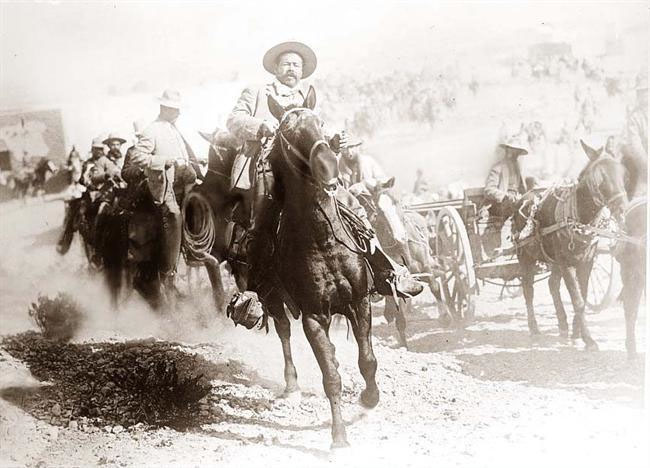
Mexico, Revolution. General Pancho Villa on horseback
El Mayor de los Dorados. The dorados (“gilded ones”) were the “elit forces” of Pancho Villa, the most famous general together with Emiliano Zapata. Villa fought in the North. Parral is in Chihuahua, a border state near to the United States. This corrido is also from the splitting of the Revolution in factions. Álvaro Obregón was a very important and very competent general, later President of Mexico.


I was the soldier of Francisco Villa
of the world famous general
who, even if sitting on a simple chair
did not envy that of the President.

Now I live on the seashore
remembering those immortal times
Ay… Ay…
Now I live on the seashore
remembering Parral and Villa.

I was one of the dorados
made a Major by chance
and made crippled by the war
while defending the country and honor.

I remember of times past
how we fought against the invader
today I recall the times past
the dorados of whom I was a Major.

My horse, ridden so many times by me
died under me in Jiménez
a bullet intended to me
run across his body.

While dying, he neighed of pain
and gave his life for the country
Ay… Ay…
while dying, he neighed of pain
how much I cried when he died!

Pancho Villa, I keep you
in my memories and in my heart
even if sometimes we were beaten
by the troops of Álvaro Obregón.

I was always your loyal soldier
until the end of the Revolution
Ay… Ay…
I was always your loyal soldier
fighting always in front of the cannons.

Fui soldado de Francisco Villa
de aquel hombre de fama mundial,
que aunque estuvo sentado en la silla
no envidiaba la presidencial.

Ahora vivo allá por la orilla
recordando aquel tiempo inmortal.
Ay… Ay…
Ahora vivo allá por la orilla
recordando a Villa allá por Parral.

Yo fui uno de aquellos Dorados
que por suerte llegó a ser Mayor,
por la lucha quedamos lisiados
defendiendo la patria y honor.

Hoy recuerdo los tiempos pasados
que peleamos contra el invasor,
hoy recuerdo los tiempos pasados
de aquellos Dorados que yo fui Mayor.

Mi caballo que tanto montara
en Jiménez la muerte encontró,
una bala que a mí me tocaba
a su cuerpo se le atravesó.

Al morir de dolor relinchaba
por la patria la vida entregó
Ay… Ay…
Al morir de dolor relinchaba
cómo le llorara cuando se murió.

Pancho Villa te llevo grabado
en mi mente y en mi corazón
y aunque a veces me vi derrotado
por las fuerzas de Álvaro Obregón.

Siempre anduve como fiel soldado
hasta el fin de la revolución
Ay… Ay…
Siempre anduve como fiel soldado
que siempre ha luchado al pié del cañón.

Mexico, Revolution. Photo by Agustín Victor Casasola (1874-1938). Cf. http://content-s10.cdlib.org/ark:/13030/hb1d5nb3n0/?layout=metadata&brand=calisphere
Caballo Prieto Azabache. (My dark horse) Ah, this is one of my favorite corridos. It speaks of a soldier crying for his horse who had saved his life when the troops of Villa were going to execute him. The Mauser were the firearms used in the Revolution. They were first imported from Germany to Mexico by Porfirio Díaz who also founded a local factory to produce them.


My dark horse, how could I
forget you, I own you my life
when the troops loyal to Pancho Villa
were going to execute me

It was a cloudy night
and I was surprised by an outpost
and having disarmed me
they sentenced me to death.

As I was already in the death cell
Villa was saying to his aide-de-camp
put this horse for me aside
as it is educated and obedient.

I know I cannot escape
but I kept thinking about it
and you, my dark horse
were thinking exactly like me.

I remember being asked of what is
my last desire before the death
and I told, I wanted to die
sitting on my dark horse.

And when I was put on you
and were going to execute me
you only expected my command
and jumped over the wall.

With three Mauser bullets in your body
you galloped, my dark one, saving my life
what you’ve done for me, my horse,
my friend, I will never forget you.

I was unable to save yours
and I can only cry of grief
therefore, my dark horse
I will not forget you ever.

Caballo prieto azabache,
como olvidarte te debo la vida.
Cuando iban a fusilarme,
las fuerzas leales de Pancho Villa.

Fue aquella noche nublada,
una avanzada me sorprendió.
Y…después de… de…sar…marme,
fui condenado al paredón.

Ya cuando estuve en capilla,
le dijo Villa a su asistente,
me apartas ese caballo
por educado y obediente.

Sabia que no iba a escaparme,
solo pensaba en mi salvación,
Y tú mi prieto azabache
también pensaste igual que yo.

Recuerdo que me dijeron
pide un deseo pa'[para] justiciarte
yo quiero morir monta'o [montado] en mi caballo
prieto azabache.

Y cuando en ti me montaron
y prepararon, la ejecución,
mi voz de mando esperaste
te abalanzaste sobre el pelotón.

con tres balazos de mauser,
corriste azabache, salvando mi vida,
lo que tu hiciste conmigo
caballo amigo no se me olvida.

No pude salvar la tuya,
y la amargura me hace llorar,
por eso prie…to a…za…bache,
no he de olvidarte nunca jamás.

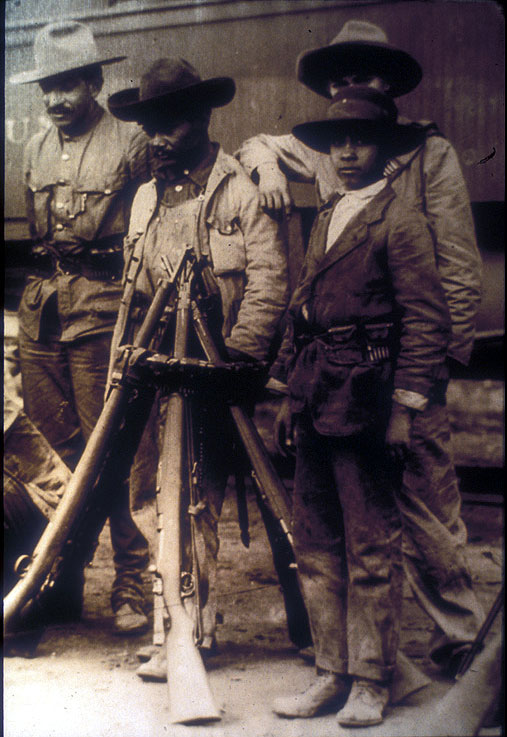
Mexico, Revolution. Soldiers. Photo by Agustín Victor Casasola (1874-1938). Cf. http://content-s10.cdlib.org/ark:/13030/hb400008gc/?layout=metadata&brand=calisphere
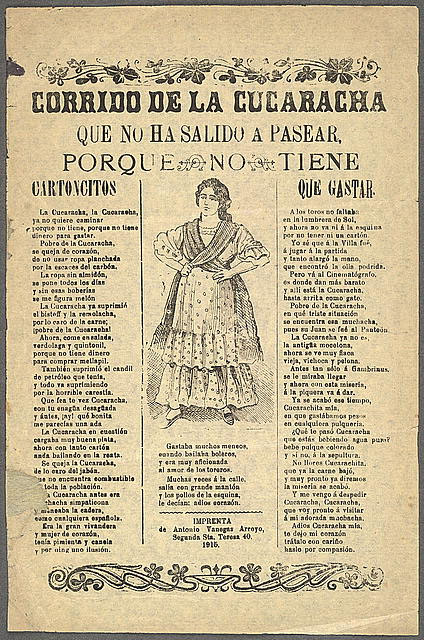
La Cucaracha. (The cockroach) One of the most popular songs of the Revolution in Mexico and the best known one in abroad. As children, we were taught a very innocent version in the school, with no marijuana and no revolutionaries in the lyrics.

Mexico, Revolution. Song sheet of the corrido La Cucaracha


The cockroach, the cockroach
cannot walk any more
as he has no more
marijuana to smoke.

The Carrancistas are leaving
they are leaving with empty stomach
for the Villistas say
they are going to die of hunger.

Poor cockroach
is bitterly complaining
that he has no ironed clothes
because of the lack of carbon.

(Choir)

Poor Madero is left
by almost everyone
Huerta, the drunken bandit
is only good for an ox to plough.

We take unstarched clothes
day after day
and without such chic
we are considered blockheads.

(Choir)

Everyone is fighting for the chair
which is the source of much money
Pancho Villa at the North
and at the South viva Zapata!

I am excited to laugh at one thing:
to see Pancho Villa without a shirt
and I am terrified by one thing:
to see the vile Huerta in a shirt.

(Choir)

I need a good Ford
to arrive to the place
where the Convention
was sent by Zapata.

A colorful parrot
says to a mottled one
whoever jokes with my country
let him be taken by the …

(Choir)

Some plunder a lot
and then are hidden far away
protected by the law
while we are considered guilty.

(Choir)

How beautiful are the camp-followers
when dancing the fandango
Viva Pánfilo Natera
the pride of Durango.

The cockroach is already dead
he is taken to be buried
he is followed by four eagles
and by the mouse of the church.

La Cucaracha, la cucaracha,
ya no puede caminar,
porque no tiene, porque le falta,
marihuana que fumar.

Ya se van los carrancistas,
ya se van por el alambre,
porque dicen los villistas,
que se estarán muriendo de hambre.

Pobre de la Cucaracha,
se queja con decepción,
de no usar ropa planchada,
por la escasez de carbón.

(Coro)

Pobrecito de Madero,
casi todos le han fallado,
Huerta el ebrio bandolero,
es un buey para el arado.

La ropa sin almidón,
se pone todos los días;
y sin esas boberías,
se me figura melón.

(Coro)

¡Todos se pelean la silla
que les deja mucha plata;
en el Norte Pancho Villa,
y en el Sur Viva Zapata!

Una cosa me da risa:
Pancho Villa sin camisa,
otra cosa me da horror,
al vil Huerta en camisón.

(Coro)

Necesito algún "fortingo"
para hacer la caminata,
al lugar donde mandó
a la convención, Zapata.

Una guacamaya pinta
le dijo a una colorada,
quien se meta con mi patria,
se lo carga la…

(Coro)

Hay unos que roban mucho,
y luego huyen muy lejos,
validos de fuero y mando
y de que nos creen pen…itentes.

(Coro)

Qué bonitas soldaderas
cuando bailan el fandango.
Viva Pánfilo Natera,
el orgullo de Durango.

Ya murió la Cucaracha
ya la llevan a enterrar,
entre cuatro zopilotes
y un ratón de sacristán.

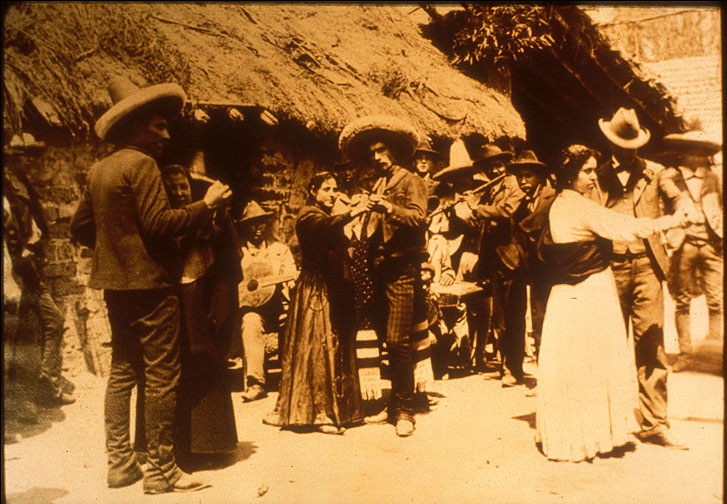
Mexico, Revolution. Soldiers dancing. Photo by Agustín Victor Casasola (1874-1938). Cf. http://content-s10.cdlib.org/ark:/13030/hb5x0nb6gc/?layout=metadata&brand=calisphere
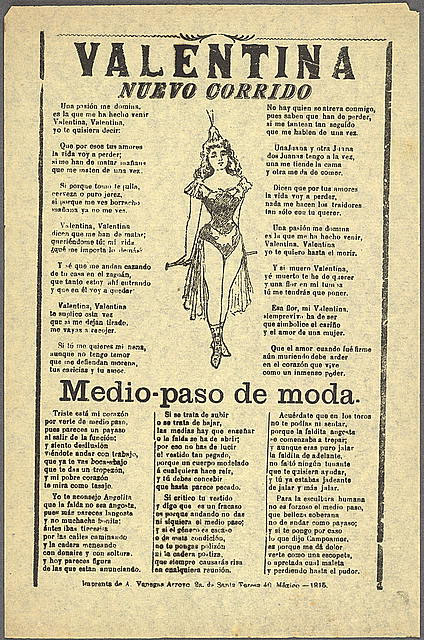
La Valentina. Another famous song of the Revolution, and one of my favorites. Even if it does not speak about the war, but about one fallen in love with “Valentina”, while he knows how dangerous it is to love her.

Song sheet of the corrido “Valentina”, Mexico, 1915


Valentina, Valentina,
I would like to tell you
what a passion rules me
that made me to come here.

They say that your love
is a curse that follows your lover
but let the devil take it
I also know how to die.

Even if I drink tequila today
tomorrow I’ll drink sherry
even if I’m seen drunk today
tomorrow they’ll not see me like that.

Valentina, Valentina,
I fall on my knees at your feet
if tomorrow they will kill me
I’ll only be killed only once.

Valentina, Valentina,
yo te quisiera decir
que una pasión me domina
y es la que me hizo venir.

Dicen que por tus amores
un mal me van a seguir,
no le hace que sean el diablo
yo también me sé morir.

Si porque tomo tequila
mañana tomo jerez,
si porque me ven borracho
mañana ya no me ven.

Valentina, Valentina,
rendido estoy a tus pies,
si me han de matar mañana
que me maten de una vez.

There are also corridos that are a veritable history class in verse, like for example these ones.

Mexico, Revolution. Photo by Agustín Victor Casasola (1874-1938). Cf. http://content-s10.cdlib.org/ark:/13030/hb2f59n9r0/?layout=metadata&brand=calisphere

El corrido mexicano

Mexico, Revolution in the South, 1912. Photo by Agustín Victor Casasola (1874-1938). Cf. http://content.cdlib.org/ark:/13030/hb367nb4xx/?layout=metadata&brand=calisphere
Fleur du Printemps has also answered our appeal to our Readers to send us the songs telling about their history, presenting us this beautiful bouquet of the corridos of the Mexican Revolution (1910-1920). The photos commenting the texts are by the photographer of the Revolution Agustín Victor Casasola (1874-1938).

Los corridos son el sucesor mexicano del romance español. Expresan sentimientos e ideas, triunfos, derrotas, dolores, alegrías tan grandes que toman un cariz colectivo entre el pueblo mexicano. El corrido es el lenguaje de las mayorías. Servía, en su tiempo, como fuente periodística; las noticias corrían por el país siendo cantadas más que en periódicos, que no eran una fuente fundamental de información en un país predominantemente analfabeta. Sólo los hechos más notables o los grandes personajes eran dignos de un corrido, pero también algunas escenas de la vida diaria en los pueblos del interior.

Mexico, Revolution. Women disembarking from a train. Photo by Agustín Victor Casasola (1874-1938). Cf. http://content.cdlib.org/ark:/13030/hb0v19p09c/?layout=metadata&brand=calisphere
El carácter del corrido es la espontaneidad, su lenguaje y música simples; utiliza pocos recursos poéticos pero es de gran concisión, da mayor importancia al fondo que a la forma. Su forma clásica es la cuartera 8a 8b 8a 8b que incluso permite que varios sean cantados con una sola melodía. Ese carácter circunstancial permite que sea actualizable, modificable. De ahí que haya muchísimas versiones de un solo corrido.

Mexico, Revolution. Soldiers in family circle. Photo by Agustín Victor Casasola (1874-1938). Cf. http://content-s10.cdlib.org/ark:/13030/hb6199p2k3/?layout=metadata&brand=calisphere
Según Andrés Henestrosa (literato, político, orador, poeta… indígena mexicano) el corrido nació hasta que hubo una cabal conciencia y sentimiento nacional, una patria. Nació con la Independencia pero alcanzó su clímax con la Revolución, con el repudio colectivo al porfirismo (Porfirio Díaz, dictador mexicano 1876-1911) y al europeísmo (Díaz era un gran impulsor del afrancesamiento de la alta sociedad mexicana). Esta fue la etapa más larga y sostenida por la redención nacional, la más plena de realidades mexicanas, es decir, la más popular.

Mexico, Revolution, Photo of a woman walking next to a line of mounted Zapatista. Photo by Agustín Victor Casasola (1874-1938). Cf. http://content.cdlib.org/ark:/13030/hb1p300718/?layout=metadata&brand=calisphere
La Revolución se originó del conflicto entre nuevos partidos, pues habían dejado de existir con la llegada al poder de Porfirio Díaz. Francisco I. Madero era líder del partido contra la reelección y fue quien comenzó la rebelión armada. Posteriormente el movimiento se dividió en facciones pues, en realidad, nunca estuvo unificado más que en contra del enemigo común: Díaz. Las facciones se dividían conforme al general que las encabezaba y a la región en la que se encontraban. Entre los generales más importantes estuvieron Venustiano Carranza en el Norte (se encargó de hacer la Constitución de 1917, que aún rige el país), Emiliano Zapata en el Centro, Pancho Villa, Pascual Orozco y Álvaro Obregón en el Norte (Obregón sería el co-fundador del Partido Nacional Revolucionario, predecesor del Partido Revolucionario Institucional que mantuvo el poder desde la fundación del PNR en 1929, hasta el año 2000).

Mexico, Revolution. General Zapata on horseback. Photo by Agustín Victor Casasola (1874-1938). Cf. http://content.cdlib.org/ark:/13030/hb6p3009q4/?layout=metadata&brand=calisphere
Sin embargo, Pancho Villa y Emiliano Zapata son los personajes con mayor devoción popular, sus nombres se utilizan en la actualidad para dar antecedentes a ciertos movimientos, tal es el caso del Ejército Zapatista de Liberación Nacional (EZLN) o del Frente Popular Francisco Villa (FPFV).

Elegí algunos de los más famosos y otros que me gusten mucho, espero que a ustedes también. Disfrútenlos

Mexico, Revolution. Revolutionary soldier aboard a train holding the hand of a woman on the ground. Photo by Agustín Victor Casasola (1874-1938). Cf. http://content.cdlib.org/ark:/13030/hb8c601174/?layout=metadata&brand=calisphere
La Rielera. Este corrido lo aprendí cuando cantaba en el coro de mi escuela y siempre me gustó. La rielera trabajaba en el ferrocarril; en este caso hablan del ferrocarril central, que conectaba la ciudad de México con el Norte, Lerdo, Gómez y Torreón son ciudades de Estados del Norte (Durango y Coahuila) que entonces eran zonas mineras importantes, en especial Torreón. Esta canción es de la época en que la Revolución se dividió en facciones y los carrancistas (de Venustiano Carranza) luchaban contra los villistas (Francisco Villa).


Yo soy rielera y tengo mi Juan,
él es mi vida yo soy su querer;
cuando me dicen que ya se va el tren,
adiós mi rielera ya se va tu Juan.

Cuando dice el conductor,
va salir para San Juan,
le llevo su canastita
con la que va a refinar.

Tengo mi par de pistolas,
con sus cachas de marfil,
para darme de balazos
con los del ferrocarril.

Tengo mi par de pistolas
con su parque muy cabal,
una para mi querida
y otra para mi rival.

Adiós muchachos de Lerdo,
de Gómez y de Torreón,
ya se van los garroteros,
ya se acabo la función.

Tengo mi par de caballos
para la Revolución,
uno se llama el Jilguero
y otro de llama el Gorrión.

Dicen que los carrancistas
parecen un alacrán,
cuando ven a los villistas
alzan la cola y se van.

So porque me ves de traje
crees que te voy a pedir,
solo quiero prieta chula
tus favores conseguir.

Si porque me ves con botas
piensas que soy melitar, [militar]
soy un pobre rielerito
del Ferrocarril Central.

Mexico, Revolution. Armed soldadera. Photo by Agustín Victor Casasola (1874-1938). Cf. http://content.cdlib.org/ark:/13030/hb909nb8h6/?layout=metadata&brand=calisphere
La Adelita. Este es uno de los corridos más famosos en México. La Revolución no sólo fue asunto de soldados, a las tropas las seguían mujeres y niños, quienes se encargaban de abastecer y alimentar a los soldados, de cuidar a los enfermos y heridos, etc. [Esta es una escena de las famosas actrices María Félix y Dolores del Río, de la época de oro del cine mexicano, que representa a las mujeres que seguían a los soldados durante la guerra.]


En lo alto de una abrupta serranía,
acampado se encontraba un regimiento,
y una joven que valiente lo seguía,
locamente enamorada del sargento.

Popular entre la tropa era Adelita,
las mujer que el sargento idolatraba,
que además de ser valiente era bonita,
que hasta el mismo coronel la respetaba.

Y se oía, que decía,
aquel que tanto la quería:

Y si Adelita quisiera ser mi esposa,
si Adelita fuera mi mujer,
le compraría un vestido de seda
para llevarle a bailar al cuartel.

Y si Adelita se fuera con otro,
la seguiría por tierra y por mar,
si por mar en un buque de guerra,
si por tierra en un tren militar.

Y después que termino la cruel batalla
y la tropa regresó a su campamento,
se oye la voz de una mujer que sollozaba,
su plegaria se escucho en el campamento.

Al oírla el sargento temeroso,
de perder para siempre a su adorada,
ocultando su dolor bajo el esbozo
a su amada le cantó de esta manera:

Y se oía, que decía,
aquel que tanto se moría:

Y si acaso yo muero en campaña,
y mi cadáver lo van a sepultar,
Adelita por Dios te lo ruego,
que con tus ojos me vayas a llorar.

Mexico, Revolution. General Pancho Villa on horseback
El Mayor de los Dorados. Los dorados eran las "fuerzas de elite" de Pancho Villa, el general revolucionario más famoso, junto con Emiliano Zapata. Villa luchaba en el Norte, Parral está en Chihuahua, Estado fronterizo con Estados Unidos. Este corrido también es de la época de las facciones. Álvaro Obregón, fue un importantísimo y muy buen militar revolucionario, después sería presidente de México.


Fui soldado de Francisco Villa
de aquel hombre de fama mundial,
que aunque estuvo sentado en la silla
no envidiaba la presidencial.

Ahora vivo allá por la orilla
recordando aquel tiempo inmortal.
Ay… Ay…
Ahora vivo allá por la orilla
recordando a Villa allá por Parral.

Yo fui uno de aquellos Dorados
que por suerte llegó a ser Mayor,
por la lucha quedamos lisiados
defendiendo la patria y honor.

Hoy recuerdo los tiempos pasados
que peleamos contra el invasor,
hoy recuerdo los tiempos pasados
de aquellos Dorados que yo fui Mayor.

Mi caballo que tanto montara
en Jiménez la muerte encontró,
una bala que a mí me tocaba
a su cuerpo se le atravesó.

Al morir de dolor relinchaba
por la patria la vida entregó
Ay… Ay…
Al morir de dolor relinchaba
cómo le llorara cuando se murió.

Pancho Villa te llevo grabado
en mi mente y en mi corazón
y aunque a veces me vi derrotado
por las fuerzas de Álvaro Obregón.

Siempre anduve como fiel soldado
hasta el fin de la revolución
Ay… Ay…
Siempre anduve como fiel soldado
que siempre ha luchado al pié del cañón.

Mexico, Revolution. Photo by Agustín Victor Casasola (1874-1938). Cf. http://content-s10.cdlib.org/ark:/13030/hb1d5nb3n0/?layout=metadata&brand=calisphere
Caballo Prieto Azabache. Ah, este corrido es uno de mis favoritos; habla sobre un soldado que llora a su caballo, quien lo salvó cuando las tropas de Villa lo iban a fusilar. Los mauser eran los fusiles de cerrojo que se utilizaron en la Revolución. Porfirio Díaz los trajo a México desde Alemania y fundó una fábrica aquí.


Caballo prieto azabache,
como olvidarte te debo la vida.
Cuando iban a fusilarme,
las fuerzas leales de Pancho Villa.

Fue aquella noche nublada,
una avanzada me sorprendió.
Y…después de… de…sar…marme,
fui condenado al paredón.

Ya cuando estuve en capilla,
le dijo Villa a su asistente,
me apartas ese caballo
por educado y obediente.

Sabia que no iba a escaparme,
solo pensaba en mi salvación,
Y tú mi prieto azabache
también pensaste igual que yo.

Recuerdo que me dijeron
pide un deseo pa'[para] justiciarte
yo quiero morir monta'o [montado] en mi caballo
prieto azabache.

Y cuando en ti me montaron
y prepararon, la ejecución,
mi voz de mando esperaste
te abalanzaste sobre el pelotón.

con tres balazos de mauser,
corriste azabache, salvando mi vida,
lo que tu hiciste conmigo
caballo amigo no se me olvida.

No pude salvar la tuya,
y la amargura me hace llorar,
por eso prie…to a…za…bache,
no he de olvidarte nunca jamás.

Mexico, Revolution. Soldiers. Photo by Agustín Victor Casasola (1874-1938). Cf. http://content-s10.cdlib.org/ark:/13030/hb400008gc/?layout=metadata&brand=calisphere
La Cucaracha. De las canciones de la Revolución más populares en México y conocidas en el extranjero. Cuando niños nos enseñaban la versión inocente en la escuela, que no hablaba de marihuana ni de revolucionarios.

Mexico, Revolution. Song sheet of the corrido La Cucaracha


La Cucaracha, la cucaracha,
ya no puede caminar,
porque no tiene, porque le falta,
marihuana que fumar.

Ya se van los carrancistas,
ya se van por el alambre,
porque dicen los villistas,
que se estarán muriendo de hambre.

Pobre de la Cucaracha,
se queja con decepción,
de no usar ropa planchada,
por la escasez de carbón.

(Coro)

Pobrecito de Madero,
casi todos le han fallado,
Huerta el ebrio bandolero,
es un buey para el arado.

La ropa sin almidón,
se pone todos los días;
y sin esas boberías,
se me figura melón.

(Coro)

¡Todos se pelean la silla
que les deja mucha plata;
en el Norte Pancho Villa,
y en el Sur Viva Zapata!

Una cosa me da risa:
Pancho Villa sin camisa,
otra cosa me da horror,
al vil Huerta en camisón.

(Coro)

Necesito algún "fortingo"
para hacer la caminata,
al lugar donde mandó
a la convención, Zapata.

Una guacamaya pinta
le dijo a una colorada,
quien se meta con mi patria,
se lo carga la…

(Coro)

Hay unos que roban mucho,
y luego huyen muy lejos,
validos de fuero y mando
y de que nos creen pen…itentes.

(Coro)

Qué bonitas soldaderas
cuando bailan el fandango.
Viva Pánfilo Natera,
el orgullo de Durango.

Ya murió la Cucaracha
ya la llevan a enterrar,
entre cuatro zopilotes
y un ratón de sacristán.

Mexico, Revolution. Soldiers dancing. Photo by Agustín Victor Casasola (1874-1938). Cf. http://content-s10.cdlib.org/ark:/13030/hb5x0nb6gc/?layout=metadata&brand=calisphere
La Valentina. Otra de las canciones más famosas de la Revolución, y una de mis favoritas; aunque esta no habla de la guerra, sino de un enamorado que sabe de los peligros de amar a “Valentina.”

Song sheet of the corrido “Valentina”, Mexico, 1915


Valentina, Valentina,
yo te quisiera decir
que una pasión me domina
y es la que me hizo venir.

Dicen que por tus amores
un mal me van a seguir,
no le hace que sean el diablo
yo también me sé morir.

Si porque tomo tequila
mañana tomo jerez,
si porque me ven borracho
mañana ya no me ven.

Valentina, Valentina,
rendido estoy a tus pies,
si me han de matar mañana
que me maten de una vez.

Hay corridos que son verdaderas clases de historia contadas en verso, como estos.

Mexico, Revolution. Photo by Agustín Victor Casasola (1874-1938). Cf. http://content-s10.cdlib.org/ark:/13030/hb2f59n9r0/?layout=metadata&brand=calisphere

Dying and resurrecting

Iran, Yazd, Zoroastrian “tower of silence” near to the townZoroastrian dakhmeh, “tower of silence” near to Yazd in Central Iran

Plato in his dialogues often gives a myth in the mouth of some of his speakers. Sometimes one of the well known Greek myths, but much more often some intricate story of faraway origin that obviously proclaims of either having been composed by himself, or having been thoroughly transformed to his own taste. The purpose of these myths, as Catalin Partenie writes in her selection made in 2004 for the Oxford World’s Classic series, was on one hand to adjust historical, philosophical, political or scientific concepts of large breadth to the genre of storytelling customary in banquets and to present them as sanctioned by the authority of tradition, and on the other hand to expound some truth in an indirect and hidden way, and thus stimulating further thought, just like parables do. The best known one is of course the legend of Atlantis in the Timaeus that Plato pretends to derive from Egypt, but here belongs also the story of the androgynes cut in two halves, or that of the ring of Gyges in The Republic that made his owner invisible and which has also served as an inspiration for Tolkien.

In The Republic Socrates also narrates the vision of Er of Pamphylia who dies in a battle, but then revives on the funeral pyre and tells of his journey in the afterlife, of the souls who, according to their actions while in life, descend for a thousand years of punishment under the earth or for the same amount of pleasures to the sky, and then by choosing themselves new forms of life return to the earth again.

To me the most interesting detail in this story has always been the name of the protagonist, archetype of Aeneas of Dante. This name – in contrast to all the other Platonic myths – does not sound Greek at all. As if Plato, contrary to his custom, conserved here a foreign – Pamphylian? – name that can in fact hint to the foreign origins of this myth.

The commentaries obviously slide over this name, or if they don’t, then they fabricate a whole series of gratuitous Greek etymologies eclipsing even those by Heidegger and Isidore of Seville, like for example Bernard Suzanne does:

The name of Er (èr, contracted form of ear) means “spring” (the season). But this name, whose only mention, at 614b, is the genitive form èros, evokes much more than that. It looks like the masculine form of Hera, the name of Zeus’ wife, except for the smooth breathing replacing the rough one. And if we look at what Plato has to say about the etymology of Hera in the Cratylus (404b-c), we see that he associates it with love (eros) through the adjective “lovable (eratè)”, but also with air (aer), which, applied to Er, opposes him to Gyges the earthling : hope is not in our material, earthly nature, but in our celestial, godly power of thought and understanding, and in the power of love that sets it on the move. Panphulos, the name of Er’s tribe, means “of all tribes or races”. Shorey suggests in a note that he might as well have translated “to genos Pamphulou” by “of the tribe of Everyman”. And while we are at names, the name of Er’s father, Armenius (tou Armeniou) is a close call for Harmony (armonia), a concept dear to Plato and central to the whole Republic, as well as to the myth of Er, with the “harmony of the Sirens” mentioned at its center (617c).

Reading the 5th-century History of Armenia by the first Armenian historiographer Movses Khorenatsi, in chapter I, 15 I find the story of the Armenian king Ara and the Assyrian queen Semiramis. Ara, son of Aram was an extraordinarily beautiful man, and the queen desired him to be either her husband or her lover. She sent several embassies to him with gifts, supplications, flattery and menaces, but all in vain: Ara remained faithful to his wife. Thus Semiramis finally went with her army upon him. They clashed under the mountain that received its name Ararat from Ara, and although the queen commanded the king to be brought to her alive, he fought heroically and remained dead on the battlefield. The queen had his corpse brought to her, and – a surprising turn – had it placed on the roof of her palace. When she was asked for the reason, she answered: “I have ordered my gods to lick his wounds, and he will be restored to life.” However, as the dead fails to resurrect and begins to decompose, she commands it to be cast in a ditch, while she has dressed up one of her paramours similar to Ara in Armenian clothes and presents him to the court like this: “The gods licked Ara and brought him back to life, fulfilling our wish and pleasure. Therefore from now on they are all the more to be worshiped and honoured by us, as they fulfill our pleasures and accomplish our desires.”

Turkey (old Greater Armenian province), sunset on the way across Lake Van from Tatvan to VanOur way across Lake Van from Tatvan to Van, on the way from Istambul to Iran. The environments of Lake Van were the cradle of Armenian civilization, the central region of “Greater Armenia”

It is observed that when Christian chroniclers mention such impostures in the pagan stories quoted by them, then they are usually “rationalizing” miraculous legends, disputing the power of the pagan gods to work miracles, for this is obviously a prerogative of God. It looks like Khorenatsi did the same with the story of Ara and Semiramis. For in the Armenian mythology collected from folk tradition, Ara was in fact “licked to life” by the divine dogs, the aralezks (whose Armenian name also means “Ara-lickers”), and he thus returned from the afterlife.

I think that there are too many common elements in the stories of Ara and Er to be independent from each other. Apart from their similar names, there is the name of Ara’s father ‘Aram’ which in Greek recalls the ethnonym ‘Aramaic’, thus Platon logically could have changed it for the ethnonym Armenios, ‘Armenian’ which fits better to the origin of the story – or perhaps he converted an original attribute ho armenios, ‘the Armenian’ into tou Armeniou, ‘(son) of Armenios’. Pamphylia was an existing region in southern Anatolia, in the direction of Greater Armenia when seen from Athens, especially if we consider that the sailor nation of the Greek looked with repugnance on the countries in the interior of the continents – a good example for this is the Anabasis of Xenophon marching across this same Armenian region – and they might have hinted to them like lying somewhere, anywhere behind the seashore region nearest to it. And finally the fate of the protagonist dying in a battle to then resurrect and bring news from the afterlife makes it almost impossible that it was not this very story which was heard by Plato and rearranged for his own purpose.

If it were only this much, it would be already interesting enough. However, there is another twist in the story. The corpse put on the roof, the aralezks “licking it to life”, and even the decomposed body cast into a ditch evoke the Zoroastrian funeral ritual, as it was described by another Greek source, the History of Herodotus (I, 140) like this:

What follows is reported about their dead as a secret mystery and not with clearness, namely that the body of a Persian man is not buried until it has been torn by a bird or a dog. The Magians [= the Zoroastrian priests] I know for a certainty have this practice, for they do it openly.

In the Zoroastrian religion, neither earth nor fire can be contaminated with dead corpses. Instead, they put them on “towers of silence” (in Persian dakhmeh) built on high places outside of the towns, and later they place the bones cleaned by predatory birds and sunshine in ossaries. In modern Iran still there is one such tower near to Yazd, the city of the greatest Zoroastrian community that we have also seen. And as the renowned scholar of pre-Christian Armenian culture James Russell explains in his Zoroastrianism in Armenia (1987), this religion became dominant in Armenia after its conversion into a Persian province. And near to the Armenian town where, according to Armenian mythology, the corpse of Ara was licked to life by aralezks, and which thereafter was thus called Lezk or Aralezk, on an altitude there stood a similar Zoroastrian shrine. After the conversion of Armenia to Christian religion – first among all countries, in 303 – it was converted into a church in honor of the dying and resurrecting Saviour.

I wanted to know where Lezk is and how it is called today, but in vain. The name of this locality can be found on the web only in the relations of the survivors of the Armenian Genocide of 1915. And where the map of 1914 of Van vilayet, published in the history of Van by Hovannisian, shows it – about ten kilometers to the north of Van city – there in the modern map of Turkey no locality can be found. It is possible that it was deserted in 1915 together with several other hundreds of Armenian settlements.

Lake Van and its environment in the Van vilayet of the Osman Empire, 1914
However, this story has one more twist in store. In fact, the scholars of Armenian mythology compare the story of Ara and Semiramis to the most important metaphor of dying and resurrecting nature, celebrated year by year from Mesopotamia through Syria and Greece to Egypt: to the story of a goddess and her lover – Inanna and Dumuzi, Ishtar and Tammuz, Cybele and Addis, Venus and Adonis –, so beautifully evoked by Thomas Mann, where the young man is wounded to death by some infernal power, but his divine lover resurrects him, and she even manages to obtain the right to spend half of the year with him in the sunshine, so that he must spend only the other half down in the other world – usually with the infernal rival of the goddess. It is not by chance that Khorenatsi also narrates in the following chapter that Semiramis, „as she liked the region very much”, had also a castle built near to Van on a cliff, so that she could spend a part of the year – the summer – there, and go back to Ninive only for the winter. This castle, albeit ruined, still stands, and its strange position made it a favorite topic for the engravings of those few 19th-century Western travelers arriving this far away.

“Citadel of Semiramis” near to the Turkish (old Armenian) city of Van, engraving by Eugène Boré, 1838“Citadel of Semiramis” near to Van, engraving by Eugène Boré, 1838

The name of Tammuz and Ara were connected not only by erudite mythographers, but also by Armenian folk tradition, and one of their most popular dances bears the name of “Tamzara”, Tammúz-Ara. Since 1915 this dance has not been performed in Eastern Anatolia, but the Anatolian Armenians of the diaspora have preserved it together with the rest of their traditions. In the video below it is performed by the Armenian Folk Dance Society of New York. Even if it has no lyrics, there is enough history behind it so that we can include it in our “history sung” thread as well. We wish the violent death of this culture was also followed by a resurrection.


The power of songs

– Have you ever considered the dreadful power of songs? – the chief commissar asked the chronicler. – The battle fought in the last month, for example, inspired a tragic song. If I wished to apply your favorite images, I could put it somehow like this: the war, under cover of the song, glides across the centuries, like fog carried by the wind. The war is over, but the song flies from generation to generation. And it will give birth to new wars, because this world is made so that sooner or later everything gets repeated. The misfortunes remembered by the songs will happen again and again, round and round. How could you extirpate the baleful black bird of this song?
Ismail Kadare, The Citadel

Fleur, of whose sensitive and rich blog we are addicted readers, promised us to write about the songs of the Mexican Revolution (1910-1920) for our thread “History sung”. Until we can read it, let us listen to another song from another war of independence, on the anniversary of the battle of Kosovo of 1389, where Serbian, Albanian and Bosnian troops still fought side by side – and lost both the battle and the whole Balkan – against the Turk.

We have already published this song by the group Kulin ban performing medieval Serbian music, but this recently found beautiful video adds a lot to the athmosphere of the song. In the spirit of the above motto by the Albanian Kadare, it is worth to pay attention to the subtle changes of layers of time, from the archaic role play of the lad joining the “partisans” (this is how we translate, for want of a better expression, the old Southern Serbian term kumite), through the photographies of the kumites that used to really fight against the Turk, to the final tableau vivant frozen into one more photo, where the Serbian warrior and the Turkish photographer wear the face of the same person. We took the Serbian lyrics from the site of Kulin ban, where it is published with a somewhat “Serbized” orthography, as if highlighting that it was not written in the official Serbo-Croatian. Although in the song the warrior sets out against the Albanian Turks, we can find on the web a number of versions both of the song and of the video provided with a commentary like that: “Serbian Hero going to war to defend Kosovo.”


Cry, Zara, cry for me, we have to part from each other
You from me and I from you, I go far away from you
I go far away, far away from Vranja
I’ll join the partisans, I’ll be a young partisan

I take my royal sabre, I take my royal weapon
To go to Pčinja, to go to Prešev-Kaza
I cross the water of Vardar, the wide water of Vardar
I will fight the Turk, the Albanian Turk

Cry for me when the sun shines on you
When the sun shines on you, consider that it comes from God
Know that it is my face, my sweet face

When the wind blows, consider that it comes from God
Tell that it is my blessed soul
When the dew falls on you, consider that it comes from God
Tell that it is my falling tears

Žali Zare da žalimo kako će se razdvojimo
Ti od mene ja ot tebe ja će idem na daleko
Ja će idem na daleko, na daleko belo Vranje
Će se pišem u kumite u kumite mlat kumita.

Pa će uzmem kralsku sablju i toj kralsko sve oružje
Pa će idem čьk u Pčinju čьk u Pčinju Prešev-Kazu
Pa će pređem Vardar vodu Vardar vodu bьš golemu
Će se tepam s tija Turci tija Turci Arnauti

Žali plači da žalimo kьt će slunce da ogreje
Kьt će slunce da ogreje ti pomisli ot Boga je
Ti da znaješ toj je mojo toj je mojo belo lice

Kьt će vetar da poduvne ti pomisli ot Boga je
Pa ti rekni toj je moja toj je moja blaga duša
Kьt će rosa da zarosi ti pomisli ot Boga je
Pa ti rekni toj su moje toj su moje drobne sluze

Six hundred years before the battle of Kosovo, across this same region ran the border of the Empire of Byzantium, defended by the akrites, the border warriors obliged to twenty-five years of military service. The Balkan borders of the empire were protected mostly by Greek and Armenian soldiers recruited in Cappadocia, the later Turkey – due tho whose influence Bogomilism, the offspring of an Armenian heresy, put firm roots in these provinces – against the Slavic tribes attacking from the north, whose descendants six hundred years later tried to defend in Kosovo the same borders against the Turkish army of Sultan Murad, of Cappadocian birth and of Greek blood, attacking from the south.

Also of Cappadocian birth is the hero of this akrites song “Εβράδυν παληοβράδυν κι ο ώλιος έδυσε” – “Evening, evil evening, the sun set down”, the border guard Yannakos, who is ambushed by the enemy, but heroically fights against them: “I slayed a thousand for Christ, and five hundred more for the Virgin Mary”. Finally he is caught, tortured, killed, and his body cut in pieces is left at the feet of the mountain “dispersed and unrecognizable”.


Εβράδυν παληοβράδυν κι ο ώλιος έδυσε - Early medieval Greek border guard song, performed by N. Constantinopoulos

Very similar to this is the Hungarian ballad of Izsák Kerekes that was collected by János Kriza in the 1860s in the Székely plateaus of Eastern Transylvania, but whose action takes place in the same Balkan world. The hero from “the famous Moha”, having said farewell to his lover:

He girded his sword on his side,
and mounted on his good brown horse,
and looking back, he told such words:
– I will let my blood flow for my father and mother
I’ll let myself be killed for my beautiful fiancée
I will die today for my Hungarian nation.

Felköté a kardját mindjárt oldalára,
S felfordula szépen jó barna lovára
És visszatekinte s ilyen szókkal beszélt:
– Kiontatom vérem apámért, anyámért,
Megöletem magam szép gyűrűs mátkámért,
Meghalok én még ma magyar nemzetemért.

he confronts alone the enemy army – in this case the Serbians, “from Szeben” – “cleaning a footpath while getting along between them, and opening a carriage-way while coming back between them”, until finally he is overcome by superior force.

Tomb of Izsák Kerekes in the churchyard of Nagymoha (Grânari)

The tomb of Izsák Kerekes still can be found in the churchyard of Nagymoha (Grânari) in Southern Transylvania, and according to its inscription he lost his life in 1704. However, the outstanding Transylvanian ethnographer István Pál Demény in his book Kerekes Izsák balladája (The Ballad of Izsák Kerekes), published in 1980 in Bucharest points out that the ballad is much older, and that the name of the hero was inserted in it only as an actualization at the time of the wars of Ferenc Rákóczi (1703-1711). The original ballad is an episode of the heroic epic poetry of the nomadic Hungarians of the first millennium, of which another version was left to us in the legend of King Saint Ladislaus (1077-1095) going to fight against the Cumans breaking into the country through the Transylvanian borders. It is as if we heard the same words of Izsák Kerekes from behind the veil of the Latin text of the chronicle: “Utilius est michi mori vobiscum, quam uxores vestras et filios videre in captivitate” – “It is better for me to die with you than to see your wives and sons in captivity.”

However, Demény also goes further, pointing out that this same song can be found, identical in all details, in the heroic epic songs of the steppe, among Mongolians and Turks. Perhaps one or another version of it was also sung by the Turkish warriors while assaulting the Citadel of Ismail Kadare, after the battle of Kosovo, or when setting out to fight against one of the Bosnian, Serbian, Albanian, Vlach, Bulgarian, Greek, Hungarian kumites – either alone, or in alliance with another of them.

Like the Cicada

Map of Argentina from the Hungarian school atlas (1915) of my grandaunt. The inscriptions, probably by her hand, are the following: Near to Lima: “Creoles, Indians”. In Bolivia: “rubber, silver. Capital: Szükre”. Near to Chile: “saltpeter, wheat, potato”. At Argentina, near to Montevideo: “cattle breeding, they produce much canned food”, and near to Patagonia: “many studs, grain”.
Our appeal to our Readers to send us the songs telling about their history has been generously answered by Julia sharing with us her experiences of their change of regime in the early ’80s:

Having read this post of the Poemas del Río Wang, I have realized that I could not give a really comprehensive picture of the music of the protest songs or the songs of the Transición in Argentina. There are so many that I do not know or do not remember, or that I know by name but, to be sincere, has never touched me. Nevertheless, if I consider it with sincerity and renounce to be exhaustive to any extent, there are some songs that begin to emerge in my head when I think about the period.

I don’t know whether they all are of the same quality, and I also know that they do not represent the same period. Some of them I remember from the period when I was 12 and they started to speak about democracy in Argentina again, while others were handed to me by my parents. Here I offer a rather aleatory compilation, adding that the last ones are those of the most universal value.

As there are many great names in Argentina that could not be absent from a complete overview but have not became part of my real history, I thought it would be the best to select only from the songs of 1982 and 1983.

In Argentina we were ruled since 1976 by a military dictatorship calling themselves “Proceso de Reorganización Nacional”) that had won themselves a dark fame by their brutal repression killing thousands and thousands. The state terrorism acted through underground canals and its dimensions were not really known to everyone in their complete magnitude until the reappearing of democracy. We lived at that time in the climate of silent violence, censure and oppression that became almost natural.

In 1982, the Junta Militar committed its silliest mistake by starting a war against Great Britain for the Falkland Islands. Although I believe that we Argentinians all defend our sovereignty above these islands, the mortal project of attacking the British and send a large number of 18 years old boys, doing their obligatory military service, poorly equipped and poorly defended, was a desperately irresponsible undertaking from the government. Unfortunately many Argentinians, intoxicated by the mental dullness provoked by Chauvinism, applauded the de facto President of the country, Comandante Leopoldo F. Galtieri in declaring war. The defeat to be expected from the British was one of the most important factors forcing the “Proceso” to leave the power and to convoke elections in 1983.

I told about this war so much in detail because it was due to this conflict with Great Britain that in this year of 1982 the military dictatorship prohibited the radio stations from broadcasting music in English, thus producing the boom (what a mutiny, to use a word of the “enemy”) of the so-called “Rock Nacional”.

Then, in 1983 we were electrified by the imminent arrival of democracy. I was 11-12 years old (and, for an exotic detail, we lived in Ushuaia, in the most southernmost city of the world), and I remember my fascination at listening to the songs of the great Argentinian rocker Charly García, like the Inconsciente colectivo.


Charly García - Inconsciente colectivo - From the album Yendo de la cama al living, 1982

The Collective Unconsciousness
Charly García

A flower is born, every day the sun rises,
every now and then you hear that voice,
like bread, wanting to sing,
in the roof of my mind, with the bees.
But at the same time there is a transformer
that consumes the best of you
holds you back, asks more and more of you
up to a point where you want to have no more to do with it.

Breast suck liberty. You’ll always have it
within your heart.
You may be corrupted,
you may forget,
but she’ll always be there.
Breast suck liberty. You’ll always have it
within your heart.
You may be corrupted,
you may forget,
but she’ll always be there.

Yesterday I dreamt about the hungry people, the mad people.
Those who went away , those who are in prison.
Today I awoke singing this song
that had already been written .
It’s necessary to sing again
once more.

Inconsciente colectivo
Charly García

Nace una flor, todos los días sale el sol
de vez en cuando escuchas aquella voz.
Cómo de pan, gustosa de cantar,
en los aleros de mi mente con las chicharras.
Pero a la vez existe un transformador
que te consume lo mejor que tenés
te tira atrás, te pide más y más
y llega un punto en que no querés.

Mamá la libertad, siempre la llevarás
dentro del corazón
te pueden corromper
te puedes olvidar
pero ella siempre está
Mamá la libertad, siempre la llevarás
dentro del corazón
te pueden corromper
te puedes olvidar
pero ella siempre está

Ayer soñé con los hambrientos, los locos,
los que se fueron, los que están en prisión
hoy desperté cantando esta canción
que ya fue escrita hace tiempo atrás.
Es necesario cantar de nuevo,
una vez más.

I also remember the song Los dinosaurios which told a lot without saying, by referring to the members of the military dictatorship leaving the power and to the “disappeared”, the persons who were arrested, tortured and in the majority killed by state terrorism developing in the years of the dictatorship between 1976 and 1983.


Charly García - Los dinosaurios - From the album Clics modernos, 1983

The Dinosaurs
Charly García

Neighborhood friends may disappear,
radio singers may disappear,
those who are in the papers may disappear,
the person that you love may disappear,
those who are in the street may disappear,
those who are on the air might disappear.
Neighborhood friends may disappear.
But the Dinosaurs, will disappear.

I’m uneasy, my love.
Today is Saturday night,
a friend is in jail.
Oh, my love,
the world disappears.
If the heavy people of the world, my love,
carry such a lot of baggage in their hands,
Oh, my love, I want to be lighthanded.
When the world pulls you down
It’s better not to be tied up to anything.
Imagine Dinosaurs in bed,
when the world pulls you down,
it’s better not to be tied up to anything.
Imagine Dinosaurs in bed.

Neighborhood friends may disappear,
radio singers may disappear,
those who are in the papers may disappear,
the person that you love may disappear,
those who are in the street may disappear,
those who are on the air might disappear,
neighborhood friends may disappear.
But the dinosaurs, will disappear.

Los dinosaurios
Charly García

Los amigos del barrio pueden desaparecer
Los cantores de radio pueden desaparecer
Los que están en los diarios pueden desaparecer
La persona que amas puede desaparecer.
Los que están en el aire pueden desaparecer en el aire
Los que están en la calle pueden desaparecer en la calle.
Los amigos del barrio pueden desaparecer,
Pero los dinosaurios van a desaparecer.

No estoy tranquilo mi amor,
Hoy es sábado a la noche,
Un amigo está en cana.
Oh, mi amor,
Desaparece el mundo
Si los pesados, mi amor, llevan
todo ese montón de equipajes en la mano
Oh, mi amor, yo quiero estar liviano.
Cuando el mundo tira para abajo
es mejor no estar atado a nada
Imaginen a los dinosaurios en la cama
Cuando el mundo tira para abajo
es mejor no estar atado a nada
Imaginen a los dinosaurios en la cama

Los amigos del barrio pueden desaparecer
Los cantores de radio pueden desaparecer
Los que están en los diarios pueden desaparecer
La persona que amas puede desaparecer.
Los que están en el aire pueden desaparecer en el aire
Los que están en la calle pueden desaparecer en la calle.
Los amigos del barrio pueden desaparecer,
Pero los dinosaurios van a desaparecer.

But without doubt the song that unified the Argentinians of any shades was the Sólo le pido a Dios by León Gieco that was written in 1978 but became a hymn of pacifism during the Falkland War of 1982 and continued to be very symbolic for all the Transición towards democracy.


León Gieco - Sólo le pido a Dios - Del álbum IV LP, 1978 - Sung in this link by Mercedes Sosa

I Only Ask God
León Gieco

I only ask God
that pain be not indifferent to me.
that dry death won’t find me
empty and alone
without having done enough.

I only ask of God
that war be not indifferent to me,
it’s a big monster
and it tramples hard
on the poor innocence of people.

I only ask God
that injustice be not indifferent to me
that I will not be slapped on the other cheek
after a claw has torn me in this manner.

I only ask God
that deceit be not indifferent to me
if a traitor is mightier than a few
let those few not forget it easily.

I only ask God.
that the Future be not indifferent to me
someone who has to leave and live a different culture is
one to be despaired of.

Sólo le pido a Dios
León Gieco

Sólo le pido a Dios
que el dolor no me sea indiferente,
que la reseca muerte no me encuentre
vacío y solo sin haber hecho lo suficiente.

Sólo le pido a Dios
que lo injusto no me sea indiferente,
que no me abofeteen la otra mejilla
después que una garra me arañó esta suerte.

Sólo le pido a Dios
que la guerra no me sea indiferente,
es un monstruo grande y pisa fuerte
toda la pobre inocencia de la gente.

Sólo le pido a Dios
que el engaño no me sea indiferente
si un traidor puede más que unos cuantos,
que esos cuantos no lo olviden fácilmente.

Sólo le pido a Dios
que el futuro no me sea indiferente,
desahuciado está el que tiene que marchar
a vivir a una cultura diferente

If I already mentioned Mercedes Sosa who sings so beautifully this song by León Gieco, I must also remember another song by María Elena Walsh that my mother had shown to me. This genial and versatile writer is an institution of children’s literature and songs in our country, but she also wrote songs “for adults”, including the Serenata para la tierra de uno, a precious song that touches me again each time I listen to it (undoubtedly a heredity from my mother). María Elena Walsh suffered a lot because of the ideological closure of the governments of Juan Domingo Perón (from 1946 to 1955 and from 1973 to 1976, followed after his death in 1974 by his wife, elected vice president) and also by the various dictatorships following them (except for some small breaths of democracy in the 60’s). This song of love to her own country and of her dedication to it beyond all the difficulties, troubles and conflicts shows the exact feelings of many Argentinians. It is obviously hard to accept, of course, that it is only us who bear responsibility for the way we live (as we had no invasions, no external attacks, neither natural catastrophes that could justify the dark moments of our history). Anyway, the lyrics of the song is very subtle, without any shade of denunciation. It only suggests almost without words how much difficulties she has to overcome in order to justify her will to live “in one’s own land”.


Serenata para la tierra de uno by María Elena Walsh, sung also by Mercedes Sosa

Serenade for One’s Own Land
María Elena Walsh

Because it pains me if I stay
But it kills me if I leave
For everything and in spite of everything, my love,
I want to live in you.

Because of your decency of vidala.
And because of your scandal of sun,
Because of your summer with jasmines, my love,
I want to live in you.

Because childhood language
Is a secret between us two,
Because you gave shelter
To my heart’s dereliction.

Because of your old rebellions
And because of the age of your pain,
Because of your endless hope, my love,
I want to live in you.

To scatter the seeds of guitars in you
To take care of you in every flower,
And to hate those that harm you, my love,
I want to live in you.

Serenata para la tierra de uno
María Elena Walsh

Porque me duele si me quedo
pero me muero si me voy,
por todo y a pesar de todo, mi amor,
yo quiero vivir en vos.

Por tu decencia de vidala
y por tu escándalo de sol,
por tu verano con jazmines, mi amor,
yo quiero vivir en vos.

Porque el idioma de infancia
es un secreto entre los dos,
porque le diste reparo
al desarraigo de mi corazón.

Por tus antiguas rebeldías
y por la edad de tu dolor,
por tu esperanza interminable, mi amor,
yo quiero vivir en vos.

Para sembrarte de guitarra
para cuidarte en cada flor,
y odiar a los que te lastiman, mi amor,
yo quiero vivir en vos.

Another, for us very emblematic song is the Como la cigarra. It was composed at the end of the 60's, in a period of transition from a military government to the last one by Perón which then, in 1976, would lead into the “Proceso”. It is interesting that the very author told that when she publicly sung this song before 1975, it did not attract special attention, and nobody seemed to understand it, but some years later, in 1983 it became a hymn of the rebirth of democracy. It seems that in that moment many Argentinians understood that we had been and we were like the cicada.


Como la cigarra – María Elena Walsh, 1972 - En este link cantada Mercedes Sosa (a mediados de los '70 supongo)

Like the Cicada
María Elena Walsh

I was killed so many times.
I died so many times
however, here I am
reviving .
I thank misfortune
and I thank the hand with the dagger
because it killed me so badly
that I went on singing

Singing in the sun
like the Cicada
after a year
under the earth
just like a survivor,
that’s returning from war.

So may times was I wiped away
so many times did I disappear,
I went to my own funeral
alone and crying
I tied a knot on my handkerchief
but then I forget
that it hadn’t been the only time
and I went on singing.

Singing in the sun,
like the Cicada
after a year
under the earth
just like a survivor
that´s returning from war

So may times will you be killed
so many will you revive
how many years will you spend
despairing.
And at the moment of shipwreck
and that of darkness
someone will rescue you
to go on singing

Singing in the sun
like the Cicada,
after a year
below the earth
just like a survivor
returning from war.

Como la cigarra
María Elena Walsh

Tantas veces me mataron,
tantas veces me morí,
sin embargo estoy aquí
resucitando.
Gracias doy a la desgracia
y a la mano con puñal,
porque me mató tan mal,
y seguí cantando.

Cantando al sol,
como la cigarra,
después de un año
bajo la tierra,
igual que sobreviviente
que vuelve de la guerra.

Tantas veces me borraron,
tantas desaparecí,
a mi propio entierro fui,
solo y llorando.
Hice un nudo del pañuelo,
pero me olvidé después
que no era la única vez
y seguí cantando.

Cantando al sol,
como la cigarra,
después de un año
bajo la tierra,
igual que sobreviviente
que vuelve de la guerra.

Tantas veces te mataron,
tantas resucitarás
cuántas noches pasarás
desesperando.
Y a la hora del naufragio
y a la de la oscuridad
alguien te rescatará,
para ir cantando.

Cantando al sol,
como la cigarra,
después de un año
bajo la tierra,
igual que sobreviviente
que vuelve de la guerra.