Just now I read the report of the Hungarian portal Index about what I read two days ago here on the German sites: that the German government parties have finally agreed on the asylum law reform. I did not pay much attention to the news either then or now, because as the German public opinion is changing minute by minute, just like the position of the German political parties struggling for survival, by the time I finish reading, the events have gone beyond them. But there is something that captures my attention much more, and also its obsolescence can be measured in centuries: the wonders of grammar.

In the picture in the lead of the article, obviously taken in Germany, a four-language inscription welcomes the newcomers, in German, English, Arabic and Persian. All four have their own charm, but now we look at the fourth. It says: آمدید خوش, âmadid khosh. Which does not mean anything. In Persian, the two words of greeting, which have welded together in an inseparable idiom, follow each other in exactly the reverse order: خوش آمدید, khoshâmadid. Feel free to copy both into Google Translator, and see what it yields.
 “Be kelâse-ye dovvom khosh âmadid!” – Welcome in the second class! (underline added)
However curvy these letters are in comparison to those familiar to us, the mere graphical form shows the difference.

 Khosh âmadid! Resounding, like the welcome in Germany, but grammatically correct
What is the reason of the blatant error? Someone obviously knew it well, entered it in the text editor, and sent it over to the graphic. And in the editor of the graphic designer, the right-to-left text stubbornly changed order, as it often happens in various word processors, we have also seen it. If it happened so, sag schon, we cannot place a Persian policeman next to every designer. A bigger problem is that it did not catch the attention of either the committee preparing the eminent event, or any of the participants or the public. The blooper emblematically symbolizes the fundamental shortcomings of the German preparations to receive people from other cultures. Moreover, by searching for the occurrences of the photo in the net – fortunately, at the moment there are only thirty-eight –, Getty Images, surely the ultimate source of the picture, advertises the picture with the motto find the perfect Persian Script stock photos.

The Arabic formula is correct: أهلاَ وسَهْلاَ ahlān wa sahlān, to good people, on a rich pasture. This one has been checked and the correct word order restored. To the Iranian and Afghan refugees, however, the sad âmadid khosh anticipates, how much understanding they should expect from the Indo-European relatives. As if we said venu bien in French. Or rather saying in German, instead of willkommen: kommen will. Which of course absolutely makes sense in the given situation. So we can downgrade the status of the blooper from mistranslation to a Freudian slip of the tongue.

In the picture in the lead of the article, obviously taken in Germany, a four-language inscription welcomes the newcomers, in German, English, Arabic and Persian. All four have their own charm, but now we look at the fourth. It says: آمدید خوش, âmadid khosh. Which does not mean anything. In Persian, the two words of greeting, which have welded together in an inseparable idiom, follow each other in exactly the reverse order: خوش آمدید, khoshâmadid. Feel free to copy both into Google Translator, and see what it yields.
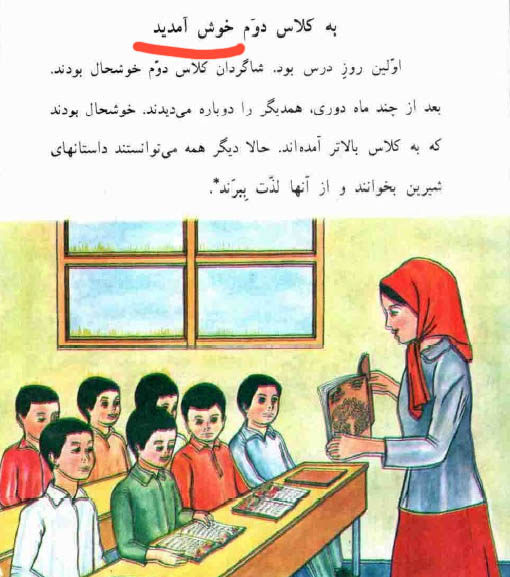 “Be kelâse-ye dovvom khosh âmadid!” – Welcome in the second class! (underline added)
However curvy these letters are in comparison to those familiar to us, the mere graphical form shows the difference.

 Khosh âmadid! Resounding, like the welcome in Germany, but grammatically correct
What is the reason of the blatant error? Someone obviously knew it well, entered it in the text editor, and sent it over to the graphic. And in the editor of the graphic designer, the right-to-left text stubbornly changed order, as it often happens in various word processors, we have also seen it. If it happened so, sag schon, we cannot place a Persian policeman next to every designer. A bigger problem is that it did not catch the attention of either the committee preparing the eminent event, or any of the participants or the public. The blooper emblematically symbolizes the fundamental shortcomings of the German preparations to receive people from other cultures. Moreover, by searching for the occurrences of the photo in the net – fortunately, at the moment there are only thirty-eight –, Getty Images, surely the ultimate source of the picture, advertises the picture with the motto find the perfect Persian Script stock photos.
The Arabic formula is correct: أهلاَ وسَهْلاَ ahlān wa sahlān, to good people, on a rich pasture. This one has been checked and the correct word order restored. To the Iranian and Afghan refugees, however, the sad âmadid khosh anticipates, how much understanding they should expect from the Indo-European relatives. As if we said venu bien in French. Or rather saying in German, instead of willkommen: kommen will. Which of course absolutely makes sense in the given situation. So we can downgrade the status of the blooper from mistranslation to a Freudian slip of the tongue.


 Come with us to…
 Atlantis
 Bestiary
 Bohemia+Prague
 Books, exhibitions, music, film
 Brave old world
 Caucasus
 Cemeteries
 Crimea
 Get to know the
 Images of the East
 Lightwriting
 Lwów/Lemberg
 Mallorca
 Message on the wall
 The Museum of Propaganda
 Odessa
 Paper Museum
 Persian letters
 The Jewish heritage


No hay comentarios:
Publicar un comentario