Switch over to our new blog! • ¡Pásese a nuestro nuevo blog!

The renewed version of our blog, with more features, a richer design, and available in nine languages, can be read here: https://wangriver.com

The new version also includes the old posts, often in expanded form. If you are curious about the updated version of this post, replace “riowang.blogspot.com/” in the URL with “riowang.studiolum.com/”, and the new link will most likely lead you there.


La versión renovada de nuestro blog, con más herramientas, un diseño más rico y disponible en nueve idiomas, se puede leer aquí: https://riowang.com

La nueva versión también incluye las publicaciones antiguas, a menudo en una forma ampliada. Si tiene curiosidad por la versión actualizada de esta entrada, sustituya «riowang.blogspot.com/» en la URL por «riowang.studiolum.com/es/», y el nuevo enlace probablemente le llevará allí.

Katyusha

May was a month of several postings filled with the spirit of World War II at the Poemas del río Wang: Little People about children in the war, Graffiti displaying wall inscriptions in the fallen Berlin and Two Images, which was a reflection about the Church through two wartime photos. For many years May for me was starting with the Victory Day celebrating 9 May 1945 – the day of capitulation of the Nazi Germany in the war that was called no less than Great Patriotic War (1941-1945) in the Soviet Union, the day that is still a public holiday in many post-Soviet countries. So here is my next posting inspired by that May spirit at Poemas del río Wang.

Katyusha is one of the iconic songs of the Great Patriotic War, although it was actually written quite earlier and performed for the first time in 1938. Katyusha (Katie) is a tender version of Katya (Kate), which is a diminutive of Russian female name Yekaterina (Catherine). This song is about a girl singing for her beloved one, who is far away on a military duty.


Музыка: Матвей Блантер
Слова: Михаил Исаковский

Расцветали яблони и груши,
Поплыли туманы над рекой.
Выходила на берег Катюша,
На высокий берег на крутой.

Выходила, песню заводила
Про степного, сизого орла,
Про того, которого любила,
Про того, чьи письма берегла.

Ой ты, песня, песенка девичья,
Ты лети за ясным солнцем вслед.
И бойцу на дальнем пограничье
От Катюши передай привет.

Пусть он вспомнит девушку простую,
Пусть услышит, как она поет,
Пусть он землю бережет родную,
А любовь Катюша сбережет.
Music: Matvey Blanter
Lyrics: Mikhail Isakovsky

Apple trees and pear trees were a flower,
River mist was rising all around.
Young Katyusha went strolling by the hour
On the steep banks, over the rocky ground.

By the river’s bank she sang a love song
Of her hero in a distant land.
Of the one she’d dearly loved for so long,
Holding tight his letters in her hand.

Oh, my song, song of a maiden’s true love,
To my dear one travel with the sun.
To the one with whom Katyusha knew love,
Bring my greetings to him, one by one.

Let him know that I am true and faithful,
Let him hear the love song that I send.
Tell him as he defends our home that grateful,
True Katyusha our love will defend.

There are several English translations of the lyrics on the Internet. Above is one of the versions that although not most accurate but can be sung with the music. Composed by Matvey Blanter (1903-1990) it was very popular at the frontline, actually on the both sides of it. There were cases when German soldiers hearing the song from their trenches were asking to perform it again. A very popular Italian partisan song Fischia il Vento (The Wind Blows) was written in 1943 for the same music.


Fischia il vento e infuria la bufera,
scarpe rotte e pur bisogna andar
a cunquistare la rossa primavera
dove sorge il sol dell’avvenir.
A cunquistare la rossa primavera
dove sorge il sol dell’avvenir.


Ogni contrada è patria del ribelle,
ogni donna a lui dona un sospir,
nella notte lo guidano le stelle
forte il cuore e il braccio nel colpir.
Nella notte lo guidano le stelle
forte il cuore e il braccio nel colpir.


Se ci coglie la crudele morte,
dura vendetta farà del partigian;
ormai sicura è la dura sorte
del fascista vile traditor.
Ormai sicura è la dura sorte
del fascista vile traditor.


Cessa il vento, calma è la bufera,
torna a casa il fiero partigian,
sventolando la rossa sua bandiera;
vittoriosi e alfin liberi siam.
Sventolando la rossa sua bandiera;
vittoriosi e alfin liberi siam.
The wind whistles, the storm rages,
our shoes are broken but we must go,
to conquer the red spring,
where the sun of future rises.
To conquer the red spring,
where the sun of future rises.

Every country is home to the rebel,
every woman sighs for him,
the stars guide him in the night,
his heart is strong and his arm ready to strike.
The stars guide him in the night,
his heart is strong and his arm ready to strike.

If cruel death catches us
the partisan’s revenge will be hard
already the hard destiny
of the mean Fascist traitor is certain.
Already the hard destiny
of the mean Fascist traitor is certain.

The wind stops, the storm calms,
the proud partisan returns home,
in the wind his red flag blows,
we have won and at last we are free.
In the wind his red flag blows,
we have won and at last we are free.

Katyusha was translated into many languages and is still performed in many countries from Israel to China. I knew this song by heart and as a child was singing Katyusha in Russian, but I never heard it in Azerbaijani language. Being a professor of mathematics, my father writes poems from time to time and in 1999 he read us his poetic translation of Katyusha with a short epigraph – “Dedicated to my uncle Mustafa”:

Artıq çiçəkləmiş alma-armudlar,
Çayın üzəriylə sürünür duman.
Bu dəmdə sahilə çıxır Katyuşa,
Dayandığı sahil yüksək bir yarğan.

Ey nəğmə, ey məsum qızın nəğməsi,
Günəşin ardınca uç, uç, havalan,
Uzaq sərhəddəki döyüşçüyə sən
Yetir Katyuşadan alovlu salam.
Çıxır, söyləməyə başlayır nəğmə
Haqqında çöl oğlu, cəsur qartalın,
Haqqında kimi ki sevmiş ürəkdən,
Sahibin qorunan xoş məktubların.

Qoy o xatırlasın sadə bir qızı,
Qoy eşitsin ki, o, necə oxuyur,
Qoy doğma torpağı qorusun daim,
Sevgi-məhəbbəti Katyuşa qorur.

Great-uncle Mustafa’s Katyusha

My father’s uncle Mustafa was the youngest, that is probably why also the most beloved brother in the family. A bright village boy, he pursued an army career and after finishing a military commanders’ school started his service as an officer in Baku. Mustafa met his future wife Valentina Andreyevna at a hospital while on service in Stavropol region of Russia in the 1930s. His family gave their blessings to his marriage with that Russian girl, and blessed they were with four children.

This photo of his youngest brother taken in 1940s my grandfather kept at his bed-side till his dying day.

The invasion of the Nazi Germany in June 1941 caught them on the western borders of the Soviet Union. His wife and children were evacuated back to his native village in Azerbaijan. The Nazi troops, following the tactic of Blitzkrieg, were indeed advancing with a speed of lightning. The Soviet Red Army was retreating and for the autumn of 1941 bloody battles were going already in approaches of the capital Moscow. A successful Soviet counter-offensive in winter 1941 threw the enemy back, but Moscow still was in a danger. Mustafa was wounded two times and while at hospital he was able to write letters to home. The last letter was written in July 1942, then after a long silence in 1943 Valentina received the last news about her husband – gara kaghyz (black paper in Azerbaijani) is how people were calling a “killed in battle” notice. For a long time I was actually thinking that those papers were really black, but in fact they were not:
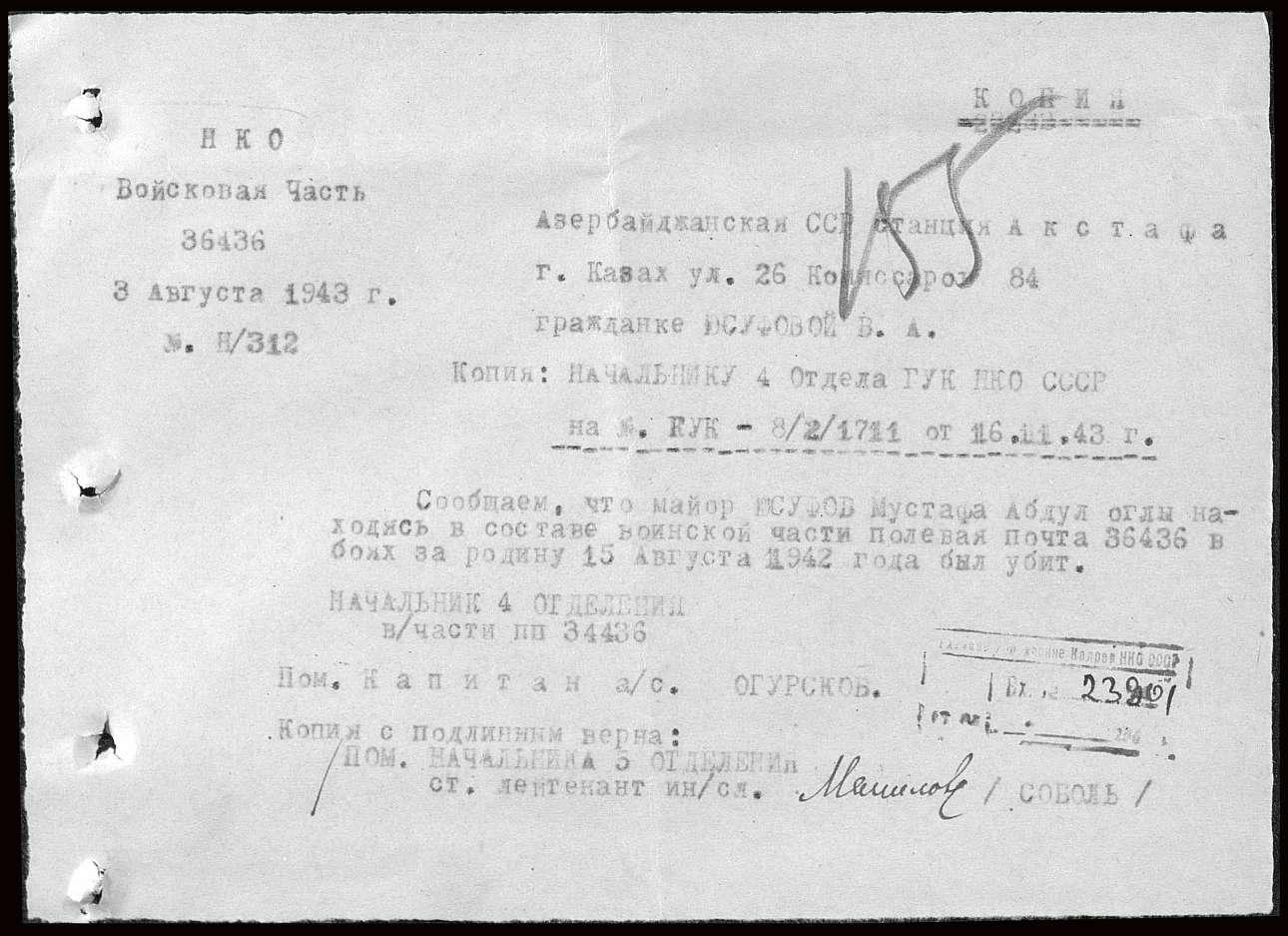
This is to let you know that major Yusufov Mustafa Abdul(la) oglu was killed in the battles for motherland on 15 August 1942. Date: 3 August 1943
This is to let you know that major Yusufov Mustafa Abdul(la) oglu was killed
in the battles for motherland on 15 August 1942. Date: 3 August 1943


No information about where, how major Yusufov was killed and where he is buried. Later his name was found in the official list of “missing in action”. So there was always some confusion about Mustafa’s fate and he was remembered from time to time with a smoldering hope for his survival.

Thus the gunpowder-smelling spirit of May at Poemas del río Wang brought back also the old memories about my great-uncle. I started to search the Internet for information about army major Mustafa Yusufov, and it was about the right time. It turned out that in 2008 the Ministry of Defense of Russian Federation made the Soviet archives about “irretrievable losses” of the Great Patriotic War available online through its project called OBD Memorial. It was periodically supplemented and now this huge database contains about 11.8 millions of digital images of archive documents. I was planning also to search the online database of the German Center of Documentation on Soviet prisoners of war.

Searching the archive is not always straightforward, since there are different spellings of names and misentered data either in the original document or in the digitized record. It did not take long to find bunch of documents concerning major Yusufov. Not only I learnt his last duty station – the 88th Rifle Division of the 31st Army and the place where he was buried, but also read how his wife was struggling and lost her two youngest children during the lean years of war.
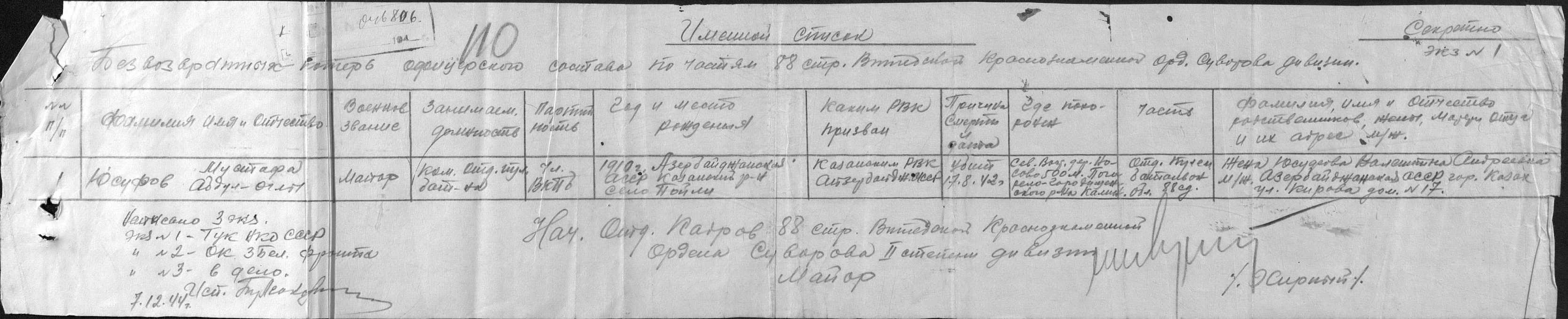
Major Yusufov Mustafa Abdul(la) oglu, commander of the detached machine gun battalion, killed on 17 August 1942, buried at 500 m North-East of Nosovo village. Date: 8 December 1944

In the spring 1942 the 88th Rifle Division was formed for the second time, because after the devastating battles in the North, near the border with Finland there were only three thousand people left from the initial 17 thousand in the first formation. The newly formed division got baptized with fire in August 1942 in the Rzhev-Sychevka offensive – the second Soviet operation in Battles of Rzhev also known as “Rzhev meat grinder”. This controversial episode of war is not as well known as Kursk or Stalingrad, although it was at least as bloody as the latter.

General course of military operations in the Summer-Autumn 1942 campaign including battles of Rzhev.
General course of military operations in the 1942 summer-autumn campaign
including the battles of Rzhev.


The first operation in January-April 1942 threw the Nazi troops further back, but by counterattacking they encircled and almost completely annihilated two Soviet army groups, they also kept Rzhev and other strategic positions in the Rzhev-Vyazma salient that looked like a fist threatening Moscow. In June 1942 Hitler ordered his troops to advance in South towards two strategic cities – Stalingrad as an important transporting center on the Volga and Baku as the major Soviet oil producer at the Caspian sea. Stalin did not foresee such a turn, and the operations around Rzhev continued to deter Nazis from transferring troops to the South. In July-September Soviet forces started a new offensive, but although they advanced further at the expense of great losses, the main objective was not achieved – Nazis held Rzhev and the salient. It was followed by another unsuccessful operation in November-December. Soviet troops entered Rzhev only in March 1943 to find out that the enemy almost insensibly retreated.

“Bolshevik had not time to throw his grenade”. Belarus, June 1941. Photo: Völkischer Beobachter newspaper.
“The Bolshevik had not time to throw his grenade”. Belarus, June 1941.
Photo: the German newspaper Völkischer Beobachter.


According to official data, the Soviet losses in the “Rzhev meat grinder” exceeded one million killed and wounded. For decades military historians and generals passed these battles over in silence, but the memory lived with those who survived. One of them was a famous Russian Soviet poet Aleksandr Tvardovsky (1910-1971), who was in Rzhev on an assignment as a war reporter for Krasnoarmeyskaya Pravda (Red Army Truth) newspaper in autumn 1942. His poem “I Was Killed Near Rzhev” written in 1946 tells the story of thousands of Soviet unknown warriors lying in Rzhev soil:

Я убит подо Ржевом,
В безымянном болоте,
В пятой роте,
На левом,
При жестоком налете.


И во всем этом мире
До конца его дней —
Ни петлички, ни лычки
С гимнастерки моей.

Я — где корни слепые
Ищут корма во тьме;
Я — где с облаком пыли
Ходит рожь на холме.

Я — где крик петушиный
На заре по росе;
Я — где ваши машины
Воздух рвут на шоссе.

Где — травинку к травинке —
Речка травы прядет,
Там, куда на поминки
Даже мать не придет.


Летом, в сорок втором,
Я зарыт без могилы.
Всем, что было потом,
Смерть меня обделила.
I was killed near Rzhev
In a nameless bog,
In the fifth company,
On the Left flank,
In a cruel air raid.


And in this whole world
To the end of its days -
Neither patches, nor badges
From my tunic you’ll find

I am where the blind roots
Seek for food in the dark;
I am where the rye waves
On a hill in the dust.

I am where the cockerel cries
In the dew of the dawn;
I am where your cars
Tear the air on highways.

Where – small stalk to small stalk –
River’s weaving its grass,
Where for the remembrance
Even my mother won’t come.


In the summer of forty-two
I was buried without a grave
Everything what came later
Was taken by the death

The name Mustafa Yusufov too is not in any name list of buried, neither there is an official memorial grave in a village called Nosovo. In fact you wouldn’t even find such a place around Rzhev if looked at most of the maps.

There are many voluntary search groups finding every year remains of hundreds of unknown soldiers, sometimes even whole tanks or planes buried in bogs. The saying “war is not over until the last soldier is buried” by a great commander, the invincible Russian generalissimus Alexander Suvorov (1729-1800) is their unofficial motto.

My inquiry at several online search group forums about the place where Major Yusufov was buried was answered quite quickly. It turned out that Nosovo was a small village near Pogoreloye Gorodishe center in Tver oblast of Russian Federation with a population that was 83 people in 2008. Exactly in that area on 4 August 1942 the 88th Rifle Division together with the 212th Tank Brigade forced a crossing of the Derzha river.
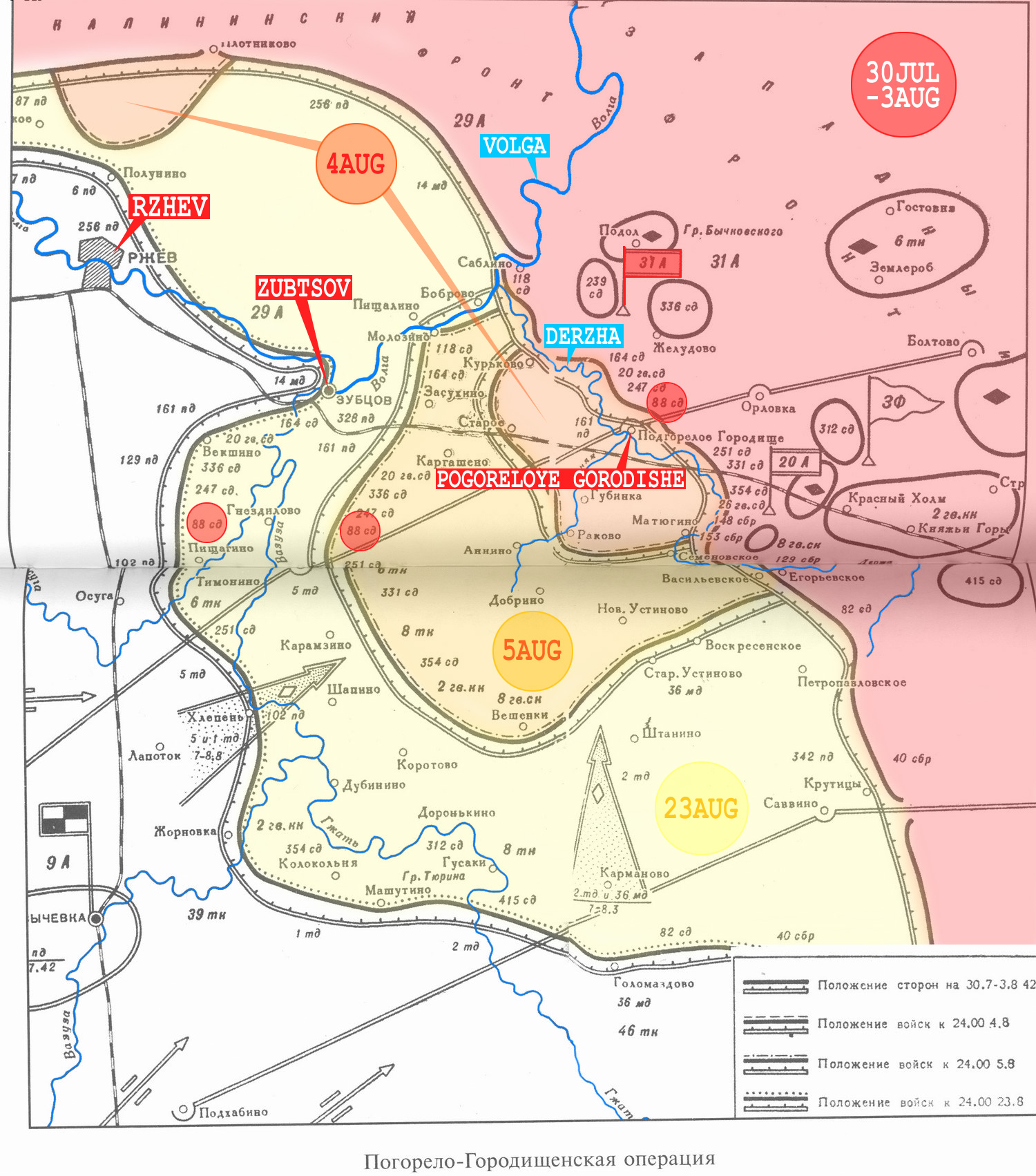
The 88th Rifle Division of the 31st Army in Pogoreloye Gorodishe operation, 30 July-23 August 1942.
The 88th Rifle Division of the 31st Army in Pogoreloye Gorodishe operation,
30 July-23 August 1942.

But the most important information was received on 24 May 2010 from Aleksey Sdvizhkov, deputy chief of the Gorizont Tourism-Searching Club at the Moscow Power Engineering Institute. He wrote that in 2007 their club was on a field trip together with the local search groups from Zubtsov and Pogoreloye Gorodishe and they found two sanitary burials with about 20 men in each exactly at the place indicated in the document: 500 meters to North-East from Nosovo. The remains were reburied in the memorial cemetery in Pogoreloye Gorodishe with military honors and religious ceremonies. Aleksey was very kind to send an official letter from their club to the local administration about adding army major Mustafa Yusufov to the name list on the memorial. He also sent me a photo of a view on Nosovo with a monument in memory of Soviet break-through, which struck me – it was Katyusha overlooking the village from top of the hill.

Katyusha in Nosovo at the Moscow-Riga road. Photo: Aleksey Sdvizhkov

Katyushas in the war

Katyusha is how Soviet soldiers named this new BM-13 rocket launcher after the girl from their beloved wartime song. The most probable reason is the letter “K” on board of BM-13 indicating the producing Voronezh Komintern Factory. Katyusha was tested in battle for the first time in July 1941, its mass production and use started to the end of 1941. German troops called it with a not less musical name of Stalinorgel, meaning Stalin’s organ. That organ music was a funeral one indeed: in ten seconds an artillery battery of Katyushas could fire a salvo delivering more than four tons of explosives to an impact zone larger than four hectares in a distance farther than five kilometers. Thus new couplets for the good old song were borne, now about this other Katyusha:

В мраке, в тьме лесных опушек наших
Смерч несется к небу огневой –
Это наша русская «Катюша»
Немчуре поет за упокой!


Все мы знаем душечку-«Катюшу»,
Все мы слышим, как она поет,
Из врага вытряхивает душу,
А бойцам отвагу придает!
In the gloom, in dark of our forests
Storm of fire is rushing to the sky –
This is our Russian “Katyusha”
Sings her song so Germans will soon die!


We all know our dearest “Katyusha”,
We all hear how does she sing her songs,
Shakes she out of enemies their souls,
And to soldiers bravery she brings!

Katyusha salvo, 1941. Photo: Samariy Gurariy

Loading Katyusha. The 1st Ukrainian Front, 29 June 1944. Photo: A. Shaykhet
Loading Katyusha. The 1st Ukrainian Front, 29 June 1944. Photo: A.Shaykhet

Katyusha salvo. The 2nd Ukrainian Front, Budapest, 27 January 1945. Photo: A. Yegorov
Katyusha salvo. The 2nd Ukrainian Front, Budapest, 27 January 1945. Photo: A.Yegorov

Katyushas at the Parade of Victory. Moscow, 24 June 1945. Photo: F. Kislov

Katyusha rocket launchers went through all the war till Berlin, and Katyusha, the song did not fall behind. On the doorsteps of the smoldering Reichstag it was sang by Lidiya Ruslanova (1900-1973), a popular Russian and Soviet singer, one of the greatest Russian folk song performers.

Katyusha by Lidiya Ruslanova. Berlin, May 1945. Photo: Grigoriy Petrusov

Расцветали яблони и груши.
По тропинкам, через лес густой
Выходила смелая Катюша
С автоматом на берег крутой.

Выходила, без пощады била
За разгром родимого села,
За того, которого любила,
За того, чьи письма берегла.
Apple trees and pear trees were a flower.
By the paths through the dense wood
Brave Katyusha came out of the forest
To the steep bank with a sub-machine gun.

She came out and fought enemies grimly
For her village razed to the ground,
For the one she'd dearly loved for so long,
Holding tight his letters in her hand.

These frontline couplets tell the story of another Katyusha, one of the 800 thousand women who served in the Red Army during that war.

Be a hero! 1941 V. Koretskiy
Fascism - bitterest enemy of women. Everybody to the fight with fascism! 1941 N. Vitolina
Fascism – the bitterest enemy of women. Everybody to the fight with Fascism!
1941 N. Vitolina

Join the ranks of frontline comrades, volunteer is helper and friend of soldiers! 1941. V. Koretskiy, V. Gitsevich
Join the ranks of frontline comrades, volunteer is helper and friend of soldiers!
1941. V. Koretskiy, V. Gitsevich
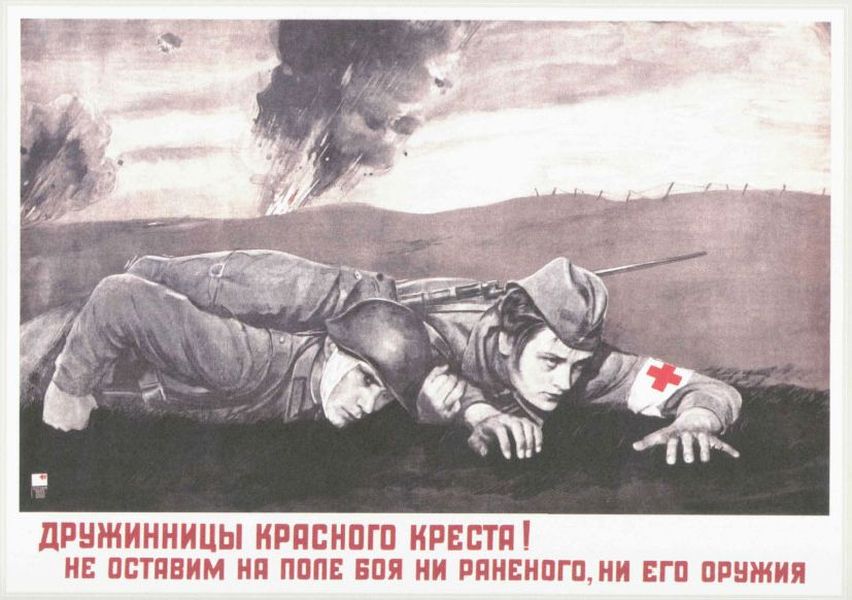
Red Cross volunteers! We will not leave on a battleground nor a wounded, neither his weapon. 1942 V. Koretskiy
Red Cross volunteers! We will not leave on a battleground nor a wounded, neither his weapon.
1942 V. Koretskiy

We will substitute you! 1941 V. Serov
Our aim is same - Berlin. 1945. V. Koretskiy
Our aim is same – Berlin. 1945. V. Koretskiy

Women were not only in auxiliary roles, such as nurses or signalers; there were women-snipers, machine gunners, tankers and even pilots.


Zuleykha Seyidmammadova (1919-1999). Photo: RIA “Novosti”
Among them was Zuleykha Seyidmammadova – the first female pilot of Azerbaijan. She went through the war starting as the regiment navigator and ending as the second in command at her 586th Fighter Aviation Regiment that was one of the three Soviet women air regiments formed in 1942.

Involvement of women in combat on such a large scale was something unprecedented and shocking for Germans and, ironically, in the first years of the war Nazi propaganda was using it as an evidence of inhumanity of the Soviet regime, while when the end was close they did not stop at sending even children to battle.

World War II was the most brutal and bloody war in the history of mankind. Pushing the limits of human atrocity, it also revealed the heights of heroism and self-sacrifice. So dual is also the story of Katyusha – the story of devoted love and fierce hostility.

Anti-aircraft gunner girls taking military oath (http://waralbum.ru/867/)
Anti-aircraft gunner girls taking military oath
Pilot Mamayeva-Bezmenova before an operational flight, August 1943 (http://waralbum.ru/1234/)
Pilot Mamayeva-Bezmenova before an operational flight, August 1943

Machine gunner Zina Kozlova, 30 June 1942. Photo: Mikhail Savin (http://waralbum.ru/2698/)
Machine gunner Zina Kozlova, 30 June 1942. Photo: Mikhail Savin

Sniper girl. Baltic front, 1944. Photo: S. Baranov/RIA "Novosti" (http://waralbum.ru/745/)
Sniper girl. Baltic front, 1944. Photo: S. Baranov/RIA “Novosti”

"Sanitary instructor" - a frontline nurse, June 1942 (http://waralbum.ru/15255/)
“Sanitary instructor” – a frontline nurse,
June 1942
Sleeping "san.instructor". Photo: David Trakhtenberg (http://waralbum.ru/8786/)
Sleeping “sanitary instructor”.
Photo: David Trakhtenberg

Mariya Shalneva (Nenakhova) regulates the traffic. Berlin, 2 May 1945. Photo: Yevgeniy Khaldey (http://waralbum.ru/5338/)
Mariya Shalneva (Nenakhova) regulates the traffic. Berlin, 2 May 1945.
Photo: Yevgeniy Khaldey

Victory! Sniper girls, 1945. Photo: Natalya Bode (http://waralbum.ru/1283/)
Victory! Sniper girls, 1945. Photo: Natalya Bode

Acknowledgements

Most of the photos are from War Album digital archive of World War II images. The images of the wartime Soviet posters can be found at My-USSR.ru, Krasnoye Znamya (Red Banner), 1941-1945 and Electronic Museum of Domestic Poster.

Other interesting links

Фронтовые судьбы песен. «Катюша» (Frontline Destiny of Songs. “Katyusha”) – an interesting collection of stories about the song, its various versions (includes sheet music): http://www.a-pesni.golosa.info/ww2/oficial/katjucha.htm

Ржев: Неизвестная битва Георгия Жукова (Rzhev: Georgi Zhukov’s Unknown Battle) – a 2009 documentary directed by Sergey Nurmamed, and narrated by Aleksey Pivovarov and Konstantin Goldenzweig caused lots of controversy in Russia: http://www.youtube.com/watch?v=Lv_8AbQJyuk

Searching for military burial places around Rzhev – a short video by a local military-historical center Oryol (Eagle): http://www.youtube.com/watch#!v=mskUclqiUQ4

VESTI Moscow 23 September 2007 TV news reportage about search work around Moscow: http://www.vesti-moscow.ru/videos.html?id=9430

Женское лицо войны. Катюша (Female Face of War. Katyusha) – a 2008 Russian documentary directed by Aleksey Kitaytsev based on a book by Svetlana Aleksiyevich: http://rutube.ru/tracks/1895638.html

Женя, Женечка и 'Катюша' (Zhenya, Zhenechka and ‘Katyusha’) – a popular 1967 Russian Soviet movie (with English subtitles) directed by Vladimir Motyl and co-written with Bulat Okudzhava tells the touching story of a romantic young man (Zhenya) going through the war together with his division of Katyusha rocket launchers: http://www.youtube.com/watch#!v=BsvveaPoUlk

Katyuşa

May ayı “Poemas del río Wang”da İkinci Dünya Müharibəsi havası ilə yoğrulmuş bir neçə yazı ilə əlamətdar oldu: müharibə uşaqları barədə “Balaca adamlar”, təslim olmuş Berlində divar yazılarından bəhs edən “Qraffiti” və iki müharibə fotosunun güzgüsündə kilsə barədə düşüncələri bölüşən “İki şəkil”. Mənim üçün uzun illər boyu may ayı 9 may 1945-ci il – Sovet İttifaqında nə az, nə çox Böyük Vətən Müharibəsi (1941-1945) adlanan bir müharibədə Nasist Almaniyasının kapitulyasiyası tarixini bayram edən, hələ də bir çox post-sovet ölkəsində dövlət bayramı kimi qeyd edilən Qələbə Günü ilə başlayırdı. Beləliklə, mənim “Poemas del río Wang”dakı bu May havasının təsiri altında növbəti yazım meydana gəldi.

“Katyuşa” Böyük Vətən Müharibəsini təcəssüm etdirən mahnılardan birdir. Əslində bu mahnı daha əvvəllər yazılmış, ilk dəfə 1938-ci ildə ifa edilmişdi. Katyuşa rus qadın adı Yekaterinanın kiçiltməsi olan Katyanın əzizləmə formasıdır. Bu nəğmə çox uzaqlarda hərbi xidmətdə olan sevgilisinə mahnı oxuyan bir qız haqqındadır.


Музыка: Матвей Блантер
Слова: Михаил Исаковский

Расцветали яблони и груши,
Поплыли туманы над рекой.
Выходила на берег Катюша,
На высокий берег на крутой.

Ой ты, песня, песенка девичья,
Ты лети за ясным солнцем вслед.
И бойцу на дальнем пограничье
От Катюши передай привет.
Musiqisi: Matvey Blanter
Sözləri: Mixail İsakovskiy

Выходила, песню заводила
Про степного, сизого орла,
Про того, которого любила,
Про того, чьи письма берегла.

Пусть он вспомнит девушку простую,
Пусть услышит, как она поет,
Пусть он землю бережет родную,
А любовь Катюша сбережет.

Matvey Blanter (1903-1990) tərəfindən bəstələnmiş mahnı cəbhədə, əslində cəbhə xəttinin hər iki tərəfində rəğbət qazanmışdı. Bu nəğməni öz səngərlərindən eşidən alman əsgərlərinin bəzən onun yenidən ifa edilməsini xahiş etdiklərini söyləyirlər. Çox sevilən italyan partizan mahnılarından biri “Fischia il Vento”nun (Külək vıyıldayır) sözləri 1943-cü ildə eyni musiqiyə yazılmışdır.


Fischia il vento e infuria la bufera,
scarpe rotte e pur bisogna andar
a cunquistare la rossa primavera
dove sorge il sol dell’avvenir.
A cunquistare la rossa primavera
dove sorge il sol dell’avvenir.


Ogni contrada è patria del ribelle,
ogni donna a lui dona un sospir,
nella notte lo guidano le stelle
forte il cuore e il braccio nel colpir.
Nella notte lo guidano le stelle
forte il cuore e il braccio nel colpir.


Se ci coglie la crudele morte,
dura vendetta farà del partigian;
ormai sicura è la dura sorte
del fascista vile traditor.
Ormai sicura è la dura sorte
del fascista vile traditor.


Cessa il vento, calma è la bufera,
torna a casa il fiero partigian,
sventolando la rossa sua bandiera;
vittoriosi e alfin liberi siam.
Sventolando la rossa sua bandiera;
vittoriosi e alfin liberi siam.
Külək vıyıldayır, tufan da qopub,
çəkmə cırıqsa də biz getməliyik,
gələcək günəşi şövqlə parlayan
qırmızı səhəri fəth etməliyik.
Gələcək günəşi şövqlə parlayan
qırmızı səhəri fəth etməliyik.

Hər diyar bu üsyankara yurd oldu,
hər qadın ah çəkdi onun halına,
gecə ona bələdçi ulduzlardır,
qəlbi sərtdir, təpər verir qoluna.
Gecə ona bələdçi ulduzlardır,
qəlbi sərtdir, təpər verir qoluna.

Bizi yaxalarsa amansız ölüm,
Partizan qisası ağır olacaq;
artıq yəqindir ki cəzanı çəkmək
mənfur faşist satqınlara qalacaq.
Artıq yəqindir ki cəzanı çəkmək
mənfur faşist satqınlara qalacaq.

Külək durur, tufan isə səngiyir,
qəhrəman partizan qayıdır evə,
qırmızı bayrağı hey dalğalanır,
zəfər çaldıq, azadıq bundan belə.
Qırmızı bayrağı hey dalğalanır,
Zəfər çaldıq, azadıq bundan belə.

“Katyuşa” bir çox dillərə tərcümə olunub və hələ də İsraildən tutmuş Çinə qədər bir çox ölkələrdə ifa edilir. Bu mahnını əzbər bilirdim və uşaq ikən Katyuşa”nı rus dilində oxuyardım, amma onu heç vaxt Azərbaycan dilində eşitməmişdim. Universitetdə riyaziyyat müəllimi olan atam hərdən şerlər yazardı və 1999-cu ildə “Katyuşa”nın özü etdiyi mənzum tərcüməsini bizə oxumuşdu. Qısaca epiqrafı var idi – “Mustafa əmimə”:

Artıq çiçəkləmiş alma-armudlar,
Çayın üzəriylə sürünür duman.
Bu dəmdə sahilə çıxır Katyuşa,
Dayandığı sahil yüksək bir yarğan.

Ey nəğmə, ey məsum qızın nəğməsi,
Günəşin ardınca uç, uç, havalan,
Uzaq sərhəddəki döyüşçüyə sən
Yetir Katyuşadan alovlu salam.
Çıxır, söyləməyə başlayır nəğmə
Haqqında çöl oğlu, cəsur qartalın,
Haqqında kimi ki sevmiş ürəkdən,
Sahibin qorunan xoş məktubların.

Qoy o xatırlasın sadə bir qızı,
Qoy eşitsin ki, o, necə oxuyur,
Qoy doğma torpağı qorusun daim,
Sevgi-məhəbbəti Katyuşa qorur.

Mustafa babanın Katyuşası

Atamın Mustafa əmisi ailədə ən kiçik, yəqin elə buna görə də ən sevimli qardaş olub. Kəndin say-seçmə gənclərindən biri, özünə hərbçi peşəsini seçib və hərbi komandir məktəbini bitirdikdən sonra Bakıda zabit kimi xidmətə başlayıb. Mustafa gələcək həyat yoldaşı Valentina Andreyevna ilə hospitalda, 1930-cu illərdə xidmət etdiyi Rusiyanın Stavropol vilayətində tanış olub. Ailəsi onun bu rus qızı ilə evlənməsinə xeyir-dua verib, tale də onları dörd uşaqla sevindirib.

Kiçik qardaşının 1940-cı illərdə çəkilmiş bu şəklini babam son gününə qədər yatağının başında saxlayardı.

1941-ci ilin iyununda Nasist Almaniyasının hücumu onları Sovet İttifaqının qərb sərhədlərində yaxalayıb. Həyat yoldaşı və uşaqları evakuasiya olunaraq Azərbaycana, doğma kəndə göndərilib. Nasist qoşunları “Blitskriq” taktikasına sadiq qalaraq əsl ildırım sürəti ilə irəliləyirdilər. Sovet Qızıl Ordusu geri çəkilirdi və 1941-ci ilin payızında qanlı döyüşlər artıq paytaxt Moskvanın həndəvərində gedirdi. 1941-ci ilin qışında uğurlu sovet əks-hücumu düşməni geri atsa da, Moskva hələ də təhlükədə idi. Mustafa iki dəfə yaralanmışdı, hospitalda olarkən evə məktub yazmaq imkanı olurdu. Axırıncı məktubu 1942-ci ilin iyulunda yazılmışdı. Xeyli müddət sonra, 1943-cü ildə Valentina ərinin son xəbərini – xalq arasında “qara kağız” adlanan ölüm haqqında bildirişini aldı. Mən uzun müddət elə bilirdim ki, bu kağızlar doğrudan da qara olub, amma elə deyilmiş:
This is to let you know that major Yusufov Mustafa Abdul(la) oglu was killed in the battles for motherland on 15 August 1942. Date: 3 August 1943
Bildiririk ki, mayor Yusufov Mustafa Abdul(la) oğlu 15 avqust 1942-ci ildə vətən uğrunda gedən döyüşlərdə həlak olmuşdur. Tarix: 3 avqust 1943-cü il

Nə mayor Yusufovun harada, necə həlak olması, nə də dəfn edildiyi yer barədə bir məlumat göstərilməyib. Sonradan onun adı rəsmi “itkin düşənlər” siyahısına da düşüb. Buna görə Mustafanın taleyi hər zaman qeyri-müəyyən olduğundan, onu sağ qalacağı barədə közərən ümidlə vaxtaşırı yada salardılar.

Beləcə “Poemas del río Wang”da may ayının barıt qoxulu havası babamın qardaşı barədə köhnə xatirələri yada saldı. Mən İnternetdə mayor Mustafa Yusufov barədə məlumat axtarmağa başladım, deyəsən elə düz vaxtında başlamışdım. Məlum oldu ki, 2008-ci ildə Rusiya Federasiyası Müdafiə Nazirliyi “OBD Memorial” adlı layihəsi vasitəsi ilə Böyük Vətən Müharibəsinin “qayıtmaz itkiləri” barədə sovet arxivlərini açıq şəkildə onlayn yerləşdirmişdir. Onlayn arxiv vaxtaşırı yenilənir və indi bu nəhəng verilənlər bazasında arxiv sənədlərinin 11,8 milyon rəqəmli təsviri saxlanır. Mən Alman Sənədləşmə Mərkəzinə məxsus sovet müharibə əsirlərinin onlayn verilənlər bazasında da axtarış aparmağı planlaşdırırdım.

Arxivdə axtarış aparmaq heç də həmişə asan deyil, çünki adların müxtəlif cür yazılışı, orijinal sənəd və ya elektron yazıda səhv daxil olunmuş verilənlər ola bilər. Çox keçmədən mayor Yusufov barəsində bir xeyli məlumat toplandı. Nəinki onun sonuncu xidmət yeri – 31-ci ordunun 88-ci atıcı divizionu, harada dəfn edildiyini, həm də həyat yoldaşının necə çətinlik çəkdiyi, uşaqlarından iki ən körpəsini müharibənin uğursuz illərində itirdiyini öyrəndim.

Major Yusufov Mustafa Abdul(la) oglu, commander of the detached machine gun battalion, killed on 17 August 1942, buried at 500 m North-East of Nosovo village. Date: 8 December 1944
Mayor Yusufov Mustafa Abdul(la) oğlu, əlahiddə pulemyot batalyonunun komandiri,
17 avqust 1942-ci ildə həlak olub, Nosovo kəndidən 500 m şimal-şərqdə dəfn edilib.
Tarix: 8 dekabr 1944-cü il


1942-ci ilin yazında 88-ci atıcı diviziya ikinci dəfə təşkil edilmişdi, çünki şimalda, Finlandiya sərhədləri yaxınlığında gedən ağır döyüşlərdən sonra ilkin heyətdə olan 17 min adamdan ancaq üç mini qalmışdı. Yeni təşkil olunmuş divizionunu ilk döyüşü “Rjev ətçəkəni” adı ilə məşhur Rjev döyüşlərində ikinci əməliyyat – 1942-ci ilin avqustunda keçirilən Rjev-Sıçevka hücum əməliyyatı oldu. Müharibənin bu mübahisəli epizodu KurskStalinqrad qədər məşhur olmasa da, ən azı sonuncu qədər qanlı olub.

General course of military operations in the Summer-Autumn 1942 campaign including battles of Rzhev.
Rjev döyüşləri də daxil olmaqla 1942-ci ilin yay-payız kampaniyasında hərbi əməliyyatların ümumi gedişi.

1942-ci ilin yanvar-aprelində keçirilən ilk əməliyyat faşistləri geriyə atsa da, onlar əks-hücumlar etməklə iki sovet ordu birləşməsini mühasirəyə alaraq demək olar ki tamamilə məhv edə, həmçinin Rjev şəhəri və Moskvanı hədələyən yumruğu xatırladan Rjev-Vyazma çıxıntısındakı digər strateji mövqeləri əllərində saxlaya bilmişdilər. 1942-ci ilin iyun ayında Hitler qoşunlarına cənubda iki strateji şəhər – Volqa üzərində vacib nəqliyyat qovşağı olan Stalinqrad və Xəzər dənizindəki əsas sovet neft istehsalçısı Bakı istiqamətində irəliləməyi əmr etdi. Stalin hadisələrin bu cür dönüşünü gözləmirdi və Rjev ətrafında əməliyyatlar faşistlərə qoşunları cənub istiqamətinə ötürmək imkanı verməmək üçün davam etdirildi. İyul-sentyabr aylarında sovet qoşunları yeni hücuma başladılar, lakin böyük itkilər hesabına xeyli irəliləsələr də əsas məqsədə nail ola bilmədilər – nasistlər Rjev və strateji çıxıntını əllərində saxladı. Bundan sonra noyabr-dekabrda daha bir uğursuz əməliyyat keçirildi. Sovet qoşunları Rjevə ancaq 1943-cü ilin martında daxil oldular və məlum oldu ki, düşmən demək olar ki hiss edilmədən geri çəkilib.

“Bolshevik had not time to throw his grenade”. Belarus, June 1941. Photo: Völkischer Beobachter newspaper.
“Bolşevik qranatını atmağa macal tapmadı”. Belarus, iyun 1941-ci il.
Foto: alman qəzeti “Völkischer Beobachter”.


Rəsmi verilənlərə görə sovet qoşunlarının “Rjev ətçəkənində” itkiləri milyonu aşmışdı. Onilliklər ərzində hərbi tarixçilər və generallar bu döyüşlərin üzərindən sükutla keçib, lakin bu hadisələr sağ qalmış insanların yaddaşında yaşayıb. Onlardan biri “Krasnoarmeyskaya Pravda” (“Qızıl Ordu Həqiqəti”) qəzetinin müxbiri kimi 1942-ci ilin payızında Rjevə ezam olunmuş məşhur rus sovet şairi Aleksandr Tvardovski (1910-1971) idi. Onun 1946-cı ildə yazdığı “Mən Rjev ətrafında öldürülmüşəm” şeiri Rjev torpağında yatan minlərlə naməlum sovet döyüşçüsünün hekayəsini söyləyir: :

Я убит подо Ржевом,
В безымянном болоте,
В пятой роте,
На левом,
При жестоком налете.


И во всем этом мире
До конца его дней —
Ни петлички, ни лычки
С гимнастерки моей.

Я — где корни слепые
Ищут корма во тьме;
Я — где с облаком пыли
Ходит рожь на холме.

Я — где крик петушиный
На заре по росе;
Я — где ваши машины
Воздух рвут на шоссе.

Где — травинку к травинке —
Речка травы прядет,
Там, куда на поминки
Даже мать не придет.


Летом, в сорок втором,
Я зарыт без могилы.
Всем, что было потом,
Смерть меня обделила.
Mən Rjev ətrafında öldürülmüşəm,
Adsız bir bataqlıq,
Beşinci rota,
Sol cinahda,
Qəddar hava hücumunda.


Bütün bu dünyanı axtarsaz belə
Axırıncı gününədək
Nə bir ilmə, nə bir nişan gəlməz ələ
Mənim əsgər köynəyimdən.

Mən gözləri kor köklərin
Qaranlıqda yem axtarıb yol getdiyi yerdəyəm;
Mən tozanaq buludunda
Dalğa-dalğa gəlib-gedən çovdarlı təpədəyəm.

Mən xoruzun banı ilə
Dan yerinin söküldüyü tər şehli səhərdəyəm;
Mən havanı yarıb keçən
Maşınları sürdüyünüz şose keçən yerdəyəm.

O yerdə ki, ələf-ələf
Darayaraq göy otları çay suları toxuyar,
O yerdə ki, qəbir üstə
Heç anam də gəlməz ziyarətə, nə bir dua oxuyar.


Qırx ikinci ilin bir yay çağında,
Gömüldüm qəbirsiz, dəfnsiz.
Kor ölümün fitvasıyla bundan sonra
Nə oldusa, oldu mənsiz.

Mustafa Yusufov adı da heç bir dəfn siyahısında yoxdur, nə də Nosovo adlı bir kənddə rəsmi əsgəri dəfn yeri mövcuddur. Əslində xəritələrin əksəriyyətində Rjev ətrafına baxdıqda heç belə bir yeri tapa bilməzsiniz.

Hər il yüzlərlə naməlum əsgərin qalıqlarını, bəzən hətta bataqlıqlarda qalmış bütöv tank və təyyarələri tapan çoxlu sayda könüllü axtarış qrupu var. Böyük sərkərdə, məğlubedilməz rus generalissimusu Aleksandr Suvorov (1729-1800) tərəfindən deyilmiş “müharibə sonuncu əsgər dəfn edilməyincə başa çatmayıb” sözləri onların qeyri-rəsmi şüarıdır.

Axtarış qruplarının bir neçə onlayn forumunda mayor Yusufovun dəfn olunduğu yer barədə verdiyim sorğuya çox keçmədən cavab aldım. Məlum oldu ki, Nosovo Rusiya Federasiyasının Tver vilayətindəki Poqoreloye Qorodişşe mərkəzi yaxınlığında yerləşən, əhalisi 2008-ci ildə 83 nəfər olan kiçik bir kənddir. Məhz bu yerdə 4 avqust 1942-ci il 88-ci atıcı diviziya 212-ci tank briqadası ilə birlikdə Derja çayını döyüşə-döyüşə keçmişdi.

The 88th Rifle Division of the 31st Army in Pogoreloye Gorodishe operation, 30 July-23 August 1942.
31-ci ordunun 88-ci atıcı diviziyası Poqoreloye Qorodişşe əməliyyatında,
30 iyul – 23 avqust 1942-ci il.

Lakin ən vacib məlumatı 24 may 2010-cu il Moskva Energetika İstitutundakı “Qorizont” turizm-axtarış klubunun komandir müavini Aleksey Sdvijkovdan aldım. O yazırdı ki, 2007-ci ildə klubları Zubtsov və Poqoreloye Qorodişşedən olan yerli axtarış qrupları ilə birlikdə o yerlərə səfər edib və onlar eynilə sənəddə göstərilə yerdə, Nosovodan şimal-şərqə doğru 500 metr məsafədə hərəsində təxminən 20 nəfər olan iki sanitar dəfn yeri aşkar ediblər. Qalıqlar əsgəri ehtiram və dini mərasimlə Poqoreloye Qorodişşedəki xatirə qəbiristanlığında yenidən dəfn edilib. Aleksey alicənablıq göstərərək klublarından yerli hakimiyyət orqanına mayor Mustafa Yusufovu xatirə kompleksindəki adların siyahısına əlavə etmək barədə rəsmi xahiş məktubu göndərdi. Bundan başqa o, Nosovo kəndinin sovet qoşunlarının cəbhəni yarmasının xatirəsinə qoyulmuş abidə görünən bir mənzərəsinin foto-şəklini də göndərdi. Şəkil məni mat qoydu – bu, təpənin üstündən kəndə baxan Katyuşa” idi.

Katyusha in Nosovo at the Moscow-Riga road. Photo: Aleksey Sdvizhkov
“Katyuşa” Nosovoda, Moskva-Riqa yolunun kənarında. Foto: Aleksey Sdvijkov

Katyuşalar döyüşdə

“Katyuşa” sovet əsgərlərinin yeni “BM-13” reaktiv artilleriya qurğusuna sevdikləri müharibə mahnısındakı qıza görə verdikləri ad idi. Bunun səbəbi çox yəqin ki “BM-13”ün bortunda istehsalçı Voronej Komintern Fabrikinin nişanı olan “K” hərfi imiş. Katyuşa” döyüş sınağından ilk dəfə 1941-ci ilin iyulunda keçib, 1941-ci ilin sonuna isə onun kütləvi istehsalı və istifadəsi başlayıb. Alman qoşunları da ona musiqili bir ad – “Stalinorgel”, yəni “Stalinin orqánı” adını qoyubmuşlar. Bu orqan musiqisi şübhəsiz ki matəm mahnısı olub: onca saniyədə bir Katyuşa” batareyası yaylım atəşi ilə dörd tondan artıq partladıcını beş kilometrdən də uzaqda yerləşən dörd hektardan geniş hədəf sahəsinə çatdıra bilirdi. Beləliklə, sevimli köhnə mahnının indi başqa Katyuşa”dan söhbət açan yeni bəndləri meydana gəldi:

В мраке, в тьме лесных опушек наших
Смерч несется к небу огневой –
Это наша русская «Катюша»
Немчуре поет за упокой!


Все мы знаем душечку-«Катюшу»,
Все мы слышим, как она поет,
Из врага вытряхивает душу,
А бойцам отвагу придает!
Zülmət meşələrin qaranlığında
Göylərə alovdan tufan yüksəlir –
Bu bizim rus “Katyuşa”mızdır,
Oxuyur almanın fatihəsini!


Tanıyırıq biz də “Katyuşa”-canı,
Eşidirik necə oxuduğunu,
Düşmənə toy tutub canını alır,
Əsgərin qaldırır döyüş ruhunu!

Katyusha salvo, 1941. Photo: Samariy Gurariy
“Katyuşa” yaylım atəşi, 1941. Foto: Samariy Quraniy

Loading Katyusha. The 1st Ukrainian Front, 29 June 1944. Photo: A.Shaykhet
“Katyuşa”nın doldurulması. 1-ci Ukrayna Cəbhəsi, 29 iyun 1944-cü il. Foto: A.Şayxet

Katyusha salvo. The 2nd Ukrainian Front, Budapest, 27 January 1945. Photo: A.Yegorov
“Katyuşa” yaylım atəşi. 2-ci Ukrayna Cəbhəsi, Budapeşt, 27 yanvar 1945-ci il. Foto: A.Yeqorov

Katyushas at the Parade of Victory. Moscow, 24 June 1945. Photo: F. Kislov
“Katyuşa”lar Qələbə Paradında. Moskva, 24 iyun 1945-ci il. Foto: F. Kislov

“Katyuşa” reaktiv qurğuları bütün müharibəni keçərək, gedib düz Berlinə çıxdılar, “Katyuşa” mahnısı da geridə qalmadı. Sevilən rus və sovet müğənnisi, rus xalq mahnılarının ən məşhur ifaçılarından biri Lidiya Ruslanova (1900-1973) onu tüstülənən Reyxstaqın astanasında ifa etdi.

Katyusha by Lidiya Ruslanova. Berlin, May 1945. Photo: Grigoriy Petrusov
“Katyuşa” Lidiya Ruslanovanın ifasında. Berlin, may 1945-ci il. Foto: Qriqoriy Petrusov

Расцветали яблони и груши.
По тропинкам, через лес густой
Выходила смелая Катюша
С автоматом на берег крутой.

Выходила, без пощады била
За разгром родимого села,
За того, которого любила,
За того, чьи письма берегла.
Çiçəkləyir yenə alma-armud.
Sıx meşədən keçən cığırla
Cəsarətli Katyuşa gəlib çıxır
Dik sahilə əldə avtomat.

Çıxır, amansızca o döyüşür
Doğma kəndin məhvinə görə
O kəsə görə ki, onu sevirdi,
Qoruyurdu məktublarını.

Cəbhədə yaranan bu bəndlər isə tamam başqa Katyuşa, müharibə vaxtı Qızıl Orduda xidmət edən 800 min qadından biri barəsində söhbət açır.

Be a hero! 1941 V. Koretskiy
Qəhrəman ol! 1941 V. Koretskiy
Fascism - bitterest enemy of women. Everybody to the fight with fascism! 1941 N. Vitolina
Faşizm qadınların ən qəddar düşmənidir.
Hamı faşizmlə mübarizəyə!
1941 N. Vitolina

Join the ranks of frontline comrades, volunteer is helper and friend of soldiers! 1941. V. Koretskiy, V. Gitsevich
Cəbhə yoldaşları sıralarına yazıl, drujinaçı döyüşçünün köməkçi və dostudur!
1941. V. Koretskiy, V. Qitseviç

Red Cross volunteers! We will not leave on a battleground nor a wounded, neither his weapon. 1942 V. Koretskiy
Qırmızı Xaç drujinaçıları! Döyüş meydanında nə yaralı, nə də onun silahını qoymayaq!
1942 V. Koretskiy

We will substitute you! 1941 V. Serov
Sizi əvəz edərik! 1941 V. Serov
Our aim is same - Berlin. 1945. V. Koretskiy
Hədəfimiz eynidir – Berlin. 1945. V. Koretskiy

Qadınlar ancaq tibb bacısı və ya yol tənzimçisi kimi köməkçi vəzifələrdə qulluq etmirdi, o zaman snayper, pulemyotçu, tankçı və hətta pilot qadınlar var idi.


Züleyxa Seyidməmmədova (1919-1999). Foto: RIA “Novosti”
Onlarda biri Azərbaycanın ilk qadın pilotu Züleyxa Seyidməmmədova olub. O, 1942-ci ildə təşkil edilmiş üç sovet qadın aviasiya alayından biri olan 586-cı qırıcı hava alayı ilə bütün müharibəni keçib, alayın şturmanı kimi başlayıb komandir müavini kimi başa vurub.

Qadınların döyüşlərə belə geniş miqyasda cəlb edilməsi almanlar üçün görünməmiş və mərəkəli hadisə idi. Qəribədir ki, müharibənin ilk illəri nasist təbliğatı bunu sovet rejiminin qeyri-insani olmasının sübutu kimi istifadə edirdi, lakin öz axırları yaxınlaşanda hətta uşaqları döyüşə göndərməkdən çəkinmirdilər.

İkinci Dünya Müharibəsi bəşəriyyət tarixində ən qəddar və qanlı müharibədir. İnsan vəhşiliyinin hüdudlarını aşan bu müharibədə həm də yeni qəhrəmanlıq və fədakarlıq zirvələri yüksəldi. “Katyuşa”nın hekayəsində də bu cür ikilik var – o, sadiq məhəbbət və amansız ədavət hekayəsidir.

Anti-aircraft gunner girls taking military oath (http://waralbum.ru/867/)
Zenitçi qızlar hərbi and içərkən
Pilot Mamayeva-Bezmenova before an operational flight, August 1943 (http://waralbum.ru/1234/)
Pilot Mamayeva-Bezmenova döyüş uçuşundan əvvəl, avqust 1943-cü il

Machine gunner Zina Kozlova, 30 June 1942. Photo: Mikhail Savin (http://waralbum.ru/2698/)
Pulemyotçu Zina Kozlova, 30 iyun 1942-ci il. Foto: Mixail Savin

Sniper girl. Baltic front, 1944. Photo: S. Baranov/RIA "Novosti" (http://waralbum.ru/745/)
Snayper qız. Baltik Cəbhəsi, 1944-cü il. Foto: S. Baranov/RIA "Novosti"

"Sanitary instructor" - a frontline nurse, June 1942 (http://waralbum.ru/15255/)
“Sanitar təlimçi” – cəbhə xəttində tibb bacısı,
iyun 1942-ci il
Sleeping "san.instructor". Photo: David Trakhtenberg (http://waralbum.ru/8786/)
Yatmış “sanitar təlimçi”.
Foto: David Traxtenberq

Mariya Shalneva (Nenakhova) regulates the traffic. Berlin, 2 May 1945. Photo: Yevgeniy Khaldey (http://waralbum.ru/5338/)
Mariya Şalneva (Nenaxova) nəqliyyatın hərəkətini idarə edir. Berlin, 2 may 1945-ci il.
Foto: Yevgeniy Xaldey

Victory! Sniper girls, 1945. Photo: Natalya Bode (http://waralbum.ru/1283/)
Qələbə! Snayper qızlar, 1945-ci il. Foto: Natalya Bode

Təşəkkürlər

Foto-şəkillərin əksəriyyəti İkinci Dünya Müharibəsi təsvirlərinin War Album (Müharibə albomu) rəqəmli arxivindən götürülmüşdür. Müharibə dövrünün plakatlarını My-USSR.ru (Mənim SSRİm), Krasnoye Znamya (Qırmızı bayraq), 1941-1945Doğma plakatların elektron muzeyində tapa bilərsiniz.

Digər maraqlı keçidlər

Фронтовые судьбы песен. «Катюша» (Mahnıların cəbhə taleyi. “Katyuşa”) – bu mahnı və onun müxtəlif versiyaları barədə maraqlı əhvalatların toplusu (musiqi notları daxil olmaqla): http://www.a-pesni.golosa.info/ww2/oficial/katjucha.htm

Ржев: Неизвестная битва Георгия Жукова (Rjev: Qeorqi Jukovun naməlum döyüşü) – rejissor Sergey Nurmamed tərəfindən 2009-cu ildə çəkilmiş, Aleksey PivovarovKonstantin Qoldentsvayqın səsləndirdiyi bu sənədli film Rusiyada çoxlu mübahisələrə səbəb olmuşdu: http://www.youtube.com/watch?v=Lv_8AbQJyuk

Rjev ətrafında əsgəri dəfn yerlərinin axtarışı – yerli “Oryol” (Qartal) hərbi-tarixi mərkəzinin hazırladığı qısa video-film: http://www.youtube.com/watch#!v=mskUclqiUQ4

VESTI Moskva 23 sentyabr 2007-ci il Moskva ətrafında axtarış işləri barəsində tele-xəbər reportajı: http://www.vesti-moscow.ru/videos.html?id=9430

Женское лицо войны. Катюша (Müharibənin qadın sifəti. Katyuşa) – rejissor Aleksey Kitaytsevin 2008-ci ildə Svetlana Aleksiyeviçin kitabı əsasında çəkdiyi rus sənədli filmi: http://rutube.ru/tracks/1895638.html

Женя, Женечка и 'Катюша' (Jenya, Jeneçka və 'Katyuşa') – rejissor Vladimir Motılın 1967-ci ildə çəkdiyi, ssenarisini isə Bulat Okujava ilə birlikdə yazdığı sevilən rus sovet filmi (ingiliscə alt-yazıları ilə) öz Katyuşa reaktiv divizionu ilə müharibənin od-alovundan keçən romantik gənc oğlanın (Jenya) hekayəsini söyləyir: http://www.youtube.com/watch#!v=BsvveaPoUlk

City

The unbroken popularity in today’s Russia of Sergey Solovev’s 1987 cult film Assa and of its soundtrack, written by the best underground bands of that period is well attested by the following video on which old Udmurt women in folk costume sing the most beautiful song of the film, the City – in Udmurt language. I do not know whether its text matches the Russian original, but I hope that our Udmurt readers (who also perfectly know Hungarian) will send us both the Udmurt text and its translation so we can include it here.


Update: In the meantime István Kozmács has sent us the following transcription and translation of the Udmurt text. Thank you very much!

Лыз-лыз инбам улын
Вань паймымон дунне
Пытсаськисьтэм капкаосыз,
Яркыт кизилиез.

Выемын со дунне
Вож-вож садъёс пöлы.
Аддзылымтэ пöйшуръёсыз
Эркын ветло отын.

Огез джуась зарниен кисьтаське,
Мукетыз паймымон чебер адске.
Вадьсазы öрзи волъя бурдъёссэ,
Вунэтын уд быгат тон синъёссэ.

Со лыз-лыз инбамын
Яркыт кизилиез
Тынад луоз лулы мынам
Тынад вань даурлы

Ачиз кин яратэ – яратiсез шеде.
Чылкыт малпанъёсыд сюлмад –
Сайкыт лулыд тынад.

Огез джуась зарниен кисьтаське,
Мукетыз паймымон чебер адске.
Вадьсазы öрзи волъя бурдъёссэ,
Вунэтын уд быгат тон синъёссэ.
Under a blue-blue sky
there’s a wonderful world
with never closed door
with a shining star

This world is merged
between green-green gardens
never seen beasts
go freely there

One shines with living gold
the other is wonderful
an eagle opens its wings between them
you’ll never forget its eyes

On that blue-blue sky
that shining star
will be yours, my soul,
will be yours forever.

Who loves – will also find love
if your heart’s thoughts are clean
if you have a shining soul

One shines with living gold
the other is wonderful
an eagle opens its wings between them
you’ll never forget its eyes

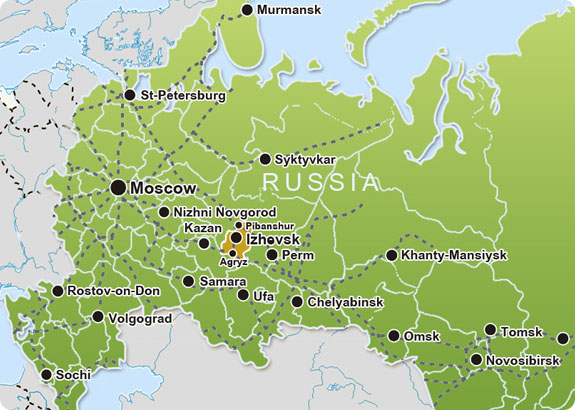
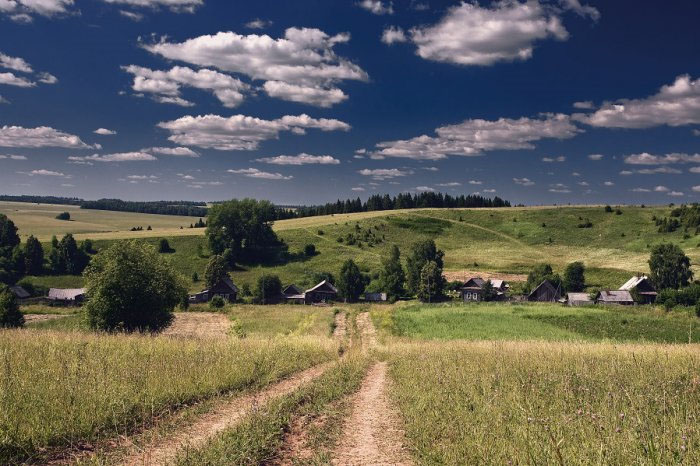
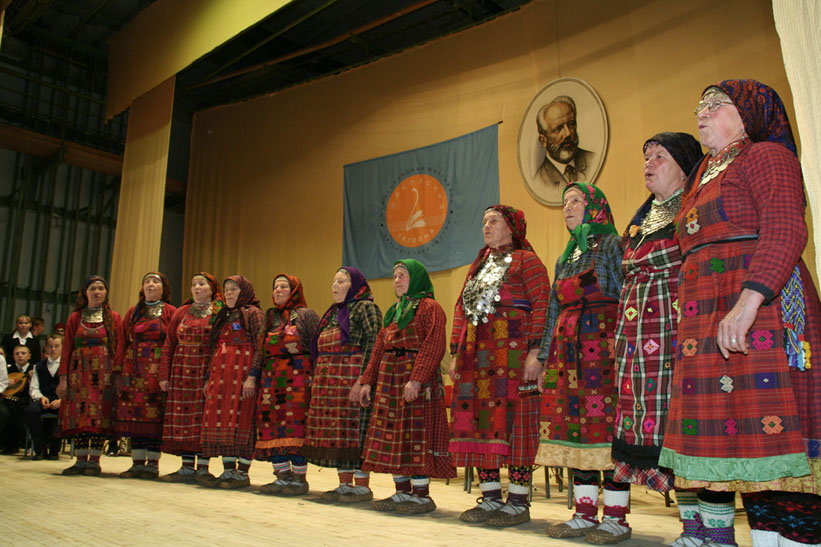
Our Finno-Ugric relatives, the Udmurts live in the Udmurt Republic of Russia where they constitute about one third of the population (in 1917 they were still the majority against the Russian immigrants). Some twenty kilometers of Izhevsk, the chief town of the republic lays the village of Buranovo in whose community center the folk choir of elderly women, before performing their own Udmurt folk songs, first sing the City. “This song is about our village”, they say touchingly. But local teacher Olga Tuktareva, the youngest member of the choir also adds in her beautiful essay written on the group:

Когда Катяапайка. Наша самая дисциплинированная и немногословная Бабушка (она наш камертон и знаток всех наших текстов) услышала «Город Золотой», тихо сказала «Как молитва»… А позже я узнала, мелодия той песни аж 15 века!

When Katyaapaika (Aunt Katya), our most disciplined and most silent Granny – our tuning fork and guard of all our lyrics – heard the Golden City for the first time, she only told: “Like a prayer…” And I got to know only later that the melody comes from the 15th century.


We found the above video last autumn. Since then, however, the Buranovskie Babushky, the Grannies of Buranovo have gained nationwide fame. They were invited to the Russian preselection of Eurovision-2010 where they – as the Finno-Ugric blog MariUver proudly announces it – came third among the twenty-five participants, preceding even a number of popular pop singers. Their show included besides the Udmurt folk songs not only the City, but also Yesterday by the Beatles – in Udmurt language. “The Udmurt text is not an exact translation of the English original. It sets out from that, but it speaks about the singers’ own lives”, says Olga Tuktareva. The video clip of the song is composed of tableaus reminding of vintage photos, similarly to that of the ballad Cry Zara by the Serbian group Kulin Ban.

The Udmurt version of Yesterday was transcribed and translated by László Fejes, and first published on the Finno-Ugric blog Rénhírek, when this post was taken over there. From there we take it back now here, in the original post.


Куректон вужерен кадь
шобыртӥз монэ
Ӵук лысву кадь тöлӟемед бере
ортчем нунал кинлы кулэ?

Вылез вордӥське
вайыса мыным кайгу
Кыӵе тон кулэ мон валай
сое али гинэ

Ог нунал, асьмеос
вал ог нунал гинэ
улонэ, яратонэ но висёнэ
мынам тон мусое

Вылез вордӥське
вайыса мыным кайгу
Кыӵе тон кулэ мон валай
сое али гинэ

Мон шудо, мон шудо
валай толон гинэ
мон ӧй тоды, ӧй вала
кузьытсэ та улонлэсь туннэ

Вылез вордӥське
вайыса мыным кайгу
Кыӵе тон кулэ мон валай
сое али гинэ
мусое
Sorrow covers me
like a shadow.
After you disappeared as the morning dew
who should need the past day?

A new (day) is born
bringing sorrow to me.
Only now I understand
how much I need you

One day,
only one day
my life, my love, my pain,
you are mine, my dear

A new (day) is born
bringing sorrow to me.
Only now I understand
how much I need you

I am happy, I am happy
Only yesterday I understood
I had not known before
how bitter life would be today

A new (day) is born
bringing sorrow to me.
Only now I understand
how much I need you
my dear

The third song they performed besides the Udmurt folk songs was also composed by a character of Assa, Viktor Tsoi, a leading star of Soviet underground rock who wrote his The Star called Sun in the 80s, during the Soviet war in Afghanistan. Here follows his original performance of the song with his band Kino.


Белый снег, серый лед,
На растрескавшейся земле.
Одеялом лоскутным на ней –
Город в дорожной петле.
А над городом плывут облака,
Закрывая небесный свет.
А над городом – желтый дым,
Городу две тысячи лет,
Прожитых под светом Звезды
По имени Солнце…

И две тысячи лет – война,
Война без особых причин.
Война - дело молодых,
Лекарство против морщин.
Красная, красная кровь –
Через час уже просто земля,
Через два на ней цветы и трава,
Через три она снова жива
И согрета лучами Звезды
По имени Солнце…

И мы знаем, что так было всегда,
Что Судьбою больше любим,
Кто живет по законам другим
И кому умирать молодым.
Он не помнит слово “да” и слово “нет”,
Он не помнит ни чинов, ни имен.
И способен дотянуться до звезд,
Не считая, что это сон,
И упасть, опаленным Звездой
По имени Солнце…
White snow, gray ice
covers the cracked earth
like a patchwork quilt.
City in the road loop,
clouds floating above the city.
The heavenly light is closed off
yellow smoke all over the city
which has lived two thousand years
under the star
called Sun…

And two thousand years of war
without any special reason.
War – the matter of the youth,
the best medicine against wrinkles.
Red, red blood –
after one hour only earth
after two hours grass and flowers
after three hours life again
warmed by the star
called Sun…

And we know that it has always been
like this, that by Destiny we prefer
him who lives according to others’ laws
and who must die young.
He does not know “yes” and “no”,
he does not remember ranks and names
and he is ready to reach the stars,
knowing not that it is just a dream,
and then falls down, scorched by the star
called Sun…

“When I translated the song from Russian to Udmurt, I was worrying whether the Grannies would understand the metaphors”, says Olga Tuktareva in the report of the Russian TV1. “Of course we did”, they say beaming. “For this is our life. It sounds as if it was a folk song of ours.”


Viktor Tsoi: The Star called Sun, sung by the Buranovskie Babushki, with the scenes
of Fedor Bondarchuk’s epic film
9 рота (2005) on the war
of Afghanistan in the background.

Three stories from the essay of Olga Tuktareva. “When in 2009 we came to Moscow for the preselection of the Eurovision”, there was one thing the grannies wanted to see by all means: the mausoleum of Lenin. They had heard so much about it throughout all their lives but had never seen it. After the visit we went to light candles in the Cathedral of Christ the Savior, and there it turned out that it was the feast day of Christ’s Ascension. “You see, nothing happens by chance”, the grannies said.

Then we went to the GUM supermarket. We visited it as a museum. “What a surprise it was when some fashionably dressed salespersons – they called themselves managers – asked us: «The Buranovskie Babushki, personally?» I almost fell down flat from the surprise! Then they asked us to sing the song of Tsoi, but we felt that this place did not suit Tsoi, so we left in silence.” Granny Zoya, whose legs ached, remained at the entrance of the supermarket. When we returned to her, she was beaming with glory. She said that passers-by wanted to give her money, but she refused it with resolution: “I do not need your money!”

The dinner was paid by the TV, costs what it costs. The grannies were browsing the menu, but they found  the prices of 400 rubels (about ten euros) in the downtown restaurant
shockingly high. “Can you serve cooked  potatoes only?” they asked. They were served it, for 50 rubels (about 1 euro), accompanied with tea and bread for free. At the end of the dinner the grannies packed the remaining potatoes in their handkerchiefs. “They will be useful on the way back home”, they said.


„И когда говорят о славе, что она людей портит, то это к моим Бабушкам не относится. Они такие же остаются искренние, открытые, настоящие, живущие одной большой мечтой – чтоб в селе была церковь, как тогда в их далеком детстве, чтоб звенели колокола, чтоб шли отцы под ручку с детьми на воскресную службу, а не собирались возле магазина, надеясь на подачку. Чтоб на полях колосилась рожь, а не бурьян, чтоб люди пели, чтоб помнили о своем главном предназначении – быть лучше, чище и порядочнее по отношению к окружающему нас миру.”

“And when they say that glory bewilders people, this surely does not apply to our Grannies. They have remained the same straightforward, sincere, open and vivid, and they are fed by one great dream: that the village would have its own church as it had in their far away childhood, so bells would ring and fathers would go with their children to the service instead of standing about in front of the shop and waiting for some bargain price. That the fields would yield rye again instead of weed, that people would sing again, and that they would remember that their most important task is to become better and cleaner and to behave more respectfully towards the world surrounding us.”