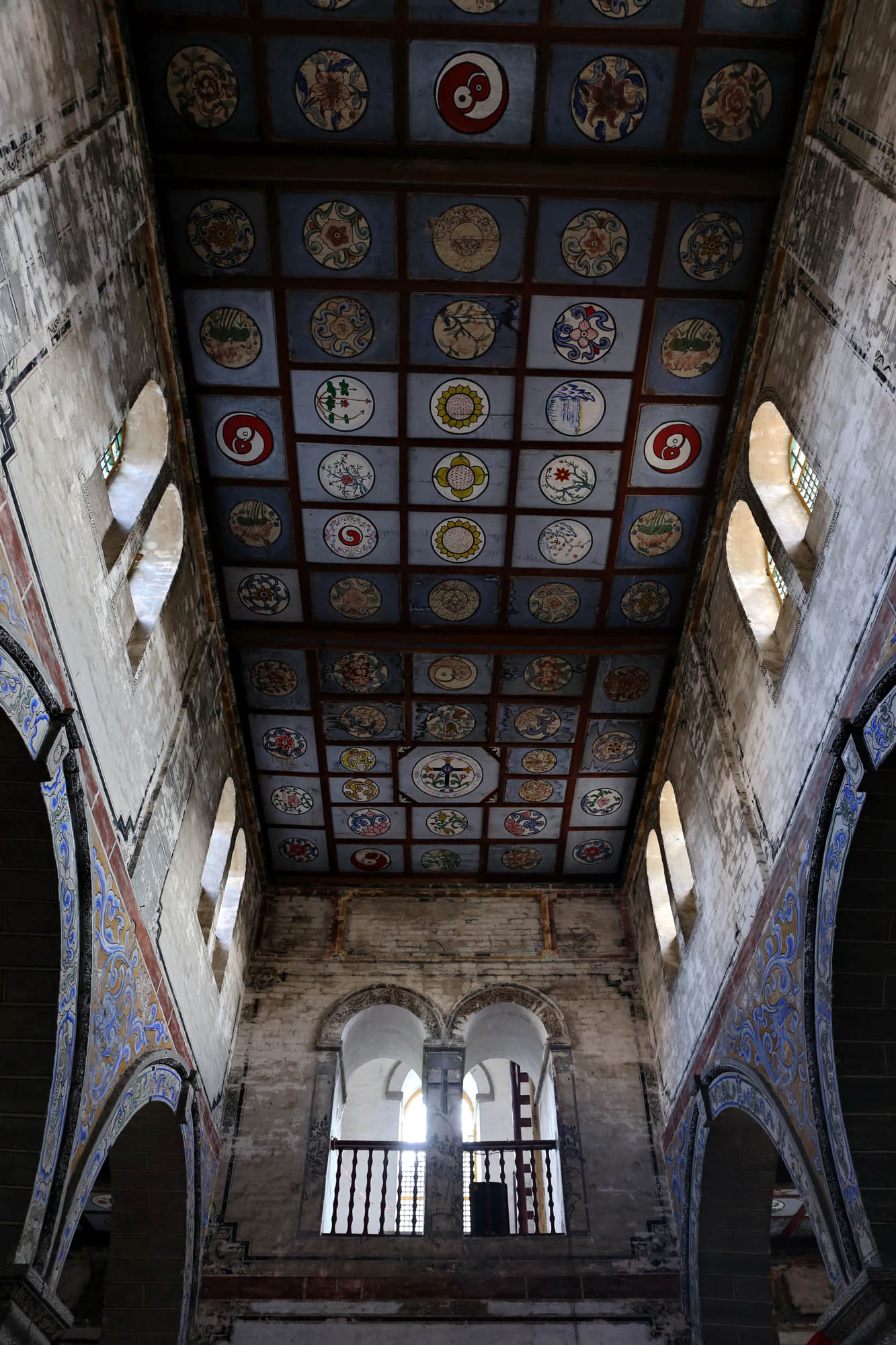
 The churchyard is still empty, but the church door is already open, the bell-ringer is praying on his knees before the altar of St. Joseph. Soon the villagers begin to arrive, most of them in folk costumes, the women sit to the right, the men to the left, according to centuries-old tradition. While the priest is hearing confessions in the confessional next to the entrance, the faithful sing the Divine Offices in vernacular. Then the priest lights the candles on the altar, the bell rings. The Mass begins.
 This could be in any Transylvanian village church on a Sunday morning. However, it is not, but rather in historical Tibet, among six-thousand-meter-high mountains, along the upper reaches of the Mekong River, in the town of Cizhong (茨中), in Tibetan Cedro (ཊསེ་ཌྲོ). The folk costume is blue and red fabric and red turban for the women, yak skin coat and wide-brimmed hat for men, who do not take it off even in the church. The vernacular is the Lisu dialect of Tibetan language. The text of the Catholic Divine Offices is sung to the tune of Tibetan Budhist sutras. And the priest is Chinese.
Bell ringing and chant in Tibetan in Cizhong. Recording by Lloyd Dunn, February 2017

The first Catholic parish in the valley was established in 1867 by the fathers of the Société des Missions Étrangères of Paris. The founder, Father Charles Renou spent two years in the lama monastery of Dongzhulin, disguised as a Chinese merchant, to learn the language, before beginning his Tibetan mission. The community grew quickly, soon it embraced the whole valley, and a second church was also founded to the south of the valley, in the town of Cigu. In 1904, during the British occupation of Tibet, Tibetan rebels massacred every European, including the French monks, but the order sent new missionaries. The next, even bigger blow hit the community in 1952, when the Chinese Communist government banned the Christian religion, exiled its foreign leaders, and imprisoned or killed the Chinese ones. The Catholics of Cizhong, just like thousands of other Chinese Christian communities, went underground, and held secret gatherings in private houses for thirty years. The ban started to ease in the 1980s. In 1982, the faithful got back the church, which had been used for elementary school. In the 1990 it was restored.
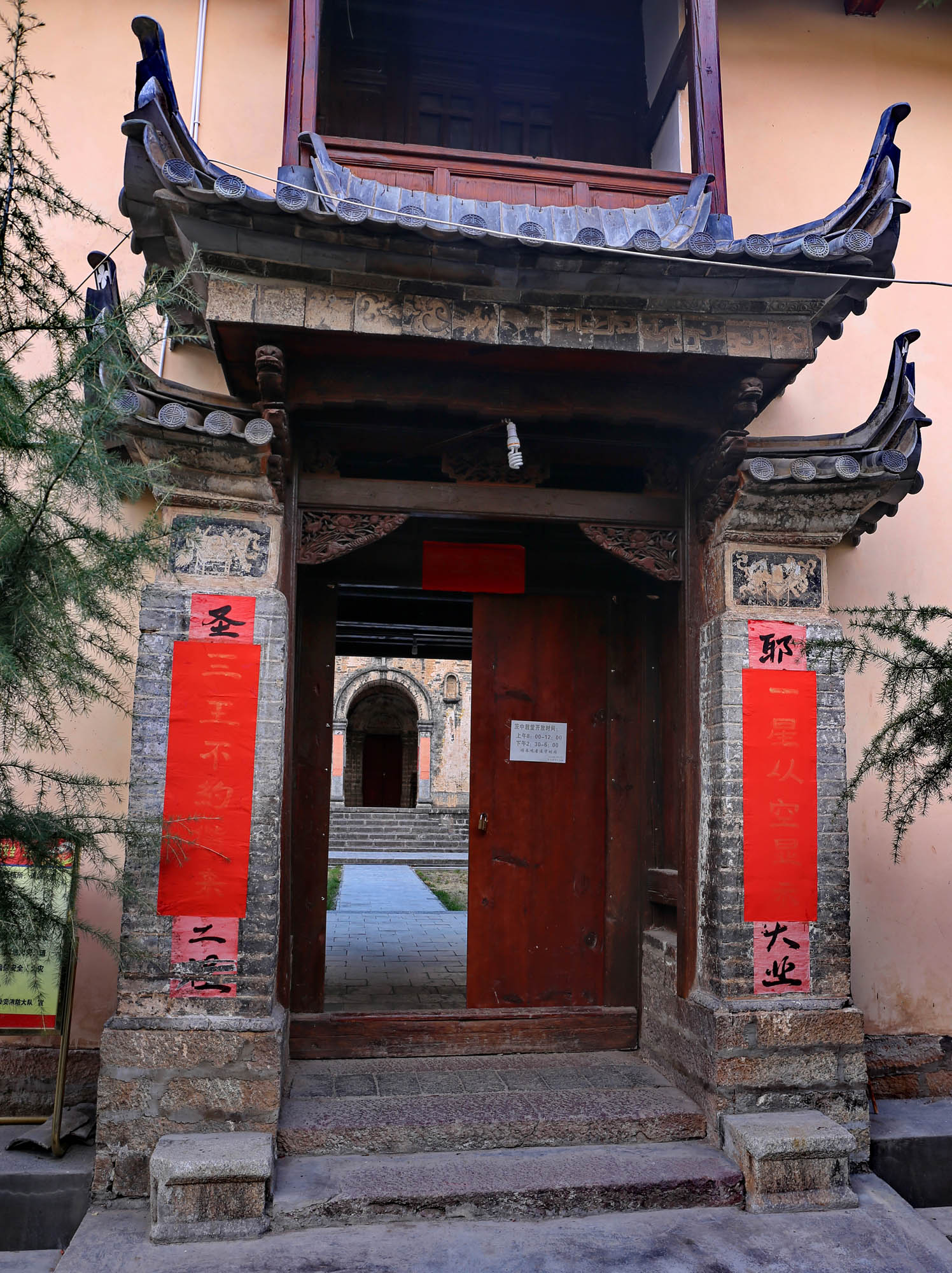
The roof of the Romanesque basilica, rebuilt after the destruction of 1905, resembles Chinese temples, its walls are decorated by Chinese lotus flowers, and its ceiling with Tibetan motifs. Only the frescoes on the walls of the aisles, depicting the life of Christ, were beaten down during the Cultural Revolution. On the main altar the statue of Christ, and on the two side altars those of St. Joseph and Mary, each flanked by two red ribbons, with Chinese citations in gold letters. Two similar red ribbons were also taped on the gate of the churchyard, perhaps not long ago, for the January feast of the Three Kings: 一星从空显示,三王不约偕来 yī xīng cóng kōng xiǎnshì, sān wáng bù yuē xié lái, “a star appeared out of nothing, three kings came together to admire it”. As if it were telling us, who, having gained knowledge of this strange star, came to see it from the far away west.

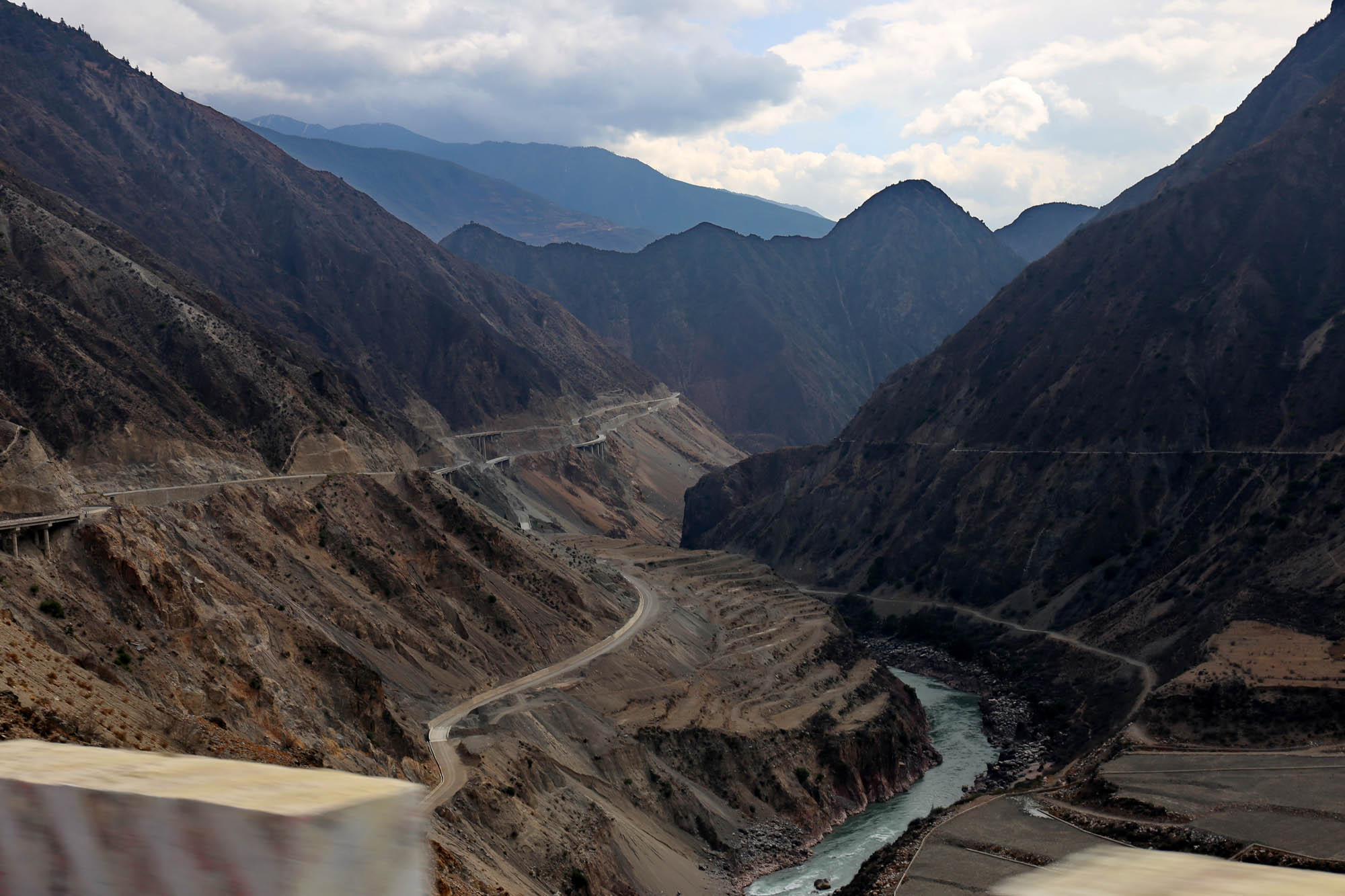
We left three days earlier from Lijiang, the central city of northern Yunnan, along the upper reaches of Yangtze, through the majestic chains of Hengduan Mountains and the passes of the Tibetan border mountain, following the Tea Horse Road, on the Gyalthang Plateau, the old pasture of the Tibetan kings, where the tea caravans could first sense being over the worst part of the trip. We also had a rest here for the first time, in the city of Zhongdian, recently renamed by the Chinese government after the mythical Shangri-La to promote domestic tourism. Then another four-hour bus trip followed, up the steep serpentines to the town of Deqin, in whose domain the ten snow white tips of the Meili mountain range shine down with wonderful colors at sunset and sunrise. From here there is no public transport, a taxi must be hired by way of well-choreographed bargaining in Chinese, during which you must get out of the car together, taking your luggage, indignantly shaking your head, until the driver himself tracks you down on the main street with a finally acceptable price. The acceptable price is four hundred yuan for two of us, about 50 euro, on Saturday afternoon to and on Sunday afternoon back from the valley of Cizhong, which lies seventy kilometers to the south along the Mekong.
As we near the church, the riverside rice fields are replaced with a quite unusual spectacle here beneath the Himalayas: vineyards. The grapes had been planted by the French fathers, and they put down roots in the valley, protected from north, and opening to the south. Its product is today delivered to the winery of a Hong Kong businessman, we came across it as “the wine of the monks” in Shaxi, but it is also sold in many places in the village.

In the north, where the Mekong valley opens, we can still see the tips of Meili Mountains. We walk toward the church among timbered Tibetan houses, barns, carved gates, on some of them a cross appears between the dragons. Calabash twists on richly productive orange trees. Old red-turbaned women return our greeting, they invite us in to eat, children hide behind the gates at the sight of the long-nosed devils. The convent once founded for Tibetan nursing and teaching nuns, later a school, is now abandoned, but the church has been nicely restored. The Chinese priest, who came from Inner Mongolia, a small, ageless man, is walking about the churchyard, saying the rosary. “What time is Mass tomorrow?” “At ten o’clock.”

The faithful arrive beginning at nine thirty, they are gathering on the church steps. Each of them gives paper banknotes to the bell-ringer sitting at the gate, for the maintenance of the church, five yuan, ten yuan, one to one and a half euros. The young woman sitting beside him carefully records each donor’s name and the amount in a booklet. A man with serious face comes with a large postman’s bag, peels down the previous week’s red announcements from the inner side of the gate, and he glues up a new one instead. There are many children, most of them carried on the back, two or three others led by the hand: the Chinese law of one-child does not apply to minority peoples. The children get the most attention in the church, too, they are passed from hand to hand, and are free to run around and play with each other in the back of the church.

It has only been a few years that the village has a priest again. He respects the layman’s ceremony which took roots in the past half century, thus the Sunday Mass is almost doubled. From ten to eleven, the faithful pray so as they did for sixty years without a priest. They sing the Divine Office in their native language, then everyone can tell what he or she considers important for the community. The serious-faced postman tells in Tibetan language the announcements he glued to the gate in Chinese. The young woman collecting the donations also stands up, and reads from the booklet who how many gave for the church. At the entry of the “foreign guests”, everyone looks on us and nods approvingly. The priest comes out from the confessional only at eleven, he lights the candles on the altar, and begins the real Mass, this time in Chinese. The church is full, there are more than two hundred persons from the sixteen-hundred-strong village, of which 80% is Christian. Young girls read the lectures, the priest delivers a short, concentrated speech, he is listened to attentively. Before communion, at the call of “Let there be peace between us”, they reach both hands to each other, according to Chinese custom, they bow before each other. Many come also to us from the men’s benches, receiving us with obvious pleasure in the community. Then they stand a long queue, everyone is taking communion.

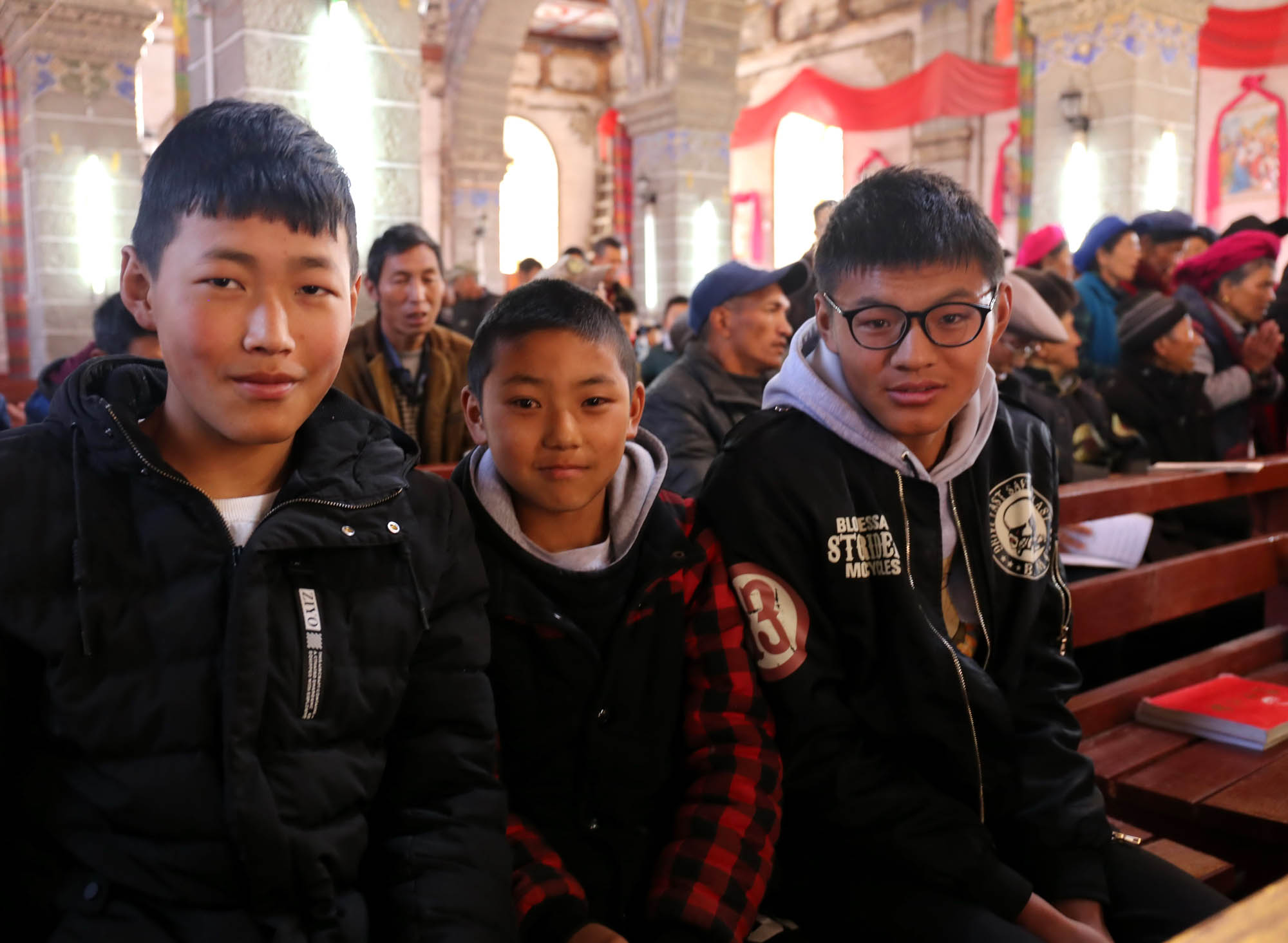
I sit in the empty first row of the men’s benches, so I could better take photos. Children sit behind me, they look at the camera. I hand it to them, I switch it to LED panel view, I show how to zoom. They carefully hand it to each other, excitedly try it, monitoring with it the church, the priest, the faithful. They give it back, asking me to take a picture of them. They also shanke hands, seriously, manly.
 After the Mass we walk to the edge of town to take photos of the rice fields. A lonely cliff is standing along the road, with a newly erected Tibetan stupa on it. We climb up to it on the hundred steep stairs. Only from the top do we see that a cemetery is located directly behind it, a Christian cemetery. Until the Cultural Revolution probably a cross stood also on the cliff, and then the Buddhists took symbolically possession of this important landmark. But the cemetery was spared. The graves bear crosses, phoenix and dragon referring to the resurrection and the heavens, Chinese inscriptions, only one old grave bears an old Tibetan script. One week ago, for the lunar new year everyone came out to visit their ancestors, as is attested by the banquet offered to the dead, according to Chinese custom: oranges, apples, bananas, candy, sunflower seed.
On the way back from the cemetery, the priest is sitting in front of a house, talking to the villagers. As he catches sight of us, his face shines, he comes to greet us, reaching out with both hands and bowing before us. “Come more often”, he says.






 Come with us to…
 Atlantis
 Bestiary
 Bohemia+Prague
 Books, exhibitions, music, film
 Brave old world
 Caucasus
 Cemeteries
 Crimea
 Get to know the
 Images of the East
 Lightwriting
 Lwów/Lemberg
 Mallorca
 Message on the wall
 The Museum of Propaganda
 Odessa
 Paper Museum
 Persian letters
 The Jewish heritage


