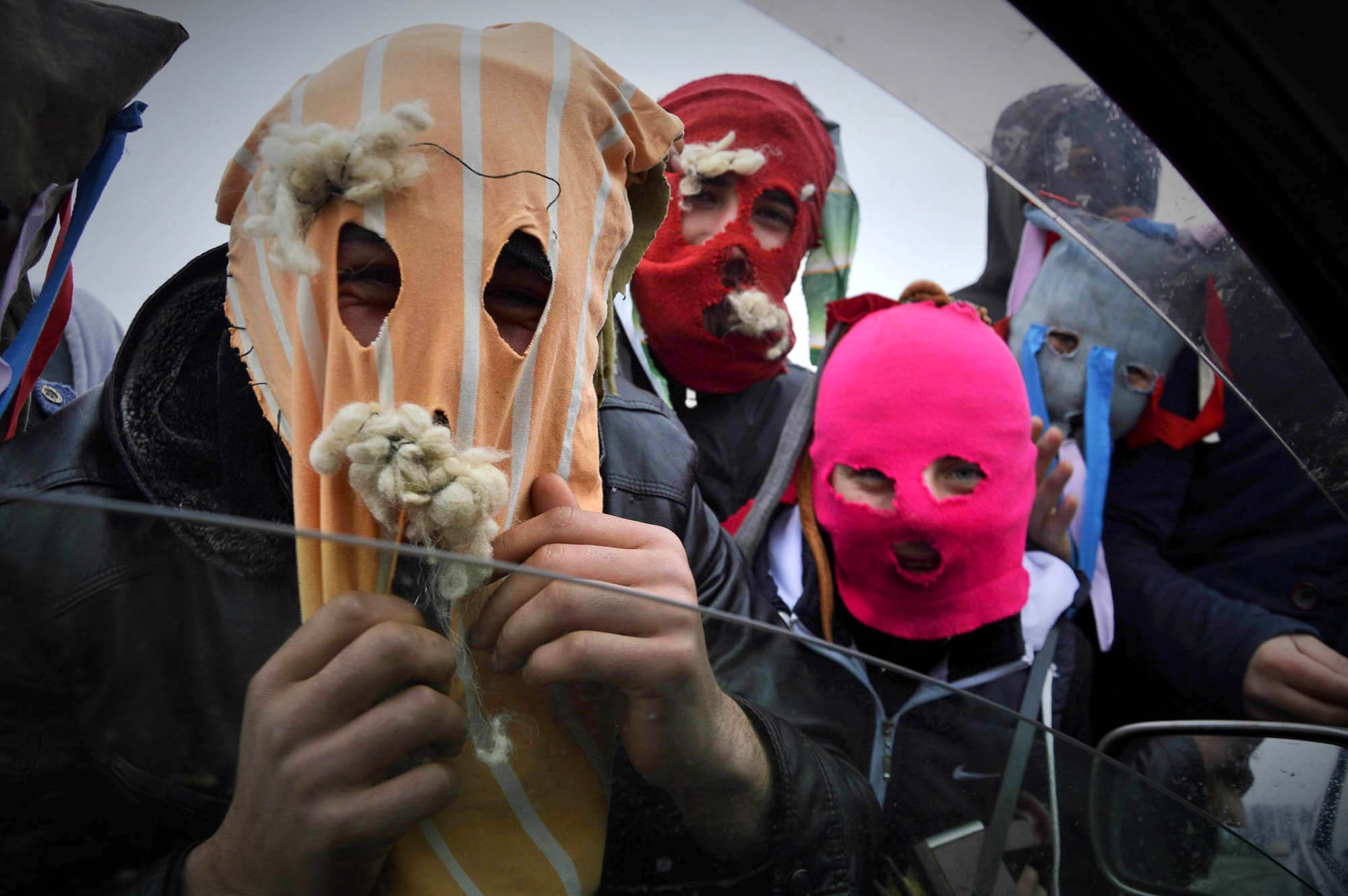
 When I catch sight of the thick rope across the road, the fires on the roadside, the masked persons who start toward us, after passing
  Sanavardo village on the banks of the Alazani River, I immediately recall Kapuściński’s reports on the road barriers and extortions of the African militias, and I switch into reverse. However, the masked ones wave that there is no problem, we should feel free to come. It comes to my mind what I read the previous night about the living carnival folk customs of Kakheti, but still I hesitate. The gathering here is friendly, they explain in local dialect, phuli, phuli, money, money, they repeat. I empty the contents of our small money bag into their hands, two or three lari, one or two euros. They require the ritual toll from Lloyd as well, they are not affected by our affirmation that the small money belonged to both of us, he must sacrifice a banknote of five, about two euros. The rope is lowered, we can go. After a few meters it comes to mind to Lloyd that we could have recorded a local song with the accordion player. We pull to the side, on the bank of Alazani, and he walks back with the recorder, like a Béla Bartók,
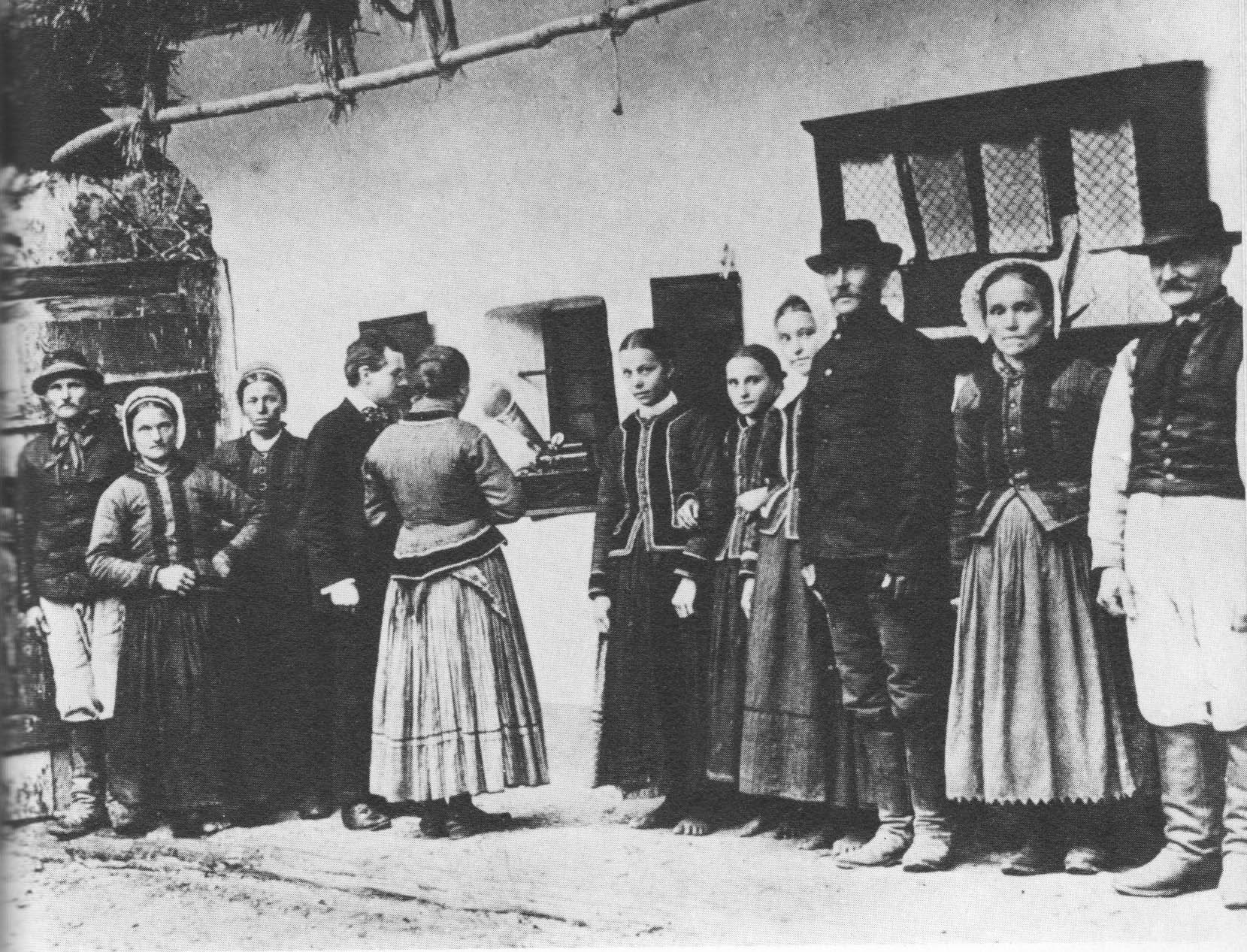 Béla Bartók collecting folk songs with phonograph from Slovak peasants in Zobordarázs (today Dražovce, a suburb of Nitra, Slovakia), 1907
or like a Vladimir V. Akhobadze,
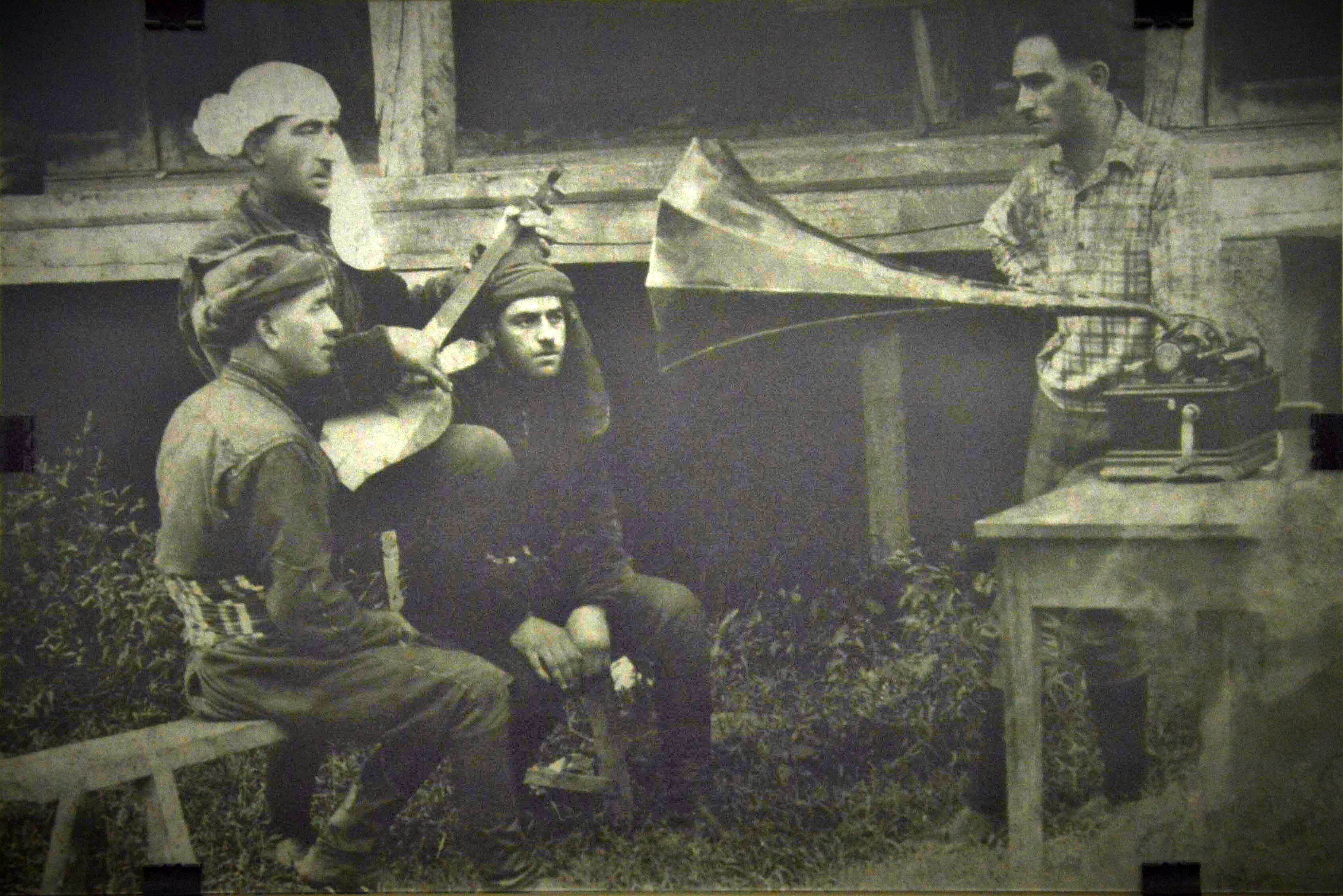 The Georgian musicologist Vladimir V. Akhobadze recording Gurian (Western Georgia) musicians (the photo was copied by us yesterday in the Tbilisi Museum of Folk Music)
pushes the recorder in their faces, simghera, he says, a song. From the noise one can clearly hear only khuti lari, khuti lari, they require further five lari for the show. But the cacophony makes it clear that the accordion is there only as a traditional carnival decoration, it will not produce any music for any lari whatsoever. A new car arrives, which must be tolled, so we also continue our way to the medieval town of Sighnaghi.
Simghera! – Khuti lari!


 Come with us to…
 Atlantis
 Bestiary
 Bohemia+Prague
 Books, exhibitions, music, film
 Brave old world
 Caucasus
 Cemeteries
 Crimea
 Get to know the
 Images of the East
 Lightwriting
 Lwów/Lemberg
 Mallorca
 Message on the wall
 The Museum of Propaganda
 Odessa
 Paper Museum
 Persian letters
 The Jewish heritage


No hay comentarios:
Publicar un comentario