…ceci est une korn.
 “Brittany. The pipe is only good when it burns well.” Collection Villard, Quimper. Poststamp 5. 7. 1910

 The Celtic languages reached their largest geographic extent not in Antiquity, before the Roman conquest, but, as Peter Burke writes, in the age of the great discoveries. In the early 16th century, English and French ships on the Atlantic Sea were mainly served by the sailors from the Celtic coastline, Wales and Brittany, and thus Welsh and Breton were the common sailor’s languages in the northern part of the ocean, from the Channel to the Caribbean Islands.
The Breton sailors under French flag reached as far as the Brazilian coast, and they brought the first tobacco to Europe, together with its original Indian name: betum. The word was also transferred from Breton into French: pétun, pétuner, ʻtobacco, to smoke’. However, it has become archaic, and today only the Breton language preserves the original Indian word: butun, butunad. The word tobacco and its variants in the modern European languages, derived by the Spanish etymologists of the Renaissance from the Caribbean Indian languages, in reality arrived from the medieval Arabic tabbaq, ʻmedicinal herb’ into Spanish as early as the 15th century, and went on the return path to America. As Nicolás Monardes writes in his Joyful Newes Oute of the Newe Founde Worlde, translated by John Frampton into English in 1577:
“Many haue giuen it [tobacco] the name, Petum, whiche is in deede the proper name of the Hearbe, as they whiche haue traueiled that countrey can tell.”
The use of tobacco in the whole of Europe was first documented in 1525 in Brittany. The first tobacco manufactory was founded here, in the haven of Morlaix, where the tobacco leaves, imported from the new continent and used as a medicinal herb, were dried, and then rolled into carrot-shaped sticks – in French carotte, in modern Breton karot. The “carrot”, which is still visible on the tobacco shop labels of Brittany, was then cut up with a knife as required for the pipe or for chewing. The pipe itself was originally made of sheep’s horn, and it was called, after its conic shape (cornet), korn in Breton.
 “May I disturb you?” – “Of course.” – “Please pass me my tobacco carrot [tabac en carotte], let me stuff my pipe.” Smoking woman in Morlaix. Artaud et Nozais, Nantes
While in many parts of Renaissance and Baroque Europe smoking was “genderized”, becoming an exclusively male pastime, in Brittany it remained the means of dissipating fatigue and hunger for both genders, just as in its original homeland. The French photographers who in the late 19th century roamed the country to make ethnographic photos, were really amazed at the sight of the old pipe-smoking Breton women, who became inevitable genre figures of the La Brettagne Pittoresque and Types Bretons postcard series. Now philaevrard has published a nice selection of them from his collection at the Cparama forum, dedicated to old French postcards.
Klervi Rivière – Marie-Aline Lagadic: Labousig ar hoad. A Breton-language gwerz – ballad – about a sailor who invites a girl to sail over together to England, but she refuses him. From the CD Femmes de Bretagne (The Women of Brittany, 1996).

The postcards with identifiable places in the map of Brittany
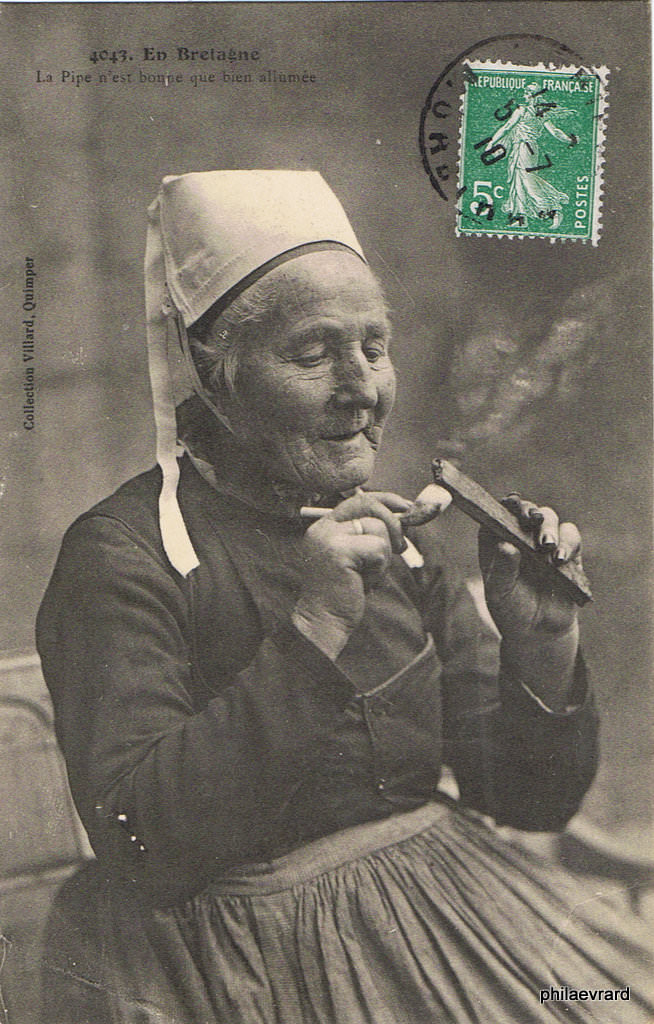 “Brittany. The pipe is only good when it burns well.” Collection Villard, Quimper. Poststamp 5. 7. 1910
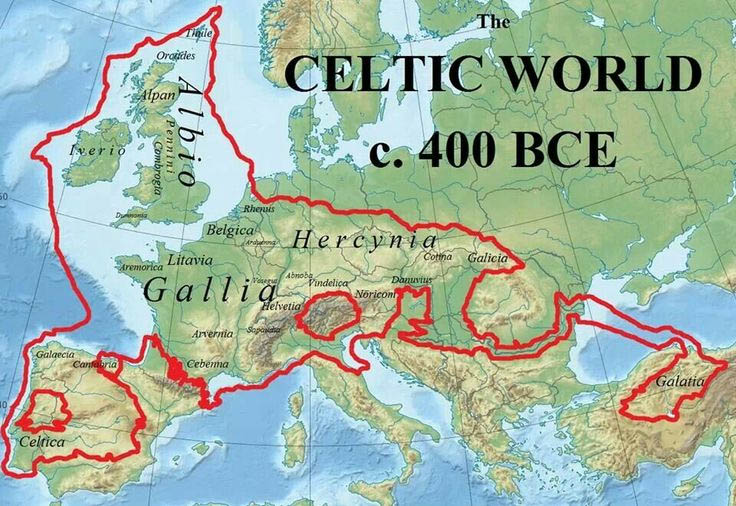 The Celtic languages reached their largest geographic extent not in Antiquity, before the Roman conquest, but, as Peter Burke writes, in the age of the great discoveries. In the early 16th century, English and French ships on the Atlantic Sea were mainly served by the sailors from the Celtic coastline, Wales and Brittany, and thus Welsh and Breton were the common sailor’s languages in the northern part of the ocean, from the Channel to the Caribbean Islands.
The Breton sailors under French flag reached as far as the Brazilian coast, and they brought the first tobacco to Europe, together with its original Indian name: betum. The word was also transferred from Breton into French: pétun, pétuner, ʻtobacco, to smoke’. However, it has become archaic, and today only the Breton language preserves the original Indian word: butun, butunad. The word tobacco and its variants in the modern European languages, derived by the Spanish etymologists of the Renaissance from the Caribbean Indian languages, in reality arrived from the medieval Arabic tabbaq, ʻmedicinal herb’ into Spanish as early as the 15th century, and went on the return path to America. As Nicolás Monardes writes in his Joyful Newes Oute of the Newe Founde Worlde, translated by John Frampton into English in 1577:
“Many haue giuen it [tobacco] the name, Petum, whiche is in deede the proper name of the Hearbe, as they whiche haue traueiled that countrey can tell.”
The use of tobacco in the whole of Europe was first documented in 1525 in Brittany. The first tobacco manufactory was founded here, in the haven of
Morlaix, where the tobacco leaves, imported from the new continent and used as a medicinal herb, were dried, and then rolled into carrot-shaped sticks – in French carotte, in modern Breton karot. The “carrot”, which is still visible on the tobacco shop labels of Brittany, was then cut up with a knife as required for the pipe or for chewing. The pipe itself was originally made of sheep’s horn, and it was called, after its conic shape (cornet), korn in Breton.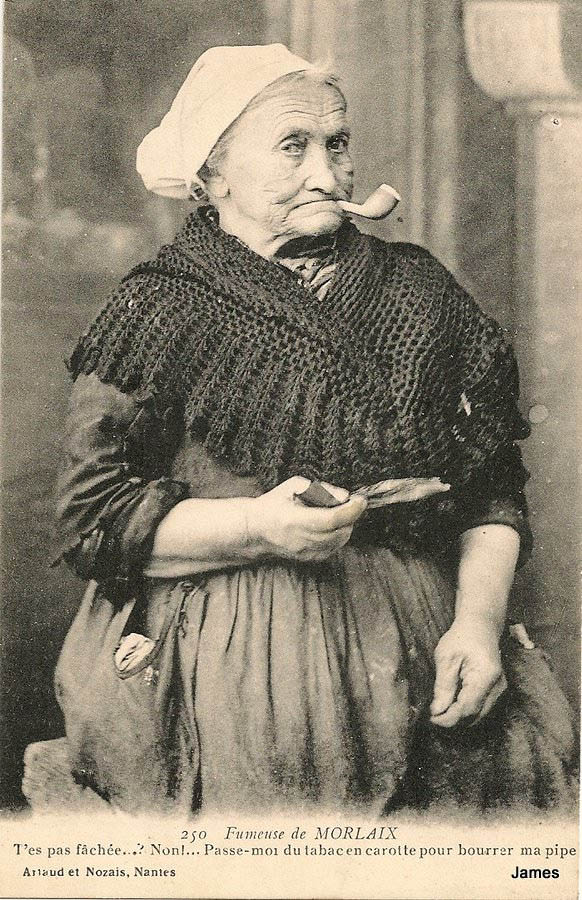 “May I disturb you?” – “Of course.” – “Please pass me my tobacco carrot [tabac en carotte], let me stuff my pipe.” Smoking woman in Morlaix. Artaud et Nozais, Nantes
While in many parts of Renaissance and Baroque Europe smoking was “genderized”, becoming an exclusively male pastime, in Brittany it remained the means of dissipating fatigue and hunger for both genders, just as in its original homeland. The French photographers who in the late 19th century roamed the country to make ethnographic photos, were really amazed at the sight of the old pipe-smoking Breton women, who became inevitable genre figures of the La Brettagne Pittoresque and Types Bretons postcard series. Now philaevrard has published a nice selection of them from his collection at the Cparama forum, dedicated to old French postcards.
Klervi Rivière – Marie-Aline Lagadic: Labousig ar hoad. A Breton-language gwerz – ballad – about a sailor who invites a girl to sail over together to England, but she refuses him. From the CD Femmes de Bretagne (The Women of Brittany, 1996).
The postcards with identifiable places in the map of Brittany


 Come with us to…
 Atlantis
 Bestiary
 Bohemia+Prague
 Books, exhibitions, music, film
 Brave old world
 Caucasus
 Cemeteries
 Crimea
 Get to know the
 Images of the East
 Lightwriting
 Lwów/Lemberg
 Mallorca
 Message on the wall
 The Museum of Propaganda
 Odessa
 Paper Museum
 Persian letters
 The Jewish heritage


No hay comentarios:
Publicar un comentario