It would be hopeless to attempt to condense into one post the long, complex and fascinating history of the mnemonic use of images. We have touched several times upon this issue whose literature is increasing every day (one of the most recent and best summaries is Lina Bulzoni’s La stanza della memoria. Modelli letterari e iconografici nell’età della stampa, Rome: Bulzoni 2001, about which we intend to write later). Emblem books offer precious examples of images that inspire meditation, direct the reception of the teachings and anchor them in the memory. In Francisco de Monzón’s Norte de Ydiotas (Compass of ignorants, 1563), for example, a woman meditates along the row of images in an imaginary church. This is the first image which represents with its Malevichian blackness the darkness of all sin:

The Jesuit Sebastián Izquierdo in his Práctica de los ejercicios espirituales, written in 1675 and later published in several translations and versions offered an illustrated guide to the Ignatian spiritual exercises. By clicking on the picture below you can see all the series.

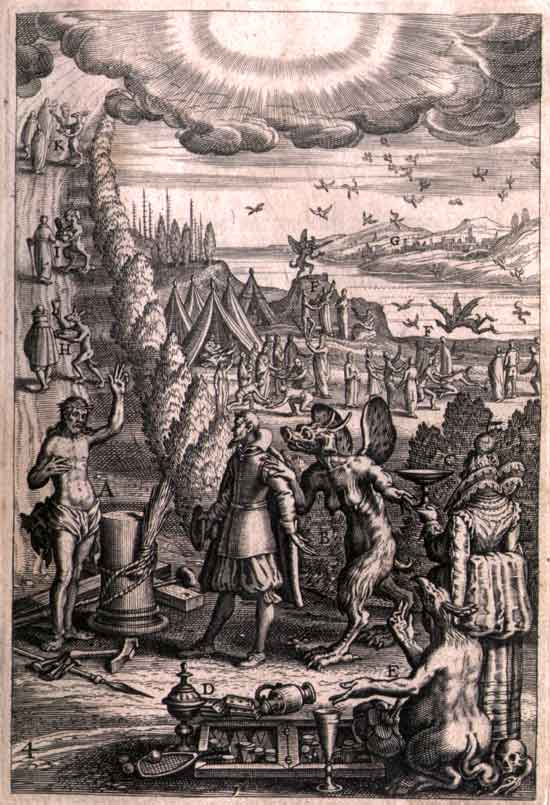
Image meditation was a favorite method of the Jesuits who, beginning with the monumental Evangelicae Historiae Imagines (1593) of the Mallorcan Jerónimo Nadal (1507-1580) published a long series of such meditations that belong to the summits of printing of their age. Here is a page of one of them, the Via vitae aeternae (1620) of Antoine Sucquet:

Here we only want to record one of the examples of the survival of this genre in the 20th century. While it is much simpler than the above, richly elaborated models, nevertheless it is much more “physiological”, as it is based on the phenomenon of retina memory.
 This means that the impression left by a long observance of a black silhouette on a white background will also continue if we close our eyes. This was the starting point of the “Bernadette Method” that spread quite rapidly since the 30s until the Second Vatican Council explicitly rejected its catechetical use.
The Salesian Bernadette sisters of Thaon-les-Vosges – and chiefly Sister Mary of Jesus – published in 1934 their first series of pictures, inspired by Father Émile Bogard. Soon they had a collection of four times hundred and fifty images on the life of Christ, the Old and New Testament, church history and Catholic teaching, and all this in the most various forms: on postcards, cartoons, games, maps and notebook covers. Meanwhile, the pedagogical use of the method was widespread and gained general acceptance.


One of the most interesting traits of the method was that it explicitly fought against the invasion of modern images which, in the form of films, posters, propaganda materials and illustrated revues penetrated into all areas of daily life. In the years immediately preceding WWII the sisters fought on several fronts against all forms of modernism, Communism and the immoral images of movies, with the weapon of these concise silhouettes where no superfluous detail diverts the attention from the central message. Their motto was Ut videant – “so they might see”. Their ideal spectator watched for long the images, repeatedly read their captions and the comments accompanying them – usually in a hard and militant tone –, and even recited them aloud.
Today the originals of the pictures can be found in the Museum Nicéphore Niépce in Chalon-sur-Saône. The Éditions Matière has recently published an abundant selection of them which provides with a new meaning the motto videre est credere.
It would be interesting to examine whether there was any connection between the Bernadette silhouettes and the ligne claire trend of pre-war French bande dessinée working with clear-cut contours which has created just in these years its most successful series, the Adventures of Tintin.
The Jesuit Sebastián Izquierdo in his Práctica de los ejercicios espirituales, written in 1675 and later published in several translations and versions offered an illustrated guide to the Ignatian spiritual exercises. By clicking on the picture below you can see all the series.
Image meditation was a favorite method of the Jesuits who, beginning with the monumental Evangelicae Historiae Imagines (1593) of the Mallorcan Jerónimo Nadal (1507-1580) published a long series of such meditations that belong to the summits of printing of their age. Here is a page of one of them, the Via vitae aeternae (1620) of Antoine Sucquet:
Here we only want to record one of the examples of the survival of this genre in the 20th century. While it is much simpler than the above, richly elaborated models, nevertheless it is much more “physiological”, as it is based on the phenomenon of retina memory.

The Salesian Bernadette sisters of
Thaon-les-Vosges – and chiefly Sister Mary of Jesus – published in 1934 their first series of pictures, inspired by Father Émile Bogard. Soon they had a collection of four times hundred and fifty images on the life of Christ, the Old and New Testament, church history and Catholic teaching, and all this in the most various forms: on postcards, cartoons, games, maps and notebook covers. Meanwhile, the pedagogical use of the method was widespread and gained general acceptance.One of the most interesting traits of the method was that it explicitly fought against the invasion of modern images which, in the form of films, posters, propaganda materials and illustrated revues penetrated into all areas of daily life. In the years immediately preceding WWII the sisters fought on several fronts against all forms of modernism, Communism and the immoral images of movies, with the weapon of these concise silhouettes where no superfluous detail diverts the attention from the central message. Their motto was Ut videant – “so they might see”. Their ideal spectator watched for long the images, repeatedly read their captions and the comments accompanying them – usually in a hard and militant tone –, and even recited them aloud.
Today the originals of the pictures can be found in the Museum Nicéphore Niépce in Chalon-sur-Saône. The Éditions Matière has recently published an abundant selection of them which provides with a new meaning the motto videre est credere.
It would be interesting to examine whether there was any connection between the Bernadette silhouettes and the ligne claire trend of pre-war French bande dessinée working with clear-cut contours which has created just in these years its most successful series, the Adventures of Tintin.


 Come with us to…
 Atlantis
 Bestiary
 Bohemia+Prague
 Books, exhibitions, music, film
 Brave old world
 Caucasus
 Cemeteries
 Crimea
 Get to know the
 Images of the East
 Lightwriting
 Lwów/Lemberg
 Mallorca
 Message on the wall
 The Museum of Propaganda
 Odessa
 Paper Museum
 Persian letters
 The Jewish heritage


No hay comentarios:
Publicar un comentario