Switch over to our new blog! • ¡Pásese a nuestro nuevo blog!
The renewed version of our blog, with more features, a richer design, and available in nine languages, can be read here: https://wangriver.com
The new version also includes the old posts, often in expanded form. If you are curious about the updated version of this post, replace “riowang.blogspot.com/” in the URL with “riowang.studiolum.com/”, and the new link will most likely lead you there.
La versión renovada de nuestro blog, con más herramientas, un diseño más rico y disponible en nueve idiomas, se puede leer aquí: https://riowang.com
La nueva versión también incluye las publicaciones antiguas, a menudo en una forma ampliada. Si tiene curiosidad por la versión actualizada de esta entrada, sustituya «riowang.blogspot.com/» en la URL por «riowang.studiolum.com/es/», y el nuevo enlace probablemente le llevará allí.
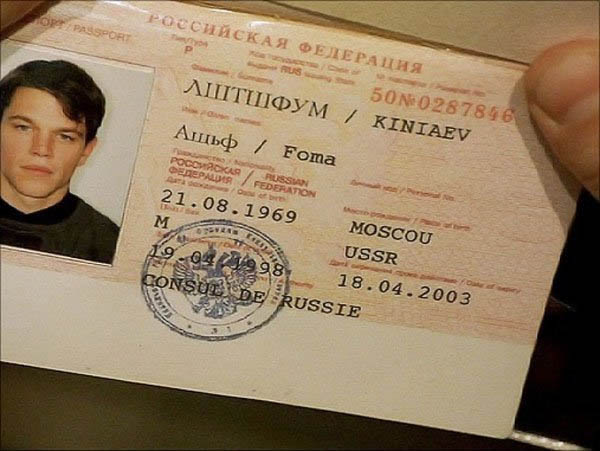

 How many tiny mistakes do you discover in the Russian passport of agent James Bourne from the Hollywood movie The Bourne Identity (2002)?


 Come with us to…
 Atlantis
 Bestiary
 Bohemia+Prague
 Books, exhibitions, music, film
 Brave old world
 Caucasus
 Cemeteries
 Crimea
 Images of the East
 Lightwriting
 Lwów/Lemberg
 Mallorca
 Message on the wall
 The Museum of Propaganda
 Odessa
 Paper Museum
 Persian letters
 The Jewish heritage


7 comentarios:
Йцукен вашу мать, so that's how it happened :) :)
This was quite popular in internet a year ago: they simply put the cyrillic letters on the buttons corresponding to the English ones. It may well be left intentionally - easter egg?
Two obvious explanations for "consul de Russie" :
1° French has always been THE language of diplomacy (note that it's still the sole language of the "Union postale universelle", at least).
2° Any well-read person knows that all Russians speak French (and it's a pleasure to find that such persons can be found in Hollywood):
— Eh bien, mon prince ! Gênes et Lucques ne sont plus que des apanages, des propriétés de la famille Buonaparte ! Non, je vous préviens que si vous ne me dites pas que nous avons la guerre, si vous permettez encore de palier toutes les infamies, toutes les atrocités de cet Antéchrist (ma parole, j'y crois), je ne vous connais plus, vous n'êtes plus mon ami, vous n’êtes plus мой верный раб, comme vous dites.
Catherine, in 1998 passports, French seems to have been still in use indeed. But the country wasn't "USSR" any longer (not even the proper French equivalent "URSS").
Nevertheless the red-colored of this passport form is in English throughout, so the form itself postdates the transition to English
No, I stand corrected about passport forms. Even in late Soviet years, when French transliteration was still in use (URSS and all), the passport form was already bilingual Russian/English.
The country is birth is indeed USSR in today's travel documents if that's where the bearer was born. So that's not a mistake.
However three more details are wrong.
1. Given name in Russian ought to contain patronymic.
2. City of birth ought to be spelled out in Russian (not in French, but not in English either)
3. Issuing office also must be spelled in Russian (not in French but not in English, too)
The official seal must cover the part of the photo.
It iз much simpliёЯ than you can guess. In Russian IT, there are at least 3 possible codepages (translation tables for 8bit codes to Cyrillic symbols); at most, countless. And the producer was a real cheapskate. Instead of hiring a professional linguist consultant, he just asked for typical names in the Internet. And got a reply. But this idiot used a wrong codepage for printing the name out. That simple.
Publicar un comentario