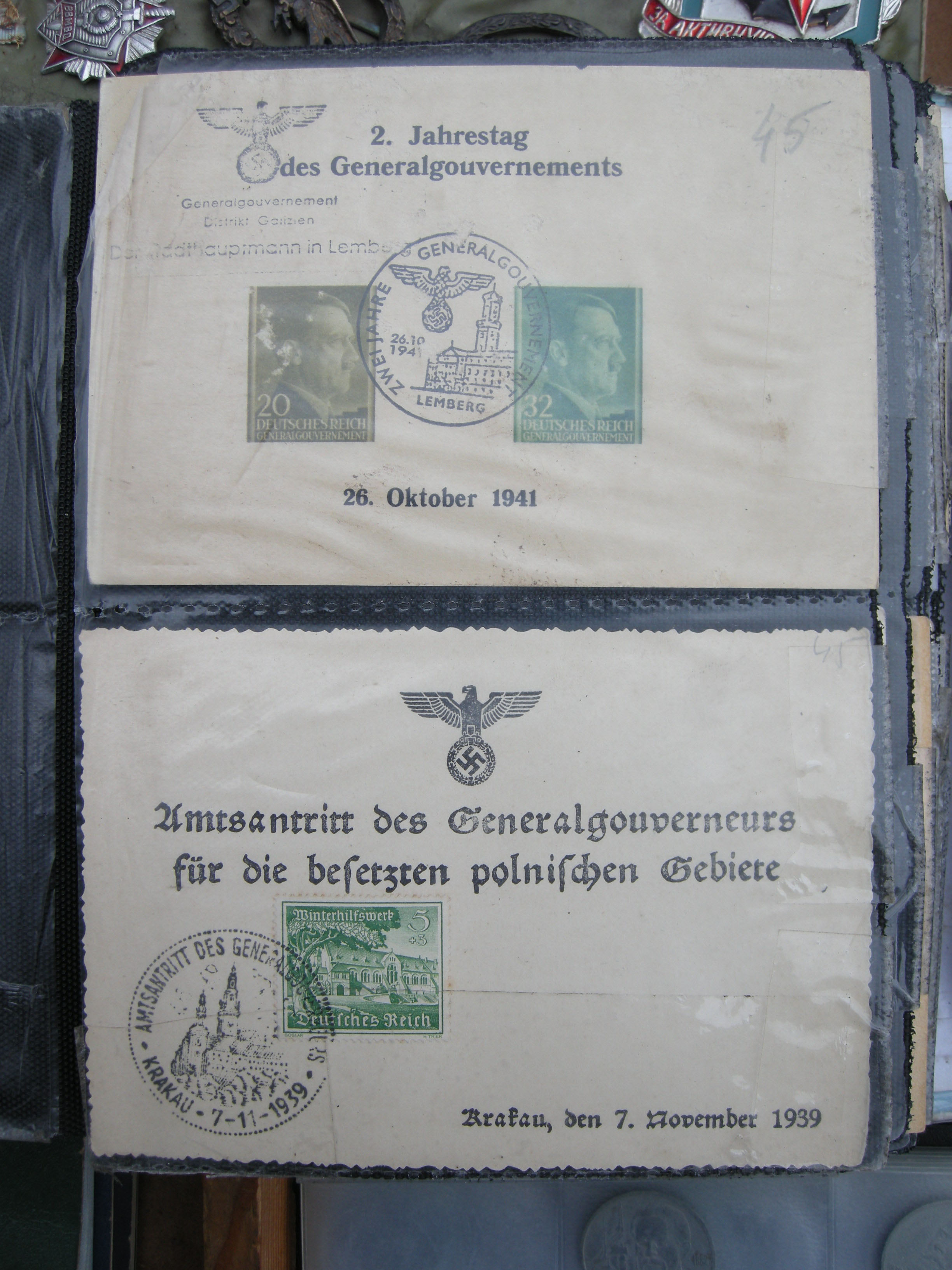
 “[First day stamp] for the second anniversary of theh [Polish] General Government. [Lemberg/Lwów] 26 October 1941” (see also: Campanile)
Stamp: “General Government. Galician District. Lemberg City Commander”
“[First day stamp] for the entry into office of the Governor General [Hans Frank] of the Occupied Polish Territories. Krakow, 7 November 1939”
   |
 Photographed in Lwów, on the flea market.
Would you like to put together the story behind it?
Starting off from the object, gently expanding the context, taking care to detail. Just like you did in the case of the post office handstamp.


 Come with us to…
 Atlantis
 Bestiary
 Bohemia+Prague
 Books, exhibitions, music, film
 Caucasus
 Cemeteries
 Crimea
 Get to know the
 Images of the East
 Lightwriting
 Mallorca
 Message on the wall
 The Museum of Propaganda
 Odessa
 Persian letters
 The Jewish heritage


4 comentarios:
These invitations/passes reminded me good old French movie La Grande Vadrouille http://www.youtube.com/watch?v=X-R2aJUCrL4
I could not see the invitations you’ve mentioned. At which second are they?
Leaving the big story behind the documents to someone else, I just want to add a small detail. As you see, the earlier card is written in Fraktur (“Gothic”), while the latter in Antiqua (“Latin”) typeface. The difference is due to the fact that the Fraktur (“Schwabacher”) font widely used by German publishers was banned by the Führer with the 3rd January 1941 Reich Regulation (Normalschrifterlass), as he came to the conclusion that it was of Jewish origin. See Friedrich Beck: “Schwabacher Judenlettern” – im Schriftverruf Drittes Reich, 2006 (pdf) The deliciously well-informed post of the Hungarian Money Blog on fake Nazi stamps on various national banknotes recommends into the attention of its readers among others this signal to recognize the fake stamps dated to and after 1941.
Very interesting fact about fonts - unknown to many, I believe. I was referring to this movie not because an invitation, rather because of a Nazi celebration in occupied France.
Publicar un comentario