 This spell is used to open up arcane doors and to reveal hidden secrets, at least in works of fiction. Its etymology is uncertain, although it has plenty of theories. Their number was further increased with one by Sándor Kégl, whose surviving correspondence shows that due to his exceptional knowledge of languages, he was often consulted in Oriental etymological questions. On 17 March 1916 he replied to an unknown academician in the following letter.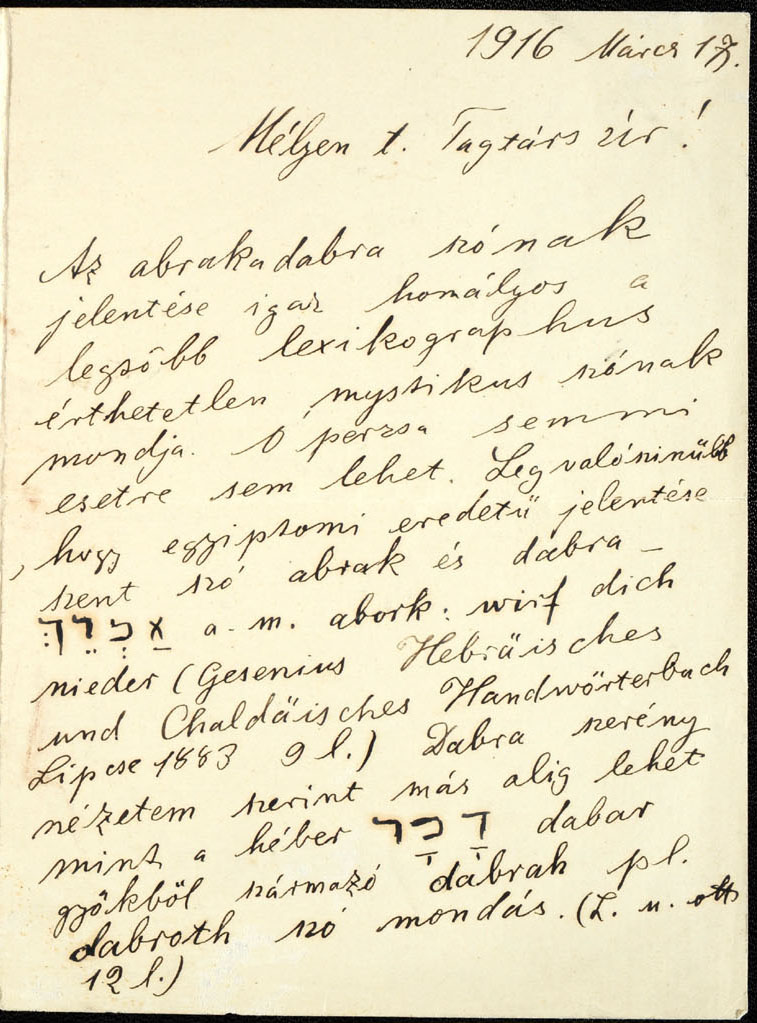
17 March 1916
Deeply Revered Colleague!
The meaning of the word ‘abracadabra’ is obscure. Most lexicographers consider it an incomprehensible and mystic word. In no way can it come from Ancient Persian. Most likely it is of Egyptian origin, meaning ‘holy word’, a composite of ‘abrak’ and ‘dabra’. אַבְרֵ i.e. abork: wirf dich nieder (Gesenius Hebräisches und Chaldäisches Handwörterbuch Leipzig 1883 p. 9) Dabra, in my humble opinion, cannot be else than dabrah, plural dabroth, word, saying, coming from the Hebrew root דָבָר dabar. (Ibid., p. 12)
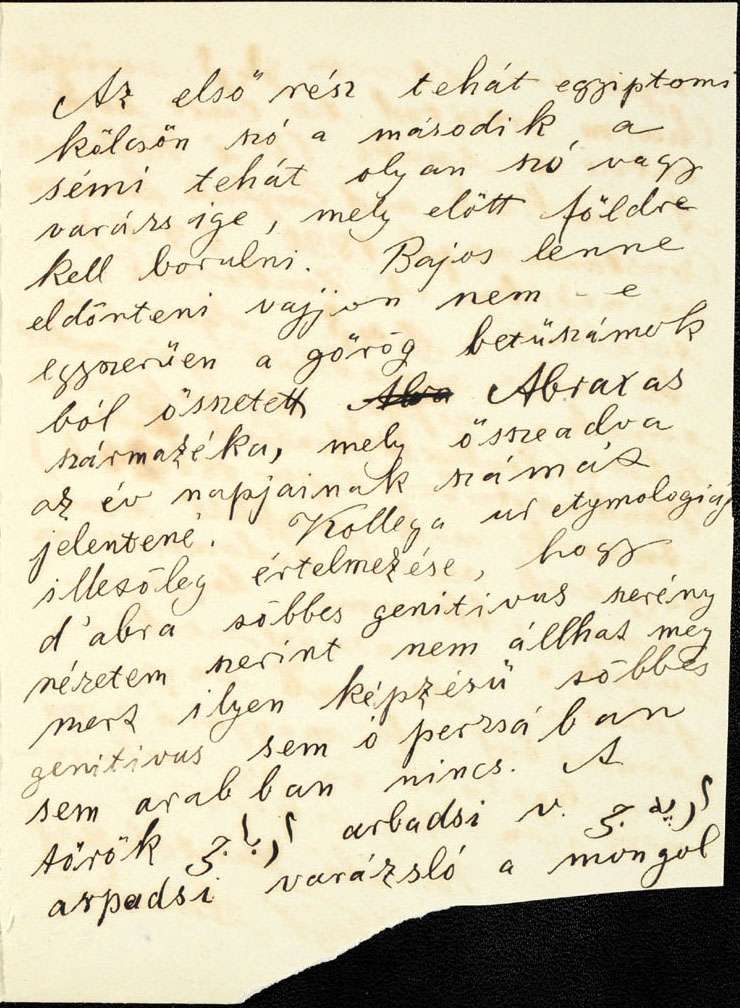
The first part is thus an Egyptian loan word, while the second part is Semitic. It is thus a word or a spell that compels one to throw himself to the ground. It is difficult to decide whether it is not simply a derivative of the Greek word Abraxas, composed of letters whose numeric value yields the number of the days of the year. Your etymology or interpretation, Dear Colleague, that d’abra is a plural genitive, in my humble view cannot stand, because neither Ancient Persian, nor Arabic has such plural genitive. Turkish ارباچی arbadshi or ارپه چی arpadshi ‘wizard’ is a
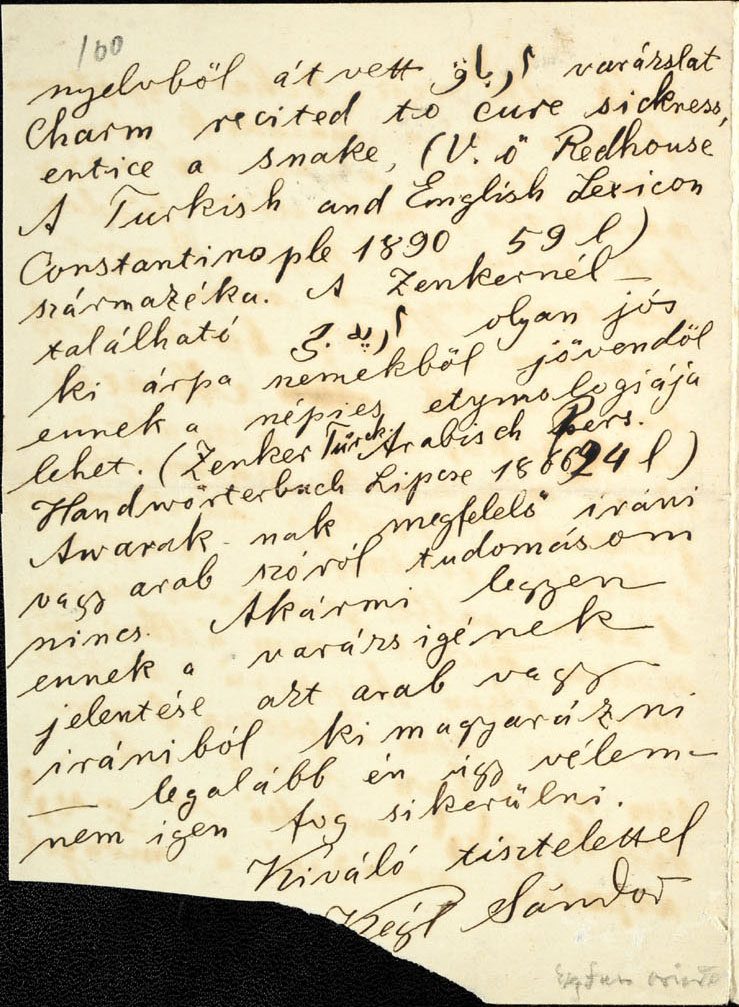
Mongol loanword ارباق “charm, recited to cure sickness, entice a snake”, (cf. Redhouse A Turkish and English Lexicon Constantinople 1890 59 l). Zenker’s ارپه چی, the oracle telling the future from barley seeds might be a popular etymology for this word (Zenker Türck.-Arabisch-Pers. Handwörterbuch Leipzig 1866 p. 24). I have no knowledge of any Iranian or Arabic word ‘awarak’. Whatever be the meaning of this spell, it will not be successfully deduced from Arabic or Iranian, at least in my opinion.
Yours sincerely
Dr. Sándor Kégl
We also annonuce with this word the solemn opening of the site of the Kégl legacy preserved in the Oriental Collection next week, on 1 December, in the Library of the Hungarian Academy of Sciences. All the benevolent Readers are welcome. The poster and invitation of the event can be also downloaded in pdf. Move the mouse above the picture to read the program in English. And the site will be accessible after the presentation at kegl.mtak.hu.


 Come with us to…
 Atlantis
 Bestiary
 Bohemia+Prague
 Books, exhibitions, music, film
 Brave old world
 Caucasus
 Cemeteries
 Crimea
 Get to know the
 Images of the East
 Lightwriting
 Lwów/Lemberg
 Mallorca
 Message on the wall
 The Museum of Propaganda
 Odessa
 Paper Museum
 Persian letters
 The Jewish heritage


2 comentarios:
Congratulations, Studiolum! I was looking forward to checking out the final version http://kegl.mtak.hu but it did not open for some reason.
Thank you, Araz! No, the site does not live yet. It will be opened only after the presentation on December 1. However, two pages of it can be already seen through the links included in the two posts on Kégl.
Publicar un comentario