 In the times of the Counter-Reformation in 16th-century Champagne, it was fashionable to place statues in churches, many statues, very realistic ones, completely colored – living statues, so to speak. In Troyes, the site of one of the most important fairs in Europe, several churches, each having its own guilds and confraternities, had its stone figures, some of them placed at the gallery, others sitting at the base of an arch, or attentively looking down from the ceiling of the presbytery.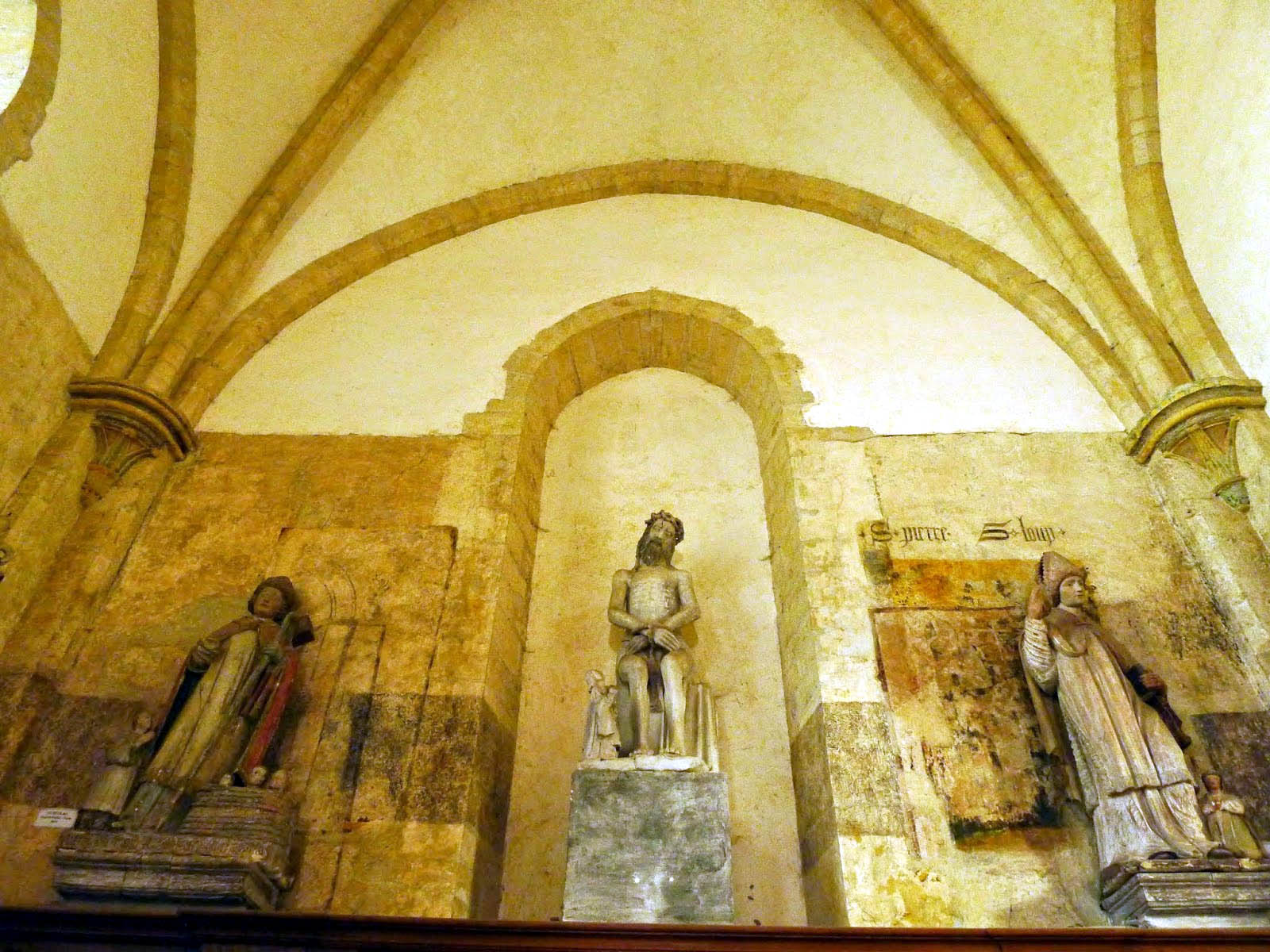
Most of these sculptors remain unknown. They usually did not sign their works, and the contracts between them and their patrons have disappeared. There remain only the statues, standing silently and attentively.
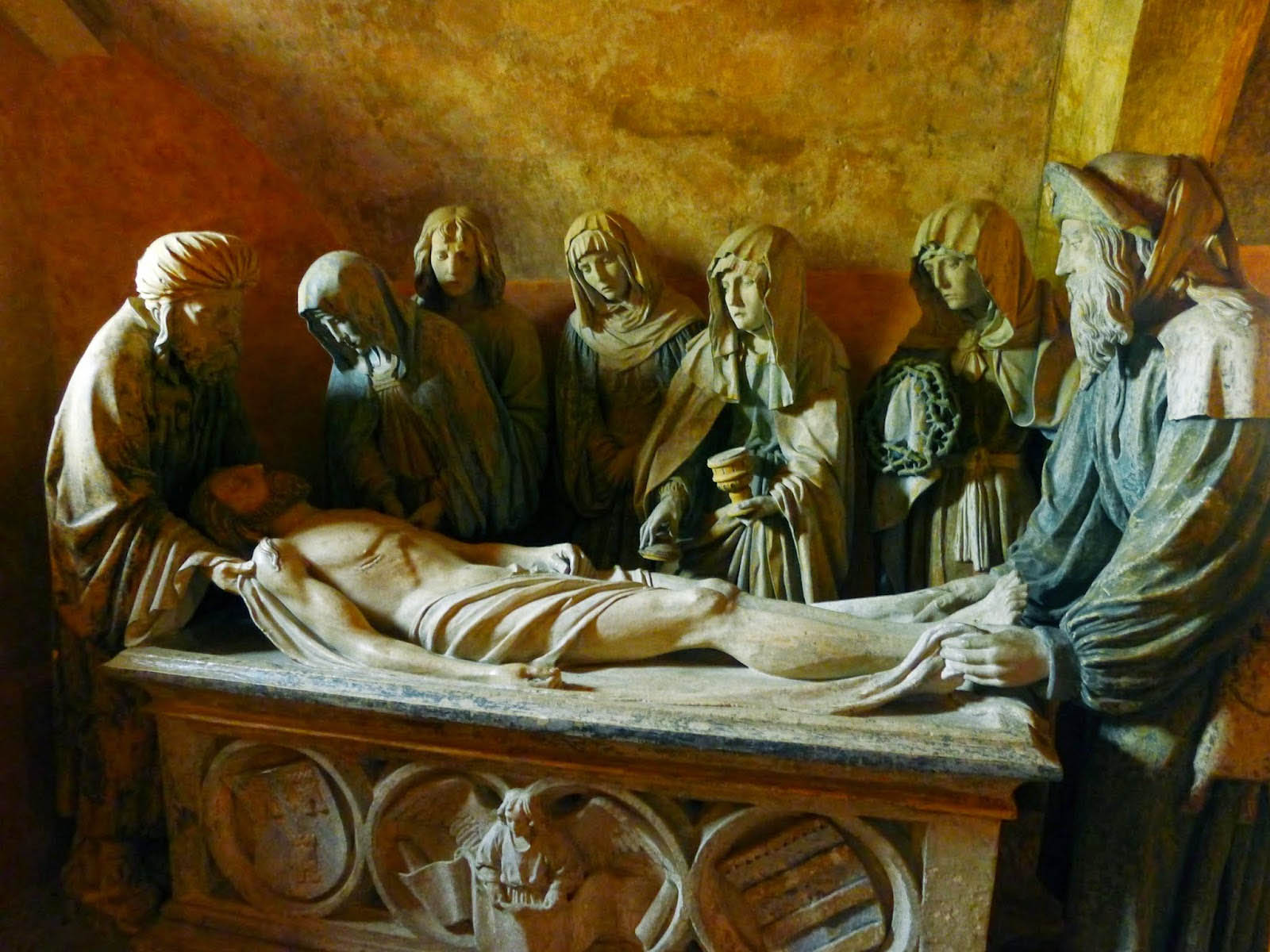
 In Chaource, near Troyes, the church is decorated with more than a hundred statues of an outstanding quality. Here, the Master of Chaource has left his name on one of the most beautiful Entombments of Europe.
You walk beyond the large grisaille windows of the Last Judgement, and then down five steps. This place is not, strictly speaking, a crypt, neither is it a side chapel, nor a tomb – but it looks like one. You descend these few steps into twilight, almost into darkness.
Yes, you descend into darkness, and there, before you see the group of the Entombment, you are startled by the stone guards who stand on either side of the door.

The guards. Larger than life, their eyes full of fear. Since 1515, they have been watching what they fail to believe, before falling asleep and awakening at the Resurrection. Since 1515, they have been standing there in their Renaissance costumes, spears in hand.
Then, as your eyes adjust to the twilight, you move ahead. There is Nicodemus, the Virgin Mary, John, Mary Salome and Mary Magdalene with a vase of perfume, Mary of Cleophas, and Joseph of Arimathea at the feet of Christ. And the body of white stone, completely smooth from centuries of caresses. All these figures are larger than you, just enough to keep you in the position of humility, while being inexpressibly human. And the patient and attentive hands of stone pause for a moment, before closing the shroud. And the eyes of stone are real eyes which look without crossing your gaze, because they are watching what no one has ever seen, and in their astonishment at seeing it, they turn back to their own thoughts.
Here, in the shadow, you encounter the thought, it has been waiting for you since 1515, and you feel very small before it.


 Come with us to…
 Atlantis
 Bestiary
 Bohemia+Prague
 Books, exhibitions, music, film
 Brave old world
 Caucasus
 Cemeteries
 Crimea
 Get to know the
 Images of the East
 Lightwriting
 Lwów/Lemberg
 Mallorca
 Message on the wall
 The Museum of Propaganda
 Odessa
 Paper Museum
 Persian letters
 The Jewish heritage


2 comentarios:
" … you feel very small before it." Indeed.
“Kommt, ihr Töchter, helft mir klagen”.
Beautiful post, thank you.
Merci Walter !
Publicar un comentario