 In recent days, thousands of students throughout Hungary protested against the government’s amateurish and hasty actions, which, two months before the university applications, want to remove the last remnants of any tuition waiver. The government communication, as usual, speaks contemptuously of the students, considering them idiots and calling them “philosophers musing in trendy pubs”. The government spokesman and the president of the chamber of industry point out on the basis of unlawfully acquired data that the leaders of the students’ self-governments have enjoyed a student’s status for more than 8-12 years, and the government newspaper Magyar Nemzet has even published a list on its first page with their personal data from the same unlawful sources. But they are real amateurs. They do not know anything. We now present you from authoritative sources not only the data, but also the portraits of those frivolous over-age students, musing in trendy pubs, who – as the government accuses them – would flee abroad en masse, to benefit the West from the taxpayers’ money spent on them. Look at them: are these types capable of a revolution?
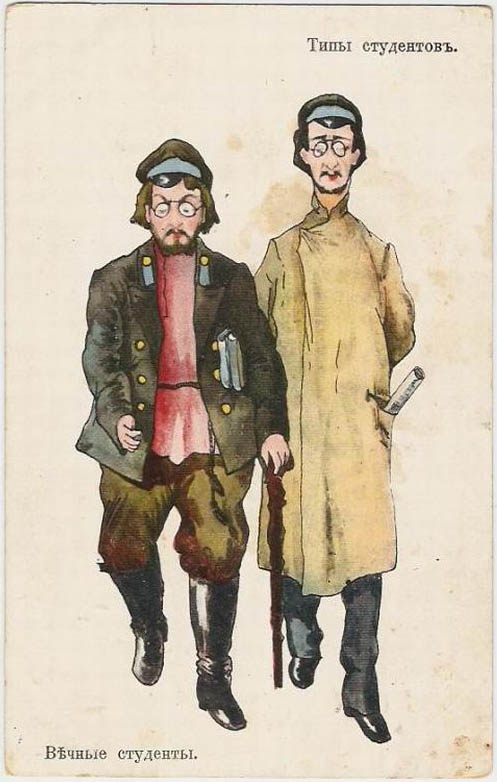 “Eternal students”
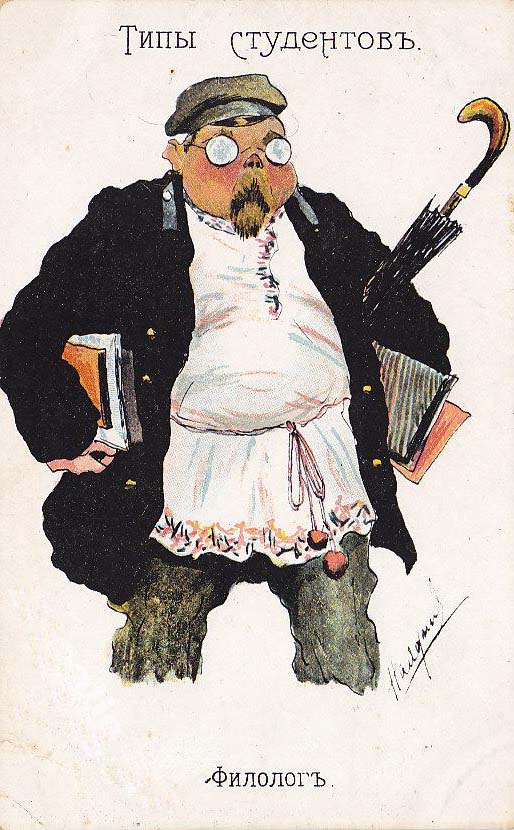 Philologist
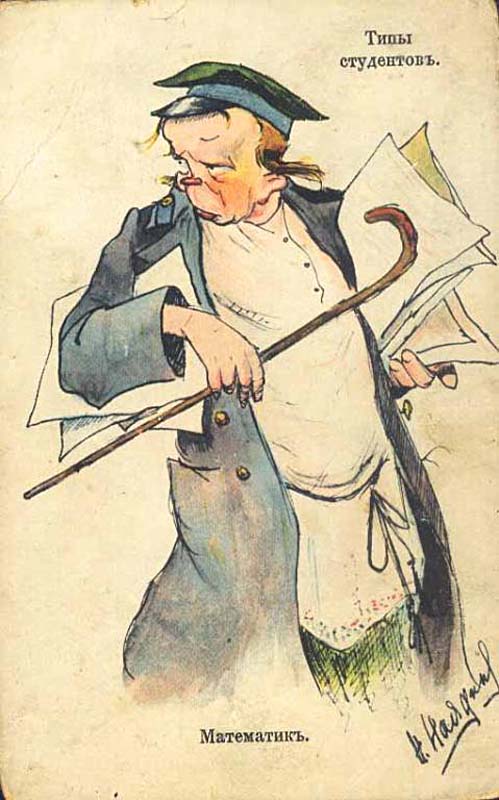 Mathematician
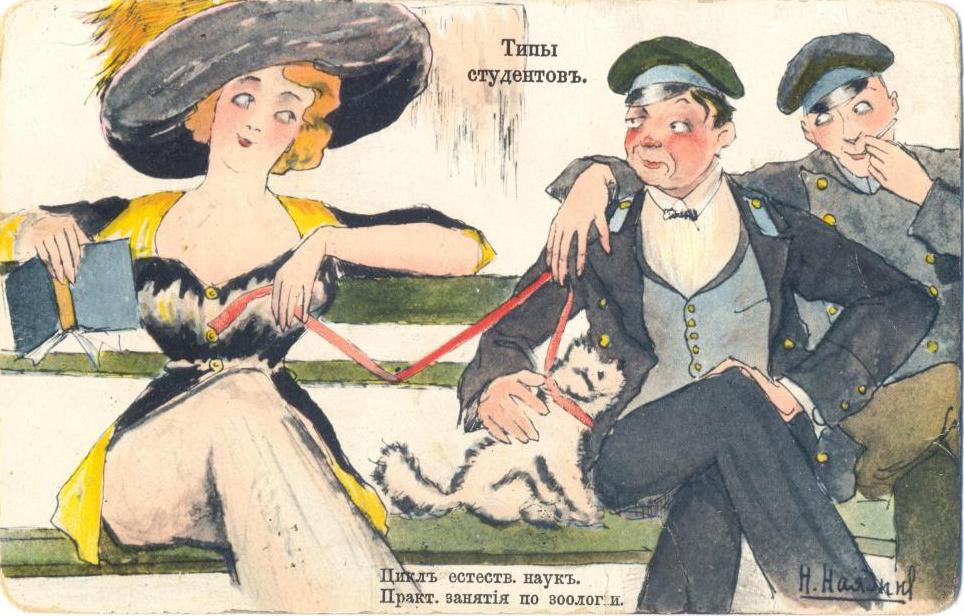 Natural sciences. Practical zoology
 Housing problem
The master of the postcards published between 1911 and 1915, Vladimir Fedorovich Kadulin enrolled in the Academy of Fine Arts in Moscow in 1902, at the age of 21. His studies were broken in 1905 due to “non-payment of tuition fees, and consecutive absences”. However, his designs signed as “Nayadin” still enjoyed great popularity. After 1917 there is no more trace of him.
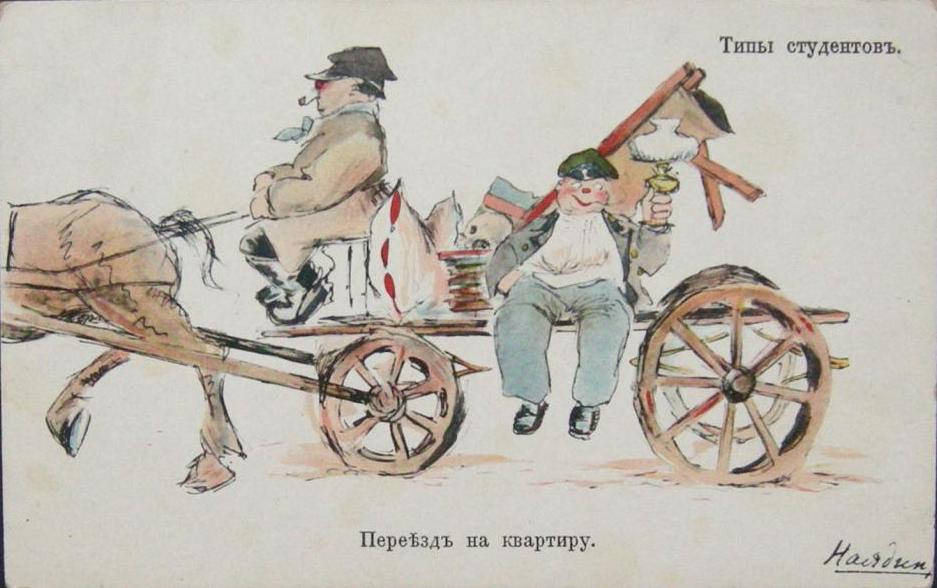 Moving to the new flat


 Come with us to…
 Atlantis
 Bestiary
 Bohemia+Prague
 Books, exhibitions, music, film
 Brave old world
 Caucasus
 Cemeteries
 Crimea
 Get to know the
 Images of the East
 Lightwriting
 Lwów/Lemberg
 Mallorca
 Message on the wall
 The Museum of Propaganda
 Odessa
 Paper Museum
 Persian letters
 The Jewish heritage


3 comentarios:
Never heard of фребеличка's before, or of Froebel (as apparently the name of this early XIX century German educator, and the inventor of kindergarten, is typically spelled in English). So фребеличка must be a "preschool teacher"?
One post-Froebelian idea really struck me BTW, it's about the educational games and toys which work wonders in the hands of their creators, only to devolve out of creative play into mechanical routine exercise in the practice of their followers. But it isn't the object such as a toy, it is a freedom of creative thought assisted by this object which matters!
Yes, perhaps you’re right, and фребеличка in the period means simply “preschool teacher”. I did not know the word either, and checked it at dic.academic.ru, where it said “Воспитательница детей дошкольного возраста по методу немецкого педагога Фребеля”, that’s why I guessed it must have been a special method in the age.
Thanks again, Studiolum, for directing my curiosity on wild tangents! At first it surprised me that kindergartens even existed in Czarist Russia ... the concept sort of feels like a proper part of the postrevikutionarty social contract, a part of "The New Way of Life" (Новый Быт).
But according to Brockhaus & Efron Encyclopedia entry on "Детский сад", there were a handful of "Childrens Gardens" in Russia at the turn of the century, all explicitly following the Froebel method. Peculiarly, the teachers there were formally known as "Childrens' Gardeneresses" (Д. садовницы)! Another term which would bewilder today's Russian speakers.
So you're right, фребеличка is best defined as a Froebel method kindergarten teacher (even though in those years, all kingergartens were Froebelian).
And best of luck to your students, may they get no lumps of coal for Xmas from the govt! We are getting too accustomed to states' spending more on jails and prisoners than on education and college students....
Publicar un comentario