Switch over to our new blog! • ¡Pásese a nuestro nuevo blog!

The renewed version of our blog, with more features, a richer design, and available in nine languages, can be read here: https://wangriver.com

The new version also includes the old posts, often in expanded form. If you are curious about the updated version of this post, replace “riowang.blogspot.com/” in the URL with “riowang.studiolum.com/”, and the new link will most likely lead you there.


La versión renovada de nuestro blog, con más herramientas, un diseño más rico y disponible en nueve idiomas, se puede leer aquí: https://riowang.com

La nueva versión también incluye las publicaciones antiguas, a menudo en una forma ampliada. Si tiene curiosidad por la versión actualizada de esta entrada, sustituya «riowang.blogspot.com/» en la URL por «riowang.studiolum.com/es/», y el nuevo enlace probablemente le llevará allí.

Persian letters


“How can one be Persian?” asks Montesquieu. “How can one learn Persian?” they ask me sometimes.

The French of the East. For a thousand years, the language of culture from Istanbul through the Caucasus to India, and in many places still it is; without it you cannot penetrate beyond a certain point into this world. The language of the purest poetry: the Persian poems are structured so much by the musicality of the language that they are untranslatable, any attempt is just a prosaic extract of their content. The language of music: the two and a half thousand year old Persian music is just as sophisticated, powerful and engaging as the European classical music. The language of a unique visual culture, to which, apart from the miniatures, the Iranian films and photos also bear witness. Of a multinational, multicultural, beautiful and isolated country of the size of a quarter of Europe, where only this language opens up doors and people, but this really does.


Kayhan Kalhor (kamanche) and Erdal Erzincan (saz): Gulnîshan (7:01)
Iranian Kurdish folk song performed by the classical Persian kamanche-player Kalhor and his frequent companion, the Turkish Erzincan, to illustrate Iran’s many cultures. From the concert held in Tehran’s Vahdat Hall.


history
• Müteferrika in Iran
• Sir Gore Ouseley and the Treaty of Gulistan (1813)
• Sándor Kégl’s Persian journey
• Ármin Vámbéry’s Persian journeys
• Persian travel sketches by Fedor Karacsay
• Nasreddin Shah in Hungary, 1889
• Ahmad Mirza, the little prince (1909-1925)
• Ahmad Mirza on the bridge of sirat
• Paraphrase of the Shahnameh against Hitler, 1943
• Beard fashions in Iran
• Elections and manifestations in Iran, 2009
• It’s winter

sites
• The chariot of time on Isfahan’s main square
• Bicycles in Isfahan
• The faces of Kashan
• Qâjâr-era palaces in Kashan and Shiraz (fr)
• Abyaneh, the Red Village
• Ashura in Abyaneh
• Village mosque in Abyaneh (fr)
• Nomadic butter churn in Abyaneh
• Masouleh, 1975
• The Persian desert
• On the edge of the desert
• A mineral world
• Vaults of Yazd
• Zoroastrian towers of silence
• The tomb of Queen Esther in Hamadan
• The Bakhtiari village of Sar Agha Seyyed
• Bakhtiari tents
• Khaled Nabi’s cemetery
• Gorgan: Turkoman shepherds and the village of Ziyarat
• Ruinous hammam in Kerman
• Cave dwellings in Kandovan
• Tehran, Behesht-e Zahra cemetery
• Beggar’s fiddle from the Museum of Music
• First day in the school in Mazandaran and Tehran
• Tabriz, the city of treasures
• Armenian monasteries in Iran
• Armenian churches in Northern Iran (fr)
• “Shepherd’s church” facing the Armenian cemetery of Julfa
• The Armenian quarter in Isfahan (fr)
• Damghan, birthplace of the demijohn?
• Qajar influences in 19th-c. Tiflis

nature
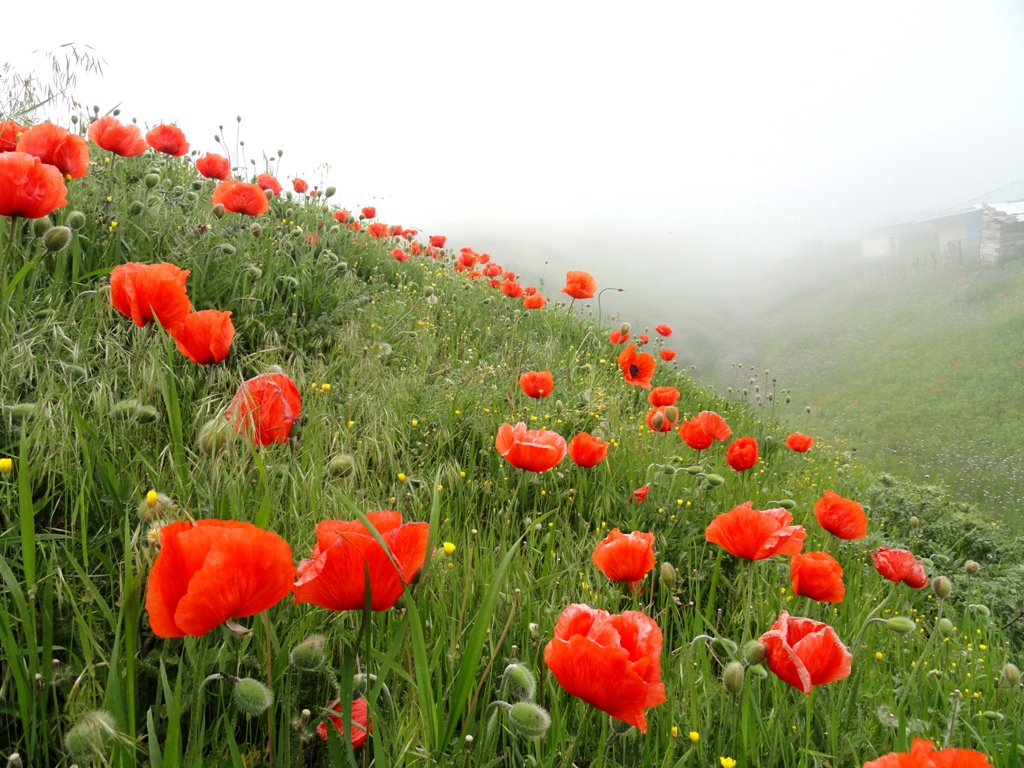
• Spring poppies in the Zagros
• Imperial crowns in the Zagros
• Conquering the Savalan Mountain
translations of poetry
• Mehdi Akhavan Sales: Comets and nights
• Sohrab Sepehri: Direction
• Omar Khayyam: The eternal secret
• Mehdi Akhavan Sales: It’s winter
• Hafez: From the blood of my heart
• Malek o-Sho'arâ Bahâr: Dawn bird
• Hushang Ebtehaj: As strangers
• Shahram Nazeri: Spring lily
• Fereidoun Moshiri: Trust in the spring
• Sohrab Sepehri: Village

music
• The power of Persian music
• Bakhtiari folk music: Cheshme-ye Kuhrang
• Masoud Bakhtyari: Tey tum rah
• Mahsa & Marjan Vahdat: Gol-e lâle
• Mohsen Namjoo: Name
• Hojjat Ashrafzadeh: Jam-e vasl
• Hossein Alizadeh - Kayhan Kalhor - Mohammad Reza Shajarian - Homayoun Shajarian: Zemestân ast
• Kayhan Kalhor: Desert night
• Soheil Nafisi: Hame-ye faslân-e donyâ
• Mohammad Reza Lotfi: Vatanam Iran
• Sahrab Tolouie: Tango perso
• Shahram Nazeri: Lâle-ye bahâr
• Shajarian – Kalhor – Alizadeh: Morgh-e sahâr
• Bijan Kamkar & Mastan Ensemble: Gharibâne
• Soheil Nafisi: Shahâbhâ va shabhâ
• Hossein Alizadeh: Horizon
• Sepa va dopa. Dance from Lorestan
• Asita Hamidi: Dokhtar-e Buir Ahmadi
• Freidoun Poorreza – Hossein Hamidi: Naz Bedashteh
• Davood Azad: Rumi + Bach
photo
• Hamid Khurshidi: Shepherds in Gorgan
• Alieh Sâdatpur: Bicycles in Isfahan
• Shahram Sharif: Iranian fragments
• Ehsan Amini and Hamed Masoumi
• Ahmad Kavousian: Masouleh 1975
• Ahmad Kavousian: Desert people
• Nasrollah Kasraian: The desert
• Alieh Sâdatpur: Bakhtiari tents
• Hamid Khurshidi: First day in the school in Mazandaran
• Ali Rafiei: First day in the school in Tehran
• Mohammad Javad Martabi: The village of Ziyarat
• Abotaleb Nadri: Brick-making children
• Ali Majdfar and Ardeshir Soltani: Khaled Nabi’s cemetery
• Mansure Motamedi: Flower-sellers in Tehran
• Omid H. Hassan: Tehran in Budapest

miniature
• Paraphrase of the Shahnameh
• A cup of tea from Isfahan
• Persian Jewish bride and bridegroom portrait

motifs
• Butterfly and candle
• Bird
• Imperial crown and tulip
• Bear cub

Iranian languages and cultures
• Tat villages in the Caucasus
• Lahij, the village of Persian border guards
• Tat and Pamiri languages
• Persian architecture in Tiflis
• The market in Kabul
• Poppy fields in Afghanistan

other
• A train to Persia
• Come with us to Iran!
• 30 (and more) reasons to visit Iran (fr)
• Happy new year, Persia
• Persian cuisine
• Iran’s secret language, the Russian
• The “five stones” game in Persia
• Sufi
• The origin of sin


2 comentarios:

Catherine dijo...

A wonderful kind of travel guide, ideal to enhance my eagerness to to visit Iran!

Studiolum dijo...

It was partly composed for that ;)