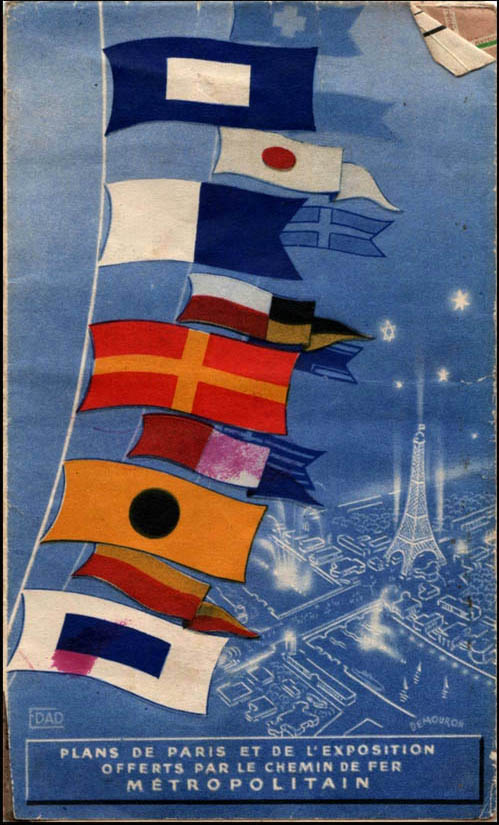
Can you identify all the flags on the cover of the public transport information booklet published for the 1937 Paris World Exposition?
The renewed version of our blog, with more features, a richer design, and available in nine languages, can be read here: https://wangriver.com
The new version also includes the old posts, often in expanded form. If you are curious about the updated version of this post, replace “riowang.blogspot.com/” in the URL with “riowang.studiolum.com/”, and the new link will most likely lead you there.
La versión renovada de nuestro blog, con más herramientas, un diseño más rico y disponible en nueve idiomas, se puede leer aquí: https://riowang.com
La nueva versión también incluye las publicaciones antiguas, a menudo en una forma ampliada. Si tiene curiosidad por la versión actualizada de esta entrada, sustituya «riowang.blogspot.com/» en la URL por «riowang.studiolum.com/es/», y el nuevo enlace probablemente le llevará allí.

 where we daily publish new photos about our travels around the world:


 Come with us to…
 Atlantis
 Bestiary
 Bohemia+Prague
 Books, exhibitions, music, film
 Brave old world
 Caucasus
 Cemeteries
 Crimea
 Get to know the
 Images of the East
 Lightwriting
 Lwów/Lemberg
 Mallorca
 Message on the wall
 The Museum of Propaganda
 Odessa
 Paper Museum
 Persian letters
 The Jewish heritage
5 comentarios:
They are international maritime signal flags. The front tier reads, from top to bottom: P-A-R-I-S. In between those letters, the next tier back (of penants) reads: 1-9-3-7. Beyond, it's more difficult, the swallow-tail shapes should be distinctive of signal flags, rather than national ones, but I do not find their patterns in memory or any reference guide that I can find. But the bottom two look like Thailand and Greece, specifically.
That’s it! As a child, I wanted to become a sailor, so I carefully read, among other things, the signal flags, so I was surprised to see them on the cover of a guide to a city deep inland. I wonder whether its users understood the meaning of the composition. As to the background flags, the upper ones might be perhaps of Switzerland and of a Scandinavian country.
Paris may be a city far inland, but its coat of arms shows a ship, reflecting the city's original situation on an island. So maritime symbols do make sense in a way...
The origin of the city arms of Paris is different. The motto under the ship is "fluctuat nec mergitur".
This phrase is translated as "Elle flotte sans être submergée" or in English "She is tossed by the waves but does not sink". Both motto and city arms have their origins in the river Seine boatsman's corporation; this powerful hanse ruled the city's trade and commerce as early as the Roman era.
Although this corporation through the centuries became an entity resembling more a municipal government than a trade organization, they maintained their original arms and motto, and it is for this that the Mairie de Paris bears them still today. It was made official on November 24th, 1853 by the Baron Haussmann.
the upper ones is the flag from Switzerland.
Publicar un comentario