
I always arrive at night to Georgia.
The first time we crossed the Turkish border on foot, and took a taxi to Batumi. Once we arrived to a large dark place, illuminated by a single lamp, the taxi left us there on that esplanade of yellow earth, in the moist heat evoking a distant Africa and all its spells, my only thought was: “my God, what an idea, to come here!”
How does one fall in love with a place?

Thereafter, I always flew. Like this night, when I returned to Tbilisi again. From the airport, I followed this brightly lit highway leading to the city. At the end it turns into a winding route, which disappears in the darkness under the railway: the Avenue George W. Bush. Beyond it, a maze of tortuous streets with dilapidated façades and deficient paving slanting towards the heart of the city. Suddenly the landscape opens up, and in front of you, hanging on the cliff overlooking Tbilisi, above the ochre walls and golden cupolas, emerges the fortress of Nariqala. The taxi descends to the river, follows the avenue along the walls of the old city, crosses the square, and disappears beneath the foliage of the sycamore trees. Between the leaves, from time to time, the yellow façades are weaving their laces of stucco.

One should tell about:
the eighty-year old driver driving his fifty-year old Volga who, getting to know that his passengers arrive from France, in his surprise mixed with happiness swerves the car in such a way that it almost hits against the oncoming car, which in this very moment, without any warning, cuts off our route;
who on the highway, in the middle of heavy traffic, does not react when a tire bursts, and continues his way for several hundred meters on three wheels;
who on the highway, in the middle of heavy traffic, does not react when a tire bursts, and continues his way for several hundred meters on three wheels;
after which, having taken us to a monastery and letting us to see it all alone, asks you to guard the taxi for a short while until he goes in to pray;
and who, on a mountain road without any visibility, rolls on the left side of the road, because it is more shady.
and who, on a mountain road without any visibility, rolls on the left side of the road, because it is more shady.
One should also tell about:
the little girl leading a lamb on a leash to the monastery – and all the others, each leading his or her own lamb, on a holiday – poor lambs;
the blue Zhiguli stopping at an intersection in Tbilisi, with a used coffin fixed on the roof;
this elderly couple, with their children behind them, who marry under the monolith dome of the church of Djvari, apparently without knowing the rites: the priest’s assistants command them to turn towards each other, go around the altar, bow, stand up – and they, silent, and almost absent, let happen what has to happen;
this elderly couple, with their children behind them, who marry under the monolith dome of the church of Djvari, apparently without knowing the rites: the priest’s assistants command them to turn towards each other, go around the altar, bow, stand up – and they, silent, and almost absent, let happen what has to happen;
the children’s graves under the trees;
Svetlana, sitting on a low stool in front of the fireplace in her house in Kakheti, and describing with nostalgia the route of the autobus which used to take her to the school along many kilometers of steel works in her native Kharkov;
the noseless man selling toys at a bus station along the way, beating his chest and shouting “Hellas, Hellas”, so that we understand that he is a Greek, and then tightening his lips, closing his eyes and asking for a kiss;
the young and very pious girl listening to religious hymns at full volume from an old cassette player, and dreaming to marry, preferably someone from Switzerland;
the young and very pious girl listening to religious hymns at full volume from an old cassette player, and dreaming to marry, preferably someone from Switzerland;
the praying crowd around a priest in a hall of the hospital, while paramedics try to make way with the victim of an accident along the road;
the little girl with a fever, but well educated, who wants to have a conversation with you in French from her bed;
the cats, here and there.
the cats, here and there.

And also:
about the writing, of Siamese sinuosity, with all these letters, so similar and yet different, like little traps plotted on signs, posters, walls, menus, announcements;
the tombstones in the cathedral of Mtskheta;
the letters drawn with chalk on the walls of certain houses, which announce that here bread is baked;

And also tell about:
the towering mountains;
the sure-footed small horses;
the cows grazing along the roads;
the open air meat sellers, with long purplish red slices suspended by a hook in front of the hut painted bright green;
the villages of the refugees from Abkhazia or Ossetia, aligned under the scorching sun along the line of cease-fire;
the prestigious visitors in the Batumi Botanical Garden, one of the richest in the world, followed by their bodyguards and a long procession of black limousines rolling at walking pace under the eucalyptus;
the women sitting on the ground in Marjanishvili Avenue, selling dill and tomatoes and watermelons in summer and green and yellow tangerines in autumn and carrots and cups filled with berries and mushrooms and grapes and;
the small yellow wax candles in front of thousand years old icons.
the prestigious visitors in the Batumi Botanical Garden, one of the richest in the world, followed by their bodyguards and a long procession of black limousines rolling at walking pace under the eucalyptus;
the women sitting on the ground in Marjanishvili Avenue, selling dill and tomatoes and watermelons in summer and green and yellow tangerines in autumn and carrots and cups filled with berries and mushrooms and grapes and;
the small yellow wax candles in front of thousand years old icons.

Tell about:
the steppe;
the shepherds;
the road where you almost get lost by running short on fuel;
the abandoned military polygon in the middle of nowhere, watching the Armenian border;
the Molokan villages up there, behind the mountain, where no road leads.
the road where you almost get lost by running short on fuel;
the abandoned military polygon in the middle of nowhere, watching the Armenian border;
the Molokan villages up there, behind the mountain, where no road leads.

Tell:
about the cool room with the blue ceiling where I spent an afternoon by reading, by reading and sleeping;
the window that opened onto a ravine facing the amusement park;
the window that opened onto a ravine facing the amusement park;
the branches of the fig tree that reached into the room and balanced on the curtains;
the clogs of the women walking on the terrace above me;
the chirping of a farmyard below;
later, when the sun decline, a male choir singing in canon in the distance;
the ruins of an ancient cathedral at the end of the street;
the happiness of being there.
the clogs of the women walking on the terrace above me;
the chirping of a farmyard below;
later, when the sun decline, a male choir singing in canon in the distance;
the ruins of an ancient cathedral at the end of the street;
the happiness of being there.
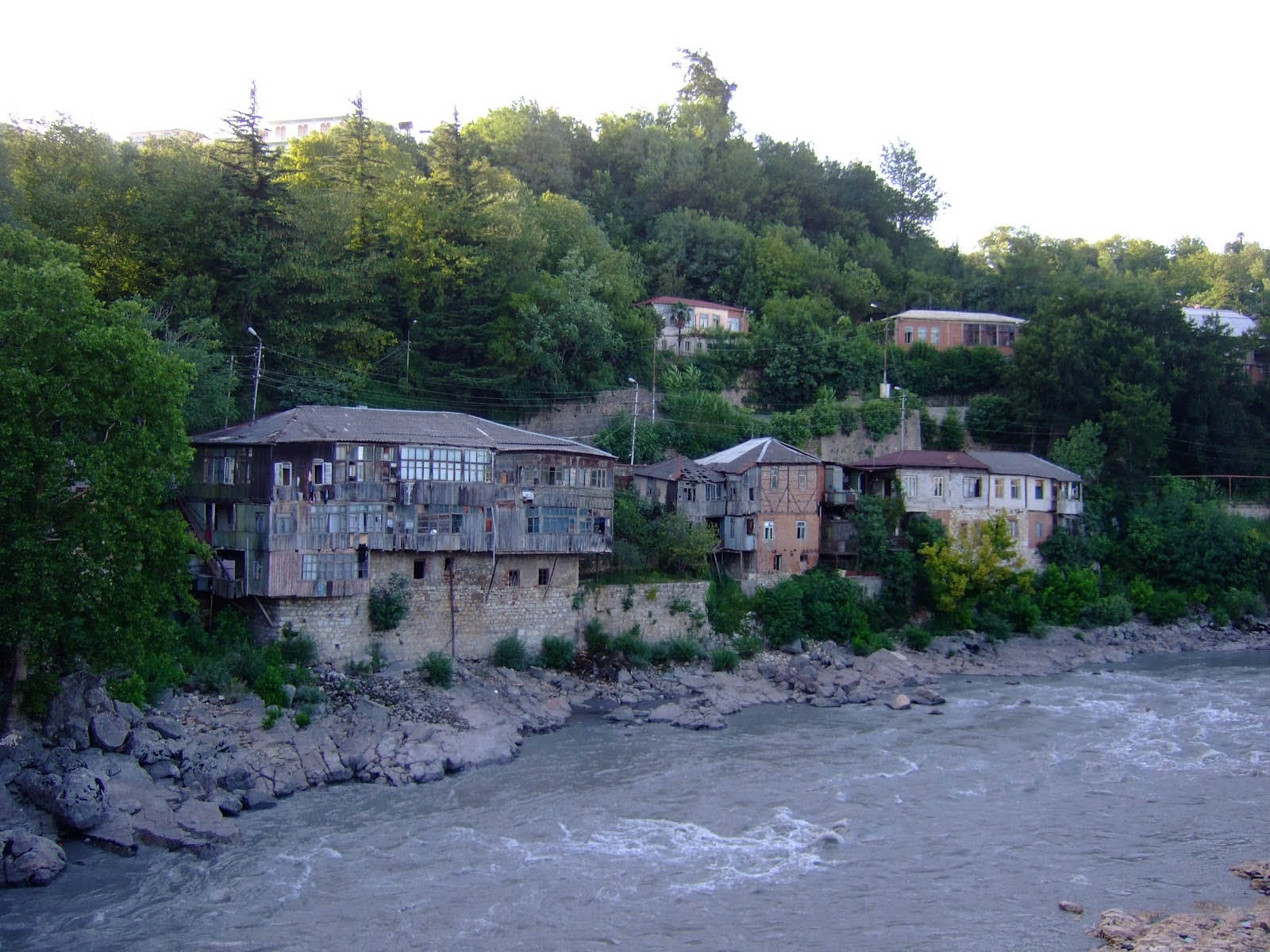

Finally, tell about the beauty of the churches, the reliefs on the yellow stone walls, the domes and porches, the long, bright aisles; the towers in the mountains; the beauty of the walls in the old town of Tbilisi, the beauty of its houses with wooden galleries: the warmth of the walls – not because of their age, not because of the past they help to survive in a city that is gradually rebuilt and is made beautiful by the grandiose renovations, flamboyant colors, glasses and metals and gardens – but because all their dirt, wrinkle and cracks, crusts and scales, crumbling plasters and stuccos which slowly glid down the façade, all this is written into the flow of time. And belonging to time means living, living this silent and attentive life of the objects, with humility and wisdom and patience.


 Come with us to…
 Atlantis
 Bestiary
 Bohemia+Prague
 Books, exhibitions, music, film
 Brave old world
 Caucasus
 Cemeteries
 Crimea
 Get to know the
 Images of the East
 Lightwriting
 Lwów/Lemberg
 Mallorca
 Message on the wall
 The Museum of Propaganda
 Odessa
 Paper Museum
 Persian letters
 The Jewish heritage


4 comentarios:
well, now I can recognize a story told by you from the very first lines.
And those stories always make me happy.
Como en cada uno de sus reportajes, éste es magnífico. Sigo su blog y cada entrada es una sorpresa- Gracias
My historical knowledge leaves me in the lurch, I'm just wondering what happened between Kharkov and Kakheti? (I mean, the reason for leave the first behind: merely personal, or some 'bigger' historical event in the background?)
Well, nothing happened between Kharkov and Kakheti — just life, exile, nostalgia. While traveling yourself, you meet people who have made of their lives a different kind of journey. If I like to tell stories, I also like to listen to stories. So it was a strange and nice moment when this Ukrainian lady, in a wonderful house surrounded by a striking landscape, began to tell me how she longed for Kharkov plants.
Publicar un comentario