Switch over to our new blog! • ¡Pásese a nuestro nuevo blog!
The renewed version of our blog, with more features, a richer design, and available in nine languages, can be read here: https://wangriver.com
The new version also includes the old posts, often in expanded form. If you are curious about the updated version of this post, replace “riowang.blogspot.com/” in the URL with “riowang.studiolum.com/”, and the new link will most likely lead you there.
La versión renovada de nuestro blog, con más herramientas, un diseño más rico y disponible en nueve idiomas, se puede leer aquí: https://riowang.com
La nueva versión también incluye las publicaciones antiguas, a menudo en una forma ampliada. Si tiene curiosidad por la versión actualizada de esta entrada, sustituya «riowang.blogspot.com/» en la URL por «riowang.studiolum.com/es/», y el nuevo enlace probablemente le llevará allí.
“How can one be Persian?” asks Montesquieu. “How can one learn Persian?” they ask me sometimes.
The French of the East. For a thousand years, the language of culture from Istanbul through the Caucasus to India, and in many places still it is; without it you cannot penetrate beyond a certain point into this world. The language of the purest poetry: the Persian poems are structured so much by the musicality of the language that they are untranslatable, any attempt is just a prosaic extract of their content. The language of music: the two and a half thousand year old Persian music is just as sophisticated, powerful and engaging as the European classical music. The language of a unique visual culture, to which, apart from the miniatures, the Iranian films and photos also bear witness. Of a multinational, multicultural, beautiful and isolated country of the size of a quarter of Europe, where only this language opens up doors and people, but this really does.
Kayhan Kalhor (kamanche) and Erdal Erzincan (saz): Gulnîshan (7:01) Iranian Kurdish folk song performed by the classical Persian kamanche-player Kalhor and his frequent companion, the Turkish Erzincan, to illustrate Iran’s many cultures. From the concert held in Tehran’s Vahdat Hall.
As I am writing this, the streets of Tehran are in full swing until eight in the morning, the beginning of the elections. Crowds of people are surging along the longest street of the world, the 30 kms long Vali Asr Avenue from the rich northern quarters to the bazaar in the south, mostly young people – 70% of Iran’s population is under 30 –, traffic has stopped, music is resounding, the asphalt is covered by election posters and leaflets that already have not been distributed: “Where has the price of the oil gone?” “Bye-bye, Ahmadinejad!” It is still uncertain what the presidential elections of tomorrow will bring, the two main candidates, Mahmoud Ahmadinejad and Mir Hossein Mousavi being both at 50% within statistical failure rate. The people of Tehran, to be on the safe side, feasts in advance, for at the much bigger feasts of tomorrow evening half of the people will have no more reason to do so.
In spite of the fact that in recent years Iran has risen to the rang of a regional power – thanks to the generous efforts of America which with enormous financial and human sacrifices has eliminated its two main rivals Iraq and Afghanistan, and through the support of Northern Iraqi Kurds brought the country on a common platform with its third man rival, Turkey – Western press has dedicated surprisingly few attention to the Iranian presidential elections. Some popular articles have been published here and there in every couple of weeks, on the unsatisfaction of the “Iranian people” – that is, people interviewed in the downtown of Tehran where the reporter got done with the obligatory fifteen lines report – on the assumption that all candidates are all the same, for all of them support the Iranian atom (the contrary would be a political suicide), that the Guardian Council has carefully filtered the candidates and thus only those politically absolutely reliable could enter the ring, and that the Council also sets very narrow limits to the power of the elected president. Therefore, Western journalists assert, the elections have no real stake. It seems as if none of them heard about Communism and as if they did not know how much difference can there be between an Andropov and a Chernenko, a Gierek and a Jaruzelski, a Grósz and a Pozsgay.
The complete broadcasting of the harsh TV debate of last Wednesday between Ahmadinejad and Moussavi (1.5 hour)
Whoever has experienced in his or her life how much political importance a somewhat bolder art exhibition, some centimeters longer hair or shorter skirt can have, will know how much it means which position the candidates occupy within the limited official playfield. Ahmadinejad, who is boasting with his plebeian origins – he is son of a blacksmith – and making a show of his plebeian manners by disregarding every protocol, since having appeared from nowhere six years ago has consciously made division and polarization the basis of his policy: internationally, between Iran and America, and within the country between Islam and its enemies. “There are no conservatives and reformers” writes his advisor Fatemeh Rajabi in the pro-government daily Ansar, “only the way of God and the way of Satan”. Moussavi, a recognized painter and architect, founder of the Tehran Academy of Art, who has won himself a lasting popularity as the highly responsible prime minister of the country between 1981 and 1989, in the terrible period of the war with Iraq, formulates his opinion more subtly. In the detailed interview given to the Spiegel he qualifies himself as a “conservative reformer” or rather a “centrist”, emphasizing the easing of tensions, the unity of the country, negotiations with America and the suspension of the catastrophic populist economic policy of the Ahmadinejad government (official inflation is 25%, but much higher in the reality). All this enters into the president’s officially permitted scope for action.
Election officials at a polling station inside a synagogue of Tehran at the parliamentary elections of 2008.
A special mention has to be made about ethnic question which in Iran – where hardly more than 50% of the population is ethnic Persian – is an especially delicate problem. In contrast to the centralizing policy of the Islamic republic, Moussavi, who himself is of Azeri origin, promises opening. It is worth to put on each other the map of Iran’s ethnic distribution (from today’s edition of Courrier International) and that of the late April election polls from the daily Jomhoriyat, where the majority of the green pro-Moussavi provinces are densely populated, developed and urbanized ethnic regions, while that of the red pro-Ahmadinejad provinces are rarely populated, semi-desert rural lands.
The subtle signs of change also include that, for the first time since 1979, the wife of a politician appears before the public. Mrs. Moussavi, Sahra Rahnavard – president of the women’s university Al-Zahra, and between 1997 and 2005 advisor of the reformer president Khatami – travels all over the country with her husband, and stands together with him on the stage – what is more, hand in hand, an unheard-of thing in Iran. This equality is an unsaid campaign promise which attracts large masses of female electors to Moussavi, as it is attested by this video of CNN below.
Another subtle sign of change is the use of internet. In Iran, where internet is extremely widespread, the government tries to keep it under control by any means. Ahmadinejad has set up a special internet commando, allegedly against “internet criminality”, whose target number one are bloggers. (The fourth most widespread language of blogs worldwide is Persian.) A special program is broadcasted on the national channel Gerdab to backbite bloggers and to present them as immoral and pro-Western. Moussavi, on the contrary, has his own site,web news, electorial YouTube page and twitter, as well as thousands of supporting pages and forums.
Nobody knows what tomorrow may bring (which is in any case only the first round). However, one thing is already sure: that these past months have brought an unsuspected and since 1979 unprecedented political fever to Iran.
“The genitalia exhibited offend the President of Iran. The Capitoline Museum has taken countermeasures.”
“I think it’s their Prime”, the interpreter suggests to Rohani
…because in the Capitoline Museums they covered up with various screens the naked statues, so they do not offend the sensitivity of the Iranians. (Italy, of course, has a long tradition of doing so. Not by accident Michelangelo’s apprentice, Daniele da Volterra is known among art historians as “Braghattone”, “the great underwear painter”, for having carefully painted panties and bras on all the scantily clad figures in the Sistine Chapel, just a few months after the death of his master.) They of course maximally offend thereby the sensitivity of the Iranians who consider the Italian gesture the betrayal of their efforts against the forced Islamization viscerally hated by them.
“Due to the large volume of Italian trade with Iran, it wouldn't have been surprising if Italians broke the statues all together”
– write some Twitter users in Iran, while others illustrate – how could it be differently, with the absolutely avantgarde Iranian design! – how it could have been done in a much more elegant way.
The last picture is to be interpreted “in Iranian”. The Italian boxes are here recovered with the website which greets you when you click on sites forbidden in Iran, like the Western blogs, for example río Wang. Just as it happens to me, when I forget to launch the small program psiphon necessary to step over the filter, which must be downloaded before you go to Iran. This site offers you “positive” websites in thematic blocks, and after a minute they broadcast beautiful and soothing photos representing the highest level of professional Iranian photography, with a soft music, so you do really forget what you wanted. They understand psychology, don’t they.
But the most elegant it would have been so, as the Iranians present their nudes.
Golestan Palace, Tehran. The Shah’s Palace, mid-19th-c.
Shah Abbas’ garden, the Boroujerdi merchant house, the Golestan Palace.All three World Heritage Sites. In the Iranian culture they represent nothing less than the Capitoline Museums in the European one. Millions of Iranian tourists visit them annually (Europeans rarely). Including mullahs, and even tours organized for mullahs. None of them have ever protested against the breasts of Shirin in Fin Garden, or the tight thighs of the Golestan lady. In the Golestan Palace I watched the fresco together with two mullahs, who were affected very little by the charms of the lady. They must have seen things like that. Instead, they were passionately interested in the cheap Tehran-Berlin flight tickets.
When we go to Iran, the women have to take a shawl upon them. We do not like it, just like the majority of Iranian middle-class women, but we accept it as the expectation of the current mainstream of Iran’s culture. In Europe in recent centuries a different kind of relationship evolved toward the representation of the naked body, and we expect our visitors to acknowledge it. Especially if – as it is shown by the above examples and the current Iranian relationship to them – it is not so different from the Iranian one. We should not to succumb to a non-existent expectation. Let us not be more Islamic than the mullahs.
The tours of río Wang have grown out of this blog at the request of our readers. For the fourth consecutive year, we are organizing tours to regions that we know well and love, and which are not found in tourist office advertisements, or even if they occasionally are, they do not delve so deeply into the history and everyday life of these places, the tissue of little streets, interior courtyards, cafés and pubs only frequented by the locals: to the Mediterranean, Eastern Europe, the Caucasus, Iran, the Far East.
Our journeys are no package tours, but rather friendly excursions. Almost always there is someone who admits to never having wanted to take part in a package tour, but he or she could not resist the offers of the blog. And in the end he/she recounts with relief, that it was absolutely no package tour. That we consider a really great compliment.
With our magnificent Iranian journey we have closed this year’s series of tours. This year, the river Wang has strayed far from its banks. In addition to our traditional tours to Galicia and Maramureș, we went several times to the Caucasus, Georgia and Azerbaijan, for the first time we organized a journey to Iran, and we have also advanced into the Mediterranean with our two tours to Rome. Together with our weekend in Prague, we have also opened the series of our urban explorations.
In 2016 we go further on these roads. We visit the third country of the Caucasus, Armenia, together with Karabagh. We organize a few regional tours in Iran: to Kurdistan, the Jewish monuments, the ancient settlements of the desert, the historical cities. In the Mediterranean we visit Mallorca and Rome, as well as Venice, follow the path of Quattrocento art from Urbino through Umbria and Toscana to Florence, and penetrate the archaic region of Barbagia, the secluded mountain villages of central Sardinia, and we continue to explore Galicia: in addition to the traditional Orthodox Easter in Lemberg/Lviv, we also tour the former Jewish settlements of the eastern, Ukrainian part of Galicia, as we did last year those in its western, Polish part. Finally, by popular demand, we also visit the region of Spíš/Zips in northern Slovakia, situated at the junction of many languages and cultural influences, and extremely rich in medieval monuments.
In addition to our usually small-size, max. 16-person tour we also start our exclusive photo tours, with the participation of only five persons each, where we tour with jeep a beautiful and remote mountain region at our own pace, stopping for a photo at any beautiful sight, but safely organizing our path and accommodation well in advance. This year we plan three such trips: to the most beautiful part of Georgia, northern Svaneti; to Iranian Kurdistan; and to one of the most beautiful mountain regions of Iran, the evergreen Gilan and North Azerbaijan, to the south of the Caspian Sea.
Give a Wang tour as a gift! Several of you wrote that you would willingly give a tour of río Wang as a Christmas present to your loved ones. If you choose one, I give priority to its organization, and within a couple of days I will tell you the exact costs.
The following tour calendar includes our proposals for 2016. We will announce each with detailed route and costs, if there are enough – at least ten, in the case of photo tours, four – persons interested in them. So inquire! :) The participation fee – which includes the accommodation (half of a double room with breakfast), leased bus, and the cost of organization/guide – is between 400 and 800 euros, and the photo tours around 1000 euro. We will give a more accurate price after the first round of organization. For information and to subscribe to our mailing list, write at wang@studiolum.com. Any proposals of change in the program are also welcome.
Beginning this December, we will regularly give personal accounts on our tours with slide projections in Budapest (and, on request, elsewhere, too). We will also distribute information about them in our newsletter.
January 14-22: The feasts of Mallorca. To many, Mallorca is a German tourist paradise, but this is only limited to the narrow southern beach. In reality, this island is a beautiful, archaic and unknown world, as we described in our earlier invitation and joint travel report, with medieval villages and abbeys, Arab gardens and olive plantations, a still living medieval Jewish quarter, traditional small trattorias, stunning mountains and coastline. January is the best month to visit the island, not only because there are no tourists, but the air is warm, and the oranges are ripe, but also because this is the season of the three largest popular feasts: the temptation of St. Anthony celebrated with all-night dancing and a pig roast; the blessing of the animals, and the feast of St. Sebastian, when thousands of demons march with fiery chariots through the old town of Palma.
February 26-28: Vanished Prague. Prague has vanished several times, but still there is enough that remains. On our weekend tour – a repetition and expansion of our New Year trip – we will visit the visible and invisible parts of the old town. While touring the labyrinth of the medieval streets and gateways, the Art Nouveau palaces and passages – myší díra, mouse holes, as they say in Prague –, we will also recall the worlds that have passed away during the reconstructions and the storms of history. The three foci of our urban exploration are the almost completely vanished former Jewish quarter, which we will meticulously reconstruct on the basis of old photos and descriptions; the southern part of the old town, which escaped modernization due to the First World War; and the little-known small streets below the castle on the opposite bank of the Vltava. Our New Year tour was joined by some seasoned Prague experts and pub-goers, who at the end admitted in amazement, how much they experienced that was new to them. With their recommendation we recommend this tour to beginners and the advanced.
March 12-15: Unknown Venice. “My father limited his visits in Venice to two buildings: St. Mark’s Basilica and Harry’s Bar”, writes John Julius Norwich, the great monographist of the city. Modern tourists are not much different from that. However, during this weekend we go further, and we tour Venice from alley to alley, house to house, from the Lido to the still extant Jewish quarter, and learn about the history of its everyday life. This tour is also a forerunner to our path of the Quattrocento, planned for September.
March 16-20: Hidden Rome. During the reprise of the highly successful Rome excursion in March, we tour the Renaissance and Baroque old city in the bend of the Tiber, visit the most important churches, palaces and squares, the two-thousand-year-old Jewish ghetto, the hidden corners untouched by fin-de-siècle urban planning, walk along the medieval pilgrimage routes, and make an excursion to the campagna. In the course of five days I try to offer in concentrated form all that I have learned during the year I spent in Rome and my later visits, and also leave time for the cafés, the trattorias, and sitting on the church steps at siesta time, without which you cannot really get to know Rome.
March 22-29: Holy Week in Sardinia.March 22-29: Holy Week in Sardinia. The Barbagia, the inner part of Sardinia encircled by mountains, is one of the most archaic regions of the Mediterranean, a stunning mountain with villages preserving thousand-year-old traditions, and prehistoric stone constructions. It is always a great experience to visit these valleys, but particularly around Easter, when the characteristic Holy Weekfestivities of the Mediterranean are celebrated with especially nice and achaic splendor. An unforgettable part of the ceremonies are the polyphonic folk choirs, which you can also hear during the siesta in the taverns.
Our collected travel reports
(further readings to our tours in 2016):
April 28 – May 1: Orthodox Easter in Lemberg/Lviv. Taking part in this is already a tradition for río Wang. In this multi-ethnic and multi-confessional city, the Greek Catholic, Orthodox and Armenian believers celebrate not only in the churches, but all over the city. We take part in the Greek Catholic benediction of the food in the centuries-old wooden churches of the open air museum, at the orthodox midnight Mass in the Renaissance Greek church, and at the Resurrection ceremony in the Armenian church, accompanied by the Armenian choir of the opera house, while we also visit the monuments of this once Polish and Jewish city. On the way we visit the Baroque town of Drohobycz, Bruno Schulz’s birthplace, and on the way back the Jewish cemetery of Bolechów, one of the most beautiful and best-preserved Hasidic cemeteries in Galicia.
May 2-10 and 16-25: Armenia and Karabagh. We complete last year’s Caucasus tours – in Georgia and Azerbaijan – with the third country. We arrive via Wizzair to Kutaisi, from where we enter the Armenian mountains through the valley of Vardzia. We come in the best season, when the mountainous region is dressed in the green splendor of the spring. We primarily visit the wonderful Armenian monasteries, but we will also stay in Yerevan, and go over to the wild Karabagh.
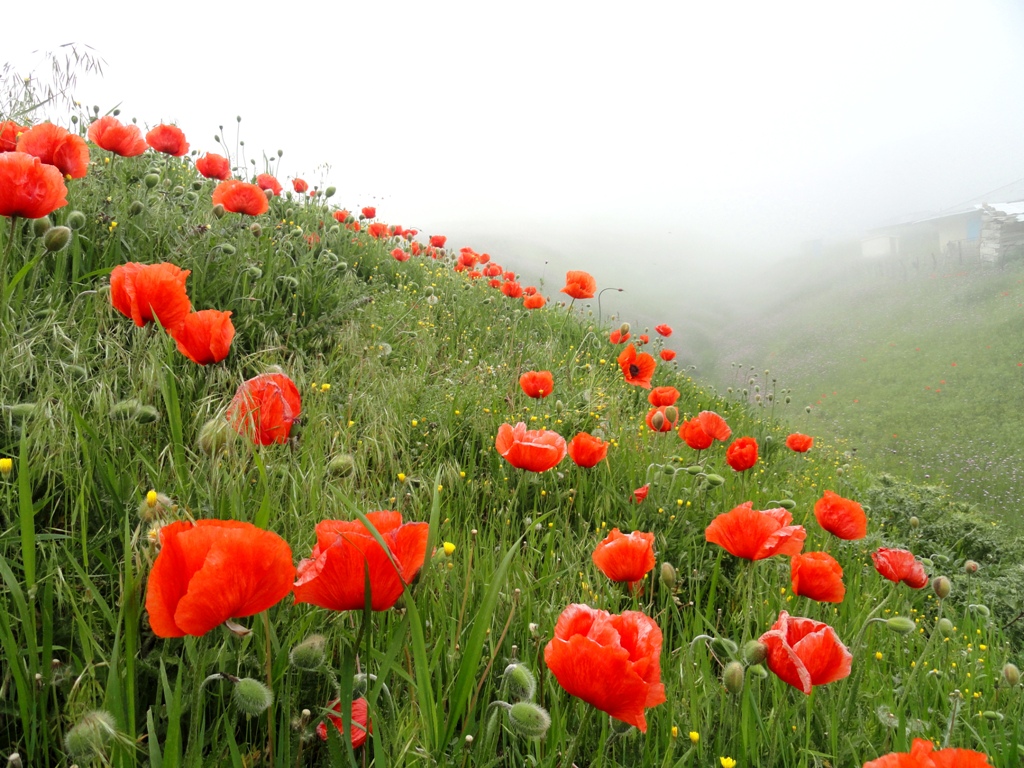
May 29 – June 5: Iran, photo tour to Kurdistan. This is the most beautiful month in Iranian Kurdistan, when the mountains are covered with the red carpet of wild tulips and imperial crowns. With our five-person jeep we go up from Tehran throughh Qazwin and Alamut, the former Assassin stronghold, to the Kurdish mountains, to Sanandaj, the capital of Kurdistan, and the secluded Howraman valley along the Iraqi border. Finally, through Kermanshah and the Bakhtiari mountains we descend to Isfahan.
June 10-19: Jewish and Kurdish Iran. In Hamadan we visit the tombs of Queen Esther and Prophet Habakkuk, the most important Jewish pilgrimage sites in Iran. From here we go up to the mountains of Kurdistan, where we will still see the late spring red carpet of wild flowers. Through the Bakhtiari mountains we descend to Isfahan, where we visit the Jewish quarter with its seventeen working synagogues, not mentioned in any guidebook, and we will also meet the local Jewish community. • P.S. Due to collision of programs, this tour is shifted to the next year.
August 20-25: Klezmer festival in Lemberg and the Jewish shtetls of Galicia. We have already visited the western, Polish part of Galicia, cut in two in 1939, and we have dedicated a long post to our touching experiences. This year, we finally set out to visit the former Jewish settlement of the eastern, Ukrainian Galicia. We will see well-preserved shtetls, still working synagogues, and meet the last Galician Jews. As an assuagement for the memorial tour, we will also take part in the klezmer festival, now organized for the sixth time by the Jewish cultural association of Lviv. Here, in addition to the great Western and Israeli names, we will also listen to traditional klezmorim from the Ukraine, Moldavia and Russia.
August 26-30: The Gothic route of Spíš/Zips. One of the most extraordinary, multi-language region of pre-1918 Hungary, now in northern Slovakia, which was also an integral part of Poland for some decisive centuries, and left to us the most beautiful Gothic monuments of these countries. Its original Zipser German inhabitants were deported in 1945, but the region has still preserved its cultural isolation. During our journey, we will visit the still existing medieval towns from Levoča to Bardejov, as well as the mansions and cemeteries recalling the vanished past.
September 2-8 and 9-15: The path of Quattrocento in Umbria and Toscana. This tour follows the path described in Antal Szerb’s cult novel Traveler and Moonlight. We start from Urbino, the Renaissance town where the first studiolum was built, and follow the thread of the centers of early Renaissance art through Umbria and Toscana: Gubbio, Assisi and Arezzo, as far as to Florence. We will also encounter the surviving pre-Christian traditions, the many-thousand-year-old pre-Roman towns built on the hilltops, and the wonderful view of the Apennine mountains. We will cover some exceptionally beautiful trails on foot, just like the medieval and early modern pilgrims and lovers of art.
September 30 – October 7: Irán, photo tour in Gilan. A one-week photo tour in a five-person jeep in one of the most beautiful provinces of Iran, the evergreen mountainous region of Gilan and Northern Azerbaijan, to the south of the Caspian Sea. We drive through breathtaking mountain passes and canyons on the land of the Shahsavan nomads, and we sleep in the beautiful green plateaus of the “Iranian Switzerland”, in the tents of the Talysh nomads. Finally we descend to the Caspian Sea at the village of Masuleh.
October 8-15: The historical cities of Iran. One year after this year’s last tour, we again arrive in Iran at the feast of Ashura, the most important Shiite religious festival. Just like this year, we will participate in it in Kashan and Nushabad, together with our local friends. We will visit the town of Abyaneh, then travel along the route of the most important historical cities of Yazd, Isfahan, Pasargade, Persepolis and Shiraz. From Shiraz we return via domestic flight to Tehran.
October 16-23: Iran, the ancient settlements of the desert. The Iranian desert, as we have written, is not dead at all, but a particularly beautiful part of the country. Thanks to the underground water channels, it is permeated with a network of thousand-year-old settlements, caravanserais and trade routes, which played an important role in Iran’s history. We will follow this network in the triangle of the historical cities along the desert, Kashan, Yazd and Isfahan, visiting thousand-year-old Jewish and Zoroastrian settlements, entering impressive clay fortifications, sleeping in lonely caravanserais in the middle of the desert, under an usurpassably starry sky. This tour will be an important contribution to the understanding of how the Iranians see their own country.
November 2-6: The Renaissance towns of Southern Bohemia. In our last tour of this year, at the time of the most beautiful fall colors, we will visit a region of impressive natural beauty, which is the richest in historical monuments, and nevertheless perhaps the least known in Eastern Europe. From Brno to Český Krumlov, we will see Renaissance crocodiles, small towns and Jewish cemeteries, medieval breweries and knight’s castles, monasteries and pilgrimage churches, and we will discover the traces of the displaced German population. We will finish our last tour in Český Krumlov, above the Vltava river, with the music of the Vltava.
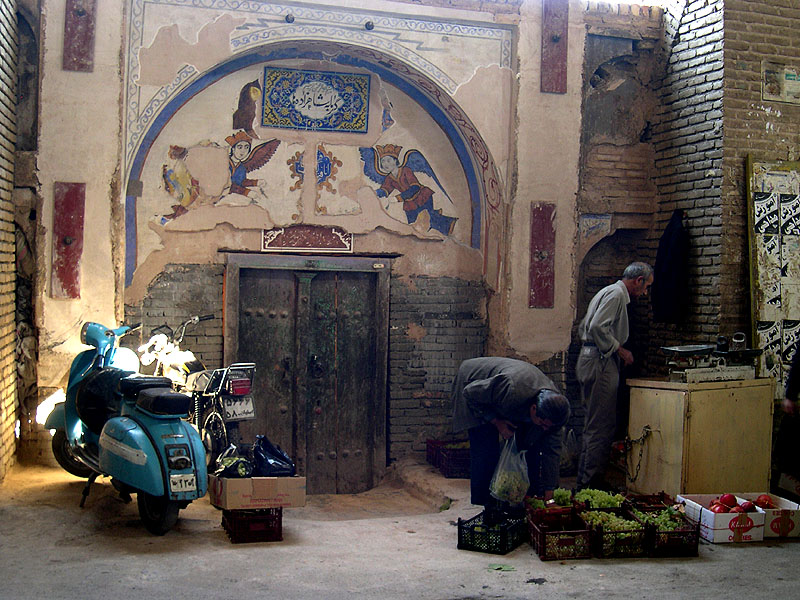

 “How can one be Persian?” asks Montesquieu. “How can one learn Persian?” they ask me sometimes.

 history
 sites
 nature
 translations of poetry
 music
 photo
 miniature
 motifs
 Iranian languages and cultures
 other


 Give a Wang tour as a gift!


 March 16-20: Hidden Rome. During the reprise of the highly successful


 May 29 – June 5: Iran, photo tour to Kurdistan. This is the most beautiful month in
 June 10-19: Jewish and Kurdish Iran. In Hamadan we visit the tombs of
 August 20-25: Klezmer festival in Lemberg and the Jewish shtetls of Galicia. We have already visited the western, Polish part of Galicia, cut in two in 1939, and we have dedicated a
 August 26-30: The Gothic route of Spíš/Zips. One of the most extraordinary, multi-language region of pre-1918 Hungary, now in northern Slovakia, which was also an integral part of Poland for some decisive centuries, and left to us the most beautiful Gothic monuments of these countries. Its original Zipser German inhabitants were deported in 1945, but the region has still preserved its cultural isolation. During our journey, we will visit the still existing medieval towns from Levoča to Bardejov, as well as the mansions and cemeteries recalling the vanished past.
 September 2-8 and 9-15: The path of Quattrocento in Umbria and Toscana. This tour follows the path described in Antal Szerb’s cult novel Traveler and Moonlight. We start from
 September 30 – October 7: Irán, photo tour in Gilan. A one-week photo tour in a five-person jeep in one of the most beautiful provinces of Iran, the evergreen
 October 8-15: The historical cities of Iran. One year after this year’s last tour,
 October 16-23: Iran, the ancient settlements of the desert. The
 November 2-6: The Renaissance towns of Southern Bohemia. In our last tour of this year, at the time of the most beautiful fall colors, we will visit


 Come with us to…

 Atlantis
 Bestiary
 Bohemia+Prague
 Books, exhibitions, music, film
 Brave old world
 Caucasus
 Cemeteries
 Crimea
 Get to know the
 Images of the East
 Lightwriting
 Lwów/Lemberg
 Mallorca
 Message on the wall
 The Museum of Propaganda
 Odessa
 Paper Museum
 The Jewish heritage


