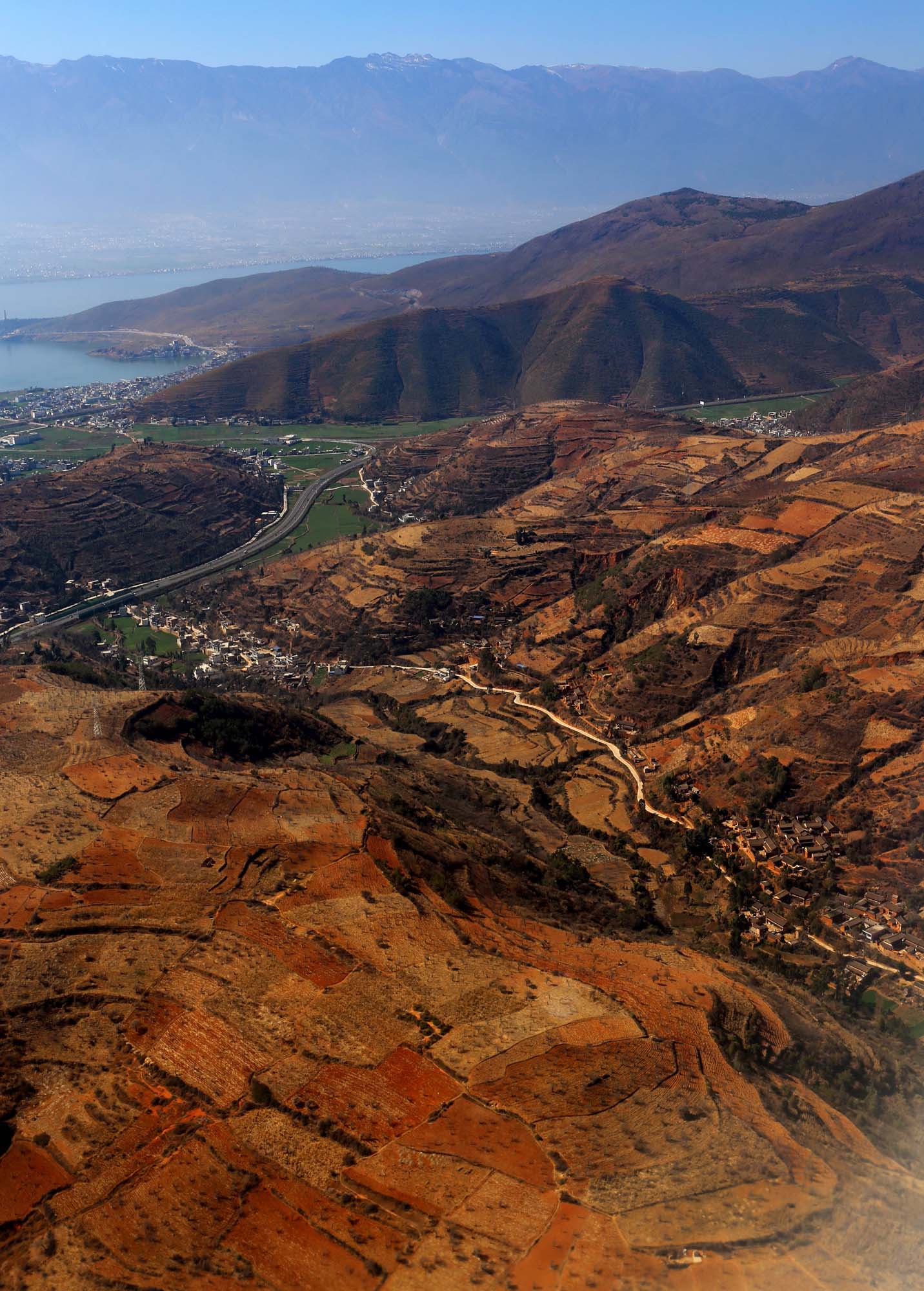
 The plane arriving from the south describes a high turn above the shiny mirror of Erhai Lake, as if making a sweeping gesture over the theater that will be the framework of our life for the next three weeks: the buttress mountains of the Himalayas, up to the Burmese and Tibetan border, and in the north, to the Sichuan pass and the sources of three large rivers, the Yangtze, the Mekong and the Irrawaddy. Then it begins to descend above the terraces of rice fields, the chessboard of arable lands and the bright green river valleys, and eventually it lands at the airport of Dali.
The central city of Yunnan’s Western half, and one of the key stations of the tea and horse route, the semicircle of Dali embraces the southern bay of Erhai Lake.
 The airport is at its eastern end, and at the western one, a good thirty kilometers away, the historical core of Dali, where we are heading. Zěnme kěyǐ qù Dàlǐ gǔchéng? how can we get to Dali Old Town, I ask at the information desk, where they gesture at the bus waiting outside. The bus is operated by the local tourist office, it takes us from here to there for fifteen yuan, exactly two euros, while a guide girl even tells about the city’s sights. In Chinese, of course, because in Yunnan they do not count on foreign tourists.
Two or three kilometers before the old town we slow down. We have arrived for the Chinese lunar new year, at this time the whole country is traveling throughout a week, and from the frosty North most come down here, to the bright South. The row is inching, everyone is looking for a parking place. “Can we get out?” I ask the guide. “Walking will be faster.” “Oh yes, of course!” she replies. “Welcome to China.”
Heading on foot towards the old town we indeed leave the bus far behind. We are close to the Ming-era city walls, when we catch sight of the gate of the
vegetable market. On the market, brown-skinned, Tibetan-faced, small-statured people sell and buy, the members of the two-million-strong Bai ethnic group, the natives of the environs of Erhai Lake and the surrounding mountains, the people of the Nanchao kingdom which flourished before the Mongol conquest. Among the customers there stand out, with their Mongol faces and round hats, the members of the Muslim Hui nationality, who do the shopping for their tiny restaurants. The preparation of most of the goods is finished there: they are cleaning fish, peeling sugar cane, bundling vegetables. We leave after a good half hour, and soon we pass by our bus still standing in traffic. We enter the city gate.


 Come with us to…
 Atlantis
 Bestiary
 Bohemia+Prague
 Books, exhibitions, music, film
 Brave old world
 Caucasus
 Cemeteries
 Crimea
 Get to know the
 Images of the East
 Lightwriting
 Lwów/Lemberg
 Mallorca
 Message on the wall
 The Museum of Propaganda
 Odessa
 Paper Museum
 Persian letters
 The Jewish heritage


1 comentario:
I have been working with Chinese for a year now. I wish I could go there with you.
I envy all of you now.
Publicar un comentario