Switch over to our new blog! • ¡Pásese a nuestro nuevo blog!
The renewed version of our blog, with more features, a richer design, and available in nine languages, can be read here: https://wangriver.com
The new version also includes the old posts, often in expanded form. If you are curious about the updated version of this post, replace “riowang.blogspot.com/” in the URL with “riowang.studiolum.com/”, and the new link will most likely lead you there.
La versión renovada de nuestro blog, con más herramientas, un diseño más rico y disponible en nueve idiomas, se puede leer aquí: https://riowang.com
La nueva versión también incluye las publicaciones antiguas, a menudo en una forma ampliada. Si tiene curiosidad por la versión actualizada de esta entrada, sustituya «riowang.blogspot.com/» en la URL por «riowang.studiolum.com/es/», y el nuevo enlace probablemente le llevará allí.
“Bismillah bird” composed of the letters of the Quranic verse Bismillah al-rahman al-rahim, “In the name of God, the compassionate, the merciful. Calligraphy by Khaleelullah Chemnad.
Para significar la divinidad, un persa habla de un pájaro que de algún modo es todos los pájaros.
To signify the godhead, a Persian speaks of a bird that somehow is all birds.
Jorge Luis Borges, El Aleph, 1949
So distinguished is the place occupied by the bird in Persian art and poetry, like for example in the As strangers by the modern Sufi poet Hushang Ebtehaj, set to music by the Kamkars and illustrated by us with another Bismillah bird, or in the closing picture of the Budapest photo series by Omid H. Hassam, which immediately reminded me the cover of the beautiful album Saz-e khamush, “Silent lute” by Mohammad Reza Shajarian, the greatest singer of Persian classical music.
On this album Shajarian is accompanied by Kayhan Kalhor on kamanche, and by Hossein Alizadeh on tar, the typical 8-shaped Iranian lute. Both are the most excellent Iranian masters of their instruments, and their music has been included more than one time in our blog. Tombak, the Iranian drum is played by Homayun, son of Shajarian.
The same four artists recite in the video below the poem Morgh-e sahâr, “Dawn bird” by the greatest 20th-century Persian poet Malek o-Sho’arâ Bahâr. The performance was registered at the famous Bam concert of 2003, organized by Shajarian in the aid of the survivors of the Bam earthquake which had produced 30,000 casualties. The audience cries in ecstasy just like we cried together with the whole audience when in 2007 the master sung this song in Isfahan.
Several versions of this song can be found on the net and on Persian albums: by the same group three years later, where the artists can be observed better, by the duo of Shajarian and the Azeri kamanche player Habil Aliov, transposed in an authentic Azeri style, or in the solo of the talented young tar player Sahba Motalebi. It is worth to read their comments as well, because they reveal a little bit what this song means for Iranians.
Since the 1960’s this poem has become one of the most popular Persian songs with the melody of Morteza Neydavud and in the performance of Shajarian. Perhaps also because 20th-century Iranian history was not in short of dawn-waitings, as it is attested by the earlier quotedComets and nights.
Morgh-e sahâr nâle sar kon
dagh-e ma-râ tâzeh tar kon
z âh-e sharar bâr in ghafash-râ
bar shekan o zir o zebar kon.
Bolbol-e par baste-ze konj-e ghafash dar â
naghme-ye âzâdi-ye no'e bashar sar â
v’az nafasi
arse-ye in khâk-e tude-râ.
Zolm-e zâlem yor-e sayyâd
âshiyânem dâde bar bâd.
Ey Khodâ ey falak ey tabi'at
shâm-e târik mâ-râ sahar kon.
مرغ سحر ناله سر کن
داغ مرا تازه تر کن
ز آه شرر بار ، این قفس را
بر شکن و زیر زبر کن
بلبل پر بسته ز کنج قفس درا
نغمه آزادی نوع بشر سرا
وزنفسی عرصه این خاک توده را
پر شرر کن
ظلم ظالم ، جور صیّاد
آشیانم ، داده بر باد
ای خدا ، ای فلک ، ای طبیعت
شام تاریک ما را سحر کن
Dawn bird, sing with sorrow,
remind me of my fresh pain,
with your burning breath
break and open this cage.
Captive nightingale, fly out of your cage,
start to sing the song of freedom,
and with one breath
set to fire the sluggish earth.
The cruelty of tyrants, the injustice of hunters
has broken my nest put to winds.
Oh God, oh world, oh nature
turn our dark night into dawn.
Nightingale – as we would like to expose it in a later post – is a topos of Persian poetry for the human soul, or more precisely for the human soul longing for God. (It is not just a coincidence that Eastern Sephardic poetry also took it over in this meaning, just like the topos of the bird representing God.) And in Persian thought the longing for God is very closely connected with the longing for the liberation from the limitations of this world, for absolute freedom. Where a Hungarian, with the famous verse of Petőfi, says “Liberty, love”, a Persian says “Liberty, God” in a thousand sophisticated ways. This is why they can sing – and they indeed do sing – this song as a psalm, a hymn and a movement song in one.
A leaflet advertising the name of presidential candidate Mir Hussein Mousavi
on the eve of the Iranian elections of June 12, 2009.
All this talk about nightingales in the previousposts has brought to my mind what could be considered their equivalent at us, around the Rio de la Plata: the zorzal (Turdus rufiventris, rufous-bellied thrush).
America does not have the same bird which is called nightingale in the Old Continent, although for example in the Caribbean there are a few that had been given that name. (It is really fascinating how the European names were gradually given to new and different species on American soil, as a consequence of the nostalgic vision of explorers and conquistadors.)
The zorzal is undoubtedly the best known songbird in the Rio de la Plata Basin. Just like the nightingale, it has a very melodious song and it is heard specially between night and dawn, in springtime, when the courting and mating season begins.
In cities, many zorzals are to be found in harmonious coexistence with humans. And in the springtime, that is between the months of October and November, many porteños, even those who know nothing about ornithology, begin to identify it as the bird which makes them wake up at dawn. To tell the truth, however charming the zorzal be, I can vouch that its penetrating and repetitive call at night can be unnerving for a light sleeper.
Like the mockingbird and the nightingale, the zorzal does not have one unique song. It varies not only according to the season of the year, but also according to the geographic zone and even from one individual to another. This is due to the fact that they imitate the songs of other birds, so that on occasions they create very particular “remixes”, even imitating the noise of motors, windmills or bells that were near their nests, thus puzzling many an ornithologist. Moreover, the song is the males’ weapon of seduction, so that while some individuals are very young and inexpert, others are mature and own a wide and proved repertoire of complex songs which have already afforded them successful conquests.
The zorzal is such an emblem of a melodious voice that Carlos Gardel, the most famous tango singer of the last century was known as “El Zorzal Criollo” (“The Creole Thrush”).
The two tangos that Gardel sings here are classic and very well known (even by those who, like myself, know nothing about tango). Many lines of these songs have become standard sayings, proverbs and aphorisms. They are also very good examples of the use of lunfardo porteño, the argot of Buenos Aires, which probably few Spanish speakers from other regions are able to decode without difficulty.
The first tango, “Mano a mano” (We’re Even) tells of a woman who, being of humble origins, now considers herself a “bacana” (a wealthy person who puts on elegant airs). In former times she accepted the singer’s love but now she holds it in contempt, because she has a rich “otario”, (a sucker, a fool) who keeps her and lets her throw “morlacos a la marchanta” (money around). He therefore speaks up with the intention of warning her that her vain illusions, her ephemeral triumphs will not last long and will soon leave her “like an old, unstuck, piece of furniture”: forgotten and hopeless.
I think we agree that this is the discourse which all of us spited by unreciprocated love would like to inflict on those by whom we have been forsaken. Al least, it is a feeling that well depicts a porteño: if something makes him suffer, he will always try to show to the other that he is beyond insults and contempt because he “knows” that the other will end up worse than himself.
Mano a mano – We’re Even Music: Carlos Gardel & José Razzano. Lyrics: Celedonio Flores
(The lyrics of the tangos, just like the text of the whole post, have been translated from Spanish to English by María Lía Macchi to whom I’m infinitely grateful for the great job!)
Rechiflao en mi tristeza, te evoco y veo que has sido de mi pobre vida paria sólo una buena mujer tu presencia de bacana puso calor en mi nido fuiste buena, consecuente, y yo sé que me has querido como no quisiste a nadie, como no podrás querer.
Se dio el juego de remanye cuando vos, pobre percanta, gambeteabas la pobreza en la casa de pensión: hoy sos toda una bacana, la vida te ríe y canta, los morlacos del otario los tirás a la marchanta como juega el gato maula con el misero ratón.
Hoy tenés el mate lleno de infelices ilusiones te engrupieron los otarios, las amigas, el gavión la milonga entre magnates con sus locas tentaciones donde triunfan y claudican milongueras pretensiones se te ha entrado muy adentro en el pobre corazón.
Nada debo agradecerte, mano a mano hemos quedado, no me importa lo que has hecho, lo que hacés ni lo que harás; los favores recibidos creo habértelos pagado y si alguna deuda chica sin querer se había olvidado en la cuenta del otario que tenés se la cargás.
Mientras tanto, que tus triunfos, pobres triunfos pasajeros, sean una larga fila de riquezas y placer; que el bacán que te acamala tenga pesos duraderos que te abrás en las paradas con cafishios milongueros y que digan los muchachos: “Es una buena mujer”.
Y mañana cuando seas deslocado mueble viejo y no tengas esperanzas en el pobre corazón si precisás una ayuda, si te hace falta un consejo acordate de este amigo que ha de jugarse el pellejo p’ayudarte en lo que pueda cuando llegue la ocasión.
Out of my mind with sadness I think about you again, and I see that in my poor miserable life you were just a good woman. Your elegant beauty gave warmth to my nest, you were kind and loyal, and I know you’ve loved me like you’ve loved no one like you’ll never love again.
We fell for each other when you were a poor girl who was trying to outsmart poverty in a boarding house: Today you’re a lady, life smiles and sings to you, you squander your sucker’s bucks just like an evil cat plays around with a wretched mouse.
Today your brain is crammed with unattainable daydreams. you’ve been deluded by your suckers, your girlfriends and your beau. The parties thrown by tycoons with their mad temptations where the ambitions of dance hall girls triumph or fall apart have become deeply embedded into your wretched heart.
I have no reason to be grateful, we’re even. I don’t care what you’ve done, what you do now, or what you’ll do. All the favours I have received, I’m sure I’ve already paid for. And if I’ve unwittingly forgotten some small debt, you can charge it on your current sucker’s account.
Meanwhile, I hope that your success, poor, ephemeral success, stretches out as a long line of riches and pleasures, that the tycoon who keeps you has lasting money that you can show off in public places with swinging pimps and that all the guys may agree “That’s a fine woman!”
And tomorrow, when you are an old, discarded piece of junk, and no hope is left in your poor heart, if you will need help, if you’re in want of advice, remember this friend who would risk his skin To help you in everything that he can when the need arises.
This other tango, also very famous, is by Enrique Santos Discepolo, a great porteño musician and poet. As it can be seen, it exhales nothing but bitterness and skepticism, a vision of life very typical of tangos and particularly characteristic of Discepolo, also the author of the well known “Cambalache”: “El mundo fue y será una porquería/ ya lo sé, en el 503 / y en el 2000 también” (“The world has always been and always will be trash, / I know, in the year 503 / and also in 2000”).
We again find the singer who assumes that he possesses supreme knowledge and therefore warns his listener to harbor no hope because it would be in vain (it’s remarkable how we porteños are defined by this image of the know-it-all…, I want to believe that not all of us are so, but its presence is constant in popular beliefs). Everything is a lie, nothing is love; nobody cares about what happens to the other and no one will help you when you are in need. He knows it because he’s already been through it and he knows about “rajarse los tamangos buscando ese mango que te haga morfar”, wearing out your shoes in search of money with which to eat. So when the other gets to realize that those around him are preparing to step into his clothes when he fails: “manyés que a tu lado se prueben las pilchas que vas a dejar” (manyés, ‘realize’ is another argot word that comes from the Italian, mangiare, to eat, because when you become aware of something it’s as if you ate it, you incorporated it spiritually), he will remember the warnings that were made to him.
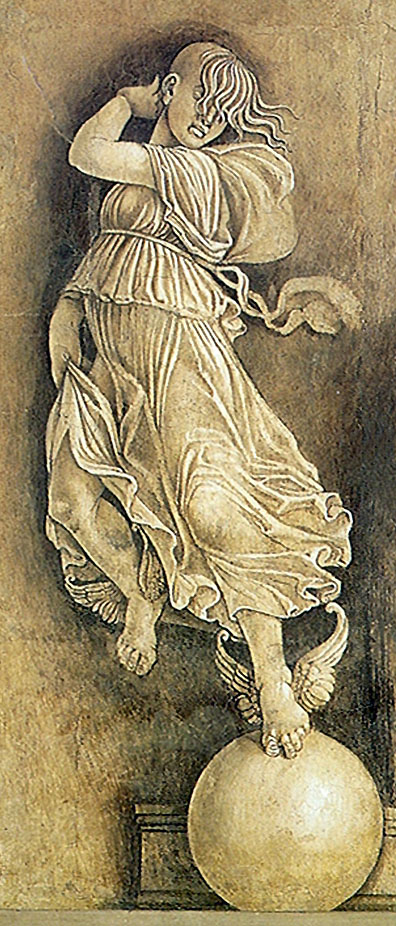
But perhaps the most interesting aspect is the image with which the tango begins on which all the subsequent development is based. “Cuando la suerte, que es grela”, that is, ‘luck, who is a woman’. Since ancient times luck, opportunity or fortune has been represented as a woman, and here is important not only the tradition of representing vices and virtues with allegorical feminine figures, but also the supposedly changing moods attributed to women or, what is more admissible, their changes of status, like those of the moon. Opportunity or fortune was therefore represented as a woman on a wheel or a sphere, because she is never stable, she goes turning and thus changing the fortunes of men. This is precisely what the tango suggests by saying “yira, yira”, that is, it goes round and round, (with another contamination by the Italian girare). But “yiro” was also the name given to prostitutes in lunfardo, because they wander around (yiran) corners of the city in search of clients. We have then the concept of luck that’s a woman, that lets you down (“fallando, fallando”) and leaves you without what you have expected of her (“Te largue parao”). Fortune goes round like a prostitute and she IS a prostitute. And this is the image of the world which has nothing stable or sure, except this bitter truth.
Yira, Tira – Going Round and Round Music & Lyrics: Enrique S. Discépolo, 1930
Cuando la suerte, que es grela, fallando y fallando te largue parao… Cuando estés bien en la vía, sin rumbo, desesperao… Cuando no tengas ni fe, ni yerba de ayer secándose al sol… Cuando rajés los tamangos buscando ese mango que te haga morfar… la indiferencia del mundo que es sordo y es mudo recién sentirás. Verás que todo es mentira, verás que nada es amor… que al mundo nada le importa Yira… Yira…
Aunque te quiebre la vida, aunque te muerda un dolor, no esperes nunca una ayuda, ni una mano, ni un favor… Cuando estén secas las pilas de todos los timbres que vos apretás, buscando un pecho fraterno para morir abrazao… Cuando te dejen tirao después de cinchar, lo mismo que a mí… Cuando manyés que a tu lado se prueban la ropa que vas a dejar… ¡Te acordarás de este otario que un día, cansado, se puso a ladrar!
When Fortune, who’s a woman, leaves you on the lurch… When you’re completely broke, aimless and desperate… When you no longer have faith nor yesterday’s mate leaves drying in the sun… When you wear out your shoes in search of a buck to buy food… Only then will you feel the indifference of the deaf and dumb World. You’ll realize that everything’s a lie that nothing is love… that the world doesn’t care at all, it just keeps going round and round…
Even though life is tearing you apart even though you’re broken by pain, don’t ever expect any help, an aiding hand, or a favour… When you’ve dried out the batteries of all the doorbells that you’ve rung looking for a brotherly bosom to embrace and die… When you’re thrown away after you’ve slaved as they did to me… When you realize that they’re trying on the clothes that you’re leaving behind… You’ll remember this jerk who one day got fed up and started to growl!
But maybe the voice of the “Creole Thrush” is best appreciated in the famous “El día que me quieras” (The Day When You’ll Love Me), which isn’t a proper tango but a tango-ballad. It was composed for the movie by the same title in 1935. Leaving aside the flamboyant gestures and acting of the two leading characters, the matchless melody and the poetry, which is perhaps somewhat kitschy but nevertheless enchants me, is one of our national prides.
El día que me quieras – The Day When You’ll love Me Music: Carlos Gardel. Lyrics: Alfredo Lepera.
Acaricia mi ensueño el suave murmullo de tu suspirar, ¡como ríe la vida si tus ojos negros me quieren mirar! Y si es mío el amparo de tu risa leve que es como un cantar, ella aquieta mi herida, ¡todo, todo se olvida!
El día que me quieras la rosas que engalana se vestirá de fiesta con su mejor color. Al viento las campanas dirán que ya eres mía y locas las fontanas me contarán tu amor. La noche que me quieras desde el azul del cielo, las estrellas celosas nos mirarán pasar y un rayo misterioso hará nido en tu pelo, luciérnaga curiosa que verá… ¡que eres mi consuelo!
Recitado:
El día que me quieras no habrá más que armonías, será clara la aurora y alegre el manantial. Traerá quieta la brisa rumor de melodías y nos darán las fuentes su canto de cristal. El día que me quieras endulzará sus cuerdas el pájaro cantor, florecerá la vida, no existirá el dolor.
La noche que me quieras desde el azul del cielo, las estrellas celosas nos mirarán pasar y un rayo misterioso hará nido en tu pelo, luciérnaga curiosa que verá… ¡que eres mi consuelo!
My daydream is caressed by the light murmur of your sighs. How mirthful life is if your black eyes are willing to look at me! And if your laughter, soft like a song, gives me shelter, my wound is soothed, everything, everything, is forgotten!
The day when you’ll love me the embellishing rose will attire itself in its best colours. Bells sounding to the winds will ring out that now you’re mine. And the fountains, insane with joy will tell me of your love. The night, when you’ll love me, peering from the blue of the sky, jealous stars will watch us go by and a mysterious beam will nestle in your hair: an inquisitive firefly who will realize that you’re my solace!
Recitative:
The day when you’ll love me, there will be only harmony, daybreak will be clear and the spring will be merry the breeze will quietly bring a rumor of melodies and the fountains will offer us their song of crystal. The day when you’ll love me, the songbird will sweeten its cords, life will blossom pain will not exist any more.
The night that you love me, peering from the blue of the sky, jealous stars will watch us pass, and a mysterious beam will nestle in your hair: an inquisitive firefly who will realize that you’re my solace!
Tanto hablar de ruiseñores en entradasanteriores me ha hecho pensar en el que podría llamarse nuestro equivalente rioplatense: el zorzal colorado (Turdus rufiventris).
En América no existe exactamente la misma ave a la que en el Viejo Continente se le da el nombre de ruiseñor, por más que hay algunas de ese mismo nombre en el Caribe, por ejemplo (sin duda es fascinante cómo los nombres europeos fueron adjudicándose a especies nuevas y distintas de las tierras americanas, según las miradas nostálgicas de los exploradores y conquistadores).
El zorzal colorado sin duda es el ave cantora más conocida de la cuenca del Río de la Plata. Como el ruiseñor, tiene un canto muy armonioso que se escucha especialmente entre la noche y la madrugada cuando en la primavera comienza la época de cortejo y apareamiento.
Por las ciudades suelen encontrarse muchos zorzales que conviven bien con los humanos. Y más de un porteño sin saber nada de ornitología lo empieza a identificar entre los meses de octubre y noviembre como el pájaro que lo despierta en la madrugada. La verdad sea dicha, por más encantador que pueda ser el zorzal doy fe de que su canto penetrante y repetitivo puede resultar enervante en una noche de sueño liviano.
Como la calandria o el mismo ruiseñor, el zorzal no tiene un único canto, sino que éste varía según la época del año, pero también por la zona geográfica e incluso de individuo a individuo. Es que son pájaros que aprenden el canto de otros, de modo que en ocasiones hacen unas creaciones muy particulares. De estos tres tipos de aves se conocen casos en los que han imitando incluso sonidos de motores, molinos o campanas que tenían cerca de sus nidos, desconcertando a más de un ornitólogo. Pero además el canto es el arma de conquista de los machos, así que los hay jóvenes e inexpertos, y otros maduros con un repertorio amplio y probado de complejos cantos que les han deparado conquistas exitosas.
Tan emblemático es el zorzal como dueño de una voz melodiosa que a Carlos Gardel, el más famoso cantante de tangos del siglo pasado, se lo llamaba «el zorzal criollo».
Los dos tangos que canta aquí Gardel son clásicos y muy conocidos por todos (incluso por quienes como yo no saben nada de tango). Muchos de los versos de las canciones se han convertido en frases hechas, refranes o apotegmas. Son muy buenos ejemplos también para mostrar el uso del lunfardo porteño, que seguramente pocos hablantes de castellano de otras regiones podrán decodificar sin dificultad.
El primer tango, «Mano a mano», habla de una mujer que antes fue humilde y ahora se cree una «bacana» (persona de dinero que la juega de elegante). Antes aceptaba el amor del cantor pero ahora lo desprecia, porque tiene un otario (un ‘tonto’) rico que la mantiene y le permite tirar los morlacos (el ‘dinero’) a la marchanta (‘por los aires’). Él entonces pretende adelantarse y advertirle que poco han de durarle esas vanas ilusiones, esos triunfos pasajeros y que pronto la van a dejar como «deslocado mueble viejo» olvidada y sin esperanzas.
Convengamos que es el discurso que todos los despechados por amor quisiéramos poder lanzarles a quienes nos abandonaron. Es al menos un sentimiento que retrata bien a los porteños: si sufre por algo siempre intentará mostrarle a su victimario que él ya está más allá de las injurias y desprecios porque además «sabe» que el otro terminará peor que él.
Mano A Mano Música: Gardel y José Razzano. Letra: Celedonio Flores
Rechiflao en mi tristeza, te evoco y veo que has sido de mi pobre vida paria sólo una buena mujer tu presencia de bacana puso calor en mi nido fuiste buena, consecuente, y yo sé que me has querido como no quisiste a nadie, como no podrás querer.
Se dio el juego de remanye cuando vos, pobre percanta, gambeteabas la pobreza en la casa de pensión: hoy sos toda una bacana, la vida te ríe y canta, los morlacos del otario los tirás a la marchanta como juega el gato maula con el misero ratón.
Hoy tenés el mate lleno de infelices ilusiones te engrupieron los otarios, las amigas, el gavión la milonga entre magnates con sus locas tentaciones donde triunfan y claudican milongueras pretensiones se te ha entrado muy adentro en el pobre corazón.
Nada debo agradecerte, mano a mano hemos quedado, no me importa lo que has hecho, lo que hacés ni lo que harás; los favores recibidos creo habértelos pagado y si alguna deuda chica sin querer se había olvidado en la cuenta del otario que tenés se la cargás.
Mientras tanto, que tus triunfos, pobres triunfos pasajeros, sean una larga fila de riquezas y placer; que el bacán que te acamala tenga pesos duraderos que te abrás en las paradas con cafishios milongueros y que digan los muchachos: “Es una buena mujer”.
Y mañana cuando seas deslocado mueble viejo y no tengas esperanzas en el pobre corazón si precisás una ayuda, si te hace falta un consejo acordate de este amigo que ha de jugarse el pellejo p’ayudarte en lo que pueda cuando llegue la ocasión.
Este otro tango, también muy famoso, es de Enrique Santos Discepolo, gran músico y poeta porteño. Se verá que no destila más que amargura y escepticismo, una visión de la vida muy típica del tango y especialmente propia de Discepolo, autor también del conocido «Cambalache» («El mundo fue y será una porquería, ya lo sé en el 503 y en el 2000, también»).
Nuevamente encontramos al cantor que se arroga una sabiduría suprema y le advierte a su interlocutor que deje atrás cualquier esperanza porque será vana (es notable cómo nos define a los porteños esta imagen del que se las sabe todas… quiero creer que no somos todo así, pero su presencia es constante en el imaginario popular). Todo es mentira, nada es amor; a nadie le importa nada de lo que le pase al otro y nadie te ayudará cuando lo necesites. Él lo sabe porque ya lo pasó y sabe lo que es rajarse «los tamangos buscando ese mango que te haga morfar»: gastar los zapatos buscando dinero para comer. Así que cuando el otro se dé cuenta de que los que tiene al lado se preparan para usar sus despojos cuando él fracase: «manyés que a tu lado / se prueban la ropa que vas a dejar» (manyés es otro término del lunfardo que viene del italiano, mangiare ‘comer’, porque cuando se toma conciencia de algo es como si se lo comiera, se lo incorporara espiritualmente), recordará las advertencias que le hizo.
Pero quizás el aspecto más interesante para nosotros es la imagen con la que comienza el tango sobre la cual se basa luego todo su desarrollo: «Cuando la suerte, que es grela», es decir ‘la suerte que es mujer’. Desde la antigüedad se representa a la suerte, ocasión o fortuna como una mujer, y aquí tiene peso no sólo la costumbre de la representación de vicios y virtudes en figuras femeninas, sino que cuenta además el supuesto humor cambiante que nos atribuyen a las mujeres o sus, más admisibles, cambios de estados, como la luna. La ocasión o la fortuna se representaba, entonces, como una mujer sobre una rueda o una esfera, porque nunca es estable, va girando y de ese modo va cambiando la suerte de los hombres. De eso mismo habla el tango, cuando dice «yira, yira», es decir gira, gira, (con otra contaminación del italiano, girare). Pero además «yiro» se les decía en lunfardo a las prostitutas, porque yiran por las esquinas de la ciudad buscando clientes. Tenemos entonces la idea de la suerte que es mujer y te falla, te defrauda («fallando, fallando») y te deja sin lo que esperabas de ella («te largue parado»). La suerte yira como una prostituta, la suerte ES una prostituta. Y todo esto es imagen del mundo que no tiene nada estable ni seguro, salvo esta amarga verdad.
Yira yira Letra y música: Enrique S. Discépolo, 1930
Cuando la suerte, que es grela, fallando y fallando te largue parao.... Cuando estés bien en la vía, sin rumbo, desesperao... Cuando no tengas ni fe, ni yerba de ayer secándose al sol... Cuando rajés los tamangos buscando ese mango que te haga morfar... la indiferencia del mundo que es sordo y es mudo recién sentirás. Verás que todo es mentira, verás que nada es amor... que al mundo nada le importa Yira...Yira...
Aunque te quiebre la vida, aunque te muerda un dolor, no esperes nunca una ayuda, ni una mano, ni un favor... Cuando estén secas las pilas de todos los timbres que vos apretás, buscando un pecho fraterno para morir abrazao... Cuando te dejen tirao después de cinchar, lo mismo que a mí... Cuando manyés que a tu lado se prueban la ropa que vas a dejar... ¡Te acordarás de este otario que un día, cansado, se puso a ladrar!
Pero quizás donde mejor se aprecia la voz del «zorzal criollo» sea en la famosísima «El día que me quieras», que no es un tango puro, sino un tango-canción. Fue compuesta para la película del mismo nombre de 1935. Más allá de lo ampuloso de los gestos y actuaciones de los dos protagonistas, la inigualable melodía y la poesía de la letra, quizás cursi –me podrán decir– pero que a mí me encanta, es uno de nuestros orgullos nacionales.
El día que me quieras Música: Carlos Gardel - Letra: Alfredo Le Pera
Acaricia mi ensueño el suave murmullo de tu suspirar, ¡como ríe la vida si tus ojos negros me quieren mirar! Y si es mío el amparo de tu risa leve que es como un cantar, ella aquieta mi herida, ¡todo, todo se olvida!
El día que me quieras la rosas que engalana se vestirá de fiesta con su mejor color. Al viento las campanas dirán que ya eres mía y locas las fontanas me contarán tu amor. La noche que me quieras desde el azul del cielo, las estrellas celosas nos mirarán pasar y un rayo misterioso hará nido en tu pelo, luciérnaga curiosa que verá...¡que eres mi consuelo!
Recitado:
El día que me quieras no habrá más que armonías, será clara la aurora y alegre el manantial. Traerá quieta la brisa rumor de melodías y nos darán las fuentes su canto de cristal. El día que me quieras endulzará sus cuerdas el pájaro cantor, florecerá la vida, no existirá el dolor.
La noche que me quieras desde el azul del cielo, las estrellas celosas nos mirarán pasar y un rayo misterioso hará nido en tu pelo, luciérnaga curiosa que verá...¡que eres mi consuelo!
Que por mayo era por mayo, cuando hace la calor, cuando los trigos encañan y están los campos en flor; cuando canta la calandria y responde el ruiseñor; cuando los enamorados van a servir al amor; sino yo, triste, cuitado, que vivo en esta prisión, que ni sé cuándo es de día, ni cuándo las noches son, sino por una avecilla que me cantaba al albor. Matómela un ballestero; dele Dios mal galardón.
In May it was, in May, when the days are hot, when the wheat ripens and the fields are in flower; when the lark sings and the nightingale replies, when lovers serve the god of Love. Except for me, poor wretch, who live in this prison, unaware of daybreak and unaware of nightfall, save when a little bird sang to me at dawn – An archer shot it; may God grant him small thanks!
This is one of the first romances, if not the very first one, that I had learned as a little boy – writes Wang Wei. It was sung by my mother and I remember her singing it exactly in those days of May described in the poem. With the difference that she added the refrain: “¡Ay, de la pena!” – “Oh, sorrow!” or “Alas!”:
Que por mayo era por mayo, cuando hace la calor, [Ay, de la pena, cuando hace la calor] cuando los trigos encañan y están los campos en flor; [Ay, de la pena, y están los campos en flor] cuando canta la calandria y responde el ruiseñor; [Ay, de la pena, y responde el ruiseñor] ...
In May it was, in May, when the days are hot – alas, the days are hot! – when the wheat ripens and the fields are in flower – alas, the fields are in flower! – when the lark sings and the nightingale replies – alas, and the nightingale replies! – …
It is a short romance, so that the forced repetitions and the slow and reiterative melody endowed it with the feeling of a never ending desperate lament. In the course of time this romance has been more and more appreciated by me and by now it has become one of my favorites. I have recalled it as in these days we spoke about nightingales, and I was happy to see that others who had not known it, now read it with the same curiosity and appreciation. And while consulting the edition of Spanish romances by Paloma Díaz-Mas (Barcelona: Crítica, 1994, 284), I also found there a special appraisal of it:
This is indoubtedly one of the most beautiful and most perfect romances. The lament of an unknown prisoner in first person, the initial description of the blossoming springtime and the lyricism and beauty of the images together make it an exceptionally impressive literary work.
The poem exists in two versions. There is also a longer one which, in a very prosaic way, presents the prisoner almost as a “wild man,” with monstruous look and broken away from society. (This, in my opinion, relates the text to the allegorical world of late 15th-century sentimental novel, converting the prision into a Cárcel de amor.) The prisoner is planning in it how to escape, and finally he is set free in an inexplicable way by the king who suddenly has mercy on him. I never liked this version. On the contrary, the one published here is almost perfect in its concentration and allusiveness.
There was another problem, however, which has made me browsing through a multitude of electronic and printed pages: the music. A first, quick search led me to the versions of Amancio Prada:
and of Chicho Sánchez Ferlosio (what a peculiar figure he was and how much we have forgot him!) who also enlarged the Medieval romance with an allegorical “commentary” of his own:
Cárcel tengo por fuera, cárcel por dentro. Voy vagando y vagando, puerta no encuentro. Tener cárcel no me importara cárcel por fuera, si de la de aquí adentro salir pudiera.
Veo el campo a lo lejos por la ventana. Tristeza, esperanza, noche y mañana. Allí crece la hierba de primavera. Esperanza y tristeza, luz y quimera.
Prison outside and prison inside. I’m roaming about and finding no door. I would not bother with the prison outside if I could set free from the prison inside.
I see the field afar through the window. Sorrow and hope night and tomorrow. The flower of the spring is blossoming there. Hope and sorrow light and mirage.
Both of them were enthusiastic about this type of poetry, mixing it with their respective manias and claims so characteristic of those seventies and early eighties when one had to regain possession of everything, including traditional poems. And of course their setting to music is very far from that subtlety of the romance how I keep it in my memory. Something similar can be told about the version of Paco Ibáñez, although it is marked by a much more popular tone, more fitting to the spirit of the text (you can listen to it here). And by searching a bit more, one also finds a more erudite and really good version sung by June Telletxero.
Romance del prisionero, interpretation of June Telletxero, accompanied on lute by Zif Bracha.
So far, so good. However, I was unable to find anywhere the version of my childhood – “alas!” Thus, in order to present it, I am constrained to hum it myself, offering a thousand apologies for the audacity, and pledging my word that as soon as someone offers us a more worthy version of it, we will immediately eliminate this one without a trace.
Romance del prisionero, interpretation of Wang Wei.
Que por mayo era por mayo, cuando hace la calor, cuando los trigos encañan y están los campos en flor; cuando canta la calandria y responde el ruiseñor; cuando los enamorados van a servir al amor; sino yo, triste, cuitado, que vivo en esta prisión, que ni sé cuándo es de día, ni cuándo las noches son, sino por una avecilla que me cantaba al albor. Matómela un ballestero; dele Dios mal galardón.
Es uno de los primeros, si no el primer romance que aprendí siendo aún niño. Lo cantaba mi madre, y la recuerdo a ella cantándolo justo en aquellos días de mayo descritos en los versos. Solo que ella introducía el estribillo «¡Ay, de la pena!»:
Que por mayo era por mayo, cuando hace la calor, [Ay, de la pena, cuando hace la calor] cuando los trigos encañan y están los campos en flor; [Ay, de la pena, y están los campos en flor] cuando canta la calandria y responde el ruiseñor; [Ay, de la pena, y responde el ruiseñor] …
Es un romance breve, así que las repeticiones forzadas, junto a la melodía lenta y reiterativa lo alargaban y le daban un aire de lamento infinito y desesperado. Con el tiempo, este romance ha crecido también en mi aprecio hasta convertirse en uno de mis favoritos. Me vino a la memoria estos días en que hablábamos de ruiseñores y comprobé con alegría que al mencionarlo a quienes no lo habían oído despertaba la misma curiosidad y gusto. Fui a refrescar mis datos a la edición de romances que hizo Paloma Díaz-Mas (Barcelona: Crítica, 1994, 284) y encontré también allí una valoración especial:
Es éste sin duda uno de los más bellos y logrados romances: el parlamento en primera persona en que un desconocido prisionero se lamenta de su situación, la descripción inicial del entorno en que florece la primavera, el lirismo y la belleza de las situaciones se conjugan para hacer un producto literario muy sugerente.
Hay dos versiones, una larga en que de manera bastante prosaica el prisionero se nos presenta casi como un «hombre salvaje», monstruoso y apartado del mundo (cosa que, a mi modo de ver, pone en contacto el texto con el ambiente alegórico de la novela sentimental de finales del s. XV, convirtiendo la prisión en una Cárcel de amor), planea la fuga y acaba siendo liberado de manera inexplicable por el rey, que de pronto se apiada de él. Nunca me gustó esta versión. En cambio, la que hemos transcrito aquí, la breve, es casi perfecta en su concentración y alusividad.
Pero es otro el problema que me ha tenido un buen rato revolviendo páginas (electrónicas y de las otras): la música. Una búsqueda básica muestra rápidamente las versiones de Amancio Prada:
Ambos se apasionaron por este tipo de poesía, pero mezclándola con sus respectivas manías y reivindicaciones, todo muy encuadrado en aquellos años setenta y principios de los ochenta en que aún había que recuperarlo todo, hasta los versos tradicionales. Y, desde luego, su musicación está muy lejos de la sensibilidad del romance tal como yo lo guardo en la memoria. Con la versión de Paco Ibáñez pasa algo parecido, aunque él le imprime un aire bastante más popular y ajustado al espíritu de la letra (podéis escucharlo aquí). Y si se busca un poco más, se encuentra una versión culta, francamente buena, cantada por June Telletxero.
Romance del prisionero, soprano: June Telletxero, laúd: Zif Bracha.
De acuerdo. Pero por ningún lado he sido capaz de dar con la versión de mi infancia, «ay, de la pena», así que me atrevo a canturrear los primeros versos pidiendo mil veces perdón por la osadía y jurando que en cuanto alguien nos proporcione una versión digna inmediatamente ésta será eliminada sin dejar ni rastro.
Romance del prisionero, interpretación de Wang Wei.
Nuestro amigo Két Sheng nos ha mostrado en los días pasados el hermoso camino que lleva desde una canción tradicional húngara, El gallo está cantando, hasta la canción sefardí Los bilbilicos cantan, a través de la bendición judía Tzur mi-shelo. Allí recordaba Két Sheng que, aparte del gallo, también el ruiseñor aparece como heraldo del amanecer y símbolo de las expectativas de la llegada del Mesías salvador en la tradición hebraica. «No podemos cerrar con más belleza el círculo de nuestro recorrido que exponiendo esta intrincada red de relaciones entre la canción hasídica húngara, la canción amorosa sefardí y el piadoso poema litúrgico judío», escribía al final de su ensayo.
Pero el círculo no está cerrado del todo. El ruiseñor como símbolo del alma que anhela al Salvador es algo bien conocido en la tradición cristiana medieval. Y su desarrollo tiene una historia tan larga y trabada que hace muy posible que la canción sefardí extrajera de ahí el motivo. Sigue siendo muy útil visitar, al respecto, aquel artículo de Mª Rosa Lida de Malkiel —que, por cierto, era judía— «El ruiseñor de las Geórgicas y su influencia en la lírica española de la Edad de Oro» (en La tradición clásica en España, Barcelona, 1975).
Los bestiarios medievales aún no reflejan este sentido alegórico. Como leemos en la página sobre el «ruiseñor» del magnífico Bestiario Medieval, solo se registran tres rasgos del ave. Plinio les da la información de que los ruiseñores empiezan a cantar en la primavera, cuando reverdecen los árboles (la calandria y el ruiseñor dialogan en el famoso romance castellano del ballestero «cuando los trigos encañan / y están los campos en flor»). Empieza entonces una verdadera competición de canto donde los perdedores pagarán con su vida el esfuerzo. San Isidoro de Sevilla en sus tan geniales como fantasiosas etimologías, hace derivar a la luscinia de lucis (luz), porque es ave que nos trae la luz de la mañana con su canto. Y por fin —aunque el Bestiario Medieval no menciona su fuente— San Ambrosio acuña la difundida parábola que compara al ruiseñor empollando los huevos y manteniéndose despierto con su propio canto, con la pobre viuda que cuida a sus hijos día y noche.
El misticismo franciscano del siglo XIII dio un nuevo giro a la interpretación alegórica del ruiseñor. Aquella nueva religiosidad, que contrastaba con el cristianismo más racionalista anterior, enfatizaba la relación personal con Dios, promoviendo las emociones, la interiorización del sufrimiento de Cristo. Y encontró en el ruiseñor un inesperado aliado. Dulcius in solitis cantat philomela rubetis, en la soledad del bosque canta más dulce el ruiseñor, escribió el rudimentario Maximianus Etruscus, convirtiendo este verso en el lema de la nueva religiosidad introspectiva y al ruiseñor en el símbolo del alma que clama por el Salvador.
El misticismo del ruiseñor, que a lo largo del siglo XIII se iría enriqueciendo con varios motivos y que, a la vez, modularía numerosos versos de la poesía amorosa cortesana (apareciendo, incluso, en los goliardescos Carmina Burana), fue resumido por el arzobispo franciscano de Canterbury John Peckham en su elegante poema latino Philomena. Este poema se atribuyó a San Buenaventura y así se divulgó e influyó en toda Europa (fray Luis de Granada, por ejemplo, hizo una delicada traducción en prosa). En sus versos, el ruiseñor —presentado con las fórmulas típicas de la lírica trovadoresca provenzal— es símbolo del monje que canta sin cesar, igual que el ruiseñor de Ambrosio, y que practica la «meditación por la imagen» que desarrollaron los franciscanos y luego impulsarán los jesuitas: desde el crepúsculo hasta la salida del sol canta sobre Adán y los sufrimientos de la raza humana irredenta; desde el alba, sobre los acontecimientos de la vida de Cristo; desde las tres, sobre las escenas de la pasión y muerte, hasta que él mismo muere de pena y agotamiento a la caída del sol. Justo como el ruiseñor de Plinio.
Manuscrito de hacia 1330 de la Philomena de John Peckham conservado en la Glasgow Library. En la inicial inferior “P(hilomena)” el ruiseñor y el monje meditan sobre las escenas de la vida de Cristo representadas en la inicial superior “C(hristus)”: su nacimiento e infancia, sus enseñanzas, María Magdalena lavando su pies, sus sufrimientos y muerte en la cruz.
Este poema de Peckham / Buenaventura fue conocido por San Juan de la Cruz —puede que en la traducción en verso de Juan López de Úbeda—. Y San Juan elige todo el material simbólico del canto del ruiseñor para descargarlo justamente en el clímax final de su Cántico espiritual (luego solo queda la última estrofa donde se cierra el poema en un cierto anticlímax). El canto en que se agotaba el ruiseñor es ahora, por el contrario, en la sintética lira de San Juan, equivalente a una «llama que consume y no da pena». Todo está ahí: el cese de los anhelos, la «soledad sonora» de los primeros versos del poema que se hace aún más dulce en «el soto y su donaire» —un soto que ya no se transita «con presura»—, el musical anuncio de la salvación inminente y definitiva, la llegada a una realidad superior y luminosa, la entrega y el descanso final en una noche que es, a la vez, un nuevo y encendido día.
El aspirar del ayre, el canto de la dulce filomena, el soto y su donayre en la noche serena, con llama que consume y no da pena.
Pero ¿dónde ha quedado en nuestro recorrido anterior la tercera característica, la del ruiseñor como portador de la luz? La alegoría medieval no se había olvidado tampoco de ella. Plinio hablaba de la canción del ruiseñor entre los árboles que reverdecen. Y en la Edad Media despunta la idea de que el ruiseñor empieza a cantar en la noche de Pascua como un anuncio de la inminente resurrección de Cristo. Así se escribe en el Carmen Paschale, el Poema Pascual, de Sedulius Schottus. Y, de hecho, la canción del ruiseñor aún resuena en la liturgia nocturna del Sábado Santo, en la secuencia del Salve festa dies de Venantius Fortunatus, donde el Resucitado trae la luz al mundo que revive y retoña.
Y aquí llegamos a la fiesta de hoy. Deseamos un muy feliz día de Pascua a todos nuestros lectores.
Canto del ruiseñor (3'15"), extraído de aquí. Otra versión se encuentra aquí (buscar „fülemüle”).
Két Sheng, starting from the Hungarian folk song The rooster is crowing, and arriving through the Hebrew blessing Tzur mi-shelo to the Sephardic love song Los bilbilicos cantan, has pointed out that in the Hebrew tradition not only the rooster, but also the nightingale is considered as the herald of the dawn and a symbol of the longing for the Messiah, the Savior. “We could not have rounded off more beautifully our round trip revealing the intricate network of relations between the Hungarian Hasidic song, the Sephardic love song and the pious Hebrew liturgical poem.” – he ended his essay.
But the round trip is not over yet. Because the nightingale as a symbol for the soul yearning for the Savior was also known in medieval Christian tradition. And the development of this symbol looks back to such a long and organic prehistory that it is also possible: even the Sephardic song borrowed the motif from there.
Early medieval bestiaries did not know about this allegorical meaning of nightingale yet. As we read on the “Nightingale” page of the outstanding Medieval Bestiary database, they only recorded three features for this bird. Pliny provided them with the information that nightingales start to sing in the springtime, at the leafing of the trees (as in the famous Spanish “ballad of the archer” the lark and the nightingale converse with each other “when the wheat ripens / and the fields are in flower”), organizing veritable singing competitions whose loosers often die from the efforts. Saint Isidor of Seville, with one of his usual false but genial etymologies derived the Latin name of the bird luscinia from light, lucis, as it brings the light by its early morning singing. And finally – although the Nightingale page does not mention its source – Saint Ambrose coined the widespread parable comparing the nightingale sitting on its eggs and keeping itself awake by its song, to the poor widow woman taking care of her children day and night.
13th-century Franciscan mysticism brought a new turn in the allegorical interpretation of nightingale. This new kind of religiousness, in contrast to earlier, rationalistic Christianity, laid emphasis on the personal relationship to God, on emotions, on the inner experience of the sufferings of Christ. In this it found an unexpected ally in the nightingale. Dulcius in solitis cantat philomela rubetis, sweeter sings the nightingale in the solitude of the forest, wrote the popular school author Maximianus Etruscus, and this verse became the motto of the new, introspective religiosity, and the nightingale the symbol of the soul yearning for the Savior.
The nightingale mysticism, which in the course of the 13th century was enriched with several new motifs and which on its turn also enriched the love poetry of the courts and the goliards of the Carmina Burana, was summarized by the Franciscan archbishop of Canterbury John Peckham in his elegant Latin poem Philomena. This poem was attributed to Saint Bonaventure, and thus it became widely known and influential (fray Luis de Granada for example made a beautiful Spanish prose translation of it). In this poem the nightingale – presented with the typical formulas of Provençal troubadour lyrics – is the symbol of the monk who, incessantly singing like the nightingale of Ambrose, practices the “image meditation” developed by the Franciscans and later by the Jesuits. From night to sunrise he sings about Adam and the sufferings of the unredeemed human race, then from sunrise on the events of Christ’s life, while from three o’clock on the scenes of His sufferings and death, until at sunset he dies from sorrow and exhaustion – just like the nightingale of Pliny.
A MS from ca. 1330 of John Peckham’s Philomena in the Glasgow Library. In the lower initial “P(hilomena)” the nightingale and the monk symbolized with it meditate on the scenes of Christ’s life represented in the upper initial “C(hristus)”: His birth and childhood, His teachings, the washing of His feet by Mary Magdalene, His sufferings and death on the cross.
This poem by Peckham/Bonaventure was also known by Saint John of the Cross, perhaps via the verse translation of Juan López de Úbeda, and he used all the symbolic elements of the song of the nightingale on the final climax of his Canticle Spiritual. The song exhausting the nightingale is in his enumeration “the flame that is consuming and painless.” Everything is here: the sweetest solitude in “the grove and its beauty,” the announcement of the imminent and definitive salvation, the entry into a higher and luminous reality, the self-giving and final repose which is also the beginning of a new day.
El aspirar del ayre, el canto de la dulce filomena, el soto y su donayre en la noche serena, con llama que consume y no da pena.
the breathing of the air, the song of the sweet nightingale, the grove and its beauty in the serene night, with a flame that is consuming and painless.
But where is the third, light-bringing feature of the nightingale left? The allegory did not forget about it either. Pliny related the song of the nightingale to the leafing of the trees. And in the Middle Ages they considered that the nightingale starts to sing on Easter night as a herald of Christ’s imminent resurrection, as it was taught by the Carmen Paschale, the Easter Song of Sedulius Schottus. And, as a matter of fact, the song of the nightingale still resounds in the Holy Saturday nocturnal liturgy in the sequence Salve festa dies by Venantius Fortunatus, in which the resurrecting Savior brings to the world light, revival and leafing.
And with this here we are at the object of the feast of today. We wish a blessed Easter to all our readers.
Nightingale song (3'15"), from here. Another version can be found here (browse for „fülemüle”).
Thanks to the inspiring comment of Julia to the post on The rooster is crowing, some fantastic new connections have been revealed between the Hungarian-Jewish folk song and the Sephardic love song.
As I wrote, the thin bond between the two songs is ensured by the piyut Tzur mi-shelo which has lent two Hebrew lines to the first song and the melody to the other one. Their similarities, however, go way beyond this. Both songs have the same scene-setting: a green forest and blooming trees. The time of the day is also identical, the dawn announced by the crowing of the rooster in the first song and by the song of the nightingales on the trees in the second one. This latter motif easily escapes the uninitiated eye, but a reader well versed in old Spanish poetry will recognize a characteristic topos of the genre borrowed from the literature of the Arabic golden age: the nocturnal intimacy of the lovers is ended by the early morning song of the birds that announces the coming of a new day and the lovers' bitter separation.
Another significant feature shared by both poems is that the beloved one appears in the allegoric form of a bird, and that the singer keeps calling this bird with a painful and yearning heart.
But why does she call him? Both poems give the very same quite striking and unexcepted answer to this question: to save her! The word “salvame” explicitly figures in the last verse of the Sephardic song, while the last strophe of The rooster is crowing explicitly links the definite union of the lover and her beloved to the coming of the Messiah, the Savior.
We could not have rounded off more beautifully our round trip revealing the intricate network of relations between the Hungarian Hasidic song, the Sephardic love song and the pious Hebrew liturgical poem.
“Yibone ha-mikdosh ir tziyoyn temale, then will that be” – sings Márta Sebestyén in the title-giving song of the album The rooster is crowing by the Muzsikás Ensemble.
Márta Sebestyén and the Muzsikás Ensemble: The rooster is crowing (3'06"). From the CD The rooster is crowing. Hungarian Jewish folk music (1992). – The CD was released outside of Hungary under the title Máramaros: The Lost Jewish Music of Transylvania. (We have already written about this album, with reference to the alleged Jewish roots of the song “Bella ciao”. The Muzsikás Ensemble visited those old Gypsy musicians who used to play on the feasts of the Hasidic Jewish communities of Maramureş, destroyed in 1944, and collected from them the former songs of these communities.)
Szól a kakas már
Majd megvirrad már
Zöld erdőben, sík mezőben
sétál egy madár.
Micsoda madár,
Micsoda madár
Sárga lába, kék a szárnya
Engem odavár.
Várj, madár, várj
Te csak mindig várj
Ha az Isten néked rendelt
Tiéd leszek már.
Mikor lesz az már,
Mikor lesz az már? Jibbone ha-mikdos ir Cijon tömale
Akkor lesz az már.
The rooster is crowing
Soon it will be daylight
In a green forest, in a smooth meadow
A bird is strolling.
What kind of bird is it?
What kind of bird is it?
Its feet are yellow, its wings are blue
It is waiting for me.
Wait, bird, wait
Always wait for me.
If God ordered me to you
I will be yours.
When will that be?
When will that be? Yibone ha-mikdosh, ir Tziyoyn temale
Then will that be.
That is, when…?
In vain we turn to the leaflet of the CD for explanation. There we can only read the legendary story about the genesis of the song in the words of the musicologist Bence Szabolcsi:
The Hasidic rabbi Eizik Taub came around 1780 to Nagykálló as a melamed (teacher) of the children of the local rashekol (president of the Jewish congregation), and later he became the rabbi of the same town. A great lover of the nature and of poetical spirit, once while walking in the fields, he heard the song of a little shepherd, and he felt an irresistible urge to learn it. So he purchased the song for two forints. As soon as they made the bargain, the rabbi learned the song and the shepherd boy forgot it. Since then the Jews of Northern Hungary feel this song their own, and they sing it in all their religious feasts, because they interpret its text as allegorically speaking about the coming of the Messiah.
Of a Hungarian shepherd boy even a Tzadik can only buy an authentic Hungarian folk song. This is also attested by Bence Szabolcsi: The rooster is crowing “is, both in the text and in the melody, a not too noteworthy variant of a well-known Hungarian folk song, with forcibly inserted Hebrew lines.” (“Népdalok” [“Folk songs”], in Az Egyenlőség Képes Folyóirata, 1921.) Later we will have more about these “forcible insertions.” But first let us try to find out how a more or less typical Hungarian folk song could become such a popular Hasidic Jewish song?
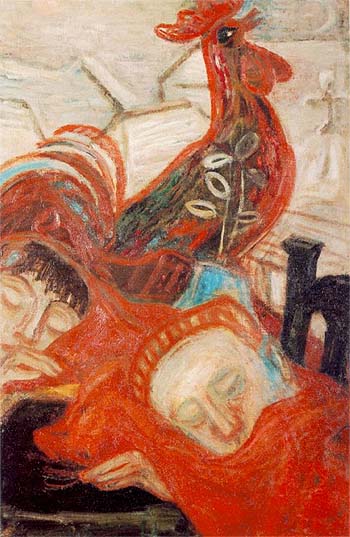
Imre Ámos (1907-1944) from the Hasidic community of Nagykálló: Waiting for the dawn, 1939
An answer to this question can be found in the modality of this song. Jewish music – both Klezmer and liturgical cantorial songs – is based similarly to Gregorian music upon different modes or scales, in Yiddish shteygers. One of these modes, the Ahavoh rabboh, named after the opening words of the morning prayer of the same name which is recited in this mode, is especially popular among Hasidic Jews. A great number of Klezmer pieces of Hasidic origin and tish nigunim – songs sung on Shabbats and high holidays at the Rabbi’s table, often in ecstatic mode – are built upon this scale.
The Ahavoh rabboh corresponds to a modified Phrygian scale – from here its Yiddish name freygish, used in Klezmer music – where the third tone is raised by a half note: mi-fa-si-la-ti-do'-re'-mi'. Just like most Eastern European folk songs, so this scale does not have a definite “owner”: Spanish Flamenco uses it and calls it “Gypsy scale,” while in Arabic and Turkish music it is known as hijaz maqam. And a closer look at our folk song, The rooster is crowing reveals that it is built upon the very same Phrygian scale with the raised third tone. Thus the Jewish community could absorb it without any changes into the framework of their own traditional musical world and identify with it.
Let us hear an example of such a freygish piece from the traditional Eastern European Klezmer repertoire: the Yiddish folk song Az du furst avek – “When you leave” in the interpretation of Joel Rubin (clarinet in C) and Joshua Horowitz (tsimbl). Apart from the freygish scale, the rubato introduction and the slow, protracted, but strict rhythm also confirm the kinship of the two songs:
Rubin & Horowitz: Az Du Furst Avek (3'23"). From the album Bessarabian Symphony. Early Jewish Instrumental Music (1994). (Joel Rubin and Joshua Horowitz in this album attempt to reconstruct the late 19th-century Jewish instrumental music. Similarly to the “historical trend” known from the performances of Baroque music, they also play on period instruments, and try to revive the authentic practice of musical performance, characterized by fluctuating rhythms, rich ornamentation, frequent use of glissandos, and generally a rendering which stood much closer to vocal technics. Their album, however, is much more than a simple excursion of cultural archaeology: it is enjoyable and living music played in a sensitive and emotionally rich manner.)
But let us now return to the text of the song. Apart from the last strophe, it is a typical Hungarian love song. The bird allegory of the lovers is well known from several Hungarian folk songs. The last strophe, however, is a late interpolation added by the Hasidic Jewish community – perhaps by Eizik Taub himself – which radically reinterprets the whole song.
The Hebrew line of this strophe is a verbatim quotation from a late Medieval piyut, a Jewish liturgical poem. The piyut called Tzur mishelo was composed by an unknown poet in Northern France, not later than the second half of the 14th century. This poem quickly spread among the Jewish communities of Europe, and it is still sung on every Shabbat at the festive board, as the introduction of the after-meals blessing Birkat ha-mazon. – It is interesting to note that the today widespread melody of Tzur mishelo is built around the same Ahavoh rabboh mode like The rooster is crowing.
The strophes of Tzur mishelo follow the individual blessings of Birkat ha-mazon which say thanks to God for the meal, for the land given to the Patriarchs, and then they supplicate the coming of the Messiah and the rebuilding of the Temple.
The rooster is crowing took over from these supplications the first verse of the last strophe of the piyut:יבנה המקדש עיר ציון תמלא, in Ashkenazi prononciation: Yibone ha-Mikdosh, Ir Tziyayn temale. That is: “The Temple will be rebuilt and the City of Sion repopulated.” Then will that be!
This strophe elevates this song to the heights of the Song of Songs. As in the traditional Rabbinic interpretation the lovers of the Song of Songs allegorically represent the longing of the Everlasting One and His people for each other, so the singer of The rooster is crowing as a representative of the Jewish people in exile is longing for her lover, the Everlasting One, with whom she can unite only in the Messianic times to come, after the return to the Promised Land and the rebuilding of the Temple of Jerusalem.
This is how the most popular Hungarian Hasidic song was born from the marriage of a Hungarian folk song with a potentially Jewish melody and of a love poem elevated to transcendental heights.
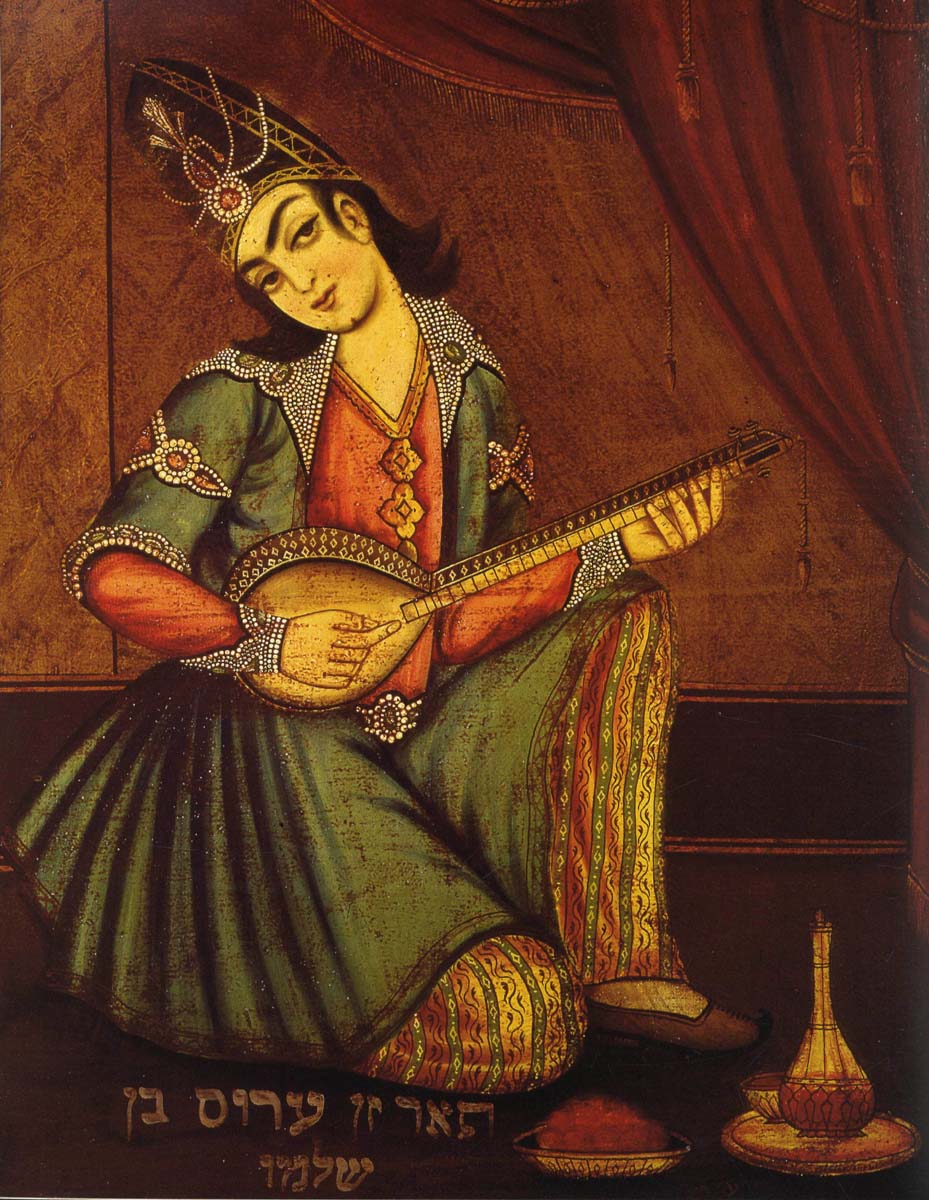
The “bridegroom”-piece of a Persian Jewish double portrait, c. 1846. Its Persian-language inscription written in Hebrew letters is: Târ-zan ʿArus ben Shelomo – “ʿArus ben Shelomo playing on tar.”
But the story is still far from its end. It is just like the piyut Tzur mishelo has a mysterious ability to inspire love poems. A thousand kilometers to the south from Nagykálló, in Sephardic Jewish communities the Tzur mishelo is intertwined with a very popular love song, although here the base of kinship is the melody rather than the text. Sephardic Jews sing to the melody of this piyut the song known both as Los bilbilicos cantan – “The nightingales are singing” – and La rosa enflorece – “The rose is blossoming.”
Savina Yannatou and the Primavera en Salonico: Los bilbilicos cantan – “The nightingales are singing” (4'11"). From the album Άνοιξη στη Σαλονίκη (Spring in Saloniki, 1995). (From this CD of Savina Yannatou, collecting the songs of the former Sephardic community of Thessaloniki, we have already quoted two songs in two posts, here and here. This song, originating in Anatolian Sephardic communities, is our third favorite. The word bilbilico, ‘nightingale’ comes from Turkish bülbül, provided with a Sephardic diminutive suffix, while the expression “the moon is wounded” is a formula borrowed from high literature for the slowly vanishing moon.)
La rosa enflorese
hoy en el mes de may
mi alma s’escurese
firiendose el lunar
Los bilbilicos cantan
con sospiros de aver,
mi alma i mi ventura
estan en tu poder.
Los bilbilicos cantan
en los arvos de la flor,
debacho se asentan
los ke sufren de amor.
Mas presto ven, colomba
mas presto ven con mí,
mas presto ven, keridha,
corre i salvame.
The rose is blossoming
now, in the month of May,
my soul is getting dark
as the moon is wounded.
The nightingales are singing
sighing with desire
my soul and my fate
is in your hands.
The nightingales are singing
on the blossoming trees
under them are sitting
those suffering of love.
Hurry quickly, dove,
hurry quickly to me,
hurry quickly, my dear,
hurry, save me.
The “bride”-piece of a Persian Jewish double portrait, c. 1846. Its Persian language inscription, written in Hebrew letters is: Rahel dar hâl vasmeh keshidan – “Rachel painting her eyebrow.”
And finally let us hear The rooster is crowing as performed by its most authentic interpreter, Rabbi Eizik Taub’s sixth descendant in a direct paternal line, Rebbe Menachem Mendel Taub, the Rabbi of the Kaliver – “of Nagykálló” – Hasidic dynasty. I do not know how fluent the Kaliver Rebbe is in Hungarian, but in any case The rooster is crowing is sung by him with an unmistakable accent of Szabolcs county, the traditional region around Nagykálló. In Jerusalem, on every Shabbat, in Hungarian.
 “Bismillah bird” composed of the letters of the Quranic verse Bismillah al-rahman al-rahim, “In the name of God, the compassionate, the merciful. Calligraphy by Khaleelullah Chemnad.

 A leaflet advertising the name of presidential candidate Mir Hussein Mousavi






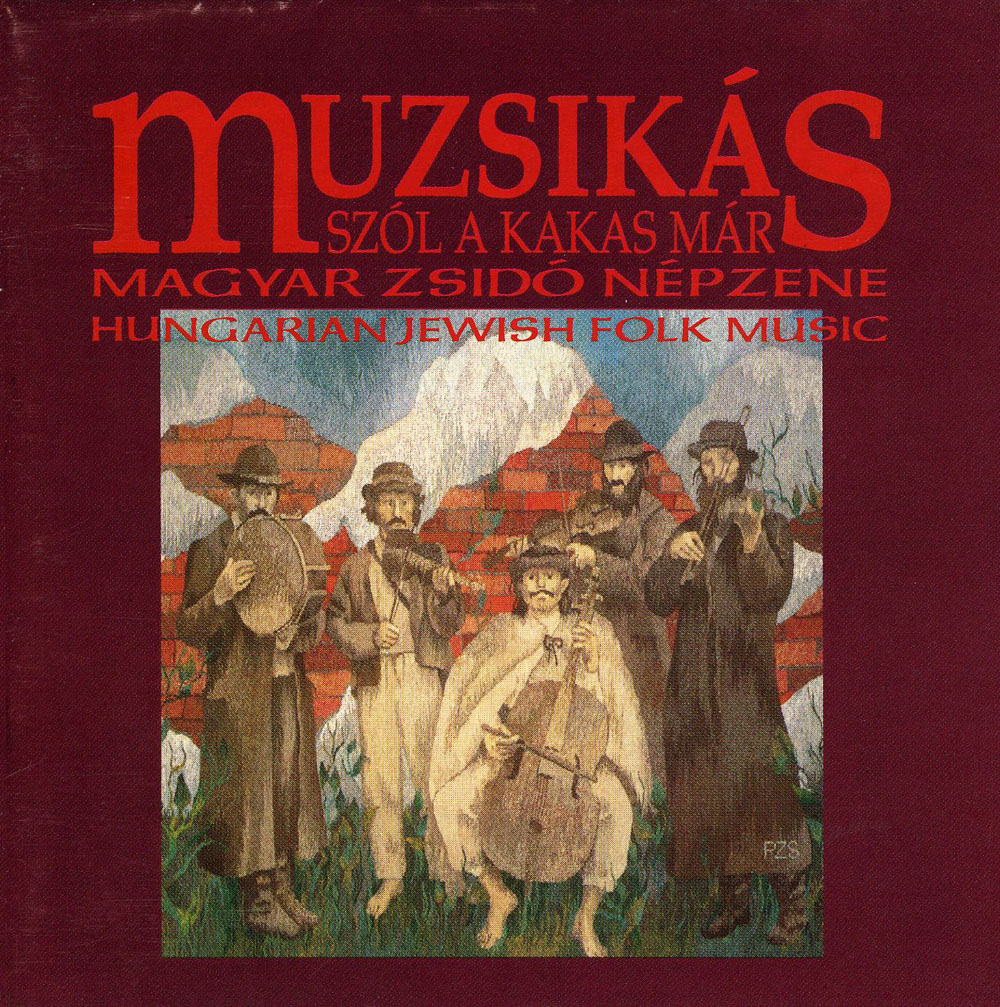


 “Yibone ha-mikdosh ir tziyoyn temale, then will that be” – sings Márta Sebestyén in the title-giving song of the album




 Come with us to…

 Atlantis
 Bestiary
 Bohemia+Prague
 Brave old world
 Caucasus
 Cemeteries
 Crimea
 Get to know the
 Images of the East
 Lightwriting
 Lwów/Lemberg
 Mallorca
 Message on the wall
 The Museum of Propaganda
 Odessa
 Paper Museum


