Switch over to our new blog! • ¡Pásese a nuestro nuevo blog!
The renewed version of our blog, with more features, a richer design, and available in nine languages, can be read here: https://wangriver.com
The new version also includes the old posts, often in expanded form. If you are curious about the updated version of this post, replace “riowang.blogspot.com/” in the URL with “riowang.studiolum.com/”, and the new link will most likely lead you there.
La versión renovada de nuestro blog, con más herramientas, un diseño más rico y disponible en nueve idiomas, se puede leer aquí: https://riowang.com
La nueva versión también incluye las publicaciones antiguas, a menudo en una forma ampliada. Si tiene curiosidad por la versión actualizada de esta entrada, sustituya «riowang.blogspot.com/» en la URL por «riowang.studiolum.com/es/», y el nuevo enlace probablemente le llevará allí.
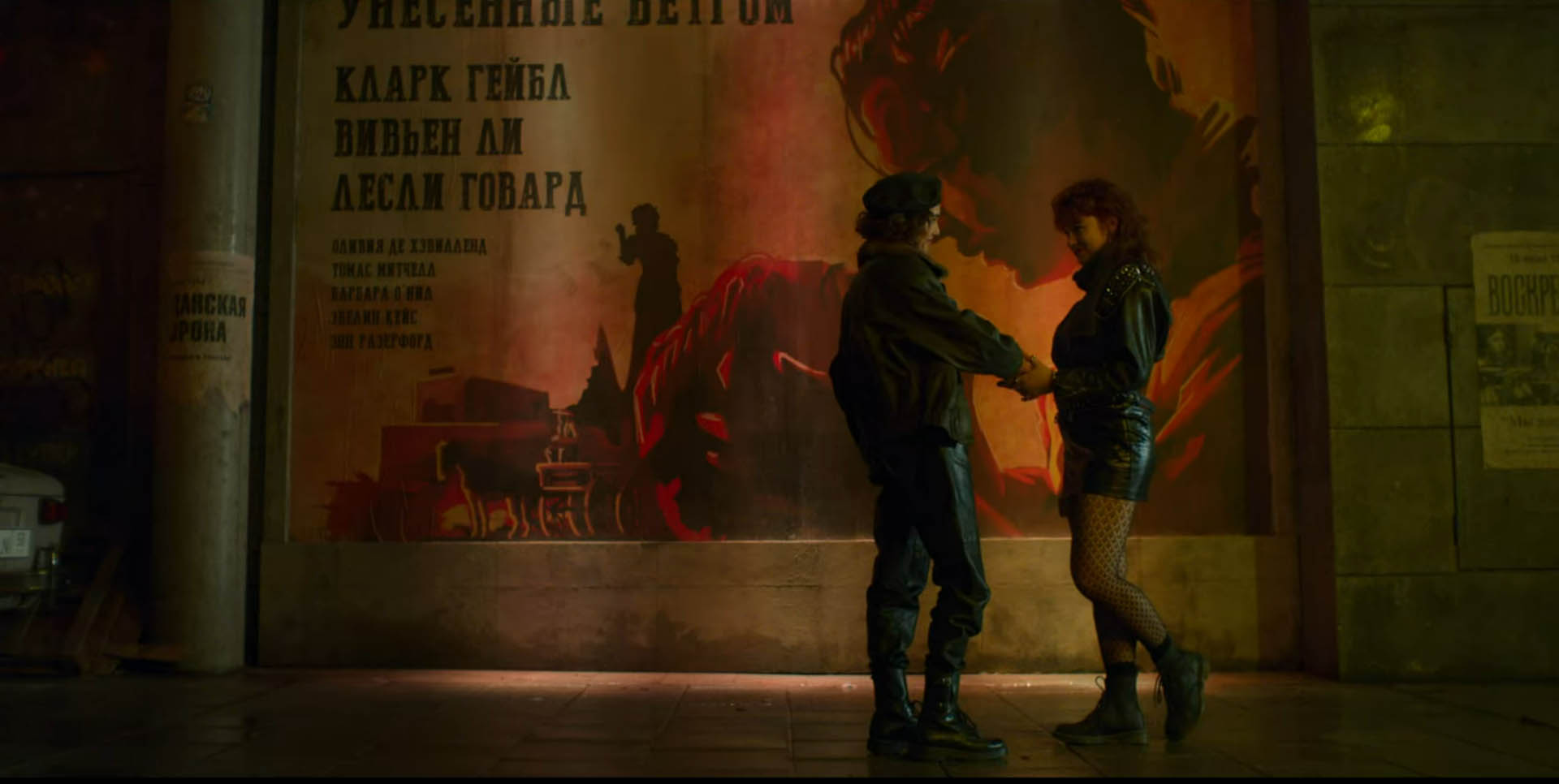
Assa (1987), directed by Sergei Soloviev, was as much a cult film of the Soviet change of regime as Hair was of an earlier change in the West. The theme songs of the movie – just like Aquarius in Hair – all became “anthems” of the change, but mainly the two that I presented some fifteen years ago here on the blog with the title There is a city:Перемен! – “Change!” and Город золотой – “The Golden City”
To the west of the Soviet Union, Assa remained largely unknown, and along with, its theme songs, too. But they are still popular in the Russian language area. This is attested by the fact that the Udmurt women’s choir Buranovskie Babushki won third place in the Russian pre-selection of Eurovision 2010 with the Udmurt version of The Golden City, along with the Udmurt version of Yesterday by Beatles, as I reported at that time. And that this is still the case, I found new evidence in the past few days.
An American spy story is running on Netflix under the title In From the Cold. In this, Russian spies trained in the 90s by KGB successor organizations, but inactive for twenty years, are reactivated – in Madrid. The two spies, who now work for opposite sides – Americans vs. Spanish far-right and ultimately Russians – had had a romantic relationship at the time. In one of the film’s key scenes, before the final showdown, this is recalled at a dinner, with none other than The Golden City as background music.
In fact, this music is not so background. It emerges as an independent actor. The figures reflect on it, telling that it was the song of an era that was beautiful but irretrievably gone.
The Russian references of the film are by the way just as stereotypical as in most other American movies. They present the image that the average American viewer thinks to know and wants to see to confirm their knowledge: the puppet figures of the vampire-like Russian KGB officer, the typically bisexual Russian woman who promotes her career with her body, the unscrupulous Russian mobster, the Russian scientist wanted for death back home because of his wonderful invention. This audience did not see Assa, and does not know what The Golden City means. Who is, then, this song for? Perhaps the movie’s Russian expert – because there had to be one, at least to recall the material world of Moscow in the 1990s – speaks out here with this song of his youth, like a message in a bottle thrown into the emptiness, without any hope of understanding, rather only to himself?
The soldiers returning from the war brought back discs, movies, clothes. The Russians who for decades had lived in isolation, suddenly confronted with the colorful and exciting life in the West, and they loved it. However, with the beginning of the Cold War the “American” way of life became undesirable again, and those who, in spite of formal and unofficial prohibitions listened to “bad” music, danced “bad” dances and dressed “inappropriately”, had to reckon with harsh retaliation.
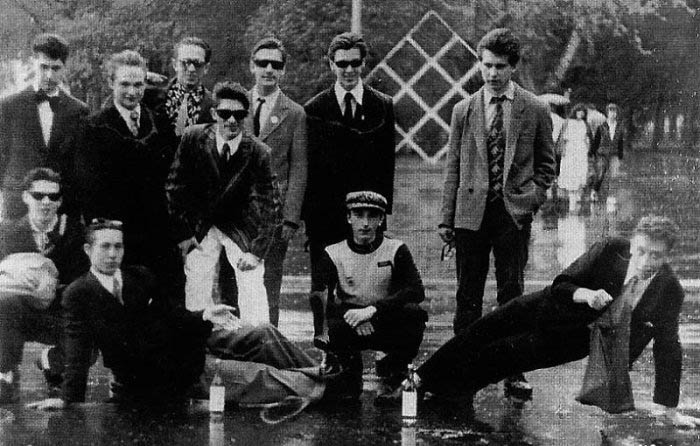
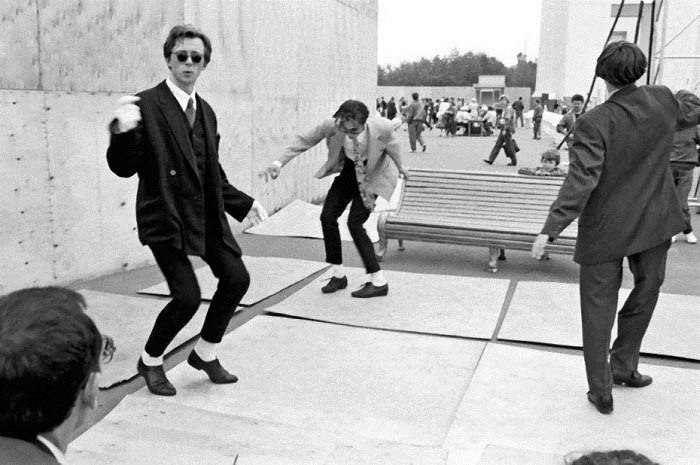
Nevertheless, there were some courageous (?), crazy (?), or simply adventurous young people, who, in spite of all prohibition, wanted to follow the American way of life. Of course, the “American” way of life had a special meaning in Moscow of the 50s. An incredible subculture emerged, and the stilyagi appeared after Moscow also in Leningrad, and, in fact, almost every major city. From the late forties to as late as the sixties, they enjoyed life in small or large companies. At first it does not sound so risky, but it all happened in the worst period of Stalin’s terror, and in the territory of the Soviet Union, which was notorious of its not-so-wide supply of goods.
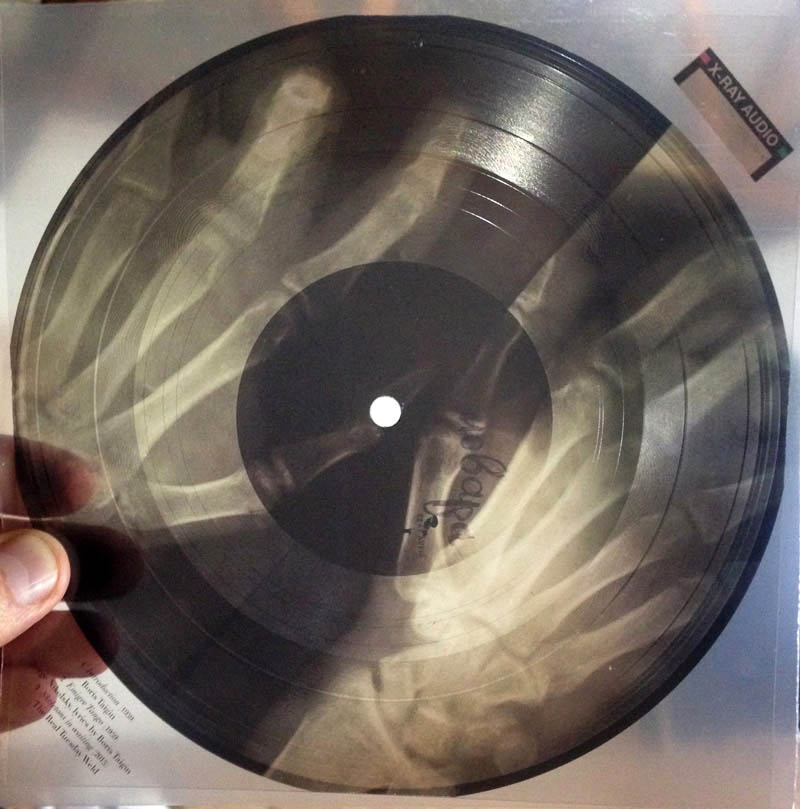
Since they could not go abroad, and had no fresh visual material, they conceived America from what they had from the war stock. They transformed the clothes brought home by the soldiers, and watched again and again the few American films they had access to. The key film – primarily because of its music – was Sun Valley Serenade (1941). This suggested them which clothes to wear, this was, for example, the source of the deer sweatshirts fetishism. The train illustrating the song Chattanooga Choo Choo gained a magic-symbolic significance: this let them fly from the pedestrian Soviet reality to the super-America of the imagination. And, of course, everyone listened to jazz. Since proper records were almost completely unavailable, they resorted to a procedure, which was also known to the young people in Hungary of the fifties (at least I have seen a scene like this in the film Nap utcai fiúk, “Boys of Sun Street”): they copied the music on used X-ray discs. This is why they called such discs jazz on bones(джаз на костях) or the skeleton of Granny. This morbid story was summarized just a couple of months ago by Stephen Coates’ richly illustrated X-Ray Audio: The Strange Story of Soviet Music on the Bone.
The introductory song of the short documentary is no jazz, but the famous Odessan gangster’s song Murka, about which we wrote in an earlier post
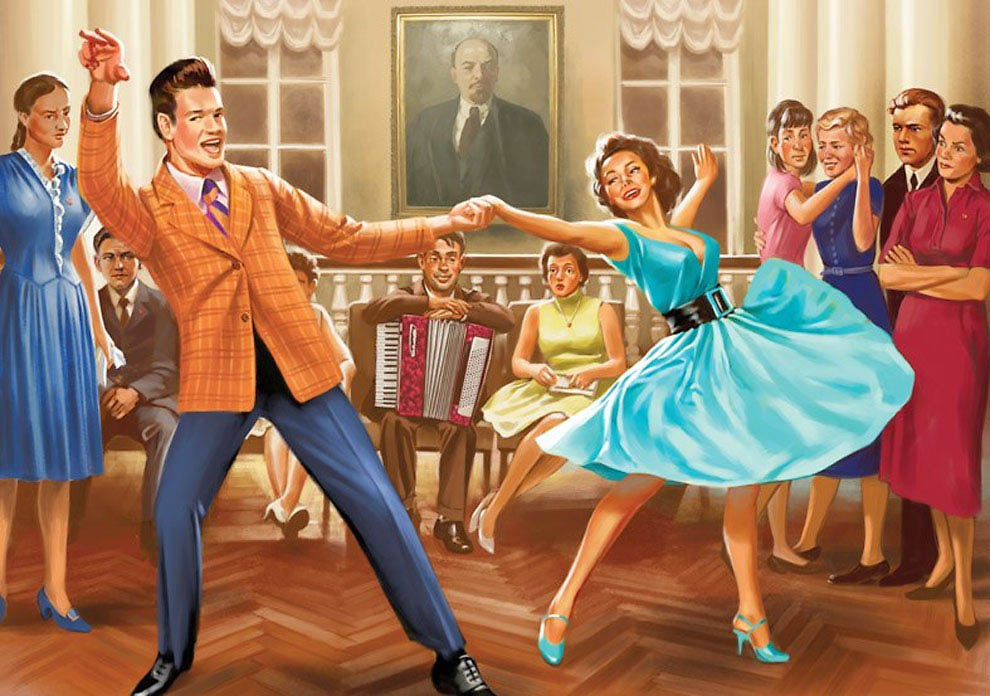
They developed a peculiar slang, whose basic words were mixed English-Russian terms. They called each other chuvak, which is a mosaic word for “one worshiping Amerikan high culture” (Человек Уважающий Высокую Американскую Культуру). At night they walked down the main street they called Broadway, that is, Moscow’s Gorky Street, went up to someone’s apartment, that is, “hata”, and there they danced in their own style. They developed three types of boogie-woogie: “atomic”, “Canadian” and “triple Hamburger” – it’s a pity I don’t know what they were like, only that Hamburger was the slow one.
There is no subculture without dealers catering for it, and so also in Moscow appeared the fartsovshchiks, who could provide for this special demand. They had good contacts, language skills, and an ability to see through police traps. They traded in ties (colorful silyotki), fashionable headgears, clothing, shoes, records, musical instruments. By the end of the sixties, the stilyagi were replaced by the hippies and other subcultures. However, the fartsovshchiki remained, just changed profile. In the Soviet shortage economy it was not difficult to sell products imported from the West, as anyone on scholarship, on job, or on a simple travel in the Soviet Union could experience it.
Interviews with former stilyagi and fartsovshchiki
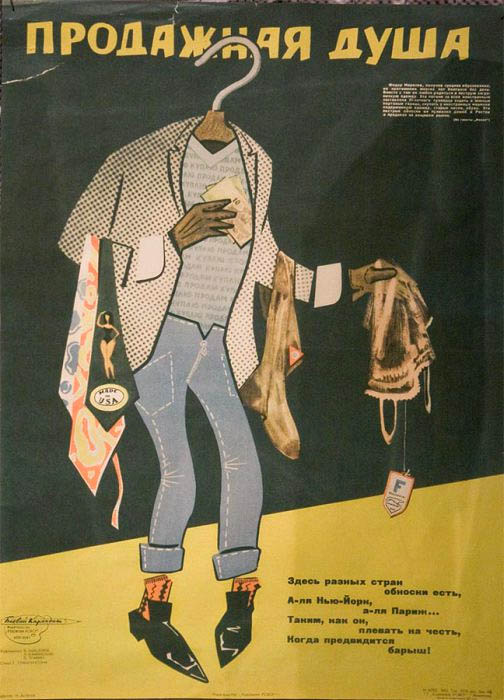
Apart from parties and secret purchases, the stilyagi were mostly preoccupied with the war against the komsomolki specialized in confronting them. Even the term stilyaga was coined by a state-sponsored humorist, a certain Belyaev in the March 1949 issue of the satyric weekly Krokodil, from where it then spread. He, of course, talks in a quite negative sense about this funny figure, who is ridiculous, scruffy, ignorant of the basic rules of social life, and thus it is no wonder that the young Soviet people just laughs at him. As to the stilyagi, they called themselves statniki, belonging to the (United) States. Then, as usual, the term which had started its career as a mocking word, became the accepted name of the subculture, which was understood by everyone. The self-conscious female komsomolka, for example, could cast in the stilyaga’s teeth: Я не лягу под стилягу! (in a free translation: I don’t go to bed with a teddy boy!)
Soviet cartoon: The stilyaga is the agent of the West!
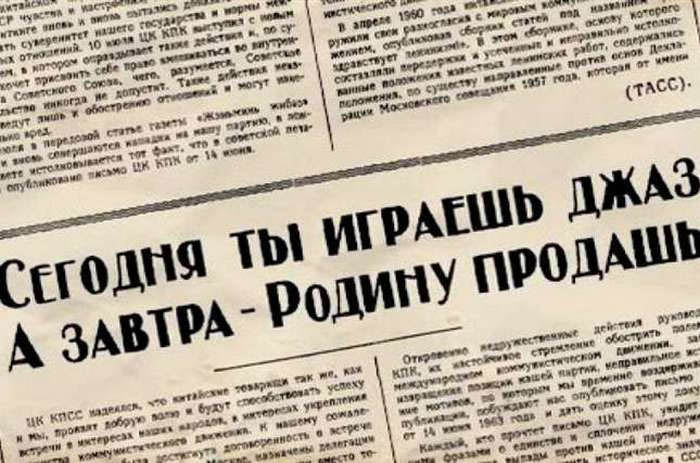
“Today you play jazz, tomorrow you betray the fatherland!”
This whole story could have lost in oblivion, had not been there Aleksey Kozlov, who in his autobiography of 2001 wrote about how he had become a saxophonist, how he founded his legendary jazz-rock band Arsenal, and how it all was linked to the story of the Moscow stilyagi. Then in 2008 partly based on Kozlov’s stories, and partly on his own imagination, Valery Todorovsky directed a film titled Stilyagi (Hipsters in the English release). All the details of the film are based on true events, but, due to a basic fraud, the whole cannot be considered an authentic document: the musical world of the film is taken from the golden era of Russian rock in the 80s. Well, it might be non-authentic, but this makes it really enjoyable, and this started the still longing stilyaga/teddy boy frenzy in Russia.
On 29 November we start the film club of río Wang with the film Stilyagi. In the club, Vadim Kemény presents every month a great Russian film from the production of the past few years, which is virtually unknown in the West. More details and registration on our Facebook site.
During the Verzió Film Festival of Budapest, they will screen on next Friday at 8:15 p.m. in Toldi Cinema the recent (2014) film of the young Iranian director Ayat Najafi, entitled in English No Land’s Song. In the twenty minutes following the screening I will talk to the director about the film, and the audience can also ask him.
And once it happened so, before the film we will have a blog meeting at 6 p.m. in a nearby café, where we will also speak about our recent Iranian journey and about our tours planned for the next year. The place depends on how many of you will come. We also have to know how many places we have to reserve for you in the cinema. Therefore, I ask you that if you plan to come to either place, please write me at wang@studiolum.comuntil the day after tomorrow, Monday 12:00 noon. If you are still uncertain, you’d better write, because it is more useful to count with more space than not to have enough. And write me also if you cannot come, but want to welcome those who could. I will publish here the exact location on Monday evening.
U.I. Fortunately many of you wrote back, so it was not easy to find a good place big enough for all of us. The winner – in style with our Eastern travels – is the Turkish restaurant on the corner of Bajcsy and Báthory Streets, just a few blocks from Toldi Cinema, with lots of tables to be pushed together, and with fantastic and cheap food. Unfortunately they don’t serve alcohol, but if beer is for you an indispensable part of a blog meeting, you can buy it next door, and I don’t think they forbid you to drink it from the pomegranate glass. And in the cinema they encouraged us that each of us reserve his/her ticket on the internet at http://toldimozi.hu/filmek/12-verzio-dalok-senkifoldjerol.
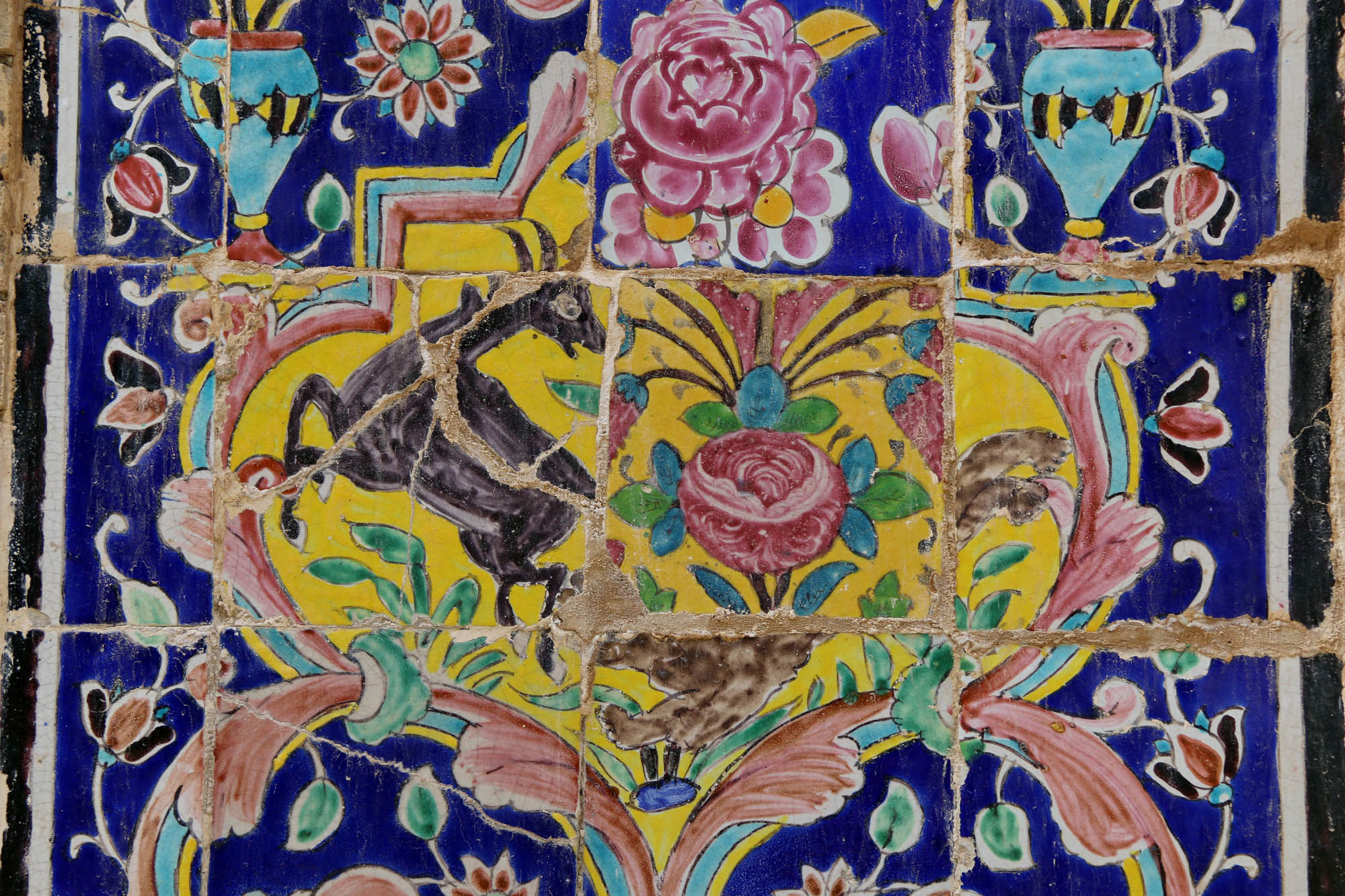
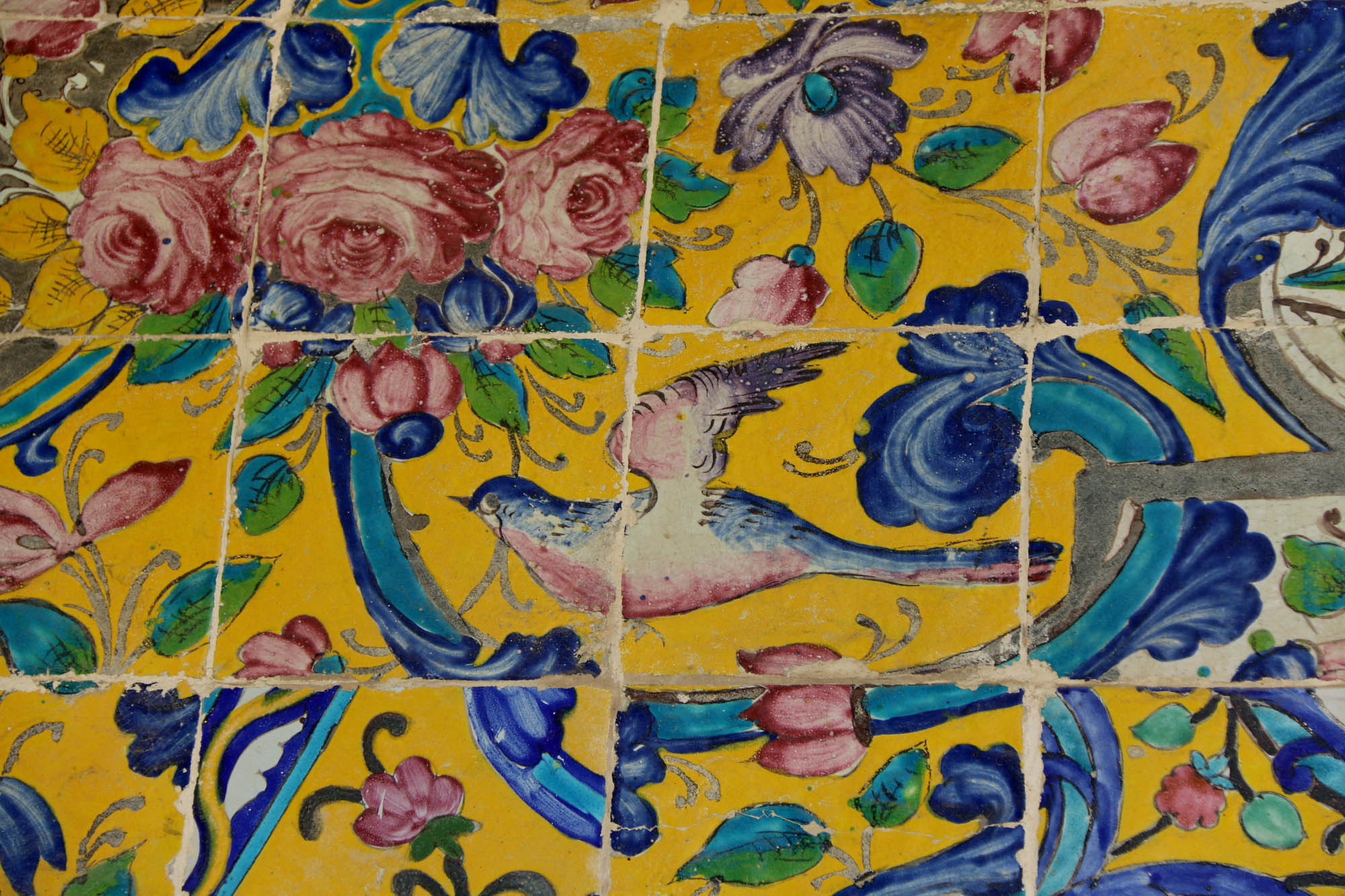
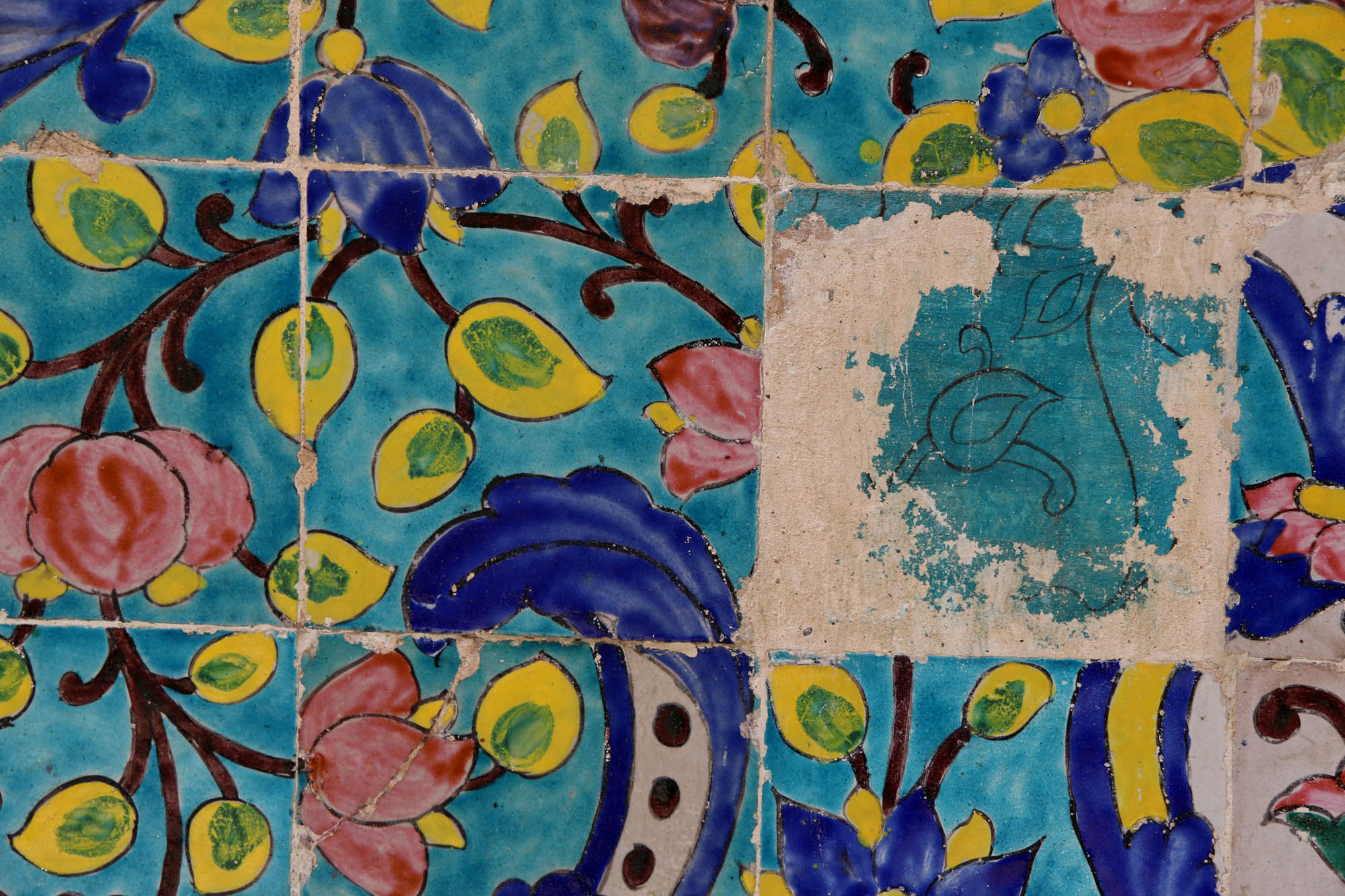
Ayat Najafi’s movie is about how his sister Sara, a composer, tries to stage in Iran the songs of the pre-revolutionary generation, and women’s solo singing, which has been banned since 1979. The original Persian title of the film – Morgh-e sahar, Dawn bird – also refers to one of the most popular pre-revolutionary songs. A couple of years ago I have written in detail about this song, that sounds several times in the film, sometimes in archival recordings, and sometimes sung by the Iranian and French musicians performing in it. You are advised to read it for a better understanding of the context. Below we hear it in the performance of Parisa, one of the most famous pre-revolutionary woman soloists. The visual backdrop is offered by the Qajar-era tiles of the Golestan Palace, deliberately neglected since the revolution.
Kamal-ol-Molk (with a stick) among his students at the Academy of Fine Arts in Tehran
Kamal-ol-Molk, the most renowned Persian painter of the late 19th century – in whose house we will stay in Kashan – captivated his audience mainly with his genre pictures. The style introduced by him was, so to speak, the counterpart of European Orientalism. While the latter crammed the large and luxurious spaces of romantic and academic painting with the exciting motifs of the mysterious Orient, Kamal-ol-Molk made the customary small and intimate pictures for Persian homes, which had clear colors, only a few figures, and no image depth, more attractive for a Persian audience increasingly receptive to European culture. He used art techniques acquired in Italy, the realistically shaped bodies, representations of the states of mind reflected on the faces, and European perspective. It is no coincidence that reproductions of his paintings, preserved in the formal imperial collections – The fortune-teller, The Jewish hucksters, Goldsmiths in Baghdad, Musicians, Noruz festival and the rest – are still common decorations in homes and public spaces alike.
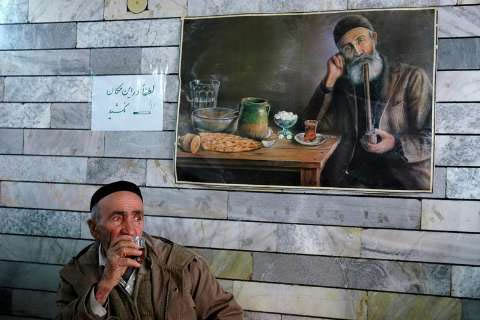
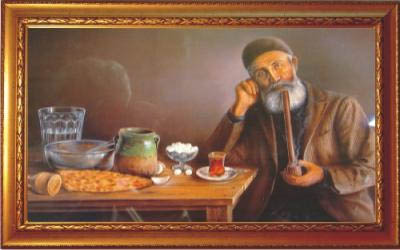
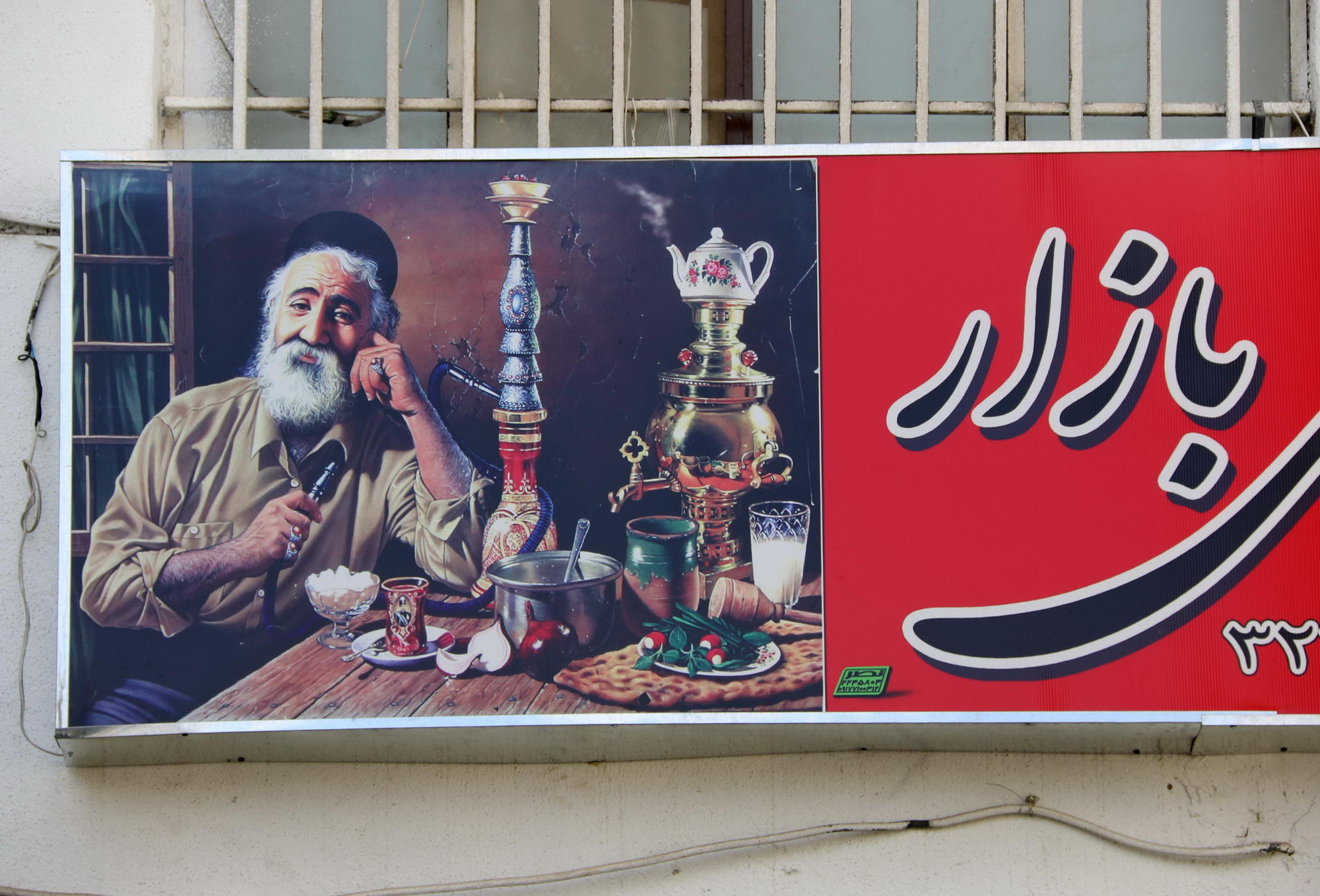
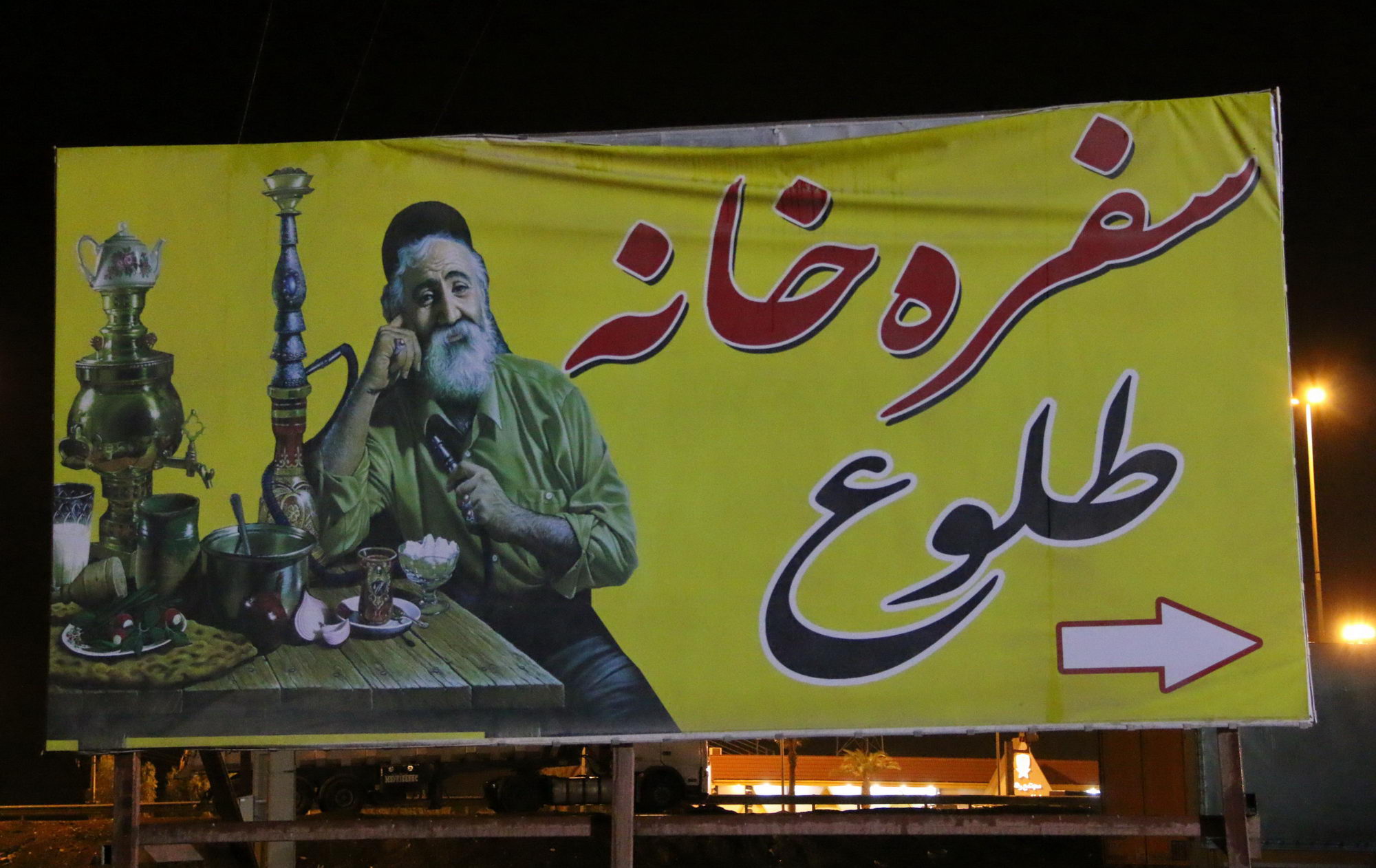
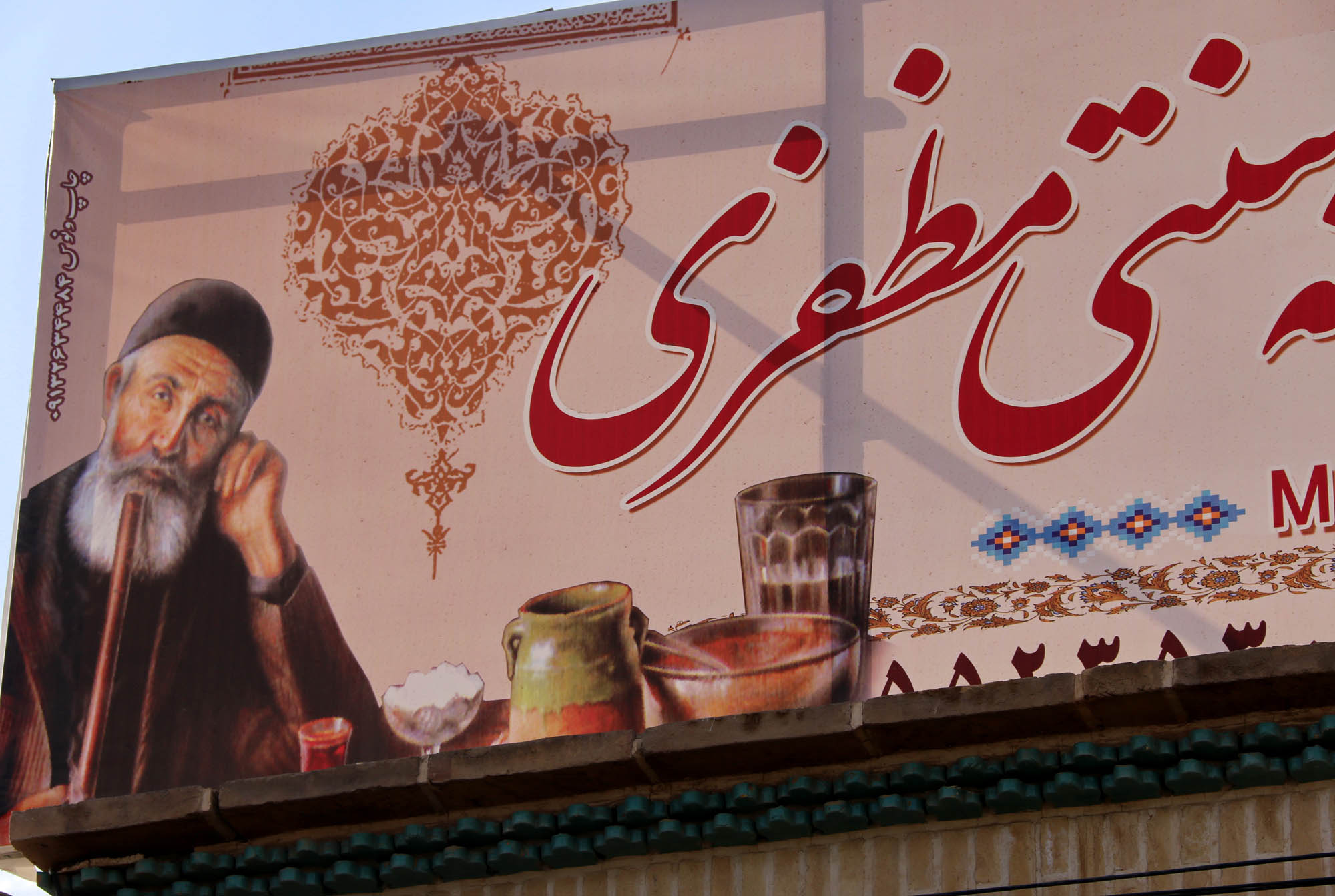
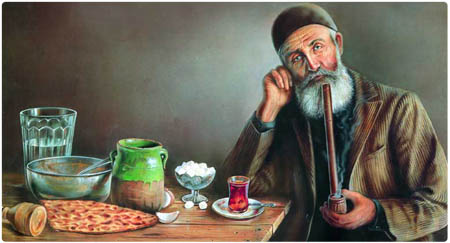
But one picture surpasses all the rest in popularity. In this, a bearded old man is sitting and smoking his pipe at a modestly laid table. We encounter this painting again and again in every city, on the walls of private rooms, workshops and cafés, and even on the shop signs of tea houses and restaurants. And what is even more surprising, the picture has been completely folklorized. They freely change and complement it in the individual reproductions to their preference, showing a hookah in the coffee houses, and with a lavishly laid table in the restaurants, depending on what is needed in the actual place.
The historic little town of Masuleh along the Caspian Sea
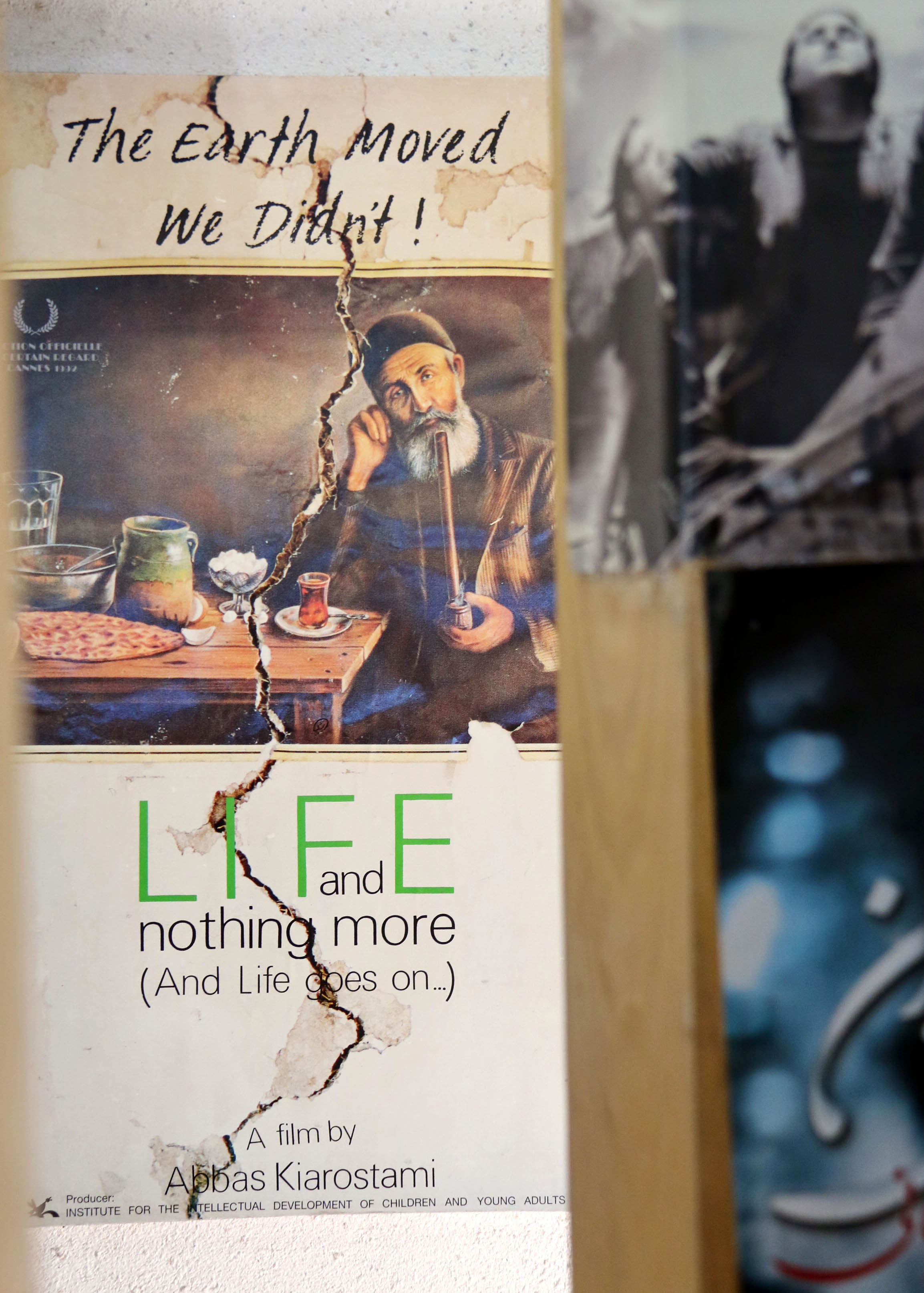
The popularity of the picture was undoubtedly bolstered by the fact that it plays an important symbolic role in one of the most important Iranian films of the last two decades, Life and nothing more (or, as it is known in Europe, And life goes on, 1992) by Abbas Kiarostami. This film is a continuation of the first really successful film by the then fifty-year-old Kiarostami, Where is the friend’s house? (1987), which we also mentioned. In the second film, the actor playing Kiarostami and his son travel from Tehran in a battered car up to the mountains of Gilan, just a few days after the earthquake that caused fifty thousand casualties, to learn whether the two young protagonists of the previous film in the village of Koker survived the catastrophe. Along with the presentation of destruction and mourning, the film, as its title suggests, primarily lets you feel the great strength and determination the survivors as they work to make the houses inhabitable again and the villages liveable, to make new families as soon as possible, so life can again go on. The film had a veritable therapeutic effect in Iran, and this treatment of the tragedy gave enormous encouragement and strength to the entire society. It is no coincidence that Kiarostami soon made a third successful film, Through the olive trees (1994), based on the meticulous analysis of one key scene in And life goes on. These three films, often called by critics “The Koker trilogy” because of the common location, is considered to be the most outstanding of Kiarostami’s works, is still well known in Iran, and its impact is palpable on the whole of Iranian cinema.
One of the climaxes of And life goes on is almost exactly in the middle of the film, when the main character stops in a ruined village, and slowly studies the remains of the houses, which are beautiful even in ruins, with the green Gilani mountains in the background. On a porch which has remained intact, he looks long at this reproduction of Kamal-ol-Molk, which was cut almost in the middle by a huge crack running from the top to the bottom of the wall, but despite this, the old man keeps on smoking just as peacefully, as if nothing had happened. The beauty and power of this scene offers a key to the whole film. It is no coincidence that this picture was put on the poster of the film, which after twenty years still can be seen in many clubs or bookstores. I photographed it in a CD shop on Vali-Asr Avenue.
It is therefore surprising, that while the image plays such an important role in the visual culture of modern Iran, and whomever you ask will consider it the best painting by Kamal-ol-Molk, nevertheless you won’t find it in any album or on any website dedicated to the master. You have to search long on the Persian web, before you find a little story, which is variously formulated on different sites:
“Around 1940, two photographers went to the town of Maragh next to Kashan to take photos of the atmosphere of the landscape, the people, and the mausoleum of Baba Afzal. They had lunch in the tea house of the village, where an old man, who had just finished his modest lunch, lit his pipe. They took a photo of him as well, and returned to Tehran. Only after the development of the photo they discovered how beautiful it was, and they put it on the studio wall.
Not long after the owner of the Laleh café went to the studio to have himself photographed. He saw on the wall the picture of the old man with the pipe, the tea and the rest of the lunch on the table. He liked it, purchased it, and hung it on the wall of his café. The photo hung on the wall for years, until one day a painter came to the café to drink a cup of coffee and smoke a cigarette. He liked the photo, and immortalized it in painting. It took only a few years, and the painting was copied all over the country, on pictures, posters and shop signs, on the walls of tea houses, cafés and restaurants, in every city and along the roads…”
The story has been just as noticeably folklorized as the image. The Laleh – Tulip – café, the famous coffee house of pre-revolutionary Tehran has long since closed, so we will never know how the original photograph looked, which was so attractive to the painter that he converted it into a painting in the manner of Kamal-ol-Molk, and he even added to it the signature of the master. Or will we?
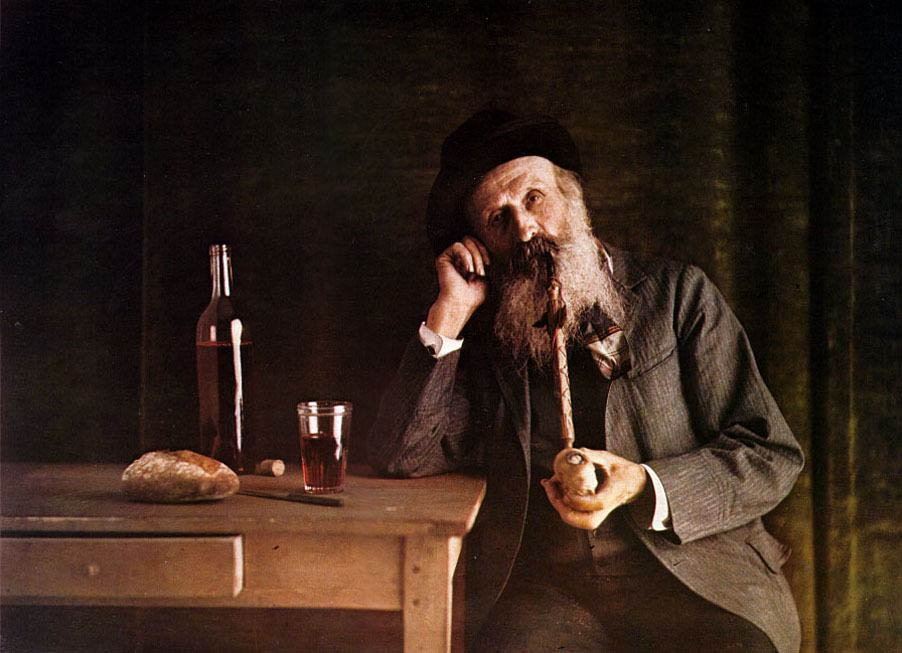
This photo was taken in 1907 by the Lumière brothers with the autochrome process patented by them in the same year. It is obvious that this pipe-smoking and wine-drinking Parisian old man had to be the model of the “Persianized” painting.
That is, the best painting of Kamal-al-Molk, the national painter, is not his own work, and not even an individual work, but a collective creation. It does not even have an authentic original, and this is why it could be folklorized and adapted in so many versions. Its birth was due to the reception of a European model and its adjustment to Persian patterns, and its popularity to the fact that it appears as an anonymous work and a collective symbol in a key scene of one of the most important movies about the issues of Iranian fate. All this together makes it truly Iranian, a work of such style and significance, that if Kamal-ol-Molk had seen it, he would surely authenticate it with his own signature.
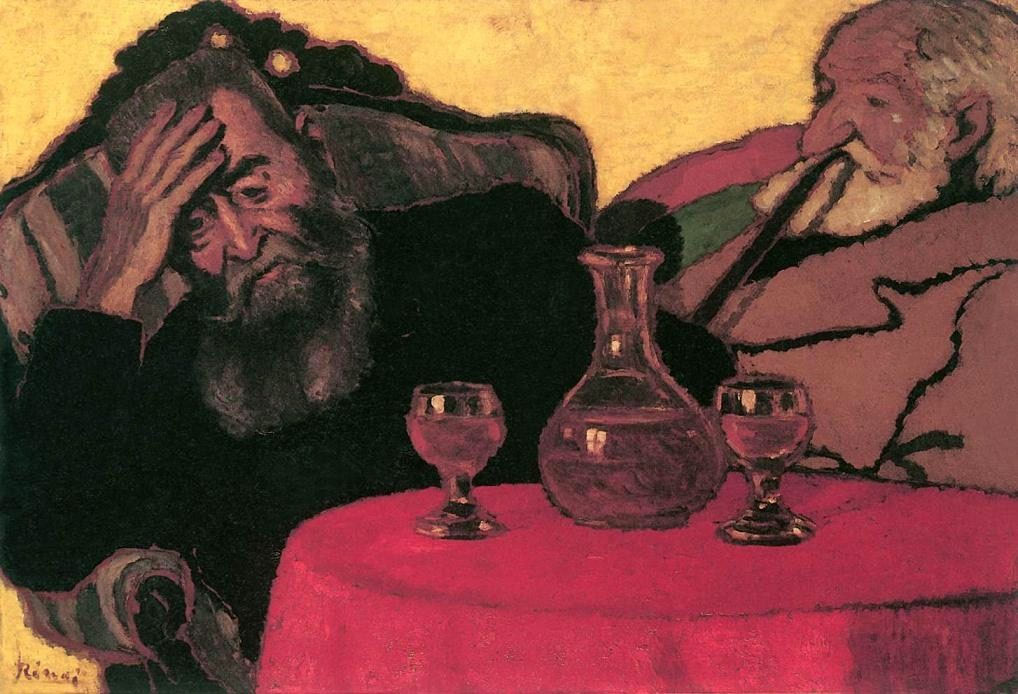
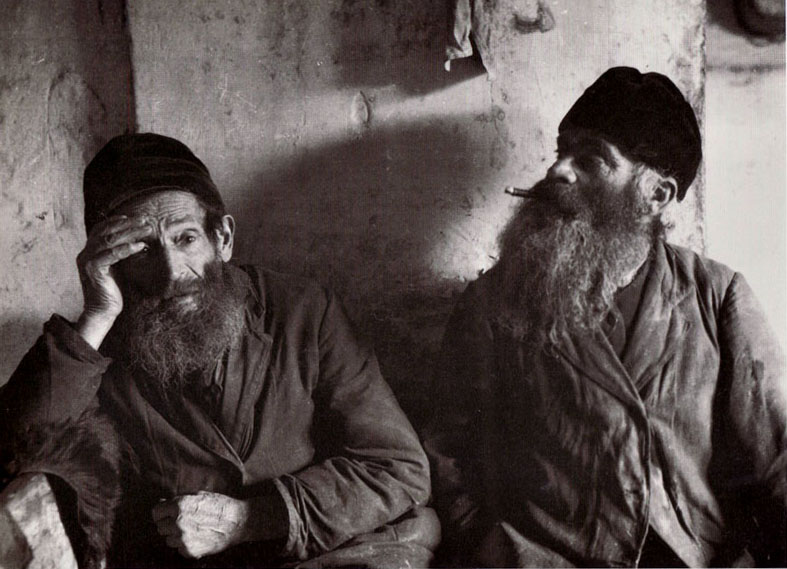
The story could end here, the mystery solved. But, fortunately, every mystery solved creates a new one begging for resolution. The configuration of the pipe, the wine and the old man with a large white beard incites our visual memory. What does it remind us of? We got it. That early visual parallel where the two old gentlemen in József Rippl-Rónai’s My father and Uncle Piacsek drinking red wine (1907) are sitting in exactly the same pose as the two old Galician Jews in Alter Kacyzne’s photo twenty years later. The photo of the Lumière brothers, although it was made in the same year as Rippl-Rónai’s painting, is clearly not a model of any of the two. Nevertheless, its figure seems to perform the role of both old men at once: his pose is similar to the one at the left, his pipe to that on the right side. And if you really want, you can also bring into this Hungarian-Jewish-French-Persian conjunction a later (1936) sketch by Kamal-ol-Molk himself, where a big-bearded old man is reading in the pose of the left side figure. Are these mere visual coincidences? Or an unconscious pictorial topos, an iconologic formula of the period? And the mystery goes on.
József Rippl-Rónai: My father and Uncle Piacsek drinking red wine, 1907
“Byale (Biała Podlaska, Lublin province), 1926. Father and son. To protect himself from the
Evil One, Leyzer Bawół, the blacksmith, will not say how old he is, but he must be
over one hundred. Now his son does the smithing and the old man has become
a doctor. He sets broken arms and legs.” Photo by Alter Kacyzne
The metro is a network system of linear spaces where masses of people come together, pass through, and part, while in motion through an underground system of escalators, tunnels, platforms and corridors, with the objective of each person getting from a point A and arriving to a point B.
As an underground system, the metro is necessarily a space apart from the happier face of the city in sunlight, being confined beneath it to dark, meandering passages, and comprising a Hades, an underworld, with rats and dirt and clotted grease. The metro, despite its historical novelty, feels ancient. A clinging smell hangs in the air, a mixture of electricity, sweat, sausage, and machine oil. It is a kind of wormhole that sucks up human particles on the surface, and then spits them out elsewhere. Its riders submerge, as if in a submarine, and each stop, each rise to the surface, is a new little world, a planet unto itself, a unique urban context. The metro strings them together like a necklace of pearls on a black thread.
Subjectively, the metro is a particular set of sensations involving rhythm and kinesis, muscular control modulated by visual and auditory stimuli, and individuals moving through its linear spaces behave in the manner of a particle stream. A person moves either with or against the flow, an invisible, but particularly salient force. One feels it rather strongly in the legs and in the torso, a momentum of the physical weight of the body, and its intentionality, dynamically altered in close coordination with all the other passing human particles, each also with their own moment and intent. It is self-arranging, and thus somewhat chaotic, and hence, unpredictable. People rush, generally plowing forward, and observing cues that land them in the right spot. Someone might stop short, an outwardly random event, and it is instantly perceived by fellow particles, if they are alert, and they adjust accordingly. But in the main, flow predominates and the sharp edges of all other forces are smoothed away in submission to its bidding.
I was met with a stark example of this flow once in Saigon, where I was confronted with the normally straightforward problem of crossing a major street. A gapless, stopless, torrent of traffic raged, like water in a bursting river, like corpuscles in a bloodstream. Crossing flows of traffic were delicately interleaving at the intersection, rather that stopping and taking turns. How to get across? Anyone reckless enough to dare to venture into this cosmic inevitability would surely be trampled beneath a hundred bicycles, a dozen motorcycles, a car, or a city bus. Sensing my perplexity, an old man came and stood at the edge of the street next to me. With a look that said, “Watch how I do it!” he started across. Encouraged by his intrepid example, I followed. Enlightenment came. I immediately understood that to keep moving at a regular speed was safe, but one must never, ever stop. Stopping in flow introduces a random event; it creates unpredictability and chaos. Just keep moving. The flow is all.
In Kiev, once, the opposite happened. Trying to enter the metro at the train station, I saw a crowd of hundreds of people funneling in through a single open door of the metro station. An entire wall of maybe ten doorways was available, of these, nine were locked tight. Overhearing a conversation, I came to understand the meaning of this conundrum. Overcrowding on the metro platform was so common in Kiev, that it was dangerous to let too many people onto the platform at once, lest someone be accidentally pushed onto the tracks. This was the simple solution, use brute force to reduce the flow so the overcrowded trains could carry riders away at a rate that brought an equilibrium of safety.
When in the flow, little conscious thought is needed to obey it. Instinctively one seeks to hold momentum and personal space, observing signs, pausing only at points where one is in need of finding bearings. We pass like phantoms beneath harsh lights of mercury vapor, and our faces, bled of color, only dimly recognize one another as fellow humans. Tight within our sensate imaginary cocoons, the psychic shells that float through space along with us, we are sometimes, in this place, as alone as we can ever be. Our tribal brethren are reduced to merely the cold stream of their firmer embodiments, a charged plasma alongside which we slide, and usually, ignore. Perhaps we do so too easily.
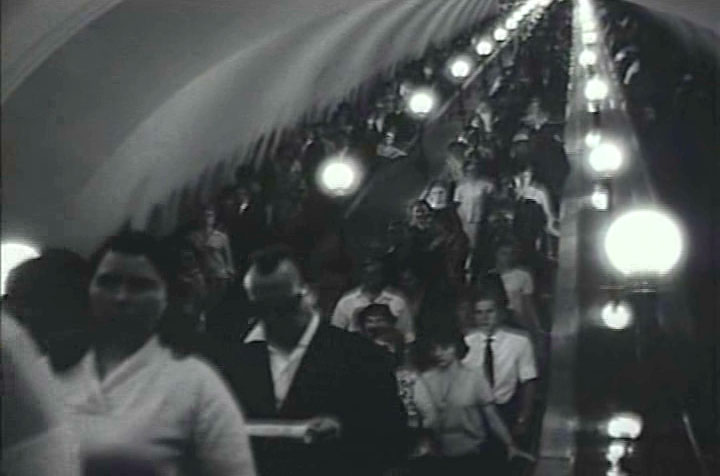
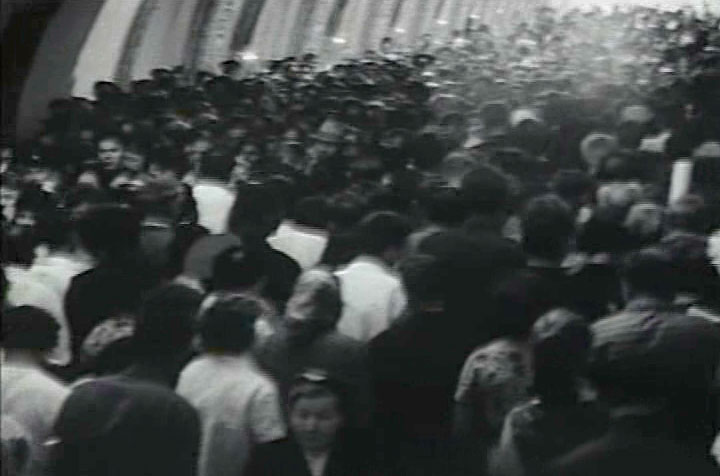
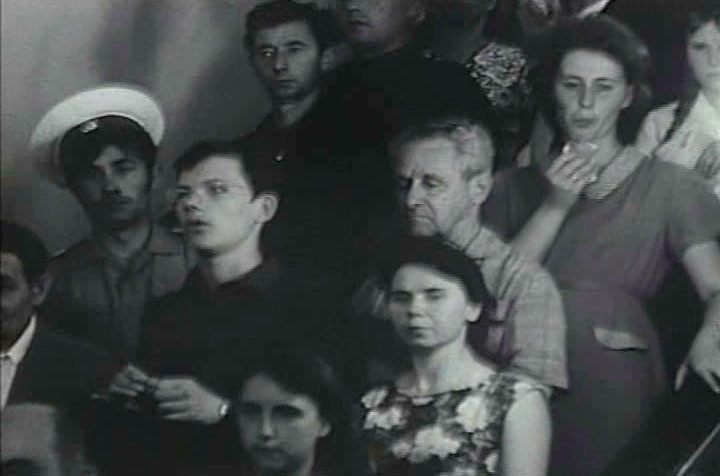
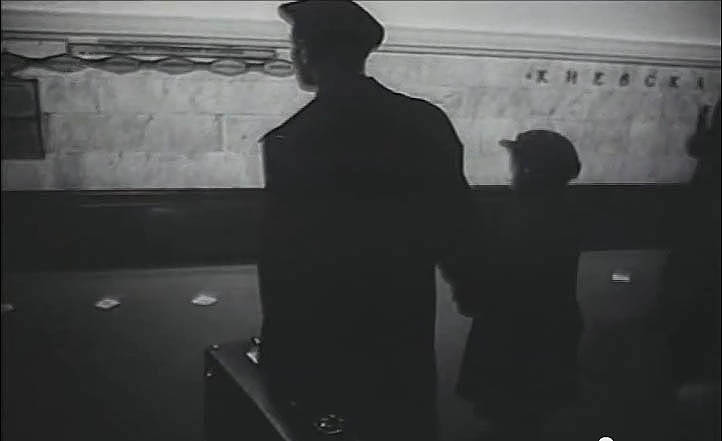
The short film Metrum was made by Ivan Balaďa in 1967 under the Czechoslovak Army’s film unit. In it, Balaďa’s camera wanders the Moscow metro system, purposely moving against the crowd so we can study the faces and postures of thousands of passing people, finding on them a thousand worries, quotidian and existential. In counterpoint to the incidental sounds of the metro and shoe heels tapping on hard pavement, we hear choral singing from the Orthodox mass. Conceived by its producers as a propaganda film to extoll the metro, when Balaďa’s piece was finally screened, it was shelved by censors.
An endless rain of passengers descends and ascends the escalators, like the ladder of Jacob, in what, a grotesque parody of the cycles of nature? Because the camera is always in motion, a sea of heads becomes a sea of souls, yearning, striving, struggling souls; here is our parody, the metro is the path of the soul through life. Some figures are silhouetted, dark, secretive; other faces find the light and we can read something of their character. They are anonymous in their numbers, each one is everyone, a symbolic being. Early, the camera finds and briefly follows a pregnant woman the passage; later in the film another woman cradles a sleeping child as she waits for her train, a pietà. A lone passenger scrutinizes a schematic map, trying to find the one true answer. An abrupt cut, and a train roars into the station, shimmering with light and the squeak of brakes, the same kind of wagons that, not so long ago, ran on Prague’s metro lines. People get off and on, and the flow continues.
The final shot leaves little doubt. We emerge from a tunnel, and the overexposed frame blinds us with white light, recalling the stories survivors tell of their near-death experiences.
In the early 60s, Soviet singer-songwriter Bulat Okudzhava (Булат Окуджава) wrote and performed Song of the Moscow Metro (Песенка О Московском Метро). Its themes, instinctively or purposely, are strongly echoed in Balaďa’s film.
Bulat Okudzhava: Песенка О Московском Метро
Мне в моем метро никогда не тесно,
потому что с детства оно, как песня,
где вместо припева, вместо припева:
– Стойте справа! Проходите слева!
Порядок вечен, порядок свят.
Те, что справа, стоят, стоят.
Но те, что идут, всегда должны
держаться левой стороны.
In my metro, it is never crowded,
because since childhood, like a song,
sings its choir. The choir sings:
“Stand to the right! Walk on the left!”
The order is eternal, the order is holy,
Those on the right, they stand, they stand.
But to those who are walking, you must
always walk on the left-hand side.
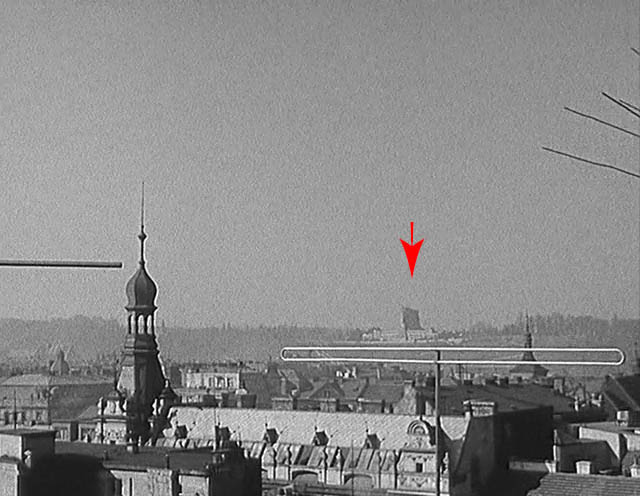
The final scene in the Czechoslovak film Holubice (“The White Dove”, František Vláčil, 1960) may contain a little surprise for audiences nowadays, if they know Prague, and if they look closely. The scene consists of a single shot, from a camera placed at a high vantage point somewhere on ul. Revoluční, during which the camera pans nearly the entire daytime skyline of Prague at the time of the film’s production, ca. 1959-60.
As we look up Revoluční to the south, we soon see the arched windows and crenellations of what is today the Palladium shopping center (then Josefská Kasárna, barracks for the Czechoslovak Army). Further around, other familiar buildings pass by, as Prague’s many famous turrets and spires can be seen through the haze. The twin gothic spires of the 13th-century Church of Our Lady before Týn float past, and far in the distance on a light gray hilltop is the Petřínská rozhledna of 1891 (a lookout tower inspired by the Eiffel Tower in Paris), which marks the hill of Petřín. After the second rooftop television antenna, we see what is probably Prague’s most identifiable landmark, the Prague Castle, Hradčany. Then, we come to a mystery.
What in the devil’s name is that?
Those familiar with today’s skyline will no doubt remember that atop the hill at Letná (the red arrow in the photograph), which overlooks the city from one end of the bridge named for Svatopluk Čech, stands a monumental kinetic sculpture resembling a metronome. In 1959, however, something very different stood there. We can see, in the picture above, the rather dim outline of a fat slab of rock, but from this indistinct image taken from afar, we cannot decisively make out what it was.
For reference, this is what stands there now.
The kinetic sculpture entitled Stroj času (“Time Machine”), by the sculptor Vratislav Karel Novák, is popularly known as the “Prague Metronome,” although the mechanism is completely different from the familiar metronome invented by Mälzel. It was erected in 1991 to mark 100 years of industrial exhibitions in Prague, and reflects that theme in its use of industrial forms and materials. It was intended to be temporary, but, as we will see, the temporary can unintentionally become permanent, while things intended for permanence may endure only for a shockingly brief time.
And, as we will further see, this post will end with a bang.
A Monument for the Ages
In 1948, soon after the Communists took power in Czechoslovakia, a decision was made to honor Stalin for his 70th birthday with a large monument for a prominent location in Prague. But the internal politics of various planning committees and other forms of political oversight virtually guaranteed that the project would take longer than expected. Much, much longer. It was over a year before a competition for the design was officially announced in 1949.
The artists of Czechoslovakia were invited to volunteer their visions for the monument, one of which would be selected for construction on the hill at Letná, a high vantage point that overlooks the city center. It was widely understood that, if you were a sculptor of any prominence, your voluntary submission was, in fact, mandatory.
The story is told that the artist Otakar Švec, a recognized sculptor who had created a noteworthy body of work during the interwar period, sat down over a dinner of goulash with a painter friend, and asked him to sketch a design. Švec liked the sketch, made some adjustments, worked it into a proposal, and submitted it, probably believing the matter closed.
Švec did not anticipate winning the competition. He had simply assumed the outcome would be politically fixed, and was quite surprised when he found out that his design had been selected from among the 90 works submitted. The casual manner by which it was designed (apparently his friend had sketched it on a napkin) suggests that he did not really care to put a great deal of thought into the project.
Švec was suddenly trapped. The competition bureaucrats subjected him to an unending series of official visits to his studio with nitpicks and small adjustments with which Švec really had no choice but to comply. As the delays accumulated, it became clear that a simply large monument wasn’t enough; it would have to be gigantic. In fact, what started as a napkin sketch morphed into the largest monument to Stalin anywhere in the world, and the largest group statue in Europe.
It would represent Stalin at the front of two lines of figures, the ones on the left representing the Soviet Union, and on the right, Czechoslovakia. It was to be more than 15 meters high and 22 meters long. Alone, Stalin’s head would weigh 52 tons; the entire work, 17,000 tons. A team of over 600 people, artists, builders, stonemasons, were employed working on the monument. With an understructure of reinforced concrete and an outer cladding of high-quality Czech granite, it would be monument built for the ages.
Сталинский закон. Пётр Киричек, дуэт с С. Хромченко
The following eight photographs of the Stalin monument were taken from the Fortepan online community (fortepan.hu), a continuously growing Hungarian archive of private photographs shared voluntarily by their owners. They are published here for the first time outside of the Fortepan site.
The unfortunate Švec probably knew that he had given birth to a monster, and entertained doubts that it could ever be constructed. He believed, perhaps hoped, that not enough high-quality granite could ever be found, but eventually, matching granites were found in two places. At the time, no crane existed in Czechoslovakia that could manipulate such massive pieces of stone, and so German „Panzer“ tanks, spoils from the war, were used to move the stone blocks. Pressure from the Kremlin seems to have been strong. To accommodate the transport, roads into Prague had to be widened, and bridges strengthened, all at great expense.
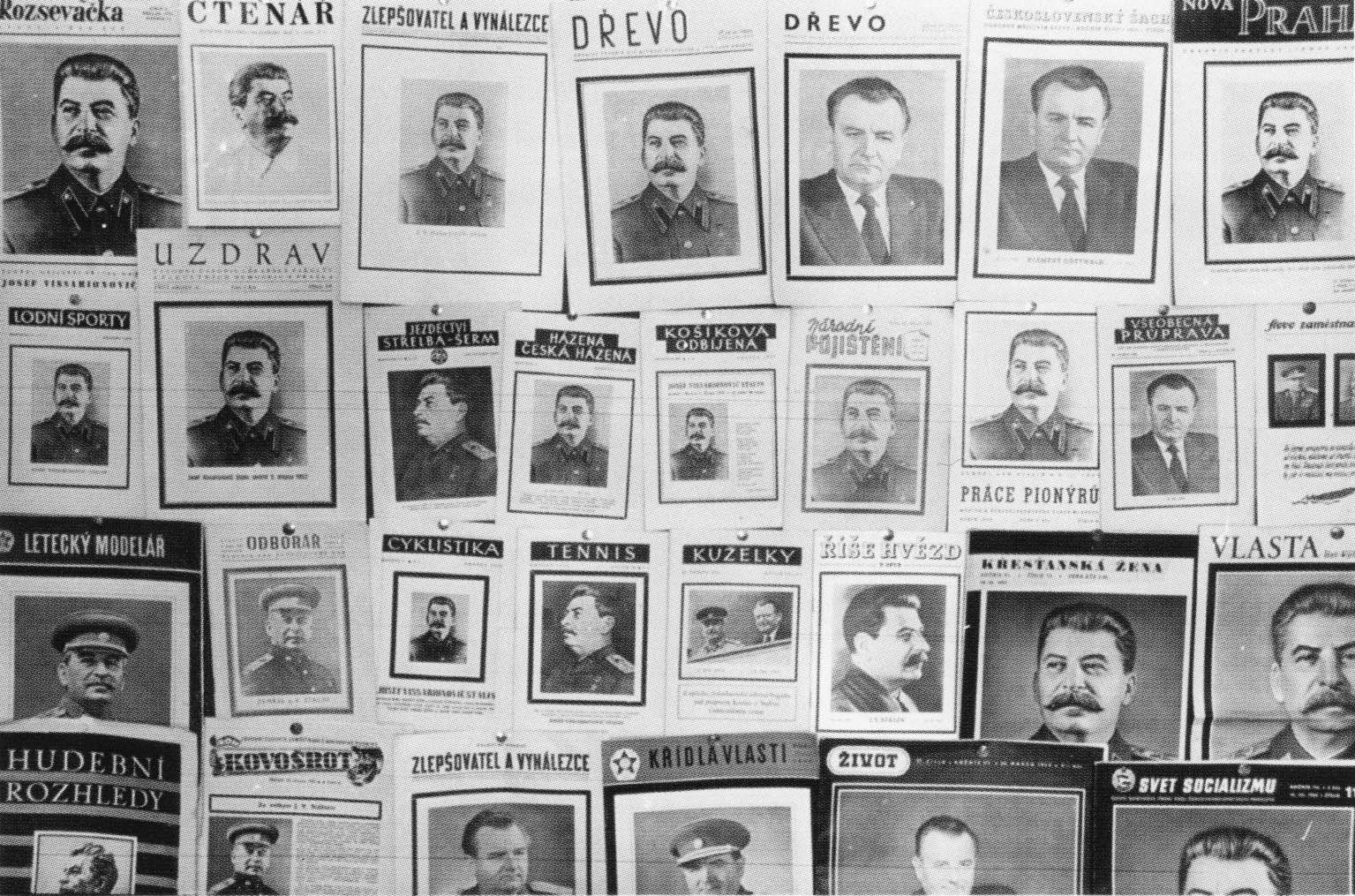
The construction phase began in earnest on 25 February 1952, an official holiday called „Soviet Army Day“, when the first blocks of granite were laid. Stalin was dead within a year, but the work, of course, continued. It was too late to back out now. Švec apparently became increasing mortified at his involvement in the project. Once the small napkin sketch was enlarged to such epic proprortions, its deficiencies became glaringly obvious. Švec solved some of the design problems by simply putting flags in the figures’ hands to obscure empty surfaces not accounted for in the original sketch. One account states that he was humiliated one day when a taxi driver pointed out that the third figure on the Czech side of the sculpture, depicting a woman, seemed to be reaching for the crotch of the man following closely behind her.
Jan Lukas: March 1953 (Stalin and Klement Gottwald)
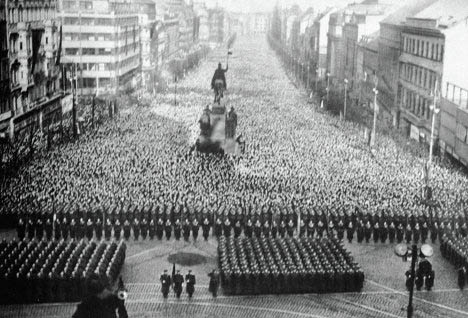
Funeral march in Prague’ St. Václav’s Square on the day of Stalin’s burial, 9 March 1953
The monument was finally dedicated on 1 May 1955. The verdict of Comrade Nikita Sergeyevich Khrushchev: “Too big, too late.” Local wags dubbed the monstrosity “fronta na maso” – the waiting line for meat, a none-too-subtle reference to food shortages under centralized planning. The artist, Otakar Švec, was not present at the ceremony. He had commited suicide a few weeks before, possibly due to the earlier suicide of his wife, combined with his remorse over the monstrosity he had created, perhaps in combination with the pressure of constant surveillance by the secret police.
Khrushchev in Prague. “Too big, too late”
The precise date of Švec’s death has seemed, until recently, difficult to pinpoint, and has enjoyed something of the quality of legend. Some sources have casually declared that he died the day before the dedication of the monument on 1 May, as if to state that the sculpture itself was the overriding reason. But the Czech Wikipedia entry on Švec marks the date as 4 April, while the English Wikipedia entry puts it on 3 March, a month earlier. The latter date seems to be a result based on Czech archival sources, uncovered as research for the book Gottland, by Mariusz Szczygieł, published in 2008, and so seems the most credible.
An Eternity of Only Eight Years
On 25 February 1956, three years after the death of Stalin, Khrushchev addressed the 20th Party Congress of the Communist Party of the U.S.S.R. with a report entitled, О культе личности и его последствиях (“On the Cult of Personality and Its Consequences”). It was a sharp denunciation of Stalin and the cult of personality that had formed around him. From that day on, the Prague Stalin monument’s days were suddenly numbered. It had swiftly been transformed from a prestigious and very public project into an outright embarrassment to the Communist Party. It would have to go.
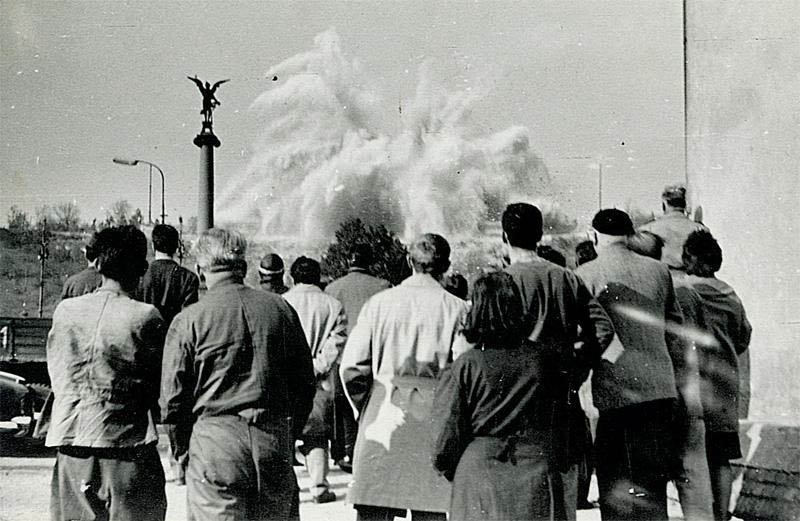
Much as they no doubt would have liked to, the Party could not destroy such a massive structure in secret. Instead, they chose to undertake demolition of the monstrosity in a quick, cataclysmic manner using dynamite. In November, 1962, eight hundred kilograms of explosives were used to blow it up. Although the blasts were no doubt heard clearly throughout the vicinity of Letná, on this matter, the Czech press of the time were entirely silent. It was officially forbidden to document it photographically, but some images were created, nonetheless.
It took about a year to clear the platform of the pieces of the monument that remained after the detonations. The platform then stood embarrassingly vacant for the next 29 years, until the “Prague Metronome” was finally found its place there.
A Reservoir of Public Memory
Another film gives us a look at the what happened after that. Made in 1963, not long after the demolition of the Stalin monument and after all the rubble was cleared away, the film Postava k podpírání (“A Character in Need of Support”), a Czech film that presaged the coming New Wave, was produced in Prague. The filmmakers Pavel Juráček and Jan Schmidt made prominent use of the vacant platform in a significant image near the end of the film, going so far as to overdub the sound of a man falling down some stairs while carrying a boiler tank (extending the sound from the previous scene) at precisely the moment when the stone Stalin, now gapingly absent, should have made its appearance.
This image seems to proclaim a change of polical weather; a loosening of the contraints, a thaw. The main character’s futile search for the elusive bureaucrat Josef Kilián, in an effort to free himself from the burden of a rented cat, was inevitably described as “kafkaesque” by foreign critics, and marked a fresh tolerance by the censors for implicit criticism of the workings of the state. Freed from Stalin’s stony panopticon gaze that once looked directly into the heart of the city from on high, the sun finally came out. The Czechoslovak New Wave would then blossom, and after it, a Czech Spring, born of optimism at the promise of a new “socialism with a human face.” We all now know of course that that optimism was, tragically, premature.
Interestingly, the public memory of the Stalin Monument has been much more resistant to destruction even than granite and reinforced concrete. There are people in Prague who still say “meet me at Stalin,” instead of “meet me at the metronome.” The site is a reservoir for public memory, and its vibe has been exploited again and again since the Velvet Revolution for politics and publicity. In the early 1990s, the pirate station Stalin Radio operated out of the chambers under the platform. In 1996, an effigy of Michael Jackson was placed there to promote a concert tour. During parliamentary elections in 1998, a billboard promoting Václav Klaus’ candidacy appeared there.
In honor of Švec’s work, and to commemorate the 51st anniversary of his suicide, the Czech artist Martin Zet in 2006 prepared the exhibition Osud národa - sochař Otakar Švec (“The Fate of a Nation - The Sculptor Otakar Švec”), including images of Švec’s earlier work. The venue for the exhibition was Artwall, the outdoor gallery mentioned in this post, and which lies on the riverside face of Letná hill.
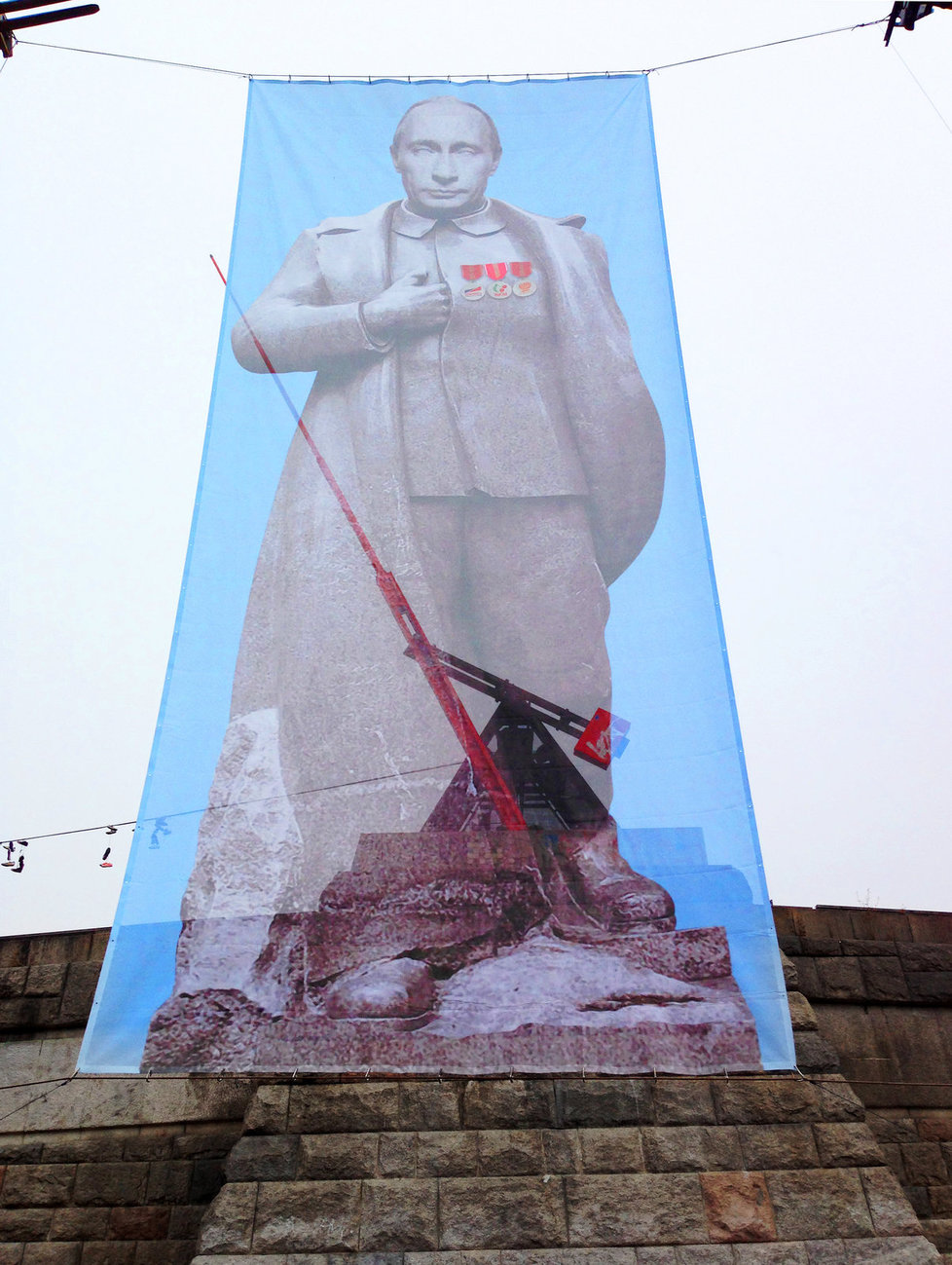
In 2011, as part of the Prague Quadrennial festival, the words “The Tears of Stalin” appeared in six-meter-high white letters in front of the metronome, likely in part a reference to “Stalinovy slzy” (Stalin’s Tears) a brand of vodka sold in Prague tourist traps. Most recently, on the first day of the 2013 parliamentary elections held in October, a huge poster depicting Russian Federation President Vladimir Vladimirovich Putin, costumed as a Stalin-like dictator, was raised on the site by a group seeking to warn against the threat of a return to a communist government in the Czech Republic.
There was once a common saying in the Eastern Bloc, sometimes stated in earnest, sometimes with bitter irony, “Пока Сталин живёт, всё будет хорошо” (“As long as Stalin lives, everything will be all right”), which, these days, can be heard paraphrased thus: “So long as the metronome stands, all is well in Prague.” The Prague Stalin Monument is long gone, but none the less, the site atop Letná hill holds a strong political charge, still vivid in public memory, that has yet to dissipate.




















 Come with us to…
 Atlantis
 Bestiary
 Books, exhibitions, music, film
 Brave old world
 Caucasus
 Cemeteries
 Crimea
 Get to know the
 Images of the East
 Lightwriting
 Lwów/Lemberg
 Mallorca
 Message on the wall
 Odessa
 Paper Museum
 Persian letters
 The Jewish heritage


