Switch over to our new blog! • ¡Pásese a nuestro nuevo blog!

The renewed version of our blog, with more features, a richer design, and available in nine languages, can be read here: https://wangriver.com

The new version also includes the old posts, often in expanded form. If you are curious about the updated version of this post, replace “riowang.blogspot.com/” in the URL with “riowang.studiolum.com/”, and the new link will most likely lead you there.


La versión renovada de nuestro blog, con más herramientas, un diseño más rico y disponible en nueve idiomas, se puede leer aquí: https://riowang.com

La nueva versión también incluye las publicaciones antiguas, a menudo en una forma ampliada. Si tiene curiosidad por la versión actualizada de esta entrada, sustituya «riowang.blogspot.com/» en la URL por «riowang.studiolum.com/es/», y el nuevo enlace probablemente le llevará allí.

Mostrando entradas con la etiqueta emblem. Mostrar todas las entradas

Coordinates


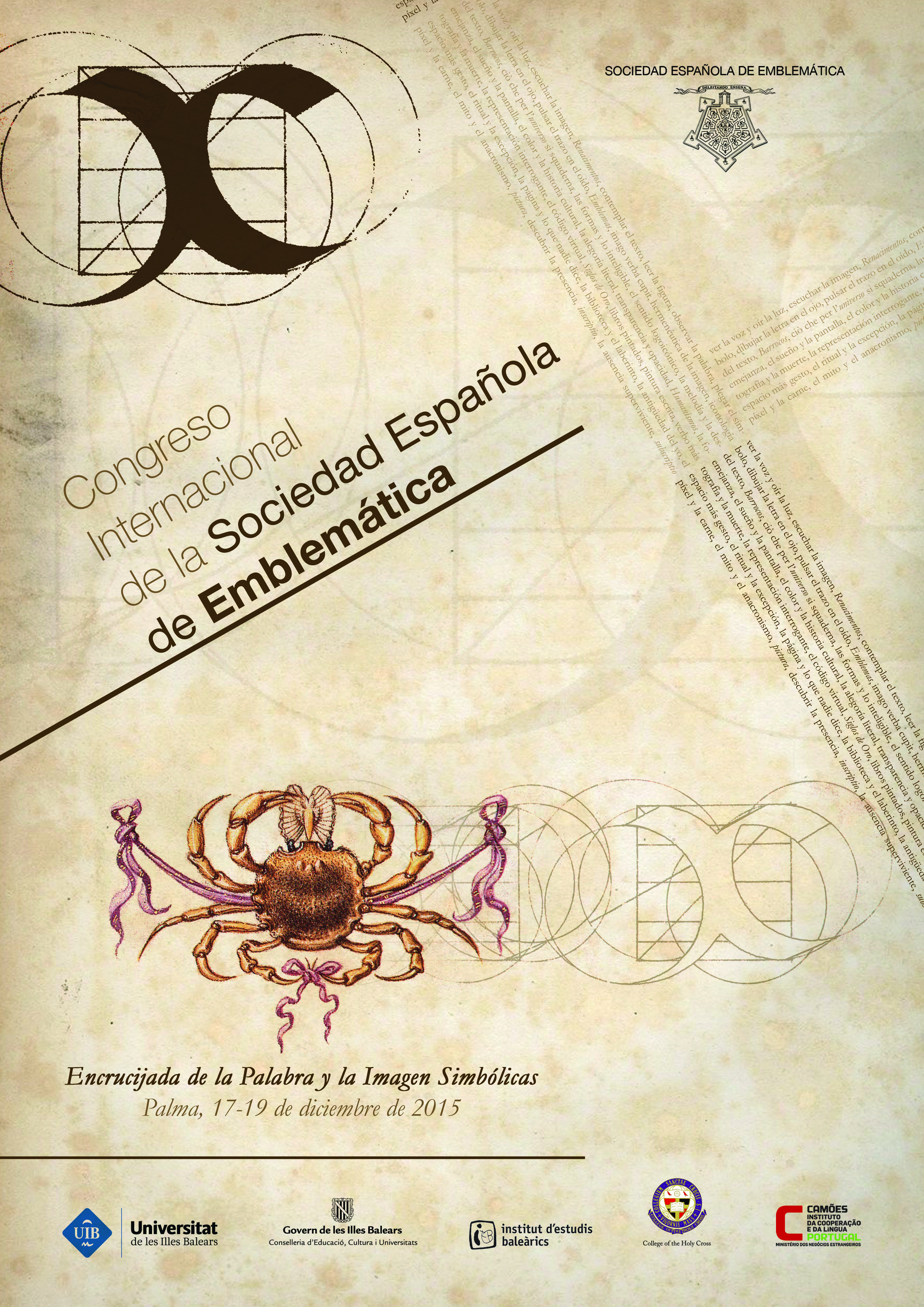
The Spanish Society of Emblematics has announced its Tenth International Congress, which we will organize in Palma de Mallorca, exactly a year from now. After thinking a lot about the title, distilling it almost to the point of the esoteric, we have opted for one which is something self-evident for this kind of meeting: Encrucijada de la Palabra y la Imagen Simbólicas, “On the crossroads of symbolic words and images”. In a way, this is the basic definition of the emblem. But this crossroads also highlights the peculiar focus of our analysis of cultural history as a whole.


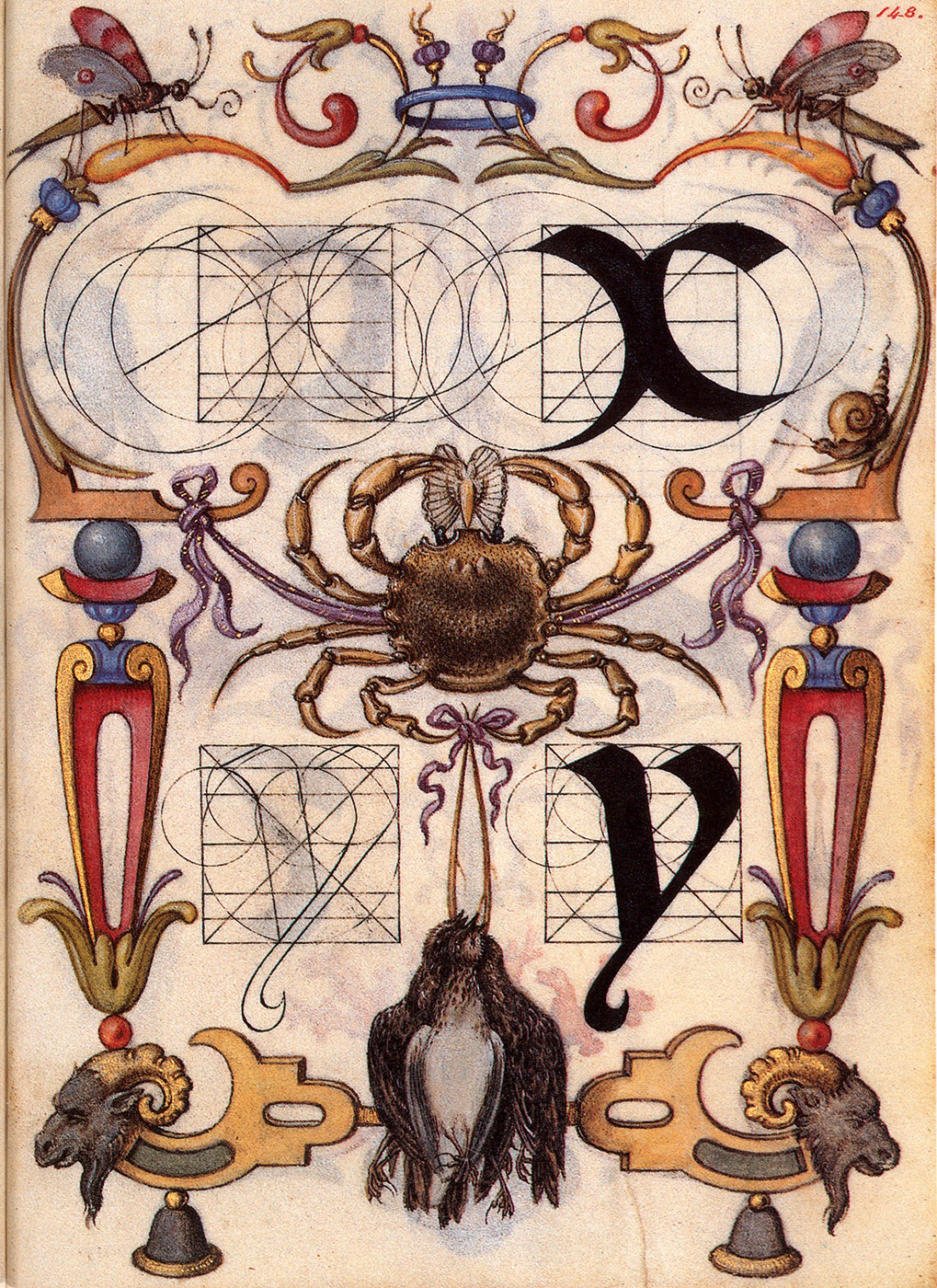
Then we had to design the poster of the event. The fact that this is the tenth congress allowed us to link the Roman X with the very concept of crossroads heralded in the title. Digging into our memory, we recalled the magnificent manuscript Mira Calligraphiae Monumenta, in which the master calligrapher of the Hungarian chancellery in Vienna, Georg/György Bocskay, designed a complex work page by page, displaying all his skills in the art of drawing letters. He finished it in 1562, but then his notebook fell into the hands of Rudolf II of Prague, who, admiring the Bocskay’s precision, decided to make it into a truly unique work, worthy of his imperial collections.


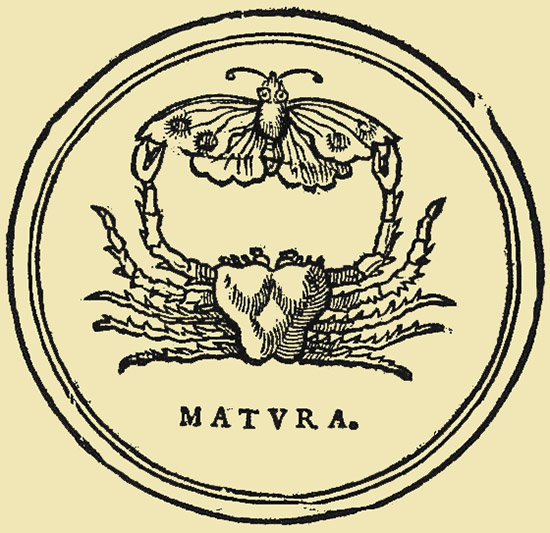
For this purpose, he instructed the best manuscript illuminator he could find, Joris Hoefnagel, to decorate it with the best of his arts, and to spare no effort. Hoefnagel not only amply executed his task, but he also complemented it with a typographic game, whose elements, whether copied, or invented on the basis of natural elements, joined with mathematical rigor the tracery and composition of the letters. Here is the “X” we wanted: the devise of Emperor Augustus, the crab clutching in its pincers a butterfly – an image usually accompanied with the Latin motto Matura –, converted in a graphic sign. Crossroads of word and image, but also a sign that we have come – maturando – to the tenth congress of the Society. Already twenty years – X-X – always having the motto in sight.


Coordenadas


La Sociedad Española de Emblemática ha convocado su X Congreso Internacional, que organizaremos en Palma dentro de un año redondo. Después de darle muchas vueltas al título, cosa que iba alambicándolo hasta hacerlo casi esotérico, hemos optado por uno que quizá sea algo obvio para este tipo de encuentros: Encrucijada de la Palabra y la Imagen Simbólicas. En cierto modo, esto define básicamente al emblema. Pero esta encrucijada también marca el peculiar núcleo desde donde nosotros analizamos la historia cultural en su conjunto.


Luego tuvimos que idear el cartel. El hecho de que sea ya el X Congreso, nos permitía enlazar la «X» de la numeración romana con el concepto mismo de encrucijada que presenta el título. Rebuscando en la memoria se nos apareció el magnífico manuscrito Mira Calligraphiae Monumenta donde el maestro calígrafo Georg Bocskay diseñó página tras página una obra compleja en la que exhibía todas sus dotes en el arte de dibujar las letras. Lo dejó acabado en 1562 pero luego el cuaderno cayó en manos de Rodolfo II, en Praga, quien, admirado de la precisión de Bocskay, decidió convertirlo en una obra verdaderamente única y digna de sus colecciones.


Para ello, encargó al mejor iluminador de manuscritos que pudo encontrar, Joris Hoefnagel, que lo decorara a su gusto y sin ahorrar esfuerzos. Hoefnagel no solo cumpliría sobradamente el encargo sino que añadió de su mano todo un juego tipográfico donde las ilustraciones copiadas o fantaseadas a partir de elementos naturales se unían al rigor matemático de la tracería y la composición de las letras. Ahí está la «X» que queríamos: la divisa del emperador Augusto, el cangrejo que atrapa entre sus pinzas a una mariposa —imagen habitualmente unida al mote latino Matura— se metamorfosea en signo gráfico. Encrucijada de palabra e imagen, sí, pero también indicio de haber llegado —madurando— hasta el décimo congreso de la Sociedad. Veinte años ya —X-X— sin faltar a la cita.


A secret message

The album amicorum, friends’ album, or memoriae causa, collection for the purpose of good memory, was an inevitable item in the meagre luggage of the students wandering from university to university in Europe between the 16th and 19th centuries. Upon setting out, their family members and friends, and in the various cities, their professors, fellow students or distinguished patrons, wrote in them some warm words of erudite aphorisms. The several thousand albums which have survived give a good opportunity for reconstructing the network of the early modern intelligentsia and the usual routes of their university studies.

The sites of the inscriptions in Ferenc Pápai Páriz’s album amicorum, published by us (1711-1726).

The alba amicorum from Hungary or with Hungarian content have been digitized and put in a publicly searchable database by the research group Inscriptiones Alborum Amicorum at the university of Szeged, directed by Miklós Latzkovits. We also work for the research group, especially when an iscription written in an unusual language or in a difficult-to-read hand comes to light. This is the case now, too.

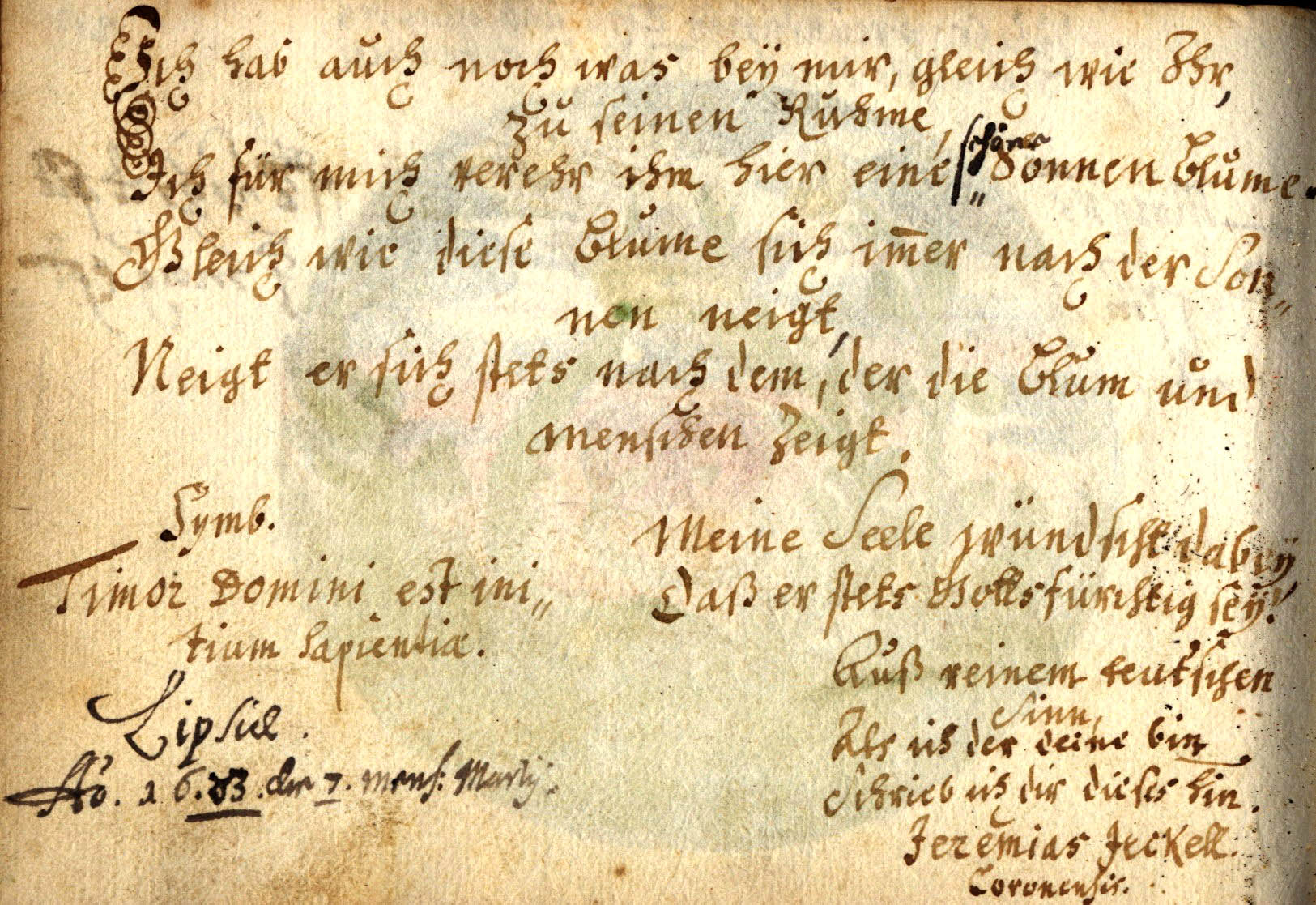
The album of Paul Schirmer from Kronstadt/Brassó/Brașov, compiled between 1681 and 1685, is preserved in the university library of Kolozsvár/Cluj. The two-page inscription below was written by Jeremias Jeckell, likewise from Kronstadt, on 7 March 1683 in Leipzig. The first page displays a beautiful emblem. The hearts of the two friends, joined by a chain, are encircled by a crown similar to the coat of arms of their home town Kronstadt. Next to it, a sunflower looks forever at the sun. According to the convention of the period, this is the symbol of the true believer always looking at God, as the accompanying German poems and Latin biblical verses confirm:

Wahre Freundschaft, Treu und Glauben
Soll nichts denn der Todt uns rauben.

Ich hab auch noch was bey mir, gleich wie Ihr, zu seinen Ruhme,
Ich für mich verehr ihm hier eine schöne Sonnenblume,
Gleich wie diese Blume sich im/m/er nach der Sonnen neigt,
Neigt er sich stets nach dem, der die Blum und Menschen zeigt.

Meine Seele wündscht dabey,
Dass er stets Gottsfürchtig sey!
Auss reinem teutschen Sinn,
Als ich der deine bin,
Schrieb ich dir dieses hin.

Timor Domini est initium sapientiae (The fear of the Lord is the beginning of wisdom, Psalm 111,10.)

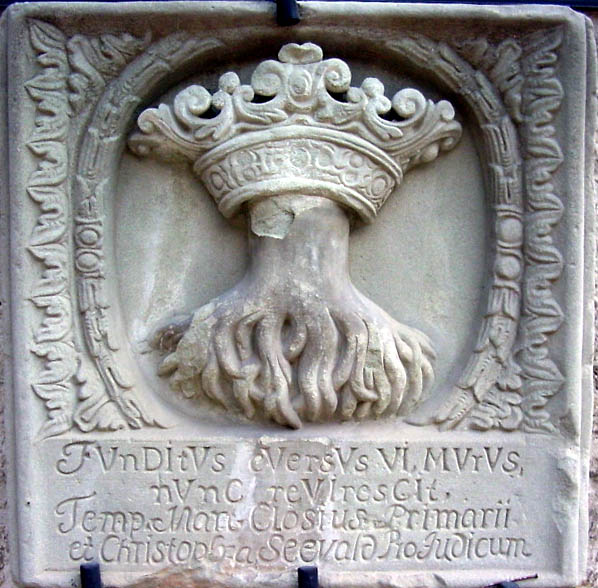
Coat of arms of Kronstadt/Brassó/Brașov


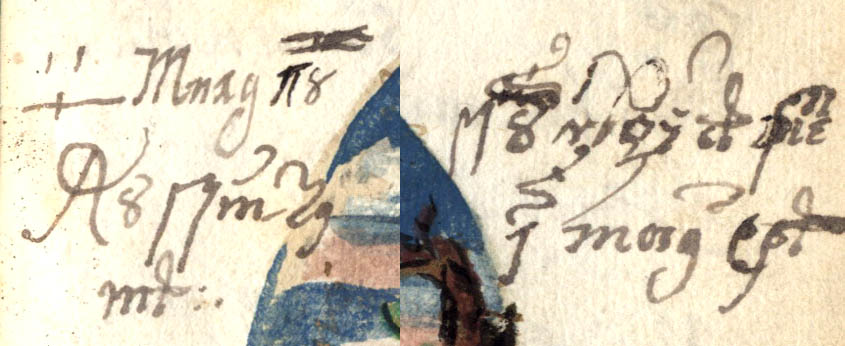
However, there is something more in the inscription, which we are not able to decypher, consisting of two short texts on the sides of the emblem, which cannot be read in any known language. We suspect it may be some kind of secret script. So again we turn to our seasoned readers. Are you able to tell what script and language were used to write these short lines, and what do they mean?


Mensaje secreto

El album amicorum –álbum de amigos–, o memoriae causa –receptáculo de buenas memorias–, era pertrecho obligado en el exiguo equipaje de los estudiantes que andaban de acá para allá por Europa, de universidad en universidad, entre los siglos XVI y XIX. En sus páginas, familiares y amigos próximos, pero sobre todo profesores, distinguidos compañeros o mecenas tratados en las diversas ciudades, escribían unas breves palabras cálidas en eruditos aforismos. Los pocos miles de álbumes que han sobrevivido ofrecen una excepcional oportunidad para la reconstrucción de la red de contactos de la intelligentsia a principios de la Edad Moderna y de las rutas habituales de los estudios universitarios.

Lugares con las anotaciones del album amicorum, que nosotros publicamos (1711-1726) de Ferenc Pápai Páriz

Los alba amicorum de Hungría, o con contenido relativo al país, los ha digitalizado y puesto al alcance del público el grupo de investigación Inscriptiones Alborum Amicorum de la Universidad de Szeged, dirigido por Miklós Latzkovits. También nosotros hemos colaborado con ellos, en especial cuando salen a luz notas en idiomas desacostumbrados o con partes difíciles de leer. Este es el caso de ahora


El álbum de Paul Schirmer de Kronstadt / Brassó / Braşov, compilado entre 1681 y 1685, se conserva en la biblioteca de la universidad de Kolozsvár / Cluj. La nota de dos páginas que veréis a continuación fue escrita por Jeremías Jeckell, también oriundo de Kronstadt, el siete de marzo de 1683 en Leipzig. La primera página muestra un hermoso emblema. Los corazones de los dos amigos, unidos por una cadena, están rodeados por una corona similar a la del escudo de armas de su ciudad natal de Kronstadt. Al lado izquierdo, un girasol mira siempre hacia un sol que brilla entre nubes. De acuerdo con las convenciones básicas de la época, es símbolo del verdadero creyente, que siempre está mirando a Dios. Así lo confirman los poemas alemanes y versículos bíblicos en latín que lo acompañan:

Wahre Freundschaft, Treu und Glauben
Soll nichts denn der Todt uns rauben.

Ich hab auch noch was bey mir, gleich wie Ihr, zu seinen Ruhme,
Ich für mich verehr ihm hier eine schöne Sonnenblume,
Gleich wie diese Blume sich im/m/er nach der Sonnen neigt,
Neigt er sich stets nach dem, der die Blum und Menschen zeigt.

Meine Seele wündscht dabey,
Dass er stets Gottsfürchtig sey!
Auss reinem teutschen Sinn,
Als ich der deine bin,
Schrieb ich dir dieses hin.

Timor Domini est initium sapientiae (El temor de Dios es el principio de la sabiduría, Salmo 111,10.)

Escudo de armas de Kronstadt/Brassó/Brașov


Sin embargo, hay algo más en la inscripción, que no somos capaces de descifrar. Son dos textos breves, a ambos lados de la pictura, que no logramos atribuir a ningún idioma conocido. Sospechamos que pudiera tratarse de algún tipo de escritura secreta. Así que de nuevo nos dirigimos a nuestros avisados lectores. ¿Sois capaces de averiguar qué clave o idioma utilizan estas breves líneas? ¿Y qué significan?


Ex libris


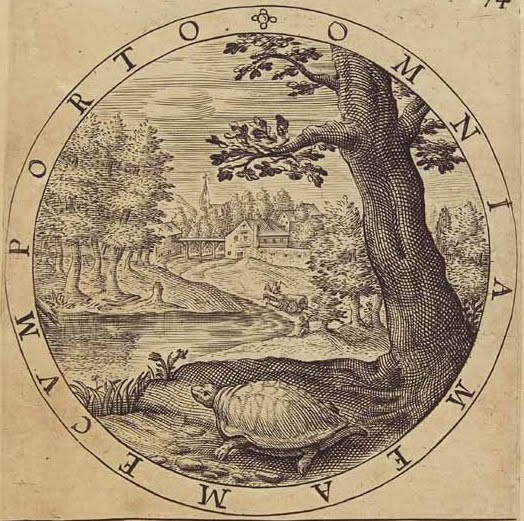
Omnia mea mecum porto, I carry with me all what is mine – an ideal motto for him who usually goes around the world with a single backpack. Although I prefer the version of the emblem illustrated with, rather than Rollenhagen’s turtle, the snail, who carries his entire house with him everywhere. But the most perfect symbolic animal, I think, would be a kangaroo, with a one-terabyte external hard drive in its pouch.

Because, in fact, the most burdensome task is to carry even your library with you, or at least those few dozen books, which you need in those far away lands. To this end, it is best to photograph / scan the books purchased, and then to give them away. The more precious, rare or useful ones to libraries, so that more people have access to them. And once you follow the example of the library-enriching maecenases, like them, you will also want to leave some sign of your gesture in the book. For example, by a simple, but nice seal. “Gift of riowang.com”, if you give it to an international library, “A wangfolyo.com ajándéka”, if you want to bestow it upon a collection of your native Hungarian land.

For the design of these two stamps I hereby announce a competition for the readers of río Wang. The deadline is exactly one week, when I would like to bring home the first consignment to the Budapest Public Library. I’ll post the best designs for a voting here on the blog. And the award is that this stamp and the name/link of its designer will be at the top of the page on which I will list the books donated to the various libraries, to ease the access to them. And, of course, that this seal will be seen by everyone picking up the book in the libraries. By many, I hope.

On field trip in Nowy Wiśnicz

Honor y honras

El Warburg and Courtauld Institute de Londres es el centro de investigación interartística más prestigioso del mundo y contiene una de las bibliotecas más útiles e impresionantes. Quien recibe una beca para estudiar aquí puede considerarse muy afortunado, no sólo por tener acceso privilegiado durante las veinticuatro horas del día –con llave propia– a los inmensos fondos bibliográficos que estableció Aby Warburg, donde se combinan de manera única la historia del arte, la literatura, la antropología, la sociología y otras disciplinas de humanidades, sino porque será casi imposible salir del Institute sin publicar un estudio que marcará en adelante toda la carrera investigadora.

El Eleanor Tufts Book Award es el premio más notable para un libro sobre cultura artística española publicado en inglés. Se elige entre tres obras aparecidas durante el año anterior, una de las cuales es siempre propuesta por el Courtauld Institute. La organización y sede del premio es responsabilidad de la American Society for Hispanic Art Historical Studies.

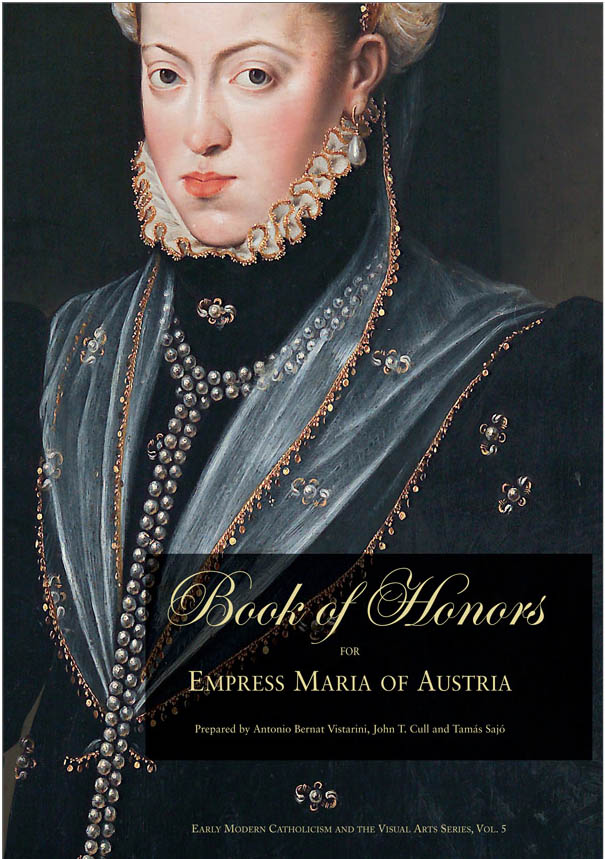
Este año el primer premio lo ha ganado Ilona Katzew por su libro Contested Visions in the Spanish Colonial World (Yale, 2011). Junto a él otros dos libros han merecido la mención de honor. Y uno de ellos, el presentado por Warburg and Courtauld Institutes, ha sido el Libro de las Honras de la Emperatriz María de Austria (1603), del que dimos noticia hace ahora algo más de un año. Preparamos esta edición los fundadores del grupo de investigación Studiolum, tres amigos repartidos entre América, España y Hungría. Estos son los motivos de la mención en palabras del Eleanor Tufts Award Committee:

Book of Honors for Empress Maria of Austria – Composed by the College of the Society of Jesus of Madrid on the Occasion of Her Death (1603), ed. Antonio Bernat Vistarini, John T. Cull and Tamás Sajó (Philadelphia: Saint Joseph’s University Press, 2011), for setting an example of a fruitful collaboration among scholars from different countries who made accessible to an English-speaking audience an important primary source and likewise for opening up a promising new line of scholarship in the fields of Spanish and Portuguese art: an annotated critical translation with facsimile of the emblems. The editors uncover a wealth of material relevant for understanding female patronage, iconography, religious practices, history, and literature of the Golden Age, and especially the importance of visual emblems in post-Tridentine Jesuit preaching. The combination of the critical and contextual essay, with the translated text, and the facsimile make this an indispensable resource for scholars and students of emblem books, literature, and symbolic imagery in early modern Spain.”

«Book of Honors for Empress Maria of Austria – Composed by the College of the Society of Jesus of Madrid on the Occasion of Her Death (1603), ed. de Antonio Bernat Vistarini, John T. Cull y Tamás Sajó (Philadelphia: Saint Joseph’s University Press, 2011), por constituir un ejemplo de colaboración fructífera entre investigadores de diferentes países que ha hecho accesible al público de habla inglesa una importante fuente primaria; y, a la vez, por abrir una nueva y prometedora línea de investigación en los campos del arte español y portugués: una traducción crítica anotada, con el facsímil de los emblemas. Los editores descubren un rico material de relevancia para la comprensión del patronazgo femenino, la iconografía, las prácticas religiosas, la historia y la literatura del Siglo de Oro, subrayando la especial importancia del emblema visual en la predicación jesuítica post-tridentina. La combinación de un ensayo crítico y contextualizador, junto con el texto traducido y el facsímil, lo convierten en un recurso indispensable para los investigadores y estudiosos de los libros de emblemas, de la literatura y la imaginería religiosa de la España moderna.»

En esta apreciación no se menciona el trabajo de otro de los coautores: György Sajó, de Copenhague, quien tradujo y comentó para este libro los cuatro poemas en hebreo presentes en aquellas decoraciones funerales de 1603.

Y estamos en deuda con el Rev. Joseph F. Chorpenning, director editorial de Saint Joseph’s University Press, por la confianza que tuvo en nuestro proyecto y la gran ayuda que nos prestó para que se pudiera llevar a cabo.

Por lo demás, qué decir sino que nos sentimos tremendamente honrados. Honradísimos.


Honras

The Warburg and Courtauld Institutes in London is the world’s most prestigious research institution and library of art history. Whoever gains here a research scholarship can regard him- or herself very lucky, not only because he can research twenty-four hours a day in the huge library established by Aby Warburg, which uniquely combines the history of art with anthropology, sociology and other social sciences, but also because it is almost impossible to leave it without publishing an important study which defines his whole further career.

The Eleanor Tufts Book Award is the world’s most prestigious prize for the books on Spanish art history published in the English-speaking world. It is annually distributed to three books, published in the previous year, one of which is always the nominee of the Warburg and Courtauld Institutes.

This year, Ilona Katzew’s Contested Vision in the Spanish Colonial World (Yale, 2011) won the first prize. Beside it, two other books received the usual Honorable Mention. And one of these two, the nominee of the Warburg and Courtauld Institutes was that Libro de las Honras de la Emperatriz María de Austria (1603), about which we wrote a year ago, that it was translated, annotated, introduced and edited by the three founders of the Studiolum publisher, the three of us, friends from America, Mallorca and Hungary. The reasons of the Eleanor Tufts Award Committee were as follows:

Book of Honors for Empress Maria of Austria – Composed by the College of the Society of Jesus of Madrid on the Occasion of Her Death (1603), ed. Antonio Bernat Vistarini, John T. Cull and Tamás Sajó (Philadelphia: Saint Joseph’s University Press, 2011), for setting an example of a fruitful collaboration among scholars from different countries who made accessible to an English-speaking audience an important primary source and likewise for opening up a promising new line of scholarship in the fields of Spanish and Portuguese art: an annotated critical translation with facsimile of the emblems. The editors uncover a wealth of material relevant for understanding female patronage, iconography, religious practices, history, and literature of the Golden Age, and especially the importance of visual emblems in post-Tridentine Jesuit preaching. The combination of the critical and contextual essay, with the translated text, and the facsimile make this an indispensable resource for scholars and students of emblem books, literature, and symbolic imagery in early modern Spain.”

This appreciation has not mentioned one of the co-authors: György Sajó from Copenhagen, that is, Két Sheng for the readers of Río Wang, who translated and analyzed for our publication the four poems in Hebrew of the funeral decorations of 1603.

What else could we add to this? Gracias por las honras.


Amor’s bullets


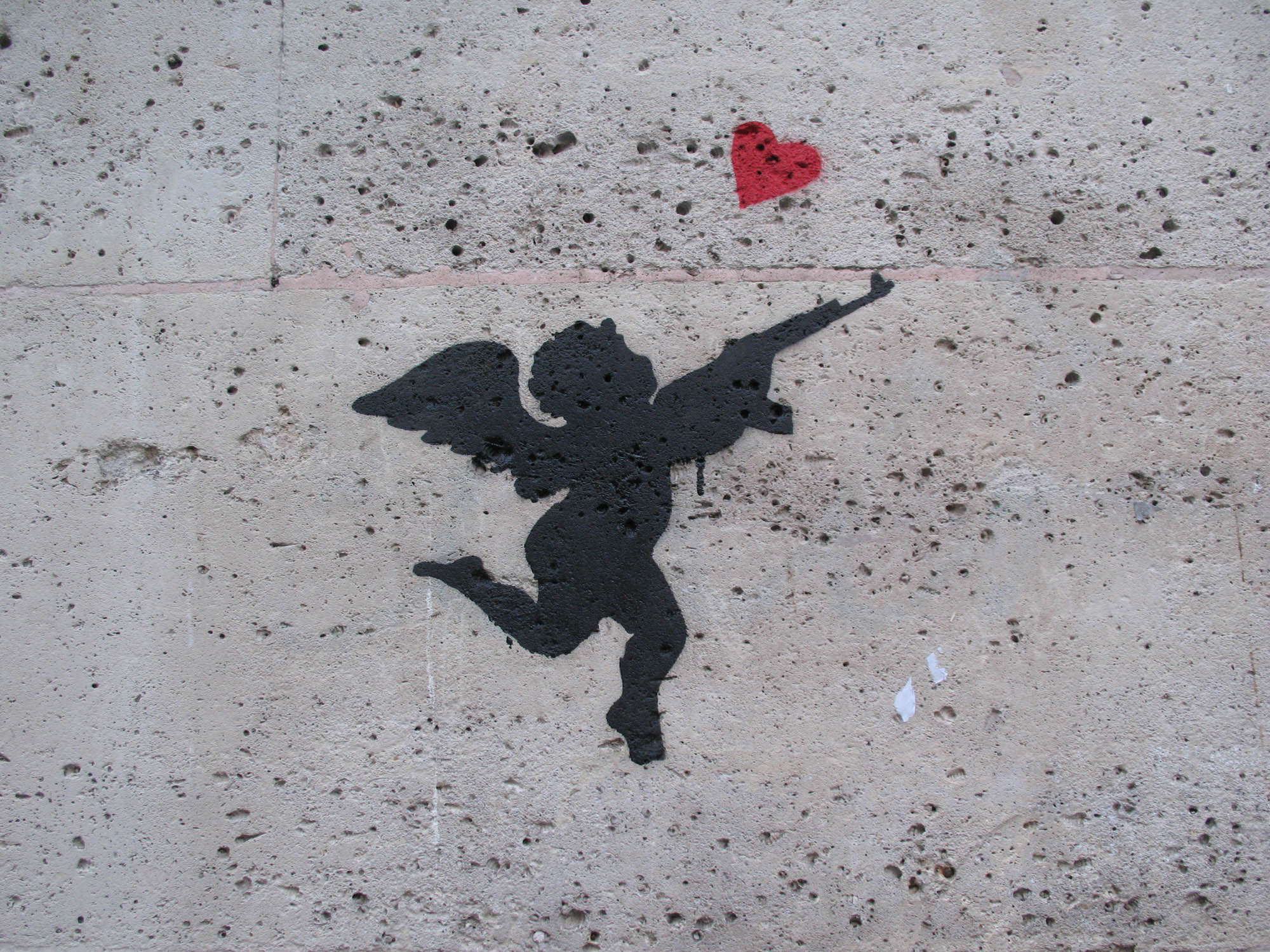
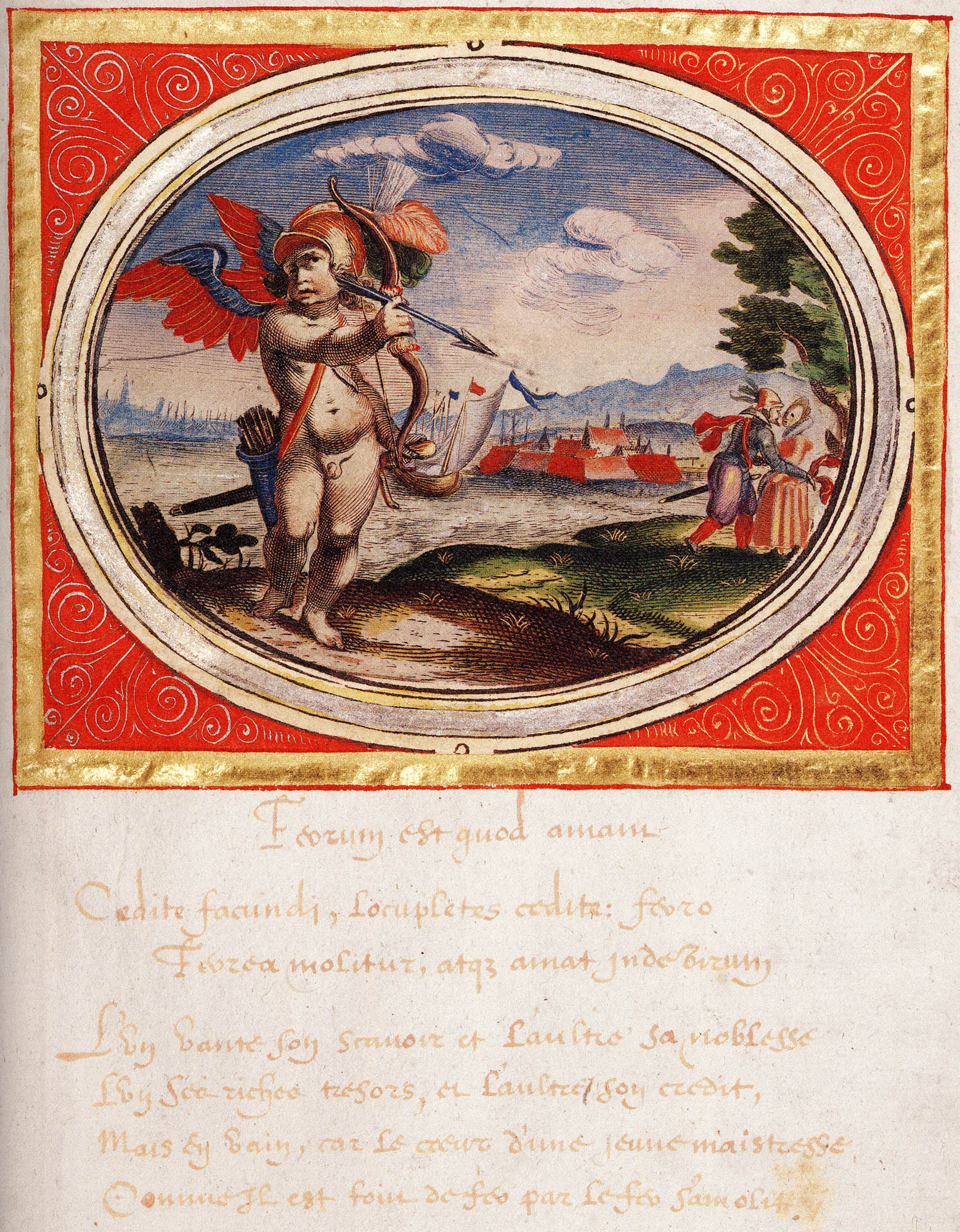
We recently found in a downtown street of Paris this graffiti, a modernized and stylized version of the topos popularized, among others, by the following emblem in Daniel Heinsius’ Emblemata amatoria (Leiden, 1613).


Ferrum est quod amant

Cedite facundi, locupletes cedite: ferro
Ferrea mollitur, atque amat inde virum

L’un vante son sçavoir et l’austre sa noblesse
L’un ses riches tresors, et l’austre son credit,
Mais en vain, car le coeur d’une jeune maistresse
Comme il est tout de fer par le fer s’amolit.
It is iron that they love

Away, talkative, away, rich: only iron
softens the iron so she loves the man.

This boasts with knowledge, that with nobility,
this with his treasures and that with fame.
But in vain, as the heart of a young lady,
as it is of iron, will be softened only by iron.

The ambiguity of the metaphor is based on the one hand on the irresistible effect of the impetuous soldier on the “jeune maîtresse”, and on the other hand on the violence indispensable to conquer her: none of both are considered nowadays as politically correct. And in fact, the Paris graffiti disarms both with its trivial postmodern topos, the “anti-cupido” which is determined to end love with an automatic firearm. But even this topos has its Renaissance model in Alciato’s emblem In formosam fato praereptam (“Beauty carried away by fate”, or in other editions De morte et amore, “On Death and Love”). Here Cupido mistakenly swaps his quiver with that of Death, so that he kills a young lover with his arrow (while Death sets an old man on amorous fire). Alciato thus at the same time also warns how ridiculous it is when an old man surrenders himself to the passion of love: another politically incorrect moment which would disturb us to see so openly drafted. But the pictures of the past haunt us, and they often imperceptibly fit to the new visual topoi and live on in them.

Andrea Alciato, Emblematum liber, Rouille, 1614

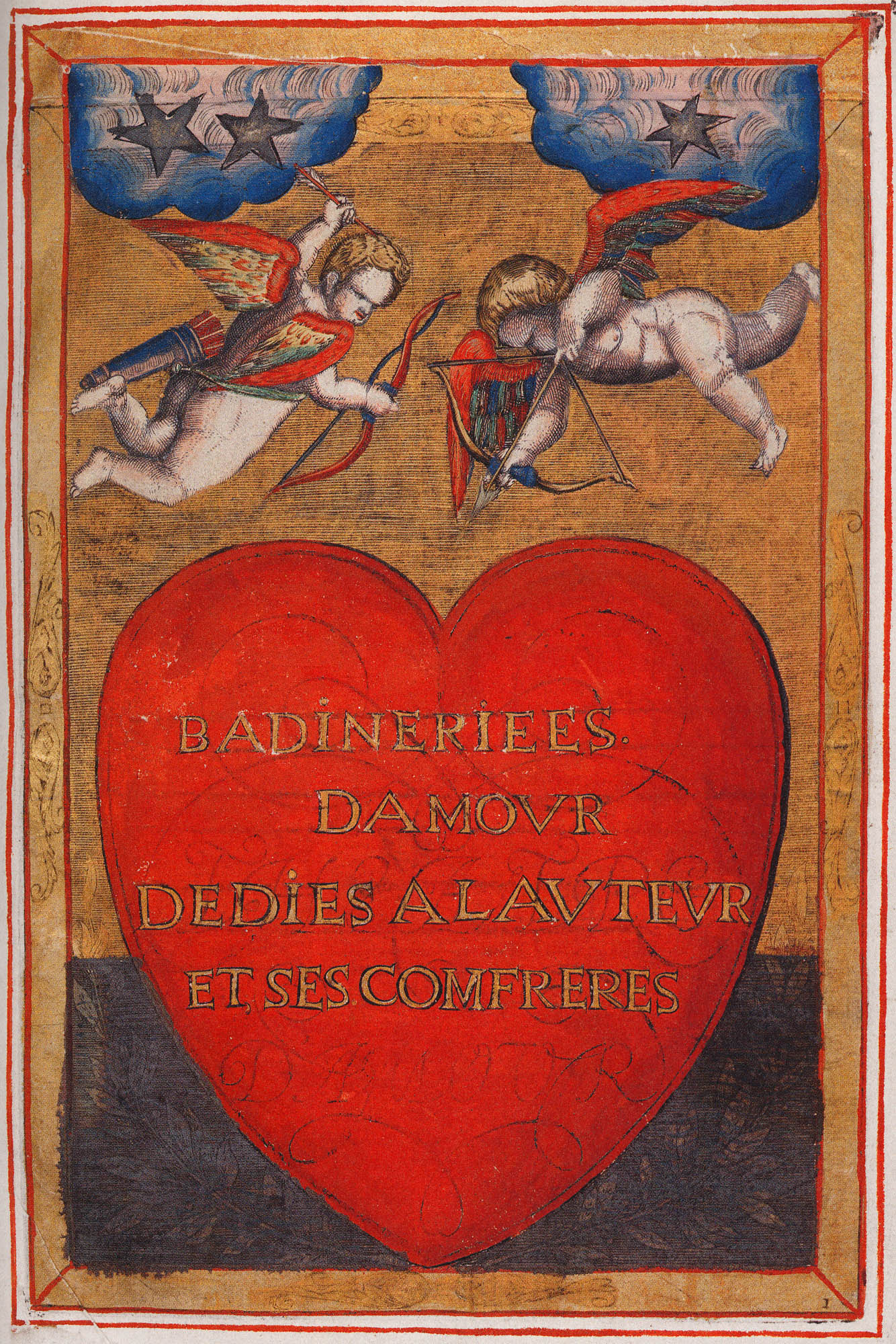
The above emblem of Heinsius with the handwritten poem comes from a magnificent album of around 1620, into which an anonymous French collector copied, illuminated and translated several emblems from the the original edition of 1613, especially the love-themed ones, with the title Badineriees d’amour dedies a l’auteur et ses comfreres. Its facsimile edition was published by Taschen in 2004.

Amor y balas


Hace unas semanas fotografiamos este grafito en la pared de una céntrica calle de París. Parece una curiosa versión moderna y muy estilizada del tema de este emblema de 1613 que se encuentra en el libro de Daniel Heinsius, Emblemata amatoria (Leiden).


Ferrum est quod amant

Cedite facundi, locupletes cedite: ferro
Ferrea mollitur, atque amat inde virum

L’un vante son sçavoir et l’austre sa noblesse
L’un ses riches tresors, et l’austre son credit,
Mais en vain, car le coeur d’une jeune maistresse
Comme il est tout de fer par le fer s’amolit.
El hierro es lo que aman

Fuera, elocuente; fuera, ricos: el hierro ablandará
a la que es de hierro y así amará al hombre.

Uno alaba su saber y el otro su nobleza,
uno su gran riqueza y el otro su fama.
Pero en vano, pues el corazón de una joven dama
es de hierro, y solo se ablanda con el hierro.

La ambigüedad del conjunto oscila entre el supuesto atractivo irresistible del impetuoso soldado para la «jeune maitresse» y el uso de la violencia necesario para su conquista. Nada de eso podría considerarse hoy «políticamente correcto». En el grafito parisino estos contenidos incómodos se desactivan bajo un más trivial juego postmoderno: un «anti-cupido» que se dedica a acabar con el amor a base de ráfagas de ametralladora. Pero en este caso también podríamos aducir el emblema de Alciato (In formosam fato praereptam, o en otras ediciones De morte et amore) en el que un Cupido, que por error ha cargado en su aljaba las flechas de hueso de la muerte, mata a un joven enamorado. Alciato nos advierte aquí, simétricamente, de lo ridículos que son los viejos a los que ataca la pasión amorosa: otra idea cuya exposición cruda hoy nos molestaría. Como decía Camões: «Mudam-se os tempos, mudan-se as vontades...» Y las imágenes del pasado sobreviven como fantasmas, adaptándose y alimentándose, muchas veces sin saberlo, de los nuevos hábitos de la mirada.

Andrea Alciato, Emblematum liber, Rouille, 1614

Esta imagen de Heinsius que hemos reproducido más arriba, con el poema manuscrito, procede de un precioso álbum de hacia 1620 donde un anónimo coleccionista francés recopiló, iluminó y tradujo diversos emblemas, sobre todo de tema amoroso: Badineriees d'amour dedies a l'auteur et ses comfreres. Lo publicó en 2004 la editorial Taschen.

Forty-two


Everyone knows what this is. The Answer to the Great Question. The Life, the Universe and Everything. The one found out by Deep Thought, the second largest computer of the universe of space and time in seven and half millions of years.

There was a moment’s expectant pause whilst panels slowly came to life on the front of the console. Lights flashed on and off experimentally and settled down into a businesslike pattern. A soft low hum came from the communication channel.
“Good morning,” said Deep Thought at last.
“Er… Good morning, O Deep Thought,” said Loonquawl nervously, “do you have… er, that is…”
“An answer for you?” interrupted Deep Thought majestically. “Yes. I have.”
The two men shivered with expectancy. Their waiting had not been in vain.
“There really is one?” breathed Phouchg.
“There really is one,” confirmed Deep Thought.
“To Everything? To the great Question of Life, the Universe and Everything?”
“Yes.”
Both of the men had been trained for this moment, their lives had been a preparation for it, they had been selected at birth as those who would witness the answer, but even so they found themselves gasping and squirming like excited children.
“And you’re ready to give it to us?” urged Loonquawl.
“I am.”
“Now?”
“Now,” said Deep Thought.
They both licked their dry lips.
“Though I don’t think,” added Deep Thought, “that you’re going to like it.”
“Doesn’t matter!” said Phouchg. “We must know it! Now!”
“Now?” inquired Deep Thought.
“Yes. Now…”
“Alright,” said the computer, and settled into silence again. The two men fidgeted. The tension was unbearable.
“You’re really not going to like it,” observed Deep Thought.
“Tell us!”
“Alright,” said Deep Thought. “The Answer to the Great Question…”
“Yes…!”
“Of Life, the Universe and Everything…” said Deep Thought.
“Yes…!”
“Is…” said Deep Thought, and paused.
“Yes…!”
“Is…”
“Yes…!!!…?”
“Forty-two,” said Deep Thought, with infinite majesty and calm.
It was a long time before anyone spoke.
Out of the corner of his eye Phouchg could see the sea of tense expectant faces down in the square outside.
“We’re going to get lynched aren’t we?” he whispered.
“It was a tough assignment,” said Deep Thought mildly.
“Forty-two!” yelled Loonquawl. “Is that all you’ve got to show for seven and a half million years’ work?”
“I checked it very thoroughly,” said the computer, “and that quite definitely is the answer. I think the problem, to be quite honest with you, is that you’ve never actually known what the question is.”


Douglas Adams: The Hitchhiker’s Guide to the Galaxy


However, the recently published Goose Game seems to finally give us the correct interpretation of forty-two, and thus the key to the Great Question of Life, the Universe and Everything.

I have recently edited for the Europe Publisher the Hungarian version of Il libro dei labirinti by Paolo Santarcangeli, published for the first time in the 1970s, but now published again with the author’s additions, new illustrations and a foreword by Umberto Eco.

This book looks back at the history of the labyrinth topos together with all its relations and dead ends. And when reaching the Renaissance, and discussing the relationship between the popular games of the period, including the turf maze and the “noble goose game”, number 42 suddenly flashes up just as the giant neon letters emerging from the dark space at the beginning of Hollywood movies:

“Due to its concentric circles, the goose game in itself has a labyrinth-like path; and if there exists any intentional and conscious representation of the “obstacle-ridden pilgrimage”, so that’s it. Besides its inherently labyrinthine nature, this game also has another surprising feature which is important for our topic. Square 42, which is considered a “dangerous” place in almost all versions of the game, is nothing else but “the house of the labyrinth”; what is more, the labyrinth is but the “trademark” of square 42."


But why exactly square number 42?

The goose game, the first European table game appeared in late 15th-century Florence, in the court of Lorenzo il Magnifico. This was also the laboratory of the first card game, which had a huge impact on the iconography of Renaissance art, quoted by me several times in the first critical edition of Cesare Ripa’s Iconologia (1593), the earliest encyclopedia of the symbol language of the Renaissance. Santarcangeli thus assumes that the number symbolism of the two games can be explained from each other.

The deck of Lorenzo il Magnifico consists of 42 numbered cards, each representing an allegory. Card number 21, ending the first half of the deck is a usual depiction of the world, the cosmos or Mother Nature in the form of a naked woman, with the globe under her foot, which also refers to her unstable and unpredictable nature. However, the image of the last card number 42 is not clear at first glance, so we have to turn to the interpretation of Santarcangeli:

“Card 42 represents a pilgrim on the brink of an abyss. He looks back in horror. Before him, but on the other side of the abyss, there is a castle. This symbolizes the man who encounters difficulties during his trip. This card also warns us not to let hesitation and obstruction stop us.”

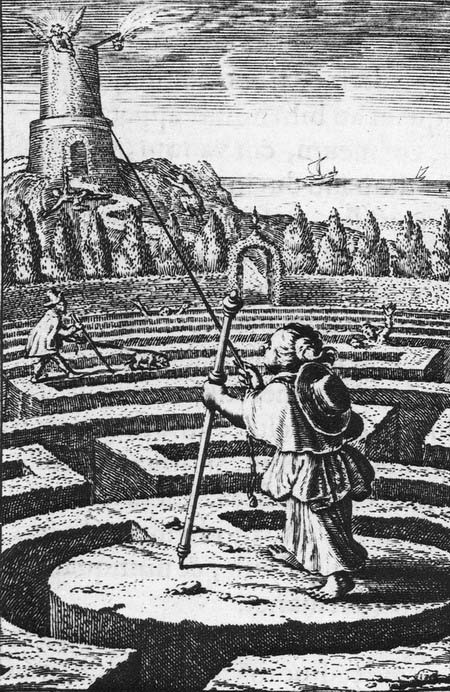
Representation of both symbols in one emblem: “The Christian soul in the labyrinth of the world”.
Engraving by Boethius von Bolswart (1580-1634) in Hermann Hugo’s Pia desideria
(1624)
, one of the most popular and most often published emblem books

The meaning of square 42 is thus the dangerous labyrinth of the world. That of card 42, its equivalent, is persistence on a given place, efforts for the really important things. And its value is exactly twice that of the unstable world. This is, then, the Life, the Universe and Everything, and the Answer matching it.

A more suitable one we cannot advise to our Readers for the new year, rich in struggles.

The photos were taken in the town of Santarcangelo di Romagna