Switch over to our new blog! • ¡Pásese a nuestro nuevo blog!

The renewed version of our blog, with more features, a richer design, and available in nine languages, can be read here: https://wangriver.com

The new version also includes the old posts, often in expanded form. If you are curious about the updated version of this post, replace “riowang.blogspot.com/” in the URL with “riowang.studiolum.com/”, and the new link will most likely lead you there.


La versión renovada de nuestro blog, con más herramientas, un diseño más rico y disponible en nueve idiomas, se puede leer aquí: https://riowang.com

La nueva versión también incluye las publicaciones antiguas, a menudo en una forma ampliada. Si tiene curiosidad por la versión actualizada de esta entrada, sustituya «riowang.blogspot.com/» en la URL por «riowang.studiolum.com/es/», y el nuevo enlace probablemente le llevará allí.

Mostrando entradas con la etiqueta Alciato; Andrea. Mostrar todas las entradas

Bookworms with cranks

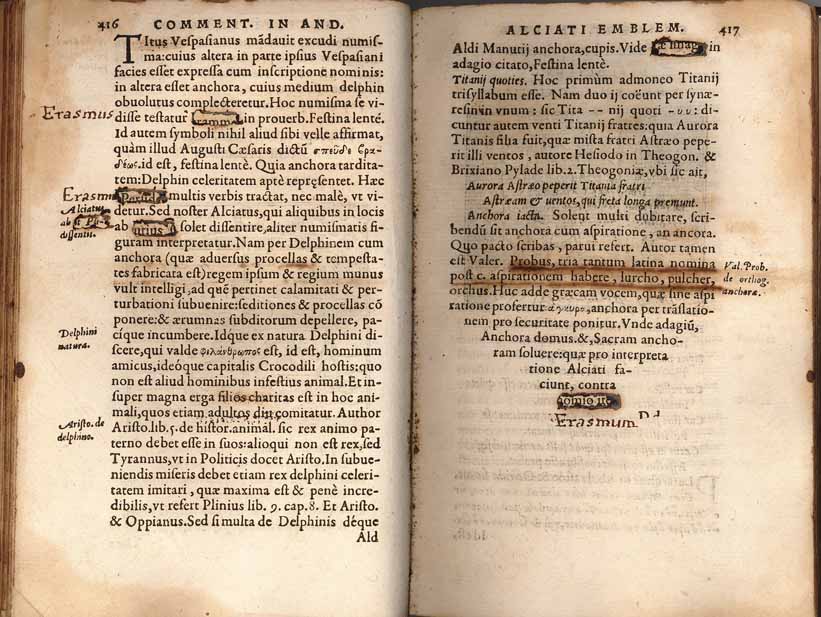
Bokworms likewise devore the volumes of Canisius and Luther, Boccaccio and Nicholas of Lyra, the Revelations and the Malleus Maleficarum. Hunger is not choosy: anything edible will do it as well. But there is a certain bookworm with a highly selective taste. The one that struck this book has consumed exclusively and with zealous gluttony all the areas where the name of Erasmus had been printed.


Most probably the name of this bookworm stands on the flyleaf of the book below the inscription Expurgatus iuxtà Indicis expurgatorii praescripta, “cleaned according to the prescriptions of the Expurgatory Index”. Unfortunately the next owner, angered by the misdeeds of the bookworm, cancelled it as a way of condamnatio memoriae. The year of the mischief, however, has remained clearly legible: 1618.


The new owner, the Canon Giovan Maria Taviani also recorded his name and the year of 1776 when he acquired this book for 13.4 lire, and thus we know who restored carefully the name of Erasmus throughout the book. Well, actually it could have been either him or another owner, as we do not know the full path covered throughout the centuries by this beautiful emblem book of Alciato provided with the notes of Francisco Sánchez – “El Brocense”. We do not know either who decorated it with the delicate red wax seal, almost a cameo. In any case, we are touched by the attention – even if sometimes a bit greedy – with which this book was owned over times. We only want to be a humble link in this chain, and momentarily content ourselves with the restoration of the broken spine.


Gorgojos con manías

Los gorgojos devoran por igual tomos de Canisio o de Lutero, de Boccaccio o de Nicolás de Lyra, el Apocalipsis o el Malleus Maleficarum. El hambre no es remilgada ni hace distingos: si algo es comestible, se zampa y basta. Pero hay un tipo de gorgojo muy selectivo. El que atacó este libro mordió exclusivamente y con caprichosa gula todas las zonas de papel sobre las que venía impreso el nombre de Erasmo.


Quizá el nombre de este gorgojo sea el que vemos escrito arriba de esta página de guarda, bajo la inscripción Expurgatus iuxtà indicis expurgatorii praescripta [expurgado según las prescripciones del Índice de libros prohibidos]. Lamentablemente el siguiente propietario, indignado por la fechoría del gorgojo, lo tachó para privar de su memoria a la posteridad y ahora es difícil leerlo. Queda, eso sí, bien registrado el año del desaguisado: 1618.


Ese nuevo propietario, el canónigo Giovan Maria Taviani, también estampó su rúbrica al comprar el libro en 1776 por 13'4 liras, aclarando así quién restauró celosamente el nombre de Erasmo. Bueno, en realidad, pudo haber sido él u otro propietario, pues desconocemos el recorrido completo de este hermoso Alciato comentado por Francisco Sánchez, El Brocense. Tampoco sabemos quién dejó el delicado sello de lacre, casi un camafeo. En todo caso, nos emociona el cariño —a veces un poco voraz, cierto— con que han poseído el libro a lo largo del tiempo y solo aspiramos a ser un simple eslabón de la cadena. De momento, nos limitaremos a restaurar el lomo, que está despegado.


Hieroglyphs in Philo…

Julia from Borges’ country has sent us an observation together with the consequent considerations worthy of her renowned compatriot.

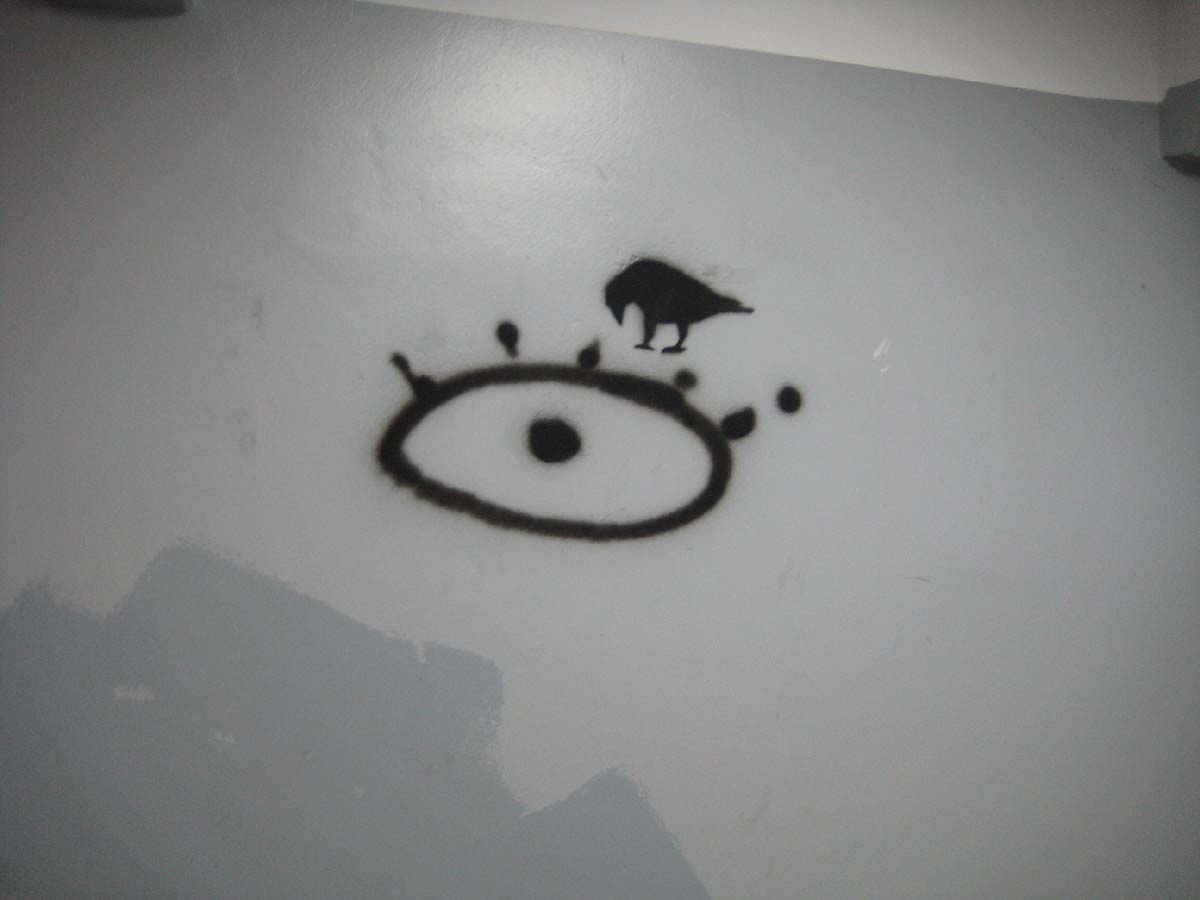
Argentine, Buenos Aires, university, enigmatic/hieroglyphic graffiti: crow with human eye
The eye, symbol of vigilance, confronted me with force as I was going down a side stairway at the Department of Philosophy and Literature of the University of Buenos Aires. This strange inscription on the wall said nothing and explained nothing and it appeared very different from the images of political groups that cluttered the walls in my times as a student.

It’s not that I no longer set foot on this building of my Department, but nowadays I go there once a week and only for a couple of hours in order to give my class and then hurry away. So it’s been years since I wandered along the corridors of the building with the insouciance and the ease of an undergraduate – who is unconscious of this ease as long as he is an undergraduate. But last month I again found myself to be a student in the building of the Department where I had been an undergraduate and, all the better to submerge myself and concentrate on the experience, I was there for five hours every afternoon during a whole week. All this excursus is aimed at the attempt of transmitting my spiritual state of reminiscent discovery at the moment when I was confronted with the image of which we speak: an eye and a bird.

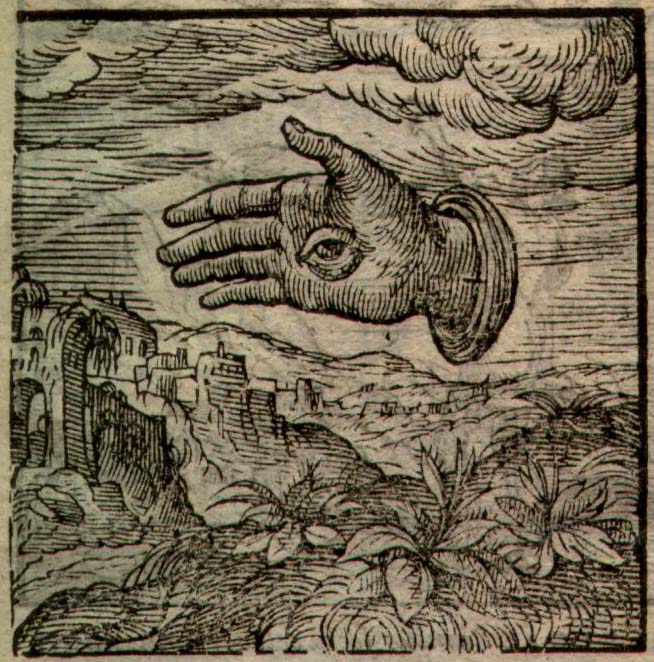
An eye, which, although drafted with spray paint and in very elemental traces, reminded me of the eyes that appeared in the Egyptian-like hieroglyphs which were so popular in the Renaissance, or those that used to be shown in various emblematic compositions (which the master of this blog will be able to illustrate better than myself.)

Alciato, Emblema 16, Ne credasAll right, to answer Julia’s challenge, here you are as an example the well known Emblem 16 of Andrea Alciato: Ne credas (Don’t be an easy-believer), from the 1591 Leiden edition by Plantin.

With in this Renaissance frame of mind, I pictured the bird that accompanied the eye – perhaps without paying much attention to its form – like some kind of a hawk, a street imitation of the Egyptian Horus.

I continued my way down the stairs wondering what it was doing there and what its meaning might be. And the answer appeared accompanying my way down (katabasis). On the following landing of those side stairs, the same black paint, but especially the same bird, made with a stencil that now was accompanied by its anchorage “Breed Crows.”

Argentine, Buenos Aires, university, enigmatic/hieroglyphic graffiti: crow with inscription “Cría cuervos”
Of course! It was a crow! And what do crows do when you breed them (according to the Spanish proverb)? “they will pick out your eyes”… (“Cría cuervos, y te comerán los ojos.”)

I found charming the construction of the message by discontinuous fragments of images and texts and, of course, I couldn’t avoid thinking about the many contacts that it had with the symbolic and emblematic practices of the Renaissance and the Baroque.

The image of the eye and the (now we know) crow was, then, a proclamation that implied a warning and, in fact, it was an accusation. The cautious and vigilant eye of the emblems and hieroglyphs, plays a double role here: to be the sentinel, and, at the same time, the possible victim, of the black crows that prowl about. And, in that passionate tension, it looks at us, transmitting its message with profound power.

In any case, it might be pointed out that the difference of proportions is eloquent. The enormous eye leaves the traitorous crow in an inferior situation. Thus the vigilant role of that prudent eye acquires a greater importance which cautions us.

But these graffiti weren’t the only interesting ones in this my touristic visit to my own Department. The following image completely entrapped me and made me think of the refined symbolic representation that was arising among the students.

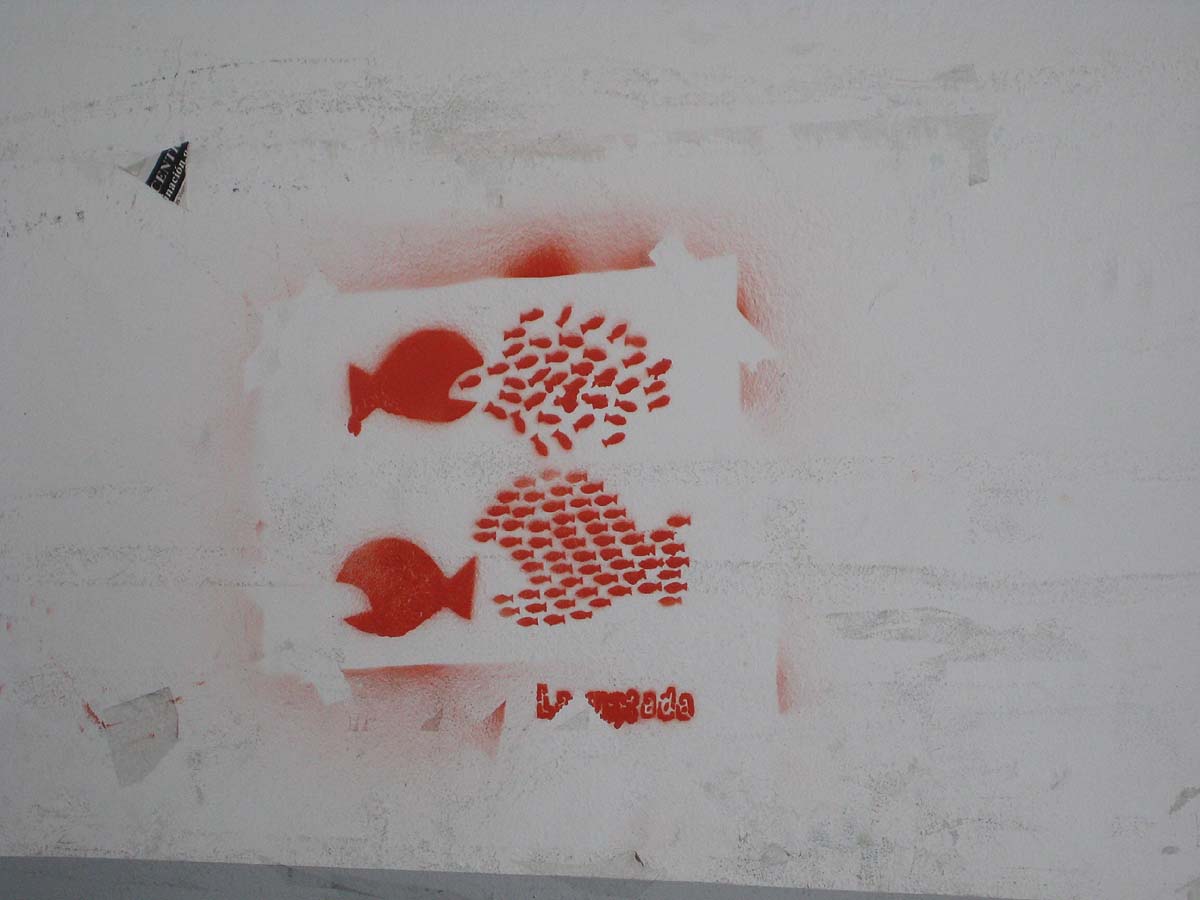
Argentine, Buenos Aires, university, enigmatic/hieroglyphic graffiti: fishes eating each other with inscription “¡Uníos!”
I read it as an anti-imperialist proclamation (in a very wide sense: the union of the little ones that are able to stand up to the mighty), but undoubtedly many interpretations can be given to it. What is doubtless is that the old and well known aphorism (“The big fish eats the small one”) is reversed thanks to the power afforded by union (we all know that “Union is power.”)

Unlike the up to now mysterious image of the crow and the eye, with no explicit attribution, we know that this other is the logo adopted by a student political group, La Juntada.

The condensation and expression of concept is very well achieved and, though I was told that the image was not created by them (maybe this logo can be found in other parts of the Planet, and it would be interesting to find out in what specific function), I thought that they had achieved a perfect fulfillment. (This is where they got the idea, they told me when I contacted them; and these / these / these are other places in the Internet where I found the motif.)

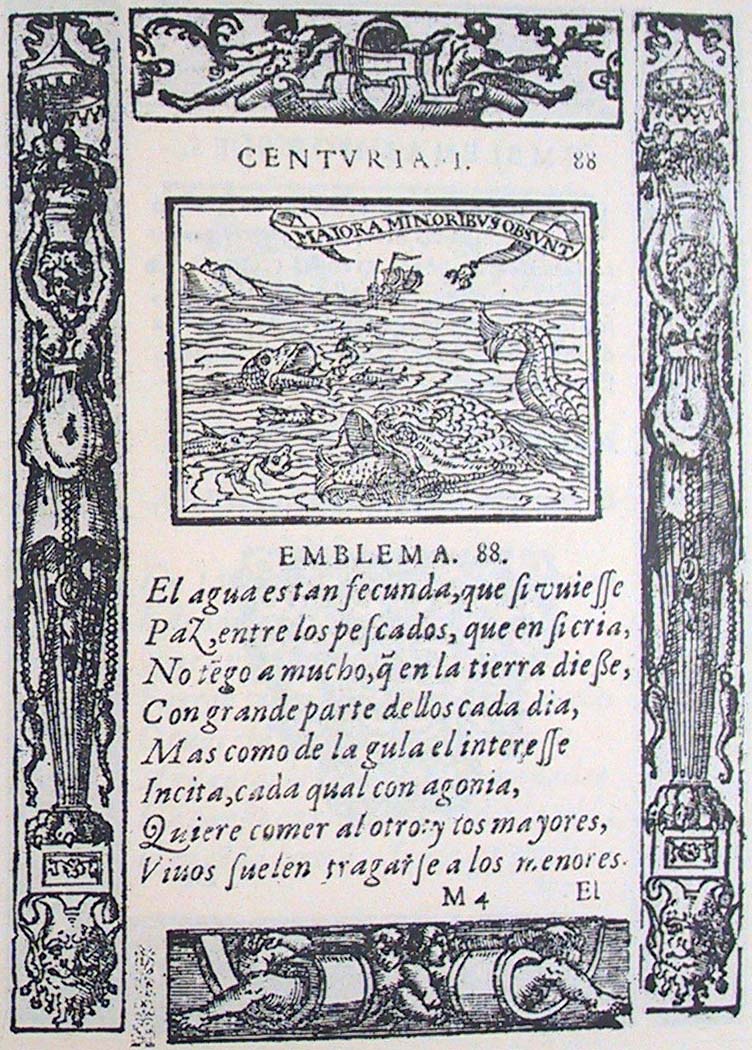
Thus, modern conception counterproposes an attitude which transforms reality (by acting on what is given by nature, we could say) to the traditional, conservative position such as this emblem of Sebastián de Covarrubias (Centuria I, emblema 88 de sus Emblemas morales, Madrid, 1610)

Covarrubias, Emblemas morales, 1611, Emblem I.88The water is so fertile that if there were / peace among the fishes inhabiting it / then it would pour them on the earth / in a great abundance every day. / But as they are all incited by gluttony / each of them makes great effort / to eat the other: and the bigger ones / usually swallow the minor ones alive.

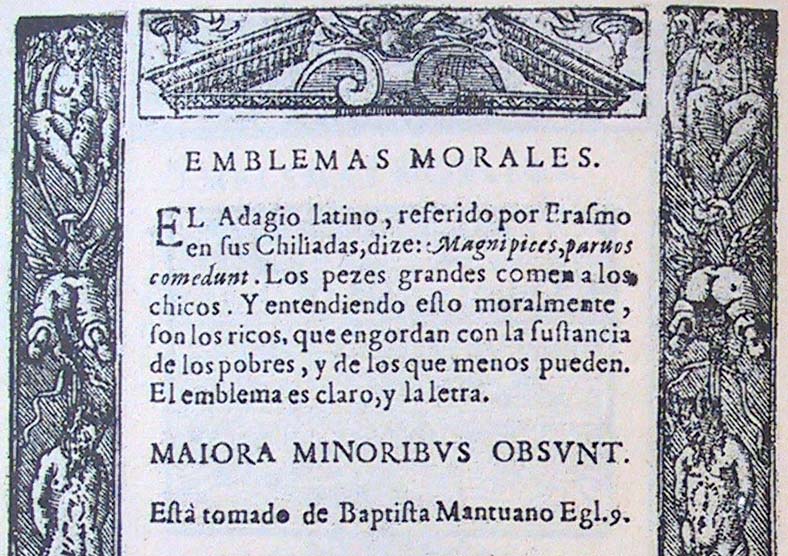
Covarrubias, Emblemas morales, 1611, Emblem I.88, commentaryThe Latin proverb quoted by Erasmus in his Chiliades [the Adagia] says thus: Magni pisces, parvos comedunt. The big fishes eat the small ones. And taken in a moral sense, it is the rich who fatten on the sustenance of the poor and of those less powerful. The emblem is clear, and the motto MAIORA MINORIBVS OBSVNT (The bigger ones block the road of the smaller ones) is taken from Book 9 of the Eclogues of Battista Mantovano.

It is true that Covarrubias employs a certain sorrowful tone on verifying such a harsh truth and we are aware of the denouncement of the rich “that fatten on the sustenance of the poor”. But in any case there is no doubt that this example of the fish is shown as something impossible to modify. Moreover, I cannot completely decide whether what the epigram expresses about the abundance of fish that we would have on land if the fact that the fish eat each other did not exist, is something positive – there would be more food for men – or negative – fish would invade us and take over power!)

How many transformations have taken place so that if formerly, nature was used as an allegory of human society, now nature is transformed ironically and allegorically with the advances of social organization. Man imposes his cosmos on the world and no longer sees himself as a microcosmos.

Jeroglíficos en Filo…

Julia from Borges’ country has sent us an observation together with the consequent considerations worthy of her renowned compatriot.

Argentine, Buenos Aires, university, enigmatic/hieroglyphic graffiti: crow with human eye
El ojo, símbolo de la vigilancia, se me apareció con fuerza al bajar por una escalera lateral de la Facultad de Filosofía y Letras de la Universidad de Buenos Aires. Nada decía, ni nada explicaba esta pintada extraña en la pared, que resultaba muy diferente de las imágenes de agrupaciones políticas que surcaban las paredes en mis tiempos de estudiante.

No es que ya no pise más ese edificio de mi facultad, pero ahora voy una vez por semana y sólo dos horas para dar mi clase y volverme a las apuradas. Así es que hacía años que no recorría los pasillos del edificio con el diletantismo y la tranquilidad del estudiante —que no sabe de su tranquilidad mientras lo es—. Pero el mes pasado volví a ser estudiante en el edificio de la facultad donde cursé el grado y, para mejor inmersión y concentración de la experiencia, fui cinco horas todas las tardes durante una semana entera. Todo este excursus, para intentar transmitir mi ánimo de descubrimiento reminiscente cuando me topé con la imagen de marras: un ojo con un ave.

Un ojo que, aunque hecho con aerosol y trazos muy básicos, me hizo pensar en los ojos que aparecían en los jeroglíficos de aire egipcio que tanto gustaban en el Renacimiento o los que solían representarse en diversas composiciones emblemáticas (que el dueño de este blog sabrá ilustrar y ejemplificar mejor que yo).

Alciato, Emblema 16, Ne credasAll right, to answer Julia’s challenge, here you are as an example the well known Emblem 16 of Andrea Alciato: Ne credas (Don’t be an easy-believer), from the 1591 Leiden edition by Plantin.

Al estar en ese ánimo renacentista, imaginé el ave que lo acompañaba —sin prestar mucha atención a su forma tal vez— como algún tipo de halcón, un remedo callejero del Horus egipcio.

Bajé las escaleras preguntándome qué haría eso ahí y cuál era su sentido. Y la respuesta llegó acompañándome en el descenso (¿catábasis?). En el siguiente descanso de aquella escalera lateral la misma pintura negra, pero especialmente la misma ave hecha con esténcil que ahora venía con su anclaje “Cría cuervos”.

Argentine, Buenos Aires, university, enigmatic/hieroglyphic graffiti: crow with inscription “Cría cuervos”
¡Claro, era un cuervo! y ¿qué hacen los cuervos cuando uno los cría (según el refrán español)?: “…te sacarán los ojos” .

La construcción del mensaje mediante fragmentos discontinuos de imágenes y textos me pareció encantadora y por supuesto no pude dejar de pensar en los muchos contactos que tenía con las prácticas simbólicas o emblemáticas del Renacimiento y el Barroco.

La imagen del ojo y el (ahora sabemos) cuervo era entonces una proclama que llamaba a la advertencia y se trataba en definitiva de una denuncia. El ojo cauteloso y prudente de los emblemas y jeroglíficos, aquí cumple una doble función: ser el vigía y al mismo tiempo la víctima posible de los negros cuervos que andan por ahí. Y en esa tensión patética nos mira transmitiéndonos su mensaje con una fuerza profunda.

De todas formas, habría que notar también que las diferentes proporciones son elocuentes. El ojo enorme deja en inferioridad de condiciones al cuervo traidor. Con lo cual cobra mayor peso el papel vigilante de ese ojo prudente que nos advierte.

Pero esos graffiti no fueron los únicos interesantes en mi visita turística a la propia facultad. Esta otra imagen me atrapó totalmente y me hizo pensar en la refinada representación simbólica que se estaba dando entre los estudiantes.

Argentine, Buenos Aires, university, enigmatic/hieroglyphic graffiti: fishes eating each other with inscription “¡Uníos!”
Yo lo leí como un alegato anti-imperialista (en sentido bien amplio: la unión de los menores que puede enfrentar al poderoso), pero sin duda se le pueden dar muchas interpretaciones. De lo que no cabe duda es de que la sentencia conocida y de larga tradición (“El pez grande se come al chico”) se utiliza invertida gracias al poder que da la unión (todos sabemos que “La unión hace la fuerza”).

A diferencia de la hasta ahora misteriosa imagen del cuervo y el ojo, sin atribución explícita, sabemos de esta otra que es el logo que adoptó una agrupación política estudiantil, La Juntada.

La condensación y expresión del concepto es muy lograda y, si bien me han dicho que la imagen no fue creada por ellos (quizás alguien encuentre este logo en otras partes del planeta, y sería interesante ver con qué función específica), me pareció que alcanzaron una realización perfecta. (De aquí sacaron ellos la idea, me dijeron cuando los contacté para consultarlos; y éstos / éstos / éstos son otros lugares de Internet donde encontré el motivo.)

De esta forma, la concepción moderna contrapone una toma de posición transformadora de la realidad (de acción sobre lo dado por la naturaleza, diríamos) que responde a la posición tradicional y conservadora, como puede ser la de este emblema de Sebastián de Covarrubias (Centuria I, emblema 88 de sus Emblemas morales, Madrid, 1610)

Covarrubias, Emblemas morales, 1611, Emblem I.88
Covarrubias, Emblemas morales, 1611, Emblem I.88, commentary
Es verdad que Covarrubias tiene un cierto tono de pesar por la comprobación de una verdad tan dura y no se nos escapa la denuncia a los ricos “que engordan con la sustancia de los pobres”. Pero de todos modos no hay duda de que este ejemplo de los peces se muestra como algo imposible de cambiar (incluso no me termino de decidir si lo expresado en el epigrama sobre la abundancia de peces sobre la tierra que tendríamos si no se diera esta situación de comerse unos a otros, es algo positivo —habría más alimento para los hombres— o negativo —¡los peces nos invadirían y tomarían el poder!).

Cuántas transformaciones se han dado para que si antes se usaba la naturaleza como alegoría de la sociedad humana, ahora la naturaleza se transforma irónica y alegóricamente con los avances de la organización social. El hombre impone su cosmos al mundo y ya no se ve a sí mismo como un microcosmos.