Switch over to our new blog! • ¡Pásese a nuestro nuevo blog!

The renewed version of our blog, with more features, a richer design, and available in nine languages, can be read here: https://wangriver.com

The new version also includes the old posts, often in expanded form. If you are curious about the updated version of this post, replace “riowang.blogspot.com/” in the URL with “riowang.studiolum.com/”, and the new link will most likely lead you there.


La versión renovada de nuestro blog, con más herramientas, un diseño más rico y disponible en nueve idiomas, se puede leer aquí: https://riowang.com

La nueva versión también incluye las publicaciones antiguas, a menudo en una forma ampliada. Si tiene curiosidad por la versión actualizada de esta entrada, sustituya «riowang.blogspot.com/» en la URL por «riowang.studiolum.com/es/», y el nuevo enlace probablemente le llevará allí.

Mostrando entradas con la etiqueta crown. Mostrar todas las entradas

The past has begun

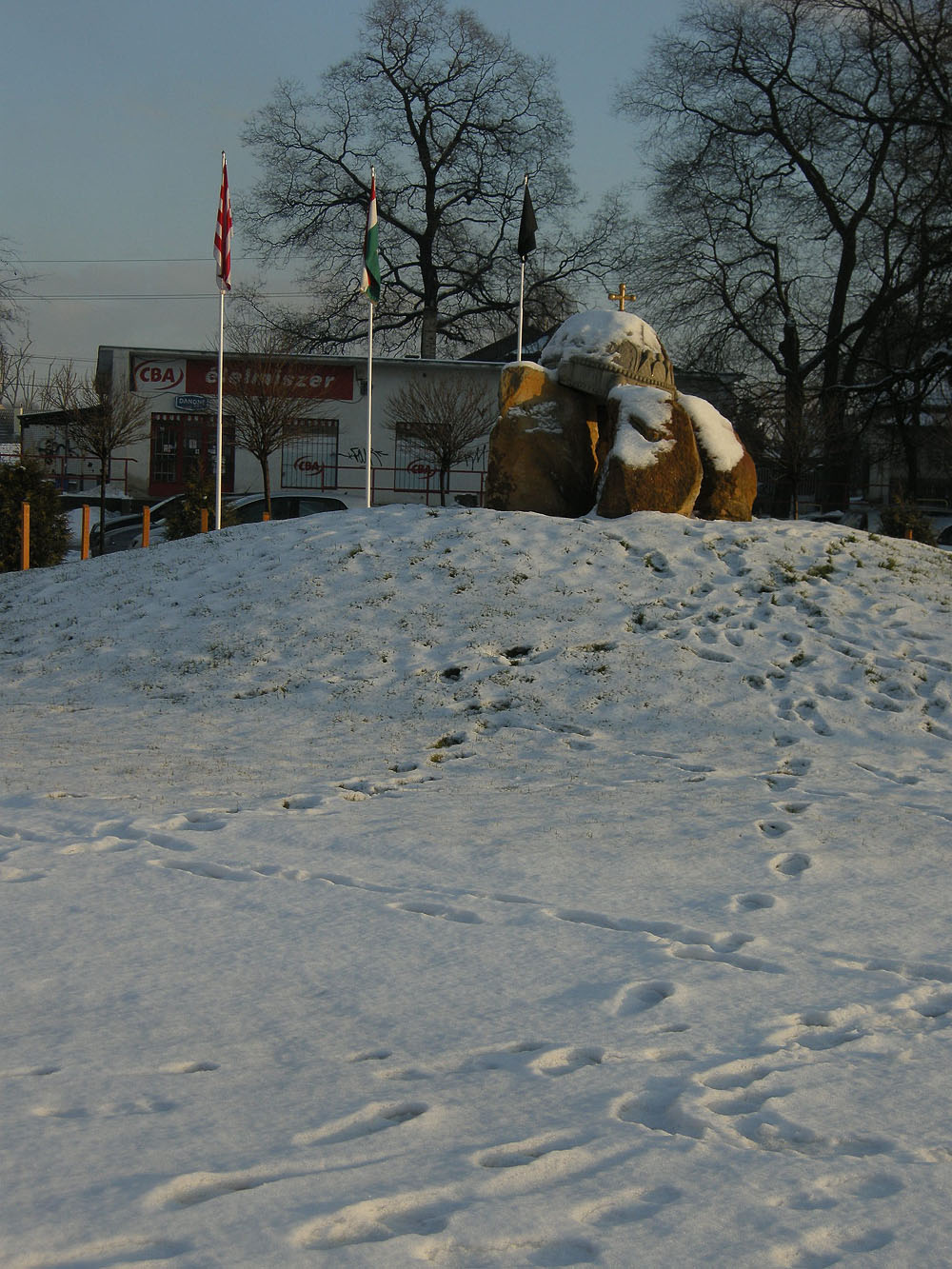
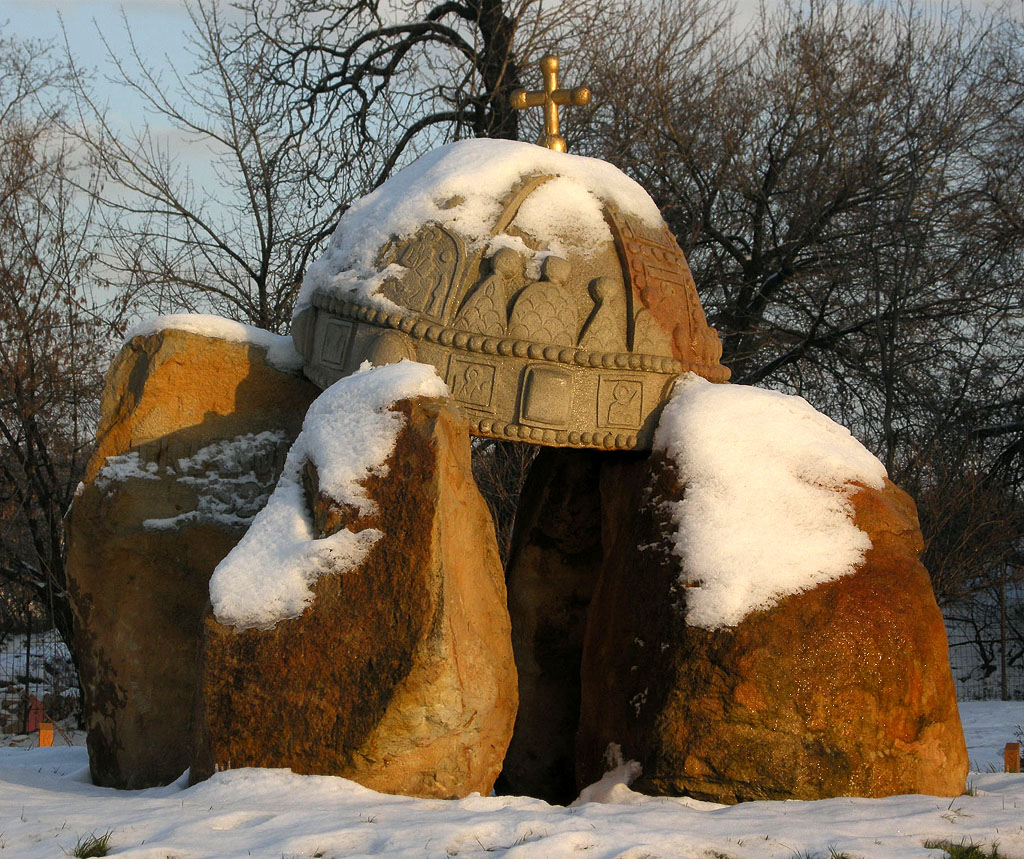
Statue of the Holy Crown of Hungary in front of the Dunakeszi railway station
The borders of our world are not in the distance, on the horizon or in the depths: they glimmer at the immedite vicinity, at the obscure edges of our intimate spaces. Somebody on a morning finds a wriggling sea star on the damp carpet of the living room, or a statuette of a god with an obstinate look in the eye, bird- and turtle-shaped mechanisms that sometimes hum and a red lamp is gleaming on the place of their eyes, or a book printed with unknown letters that include irised illustrations representing jungle temples and tigers. These things arrived to our shores only by mistakes, and then we enwrap them with some kind of substitutive meanings originating in our own experiences, on the basis of false similarities. We are guarded by the protective arm of the careful and perfidious god of the grammar that conceals from us the face of the monsters. (Michal Ajvaz: Druhé město (The other town), Brno 2005)

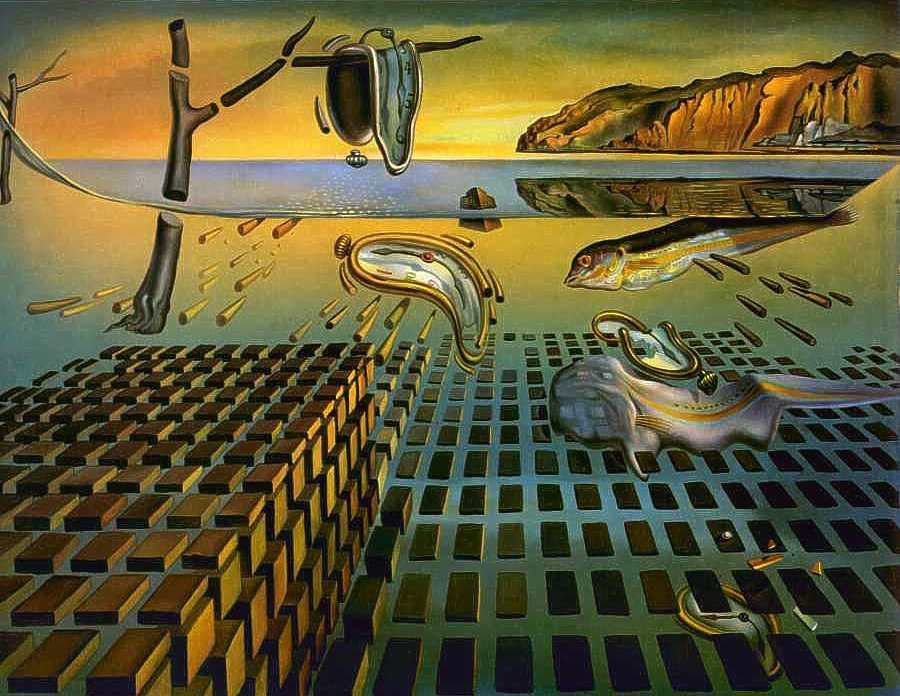
As the objects of the obscure, irrational and surreal “other town” hiding behind the usual and everyday Prague which sometimes penetrate by chance into our world and thus open the eyes of Michal Ajvaz to the existence of that one, are not what they appear to be, the sand container in Petřín is in the reality the lighting-window of the dome of an underground pagan cathedral, and the last door of the basement toilet of the Slavia café opens on an immense jungle cut across by a powerful river, in which the members of a tiger-adoring sect are massacring their own heretics; so the Hungarian crown standing in front of the railway station of Dunakeszi and slowly dribbling on the four Stonehenge dolmens supporting it like the clocks of Dalí, thus dissolving and invalidating the time, is not identical with the Hungarian crown that we have seen in the previous two posts, although it bears a striking resemblance to it. For the one we have seen in Iran and Austria, is the insignia of the Hungarian kings since the 12th century which, with its components coming from different countries, with the beautiful enamel images from 11th-century Limoges and 12th-century Byzantium, with the portrait of the Byzantine emperor Michael Dukas inserted on the place of a former icon of the Virgin Mary, with the cross standing obliquely but proudly on its top, and with its history full of vicissitudes is a true portrait of the thousand years old Hungarian statehood. The crown modeled in Dunakeszi, however, is a several thousand or ten thousands year old jewel of Hun or Sumerian origin – anyway, the both are the same –, a magic model of the cosmos, an energy center, sum of an infinite knowledge coming from outside the Earth or from the collective unconscious of mankind, the tabernacle of the religion of the highest order that has ever existed or that can be conceived. At least this is what the members of this esoteric Hungarian sect, unfortunately growing in number, preach of it.
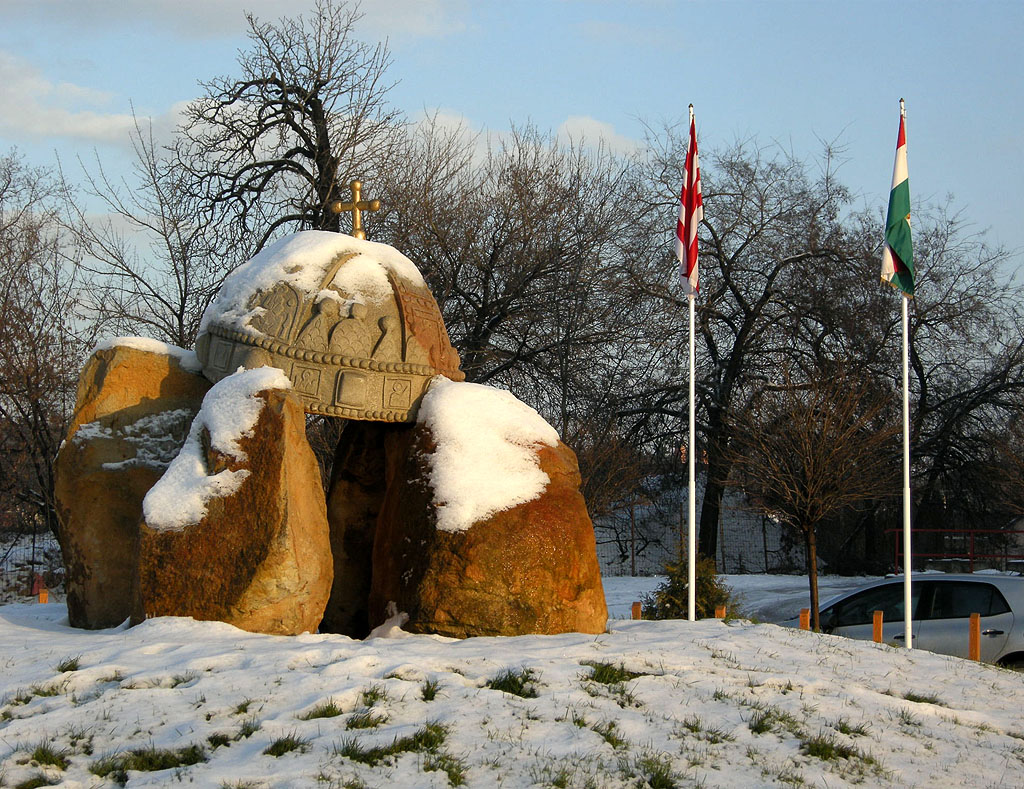
Statue of the Holy Crown of Hungary in front of the Dunakeszi railway station
The priests and believers of this religion are among us, like the night high priest of the faith of Dargúz in Ajvaz’s novel who in the daytime is the waiter of the restaurant of Pohořelec. They are stubborn Calvinists holding in contempt all kind of Popist idolatry, but uttering with the utmost respect the name of the Holy Crown. Catholics taking Communion every day, but propagating the Gospel of the Holy Crown every week in the Tuesday prayer meeting with the devote support of the parish priest. Department leaders of the Hungarian National Library who open the halls of the library to the mission of this cult. Architects – a most important order of knighthood of this religion – of whom you hope statically reliable houses and you receive the pattern design of the lines of force of the Holy Crown embracing the universe. Goldsmiths, sculptors and applied artists who on the one hand guarantee with their name for the authenticity of the myth of origin of this cult object, and on the other hand fill with works of art inspired by the myth the cultural centers, public squares, institutions and publications. Their presence is more perceptible in the countryside where I live than in the city where – as Ajvaz puts – the arm of the careful and perfidious god of the grammar conceals from us their network and their communities, on whose regular gatherings the wandering prophets of this faith József Molnár V., Gábor Papp, Lajos Szántai and their disciples steadily provide with spiritual food the believers of this mistery religion.
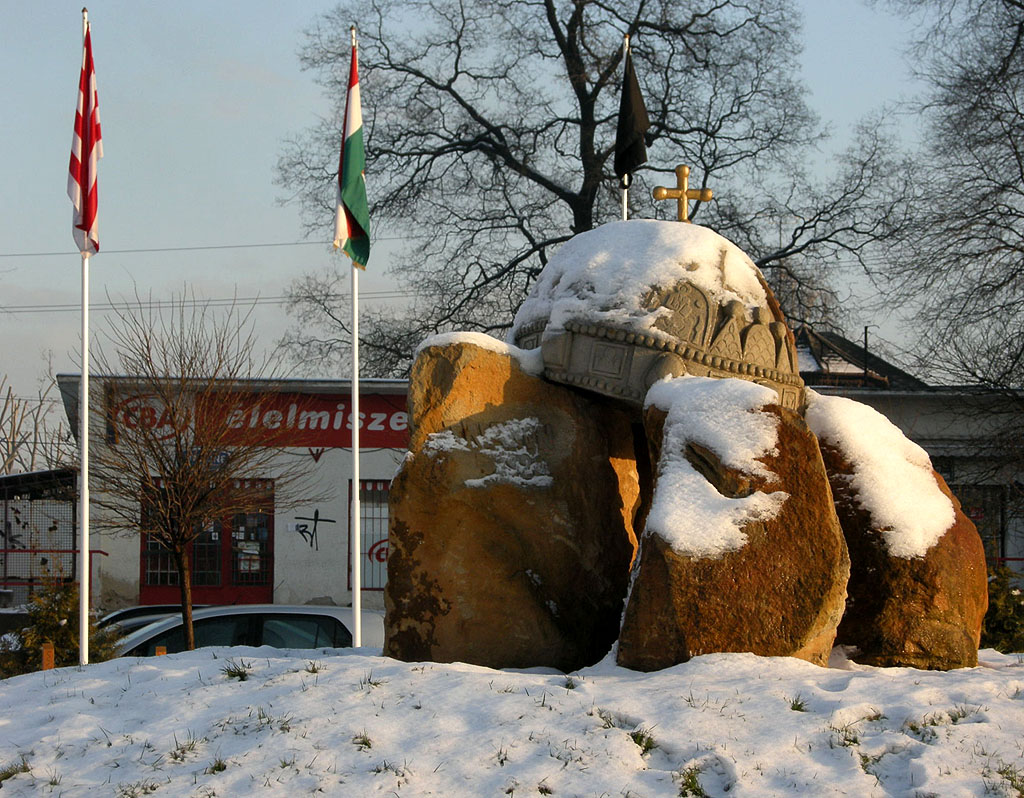
Statue of the Holy Crown of Hungary in front of the Dunakeszi railway station
The crown in Dunakeszi refers to this still hiding world not only with its typical stylistic marks – its stiff, idol-like elaboration, its rustic dolmens and the burial hill heaped up under them –, but also with the fact that it visualizes an important article of faith of this cult: that the angle of inclination of the cross on the top of the crown is exactly identical with the angle of obliquity of the axis of the Earth. The sculptor, in order to emphasize this dogma, slipped the crown on the dolmens so that now everything is oblique on it, except for the only really oblique element, the cross, which thus stands erect perfectly vertically towards the sky, parallel with the axis of the Earth, looking exactly on the North Star like a small magic antenna.

Kacsintós Shakespeare / ravasz Sekszpir Viliam, Cseh Tamás - Bereményi Géza számának illusztrációja.....In order to make realistic
the implausible hunch on your back,
you must simply bend the back of the world
on the model of your hunch.

Tamás Cseh - Géza Bereményi:
Song about the Wily William Shakespeare

Still hiding world, I say. Because if the book of Michal Ajvaz mapped how an “other world” imperceptibly fills in the cavities of the usual everyday reality, another Czech author, Karel Čapek has described in his War with the salamanders what happens when the situation becomes unstable, and that other, dark and surreal world breaks with a great force into ours.

Statue of the Holy Crown of Hungary in front of the Dunakeszi railway station
May God save us of such eventuality.

Tale to size


write you the tale about the bear and the crown. let there be also the padishah of Madjaristan.
comment by Anna to the previous post (in the Hungarian version of the blog)

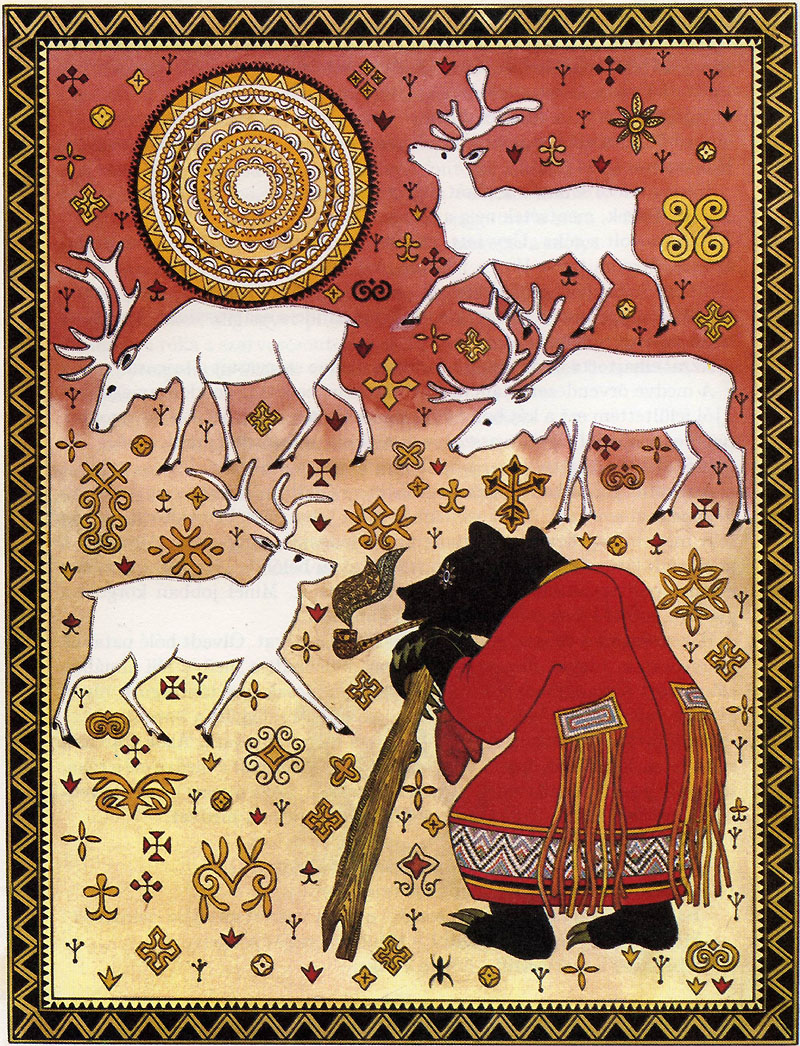
Illustration of Gennadiy Pavlishin to the Tales of the river Amur
Once upon a time there was a bear living in the middle of a big round forest. The crowns of the high trees of the forest leaned against each other like the vault of a church. Under them there was an eternal, pleasant half-light reigning, no rain poured and no wind raged ever. The bear loved the forest very much, he loved to go around in it and to have talks with the other animals about the things of the forest. And he thought it would be like this in all his life.

Illustration of Gennadiy Pavlishin to the Tales of the river AmurIllustrations of Gennadiy Pavlishin to the Tales of the river Amur

On a day, however, the bear somehow got to the edge of the forest, of which he had known only from hearsay before. He came out from between the trees, and caught sight of the blue sky with the sun shining on it brilliantly. Unknown flowers were blooming on the meadow and deers were grazing on it, whom the bear had never seen before – their huge antlers were too large for the thick forest. “My God, how beautiful is the world outside the forest!” – the bear thought in astonishment. From that time on he went day by day to the edge of the forest to have a look at that wonderful view, until on a day he said: “I go and see what else is there in the world over the meadow.” And he left the forest without looking back any more.


Photis Ionatos: Ithaca, poem by Kavafis. From the CD “Ithaque”

Κωνσταντίνος Π. Καβάφης:
Ιθάκη

Σα βγεις στον πηγαιμό για την Ιθάκη,
να εύχεσαι νάναι μακρύς ο δρόμος,
γεμάτος περιπέτειες, γεμάτος γνώσεις.
Τους Λαιστρυγόνας και τους Κύκλωπας,
τον θυμωμένο Ποσειδώνα μη φοβάσαι,
τέτοια στον δρόμο σου ποτέ σου δεν θα βρεις,
αν μεν' η σκέψις σου υψηλή, αν εκλεκτή
συγκίνησις το πνεύμα και το σώμα σου αγγίζει.
Τους Λαιστρυγόνας και τους Κύκλωπας,
τον άγριο Ποσειδώνα δεν θα συναντήσεις,
αν δεν τους κουβανείς μες στην ψυχή σου,
αν η ψυχή σου δεν τους στήνει εμπρός σου.

Να εύχεσαι νάναι μακρύς ο δρόμος.
Πολλά τα καλοκαιρινά πρωϊά να είναι
που με τι ευχαρίστησι, με τι χαρά
θα μπαίνεις σε λιμένας πρωτοειδωμένους,
να σταματήσεις σ' εμπορεία Φοινικικά,
και τες καλές πραγμάτειες ν' αποκτήσεις,
σεντέφια και κοράλλια, κεχριμπάρια κ' έβενους,
και ηδονικά μυρωδικά κάθε λογής,
όσο μπορείς πιο άφθονα ηδονικά μυρωδικά,
σε πόλεις Αιγυπτιακές πολλές να πας,
να μάθεις και να μάθεις απ' τους σπουδασμένους.

Πάντα στον νου σου νάχεις την Ιθάκη.
Το φθάσιμον εκεί ειν' ο προορισμός σου.
Αλλά μη βιάζεις το ταξείδι διόλου.
Καλλίτερα χρόνια πολλά να διαρκέσει
και γέρος πια ν' αράξεις στο νησί,
πλούσιος με όσα κέρδισες στο δρόμο,
μη προσδοκώντας πλούτη να σε δώσει η Ιθάκη.
Η Ιθάκη σ'έδωσε τ' ωραίο ταξείδι.
Χωρίς αυτήν δεν θάβγαινες στον δρόμο.
Άλλα δεν έχει να σε δώσει πια.

Κι αν πτωχική την βρεις, η Ιθάκη δε σε γέλασε.
Έτσι σοφός που έγινες, με τόση πείρα,
ήδη θα το κατάλαβες οι Ιθάκες τι σημαίνουν.
....Konstantinos P. Kavafis:
Ithaca

As you set out for Ithaca
hope your road is a long one,
full of adventure, full of discovery.
Laistrygonians, Cyclops,
angry Poseidon - don't be afraid of them:
you' ll never find things like that on your way
as long as you keep your thoughts raised high,
as long as a rare excitement
stirs your spirit and your body.
Laistrygonians, Cyclops,
wild Poseidon - you won't encounter them
unless you bring them along inside your soul,
unless your soul sets them up in front of you.

Hope your road is a long one.
May there be many summer mornings when,
with what pleasure, what joy,
you enter harbours you're seeing for the first time;
may you stop at Phoenician trading stations
to buy fine things,
mother of pearl and coral, amber and ebony,
sensual perfume of every kind -
as many sensual perfumes as you can;
and may you visit many Egyptian cities
to learn and go on learning from their scholars.

Keep Ithaca always in your mind.
Arriving there is what you're destined for.
But don't hurry the journey at all.
Better if it lasts for years,
so you're old by the time you reach the island,
wealthy with all you've gained on the way,
not expecting Ithaca to make you rich.
Ithaca gave you the marvelous journey.
Without her you wouldn't have set out.
She has nothing left to give you now.

And if you find her poor, Ithaca won't have fooled you.
Wise as you will have become, so full of experience,
you'll have understood by then what these Ithakas mean.

During his long journey he met many strange creatures,


saw and heard a lot of strange things,


learned a lot,


made acquaintance with the forgotten streets and backyards of the cities,


some times he got in trouble, but he always managed to fight out of it.


Finally on a day he happened to get to the land of the padishah of Madjaristan.


The padishah of Madjaristan, the terrible tyrant was just struggling with problems of succession out of his own fault.


He thus announced that his beautiful daughter came to an age to marry and was waiting for suitors. And the suitors started to arrive from the direction of the four winds, all kinds of princes and counts and selected Gypsy lads. The princess, however, did not want any of them, because long time before she had seen in a dream that none else but a flying bear would be her choice, arriving to her from a faraway land.

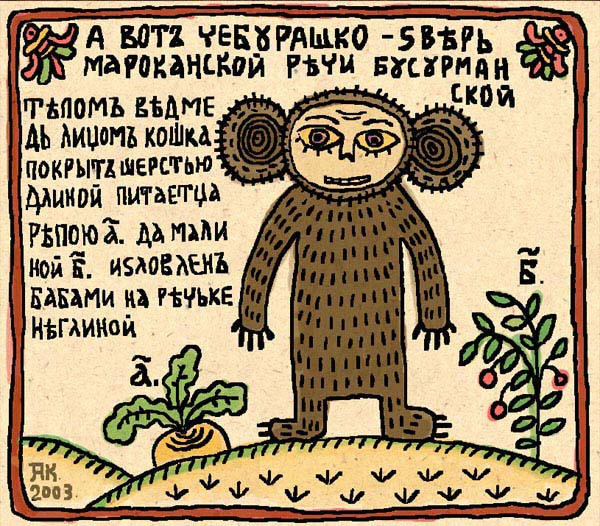
Cheburashka from the modern lubok series by Andrej KuznetsovCheburashka from the modern lubok series by Andrej Kuznetsov

She was sitting day and night on the highest point of the castle and watching whether there is a bear nearing who looks like a small black cloud.


Savina Yannatou and the Primavera en Salonico: Ya salió de la mar la galana (The lady has already come out of the sea), a Sephardic song from Thessaloniki, from the CD “Primavera en Salonico” (Spring in Saloniki)

Muchachicha está en el baño
vestida de colorado.
Échate a la mar.
Échate a la mar y alcanza
– échate a la mar.


A la mar yo bien me echava,
si la suegra licencia me dava.
Échate a la mar.
Échate a la mar y alcanza
– échate a la mar.


Ya salió de la mar la galana
con un vestido al y blanco
ya salió de la mar.

Entre la mar y el río
mos creció un árbol de bembrillo
ya salió de la mar.

La novia ya salió del baño,
el novio ya la está esperando
ya salió de la mar.

Entre la mar y la arena
mos creció un árbol de almendra
ya salió de la mar.
................The girl is in the bath
vested in red.
Swim into the sea.
Swim into the sea and come back
– swim into the sea.


I would happily swim into the sea
if my mother-in-law gave permission.
Swim into the sea.
Swim into the sea and come back
– swim into the sea.


The lady has already come out of the sea
in a red and white vest
she has come out of the sea.

Between the sea and the river
a tree of quince has grown
she has come out of the sea.

The bride has already come out of the bath,
the bridegroom is waiting for her
she has come out of the sea.

Between the sea and the sand
an almond tree has grown
she has come out of the sea.


As soon as she caught sight of him, she immediately recognized him: no doubt, this was the bear she had seen in her dream. She has immediately led him to her father who gave them his blessing together with his crown and half of his kingdom.


And they threw a big wedding party, made merry, the dishes and drinks covered all place from Hencida to as far as Bonchida, and it would have spread even further, but the road over the mountain from Bonchida to Szék was not yet made and even the musicians from Szék had to come to the wedding over Szamosújvár. I was also there, dancing till morning, eating and drinking, seeing and hearing everything, just like I have told it now to you.

Let them live happily until they die and a thousand times more.


The Bear King

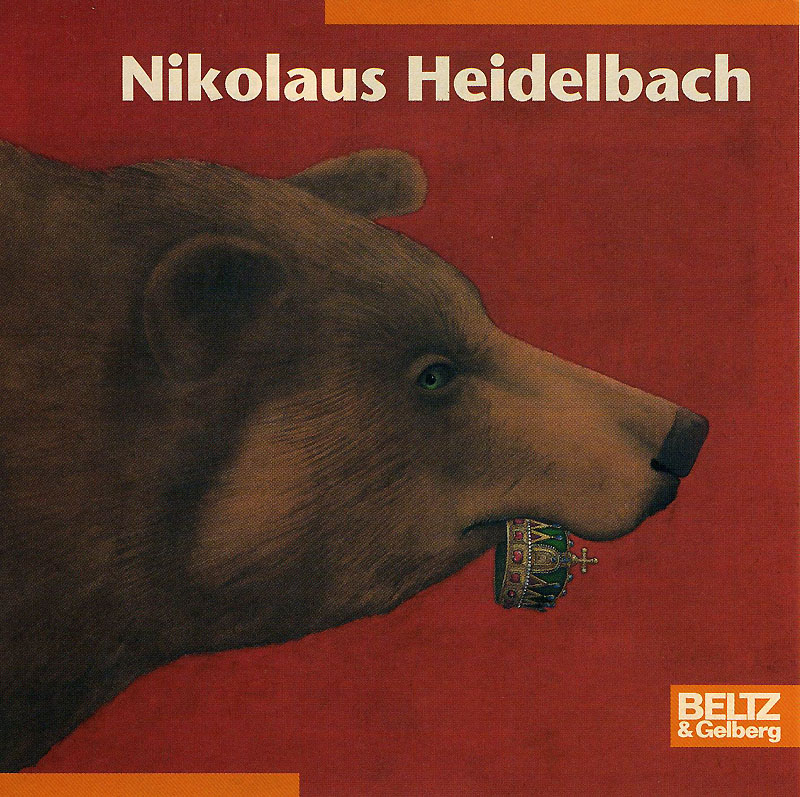
Illustration by Nikolaus Heidelbach on the cover of the Grimm folk tales: a bear with the Hungarian crown
However, the Hungarian crown is known not only to Iranians since their childhood, but also to the inhabitants of such far away, exotic and improbable countries like Austria.

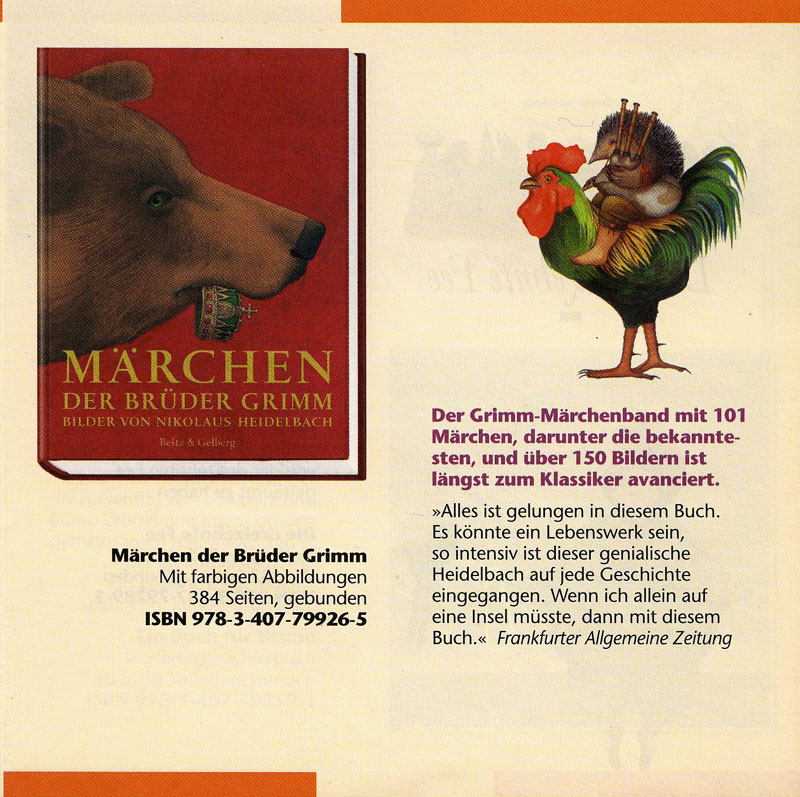
I have seen this book cover in the shopwindow of my favorite bookshop in Vienna, the Morawa in the Wollzeile street, and although I would have entered anyway, now I was immediately looking for this book, an anthology of 101 folk tales by the Grimm brothers with 150 exquisite illustrations by Nikolaus Heidelbach.

Illustration by Nikolaus Heidelbach on the cover of the Grimm folk tales: a bear with the Hungarian crown and a hedgehog with bagpipes riding on a rooster
Strangely, in the book itself I have not found this bear from the cover with the Hungarian crown in its mouth. And what is more, not even a folk tale to which it could have belonged.

After a serious consideration I came to the conclusion that this picture on the cover is a tale in itself, a charming and absurd extra tale, free from any moral lesson, for adults.

Treasures

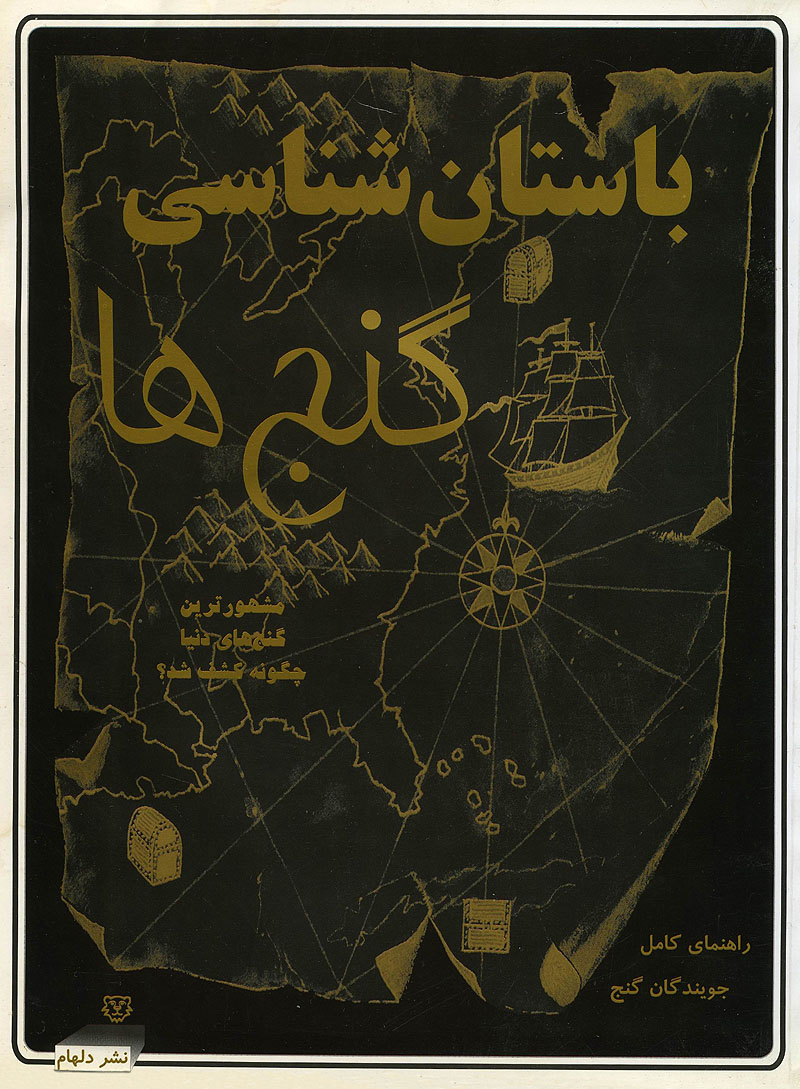
Bâstân-shenâsi: Gench-hâ (Antiquities: Treasures)
I bought this book in Tabriz, just one corner from that church at the bazaar which was already described by Marco Polo. We were accompanied to the church by an unknown old-fashioned Azeri gentleman with little laughing wrinkles in the corner of his eye, whom we approached for directions on the street. The church was closed so that we could not enter, but a very kind elder Azeri woman offered us exquisite Tabriz chocolate in the courtyard. Tabriz is the capital of chocolate as we experienced it in the neighboring confectionery where, while we were having a chat with the pastry-cook, two beautiful local girls praised me for my beard. I don’t know whether they did so because I wore beard like good Muslims, or, on the contrary, because I had cut it short unlike they.

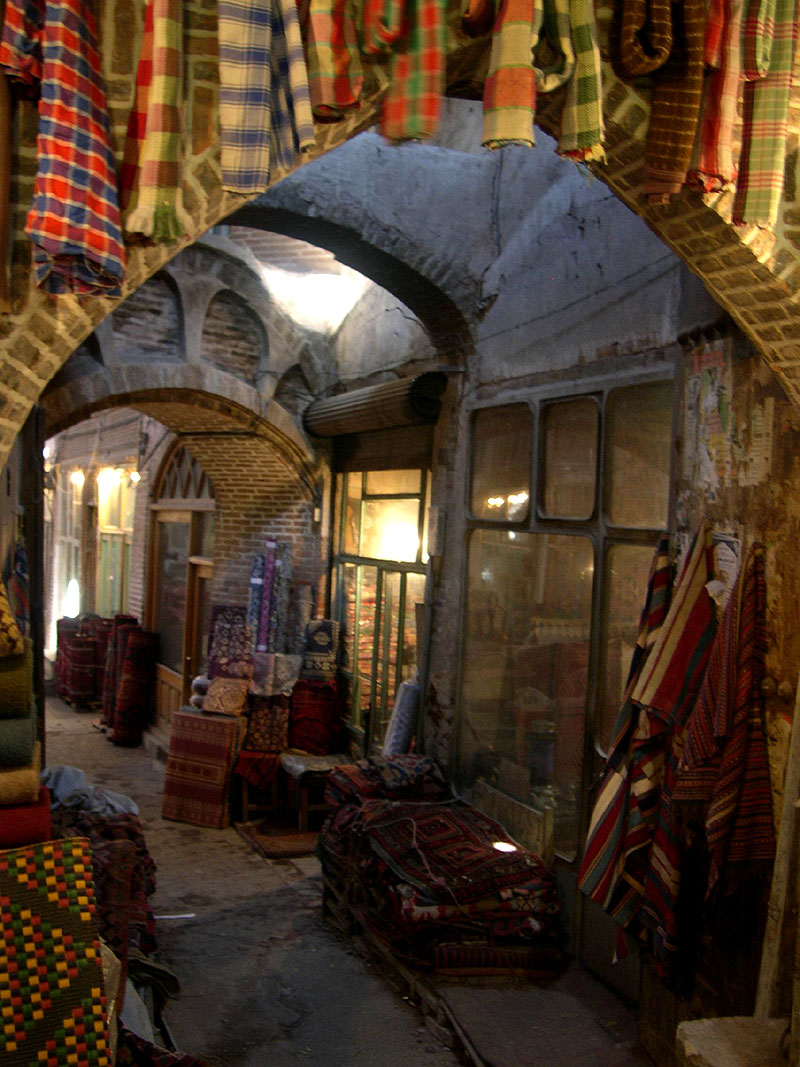
Treasures in the bazaar of TabrizTreasures in the bazaar of Tabriz

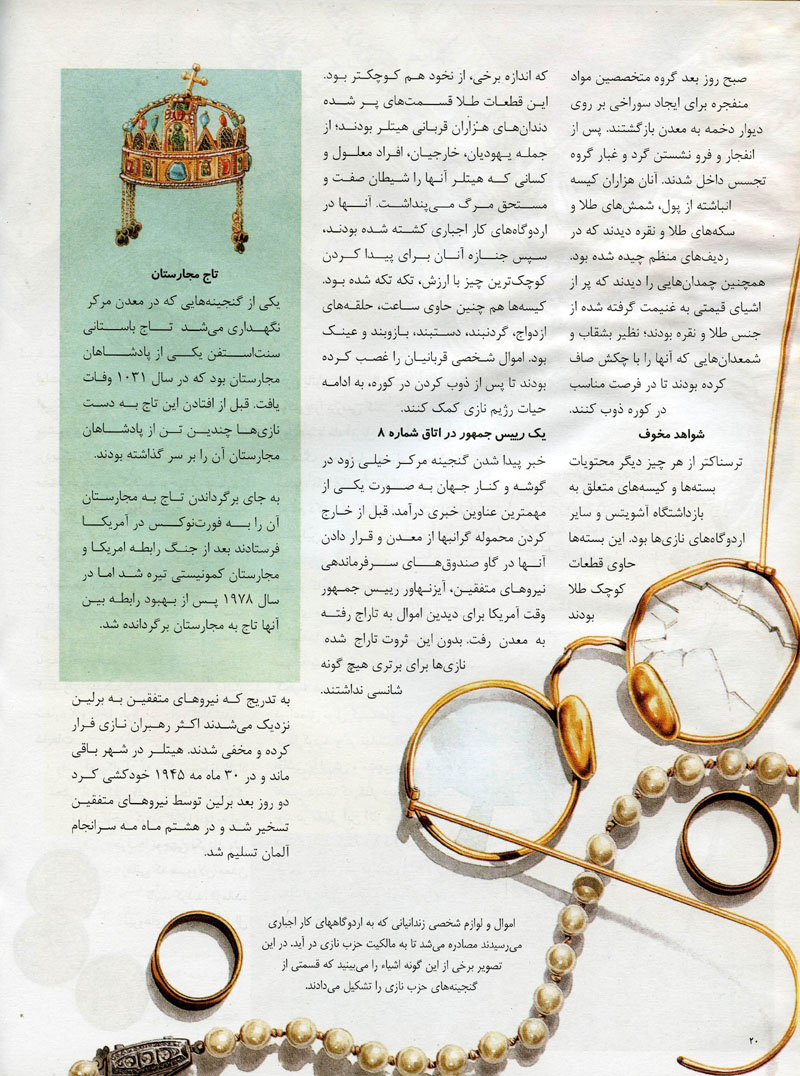
And as if so many treasures found were not enough for a morning, in the bookshop – where we had a long conversation with the extremely intelligent young shopkeeper – I found just this volume entitled Gench-hâ, that is “Treasures” of the series Bâstân-shenâsi (Science of antiquity), introducing with several pictures and well-written concise texts to schoolboys the most remarkable treasures of the world, from those of the Pharaons, of the Scythians and of Troy through those of the pirates, of the Great Armada and of the Titanic to the Aztec golden statues and the treasures robbed by the German army. But Tabriz, with the characteristic generosity of Iranian hosts, managed to add in this volume even to all the treasures of the world two extra treasures that only a Hungarian guest can properly appreciate.

The first one is the title of the book itself. If we omit the -hâ sign of the plural, we get the word gench, which is identical in meaning and similar in sound to Hungarian kincs (pronounced kinch), and even more to its Medieval form kench.

kincs 1213/1550: ? „Iudice Paulo curiali cõite de Bichor, pristaldo Boncy, Cunsudu portato ferro cum solui deberet”, sz. szn. (VárReg. 153.); 1291-4: ? Kuncheý sz. hn. (MNy. 22: 222); 1301: Kynchus sz. hn. (Györfy 1: 731); 1358-9: Kenches sz. hn. (MNy. 16: 38); 1372 u./1448 k.: „kyt en aloytok nagÿ kencznek holot semmÿ” (JókK. 130). J: 1. 1213/1550: ? ’(felhalmozott) anyagi érték, ingó vagyontárgy, értékes, becses valami vagy valaki; Schatz’ (l. fent), 1372 u./1448 k.: ’ua.’ (l. fent); 2. 1416 u./1466: ’kincstár; Schatzkammer’ (MünchK. 40). – Sz: ~es 1301: hn. (l. fent); 1495 e. kinLos hazaba (GuaryK. 111) | ~ez 1416 u./1450 k.: kenLeznèc gr. ’kincset gyűjt, szerez’ (BécsiK. 219). —— Ismeretlen eredetű. 2. jelentésében a lat. thesaurus ’kincs; kincstár’ tükörszava. – Iráni és török származtatása nem fogadható el, a kéj ~ kény szóval való egybekapcsolása is téves. —— CzF.; Vámbéry: NyK. 8: 188; Munkácsi: NyK. 17: 97, 28: 267, 29: 20, AkÉrt. 5: 133, KSz. 1: 242, ÁKE. 412; Miklosich: TENachtr. 1: 74; Asbóth: NyK. 34: 106; Tagányi: MNy. 20: 138; Sköld: UngJb. 5: 435; Melich: AkNyÉrt. 25/4: 35; Fokos: Balassa-Eml. 56; Rásonyi Nagy: UngJb. 15: 551; Horger: MNy. 33: 247, 36: 322; SzófSz.; Kardos: MNyTK. 82. sz. 55. – Vö. köz~.

When checking the roots of the Hungarian word in the A magyar nyelv történeti-etimológiai szótára (Historical-etymological dictionary of the Hungarian language, 1977), there we read: Of unknown origin, and somewhat later: Its Iranian and Turkish etymology is unacceptable. But this affirmation itself seems to be unacceptable, as almost all the great names in the following bibliography stand up for the Iranian and/or Turkish etymology of the word. The names of the Western Hungarian village Gencsapáti and the Eastern Hungarian village Gencs (this latter now in Romania) are both officially said to come from the Iranian/Old Turkish word ‘genj’ = ‘treasure’, and the authoritative Ókori lexikon (Lexicon of Ancient Scholarship) also writes about the name of the Iranian city of Gaza, where the treasure of the Persian kings used to be conserved: “it comes from Sanskrit gandsha, that is treasure, like New Persian gendsh, which gave origin to Old Hungarian gench, treasure.” (This Iranian word is also the root of the Hebrew genizah, of the attic of the synagogue where the manuscripts including the name of God are being accumulated in the course of the centuries, and Dávid Kaufmann could say a lot about what a great treasure this is.) Such bias is a sad, but characteristic feature of this great dictionary of Hungarian etymology, compiled by “hardcore” Finno-Ugrist academicians who will do anything but recognize the Turkish or Iranian roots of “a word of unknown origin”. This has been eloquently and bitterly set forth by Hasan Eren, head of the department of Hungarology at the University of Ankara, honorary member of the Hungarian Academy of Sciences and redactor of the great Turkish dictionary of etymology, in his recension written about the Hungarian dictionary.

But another, much bigger surprise is the other extra treasure to which the book dedicates a special place on the two pages written about the treasures dragged off by the Nazis from the occupied countries.

A magyar korona a perzsa „Kincsek” könyvben
The crown of Hungary (Tâdj-e Madjâristân). Among the treasures found in the repository of Merkers, there was also the ancient crown of one of the Hungarian kings, Saint Stephen (Santestefan pâdishâh-e Madjâristân) who died in 1031. Before it got to the hands of the Nazis (nâzi-hâ), several kings of Hungary wore it on their heads.”

True, Saint Stephen died in 1038, but let the first stone be cast on the author by him who can tell the year of the death of King Dareios or Shah Great Abbas with the accuracy of at least one century. This little illustrated description appeared in a popular series, published in a high number of copies in Iran, where everyone we met could tell what the capital of Hungary was. Raise your hand if you have already heard about the Peacock Throne which is of the same importance for Persians, or if you know that the diamond called in Persian Koh-i-Nur, ‘the Mountain of Light’ – the largest one in the world at its times – adorned the crown of Persian rulers before it fell in 1877 into the hands of another occupying army, and from there into that “repository” of London where it has been preserved till our days, the Buckingham Palace.