Switch over to our new blog! • ¡Pásese a nuestro nuevo blog!

The renewed version of our blog, with more features, a richer design, and available in nine languages, can be read here: https://wangriver.com

The new version also includes the old posts, often in expanded form. If you are curious about the updated version of this post, replace “riowang.blogspot.com/” in the URL with “riowang.studiolum.com/”, and the new link will most likely lead you there.


La versión renovada de nuestro blog, con más herramientas, un diseño más rico y disponible en nueve idiomas, se puede leer aquí: https://riowang.com

La nueva versión también incluye las publicaciones antiguas, a menudo en una forma ampliada. Si tiene curiosidad por la versión actualizada de esta entrada, sustituya «riowang.blogspot.com/» en la URL por «riowang.studiolum.com/es/», y el nuevo enlace probablemente le llevará allí.

Mostrando entradas con la etiqueta Dürer; Albrecht. Mostrar todas las entradas

Rhinocerology 5. A distant relative

Although I wanted to speak about the Far Eastern occurrences of the rhinoceros only later, nevertheless now I have to lead forward a Japanese animal. On the one hand because I’m already late with its presentation, for I received it from Komaváry in Tokyo as a New Year present, and on the other hand because it fits very well here, at the end of the Dürer pedigree, as its farthest descendant both in time and in space.

True, the following comics is not about the rhinoceros, but about an elephant… however, wait till the end. And anyway I’m planning to add a post on the elephant and on the rhinoceros, so let this one be a trailer (coming! coming!) to it.

To understand the basic concept of the comics (why does the elephant work like this?) you have to know that the Chinese name of the elephant – 象 xiàng – also means ‘image, imagination’, and this is how it is used in Japanese, too. I don’t know why. It is quite rare in Chinese that a character has two meanings as distant as these. The character itself is simply the image of an elephant, rotated in 90 degrees to economize on space. From the inscriptions of ancient bronzes, oracle bones and stamps this is how we can reconstruct its etymology:

Formation of the Chinese character of elephant 象
In vain I browse through the Chinese historical dictionaries, they do not give any hint as to the reason of this peculiar homonym. However, I seem to remember to have read somewhere in the great French sinologist Claude Larre that around the creation of this character the elephant was on the verge of extinction in China, and soon there was left none. Its Chinese character, however, remained, and in order to take some good use of it, they indicated with it the word ‘image, similarity, imagination’ pronounced in the same way as ‘elephant’: xiàng. By this they also referred, to some extent, to the elephant, for by that time it had become a fabulous, imaginary animal in China. Do you remember the Zen story where blind people feeling the elephant imagine it as a thick column, as a great wall or as a boa, depending on where they stand? 瞎摸象, xiā mó xiàng, “the blind is feeling the elephant”, as the proverb says. Nevertheless, in those times Chinese people with healthy eyes could not have more precise ideas about the look of the animal either.

There exists another character of a similar meaning 像 xiàng, in which the sign for “man” stands in front of the elephant. In Chinese this means ‘portrait, statue’ (surely as a result of the compound “man+image”), while in Japanese, writes Komaváry, it is a component of the word 想像力 sōzōryoku, “imagination.” Is it perhaps the blind man, he asks, feeling the elephant? While I imagine how much it could have stimulated the imagination of old Japanese people when, perhaps once in a life, an elephant appeared in the town and a man in front of it: a showman, a juggler, a tender. Someone like the protagonist of the following story.

The Japanese inscriptions have been translated by Komaváry. You can read them in a popup window by moving above them with the mouse. Images in a row are read from right to left according to the Japanese custom. Our javascript popups do not work in Google Reader, so reader addicts are invited to come in. The elephant will hunch up a bit.

ElefántElefántElefántElefántElefántElefántElefántOrrszarvú
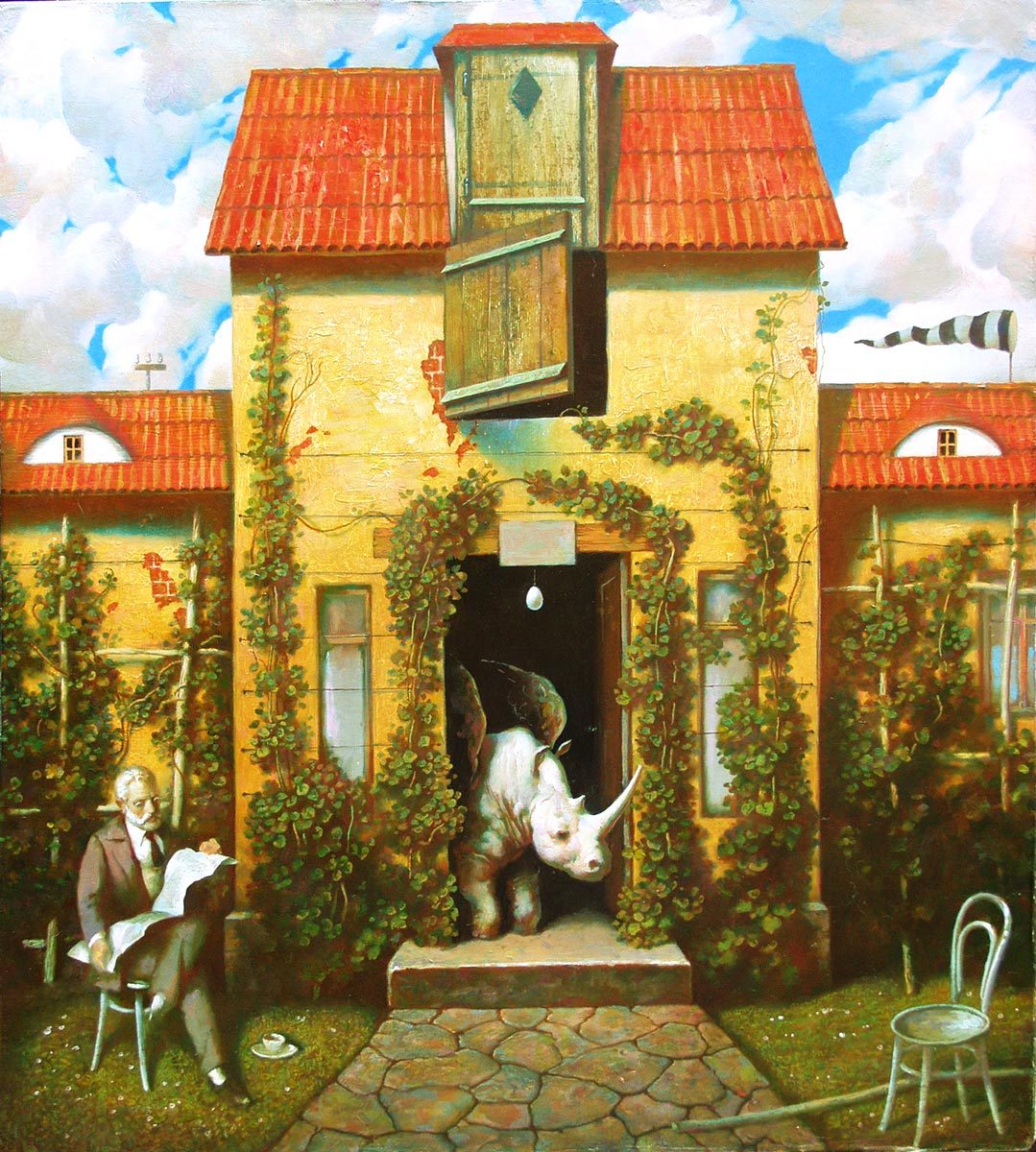
This rhinoceros is the last one not only in the melancholic zoology of the comics, but also in the sense that this animal, published a month ago, in December 2008, is the last descendant of the Dürer woodcut known to me. Have you seen its armory and horn on the withers?

I think this similarity is intentional. For the author could have found a thousand images on living rhinoceroses, and nevertheless he decided to copy the figure of Dürer. This is because to his ingenious story on imagination – xiàng – he needed precisely an imaginary rhinoceros. How can we prove this? With the etymology of the Chinese – and also Japanese – name of the rhinoceros.

The Chinese name of the rhinoceros – 犀 – is a combination of the characters 尾 wĕi ‘tail’ and 牛 niú ‘cattle’, meaning something like ‘cattle with a tail’. That the rhinoceros is similar to the cattle is all right. But why did they emphasize just the tail, perhaps the least significant member of the rhinoceros? To understand it, we have to know that the rhinoceros in Chinese fairy tales – for a real one has been just as unknown there in the last thousands of years as a real elephant – has a long tail. And lo, can you see which tail does this one on the last picture try to conceal behind its tender?…

Perhaps even the elephant leaving on the wings is a reference to the flight of imagination, although I do not know whether this expression exists in Japanese. And although the rhinoceros seems to be a much more down-to-earth being, nevertheless… I only say you’d better take care.

Oleg Dozortzev: A house of the winged rhinoceros, 2008Oleg Dozortzev: A house of the winged rhinoceros, 2008


Rhinocerology 4. The truth suppressed

The rhinoceros of Nicko Rubinstein
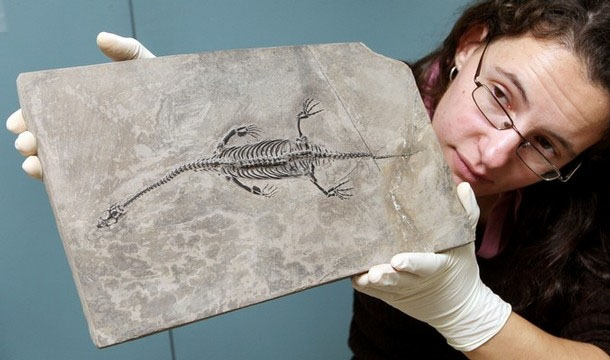
Evolutionary dead-end. This is how biological taxonomy calls those genotypes which branch off the tree of evolution, get stuck and then fall off (can you follow the metaphor?), or else they salvage their gene stock in ecosystems protected from evolutionary competitors and they continue far from the main stream of phylogeny their no longer purposeful race-preserving activity.

The rhinoceros of Nicko Rubinstein
Of course one can establish only retrospectively which of the two branches became the main stream. In a given moment the other one may even have everything in its favor, it can be stronger, more intelligent or beautiful than the main stream. Like, for example, dinosaurs were in contrast to primitive shrew, the first mammal. The main stream, however, has one incomparably great advantage in contrast to the dead end. Namely the fact that retrospectively it was the other that proved to be the dead end.

Examination of a 200 million years old fossil in the Victoria Museum, Australia
Similar branching off happened in the first decades of the 16th century, during the naturalization of the rhinoceros in Europe.

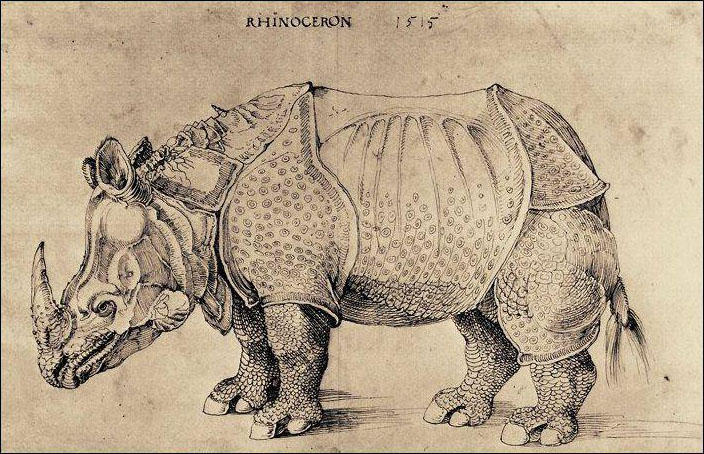
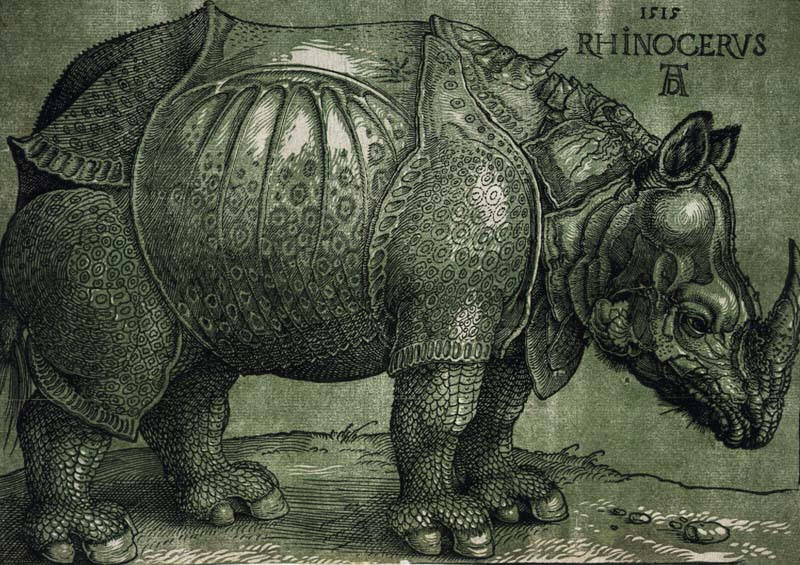
The rhinoceros of Dürer, drawing, 1515
We have seen that Renaissance representations of rhinoceros all derive, either directly or indirectly, from the 1515 engraving of Dürer. And through it from the above preparatory drawing preserved in the British Museum, made by Dürer on the basis of a drawing made from nature of the Lisbon beast.

No wonder that Dürer’s engraving had such success. Its convincing anatomy and statics give the impression of an authentic representation, while its compact modelling and stylized elaboration makes it a captivating picture and a marketable illustration. So much that – as we have already seen and will also see in other examples – even its inaccuracies, the „horn on withers,” the „armory” or the „dragon pattern” were transposed on the copies of other representations of the animal (ancient coins, pictures of different animals). The latest offspring of this engraving was born in December 2008 (!), less than a month ago, but this will be presented in the next post.

However, palaeontologists have recently unearthed also some fossil rhino specimens, which were all born in the same time as that of Dürer and apparently from the same parent, but they differ in some decisive details from the var. Düreris.

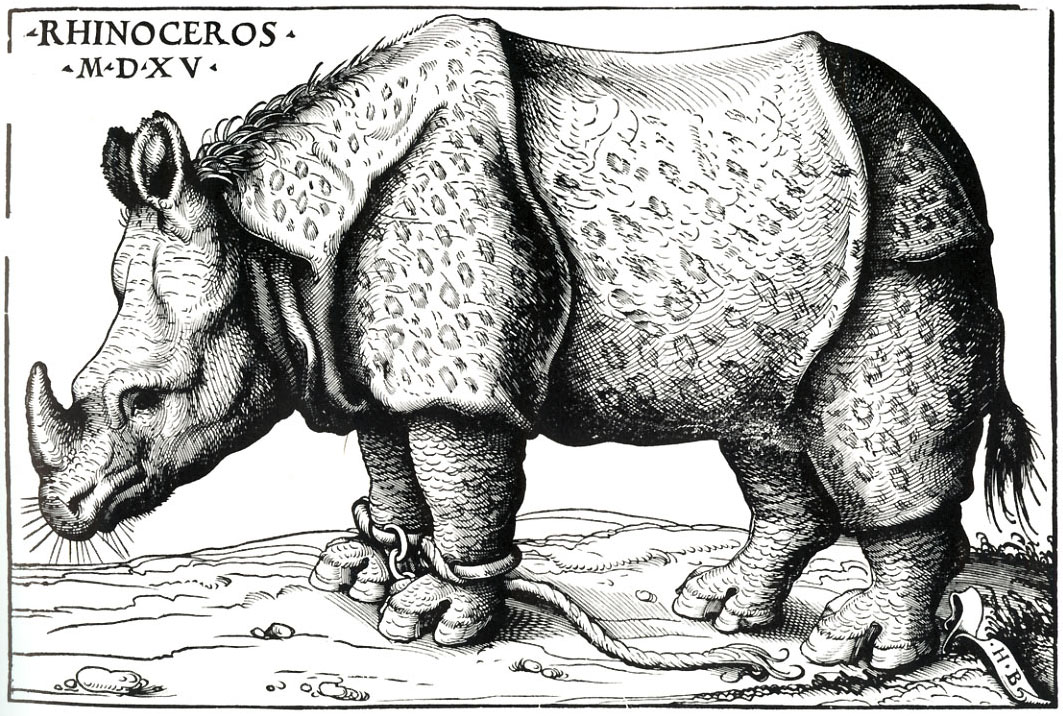
The rhinoceros by Hans Burgkmair, 1515
This woodcut has survived in one single copy in the Albertina of Vienna. Its maker Hans Burgkmair from Augsburg was a student of Martin Schongauer, the most important woodcutter before Dürer. Beginning with 1508 he made several hundreds of woodcuts for Emperor Maximilian I, similarly to Dürer, or often together with him.

Rhinoceros, engraving by Giovanni Giacomo Penni, 1515The source of Burgkmair’s woodcut was apparently the same sketch as to Dürer’s (and probably also to that of Giovanni Giacomo Penni, here to the left). No wonder, for the imperial commissions were procured for both of them by Dürer’s friend, the court humanist Konrad Peutinger of Augsburg. It was probably him who handed over to both of them the original sketch and description sent from Lisbon to “the merchants of Nuremberg.”

It seems that the woodcut of Burgkmair stood closer to the original drawing. It maintained the leg-straps, also visible on Penni’s woodcut, on the forelegs (which contributed to the death of the animal during the naufrage), its skin is more similar to the hard wrinkles of the Indian rhinoceros than the armory drawn by Dürer, and even its pattern is more realistic. According to modern experts, the round spots might be the symptom of the inflammation of skin which can in fact occur among rhinoceroses.

The two woodcuts were made in the same time, by two comparably outstanding masters, for the same public. This public, however, accepted only Dürer’s stylized representation, even making an icon out of it, while rejecting that of Burgkmair, even though this stood much closer to the reality. This rejection was so definitive that had this single copy of the image not survived we would not even known it had ever existed.

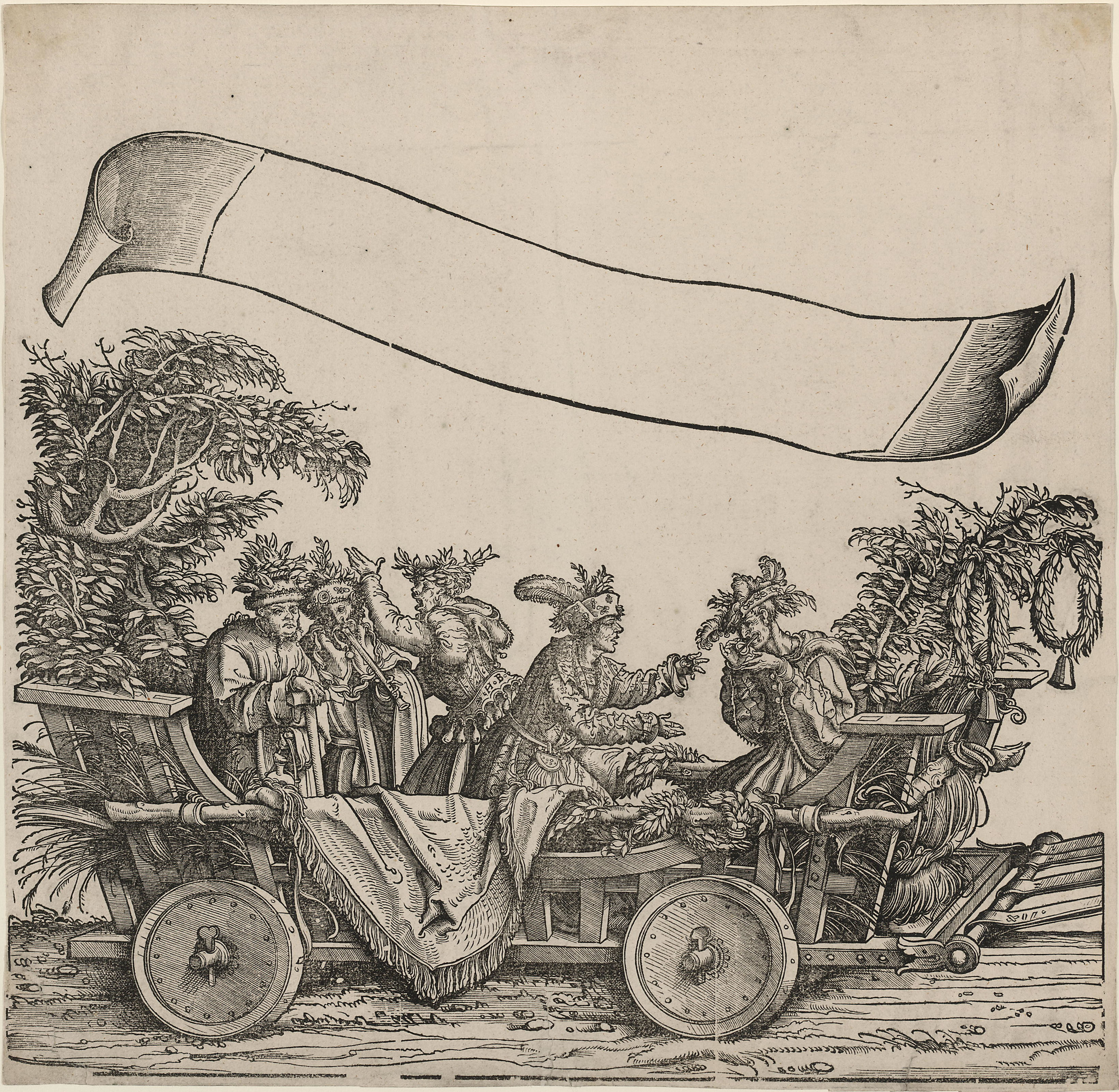
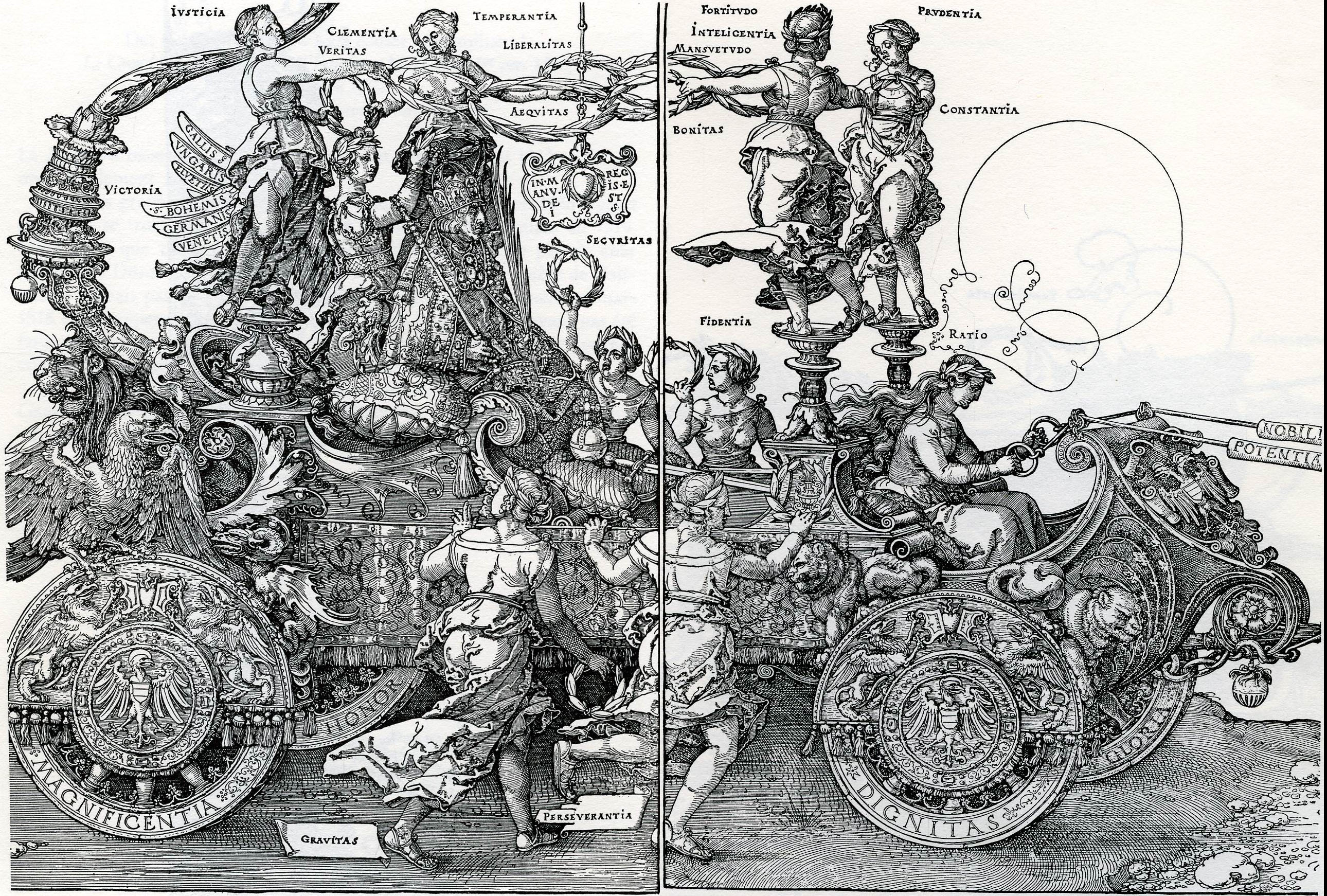
The differences between their respective style are well displayed by the images of the monumental composition The Triumphal Procession of Maximilian I assembled of 135 woodcuts (1518-1522), which were made principally by the two masters. Well, if we are allowed culicem elefanti conferre, to compare a mosquito to the elephant, as their friend Erasmus wrote in the same time in proverb 3.1.27 of his Adages. For Burgkmair’s picture represents the charriot of the jesters, while Dürer’s that of Maximilian himself encircled by his virtues. However, this division of labor is not accidental, but it shows how much more the stylized woodcuts of Dürer alloying Gothic with Quattrocento were appreciated by the period than the more naturalistic, loose-limbed, Brueghelian figures of Burgkmair. (You are recommended to see the pictures also enlarged.)

Hans Burgkmair: Triumphal procession of Maximilian I
Dürer: Triumphal procession of Maximilian I
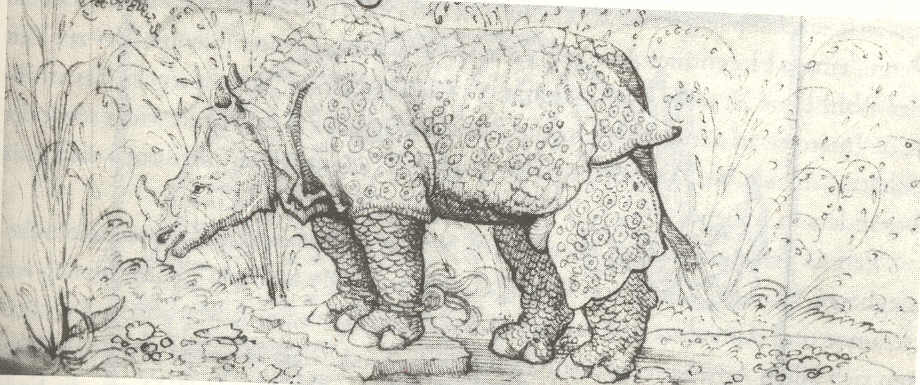
As it often cannot be determined whether two fossils belonged to the same subspecies, so we cannot tell about another individual rhinoceros finding from this period whether it was made after Burgkmair’s woodcut and complemented with some elements of Dürer’s one, or it is rather a direct copy of the lost first sketch. But we think it must be rather this latter. This hypothesis is also supported by the fact that this drawing was made on the commission of Maximilian I, and its master was that most probably the same Albrecht Altdorfer who also prepared some of the woodcuts of the Triumphal procession. This animal survived in a marginal drawing of the prayer book of Maximilian I, made in 1515 and conserved in the Bibliothèque Municipale of Besançon. However, in spite of the distinguished niche and the greater closeness to reality, this representation also succumbed in the struggle for existence to its Dürerian evolutionary rival.

Prayer book of Emperor Maximilian I, 1515
A rudimentary “horn on the withers” occurs in this picture, too. Thus there had to be something already on the first drawing which led to the stylized “second horn” of Dürer’s rhinoceros. I wonder so much what it could have been.

Finally also a third, isolated rhinoceros survived from these years, and in a sculptural form to that, in Westphalia, on the stall erected in 1520 in the choir of the Saint Martin church in Minden. This one was certainly not made on the basis of the original sketch, but of a woodcut, as it was customary in the period. Perhaps right after the woodcut of Burgkmair which thus did not remain without an offspring. This little figure is so plastic, so vivid, that I would gladly continue the phylogenic metaphor by saying that, similarly to the Jurassic fauna surviving on the island of the Pacific, it has also withdrawn to this silent island, rendering its phenotype somewhat piglet-like, and since then it has been living its calm life between two ever-yielding vine trees.

Rhinoceros statuette on the stalls in the choir of Minden’s Saint Martin church, 1520
*

A: But why was it exactly the woodcut of Dürer to become so successful, and why were the others neglected?
B: I write under the drawing of Dürer that on the one hand it gave a very authentic anatomical and statical impression, and on the other hand it was both compact and stylized in a way very much appreciated by the period.
A: I think this is not enough. It also must have contributed to its success that this woodcut is like a jewel, so emblematic and subtly elaborated. The other drawings are so much “animal-like,” you can almost feel their smell.
B: I think this did not disturb the Renaissance at all, they were accustomed to this level of corporeality, and what is more they even required it. Even on the pictures. The great zoology of Gesner from 1551 is full of such pictures. There the illustrations of the ungulates are so similar to the image of Burgkmair that it would have been certainly included if the drawing of Dürer had not existed.
A: Well, that’s right. But even then, it is this stylized and jewel-like appearance that capturates you the most in it.
B: Perhaps we only feel so after the Art Nouveau. It is no chance that Dürer was rediscovered in the 19th century. True, also the Renaissance required a certain degree of stylizedness, especially then, in early sixteenth-century German court art, but this was only one of the ingredients of Dürer’s success, and perhaps not even the more important one. I rather think that his period loved those compact, statue-like figures constituting a space around themselves which were learned by Dürer from the “pathos figures” of the Italian Quattrocento. Such figures are used also in the Triumphal procession, and such is the rhinoceros as well.


Rhinocerology 3. The first litter

Nature imitates art.
Oscar Wilde: Portrait of Dorian Gray

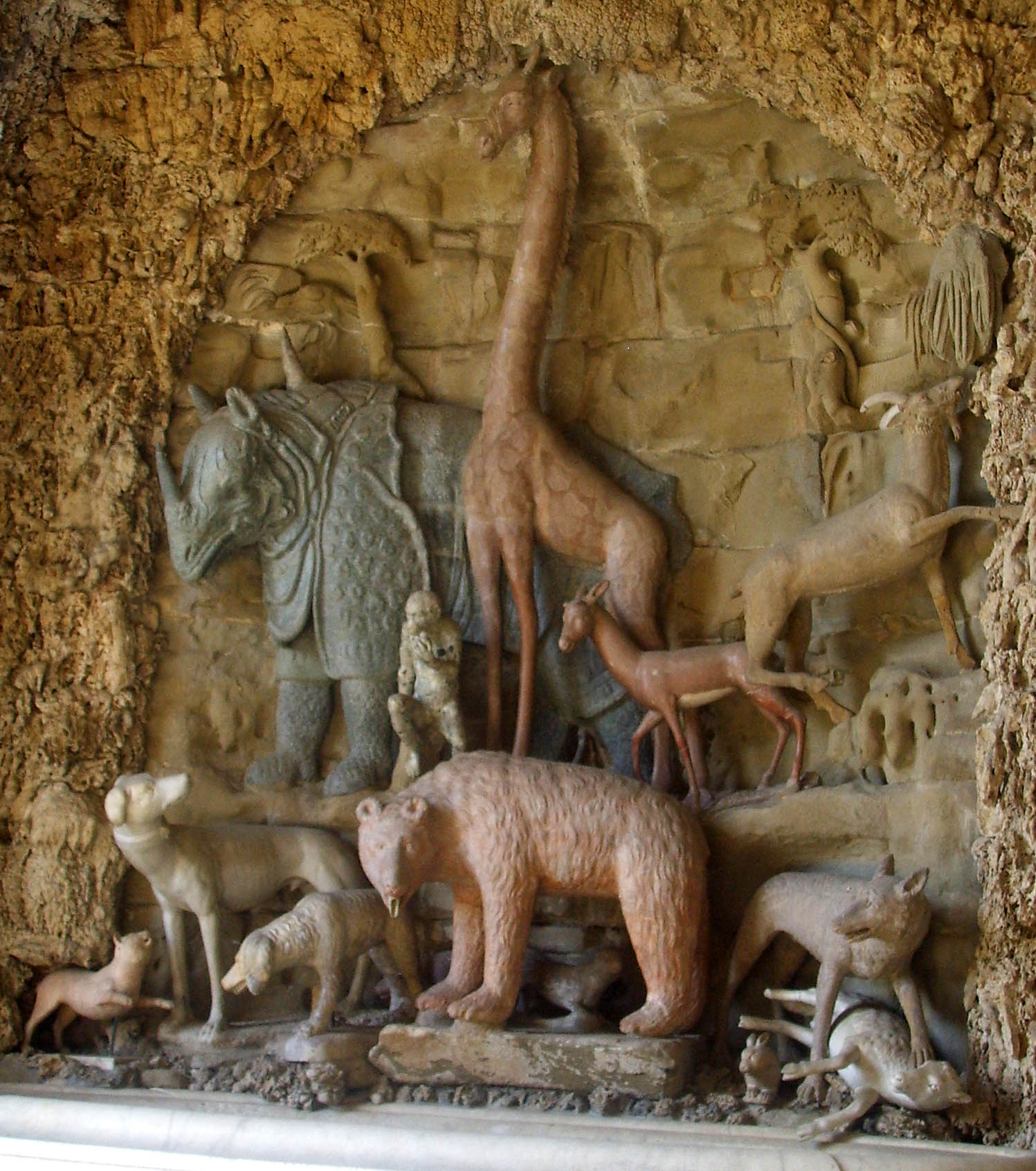
The rhinoceros of Dürer in the Grotta degli Animali of the Villa di Castello of Florence by Giambologna, after 1537Giambologna: Grotta degli Animali, Firenze, Villa di Castello, after 1537

Pisa, Cathedral, detail of the bronze door with the rhinoceros of DürerPisa, Cathedral, detail of the bronze door made by the workshop of Giambologna, first half of the 16th century

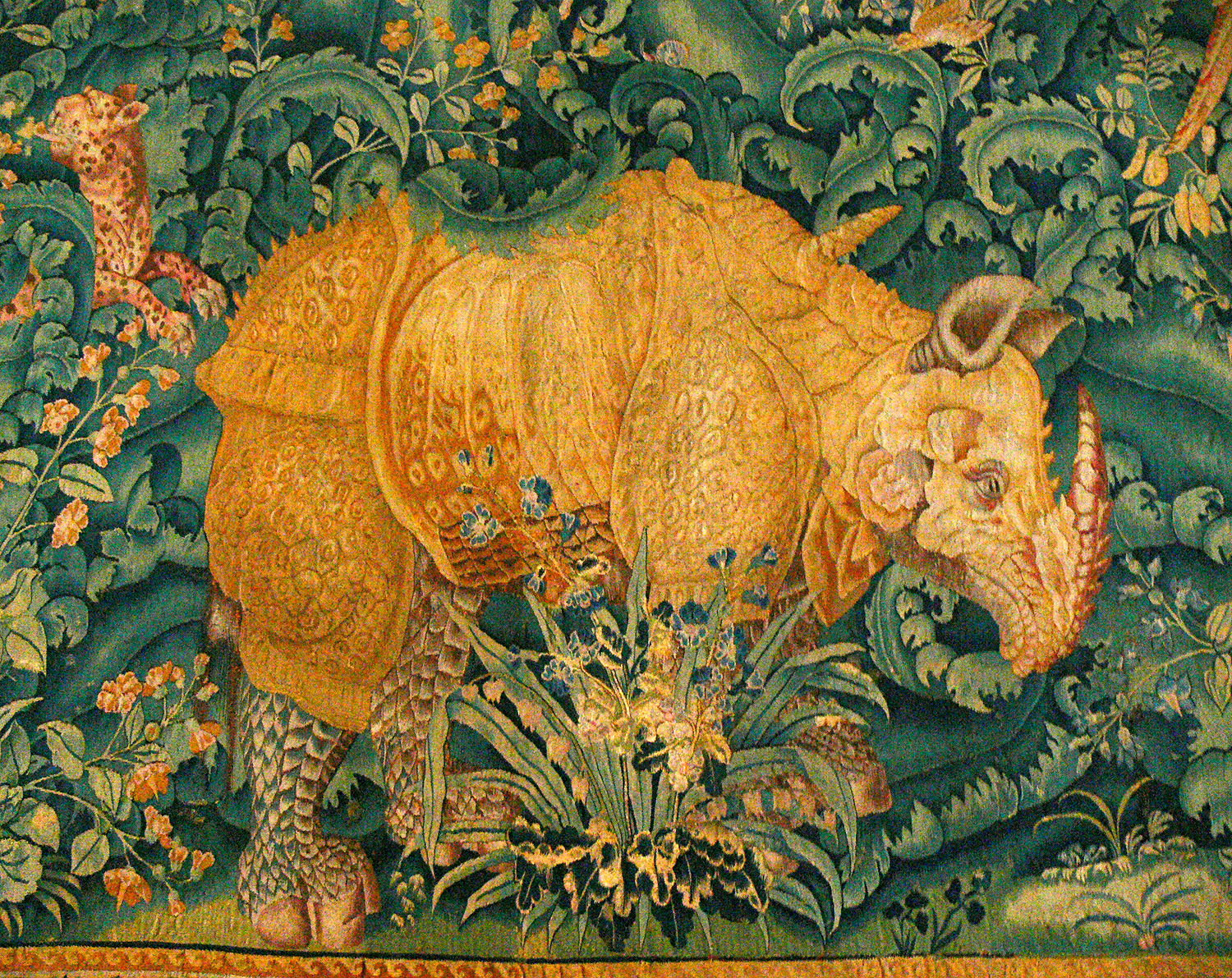
The rhinoceros of Dürer on a Netherlandish gobelin in the Kronborg Castle, 1550Castle of Kronborg (Danemark), Netherlandish gobelin from 1550

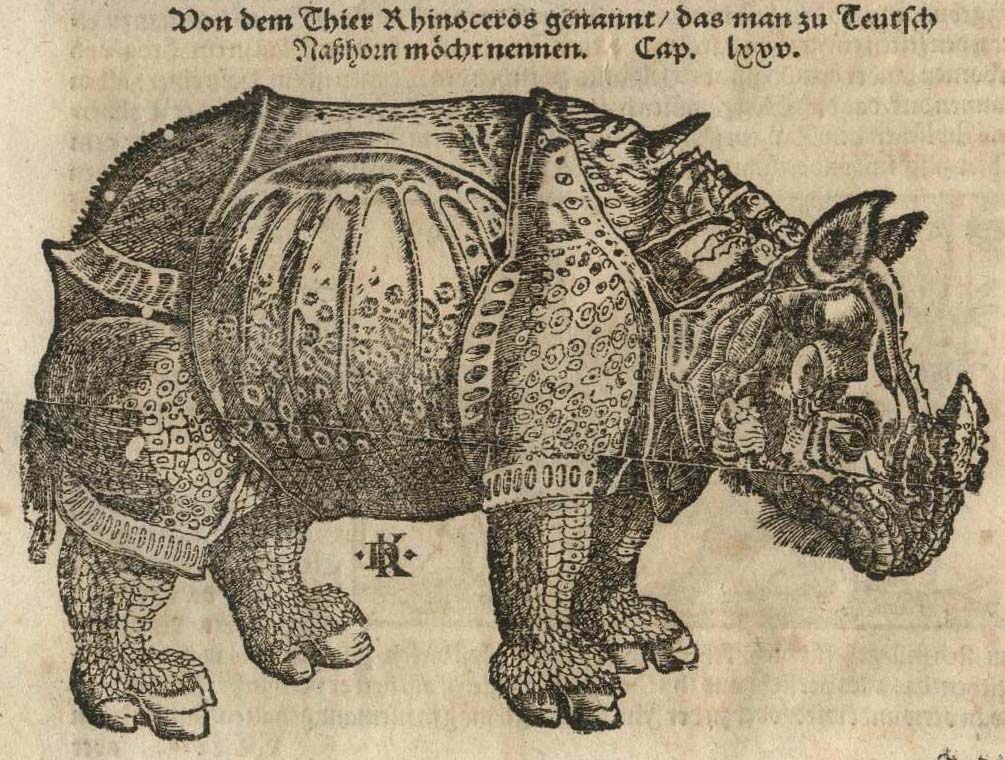
As the above examples show, by the middle of the 16th century the rhinoceros spread all over Europe from the southernmost South to the northernmost North. These animals, however, were not the direct offsprings of the engraving by Dürer.

The rhinoceros of Dürer, 8th edition by Willem Janssen, Amsterdam, 17th centuryDürer’s rhinoceros, 8th edition by Willem Janssen, Amsterdam, 17th century

True, Dürer’s engraving was reprinted several times in the two centuries following its first publication. However, these stand-alone leaflets were usually conserved in the cabinets of curiosities of princely collectors like in private zoos. The “true image” of the rhinoceros established by Dürer was transmitted to the public principally through the engravings of the Renaissance handbooks and encyclopedias. This very exciting period of the birth of the modern encyclopedia has not been yet really discovered by modern research which focuses either on the medieval encyclopedies like the Etymologies by Isidor of Seville or the four Speculum’s by Vincent of Beauvais, or on the 18th-century French Encyclopedia by Diderot and Alembert and its immediate scientific predecessors (although the pendulum of Foucault as well as the lexicon of Lemprière and their epigons are already looting them with abundant profit). Nevertheless, these works were highly celebrated in their age, and even today they are very enjoyable readings, offering plenty of enchanting surprises. And besides they established all those standards that we consider as self-evident today, from alphabetic orden through thematic lexicons to the bibliography.

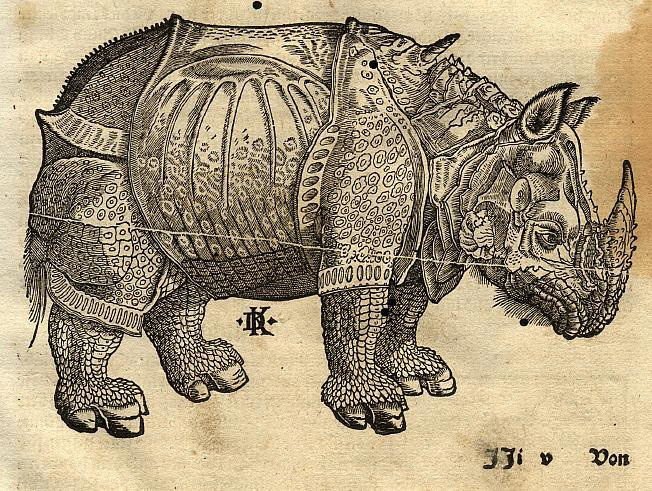
The rhinoceros of Dürer in the Cosmographia of Sebastian Münster, around 1550
One of the first and most influential encyclopedias was the Cosmographia compiled by the Basel geographer and Hebraist Sebastian Münster and published in five languages and thirty-three editions between 1544 and 1628. Its success was very much enhanced by its beautiful engravings composed by eminent artists like Hans Holbein the Younger, Urs Graf or David Kandel. This latter one, who also illustrated another early encyclopedia, the epoch-making Kreütter Buch or Herbal (1546) by Hieronymus Bock, made that copy of Dürer’s picture which thereafter spread the true image of the rhinoceros in several reprints and editions all over Europe.

The rhinoceros of Dürer in the 1580 French edition of the Cosmographia of Sebastian Münster
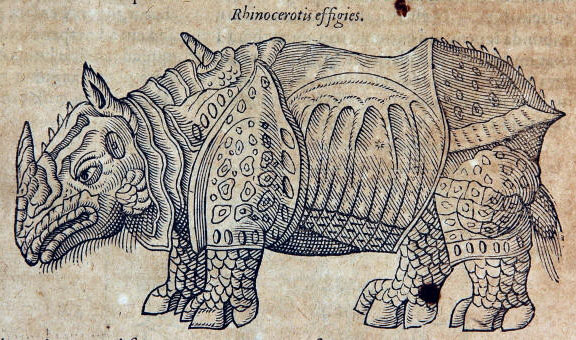
A characteristic feature of this engraving is that the printing block seems to have broken after an early edition, and since then a somewhat oblique thin horizontal line run through all the later prints like a watermark attesting its authenticity. In colored copies, like in the above 1580 French edition of the Cosmographia they tried to eliminate it through overpainting.

The rhinoceros of Dürer in the Cosmographia of Sebastian Münster, 1598
However, by later editions like this Basel 1598 one, the printing block became worn not only on its printing side but also on its joint surface, and the two halves were slightly shifted from each other.

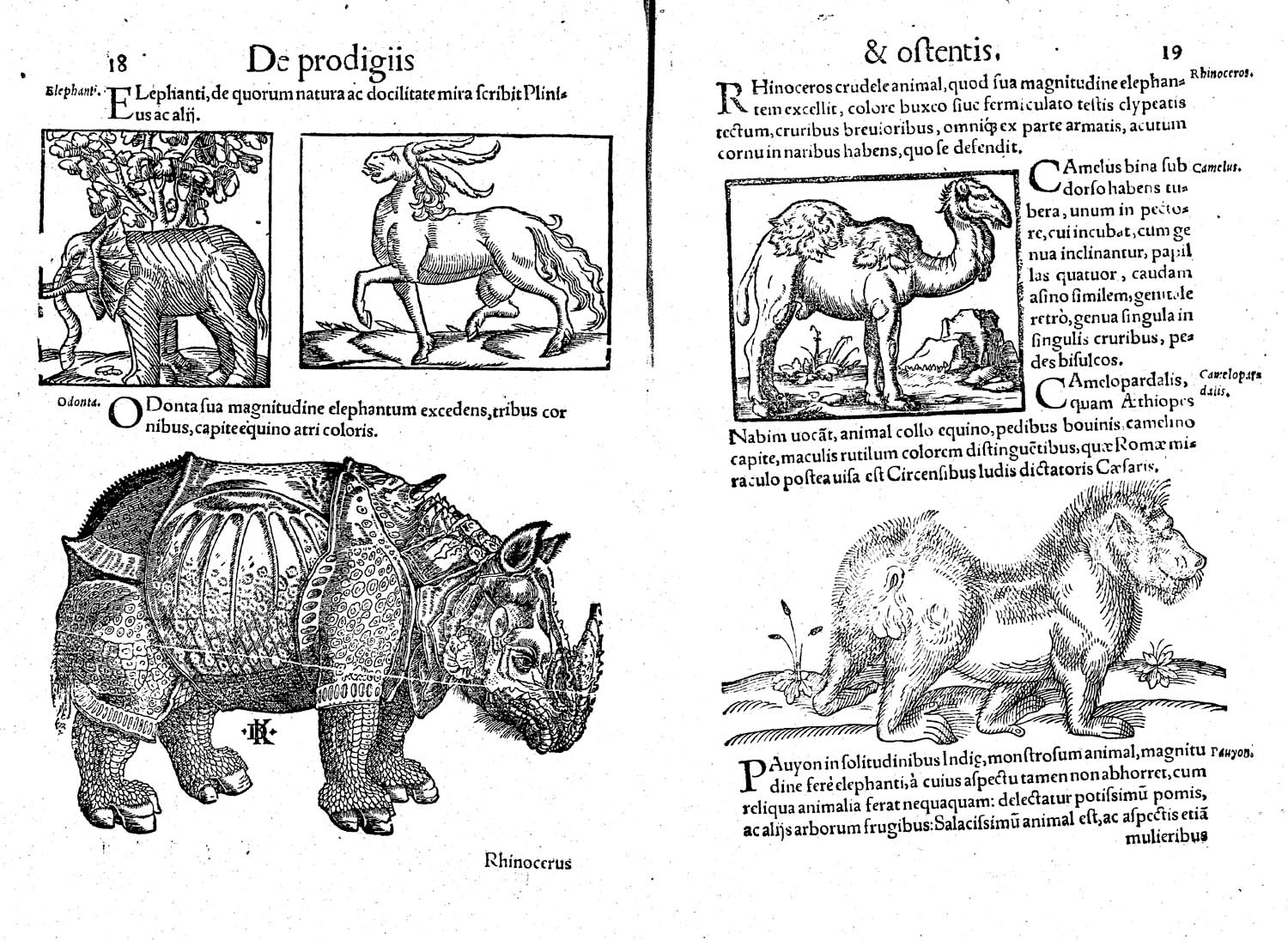
The rhinoceros of Dürer in Conrad Lycosthenes’s Prodigiorum ac ostentorum chronicon, 1557
This engraving was used in other handbooks as well, like here in the collection Prodigiorum ac ostentorum chronicon (Chronicle of the miracles and omens), Basel 1557 by the illustrious German humanist Conrad Lycosthenes, an illustrated register of all the wonderful events, signs and phenomena mentioned from the Antiquity to the Renaissance. The rhinoceros appears here among the other wondrous animals. But it also entered in Paolo Giovio’s Dialogo dell’imprese militari e amorose (Discourse about the military and amorous symbols), the father of all 16th-century symbol encyclopedias, to which we will return in a next post.

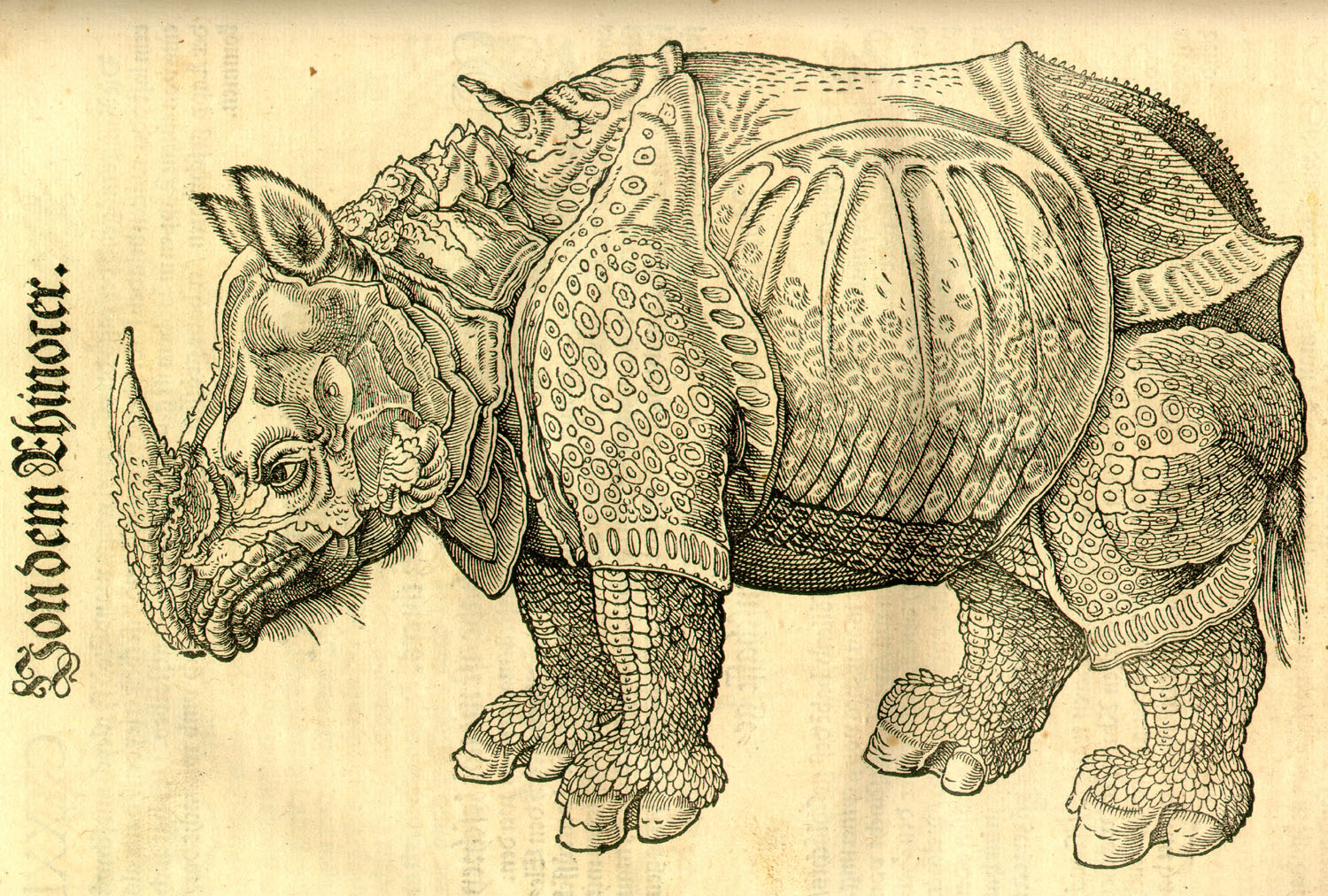
The rhinoceros of Dürer in the Thierbuch of Conrad Gessner, 1563
The image self-evidently received an eminent place in the monumental Historia animalium (1551-8) by the Swiss physician Conrad Gessner, also published in German from 1565 and in English in 1606. This four volumes first zoological encyclopedia not only published an excellent copy of Dürer’s engraving, but it also carefully collected all the known information about the animal in three folio pages printed with small letters. The translation of the complete text will be offered in a next post as a curiosity.

The rhinoceros of Dürer in the Thierbuch of Conrad Gessner, 1563
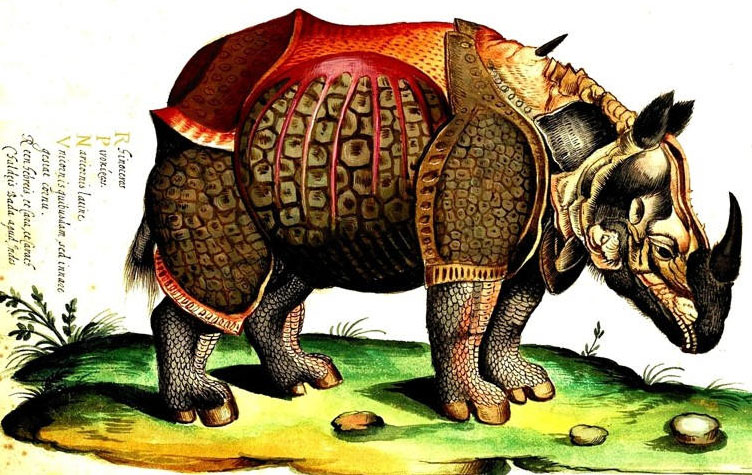
The rhinoceros of Dürer in the Historia animalium of Conrad Gessner, 1551
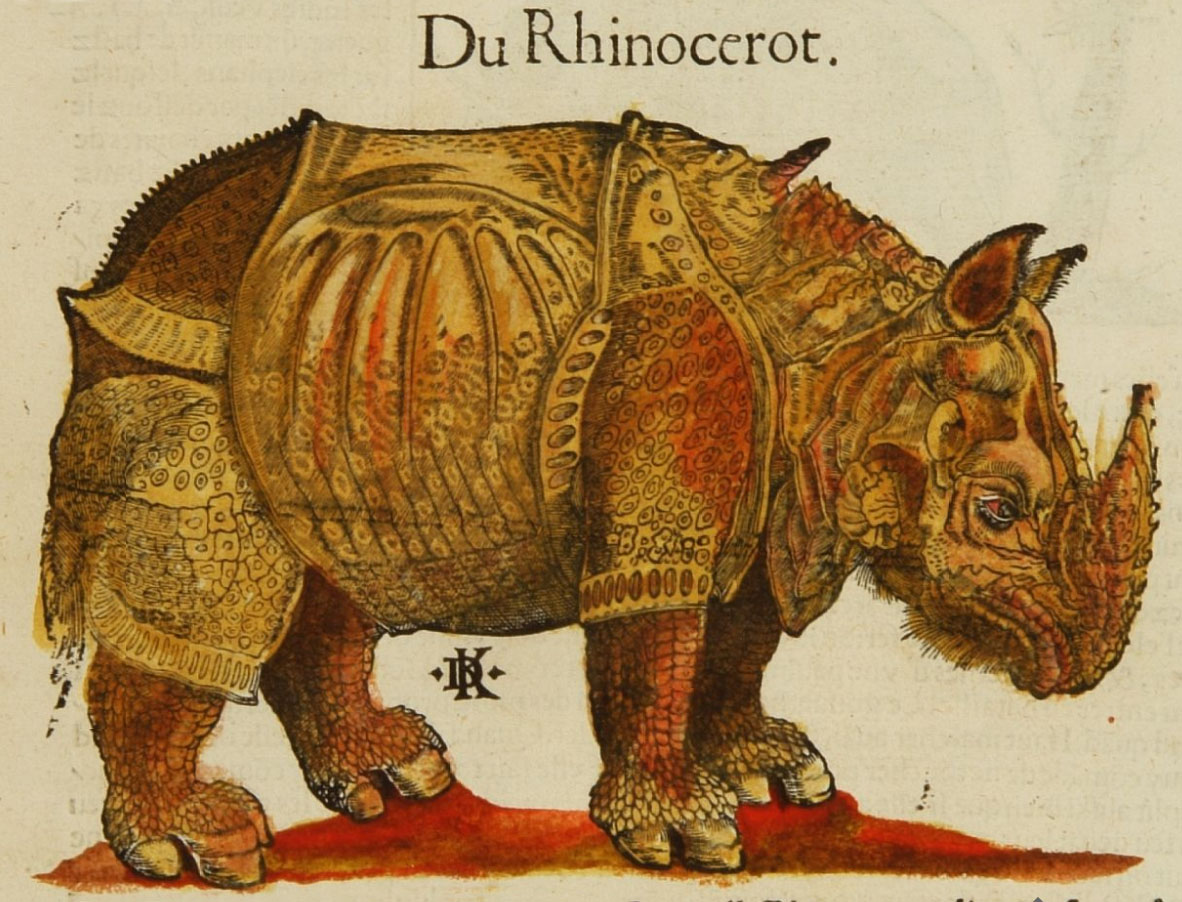
However, prints could convey only forms and no colors. The different coloring of two copies of the Historia animalium shows well, how different ideas the contemporaries had about the true colors of this animal.

The rhinoceros of Dürer in Ulisse Aldrovandi
And it shines in even more striking colors in the great zoological encyclopedia published in eleven folio volumes between 1599 and 1640 by Ulisse Aldrovandi, founder of one of the earliest botanical gardens (Bologna) and owner of one of the largest collection of curiosities of his age.

The rhinoceros of Dürer in Ambroise Paré
Ambroise Paré, the surgeon of four French kings, who won our sympathy by his personal motto which bears witness to a serious self-criticism and psychological sense – Guérir quelquefois, soulager souvent, consoler toujours, “Intervene rarely, relieve often, console always” – was one of the most original natural scientists of the 16th century. Within his far-reaching and painstaking oeuvre he also dedicated a chapter to the rhinoceros. In his Discours de la licorne (Treatise on the unicorn), translated and published in several editions he attempts to establish the origin of the “corn of unicorn” considered as an effective medicine against poisoning and epidemy, and he also proposes its identification with the rhinoceros. On this occasion he publishes not only the above picture of the latter animal, but also illustrates its combat with the elephant as described by Pliny and as we will present it in a later post.

Rhinocerology 1. The rhinoceros of the pope

Dürer, rhinoceros, engraving, 1515Message à Philippe De Jonckheere à propos de son rhinocéros: «Tu sais que Dürer avait fait à pied le chemin de Munich à Rome pour aller dessiner de visu le premier rhinocéros ramené en Europe, et que la gravure tirée de son dessin est probablement le premier best-seller de l’histoire de l’imprimerie? – et qu’on a ensuite rajouté le rhinocéros sur les réimpressions de Pline, qui se basait sur les récits des légionnaires revenus d’Afrique, et en avait conçu la licorne en mêlant un peu tout – mais pour ceux du 16ème siècle, si c’était chez Pline on pouvait ajouter, mais pas corriger: primauté du livre sur le réel – et la phrase de Rabelais: “Comme assez sçavez, que Africque aporte tousiours quelque chose de nouveau”, où Flaubert dit que chaque fois qu’il lit cette phrase, il voit des hippopotames et des girafes…» Oui mais voilà: ni Dürer ni le rhinocéros ne sont jamais allés à Rome, j’avais simplifié l’histoire. = My earlier message to Philippe De Jonckheere concerning his rhinoceros: Do you know that Dürer went from Munich to Rome on foot in order to see and draw the first rhinoceros ever brought to Europe, and that the engraving based on his drawing became the first bestseller of the history of printing? – and that this rhinoceros was then also included in the reprints of Pliny based on the reports of the Roman legionaries returning from Africa, which even led to the birth of the idea of the unicornis, thus mixing everything a little bit – but for the 16th century one could add things to Pliny, but not change things in it: voilà the priority of the book above the reality –, and the saying of Rabelais: “As you well know, there is always something new coming from Africa,” about which Flaubert says that whenever he reads it, he always sees hippos and giraffes…” Well, I was mistaken. Neither Dürer, nor the rhinoceros ever reached Rome. I have simplified the story.

Ernst Gombrich in his Art and illusion (1960) – that in my university years, when I still led a list of those ten books that influenced me the most, I included in it – says that the artist does not draw what he sees but what he knows. He unconsciously formulates the view with the help of the schemes he had learnt, and thus however realistic the representation might appear to his contemporaries, a later generation using different schemes will regard it rigid and schematic.

The same idea leads the pen of the Hungarian classical philologist of international renown János György Szilágyi in his Legbölcsebb az idő (Time is the wisest) (1978, 1987). In this overview of the centuries long history of the falsification of ancient vase paintings he points out that the fakers of a generation were exposed always when the visual schemes applied by them and regarded as self-evident by their generation became obviously conspicuous for the next one.

It is quite possible that Egyptians enjoyed as fresh and original representations of the nature those images which appear as rigid hieratic frescoes to us, for whom their schemes are obvious and archaic.

Drawing lesson in Egypt, by Alain, in Ernst Gombrich’s Art and illusion (1960)
Gombrich illustrates this argument with one of the earliest European drawings of which we know that it was explicitly made “after nature.” In the famous sketch book of the 13th-century French architect Villard de Honnecourt we read to the right of the lion below: “Voici 1 lion si com on le voit par devant. Et sacies bien qu’il fu contrefais al vif.” (Here you are a lion, frontally seen. And you must know that I drew it after nature.) We have no reason to doubt in the truthfulness of the renowned architect who toured all Europe, and had the possibility of seeing living lions in more than one princely court. Nevertheless to us his drawing resembles more those Gothic lion statues whose masters never saw a living lion than to the animal we know from the zoo or from photos and films.

Lion drawn “after nature” from the sketch book of Villard de Honnecourt (13th century)
Gombrich’s other example is the engraving Dürer made in 1515 on the rhinoceros of the pope.

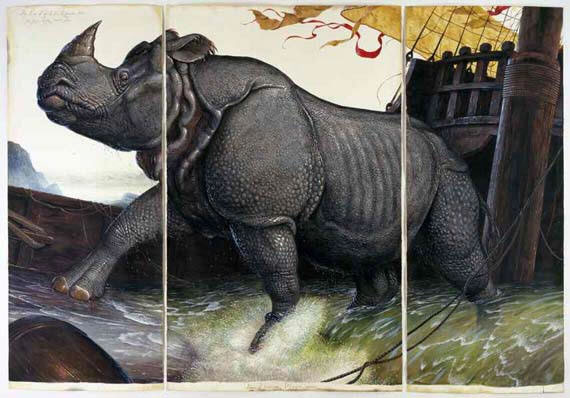
The complex manoeuvres of power politics which led this rhinoceros from hand to hand from India to Italy were described in detail by Silvio Bedini, keeper of the rare books of the Smithsonian Institute in his brilliant The papal pachyderms (1981, Proceedings of the American Philosophical Society). The sultan of Cambay donated the animal to the Portuguese governor of Goa in order to sweeten the bitter pill, that is the refusal of the Portuguese territorial claims. The governor sent it further to Lisbon in order to allay the anger of King Manuel I on the failure of the mission. The king sent it to Pope Leo X to Rome in order to secure his benevolence as an arbiter concerning the border line between the Portuguese and Spanish expansion in South-Eastern Asia. Only the rhinoceros had no profit from all that. The ship with which he was carried in February 1516 to Italy, was caught by a storm, and the rhinoceros,

hanc inusitate feritatis belluam, quae in arena amphitheatri elephanto ad stupendum certamen committi debuerat, Neptunus Italiae invidit et rapuit, quum navigium, quo advehebatur, Ligusticis scopulis illisum, impotentis tempestatis turbine mersum periisset; eo graviore omnium dolore, quod bellua, Gangem et Indum altissimos terrae patriae fluvios tranare solita, in ipsum littus supra portum Veneris, vel arduis saxis asperrimum, enatare potuisse crederetur, nisi, compeditus cathenis ingentibus, nihil proficiente evadendi conatu, superbo maris Deo cessisset.

this animal of unusual ferocity, which would have confronted
even the elephant in a marvellous fight on the sand of the amphitheatre, was taken away out of envy by the Neptun of Italy when the ship carrying it bumped against a rock at the Ligurian shore and went down in the waves of the sea lashed into fury, to a great sorrow and pain of everyone who know that this beast is able to swim across the Ganges and the Indus, enormous rivers of his native land, and thus could have easily swimmed out to the seashore rocks above the haven of Venus, were not his feet linked by heavy chains; but so, having no use of his swimming knowledge, rendered itself to the arrogant god of the sea.

– writes in the Gallery of famous men (1548) Paolo Giovio, historian of the pope and author of the immortal History of Italy, who will play later an important role in keeping and forming the visual memory of the rhinoceros.

Walton Ford, Loss of the Lisbon Rhinoceros, 2008Walton Ford: Loss of the Lisbon Rhinoceros, 2008

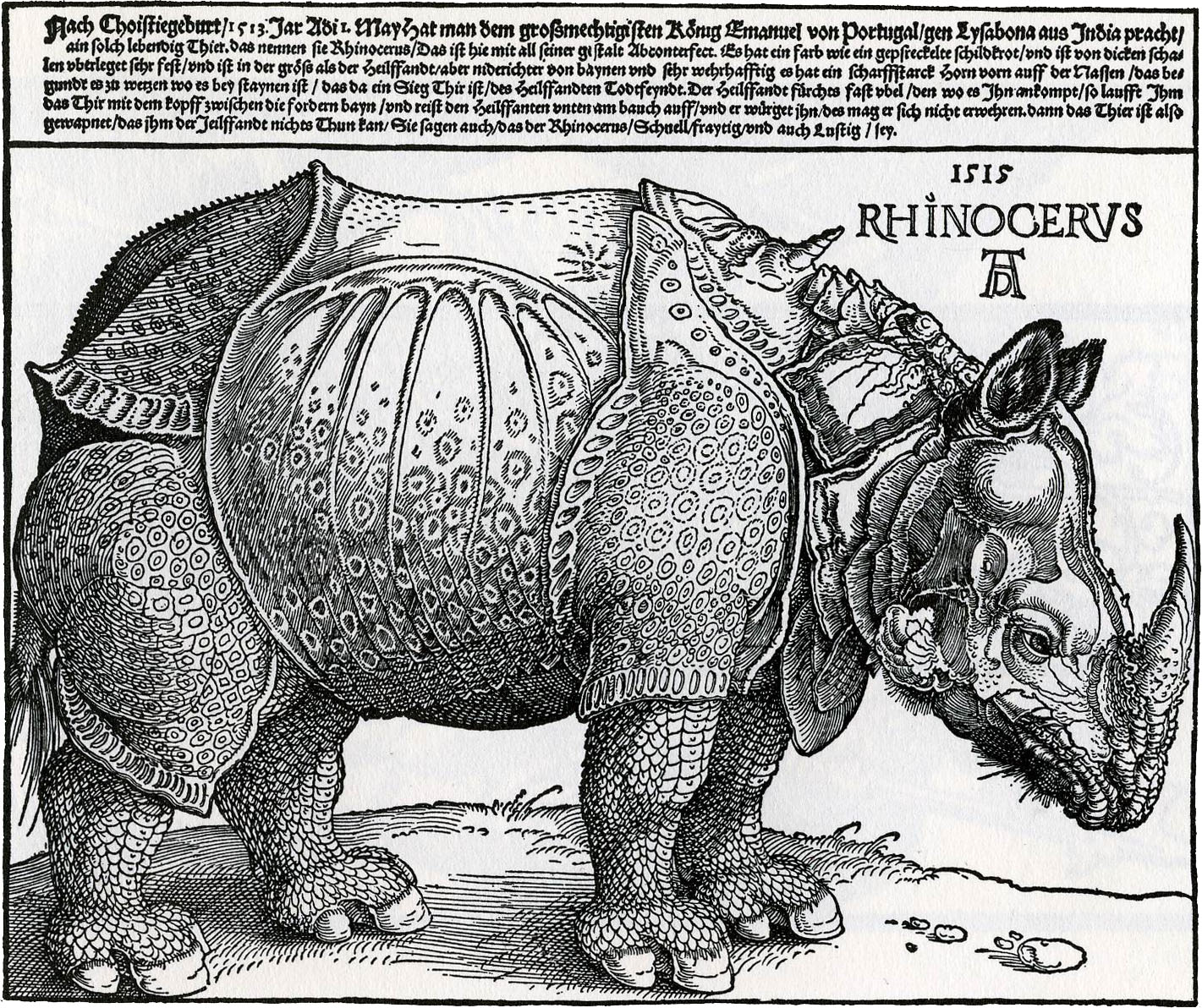
However, to the good luck of the European visual tradition, during the Lisbon months a learned description, and even a sketch was made on the rhinoceros from the pen of the Moravian merchant Valentim Fernandes living in Portugal, to which we will return in a later post. The Italian translation of the description addressed to “the merchants of Nuremberg” is conserved in the Magliabechiana library of Florence. Of its original German text has only survived that part which Albrecht Dürer, who prepared his engraving of the rhinoceros – “the most influential European animal representation,” as T. H. Clarke writes in his The rhinoceros from Dürer to Stubbs, 1515-1799 (1986) – on the basis of this description and sketch, included at the upper edge of his work:

Nach Christiegeburt, 1513. Jar Adi 1. May hat man dem grossmechtigisten König Emanuel von Portugal, gen Lysabona aus India pracht, ain solch lebendig Thier. das nennen sie Rhinocerus, Das ist hie mit all seiner gestalt Abconterfect. Es hat ein farb wie ein gepsreckelte [sic] schildkrot, vnd ist von dicken schalen vberleget sehr fest, vnd ist in der gröss als der Heilffandt, aber niderichter von baynen vnd sehr wehrhafftig es hat ein scharffstarck Horn vorn auff der Nassen, das begundt es zu werzen wo es bey staynen ist, das da ein Sieg Thir ist, des Heilffandten Todtfeyndt. Der Heilffandt fürchts fast vbel, den wo es Ihn ankompt, so laufft Ihm das Thir mit dem kopff zwischen die fordern bayn, vnd reist den Heilffanten vnten am bauch auff, vnd er würget ihn, des mag er sich nicht erwehren. dann das Thier ist also gewapnet, das ihm der Jeilffandt [sic] nichts Thun kan, Sie sagen auch, das der Rhinocerus, Schnell, fraytig, vnd auch Lustig, sey.

In the year 1513 after Christ’s birth, on 1. May there was brought from India to Lisbon to the mighty King Emanuel of Portugal such a living animal, that they call rhinocerus. It is reproduced here in its complete form. Its color is like a speckled turtle, and it is covered very securely with thick scales, and in size it is like the elephant, but shorter in the legs and very much prepared for fighting. It has a sharp strong horn on the front of the nose, which it takes to whetting wherever there are stones. It is a triumphant animal, the elephants’ deadly enemy. The elephant fears it terribly, because when he comes upon it, the animal runs at him with the head between the front legs, and tears the elephant’s belly from beneath, and kills him, while this cannot defend himself. For the animal is so well armed, that the elephant can do nothing to him. They also say that the rhinocerus is a quick, glad-tempered, and even merry animal.


Dürer, The rhinoceros, 1515Dürer: The rhinoceros, 1515. This is the second edition of the engraving, made in the same year as the first one, with the only difference that the first edition published the text in five lines instead of six.

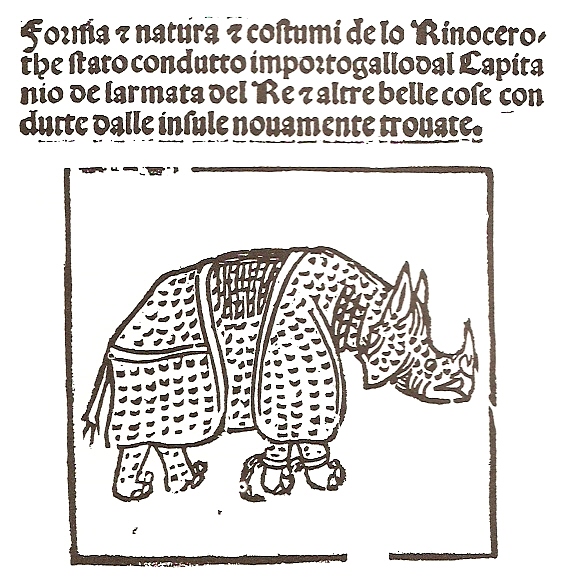
We do not know how detailed and true to life was the sketch sent to Nuremberg together with the letter of Fernandes. It must caution us anyway that the same or a similar sketch also arrived to Rome, where the Florentine physician Giovanni Giacomo Penni published a description in verse about the rhinoceros well in advance before it left Lisbon for the papal court. With the loss of the animal, however, this publication also lost its raison d’être, and its propagation stopped. It has survived in one single copy, today conserved in the Colombina library of Seville, whose special feature is that on its last page there was noted by the hand of Christopher Columbus himself: “Este libro costó en Roma medio quatrain por nouiembre de 1515 / Esta registrado 2260” (I purchased this book in Rome in November 1515 for half quatrain. This is copy number 2260).

Giovanni Giacomo Penni, Forma & Natura & Costumi de lo Rinocerothe, 1515Giovanni Giacomo Penni: The form, nature and customs of the
rhinoceros taken to Portugal by the captain of the
King’s fleet, as well as a lot of beautiful
things coming from the
newly found
islands


If the sketch sent to Nuremberg was similar, then Durer had plenty to add to it from his own knowledge of zoology, anatomy and proportions, from the description, and – as Gombrich stresses it – from the contemporary pictorial tradition and dominant visual schemes. He perceived the skin of the rhinoceros folded in hard plates as a kind of a knight’s armor, like the one worn by contemporary war-horses, following Fernandes’s expression gewapnet ‘armed.’ He covered both the armor and the feet of the animal with the scales mentioned by Fernandes, like those of the dragons, and he also articulated “the armor’s side plate” with a pattern recalling the dragon’s wing. He inserted between its two shoulder-blades a small horn – it is not clear whether he misunderstood something on the sketch, or he simply had to find a proper place for the “second horn” mentioned by Pliny, to which we will return in a next post – which protrudes from the middle of a small knob like the thorn in the middle of the knight’s shield keeping away the enemy in a hand-to-hand combat. And finally he covered the whole surface of the animal with a finely chiselled decoration in the spirit of the contemporary German engraving tradition.

The image created in this way is, however, not only extremely compact, powerful and convincing, but it is also much closer to reality than what could have been expected in such circumstances. Was Fernandes’s sketch this much better than the drawing of Penni? Or there were some additional visual sources available to Dürer on the rhinoceros? In the next post we will examine such a possible source.


Rhinocerology, or the power of images

The rhinoceros of Dürer, composition by Bob Warren
or the image
of an image

(Miroslav Holub: Go and open the door)

1. The rhinoceros of the pope
2. Rhinoceros on the reverse
3. The first litter
4. The truth suppressed

We have borrowed the second part of our title from David Freedberg’s influential The power of images: Studies in the history and theory of response (1989) in which he writes about the influences exerted on our thinking, categories and values by the images around us, each having their own biography, a whole history of their ever changing meanings, effects and traditions.

In this series opened now and planned for a couple of more posts we invite our Readers to a zigzag excursion, let us call it Rhinoceros Memory Tour, in the course of which we will follow the path of one image, the picture of the rhinoceros, starting from the moment when this curious animal popped up at the horizon of the Europe of the discoveries and the first picture was made of it.

A special feature of this story is that the picture was not made of a living rhinoceros, but it was a reconstruction based on various pictorial and verbal morsels, and from the very beginning it lived a life independent of its model. The picture gave life to other pictures, these mated with other images, and established their own separate little pasture within the repertory of Renaissance images and other symbols. Occasionally a living rhinoceros also popped up. In such cases the pictures encircled the intruder with suspicion, puffed against him in a hostile manner, but in the meantime they secretly borrowed one or another detail of it, and then proclaimed in a loud voice the inexactness of all previous representations.

By the end of our excursion we will not know much more about the rhinoceros itself than at the beginning. Certainly not more than what the man of the Renaissance knew about it. But we will know a lot more about the secret life of the Renaissance images. A peculiar little jungle, this is. Mind the lianes.

The rhinoceros of Dürer, statuette by Michael Speaker