Switch over to our new blog! • ¡Pásese a nuestro nuevo blog!

The renewed version of our blog, with more features, a richer design, and available in nine languages, can be read here: https://wangriver.com

The new version also includes the old posts, often in expanded form. If you are curious about the updated version of this post, replace “riowang.blogspot.com/” in the URL with “riowang.studiolum.com/”, and the new link will most likely lead you there.


La versión renovada de nuestro blog, con más herramientas, un diseño más rico y disponible en nueve idiomas, se puede leer aquí: https://riowang.com

La nueva versión también incluye las publicaciones antiguas, a menudo en una forma ampliada. Si tiene curiosidad por la versión actualizada de esta entrada, sustituya «riowang.blogspot.com/» en la URL por «riowang.studiolum.com/es/», y el nuevo enlace probablemente le llevará allí.

Mostrando entradas con la etiqueta bestiary. Mostrar todas las entradas

God's menagerie

Of the three grand portals of Rouen Cathedral, the northern one – known as the Portail des Libraires – is the most iconographically ambitious and expansive. The tympanum features a carved Last Judgment, flanked by the seven days of Creation and the beginning of humanity’s story below and a statue of Saint Michael casting down evil above, in front of the rose window. The numerous small panels at the base act as a footnote and inventory to the Judgment, while Saint Michael offers an apocryphal supplement to the Creation story, highlighting the fundamental dimensions of good and evil and alluding to the weighing of souls awaiting the dead. In short, the portal unites the beginning and end of the world in a single, universal vision.

Not all three portals are conceived with such breadth. The western main façade, begun around 1200, treats each of its three portals differently. The left portal (which I discussed recently) depicts the deaths of the two Saint John; the central portal shows the Tree of Jesse, tracing the genealogy of the cathedral’s patron, the Virgin Mary; and the right portal depicts another martyrdom, that of Saint Stephen. Across the façade, statues of prophets, apostles, and saints unify the three portals.

Construction of the cathedral was largely completed by the 1250s. At that time, successive archbishops began refining the building’s details, the transepts, side chapels, the canons’ wing, and the cloister. At the end of the 1200s, the southern and northern transept portals were completed. The southern portal integrates Old and New Testament narratives into a single coherent story, centered on Christ’s redemptive work and glory. It spans humanity’s key historical cycles across thousands of years and dozens of images. This is an ample conception, the most important historical cycle of mankind, which embraces several thousand years in dozens of images. Yet the northern transept portal surpasses even this, offering a perspective that stretches from the Creation to the end of the world.

This monumental vision had political motives. In 1204, King Philip II of France conquered Normandy, which was previously largely independent – or, after the Norman Conquest of England in 1066, was under the Norman-English crown – and brought it under French rule. Within France, the Rouen archbishopric was overshadowed by Paris’s Notre-Dame. The archbishops sought to compensate through political representation, including architectural statements. To compete with Paris’s Sainte-Chapelle, they built the Chapel of the Virgin as an archiepiscopal burial site, and they modeled the new transept portals, instead of the outdated main façade of the cathedral, on the grand façades of Notre-Dame’s transepts.

Charles Nodier: Voyages pittoresques et romantiques dans l'ancienne France. Vol. 1. Ancienne Normandie, 1820

The Portail des Libraires itself was begun around 1280 by Guillaume de Flavacourt, Archbishop of Rouen between 1278 and 1305, together with master builder Jean Davy. Construction required clearing the area between the cathedral and the Rue Saint Romain, the row of canon houses, for which the archbishop had other plans. Around 1300, he added wings on either side of the portal, connecting the cathedral to the street. The left wing became the archbishop’s palace, with the Chapel of the Virgin, and the right wing housed the library. The portal – and the courtyard formed between the wings – takes its name from the library as well as from the booksellers who offered their goods in the courtyard to the canons coming to the library. The canons could also quickly return to their notes after communal prayers recited every three hours via the grand stairway inside the portal.

By the first half of the 13th century, Gothic church façades had developed a characteristic, unified structure. At the center of each portal, the tympanum depicts the main theme of the façade: here, the Last Judgment, arranged in three tiers. The lowest one shows the dead rising from their graves, the middle one shows them lined up before their Judge, while the uppermost – which should depict Christ as Judge – is missing. Some scholars suggest it was destroyed, though most likely it was never completed.

Surrounding the tympanum on the archivolts are twenty-four figures – apocalyptic elders, prophets and apostles, as well as anels – providing a celestial framework for the scene. Above, in front of the rose window, Archangel Michael casts Lucifer from heaven. Though this apocryphal event occurred at the beginning of the world, Michael also functions as protector of the dead, as well as a soul weigher at the Last Judgment, keeping the devils at bay, which links him to the central theme.

Beneath the tympanum, on the trumeau, stands a statue of Saint Romain, the city’s 7th-century bishop and patron saint, with the chained Gargouille monster at his feet. Trumeau statues in Gothic portals usually relate to the tympanum’s theme, making Saint Romain an anomaly here. However, knowing that this statue was carved only during the 19th-century restoration and placed on the façade facing Rue Saint Romain clarifies the choice. 13th-century sources refer to this portal as the “New Gate of the Virgin Mary”, suggesting that a Madonna with child originally stood here as a heavenly intercessor on Judgment Day.

The Gargouille – which shares the Indo-European root garg, meaning “wild” with the Celtic hero Gargantua and the Greek Gorgo, and lends its name to the gargoyles – was often depicted in the Middle Ages as a dragon crouching at the feet of the holy bishop, as seen on many Rouen timber-framed house portals.

But perhaps the most remarkable feature of the portal is its base: an accordion-like sequence of half-pillars flanking the doorway, each with narrown niches for statues, from the top of which the curves of the tympanum’s archivolts spring. The façades of these half-pillars are decorated with five rows of quadrilobe panels each, covering the surface in a grid pattern, as if embroidered tapestries had been laid across the portal’s base.

The top row of panels depicts the scenes of the Creation: to the right of the portal, from “Let there be light” to the Tree of Knowledge; to the left, from the Expulsion to Cain’s murder.

During the seven days of Creation, the Creator wears Christ’s cruciform halo. As God created by His word alone, and Christ is the Word according to John, it was fitting that He executes the steps of Creation. These steps are unusually presented in circular diagrams. Only at the creation of man do we see three male heads, symbolizing the Trinity, as the Bible switches here to plural:  “Let us make man in our image, after our likeness” (Gen 1:26)

libraires1 libraires1 libraires1 libraires1 libraires1 libraires1 libraires1 libraires1 libraires1 libraires1

libraires2 libraires2 libraires2 libraires2 libraires2 libraires2 libraires2 libraires2 libraires2 libraires2

Beneath each scene of the Creation and the episodes of first men’s story, are four quadrilobe panels with four grotesque creatures, on each of the twice ten pillars:

libraires3 libraires3 libraires3 libraires3 libraires3 libraires3 libraires3 libraires3 libraires3 libraires3 libraires3 libraires3 libraires3 libraires3 libraires3 libraires3 libraires3 libraires3 libraires3 libraires3

libraires4 libraires4 libraires4 libraires4 libraires4 libraires4 libraires4 libraires4 libraires4 libraires4 libraires4 libraires4 libraires4 libraires4 libraires4 libraires4 libraires4 libraires4 libraires4 libraires4 libraires4

It is understandable that the origins of the world and of human history appear on the base of a Last Judgment portal: the beginnings of the world is a prerequisite for its end, and humanity’s fall a prerequisite for Judgment. But why these monstrous beings?

Scholrs d not entirely agree, but, setting aside more speculative interpretations, most consider them a form of bestiary.

Medieval bestiaries – collections illustrating the traits of animals – served two main purposes. They displayed the richness of Creation, and they conveyed moral lessons through the characteristics of each creature. Both roles are appropriate here, beneath the Creation and the Last Judgment which holds people accountable for their moral decisions.

Four-legged animals from Bartholomaeus Anglicus’ Le Livre des Proprietés des Choses, translated by Jean Cordichon, 14th c. Reims, Bibl. Municipale Ms. 993 fol. 254v.

Furthermore, the formation of this “basal carpet” is closely tied to bestiary traditions. Its precedents are relief sequences on the two sides of earlier Gothic cathedral portals that were independent sets, not linked to the topic of the tympanum: depictions of months, the struggle of the seven virtues with the seven deadly sins, the liberal arts, or animals. These are quickly organized into square-framed panels inherited from Romanesque art, and first descend here in Rouen to the base of the portals, forming a series of biblical narratives on the southern portal, and a bestiary encyclopedia on the northern one.

But why an encyclopedia of fantastic creatures only?

First, in this period there was heightened interest in exotic beings from distant lands, satisfied by Indica travelogues, Livres des Merveilles, John Mandeville, Alexander romances and other manuscripts. The beings described in them were all considered real and included in bestiaries. Vézelay’s Magdalene church tympanum (1140-50) offers a good example, depicting monstrous creatures among the nations Christ commands his apostles to teach (Mt 28:19).
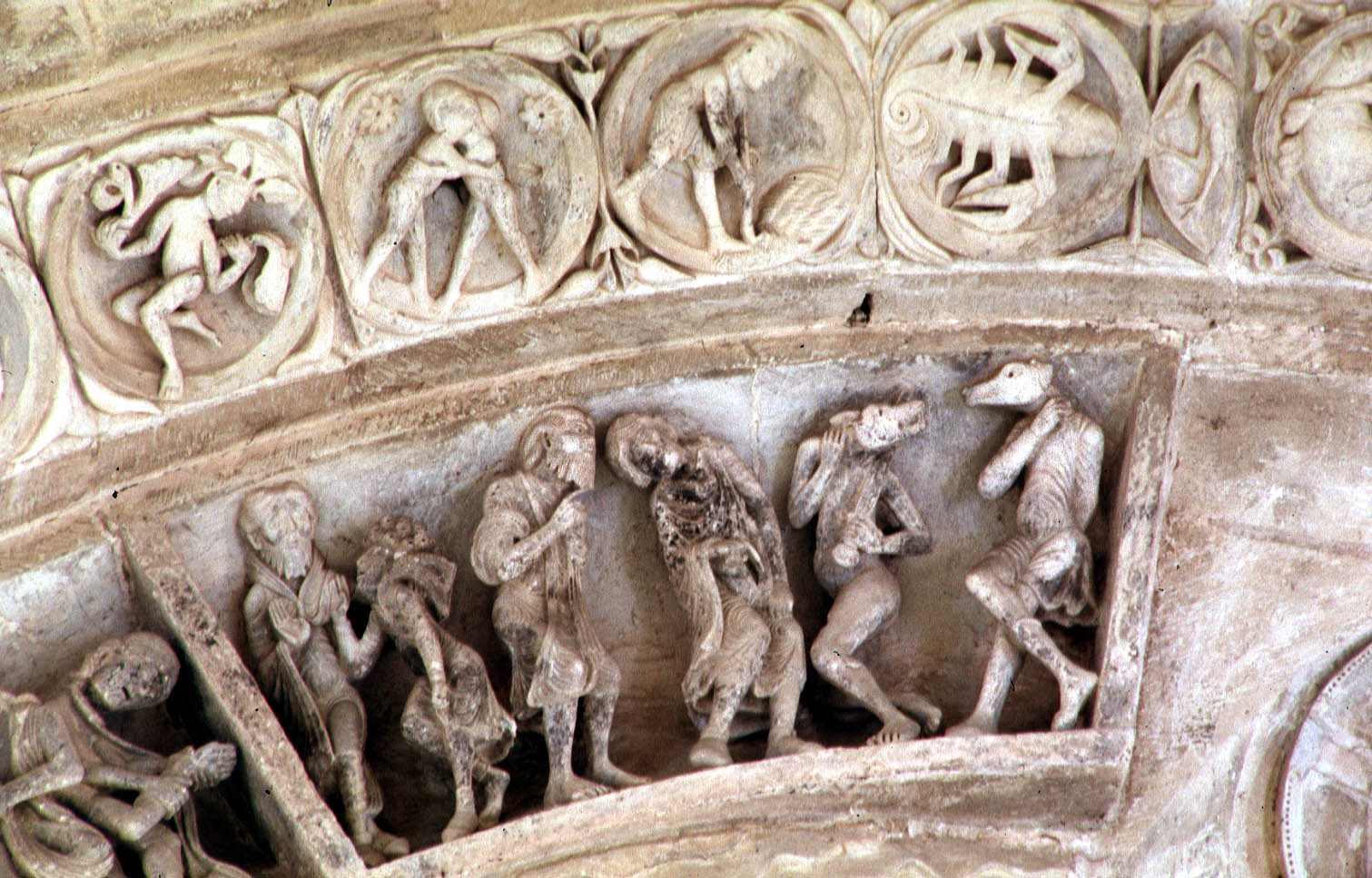
Second, manuscript illuminators – whose motives were often copied in decorative sculpture as well – passionately filled their margins with grotesque and hybrid creatures, as they also occupy the margins of the portal here.

Third, the top narrative row at the base depicts not only Creation but also the Fall, humanity’s moral darkening, and their descent into murder, for which these hybrid, distorted, half-animal figures serve as fitting illustrations.

Finally, the innumerable multitude of creatures emphasize above all the inexhaustible richness of Creation and the Creator. As God commands, “Let the waters teem with living creatures” (Gen 1:20), so the portal base teems with every conceivable and inconceivable being – not only the eighty in the square panels, but also others in the triangular spaces between the quadrilobe forms and their square frames: dragons, hybrids, lambs, a man hunting a fox, birds, fish and more, totaling 280.

And these small corner-dwelling creatures are no less important than the large ones. As Salome’s tance on the cathedral’s main façade inspired Flaubert, so these inspired Ruskin visiting Rouen Cathedral, and later Proust interpreting Ruskin, continuing the chain of Creation into the twentieth century and beyond.

Ruskin’s drawing on three “corner beings”, in The Seven Lamps of Architecture, 1849

“I say nothing of their general design, or of the lines of the wings and scales, which are perhaps, unless in those of the central dragon, not much above the usual commonplaces of good ornamental work; but there is an evidence in the features of thoughtfulness and fancy which is not common, at least now-a-days. The upper creature on the left is biting something, the form of which is hardly traceable in the defaced stone but biting he is; and the reader cannot but recognise in the peculiarly reverted eye the expression which is never seen, as I think, but in the eye of a dog gnawing something in jest, and preparing to start away with it: the meaning of the glance, so far as it can be marked by the mere incision of the chisel, will be felt by comparing it with the eye of the couchant figure on the right, in its gloomy and angry brooding. The plan of this head, and the nod of the cap over its brow, are fine ; but there is a little touch above the hand especially well meant : the fellow is vexed and puzzled in his malice; and his hand is pressed hard on his cheek bone, and the flesh of the cheek is wrinkled under the eye by the pressure. The whole, indeed, looks wretchedly coarse, when it is seen on a scale in which it is naturally compared with delicate figure etchings; but considering it as a mere filling of an interstice on the outside of a cathedral gate, and as one of more than three hundred (for in my estimate I did not include the outer pedestals), it proves very noble vitality in the art of the time.”

John Ruskin, The Seven Lamps of Architecture, 1849

“Finally, Ruskin's medieval studies confirmed, with his belief in the goodness of faith, his belief in the necessity of free, joyful, and personal work without the intervention of mechanization. In order that you might realize this better, it would be best to transcribe here a very characteristic page of Ruskin. He is speaking of a figurine a few centimeters in size, lost in the midst of hundreds of such tiny figurines, of the porch of the Booksellers of the Rouen cathedral:

«The fellow is vexed and puzzled in his malice; and his hand is pressed hard on his cheek bone, and the flesh of the cheek is wrinkled under the eye by the pressure. The whole, indeed, looks wretchedly coarse, when it is seen on a scale in which it is naturally compared with delicate figure etchings; but considering it as a mere filling of an interstice on the outside of the cathedral gate, and as one of the more than three hundred, it proves very noble vitality in the art of the time.»

«We have certain work to do for our bread, and that is to be done strenuously; other work to do is for our delight, and that is to be done heartily: neither is to be done by halves and shifts, but with a will; and what is not worth this effort is not to be done at all. Perhaps all that we have to do is meant for nothing more than an exercise of the heart and of the will, and is useless in itself; but, at all events, the little use it has may well be spared if it is not worth putting our hands and our strength to. It does not become our immortality to take an ease inconsistent with its authority, nor to suffer any instruments with which it can dispense, to come between it and the thing it rules. There is dreaming enough, and earthiness enough, and sensuality enough in human existence without our turning the fe w glowing moments of it into mechanism, and since our life must at best be but a vapour that appears for a little time and then vanishes away, let it at least appear as a cloud in the height of Heaven, not as the thick darkness that broods over the blast of the Furnace, and rolling of the Wheel.»

I confess that when I reread this page at the time of Ruskin's death, I was seized with the desire to see the little man he speaks of. And I went to Rouen, as if obeying a dying wish, and as if Ruskin, upon dying, had in some way entrusted to his readers the poor creature to which he had given life again by speaking of it, and which, unknowingly, had just lost forever the person who had done for it as much as its first sculptor. But when I arrived near the huge cathedral in front of the portal where the saints were warming themselves in the sun, saw higher up the galleries where the kings radiated up to those supreme heights of stone I believed uninhabited, and where here a sculptured hermit lived in isolation, letting the birds rest on his forehead, while there a gathering of apostles listened to the message of an angel poised near them, folding his wings, under a flight of pigeons spreading theirs, and not far from a personage who, receiving a child on his back, turned his head in a sudden and secular motion; when I saw, lined up before its porches or leaning over the balconies of its towers, all the stone hosts of the mystic city breathing the sun or the morning shadow, I understood it would be impossible to find a figurine of but a few centimeters in the midst of this superhuman multitude.

I nevertheless went to the porch of the Bookseller's. But how to recognize the figurine among hundreds of others? All of a sudden, a talented and promising young sculptress, Mrs. L. Yeatman, said to me, «Here is one that looks like it.» We looked farther down, and there it was. It scarcely measures ten centimeters. It is crumbling, and yet the look is the same, the stone still has the hole that raises the eyeball and gives it that expression which made me recognize it. The artist, who died centuries ago, left there, among thousands of others, this little person who dies a little more each day, and has been dead for a really long time, forever lost in the midst of the crowd. But he had put it there.

One day, a man for whom there is no death, for whom there is no material infinity, no oblivion, a man who, casting away from him that nothingness which oppresses us to follow purposes which dominate his life, purposes so numerous that he will not be able to attain them all, while we seemed to have none, this man came, and, among those waves of stone where each lacelike effervescence seemed to resemble the others, seeing there all the laws of life, all the thoughts of the soul, naming them by their names, he said, "See, it is this, it is that." As on the Day of Judgment, which is represented near by, his words resound like the archangel's trumpet, and he says:

«Those who have lived will live, matter is nothing.»

And, in fact, like the dead whom, not far away, the tympanum represents awakening at the sound of the archangel's trumpet, arising, having recovered their forms, recognizable, alive, the figurine is now alive again and has recovered its look, and the Judge has said, "You have survived; you will live." As for him, he is not an immortal judge, his body will die; but what does it matter! as if he were not destined to die he performs his immortal task, unconcerned at the size of the thing that occupies his time, and, having but one human life to live, he spends several days in front of one of ten thousand figures of a church. He made a drawing of it. It corresponded for him to those ideas that exercised his mind, indifferent to approaching old age. He made a drawing of it; he spoke of it. And the harmless and monstrous little figurine will have come back to life, against all hope, from that death which seems more total than the others, which is the disappearance into the midst of infinite numbers and the leveling down of similarities, but from which genius quickly rescues us. Finding the figurine there again, one cannot help but be touched. It seems to live and to gaze, or rather to have been caught by death at the very moment of its gaze, like the Pompeians whose movements remain suspended. It is a single thought of the sculptor, in fact, that has been arrested here in its movement by the immobility of the stone. I was touched on finding the figurine there again; nothing therefore dies that has survived, no more the sculptor's thought than Ruskin's thought.

Marcel Proust, „Jean Ruskin”, La Chronique des arts et de la curiosité, January 1, 1900
(English translation from Marcel Proust: On Reading Ruskin, 1987)

Las bestias de Dios

De los tres grandes portales de la catedral de Ruan, el del lado norte –conocido como el Portail des Libraires– es el más ambicioso y elocuente desde el punto de vista iconográfico. El tímpano presenta un friso del Juicio Final, flanqueado por los siete días de la Creación y el inicio de la historia de la humanidad en la parte inferior, y por una estatua de San Miguel expulsando al maligno arriba, delante del rosetón. Los numerosos paneles pequeños de la base actúan como notas al pie e inventario del Juicio, mientras que san Miguel ofrece un suplemento apócrifo a la historia de la Creación, destacando las dimensiones fundamentales del bien y del mal y aludiendo al pesaje de las almas que aguarda a los difuntos. En suma, el portal une el principio y el fin del mundo en una sola visión universal.

Los tres portales restantes no están todos concebidos con la misma amplitud. La fachada principal occidental, iniciada hacia 1200, da un tratamiento diferente a cada uno. El portal izquierdo (del cual hablé recientemente) representa las muertes de los dos sanjuanes; el portal central muestra el Árbol de Jesé, con la genealogía de la patrona de la catedral, la Virgen María; y el portal derecho representa otro martirio, el de San Esteban. A lo largo de la fachada, estatuas de profetas, apóstoles y santos unifican los tres portales.

La construcción de la catedral estuvo en gran medida terminada hacia la década de 1250. Desde ese momento los sucesivos arzobispos comenzaron a refinar los detalles del edificio, los transeptos, las capillas laterales, el ala de los canónigos y el claustro. A fines del siglo XIII, se completaron los portales de los transeptos sur y norte. El portal sur integra narraciones del Antiguo y del Nuevo Testamento en una única historia coherente, centrada en la obra redentora y gloriosa de Cristo. Abarca los principales ciclos históricos de la humanidad a lo largo de miles de años y docenas de imágenes. Sin embargo, el portal norte del transepto va incluso más allá, ofreciendo una perspectiva que abarca desde la Creación hasta el fin del mundo.

Esta visión monumental tuvo motivaciones políticas. En 1204, el rey Felipe II de Francia conquistó Normandía, que hasta entonces había sido en gran medida independiente –tras la conquista normanda de Inglaterra en 1066, estuvo bajo la corona normando-inglesa– y la sometió al dominio francés. Dentro de Francia, el arzobispado de Ruan se vio ensombrecido por Notre-Dame de París. Los arzobispos buscaron compensar esta pérdida de peso mediante la representación política, incluyendo también actuaciones arquitectónicas. Para competir con la Sainte-Chapelle de París, construyeron la Capilla de la Virgen como lugar de sepultura arzobispal, y modelaron los nuevos portales del transepto, en lugar de la ya anticuada fachada principal, siguiendo la pauta de las grandes fachadas de los transeptos de Notre-Dame.

Charles Nodier: Voyages pittoresques et romantiques dans l'ancienne France. Vol. 1. Ancienne Normandie, 1820

El propio Portail des Libraires lo inició hacia 1280 Guillaume de Flavacourt, arzobispo de Ruan, entre 1278 y 1305, encargándolo al maestro constructor Jean Davy. La construcción requirió despejar el área entre la catedral y la Rue Saint-Romain, la hilera de casas de los canónigos, para las cuales el arzobispo tenía otros planes. Hacia 1300, añadió alas a ambos lados del portal, conectando la catedral con la calle. El ala izquierda se convirtió en el palacio arzobispal, con la Capilla de la Virgen, y el ala derecha albergó la biblioteca. El portal –y el patio formado entre las alas– recibe su nombre tanto de la biblioteca como de los libreros que ofrecían sus mercancías en el patio a los canónigos que acudían a la biblioteca. Los canónigos también podían regresar rápidamente a sus notas después de las oraciones comunitarias recitadas cada tres horas a través de la gran escalera interior del portal.

Hacia la primera mitad del siglo XIII, las fachadas de las iglesias góticas habían desarrollado una estructura característica y unificada. En el centro de cada portal, el tímpano representa el tema principal de la fachada: aquí, el Juicio Final, dispuesto en tres niveles. El inferior muestra a los muertos levantándose de sus tumbas, el intermedio los muestra alineados ante su Juez, mientras que el superior – que debería representar a Cristo como Juez – falta. Algunos historiadores sugieren que fue destruido, aunque lo más probable es que nunca se completara.

Rodeando el tímpano en las arquivoltas hay veinticuatro figuras –ancianos apocalípticos, profetas y apóstoles, así como ángeles– que proporcionan el marco celestial de la escena. Arriba, frente al rosetón, el arcángel Miguel arroja a Lucifer del cielo. Aunque este evento apócrifo tuvo lugar al principio del mundo, Miguel también funciona como protector de los difuntos, así como pesador de las almas en el Juicio Final, manteniendo a raya a los demonios, lo que lo vincula al tema central.

Debajo del tímpano, en el parteluz, se encuentra una estatua de san Román, obispo del siglo VII y patrón de la ciudad, con el monstruo Gargouille encadenado a sus pies. Las estatuas de los parteluces en los portales góticos suelen relacionarse con el tema del tímpano, lo que convierte la presencia aquí de San Román en cierta anomalía. Sin embargo, saber que esta estatua fue esculpida solo durante la restauración del siglo XIX y colocada en la fachada que da a la Rue Saint-Romain lo explica. Fuentes del siglo XIII se refieren a este portal como la «Puerta Nueva de la Virgen María», lo que sugiere que originalmente aquí se veía una Madonna con el Niño como intercesora celestial en el Día del Juicio.

La Gargouille –que comparte la raíz indoeuropea garg, que significa «salvaje», con el héroe celta Gargantúa y la Gorgona griega, y que da su nombre a las gárgolas– se representaba a menudo en la Edad Media como un dragón agazapado a los pies del santo obispo, como se ve en muchos portales de casas con entramado de madera de Ruan.

Pero quizá el rasgo más notable del portal sea su base: una secuencia en acordeón de medias columnas flanqueando la puerta, cada una con estrechas hornacinas para estatuas, de cuyo extremo superior brotan las curvas de las arquivoltas del tímpano. Las fachadas de estas medias columnas están decoradas con cinco hileras de paneles cuadrilobulados cada una, cubriendo la superficie en un patrón de cuadrícula, como si unos tapices bordados se hubieran tendidos a lo largo de la base del portal.

La hilera superior de paneles representa las escenas de la Creación: a la derecha del portal, desde el «Fiat lux» hasta el Árbol del Conocimiento; a la izquierda, desde la Expulsión hasta el asesinato de Caín.

Durante los siete días de la Creación, el Creador lleva el halo cruciforme de Cristo. Como Dios creó únicamente por su palabra y Cristo es el Verbo según Juan, era apropiado que Él ejecutara los pasos de la Creación. Estos pasos se presentan, de manera inusual, en diagramas circulares. Solo en la creación del hombre vemos tres cabezas masculinas, simbolizando la Trinidad, ya que la Biblia aquí pasa al plural: «Hagamos al hombre a nuestra imagen, conforme a nuestra semejanza» (Génesis 1:26).

libraires1 libraires1 libraires1 libraires1 libraires1 libraires1 libraires1 libraires1 libraires1 libraires1

libraires2 libraires2 libraires2 libraires2 libraires2 libraires2 libraires2 libraires2 libraires2 libraires2

Debajo de cada escena de la Creación y de los episodios de la historia de los primeros hombres, hay cuatro paneles cuadrilobulados con cuatro criaturas grotescas, en cada una de las veinte columnas dobles.

libraires3 libraires3 libraires3 libraires3 libraires3 libraires3 libraires3 libraires3 libraires3 libraires3 libraires3 libraires3 libraires3 libraires3 libraires3 libraires3 libraires3 libraires3 libraires3 libraires3

libraires4 libraires4 libraires4 libraires4 libraires4 libraires4 libraires4 libraires4 libraires4 libraires4 libraires4 libraires4 libraires4 libraires4 libraires4 libraires4 libraires4 libraires4 libraires4 libraires4 libraires4

Es comprensible que los orígenes del mundo y de la historia humana aparezcan en la base de un portal del Juicio Final: el principio del mundo es requisito para su fin, y la caída de la humanidad requisito para el Juicio. Pero ¿por qué estos seres monstruosos?

Los historiadores del arte no están del todo de acuerdo, pero dejando de lado interpretaciones más especulativas la mayoría los considera una forma de bestiario.

Los bestiarios medievales –colecciones que ilustraban las características de los animales– tenían dos propósitos principales. Mostraban la riqueza de la Creación y transmitían lecciones morales a través de las características de cada criatura. Ambos papeles resultan apropiados aquí, bajo la Creación y el Juicio Final que responsabiliza a los hombres de sus decisiones morales.

Animales cuadrúpedos del Livre des Propriétés des Choses de Bartholomaeus Anglicus, traducido por Jean Cordichon, siglo XIV, Reims, Bibl. Municipale Ms. 993 fol. 254v

Además, la formación de esta «alfombra o tapiz de base» está estrechamente vinculada a las tradiciones del bestiario. Sus precedentes son secuencias en relieve a ambos lados de otros portales  anteriores de catedrales góticas, conjuntos independientes, no vinculados al tema del tímpano: representaciones de los meses, la lucha de las siete virtudes con los siete pecados capitales, las artes liberales o los animales. Estos se organizan rápidamente en paneles enmarcados en cuadros heredados del arte románico, y aquí en Ruan descienden por primera vez a la base de los portales, formando una serie de narrativas bíblicas en el portal sur, y un bestiario enciclopédico en el portal norte.

Pero ¿por qué vemos tan solo una enciclopedia de criaturas fantásticas?

En primer lugar, en este período había un gran interés por los seres exóticos de tierras lejanas, satisfecho fundamentalmente mediante relatos de viajes a la India, Livres des Merveilles, las crónicas de John Mandeville, los romances de Alejandro y otros manuscritos. Los seres descritos en ellos eran considerados reales e incorporados a los bestiarios. El tímpano de la iglesia de la Magdalena en Vézelay (1140-50) ofrece un buen ejemplo, representando criaturas monstruosas entre las naciones a las que Cristo manda a sus apóstoles a enseñar (Mt 28:19).

En segundo lugar, los iluminadores de manuscritos –cuyos motivos eran copiados a menudo también en la escultura decorativa– llenaban con pasión e imaginación desbordada los márgenes de los folios con criaturas grotescas e híbridas, como también ocupan los márgenes de este portal.

En tercer lugar, la fila narrativa superior de la base representa no solo la Creación sino también la Caída, el oscurecimiento moral de la humanidad y su descenso hacia el asesinato, para lo cual estas figuras híbridas, distorsionadas, semi-animales, sirven como ilustraciones apropiadas.

Finalmente, la innumerable multitud de criaturas enfatiza por encima de todo la riqueza inagotable de la Creación y del Creador. Así como Dios ordena: «Que las aguas se llenen de seres vivientes» (Génesis 1:20), también la base del portal se llena de todo ser concebible e inconcebible –no solo los ochenta en los paneles cuadrados, sino también otros en los espacios triangulares entre las formas cuadrilobuladas y sus marcos cuadrados: dragones, híbridos, corderos, un hombre cazando un zorro, aves, peces y más, hasta un total de 280.

Y estas pequeñas criaturas acurrucadas en las esquinas no son menos importantes que las grandes. Así como la danza de Salomé en la fachada principal de la catedral inspiró a Flaubert, también estas inspiraron a Ruskin cuando visitó la catedral de Ruan, y más tarde a Proust interpretando a Ruskin, continuando la cadena de la Creación hasta el siglo XX y más allá.

Dibujo de Ruskin de tres «seres de esquina», en The Seven Lamps of Architecture, 1849

«No diré nada del diseño general, ni de las líneas de las alas y escamas, que son quizá, salvo en las del dragón central, poco más que los lugares comunes habituales del buen trabajo ornamental; pero hay en los rasgos una evidencia de reflexión y fantasía que no es común, al menos en nuestros días. La criatura superior a la izquierda muerde algo cuya forma es apenas reconocible en la piedra deteriorada, pero morder, muerde; y el lector no puede dejar de reconocer en el peculiar ojo vuelto la expresión que nunca se ve, según creo, salvo en el ojo de un perro royendo algo en broma, preparándose para escapar con ello: el significado de la mirada, en la medida en que puede marcarse por la mera incisión del cincel, se percibirá al compararlo con el ojo de la figura recostada a la derecha, en su sombrío y airado ensimismamiento. El planteamiento de esta cabeza, y el pliegue del gorro sobre su frente, son finos; pero hay un pequeño detalle sobre la mano especialmente bien logrado: el tipo está molesto y perplejo en su malicia; y su mano se aprieta fuertemente contra el pómulo, y la carne de la mejilla se arruga bajo el ojo por la presión. El conjunto, en verdad, parece miserablemente tosco cuando se ve en una escala en que se compara naturalmente con delicados grabados de figuras; pero considerándolo como un mero relleno de un intersticio en la parte exterior de la puerta de una catedral, y como uno entre más de trescientos (pues en mi cálculo no incluí los pedestales exteriores), demuestra una noble vitalidad en el arte de la época.»

John Ruskin, The Seven Lamps of Architecture, 1849

«Finalmente, los estudios medievales de Ruskin insistían, junto con su convicción en la bondad de la fe, en la necesidad de un trabajo libre, gozoso y personal, sin intervención de la mecanización. Para entenderlo mejor, vale la pena transcribir aquí una página suya muy característica. Habla de una figurita de unos pocos centímetros de tamaño, perdida en medio de cientos de similares figuritas en el Pórtico de los Libreros de la catedral de Ruan:

"El tipo está molesto y perplejo en su malicia; y su mano se aprieta fuertemente contra el pómulo, y la carne de la mejilla se arruga bajo el ojo por la presión. El conjunto, en verdad, parece miserablemente tosco cuando se ve en una escala en que se compara naturalmente con delicados grabados de figuras; pero considerándolo como un mero relleno de un intersticio en la parte exterior de la puerta de la catedral, y como uno entre más de trescientos, demuestra una noble vitalidad en el arte de la época."

"Tenemos cierto trabajo que hacer para nuestro sustento, y ese ha de hacerse con esfuerzo; otro trabajo que hacer es para nuestro deleite, y ese ha de hacerse con entusiasmo: ninguno debe hacerse a medias ni con apaños, sino con voluntad; y lo que no merece tal esfuerzo, no debe hacerse en absoluto. Quizá todo lo que tenemos que hacer no está destinado a nada más que a ser un ejercicio del corazón y de la voluntad, y es inútil en sí mismo; pero, en todo caso, el poco uso que tenga puede bien ahorrarse si no vale la pena poner en ello nuestras manos y nuestras fuerzas. No corresponde a nuestra inmortalidad adoptar una comodidad incompatible con su autoridad, ni permitir que instrumentos de los que puede prescindir se interpongan entre ella y lo que gobierna. Ya hay suficiente ensoñación, suficiente terrenalidad y sensualidad en la existencia humana sin que nosotros convirtamos los pocos momentos ardientes de ella en mecanismo, y dado que nuestra vida, en el mejor de los casos, no es más que un vapor que aparece por un poco de tiempo y luego se desvanece, que aparezca al menos como una nube en la altura del cielo, y no como la densa oscuridad que se cierne sobre el soplo del horno y el rodar de la rueda."

Confieso que, cuando releí esta página en la época de la muerte de Ruskin, me asaltó el deseo de ver al hombrecillo del que habla. Y fui a Ruan, como si obedeciera un deseo póstumo, y como si Ruskin, al morir, hubiera confiado de algún modo a sus lectores a la pobre criatura a la que había devuelto la vida al hablar de ella, y que, sin saberlo, acababa de perder para siempre a la persona que había hecho por ella tanto como su primer escultor. Pero cuando llegué cerca de la enorme catedral, frente al portal donde los santos se calentaban al sol, vi más arriba las galerías donde los reyes irradiaban hasta aquellas supremas alturas de piedra que creía deshabitadas, y donde aquí vivía en aislamiento un ermitaño esculpido, dejando que las aves descansaran sobre su frente, mientras allí una reunión de apóstoles escuchaba el mensaje de un ángel posado cerca de ellos, plegando sus alas, bajo el vuelo de unas palomas que desplegaban las suyas, y no lejos de un personaje que, recibiendo a un niño sobre su espalda, volvía la cabeza en un movimiento repentino y secular; cuando vi, alineadas frente a sus pórticos o asomadas sobre los balcones de sus torres, todas las huestes de piedra de la ciudad mística respirando el sol o la sombra matutina, comprendí que sería imposible encontrar una figurilla de apenas unos centímetros en medio de esa multitud sobrehumana.

No obstante, fui al Pórtico de los Libreros. Pero, ¿cómo reconocer la figurilla entre cientos de otras? De repente, una joven escultora talentosa y prometedora, la señora L. Yeatman, me dijo: «Aquí hay una que se le parece». Miramos más abajo, y allí estaba. Apenas mide diez centímetros. Se desmorona, y sin embargo la mirada es la misma, la piedra conserva aún el hueco que eleva el globo ocular y le da esa expresión que me permitió reconocerla. El artista, que murió siglos atrás, dejó allí, entre miles de otras, a esta pequeña persona que muere un poco más cada día, y que lleva mucho tiempo muerta, perdida para siempre en medio de la multitud. Pero él la había puesto allí.

Un día, un hombre para el cual no existe la muerte, para el cual no hay infinitud material ni olvido, un hombre que, apartando de sí esa nada que nos oprime para seguir propósitos que dominan su vida, propósitos tan numerosos que no podrá alcanzarlos todos, mientras nosotros parecíamos no tener ninguno, este hombre vino, y, entre aquellas olas de piedra donde cada efervescencia calada parecía asemejarse a las demás, viendo allí todas las leyes de la vida, todos los pensamientos del alma, nombrándolos por su nombre, dijo: “Mira, es esto, es aquello.” Como en el Día del Juicio, que se representa cerca, sus palabras resonaron como la trompeta del arcángel, y dijo:

"Los que han vivido vivirán, la materia es nada."

Y, en efecto, como los muertos que, no lejos de allí, el tímpano representa despertando al sonido de la trompeta del arcángel, levantándose habiendo recobrado sus formas, reconocibles, vivos, la figurilla está ahora viva de nuevo y ha recobrado su mirada, y el Juez ha dicho: “Has sobrevivido; vivirás.” En cuanto a él, no es un juez inmortal, su cuerpo morirá; pero, ¡qué importa! como si no estuviera destinado a morir, cumple su tarea inmortal, sin preocuparse del tamaño de la cosa que ocupa su tiempo, y, teniendo una sola vida humana que vivir, dedica varios días frente a una de las diez mil figuras de una iglesia. Hizo un dibujo de ella. Le correspondía a aquellas ideas que ocupaban su mente, indiferente a la vejez que se acercaba. Hizo un dibujo de ella; habló de ella. Y la inocua y monstruosa pequeña figurilla habrá vuelto a la vida, contra toda esperanza, de esa muerte que parece más total que las otras, que es la desaparición en medio del número infinito y el aplanamiento de las semejanzas, pero de la cual el genio nos rescata rápidamente. Al encontrar la figurilla allí de nuevo, uno no puede dejar de sentirse conmovido. Parece vivir y mirar, o más bien haber sido sorprendida por la muerte en el mismo instante de su mirada, como los pompeyanos cuyos movimientos permanecen suspendidos. Es un solo pensamiento del escultor, en efecto, el que ha sido detenido aquí en su movimiento por la inmovilidad de la piedra. Me conmovió encontrar de nuevo la figurilla allí; por lo tanto, nada muere si ha sobrevivido, ni el pensamiento del escultor ni el pensamiento de Ruskin.»

Marcel Proust, „Jean Ruskin”, La Chronique des arts et de la curiosité, January 1, 1900