Switch over to our new blog! • ¡Pásese a nuestro nuevo blog!

The renewed version of our blog, with more features, a richer design, and available in nine languages, can be read here: https://wangriver.com

The new version also includes the old posts, often in expanded form. If you are curious about the updated version of this post, replace “riowang.blogspot.com/” in the URL with “riowang.studiolum.com/”, and the new link will most likely lead you there.


La versión renovada de nuestro blog, con más herramientas, un diseño más rico y disponible en nueve idiomas, se puede leer aquí: https://riowang.com

La nueva versión también incluye las publicaciones antiguas, a menudo en una forma ampliada. Si tiene curiosidad por la versión actualizada de esta entrada, sustituya «riowang.blogspot.com/» en la URL por «riowang.studiolum.com/es/», y el nuevo enlace probablemente le llevará allí.

Mostrando entradas con la etiqueta Madrid. Mostrar todas las entradas

Messages

“Once I HAD social and labor rights”

In the demonstration of last Saturday in Madrid, two things surprised us, apart from the dimensions of the large crowd filling all the Plaza de Colón and the neighboring streets. First, how the T-shirts were transformed into the main vehicle of expression of the protest, and on the other hand, how many of them were written in the various languages of the Spanish state, especially in Catalan.

“We are not cutout figures”

“And when will they operate you?” “I have to go there on 25 October, but I don’t know whether I will, because I feel no more pain” “Just go, at least you will frighten them” – PUBLICH HEALTH: It is more probable that you will die before they attend you

This demonstration brought together in the Plaza de Colón the protests of various professional groups most directly affected by the cuts the government has applied to the core of the welfare state. Thus, health and education, both in a distinctive green color, were the most visible.

“Ill, and no money? No problem. For 10 euros do it yourself”

“No rights, no future, no nothing”

Machado’s metaphore, „Madrid, breakwater of all Spain”, has already become a commonplace, but in the city you can always feel its truth. We, who are not from Madrid, but from a far away periphery of the country, where Madrid’s name is used as a metonym for all political and economic ills, in the few days spent in the city are always surprised not to see the devil jumping out from every lamppost, and to experience the open and welcoming spirit of the locals, the general hospitality of a city which has so little to do with its rulers.

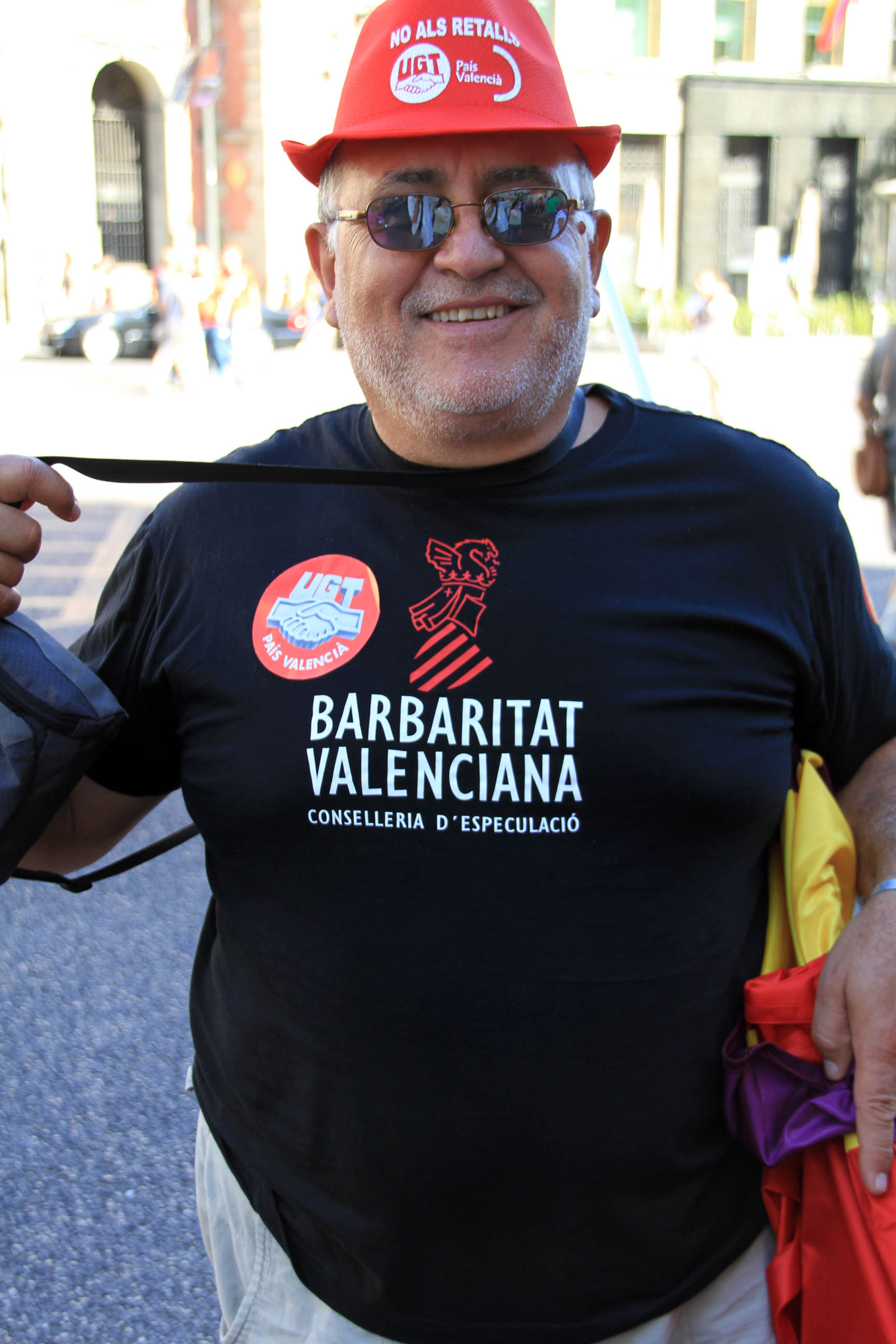
“Barbarity of the Valencian [Government]. The Council of Speculation” (Catalan)

“Esperanza, listen! The people is combating!” (Catalan)

Today Esperanza Aguirre, President of Madrid has resigned. The Saturday demonstration was surely not the reason, but we can attest that her name was cited there with very little affection for a couple of hours.

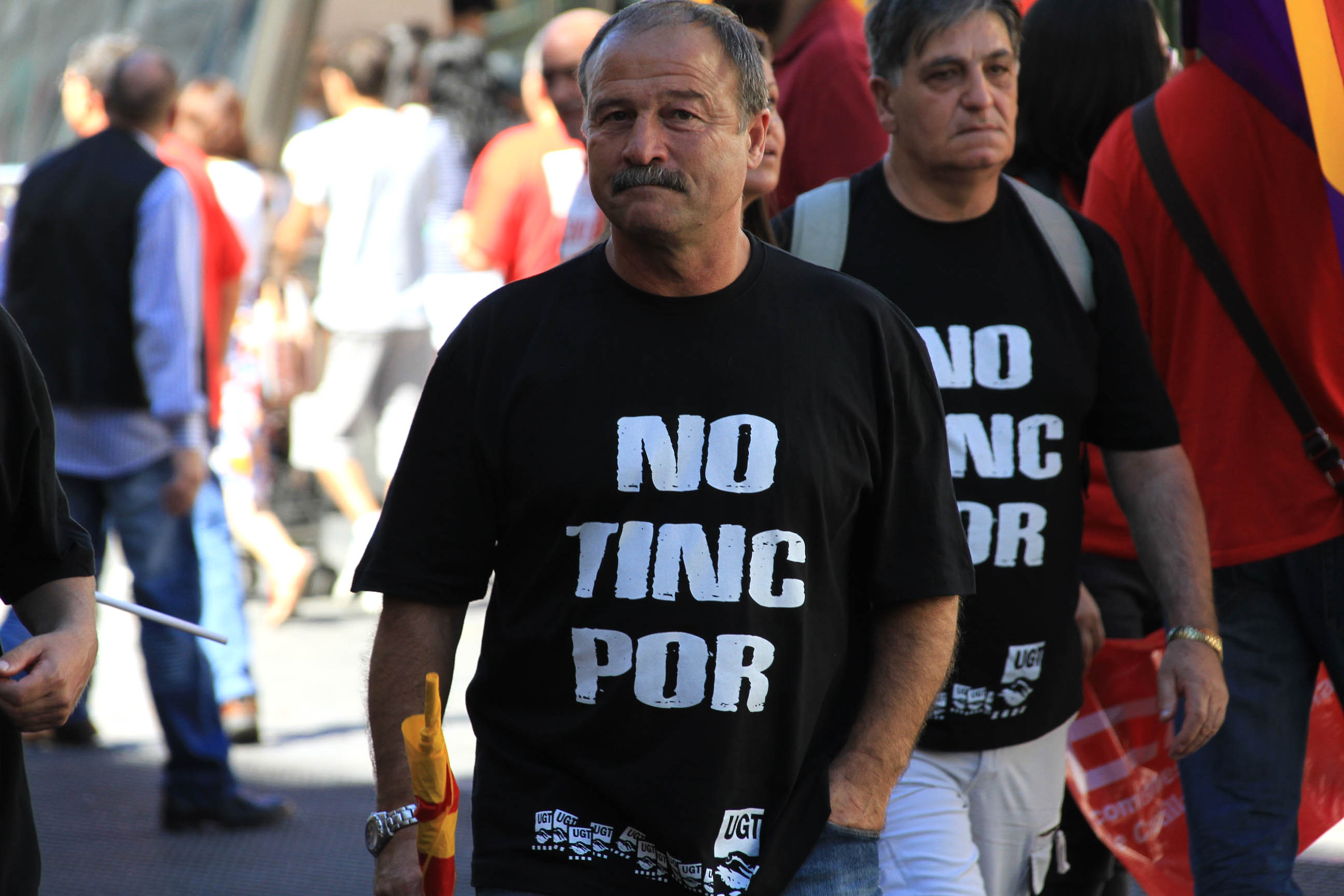
“I have no fear” (Catalan)

“Let us defend our rights. Let us not shut up!” (Catalan)

“Let’s go!” (Basque)

“For a quality public education” (Catalan)

“I is another” (“Je est un autre”), at the foot of the Cybele fountain


And finally, in a bar, a park, or, as in this case, in the Museum of Prado there is always a quiet place to rest.

Inscriptiones


En la manifestación del pasado sábado en Madrid nos sorprendieron dos cosas –aparte de la gran cantidad de gente que asistió llenando la Plaza de Colón y desbordando las calles de alrededor: cómo las camisetas se han convertido en el vehículo principal de expresión de la protesta, muchas veces en tono humorístico, y la gran cantidad de textos —en camisetas y pancartas— escritos en las diversas lenguas del estado, especialmente en catalán.


Era una manifestación que hacía confluir en la Plaza de Colón las protestas separadas de los distintos grupos profesionales más directamente afectados por los recortes que el gobierno ha aplicado a los núcleos básicos del «estado del bienestar». Así, la sanidad y la educación, ambas con el color verde como distintivo, fueron los sectores más visibles.


A Madrid siempre se le puede aplicar esa metáfora machadiana, un poco cursi, de «rompeolas de todas las Españas». A quienes no somos de Madrid sino de los territorios periféricos que utilizan el nombre de Madrid como metonimia de todos los males políticos y económicos, cuando estamos unos días en esa ciudad nos sorprende no ver al demonio saltar detrás de cada farola, y comprobamos una vez más el espíritu abierto y acogedor de los madrileños, la hospitalidad general de una ciudad que tiene tan poco que ver con sus gobernantes.

«Barbaridad [por Comunidad] valenciana. Consejería de especulación» (catalán).


Hoy Esperanza Aguirre, la presidenta de Madrid, ha dimitido. No habrá sido por la manifestación del sábado, pero podemos dar fe de que allí se la nombró con muy poco cariño durante una par largo de horas.

«No tengo miedo» (catalán)

«Defendamos nuestros derechos. ¡No callemos!» (catalán)

«¡Vamos!» (euskera)


«Je est un autre», al pie de La Cibeles.


Y al final, en algún parque, en un bar o en la acogedora cafetería del Museo del Prado, como este caso, siempre habrá un rincón tranquilo donde descansar.

Madrid - Prague


We have found this beautiful text by Antonio Muñoz Molina in the last edition of Babelia only some hours after we have illustrated with a quotation from his Sefarad the importance of the celebrations of the Holy Week in Úbeda. The text, which perhaps intentionally imitates the “long sentences” of Bohumil Hrabal, speaks about Josef Sudek, whose photos have been recently exhibited for the first time after half century in Madrid. The life and figure of Sudek are just as enigmatic as the city he kept photographing in all his life, and his images have directly or indirectly determined the way we look at Prague.


Josef Sudek is a man roaming the streets of Prague, bent under the weight of a cumbersome and archaic camera and of a tripod of an itinerant photographer, a photographer left here from a previous epoch who takes his pictures hidden under the large black veil and slowly pressing the rubber ball of the releasing mechanism. In a Zen koan they ask how the clap of one hand sounds. The art of Josef Sudek has something of the fabulous resonance of this hand which cannot clap with the other, as he had lost his right arm on the Italian front during the First World War, and although sometimes an assistant helps him to stand up the camera, during his taciturn roamings over Prague he is always seen alone, the clumsy Kodak of 1894 and the tripod already became a part of his profile, just like the beret and the black coat and the left shoulder sinking always lower in lack of the counterweight of the right arm, already a phantasm and still painful, amputated in the field hospital. In 1926, when Josef Sudek had been a war invalid for almost ten years, he once again returned to Italy accompanying his friends from the Prague Philharmonics. Music was his other great love. In the middle of a concert he rose from his seat, left the theater like a somnambulant, and through deserted and dark streets he reached the outskirts of the town, wandering all through the night, this time free from the weight of the camera, lost in unknown landscapes. And in the gray fog of the dawn in a plain field he saw a farmhouse, and with the inappellable certainty of the dreams he knew that this was the farmhouse where he had been taken when he was wounded, when his arm was cut off. “But I have not found my arm,” he related later, although he did not tell where he had been after, while his friends from the orchestra were looking in vain for him before continuing the tour without him.


He returned from this journey and did not leave Prague any more. He rented a small studio looking onto a shady garden and there he worked and lived during the fifty years that were left to him. The war and the loss of the right arm swept his youth off. The obstacles on my way became my way, writes Nietzsche. It is possible that the real vocation is a way which opens by chance after all the other ones which looked more evident are closed. If they did not have to amputate his right arm at the height of the shulder because of a necrotized wound, Josef Sudek would have become a bookbinder. And without the small disability pension he received after the war he could have not devoted himself to photography
, body and soul. He began by taking pictures of the veterans he met by chance in the hospitals, of those mutilated and spiritually distorted figures populating all Europe after the slaughter, but it took him years to find his own style. At the age of twenty he had to learn how to live with one arm less, how to manage the camera and the process of image development. But it was even more difficult to learn how to see those things that nobody paid attention to, although they were there before the eyes of everyone. To do so, he had to center himself, to choose or find a fix position in the chaos and multiplicity of the world, like sharpening the focus of a lens. In order to see Prague, Josef Sudek had to leave Prague for a while. He traveled to the south, and in that Italian dawn – with the fertile plains and hazy distances only interrupted by some houses or trees – he saw the same place again where his previous life had been broken by the machine-gun, and although he could not find his missing arm any more, but nevertheless he found his other, invisible arm and hand with which he could give form to the mystery of his poetic invention.


He did not need to leave any more. The farthest terra incognita he rambled to were the fields over the tramway terminuses. He strolled about the streets with the large camera on his shoulder, in a hurry to arrive to a certain constellation of the lights, or remaining still for several minutes waiting for the right moment under the black veil. He used to say that photographing is a strange art, as it cannot show the things openly, only through allusions, revealing only the necessary minimum in order the complete image be born in the look and in the imagination of the onlooker. The panoramic format of 30×10 permitted by his camera embraced the horizontality of a square or of a field in which the human silhouettes appear isolated in the distance, but are not lost in it, for sometimes they seem to be absorbed in contemplation like the background figures of a painting by Friedrich, and sometimes we see them walking with a determined purpose, men and women crossing a street in the downtown, or moving off towards a housing block after having got off from the tramway at the last station, which is already not in the city and not yet in the fields but somewhere on the outskirts from where the roofs and towers of Prague seem just slightly more than a jagged profile on the horizon.


• Gallery + + + + +
• Catálogo 2009
• Film + +
• Sudek + + + + + + +
• Wikipedia (Czech)
• Blog + + + + + + +
• Sudek Studio
• Books +
In the photos of Sudek Prague seems to be suspended in time, offuscated in the ambiguous lights of the sunsets and dawns, depopulated and silent in the humid winter nights ligthed by the phosphorescence of the fog or of the snow and traversed by tramways like by submarines with reflectors on their prow. This is that assaulted and tormented city where the refugees of half Europe sought shelter from the advancement of Nazism, the one retaining its breath when in the infamous pact of Munich of
November 1938 the British and French permitted to Hitler to amputate half of the country, the one occupied in 1939 by the German army and by the efficient executioners of the Gestapo, the one which, only a few years after the end of the Nazi occupation, succumbed to the puppet regime of the Communists manipulated by the Soviets. Prague, which used to be in the heart of Europe, retired far behind the hermetism of the Iron Curtain: this is how we see her in these photos of Sudek from the fifties that are now exhibited in Madrid, in a silent room of the Círculo de Bellas Artes. A city of squares without traffic and of deserted nights in which the shudder of the military tattoo is still resounding, of statues full of pathos on the façades of the buildings, of windows covered with moisture, of shady gardens beaten up by the weeds that exhale the deep odour of humid earth and wet leaves. In the silence some steps resound on the cobblestones, the rumor of panting breath. The man of the sloping shoulder is sleeplessly roaming the city, in search of that light of the dawn which he only saw twice in his life, on the day when his arm was amputated, and on the day when, many years later, by wandering as in a dream, he found it.


Madrid - Praga


Hallamos este hermoso escrito de Antonio Muñoz Molina en la última edición de Babelia sólo unas horas después de que ilustráramos con una cita de su Sefarad la importancia de las celebraciones de la Semana Santa en Úbeda. El texto, que quizá intencionadamente imita las «sentencias largas» de Bohumil Hrabal, habla sobre Josef Sudek, cuyas fotos se han expuesto en Madrid por primera vez después de medio siglo. La historia y figura de Sudek son tan enigmáticas como la ciudad que él fotografió durante toda su vida y sus imágenes, directa o indirectamente, han determinado hasta hoy nuestra manera de ver Praga.


Josef Sudek es un hombre que camina por las calles de Praga encorvado por el peso de una cámara voluminosa y arcaica y de un trípode de fotógrafo ambulante, de fotógrafo siempre como de otra época que se oculta bajo la joroba de la cortinilla negra para tomar sus retratos, apretando despacio la pera de goma del disparador. En un acertijo Zen la pregunta es cómo sonará la palmada de una sola mano. El arte de Josef Sudek tiene algo de la resonancia quimérica de esa mano que no puede chocar con otra, porque había perdido el brazo derecho en el frente italiano durante la Primera Guerra Mundial, y aunque a veces un asistente le ayudaba a preparar la cámara, en sus caminatas callejeras solía vérsele por Praga cargando con ella a solas, el armatoste Kodak de 1894 y el trípode convertidos ya en una parte de su perfil, como la boina y la capa negra y el hombro izquierdo cada vez más inclinado, a falta del contrapeso del otro brazo ya fantasma, dolorido todavía, amputado en un hospital de la retaguardia. En 1926, cuando Josef Sudek llevaba casi diez años siendo un mutilado de guerra, volvió a Italia acompañando a sus amigos de la Filarmónica de Praga. La música era su otro gran amor. En medio de un concierto se levantó de su asiento y salió como sonámbulo del teatro, y por calles vacías y a oscuras llegó al extrarradio y estuvo caminando toda la noche, esta vez más ligero sin el peso de la cámara, perdido en paisajes que no conocía. En la niebla gris del amanecer, en un campo llano, vio una granja, con la sensación de reconocimiento inapelable de los sueños. Era la granja a la que lo habían llevado cuando fue herido, cuando le cortaron el brazo. «Pero mi brazo no lo encontré», contaba luego, aunque no dijo dónde estuvo después, cuando sus amigos de la orquesta lo buscaron en vano antes de continuar sin él la gira.


Volvió de ese viaje y ya nunca más salió de Praga. Alquiló un pequeño taller que daba a un jardín umbrío y en él trabajó y vivió los cincuenta años que le quedaban de vida. La guerra y la pérdida del brazo habían trastornado su juventud. Los obstáculos en mi camino se convirtieron en mi camino, escribe Nietzsche. La verdadera vocación puede ser un camino que sólo se abre por azar cuando se han cerrado otros que parecían más evidentes. Si no hubieran tenido que amputarle el brazo derecho a la altura del hombro por culpa de una herida de guerra infectada Josef Sudek habría sido encuadernador. Y sin la pequeña pensión de invalidez que le quedó después de la guerra no habría podido dedicarse en cuerpo y alma a la fotografía. Empezó haciendo retratos de los veteranos con los que coincidía en los hospitales, figuras de aquella población de espectros mutilados o enloquecidos que quedó en Europa después de la carnicería, pero iba a tardar algunos años en encontrar su estilo. Con veintitantos años tenía que aprender a vivir con un brazo de menos, a manejar la cámara y los procesos del revelado. Pero más difícil era aprender a mirar aquellas cosas en las que nadie reparaba aunque estuvieran a la vista de todos. Para hacer algo era preciso centrarse: elegir o encontrar una posición fija en el aturdimiento y la variedad del mundo; como ajustar el foco de una lente. Para mirar Praga, Josef Sudek tuvo que irse brevemente de Praga. Viajó hacia el sur y en aquel amanecer italiano —las llanuras fértiles, las distancias brumosas, interrumpidas por casas o árboles— vio de nuevo el lugar en el que su primera vida había sido destrozada por la metralla, y al no encontrar el brazo que le faltaba lo que descubrió fue el otro brazo y la otra mano invisibles gracias a los cuales iba a resonar el misterio de su invención poética.


Ya no necesitaría salir nunca más. La tierra incógnita más alejada en la que iba a aventurarse eran los descampados al final de las líneas de los tranvías. Trotaba por los callejones con la gran joroba de la cámara al hombro, dándose prisa para llegar a un cierto instante de luz, o se quedaba inmóvil durante muchos minutos, esperando el momento exacto, cobijado por la cortinilla negra. Decía que fotografiar era un arte raro, porque no se podían mostrar las cosas abiertamente, sino dando pistas, desvelando sólo lo justo, para que la imagen completa estuviera en la mirada y en la imaginación del espectador. Los formatos panorámicos de 30×10 que permitía su cámara abarcaban la horizontalidad de una plaza o de una llanura en las que las siluetas humanas están aisladas en la lejanía, pero no perdidas en ella, porque unas veces tienen el aire de contemplación de las figuras de espaldas en los cuadros de Friedrich y otras se las ve caminar con un propósito ensimismado, hombres y mujeres que cruzan una calle céntrica o que se alejan hacia un bloque de viviendas después de bajarse del tranvía en la última parada, la que ya no está en la ciudad pero tampoco es el campo, el extrarradio desde el que los tejados y las torres de Praga son poco más que un perfil recortado contra el horizonte.


• Galeria + + + + +
• Catálogo 2009
• Película + +
• Sudek + + + + + + +
• Wikipedia (checo)
• Blog + + + + + + +
• Sudek Studio
• Libros +
En las fotos de Sudek Praga parece suspendida en el tiempo, desdibujada en las luces ambiguas de los atardeceres y los amaneceres, deshabitada y silenciosa en noches húmedas de invierno, en noches con la fosforescencia de la niebla o la nieve atravesadas por tranvías como submarinos con un faro encendido en la proa. Pero ésa es la ciudad asediada y convulsa a la que acuden refugiados de media Europa según avanza el nazismo, la que contiene el aliento cuando en noviembre de 1938, en el pacto infame de Múnich, los británicos y franceses aceptan que la mitad del país sea amputada para entregársela a Hitler, la que en 1939 es ocupada por el ejército alemán y por los eficaces carniceros de la Gestapo, la que sólo unos pocos años después del final de la ocupación nazi sucumbe a la mascarada de un régimen comunista mangoneado por los soviéticos. La Praga que estuvo en el corazón de Europa se volvía remota tras el hermetismo del Telón de Acero: así la vemos en estas fotos de Sudek de los años cincuenta que se muestran ahora en Madrid, en una sala recóndita del Círculo de Bellas Artes. Una ciudad de plazas sin tráfico y noches deshabitadas en las que todavía perdura el escalofrío del toque de queda, de estatuas enfáticas en las cornisas de los edificios, de cristales de ventanas empañados por la condensación, de jardines en sombras comidos por la maleza que exhalan un olor profundo a tierra húmeda y hojas empapadas. En el silencio unos pasos suenan sobre los adoquines, una respiración jadeante. El hombre insomne de la espalda torcida camina por la ciudad en busca de aquella luz de amanecer que vio sólo dos veces en su vida, el día en que le amputaron el brazo, el día en que lo buscó varios años después como extraviado en un sueño.


¡Viva España!

This is how the proposed new text of the Spanish hymn begins, that was just rejected by the Spanish Olympic Committee when I arrived to Spain. Throughout its ephemeral life this text has caused much tempest that has even reached as far as to Hungary. Simultaneously, the leaders of the right-wing party decided not to enter in the approaching elections their last trustworthy face, the Mayor of Madrid Gallardón, but to nominate instead Manuel Pizarro, a businessman of a controversial past on the second place of their list. The web forum of readers of El País of which I also have the honor of being a member has immediately discovered, with a good nose, the subtle relationship between these changes and my travel to Spain. The East-European agent arrived to Spain for the subversion of the Right, and he has already hitched up to the job.

Caserna antigua en el centro de Palma de Mallorca / Old barrack in the downtown of Palma de Mallorca, Spain
My first step is to look for an internet spot to receive my instructions. The members of the readers’ forum had promised me to compose a list of the bars I should unconditionally visit in Madrid in those few days while working in the National Library. I get in touch with them in the quarter of Carabanchel, in an Ecuadorian internet locutorio that has established an exemplary internationalist brotherhood with the proletariat of a large number of the countries of the world. Half of the room is occupied by a Columbian food store in which the wares are not arranged by sort, but by countries of origin. They line up on the shelves under handwritten shelf-marks like in a good library, in order the guest worker should not browse for long: Ecuador, Argentina, Peru, Poland, Romania... The countries known by me are unequivocally represented by wares in lack of which the guest workers of that country are orphan kids: for example mineral water of Borsec and poteen of Braşov for the Romanian immigrants who are just illegally dismantling and selling as Francoist souvenir the iron grids of the once notorious, today abandoned prison of Carabanchel, thirty euros a piece of an ell. “Does it really sell?” I ask of the little round Columbian seller, with a hint to the water of Borsec. “Like hot cakes!” he answers with a large smile.

La cárcel de Carabanchel abandonada / Abandoned prison of Carabanchel (Madrid), Spain
The first program item is the visit of the Rastro scheduled to realize on Sunday morning. However, this flea market spreading over the steep southern streets of Madrid has lost much of its glamor, today it is rather a tourist spot and a market of cheap Chinese commodities. Nevertheless, the seafood bars coming in quick succession on the Ribera de Curtidores offer a generous compensation to the observer who arrives from a country without sea.

Bar de pescado, Ribera de Curtidores, Madrid / Seafood Bar, Ribera de Curtidores, Madrid (Spain)
In the evening we still go with Ana to the Bukowski Club run by their friend, the Argentinian writer Carlos Salem, but with this the thread is altogether broken. I will not get to the Cafe Comercial at the Bilbao metro station, neither to the antiquarian shop on Moyano, not even to the Pizzeria “El Trebol” at the Sol station, where I should greet Gerardo and Arturo in the name of Ariel. I come down with flu, and lay with fever throughout the two days I had dedicated for working in the library and exploring the city. Mission incomplete. It is a luck that with my last forces I had been able to drag myself to the National Library where I get to know that it has unexpectedly closed, because an Argentinian diplomat had been stealing books for several months and now as he’s got pinched they make inventory. Better so, at least I am not annoyed that much by the idleness forced upon me.

Ana and José, our friends whom we had known in Iran attend me with devotion. They cook tea for me, look for pills, and give me Orsón, the big plush St. Bernard dog as a bed-warmer. I ask them to bring me some Borsec mineral water from the Columbian shop, as this is also used as a medicine in the Carpathian Székely land from where it comes. With the poteen of Braşov I do not dare to make experiments.

On Wednesday morning I am roaming still dizzy with illness on Terminal 4 of the Madrid airport, looking for a plug for my notebook. On Spanish airports I always find a place where I can work some hours until departure. Here, however, I have no success with this either. In the cafés, the salad bars, and even in the always reliable McDonalds envious hands smoothed out the bottoms of the columns and the walls alongside the chairs.

I sit down at least for a coffee, with a book in the hand. In the meantime it is announced that the plane to Mallorca will leave with a delay of an hour. I am just reading about how hopelessly Kapuściński tries to find a plane in the middle of the revolution in Kongo, when someone next to me begins to hum a tune. I jerk up my head. A young woman is softly singing to herself at the next table above her coffee, still half sleeping, persistently. I cannot grasp the melody, the rhythm is also free. It sounds like flamenco, and then perhaps like a ballad. The throaty alto voice fills the café and makes it homely. Bienvenido a España.

Madrid, Terminal 4, flight departure