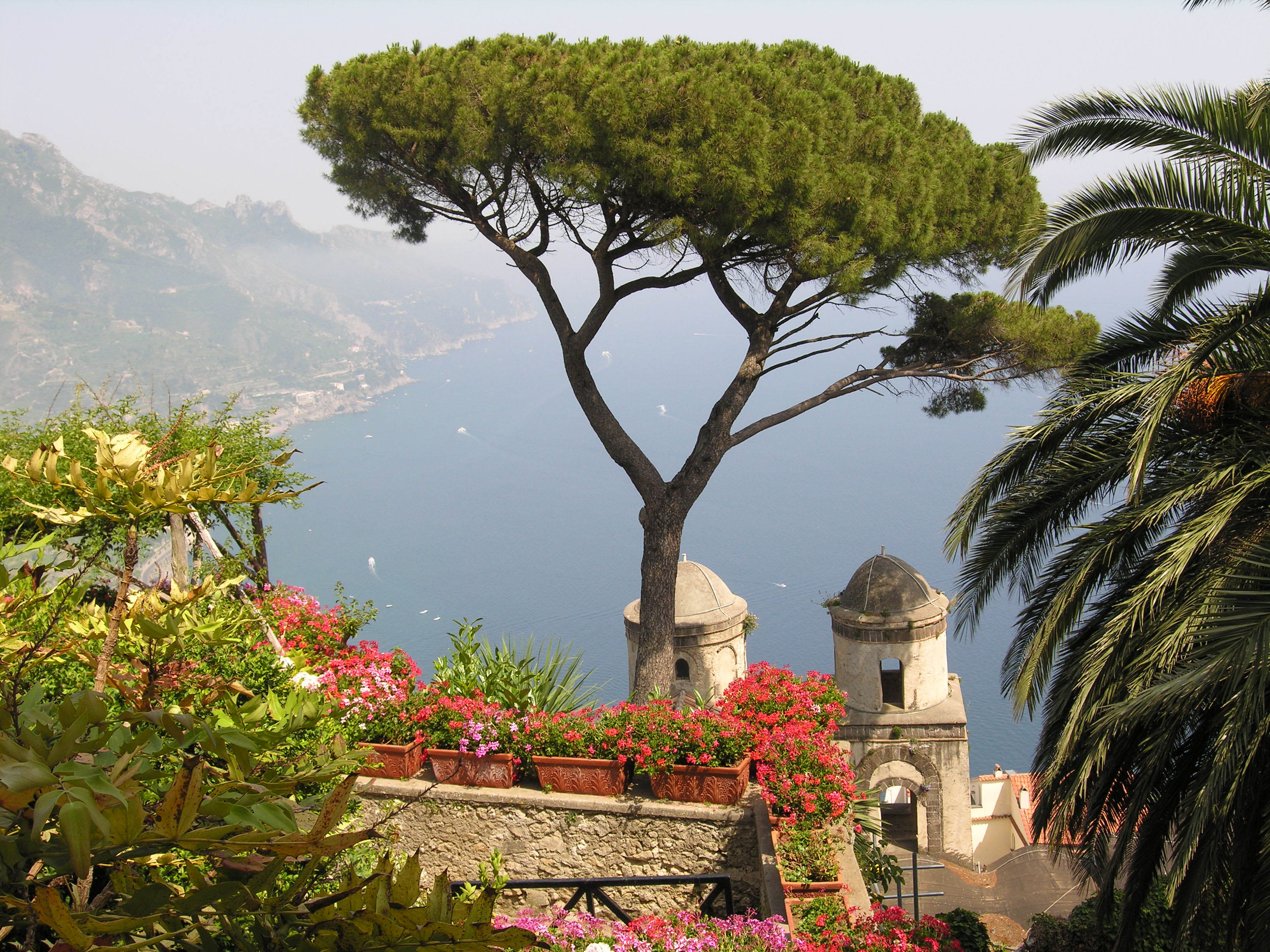
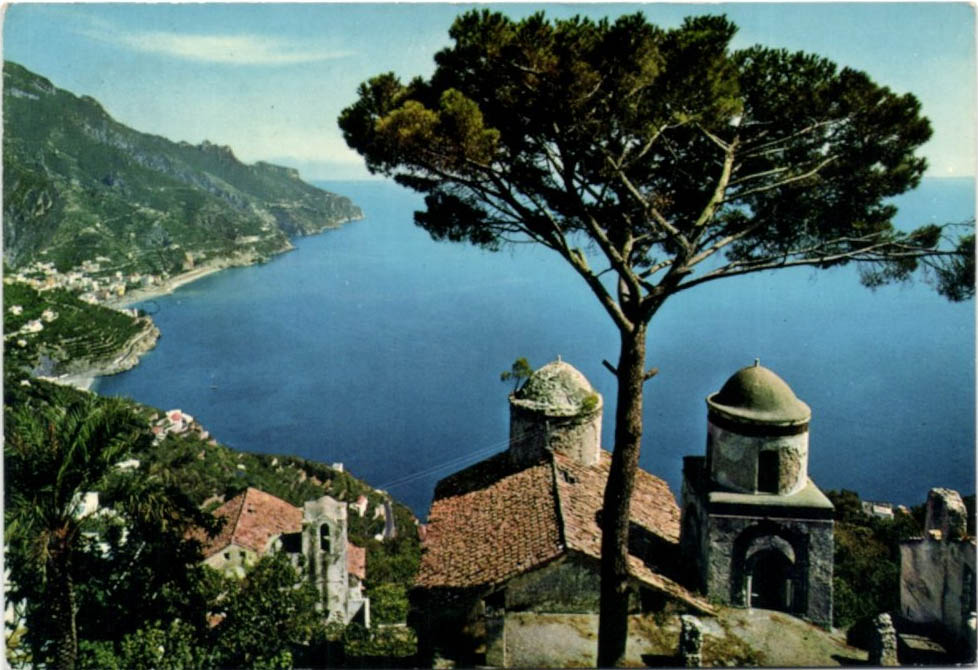
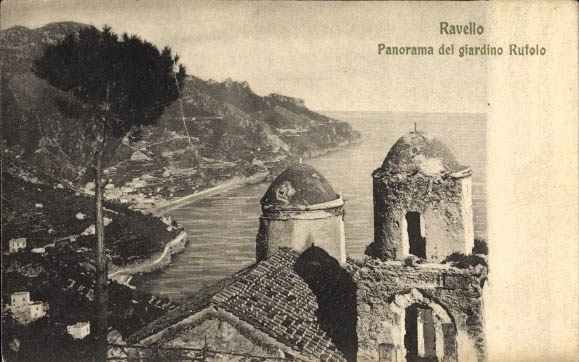
 How fast does a pinea grow? Those who know will easily calculate it when the third photograph here below was taken, if compared to the first photo of 2006 and the second postcard of 1970.
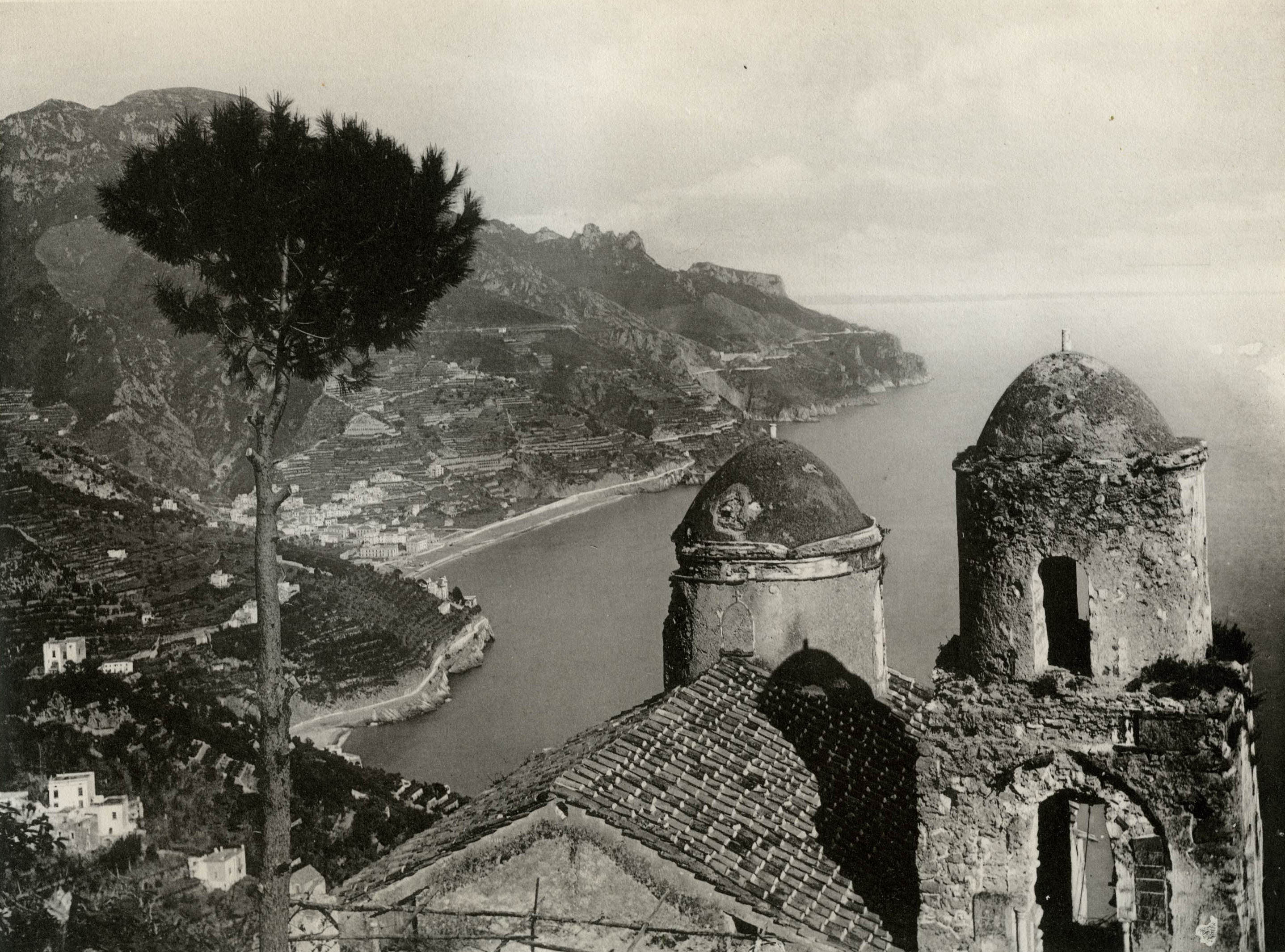 “View from Palazzo Rufolo with the domes of Annunziata”
I cannot tell it, because in the old photo album, which I bought today in the Berlin flea market, there is no year, nor any text whatsoever apart from the captions.

 The album, as its title shows, presents the monuments of the Southern Italian town of Ravello. First of all, several details of Palazzo Rufolo, its Romanesque walls and Gothic windows, its garden and its spectacular view on the Bay of Sorrento. Then, the Palazzo d’Afflitto, the town’s Romanesque fountain with a lion, the pulpit of San Giovanni del Toro, and that of the cathedral, a beautiful Romanesque construction with mosaic, supported by six stone lions.
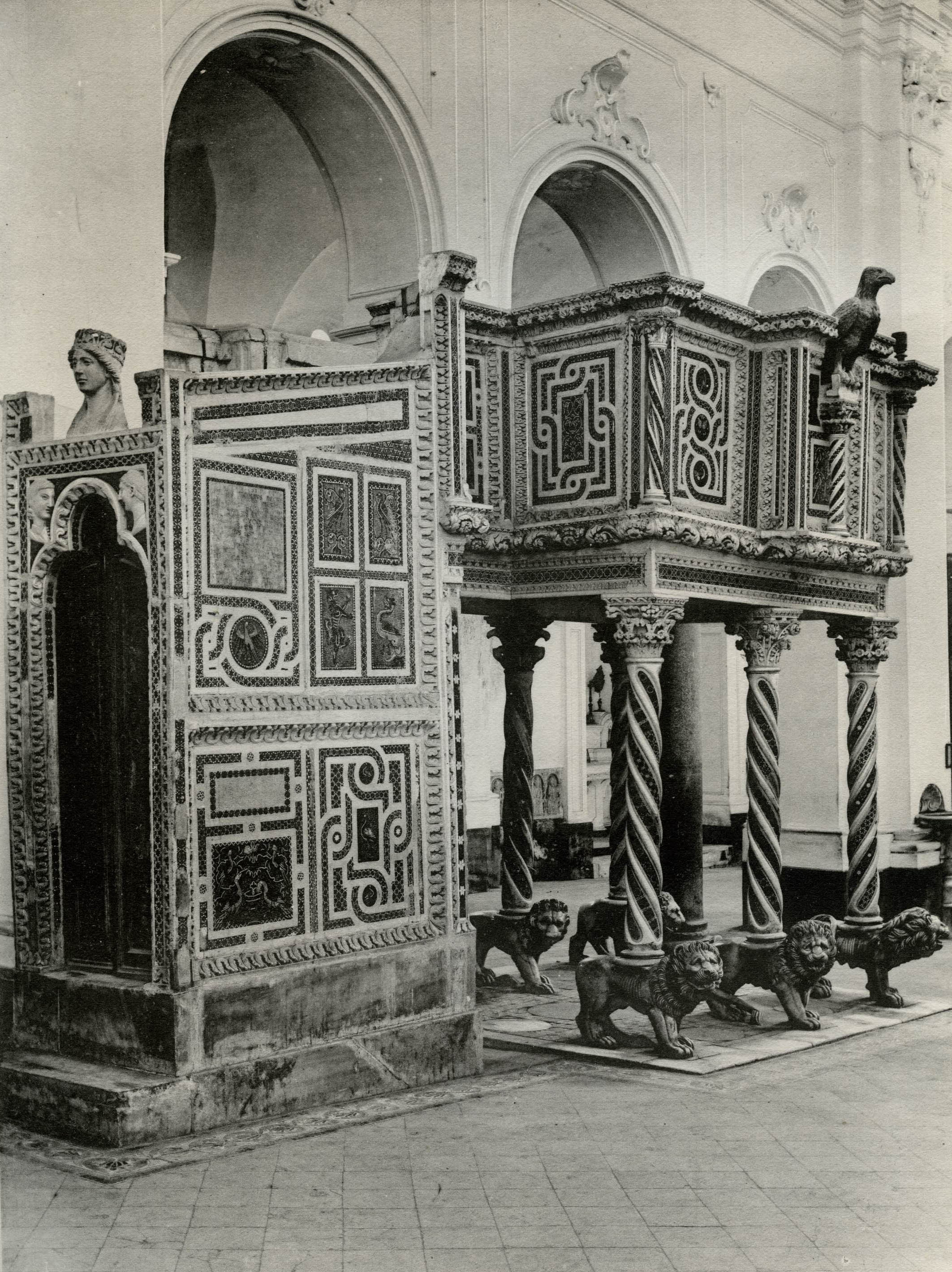 “The pulpit of the Catheral of Ravello, with the head sculpture of Sigiligaita Rufolo”
The most moving feature of these photos is that all sites are a bit neglected. Nowadays, when you visit the polished-up monuments across all Italy, it is refreshing to see such pictures, in which the almost thousand-year-old churches and towns receive you so shabbily, casually, with the promise of discovery, of the first arrival. Like in Iran or in Armenia. Or in Csík/Ciuc, in the Eastern Carpathians, in the mid-eighties, when I arrived there for the first time to survey the almost thirty medieval churches in old Hungary’s highest populated mountain region.
 “Bell tower of the ancient St. Martin’s church”
I take off the shelf the 1906 volume Unteritalien, Sizilien, Sardinien, Malta, Tunis, Corfu from the complete Baedeker series of belle-époque Europe, also collected at a flea market. I open it to pages 194-195, Ravello, where I read this:
“The ancient mountain town of Ravello (374 m), which today counts only 1165 inhabitants, was founded at the time of the Normans, and in its golden age, under the Anjou, in the 13th century it had 36 thousand inhabitants, 13 churches, 4 monasteries and several palaces. It is worth a visit, not only because of the magnificent view, but also from an art historical viewpoint, in particular for those who do not yet know the Norman-Moorish architecture.
In the Romanesque CATHEDRAL (S. Pantaleone), founded in 1086 by Orso Pappice, the first bishop of Ravello, but largely rebuilt, the most notable sight is the bronze door with saints and ornaments in relief, donated in 1179 by Barisanus of Trani from the Muscetolo family (you should have it opened from inside to see it, because from outside a wooden door stands in front of it). In the interior, a magnificent marble *pulpit with inlaid mosaic, held by six columns on the back of stone lions. Its donor was Niccolò Rufolo, the consort of Sigilgaita della Marra. The inscription names a certain Nicolaus de Bartholomeo de Fogia marmorarius as its creator.
Leaving the cathedral, and passing by a picturesque Moorish fountain to the left side (with a nice outlook to the valley towards Scala), after 100 steps we reach the entrance of Palazzo Rufolo (turn right before the second gate tower), which is in the possession of Mrs. Reid, a British woman. The palace, one of the oldest in Italy, was built in Saracen style in the 11th century, and was once inhabited by Kings Charles II and Robert the Wise. In the middle, a fantastic small columned courtyard. In the beautifully landscaped garden, a terrace (340 m a[bove] s[ea level]), with a magnificent view; to the gardener, 40-50 c[entesimo].
Turning back, and setting out on the path which leads to the left side from the cathedral, in 5 m[inutes] we arrive to S. Giovanni del Toro in the E[astern] side of Ravello. A Romanesque columned basilica (closed; the guard under the gate tower; 25 c[entesimo]) with a beautiful pulpit (11th c.), with well-preserved medieval frescoes representing the life of Christ on its stairs and in the crypt.
Opposite S. Giovanni stands the former Palazzo d’Afflitto. Following the path which passes by the garden, after 200 steps we reach the Piazza di Ravello with a Norman-Moorish-style fountain.
GUE[STHOUSE]: *Belvedere H[otel]-P[ansion] (Caruso), in the former Pal. d’Afflitto, with magnificent view from the garden. R[oom], L[amp], S[ervice] 3, B[reakfast] 1½, Lu[ncheon] w/o w[ine] 3, L[unch] w/o w[ine] 4, F[ull board] w/o w[ine] 7-8 fr.”
 The region of Salerno and Amalfi, Baedeker Unteritalien etc. 1906, p. 182. Below: The detail of the map depicting Ravello (above Amalfi, to the right from the serpentine road).
It is telling that, although Ravello has several other monuments as well – for example, the Annunziata church in the first picture above –, the Baedeker mentions exactly those five, which also have an illustration in the photo album. Even some details coincide: the photo album also emphasizes that Palazzo d’Afflitto is “Hôtel Belvedere” today, it also publishes the pictures of the two pulpits from the two churches, that of S. Giovanni from an angle where the frescoes are well seen, and under that of the cathedral he also mentions the name of Sigiligaita Rufolo. This latter was the most powerful lady in Southern Italy at that time, the sister of Angelo I De Marra, the treasurer of Emperor Frederick II. It is no coincidence, therefore, that the Baedeker only refers as her consort to Niccolò Rufolo, who by way of this marriage rose to Southern Italian aristocracy, and made his estate in Ravello one of the centers of the kingdom of Sicily in the first half of the 13th century. The golden age of Ravello lasted until 1283. In this year the Anjou dynasty, which had come to power in 1266, confiscated the town from the Rufoli, who became too powerful, and made it a royal estate. The spectacular rise and fall of the family is also mentioned in Boccaccio’s Decamerone, second day, fourth tale. Apparently nothing changed, but the wealth oozed in other directions, and nothing more was built here. Ravello has remained in its 13th-century state to the present day.
 “Sigilgaita”. The first page of E. Allen’s Guide of Ravello, 1909
The Baedeker and the album obviously collaborate. The early 20th-century tourist visits the sights that the Baedeker recommends him, and buys postcards or albums about the same. Therefore, the photographer composing the album takes into account the recommendations of the Baedeker, in order to maximize his sales. There is only one major difference between them. The Baedeker dedicates only two sentences to the Palazzo Rufolo. Among the twenty-four photographs of the album, however, not less than twelve represent it, and, in addition, these are the album’s most personal photographs. The album’s roots must be searched therefore somewhere around the Palazzo Rufolo.
 “The courtyard of the Palazzo Rufolo with the capital”
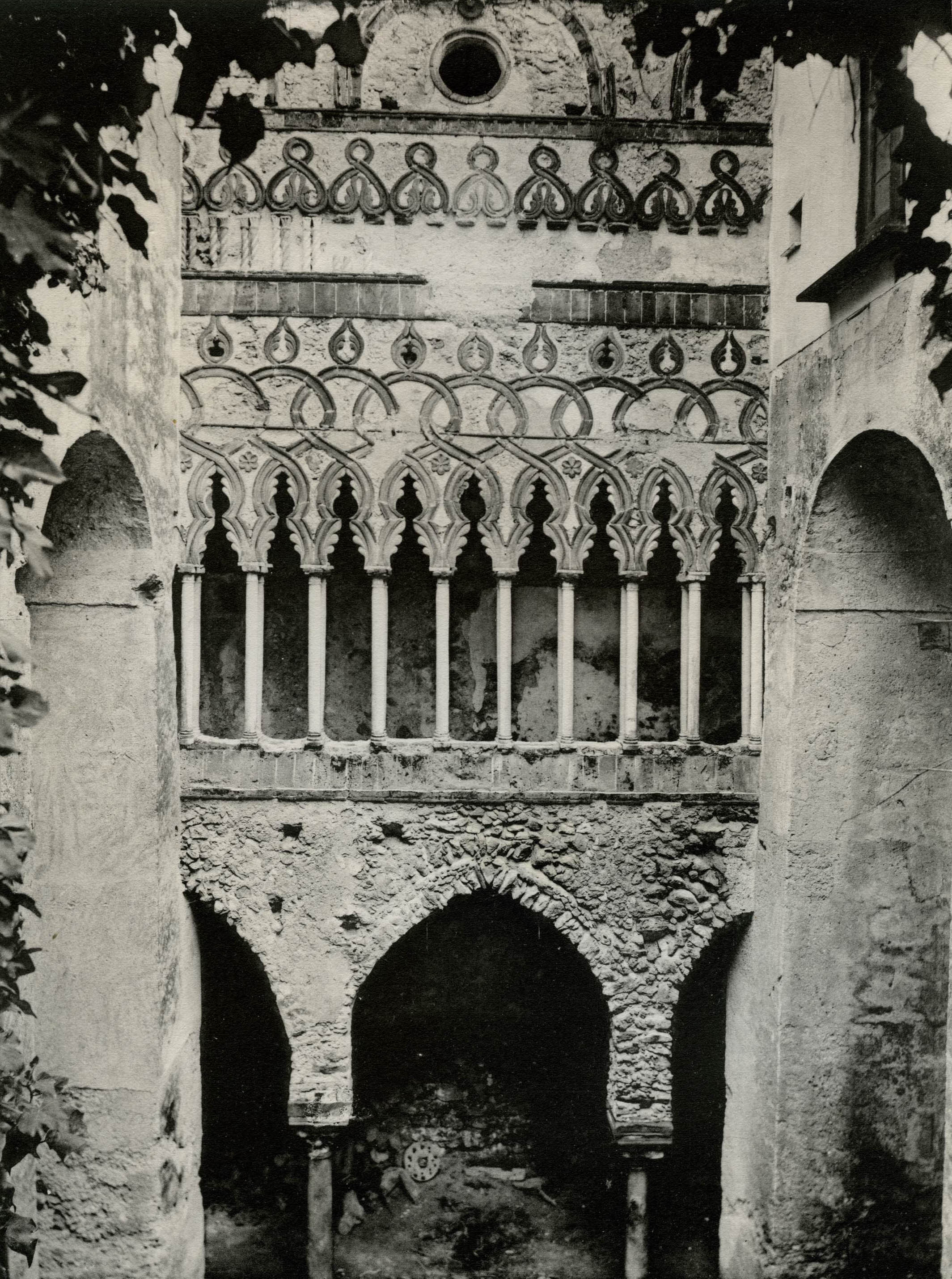 “A view of the courtyard of the Palazzo Rufolo”
In 1906, the Baedeker mentions “Mrs. Reid, a British woman” as the owner of the palazzo. However, the palace had been bought by Mr. Reid a half-century earlier. The obituary of 21 July 1892 of The Times remembers him like this:
“Mr. Francis Nevile Reid, who died at Ravello on the 12 inst. at the age of 66, will be greatly missed and sincerely mourned throughout the beautiful region of southern Italy where he had lived for something like 40 years. A member of a wealthy Scottish family, he suffered, as a very young man from delicacy of the chest; and as, during a journey in Italy, he found great good from the air of Ravello, above Amalfi, he bought land there, and the half ruined Palazzo of the once famous Rufoli family, and there he henceforth made his home. In those days the hill country of the kingdom of Naples was about the most backward and barbarous part of Italy; and Mr. Reid set himself to introduce some kind of civilization into his commune and neighbourhood. He made the Palazzo habitable, while preserving its ancient features with loving care; he gave employment to the underfed and underpaid people; he gradually organized a decent municipality; and, in the end, a few years ago, he succeeded in getting the excellent carriage road made to Amalfi, thus opening up the district and immensely increasing its chance of prosperity. Many were the difficulties that he had to overcome, especially from the small bourgoizie, who complained that he raised the rate of wages that they had to pay; and on one occasion, a few years ago, the ghastly murder of a local friend and partisan of his, in a quarrel arising out of this partisanship, reminded him of the real savagery that still remained among the people of Ravello. More than once, in the old days, he had a narrow escape from the brigands, who, in the last years of Bomba and after his overthrow, infested the mountains of the Surrentine peninsular. Once, as Mr. Reid, his wife, and her mother were about to sit down to dinner, the village cobbler ran in to tell them that 70 of these scoundrels were assembling in the Piazza, and that he would be seized on ten minutes. He and the ladies just succeeded in slipping away down a narrow path to Minori, the little seaport 1,000ft. below. where they took boat for Capri, staying there till order was restored. General Pallavicini swept the mountains clear of brigands, and since that time Mr. Reid has been able to live and carry on his career of quiet beneficence undisturbed. It is hard to estimate what a loss his death will cause throughout that lovely but very poor region, to which, for a generation of more, he has literally been a Providence.”
Francis Nevile Reid (1826-1892) first came to Naples in 1845, where already a major British expat community fluctuated around the Gibson Carmichael family. Reid also married into the family, and stayed here. In 1851 he bought the abandoned Palazzo Rufolo some fifty kilometers to the south from Naples, at the foot of Monti Lattari, overlooking the Bay of Sorrento, which he restored in the romantic-oriental spirit of the age, with very good taste. He also rearranged the vast garden of the palace on the model of the British exotic and English gardens, and he developed it into one of the most famous gardens in Southern Italy. In the spirit of British philanthropy, he contributed to the development of the town with new roads, a water supply, a public fountain and many other things at his own expense. The travelers – who, through Reid’s family and social network, already in Naples learned of the spectacle, and whom he personally welcomed – reported that the place held the greatest fascination in their travelogues. Richard Wagner, who visited Ravello in 1880, took it as the model of the garden of the wizard Klingsor in the Parsifal. The yearly Wagner Days down in the town have been organized in his memory since the 1930s.
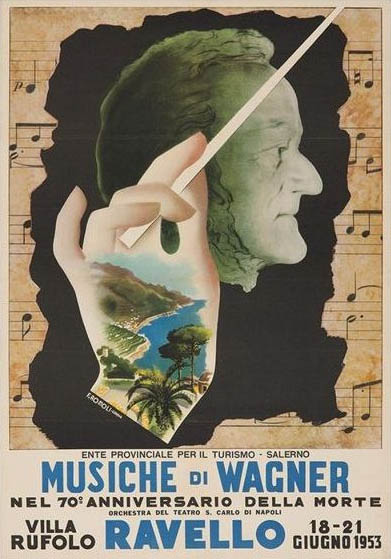
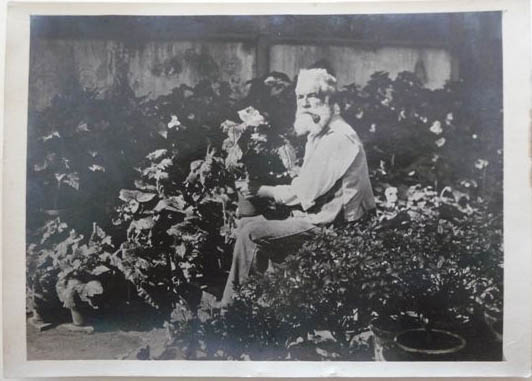
Reid’s most important assistant in the creation and maintenance of the garden was a young local peasant, Luigi Cicalese (1852-1932). The smart boy as the pupil of Reid became an extremely skilled gardener, and when he wanted to emigrate to Australia because of the unemployment that struck all of Southern Italy, Reid convinced him to stay. He made him the administrator and gardener of the villa: thus, the users of the Baedeker were paying him the 40-50 centesimi recommended for visiting the garden. In addition, because of him, he took up photography. Cicalese took carefully composed, sensitive pictures of the garden and the town which he knew well. The local persons appearing in his photos also are no mere decorative genre figures, but his fellow citizens, who look at Luigi photographing them as old acquaintances, often with a sly smile. In the spirit of the new fashion of the 1890s, he also started to sell his photos on postcards to the visitors of Ravello, and, judging from the large number of his photos popping up on auction sites, his publications must have been very popular. However, the upscale tourists purchased his photographs rather in large, approximately A4-size albums, like the one that has just fell into my hands in the Berlin flea market, obviously from the legacy of one such German tourist.
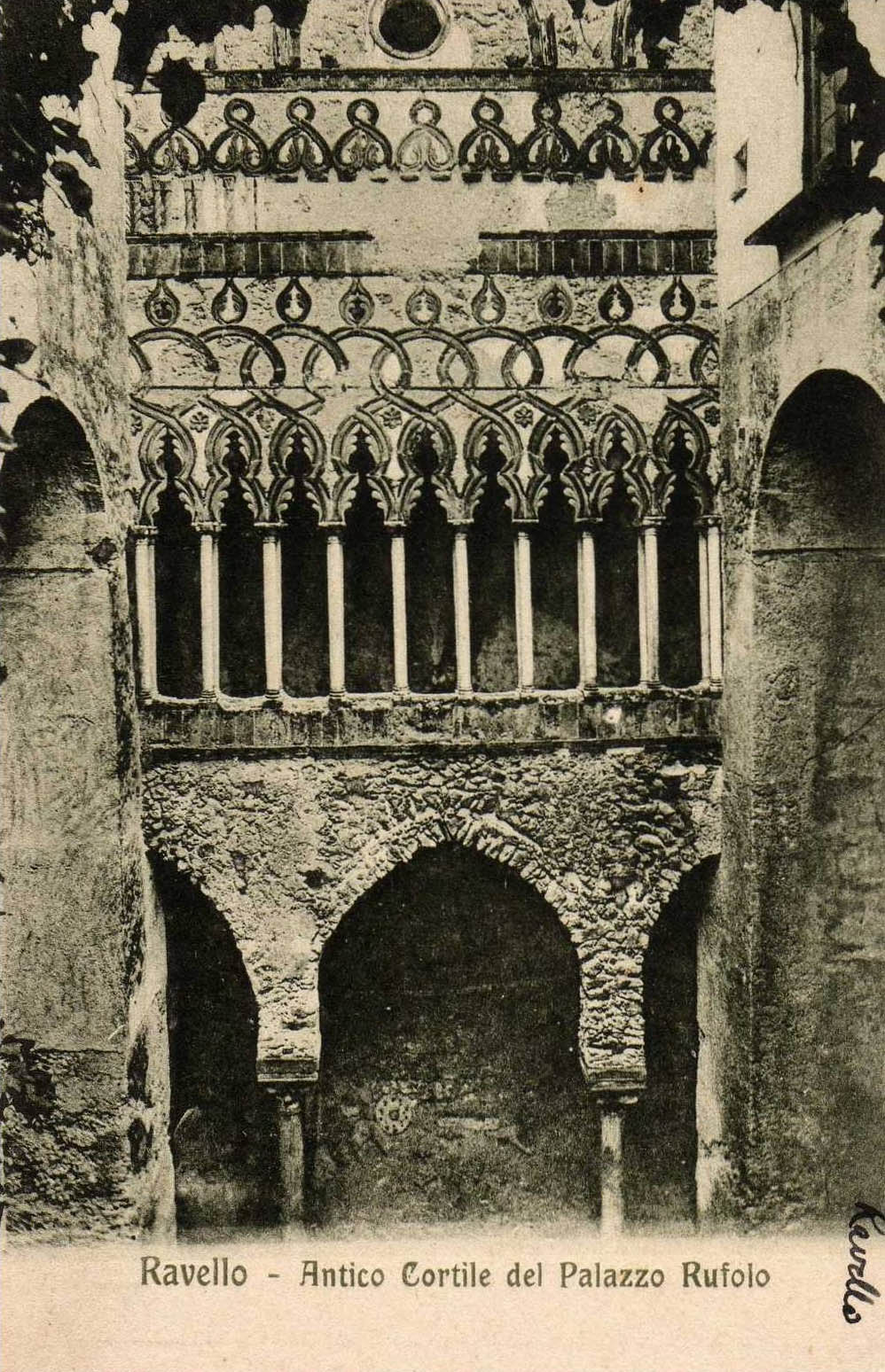 Postcard with the distinctive font of the Cicalese publications. Below: “The courtyard of Mastro Francesco” from the album, and on a postcard, with local figures
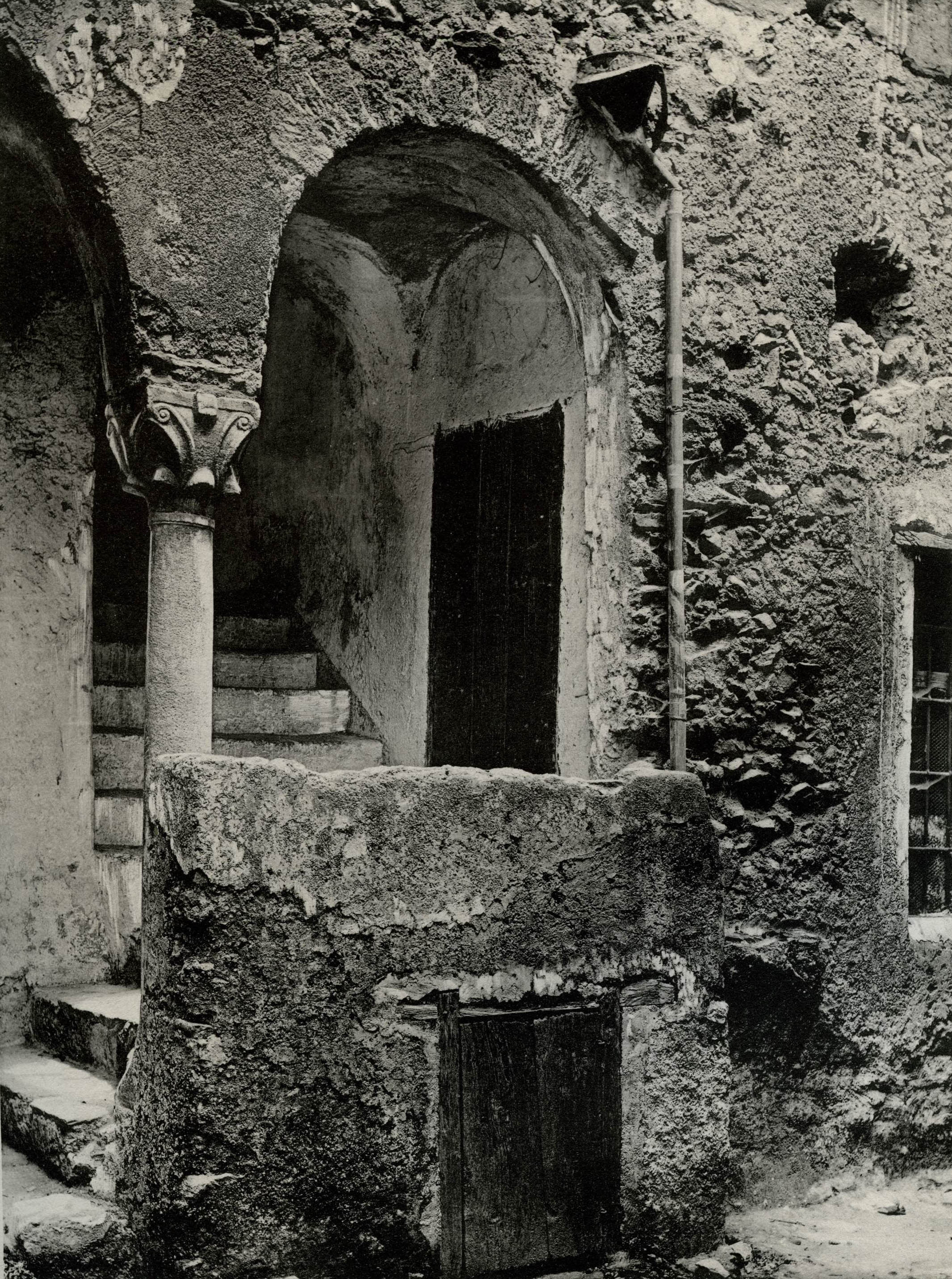 “Old courtyard (Courtyard of Mastro Francesco)”

Reid amassed throughout his life the notes to a history and guidebook of Ravello, which, however, he never wrote. Only in 1909 was it compiled from his notes and published in London by E. Allen. The book, which quickly became popular among British visitors to Ravello, is also illustrated by Luigi Cicalese’s photographs. This explains also why there is no text in Cicalese’s album. Indeed, it was purchased by visitors who brought with them from home the English guidebook or the German Baedeker. The illustrations in the album follow the text of the book, and at the same time, the text of the book serves as a caption to the photographs of the album. Let us see how.
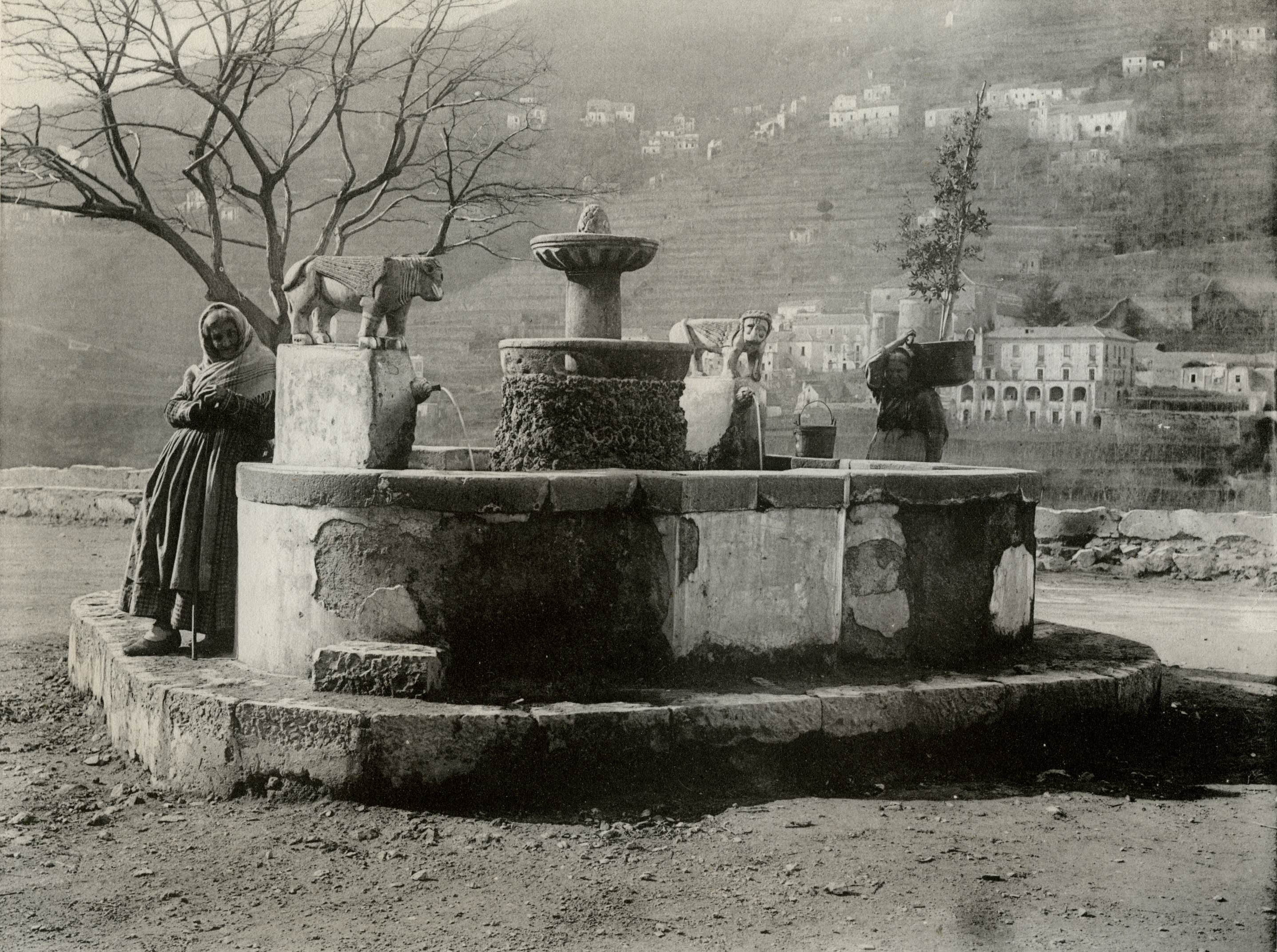 “The old well of the Piazza of Ravello”
After a historical introduction, the guidebook begins the walk from the 12th-century fountain in Ravello’s main square. This fountain must have been particularly popular among tourists, because its image has survived in many versions from the decades after the turn of the century. In auction sites, we most commonly find the photo by Cicalese, sometimes colored, which was also sold by his son Carlo under his own name, as he continued his father’s craft. But many later publishers issued their own poscards of it.
“In the centre of the Piazza is a curious fountain, on the rim of which stand a lion and a winged bull. Nothing remains of the neighbouring chapel dedicated to Sant’ Agostino except its columns with their sculptured capitals, but behind it a terrace commands a good view of the Minori valley. From the opposite side of the Piazza, we look down into the Dragone valley, up which winds the new carriage road to Ravello, while beyond the stream rises the hill on which stand Scala and several dependent villages, and on a projecting rock at the head of the valley are the tower and ruined arches of Santa Maria, once the scene of the investiture of the “Captain of the Duchy”, and the sedile of the nobles.”
Romano Zanotti: Cicerenella. From the album Napoli

The first sight, as in the Baedeker, is the cathedral, and the English guidebook also highlights the beautiful pulpit. It presents in detail the inscriptions, the donors and the artist. It explains and criticizes in wry British humor the various theories about the identity of the sculpted head adorning the pulpit’s entrance, from the Madonna through “one Queen Johanna” to the Beloved of the Song of Solomon and the Mater Ecclesia. Then he points out that it cannot be other than Countess Sigilgaita de la Marra. He also describes the ambo standing opposite the pulpit, not mentioned in the Baedeker, but illustrated with a photo in Cicalese’s album.
“The magnificent pulpit, which, though mutilated, remains the glory of the Cathedral, was given by Nicola Rufolo in 1272. The west end rests upon spiral columns of marble and mosaic, supported by lions and lionesses in the act of walking, the capitals being formed of pierced leaves in high relief. The elaborate designs in mosaic are worthy of close inspection. The panels represent peacocks drinking, birds singing amid twining tendrils, griffins and other monsters surrounded by borders of diverse character, yet in perfect harmony of colour and delicate design.
Facing the pulpit is an ambo of a date anterior to that of the other mosaics, as indicated by the larger tesserae used, the inlaid work in porphyry, and the different character of the designs. The rectangular panels are divided by a door over which are two peacocks; the reading desk is supported by an eagle holding in its claws a scroll on which are these words, “In principio erat Verbum,” while on either side, and screening the steps, are triangular mosaics representing Jonah, who is on one side being swallowed and on the other ejected by a marine monster.”
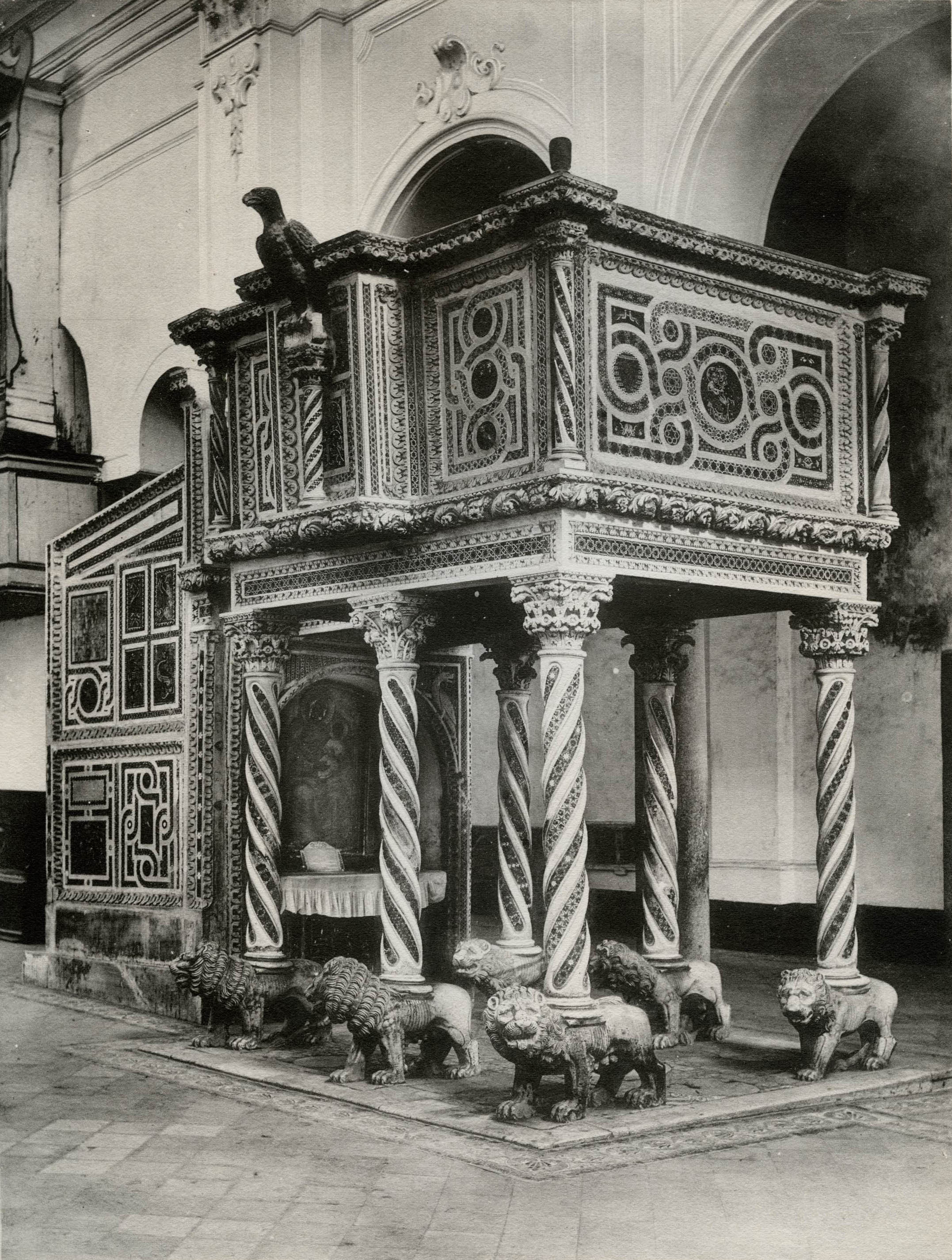 “The pulpit of the cathedral of Ravello”
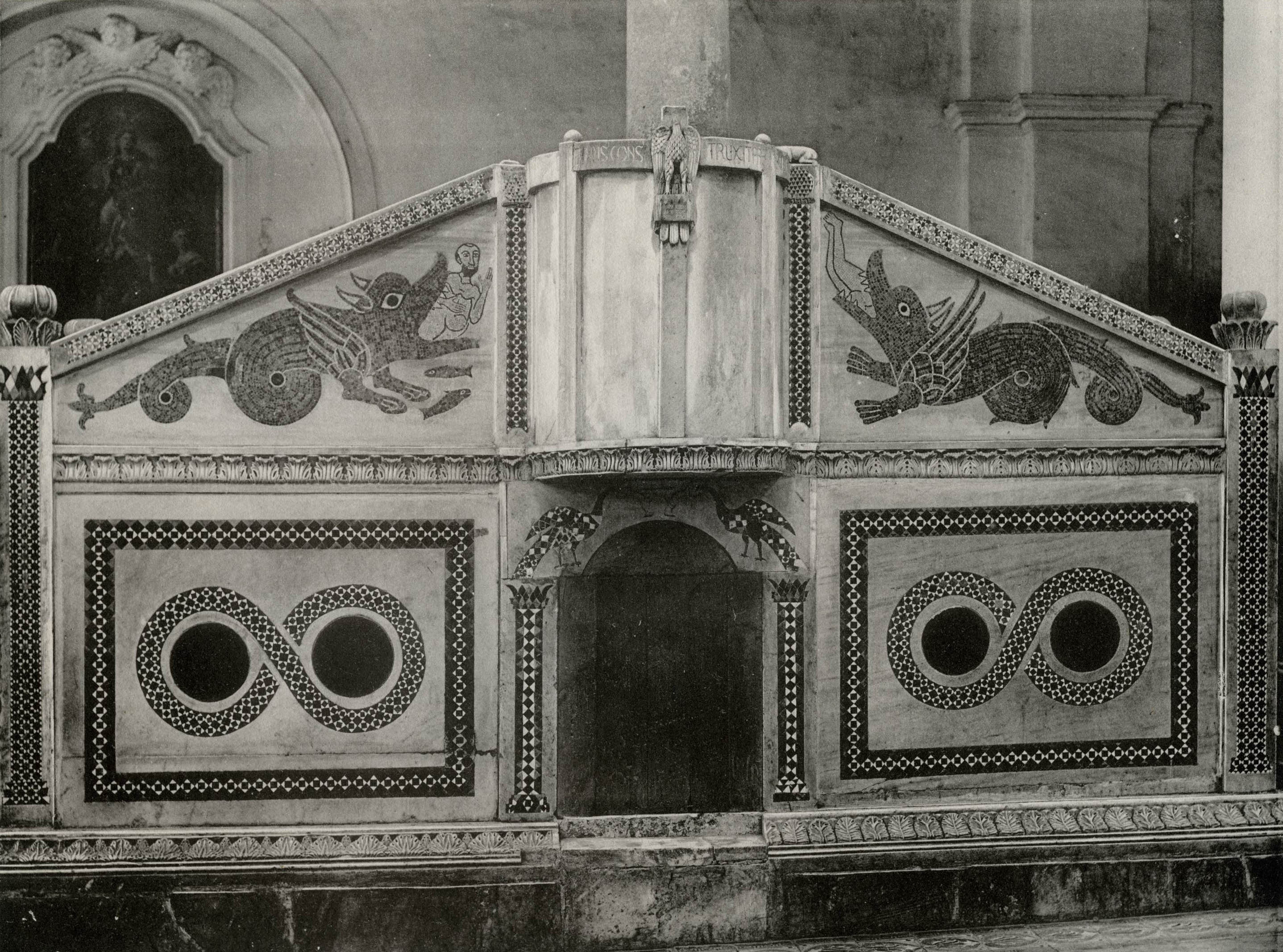 “Cathedral of Ravello. Ambo with the representation of Prophet Jonah”
The other pulpit, that of the church of San Giovanni del Toro, elicits even more enthusiasm from the author. No wonder, since it had the same great impression on M. C. Escher, who visited Ravello in 1922 (where he also became acquainted with his future wife), and by his own admission he was inspired by the patterns of this pulpit to start experimenting with self-reversing motifs.
“San Giovanni del Toro ranks in artistic interest next to the Cathedral. The beautiful pulpit was the gift of the Bovio family; and their arms, two golden bulls in mosaic on a graceful groundwork of trefoils, are in good preservation. The bases of the four supporting pillars represent fish or marine monsters in the act of swimming away – lions clinging to a rock; while on each of the most ornate capitals are a bull eating a leaf, a bearded man resting his hands on his knees, a bird holding a snake, and a boy riding an ostrich.
The body of the pulpit is covered with mosaics differing in design from those in the Cathedral, the principal one being Jonah emerging from the fish’s mouth. The reading desk is supported by an eagle holding open the Gospel of St. John inscribed with these words: “In principio erat Verbum et Verbum erat apud Deum.”
The insertion of entire plaques of oriental pottery in this pulpit is of great interest, and is said to be a unique instance of that method of decoration. Arabic letters are distinctly visible on them, and if the theory be correct that the brilliant mosaic was chiefly formed of pieces of lustrous Saracenic ware, these entire plaques are probably the very material that used to be broken up to make the mosaic.
A candlestick of marble and mosaic is surrounded by figures of three priests, one bearing a roll, another a book, and a third a censer. A fresco on the side of the staircase represents our Lord appearing to Mary after His Resurrection; in a niche beneath the pulpit is the Saviour, between the two Marys; while on the left-hand wall is the Angel of the Annunciation, and on the right the Virgin; above these is God the Father as an aged man, and to His left a dove signifying the procession of the Holy Spirit.”
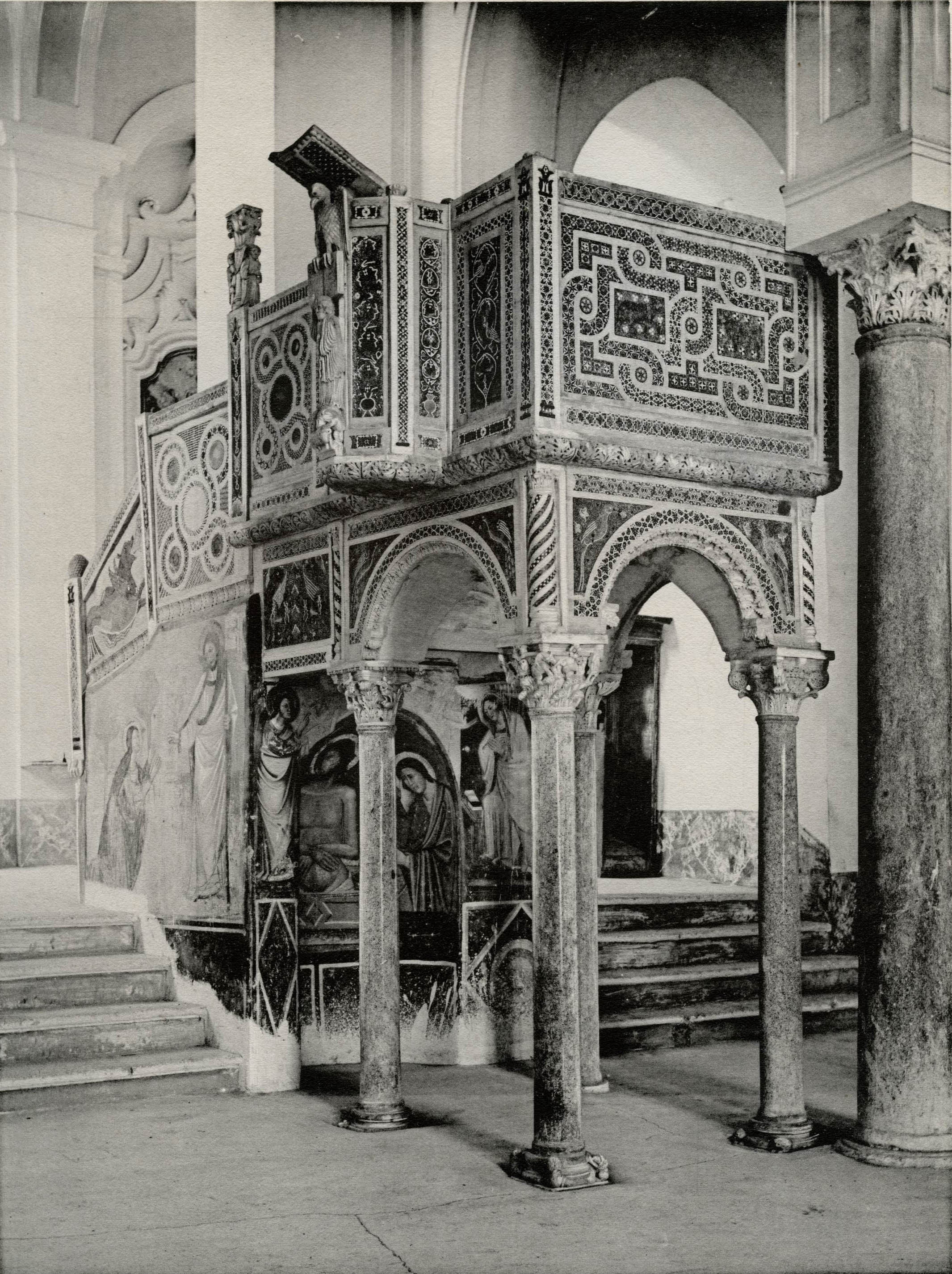 “The pulpit of S. Giovanni del Toro”
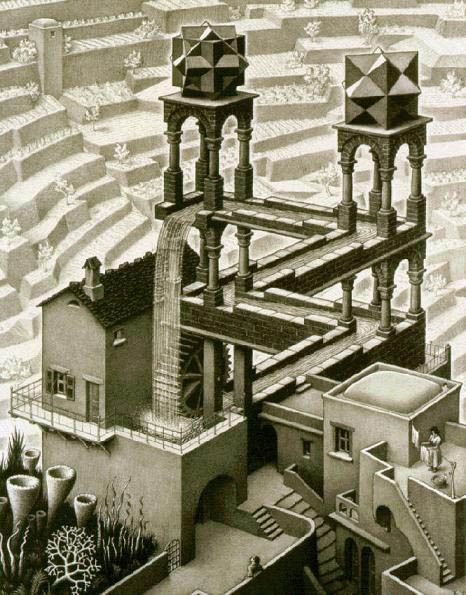 M. C. Escher: Relativity, 1953
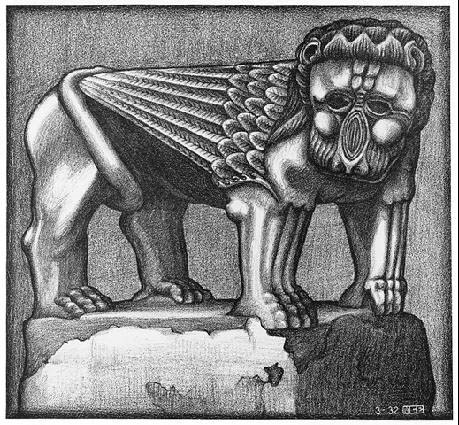 M. C. Escher: The lion of the fountain in Ravello, 1923
About the Palazzo d’Afflitto he only says two sentences, one about the marble gate of the palace, and the other about the garden. These two are also illustrated in the album.
“Opposite S. Giovanni del Toro is the Palazzo d’Afflitto, now Hôtel Belvedere. The marbles of the entrance and court were brought from St. Eustace, on the opposite side of the valley. Various fragments have been pieced together for the purpose, of which the most interesting are the Sibyl and the Prophet, on either side of the entrance. From the vineyard a comprehensive view extends over Minori and the higher valley of the Dragone.”
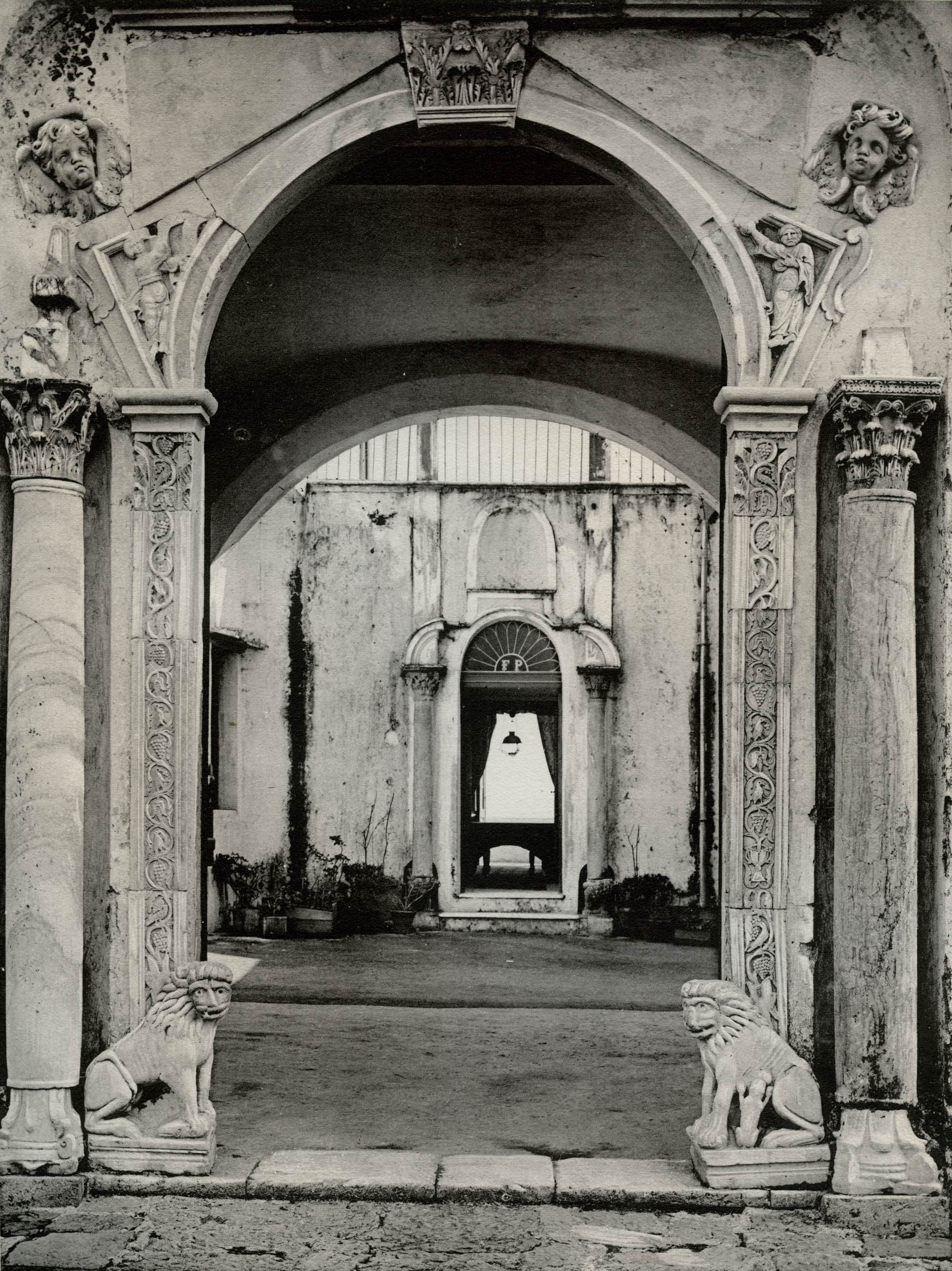 “The entrance of the old Palazzo Afflito (Hôtel Belvedere)”
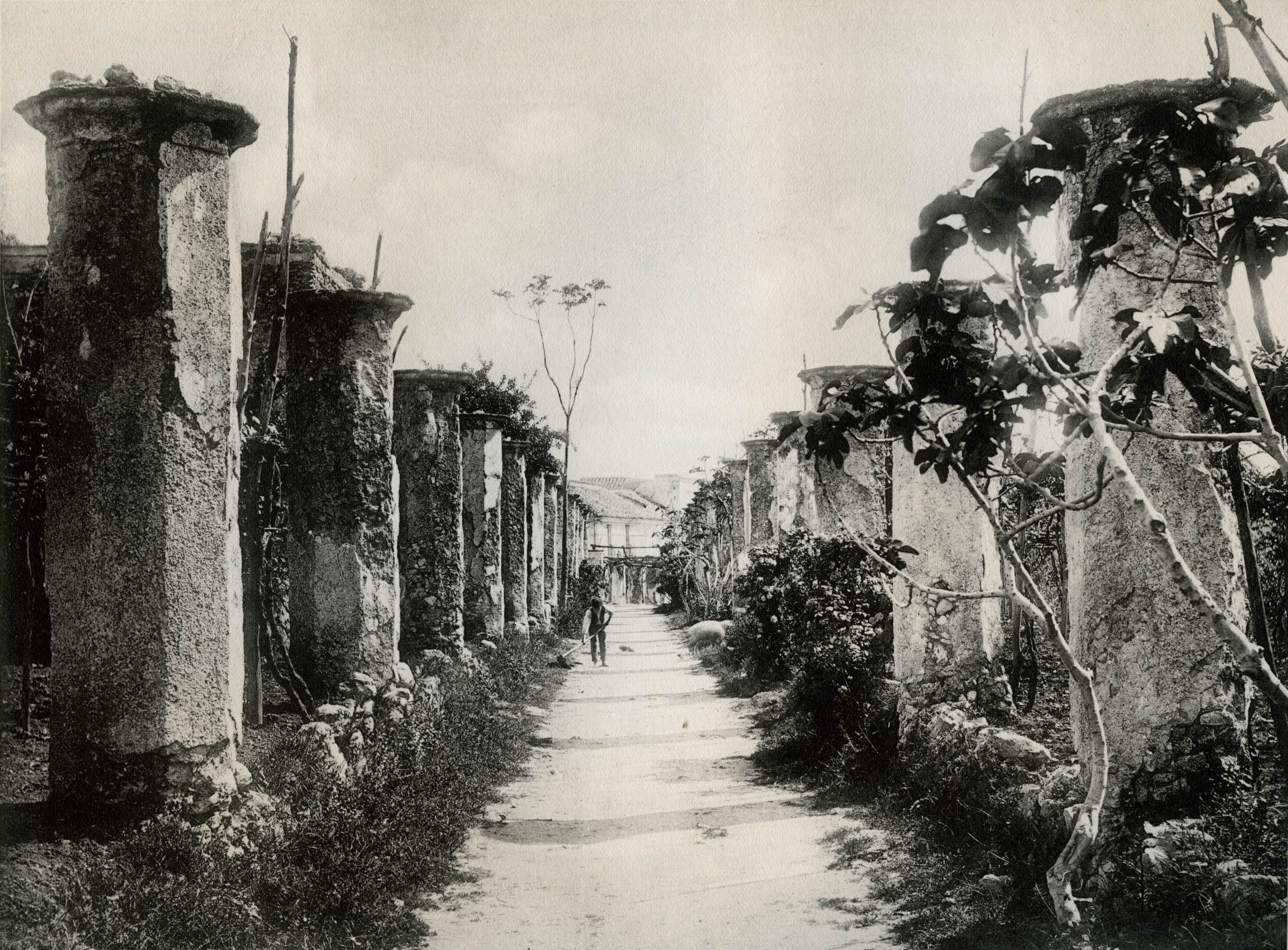 “The viale of the Afflitto garden (Hôtel Belvedere)”
The text has a special mention of the bell tower of the cathedral. The author links it to the Reid family, who by fundraising saved it from destruction. The album also shows the bell tower and the entrance to the Rufolo Garden on one photo, although the guidebook has another Cicalese photograph, where it stands alone:
“The belfry retains the ancient form, and consists of the basement and two upper stories, each containing an arch surrounded by red tiles with a white marble cornice. Inside each arch are two smaller arches divided by a marble pillar and surmounted by a circular opening, while above the second story a frieze of white marble columns, supporting intersecting arches of coloured stone, completes the ornamentation of the tower.
In the middle of the nineteenth century the tower was struck by lightning more than once, and imperfectly repaired, so that it threatened to become a complete ruin. Large fissures would open and shut when the bells were rung, and the central pillars on the windows were crushed beneath the weight of the unsupported arches. A subscription list was opened by the late Mrs. Reid, to which the Ravellese at home and abroad contributed, and were generously aided by the many visitors, who, as lovers of Art, appreciate the ancient campanile. A careful restoration was completed in 1902 under the superintendence of the Government Department for the Preservation of Ancient Monuments, which preserves intact the whole exterior.”
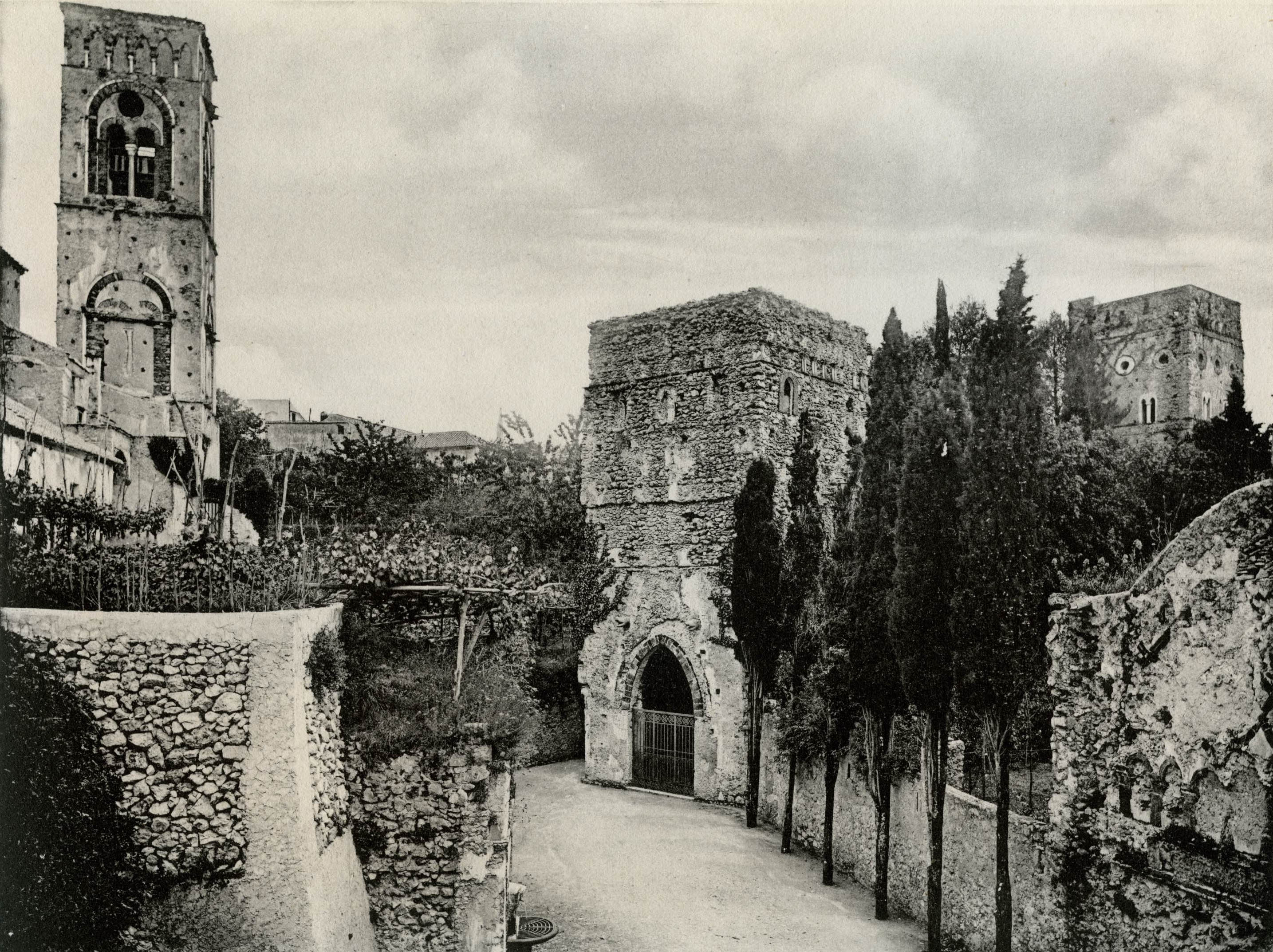 “The entrance of the Palazzo Rufolo with the bell tower and the donjon”
 “The bellfry”
And with this we have arrived to the Palazzo Rufolo, which means Ravello’s spiritual center both to E. Allen and Luigi Cicalese. Two of the six chapters of the book focus only on the history and description of it.
“Pre-eminent among the nobles of Ravello were the Rufoli, the donors of the Cathedral pulpit, benefactors of the church, prosperous merchant princes, and owners of the beautiful palace near the Cathedral, where they entertained kings and prelates.
The terrace of the garden commands a superb view of the coast as far as Capo d’Orso, with the towns of Minori and Maiori embosomed in vines, lemon and orange groves, while beyond the Bay of Salerno may be seen the distant plain of Paestum and the mountains of the Cilento. Below the gardens are the two domed towers of the Annunziata, a church given by the Emperor Ladislaus to the Fusco family, and by them dismantled A.D. 1691, when two columns of verde antico were given to Cardinal Cantelmo of Naples.”
From the many stories, which also include plenty of briganti adventures, we only present one. Partly because it shows the miserable state that the palace and the garden was in before Reid bought it, and partly because it illustrates, as the Times puts it, “… the real savagery that still remained among the people of Ravello”.
“So extensive a ruin, bearing traces of former wealth, was certain to be connected with some tradition of buried treasure in a country so frequently exposed to the changes of war, where money or valuables were buried to conceal them from Saracenic or other invaders, whilst the owners, dying in slavery or at the galleys, were unable to reveal the place of concealment or to reclaim their property. As late as A.D. 1821, a Sicilian, generally called Don Paolo il Campanellista (the bell-maker), lived in part of the d’Afflitto palace, and was believed to have a familiar spirit imprisoned in a brass rod. He asserted his ability to discover by its means the position of buried treasure, and to obtain its surrender from the evil spirits who claim all such deposits after they have ben concealed a hundred years. He was reported to have unearthed two jars of ancient coins at Torella in this way; and, as the owner of the house in which he lived was the cousin of Pantaleone d’Afflitto, to whom the Palazzo Rufolo belonged, the latter was persuaded to allow Don Paolo to search the ruined court of the palace for treasure concealed there.
At that time it was approached by vaulted rooms, bearing traces of ancient frescoes, while on the opposite side were unexplored chambers. Several friends and villagers joined the explorers, among others a youth named Tommaso Mansi. A woman who was actually present at the strange scene used to relate that, after certain forms of incantation had been performed by Paolo, a noble staircase suddenly appeared descending to an arched vault, in which stood four statues of pure gold, surrounded by heaps of the precious metals; but before they could seize the treasure, a tall man with a long beard, wearing a velvet robe with silver buttons, issued forth and drove them away, saying in Hebrew, that until they brought him the innocent soul of a child three years old, they could not touch what had been disclosed to their view. He then disappeared, and a terrible serpent darted forth and chased away the intruders, while both stairs and treasure vanished.”
The story goes on that Tommaso Mansi, “who had an unconquerable craving for wealth”, comes more and more under the effect of the absurd vision, and finally with two fellow culprits they really kidnap a three-year-old child, whom they sacrifice in the garden in the midst of magical rituals. Whether they found the treasure, is not clear, but they were arrested and convicted. The full protocol of the suit is published in Pucci, Discorsi in Materia criminale, Salerno 1857.
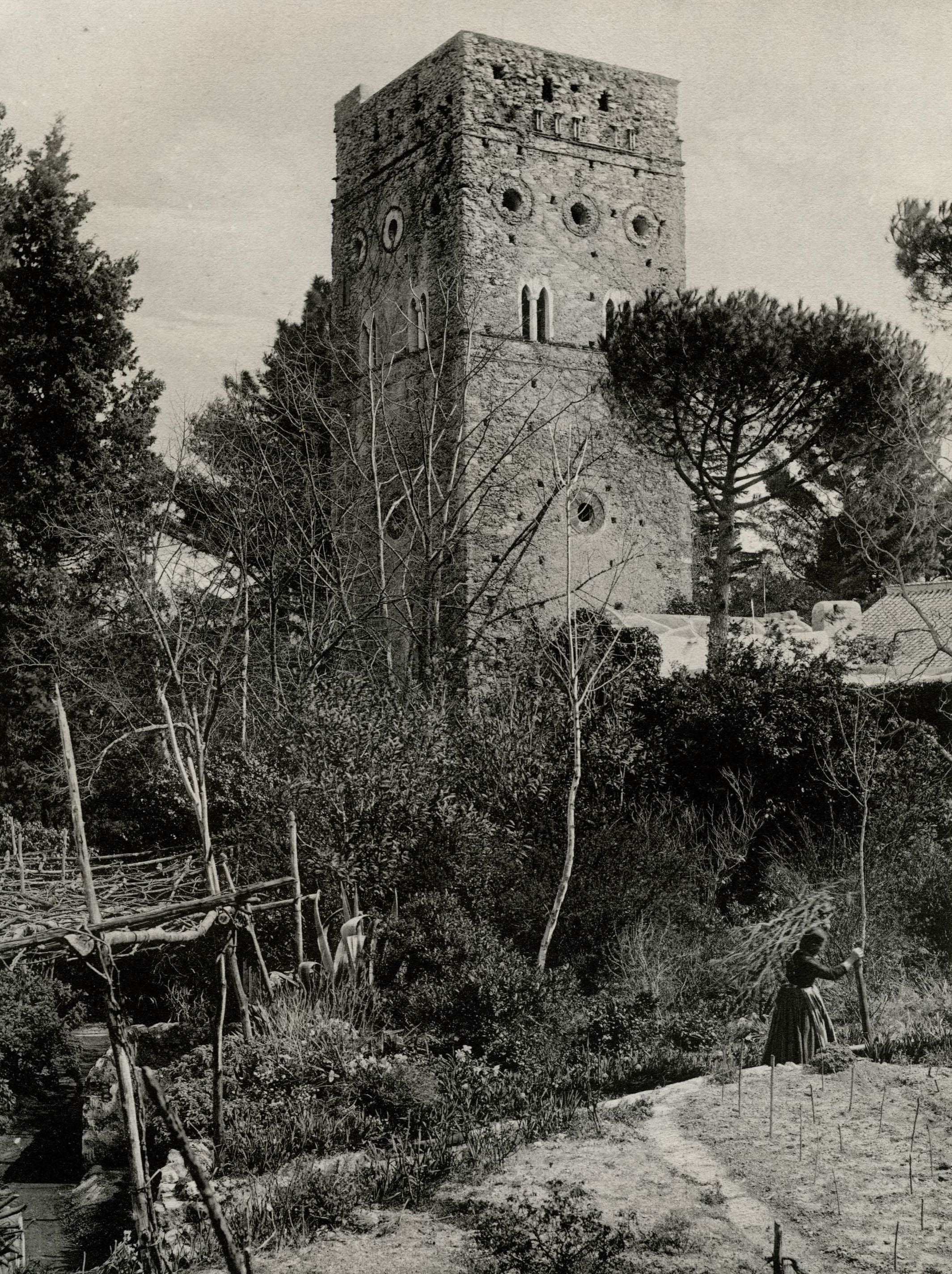 “The donjon of the Palazzo Rufolo”
Luigi Cicalese died in 1932, at the age of eighty, as a respected citizen of the city, who was elected mayor several times. He had ten daughters, all of whom married emigrants from Ravello, from London through Belgium and Marseille to South Africa and Australia. The patriarch dutifully visited one of them every year. He also had two sons, they carried on his gardener’s and photographer’s craft. The Rufolo Garden and Palace are still taken care by their grandchildren, already in the fourth generation.
Tito Schipa: Quanno spònta la luna a Marechiare, pure li pisce nce fanno a ll’amore… (When the moon shines on Marechiare, even the fish make love…), 1886. Performed by the Italian-British Sir Paolo Tosti

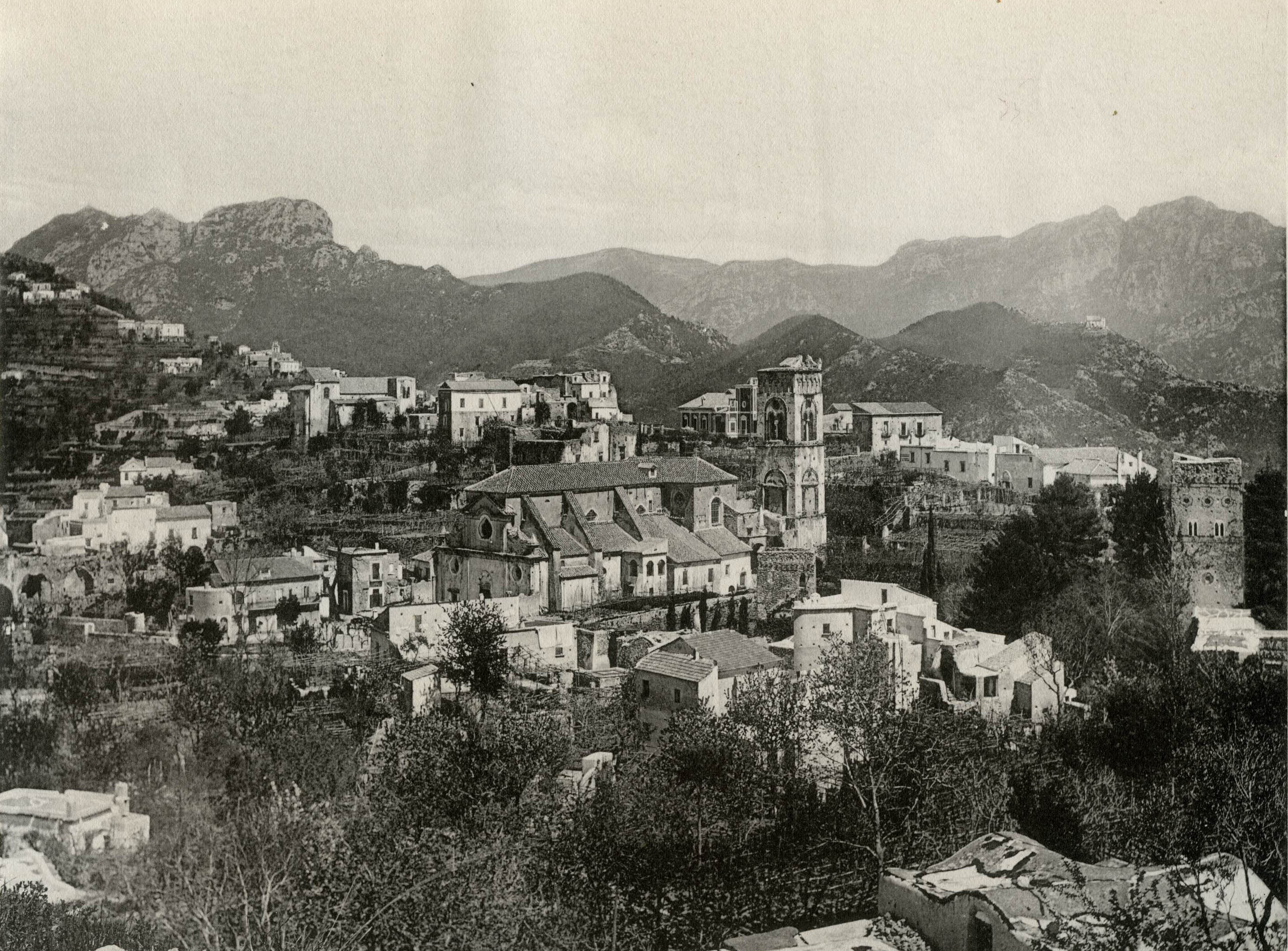 “The panorama of Ravello”









 Come with us to…
 Atlantis
 Bestiary
 Bohemia+Prague
 Books, exhibitions, music, film
 Brave old world
 Caucasus
 Cemeteries
 Crimea
 Get to know the
 Images of the East
 Lightwriting
 Lwów/Lemberg
 Mallorca
 Message on the wall
 The Museum of Propaganda
 Odessa
 Paper Museum
 Persian letters
 The Jewish heritage


