Switch over to our new blog! • ¡Pásese a nuestro nuevo blog!
The renewed version of our blog, with more features, a richer design, and available in nine languages, can be read here: https://wangriver.com
The new version also includes the old posts, often in expanded form. If you are curious about the updated version of this post, replace “riowang.blogspot.com/” in the URL with “riowang.studiolum.com/”, and the new link will most likely lead you there.
La versión renovada de nuestro blog, con más herramientas, un diseño más rico y disponible en nueve idiomas, se puede leer aquí: https://riowang.com
La nueva versión también incluye las publicaciones antiguas, a menudo en una forma ampliada. Si tiene curiosidad por la versión actualizada de esta entrada, sustituya «riowang.blogspot.com/» en la URL por «riowang.studiolum.com/es/», y el nuevo enlace probablemente le llevará allí.
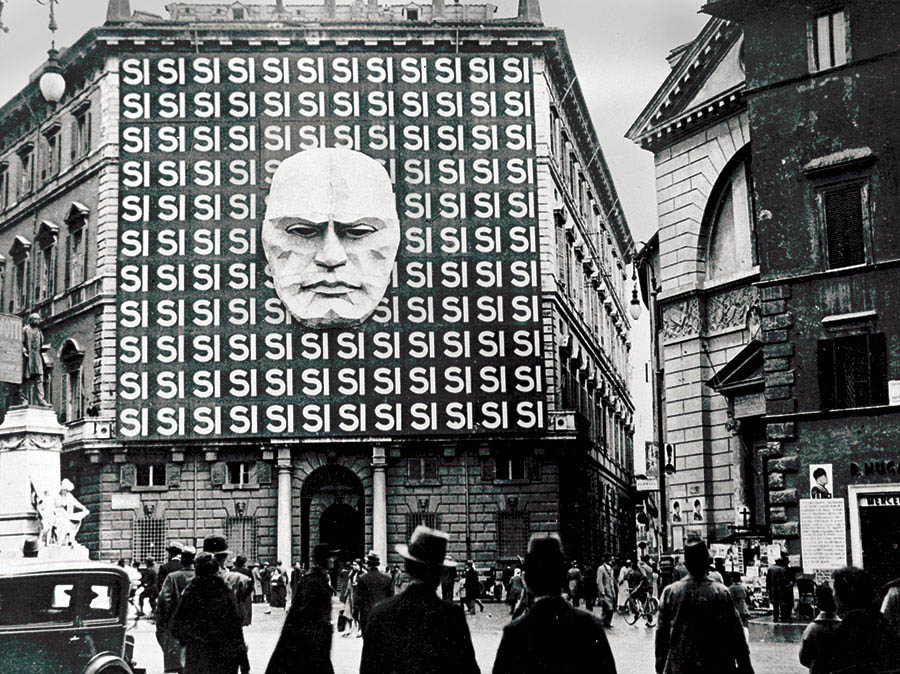
Mussolini’s portrait on the Fascist Party’s Roman headquarter, 1934
This term was used by Umberto Eco for those still flourishing nationalist authoritarian regimes, whose distinguishing characteristics were summarized by him in fourteen points. I, however, use it now more specifically for the visual legacy of the Italian fascist ideology of 1922 to 1945, which is still visible in the public spaces of Italy.
Sicily is a graffiti paradise. Movements, religions, ideologies both generously and creatively use this medium to promote their messages. Walking the narrow streets of Palermo, Siracusa or Catania, you have the feeling of attending an endless poster exhibition.
Among the contemporary messages, ghost signs also appear here and there, whose sell-by date – theoretically – has long since expired. In the main square of Monreale near Palermo, in front of the Romanesque cathedral, a neatly framed, carefully typographed inscription can be read on the firewall. The left side is still relatively legible, while the right side has already faded into the background. However, the existing fragments allow the whole text to be googled:
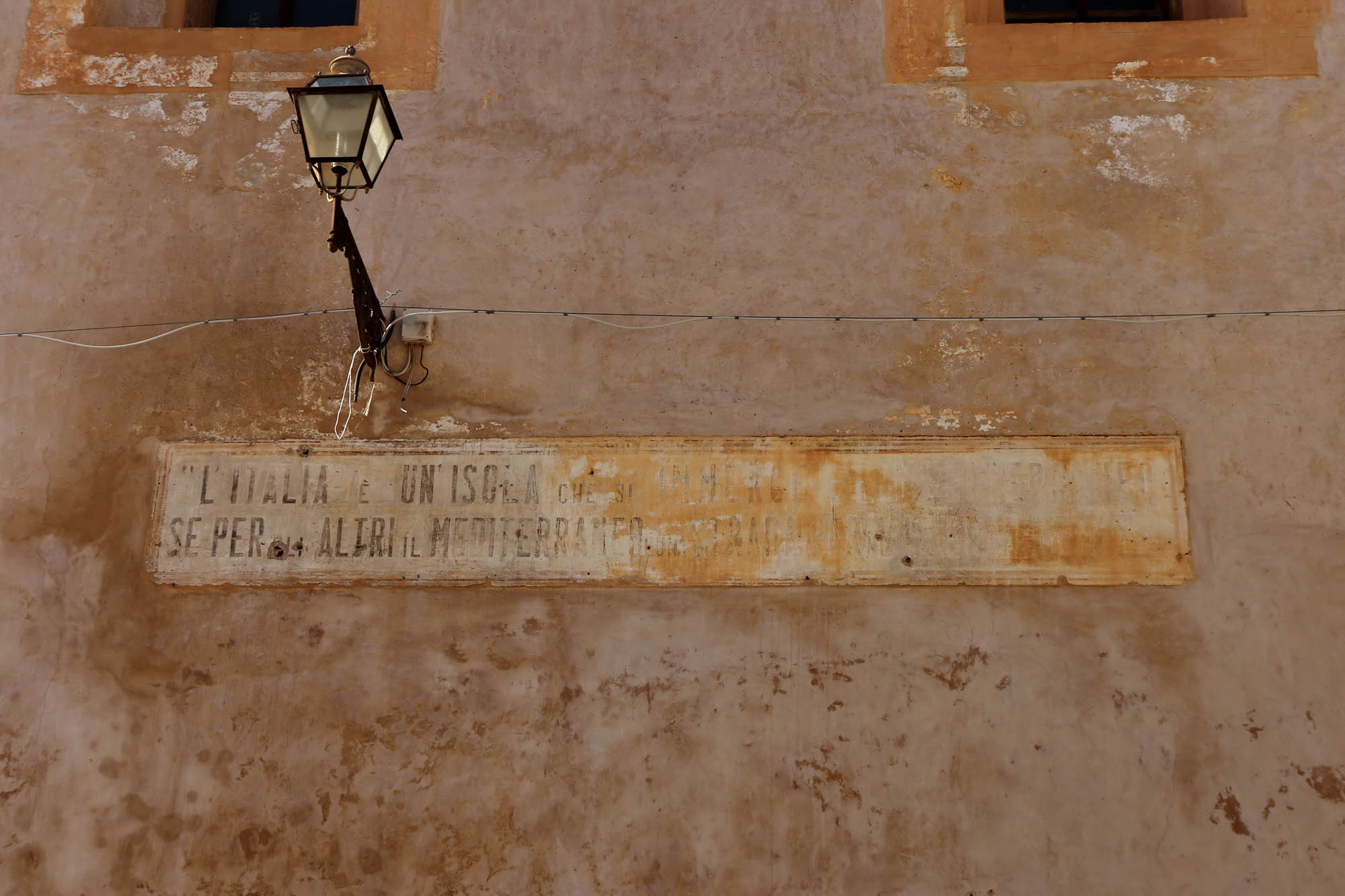
«L’Italia è un’isola che si immerge nel Mediterraneo. Se per gli altri il Mediterraneo è una strada, per noi italiani è la vita.»
“Italy is an island embraced by the Mediterranean Sea. While for others, the Mediterranean Sea is a route, for us Italians, it is life itself.”
This quote is from Mussolini’s Milan speech of 1 November 1936, one of those “great historic speeches”, which, writes Eco, “marked all my childhood, and whose most significant passages we memorized in schools.” This is just one of those passages.
Detail from Mussolini’s Milan speech
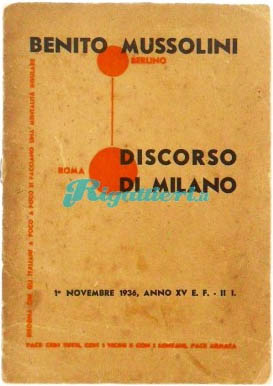
This quote delivered a well-calculated message of foreign and domestic policy. On the foreign front, it reflected on Foreign Minister Ciano’s visit to Germany a few weeks earlier, where Ciano and Hitler had agreed on the joint struggle against the Spanish Republic and Bolshevism, and Hitler pledged support to Italy against British ambitions in the Mediterranean Sea, declaring that “the Mediterranean is an Italian sea”; and Hitler also recognized the conquest of Ethiopia by Italy in the spring of that year. Mussolini, in his speech, echoes Hitler’s formula, and introduces for the first time the concept of a “Berlin-Rome axis”, which was also sketched for the simple folk on the front page of the published speech. On the other hand, he still seeks some compromise with the British, for whom, he admits, the Mediterranean “is a route, or rather a kind of shortcut” to their Far Eastern colonial empire through the Suez Canal (“the idea of which, I note only in parenthesis, was first raised by an Italian, Negrelli, who was at that time called insane by the English”). However, the Monreale inscription emphasizes two phrases that are digestible for the domestic public (and which originally stood far apart from each other, in different contexts), thus reinforcing in them the imperialistic idea of Mare Nostrum and nationalistic pride. The festive podium stood obviously here, in the main square, facing the cathedral, and the message of the respective speakers was raised high and woven into a national-imperial context by the quote of the Duce hovering above them.
One hundred fifty kilometers to the east, in the main square of Nicosia, on the wall of Bar Antica Gelateria, are the remains of a similar inscription. The central part of the five-line inscription painted on the plaster has been cut off. It does not look as if it was done with the purpose of destroying it, but rather that something was mounted there, and its straight contours cut out the center of the text. I can reconstruct the top line for a while from the top of the letters: “Il popolo italiano ha…”.
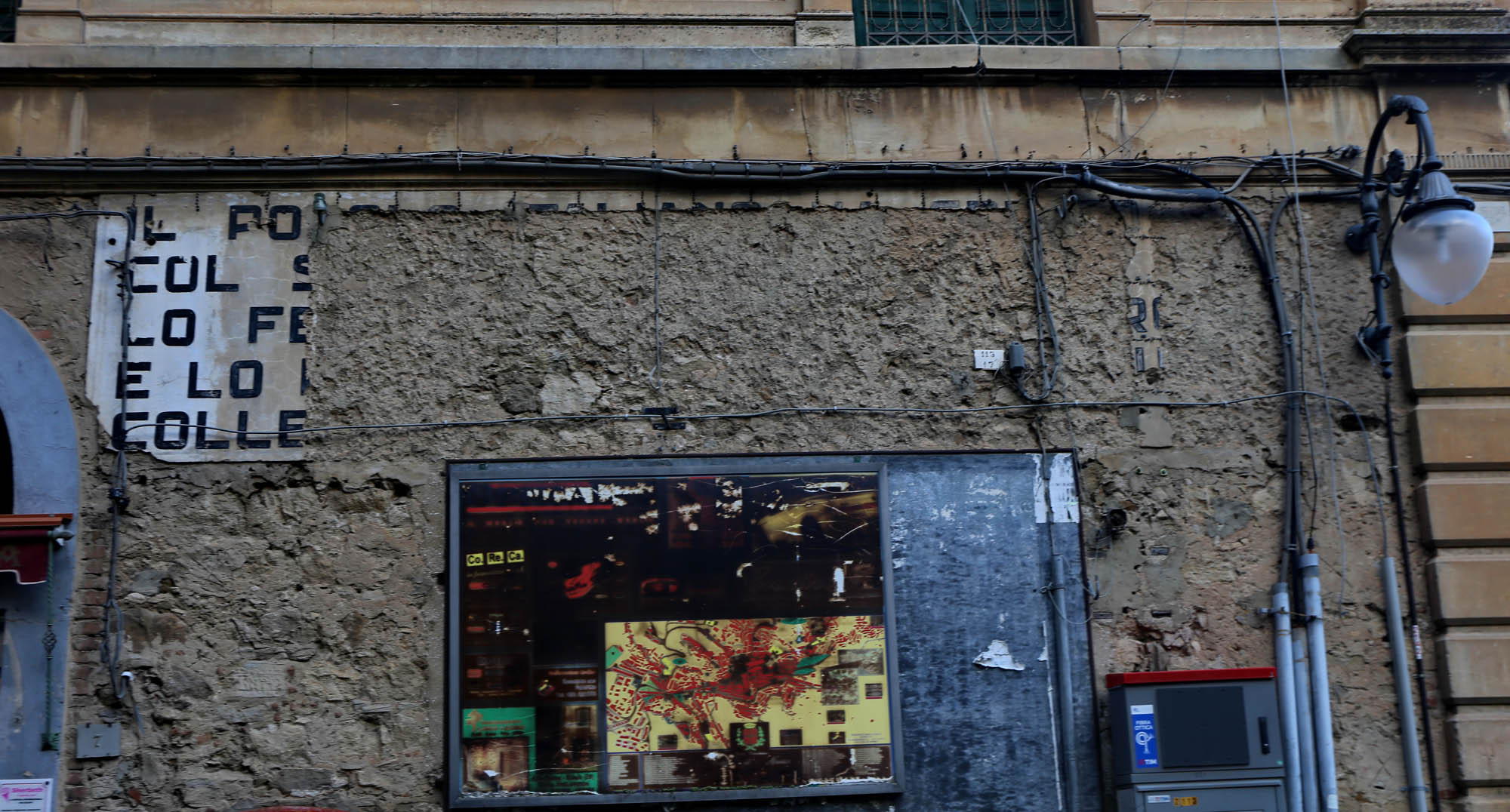
I go in Diana Bar, and while asking for a coffee, I ask the barista whether he knows what was written there. “The professore knows it for sure”, he leads me enthusiastically and respectfully to one of the small, round marble tables, where a small, round gentleman is reading his newspaper. The professore puts on his glasses, looks far into the deep well of the past, and dictates:
«Il popolo italiano ha creato col suo sangue l’impero. Lo feconderà col suo lavoro e lo difenderà contro chiunque con le sue armi.»
„The Italian people created the empire with his blood. He will fertilize it with his work, and will protect it against anyone with his weapons.”
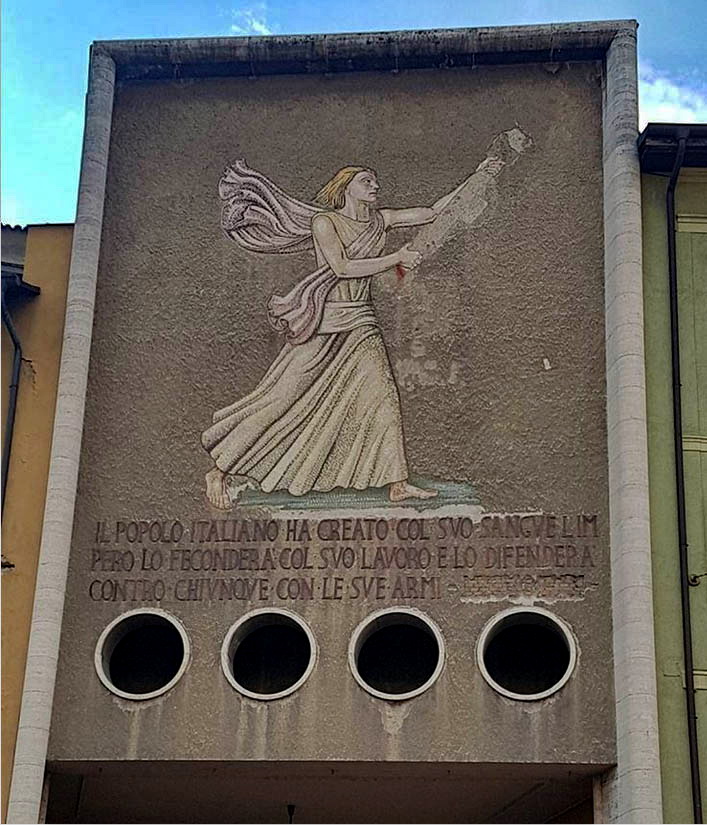
This famous passage, frase celebre, is from Mussolini’s Victory Day speech of 9 May 1936 in Rome, where he announced the end of the Ethiopian War and the birth of the Italian Impero. Once again, this is a speech of major foreign political importance, demanding a place for Italy alongside the great powers, while, on the other hand, it also sends a message to the people concerning what the empire expects of them. In its time, the passage was popularized by many public works and inscriptions throughout Italy, including this mural still standing today in via Roma in Trento, from which Mussolini’s name was later carved off (by leaving its outlines):
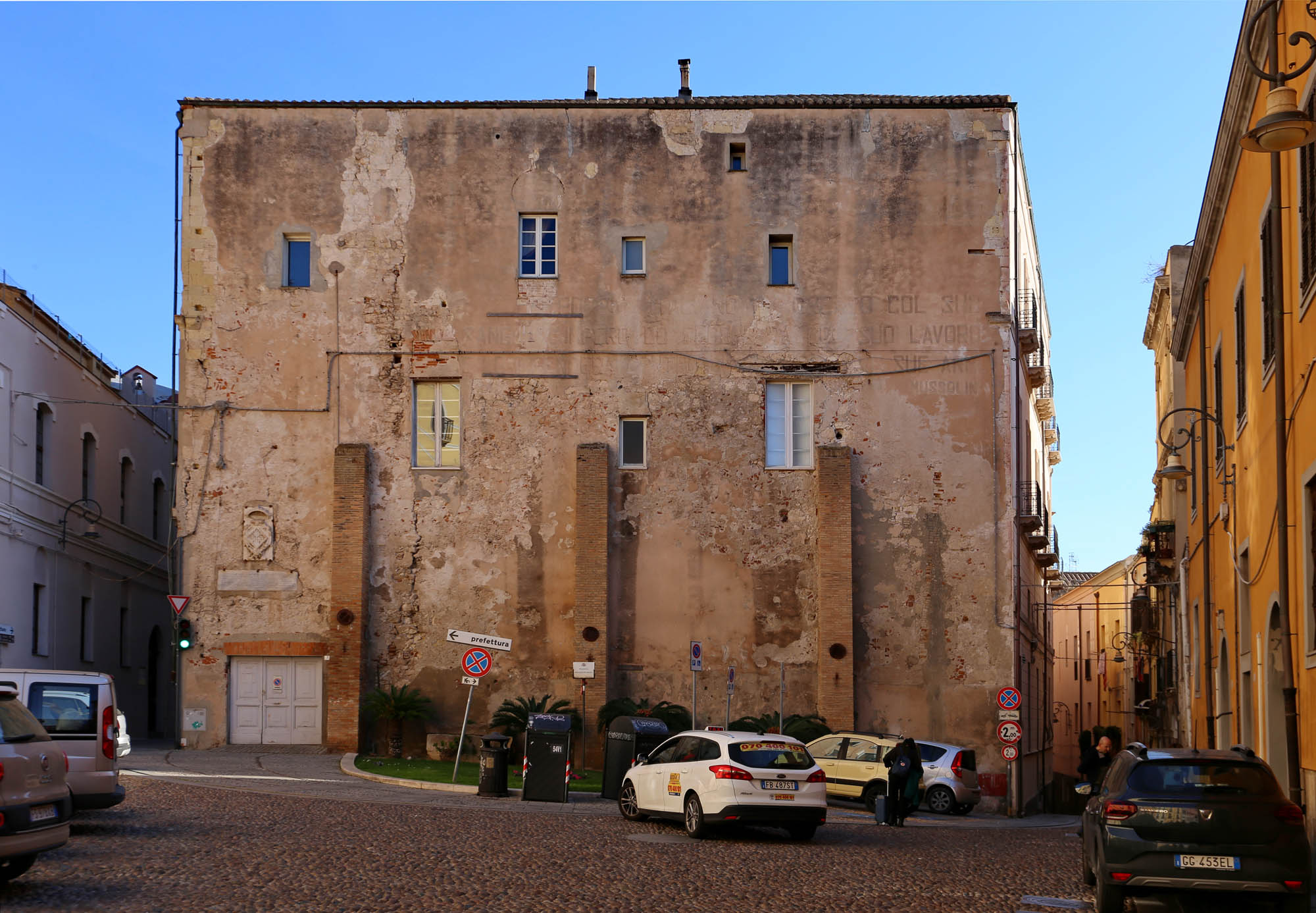
Or in Cagliari, where the same passage can be read on the representative façade of the Scuola Umberto e Margherita overlooking the Piazzetta Mafalda di Savoia, up in the castle. More precisely, only a few fragments of it are legible. Nevertheless, by now we have such expertise in the subject that, just like the professore, we can reconstruct from memory what is unreadable to the beginner. Here, they even left Mussolini’s signature.
Apropos of the Nicosia text, I cannot help but mention that a few meters away we can also read a molto più celebre inscription. If you ascend the steep steps between the two bars to the “hill of the twenty-four barons”, the nest of the noble palaces of Nicosia, the text on the south wall of the tower of the hilltop Church of the Savior, enlarged each year from the early 1700s on, perpetuate the day and month of the arrival of the first swallows to Nicosia. During our recent visit, the church was closed, so I cannot attach a picture of the inscription, just the view of the old town from the church square, with Etna in the distance. Down there, to the left of the Norman Romanesque church of St. Nicholas, converted from an Arab mosque, is the main square with the inscription of 1936. The other church in the background, on the top of the other hill, was the church of St. Nicholas of the pre-Norman Greek population, which gave the name Nicosia to the town. As in the St. Nicholas Day processions the Greek and Catholic believers regularly clashed with each other, this church was renamed the Church of the Assumption, to celebrate its feast and procession in the summer, on 15 August instead of 6 December.
A third memorial helps us to understand why post-war systems have left the public decorations of fascism more or less untouched. Thirty kilometers to the west, at the foot of the Madonia Mountains, a marble sign on the town hall of the mountain town of Gangi announces:
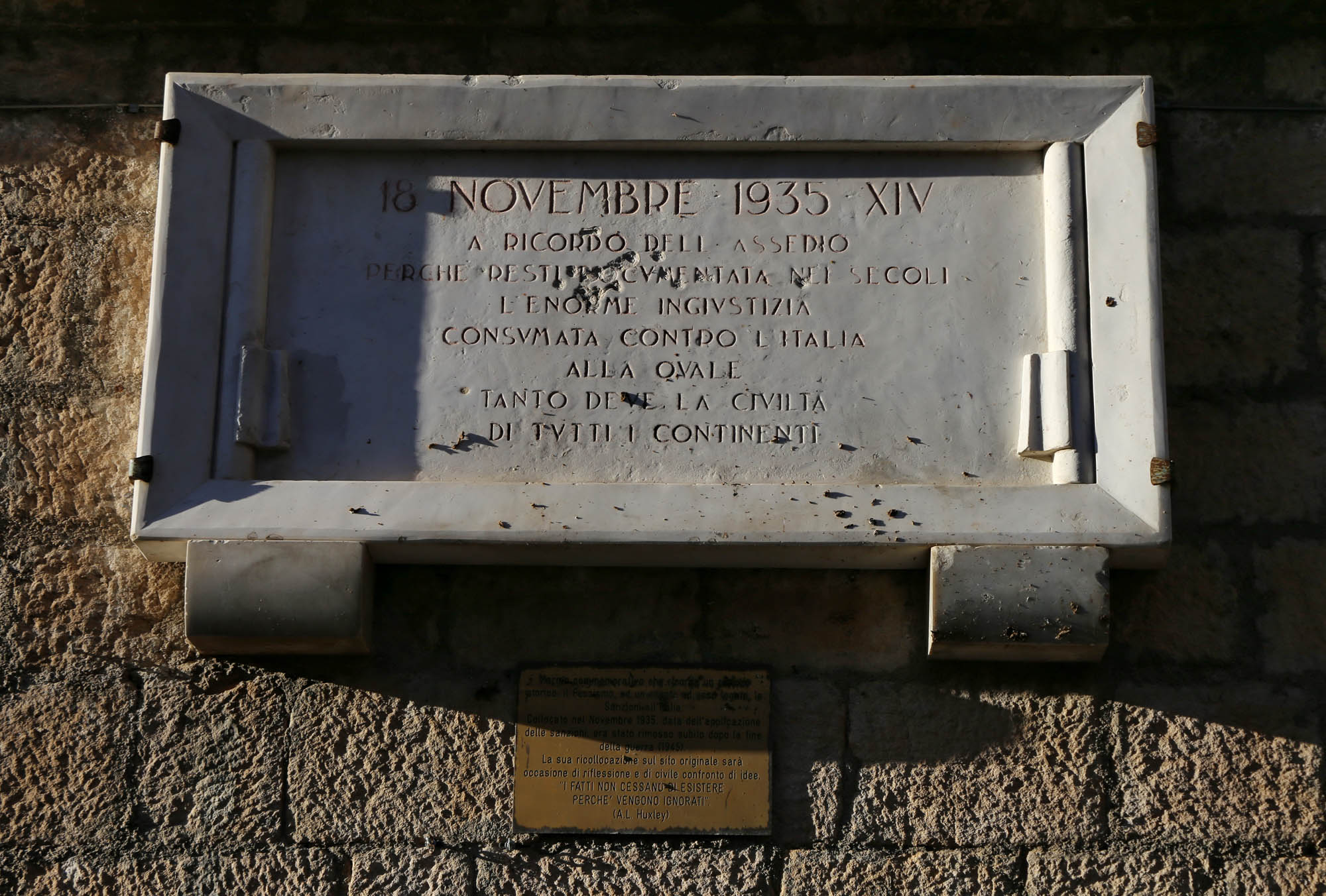
«18 Novembre 1935 XIV. A ricordo dell’assedio perché resti documentata nei secoli l’enorme ingiustizia consumata contro l’Italia, alla quale tanto deve la civiltà di tutti i continenti.»
„18 November 1935, XIV[th year of fascism]. In eternal memory for centuries of the attacks and of the terrible injustice against Italy, to which the civilization of all continents owes so much.”
The attacks and the terrible injustice were the sanctions of the League of Nations against Italy for invading Ethiopia. These sanctions, by the way, were diluted by Britain and France, the leading powers of the League, for the sake of good relations with Italy, and thus Mussolini was able to occupy Ethiopia without any problems. However, the incident provided an opportunity to blackmail Brussels the League of Nations to the people of Italy, which, despite being the eastern bastion of Europe for centuries the torch of civilization for Europe (and other continents, including Africa) for thousands of years, was neglected and humiliated by the new nations that grew fat at the cost of his sweat.
The key to the survival of these inscriptions is offered by the small copper plate that was placed underneath the marble plaque obviously long after the end of the war:
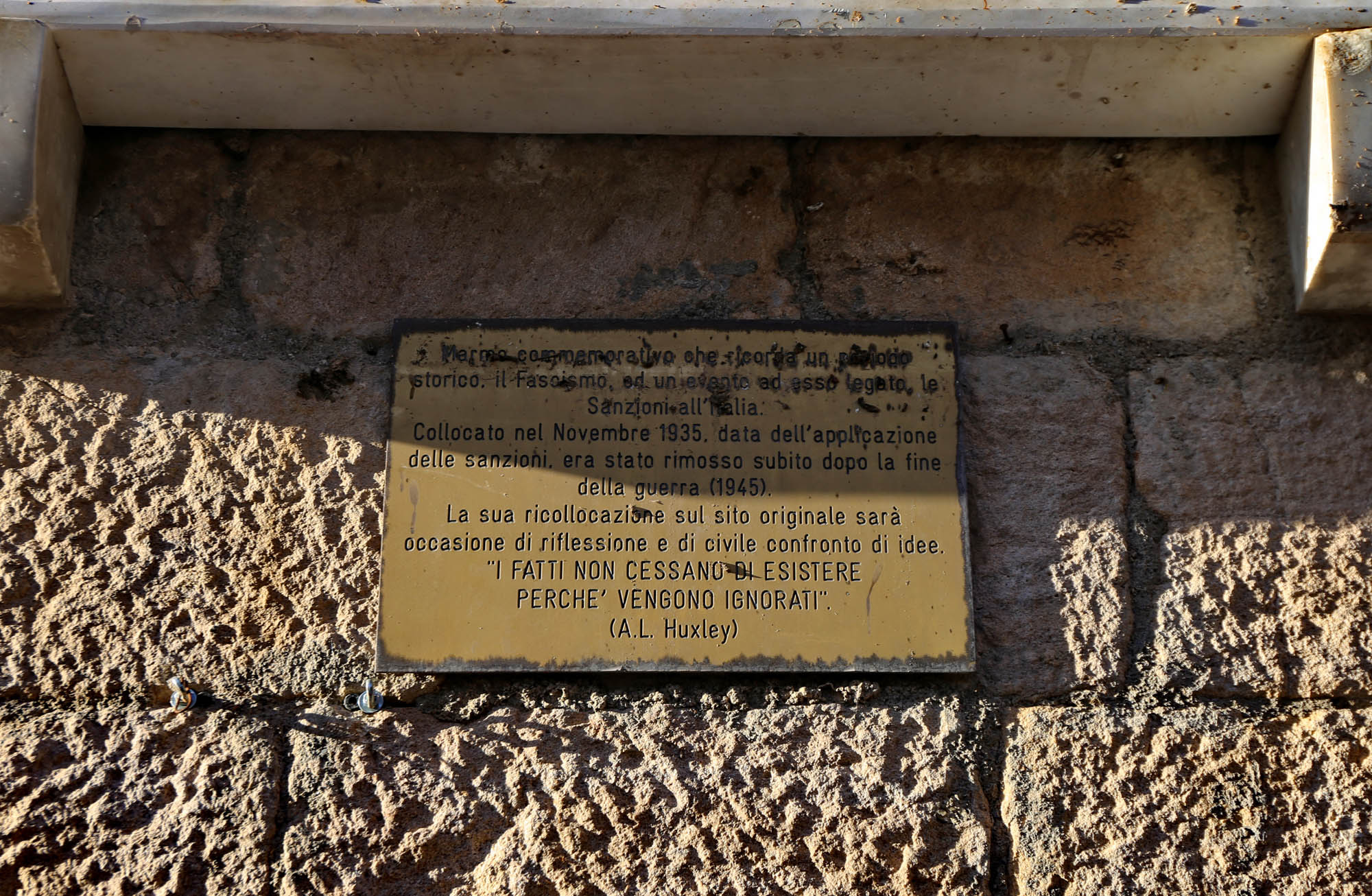
“A marble plaque reminiscent of the historic era of fascism and a related event, the sanctions against Italy. It was exhibited in November 1935, and it was removed immediately after the end of the war (1945). Its restoration to the original place serves reflection and the civil confrontation of ideas. «FACTS DO NOT CEASE TO EXIST BECAUSE THEY ARE IGNORED.» (A. Huxley)”
This latter frase celebre could also stand in the place of the often renamed, demolished, destroyed, relocated Eastern European memorials, plaques, street signs. Although it would be much better if it stood underneath the originals left in place.
It was on the dark side of twilight when we got to Bistritz, which is a very interesting old place. Being practically on the frontier – for the Borgo Pass leads from it into Bukovina – it has had a very stormy existence, and it certainly shows marks of it.
Bram Stoker: Dracula. A Mystery Story
Today I completed the translation of Umberto Eco’s History of fabulous lands and places, which was my companion during the past six months in Subotica and Tokaj, Lwów and Odessa, Czernowitz and Kamenets-Podolsk, Berlin and Mallorca, at the source of the Tisa in Subcarpathia and the Hasidic pilgrim places in Podolia, in the wooden churches of Maramureș and the painted monasteries of Bukovina, when climbing up from the Radna mountains to the Nyíres Pass, and descending from the Borgó Pass to Bistritz/Beszterce/Bistrița. The sites he writes about are related with a particular syncopation to the sites where I translated it, the wanderings of Ulysses to the Cheremosh Valley, and the lost continent of Atlantis to Czernowitz, offering such unexpected readings of the books, which I am really sorry to be unable to share with the readers in the form of a continuous translator’s footnote.
The book, which Bompiani will publish in October in several languages at the same time (even after many years of translator’s experience, I read in an amazement the dates from the future in the colophon of a publisher’s pdf), is not just about legendary places in general, about which voluminous encyclopedias have been written, but specifically about imaginary places which were considered existing ones by the readers, who then tried to find them, even for centuries, from Atlantis to the Paradise on Earth, and from the hiding place of the Holy Grail to the unknown Southern Continent, with a special emphasis on twentieth-century mystification, from the Nazi occultism’s Thule and Hpyerborea, through the teachings of the eternal ice and hollow earth, to the stolen rubbish of Dan Brown. And in the last chapter Eco also expounds that existing places have also become the subject of successful novels, and hereby of a veritable cult. He offers a long list of examples, from Robinson’s island through Arsène Lupin’s rock and the prison of the Count of Monte Cristo to Sherlock Holmes’ house at Baker Street and Nero Wolfe’s one in New York, but – as we have already told in the posts on Eratosthenes’ well and the lion’s tail –, he would not be Eco, had he not let a juggler’s ball fall:
“A real person was also the 15th-century voivode Vlad Țepeș, now better known as Dracula after his father’s name, who of course was not a vampire, but became famous by indiscriminately impaling his enemies.”
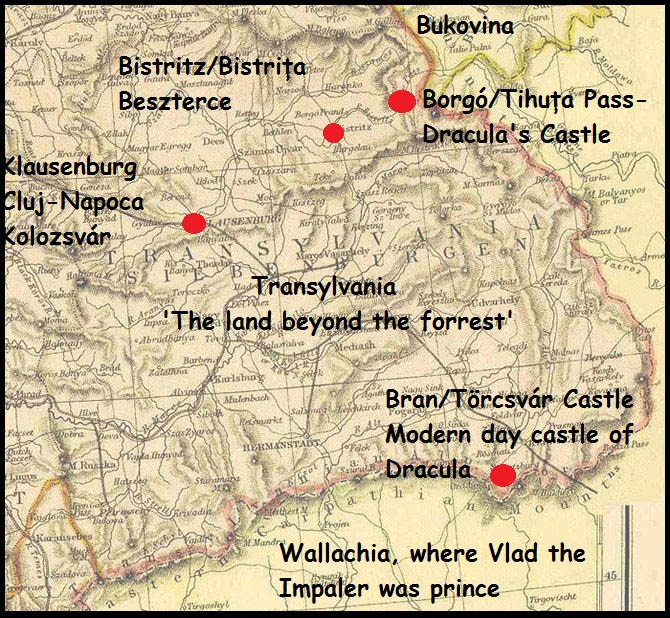
As to ho how the existing person is mingled with the existing places as a cuckoo’s egg, is just the smaller issue. The bigger issue is that the example is completely wrong: the person is famous for being not linked to any actual place, or perhaps rather to too many places. Eco stuck his hand into a wasps’ nest. In fact, for Vlad Țepeș, Vlad the Impaler, prince of Wallachia, just like for Homerus, seven locations compete. The best known is the impressive fortress of Törcsvár/Bran, where the young Vlad is said to have been imprisoned for a short time, and which since 1920 has been propagated by the Romanian tourist office as Dracula’s castle. This claim was challenged after 1990 by Schäßburg/Segesvár/Sighișoara, in whose fortress Vlad was born in 1431 – his father having fled to Hungary before his pro-Ottoman rivals, and having been admitted in this year to the Order of the Knigths of the Dragon (in Romanian Dracul) founded by Emperor Sigismund –, so that even a decade ago the Mayor of Sighișoara urged the building of a huge Dracula entertainment park around the city, until Prince Charles of England, who after 1990 purchased and started to develop large former Saxon lands in the neighborhood, threatened him to withdraw from the region after such a tastelessness. The third place is the former princely center in Târgoviște, where a plaque and several horrific souvenirs recall his reign. The fourth is Istanbul, where the film Drakula İstanbul’da, “Dracula in Istanbul”, inspired by Stoker’s novel, was shot in 1953, recalling the years spent here by the young Vlad as an Ottoman hostage, and where the characters of Elizabeth Kostova’s 2005 bestseller The Historian research the traces of Dracula. The fifth is the fortress of Poienari in the southern Carpathians, which he caused to build by the forced labor of the boyars conspiring against him. The sixth Pécs in southern Hungary, where they recently excavated the palace donated him by King Matthias. And the seventh is of course the Borgó Pass, where the count’s castle stood in Stoker’s novel, and where today the reader crossing the pass will find a Hotel Dracula’s Castle: of course not where the castle stood according to the novel, for it was out of sight, over a few marsh-fires and a wolfs’ adventure, but at the crossroads, where Jonathan Harker, amongst the passengers’ universal crossing of themselves, changes from the Beszterce-Bukovina stagecoach to the cart sent for him by Count Dracula.
Soon we were hemmed in with trees, which in places arched right over the roadway till we passed as through a tunnel. And again great frowning rocks guarded us boldly on either side. Though we were in shelter, we could hear the rising wind, for it moaned and whistled through the rocks, and the branches of the trees crashed together as we swept along. It grew colder and colder still, and fine, powdery snow began to fall, so that soon we and all around us were covered with a white blanket. The keen wind still carried the howling of the dogs, though this grew fainter as we went on our way. The baying of the wolves sounded nearer and nearer, as though they were closing round on us from every side. I grew dreadfully afraid, and the horses shared my fear. The driver, however, was not in the least disturbed. He kept turning his head to left and right, but I could not see anything through the darkness.
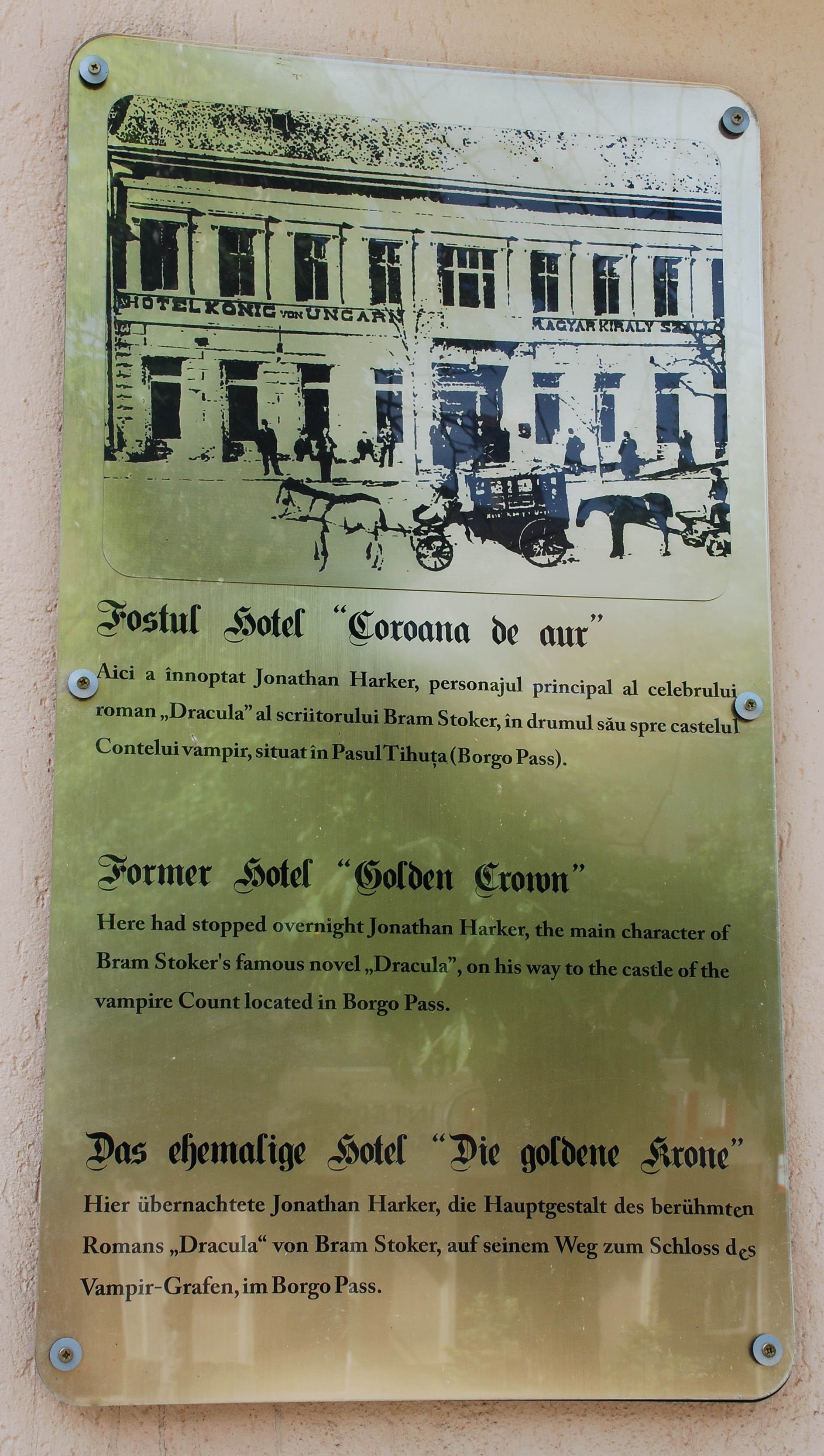
Although if Eco – or rather his editors and students, who deliver an increasingly important part of his ideas and materials – had dug a bit into the Stoker literature, he could have easily found a cult place to Dracula as well. After 1990 the Saxons disappeared from Bistritz, but the Hungarians and Romanians remaining there have made great efforts to preserve and present the past of the city, including the only authentic place in Bram Stoker’s Dracula story.
Count Dracula had directed me to go to the Goldene Krone Hotel, which I found, to my great delight, to be thoroughly old-fashioned, for of course I wanted to see all I could of the ways of the country. I was evidently expected, for when I got near the door I faced a cheery-looking elderly woman in the usual peasant dress--white undergarment with a long double apron, front, and back, of coloured stuff fitting almost too tight for modesty. When I came close she bowed and said, “The Herr Englishman?” – “Yes”, I said, “Jonathan Harker.” She smiled, and gave some message to an elderly man in white shirtsleeves, who had followed her to the door. He went, but immediately returned with a letter:
My friend. – Welcome to the Carpathians. I am anxiously expecting you. Sleep well tonight. At three tomorrow the diligence will start for Bukovina; a place on it is kept for you. At the Borgo Pass my carriage will await you and will bring you to me. I trust that your journey from London has been a happy one, and that you will enjoy your stay in my beautiful land. – Your friend,
Dracula
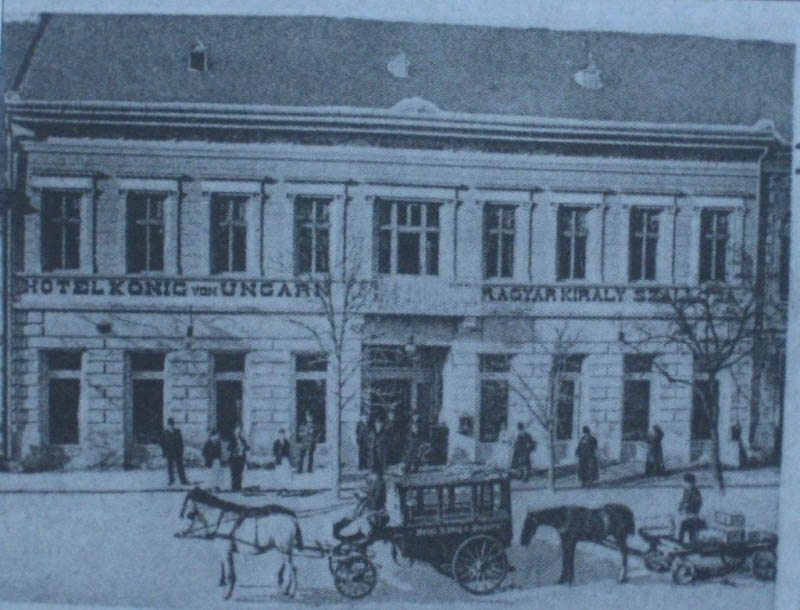
Place of the former King of Hungary Hotel on the late 18th-century map of Bistritz
The former King of Hungary – between the two world wars Paulini – Hotel today
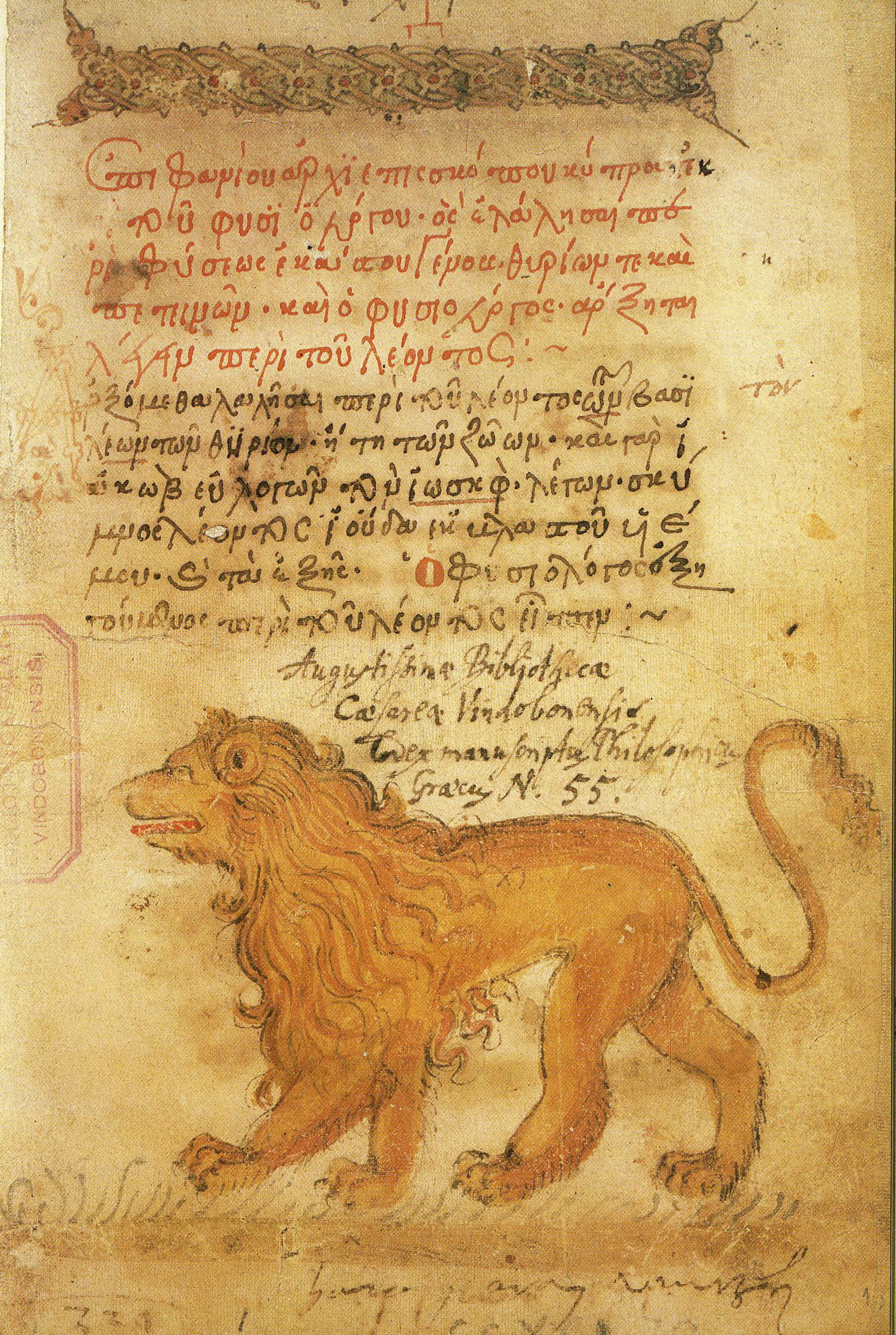
Lion in the Greek manuscript of the Physiologus (see below), made in Venice in the early 16th century, which in 1587 come from the property of the great Hungarian humanist and doctor Johannes Sambucus (János Zsámboki) to the Viennese Imperial Court Library (today Austrian National Library) (Cod. Phil. Gr. 290)
I have already mentioned, that the translator of Umberto Eco sometimes comes across passages, where the master (and his editor), similarly to good Homerus, fell asleep, or rather did not check in the impetus of the narration whether the facts only vaguely living in his memory conform to the reality. Earlier I used to add my corrections in footnotes, until the publisher, shocked by the number of notes, asked me to rather correct the text itself, since Eco (and his editor) would have written the same, had they looked after it. Since then I have done so, but to keep track of what I do, I write the more complex cases here in the blog. Like the last time I did with Eratosthenes’ well, or I will do now with the lion’s tail.
The lion’s tail came here, or rather into the chapter on bestiaries of Eco’s new book, from the Physiologus. The Physiologus was a Greek-language compilation from the second to third century AD, which was translated into several languages, and became one of the bestsellers of the Middle Ages and the forefather of all bestiaries. It described forty animals, plants and minerals, still on the basis of the Hellenistic tradition, but already interpreted in Christian spirit. Eco mentions an example:
Dopo avere descritto questi esseri, il Fisiologo mostra come e perché ciascuno di essi sia veicolo di un insegnamento etico e teologico. Per esempio il leone che, secondo la leggenda, cancella le proprie tracce con la coda per sottrarsi ai cacciatori, diventa simbolo di Cristo che cancella i peccati degli uomini.
After describing them, the Physiologus also explains how and why each of them carries some ethical and theological teaching. The lion, for example, which erases its own footprints with the tail, so as to hide from the hunters, becomes a symbol of Christ, who erases the sins of mankind.
The lion erasing its own footprints with the tail. Physiologus, Codex Sambucus
An attractive parallel indeed, which connects the signifier with the signified by way of the naive association of “erasing” – just like St. Isidore of Seville does in his Etymologies, so indulgently referred to by Eco –, but which does not further expand the analogy (the footprints of Christ =/= sins of mankind). However, when we open the Physiologus at this place, we read something absolutely different: a fully expanded metaphor, which refers to a Christological doctrine living throughout the whole Middle Ages:
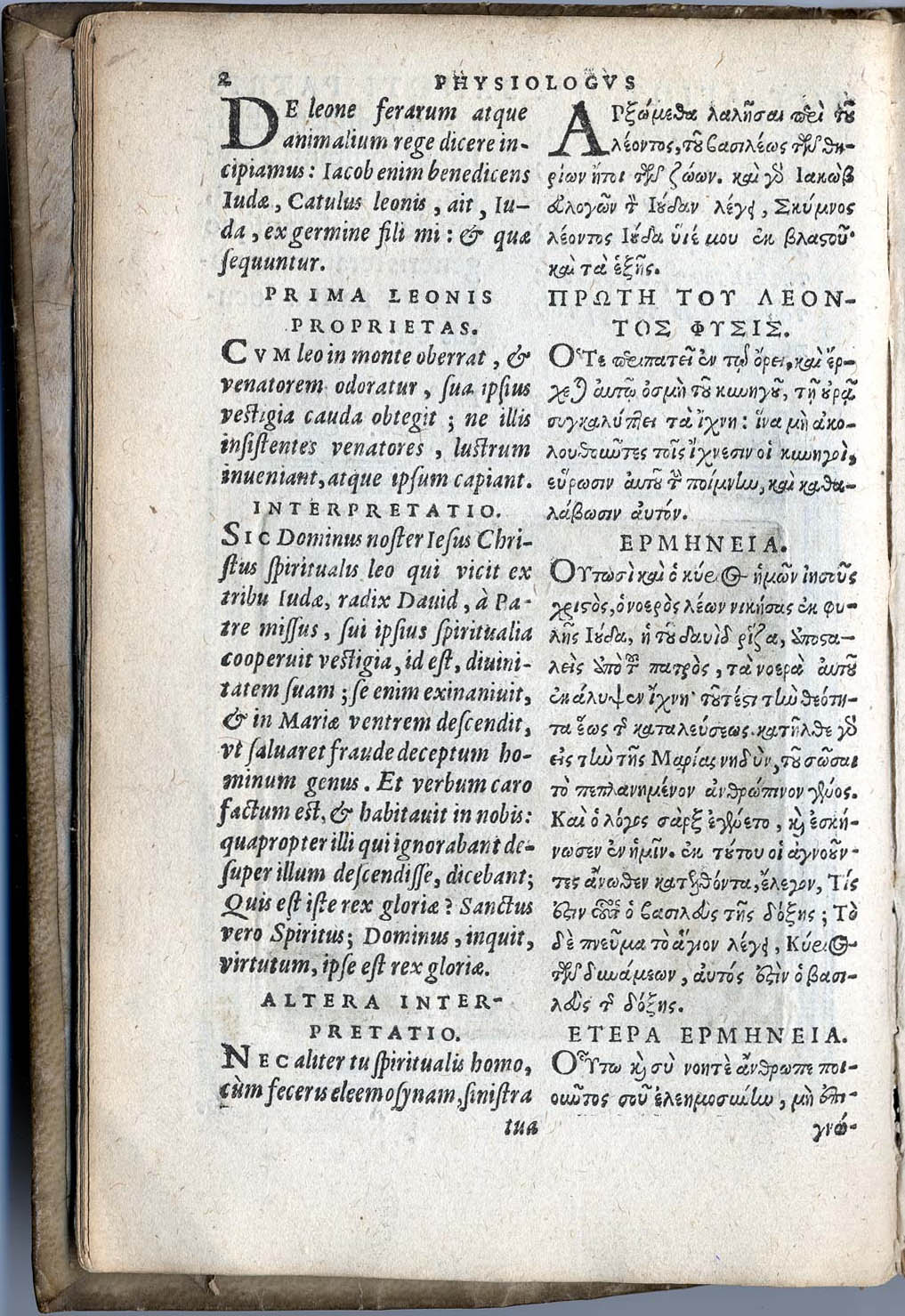
The first two pages on the lion from the 1588 Plantin edition of the Physiologus (the Greek and Latin original of the cited text is on the second page)
“When the lion roams the mountains, and he feels the smell of the hunter, he erases his footprints with his own tails, to prevent the hunters following him up, finding his abode, and capturing him … In the same way our Lord Jesus Christ, the spiritual lion … sent by the Father, erased His spiritual footprints, that is, His divinity; He emptied himself, and descended into the womb of Mary to save the deceived mankind.”
The unknown author (identified in the Middle Ages with the fourth-century Bishop of Cyprus and Church Father St. Epiphanius) relates the “scientific observation” accepted from Plutarch and Aelian with a popular theological doctrine which we find in several church fathers – Athanasius, St. Gregory of Nazianzos, Dionysius Areopagita, and even Epiphanius himself – as well as in later writers referring to them: that Christ assumed a human body so as to cheat the devil, the cheater of mankind, who, knowing nothing about His divinity, sought to destroy him as a man and as a (purely human) Messiah, thus actively contributing to His death on the cross and thereby the salvation of mankind.
The theologians recall this great trick with pleasure and by coloring the details. The fourth-century Rufinus of Aquileia, translator of Origen and friend (and later bitter debate partner) of St. Jerome, connects this doctrine with the metaphor of the hook in his commentary on the Apostles’ Creed:
“The object of the mystery of the Incarnation was the divine virtue of the Son of God, as a hook, concealed beneath the form of human flesh. He being found in fashion as a man (Phil 2:8), lured the Prince of this world to a conflict, offering His flesh as a bait. … As a fish seizes a baited hook, it not only does not take the bait off the hook, but is drawn out of the water to be itself food for others. So he, who had the power of death, seized the body of Jesus in death, not being aware of the hook of Divinity enclosed within it, but swallowed it and was caught. The bars of hell being broken apart, he was drawn out as it were from the abyss to become food for others. Ezekiel foretold this under the same figure, saying, ‘I will draw you out with My hook, and stretch you out on the earth. The plains shall be filled with you, and I will set all the fowls of the air over you, and I will satiate all the beasts of the earth with you’ (Ez 29:4-5, 32:3-8). … Job in like manner says in the person of the Lord speaking to him, ‘Will you draw forth the Leviathan with a hook, and will you put your bit in his nostrils?’” (Job 41:1-2)
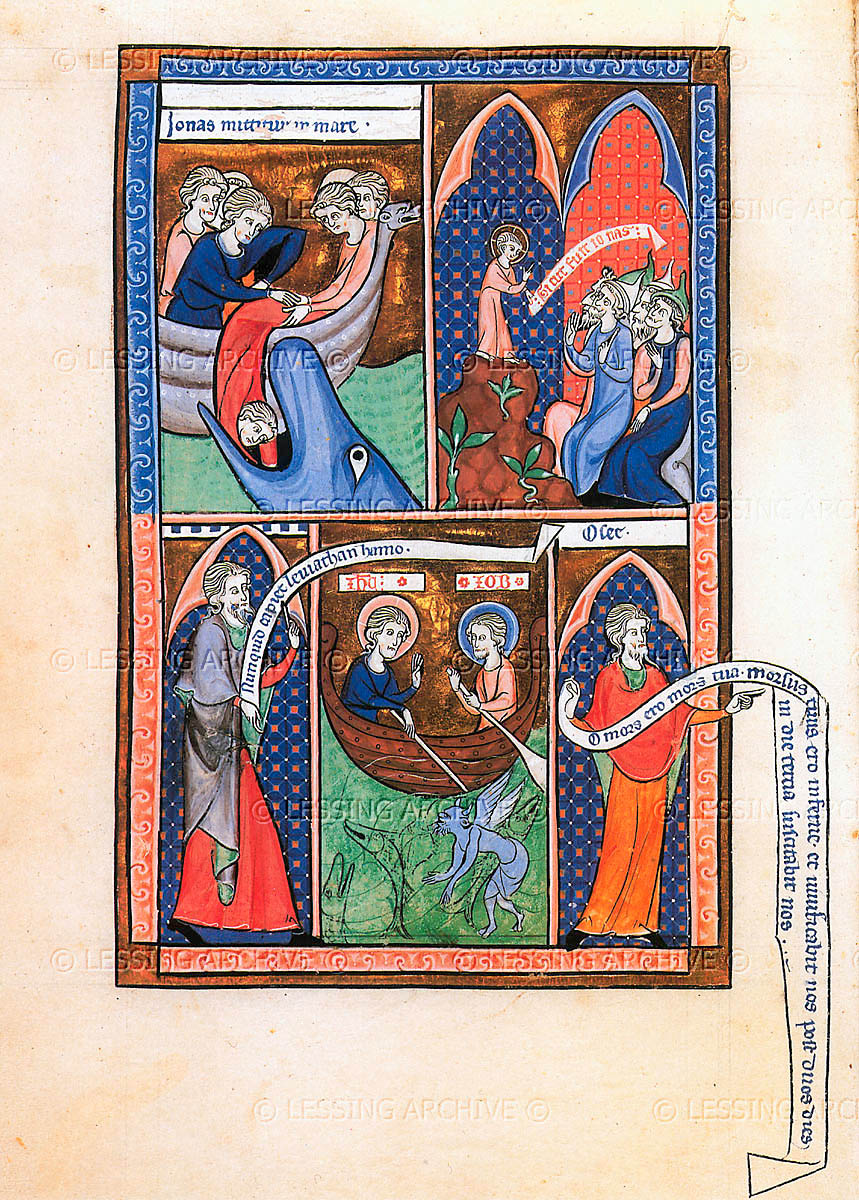
We see this version of the metaphor in one of the beautiful pieces of thirteenth-century Parisian miniature painting, the Reims Missale (1285-1297) preserved in St. Petersburg, on whose complex iconography I once held an entire semester at the university. On Folio 59v – also an illustration of the Creed – Christ fishing in a boat with Job puts the same question to him, while with the fishing pole hanging in front of the devil He already proves that He does draw forth the Leviathan. And the long scroll of Prophet Oseas, standing to the right, tells us how to understand this: O mors ero mors tua, morsus tuus ero inferne, “oh, death, I will be your death, I will be your sting, oh hell”. Accordingly, this verse became the first antiphone of the Holy Saturday Laudes, the the morning office.
Guillaume Bouzignac (c. 1587 – 1641): O mors ero mors tua, Les Arts Florissants, William Christie
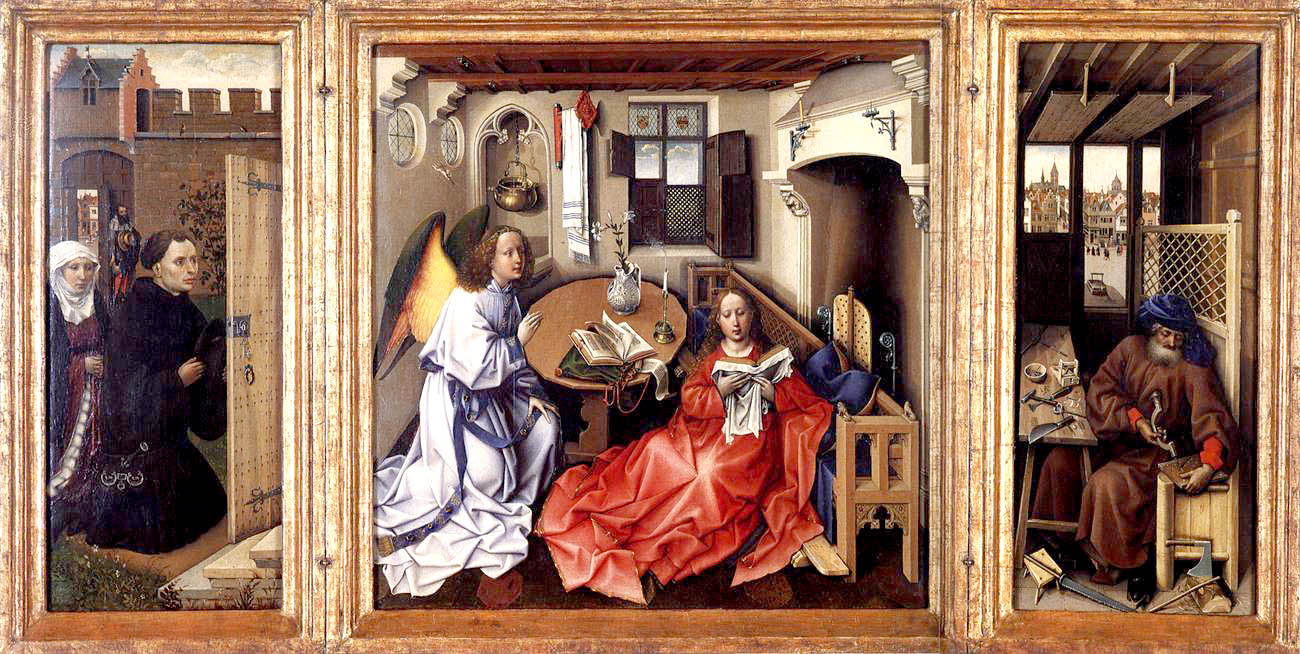
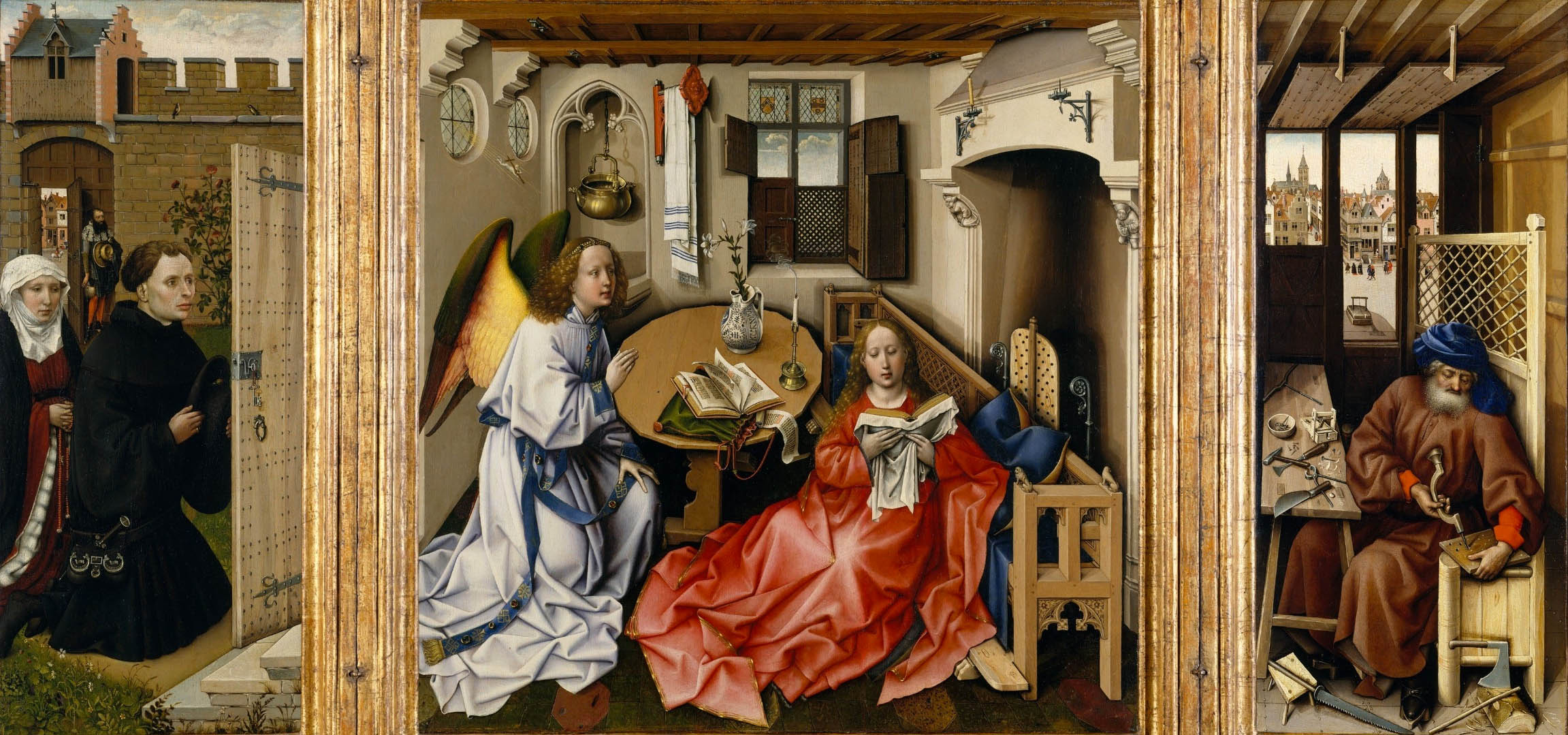
Other times they referred to the trap set to the devil with a different tool. St. Augustine says: “The Lord’s Cross was the devil’s mousetrap, the bait that caught him, the Lord’s death.” This is what we see in Robert Campin’s Mérode Altarpiece (between 1425 and 1428): while in the middle the scene of the Annunciation, that is, of Christ’s incarnation takes place, on the right side St. Joseph is knocking together mousetraps.
Supported by the authority of all this tradition, I have thus changed Eco’s text in the Hungarian translation, carefully erasing the traces of his slip-up:
After describing them, the Physiologus also explains how and why each of them carries some ethical and theological teaching. The lion, for example, which erases its own footprints with the tail, so as to hide from the hunters, becomes a symbol of Christ, who hides His divine nature from the devil.
After the Middle Ages, the motif of Satan cheated by Christ’s human nature and then bitterly disappointed, receded into the background, but hit has not completely disappeared. Its distant echoes can be heard even in so unexpected places, as Carman’s Carman Sunday’s on the way.
The demons where planning on having a party one night.
They got beer and Jack Daniels and pretzels, a little red wine, and some white.
They were celebrating how they crucified Christ, on that tree.
But Satan, the snake himself, wasn’t so at ease.
He took his crooked finger and he dialed the phone by his bed,
To call an old faithful friend, to know for sure, that he was dead.
He said, “Grave, Grave tell, did my plan fail?”
Old Grave just laughed and said, “Oh man, the dude is dead as nails.”
Chorus:
Well hey, hey, hey on Friday Night, they crucified the Lord at Calvary,
But He said, “Don’t dread, in three days, I’m gonna live again, you’ll see.”
When problems try to bury you and make it hard to pray,
It may seem like Friday night, but Sunday’s on the way!
A tranquilizer and a horror flick could not calm Satan’s fear.
So Saturday night, he calls up the grave… scared, of what he’d hear.
“Hey, Grave, what’s goin’ on?” Grave said, “Man, you called me twice,
and I’ll tell you, once more again boss, the Jew’s on ice!”
Devil said “Man grave, do you remember when old Lazarus was in his grave?
You said everything’s cool and four days later, BOOM, Ol’ Lazarus, he was raised!
Now this Jesus, He is much more trouble than anyone has been to me.
And he’s got me shocked, cuz He says, He’ll only be there three!”
Chorus
Sunday morning Satan woke with a jump, ready to blow a fuse.
He was shaking from the tips of his pointed ears, to the toes of his pointed shoes.
He said “Grave tell me is He alive? I don’t want to lose my neck!”
Grave said, “Your evilness, maintain your cool. You are a wreck!”
Grave said, “Now just cool your jets, Big D, my sting is still intact,
You see, Jesus is dead forever, he ain’t never coming back,
so just mellow out man, just go drink up or shoot up, but just leave old Grave alone,
and I’ll catch you la… la… oh no! OH no! OH NO! OH NO…
SOMEBODY’S MESSING WITH THE STONE!
Then the stone was rolled away and it bounced a time or two,
and an Angel stepped inside and said, “I’m Gabriel, who’re you?
And if you’re wondering where the Lord is, at this very hour,
I’ll tell you he’s alive and well, with resurrection power!”
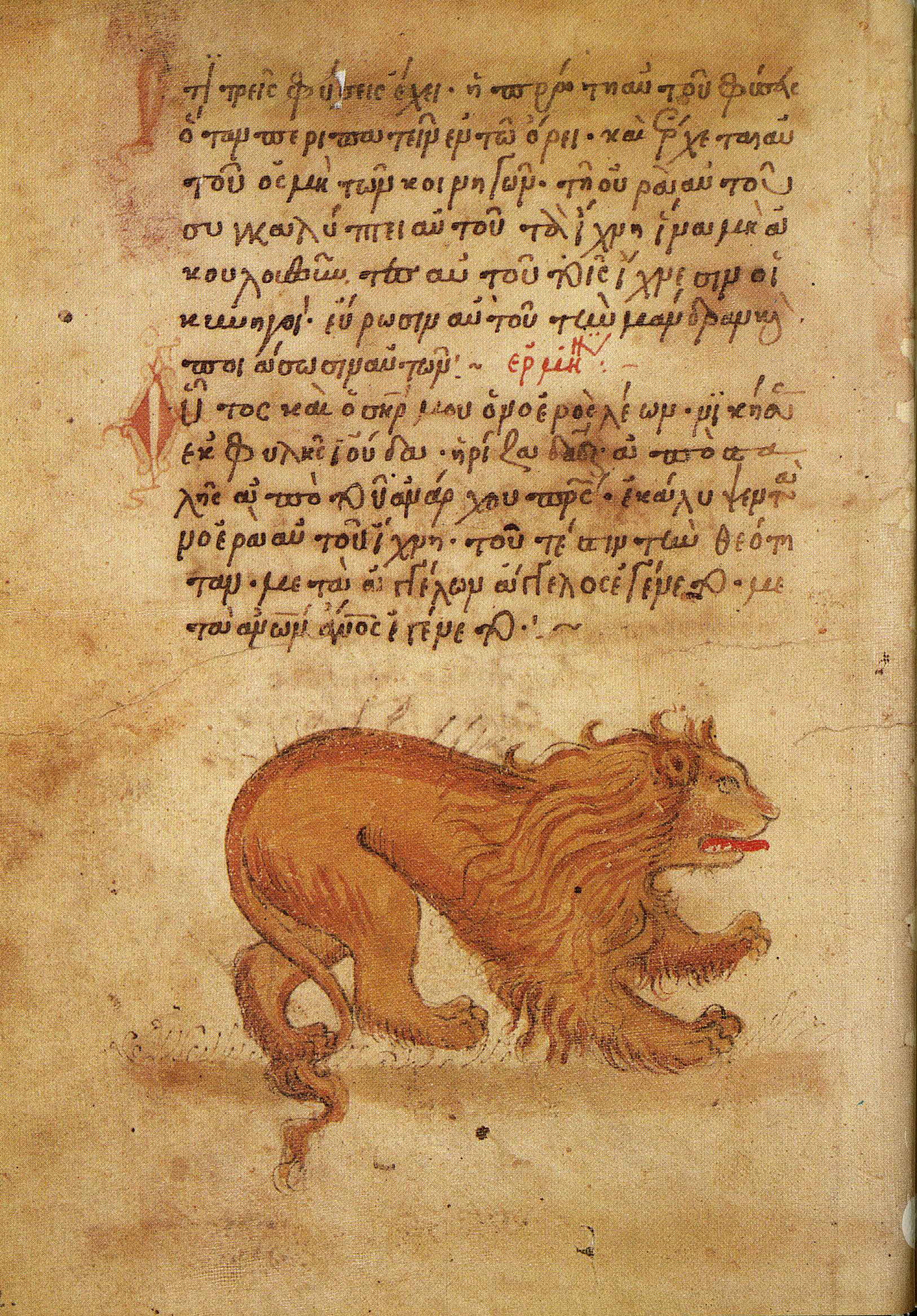
“The third characteristics of the lion: when its female gives birth, the puppy comes dead into the world, and she keeps it until, on the third day, the father comes and, by breathing onto its face, resuscitates it.” Physiologus, Codex Sambucus
León del manuscrito griego del Physiologus (ver más abajo), copiado en Venecia en el s. XVI, y que en 1587 pasó de las manos del gran humanista y médico húngaro Johannes Sambucus (János Zsámboki) a la Biblioteca de la Corte Imperial Vienesa (hoy Biblioteca Nacional de Austria) (Cod. Phil. gr. 290)
Ya hemos contado cómo el traductor de Umberto Eco ha de vadear a veces pasajes donde el maestro (y su editor), al igual que el buen Homero, se adormila; y hay otros lugares en que llevado por el ímpetu del relato no comprueba si lo que le dicta la memoria se ajusta a la realidad. Al principio solíamos añadir las observaciones en notas a pie de página hasta que el editor, sorprendido por su elevado número, prefirió que corrigiéramos directamente el texto, considerando que Eco (y su editor) habría escrito lo mismo de haber realizado él la comprobación. Así lo hacemos pero para mejor guardar registro del proceso anotamos algunos casos complejos también aquí. La última vez fue el pozo de Eratóstenes, y hoy es la cola del león.
La cola del león ha llegado hasta nuestra mesa –o mejor dicho hasta el capítulo sobre los bestiarios del nuevo libro de Eco– desde el Physiologus. El Physiologus, compilación en lengua griega elaborada en los siglos segundo y tercero, traducida luego a varios idiomas y convertida en uno de los best-sellers de la Edad Media, es la matriz de todos los bestiarios posteriores. Describía cuarenta animales, plantas y minerales, siempre sobre la base de la tradición helenística pero interpretada ya en clave cristiana. Eco menciona un ejemplo:
Dopo avere descritto questi esseri, il Fisiologo mostra come e perché ciascuno di essi sia veicolo di un insegnamento etico e teologico. Per esempio il leone che, secondo la leggenda, cancella le proprie tracce con la coda per sottrarsi ai cacciatori, diventa simbolo di Cristo che cancella i peccati degli uomini.
Después de describir a estos seres, el Physiologus muestra cómo y por qué cada uno de ellos conlleva una enseñanza ética y teológica. El león, por ejemplo, que según la leyenda borra sus propias huellas con la cola a fin de esconderse de los cazadores, se convierte en símbolo de Cristo, que borra los pecados de la humanidad.
El león borra el rastro de sus huellas con la cola. Physiologus, Codex Sambucus
Un paralelo atractivo, en efecto, que une significante y significado por la asociación ingenua de «borrar» –tal como hace san Isidoro de Sevilla en sus Etimologías, citado con cierto desdén por Eco– pero que no desarrolla la analogía apuntada (huellas de Cristo =/= pecados de la humanidad). Sin embargo, al abrir el Physiologus por la página correspondiente leemos algo bien distinto: una metáfora mucho más expandida que recoge una doctrina cristológica viva a lo largo de toda la Edad Media:
Las dos primeras páginas sobre el león en la edición del Physiologus de 1588 impreso por Plantin (el original griego y latino del texto citado se ve en la segunda página)
«Cuando el león vaga por las montañas y nota el olor del cazador, borra sus huellas con su propia cola para evitar que le persigan, que encuentren su morada y lo capturen ... De la misma manera nuestro Señor Jesucristo, el león espiritual ... enviado por el Padre, borró sus huellas espirituales, es decir, su divinidad; se despojó totalmente y descendió al vientre de María para salvar a la humanidad engañada».
El autor desconocido (identificado en la Edad Media con el obispo de Chipre del siglo IV y Padre de la Iglesia san Epifanio) relaciona la «observación empírica» aceptada por Plutarco y Eliano, con una doctrina teológica popular que exponen varios Padres de la Iglesia –Atanasio, Gregorio Nazianzeno, Dionisio Areopagita, e incluso el propio Epifanio– y, citando a éstos, otros escritores posteriores: que Cristo asumió un cuerpo humano con el fin de engañar al diablo, el engañador de la humanidad, que así, sin tener conocimiento de su divinidad, querría matarle como hombre y como un Mesías exclusivamente humano, contribuyendo de esta manera activamente a su muerte en la cruz y por tanto a la salvación de la humanidad.
Los teólogos cuentan este truco con gran placer y vívidos detalles. Rufino de Aquilea, también en el siglo IV, traductor de Orígenes y amigo (aunque luego entablarían una fuerte disputa) de san Jerónimo, conecta esta doctrina con la metáfora del anzuelo en su comentario sobre el Credo de los Apóstoles.
«El objeto del misterio de la Encarnación era la virtud divina del Hijo de Dios como anzuelo oculto en la forma de la carne humana. Estando Él bajo la condición de hombre (Fil. 2:8), atrajo al Príncipe de este mundo hacia una celada, ofreciendo su carne como cebo ... Como el pez que se traga el anzuelo no sólo no separa el cebo del gancho sino que él mismo sale fuera del agua para convertirse en comida para otros, así él, que tenía el imperio de la muerte, se apoderó del cuerpo de Jesús en la muerte, sin ser consciente de que el gancho de la divinidad estaba encerrado dentro, y se lo tragó y fue capturado. Al romperse las barras del infierno se vio arrastrado, por así decirlo, desde el abismo para convertirse en alimento de otros. Ezequiel profetizó esto bajo la misma figura, diciendo: «Voy a sacarte con mi anzuelo, y te extenderé sobre la tierra. Las llanuras se llenarán de ti, y dispondré sobre ti a todas las aves del cielo, y saciaré a todas las bestias de la tierra contigo» (Ez 29:4-5, 32:3-8) ... Job de la misma manera dice, en la persona del Señor que le habla: «¿Podrás tú atrapar con anzuelo al Leviatán, y le pondrás una anilla en las narices?» (Job 41:1-2)
Vemos una versión de la metáfora en una de las mejores muestras de la miniatura parisina del siglo XIII, el Misal de Reims (1285-1297) conservado en San Petersburgo, cuya compleja iconografía enseñamos durante un semestre en la universidad. En el folio 59v –también ilustración del Credo– Cristo pesca desde una barca con Job y le plantea la misma pregunta. Pero con la caña tendida ante el diablo ya le está demostrando cómo es capaz de atrapar al Leviatán. Y la larga filacteria del profeta Oseas, a la derecha, nos dice cómo interpretar el conjunto: O mors ero mors tua, morsus tuus ero inferne, «oh, muerte, seré tu muerte; seré tu dolor, oh, infierno». En consecuencia, este versículo se convirtió en la primera antífona de las laudes del Sábado Santo, en el oficio matutino.
Guillaume Bouzignac (ca. 1587 – 1641): O mors ero mors tua, Les Arts Florissants, William Christie
Otras veces se alude a la trampa tendida al diablo con un instrumento diferente. Dice san Agustín: «La cruz de Cristo fue ratonera del diablo; el cebo que lo atrapó, la muerte del Señor». Es esto lo que vemos en el Retablo de Mérode, de Robert Campin (entre 1425 y 1428): mientras que en el centro tiene lugar la escena de la Anunciación, es decir, de la Encarnación de Cristo, en el batiente derecho san José arma unas trampas para ratones (y fijémonos cómo se cruzan sus herramientas, la presencia de los clavos... sobre su banco de carpintero).
Apoyados en la autoridad de toda esta tradición hemos cambiado así el texto de Eco en la traducción al húngaro, cuidando de borrar las huellas del desliz:
Después de describir a estos seres, el Physiologus también muestra cómo y por qué cada uno de ellos conlleva una enseñanza ética y teológica. El león, por ejemplo, que borra sus propias huellas con la cola a fin de esconderse de los cazadores, se convierte en símbolo de Cristo que esconde al diablo su naturaleza divina.
Pasada la Edad Media, este motivo de Satanás engañado por la naturaleza humana de Cristo y amargamente burlado, quedaría en segundo plano. Pero no desapareció del todo. Sus ecos lejanos se escuchan hasta en lugares tan inesperados como esta sorprendente Sunday’s on the Way (el domingo está en camino) de Carman.
The demons where planning on having a party one night.
They got beer and Jack Daniels and pretzels, a little red wine, and some white.
They were celebrating how they crucified Christ, on that tree.
But Satan, the snake himself, wasn’t so at ease.
He took his crooked finger and he dialed the phone by his bed,
To call an old faithful friend, to know for sure, that he was dead.
He said, “Grave, Grave tell, did my plan fail?”
Old Grave just laughed and said, “Oh man, the dude is dead as nails.”
Chorus:
Well hey, hey, hey on Friday Night, they crucified the Lord at Calvary,
But He said, “Don’t dread, in three days, I’m gonna live again, you’ll see.”
When problems try to bury you and make it hard to pray,
It may seem like Friday night, but Sunday’s on the way!
A tranquilizer and a horror flick could not calm Satan’s fear.
So Saturday night, he calls up the grave… scared, of what he’d hear.
“Hey, Grave, what’s goin’ on?” Grave said, “Man, you called me twice,
and I’ll tell you, once more again boss, the Jew’s on ice!”
Devil said “Man grave, do you remember when old Lazarus was in his grave?
You said everything’s cool and four days later, BOOM, Ol’ Lazarus, he was raised!
Now this Jesus, He is much more trouble than anyone has ever been to me.
And look Grave he’s got old Devil shook cuz He said, he’s only gonna be dead for three!”
Chorus
Sunday morning Satan woke with a jump, ready to blow a fuse.
He was shaking from the tips of his pointed ears, to the toes of his pointed shoes.
He said “Grave tell me is He alive? I don’t want to lose my neck!”
Grave said, “Your evilness, maintain your cool. You are a wreck!”
Grave said, “Now just cool your jets, Big D, my sting is still intact,
You see, Jesus is dead forever, he ain’t never coming back,
so just mellow out man, just go drink up or shoot up, but just leave old Grave alone,
and I’ll catch you la… la… oh no! OH no! OH NO! OH NO…
SOMEBODY’S MESSING WITH THE STONE!
Then the stone was rolled away and it bounced a time or two,
and an Angel stepped inside and said, “I’m Gabriel, who’re you?
And if you’re wondering where the Lord is, at this very hour,
I’ll tell you he’s alive and well, with resurrection power!”
«Tercera característica del león: cuando la hembra da a luz, el cachorro viene al mundo muerto, y así permanece hasta que, al tercer día, se le acerca el padre y, echándole su aliento en el rostro, lo resucita» Physiologus, Codex Sambucus.