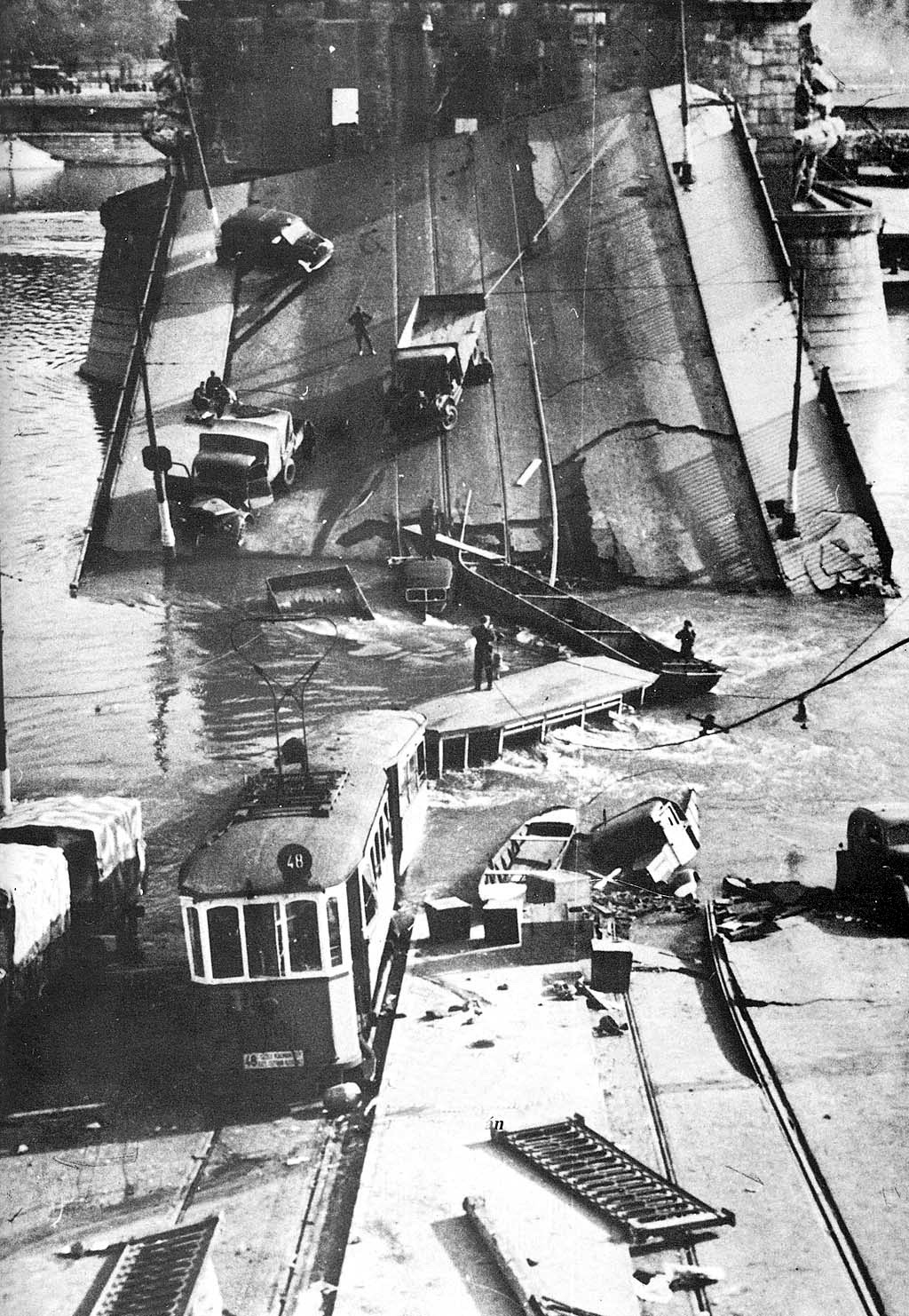
Switch over to our new blog! • ¡Pásese a nuestro nuevo blog!

The renewed version of our blog, with more features, a richer design, and available in nine languages, can be read here: https://wangriver.com

The new version also includes the old posts, often in expanded form. If you are curious about the updated version of this post, replace “riowang.blogspot.com/” in the URL with “riowang.studiolum.com/”, and the new link will most likely lead you there.


La versión renovada de nuestro blog, con más herramientas, un diseño más rico y disponible en nueve idiomas, se puede leer aquí: https://riowang.com

La nueva versión también incluye las publicaciones antiguas, a menudo en una forma ampliada. Si tiene curiosidad por la versión actualizada de esta entrada, sustituya «riowang.blogspot.com/» en la URL por «riowang.studiolum.com/es/», y el nuevo enlace probablemente le llevará allí.

Mostrando entradas con la etiqueta field post. Mostrar todas las entradas

The long voyage


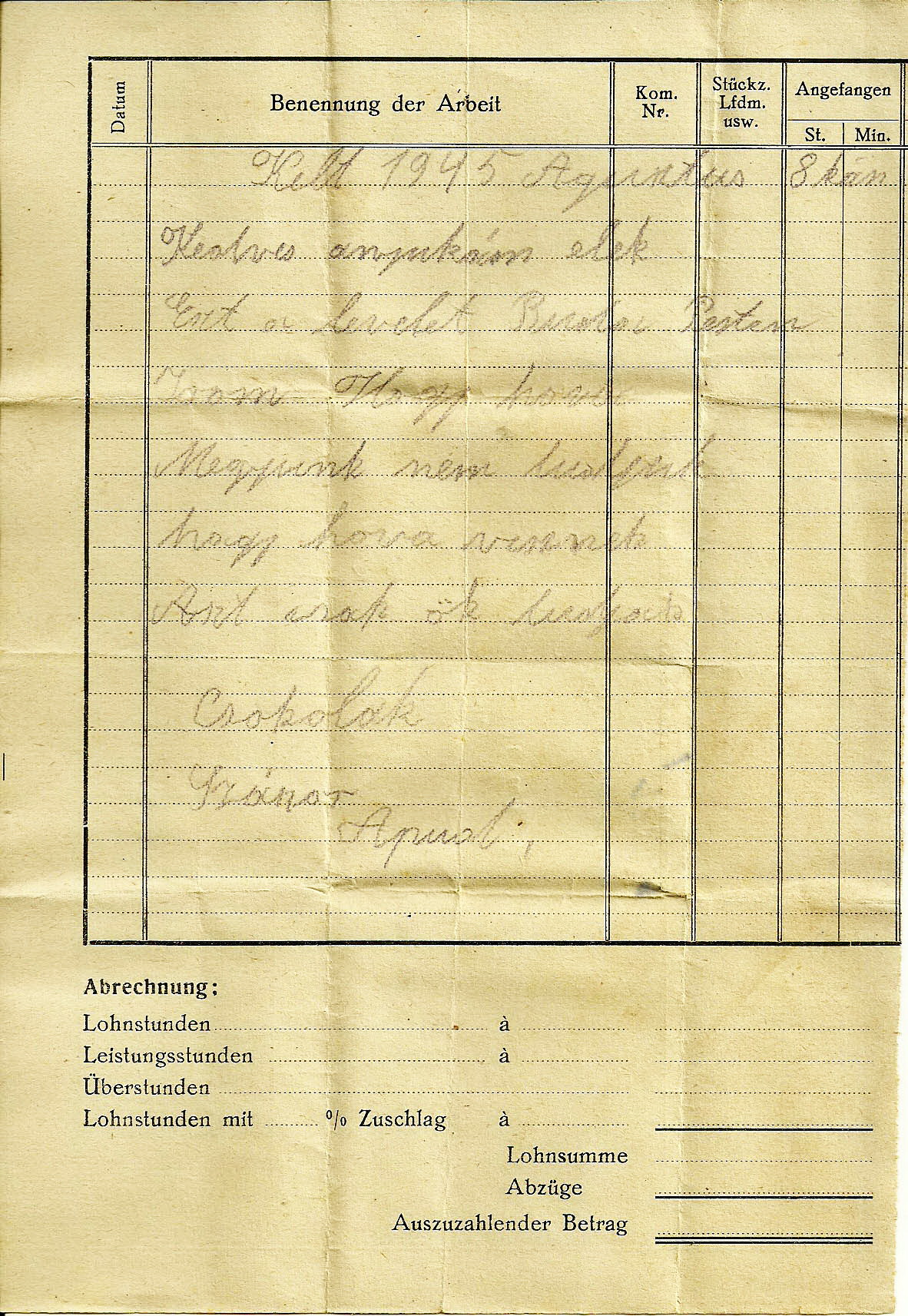
Kelt 1945 Agusztus 8kán

Kedves anyukám élek
Eszt a levelet Buda Pesten
Irom Hogy hova
Megyunk nem tudjuk
hogy hova visznek
Aszt csak ök tudjak

Csokolak
Szászor
Apud

Karasz Pálné
Részére
Békés Megye
Orosháza
Köségi posta 133/31
Dated on 8th Agust

Dear Mommy I am living
This letter I write
On Buda Pest. We do not
Know where we go
where they take us
Only they know it

I kiss you
A hundret times
Daddy

For
Mrs. Karasz
Békés county
Orosháza
Post office 133/31


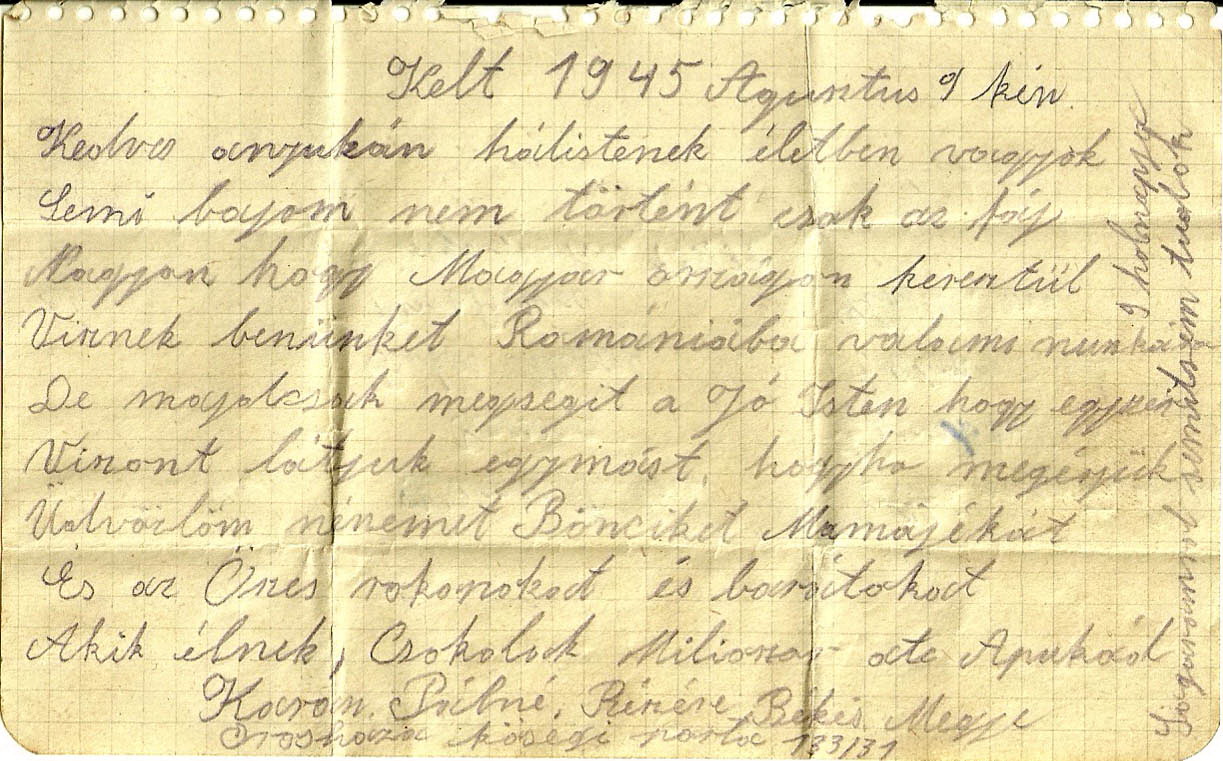
Kelt 1945 Agusztus 9kén

Kedves anyukán hálistenek életben vagyok
Semi bajom nem történt csak az fáj
Nagyon hogy Magyar országon keresztül
Visznek benünket Romániába valami munkára
De majdcsak megsegit a Jó Isten hogy egyszer
Viszont látjuk egymást, hogyha megérjük
Üdvözlöm nénémet Böncikét Mamájékat
És az Öszes rokonokat és barátokat
Akik élnek, Csokolak Milioszor ate Apukád

Sógoromrol semitsem tudok 1 holnapja

Karasz Pálné Részére, Békés Megye
Orosháza köségi posta 133/31

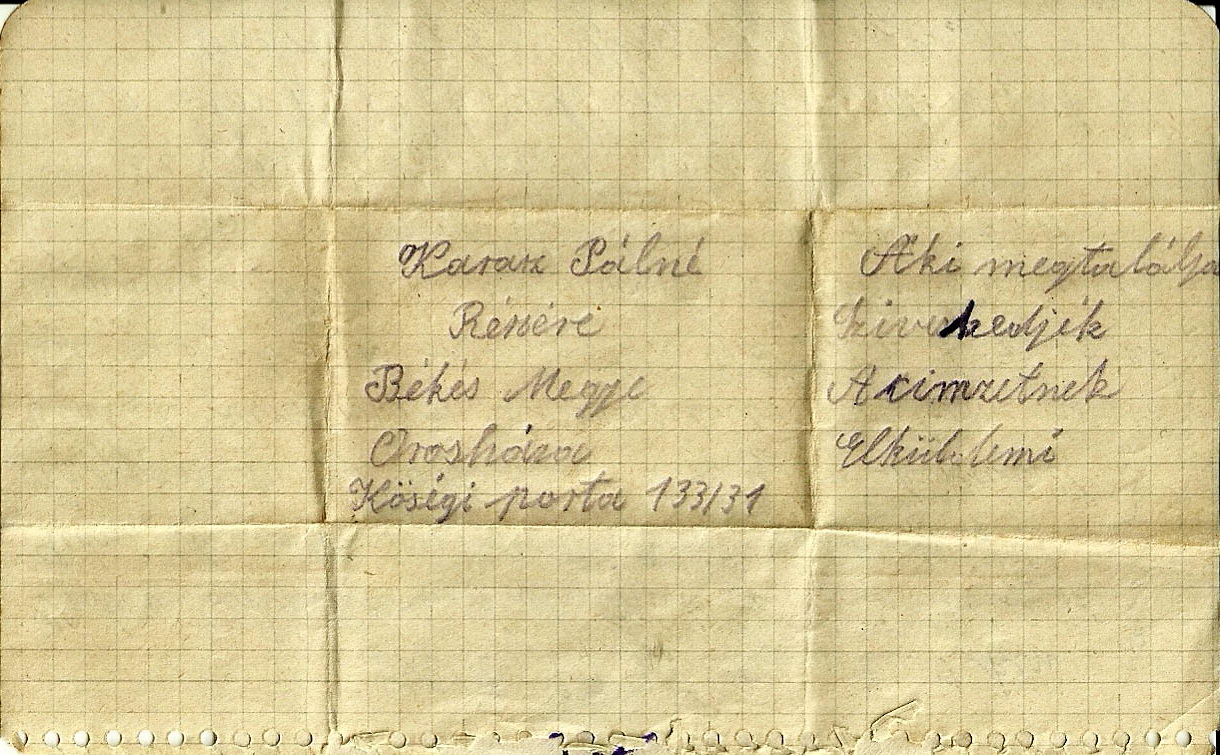
Karasz Pálné
Részére
Békés Megye
Orosháza
Köségi posta 133/31

Aki megtalálja
Sziveskedjék
A cimzetnek
Elküldemi
Dated on 9th Agust

Dear Mommy thanks God I’m alive
I’m healthy, it only hurts that
They take us through Hungary
To Romania to some work
But the Good God will help me that once
We will see us again, if we live to see it
I greet my sister, Böncike, my Mum
And all the relatives and friends
Who are alive. A million kisses from Daddy

I know nothing of my brother-in-law since a month

For Mrs. Karasz, Békés county
Orosháza, village post office, 133/31

For
Mrs. Karasz
Békés county
Orosháza
Post office 133/31

If you find it
Please send it
To the Addressee


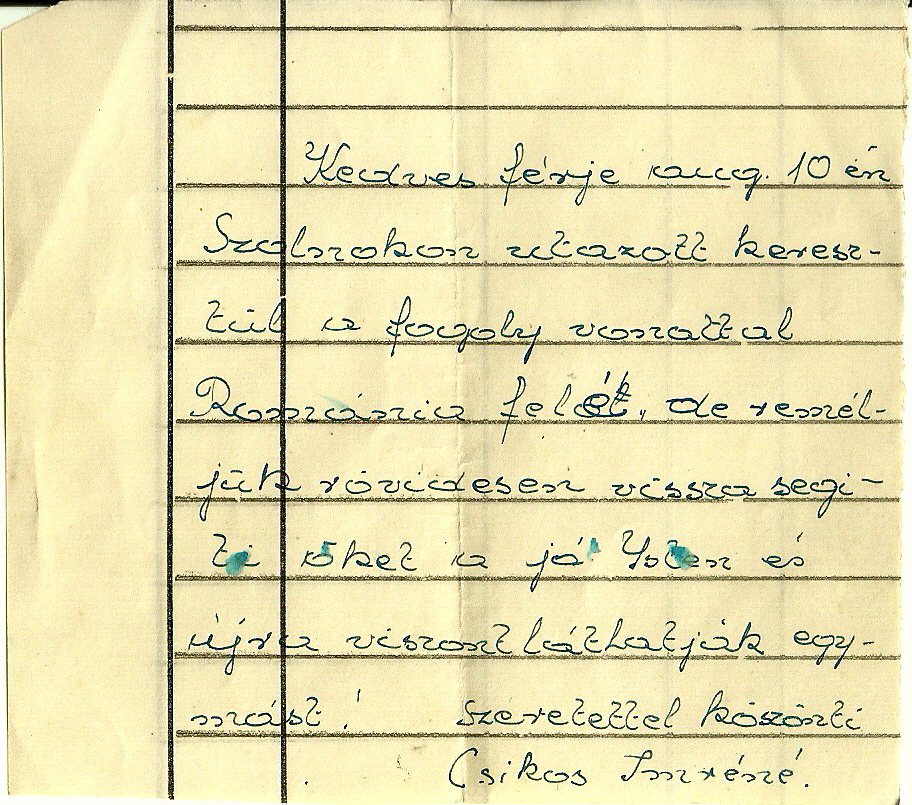
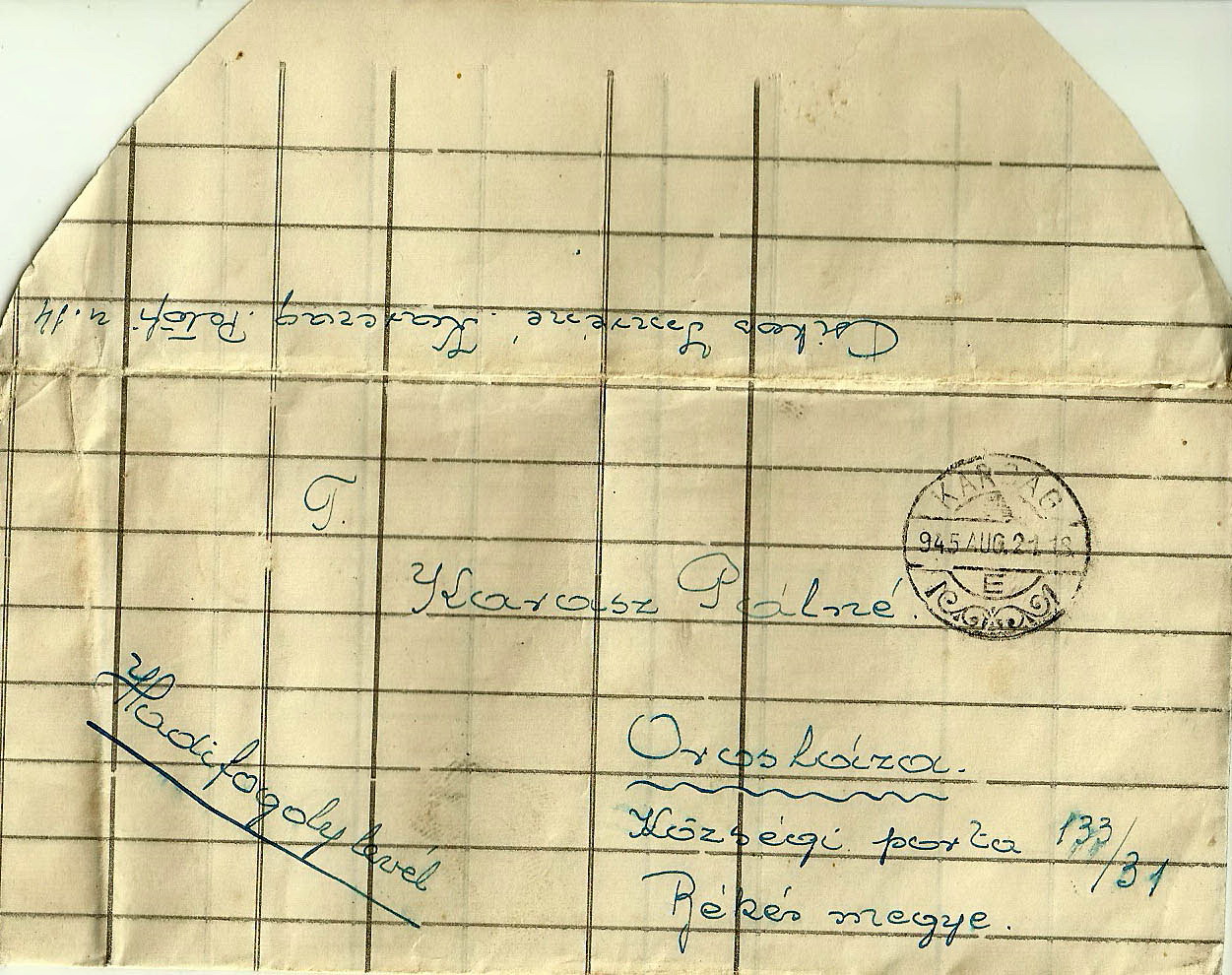
Kedves férje aug. 10én Szolnokon utazott keresztül a fogoly vonattal Románia felé, de reméljük rövidesen visszasegíti őket a jó Isten és újra viszontláthatják egymást! Szeretettel köszönti Csikos Imréné

Hadifogolylevél

T. Karasz Pálné
Orosháza
Községi posta 133/31
Békés megye

[Feladó:] Csikos Imréné, Karczag, Petőfi u. 14.
Your dear husband traveled through Szolnok with the prisoners’ train to Romania on Aug 10, but he will be hopefully brought back soon by the good God, and you can see each other again! Warm greetings from Mrs. Imre Csikos

POW letter

To Mrs. Karasz
Orosháza
Post office 133/31
Békés county

[Sender:] Mrs. Imre Csikos, Karcag, Petőfi 14


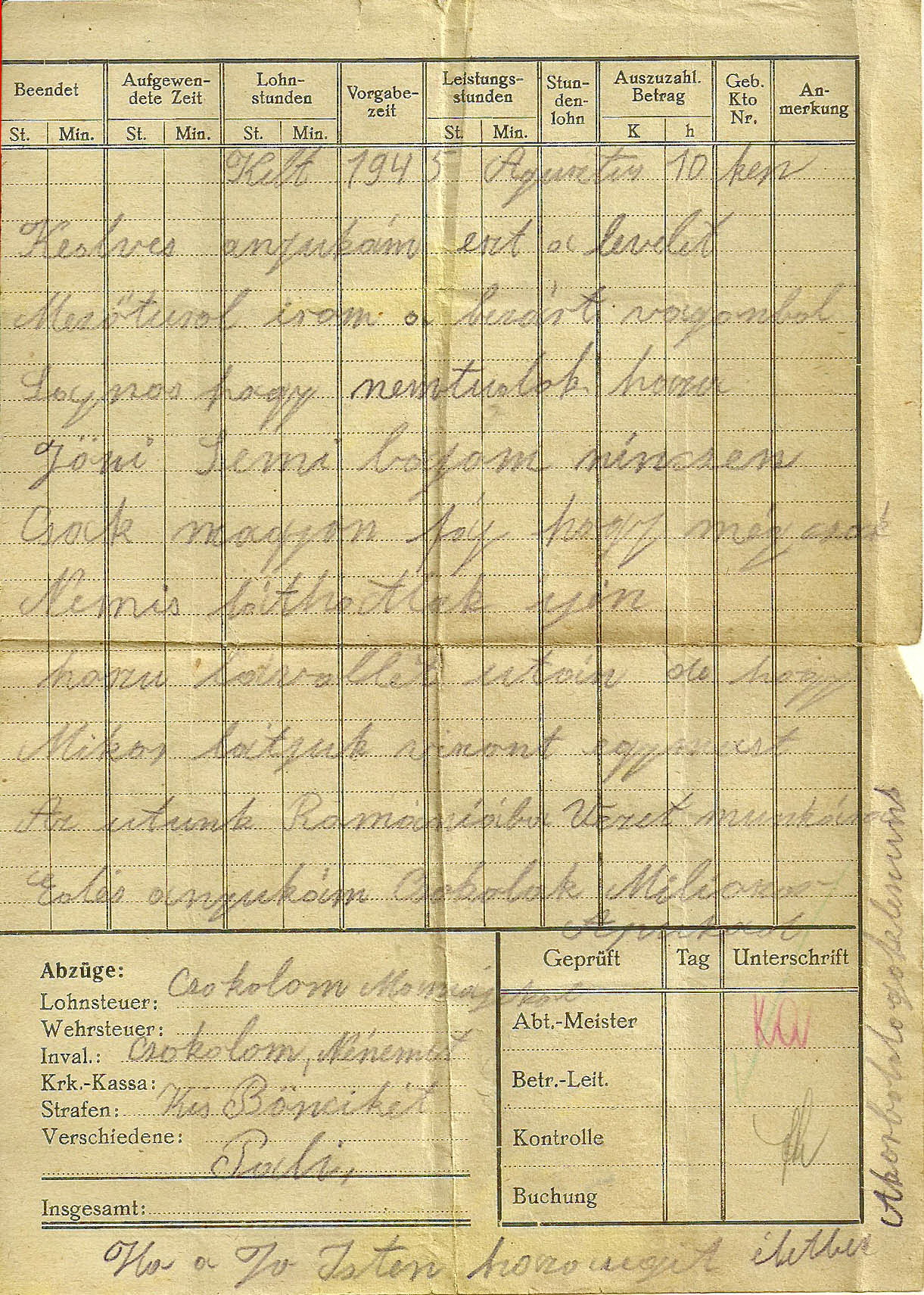
Kelt 1945 Agusztus 10kén

Kedves anyukám ezt a levelet
Mezőturol irom a lezárt vagonbol
Sajnos hogy nemtudok haza
Jöni Semi bajom nincsen
Csak nagyon fáj hogy még csak
Nemis láthatlak újra
hoszu távollét után de hogy
Mikor látjuk viszont egymást
Az utunk Romániába vezet munkára
Édes anyukám Csokolak Milioszor
Apukad

Csokolom Mamájékat
Csokolom Nénémet
Kis Böncikét
Pali,

Ha a Jo Isten hazasegit életben
Akorboldogokleszunk

Karasz Pálné
Reszére
Békés Megye
Orosháza
Köségi posta 133/31
Dated on 10th Agust

Dear Mommy I write this letter
From Mezőtúr, the sealed cattle car
I am so sorry I cannot come
Home I have no problem, only
It hurts that I even canot see
You again after such
a long absence, but
When will we see us again
Our trip leads to Romania for work
Dear Mommy, a milion kisses
From Daddy

Kisses to Mum
Kisses to my Sister
To Little Böncike
Pali.

If the good God helps me home
Then wewillbehappy

For
Mrs. Karasz
Békés county
Orosháza
Village post 133/31


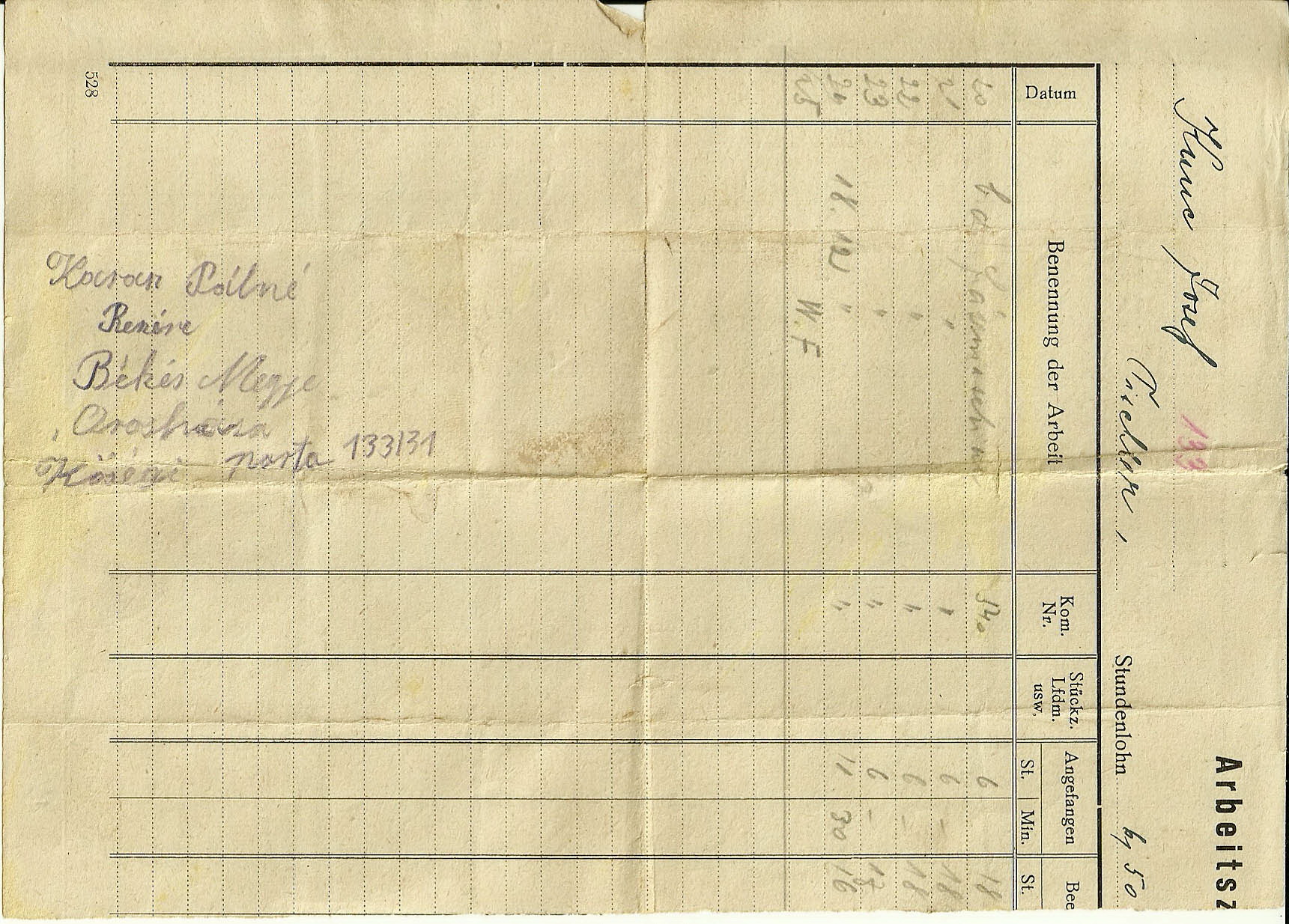
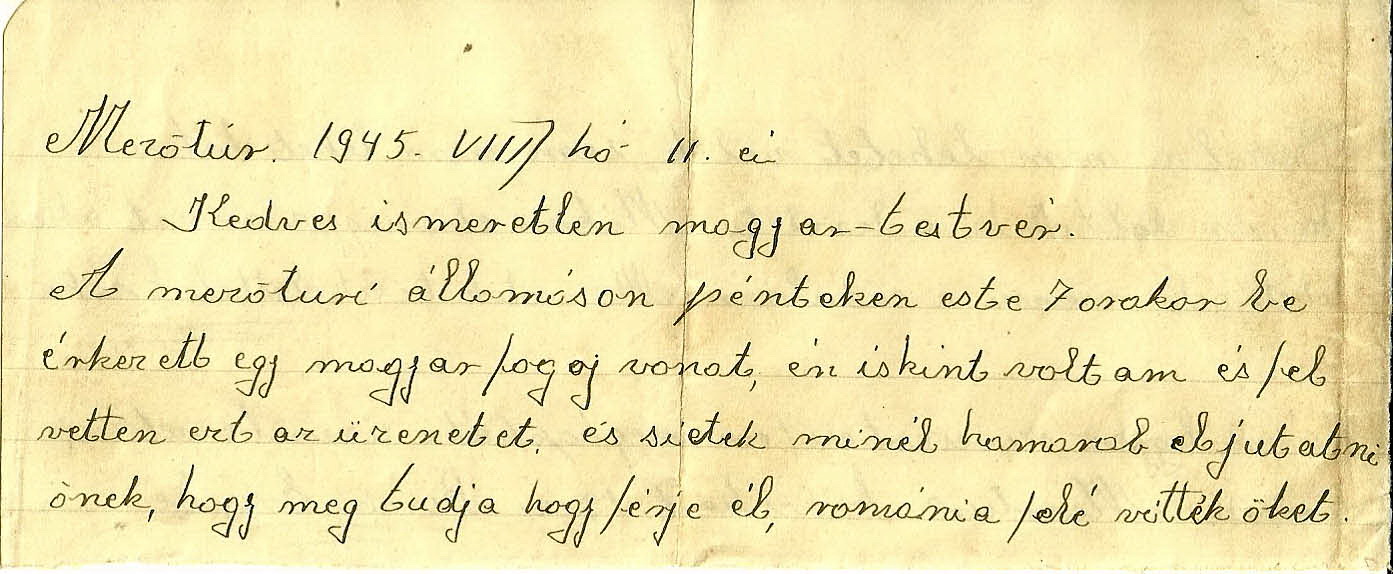
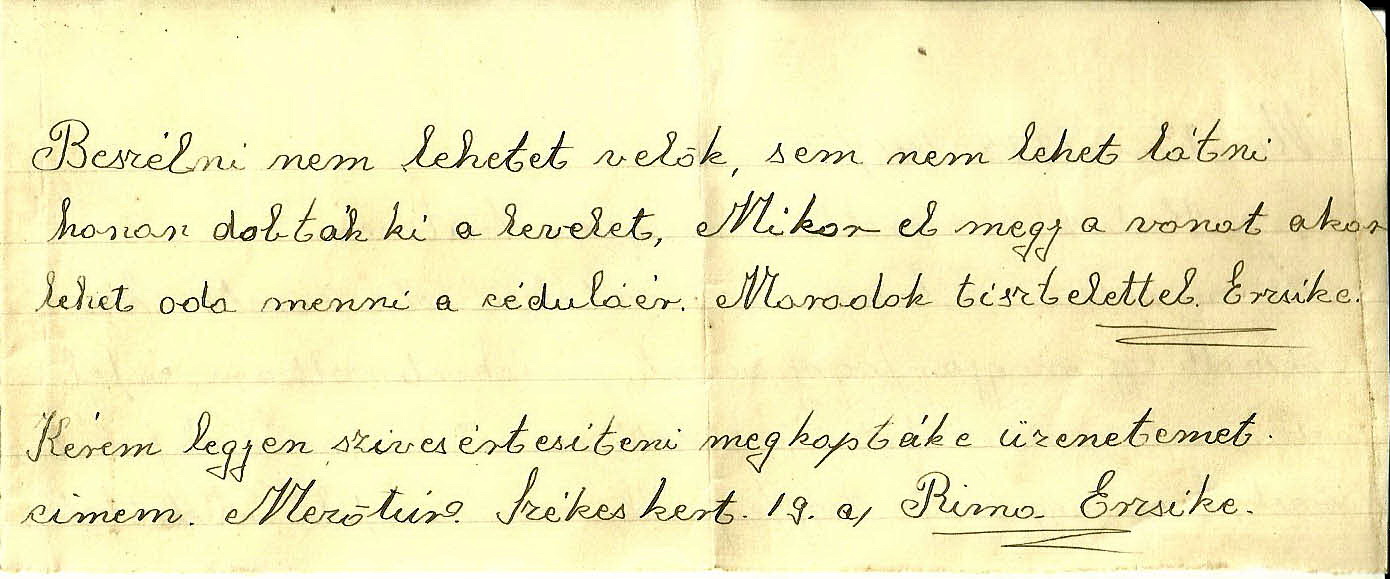
Kedves ismeretlen magyar testvér
A mezőturi állomáson pénteken este 7 orakor be érkezett egy magyar fogoj vonat, én is kint voltam és fel vettem ezt az üzenetet, és sietek minél hamarab eljutatni önek, hogy meg tudja hogy férje él, románia felé vitték öket. Beszélni nem lehetet velök, sem nem lehet látni honan dobták ki a levelet. Mikor el megy a vonat akor lehet oda menni a céduláér. Maradok tisztelettel Erzsike

Kérem legyen szives értesíteni megkapták e üzenetemet
cimem. Mezőtúr. Székeskert 19.a Rima Erzsike

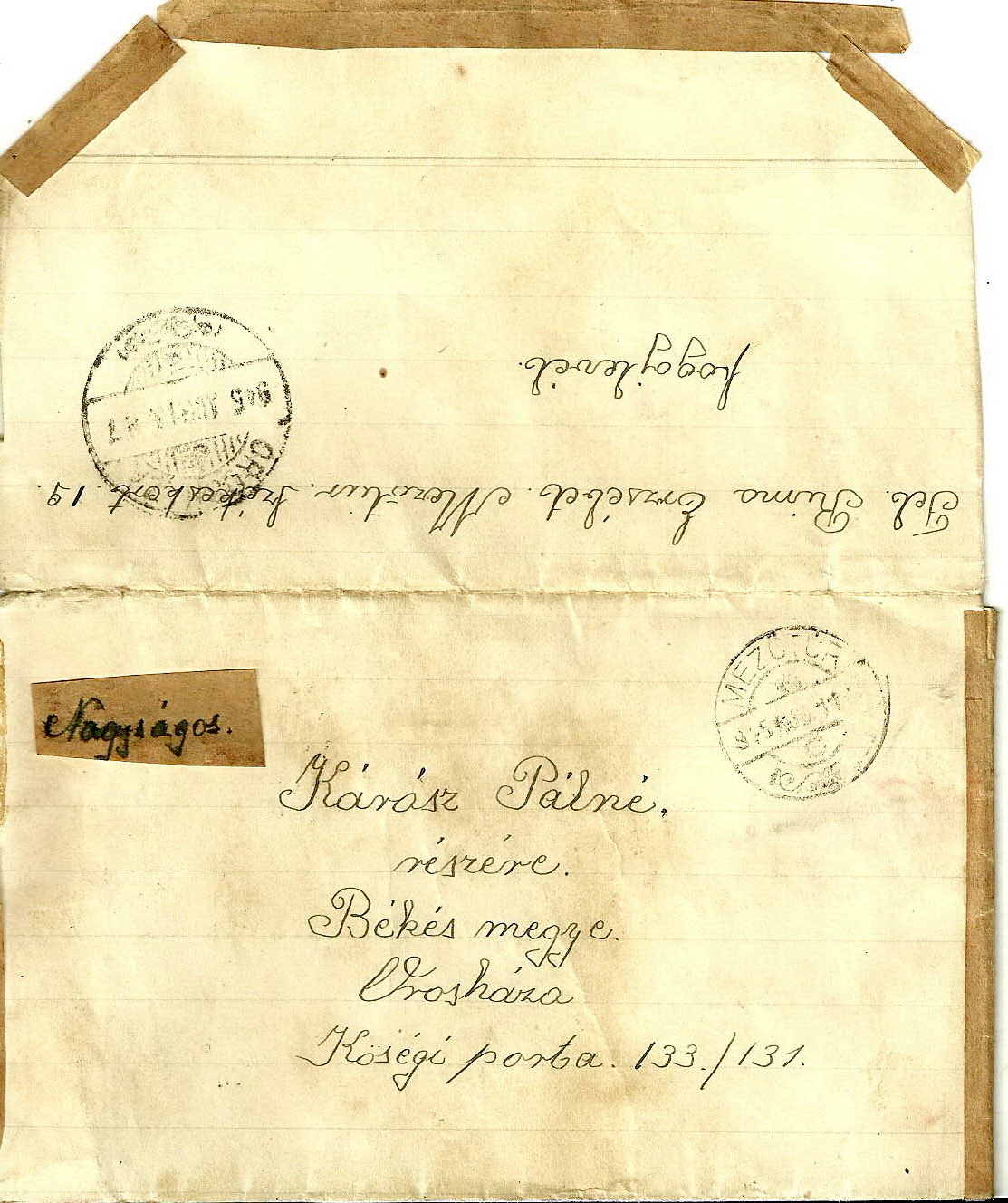
Nagyságos
Kárász Pálné
részére
Békés megye
Orosháza
Köségi posta 133/131

Fel. Rima Erzsébet. Mezőtúr. Székeskert 19

fogojlevél
Dear unknown Hungarian sister
On Friday at 7 p.m. a Hungarian POW train arrived at the station of Mezőtúr. I was also there and I picked up this message, and I hurry to send it to you so you would know that your husband is alive, they are taken towards Romania. It was impossible to speak with them, one could not even see from where the letter was thrown out. Only when the train leaves, you can go there to pick up the letters. Respectfully, Erzsike

Please be so kind to inform me whether you got my message
my address: Mezőtúr, Székeskert str. 19/a, Erzsike Rima

For Respected Mrs. Kárász
Békés county
Orosháza
Post office 133/131

Sender: Erzsébet Rima, Mezőtúr, Székeskert 19

POW letter


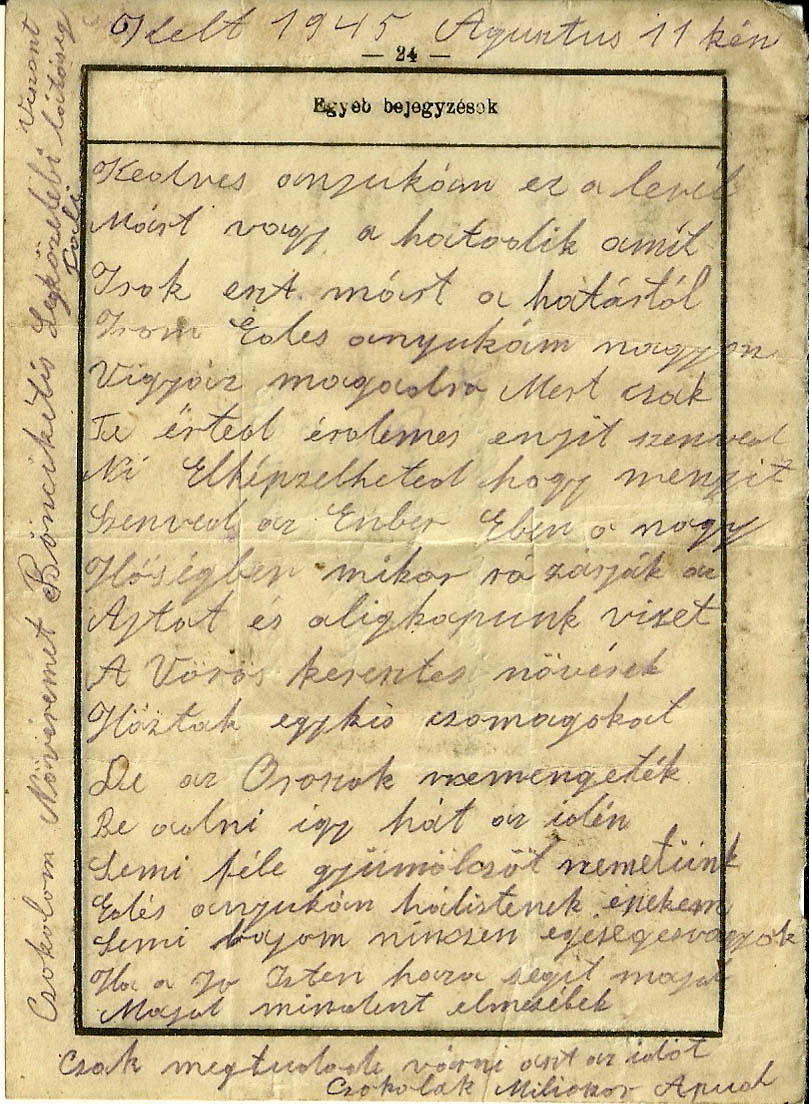
Kelt 1945 Agusztus 11kén

Kedves anyukám ez a levél
Márt vagy a hatodik amit
Irok eszt márt a határtól
Irom Édes anyukám nagyon
Vigyáz magadra Mert csak
Te érted érdemes enyit szenved
Ni Elképzelheted hogy menyit
Szenved az Ember Eben a nagy
Hőségben mikor rázárják az
Ajtot és alig kapunk vizet
A Vörös keresztes növérek
Hoztak egykis csomagokat
De az Oroszok nemengeték
Be adni igy hát az idén
Semi féle gyümölcsöt nemetünk
Edés anyukám hálistenek énekem
Semi bajom nincsen egésegesvagyok
Ha a Jo Isten haza segit majd
Majd mindent elmesélek
Csak megtudod várni aszt az idöt
Csokolak Milioszor Apud
Csokolom Növéremet Böncikétis
Legközelebi Viszont látásig Pali

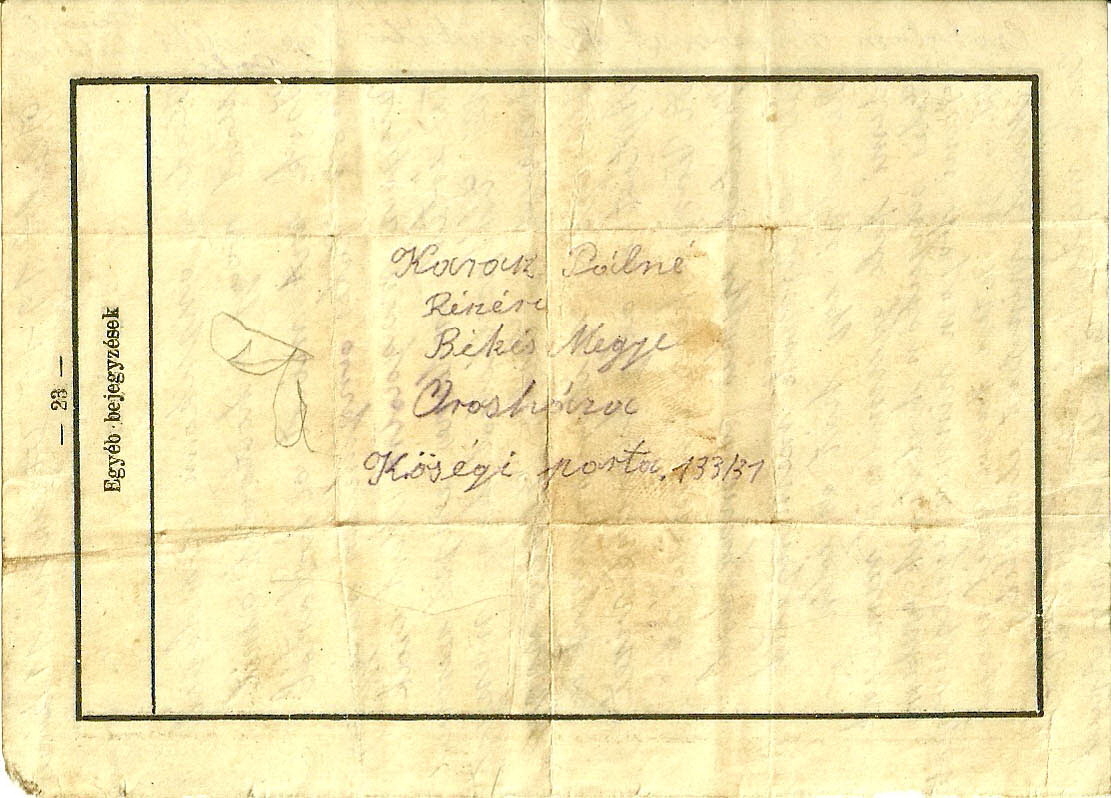
Karasz Pálné
Részére
Békés Megye
Orosháza
Köségi posta 133/31
Dated on 11 Agust 1945

Dear Mommy this letter
Is about the sixth which I
Write, this one from the border
I write. Dear Mommy, please
Take care. Because it is only
Worth for you so much to suf
Fer You can imagine how much
One suffers in this great heat
When they close the doors and we
Hardly get any water. The Red
Cross sisters brought
Us some little packages But
The Russians did not let
Them give it to us, so this year
We did not eat any kind of fruit
Dear Mommy thanks God I
Have no problem, healthyiam
If the Good God helps me home
I will tell everything
May you wait that time!
A million kisses from Daddy
Kisses to my Sister, also Böncike,
Till nearest Goodbye. Pali

For
Mrs. Karasz
Békés county
Orosháza
Village post 133/31


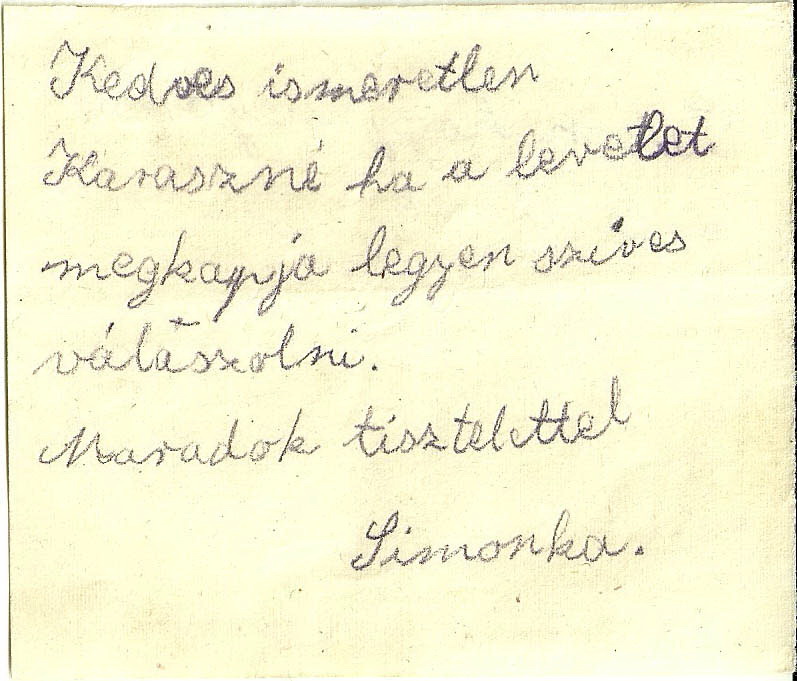
Kedves ismeretlen Karaszné, ha a levelet megkapja legyen szives válaszolni.
Maradok tisztelettel
Simonka

Tudom hogy meg örül a levélnek

Fogolylevél

Cim.
Karasz Pálné
részére
Békés megye
Orosháza
Községi posta 133/31

[Feladó:] ifj. Simonka Péter
Kétegyháza
N[agy]váradi ú. 98.
Békés megye
Dear unknown Mrs. Karasz, if you get this mail, be so kind to answer me
Respectfully
Simonka

I know you will be happy to get this letter

POW letter

Address:
For
Mrs. Karasz
Békés county
Orosháza
Post office 133/31

[Sender:] Péter Simonka Jr.
Kétegyháza
Nagyváradi út 98
Békés county


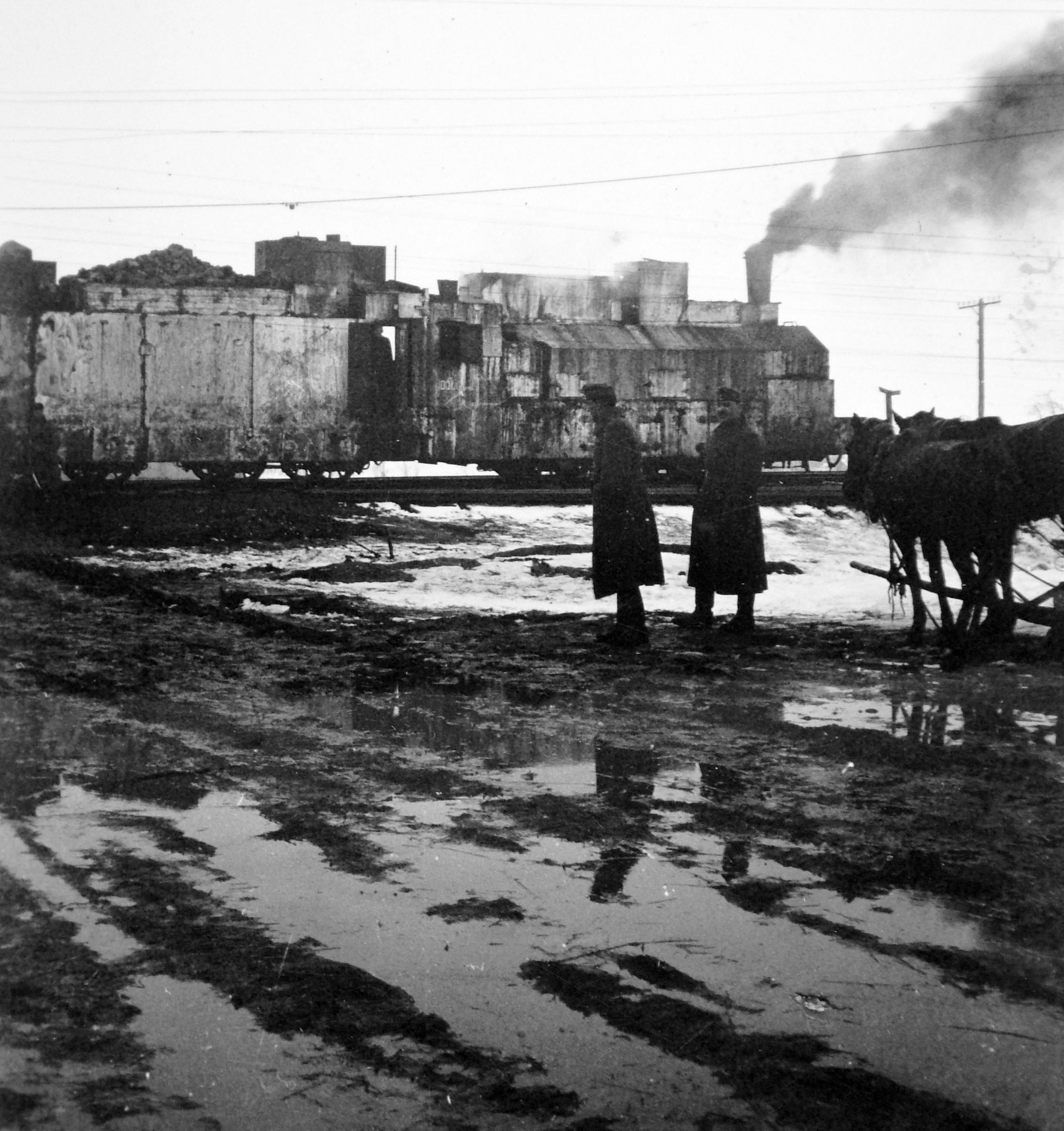
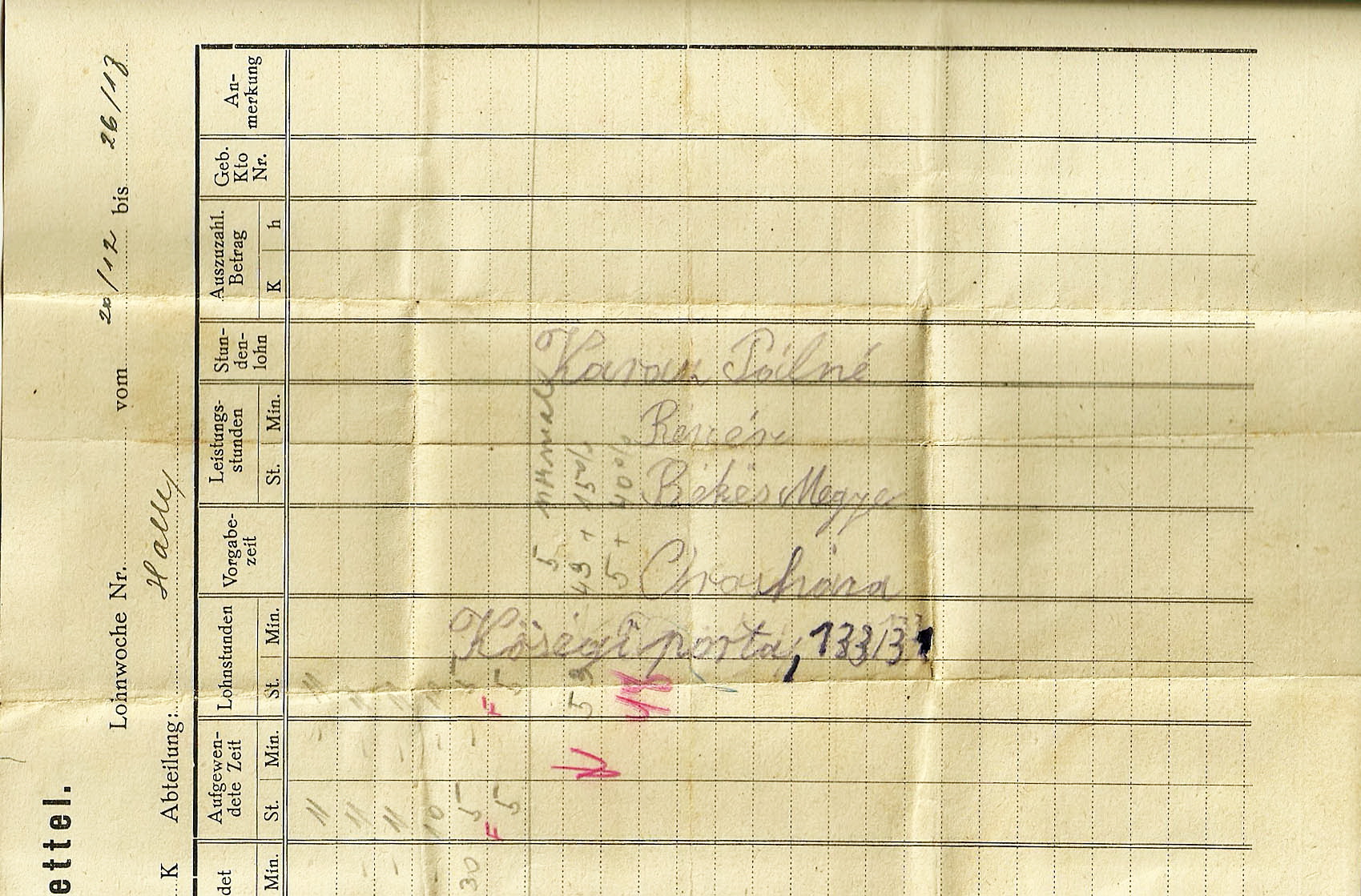
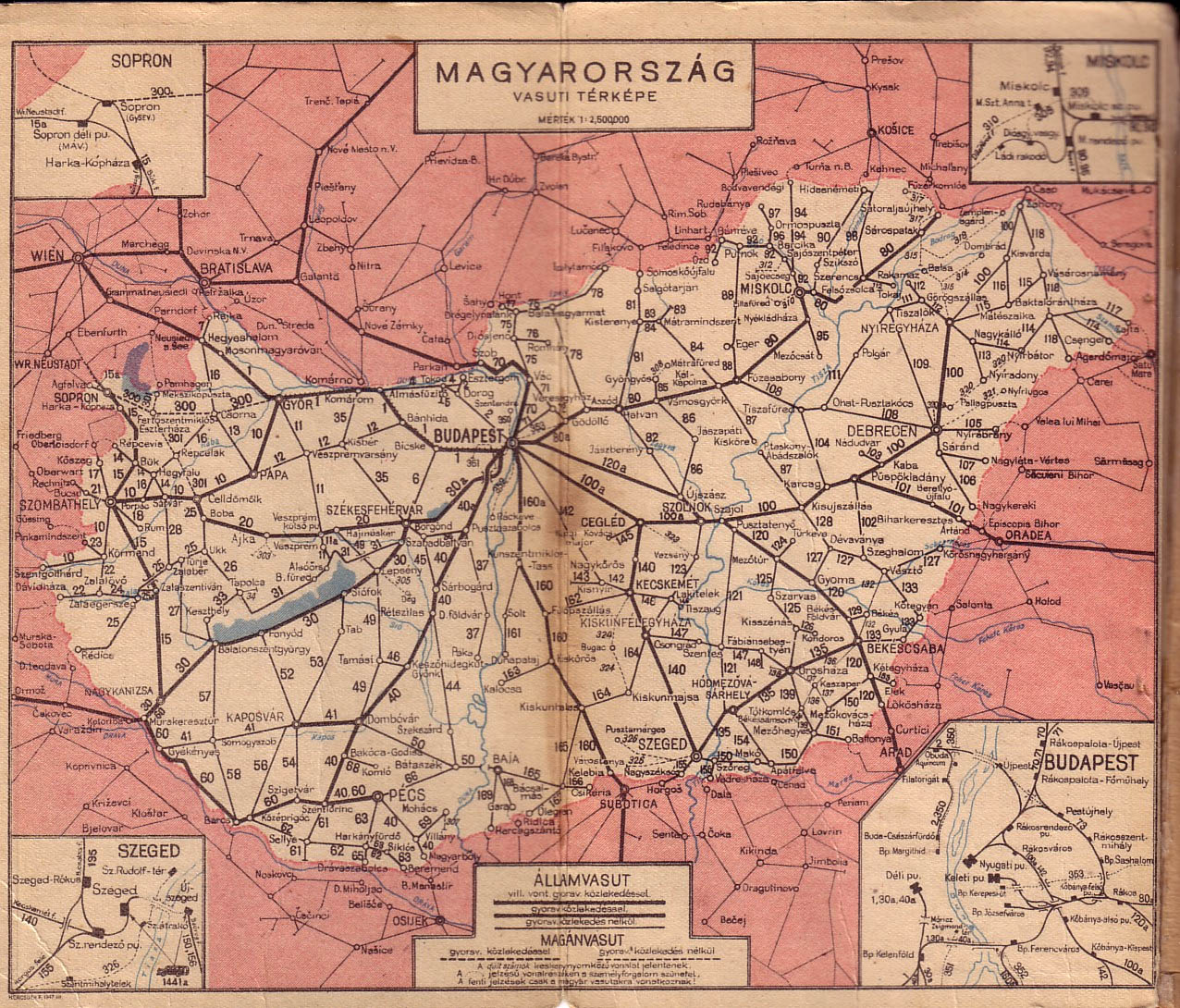
The Hungarian soldiers commanded by the Germans to the defense of the Reich west of Hungary, and there captured by the Red Army, were transported to the Soviet Gulag on two routes in the summer of 1945. The first led through Debrecen to the collecting camp of Máramarossziget/Sighetu Marmației, and from there by train to Kiev. The other through Arad to the collecting camp of Focșani, and from there through Constanța to Odessa by boat. The “sender” of the above letters, Pál Karasz from Orosháza was brought along the latter route.

The four letters which survived from the ones thrown out from the cattle car and entrusted to the solidarity of the fellow compatriots were written from 8 to 11 August 1945 in Budapest, Szolnok, Mezőtúr and Kétegyháza (marked in red on the contemporary railway map below). This road is now two hours by train. Then it was nearly four days. And then four times more followed to Focșani, where the prisoners could first get out of the crowded cattle car. I mean, the ones who survived the long voyage.

The solidarity post worked surprisingly well in the occupied and devastated country. From the six letters written until Kétegyháza, four ones reached the addressee. The route of the one written in Budapest is uncertain, but the one of Szolnok was forwarded by an inhabitant of Karcag (marked in blue), and the two other were posted by locals, accompanied with their sympathetic letters, to Mrs. Karasz in Orosháza (marked in green). To the prisoner, as he writes, it was especially painful that the train passed near his home, and he could not even look out of the wagon.

The train followed the same way as the hero of Pál Závada’s best-selling novel Yadviga’s Pillow (1997), Márton Osztatní, who was captured in Brno. He also “wrote tiny letters”, he was also from Békés county, he was also carried near his home to Focșani through Budapest, Szolnok and Mezőtúr. He also arrived there on 10 August. But he never reached Kétegyháza.

“[1945] July 17. We sleep squatting through the night. The toalet is a conic stovepipe across the floor. It’s dark and stuffy hot. I’m learning Russian, I have a Russian dictionary and grammar. I don’t follow the days. We have been traveling for five or six days, I don’t know. I press my mouth on the door fissure to get some fresh air. The food is constantly corn, sometimes cracked, bran, salted fish, suchar, that is, rock hard dried bread. Dysentery is spreading, First me, then Lieutenant Sárközi became commanders of the toalet. We let the people come three times a day, but it did not work. Many people had to come at night. Finally, there was no half hour without someone suffering. Two of the four windows of the wagon are nailed. A stench that puts to shame a ferret farm. I start my last notebook page, but only if we stand. I mostly think about my poor son, little Jancsika. Outside, the hottest summer heat. Some are fainting. Several weeks without a bath; beards, and distant, deranged glances, skinny, half-nude bodies. My God, at least we should not look at each other! I think my friend Bandi got crazy. Crying, loud praying. Some are talking in their sleep and are at home. The border! The thousand-year-old Hungarian border! We start writing tiny letters, and we throw them out when we see civilians. Some frightening news. We are not going home, but to Focșani, Romania! Then good bye, civilian life! First Romania, then Russia – slow death. They do not accept us at the frontier. Are we so vile villains? Had I not gone out because it was ordered? In our wagon, some 30-35 persons suffer from dysentery, including me. One is almost dying. We have already traveled some 20 days. Szolnok, Szajol, Mezőtúr. Oh, familiar countryside! I feel that I have no force any more. We are constantly lying. There is no more place.

And finally this was the last note of my Mother, Mrs. András Osztatní, née Mária Jadviga Palkovits: Yesterday, on August 10, 1945 I received the news, of which no more terrible can be received by a mother. My beloved son Marci died. And on the train, when he was the nearest to me! My God, how could you allow it? And how could I allow him to go to the war? I should have had to forbid it, I should have had to hide him or bring him out of the hell on my two arms. I was not where I should have been, I did not do what I should have done. We immediately run with Misu to see him. And I saw him. But I cannot describe it. I should have perished instead of him!”


Mrs. Pál Karasz preserved until her death the letters of her husband thrown out of the cattle car, along with the cover letters of the goodwill senders. From her estate they got to the collector János Fellner, who recently presented them in the Facebook group “Collectors of camp post cards”. Here we publish them with his permission.

“Here, along the trench…”


We have already written several times about the Great War here in río Wang. On various aspects of it, but always from a grassroots perspective. About the wartime children’s books, the child propaganda, the Székely soldier letters, the soldier’s songs sung on the two shores of Isonzo, the grateful Russian prisoners of war, the Galician Jews marching out to greet Archduke Frederick, and much else. From this perspective it has been examined also by the conference recently organized by our friends in Szeged. Unfortunately we could not be there in person, but at our request Norbert Glässer, the organizer of the conference, associate of the anthropology department of Szeged, and leader of The Ties research project sent us a report on the event.

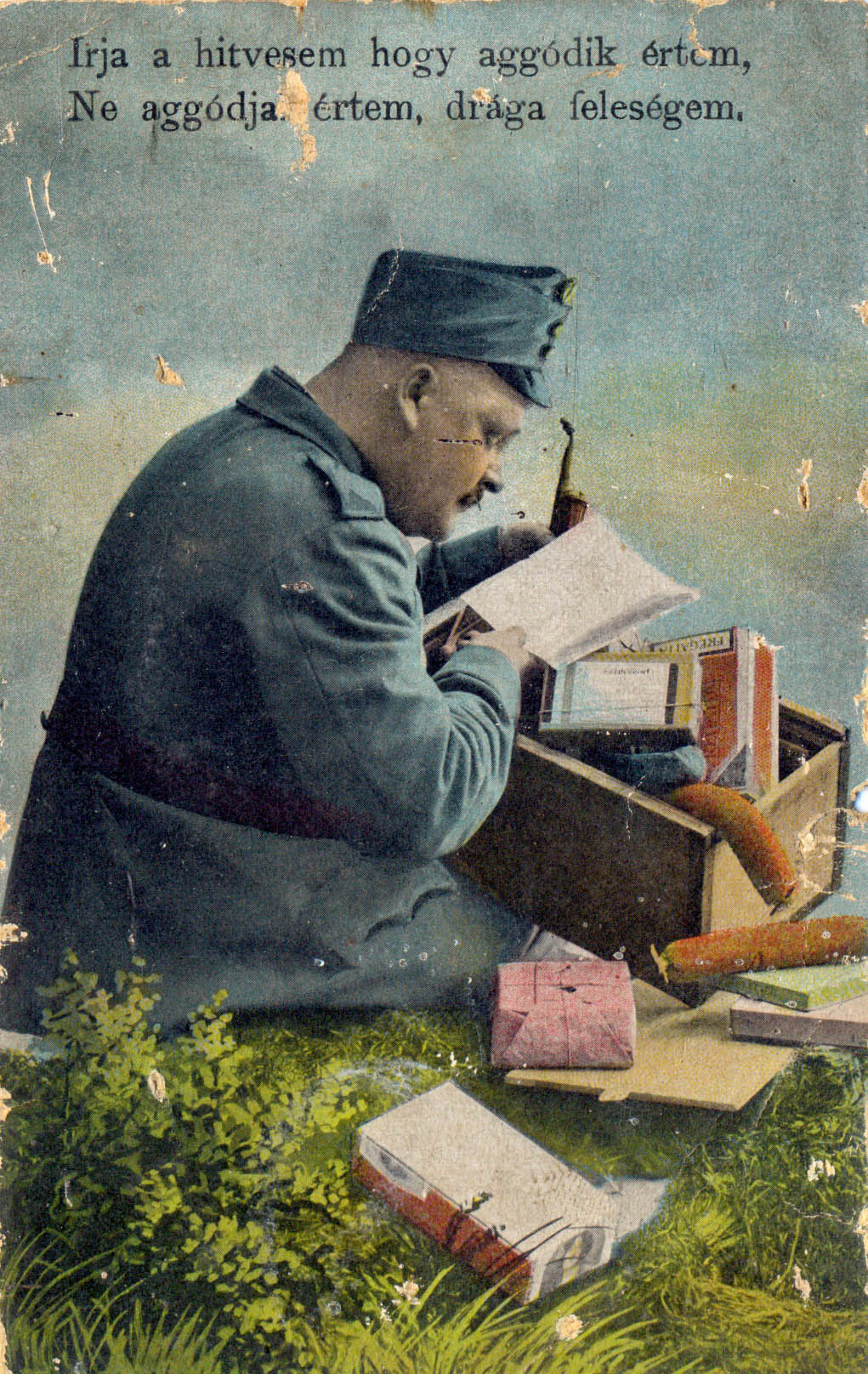
„My consort is writing that she’s worrying for me / Don’t worry for me, my dear wife”

The events of the First World War not only radically changed the European power relations and state boundaries, but they also had a considerable impact on everyday life, since it fundamentally transformed former networks and posed new challenges to the communities. On this they held a scientific conference entitled The impact of the Great War on the changes of everyday culture on 26 and 27 November 2015 in Szeged, organized by the Research Group of Religious Culture of the Hungarian Academy and of Szeged University, the Faculty of Ethnology and Cultural Anthropology of Szeged University, the Ethnographic Research Group of the Academic Committee of Szeged, and the Meritum Public Association of Culture and Education.

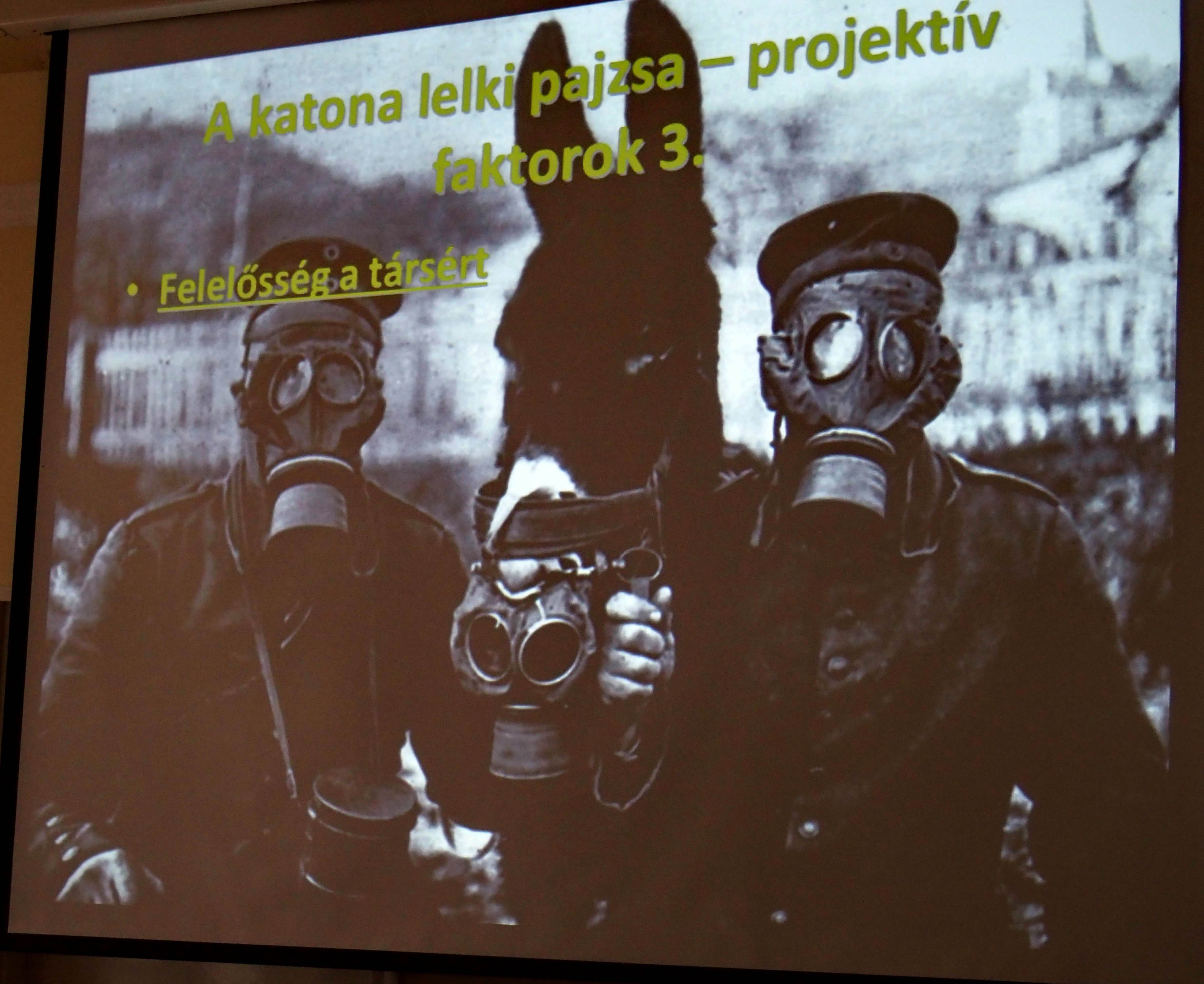
The conference speakers viewed the war as a transition, which amplified some processes of modernity, revealed new phenomena, or made new directions to changes. The war was also a crisis situation, which prompted the society to search new answers and models, and questioned models which had worked for several generations. The conference gave special attention to the perceptions of war of various groups, including religious confessions, and the intertwining of life’s turning points and religious contents with war situations.

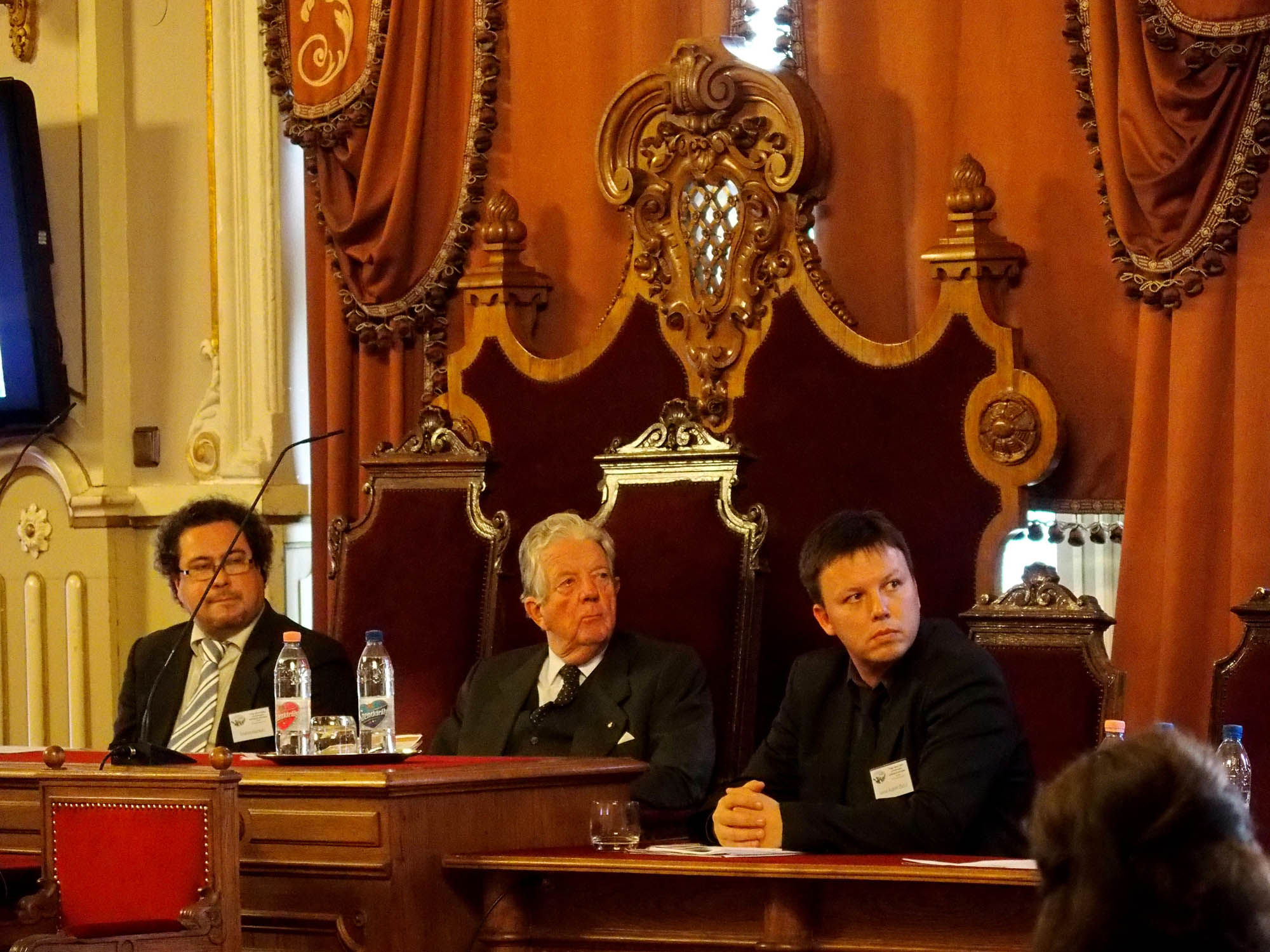
The event was held under the patronage of Michael von Habsburg-Lothringen, Ambassador Extraordinary and Plenipotentiary of the Sovereign Military Order of Malta, Chairman of the Cardinal Mindszenty Foundation. Archduke Joseph August von Habsburg-Lothringen, Commander of the 7th Corps, took part in the battles of Doberdo together with the 46th Infantry Battalion of Szeged. His grandson, Michael von Habsburg-Lothringen also remembered this in his opening speech in the ceremonial hall of the Town Hall of Szeged.


As part of the program, in the Corridor Gallery of the Department of Ethnology and Cultural Anthropology they opened the temporary exhibition “Here, along the trench…”, organized by László Mód from the postcard collection of József Szanka. The period postcards presented the relation system of the front and the hinterland, the fighting soldiers and their families waiting for them, the everyday life and feasts in wartime. Professor Gábor Barna, head of the Research Group of Religious Culture in his opening speech drew attention to the special postcards quoting the verses of the prayer Our Father, and embedding them in war situations. These travesties could also give force of motivation midst the trials of front life. The pictures showing the whole society, from the ruler to the family members, praying for the victory and the end of the war, set in a transcendental context the war events. This is clearly expressed in the picture of Jesus supporting Emperors William and Franz Joseph, but this is also the background of the representations of Jesus and Mary appearing in the battlefield. Due to their novelty, and the differences of the visual culture of the period from that of today, these images could have a significant influence on the contemporary viewers.

ww1szeged ww1szeged ww1szeged ww1szeged ww1szeged ww1szeged ww1szeged ww1szeged ww1szeged ww1szeged ww1szeged ww1szeged ww1szeged ww1szeged ww1szeged ww1szeged ww1szeged ww1szeged ww1szeged ww1szeged ww1szeged

Next conferences:
“Franz Joseph Malkenu”,
27. October 2016

“Take the crown…”,
23-24 November 2016
The speakers analyzed the issues of the First World War and literacy in the light of wartime letters, diaries and subsequent narratives, and presented the effects of the war on the hinterland within the framework of micro-historical case studies about military hospitals, the economic management of the front, captivity of war and reconstruction. They also examined the impact of the war on the organization of communities, such as the establishment of a new quarter in Szeged, the role of the “Tree of Doberdo” in the war memory of the inhabitants of the city, the influence of the war on the self-organization of associations and political groups. The thematic lectures of the conference included the changing female roles, the fate of the women who replaced the men fighting in the front, their replies to everyday challenges from female employment to the changes in cleaning.


The video recording on the opening of the conference and the plenary section can be seen here.

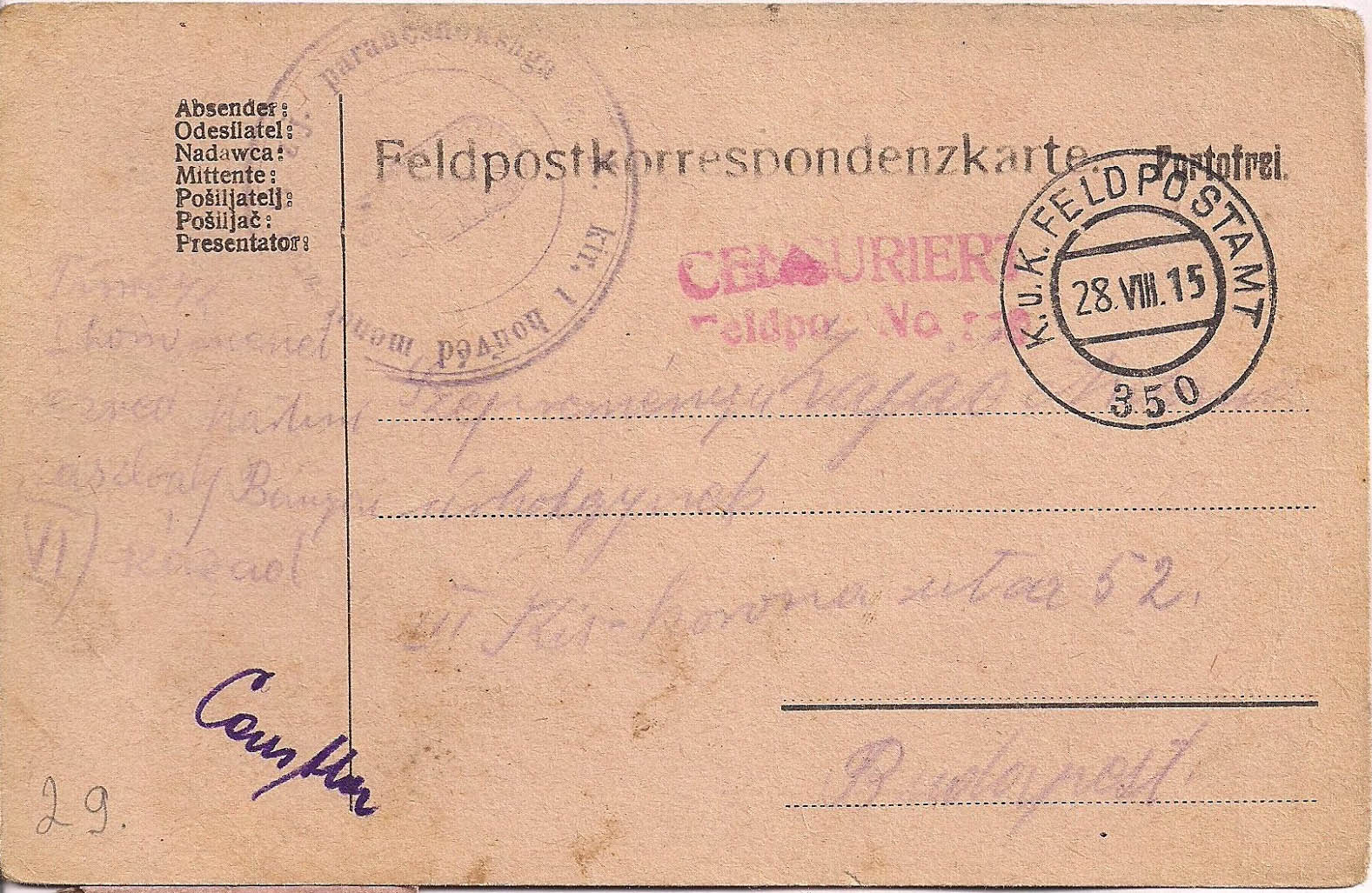
Pink postcards 28


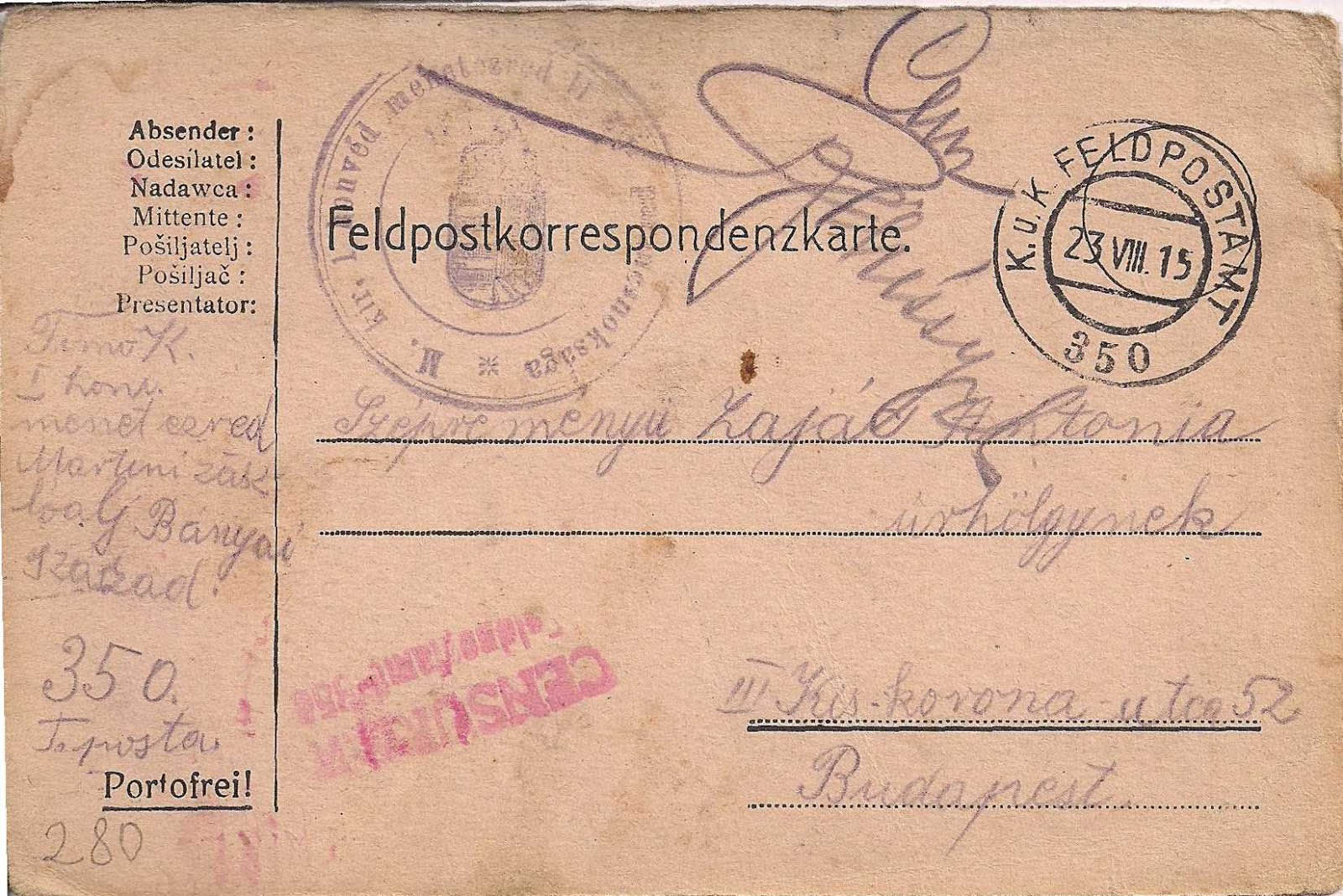
Absender:
Odesilatel:
Nadawca:
Mittente:
Pośiljatel:
Posiljać:
Presentatur:
K. Timó 1st
Marching Regiment
Martini Battalion
Bányay Company
Post 350

Feldpostkorrespondenzkarte

To the honored Miss Antonia Zajác
3rd district, Kis-Korona Street 52.
Budapest


Previous letters (gray dots):

Galicia, 22 August 1915
Galicia, 6 August 1915
Galicia, 2 August 1915
Galicia, 25 July 1915
Galicia, 14 July 1915
Galicia, 12 July 1915
Galicia, 6 July 1915
Galicia, 25 June 1915
Galicia, 10 June 1915
Debrecen, 5 June 1915
Budapest, 1 June 1915
Budapest, 1 March 1915
Budapest, 10 February 1915
Kecskemét, 30 January 1915
Dukla Pass, 11 January 1915
Felsőhunkóc, 4 January 1915
Sztropkó, 31 December 1914
Budapest, 23 December 1914
Budapest, 21 December 1914
Budapest, 11 December 1914
Budapest, 2 December 1914
Budapest, 28 November 1914
Budapest, 27 November 1914
Budapest, 18 November 1914
Budapest, 27 October 1914
Debrecen, 25 September 1914
Szerencs, 28 August 1914
My dear MomOn 27 August

I have received the cards you sent me on the 29th. I was very much looking forward to it. I don’t understand what you write that only at home they received a card from me, when I always send my postcards in pairs. And it would not be bad if you wrote more frequently, because from here I am allowed to write only that I feel well, but you can write more.

Buy The Evening of 22 August, from there you can learn more about what we are doing here (from the article of Ferenc Molnár, he was here at us).

I have seen cherries and peppers, but I have not eaten of them. Let us leave them for better times.

I thin I will have no more winter here. It was enough in the past.


Many hugs and kisses from your Károly


[The curious posterity can get some idea of the life of the soldiers on the front line, even if indirectly, because censorship works perfectly.

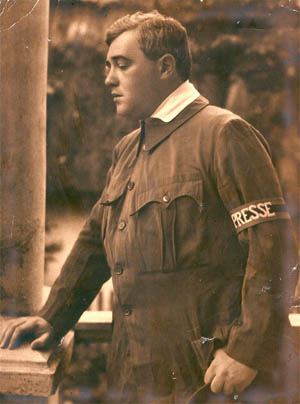
It appears from the letter, that the part of the front line where Károly served, was visited by war correspondent Ferenc Molnár, the reputable journalist and novelist, who would later make a career in the United States. He shared his experiences with the readers of Az Est (“The Evening”).

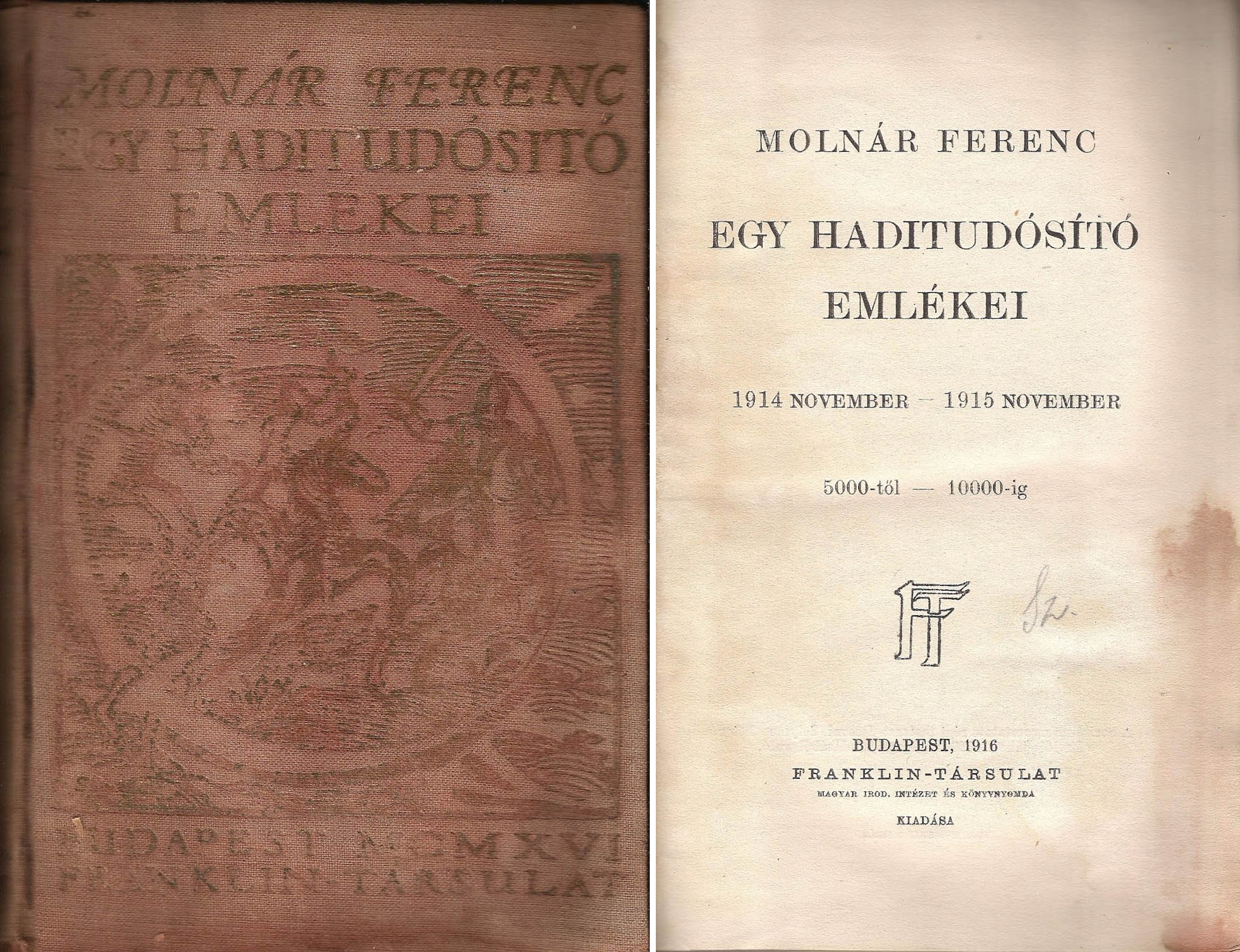
He published his collected reports as early as in 1916 with Franklin Társulat, entitled Memories of a war correspondent. Strike the iron while it is hot!

Ferenc Molnár as a war correspondent (Hungarian National Library / Department of Theater History, KB 838/1964)


One can easily find the written record of his visit paid to Károly’s trench, from page 411:

“AT ZLOTA-LIPA

Panowice, August

I spent the morning in the positions of the 1st Infantry Regiment of Budapest. As you have almost expected: they have established a veritable city partk in the forest, with stands and swings, they built a stylish villa for their commander, and a cabaret stage for themselves. The buildings and labels are full of ideas. There is a soldiers’ promenade, a choral society, they wrote a couplet “Venetian Nights”, programs distributed in several copies; arts and crafts, statues carved from white limestone, superb sticks clipped from young pine, mouthpieces, they have poems, songs and “Phone Newsletter” (on silent evenings they connect the phones of the trenches, they play violin, sing and recite poems), newspaper reading, promenade (with a sign “it is strictly forbidden to step on the grass”), Gypsy musicians and acrobats – Pest remains Pest even here…

…The first commander of the young regiment was Colonel Zsigmond Csicsery, who was later commanded to another commission. Now Lieutenant Colonel Ferenc Frauendorfer is their commander-in-chief, Captains Tauffer, Martini and Ghiczy the captains of battalions. The regiment is fighting a standing war. After hard and wild battles, the kids of Pest now show in the trench-war, what they are capable of…”

The place and the persons can be perfectly identified. The writer visited the 1st Infantry Battalion of Budapest, and he mentions a name which always figures in the address of the sender of the pink postcards: Battalion Commander Martini.

The wartime censorship obviously severely filtered the information, and suggested the description of an intentionally idyllic picture to the correspondent, who reassured the anxious families with it. Perhaps also the members of the Timó and Zajácz families who remained at home, if they ever read Az Est.

However, Ferenc Molnár finds a way to play out the rigors of censorship, and to show in a few lines the reality of the war:

“…I never wrote letters on paper as hopelessly as now. You cannot describe the war for those at home. Whoever is here, understand each other without speaking… The twenty-year-old disease of the will to write torments me here with such a heat, that I must forget all prudence, and just write, write to home – shouting through miles, over the mountains, from Galicia, that the center of the world is not at home, but here, in this dirt and dust, between the trenches and wooden crosses, where the pike-gray kids look out with hope from the holes of the earth…”]

Pink postcards 27


Absender:
Odesilatel:
Nadawca:
Mittente:
Pośiljatel:
Posiljać:
Presentatur:
K. Timó 1st
Marching Regiment
Martini Battalion
Bányay Company
Post 350

Feldpostkorrespondenzkarte

To the honored Miss Antonia Zajác
3rd district, Kis-Korona Street 52.
Budapest


Previous letters (gray dots):

Galicia, 6 August 1915
Galicia, 2 August 1915
Galicia, 25 July 1915
Galicia, 14 July 1915
Galicia, 12 July 1915
Galicia, 6 July 1915
Galicia, 25 June 1915
Galicia, 10 June 1915
Debrecen, 5 June 1915
Budapest, 1 June 1915
Budapest, 1 March 1915
Budapest, 10 February 1915
Kecskemét, 30 January 1915
Dukla Pass, 11 January 1915
Felsőhunkóc, 4 January 1915
Sztropkó, 31 December 1914
Budapest, 23 December 1914
Budapest, 21 December 1914
Budapest, 11 December 1914
Budapest, 2 December 1914
Budapest, 28 November 1914
Budapest, 27 November 1914
Budapest, 18 November 1914
Budapest, 27 October 1914
Debrecen, 25 September 1914
Szerencs, 28 August 1914
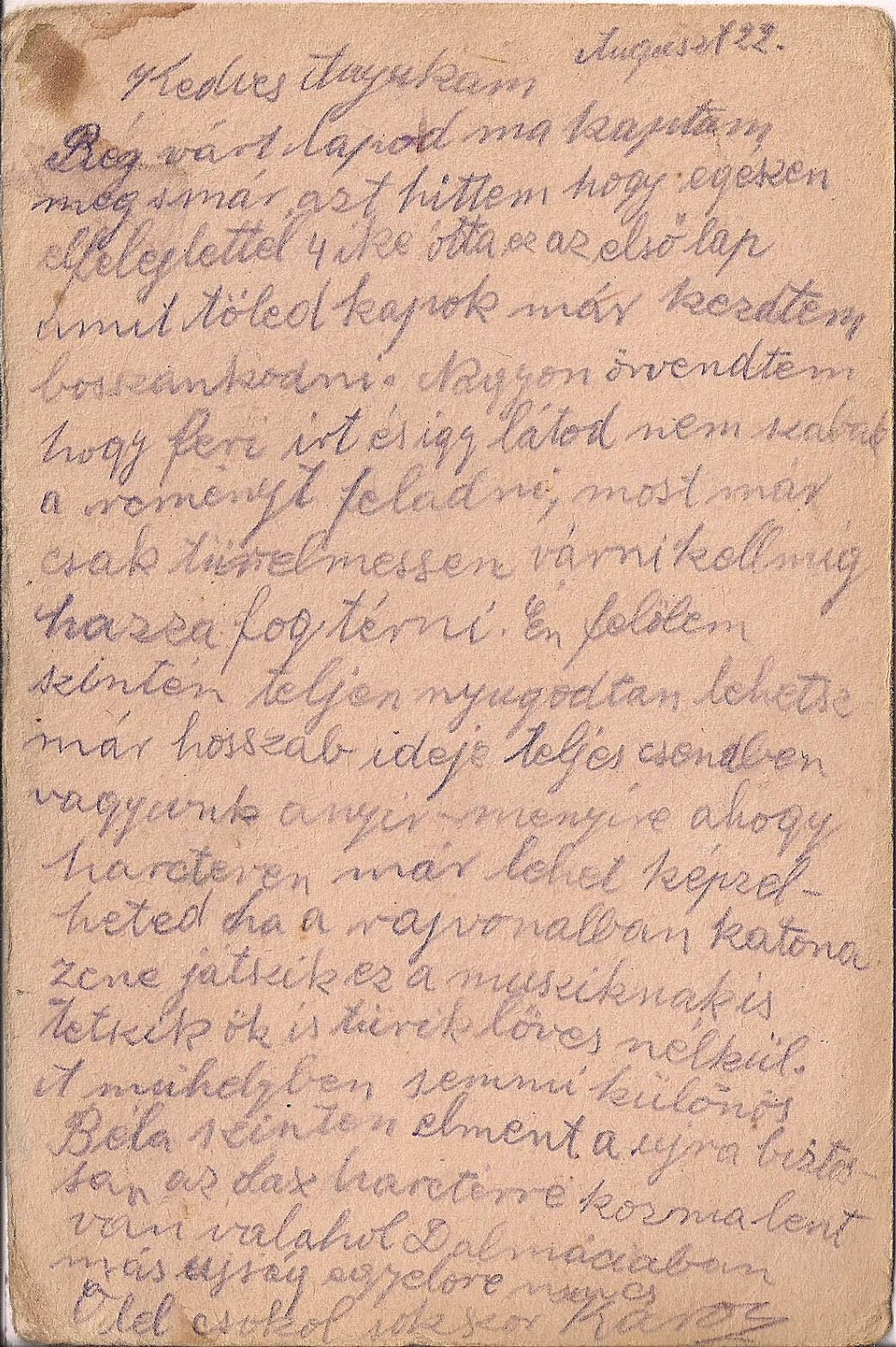
My dear momAugust 22.

Today I received your long-awaited postcard. I had thought you completely forgot about me. Since the 4th, this is the first card from you. I was starting to get annoyed. I was very happy that Feri had written, so you see, one must not give up hope. Now you only have to patiently wait until he comes home. As to me, you can be completely calm. We have been in peace for a longer time, so far as one can be in the battle field.

You can imagine, if martial music is playing in the front! The Russians also like it, they also listen to it without shooting.

In the workplace, nothing special. Béla also went away again, certainly to the Italian battlefield. Kozma(novics) is down somewhere in Dalmacia.

There is currently no other news.

Many kisses and embraces from Károly


[The whereabouts and exact place of Károly Timó’s troops, apart from fighting somewhere in the Russian front, are completely unreadable from the field postcards. After a hundred years it is almost impossible to exactly trace how the regiments, battalions and sections swirled, sweeping along Infantryman Károly Timó. And even if we could identify the details, like the place where he was wounded in the winter, we cannot imagine what he and his comrades might have thought and felt there. His braid-maker colleagues from the workshop are scattered around all the fronts. They must be missing from the rapidly increasing market of black braids, cords and fringes.

Censorship works perfectly. Only the stamp of the field post office and the number 350 gives some hint to the modern researcher.

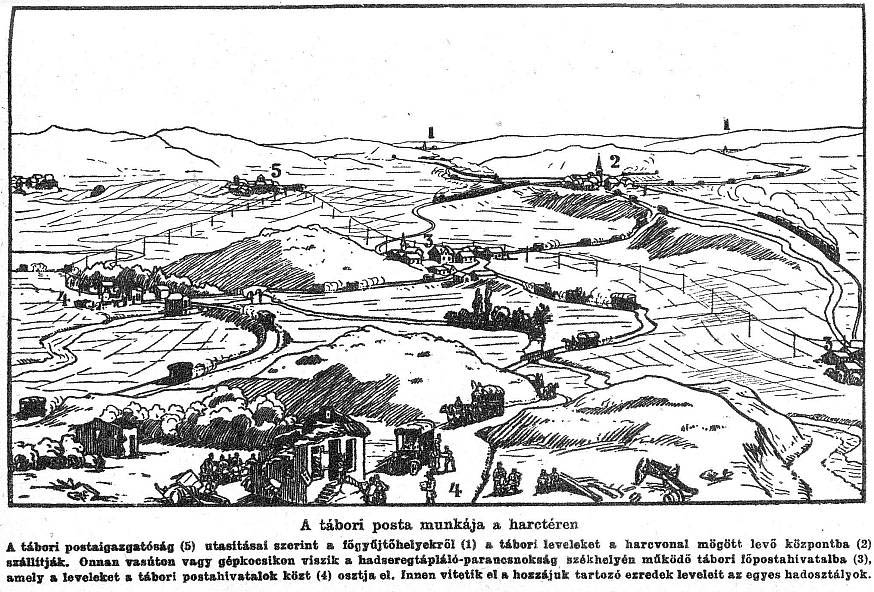
On the structure of field post offices there are several overviews on the internet.


My starting point was an English-language website of Austrian philatelists. It lists the names of the divisions, whose correspondence was forwarded by a field post of a certain number. Accordingly, Károly served in ID 55, that is, the 55th Infanterie-Division, whose commander-in-chief between October 1914 and October 1915 was General Marshall Ignaz Fleischmann. These data can be obtained in just a few clicks from the English-language database of the division commanders.

A few more clicks lead us to the most important source on the divisions. According to them, their military activities and major battles in August and September 1915 were the following.

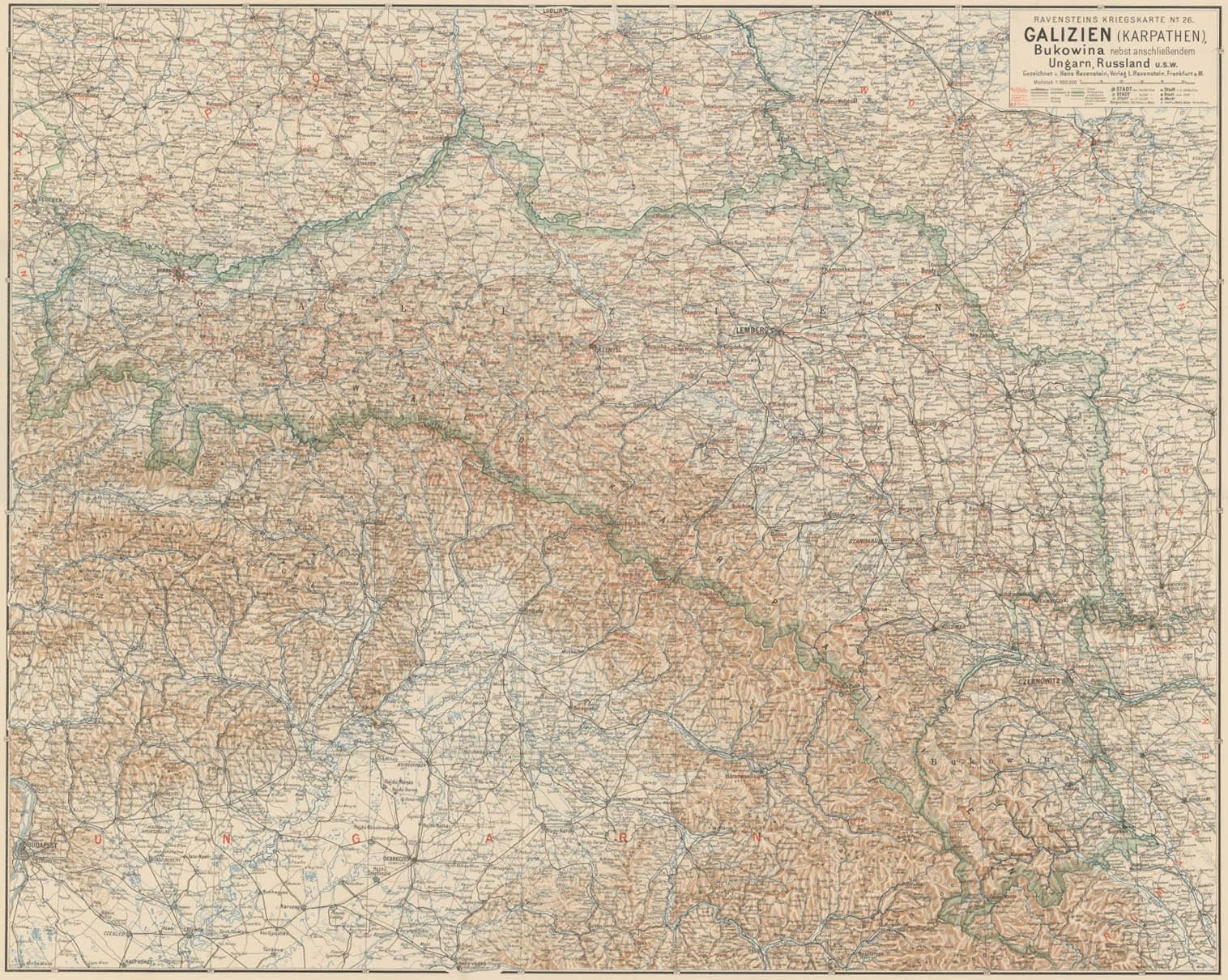
The offensive in Eastern Galicia was conducted between 26 August and 6 September, the battles along the Siret river between 6 and 12 September. The site maps.hungaricana.hu, published by the repeatedly cited Arcanum Kft., is a great help in following the Galician military events.


Then, in 13 and 14 September 1915, the Russians launch a counterattack in the region of Burkanow and Lutsk.]

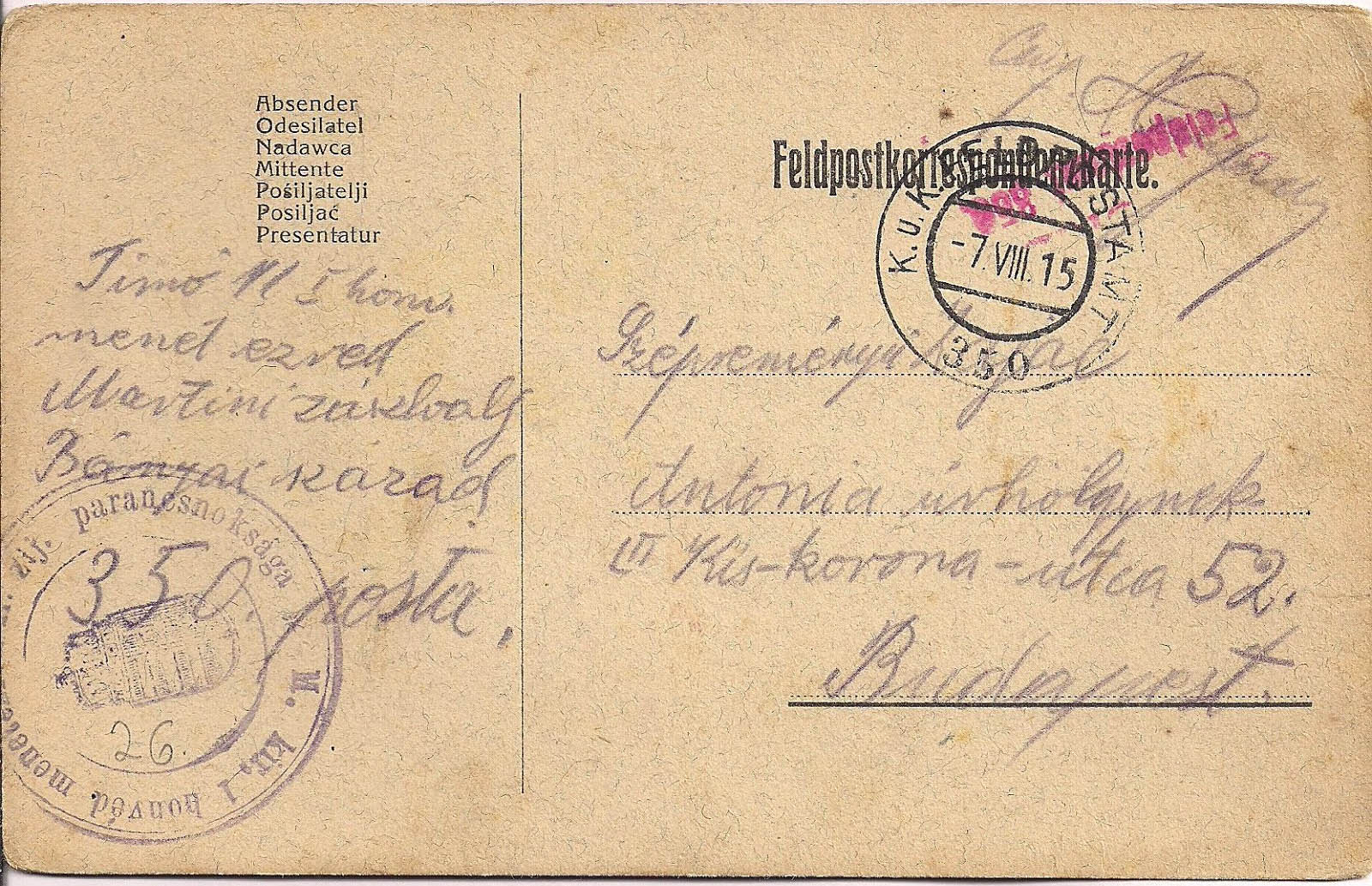
Pink postcards 26


Absender:
Odesilatel:
Nadawca:
Mittente:
Pośiljatel:
Posiljać:
Presentatur:
K. Timó 1st
Marching Regiment
Martini Battalion
Bányay Company
Post 350

Feldpostkorrespondenzkarte

To the honored Miss Antonia Zajác
3rd district, Kis-Korona Street 52.
Budapest


Previous letters (gray dots):

Galicia, 2 August 1915
Galicia, 25 July 1915
Galicia, 14 July 1915
Galicia, 12 July 1915
Galicia, 6 July 1915
Galicia, 25 June 1915
Galicia, 10 June 1915
Debrecen, 5 June 1915
Budapest, 1 June 1915
Budapest, 1 March 1915
Budapest, 10 February 1915
Kecskemét, 30 January 1915
Dukla Pass, 11 January 1915
Felsőhunkóc, 4 January 1915
Sztropkó, 31 December 1914
Budapest, 23 December 1914
Budapest, 21 December 1914
Budapest, 11 December 1914
Budapest, 2 December 1914
Budapest, 28 November 1914
Budapest, 27 November 1914
Budapest, 18 November 1914
Budapest, 27 October 1914
Debrecen, 25 September 1914
Szerencs, 28 August 1914
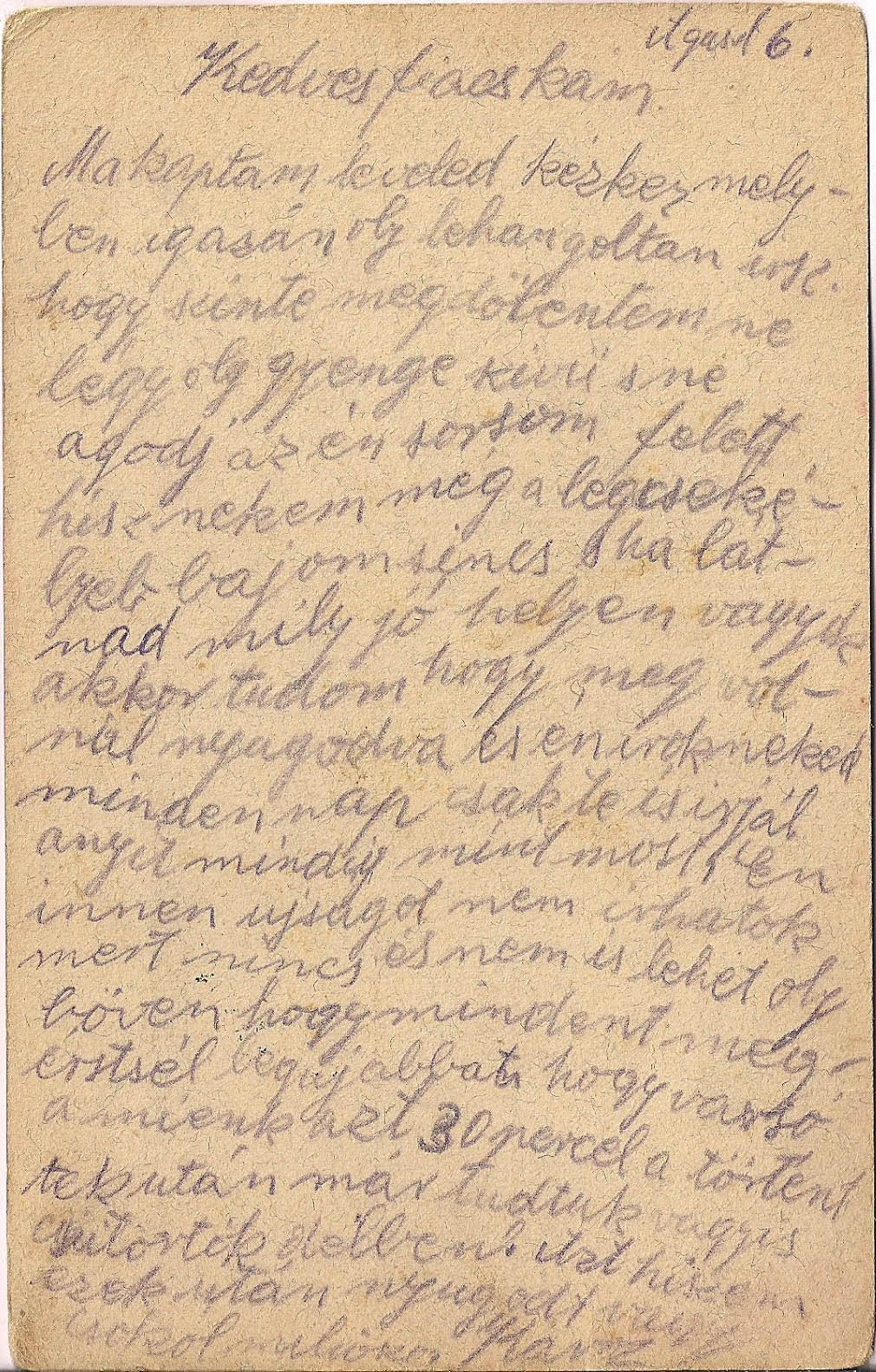
My dear son6 August

Today I received your letter, in which you write really so dejectedly that I was almost shocked. Don’t be so weak-hearted, and do not worry about my destiny, as I do not have the least problem. And if you saw what a good place I have, I know you would calm down. And I write every day, so please you also write always as much as now. I cannot write any news from here, because there is none, and I cannot write so amply that you would understand everything.

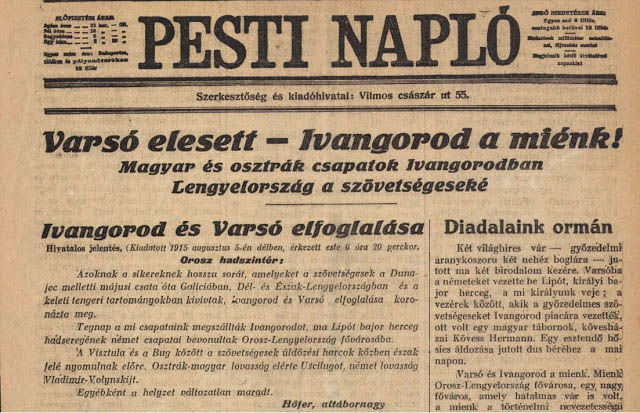
The latest news, that Warsaw is ours, we knew already thirty minutes after the events, that is, Thursday at noon.

I hope you are relaxed after this.

A million kisses, Károly


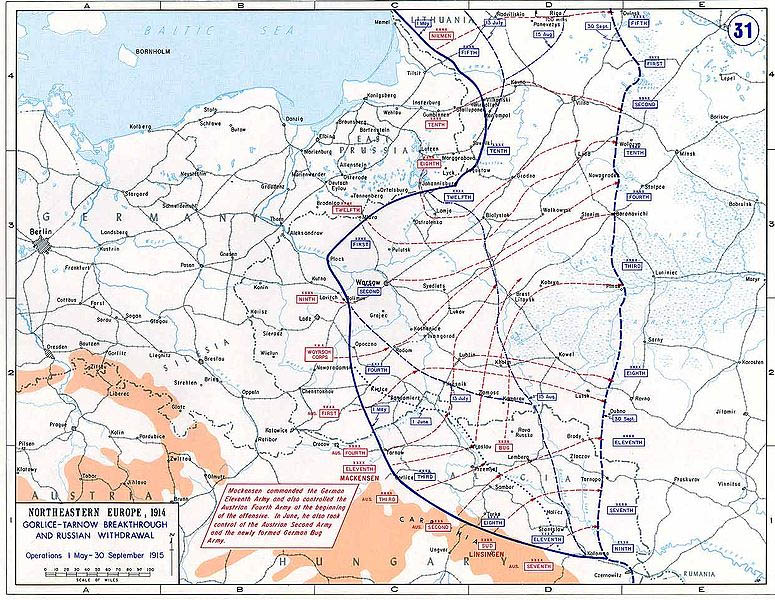
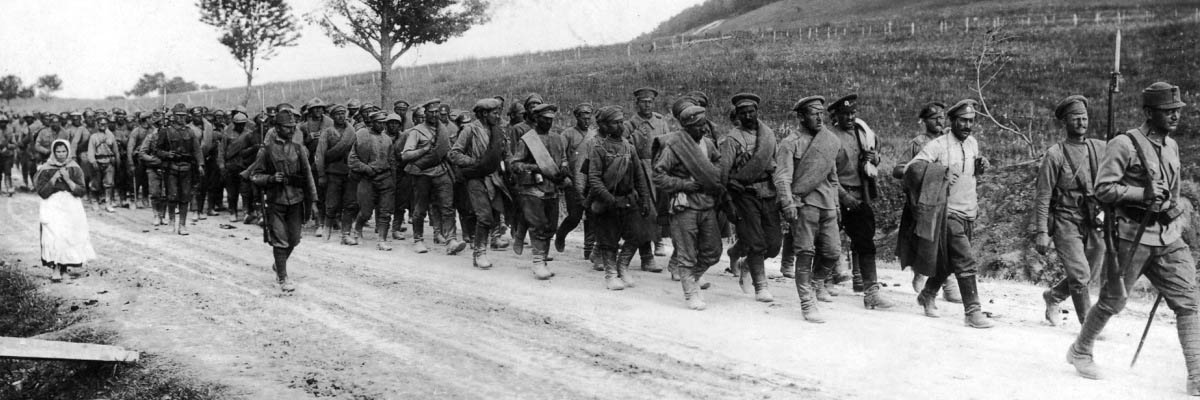
[The Central Powers realize their most successful campaigns in the Russian theater of war.

The Gorlice breakthrough has brought the strategically desirable result. The enemy forces have been squeezed out from almost the entire territory of Galicia.

Przemyśl and Lember were recaptured, and Ivangorod and Warsaw in the north were also captured. The occupation of Vilnius seemed to be a nearing reality.


It was at this time that the Höferiades might have approached the closest the reality of the events in the theaters of war.]

rl03 rl03 rl03 rl03 rl03 rl03

The Gorlice-Tarnów breakthrough, and the Russian retreat, August 1915


Next postcard: 8 August 1915