
Luck


Black men fighting in a tunnel. On Humboldt Forum’s new ethnographic exhibition
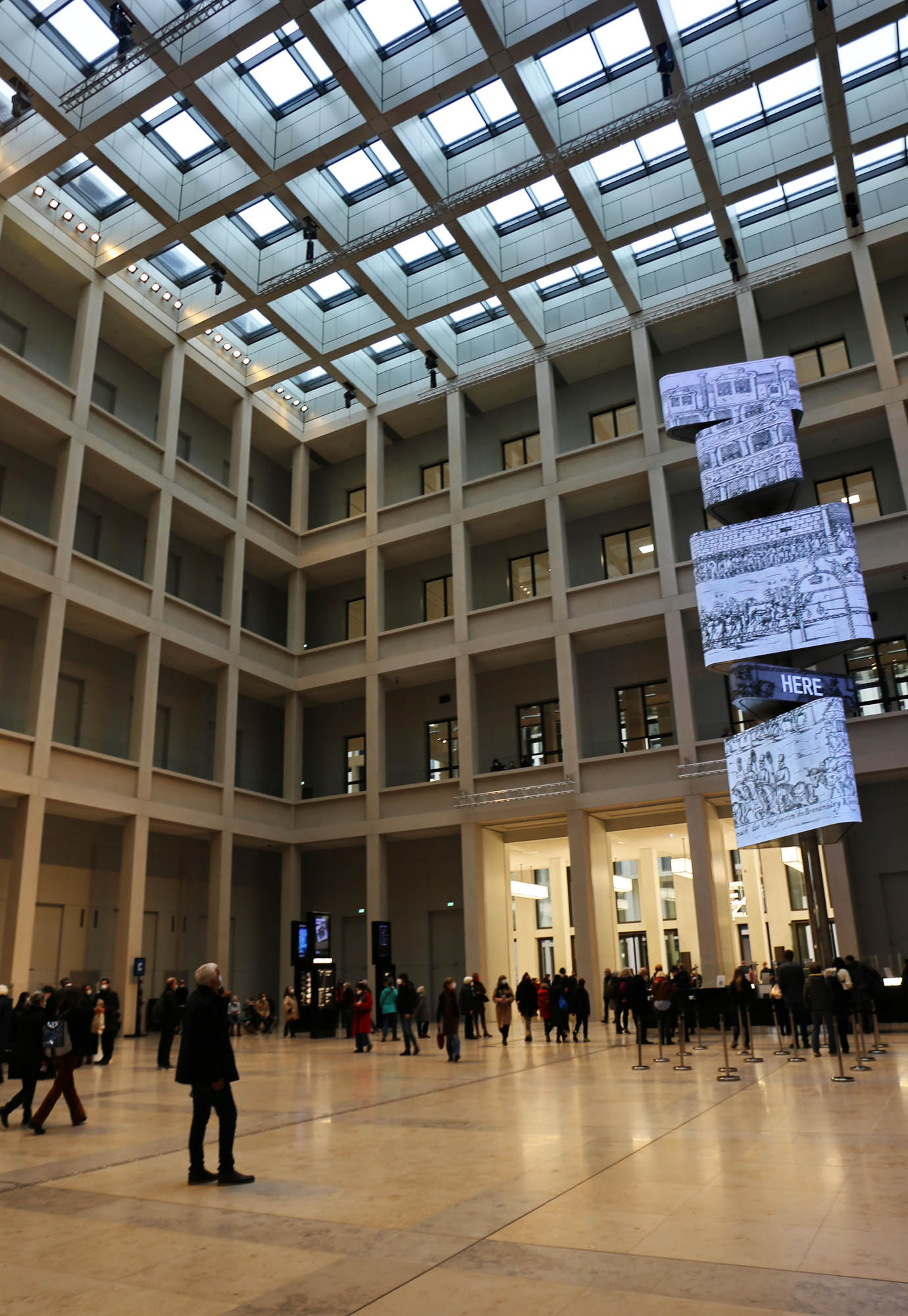

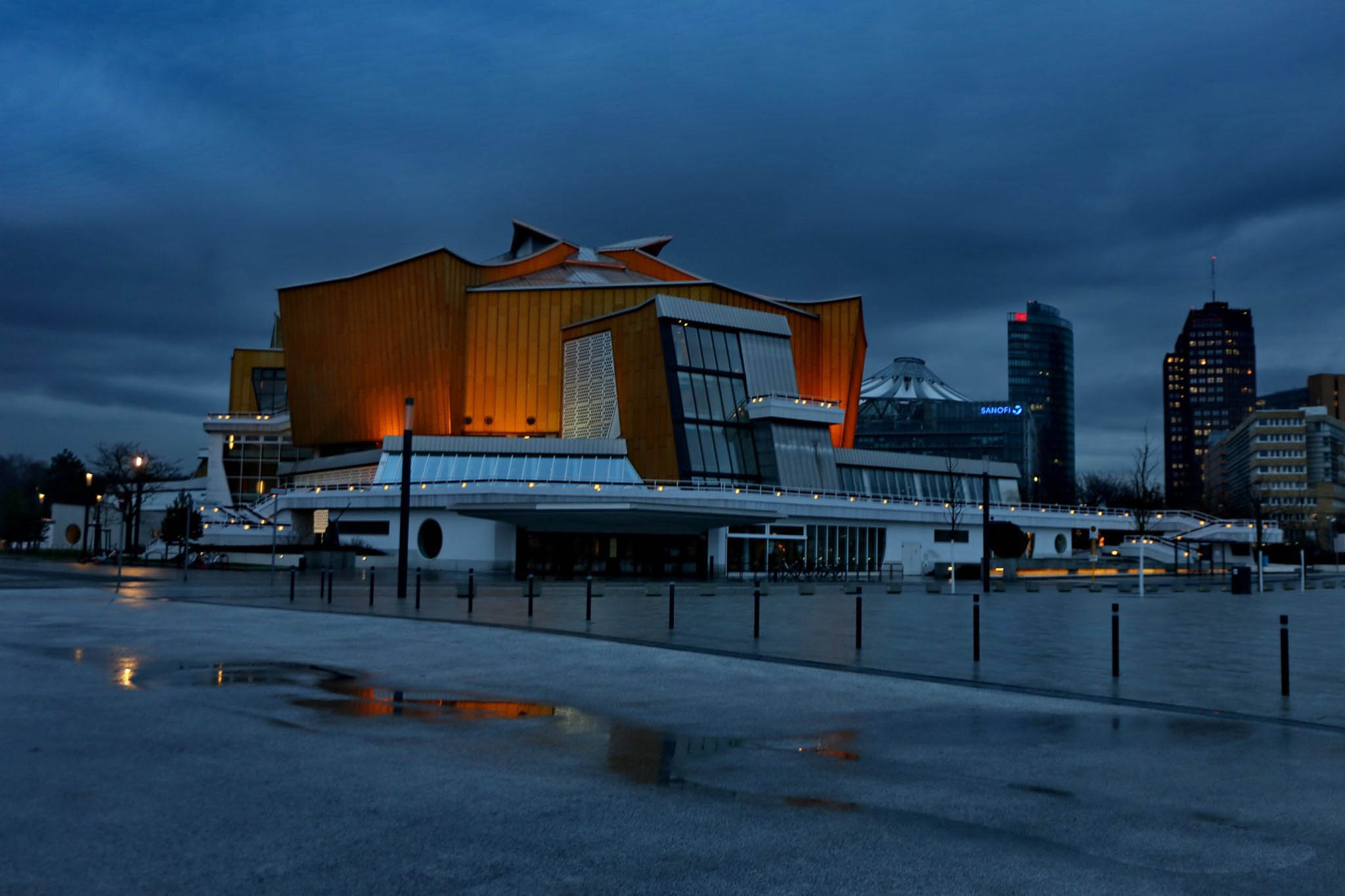
Well, this has come, too. After eight years of jackhammering and towering cranes, construction blinds and traffic diversions, pink pipes (for the debris) and blue pipes (for the water) winding through the heart of the city, the baroque royal palace finally rises in the middle of Berlin for the second time. Not as beautifully carried out, with the meticulous care of the old masters, as the first one, but rather roughened up a bit, like “so umgefähr, on the basis of this you can already imagine what the original might have been like”. And of course this all just the exterior facades, because inside it’s all modern, like a mediocre mall. The master apparently came from this scene, he had a feel for it. Franco Stella, of Venice, is almost eighty years old, but he has not had a really significant building yet. Maybe he accepted this job in 2008 because it was a real wasp nest, poked by only a few. Rebuilding a completely destroyed historic building out of nothing (the palace was bombed in WWII, and rather than restore it, the remains were instead cleared away by the new East German leadership, who built the GDR’s asbestos concrete parliament in its place), moreover in a place historically and ideologically so sensitive: the whole process of design and construction was accompanied by much debate and criticism. The opening of Europe’s most expensive cultural project was delayed from 2019 to 2021, but that is nothing compared to the fact that Europe’s most expensive airport, in the same city, is almost ten years late, or that no German trains or S-Bahns run on time.

The Humboldt Forum, as the new palace is called, was intended to be a museum of non-European cultures, “the German equivalent of the British Museum”, as touted in the German press. Its collections – the Ethnographic Museum and the Museum of Asian Art – had been housed in the Dahlem Museum up until 2015, when they started the process of moving them. Since then, I have been missing this excellent museum painfully; to it I dedicated one of the first posts of this blog. Now I go to see how the new museum outperforms its predecessor, already world-class, and how the larger space and state-of-the-art museum technology will enrich the exhibition of the objects.
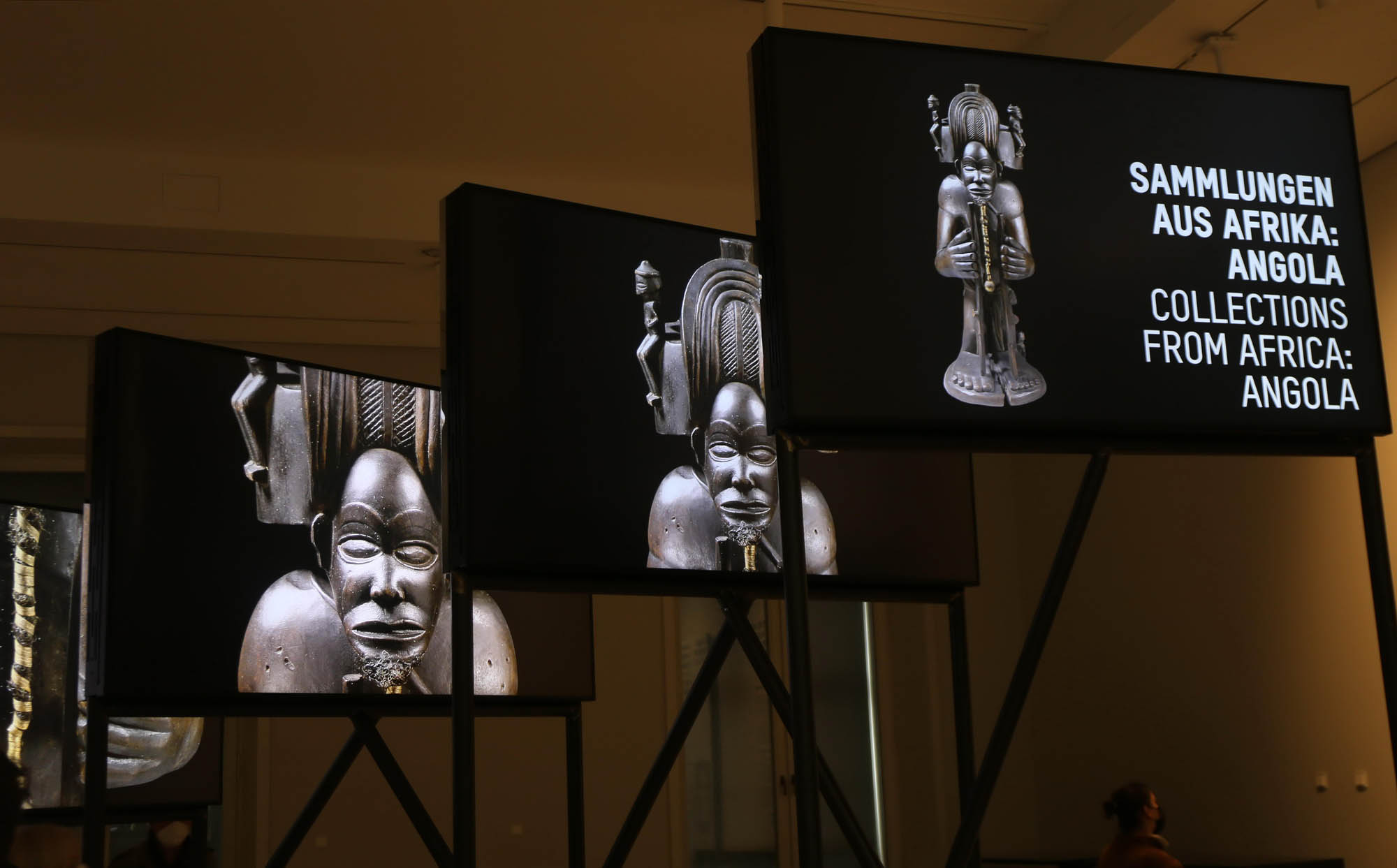
The placement of the collections is still going on. So far, two sections have opened, representing Africa-Oceania and Asia. The latter has been really given a boost by its new home: many more objects are on exhibit now, and the cultures and their contexts are better visualized. I want to write about these separately. But the first impression, the African exhibition, is depressing. It’s as if we were in a completely different museum from the Asian section: everything is more amateurish, from the organization through the exhibition to the labeling.
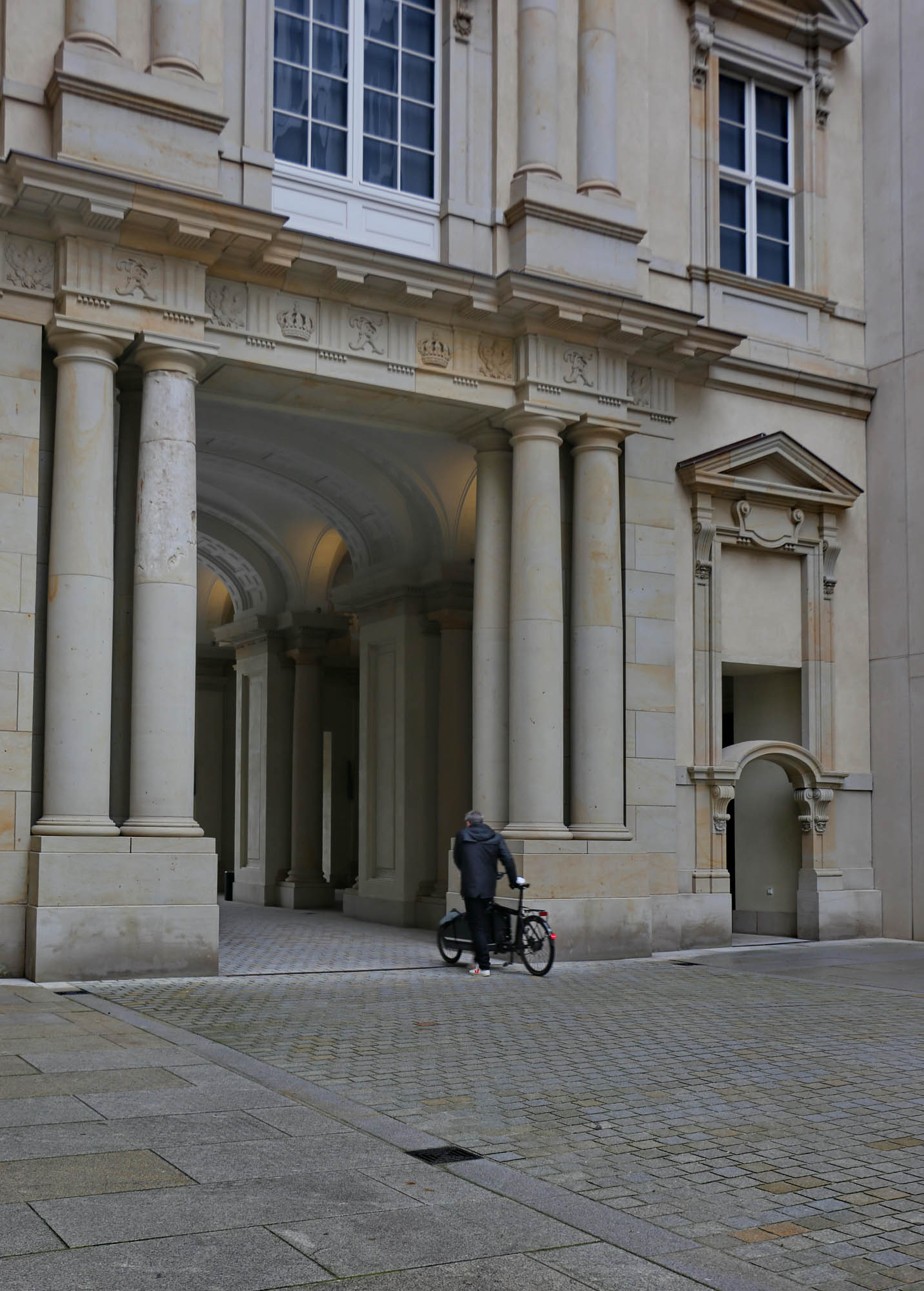
In the old Dahlem Museum, one of the great master strokes was the lighting. They were among the first museums to adopt individual spot lighting of each object in a dimly lit room, which made the objects stand out in their uniqueness and plasticity, lending them a radiance, an aura, even. In the Humboldt, this form of presentation persists in the Asian section. But in the Africa-Oceania section, the background of the displays is dark (Why, when the vast majority of the objects is also dark?), and harsh spotlights are trained on them from the wrong side of the glass. Thus, the whole display glass reflects the room, the window glare and the reflections of the visitors, and you can hardly see anything of the objects themselves in the midst of a laser storm of hundreds of spot lights. The reason you cannot see much of this in the photos below is that I tried to shoot the less exposed pieces and retouched the photos in many places. The overall impression is better conveyed by this painting by the Polynesian Greg Semu, Self-portrait with Twelve Disciples or: The last Cannibal Supper, Because Tomorrow We Become Christians, although I have also retouched this photo.

Maybe it is not bad that we se so little of the objects, because otherwise we would start to wonder about the identity of each one. However, the concept of the exhibition is not to fiddle with single objects. In the huge central hall of the African collection, objects are exhibited in bulk in the three wall displays, like in a colonial souvenir shop, without labels, with only a few illegible dog tags linked on the feet of some of them. Unbelievable, but true. I remember that the Bradt Guide Ukraine wrote in the 1990s about the Museum of Atheism in Lemberg/Lviv (which has since been renamed the Museum of Religion, with the actual collection unchanged), that its exhibition – the furnishings of many closed-down churches and synagogues was simply dumped there – is like a provincial junkshop. The Lemberg express has now reached Berlin. I can only hope this is a temporary state; that as most of the rooms in the floor plan of the African section are still closed due to the process of moving in and arranging the pieces, so they will later dedicate some attention and care to those rooms already open, and we will then find out where the otherwise high-quality African artefacts came from, what they mean and what purpose they served.

However, our hopes wither in the already more attentively arranged smaller rooms, where the objects have their labels. In fact, these rooms seem to be arranged by two separate museologists. One has dealt with the individual objects and mostly provided thorough information about them, while the other was tasked with creating the general concept. Most of the objects originate in the pre-1920 German colonies in Africa and Oceania – their history is now experiencing a renaissance with numerous exhibitions, books, publications of personal photo collections and memoirs –, and so the second museologist considered it his job to focus on the colonial past. And, strangely, he used the same approach as a century ago, but turned it on its head. While the nostalgia exhibitions of the 1920s and 1930s primarily emphasized how much the white – Aryan – man gave to the blacks, the current exhibition focuses on the sins committed by the colonists, in the spirit of overall German guilt. I’m not saying that one should not confront the past, but at the same time, I am not visiting an exhibition about Africa to learn more about the bad German conscience. I am here to learn about the African cultures themselves. Sadly this is not the place for that. And, in the midst of the deeply felt guilt, this only serves as another kick to these already much-kicked cultures.
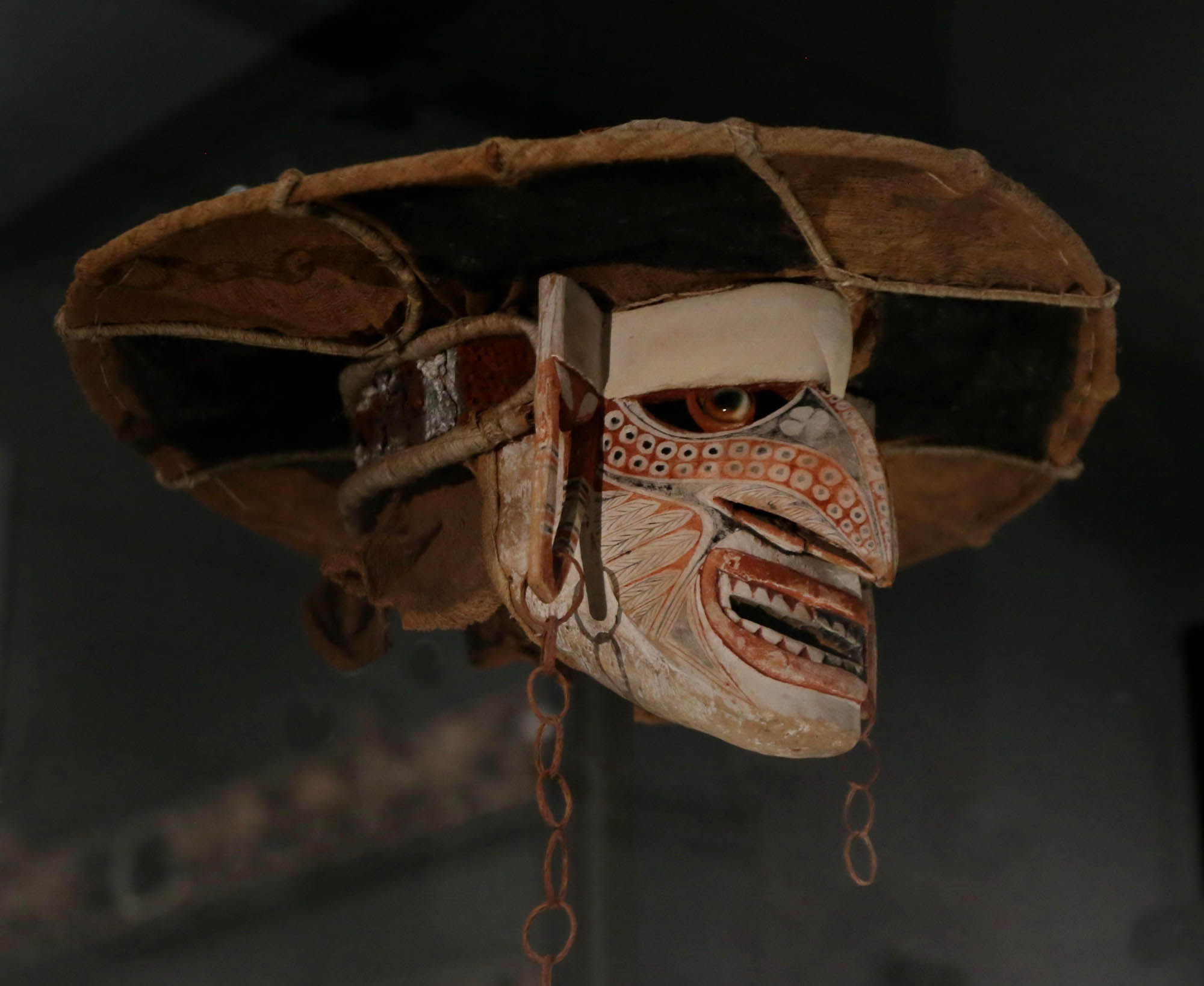 A mask representing a European man, 1880s, Papua New Guinea, the island of New Ireland (known in the period as Neumecklenburg)
In the Dahlem Museum I did not have this sense of lack. But if I had, I could well have restored my faith in a visit to the museum’s excellent bookstore, which was perhaps the best bookstore of ethnography and anthropology in all of Europe. The Humboldt’s souvenir shop – I would not call it a bookstore – is a deep disappointment in comparison to the Dahlem, or to any other museum. Mugs, puzzles, T-shirts, plush figures. Of books or catalogs, there are maybe a dozen. Whosoever needs such things, let them order them from Amazon. Of course not on the deplorable, third-world German internet, but rather by means of a trusty letter or stone tablet.
 Humboldt Shop, or guilt takes off its mask
Missing women
 the photo is from here |
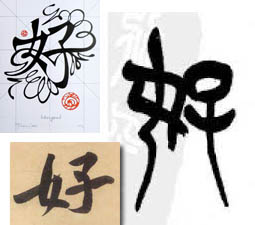
“How many letters are there in the Chinese alphabet?” The answer to this frequently asked question is not unambiguous. First of all, Chinese writing is not an alphabet, that is, it does not use letters, but rather word signs abstracted from images, the number of which is many times higher than even the richest alphabet. The largest Chinese dictionaries and the Chinese national character table count tens of thousands of characters – 48,000 in the 1992 edition –, but most of them are historical or obsolete term that cannot be said to be part of “the Chinese alphabet” anymore. Readers of fiction recognize an average of 3-4 thousand characters, and specialists some 5-6 thousand. The standard published in 2013 in mainland China contains 8,105 characters, of which one must be able to write virtually all.
However, this number is only two-thirds of the comprehensive character set of pre-war Chinese, and the vast majority of today’s characters does not even look like the ones used for millennia before.
In the rush of the fever of modernization that began in China around the turn of the century which intensified after the republican revolution of 1912, more and more intellectuals proclaimed that the complexity of Chinese writing was one of the biggest obstacles to the country’s development. Many wanted to switch to a Latin script – which, however, is almost imposible for writing Chinese –, or at least to reduce the number of characters or simplify their complex forms. Their opponents claimed that this would have brought on a fatal impoverishment of the rich historical heritage encoded in the characters.
Finally, the Chinese Communist Party – officially to promote literacy, but also to break with the past – introduced today’s simplified writing system in 1956. It simplified the form of many characters, and eliminated nearly one-third of them. This system is only official in mainland China, while Hong Kong, Taiwan and the old Chinese diasporas – in the USA, Britain or Indochina – still use the old characters.

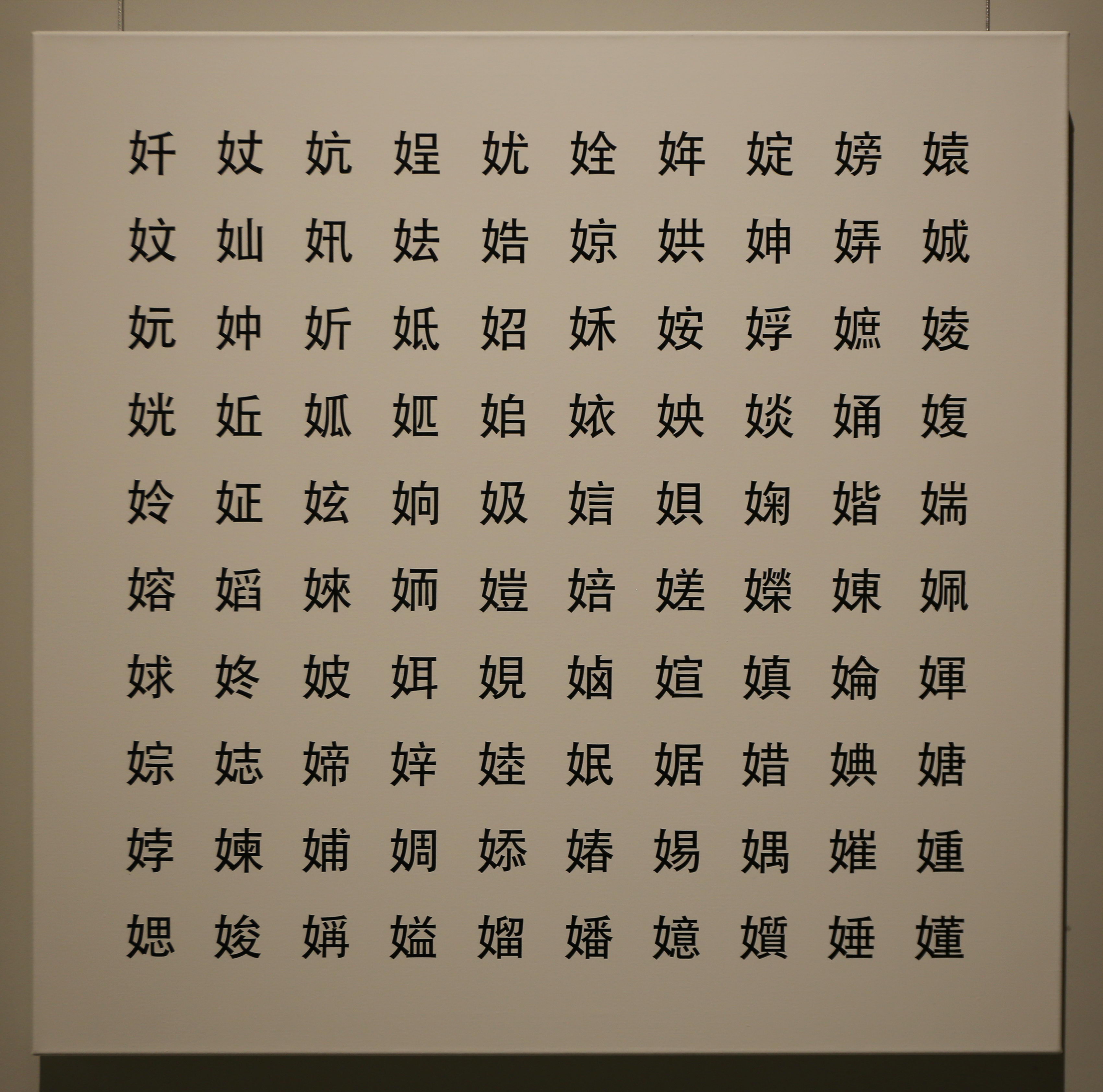
And speaking of women, it is well known how the combination of the “one child” policy and the pension system introduced by the Communist Party distorted China’s demographics. Since married couples can’t rely on their pensions, and with only their sons to support them in their old age, they obviously want the permitted “one child” to be male, because any girl would support her husband’s family. Therefore, since the sex of the unborn child can be determined in advance, a much higher proportion of female fetuses have been aborted than males. In mainland China, there were 117 men per 100 women in 2001, meaning that nearly 20% of men will not be able to find a wife back home because of the missing women.
Tigers in Berlin
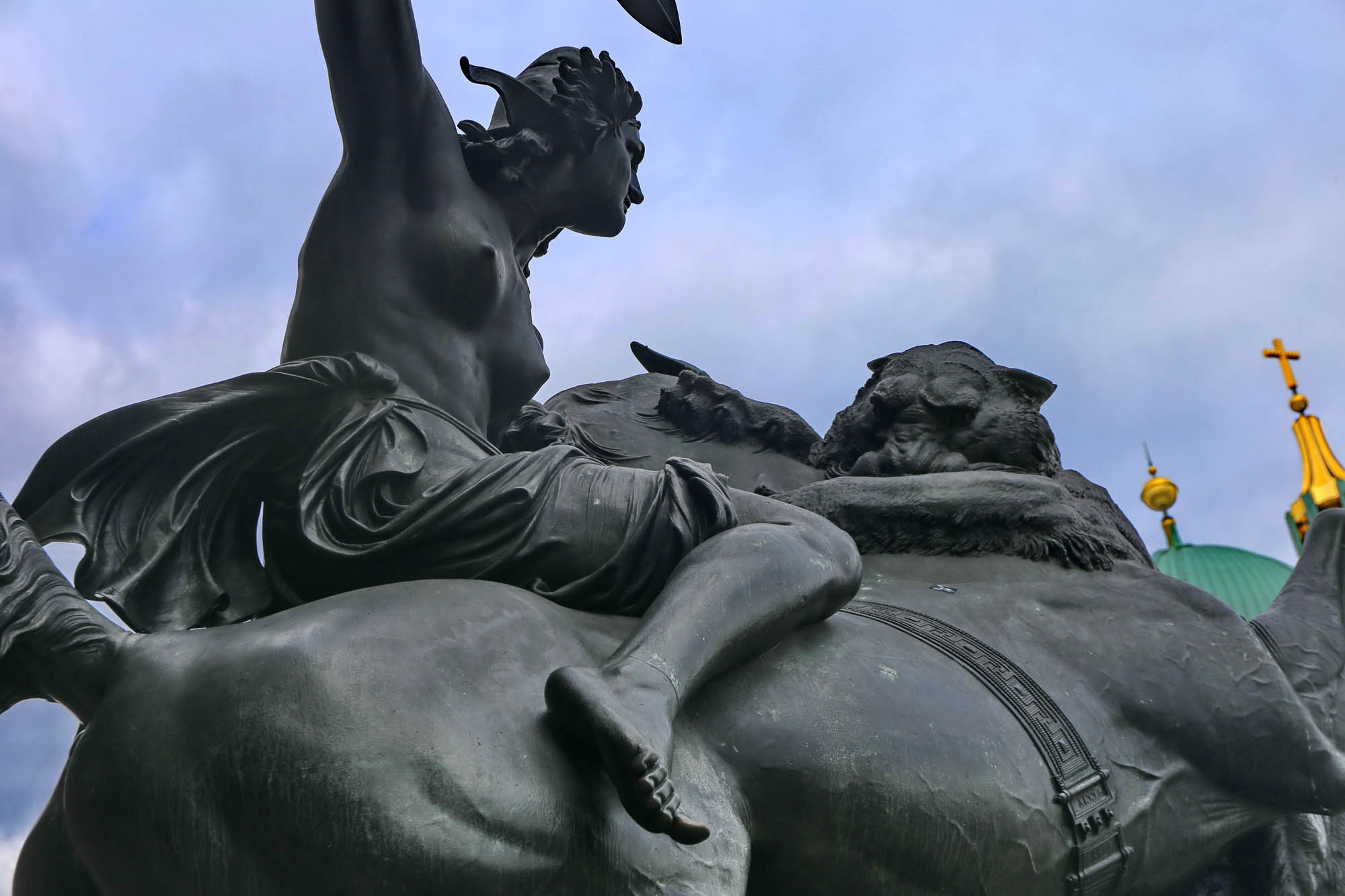 Museums have reopened in Berlin, and one goes to museum again. The ancient collection of the Altes Museum on Museum Island is an intimate acquaintance, I missed it. Coming out, I sit down on the stairs to flip through, in the spring sunshine, the catalog of the new exhibition on Greek portrait sculptures, about which I will soon write. And as I raise my head, I suddenly take notice of something I have seen a thousand times: the two bronze statues flanking the steps of the museum. Two equestrian statues to the right and left, their riders stabbing two big cats: the woman to the right a tiger, and the man to the left a lion. They did not get there today: the amazon in 1843, and the man in 1861. Yet now I think about it for the first time: why are here, in front of the house of fine arts, the temple of the spirit, two such action statues, whose figures in obvious superior position – on horseback, hunting with weapon – are brutally massacring endangered protected animals?
I am not alone with this question. The Reclam Kunstführer Berlin, to which I first turn for an answer in the museum shop, is also perplexed, stating that “the sculptures have nothing to do with the museum’s program.”
How and why did they get here anyway?
Karl Friedrich Schinkel, the designer of the museum originally wanted to place here the equestrian statues of the two Prussian kings donating the museum, Frederick William III and IV. In fact, the museum, built between 1823 and 1830 as Königliches Museum, housed the royal private collections, and aimed at sharing their antique heritage with the educated bourgeoisie. The museum thus logically fits into the building complex surrounding the Lustgarten, the royal ornamental garden: to the south the royal palace (whose reconstruction, after the devastation of the war and the hiatus of the GDR times, will be finished this year) as the symbol of power, to the east the Berliner Dom as that of the church, to the west the Zeughaus, the armory and then military museum as that of the army, and to the north the museum as that of the spirit.
However, Frederick William IV did not want royal statues here. Nevertheless, the idea was already on its way, and the stair railings cried out after equestrian statues.
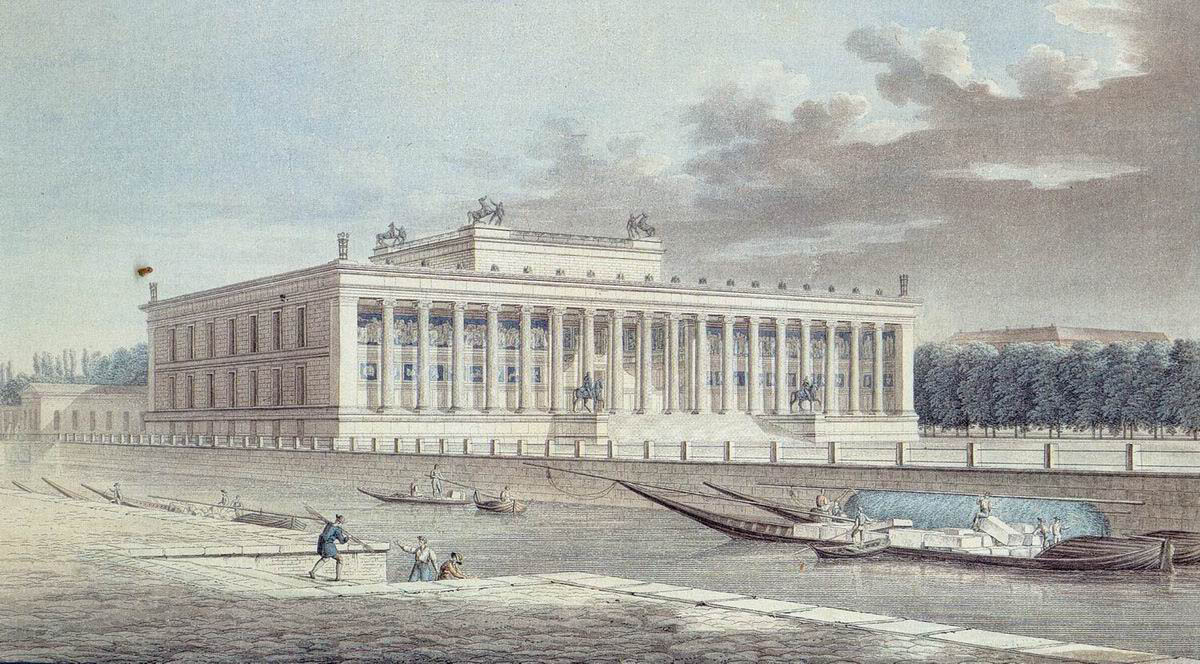 Friedrich Thiele: The Altes Museum, 1830, with two equestrian statues that never existed. The first equestrian statue, the Amazon killing a tiger or simply Amazon by the Silesia-born but Berlin-educated sculptor August Kiss was placed on the right rail in 1843. The September 30 issue of Illustrirte Zeitung reported in detail about its set-up and also provided art criticism. According to the author monogrammed L. R., the greatest merit of the work is that it was cast from public donation. The artist “was bold enough” to model the sculpture in life size in his studio, and only later a “large association of enthusiastic friends of art, led by the King” (of which Schinkel was also a member) collected the sum necessary to casting. This is, then, the first – albeit not visible – link between the museum and the sculpture: the active participation – “sacrifice” – of the educated burgeoisie in the enrichment of the new center of bourgeois culture – or, in the vocabulary and conception, its “temple”.
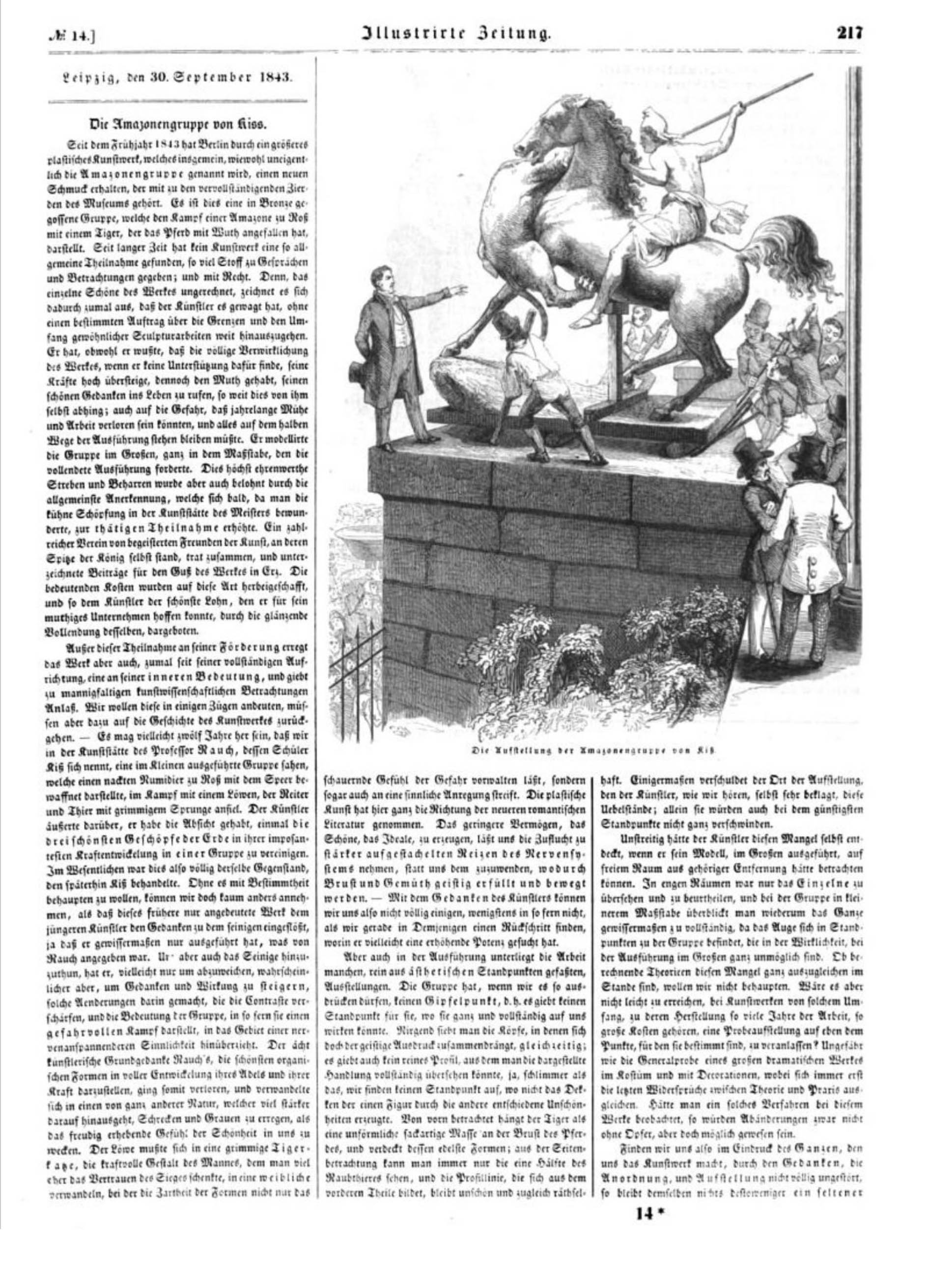 Illustrirte Zeitung, September 30, 1843. The muscle men setting up the statue in the engraving seem to be helping the amazon with their sticks against the tiger.
The spirit of the age also saw in the sculpture the embodiment of the victory of the spirit over animal savagery, that is, exactly the Bildungsziel the museum served for. It is no coincidence that August Kiss’ other masterpiece was the
statue of St. George (1855) in front of the Nikolaikirche, whose dragon has been traditionally associated with evil, and its knockdown thus symbolizes the victory of good.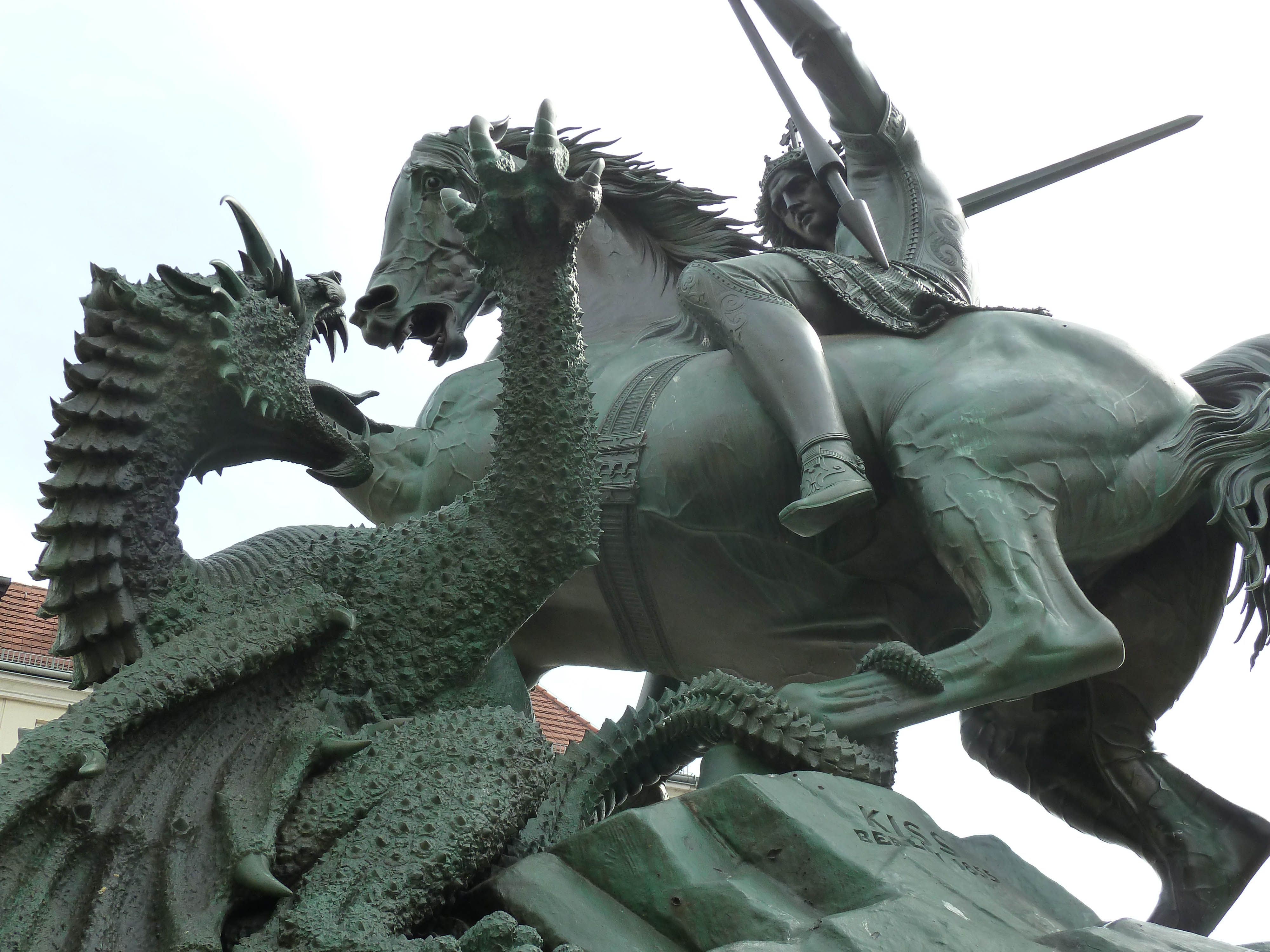
The prolific critic Karl August Varnhagen also praises the sculpture for this reason: “It is a great, bold, expressive and powerful work. … One can see that the horse is already lost, but the person is triumphing. The beautiful amazon radiating with spiritual superiority will survive, and will at least take revenge for the horse.” This concern for a secondary figure is unusual from a critic, but we know that Varnhagen fought the Napoleonic wars under Austrian, Prussian and Russian flags, and was able to exactly gauge what it means to lose a horse in an emergency.
However, no one is yet concerned for the tiger at this time. The only criticism of Illustrirte Zeitung was that while the amazon and the horse are beautifully crafted, the tiger hangs around the horse’s neck as a “shapeless, bag-like mass”, and one cannot find a vantage point from which its entire figure can be seen at once. I can confirm this myself as a photographer.
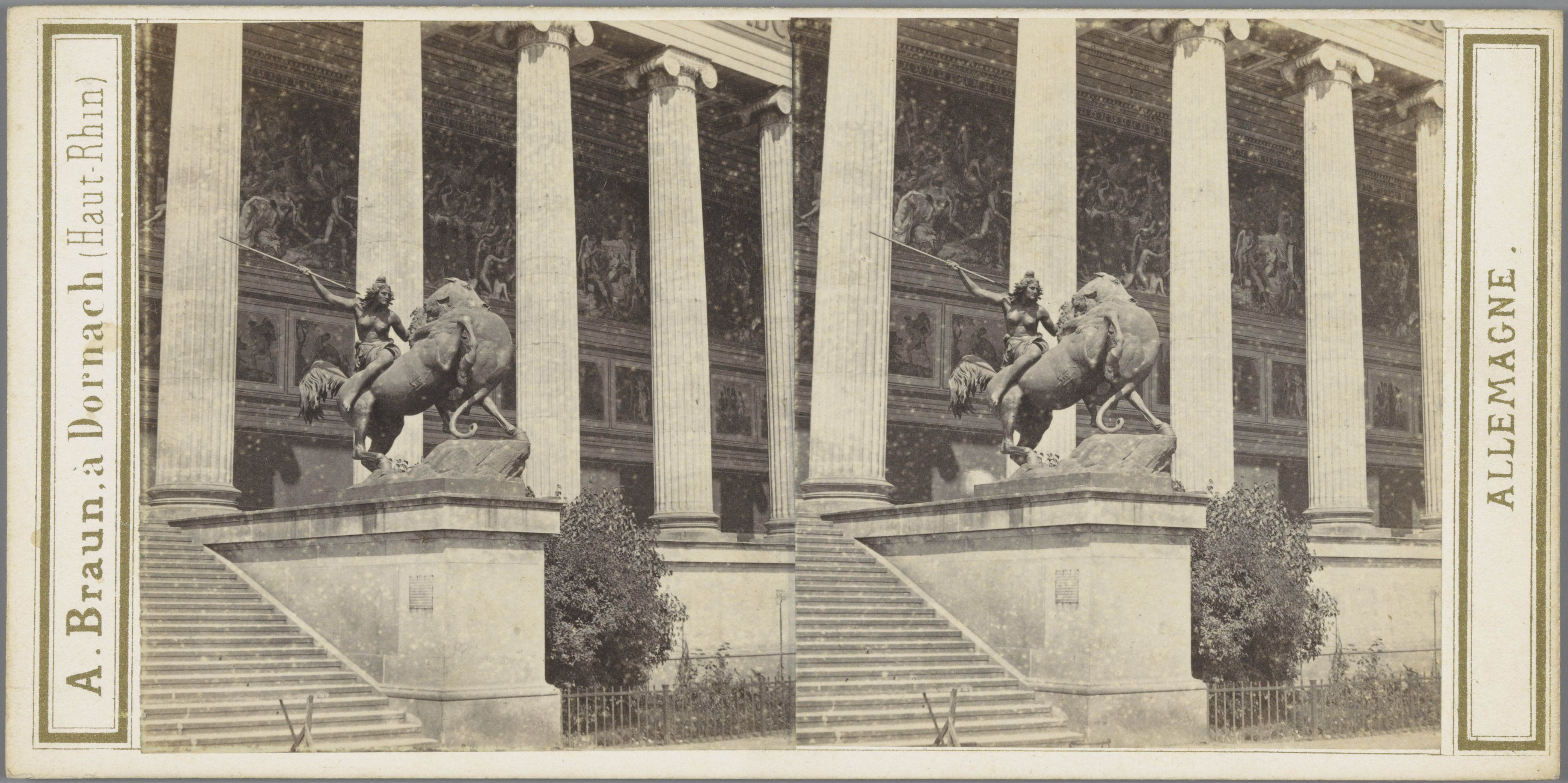 Photo by Adolphe Braun & Compagnie, ca. 1860-66
The statue was a great success. Prussia entered it for the 1851 London World’s Fair, where it stood in the Eastern Wing of the Crystal Palace, among the exhibits of the German Customs Union (there is no Germany yet at that time!). Michael Leapman writes about it in his The world for a shilling: How the Great Exhibition of 1851 shaped a nation (2011):
„A little further on was the German sculptor August Kiss’s depiction of an Amazon on horseback attacked by a tiger, whose combination of energy and delicate modelling made it many people’s favourite work in all of the Crystal Palace. The tiger’s claws were embedded in the horse’s body while the Amazon held her spear aloft, ready to deliver the decisive blow.”
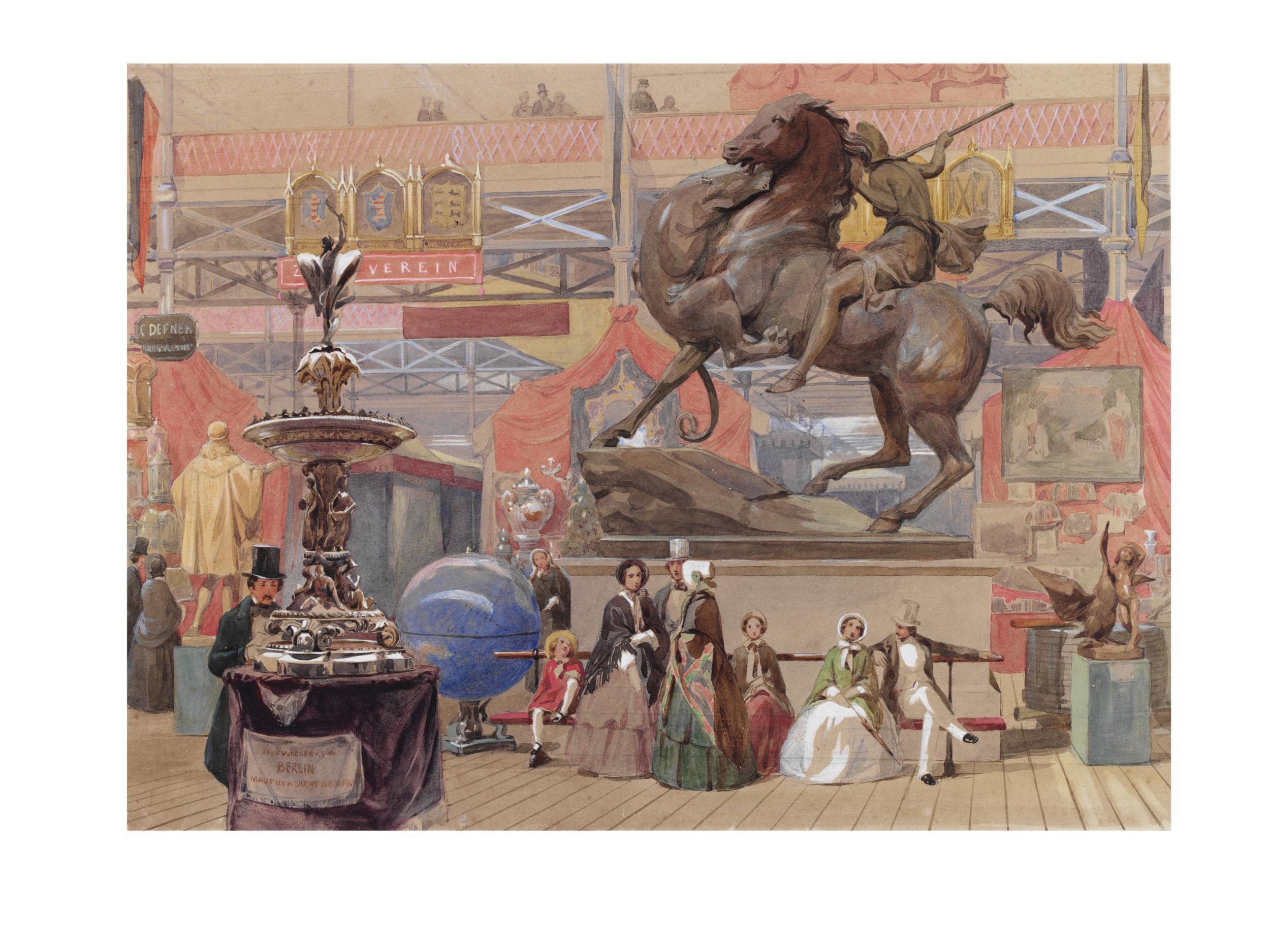 John Absolon: The Eastern Wing of the Crystal Palace, 1851
The statue’s popularity in Britain is evidenced by the fact that George Eliot used it as a metaphor in one of her critiques four years later. Speaking about a short story by Charles Kingsley, she praises its romantic impetus and faithfulness to nature, as opposed to the mass of writings that merely copy each other and use neo-classical commonplaces. And she suddenly uses this parallel: “After a surfeit of Hebes and Psyches, or Madonnas and Magdalens, it is a refreshment to turn to Kiss’ Amazon.” The memory of the statue was obviously still alive among the educated English audience if Eliot could refer to it like this, without any introduction. Interestingly, the thirteen year older critique of the Illustrirte Zeitung criticized the sculpture exactly for what Eliot praised it: that it does not follows the neo-classical ideal of beauty, and “instead of maximizing the unfolding of the nobility and force of the most beautiful organic forms” it aims at “terror and horror”, and instead of “spiritually recharging and moving the bosom and the emotions” at the “strong arousal of the nervous system”: “plastic art here has completely gone in the direction of modern romantic literature.”
And John Ruskin could refer to the memory of the exhibition even as late as 1859 in his Berlin report published in Scotsman: “Kiss’ Amazon makes a good grotesque for the side of the Museum steps; it was seen to disadvantage in London.”
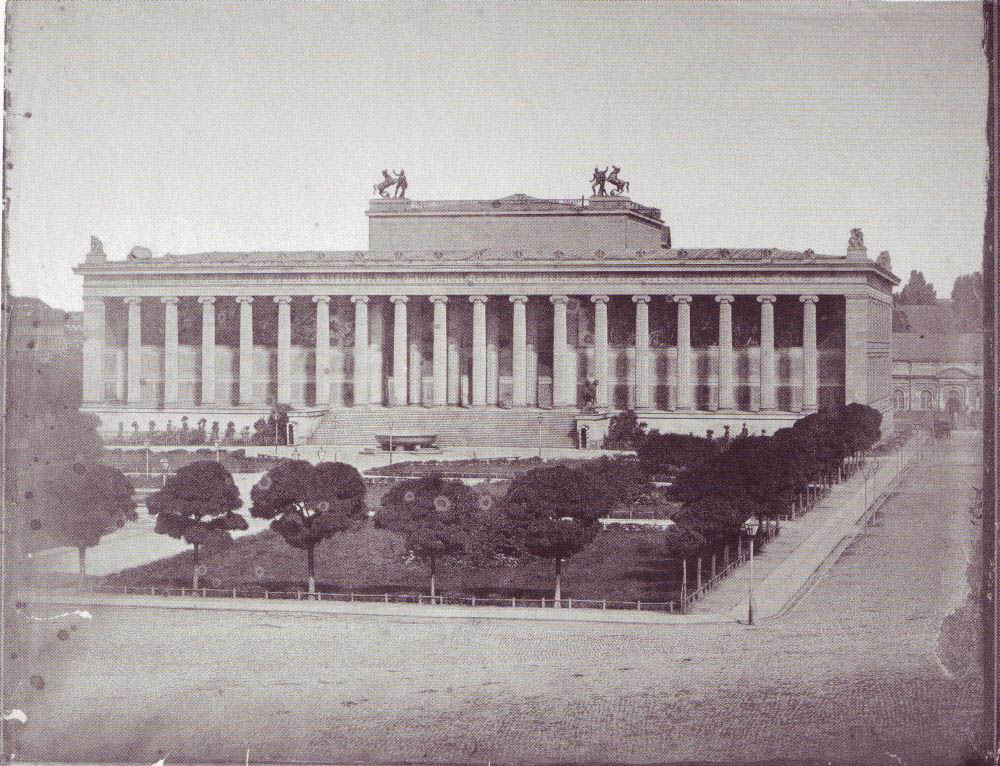
In this 1854 photograph, the Amazon is still alone along the steps of the museum. But her mate,
the lion killer, “der Löwenkämpfer” is already on the way. It was created between 1847 and 1856 by Albert Wolff, who was a student of the same Christian Daniel Rauch, founder of the Berlin School of Sculpture and leading sculptor of 19th-century Germany, as Kiss. As early as 1843, the Illustrirte Zeitung mentions a small statue seen by its author in Rauch’s workshop around 1831, depicting a naked Numidian rider stabbing an attacking lion with a spear. According to the author, this model inspired – with the mentioned changes – the statue of Kiss, and it was also followed, probably without significant changes, by Wolff’s lion killer.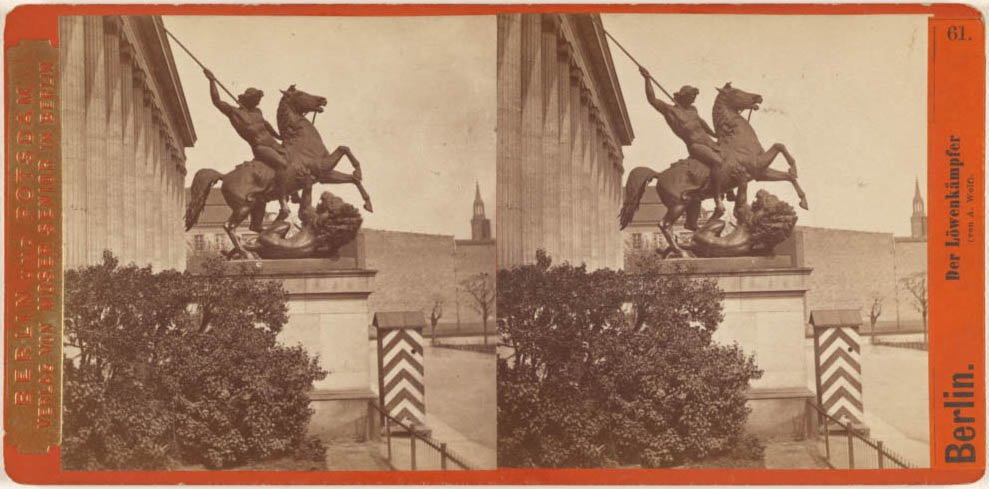 The Löwenkämpfer. Above, in the 1860s photo by Senior Moser, and below, in the 1940s picture by Heinz Stockfleth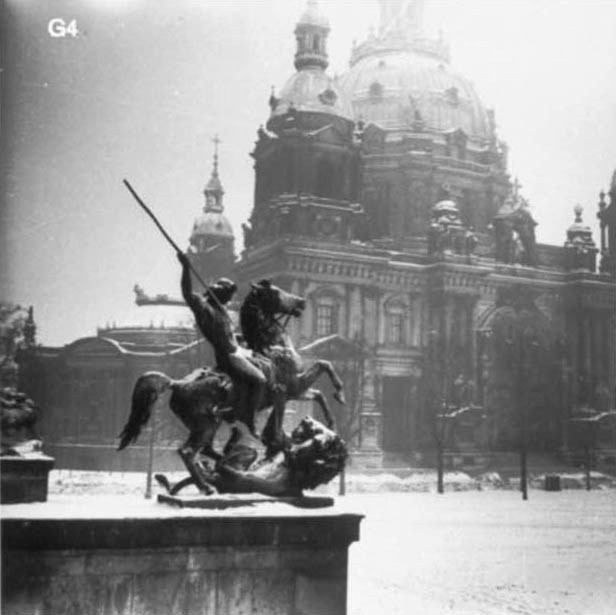
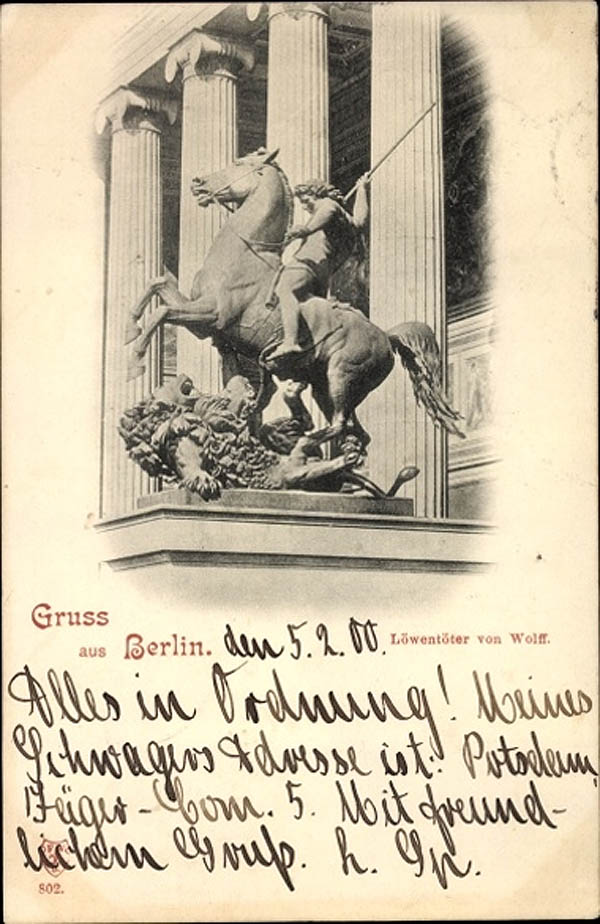
According to the literature, Rauch from the outset intended his lion killer for the stairs of the museum, and Schinkel, who died in 1841, knew and supported this. This may have helped the setting-up of the earlier completed Amazon, and this explains why August Kiss undertook so boldly, without an adequate financial background, to model his statue life-size: he probably recognized that Rauch’s model tuned the audience to such an equestrian statue. However, by 1861 this mood has largely passed. The critic Franz Kugler, who in 1843 still praised the setting-up of the Amazon, saying it fitted well to the (since then destroyed) frescoes of Schinkel in the museum lobby, in 1861 already wrote about the lion killer the same what is our first thought a hundred years later, in a completely changed atmosphere of reception: “In vain we look for a connection between the temple of peaceful arts and such a wild depiction of barbarian roughness.” Yet the sculpture is much more neo-classical, more balanced than its 1843 predecessor.
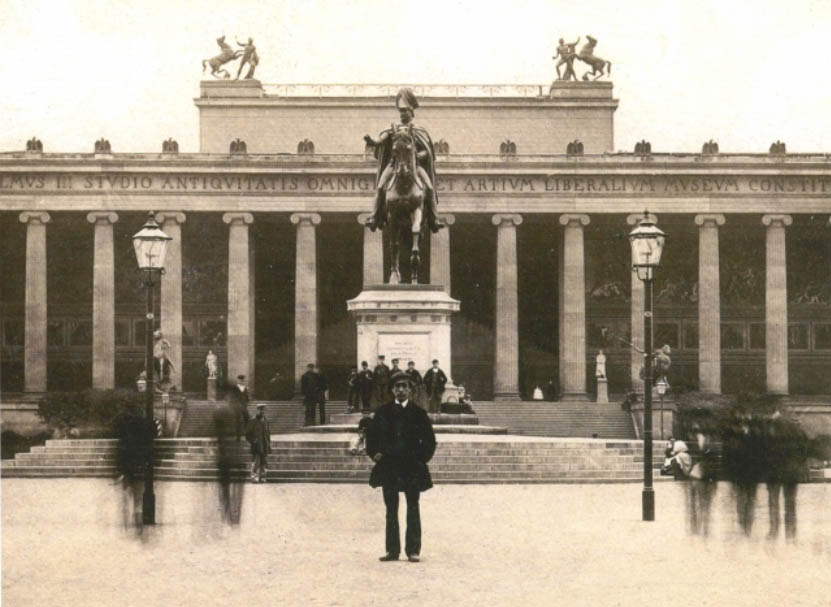 Albert Wolff managed to place one more equestrian statue in front of the Altes Museum: that of Frederick William III, in 1871. This statue was fused in 1944 for war purposes.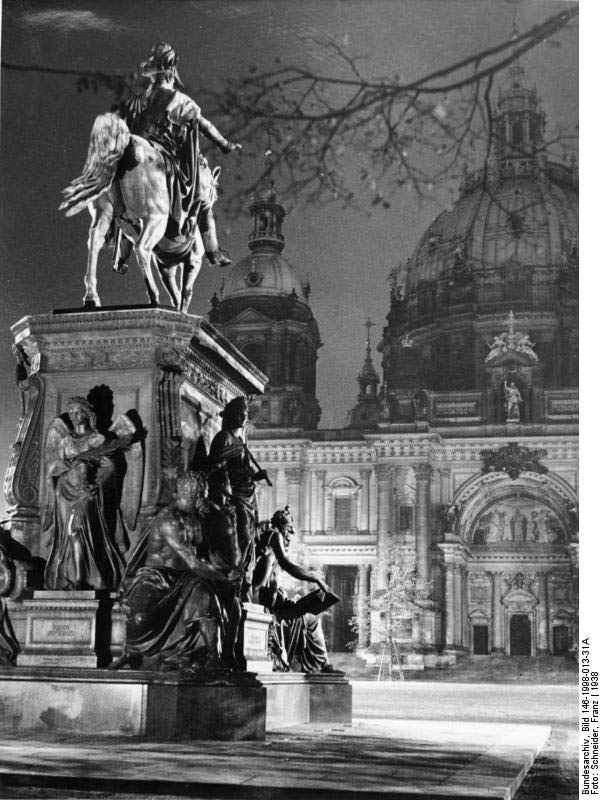
Such neo-classical genre statues are often inspired by ancient sculptures, or at least by ancient descriptions of works of art that did not survive. What could have been the ancient inspiration of the two big cat killers?
We know no statue of a tiger or lion killer from antiquity. But we do know reliefs or two-dimensional representations of this topic.
One of them is right here, in the museum: a mosaic from around 130 AD from the Tivoli Villa Hadriana, on which centaurs, i.e. horse-men fight with three big cats: a tiger, a lion and a panther. The tiger bites with its claws into the body of the centaur laying on the ground just as the tiger of the Amazon does with the horse. The museum purchased this mosaic around 1840, so both sculptors could see it.
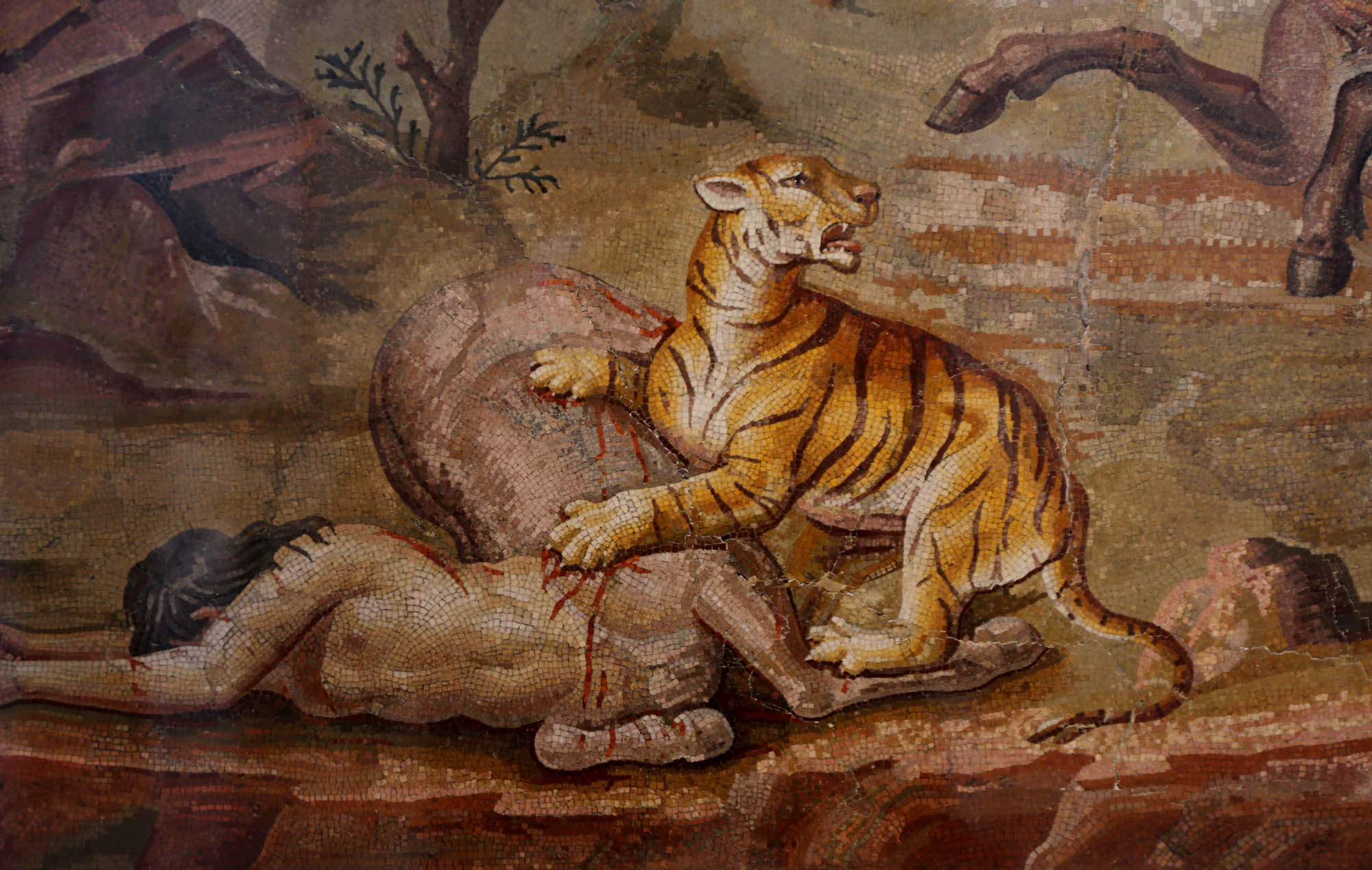
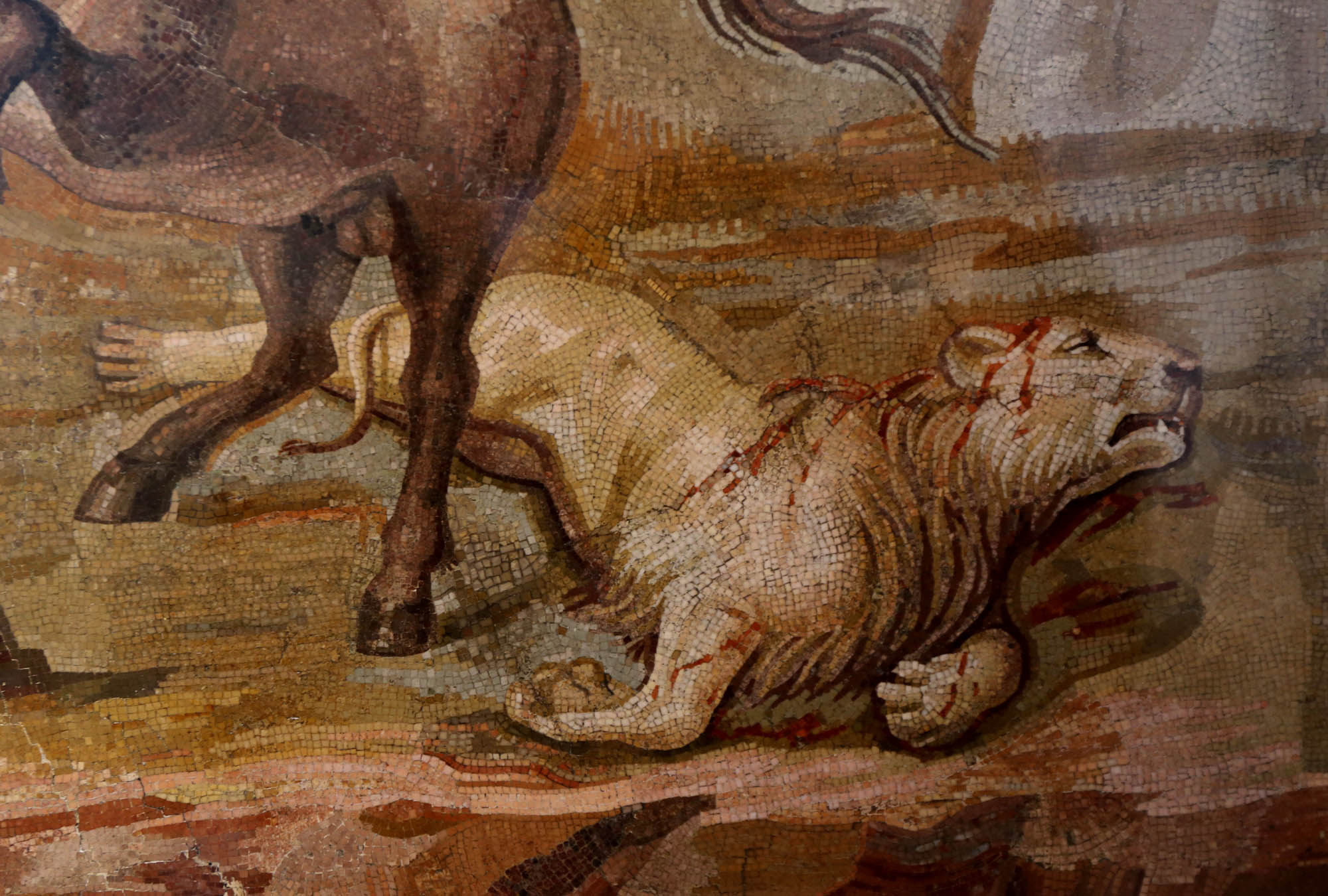
For today’s recipient, this image feels like an overwritten fantasy. It is too much by half. Three big prey cats attacking at once? and centaurs? But most probably this was the originally intended effect. The mosaic had to convey concentrated exoticism, and the key elements of this were the transitorial human-animals living somewhere far away, on the edge of the oikumene, as well as the tiger. For the Romans, tiger was a trademark of exoticism.
In the 4th-century Villa Romana del Casale in Sicily, one of the largest surviving Roman mosaic ensembles, the floor of the great central cross corridor is adorned with the scene of the “great game hunting”, where we see hunting and animal capture in Africa to the left, and in Asia to the right. The scenes on the left are quite authentic, as the Romans knew Africa well, and probably the owner of the villa played an important role in capturing large African animals and transporting them to the Roman circus. On the right, however, which they only knew from hearsay, hell breaks lose. Alles geht, from rhinoceros to griffin. And among the exotic animals, the tiger plays an emblematic role, sort of a hallmark of being in a world of fairy tales.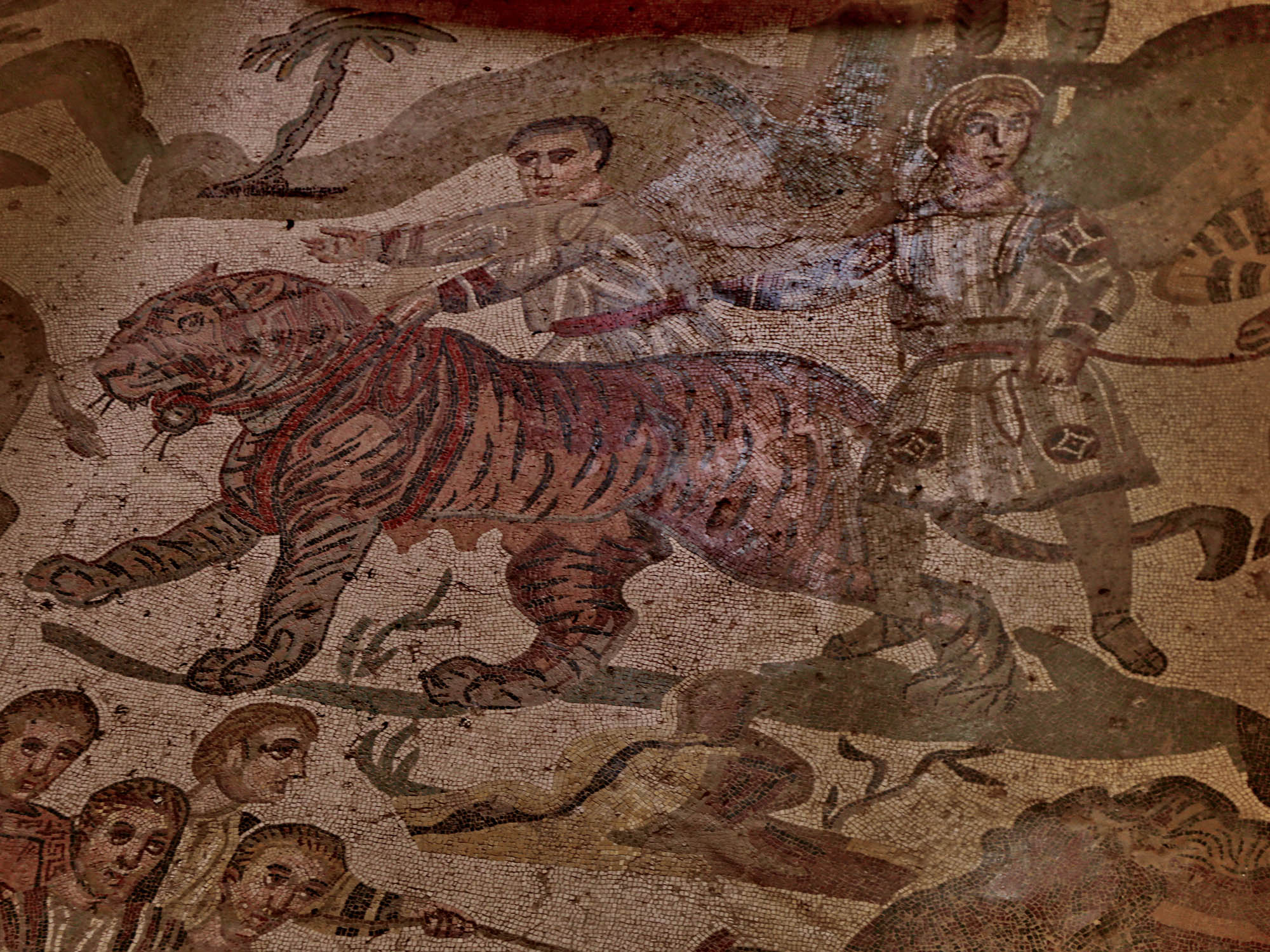
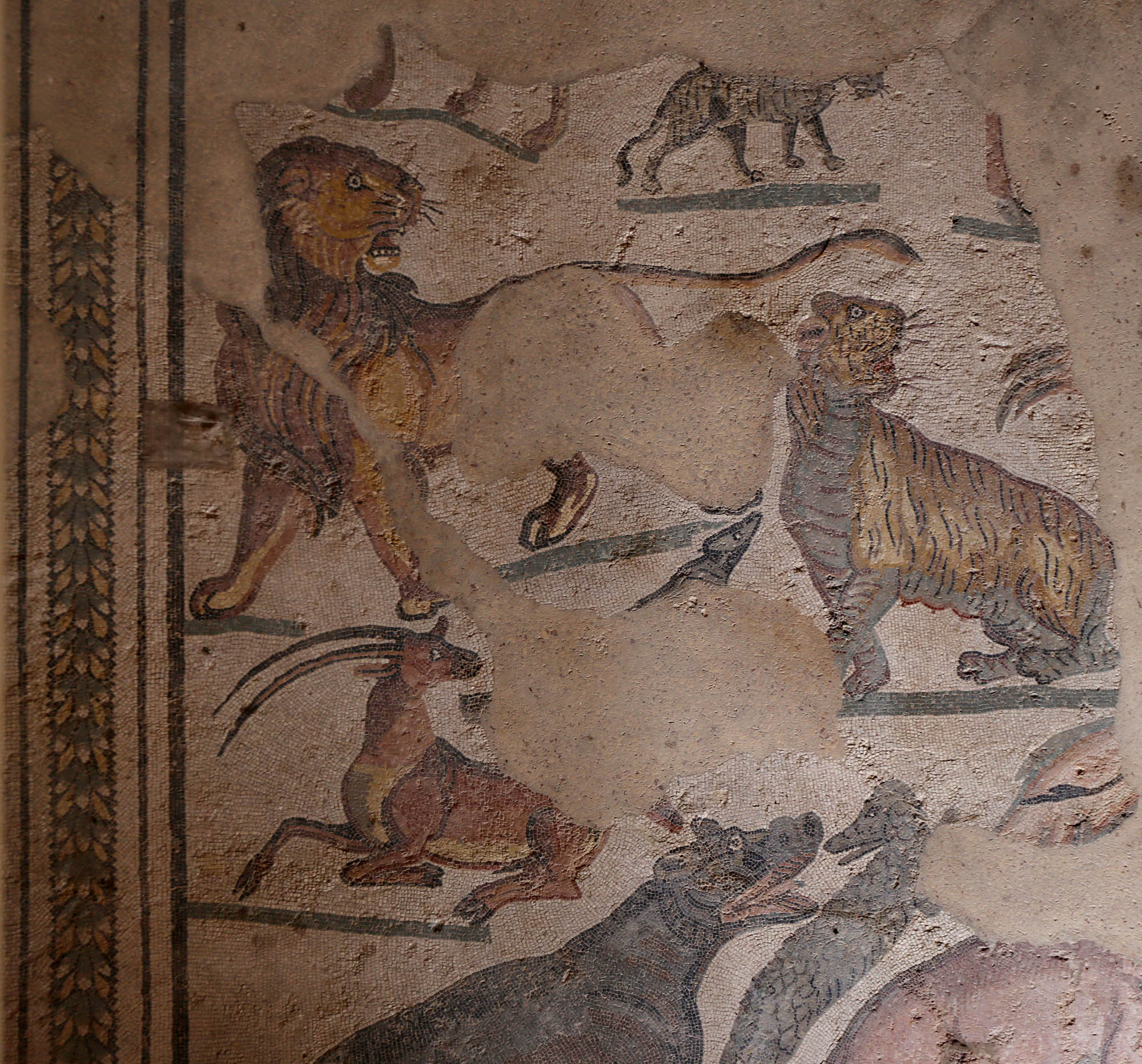
The Romans first saw a tiger in 20 BC, which was brought by an Indian embassy to the island of Samos as a gift to the emperor. And Augustus, as Pliny reports in his Naturalis historia 8.25, managed to stage a tiger in public only in 13 AD, at the inauguration of Marcellus’s theater. True, in the Gladiator, the late 2nd-century emperor Commodus was able to muster up as much as twelve tigers into the Colosseum just to end up unfairly with Centurion Maximus, but that’s not the only excess in that film.
The Asian scenes of the Villa Romana also include a Pliny story from Naturalis historia 8.25, the one which Centurion Fungus Maximus Tertius wanted to see on his mosaic floor in Zeugma. That is, if the hunter abducts the tiger’s kids, it will follow him, but then the hunter throws a round mirror (a polished metal sphere or convex metal plate) in front of it, in which it sees itself small and lingers with it for a while, believing seeing its kid. Here we see the hunter with the caterpillar-like little tigers on his chest galloping up the boat ready to depart, and the busy tiger behind him. The mere fact that this form of hunting was portrayed as a promising opportunity on the floor of the villa of an otherwise serious large-scale African animal capture specialist shows how exotic an animal the tiger was.
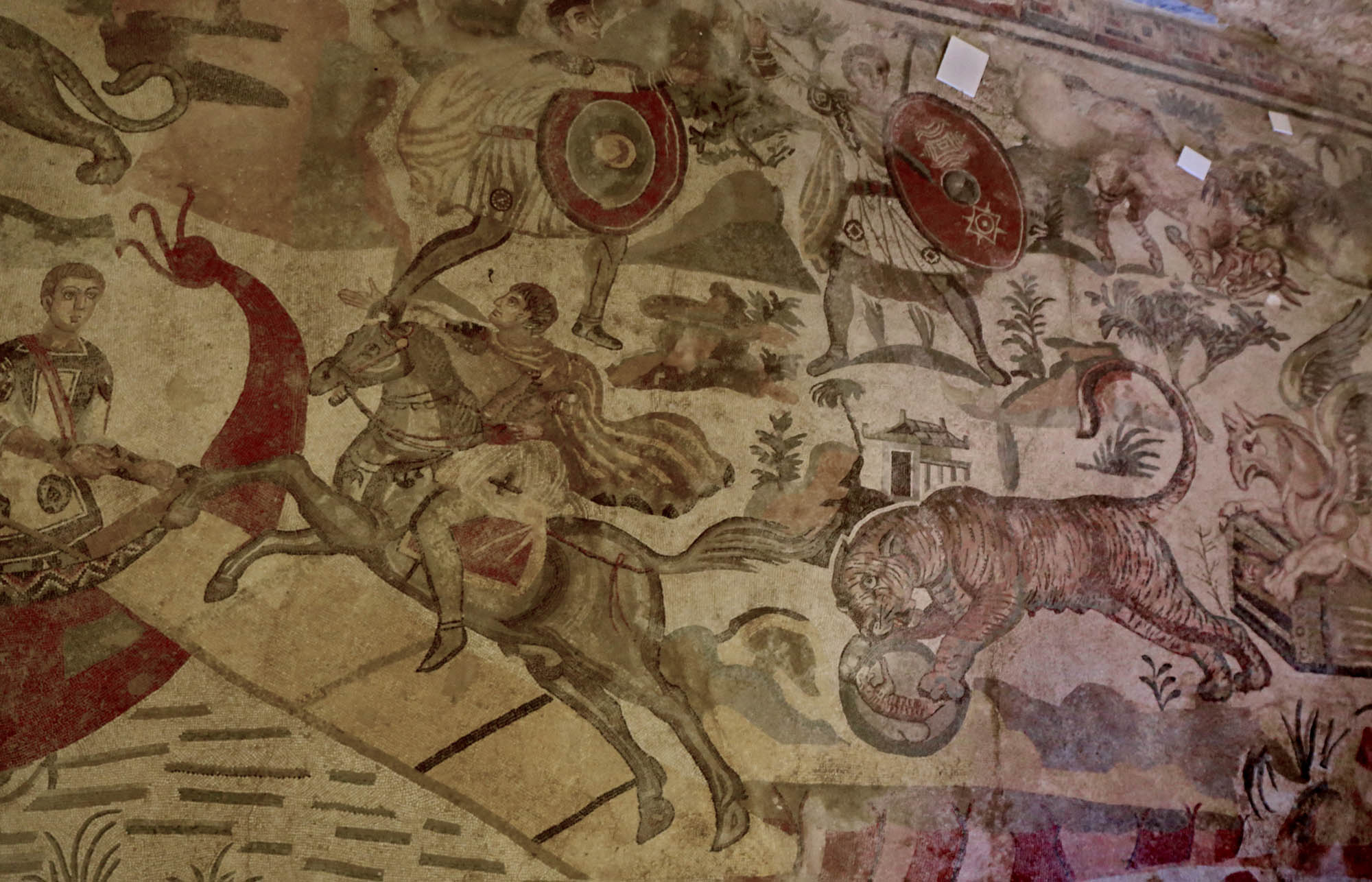

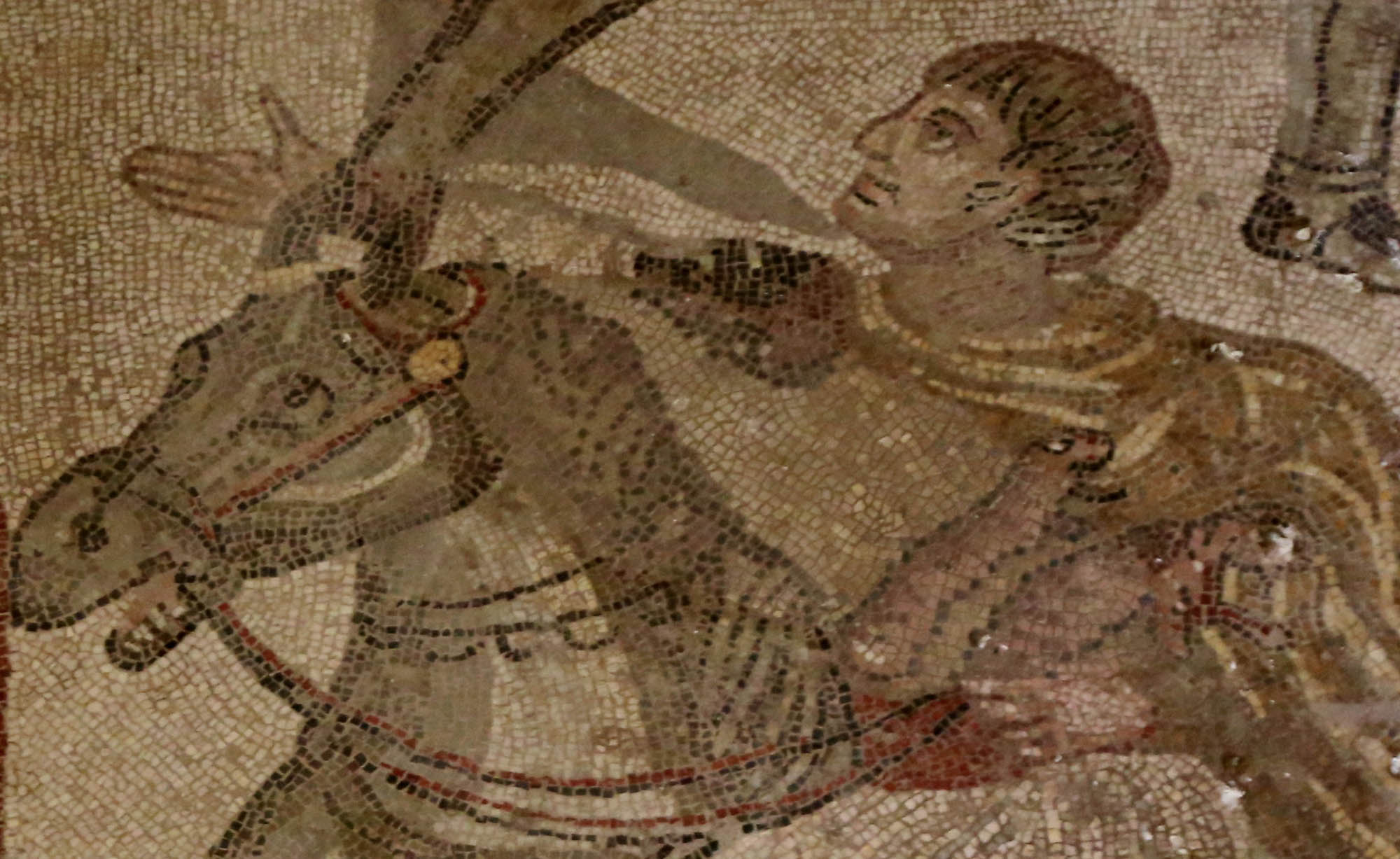
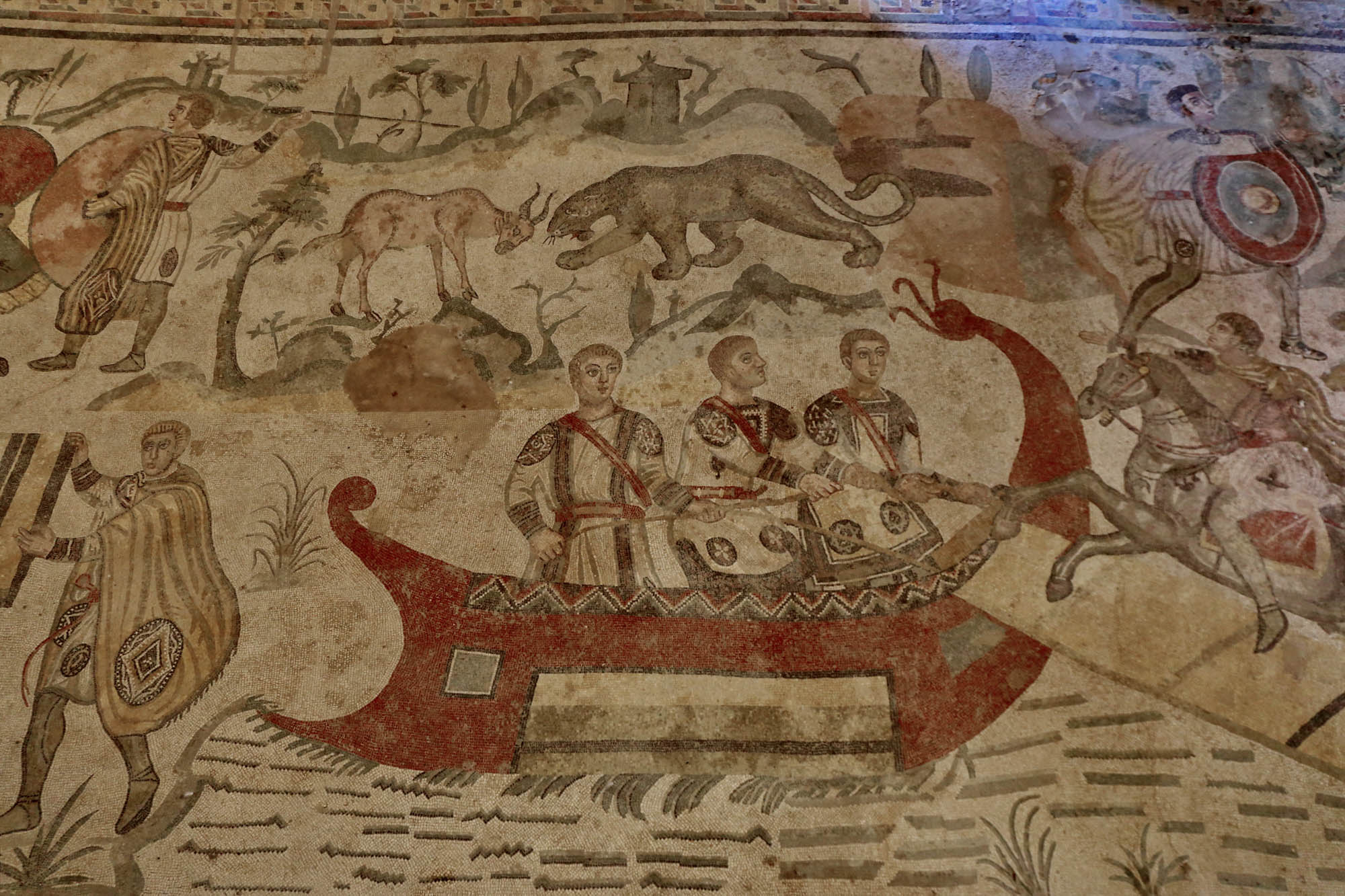
The exotic character of the tiger is also evident in the villa’s sea scene. Here the artists, inspired by the horse / water horse (hyppo-potamos) dichotomy, created some similar aquatic animals for the depths of the inexhaustible sea, next to the sea gods and nayads. Among them is the water tiger.
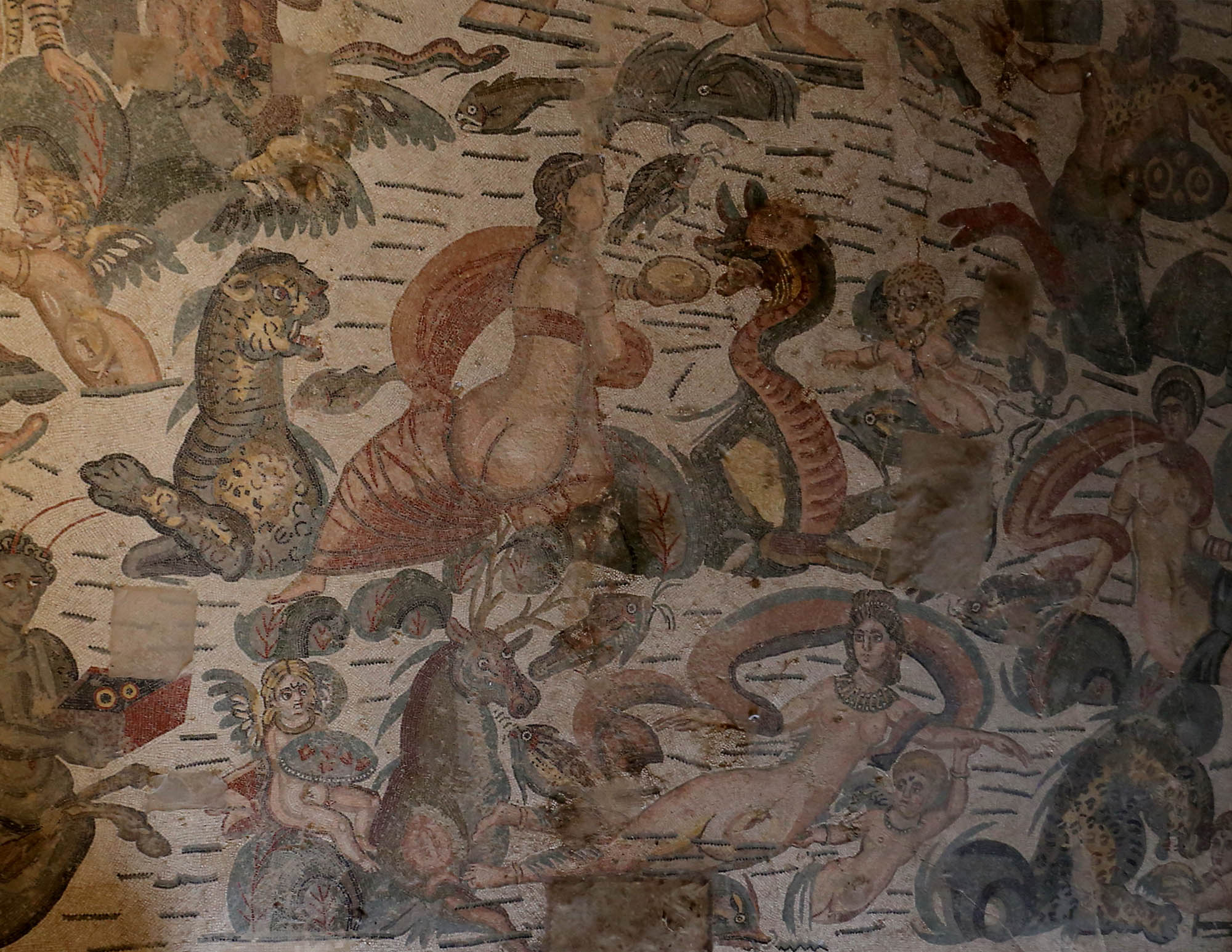
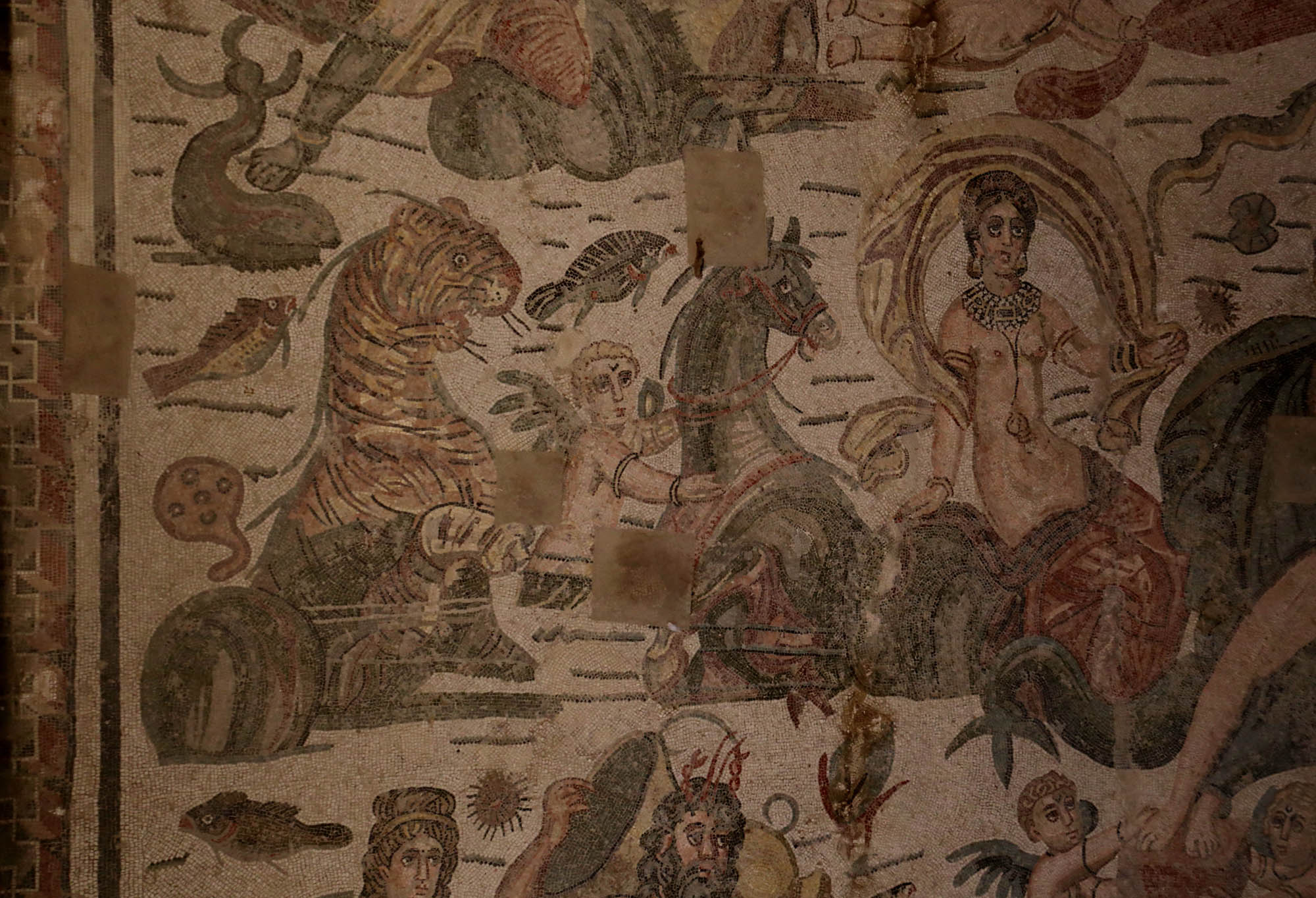
Probably the exoticism of the tiger attracted the amazon as an additional character, as it did the griffin on the mosaic of the villa. An exotic animal needs an exotic hunter, like on the floor of Villa Hadriana. And besides, the verses of Virgil (Aeneis 11.576-577), well known to every Bildungsbürger say that the amazon wears tiger skin:
Pro crinali auro, pro longae tegmine pallae
Tigridis exuviae per dorsum a vertice pendent.
(Instead of gold jewelry on her hair and a long robe, tiger skin hangs down on her back.)
And someone had to kill that tiger. The statue at the entrance of the Altes Museum was seen as an illustration of this verse by the little Bildungsbürgers coming here on a class trip, as long as this category existed.
The world has changed a lot since then. It became clear exactly here in Berlin, that human spirit did not prevail over animal savagery. And we have learned to see in the tiger and other animals the spirit of nature endangered by human savagery.
Like here next to me, on the firewall of the Birkholz senior center in Charlottenburg.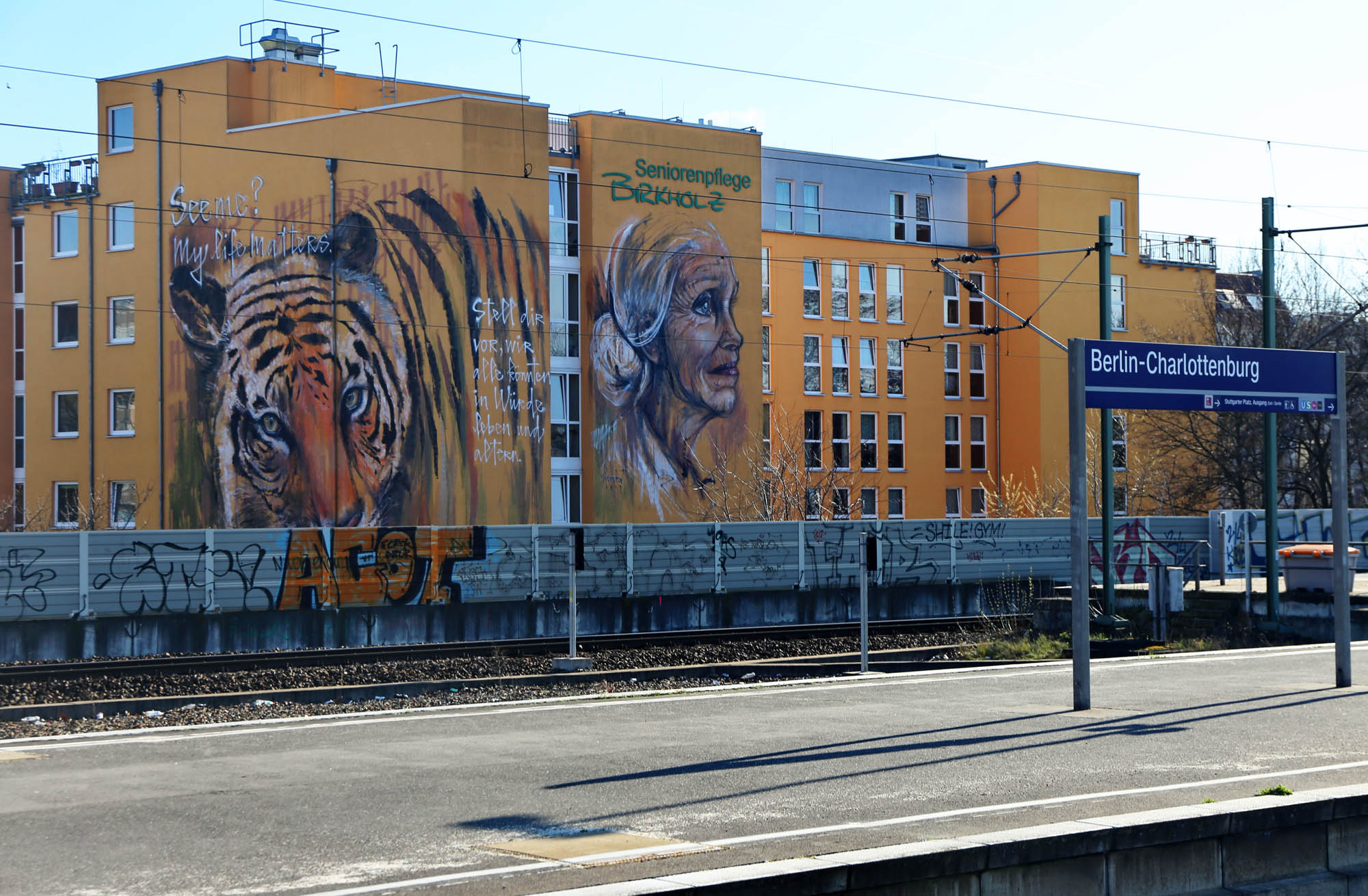
 “[Can you] see me? My life matters.” “Let’s imagine a world, in which every being is protected.”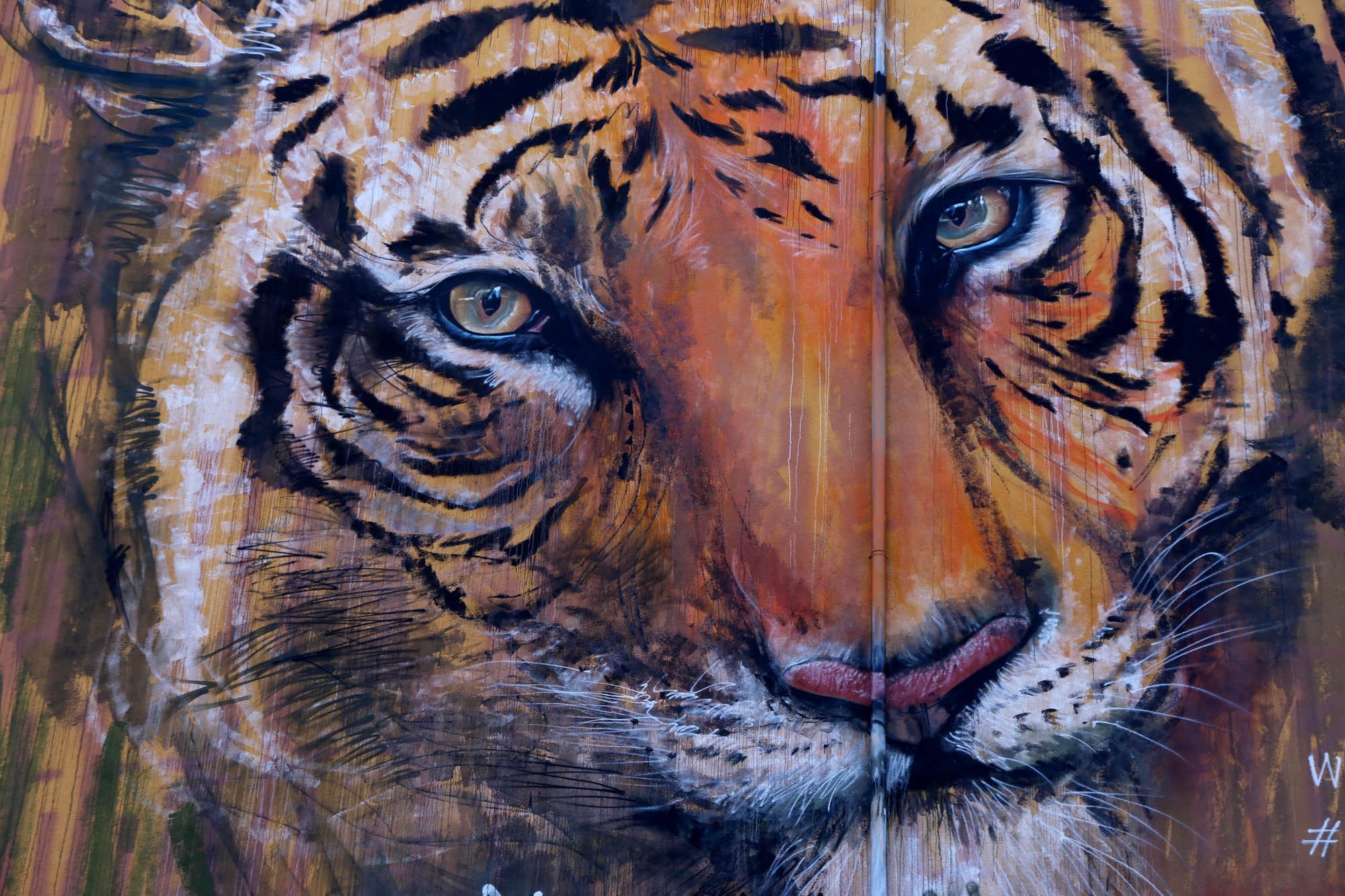
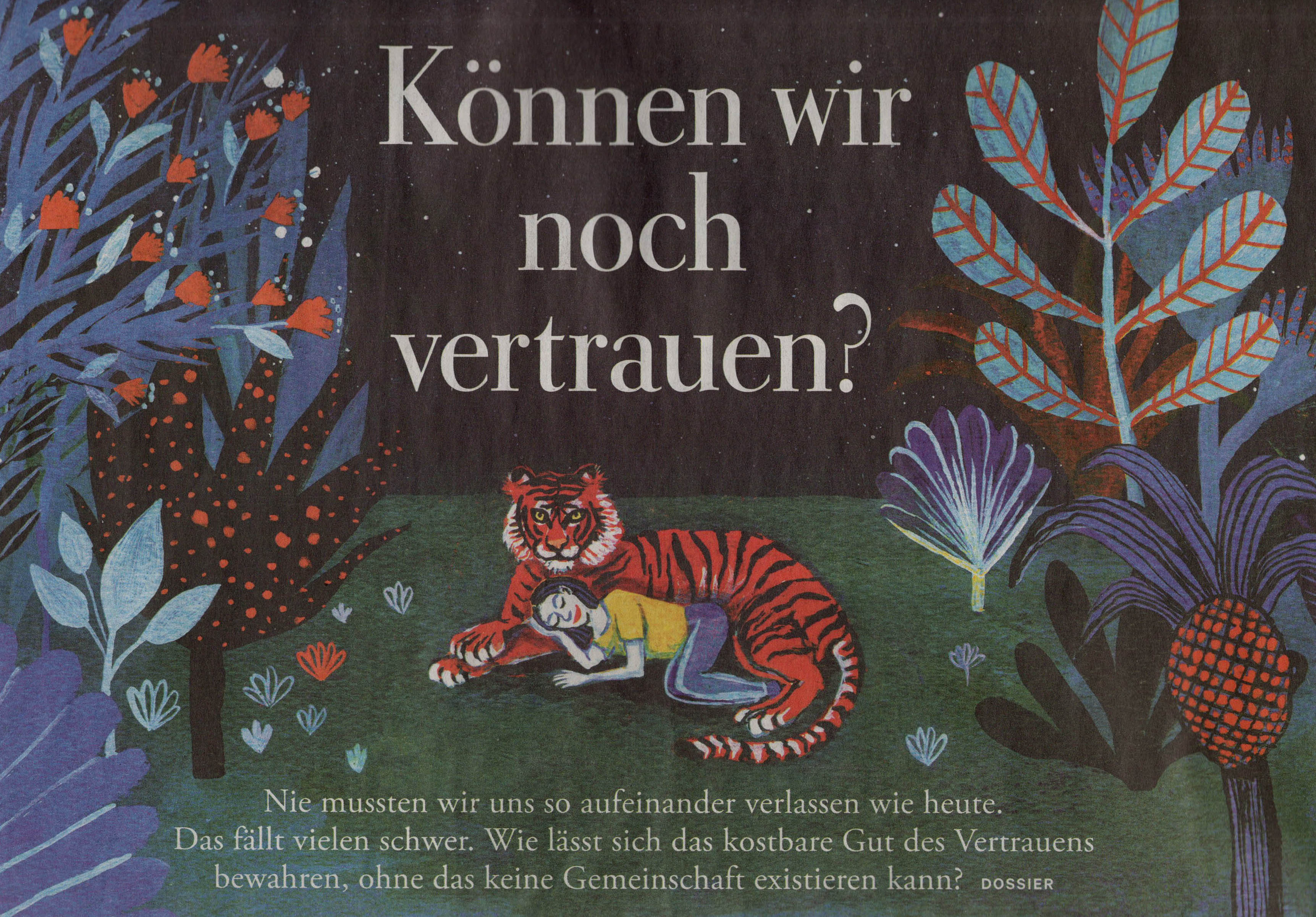
We see this humanization of the tiger on the front page of today’s Die Zeit, where it figures as an illustration of the article “Can we still trust?” both as a scary animal (whom we may not be able to trust) and as a being endangered and longing for trust just like us. Following the pattern of the biblical topos where the lion lies with the sheep and the tiger with the amazon.


 Come with us to…
 Atlantis
 Bestiary
 Bohemia+Prague
 Books, exhibitions, music, film
 Brave old world
 Caucasus
 Cemeteries
 Crimea
 Get to know the
 Images of the East
 Lightwriting
 Lwów/Lemberg
 Mallorca
 Message on the wall
 The Museum of Propaganda
 Odessa
 Paper Museum
 Persian letters
 The Jewish heritage


