Switch over to our new blog! • ¡Pásese a nuestro nuevo blog!

The renewed version of our blog, with more features, a richer design, and available in nine languages, can be read here: https://wangriver.com

The new version also includes the old posts, often in expanded form. If you are curious about the updated version of this post, replace “riowang.blogspot.com/” in the URL with “riowang.studiolum.com/”, and the new link will most likely lead you there.


La versión renovada de nuestro blog, con más herramientas, un diseño más rico y disponible en nueve idiomas, se puede leer aquí: https://riowang.com

La nueva versión también incluye las publicaciones antiguas, a menudo en una forma ampliada. Si tiene curiosidad por la versión actualizada de esta entrada, sustituya «riowang.blogspot.com/» en la URL por «riowang.studiolum.com/es/», y el nuevo enlace probablemente le llevará allí.

Mostrando entradas con la etiqueta Israel. Mostrar todas las entradas

The boat of Saint Peter

In the last days of March 1506, just before the Feast of the Annunciation, the oldest and holiest church of Western Christianity — the Basilica of Saint Peter in Rome — began to be dismantled. The culprits were no pagans or heretics, but Christ’s own earthly representative and Saint Peter’s successor himself: Pope Julius II.

The official reason was the supposed disrepair of the ancient basilica, founded by Emperor Constantine the Great. But for the megalomaniac pontiff, it was the perfect excuse for yet another grand project — to join the ranks of his other colossal commissions: the never-finished tomb designed by Michelangelo, the Sistine Chapel he had the same artist paint, and the papal apartments he had Raphael decorate. Now he wanted something even more monumental — a new mother church for Christianity that would also immortalize his name.

The project broke not only the old basilica but also the Church itself. The indulgences sold to fund construction sparked Martin Luther’s protest — and the Reformation. Two centuries later, the endeavor limped to an uninspired close: a vast but characterless barn of a church, a patchwork of banal architectural ideas. Its colossal scale is diminished by a mediocre façade, and even its one saving grace — Bernini’s grand colonnade — was visually “deflated” when Mussolini drove his grand avenue straight up to it in the 1930s.

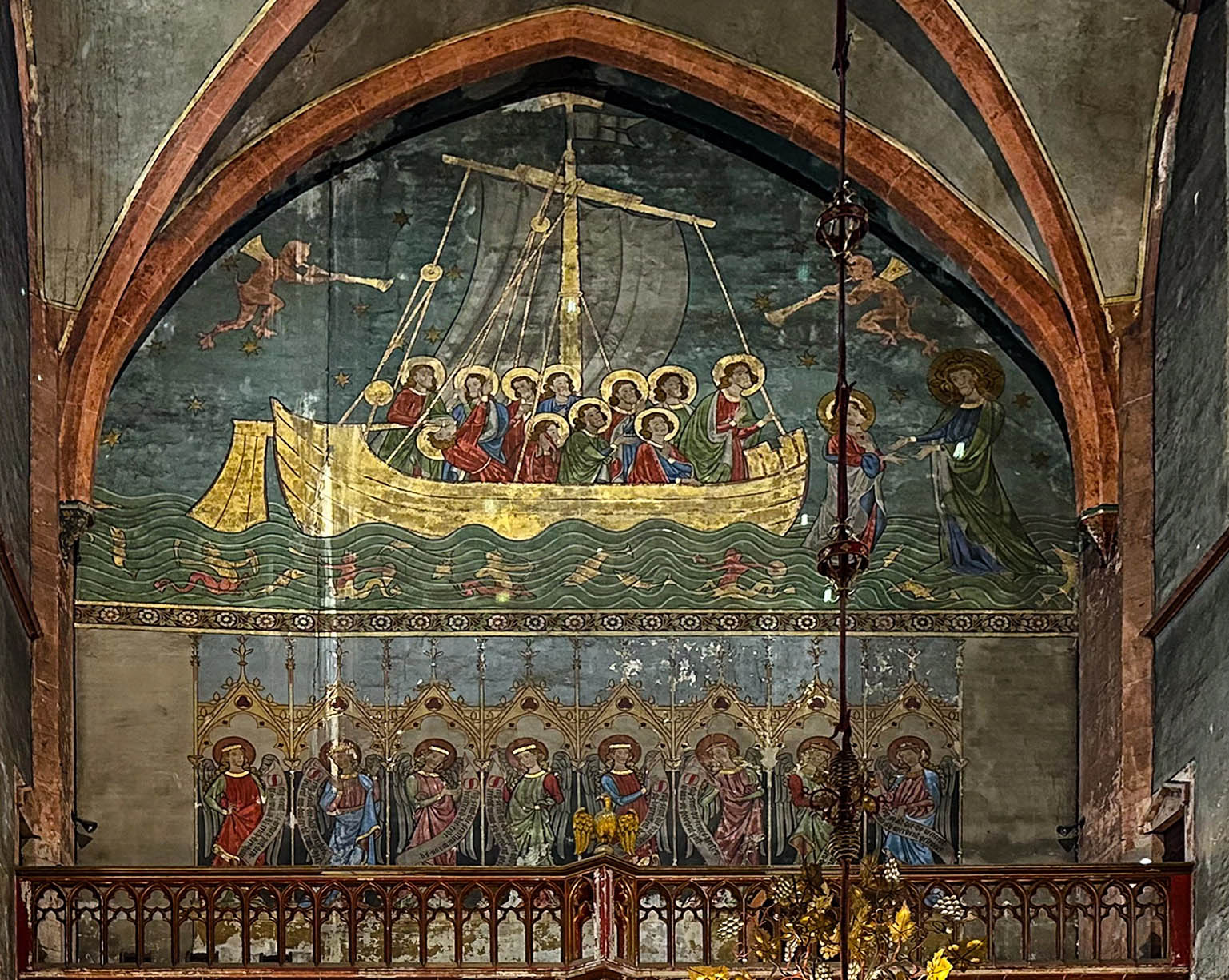
Something else perished, too — a true emblem of the Church, a jewel of the old basilica, and one of the masterpieces of a new artistic age. The façade of the old basilica had once been adorned with a monumental mosaic by Giotto: the Navicella, or The Boat of Saint Peter. The work was commissioned sometime between 1300 and 1330 by Cardinal Jacopo Gaetani Stefaneschi, the same patron who had Giotto paint the triptych now kept in the Vatican Picture Gallery.

The mosaic depicted the scene from Matthew 14:24–32 — when the apostles’ boat is tossed by a storm and Christ appears, walking upon the waves. Peter longs to walk on the water too. Christ beckons him, and Peter takes a few miraculous steps before doubt overcomes him and he begins to sink — until Christ reaches out, saving him and pulling him back into the boat. The image is as symbolic as the story itself: the Church represented by the boat, and Peter — the pope — wavering between faith and frailty as he struggles to steer it through the storm.
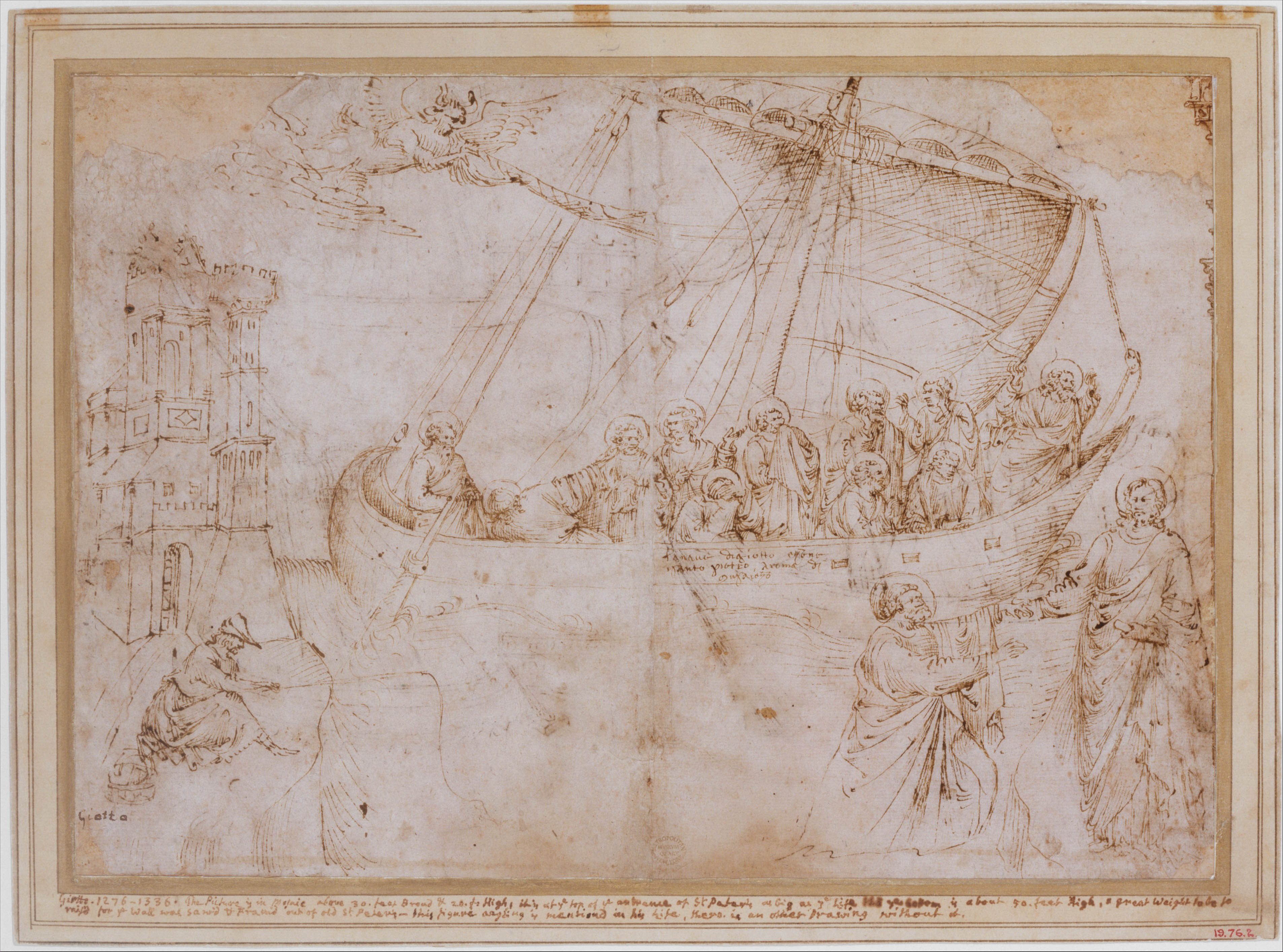
Parri Spinelli’s free copy of the mosaic, ca. 1420, Metropolitan Museum of Art, New York

The demolition of the old basilica and the construction of the new one advanced gradually, from the apse toward the façade. By 1610, the works had reached the front of the church. By then, the basilica’s clergy had recovered from their initial shock and began rescuing what they could. The mosaic was detached and reassembled, but in the process, much of its original character was lost. The version that Orazio Manenti installed above the interior doorway of the new basilica in 1674 is more a weak Baroque imitation than a faithful restoration. One doubts Giotto would have claimed paternity for it.
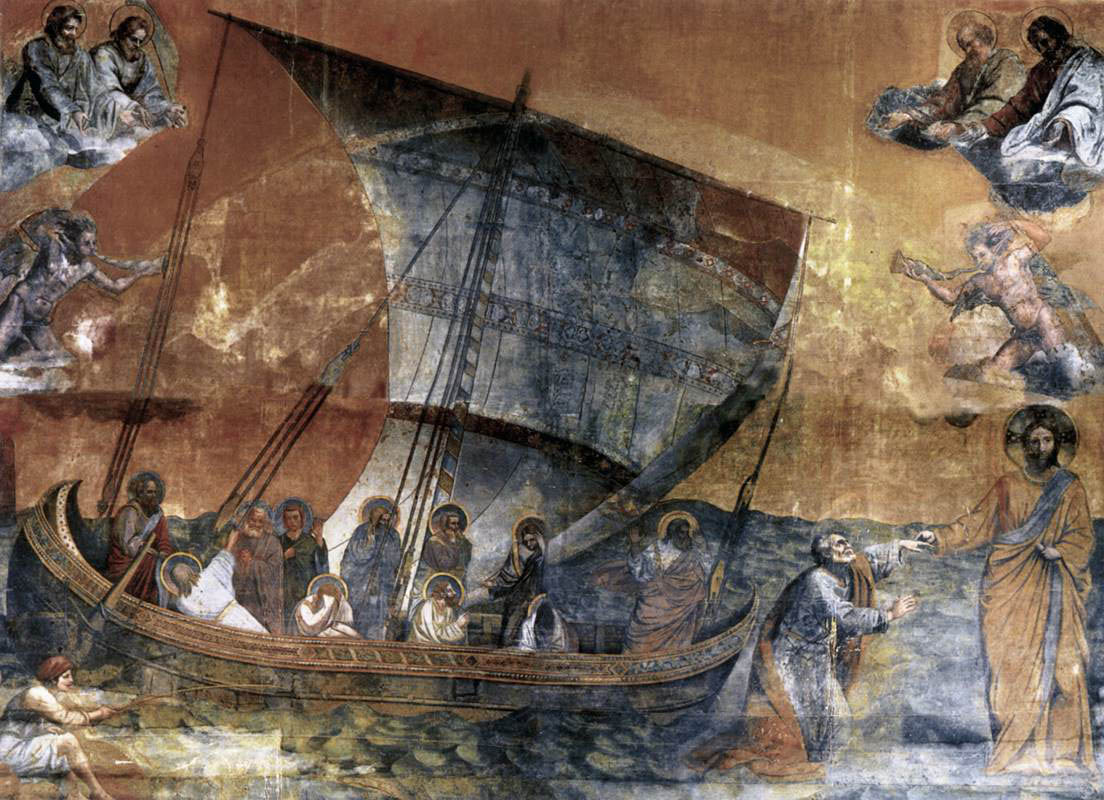
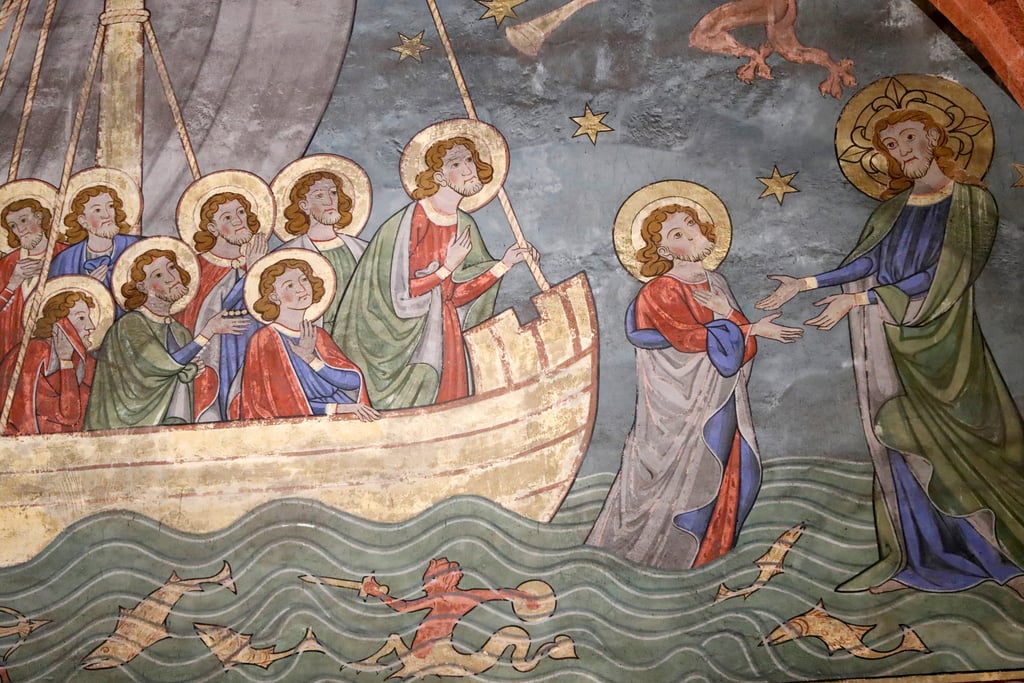
Fortunately, several contemporary copies of the original mosaic survive — and they are of far higher quality than the mutilated remnant in Rome. One of the finest can be seen in Strasbourg, in the Church of Saint Pierre Le Jeune, where the composition — contemporary with Giotto’s original — was reimagined north of the Alps in the Gothic style that was fashionable there.
 

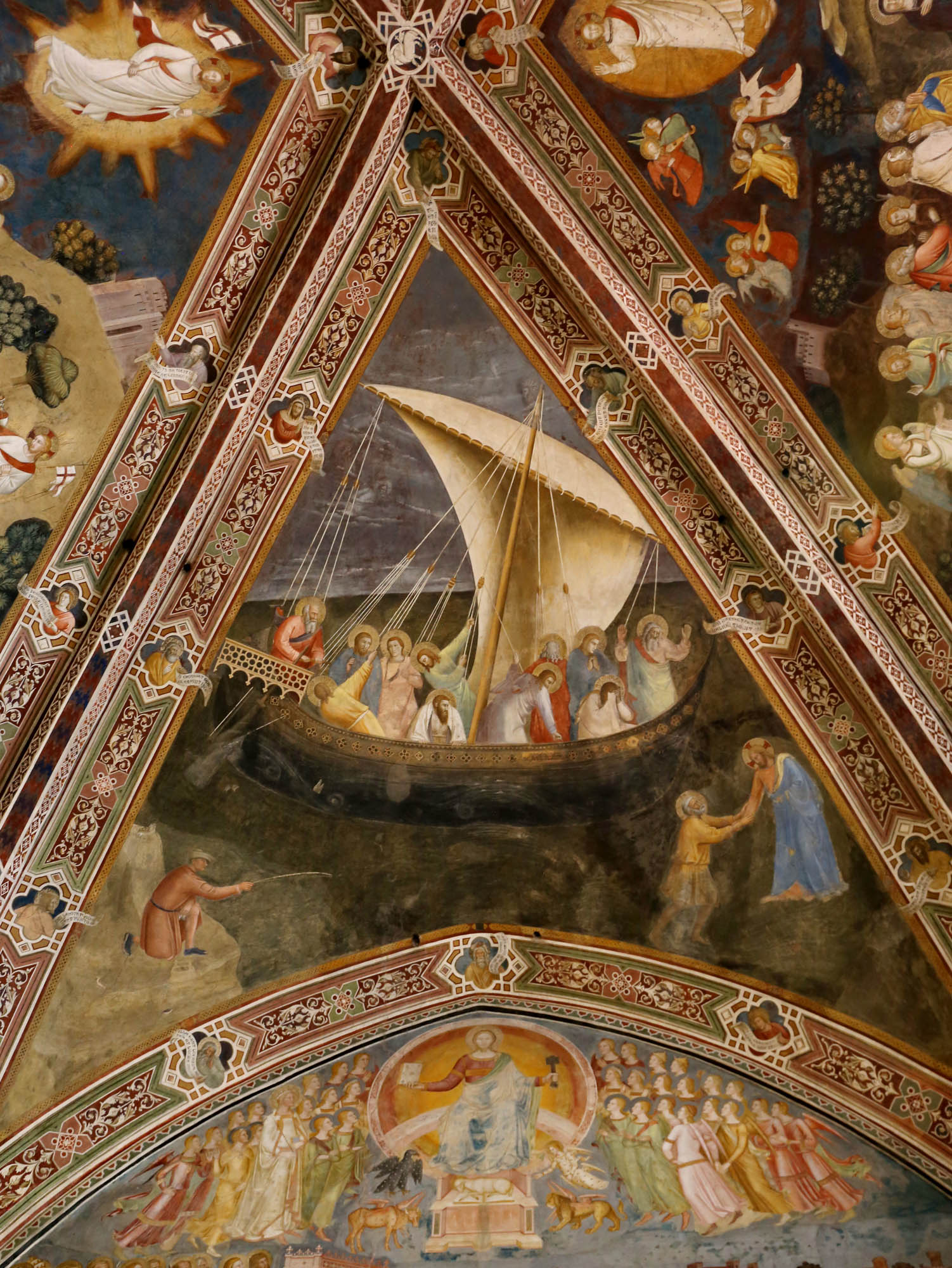
Another, painted not long after, was executed by Andrea di Bonaiuti between 1365 and 1367 in the so-called Spanish Chapel of Santa Maria Novella in Florence — a version I’ll soon write more about in detail. In Bonaiuti’s fresco, the wind-blowing demons have vanished, replaced by a fisherman on the left — utterly absorbed in his fishing, oblivious to the miraculous scene before him, like the fisherman in Brueghel’s Fall of Icarus.
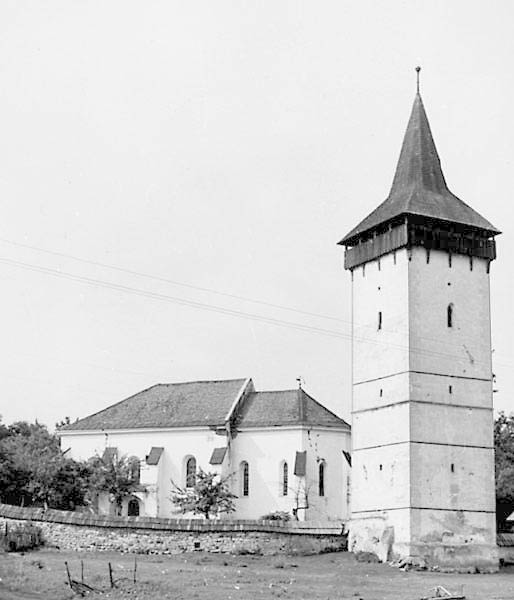
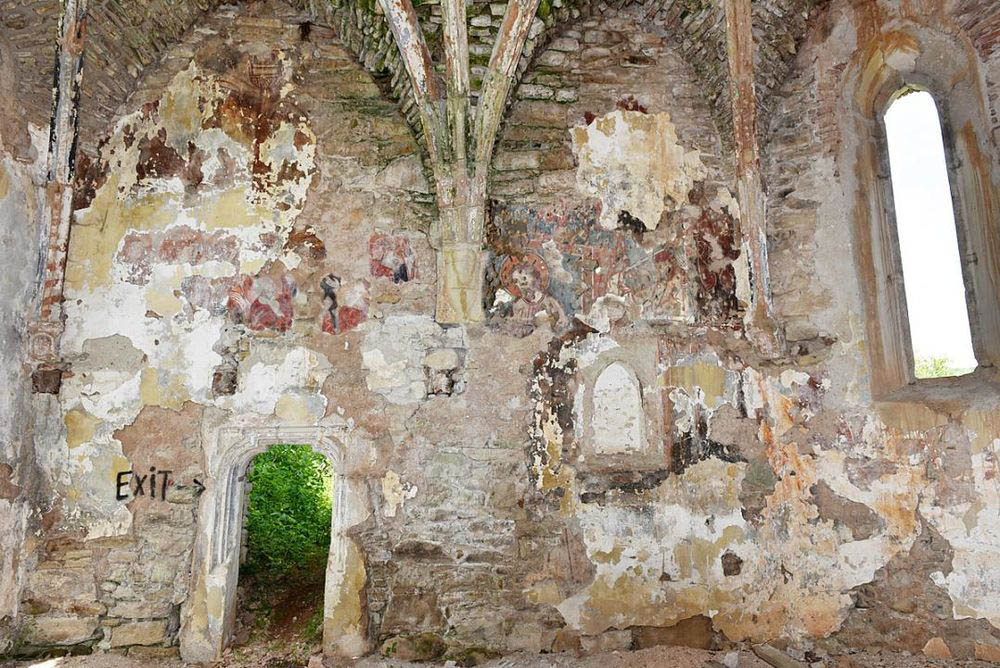
And in 2016, fragments of a 14th-century copy were uncovered in the ruins of the medieval Saxon church of Kiszsolna (Senndorf/Jelna) in Transylvania. Along with those in Strasbourg, Florence, and Pistoia, it is one of only four contemporary European reproductions of Giotto’s Navicella. The composition can only be recognized by the trained eye, so rather than reproducing the image here, I’ll direct readers to art historian Tekla Szabó’s excellent study, which also shows how Giotto’s design inspired other contemporary frescoes in Transylvania and Upper Hungary — depicting sailing ships that symbolized either the Church itself or the martyrdom of Saint Ursula and her companions. An article of the since defunct Népszabadság nicely summarized the importance of that discovery.
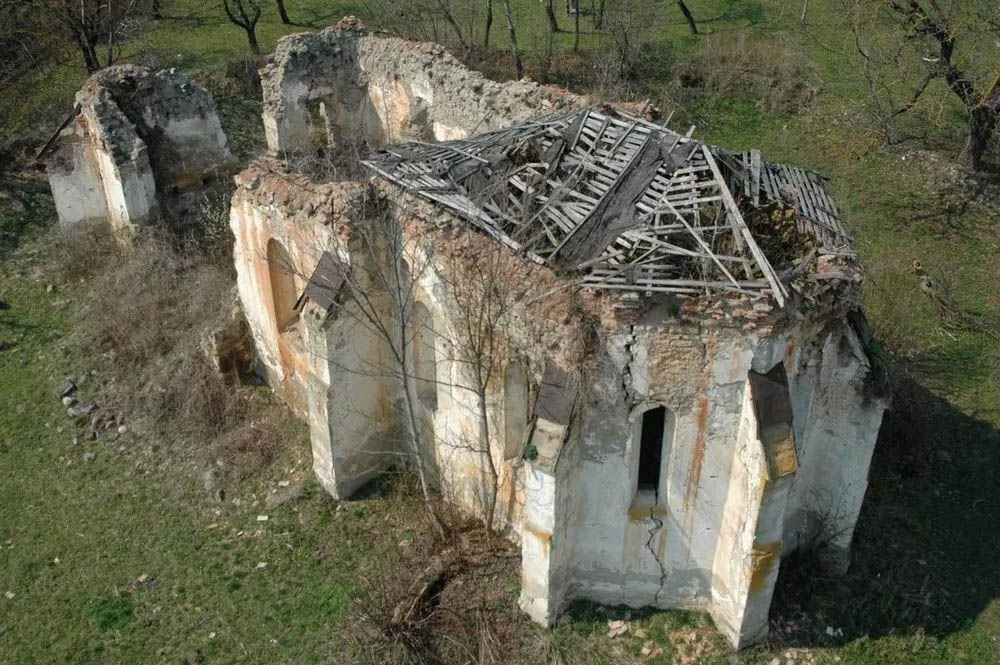
The church of Kiszsolna today and in the 1940s, with the remaining fresco fragments in the sanctuary

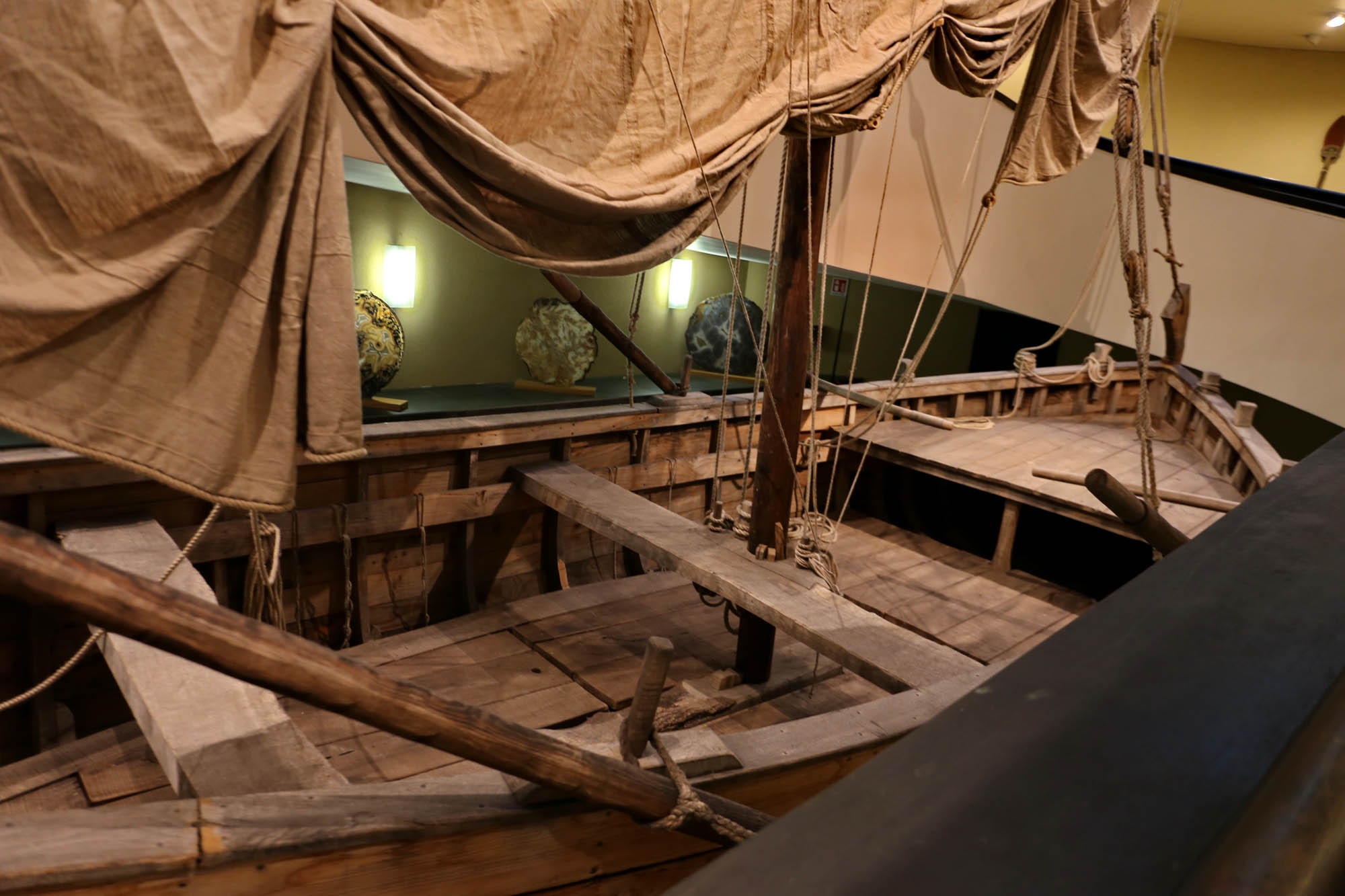
A year ago, however, another boat arrived in the Vatican — no less symbolic than Giotto’s mosaic vessel. In 1986, when the water level of the Sea of Galilee dropped unusually low, archaeologists discovered in the mud a nine-meter-long sailing boat — a typical fishing vessel from the time of Christ, with four oars and room for twelve men. Carbon dating and ceramic analysis placed it between 50 BC and 50 AD, meaning it could well have belonged to Peter or one of his fellow fishermen.

A replica of this Galilee Boat, made for the Aponte family — a seafaring dynasty from the Bay of Naples active since the 17th century — was presented to Pope Francis in March 2023, just before the Feast of the Annunciation.

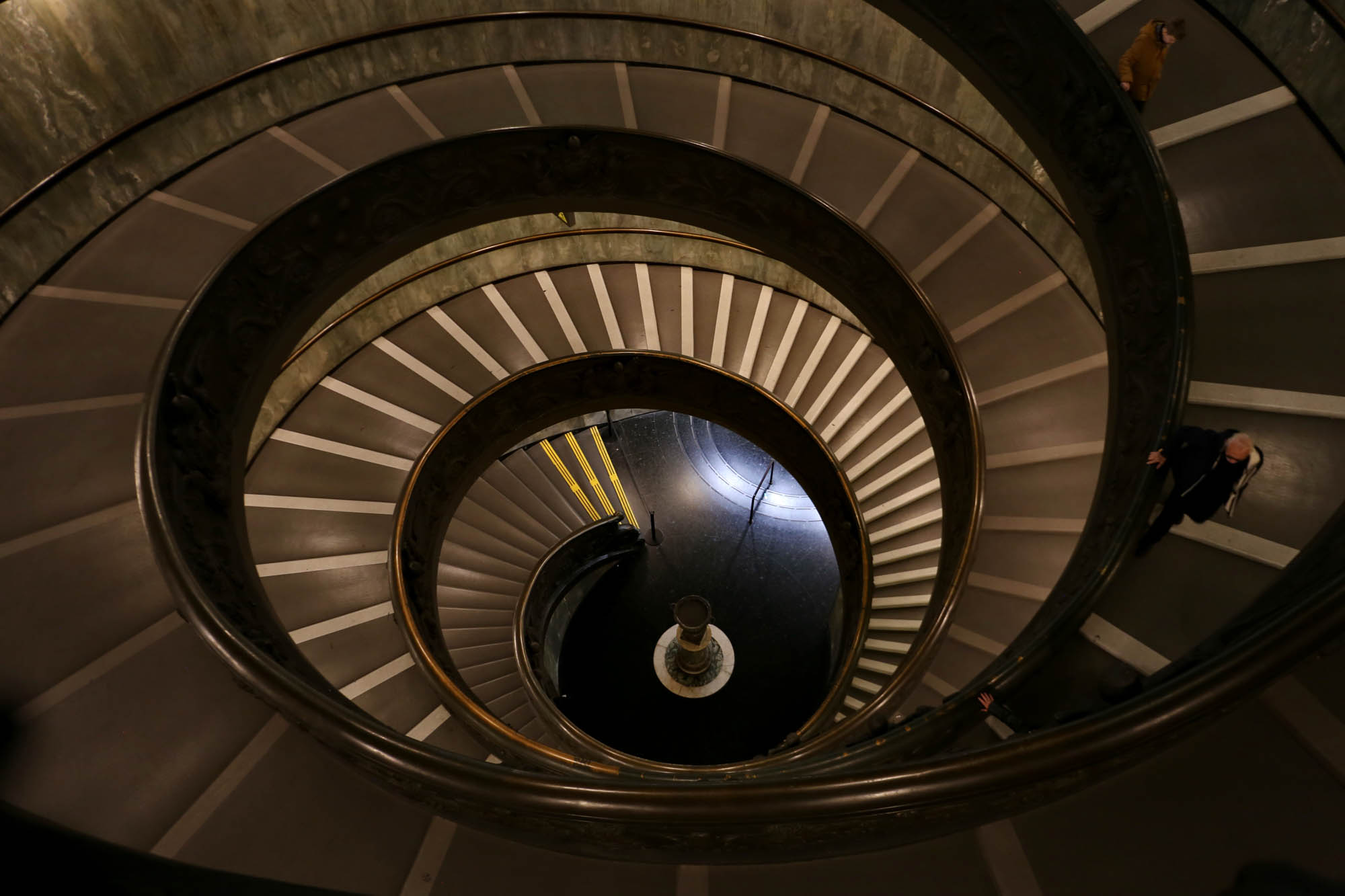
This Boat of Saint Peter, though not mounted on the basilica’s façade, now welcomes modern pilgrims at the entrance to the Vatican Museums, set in the middle of the grand staircase leading up to the galleries — a quiet reminder of the Church’s origins, and an anchor cast deep into time.

navicella1navicella1navicella1navicella1navicella1navicella1

Él da la nieve como lana


«Él da la nieve como lana,
y derrama la escarcha como ceniza»
(Salmo 147:16)

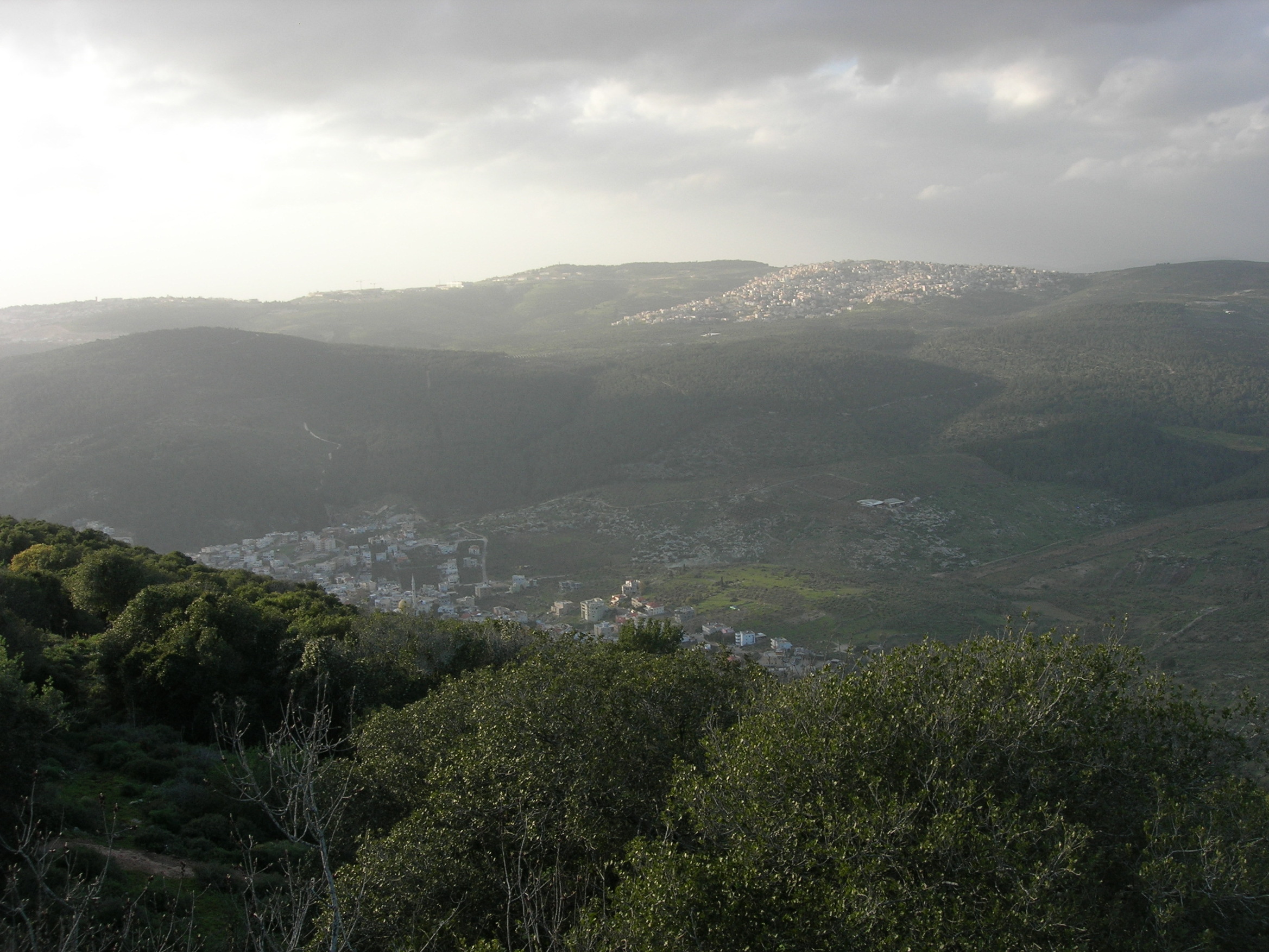
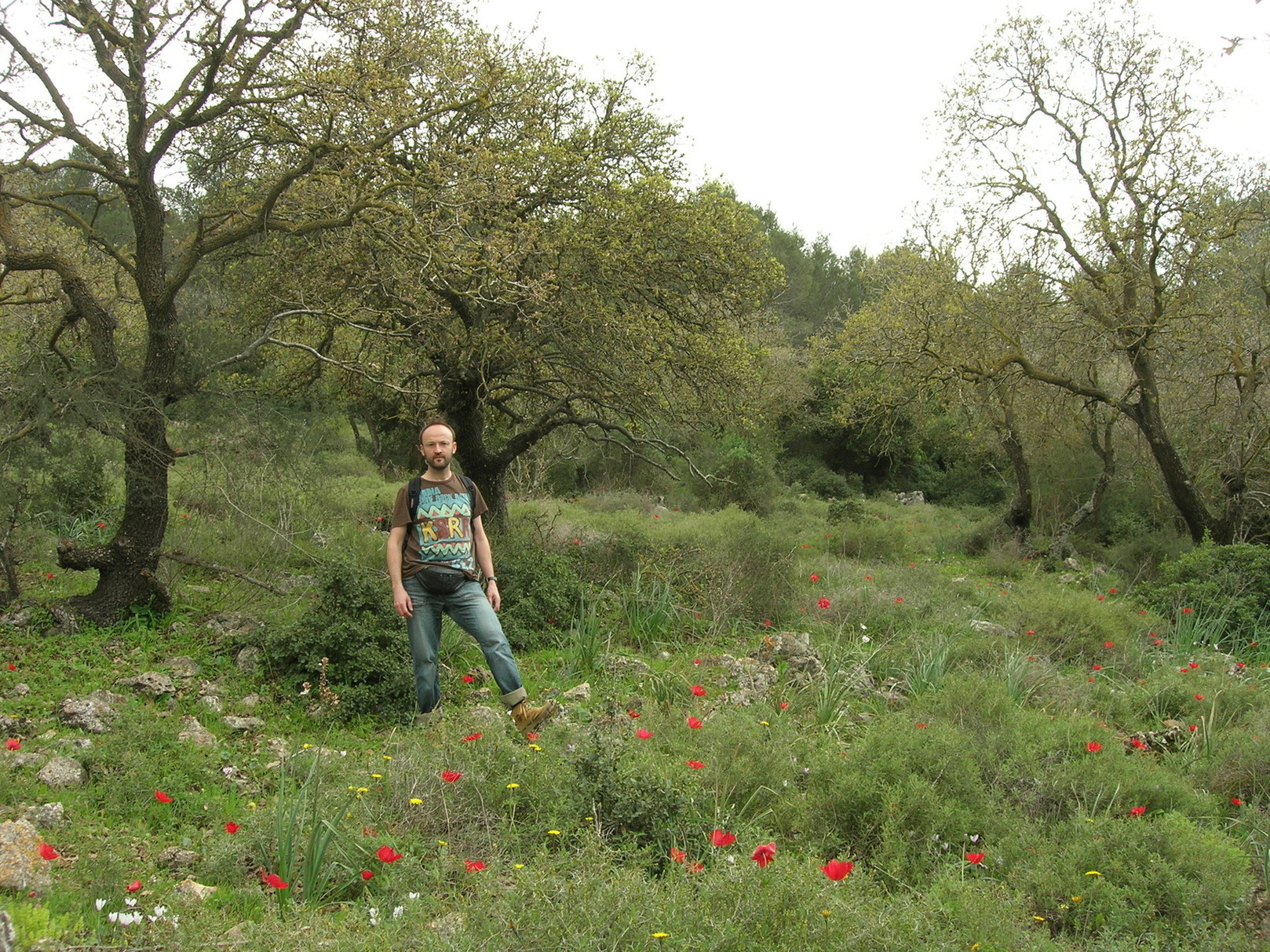
El salmo que corresponde al día de hoy en la liturgia católica es el 147, pero se nos hizo presente hace dos semanas, junto con casi todas sus imágenes, cuando huíamos del invierno danés en Israel, buscando un poco de primavera. El primer día fue realmente primaveral: veinte grados y buen sol. Emprendimos una larga caminata desde Nazaret a través de tantos paisajes pintorescos para subir finalmente al Monte de la Transfiguración o Monte Tabor, como luego se le ha llamado. Avanzamos extasiados por una espléndida alfombra de flores que lo cubría todo.


«El Señor hace crecer la hierba de los montes,
y las plantas para uso de la gente»

(Salmo 147:8)

No imaginamos que éste sería nuestro primer y último día de primavera israelí. Por la noche empezó a llover y así continuó sin remisión durante varios días.

«Él es quien cubre de nubes los cielos, 
el que prepara la lluvia para la tierra»
(Salmo 147:8)

Llovió incansablemente durante tres días, lo que para Israel, que siempre lucha contra la sequía, fue sin duda una gran bendición. No tanto para nosotros. Bajo la lluvia desoladora fuimos en autobús a Jerusalén, donde el agua convertía las calles en ríos y la temperatura no pasaba de cinco grados.

«Él deja caer las piedrecillas de granizo; 
y a causa del frío todo se congela»
(Salmo 147:17)

Era realmente terrible. Me puse dos jerseys y encima dos abrigos para pasear por la ciudad; porque una vez que se llega a Jerusalén, no será una maldita lluvia la que consiga encerrarnos en el hotel, ni toda el agua que pueda empaparnos las zapatillas de verano.


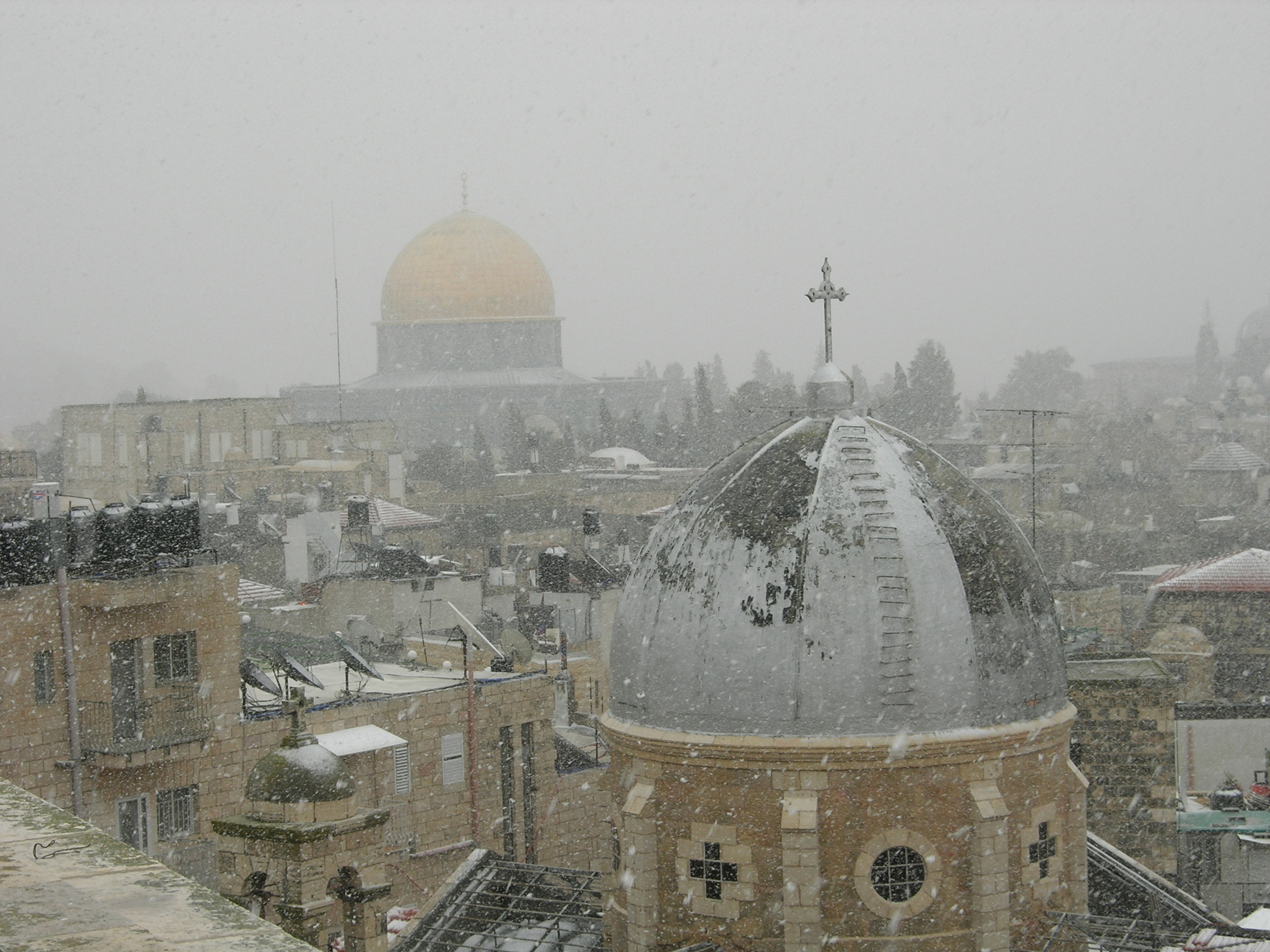
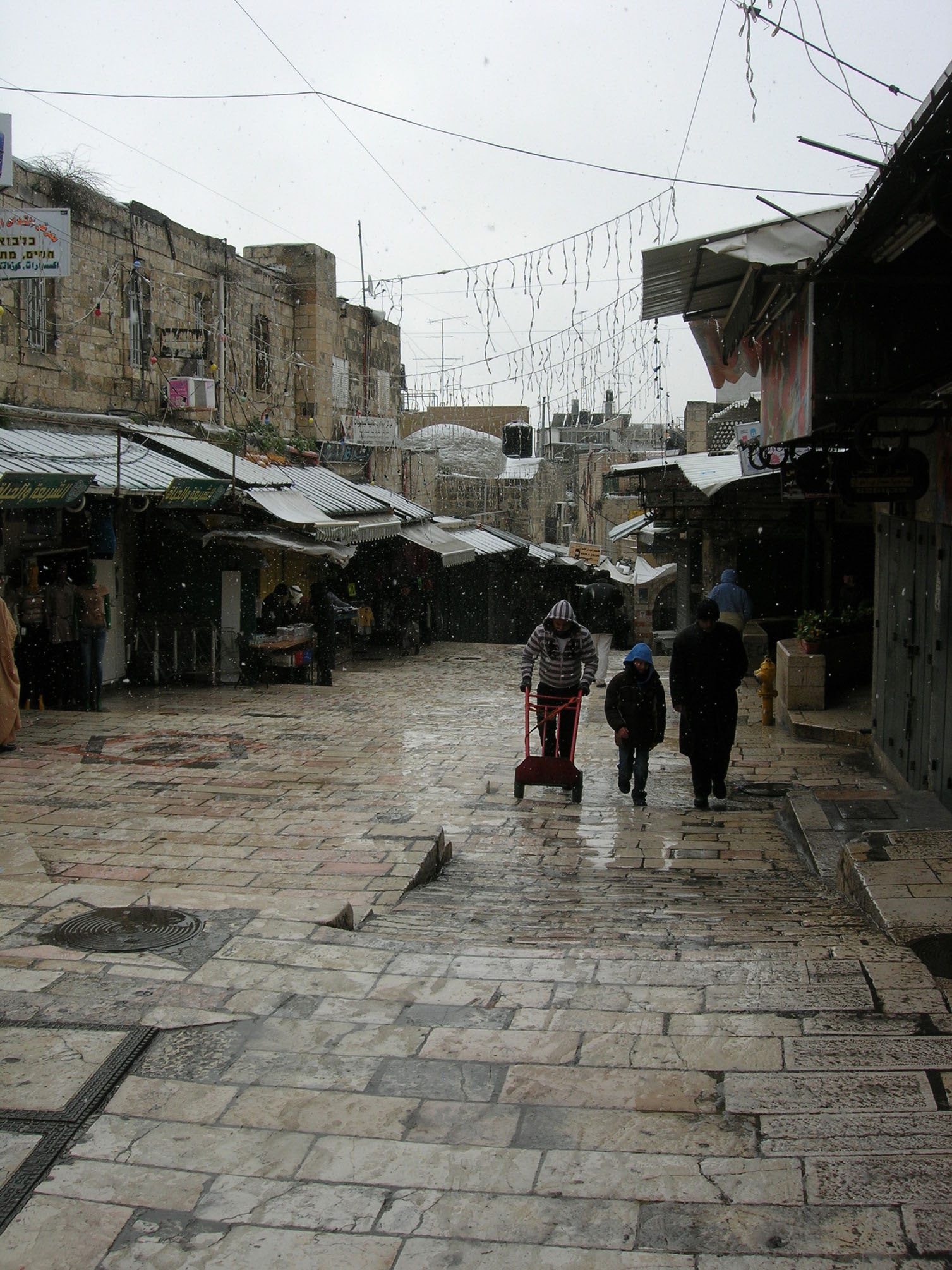
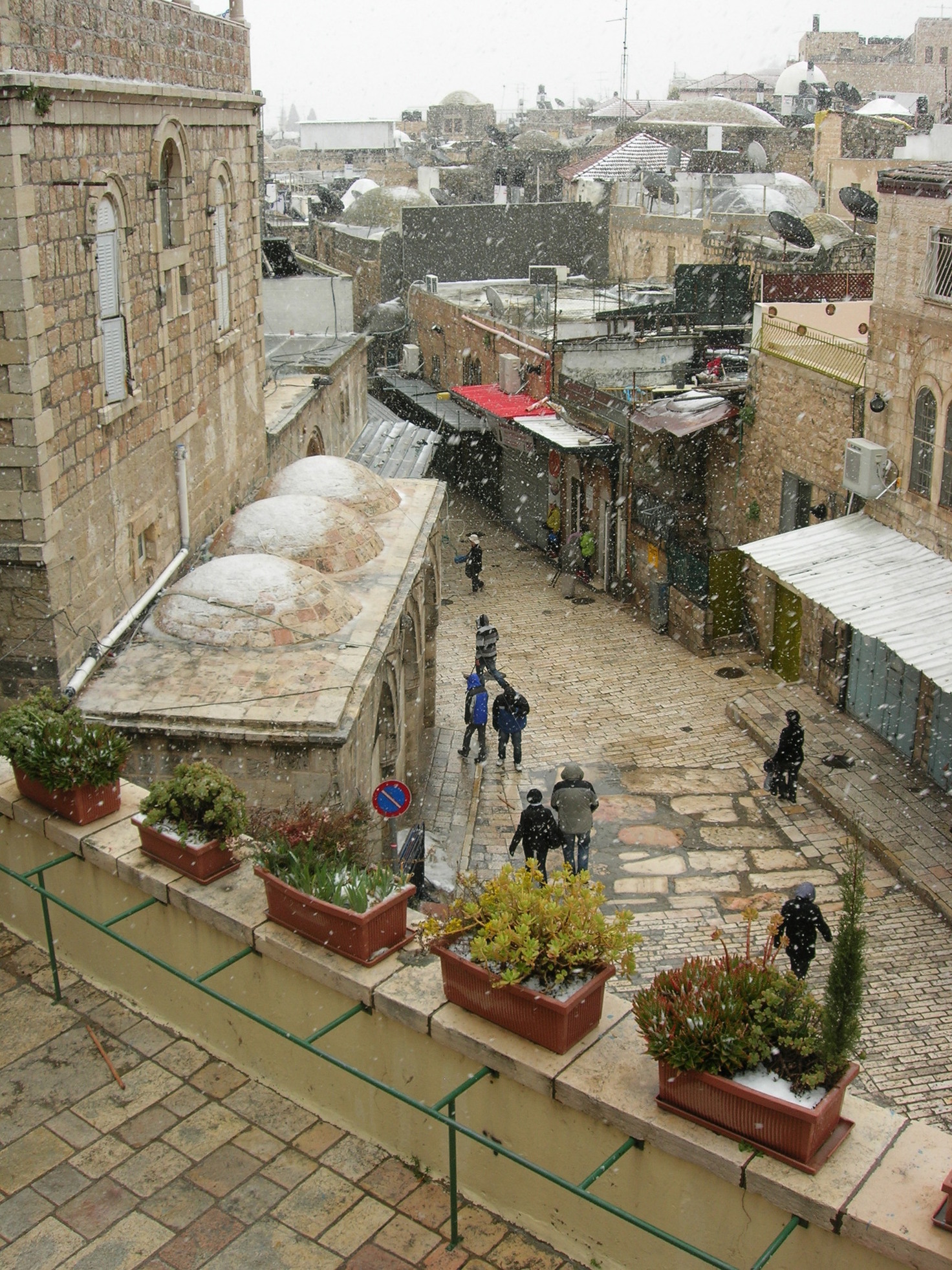
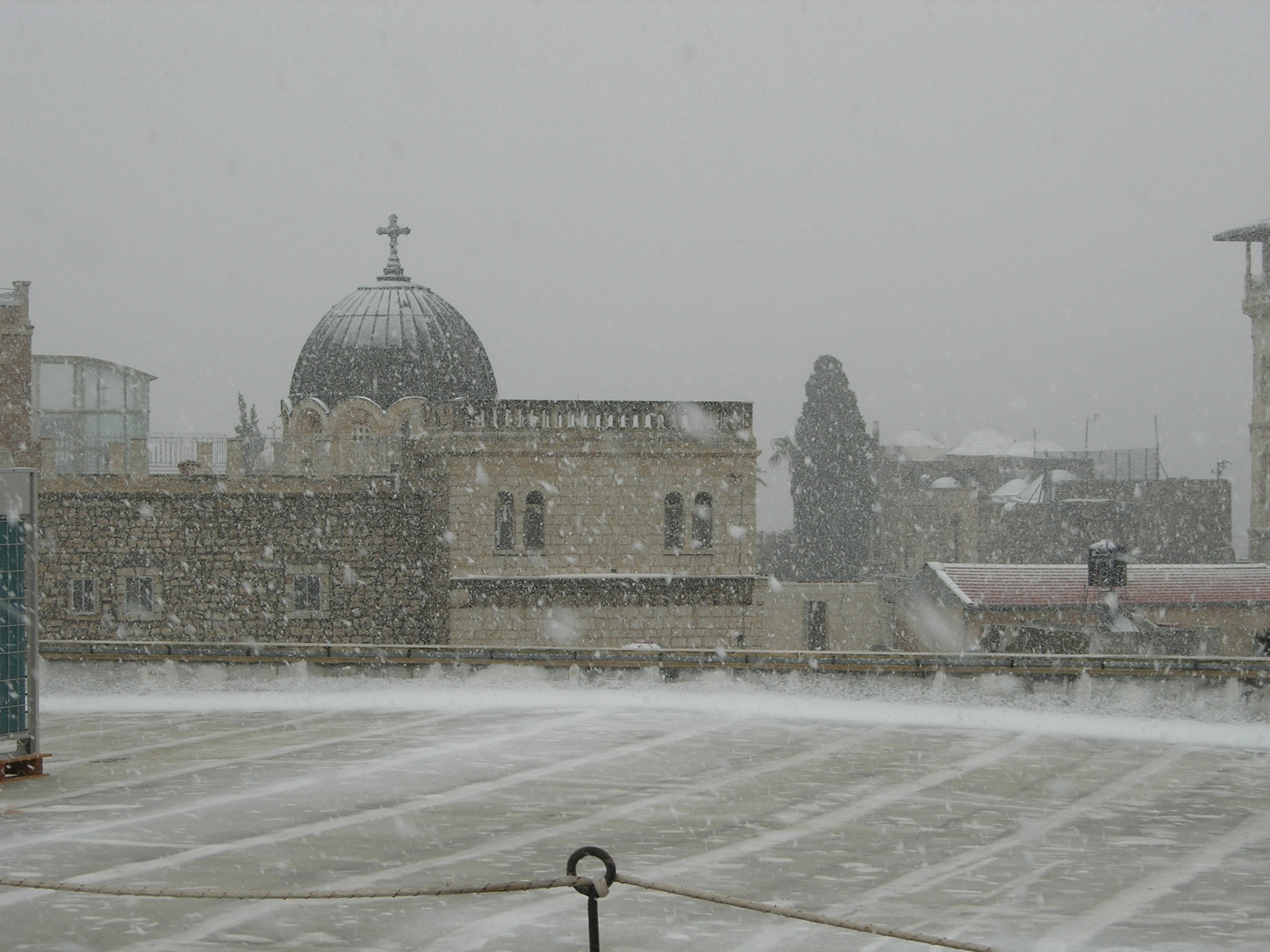
A la mañana siguiente, dos de marzo, ocurrió sin embargo un milagro que suele acontecer en Jerusalén cada cinco años y que nos hizo olvidar todas las penalidades de los días anteriores. Comenzaron a caer gruesos copos de nieve. Nevó durante aproximadamente una hora, a ratos con una intensidad de tormenta, y el suelo se cubrió finamente de blanco. Por descontado, la nieve no nos llegó hasta la cintura, como en aquel invierno de 1921 del que no hace mucho vimos las fotos, pero fue una nevada de verdad, espesa y permanente. Y nos sumergimos en el bullicio que se provocó en las calles de Jerusalén.


«Él da la nieve como lana
y derrama la escarcha como ceniza»
(Salmo 147:16)

La gente de allí se emocionaba con este fenómeno extraordinario. Algunos incluso llegaron a Jerusalén desde el campo, la noche anterior, al oír la noticia de la inminente nevada, no fueran a perderse el acontecimiento. La insólita nevada se puede ver en unos cuantos vídeos en la red: aquí sólo quiero compartir dos breves secuencias muy hermosas. El primero está filmado en la ciudad vieja, y el segundo en la parte moderna, al oeste de Jerusalén. Los podríamos haber filamdo nosotros mientras paseábamos exactamente por estos mismos lugares:


Los vídeos fueron tomados por dos personas distintas, lo que hace sorprendente la similitud de la música elegida para acompañarlos. Esta música atemporal, de guitarra acústica, suave, en vivo contraste con la más fuerte, más dinámica y en general con toques orientales que vierten las radios israelíes, revela bien el asombro y la admiración con que los lugareños experimentaron este fenómeno natural excepcional —en las pocas horas que tardó en fundirse.


«Enviará su palabra, y los derretirá;
soplará su viento, y fluirán las aguas.
Alaba a Jehová, Jerusalén;
Alaba a tu Dios, Sión»
(Salmo 147:18, 12)


He spreads the snow like wool


He spreads the snow like wool
and scatters the frost like ashes.

(Ps 147:16)

In the Catholic liturgy, the psalm of today’s Holy Mass is the 147th. It was exactly this psalm which came to life before us, together with almost all its images, when two weeks ago, in the last days of February we escaped the Danish winter and headed to Israel in search of some springlike weather. Our first day was springlike indeed: twenty degrees with sunshine. We started for a long hiking from Nazareth, wandered through picturesque landscapes, and finally successfully climbed the Mount of Transfiguration, or Mount Tabor, as it is called today. And we were enraptured by the magnificent spring flower carpet covering everything.


He makes grass grow on the hills,
and plants for people to use.

(Ps 147:8)

We did not know that this would be our first and last springlike day in Israel. That evening it started to rain, and it spilled  hopelessly for several days.

He covers the sky with clouds;
he supplies the earth with rain.

(Ps 147:8)

It was pouring non-stop for three days, which for Israel, which is struggling with the drought, was certainly a huge blessing, but not so much personally for us. In this desolate rain we went across by bus to Jerusalem, where the water was running in streams over the streets, and the temperature was not more than five degrees.

He hurls down his hail like pebbles.
Who can withstand his icy blast?

(Ps 147:17)

Well, we certainly could not withstand it. I had two pullovers and two coats on while roaming about the city, because once you are in Jerusalem, you will certainly not lock yourself up in your hotel room for some bloody rain, however much it flows in streams through my summer shoes.


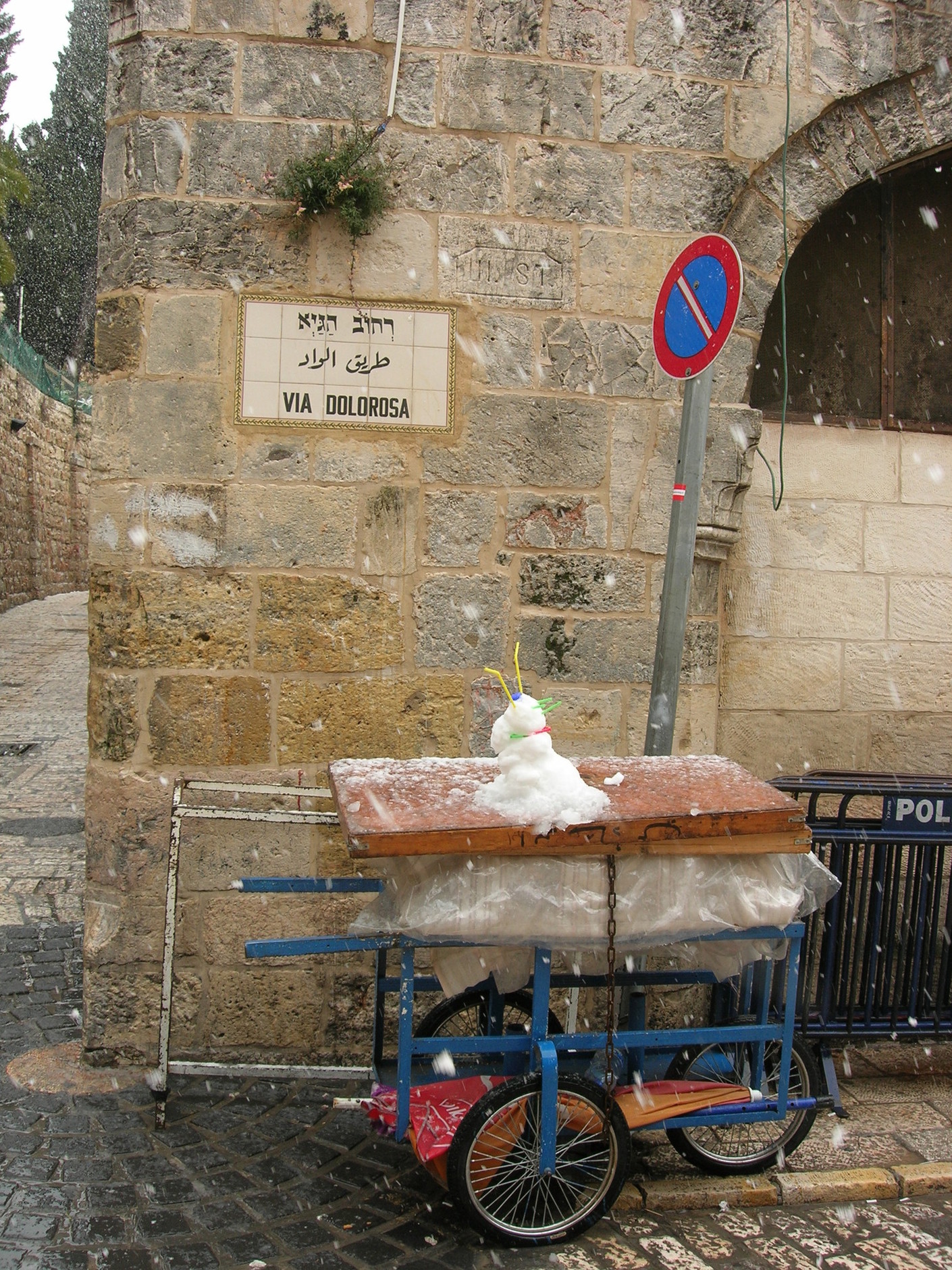
The next morning, on the second of March, however, a miracle occurred which happens once every five years in Jerusalem, and which made us forget all the hardships of the previous days. It started to snow in huge flakes. It was snowing for about a hour, at times with the intensity of a snow storm, and it covered the soil with a thin layer for some hours. A waist-deep snow, like during that ominous winter of 1921 we have recently shown photos about, there was not, of course, but a real, thick, permanent snow, yes. We threw ourselves into the bustle of snowy Jerusalem.


He spreads the snow like wool
and scatters the frost like ashes.

(Ps 147:16)

The locals were also completely excited by this extraordinary natural phenomenon. Some even traveled from the countryside to Jerusalem the previous night at hearing the news about the impending snowfall, just not to miss the big event. The snowfall itself is presented in several videos on the net: I just want to share two beautifully cut short ones with our readers. The first one was made in the Old City, and the second in the modern, western part of Jerusalem. They could have been made by ourselves, too, as we walked through exactly these places:


The two videos were taken by two different local residents, so it is very striking how similar the music are which accompany them. The timeless, gentle acoustic guitar music which is in such a sharp contrast to the louder, more dynamic, oriental-spiced music generally pouring from Israeli radios, renders really well the awe and admiration with which the locals watched this rare natural phenomenon – for the few hours until it melted.


But he sends his word and melts them;
he stirs up his breezes, and the waters flow.
Extol the LORD, Jerusalem;
praise your God, Zion.

(Ps 147:18, 12)


A happy Christmas / Una feliz Navidad


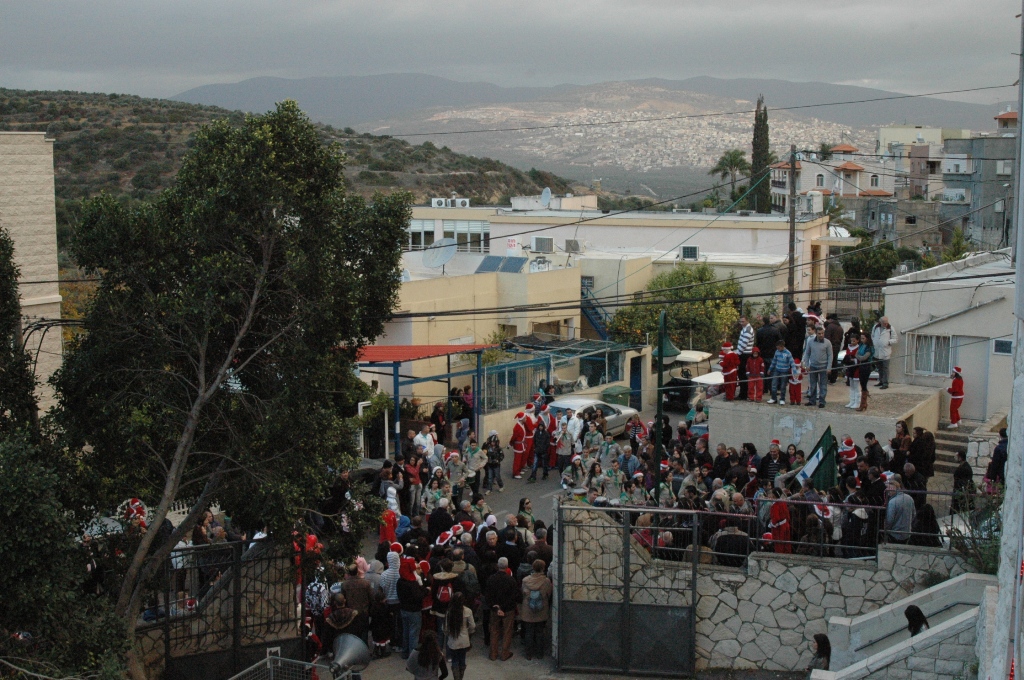
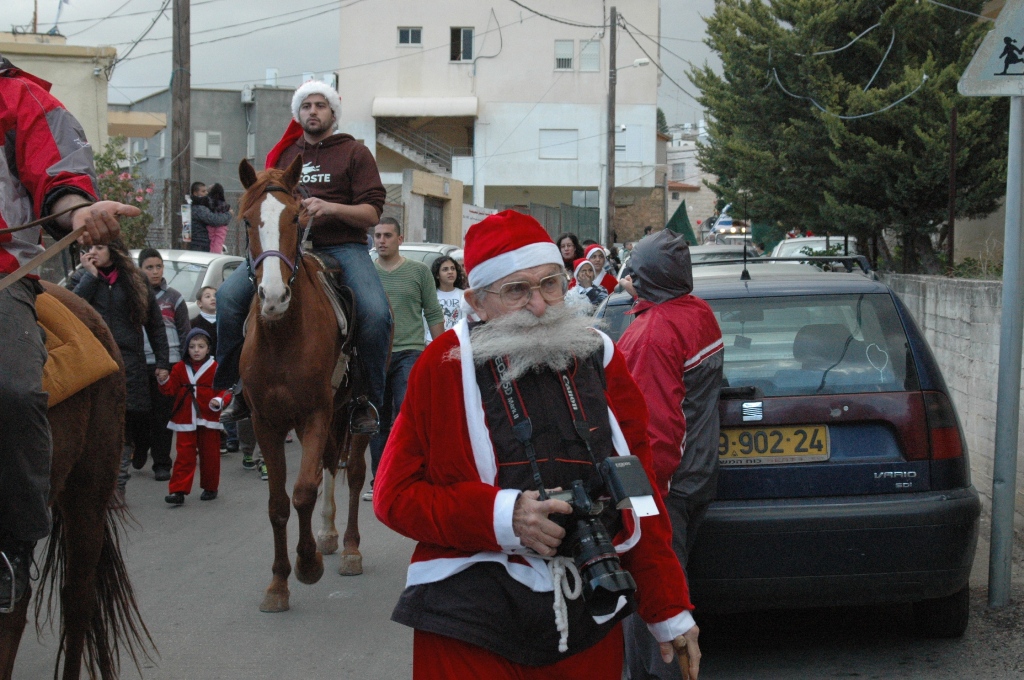
Probably the church of the Arab Catholic village of Eilabun in Galilee is the only one in the world whose Orthodox iconostasis was made by a Jewish icon painter, Sergei by name. In the town of four thousand inhabitants – whose name was made worldwide known by Hishram Zeiq’s 2007 film on the massacre of Eilabun committed by the Israeli troops in 1948 – they celebrate on Christmas afternoon the festive parade opened by the band of the Arab scouts and ended by that of the Jewish scouts. Photos by Nakaryak. Turn on the video at least for a background music.Probablemente, la iglesia del pueblo católico árabe de Eilabun, en Galilea, sea la única del mundo cuya iconostasis ortodoxa ha sido hecha por un pintor de iconos judío, de nombre Sergei. En esta ciudad de cuatro mil habitantes —que se hizo famosa internacionalmente en 2007 cuando Hishram Zeiq estrenó su película sobre la matanza de Eilabun, cometida por las tropas israelíes en 1948— celebran en la tarde de Navidad un desfile encabezado por la banda de los «scouts» árabes y cerrado por la de los «scouts» judíos. Fotos de Nakaryak. Vale la pena activar el vídeo al menos como música de fondo mientras veis las fotos.

Nakaryak/Рыжий, the author of the original Russian post has notified us in a comment that the scouts whom we have considered Jewish on the basis of their green ties (and who carry the Israeli flag) are just as Arab as those with the yellow-white ties. In the version of the post which he published on the Ботинок portal he also quotes another Russian post on the Arab inhabitants of the village, which we will try to translate and publish soon.


Frescoes rediscovered

He was clutching a piece of black bread he smuggled home and had a passport in the pocket to flee the country. He had a number of powerful and precise words behind him, as well as some stories that make him one of the greatest authors of the 20th century, and before him a manuscript which should have been his masterpiece and which has never been found. At this precise point, at the corner between past and future, in front of the Maryla shop between the Czacki and Mickiewicz streets, time has stopped him forever. *

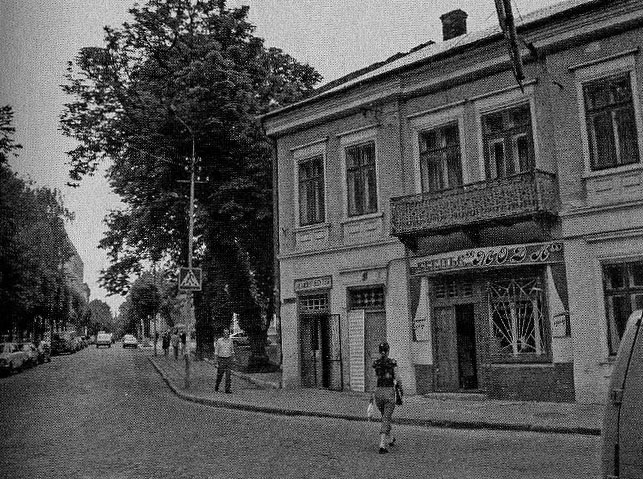
The corner at the Maryla shop in the 1920s and in 2004. From the books by Р. Пастух:
Вулицями старого Дрогобича
(On the streets of the old Drohobycz), Львів:
Каменяр 1991, and Omer Bartov: Erased: vanishing traces of Jewish
Galicia in present- day Ukraine,
Princeton University Press 2007.


Bruno Schulz, a writer in Polish language, was born in a Jewish family in Eastern Galitsia, now in the Ukraine. He is best known for his Cinnamon Shop and Sanatorium under the sign of the Hourglass, but he was also a provocative and unorthodox designer. The engravings of his The Idolatrous Booke, published in 1922, provoked a certain scandal.


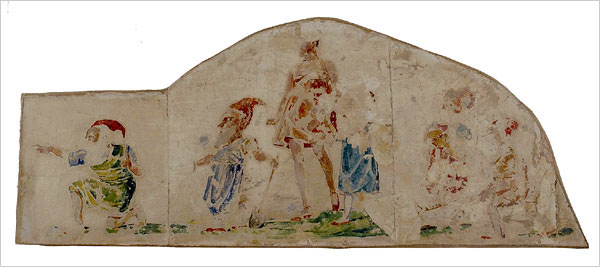
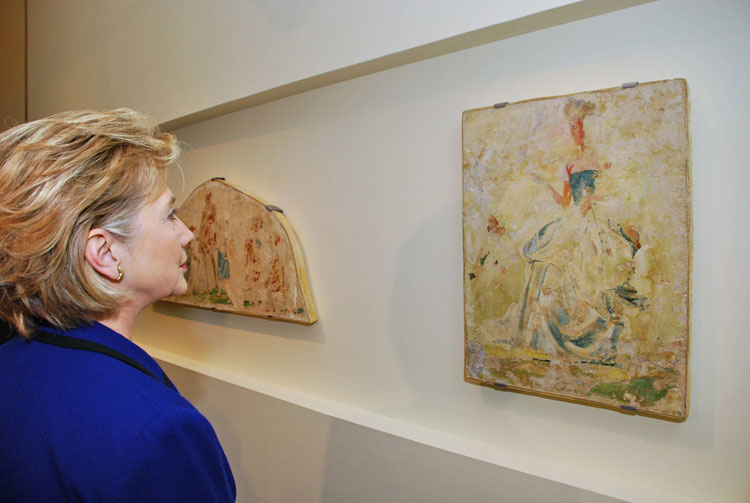
During the Nazi occupation of his native Drohobycz – a then tripartite city, according to a well-known definition: 50% Polish, 50% Ukrainian and 50% Jewish – Schulz was confined to the ghetto together with other Jewish families (of the 15,000 Jews in the city before the war, only 400 were saved from the mass executions and the extermination camp of Belżec), obtaining a temporary protection by the SS officer Felix Landau, who ordered him to paint some frescoes for the children’s room in the house he had put in requisition. Those paintings are the ultimate witness of the genius of Bruno Schulz.

On 19 November 1942, during an operation in the city that killed 264 Jews, another SS officer, Karl Günther killed Schulz on the street with a blow on the head, so that he could later boast to Landau who had offended Günther by killing “his” Jew, the dentist Löw. The writer’s body was buried in the Jewish cemetery in a mass grave. During the Soviet period, the cemetery was obliterated by a quarter of gray barracks. So there was left nothing of Schulz in Drohobycz, not even the frescoes covered with various layers of paint and time and then forgotten.

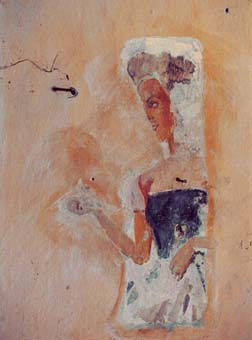
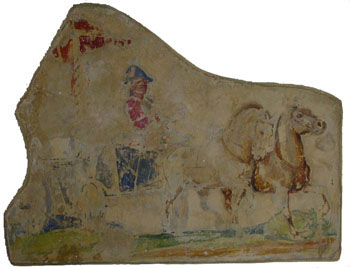
On 9 February 2001 Benjamin Geissler, a German documentary filmmaker, after a long search managed to identify the house occupied by Landau during the war. A team of experts started to remove the outer layers of paint from the walls, and found traces of frescoes painted by Schulz, representing scenes inspired by the fairy tales of the Brothers Grimm.


While in the Ukraine the restoration of the paintings was being planned, on 21 May the five fragments hitherto brought to light suddenly disappeared. They were removed from the walls together with the plaster.


Later the Yad Vashem Holocaust Museum in Jerusalem announced that they entered into their possession. It was then revealed that some people had carried out a flash operation on the commission of the museum and perhaps with the help of the Mossad in order to remove the frescoes and to transport them to Israel, which claimed the moral right to their possession as an evidence of the Shoah.

An international quarrel broke out: to whom do these paintings belong, to Drohobycz and the Ukraine, to the Polish culture, or to the Jewish heritage and the memory of the Holocaust? Bruno Schulz, long forgotten and regarded with some suspicion in the Ukraine because of the Polish language of his works and by the Poles because of his Jewish origin, became a subject of contention and dispute between states, intellectuals and historians.

Finally in 2008 an agreement was born. Israel acknowledged that the paintings belonged to the Ukrainian cultural heritage, while the Museum of Drohobycz which preserves the other fragments of the fresco recovered subsequently, agreed to grant the paintings removed as a long-term loan in favor of Yad Vashem which in February 2009 exposed them to the public for the first time.

Secretary of State Hillary Clinton visiting the exhibition

But this story still has something to say. The author’s powerful and precise words planted roots and gave more fruits. Bruno Schulz in the frescoes realized for the sadistic Nazi murderer of Jews Landau, portrayed himself and some other Jewish inhabitants of the city on the frescoes. The woods painted on the fairy tale scenes are reminiscent of that of Bronnitzky at the gates of Drohobycz, where in those days an authentic witch hunt took place (and the witch portrayed here had the face of Landau’s lover), resulting in the assassination and burial of thousands of Jews.


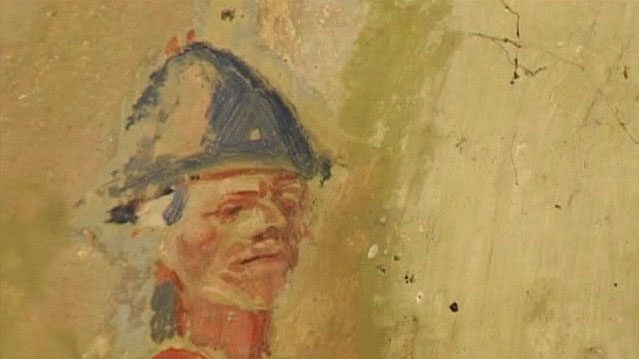
And the coachman driving two white horses has the same irregular face of the author, loking at us with a look of defiance, able to pass through almost 70 years of neglect to tell us and bear witness to those tragic days.


The discovery of the portrait of Schulz from the film realized by Beniamin Geissler