Switch over to our new blog! • ¡Pásese a nuestro nuevo blog!

The renewed version of our blog, with more features, a richer design, and available in nine languages, can be read here: https://wangriver.com

The new version also includes the old posts, often in expanded form. If you are curious about the updated version of this post, replace “riowang.blogspot.com/” in the URL with “riowang.studiolum.com/”, and the new link will most likely lead you there.


La versión renovada de nuestro blog, con más herramientas, un diseño más rico y disponible en nueve idiomas, se puede leer aquí: https://riowang.com

La nueva versión también incluye las publicaciones antiguas, a menudo en una forma ampliada. Si tiene curiosidad por la versión actualizada de esta entrada, sustituya «riowang.blogspot.com/» en la URL por «riowang.studiolum.com/es/», y el nuevo enlace probablemente le llevará allí.

Mostrando entradas con la etiqueta wine. Mostrar todas las entradas

My Tokajs


In September, we organized with Dani Ercsey a tour called “The Route of Jewish Wine”, as we followed the route from the Hungarian Tokaj to the Polish Galicia and to Lublin in the former Russian Poland, along which Jewish wine traders transported the wine of Tokaj to the north, and the “princes” of the Hassidic rabbinical dynasties descended to the south. We are still in debt with a detailed report on the tour. However, we received a short impression from one of the participants, Anna Gáspár (Kempfner), with the comment that if we consider it good, we can publish it on the blog. Two days after sending us her essay, Anna suddenly died of a heart attack. We publish her writing, the last harvest of a rich life, in her memory. Our illustrations were made during our last common tour.

ANNA GÁSPÁR: MY TOKAJS

Plural, possessive case?

It occurred to me near Mád, when I introduced myself to the hitherto unknown fellow travelers, while tasting Tokaj wines: I have Tokajs, in plural. I don’t think it meant anything to anyone else but me when I suddenly uttered it.

Mád, Tállya, Tolcsva. This is how we learned the most famous places of the Tokaj wine region. Mád, Tállya, Tolcsva, this is how I memorized them as a little schoolgirl in 1950.

Some ten years later, I became friends with Polish architects in a university internship. First we visited for three weeks their wonderful country, from the Hel Peninsula to Krakow. We were amazed at their astonishingly modern architecture and fascinating historical world, we listened to the Polish language full of consonants, enjoyed the fragranes and tastes, were fascinated with their fashion that was very different from ours. We were delighted to see their extremely imaginative design, witty posters, their so different culture.

And then they came to us, enchanted at the sight of our capital that survived the war, enjoying the summer atmosphere of Lake Balaton. I went with them to Eger, Miskolc, Tokaj. I was their interpreter. I thought, Russian will be no problem to a Slav. But Polish students did not like Russian, and hated the RUssians. They absolutely did not want to speak Russian.

I had to learn Polish. They helped me, laughed at me, corrected me. I listened to them, I fantasized. We were happy. They loved Hungary and loved me. And in Tokaj, when descending through some hole into a cellar, it turned out they also loved Tokaj wine.

It was cool down there. We also got some food, we tasted a lot of barrels. As we ascended to the open sky, on a bright day, if I remember well, we fell on our fours, unable to walk. We somehow pushed our way to the campsite at the foot of the Tisza bridge. Whoever saw us on the road, must have had fun.

I was shocked by the grayness and poverty of the town. Is this Tokaj?

It did not take another ten years for Tokaj to reappear in my life, already familiar. In my first workplace, my first and only husband, towards the end of his bachelor years, fully in love with me, invited me together with his colleague Pista, who came from Erdőbénye in the Tokaj region, to the Tokaj Wine Bar near the Opera House. We impressed each other a lot, the two drink-resistent men and myself, the resh graduate engineer. As they later told me, I drank a liter of Tokaj Furmint on the spot. I enchanted them. Laci then married me, we had three children, and we lived together as long as he was alive. Was Tokaj wine the cause of it all?

Our children grew up and flew away, and Laci had arrived to the end of his road, when, unexpectedly, I became a vineyard owner in Tokaj, in Erdőbénye, next to Mád, in the Omlás Slope. Some fifty years have passed since our drinking at the Opera House. Although I have not become a wine addict – for many reasons –, I lived as a wonderful adventure the decade of being transformed from an unexperienced city dweller into a Tokaj oenologist. The transformation was due to Alex, my sommelier friend from Barcelona, the descendants of Pista, Mari and Bálint, and Józsi Pethő of Erdőbénye, who cultivated my one-hectare “estate” as his own. And, of course, to the wine school I completed in the meantime.

The splendor of nature, the magical and unlearnable vine cut, the spring bud-opening full of hopes, the quiet, chubby, secret blooming, the growing tendrils, the slow ripening of the bunches, and the late October harvest with the fragrance of honey, walnut and plum. This is what the vineyard gave to me, with its fruit blessed with different treasures every year, created from the same minerals, the same soil, and the ever-changing weather.


Must and wine. In Tokaj, you don’t have to manipulate it. Here the wine is samo-rodni, born by itself, and who would understand it better than I?

We made good wine. Hungarians, Slovaks and Poles gladly consumed it at the inebriated Erdőbénye Festivals.

But I have no vineyard any more.

This year, in early autumn, the magical Tokaj wine enticed me to a new adventure: traveling, exploring and tasting a wide variety of Tokaj wines. Not only in the Tokaj wineries, but also in Slovakia, and in Polish Galicia. Many wines, many synagogues, many hills, many little towns, many Jewish cemeteries within and beyond the borders. I did not care that it hurted here and there, that I could walk only a little, that I had trouble to stand waiting.

And in the Polish Tarnów, a miracle happened.

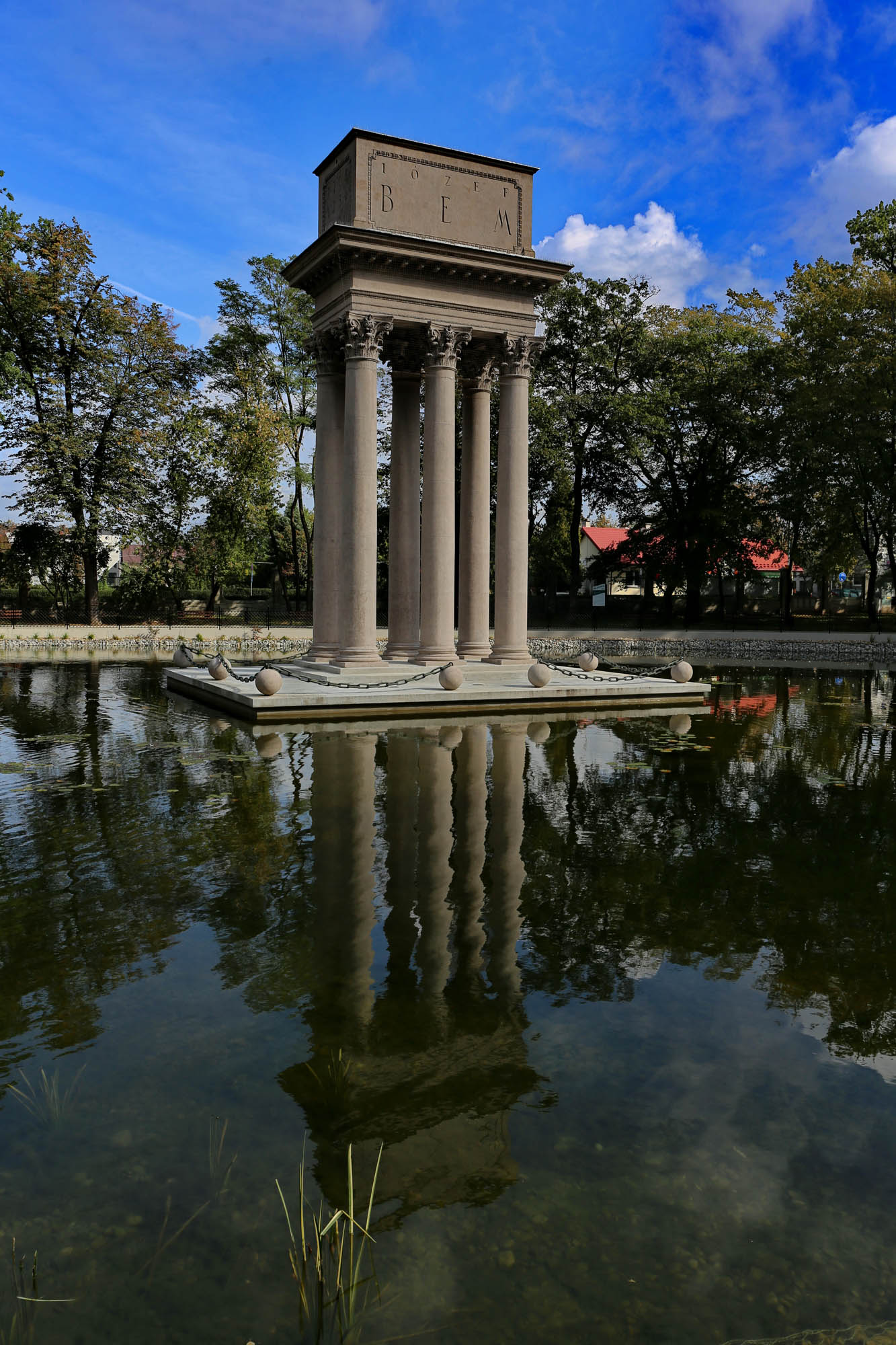
Here was born and here is buried Bem Apó, floating between heaven and earth, because at the end of his life he converted to Islam, and he was not allowed to be buried in a consecrated land. His tombstone is worthy of his deeds: the sarcophagus hiding his mortal remnants is held by six snow-white pillars standing in the middle of a lake.


Still, this was not the miracle of Tarnów.

In the evening, in the restaurant of a funhouse-like hotel converted from an old-fashioned Monarchy-era post office, where every wall was covered by huge paintings, portraits and landscapes in the wildest and darkest colors, the works of a poor painter who paid for the room and board for his pictures (oh, horror, I wish he would have not done that) – so, in the evening in the restaurant we tasted Tokaj wines, just like on other days. At the end of a great dinner, this time three kinds of dry Tokaj samorodni.

A Mezőzombor Disznókő Wine House 2015, and an Olaszliszka 2009 samorodni from the French Samuel Timon. The third one I do not remember.

It took my breath away. I remained speechless. Never before I experienced this kind of enjoyment, beauty, dazzle and obliteration. Nothing and everything, a gift of nature, for which I am grateful from the bottom of my heart.

Wines of my body and soul, Tokaj wines, my Tokajs.


Polyphemus’ ruin


In the post Good wine needs no bush the gastronomical aspect of the topic was lost. That is: what kind of wine was offered by the ingenious Ulysses to the Cyclops who had devoured his companions? And is Studiolum right when he is afraid of the wine offer of the Caffè del Centro in Piazza Armerina? And in general, what and where to drink if we come to this part of Sicily?

The mosaics focused on by the post depict a Greek story, whose respective episode takes place in today’s Sicily, so I will obviously not talk about Roman, but rather Greek wines, as well as modern Italian wineries.

At the time of Homer, in the 8th c. BC already existed Greek settlements and poleis in the island, but viticulture was much more rudimentary than around the emitting poleis. This is why Polypheus says that although he also has wine, but it cannot compete with the nectar obtained from Ulysses.

“He then took the cup and drank, he was so delighted
with the taste of it that he begged me for another bowl full:
ʻBe so kind’, he said ʻas to give me some more, and tell me your name at once.
I want to make you a present that you will be glad to have.
We have wine even in this country, for our soil
grows grapes and the sun ripens them,
but this drink is like nectar and ambrosia all in one.”
(Homer, Odyssey 9, translated by Samuel Butler)


Ulysses took home wine on his journey, that is, wine of Ithaca, and although ancient Ithaca’s position is at least controversial today, nevertheless we can state that whether the wine came from modern Ithaca, or from the neighboring Cephalonian peninsula of Paliki – which was probably an island at that time –, it was sweet and strong, and the sailors diluted it with seawater to drink. Today, PDO Robola, PDO Muscat and PDO Mavrodaphne stand out among the wine regions of Cephalonia. Each denotes a grape variety. The first one typically gives light, dry white wines, so this region is most in line with today’s wine consumption. The other is a local clone of one of the oldest grape varieties, Muscat Blanc à Petits Grains, which produces natural sweet wines and so-called fortified sweet wines (where the fermentation of the wine is stopped by the addition of alcohol, so it remains sweet). Finally, Mavrodaphne is a naturally sweet red wine, so it is closest to the former Greek wine culture, where sweet wines were typically produced by drying the grape on straw bed after harvest, thus concentrating its sugar content. Then it was pressed, eventually enriched with previously prepared sweet wine, and then they added spices and seawater to it. The best example of this type of wine (although no spices are added any more) is the wine Methyse of 2004 from Cephalonia’s Foivos Winery, considered one of the highest rated Greek wines of recent years. (And the wine Commandaria of the Greeks of Cyprus, which has been traditionally made in this way to this day.)

However, we know that Ulysses did not offer his own wine to the Cyclops:

“I also took a goatskin of sweet black wine
which had been given to me by Maron, son of Euanthes,
who was priest of Apollon, the patron god of Ismarus,
because we spared his life and also his wife and son,
who lived in the wooded precincts of the temple.”

Unfortunately, the ancient fame of the wine region PGI Ismaros in Thrace is brighter than its present. Maron is only remembered by a seaside wellness hotel, and in terms of wines, there is no trace of one of the most famous, most dense and sweetest red wine of the ancient Greek world, the only one that had to be diluted in 1:20 proportion (!) so it would not make you drunk. (Nevertheless, I do recommend at least one local vinery, where you can find not sweet red, but light, modern dry white wines: the Kikones.)

Well, back to the streets of Piazza Armerina, where Greek wine is definitely no longer on offer today. Barely two hundred years after Homer, in the 6th century BC, the wines of the region not only reached, but exceeded the quality of Greek wines. This is partly because the Greek settlers, perhaps under Etruscan influence, began for the first time in the world to plant grapes in rows, in stalk cultivation, thus first establishing a monoculture of wine. The first steps to it already appear on the shield of Achilles, in Homer’s Iliad:

“He wrought also a vineyard, golden and fair to see,
and the vines were loaded with grapes.
The bunches overhead were black, but the vines
were trained on poles of silver
He ran a ditch of dark metal all round it,
and fenced it with a fence of tin;
there was only one path to it,
and by this the vintagers went when they would gather the vintage.
Youths and maidens all blithe and full of glee,
carried the luscious fruit in plaited baskets;
and with them there went a boy
who made sweet music with his lyre,
and sang the Linus-song with his clear boyish voice.”
(Homer, Iliad, 18, translated by Samuel Butler) 

Grape harvest in the reconstruction of the shield of Achilles. Above in the cover of the 22 September 1832 of Penny Magazine, below in Kathleen Vail’s reconstruction


Sicily, Magna Graecia of the time, was also called Oenotria, the “land of grapes cultivated on stalks”. The quality and reputation of local wines grew rapidly, but the history of today’s Sicilian wines was influenced at least as much by Arabic raisin culture, Normann gastroculture, Etruscan grape varieties, Roman and Carthaginese taste, as today’s marketing trends and Italian cuisine.


The Caffè del Centro mentioned by Studiolum in fact does not seem like anything more than a mediocre pub, although on TripAdvisor it has 4.0 from 37 reviews and on Google 3.8 from 21, so it must be a good place for a sandwich or other snack. The wine bar with the bakery is on Piazza Garibaldi, but its mother shop works in a narrow street beyond the corner (Via Guglielmo Marconi 2), and offers only coffee and cakes, perhaps some sandwiches. Most points are lost on the speed and quality of service. Wine is mentioned only once: a commenter in this summer wrote that the “local” wine was very poor. The quotation mark raises questions, but unfortunately the shop has no wine page on the net, nor has it any web page. Let’s accept that the wine is poor, but is it not local? In Sicily this is almost unimaginable. What is local wine and where can you get it in this charming little town?

Vineyards next to Piazza Armerina

The closest wine region is Riesi DOC to the southwest of the city. The most important grape variety of its white wines is Inzolia (also known as Ansonica), a variety producing a white wine of neutral taste, or with hazelnut characteristics. Many believe it to be of Greek origin, but it was in fact first described in 1696 (by the first Sicilan botanist, Francesco Cupani, in his Hortus Catholicus), and it also occurs in Sardinia and Tuscany. French Chardonnay is also important here. One of the two must be present in at least 25% in every Riesi Bianco wine, as well as in the sparkling wines and local sweet wines (vendemmia tardiva).


In red Riesi wines, Nero d’Avola (sometimes called Calabrese) or Cabernet Sauvignon are the most important. Nerello Mascalese is mainly used for rosé wines. The top wines of Superiore and Superiore Riserva can only be made from the local Nero d’Avola. For a first taste, I recommend the Riesi Rosso of the Feudo Principi di Butera winery, a relatively simple, but well-drinkable red wine from 2015.


The Cerasuolo di Vittoria DOCG wine region to the south-east of the town and of the mosaics is also known for its Nero d’Avola (Calabrese) and Frappato grape varieties. They are often marketed together as a cuvée. The Cerasuolo di Vittoria Classico DOCG red wine of 2015 from Azienda Agricola Cos received a very high rating from international experts, but if you are also price sensitive, try the Cerasuolo di Vittoria DOCG of 2015 from the Feudo di Santa Tresa (and don’t be afraid of the newer vintages, either).

Centuries-old farm to the south of Piazza Armerina

So far I have only recommended red wines. Let’s see the white wine situation. Sicily is one of the best known wine regions in the world, interestingly rather thanks to Lampedusa’s Panther and Marlon Brando’s godfather than to its wines. The southern island evokes the idea of “red wine region”, while it has more white wine than red!

Bar Vitelli, the site of Godfather in the movie’s Corleone (in reality, Savoca)

The Catarratto Antisa 2018 wine from the Tenuta Regaleali winery (Tasca Group, Conti d’Almerita) allures you with its fresh acidity and cypress flavor, which is no wonder, since the grapes grow 900 meters above sea level. This is the wine of freshly fried or deep-fried seafood, so it’s worth trying more than once.


As far as the site is concerned, that is, where one should have a glass of wine in Piazza Armerina, the folks of the internet clearly recommends the Bla Bla Wine Bar in Via Garibaldi 89. It received a 4.9 from 7 ratings, which emphasize its good wines and good atmosphere. It is only open from 5.30 p.m., but then until 1.00 a.m. TripAdvisor gives it 5.00 from 19 ratings, that is, the best available. They have no website, their FB page is not updated, so I could find no wine list. But if you ask for Catarratto (white) or Nero d’Avola (red), you will not be disappointed. And if you will mention the above wineries and wines, they will think you are an expert.

Just take care your wine tasting should not end up in Kottabos, one of the most famous Sicilian wine game of ancient times, which, if truly authentic, is assisted by a devoted young servant who only wears a string of flowers on his head, and puts the plastinx back in place and refills the wine bowls…


Good wine needs no bush


The Villa Romana del Casale in the center of Sicily, a few kilometers from Piazza Armerina, is one of the largest preserved mosaic ensembles of the ancient world. The senatorial owner of the Roman villa from the early 4th century adorned his huge mansion with over 3,500 square meters of first quality mosaics. Since the villa, built away from all settlements in a wooded valley, was first and foremost an elegant hunting lodge where the owner and his friends or clients retired to refresh themselves from Roman political life, most of its mosaics depict hunting. The floor of the guest suites displays hunting for local game, so the guests can dream about them before they pick up the compulsory hunting equipment at dawn and go to the woods. And on the floor of the large common space between the suites of the guests and of the dominus, mosaics depict hunting for exotic African and Indian beasts which the dominus probably dreamt of, or perhaps he also procured such animals for the Roman Circus.

All of these will be discussed in a future post. Now I just want to talk about the scene decorating one of the dominus’ suites. To be exact, the antechamber of the domina’s bedroom (marked with a red dot on the floor plan). This mosaic shows a story that you do not want to dream about. It is the episode from the Odyssey where the Greeks venture into the giant cave of the one-eyed Polyphemus – which is known to have been in Sicily –, and the terrible cyclops begins to devour them. Then Odysseus walks up to him, offering him a large jug full of night-colored wine, and, having made him drunk, puts out his single eye with a sharpened and heated stick.


Obviously, the terrible scene is made suitable for the antechamber of a bedroom by the soporifer, dream-bringing nature of wine. It is also conceivable that in this room the domina had wine with the dominus before bedtime. More to the point, this antechamber leads not only to the one-person female bedroom, but also to a cubiculum to the left, whose function is made clear by the scene in the mosaic floor.


This depiction is special not only because of its explicitly erotic nature. But also because the woman here wears a bikini just like the female athletes in the villa’s fitness room or the sea goddesses in the Arion room, which are the oldest bikinis documented in Europe. And that it also offers a clue to the scholarly problem of cultural history as to which intimate garment was first removed in ancient Rome.


But every honey runs out once, as the Italian proverb holds. The villa, already devastated by the Vandals, Arabs, Byzantines and Normans, was covered by mud in a landslide in the 12th century. This layer of mud preserved the mosaics until excavations began in the 1920s. The survivors of the disaster moved to the nearby mountain, where they took with them, too, the name of the village established around the villa, Platia (palatina, “belonging to the palace”).


The new settlement, Piazza (since 1862, Piazza Armerina) inherited not only its name from the villa. The little town strives to extract all the benefits from the World Heritage site belonging to it. Hotels, restaurants, public buildings are decorated with replicas of the ancient mosaics. Clothes shops are highlighted by the bikini pictures, bus stops by the female figures of the relay race. And the cheap pub in the main square obviously uses the scene of the drunk Polyphemus as a signboard.


However, the message of the signboard is ambiguous. It can refer to the excellence of the wine offered by Ulysses, but also to its unpleasant consequences. The polyphemi gravitating around the pub door – as in the above photo – uncomfortably reinforce the latter impression.

Polyphemus with a drinking cup. Boeothia, 5-4th c. BC. Boston, Museum of Fine Arts

The enemy

Avoid alcoholic drinks!

The first glass
Sober Mike at the age of 20 and 32
The blessings of a sober life
The last glass
Drunkard Steve at the age of 20 and 32
The consequences of drinking

It is for several years now that this picture has been on the wall of the old Swabian house along the Danube * to where traditionally around this time, the end of June the Budapest-Nagymaros birthday cycling tour starts, which is such a prominent occasion that one comes home for it even from the shores of a much larger water. As we are languishing there on the porch, our eyes meet above the glass now the honest look of Sober Mike, now the watery gaze of Drunkard Steve, one bringeth fear, the other joy to me, and it is not impossible that as a consequence of the pedagogy of persuasion and deterrence one or two beer less is grabbed than could be justly taken after seventy kilometers of cycling.


This was also the purpose of the committee of the Ministry of Education which in some early year of the 20th century commissioned the design and publication of this artwork. It was surely not later than 1920, because the publishing Polatsek’s Bookstore still worked in Temesvár instead of Timişoara. But by searching for the title of the poster we find that already since 1910 it regularly featured on the lists of school supplies. In 1910 it was for example included among the school supplies requested from the Ministry by the Simontornya elementary school. In 1912 it was the only wall panel in the possession the elementary school of the Eastern Hungarian Tuzsér, and knowing well the region we find this a reasonable choice. And it was also listed together with two other posters – on the breeding of silkworms and on the operation of the steam engine – in the minutes of nationalization of the Calvinist elementary school of Dad during the short-lived first Communist proletarian dictatorship in March-July 1919. We hope it had a positive influence on the commissars. I wish there were such a panel at that time also in the Schalkház Hotel of Kassa, transformed into the House of the Soviet where, according to the daughter of the owner – Sára Schalkház/Salkaházi, shot into the Danube in 1944 for saving Jews –, People’s Commissar Jenő Landler and his staff kept drinking day and night in the middle of the general prohibition until the Czech army kicked them out from Upper Hungary, modern Slovakia.


But we also have an earlier date for this wall panel. Its scenes are included as separate illustrations in the popular anti-alcohol booklet by the pioneer of Hungarian temperance movement, Dr. Fülöp Stein: Az alkohol (Budapest 1906). Each was provided with a detailed description which cannot be very different from how they were presented by the teacher in the elementary schools.


“This is the sad picture of the drunkard’s household. The yard and the house are destroyed, rain is falling through the roof, the barn is dilapidated. The children are dirty and ragged, and they are wasted by much starvation. Their mother is perching ill on the doorstep, and the father looks at their misery with a distraught look.”


“How different is this picture, all joy, courage, good humor, the signs of external and internal order. The father watches with delight the well-being of his family. Is there anyone who would not recognize which of the two fathers is a drunkard and which a sober one? Anyone seeing and examining these two pictures will need no further explanation on which lifestyle to adhere.”


“Few people guess when they give the first glass to their children, so they would have a better mood, how fatal it can become for the further life of the child, and that the last glass of the frozen drunkard is the direct consequence of that first glass”


However, the panel is most likely not earlier than 1898. It was then that the Armand Colin & C[ompagn]ie of Paris published for the schools a wall poster which surely served as a model for the Hungarian version. We know that the anti-alcohol illustrative materials brought from the Paris world exhibition of 1901 formed the founding stock of the showroom of the Social Museum under the Rumbach street 5 seat of the Grand Templar Masonic Temperance Lodge, and although there was nothing left of the collection after the bomb hit in 1944, the Colin poster was almost surely among them.

“Here’s the enemy: the alcohol!”

However, this poster, composed by Doctor Galtier-Boissière, does not exactly illustrate the same as the Hungarian one. Although it also focuses on the difference of pre-and post-alcoholism physiognomy, nevertheless the two side panels make distinction between natural or good alcohols (beer, wine, cider and perry) and artificial or bad alcohols distilled of sugar beets, potatoes or, horribile dictu, wheat. The previous ones only make a guinea pig pleasantly dizzy and sweetly fall asleep, while the latter cause it convulsions and to snuff it. This scientifically indefensible distinction lived on in the French education until the 1950s, obviously due to the influence of the wine lobby.


A unique feature of the Colin tableau is the comparison of the look of the healthy and alcoholic internal organs, stomach, liver, heart, kidneys, brain, which must have been a great deterrent: a French gentleman is always solicitous about the public appearance of his kidneys. These were not taken over to the Hungarian poster, but they do figure in the form of a photo series in Stein’s book.

“Omnibus to Charenton! [the mental hospital]
By change through alcohol or directly through absinthe.”

The Hungarian poster is dominated instead by scenes of life. This idea could also take its origin from the back side of Colin’s tableau, which represented in four stations how the drunkard loses his will, his dignity, his judgment and, finally, his common sense.


However, their direct source must have been something else. Among the illustrations of Stein’s booklet we also find a complete life story of an alcoholic from the first glass to the last convulsion, and they are quite similar to the career summarized in two pictures on the Hungarian poster. Some research will reveal that these illustrations come from the elementary school book Histoire d’une Bouteille, “History of a bottle” by J. Baudrillard. In fact, the French temperance societies achieved in 1895 that a mandatory course was introduced in the elementary schools on the dangers of alcohol – of bad alcohol! –, equal in rank to geography or mathematics.


Moreover, the face of the protagonist, Jean-Louis at the age of 20 is confusingly similar to Sober Mike, while as a 40-year old alcoholic to Drunkard Steve.


This book shows in twelve pictures the path of the drunkard from family happiness through the fall and decay to the prison and death. The illustrations were originally black and white, and the kids had to color them, thereby carefully committing to memory each deterrent detail. For the adults they were also sold in the form of color postcards.

A happy family

The first step

Bad habits

On Pay Day

The alcoholic rage

The drunkard makes scandal

The way to craziness

The crime

On the tribunal

And despite the theatrical compositions, even though we know well that it is propaganda, this series of images does not remain ineffective on us either, for we know that what they represent was reality for thousands of families.

The woman reduced to misery

Madness

Death of the drunkard (delirium tremens)

Not for school but for life we learn.