Switch over to our new blog! • ¡Pásese a nuestro nuevo blog!

The renewed version of our blog, with more features, a richer design, and available in nine languages, can be read here: https://wangriver.com

The new version also includes the old posts, often in expanded form. If you are curious about the updated version of this post, replace “riowang.blogspot.com/” in the URL with “riowang.studiolum.com/”, and the new link will most likely lead you there.


La versión renovada de nuestro blog, con más herramientas, un diseño más rico y disponible en nueve idiomas, se puede leer aquí: https://riowang.com

La nueva versión también incluye las publicaciones antiguas, a menudo en una forma ampliada. Si tiene curiosidad por la versión actualizada de esta entrada, sustituya «riowang.blogspot.com/» en la URL por «riowang.studiolum.com/es/», y el nuevo enlace probablemente le llevará allí.

Mostrando entradas con la etiqueta cat. Mostrar todas las entradas

Dissolving: Planet of the Cats


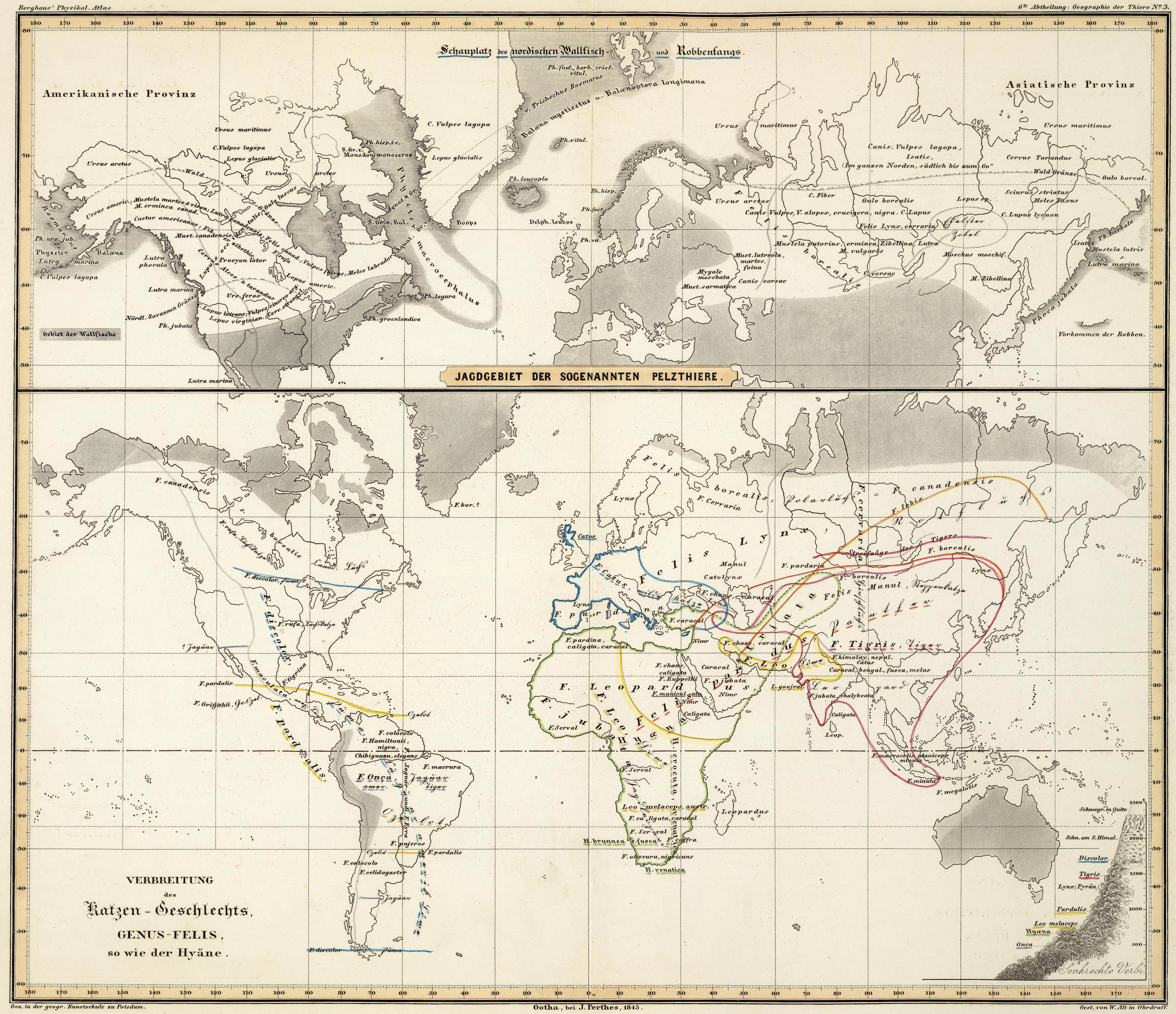
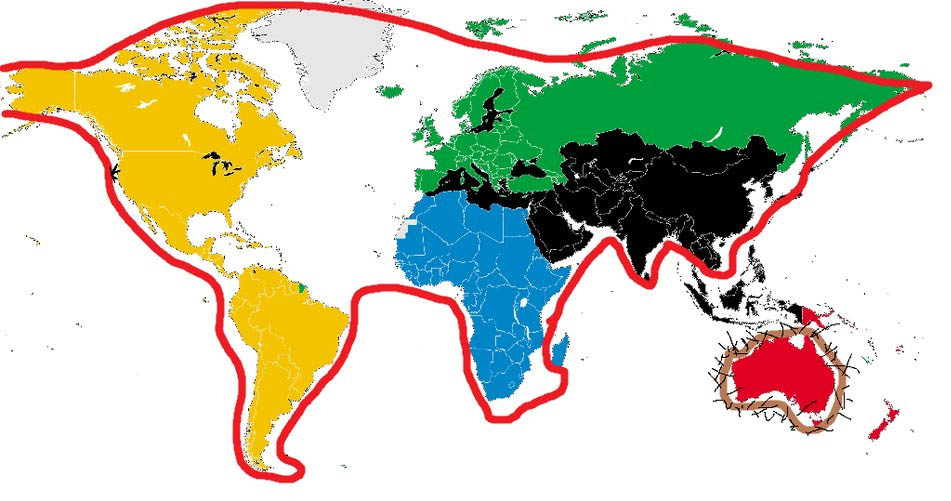
With the speed of a ball of yarn batted around by cats, the above graphic is being spread on the net, making visually clear the takeover of a new dominant race over our planet. Too late to repine. You should have taken note of the first warning a hundred and seventy years ago. How innocent they appeared at that time!

Heinrich Berghaus: Verbreitung des Katzen-Geschlechts, Genus-Felis (The spreading of the genus of the cats, Genus Felis). Justus Perthes, Gotha, 1845


Sándor Weöres – Ferenc Sebő, March of the Cats


Evening Falls in Holešovice


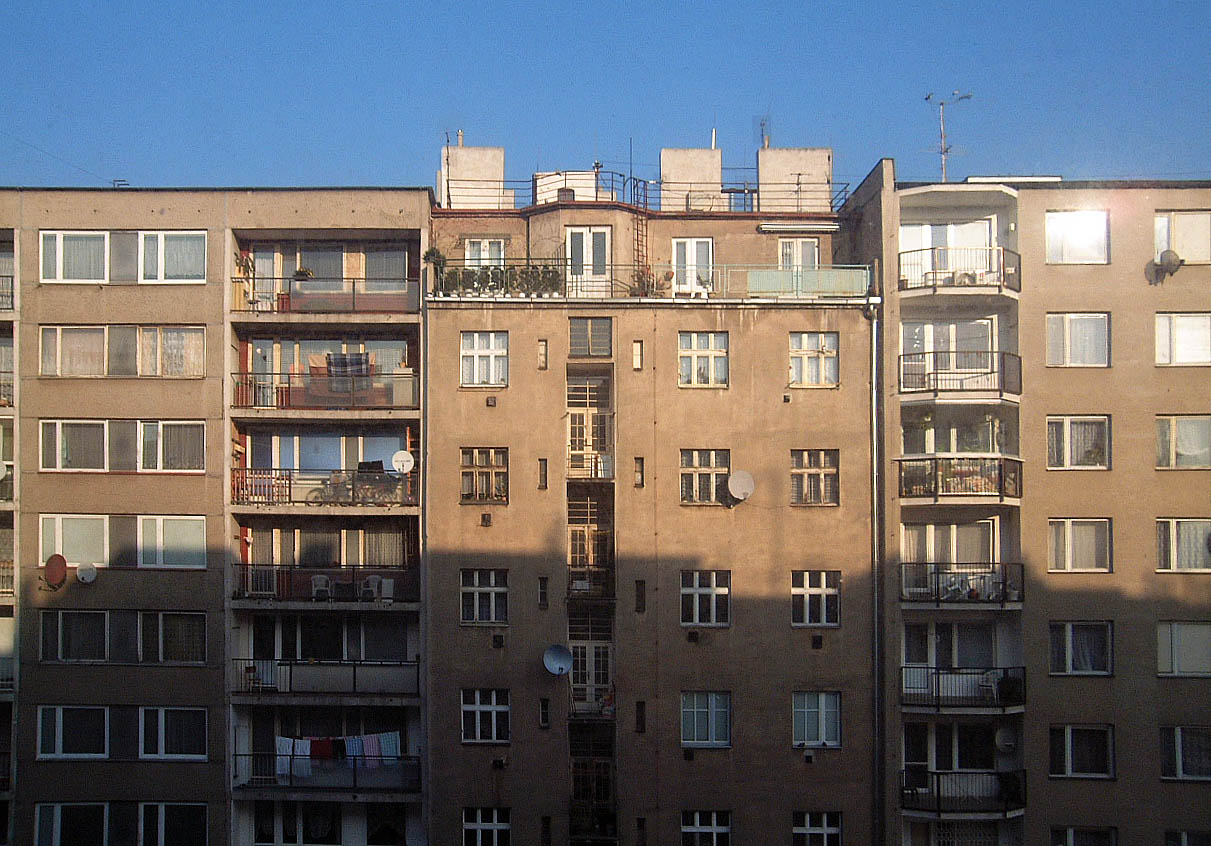
I once lived in a flat in the Holešovice district of Prague which had belonged to an old widow. Due either to a lack of resources or will, the flat had stood unchanged for decades. With its odd collection of old cheaply-made furniture, strange muted colors, faded framed prints of the Virgin, and a general lack of modern amenities, it sometimes felt as if I were living in another time.

“Do you hear that?” asked the caretaker when I moved in. I was forced to admit that I hadn’t. “Exactly my point! It’s quiet as a tomb here, and that’s how we like to keep it.”

The main room of the flat was ordinary, but there was a small one-meter-square storage room off to the side of it which, unlike every other room save the bathroom, had a floor of checkered ceramic tiles, discolored and drab by their remote age. It smelled of machines and old rags from a box of old tools and various little cans for squirting oil that remained there; the widow’s late husband had apparently been a handyman. This forgotten, but sunny, chamber opened to the world through a large steel-framed window, which would not have looked out of place in a machine shop. The window swung out on hinges, which readily converted the small room into what I called “my balcony.”

This balcony of mine overlooked a courtyard, around which the backs of an entire city block of buildings huddled, concealing from the street all the usual things that reside in such places: garbage bins, a derelict swing and a rusting seesaw, an unmown patch where the resident dogs were taken daily by their owners, and a gray parking lot. Rows of cars, assorted abandoned furniture, damp concrete slabs in beards of bright green moss, and a few untended trees and shrubs found root here and there. There were many, many dark little corners hidden from the view of anyone casually passing through.

For a few minutes each afternoon as evening fell, I would retire there to my balcony, just to look out on the world for a short time and savor the view of it. On the wall below me, a steel door would abruptly creak open, the plaint of unoiled hinges, and then bang just as suddenly shut. Then I would hear a series of hard little clicks, each a few seconds apart. An old woman, bent with a crippling hunchback, would mince forth as if climbing a slope, and slowly make her way to the end of the courtyard, where there was a small village of garbage bins. A mesh shopping bag always hung from her free hand.

Her hard tipped cane clicked sharply on the asphalt, and each time it did, she moved carefully forward two small steps and then the cane would click again as she regained breath and balance. Click, click, click. Like the swiftest hand of a clock, she would make her way around the courtyard.

From the edges of the courtyard, from among the bushes and clusters of weeds, from behind the bins and from under the cars, as if conjury had materialized them from vapor, cats would begin to appear.

First, I would see one cat, then two, and then four. Gradually, a dozen or more would slink out, a snaggle of cats moving with purpose toward the same spot. Cats that were by and large invisible during the day, many cats, apparently living in the courtyard, crouched in their daytime hiding places, sly and cautious cats, waiting patiently for this moment.

The cats would come gamboling toward a simple shelter that kept the rain off the garbage bins. The old woman and all the cats of the courtyard would convene on that spot, and only then would she open her bag to reveal her purpose. The old woman had taken it upon herself to feed all the homeless cats that were living there as her neighbors.

She sometimes drew out tins of cat food, but often it was dry kibble, or the leftovers from her own simple meals. She would leave these offerings there in the protected space, in a row of disposable margarine containers, for the cats to greedily gobble up.

Each night, there would be as many as twenty cats and kittens, hungrily feeding on the scraps of food left for them. The old woman would bend down a bit more and some of the bolder cats would permit her to scratch them gently around the ears. As the light of the sun dims and the sky turns to blush, they rub sidelong, backs arched, tails high, against the woman’s legs, and then lay down and roll on their backs invitingly.

El cementerio de Murat Reis


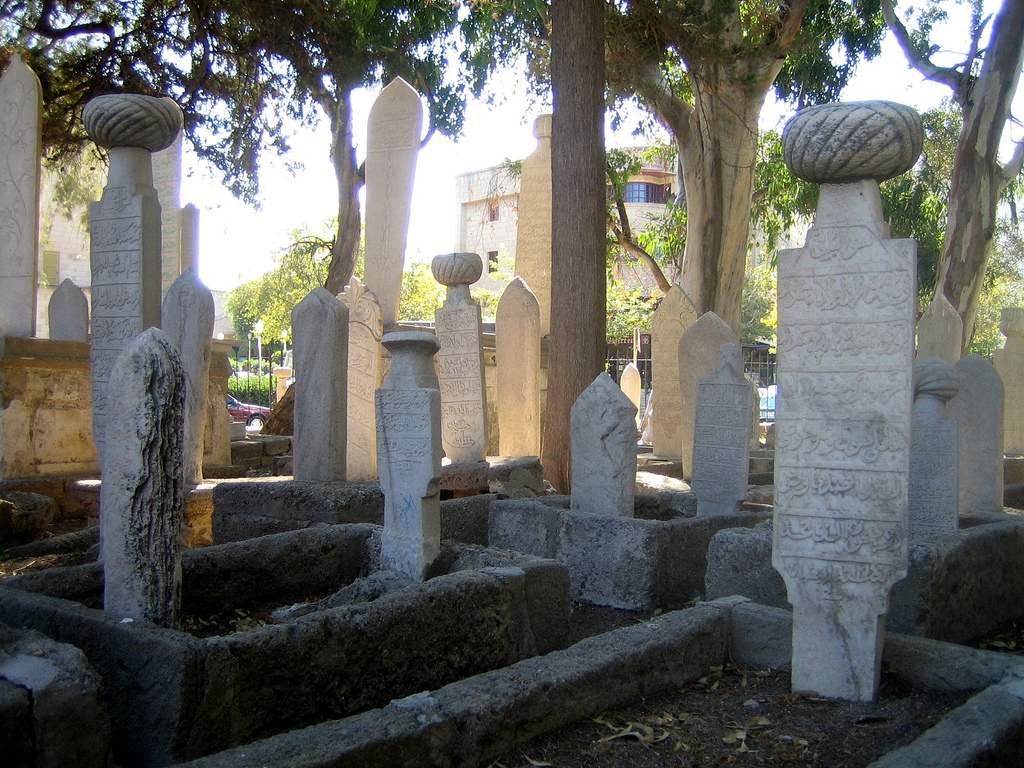
«Fue en Rodas donde pasé esos años tan felices después de la guerra, recogido en el jardín sagrado de Murat Reis. Estuve realmente viviendo en un cementerio turco de tal belleza y silencio que con frecuencia deseaba morir y quedar sellado en una de aquellas hermosas formas; yacer allí soñando para siempre con Eyoub y las grandes damas que ensueñan el tiempo en el vehemente silencio del calor turco, con solo el sonido de las hojas que caen... Mi mesa en el jardín roída por el calor y el vino derramado; en ella a veces tomaba notas o dibujaba algo. Todo transcurría con sudor, calor y vino. Los amigos de visita escribían mensajes sobre la mesa cuando yo estaba ausente, y al final empezaban a escribir poemas. El patio estaba completamente rodeado de hibiscos en flor — la más hermosa, tenaz y femenina planta que existe.» (Lawrence Durrell: Las islas griegas)


La armada otomana dirigida personalmente por Solimán el Magnífico se adueñó de la isla de Rodas el 22 de diciembre de 1522 tras cuarenta años de ataques intermitentes y seis meses de asedio continuado. El Gran Maestre de la Orden de San Juan de Jerusalén, que combatió durante aquellos seis meses hasta el límite de sus fuerzas con la vana esperanza de recibir algún auxilio desde Europa, pactó en vísperas de Nochebuena rendir la ciudad a cambio de una retirada libre. Los ejércitos de la Orden de San Juan no volverían a amenazar las costas turcas de Asia Menor ni a la flota turca que campaba por el Egeo. El Mediterráneo quedaba más abierto para la conquista otomana.

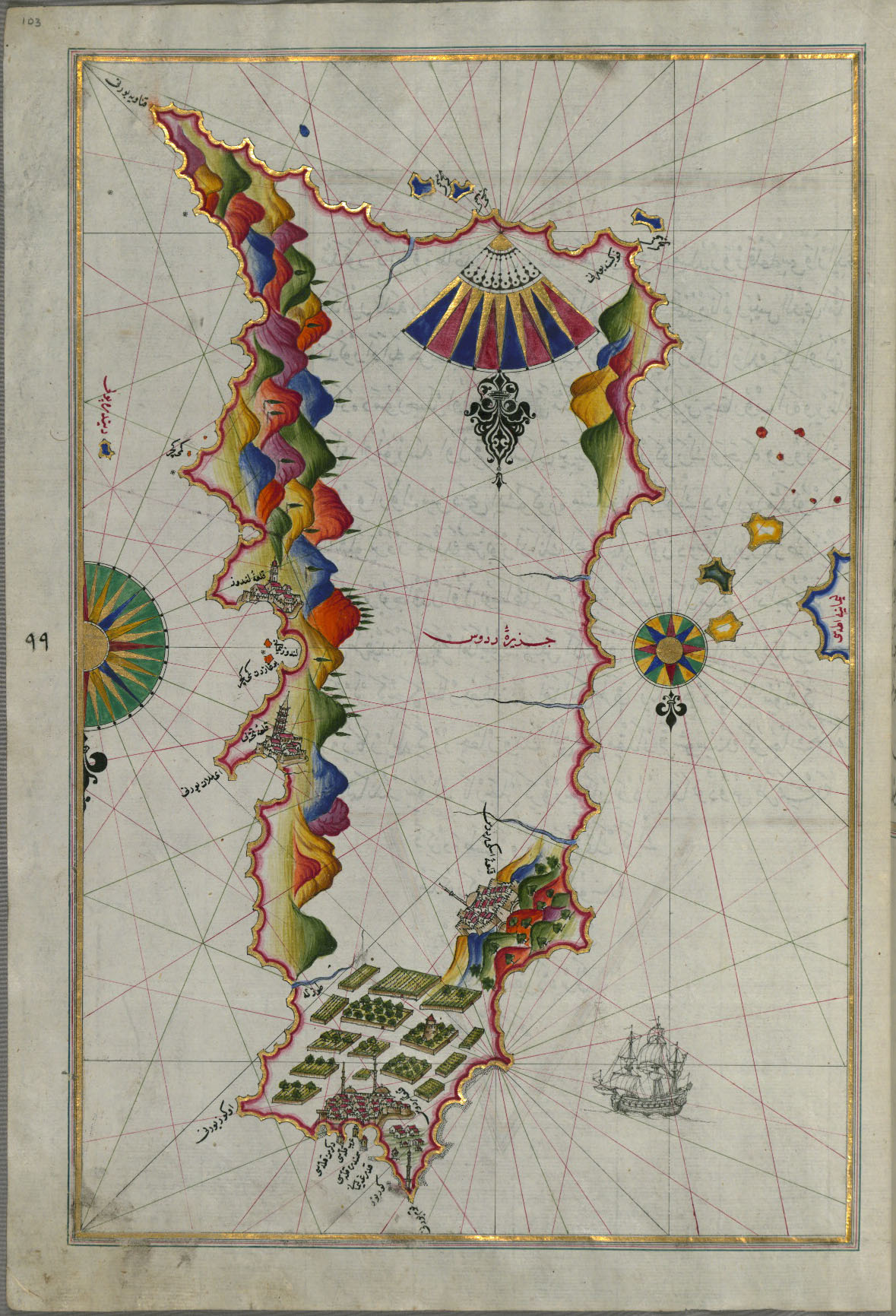
La ciudad de Rodas en el extremo norte de la isla, en una copia del siglo XVII del mapa de Piri Reis, de 1525, orientado al sur. Se encuentra en la Walter Art Library Collection. Clic para el mapa completo de la isla.

Murat Reis —es decir, el Almirante Murat— era nativo de Rodas, de una familia de albaneses musulmanes establecidos en la isla. Hasta los doce años estuvo al servicio de los grandes almirantes otomanos Turgut Reis, Piri Reis y Barbarroja Hayreddin Pashá. En 1552 Solimán lo nombró almirante de la flota turca en el Océano Índico, donde combatió a los portugueses. Desde 1570 capitaneó de nuevo una armada en el Mediterráneo, en la defensa del Egeo y preparando la conquista de Chipre y Creta, en manos venecianas. Murió en 1603 y fue enterrado en el puerto de Rodas, en el cementerio de la Mezquita de Murat Reis que él había fundado. Su tumba se convirtió en lugar de peregrinaje para los marineros turcos.


«Tras pisar por primera vez Rodas observé entre diversas Honorables sepulturas una todavía más notable que las otras, y nueva. Pregunté de quién era y un turco que ignoraba la respuesta me dijo que del Capitán Bashá, muerto el año anterior por el ataque de dos Navíos ingleses. Y tras ello empezó a maldecir a nuestra Nación y a amenazar con que todos deberían ser quemados; lo cual, respondiendo a sus preguntas, me hizo definirme como Escocés que, al ser un nombre desconocido para él, me salvó. Y no creo que fuera traición a mi patria sino más bien una retirada de una esquina a la otra.» (Henry Blount: Viaje a Levante, 1650) 


«Unos pocos puntos esporádicos de luz brillaban en la ciudad nueva, pero la iluminación callejera no había sido restablecida aún, y caminamos hundidos en una profunda y serena oscuridad, mientras las primeras estrellas comenzaban a adquirir formas en el cielo nocturno. Recuerdo que fue entonces cuando nos tropezamos con el pequeño jardín que circunda la mezquita de Murad Reis, un jardín en cuyo centro descubriría más tarde la Villa Cleóbulo; y allí nos sentamos un rato, retrepados en las lápidas turcas, fumando y gozando de la oscuridad que ahora (la primavera estaba avanzada) tenía una suavidad casi palpable, la sedosidad del terciopelo viejo.» (Lawrence Durrell, Reflexiones sobre una Venus marina)


«Torr tiene algunos datos divertidos en cuanto al pequeño cementerio turco que yo he llegado a considerar el jardín de Villa Cleóbulo. Durante la Edad Media formó parte del jardín del Gran Maestre. "En 1496 —dice Torr— había un avestruz viejo y dos jóvenes, con las alas cortadas, en un cercado. Ponían sus huevos en la arena y los empollaban mirándolos; se alimentaban de hierro y acero. Había también una oveja de la India y varios otros animales extraños; en especial un podenco regalado al Gran Maestre por el sultán Bayaceto. Tenía el tamaño de un galgo, era de color pardo, carecía de pelo, salvo en torno a la boca, y sus garras eran como las de un pájaro. De este último hecho proviene el relato de que que el Gran Turco poseía un pájaro que cada tres años ponía tres huevos; y de dos de los huevos salían pájaros, pero del tercero un cachorro de perro. Y había que retirar al cachorro en cuanto rompía el cascarón; de lo contrario, los pajarillos lo picoteaban." Ni siquiera la sombra de una sonrisa perturba la seca exposición del erudito inglés que nos ha dado la mejor monografía histórica sobre la isla. Pero es que la historia era para Torr un asunto serio. No he podido averiguar si visitó Rodas. Quizá le pareció más prudente no sumergirse en este paisaje soleado, cuyo vino y cuyas frutas sólo pueden conducir a un hombre a la pereza, a dar largas a todas las cosas e incluso a mentir.» (Lawrence Durrell, Reflexiones sobre una Venus marina)


La isla de Rodas fue tomada a los turcos por Italia en 1912, y el Tratado de Lausana confirmó la soberanía italiana sobre todo el Dodecaneso. Con ello la población turca y griega evitó los violentos cambios de población de 1924. Sin embargo, una gran parte de los dos mil judíos sefardíes que vivían allí desde fines del siglo XV fueron deportados por la ocupación alemana durante la Segunda Guerra Mundial. El cónsul de Turquía consiguió salvar tan solo a aquellos doscientos cuyas familias aún conservaban al menos un miembro con ciudadanía turca. La isla, que en 1947 pasó a Grecia, siguió manteniendo su población turca. Ellos han cuidado de la mezquita y el cementerio de Murat Reis.


«Como nación son los más retirados y secretos que conozco. Esto no implica falta de espontaneidad ni de buena voluntad —ambas cosas las tienen en gran medida. Pero los siglos de diferencia religiosa han dado al musulmán turco el aspecto de una cidad amurallada. En Rodas viven como topos, detrás de ventanas enrejadas, en jardines cerrados llenos de naranjos; no es una comunidad dividida internamente, como lo está la griega por celos mezquinos y cismas, ni tampoco externamente por una pluralidad de intereses políticos.» (Lawrence Durrell, Reflexiones sobre una Venus marina)


«Nuestro acuerdo se cimenta con una visita a la tumba de Hascmet, el poeta satírico turco que yace enterrado en un pequeño rincón cerrado del patio. La tumba está desconchada y gastada por la lluvia. Una cabra mastica y mordisquea alrededor, atada a un eucaliptus enano pegado a la pared. Puse la mano sobre la lápida y sentí el calor del sol en ella. ¿Quién fue Hascmet y cómo acabó exiliado aquí, en este cementerio olvidado lleno de amodorradas tumbas de funcionarios turcos? Es un problema que tendrá que resolver Gideon de sobremesa.» (Lawrence Durrell, Reflexiones sobre una Venus marina)

«Olviden a ese cansino, docto y divertido Gideon; es un medio fantasioso, medio alter-ego de Larry: un personaje semificticio aunque nuclear en Reflexiones sobre una Venus marina» — John Leatham: «Durrell on Rhodes», en Anna Lillios: Lawrence Durrell and the Greek world.


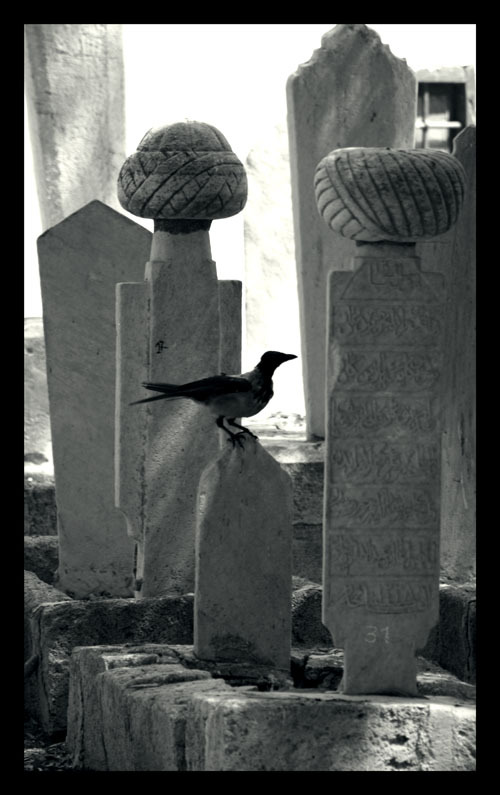
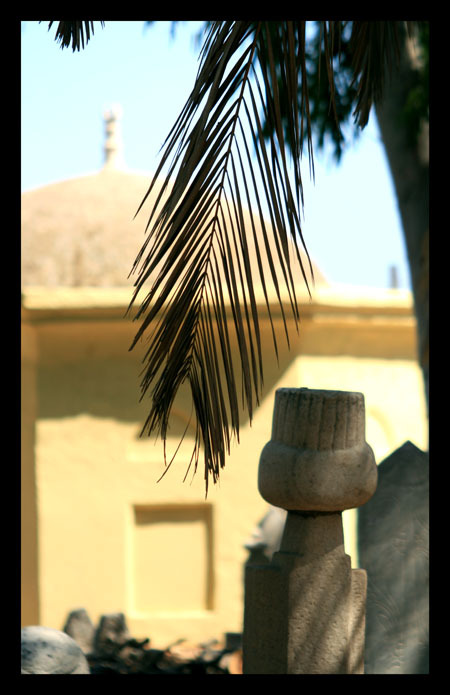
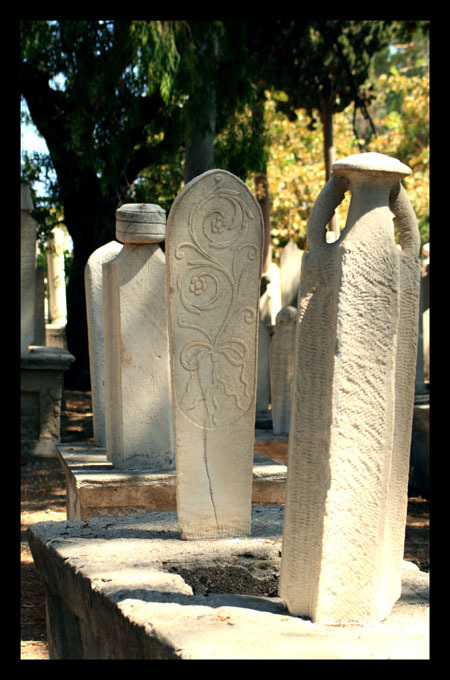
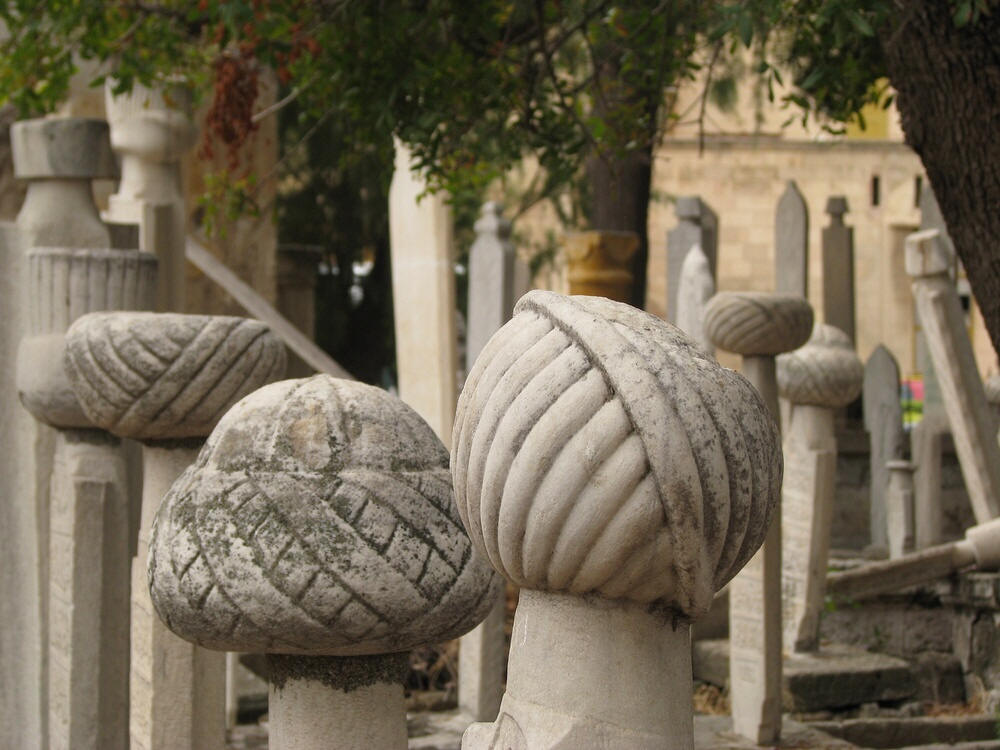
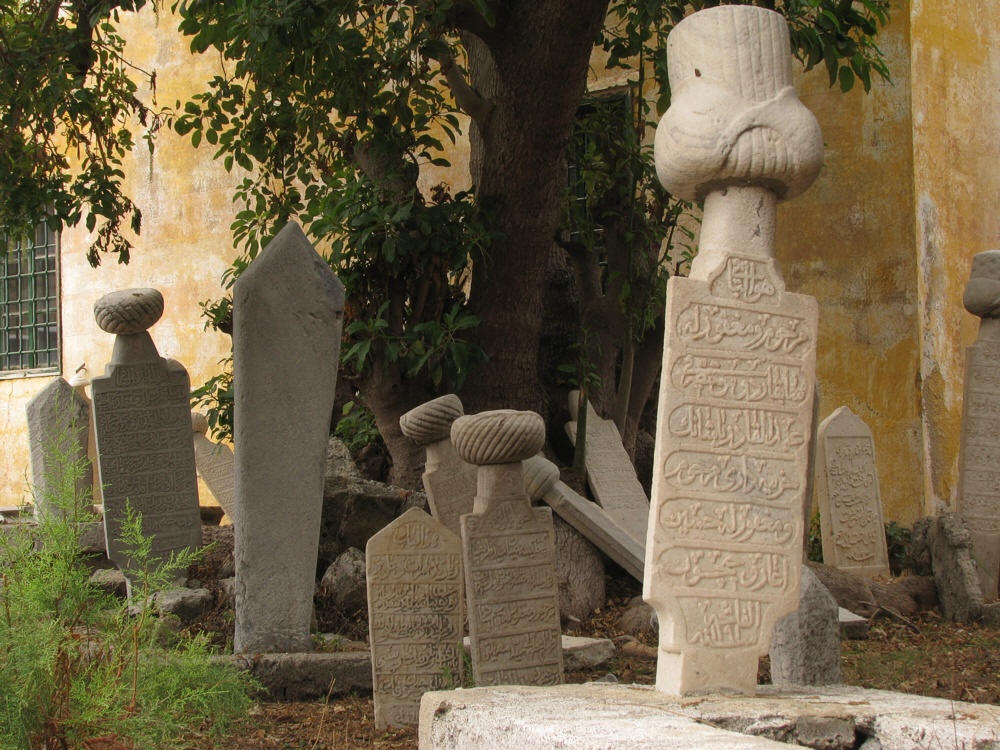
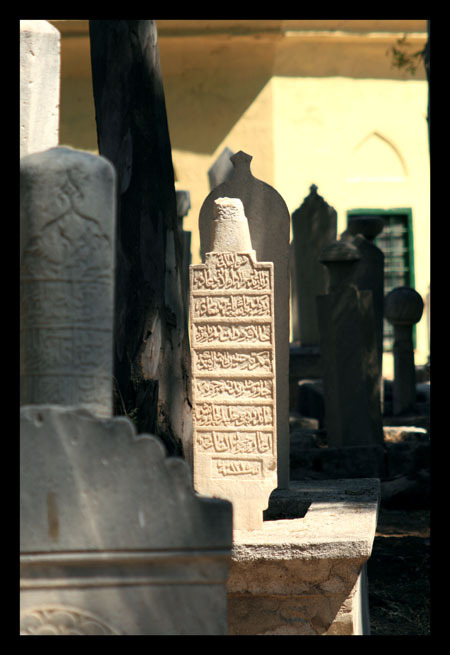
«Regresamos ahora los tres cruzando el meláncólico pero hermoso atrio, haciendo una pausa de tanto en tanto a la sombra de los altos árboles mientras Hoyle descifra la inscripción de una tumba u ofrece al mufti una chocolatina de la caja plateada que siempre lleva en el bolsillo. Al caminar crujen bajo nuestros pies las hojas en forma de hoz de los eucaliptos. El cementerio presenta un triste estado de deterioro. Muchas tumbas se caen a pedazos y en algunos lugares los barridos de las hojas sueltas las han oscurecido. La mayoría de de los que aquí están sepultados fueron funcionarios turcos. Unos pocos eran exiliados políticos. La lápida registra el sexo de su propietario: con un pesado turbante de mármol es un hombre, con una especie de piña de mármol es una mujer. Los dignatarios más elevados tienen una pequeña capilla propia, una especie de garita de piedra de techo abovedado y ventanas enrejadas. Pero ahora, por obra del tiempo y el viento muchos de esos turbantes de piedra han sido arrastrados y descansan en las veredas como cabezas de estatuas decapitadas. Bordeamos la última hilera de tumbas y nos sumergimos en el denso seto de adelfas que oculta la casa.» (Lawrence Durrell, Reflexiones sobre una Venus marina)

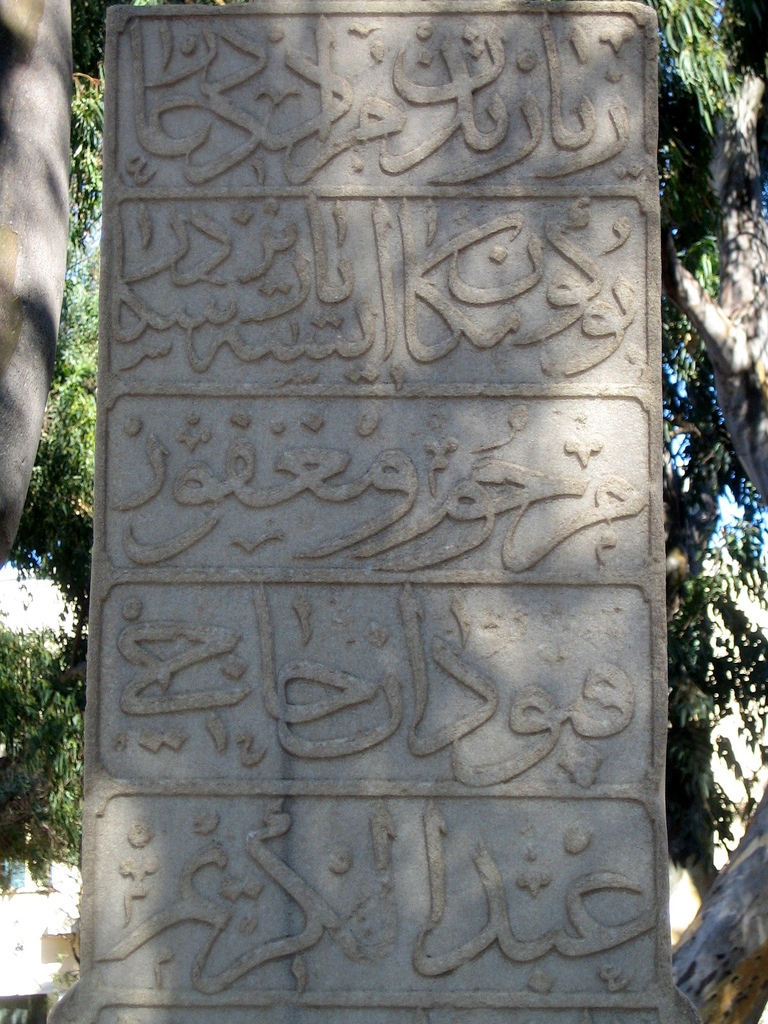
“«Visitante, deseo una oración. Hoy será para mí, pero mañana para ti. El difunto y perdonado Capitán Haji Abdul Kerim»”

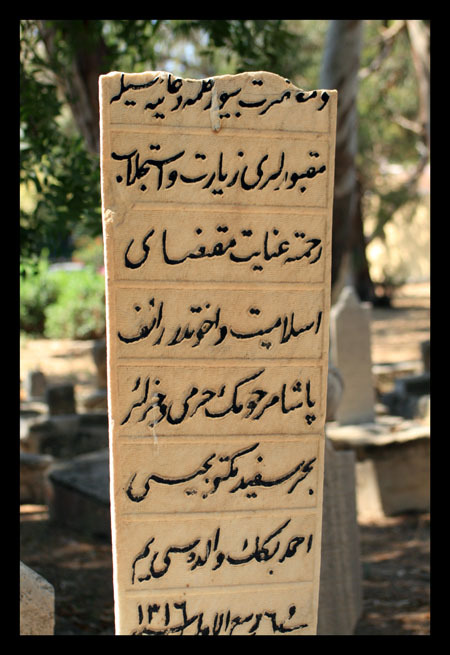
“«[Aquí yace] El difunto y perdonado soldado de la fe Ahmad Abdullah, uno de los portaestandartes del victorioso sultán Solimán»”


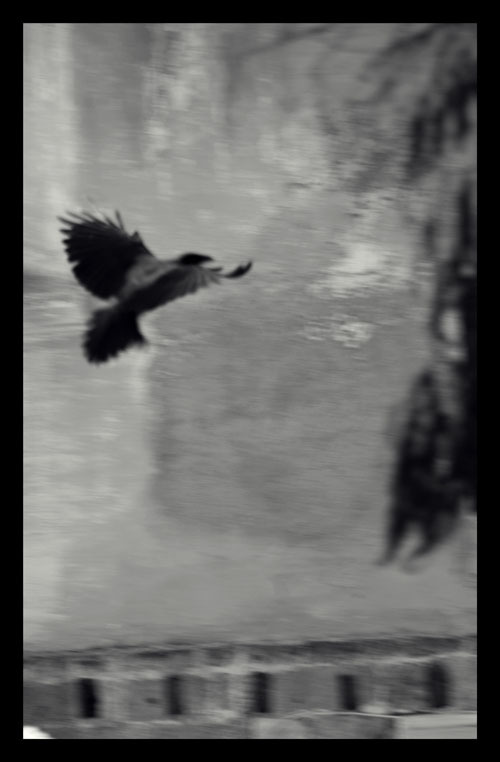
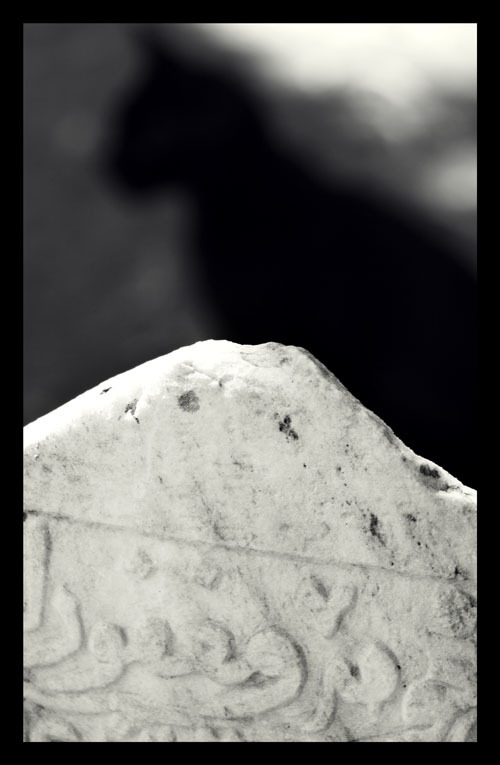
Las fotos las seleccionamos hace unos años de un fotoblog ruso que ya no se encuentra. No hemos podido encontrar de nuevo a su autor ni su dirección. Esta casualidad acaba de hacer justicia al cementerio de Murat Reis.

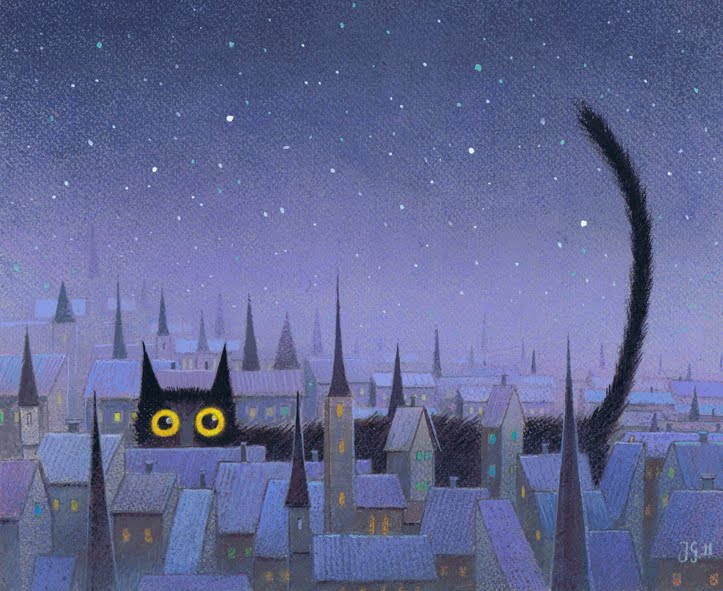
The Black Cat


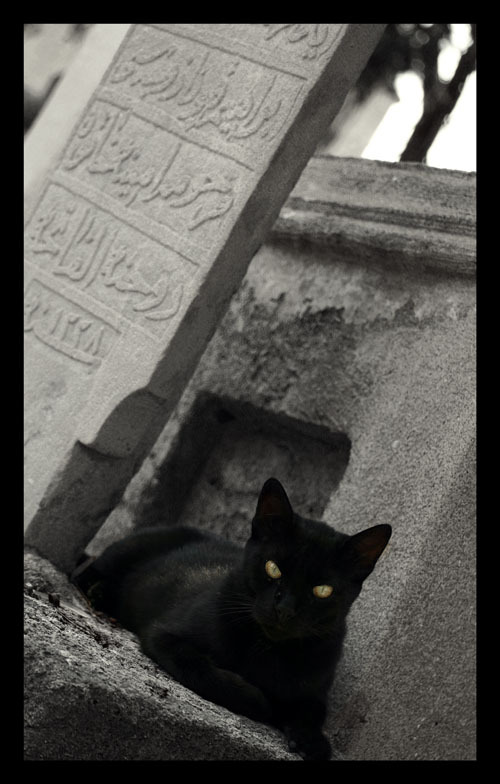
Bulat Okudzhava: Little song about the Black Cat

Со двора – подъезд известный
под названьем “черный ход”.
В том подъезде, как в поместье,
проживает Черный Кот.

Он в усы усмешку прячет,
темнота ему – как щит.
Все коты поют и плачут –
этот Черный Кот молчит.

Он давно мышей не ловит,
усмехается в усы,
ловит нас на честном слове,
на кусочке колбасы.

Он не требует, не просит,
желтый глаз его горит.
Каждый сам ему выносит
и “спасибо” говорит.

Он и звука не проронит -
только ест и только пьет.
Грязный пол когтями тронет
как по горлу поскребет.

Оттого-то, знать, невесел,
дом, в котором мы живем.
Надо б лампочку повесить…
Денег всё не соберем.
We’ve a doorway with a staircase,
Also known as a “black door”.
In that place as in a palace
A black cat has set up store.

There’s a smirk beneath his whiskers,
Darkness fits him like a glove.
Other cats are coy or frisky,
This black cat won’t make a move.

As his leer gets only bolder,
He does not catch mice or steal.
Somehow we are all beholden,
Running briskly with his meals.

As the yellow cat eyes glower,
He does not demand or cadge.
Every one of us forks over,
Grateful for the privilege.

This cat doesn’t issue orders,
He just sits and drinks and eats.
When he claws the dirty floor it’s
Like he’s clawing at our throats.

Must be that’s why we’re in chaos,
And the scowling never ends.
One small lightbulb might have saved us…
But we just can’t raise the funds.

Jerzy Głuszek: Czarny kot

Murat Reis' cemetery


“It was in Rhodes where I spent such happy post-war years, locked into the sacred garden of Murat Reis. I was indeed living in a Turkish cemetery of such beauty and silence that I often longed to die and be sealed into one of those beautiful forms; to lie there dreaming for ever of Eyoub and the great ladies who dream away time in the vehement silence of the Turkish heat, with just the sound of the leaves falling… My table in the garden rotted with heat and spilt wine; sometimes I made notes on it or drew something. Everything ran with sweat, wine and heat. The visiting friends wrote messages on the table when I was absent, and finally started to write poems. The yard was completely surrounded with flowering hibiscus – the most beautiful, tenacious and feminine plant there is.” (Lawrence Durrell: The Greek Islands)


The Ottoman army led personally by Suleiman the Conqueror seized the island of Rhodes on 22 December 1522, after forty years of renewed attempts and six months of continuous siege. The Great Master of the Johannite knights, who reached the end of their forces after waiting in vain for any liberating army from Europe during six months, agreed two days before Christmas on the surrender of the city in return for a free withdrawal. The Johannite fleet did not threaten any more the Turkish coasts of Asia Minor and the Turkish navy raiding over the Aegean Sea. The Mediterranean Sea was opened before the Ottoman conquest.

The city of Rhodes on the northern tip of the island, from a 17th-c. copy of Piri Reis’ south-oriented map made in 1525, in the Walter Art Library Collection. Click for the whole map

Murat Reis – that is, Admiral – was already born in Rhodes, in a Muslim Albanian family settled on the island. Since the age of twelve he served under the greatest Ottoman admirals, Turgut Reis, Piri Reis and Barbarossa Hayreddin Pasha. In 1552 Suleiman appointed him admiral of the Turkish navy in the Indian ocean, where he fought against the Portuguese fleets. From 1570 he led a fleet on the Mediterranean Sea again, defending the Aegean Sea and preparing the occupation of Cyprus and Crete from the Venetians. He died in 1603, and was buried in the port of Rhodes, in the cemetery of the Murat Reis Mosque founded by him. His tomb became a pilgrimage site for Ottoman sailors


“Upon my first landing [in Rhodes] I had espyed among divers very honourable Sepultures, one more brave then the rest, and new; I enquired whose it was; a Turke not knowing whence I was, told me it was the Captaine Basha, slaine the yeare before by two English Ships; and therewith gave such a Language of our Nation, and threatning to all whom they should light upon, as made me upon all demands professe my selfe a Scotchman, which being a name unknowne to them, saved me, nor do I suppose it any quitting of my Countrey, but rather a retreat from one corner to the other.” (Henry Blount: A Voyage into Levant, 1650)


“A few sporadic points of light shone in the new town, but the street-lighting had not yet been restored and we walked in a deep calm darkness as the first stars began to take shape upon the evening sky. It was now. I remember, that we stumbled upon the little garden which encircles the Mosque of Murad Reis—a garden at whose heart I was later to find the Villa Cleobolus; and here we sat for a while perched upon Turkish tombstones, smoking and enjoying the darkness which had now (spring was advanced) an almost touchable smoothness, the silkiness of old velours.” (Lawrence Durrell: Reflections on a Marine Venus)


“Torr has some amusing facts about the little Turkish graveyard which I have come to think of as the garden of Villa Cleobolus. During the Middle Ages it was part of the Grand Master's garden. 'In 1496,' says Torr, 'an old ostrich and two young were kept with their wings clipped in a walled enclosure here. They laid their eggs in sand and hatched them by simply looking at them: they fed on iron and steel. There was also a sheep from India and various other strange animals: particularly a hound given to the Grand Master by Sultan Bajazet. It was about the size of a greyhound, mouse-coloured, with no hair at all except about the mouth, and it had claws like a bird. From this last fact comes the story that the Grand Turk had a bird that every year laid three eggs; and from two of the eggs came birds, but from the third a puppy. It was necessary to remove the puppy as soon as it broke its shell: otherwise the birds pecked it.' Not the shadow of a smile disturbs the dry exposition of the scholarly Englishman who has given us the best historical monograph on the island. But then history for Torr was a serious business. I have not been able to discover whether he visited Rhodes. Perhaps he thought it wiser to stay out of this sunlit landscape whose wine and fruit could only lead a man to laziness, procrastination and even to mendacity.” (Lawrence Durrell: Reflections on a Marine Venus)


The island of Rhodes was occupied by the Italians from Turkey already in 1912, and the Treaty of Lausanne awarded it together with the whole Dodekanesos to Italy. Thus its Turkish and Greek population was equally spared from the terrible exchange of population in 1924. Only a large part of the two thousand Sephardic Jews living here since the late 15th century were deported by the German occupiers in the Second World War. The Turkish Consul managed to save only those two hundred of them, whose families still included at least one living Turkish citizen. The island, which in 1947 was awarded to Greece, preserved its Turkish population. They take care of the mosque and cemetery of Murat Reis.


“As a nation they are the most withdrawn and the most secretive of any I have met. This does not imply either lack of spontaneity or of goodwill—they have a great measure of both. But the centuries of religious difference have given each Moslem Turk the look of a walled city. In Rhodes they live like moles behind barred windows, inside walled gardens, full of orange trees; as a community they are not divided internally as the Greeks are by petty jealousies and schisms, nor externally by a multiplicity of political interests.” (Lawrence Durrell: Reflections on a Marine Venus)


“Our agreement is cemented by a visit to the grave of Hascmet, the Turkish satirical poet, who lies buried in a small walled enclosure in one corner of the courtyard. The tomb is chipped and stained by rain. A goat munches and scratches round it, tethered to a dwarf eucalyptus by the wall. I put my hand to the gravestone and feel the warmth of the sun upon it. Who was Hascmet, and how did he come to be exiled here, to this forgotten graveyard full of the sedate tombs of Turkish civil servants? It is an after dinner problem for Gideon to solve.” (Lawrence Durrell: Reflections on a Marine Venus)

“Forget that tiresome, learned and entertaining Gideon; he was half fanciful, half an alter ego of Larry’s: a semi-fictional though pivotal character in Reflections on a Marine Venus.” – John Leatham: “Durrell on Rhodes”, in Anna Lillios: Lawrence Durrell and the Greek world


“We walk back now, the three of us, across the melancholy but beautiful churchyard, pausing from time to time in the shade of the tall flowing trees as Hoyle deciphers the lettering on a tomb, or offers the Mufti a chocolate from the little silver box he always carries about with him in his pocket. Our feet crunch the crisp sickles of eucalyptus-leaf underfoot as we walk. The graveyard is in a sad state of disrepair. Many of the tombs have fallen to pieces, and in places the loose drift of leaves has half obscured others. The majority of those who lie buried here are Turkish civil servants. A few are political exiles. The gravestone records the sex of its tenant: with a heavy marble turban surmounting it, in the case of a man, and with a sort of marble pine-apple in the case of a woman. The greater dignitaries have a small vault to themselves—a sort of stone sentry-box with a domed roof and barred windows. But now with wind and weather many of the stone turbans have been blown off and lie about in the pathways like heads blown from statues. We skirt the final row of tombs and plunge into the dense thicket of oleander which hides the house.” (Lawrence Durrell: Reflections on a Marine Venus)

“To the visitor, my wish is a prayer (from you); Today it may be for me, but tomorrow it shall be for you; the late and forgiven Captain Haji Abdul Kerim.”

“(Here lies) The Late and Forgiven, Warrior of the Faith Ahmad Abdullah, one of the Flagbearers of the Conquering Sultan Suleiman.”


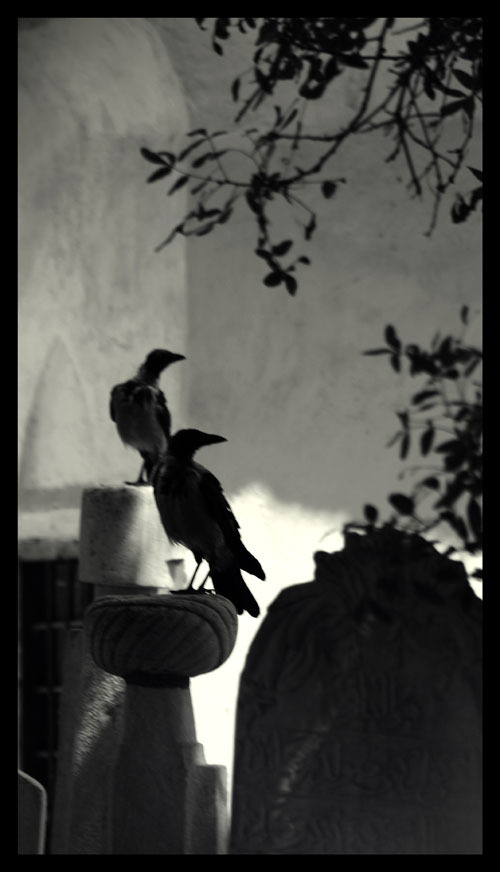
The photos were saved some years ago from a since then cancelled Russian photo blog, whose address and author I could not find any more. I think this fact fits well to the cemetery of Murat Reis.