Switch over to our new blog! • ¡Pásese a nuestro nuevo blog!

The renewed version of our blog, with more features, a richer design, and available in nine languages, can be read here: https://wangriver.com

The new version also includes the old posts, often in expanded form. If you are curious about the updated version of this post, replace “riowang.blogspot.com/” in the URL with “riowang.studiolum.com/”, and the new link will most likely lead you there.


La versión renovada de nuestro blog, con más herramientas, un diseño más rico y disponible en nueve idiomas, se puede leer aquí: https://riowang.com

La nueva versión también incluye las publicaciones antiguas, a menudo en una forma ampliada. Si tiene curiosidad por la versión actualizada de esta entrada, sustituya «riowang.blogspot.com/» en la URL por «riowang.studiolum.com/es/», y el nuevo enlace probablemente le llevará allí.

Mostrando entradas con la etiqueta Giovio; Paolo. Mostrar todas las entradas

Amor celestial y amor mundano

Ilustración de Endre Szász para la edición húngara de los Rubaiyat de Khayyam

Dos imágenes de aquella edición rusa de Omar Khayyam que comentamos hace tiempo no las incluimos en la correspondiente entrada del blog. En parte por ajustarnos a una tabla de cuatro por cuatro, pero también por reservarlas para otra ocasión. Ahora hablaremos de una de ellas.
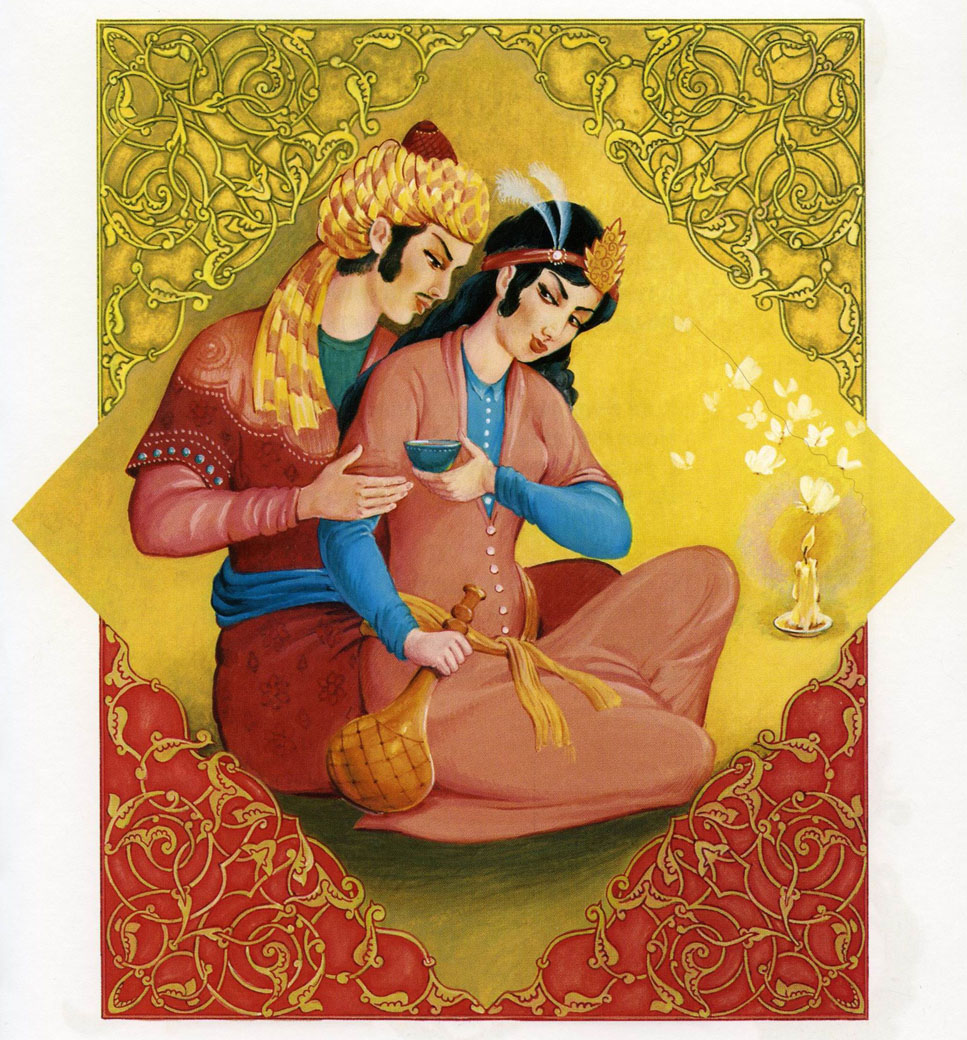
Belousov’s illustration to Golubev’ Russian Khayyam edition
Contiene la iconografía usual de Khayyam: el vino y la mujer, el deseo y la fugacidad. No es muy distinta, por cierto, de la imagen duodécima que veíamos en aquella tabla. La diferencia básica está en la vela, al fondo, que atrae hacia su llama a las mariposas nocturnas: un tópico tan presente en la imaginación literaria que parece haber arraigado en nuestra mente desde la oscuridad antropológica de la primera noche en que dominamos el fuego.

Y es también un motivo muy importante en la poesía persa clásica. Annemarie Schimmel, la mayor experta occidental en sufismo, escribe en su A Two-Colored Brocade. The Imagery of Persian Poetry (1992) que allí no hay animal poético más popular que este, aparte del ruiseñor (del que ya hemos tratado un par de veces pero aún hablaremos de su significado persa). Y no es por casualidad: ambos son símbolos del alma. El ruiseñor, del alma que anhela a Dios, mientras que la mariposa simboliza el alma que, aniquilada en la llama divina, se hace una con Dios alcanzando así la meta suprema del sufí.

Durante mil años varios miles de poetas persas han repetido este motivo desde India a Estambul, y desde el mártir sufí del siglo IX Hallaj hasta la poeta surrealista Forough Farrokhzad. Un bello ejemplo clásico es el ghazal de Hafez (con unas sutilezas difíciles de traducir):

آتش آن نیست که از شعله ی او خندد شمع
آتش آن است که در خرمن پروانه ردند

âtash ân nīst ke az sho‘le-ye ū khandad sham‘
âtash ân ast ke dar kharman parvâne zadand

El fuego verdadero no es el que danza en la llama del candil
El fuego verdadero es el que cosecha a la mariposa
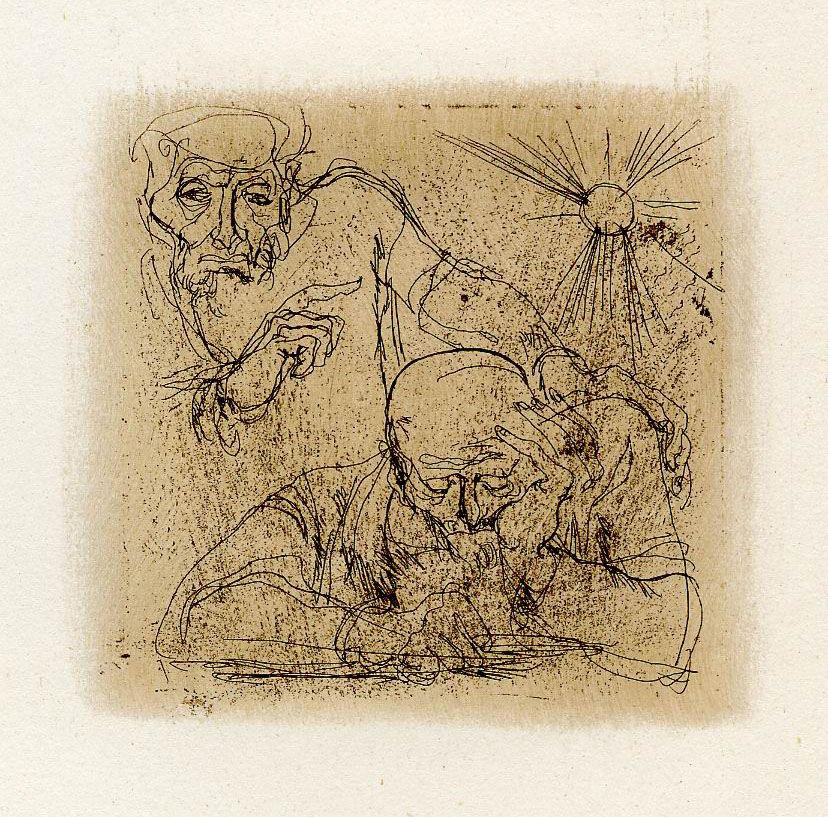
Illustration of Endre Szász to the Hungarian edition of Khayyam by Lőrinc Szabó
La mariposa quemada en la llama nocturna recorre por igual la literatura clásica europea. Erasmo, en sus Adagia 1.9.51, Pyraustae exitus (muerte de la pirausta o insecto del fuego), cita un fragmento de Esquilo como su primera aparición, que ha sobrevivido justo por haberse convertido en proverbio ya en la Antigüedad e incluido en las colecciones de proverbios griegos: Δέδοικα μωρόν (correctamente μῶρον) κάρτα πυραύστου μόρον. Es decir, La mayor locura de todas las locuras es la muerte de la mariposa en la llama. Cuanto más denostadora es la sentencia, más revela la diferencia mencionada entre los puntos de vista griego y persa. Así, Erasmo interpreta el proverbio en el sentido de la precipitación y de la transitoriedad de las cosas. Y andando el tiempo Sebastián de Covarrubias llegará a decir, muy enfadado, que la mariposa «es un animalito... el más imbécil de todos los que puede haber».

Gabriele Simeoni, Impresa 15, in: Paolo Giovio, Dialogo delle imprese militari ed amorose, 1574
En Occidente, este motivo no se conectó con el amor hasta después de dos mil años de su aparición. Petrarca lo lanzó definitivamente por esta vía sobre todo en su soneto 141, donde los ojos de Laura son la llama alrededor de la cual él gira y se abrasa (y ver también el soneto XIX). A partir de 1500 todo el petrarquismo (y antipetrarquismo) repitió, glosó y exageró hasta más no poder la imagen. Fue también justo a partir de 1500 cuando Europa entró en contacto con la cultura persa.

Una representación gráfica de la idea aparece pronto de la mano de Gabriele Simeoni, el alumno del obispo humanista Paolo Giovio, cuya principal obra, la Historia de Italia ya mencionamos a propósito del rinoceronte del Papa. Otra obra de Giovio, mucho menos voluminosa pero más influyente, fueron las Imprese militari et amorose, publicadas inicialmente en 1550, donde recogía los símbolos personales —imprese— de personajes ilustres del medio siglo anterior. Una edición ampliada salió luego en 1574, con la participación de Simeoni, que añadió unas cuarenta empresas propias. La número 15 es la que hemos reproducido arriba, a la que añade esta explicación (leemos primero la versión breve de la edición inglesa de 1585, luego la del original italiano de 1574 y abajo la traducción española de Alfonso de Ulloa, 1561).
Vnder the figure of the butter flie, who so much delighteth in the brightnes of the fire, that of her owne accord she casteth her selfe into the same, and so is burned: may be signified, how that a man who goeth about, or affecteth euerie thing without deliberation and choice, getteth many times to himself shame, reproch and destruction withall.

Vn Gentil’ huomo amico mio mi ricercò di ritrouargli vn’impresa d’amore, ond’ io gli feci disegnare vna Farfalla intorno à vna Candela accesa con queste parole, COSI TROPPO PIACER CONDVCE A MORTE. seguendo la natura di cosi semplice animale, che i Greci dall’amar naturalmente il fuoco han chiamato πυραυστὴν auuertendo che’l senso di questa impresa può essere inteso doppiamente, conciò sia che appropriandolo al corpo, ei non è dubbio alcuno (secondo Platone) che vno innamorato è morto in se stesso, viuendo il suo pensiero (che è la propria vita dell’anima) intorno alla cosa amata. Onde il detto Filosofo soleua dire quand’ ei trouaua vn’innamorato, COLVI VIVE IN VN’ ALTRO CORPO. Ma attribuendo moralmente quest’ amore all’anima, egli è certissimo che mentre che l’huom si deletta intorno à vna bellezza corporale (figurata quì da me per lo splendore della Candela) dimenticando bene spesso il Creator per la creatura, e cadendo in qualche scandolo, vengono finalmente à perdere il corpo e l’anima. Il che accade ordinariamente à certi ricchi sciocchi innamorati, che volendo parlar di amore non sanno in qual parte del corpo eglino s’habbian la testa.

Un Caballero amigo mío siendo él enamorado, rogóme de le dibujar una Divisa, y le hice pintar una mariposa alrededor de una candela encendida con estas palabras: COSÌ VIVO PIACER CONDVCE A MORTE. Siguiendo la natura de un animal tan simple que los Griegos llamaron πυραυστὴς, [pirausta] porque él ama naturalmente la claridad del fuego. La cual sentencia se puede entender en dos maneras: porque tomándolo por un cuerpo, es verdad según dice Platón, que un enamorado es muerto en sí, viviendo en su pensamiento (que es la vida del alma) alrededor de lo que él ama, por donde el sobredicho Filósofo viendo un enamorado solía decir, Aquel vive en otro cuerpo. Pero tomándolo por el alma, cierto es mientras tomamos placer con una hermosura corporal significada por la claridad de la candela, muchas veces olvidamos el Criador por la criatura, y cayendo en hartos inconvenientes en los cuales las mujeres nos ponen, perdemos a la fin deshonradamente el cuerpo y el alma, así como hacen algunos necios los cuales metiéndose en requiebros de amores no saben en qué parte de su cuerpo tienen su cabeza.
La invención de Simeoni hizo carrera en la floreciente literatura simbólica de los siglos XVI y XVII. En aquella refinada sociedad, la esencia de la práctica que hoy conocemos como el juego del emblema, y que nos dejó más de un millón de muestras (¡y cuántos otros millones se perdieron por su propio carácter efímero!), consistía en que los poetas y artistas tomaran sus metáforas centrales de un conjunto de símbolos bien conocidos y especialmente codificados y popularizados por los libros de emblemas. Luego modificaban sutilmente las alusiones y matices, provocando así un peculiar placer estético a los connoisseurs. Los equivalentes modernos de este juego intelectual puede reconocerlos cualquiera, hasta hoy en día, observando las características de su propio medio cultural.

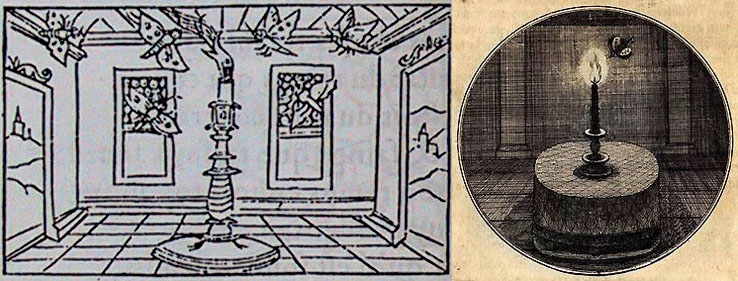
Gilles Corrozet, Hecatongraphie, 1544 and Juan Borja, Emblemata moralia, 1697 emblem with candle and butterfly
Pero antes de Simeoni hubo algún otro intento de situar esta imagen en la tradición de la imaginación visual europea. Gilles Corrozet la incluyó en su libro de emblemas de 1543 con el mote La guerre doulce aux inexperimentez (la guerra [es] dulce a los inexpertos) —arriba a la izquierda— que refleja el célebre capítulo pacifista Dulce bellum inexpertis de Erasmo, al que dedica una sección especial Pierre Bayle en su gran Dictionnaire de 1695. Este intento de convertir capítulos de los Adagia erasmianos en «proverbios visuales» fue característico de la primera emblemática (recordemos que el género se estableció en 1530). En el caso de este motivo, sin embargo, la interpretación amorosa de Simeoni demostró mucho más éxito que la antibelicista de Corrozet. De hecho, el único seguidor de Corrozet que hemos encontrado es Juan de Borja, embajador en Praga (1581), cuyo emblema Fugienda peto (deseo lo que tendría que evitar —figura de arriba a la derecha, tomada de la edición de 1697—), se aplica a evitar los peligros de la guerra, aunque también contiene la deriva hacia la guerra interior entre razón y deseo.
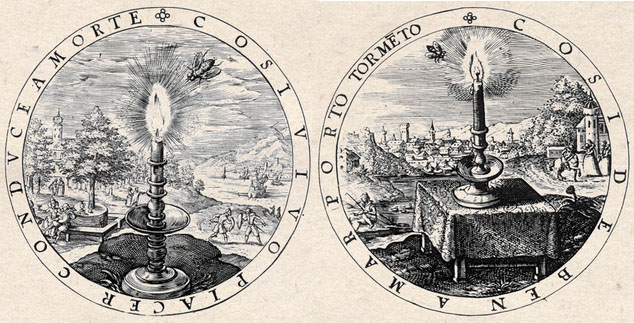
Gabriel Rollenhagen, Nucleus emblematum, 1611, emblems with candle and butterflyGeorge Wither, A choice of emblemes, 1635, emblem with candle and butterfly
La via amorosa de Simeoni fue continuada por el humanista holandés Hadrianus Junius en su emblema Amoris ingenuis tormentum (tormento del falso amor), donde compara la candela a la mujer que destruye a sus amantes; y mientras cita diligentemente todas las referencias clásicas de Erasmo, añade otra de Petrarca a las ya conocidas: Così de ben amar porto tormento (así del bien amar obtengo tormento —aquí puede leerse un interesante estudio de Ari Wesseling sobre los emblemas de Junius a la luz de los Adagia de Erasmo—). El doble mote conduce a un curioso equívoco. Gabriel Rollenhagen (imagen de arriba) incluye la imagen dos veces en su gran colección de emblemas (1611), copiando a Simeoni y a Junius, cada uno con su mote original. George Wither, que convirtió el libro de Rollenhagen en el texto fundador de la emblemática inglesa, A collection of emblemes (1635), encontró ciertamente sospechosa la duplicación, y en la segunda imagen (ver a la derecha) borró la llama y la mariposa y cambió el mote en Cui bono?, es decir, ¿qué hay de bueno en una candela apagada? Quizá fuera esta la reinterpretación más atrevida de la imagen que, no obstante, no encontró seguidores. La versión final del símbolo, publicada y dibujada en varias ediciones, versiones e idiomas, fue la de Otho Vaenius en sus Amorum emblemata (1608), donde su claro sentido se subraya aún más por la adición de un pequeño Cupido.

Otho Vaenius, Amorum emblemata, 1608, emblem with candle and butterfly
Así, la interpretación persa y la europea del símbolo muestra sus diferencias básicas. En Europa, heredera del juicio negativo de Esquilo —la mayor de todas las locuras— apunta al amante cautivo y luego víctima de un inmerecido —innoble, humillante, rechazado— amor. En la tradición persa, al contrario, representa la máxima expresión del amor, aspiración divina y anhelo de unión con Él. Como ya observara Hammer-Purgstall, el diplomático austríaco, aventurero y orientalista, uno de los primeros investigadores de la literatura persa, cuya traducción de Hafez inspiró el Divan de Oriente y Occidente de Goethe: «La mariposa es, para el pensamiento oriental, no como para Occidente un símbolo de la inestabilidad y del revoloteo de la mente, sino más bien un símbolo del amor más fiel, que se olvida de sí mismo y se sacrifica» (Geschichte der schönen Redekünste Persiens). Esta última interpretación también fue utilizada por Goethe en su poema Selige Sehnsucht.

Por tanto, la ilustración rusa que conecta el amor terrestre cantado por el escéptico Khayyam con las mariposas volando alrededor de la vela encendida contiene una interpretación equivocada de la tradición persa. Un persa jamás habría utilizado este símbolo en un poema o una miniatura sobre el amor mundano. El vería ahí una forma de amor y unión mucho más alta.


En la tradición occidental hemos encontrado una sola vez esta imagen como metáfora del amor divino. Santa Teresa de Ávila en el capítulo 17.7 del Libro de la Vida habla del tercer grado de la oración mística, donde voluntad y razón ya están sosegadas pero la memoria todavía aletea como una mariposa nocturna. Dice:
Algunas veces es Dios servido de haber lástima de verla tan perdida y consiéntela Su Majestad se queme en el fuego de aquella vela divina donde las otras potencias están ya hechas polvo, perdido su ser natural, estando sobrenatural gozando tan grandes bienes.
Aquí, sin embargo, el fondo no es en absoluto el mismo que en la mística sufí, es decir, la disolución de la persona en Dios, sino solo el apaciguamiento de las potentiae humanas para que la persona, preservando su personalidad propia, entre en contacto de la manera más íntima con Dios. Esta es la mayor diferencia entre la mística cristiana y el sufismo, el panteísmo o hasta el strib und werde de Goethe. El Dios cristiano, que incluye en sí tres personas distintas, no abole la personalidad de quien se une a él, sino que la perfecciona. Y la metáfora para este tipo de unión no es la mariposa aniquilada en el fuego, sino más bien otras dos imágenes bien conocidas por la tradición occidental y por la persa, pero que se usan con este sentido solo en Occidente: el renacimiento del Ave Fénix entre las brasas de su nido perfumado y la salamandra que encuentra entre las llamas su último hogar y perfección última.

* * *
Pensamos que puede ser de utilidad dar la breve bibliografía que hemos consultado sobre el tema de la mariposa y la llama, especialmente en la emblemática y en la literatura española.
· Trueblood, Alan S. «La mariposa y la llama: motivo poético del Siglo de Oro». En Actas del Quinto Congreso Internacional de Hispanistas, editado por Maxime Chevalier, François Lopez, Joseph Perez y Noël Salomon, Burdeos: Instituto de Estudios Ibéricos e Iberoamericanos - Université de Bordeaux III, 1977, 829-837.
· Cabello Porras, Gregorio. «"La mariposa en cenizas desatada": una imagen petrarquista en la lírica áurea, o el drama espiritual que se combate dentro de sí». Estudios Humanísticos (Universidad de León) 12 (1990): 255-277.
· Cabello Porras, Gregorio. «"La mariposa en cenizas desatada": una imagen petrarquista en la lírica áurea, o el drama espiritual que se combate dentro de sí (2a parte)». Estudios Humanísticos (Universidad de León) 13 (1991): 57-75.
· Pulido, Isabel. «Fuentes clásicas de dos motivos de la poesía española: la grulla y la mariposa». Exemplaria 3 (1999): 17-35.
· Pedrosa, José Manuel «La mariposa, el amor y el fuego: de Petrarca y Lope a Dostoievski y Argullol». Criticón 87-88-89 (2003): 649-660.
· Robledo Estaire, Luis. «Emblemas cantados en la España del Barroco». En Paisajes emblemáticos: La construcción de la imagen simbólica en Europa y América, editado por César Chaparro Gómez, José Julio García Arranz y Jesús Ureña Bracero, Mérida: Editora Regional de Extremadura, 2008, 375-394.
Este estudio localiza la imagen de la mariposa que se acerca y se quema en la llama en composiciones musicales del Siglo de Oro. Robledo menciona de pasada una curiosa derivación de la imagen, mencionada por el predicador fray Pedro de León y que le sirve para justificar la quema en la hoguera de los reos de sodomía: «Las mariposas... vuelan adelante y atrás, cada vez acercándose más al fuego... [La mariposa] revolotea cerca de las llamas de un fuego y sólo se quema un ala... Revolotea cada vez más cerca y se quema otra parte de sí hasta que al final se quema totalmente... [Los sodomitas] que no se enmiendan, llevados por el pecado acabarán por fin en el fuego como mariposas» [saca la cita de Federico Garza Carvajal, Quemando mariposas. Sodomía e imperio en Andalucía y México, siglos XVI-XVII, Barcelona: Laertes, 2002, 17-18]
· Rafael García Mahíques en su comentario de las Empresas sacras de Núñez de Cepeda (Madrid: Tuero, 1988, págs. 40-41) comenta la empresa que el jesuita dedica a esta imagen, Nescia necis.
Además de los emblemistas mencionados en el texto anterior, hemos encontrado el uso de la imagen de la mariposa y la llama en estos otros:
· S. Bargagli, Dell'imprese... 1578 (Venecia 1594, págs. 125-127).
· C. Camilli, Imprese illustri, 1586, III, págs. 27-28.
· W. Westhovius, Emblemata, 1640, págs. 62.
· H. Engelgrave, Lux evangelica... 1655, embl. XLI.
· P. Le Moyne, L'Art des devises, 1666, págs. 368-369.
· P. Rodríguez de Monforte, Descripción... honras Phelippe IV... 1666.
· J. Camerarius, Symbolorum et emblematum... 1668 IV, emb. XCVII, págs. 194-195.
· F. Picinelli, Mondo simbolico, 1694, págs. 390-392 (aplicada al martirio de San Lorenzo).
· J. Bornitz, Emblemata ethico-politica, 1699, p. 54.

Heavenly and earthly love

Illustration to Khayyam’s Hungarian edition by Endre Szász

I am in debt with two images that I had not published among the illustrations of the Russian edition of Omar Khayyam, partly in order not to destroy the beautiful arrangement of four times four, and partly because I wanted to write about them something more anyway.
Belousov’s illustration to Golubev’ Russian Khayyam edition
The one of which I write today follows the usual iconography of Khayyam: wine and woman, desire and transience. It is not much different, let us say, from picture twelve on the four times four table. The only important difference is the candle in the background which attracts with its flame the night butterflies.

The image of the butterfly immolated in the light of the candle is one of the most important motifs of classical Persian poetry. Annemarie Schimmel, the greatest Western expert of Sufism writes in her A Two-Colored Brocade. The Imagery of Persian Poetry, 1992 that there is no more popular poetic animal than this, except for the nightingale (about which we have already written a couple of times, but still we are in debt with the presentation of its Persian meaning). It is no accident: both are soul symbols. The nightingale symbolizes the soul longing for God, while the butterfly the soul which, annihilated in God’s fire, becomes one with Him and thus reaches the supreme goal of all Sufi.

For a thousand years several thousand Persian poets have repeated this motif from India to Istambul and from the 9th-century Sufi martyr Hallaj to 20th-century Surrealist poetess Forough Farrokhzad. A beautiful classical example is the ghazel of Hafez:

آتش آن نیست که از شعله ی او خندد شمع
آتش آن است که در خرمن پروانه ردند

âtash ân nīst ke az sho‘le-ye ū khandad sham‘
âtash ân ast ke dar kharman parvâne zadand

true fire is not the one dancing in the flame of the candle
true fire is the one harvesting the butterfly

Illustration of Endre Szász to the Hungarian edition of Khayyam by Lőrinc Szabó
The image of the butterfly burnt in the flame of the candle was also known in European classical literature. Erasmus in Adagia 1.9.51, Pyraustae exitus – “Death of the fire-insect” – cites a fragment of Aeschylus as its earliest occurrence, which has survived just because it had been cited as a proverb already in the antiquity and included in Greek proverb collections: Δέδοικα μωρόν (correctly μῶρον) κάρτα πυραύστου μόρον, that is, among all follies the greatest folly is the death of the butterfly in the fire. The less flattering this opinion is, the more it renders palpable the already mentioned difference of the Greek and Persian world views. Accordingly, Erasmus interpreted the proverb as related to hastiness and ephemeral things. And Sebastián de Covarrubias emphasizes in his great encyclopedia that the butterfly is “the most stupid animal among all”.

Gabriele Simeoni, Impresa 15, in: Paolo Giovio, Dialogo delle imprese militari ed amorose, 1574
In the West this motif was connected with love only two thousand years after its birth. It was Petrarch who in his 141st sonnett compared the eyes of the beloved lady to the flame, and himself to the butterfly circling around it. This metaphor was made popular in the Petrarchist poetry of the 1500s, exactly when Europe got into contact with Persian culture.

A pictorial form was given to the idea for the first time by polyhistor Gabriele Simeoni, the alumn of the humanist bishop Paolo Giovio whose main work, the History of Italy was already quoted by us a propos of the destruction of the Pope’s rhinoceros. The other, much slimmer but the more influential main work of Giovio was the Imprese militari et amorose, first published in 1550, in which he collected the personal symbols – imprese – of the most illustrious people of the previous half century. An enlarged edition was published in 1574 by Simeoni, who added forty or so imprese of his own invention. Number 15 was the above image, provided by him with the following explanation (first we quote the short version of the 1585 English edition, and then the original 1574 Italian version with our own translation):

Vnder the figure of the butter flie, who so much delighteth in the brightnes of the fire, that of her owne accord she casteth her selfe into the same, and so is burned: may be signified, how that a man who goeth about, or affecteth euerie thing without deliberation and choice, getteth many times to himself shame, reproch and destruction withall.

Vn Gentil’ huomo amico mio mi ricercò di ritrouargli vn’impresa d’amore, ond’ io gli feci disegnare vna Farfalla intorno à vna Candela accesa con queste parole, COSI TROPPO PIACER CONDVCE A MORTE. seguendo la natura di cosi semplice animale, che i Greci dall’amar naturalmente il fuoco han chiamato πυραυστὴν auuertendo che’l senso di questa impresa può essere inteso doppiamente, conciò sia che appropriandolo al corpo, ei non è dubbio alcuno (secondo Platone) che vno innamorato è morto in se stesso, viuendo il suo pensiero (che è la propria vita dell’anima) intorno alla cosa amata. Onde il detto Filosofo soleua dire quand’ ei trouaua vn’innamorato, COLVI VIVE IN VN’ ALTRO CORPO. Ma attribuendo moralmente quest’ amore all’anima, egli è certissimo che mentre che l’huom si deletta intorno à vna bellezza corporale (figurata quì da me per lo splendore della Candela) dimenticando bene spesso il Creator per la creatura, e cadendo in qualche scandolo, vengono finalmente à perdere il corpo e l’anima. Il che accade ordinariamente à certi ricchi sciocchi innamorati, che volendo parlar di amore non sanno in qual parte del corpo eglino s’habbian la testa.

A noble friend of mine asked me to prepare him an amorous impresa. I have designed a butterfly flying around the flame of a candle with these words: COSÌ TROPPO PIACER CONDUCE A MORTE (SO DOTH PLEASANT DELIGHTS LEADE TO DESTRUCTION
[Petrarch]), thus displaying the nature of this animal which, as it loves fire so much, was called πυραυστὴς by the Greek. This impresa can be interpreted in two ways. First, applied to the body, there is no doubt that, as Plato says, he who is in love has died for himself, and in thought (which is the life of the soul) he lives in the object of his love. This is why this philosopher told when encountering someone in love: This lives in another body. However, if we attribute love in a moral sense to the soul, then we can often observe that one delighted by corporal beauty (represented here with the light of the candle) forgets the Creator for sake of the created, and falling into scandal he finally loses both his body and his soul. As it usually happens with some stupid rich young people who, speaking about love, do not clearly know in which part of their body their head is to be found.

The invention of Simeoni has made a nice carreer in the flourishing symbolic literature of the 16-17th century. The essence of this refined society play called the emblem game by modern literature, which has left more than a million emblems to us (and how many times more must have perished!) was that poets and artists took their central metaphors from a well-known stock of symbols popularized by emblem books, and changed just subtly their allusions which was perceived with a great delight by the connoisseurs. The modern equivalents of this cultural play can be recognized by everyone in his/her own subculture even today.

Gilles Corrozet, Hecatongraphie, 1544 and Juan Borja, Emblemata moralia, 1697 emblem with candle and butterfly
Even before Simeoni it was attempted to make this motif part of the European visual imagery. Gilles Corrozet included it in his emblem book of 1543 with the motto La guerre doulce aux inexperimentez, “sweet is war for the inexperimented” (above left), echoing the celebrated pacifist chapter Dulce bellum inexpertis by Erasmus, to which a special section was dedicated in Pierre Bayle’s great Dictionnaire of 1695. This attempt to convert the chapters of Erasmus’ great collection of ancient proverbs, the Adagia into “visual proverbs” was characteristic of the early emblematics (this genre has been established in the 1530’s). In the case of this motif, however, Simeoni’s amorous interpretation proved to be much more successful than Corrozet’s anti-war interpretation. This latter only found one single echo in Juan Borja, Embassador in Prague (1581) whose emblem with the motto Fugienda peto, “I wish what should be avoided” (above right, from the 1697 edition) calls the attention to the dangers of the war to be avoided, but right then he interprets them for the inner war between reason and desires.

Gabriel Rollenhagen, Nucleus emblematum, 1611, emblems with candle and butterflyGeorge Wither, A choice of emblemes, 1635, emblem with candle and butterfly
Simeoni’s amorous interpretation was continued by the great Dutch humanist Hadrianus Junius, who in his emblem Amoris ingenuis tormentum, “torments of false love” compared the candle to the woman destroying her lovers, and while dutifully quoting all the classical references of Erasmus, he also added to the citation from Petrarch another from the same author: Così de ben amar porto tormento, “this is how I bear the torments of my true love”. The double motto led to a strange misunderstanding. Gabriel Rollenhagen (above) included the image twice in his great collection of emblems (1611), taking the one from Simeoni and the other from Junius, both with its matching motto. George Wither, who converted Rollenhagen’s volume into the founding work of English emblematics, A collection of emblemes (1635) in fact found suspicious the duplication, and on the second image (to the right) he deleted the flame and the butterfly and changed the motto into Cui bono? that is, what is the use of a candle without light? Perhaps this was the boldest reinterpretation of the image which, however, found no followers. The final version of the symbol, published and painted in several editions, versions and languages, was that of Otho Vaenius in the Amorum emblemata (1608) where its proper meaning was also underlined with a small Cupido added.

Otho Vaenius, Amorum emblemata, 1608, emblem with candle and butterfly
Thus the Persian and European interpretation of this symbol shows a basic difference. Its European interpretation, which has inherited the odium of Aeschylus’ negative judgment – the greatest among all follies – refers to the lover falling captive and then victim to an unworthy – ignoble, humiliating, refused – love. In the Persian tradition, on the contrary, it represents the love of the highest order, aspiring to God and longing for the union with Him. As it was already observed by Hammer-Purgstall, the adventurous Austrian diplomat and orientalist, a first researcher of Persian literature, whose translation of Hafez inspired Goethe’s East-Western Divan: “The butterfly is, for the Eastern understanding, not, as it is for the Western, a symbol of instability and fluttering mind but rather a symbol of the most faithful love, which is oblivious of itself and sacrifices itself.” (Geschichte der schönen Redekünste Persiens). This latter interpretation was also borrowed by Goethe in his poem Selige Sehnsucht.

Therefore the Russian illustration paralleling the earthly love praised by the sceptical Khayyam with the butterflies flying to the flame of the candle is a complete misunderstanding of the Persian tradition. A Persian would never use this latter symbol in a poem or miniature about earthly love, for it represents to him a much higher form of love and union.


In the Western tradition this image occurred one single time as a metaphor of divine love. Saint Teresa of Ávila in chapter 17.7 of the Libro de la Vida, describing the third degree of mystical prayer where will and reason have already settled, but memory still flutters around “like a night butterfly”, says this:

Algunas veces es Dios servido de haber lástima de verla tan perdida y consiéntela Su Majestad se queme en el fuego de aquella vela divina donde las otras potencias están ya hechas polvo, perdido su ser natural, estando sobrenatural gozando tan grandes bienes.

God, feeling pity on this lost condition of her, sometimes permits her to be burnt in the fire of that divine candle which had already reduced the other potencies to ashes, and she, by way of this great act of kindness losing her natural condition, becomes supernatural.


Here, however, the matter is absolutely not the same as in Sufi mystics, that is, the complete solution of the person in God, but only a temporary settling of a human potentia in order the person, preserving his or her own personality, gets into the most personal contact with God. This is the greatest difference between Christian mystics and Sufism, pantheism or ever the Goethean stirb und werde. The God of the Christians, who already includes three persons without melting them, does not abolish the personality of the person uniting with Him, but brings it to perfection. And the metaphor for this kind of union is not the butterfly annihilated in the fire, but rather two other images which are known both by the Western and the Persian tradition, but which were used in this sense only in the West: the phoenix reborn from the fire and the salamander which finds in the fire its final home and greatest perfection.

Rhinocerology 3. The first litter

Nature imitates art.
Oscar Wilde: Portrait of Dorian Gray

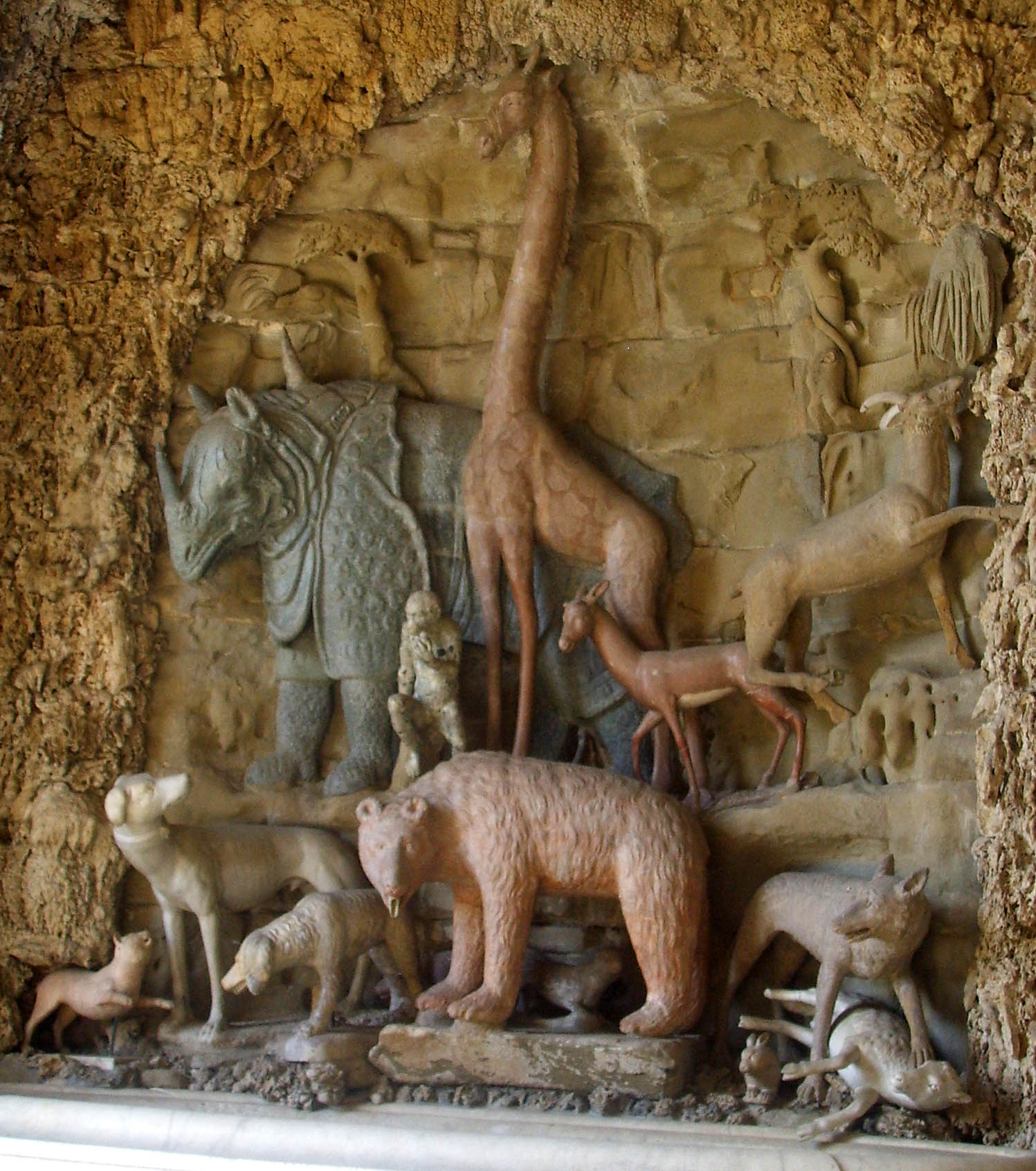
The rhinoceros of Dürer in the Grotta degli Animali of the Villa di Castello of Florence by Giambologna, after 1537Giambologna: Grotta degli Animali, Firenze, Villa di Castello, after 1537

Pisa, Cathedral, detail of the bronze door with the rhinoceros of DürerPisa, Cathedral, detail of the bronze door made by the workshop of Giambologna, first half of the 16th century

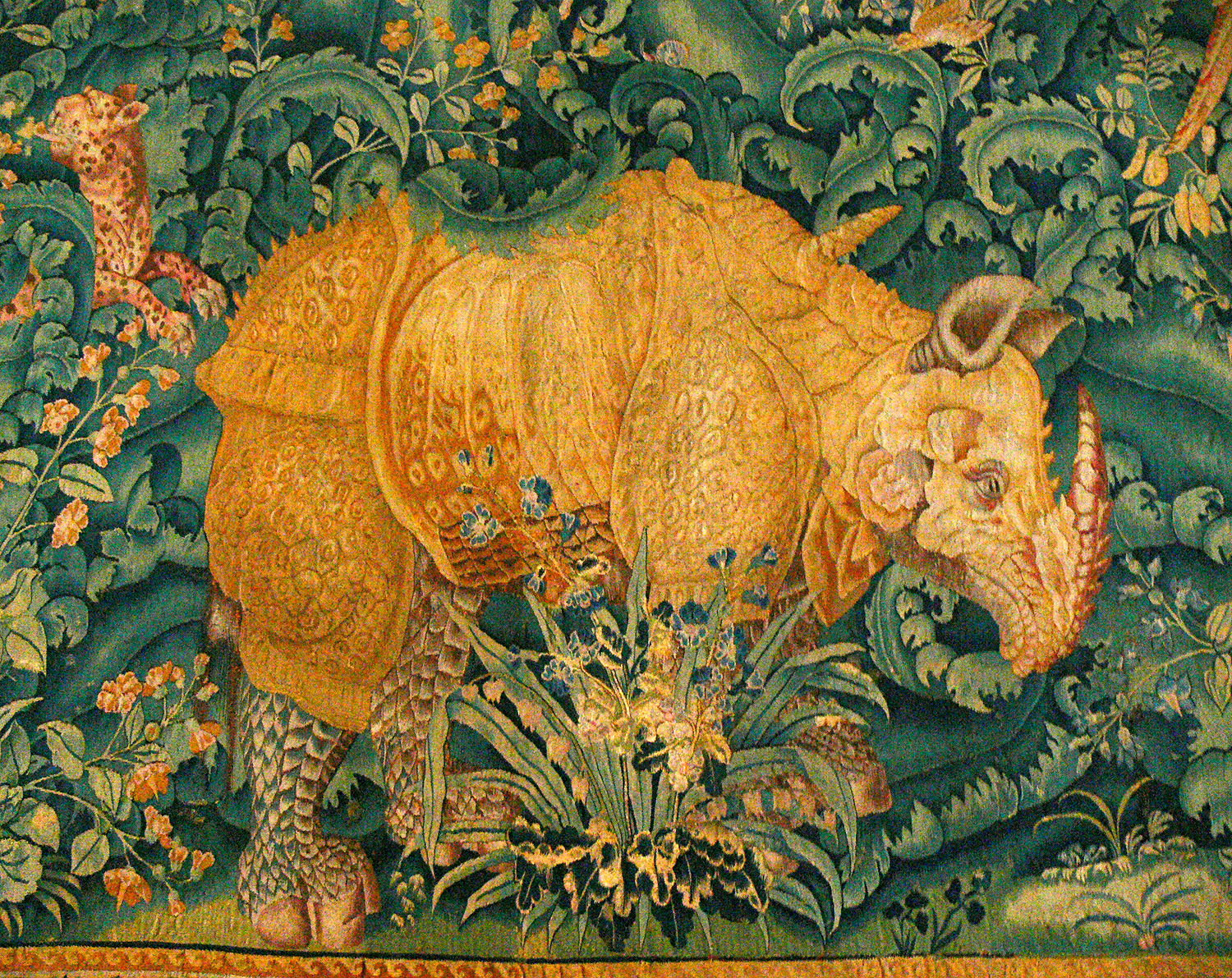
The rhinoceros of Dürer on a Netherlandish gobelin in the Kronborg Castle, 1550Castle of Kronborg (Danemark), Netherlandish gobelin from 1550

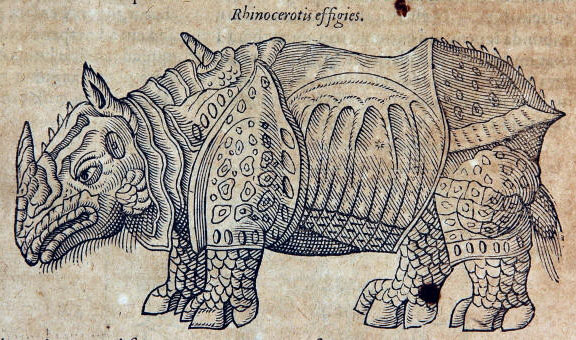
As the above examples show, by the middle of the 16th century the rhinoceros spread all over Europe from the southernmost South to the northernmost North. These animals, however, were not the direct offsprings of the engraving by Dürer.

The rhinoceros of Dürer, 8th edition by Willem Janssen, Amsterdam, 17th centuryDürer’s rhinoceros, 8th edition by Willem Janssen, Amsterdam, 17th century

True, Dürer’s engraving was reprinted several times in the two centuries following its first publication. However, these stand-alone leaflets were usually conserved in the cabinets of curiosities of princely collectors like in private zoos. The “true image” of the rhinoceros established by Dürer was transmitted to the public principally through the engravings of the Renaissance handbooks and encyclopedias. This very exciting period of the birth of the modern encyclopedia has not been yet really discovered by modern research which focuses either on the medieval encyclopedies like the Etymologies by Isidor of Seville or the four Speculum’s by Vincent of Beauvais, or on the 18th-century French Encyclopedia by Diderot and Alembert and its immediate scientific predecessors (although the pendulum of Foucault as well as the lexicon of Lemprière and their epigons are already looting them with abundant profit). Nevertheless, these works were highly celebrated in their age, and even today they are very enjoyable readings, offering plenty of enchanting surprises. And besides they established all those standards that we consider as self-evident today, from alphabetic orden through thematic lexicons to the bibliography.

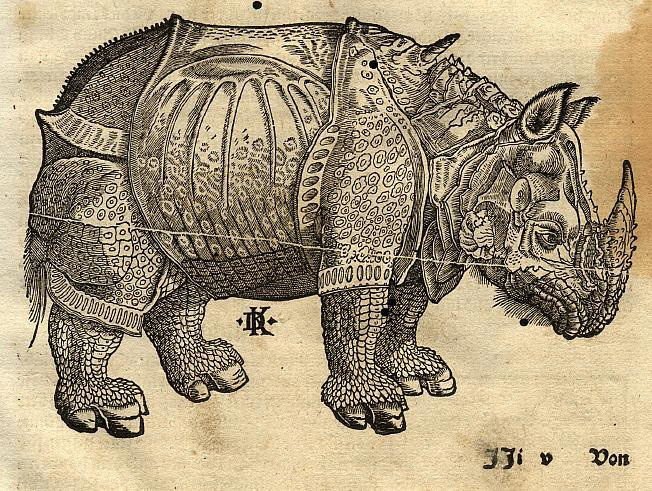
The rhinoceros of Dürer in the Cosmographia of Sebastian Münster, around 1550
One of the first and most influential encyclopedias was the Cosmographia compiled by the Basel geographer and Hebraist Sebastian Münster and published in five languages and thirty-three editions between 1544 and 1628. Its success was very much enhanced by its beautiful engravings composed by eminent artists like Hans Holbein the Younger, Urs Graf or David Kandel. This latter one, who also illustrated another early encyclopedia, the epoch-making Kreütter Buch or Herbal (1546) by Hieronymus Bock, made that copy of Dürer’s picture which thereafter spread the true image of the rhinoceros in several reprints and editions all over Europe.

The rhinoceros of Dürer in the 1580 French edition of the Cosmographia of Sebastian Münster
A characteristic feature of this engraving is that the printing block seems to have broken after an early edition, and since then a somewhat oblique thin horizontal line run through all the later prints like a watermark attesting its authenticity. In colored copies, like in the above 1580 French edition of the Cosmographia they tried to eliminate it through overpainting.

The rhinoceros of Dürer in the Cosmographia of Sebastian Münster, 1598
However, by later editions like this Basel 1598 one, the printing block became worn not only on its printing side but also on its joint surface, and the two halves were slightly shifted from each other.

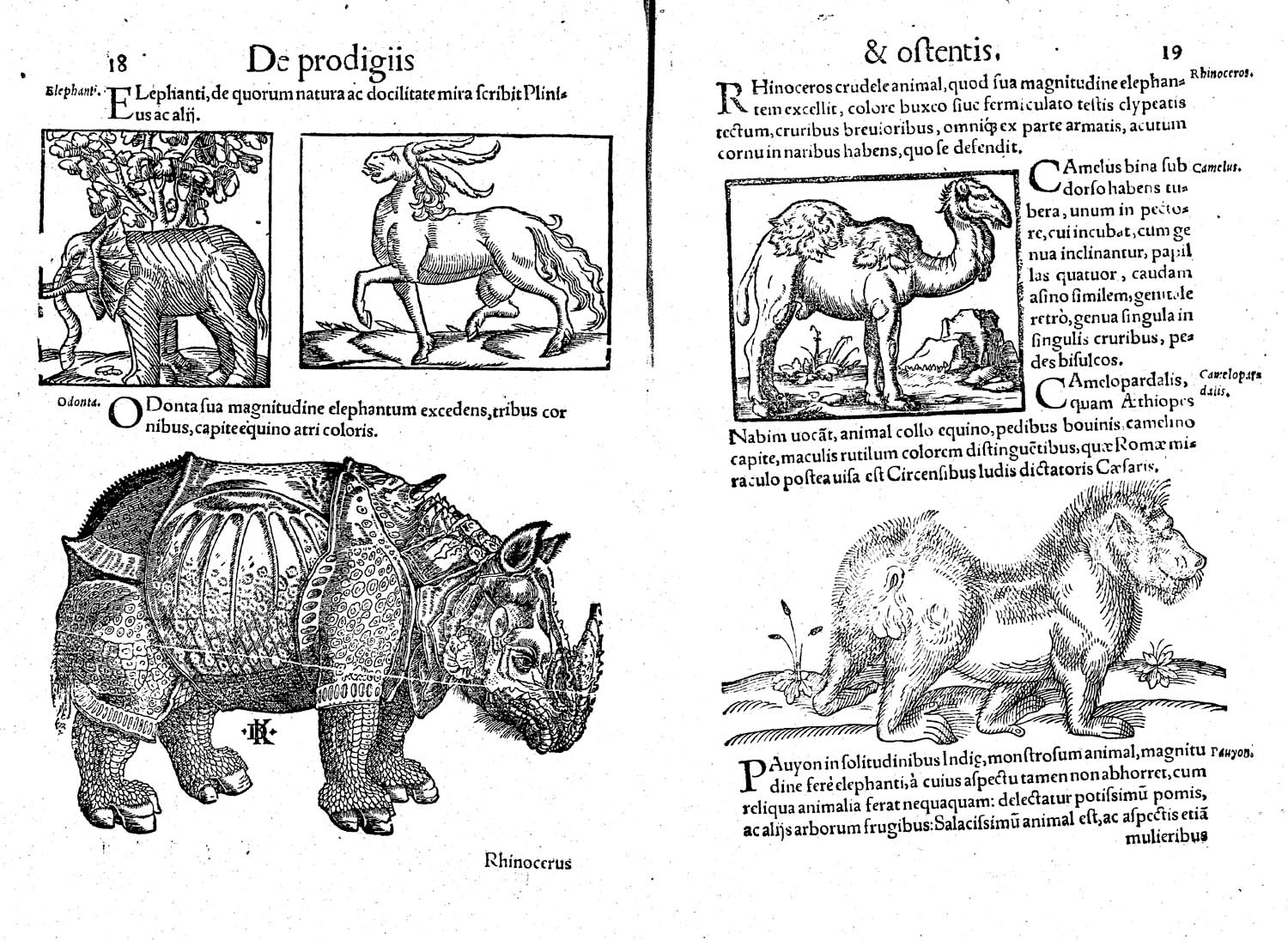
The rhinoceros of Dürer in Conrad Lycosthenes’s Prodigiorum ac ostentorum chronicon, 1557
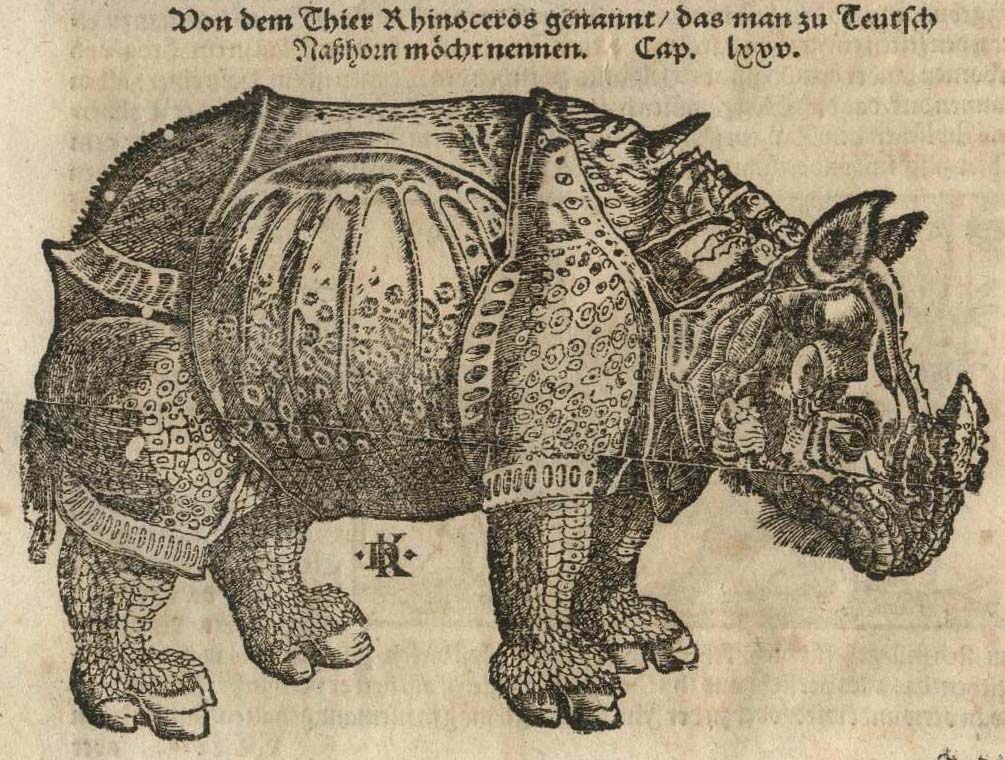
This engraving was used in other handbooks as well, like here in the collection Prodigiorum ac ostentorum chronicon (Chronicle of the miracles and omens), Basel 1557 by the illustrious German humanist Conrad Lycosthenes, an illustrated register of all the wonderful events, signs and phenomena mentioned from the Antiquity to the Renaissance. The rhinoceros appears here among the other wondrous animals. But it also entered in Paolo Giovio’s Dialogo dell’imprese militari e amorose (Discourse about the military and amorous symbols), the father of all 16th-century symbol encyclopedias, to which we will return in a next post.

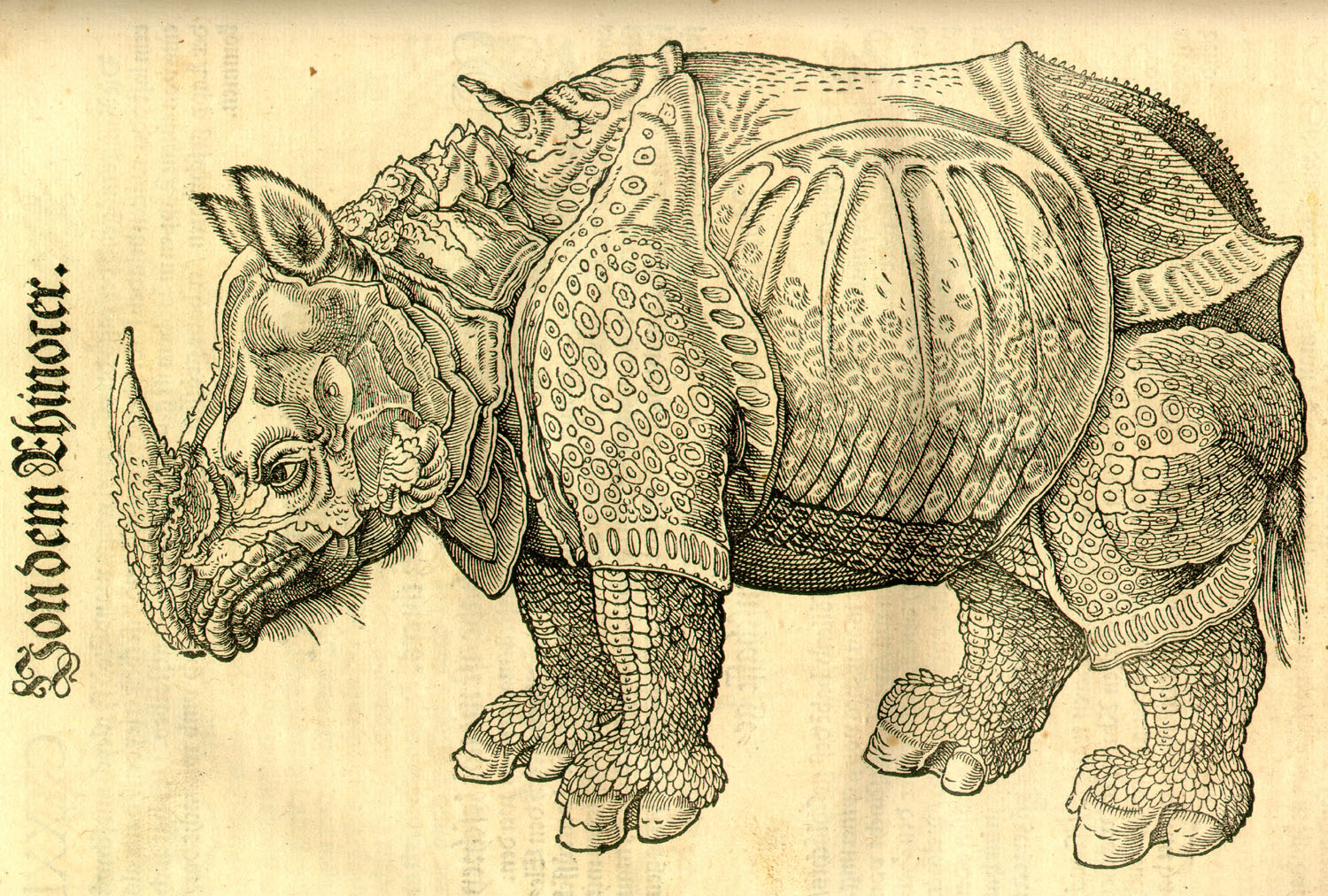
The rhinoceros of Dürer in the Thierbuch of Conrad Gessner, 1563
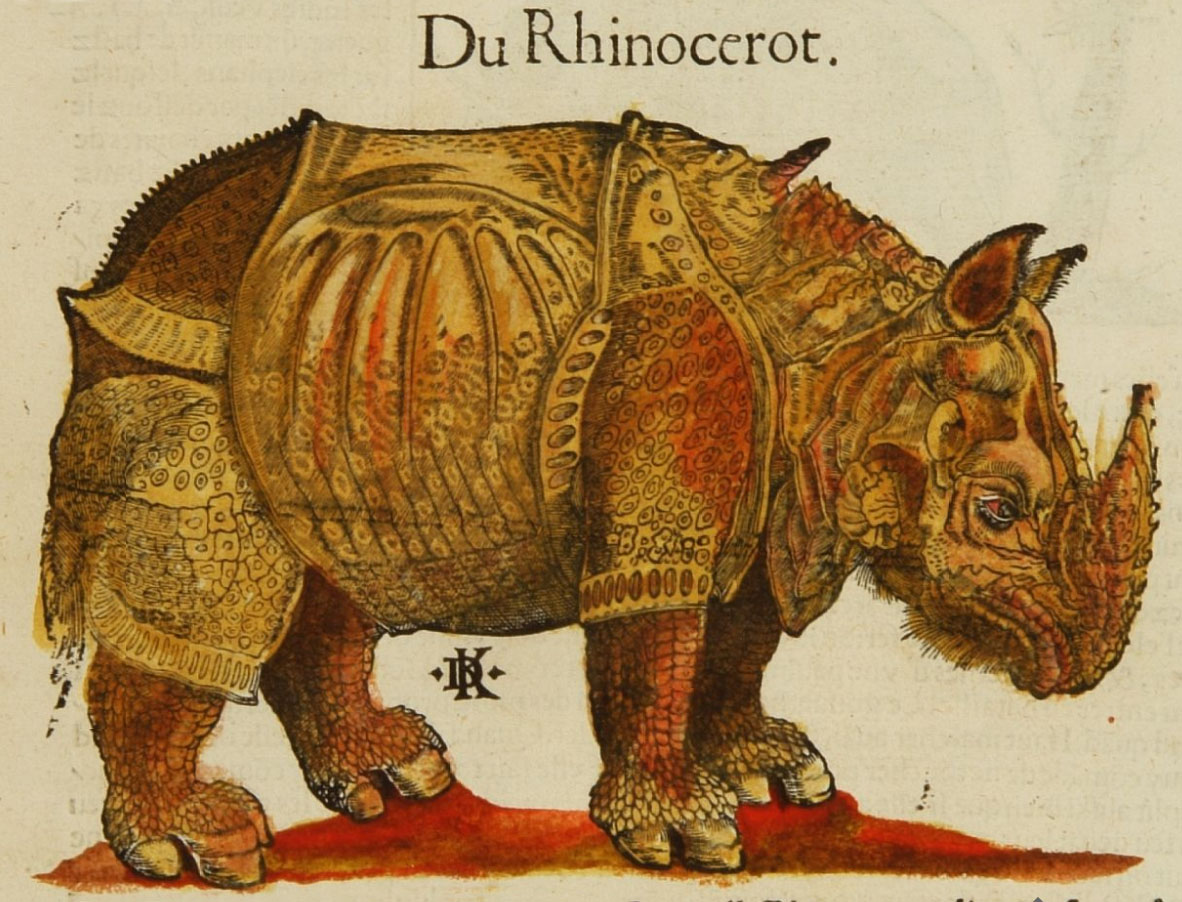
The image self-evidently received an eminent place in the monumental Historia animalium (1551-8) by the Swiss physician Conrad Gessner, also published in German from 1565 and in English in 1606. This four volumes first zoological encyclopedia not only published an excellent copy of Dürer’s engraving, but it also carefully collected all the known information about the animal in three folio pages printed with small letters. The translation of the complete text will be offered in a next post as a curiosity.

The rhinoceros of Dürer in the Thierbuch of Conrad Gessner, 1563
The rhinoceros of Dürer in the Historia animalium of Conrad Gessner, 1551
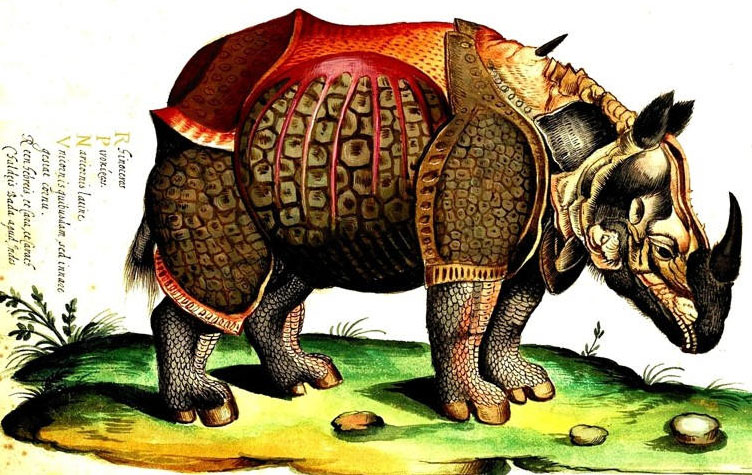
However, prints could convey only forms and no colors. The different coloring of two copies of the Historia animalium shows well, how different ideas the contemporaries had about the true colors of this animal.

The rhinoceros of Dürer in Ulisse Aldrovandi
And it shines in even more striking colors in the great zoological encyclopedia published in eleven folio volumes between 1599 and 1640 by Ulisse Aldrovandi, founder of one of the earliest botanical gardens (Bologna) and owner of one of the largest collection of curiosities of his age.

The rhinoceros of Dürer in Ambroise Paré
Ambroise Paré, the surgeon of four French kings, who won our sympathy by his personal motto which bears witness to a serious self-criticism and psychological sense – Guérir quelquefois, soulager souvent, consoler toujours, “Intervene rarely, relieve often, console always” – was one of the most original natural scientists of the 16th century. Within his far-reaching and painstaking oeuvre he also dedicated a chapter to the rhinoceros. In his Discours de la licorne (Treatise on the unicorn), translated and published in several editions he attempts to establish the origin of the “corn of unicorn” considered as an effective medicine against poisoning and epidemy, and he also proposes its identification with the rhinoceros. On this occasion he publishes not only the above picture of the latter animal, but also illustrates its combat with the elephant as described by Pliny and as we will present it in a later post.

Rhinocerology 1. The rhinoceros of the pope

Dürer, rhinoceros, engraving, 1515Message à Philippe De Jonckheere à propos de son rhinocéros: «Tu sais que Dürer avait fait à pied le chemin de Munich à Rome pour aller dessiner de visu le premier rhinocéros ramené en Europe, et que la gravure tirée de son dessin est probablement le premier best-seller de l’histoire de l’imprimerie? – et qu’on a ensuite rajouté le rhinocéros sur les réimpressions de Pline, qui se basait sur les récits des légionnaires revenus d’Afrique, et en avait conçu la licorne en mêlant un peu tout – mais pour ceux du 16ème siècle, si c’était chez Pline on pouvait ajouter, mais pas corriger: primauté du livre sur le réel – et la phrase de Rabelais: “Comme assez sçavez, que Africque aporte tousiours quelque chose de nouveau”, où Flaubert dit que chaque fois qu’il lit cette phrase, il voit des hippopotames et des girafes…» Oui mais voilà: ni Dürer ni le rhinocéros ne sont jamais allés à Rome, j’avais simplifié l’histoire. = My earlier message to Philippe De Jonckheere concerning his rhinoceros: Do you know that Dürer went from Munich to Rome on foot in order to see and draw the first rhinoceros ever brought to Europe, and that the engraving based on his drawing became the first bestseller of the history of printing? – and that this rhinoceros was then also included in the reprints of Pliny based on the reports of the Roman legionaries returning from Africa, which even led to the birth of the idea of the unicornis, thus mixing everything a little bit – but for the 16th century one could add things to Pliny, but not change things in it: voilà the priority of the book above the reality –, and the saying of Rabelais: “As you well know, there is always something new coming from Africa,” about which Flaubert says that whenever he reads it, he always sees hippos and giraffes…” Well, I was mistaken. Neither Dürer, nor the rhinoceros ever reached Rome. I have simplified the story.

Ernst Gombrich in his Art and illusion (1960) – that in my university years, when I still led a list of those ten books that influenced me the most, I included in it – says that the artist does not draw what he sees but what he knows. He unconsciously formulates the view with the help of the schemes he had learnt, and thus however realistic the representation might appear to his contemporaries, a later generation using different schemes will regard it rigid and schematic.

The same idea leads the pen of the Hungarian classical philologist of international renown János György Szilágyi in his Legbölcsebb az idő (Time is the wisest) (1978, 1987). In this overview of the centuries long history of the falsification of ancient vase paintings he points out that the fakers of a generation were exposed always when the visual schemes applied by them and regarded as self-evident by their generation became obviously conspicuous for the next one.

It is quite possible that Egyptians enjoyed as fresh and original representations of the nature those images which appear as rigid hieratic frescoes to us, for whom their schemes are obvious and archaic.

Drawing lesson in Egypt, by Alain, in Ernst Gombrich’s Art and illusion (1960)
Gombrich illustrates this argument with one of the earliest European drawings of which we know that it was explicitly made “after nature.” In the famous sketch book of the 13th-century French architect Villard de Honnecourt we read to the right of the lion below: “Voici 1 lion si com on le voit par devant. Et sacies bien qu’il fu contrefais al vif.” (Here you are a lion, frontally seen. And you must know that I drew it after nature.) We have no reason to doubt in the truthfulness of the renowned architect who toured all Europe, and had the possibility of seeing living lions in more than one princely court. Nevertheless to us his drawing resembles more those Gothic lion statues whose masters never saw a living lion than to the animal we know from the zoo or from photos and films.

Lion drawn “after nature” from the sketch book of Villard de Honnecourt (13th century)
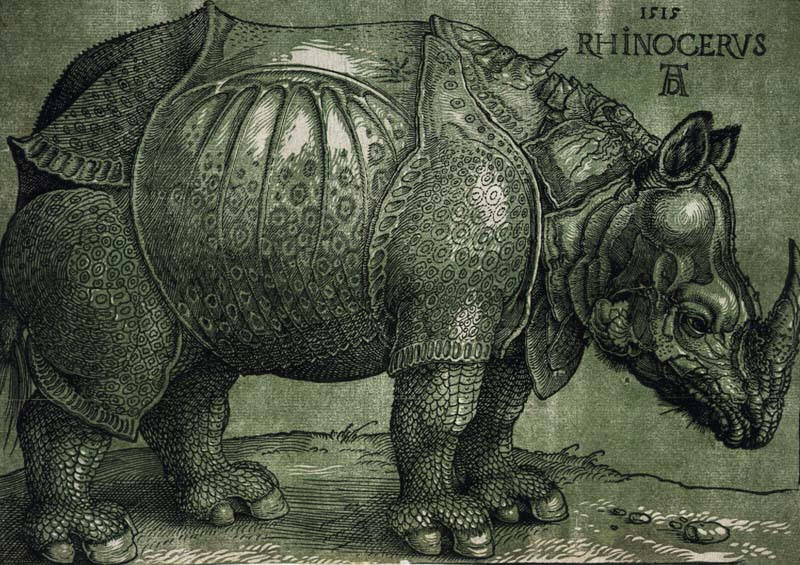
Gombrich’s other example is the engraving Dürer made in 1515 on the rhinoceros of the pope.

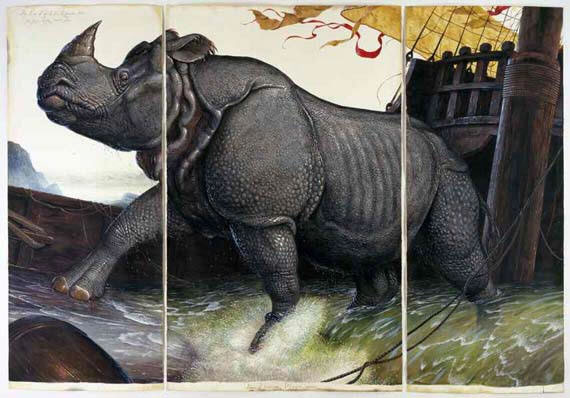
The complex manoeuvres of power politics which led this rhinoceros from hand to hand from India to Italy were described in detail by Silvio Bedini, keeper of the rare books of the Smithsonian Institute in his brilliant The papal pachyderms (1981, Proceedings of the American Philosophical Society). The sultan of Cambay donated the animal to the Portuguese governor of Goa in order to sweeten the bitter pill, that is the refusal of the Portuguese territorial claims. The governor sent it further to Lisbon in order to allay the anger of King Manuel I on the failure of the mission. The king sent it to Pope Leo X to Rome in order to secure his benevolence as an arbiter concerning the border line between the Portuguese and Spanish expansion in South-Eastern Asia. Only the rhinoceros had no profit from all that. The ship with which he was carried in February 1516 to Italy, was caught by a storm, and the rhinoceros,

hanc inusitate feritatis belluam, quae in arena amphitheatri elephanto ad stupendum certamen committi debuerat, Neptunus Italiae invidit et rapuit, quum navigium, quo advehebatur, Ligusticis scopulis illisum, impotentis tempestatis turbine mersum periisset; eo graviore omnium dolore, quod bellua, Gangem et Indum altissimos terrae patriae fluvios tranare solita, in ipsum littus supra portum Veneris, vel arduis saxis asperrimum, enatare potuisse crederetur, nisi, compeditus cathenis ingentibus, nihil proficiente evadendi conatu, superbo maris Deo cessisset.

this animal of unusual ferocity, which would have confronted
even the elephant in a marvellous fight on the sand of the amphitheatre, was taken away out of envy by the Neptun of Italy when the ship carrying it bumped against a rock at the Ligurian shore and went down in the waves of the sea lashed into fury, to a great sorrow and pain of everyone who know that this beast is able to swim across the Ganges and the Indus, enormous rivers of his native land, and thus could have easily swimmed out to the seashore rocks above the haven of Venus, were not his feet linked by heavy chains; but so, having no use of his swimming knowledge, rendered itself to the arrogant god of the sea.

– writes in the Gallery of famous men (1548) Paolo Giovio, historian of the pope and author of the immortal History of Italy, who will play later an important role in keeping and forming the visual memory of the rhinoceros.

Walton Ford, Loss of the Lisbon Rhinoceros, 2008Walton Ford: Loss of the Lisbon Rhinoceros, 2008

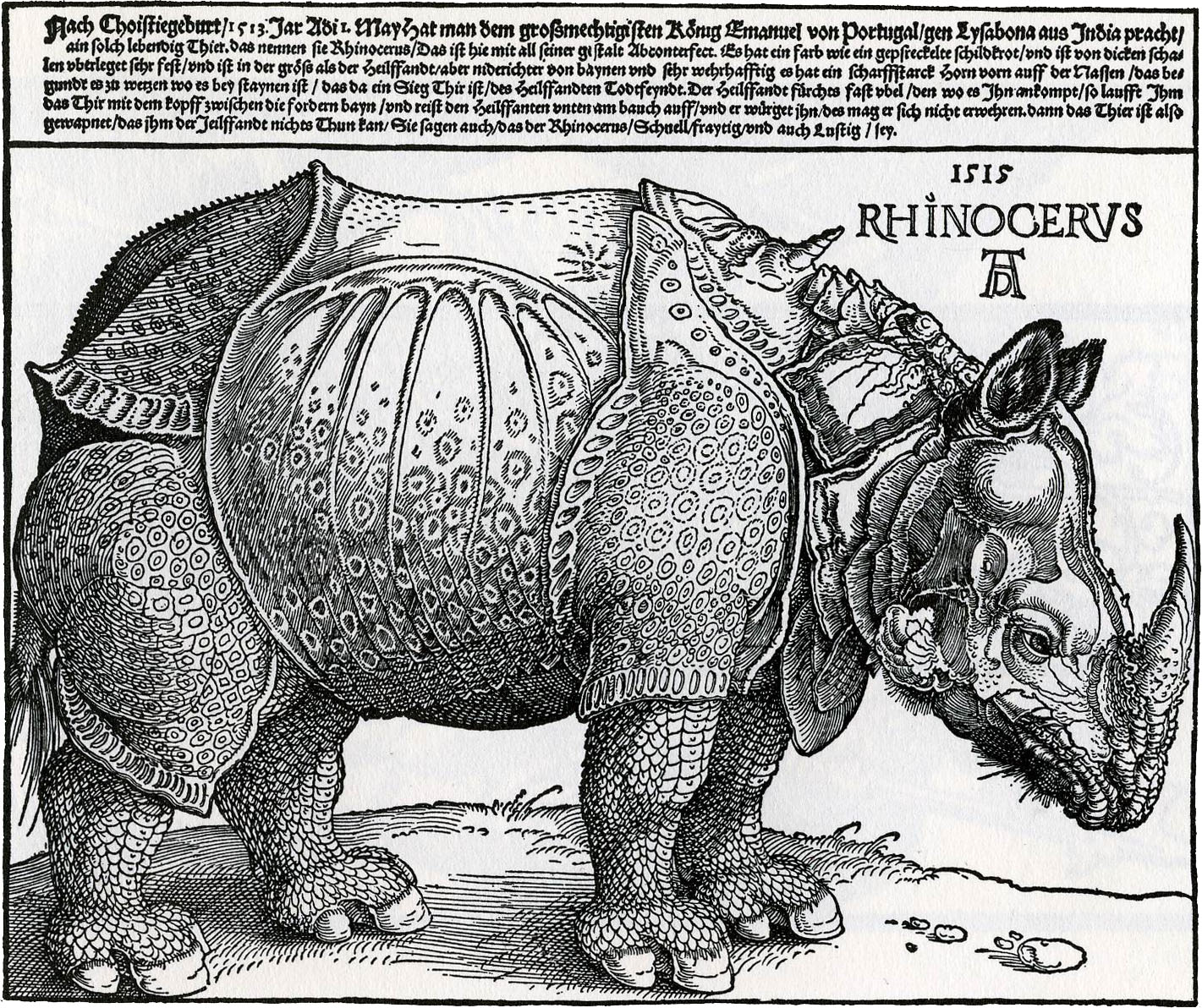
However, to the good luck of the European visual tradition, during the Lisbon months a learned description, and even a sketch was made on the rhinoceros from the pen of the Moravian merchant Valentim Fernandes living in Portugal, to which we will return in a later post. The Italian translation of the description addressed to “the merchants of Nuremberg” is conserved in the Magliabechiana library of Florence. Of its original German text has only survived that part which Albrecht Dürer, who prepared his engraving of the rhinoceros – “the most influential European animal representation,” as T. H. Clarke writes in his The rhinoceros from Dürer to Stubbs, 1515-1799 (1986) – on the basis of this description and sketch, included at the upper edge of his work:

Nach Christiegeburt, 1513. Jar Adi 1. May hat man dem grossmechtigisten König Emanuel von Portugal, gen Lysabona aus India pracht, ain solch lebendig Thier. das nennen sie Rhinocerus, Das ist hie mit all seiner gestalt Abconterfect. Es hat ein farb wie ein gepsreckelte [sic] schildkrot, vnd ist von dicken schalen vberleget sehr fest, vnd ist in der gröss als der Heilffandt, aber niderichter von baynen vnd sehr wehrhafftig es hat ein scharffstarck Horn vorn auff der Nassen, das begundt es zu werzen wo es bey staynen ist, das da ein Sieg Thir ist, des Heilffandten Todtfeyndt. Der Heilffandt fürchts fast vbel, den wo es Ihn ankompt, so laufft Ihm das Thir mit dem kopff zwischen die fordern bayn, vnd reist den Heilffanten vnten am bauch auff, vnd er würget ihn, des mag er sich nicht erwehren. dann das Thier ist also gewapnet, das ihm der Jeilffandt [sic] nichts Thun kan, Sie sagen auch, das der Rhinocerus, Schnell, fraytig, vnd auch Lustig, sey.

In the year 1513 after Christ’s birth, on 1. May there was brought from India to Lisbon to the mighty King Emanuel of Portugal such a living animal, that they call rhinocerus. It is reproduced here in its complete form. Its color is like a speckled turtle, and it is covered very securely with thick scales, and in size it is like the elephant, but shorter in the legs and very much prepared for fighting. It has a sharp strong horn on the front of the nose, which it takes to whetting wherever there are stones. It is a triumphant animal, the elephants’ deadly enemy. The elephant fears it terribly, because when he comes upon it, the animal runs at him with the head between the front legs, and tears the elephant’s belly from beneath, and kills him, while this cannot defend himself. For the animal is so well armed, that the elephant can do nothing to him. They also say that the rhinocerus is a quick, glad-tempered, and even merry animal.


Dürer, The rhinoceros, 1515Dürer: The rhinoceros, 1515. This is the second edition of the engraving, made in the same year as the first one, with the only difference that the first edition published the text in five lines instead of six.

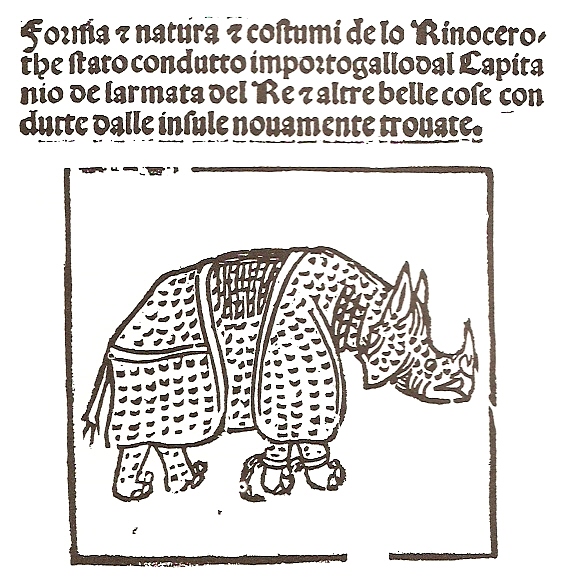
We do not know how detailed and true to life was the sketch sent to Nuremberg together with the letter of Fernandes. It must caution us anyway that the same or a similar sketch also arrived to Rome, where the Florentine physician Giovanni Giacomo Penni published a description in verse about the rhinoceros well in advance before it left Lisbon for the papal court. With the loss of the animal, however, this publication also lost its raison d’être, and its propagation stopped. It has survived in one single copy, today conserved in the Colombina library of Seville, whose special feature is that on its last page there was noted by the hand of Christopher Columbus himself: “Este libro costó en Roma medio quatrain por nouiembre de 1515 / Esta registrado 2260” (I purchased this book in Rome in November 1515 for half quatrain. This is copy number 2260).

Giovanni Giacomo Penni, Forma & Natura & Costumi de lo Rinocerothe, 1515Giovanni Giacomo Penni: The form, nature and customs of the
rhinoceros taken to Portugal by the captain of the
King’s fleet, as well as a lot of beautiful
things coming from the
newly found
islands


If the sketch sent to Nuremberg was similar, then Durer had plenty to add to it from his own knowledge of zoology, anatomy and proportions, from the description, and – as Gombrich stresses it – from the contemporary pictorial tradition and dominant visual schemes. He perceived the skin of the rhinoceros folded in hard plates as a kind of a knight’s armor, like the one worn by contemporary war-horses, following Fernandes’s expression gewapnet ‘armed.’ He covered both the armor and the feet of the animal with the scales mentioned by Fernandes, like those of the dragons, and he also articulated “the armor’s side plate” with a pattern recalling the dragon’s wing. He inserted between its two shoulder-blades a small horn – it is not clear whether he misunderstood something on the sketch, or he simply had to find a proper place for the “second horn” mentioned by Pliny, to which we will return in a next post – which protrudes from the middle of a small knob like the thorn in the middle of the knight’s shield keeping away the enemy in a hand-to-hand combat. And finally he covered the whole surface of the animal with a finely chiselled decoration in the spirit of the contemporary German engraving tradition.

The image created in this way is, however, not only extremely compact, powerful and convincing, but it is also much closer to reality than what could have been expected in such circumstances. Was Fernandes’s sketch this much better than the drawing of Penni? Or there were some additional visual sources available to Dürer on the rhinoceros? In the next post we will examine such a possible source.