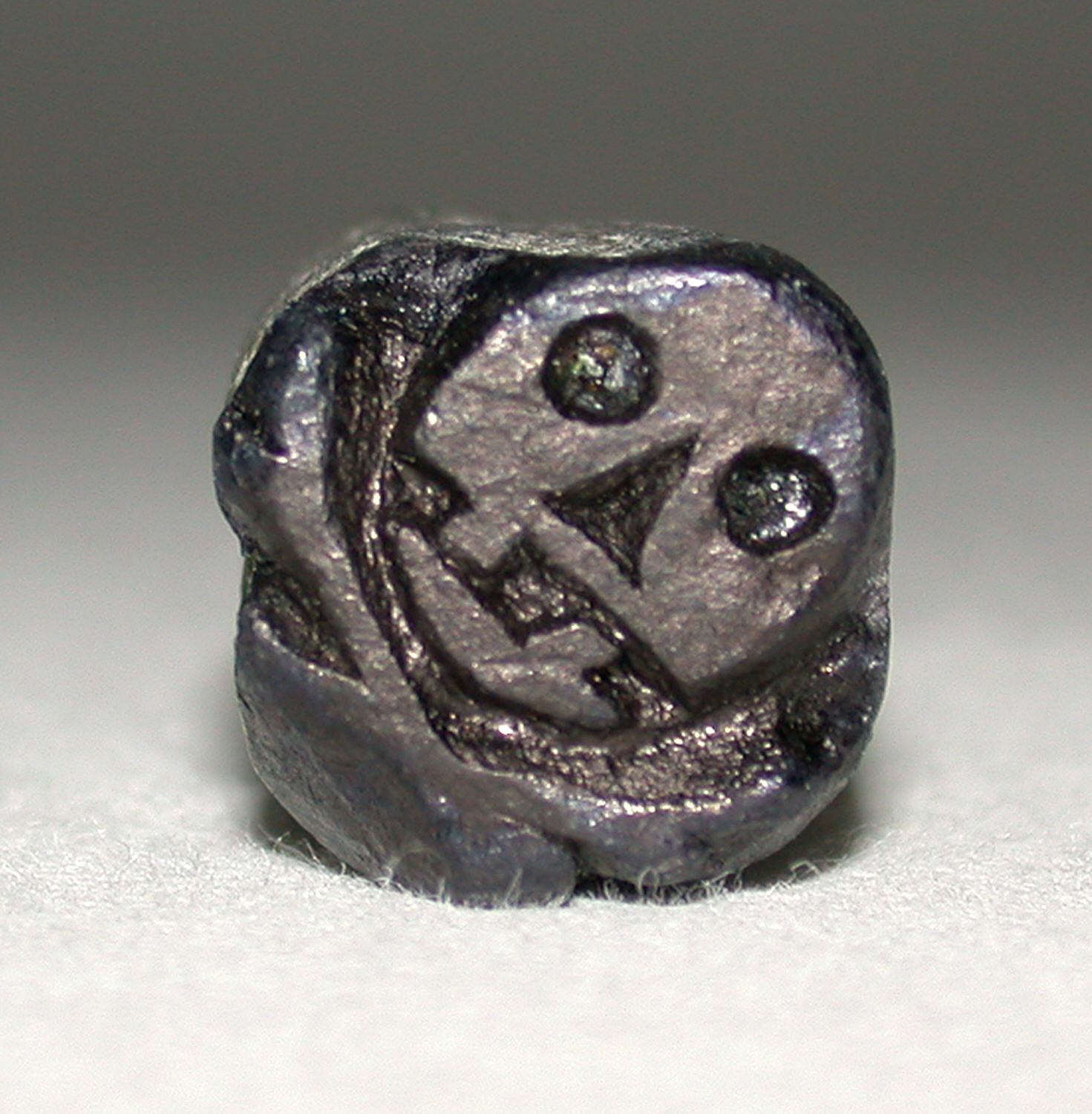
Pre-Columbian deity? Inuit walrus bone carving? Renaissance amulet? Baroque memento mori? This contest was opened yesterday on a favorite U.S. blog, which this morning published the solution. We are going to do so this evening, and until then we are looking forward with excitement to the attempts of our readers, which are usually much more ingenious than the inexorable reality.

It really feels good that this game made our readers (especially in the Hungarian version) so enthusiastic, and that you have sent your attempts of solution in such a great number. It was a special pleasure to see that you have grasped the essence of the game, and instead of using brute force, e.g. google image search, you have started from the properties of the object in trying to find out logically its purpose.
Almost all the comments contained some element that have to do with the actual purpose of the object: the lead, the seal, the death… But the actual purpose is not the only measure. To give a coherent and witty pseudo-deciphering is just as great or even greater achievement than to reconstruct the original purpose, all the more because theoriginal purpose is often – and we obviously choose such objects for the riddle – just as fantastic and improbable as the most successful pseudo-solutions. Therefore here below, in the summary of the attempts of interpretation we do not separate the actual solution from the others, but add it to the very end of the list, as one of the fictions, and perhaps not even the most exciting one.
Inspired from the reception of this experiment, from now on we will regularly publish such riddles. If you encounter any image, text, music etc. that is particularly suitable for this purpose, please send it to us.
| • A deadly message carved into a bullet for the enemy • A modern art work printed into an angler’s lead weight • Halloween tooth filling • Stylishly decorated head of a coffin nail • Seal ring • Carved tip of a pencil • Mummy | • Votive seal of “for better for worse” • Seal of a medieval dentist or inquisitor • Iron for branding pirates • Perhaps there are/were four similar ones, with various (eventually more cheerful) motifs, that is, a set for the five stones game • Mint stamp |
this object is a dice decorated with skull and bones for pirate board games from the early 20th century (the “seven seas’ devil” board game was played in salons by adults, and the loser had to learn by mind a poem on the sea, or if he was an artist, he had to write one, or create any other art work. they say that Debussy was inspired by such a lost game to compose La Mer. although the Jeux and the Children’s Corner suggest that he was a great player, nevertheless the truth is that he played miserably. the “seven seas’ devil” was very popular in Scotland too. a passionate, or, according to some, an infantile local player, J. M. Barrie decided after a night spent with the game to write the Little White Bird, in which for the first time appears Peter Pan, the eternal little boy fighting with pirates)
a ring, inherited from father to son, to which once an ordinary ship and loyal crew belonged. Later the captains became board members at the United Fruit Company, and the first mates founders of manager’s dynasties. After the company’s relationship was spoiled with the government’s middlemen, the golden days were over. They say this also had to do with some unchecked cargoes running into different U.S. ports. Nowadays a flesh with the ring is still worth some boxes of banana, but it’s wearer is no longer honored with a salute by the sailors.
 Don’t believe that only urban gentlemen can have hobbies, only craftsmen are able to master the art. Take for example this prison captain.
To administer a prison is an art itself, and the more so in such an outback, mountain landscape, where sometimes even the ass goes on a man’s back. He did his job with honor, and who could blame him for having also built a tower of rubblestones and having its yard swept clean even in the heaviest snow-storms. No scurvy or any other kind of disease killed here anybody, only lead bullets the ones who were allotted this fate somewhere down in the cities of the plain. The only killers were here the lead bullets cast by the captain.
Because the captain cast his bullets himself indeed: this is what the tower served for. It was perhaps the mountain air glowing around the bubbling lead, perhaps the purity of the mountain water into which it dropped hissing, but every solidified drop fished out from the pool below the tower was just like a metallic silver pearl.
An urban gentleman or a craftsman would have sat back in satisfaction, but the captain’s art just started here. The prison worked well, and if someone looked through carefully the annals, perhaps would have noticed that all too well, but the annals were the first to perish in the fire when the tower was broken by anti-tank grenades and its ruins covered the guard wing with flames.
And if anyone had any suspicion, the captain would have explained to him that the boundary is as thin here between a mountain shepherd and a bandit as the stripe of a lead drop falling in front of a cell’s window.
So when the last week came, the prisoners were given three lead bullets from the prison captain. A special tool, a bullet knife was also added to them for two long hours before sunset every day. For two hours the prisoners were carving the bullets, and then, at the distribution of the thin evening soup the bullet knives were collected.
The bullets not, they were left in the cell. When the sentences accumulated one could clearly hear how the bullets rub to each other while roaming about in the sweaty palms.
 The bullets were there in the palms upon awakening, at the morning walk, at the poor lunch, but even when breaking stones, tightened to the pickax’s handle. Every convicted carried with him for a week his own death in the palm.
The last morning the prisoners were taken off one by one to the loess wall of the back yard. As they passed before the three uniformed soldiers, they placed the bullets one by one into the white-gloved palms.
The balls were glittering: the sweat lent them a patina which could have never created by any blacksmith’s expertise.
The three soldiers put the three bullets into three rifles. The sentenced to death in his last seconds stared at three gun tubes.
However, in the decisive moment only two guns fired. As soon as the prison doctor checked the dead, the captain walked to the third soldier. To the one who received the mute rifle for his task. Sometimes it was the soldier to the right whose weapon clock clicked dully, sometimes the shot was missing from the left, sometimes the bullet remained in the tube at the middle – the captain tried to mix the weapons as long as he himself did not know which of the three carvings would be spared.
Then in the afternoon he went up to his room, poured himself a finger of cognac, and then – just like an insect collector when discovering a new species on the meadow browsed through a thousand times – changed his white saffian gloves for a thin white tissue glove, and by taking out of his pocket the harvest of the day, he carefully examined each bullet.
Then he rubbed them with a cambric kerchief, and put them in the next empty place in the ten times ten cell timber frame made for this purpose. We do not know how many frames were filled by carved bullets, as we do not know where the frames disappeared.
We only know that the frame of destiny once suddenly changed, and the captain, in his buttonless, torn, bloody uniform stood there in front of his own loess wall. Not three, but thirteen weapons were directed to his breast, but their bullets were not dropped from towers, but produced by tons in far away city factories to sprinkle with holes a whole continent.
 In the brief silence before the death – because the world keeps silent a little bit before every death – the thirteen riflemen heard a strange, rubbing noise, as if the captain grinded his teeth, although he was taking the breath with full mouth and his eyes staring.
When the body got completely cool, and despite the cold mountain air the team was warmed up by the captain’s cognac, one of the riflemen slipped to the corpse lying at the wall. A year earlier he was a little swineherd, and now a partisan, but he himself could not decide whether it was his machine gun which brought him there or he was bringing the machine gun. He did not want anything of the captain – the others carefully went through his pockets in the afternoon –, he only wanted to close those eyes wide open, he just did not want to see that gaping mouth. In the darkness he accidentally hit the captain’s hand, he accidentally found the three bullets. He hoped to have found something of value, but when the next day he looked at the carvings, he hoped something else: that perhaps these three talismans would take him home.
And finally it was indeed him the only one to get home from the thirteen, only to leave again a few years later. He had to go, he was chased by hunger, by the hunger which took off everything else, leaving only a tiny bundle and these three bullets. As a last hope, he offered one of them to the captain of a ship – another captain, who, he hoped, would take it for a pearl, for a rare treasure.
This captain was an experienced man, who had sailed over the seven seas, so he exactly knew that it is no pearl any more that a man of his age appreciates. Nevertheless, as he was an experienced man, he took one of the bullets, turned it over in his hands, and shuddered. Power is in this, boy, he said, and let him on the ship. The boy did not feel the power, but it was this piece of lead, the dead man’s pearl which took him to the New World.
The two remaining pearls were with him until he learned the language, until from the bed rent of the block building full of immigrants and cockroaches he went so far to rent his own apartment, until he found the partner of his life, and until they moved out to their own garden house. A son was born to them, whom the father tried to spare from everything he was separated by an ocean from.
The boy was not even eighteen when he was also brought away by a machine gun – or the machine gun by him? – over another ocean. His father could not do more than just providing him with one of the carved bullets to protect his child. Months went by without any news, and he found himself praying in an almost forgotten language to a God more bearded than the one here.
 Neither the bullet, nor the son did not return, only an empty coffin coverd with a flag. Later he wanted to believe that the bullet helped anyway, that it brought a quick death to the son, not the diseases of the jungle or a bamboo stake. He was turning the last bullet in the hand, stopped praying, and decided that he would raise himself his grandson, the last gift of his child, who was conceived the night before the conscription.
The man who had no father was afraid. And as he was afraid, he drank, and in order not to be afraid when drunken, he occasionally squeezed the talisman received from his grandfather. He was drinking and squeezing it when they buried his grandfather, the drink and the carving was with him at the first kiss and at the wedding, too. And it was with him now, when the man, who had no father, tried to be a father. He watched his daughter playing by pushing back and forth the ice cube he pinched off from his drink for her. He poured himself again, then he opened the little leather bag hanging around his neck, and rolled a bright, carved ball toward the child, perhaps she would prefer it to the ice.
When his wife arrived home, he was already sleeping in the armchair, so he did not know the woman getting pale and taking the bullet out of the mouth of the giggling girl. She recognized the skull and was angry. She was angry of the sleeping husband, angry of the empty bottle, but most angry of the lead bullet, as she remembered that it carried death with itself – a slow poison leaking into the body which makes one dull. She insisted to change all the tubes right before the birth of the child in the house inherited by his husband, to have the old paint scraped off by professionals and to spray the walls again, and then this…
Three days later the shouting garbage collectors did not notice that in one of the bags, in the plastic box of a diet yogurt, between coffee grounds and egg shells, there was a lead bullet, they did not notice that the bag was four grams heavier.
While [in the 1850s] small [American] post offices were issued circular date stamps postmasters usually also needed separate stamp canceling devices. Canceling handstamps were used in order to ensure stamps were used only once. Such canceling devices were sometimes made by hand. One example of the creativity of postal employees of the time is this hand-made skull and cross-bones handstamp. This handstamp, known as a „fancy cancel”, was shaped from lead. As such imprints wore down with use; postmasters and clerks drew out their knives and created new designs. Fancy cancels began disappearing from use after 1904. That was the year the Post Office Department ordered postmasters to stop using “unauthorized postmarking stamps” as part of a standardization and modernization program.
a ring, inherited from father to son, to which once an ordinary ship and loyal crew belonged. Later the captains became board members at the United Fruit Company, and the first mates founders of manager’s dynasties. After the company’s relationship was spoiled with the government’s middlemen, the golden days were over. They say this also had to do with some unchecked cargoes running into different U.S. ports. Nowadays a flesh with the ring is still worth some boxes of banana, but it’s wearer is no longer honored with a salute by the sailors.
Don’t believe that only urban gentlemen can have hobbies, only craftsmen are able to master the art. Take for example this prison captain.To administer a prison is an art itself, and the more so in such an outback, mountain landscape, where sometimes even the ass goes on a man’s back. He did his job with honor, and who could blame him for having also built a tower of rubblestones and having its yard swept clean even in the heaviest snow-storms. No scurvy or any other kind of disease killed here anybody, only lead bullets the ones who were allotted this fate somewhere down in the cities of the plain. The only killers were here the lead bullets cast by the captain.
Because the captain cast his bullets himself indeed: this is what the tower served for. It was perhaps the mountain air glowing around the bubbling lead, perhaps the purity of the mountain water into which it dropped hissing, but every solidified drop fished out from the pool below the tower was just like a metallic silver pearl.
An urban gentleman or a craftsman would have sat back in satisfaction, but the captain’s art just started here. The prison worked well, and if someone looked through carefully the annals, perhaps would have noticed that all too well, but the annals were the first to perish in the fire when the tower was broken by anti-tank grenades and its ruins covered the guard wing with flames.
And if anyone had any suspicion, the captain would have explained to him that the boundary is as thin here between a mountain shepherd and a bandit as the stripe of a lead drop falling in front of a cell’s window.
So when the last week came, the prisoners were given three lead bullets from the prison captain. A special tool, a bullet knife was also added to them for two long hours before sunset every day. For two hours the prisoners were carving the bullets, and then, at the distribution of the thin evening soup the bullet knives were collected.
The bullets not, they were left in the cell. When the sentences accumulated one could clearly hear how the bullets rub to each other while roaming about in the sweaty palms.
The bullets were there in the palms upon awakening, at the morning walk, at the poor lunch, but even when breaking stones, tightened to the pickax’s handle. Every convicted carried with him for a week his own death in the palm.The last morning the prisoners were taken off one by one to the loess wall of the back yard. As they passed before the three uniformed soldiers, they placed the bullets one by one into the white-gloved palms.
The balls were glittering: the sweat lent them a patina which could have never created by any blacksmith’s expertise.
The three soldiers put the three bullets into three rifles. The sentenced to death in his last seconds stared at three gun tubes.
However, in the decisive moment only two guns fired. As soon as the prison doctor checked the dead, the captain walked to the third soldier. To the one who received the mute rifle for his task. Sometimes it was the soldier to the right whose weapon clock clicked dully, sometimes the shot was missing from the left, sometimes the bullet remained in the tube at the middle – the captain tried to mix the weapons as long as he himself did not know which of the three carvings would be spared.
Then in the afternoon he went up to his room, poured himself a finger of cognac, and then – just like an insect collector when discovering a new species on the meadow browsed through a thousand times – changed his white saffian gloves for a thin white tissue glove, and by taking out of his pocket the harvest of the day, he carefully examined each bullet.
Then he rubbed them with a cambric kerchief, and put them in the next empty place in the ten times ten cell timber frame made for this purpose. We do not know how many frames were filled by carved bullets, as we do not know where the frames disappeared.
We only know that the frame of destiny once suddenly changed, and the captain, in his buttonless, torn, bloody uniform stood there in front of his own loess wall. Not three, but thirteen weapons were directed to his breast, but their bullets were not dropped from towers, but produced by tons in far away city factories to sprinkle with holes a whole continent.
In the brief silence before the death – because the world keeps silent a little bit before every death – the thirteen riflemen heard a strange, rubbing noise, as if the captain grinded his teeth, although he was taking the breath with full mouth and his eyes staring.When the body got completely cool, and despite the cold mountain air the team was warmed up by the captain’s cognac, one of the riflemen slipped to the corpse lying at the wall. A year earlier he was a little swineherd, and now a partisan, but he himself could not decide whether it was his machine gun which brought him there or he was bringing the machine gun. He did not want anything of the captain – the others carefully went through his pockets in the afternoon –, he only wanted to close those eyes wide open, he just did not want to see that gaping mouth. In the darkness he accidentally hit the captain’s hand, he accidentally found the three bullets. He hoped to have found something of value, but when the next day he looked at the carvings, he hoped something else: that perhaps these three talismans would take him home.
And finally it was indeed him the only one to get home from the thirteen, only to leave again a few years later. He had to go, he was chased by hunger, by the hunger which took off everything else, leaving only a tiny bundle and these three bullets. As a last hope, he offered one of them to the captain of a ship – another captain, who, he hoped, would take it for a pearl, for a rare treasure.
This captain was an experienced man, who had sailed over the seven seas, so he exactly knew that it is no pearl any more that a man of his age appreciates. Nevertheless, as he was an experienced man, he took one of the bullets, turned it over in his hands, and shuddered. Power is in this, boy, he said, and let him on the ship. The boy did not feel the power, but it was this piece of lead, the dead man’s pearl which took him to the New World.
The two remaining pearls were with him until he learned the language, until from the bed rent of the block building full of immigrants and cockroaches he went so far to rent his own apartment, until he found the partner of his life, and until they moved out to their own garden house. A son was born to them, whom the father tried to spare from everything he was separated by an ocean from.
The boy was not even eighteen when he was also brought away by a machine gun – or the machine gun by him? – over another ocean. His father could not do more than just providing him with one of the carved bullets to protect his child. Months went by without any news, and he found himself praying in an almost forgotten language to a God more bearded than the one here.
Neither the bullet, nor the son did not return, only an empty coffin coverd with a flag. Later he wanted to believe that the bullet helped anyway, that it brought a quick death to the son, not the diseases of the jungle or a bamboo stake. He was turning the last bullet in the hand, stopped praying, and decided that he would raise himself his grandson, the last gift of his child, who was conceived the night before the conscription.The man who had no father was afraid. And as he was afraid, he drank, and in order not to be afraid when drunken, he occasionally squeezed the talisman received from his grandfather. He was drinking and squeezing it when they buried his grandfather, the drink and the carving was with him at the first kiss and at the wedding, too. And it was with him now, when the man, who had no father, tried to be a father. He watched his daughter playing by pushing back and forth the ice cube he pinched off from his drink for her. He poured himself again, then he opened the little leather bag hanging around his neck, and rolled a bright, carved ball toward the child, perhaps she would prefer it to the ice.
When his wife arrived home, he was already sleeping in the armchair, so he did not know the woman getting pale and taking the bullet out of the mouth of the giggling girl. She recognized the skull and was angry. She was angry of the sleeping husband, angry of the empty bottle, but most angry of the lead bullet, as she remembered that it carried death with itself – a slow poison leaking into the body which makes one dull. She insisted to change all the tubes right before the birth of the child in the house inherited by his husband, to have the old paint scraped off by professionals and to spray the walls again, and then this…
Three days later the shouting garbage collectors did not notice that in one of the bags, in the plastic box of a diet yogurt, between coffee grounds and egg shells, there was a lead bullet, they did not notice that the bag was four grams heavier.
While [in the 1850s] small [American] post offices were issued circular date stamps postmasters usually also needed separate stamp canceling devices. Canceling handstamps were used in order to ensure stamps were used only once. Such canceling devices were sometimes made by hand. One example of the creativity of postal employees of the time is this hand-made skull and cross-bones handstamp. This handstamp, known as a „fancy cancel”, was shaped from lead. As such imprints wore down with use; postmasters and clerks drew out their knives and created new designs. Fancy cancels began disappearing from use after 1904. That was the year the Post Office Department ordered postmasters to stop using “unauthorized postmarking stamps” as part of a standardization and modernization program.




















 Come with us to…
 Atlantis
 Bestiary
 Bohemia+Prague
 Books, exhibitions, music, film
 Caucasus
 Cemeteries
 Crimea
 Get to know the
 Images of the East
 Lightwriting
 Lwów/Lemberg
 Mallorca
 Message on the wall
 The Museum of Propaganda
 Odessa
 Persian letters
 The Jewish heritage


